A couple of years ago when I first started this blog, I made mention of a skydive-configured Cessna 185 Carryall that had been involved in a landing accident awhile back, and had remained confined to the corner of the hangar ever since. The topic of one of my early Plane’s Anatomy posts, this specific, slightly understated ( 😀 ) aircraft had recently been thrust into the local spotlight again, this time when it finally coughed back to life after its long rest.
Overall not a particularly interesting or exciting aircraft by any objective measure – just a regular 185 – 9A-BKS is nevertheless one of the most endeared and endearing aircraft at Lučko; a charismatic fuel-to-noise converter that had at one point or the other served as a jump platform for virtually every skydiver in the area. Quite a loud aircraft, sporting a two-blade transsonic prop, BKS had cut a distinctive high pitched noise that could be heard all the way to the suburbs of Zagreb – some 10 km away – and pretty much represented the main symbol of the airfield.
The noise stopped however at the beginning of 2008, when BKS’ pilot braked a bit too hard on landing, sending the prop tips into the ground. While the aircraft itself had suffered no damage, the propeller was ruined and the engine overstressed by the sudden stop, both necessitating a thorough – and thoroughly expensive – overhaul. These costs, coupled with the operator’s poor financial state (which continues to this day) had dragged repairs through more than four years, until BKS finally fired up on 10 June this year 🙂 .
Naturally, I was ready to immortalize the event with my camera – even though it had meant a whole day of waiting at the airfield on an empty stomach 😀 – and even decided to shoot a spot of video to capture the moment.
But, “first start” was much overshadowed by the death of one of our most beloved skydivers, who tragically died on a jump at a county fair while we were preparing to light BKS. In view of that, both the following photo and video are dedicated to our dear Jasna 😦 .
Trying to avoid a “Carryall haircut” as I attempt to bring out the raw power and poise of the 185. Ran for the first time since overhaul, the engine had lost most of it characteristic deep roar, sounding for awhile like an 8.5 liter sewing machine. With just a few minutes of operation on the clock when this was taken, the engine still hadn’t fully drawn in oil and lubricated all of its parts – most notably the valves and valve seats – leaving it clanking like it’s falling apart
With monotonous inevitability and regularity, winter weather has returned to Croatia. While to many this may evoke images of white landscapes, snow flurries and fluffy clouds, the harsh reality was somewhat different – fog, more fog and – when the fog decides to lift – low cloud :D. With visibilities at our continental airports rarely above 200 meters – dropping to 50 in the mornings – GenAv flying ops have normally been stopped dead in their tracks, so there’s actually little to report on… however, hope remains that it may clear, so in the mean time, here’s a shot of the average day at Lučko…
For some odd reason, nobody was flying this day :D. To give a measure of the thickness of the Zagreb Winter Fog, the control tower - barely visible in the back - is just 90 or so meters away from me...
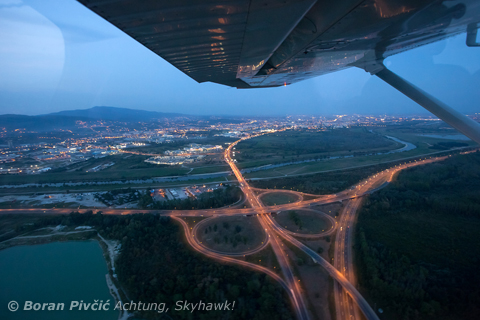
Having become slightly stir crazy with the pedestrian pace of general aviation in Croatia of late, a friend of mine and I decided it might be a good idea to go and unwind a bit in the wild blue above the country’s capital of Zagreb :). Growing bored of constantly overflying the city by day, we decided we might just as well enjoy the view during sunset – so timing it just right on a beautifully calm summer afternoon, we fired up our trusty C172 and headed out of the quiet field…
Overflying one of the city's main highway junctions, where two important routes to Middle Europe meet. As you can see, our "sunset" flight turned into a non-event due to increasing haze in the distance, but we decided to make the best of it and enjoy some near-night photography :).
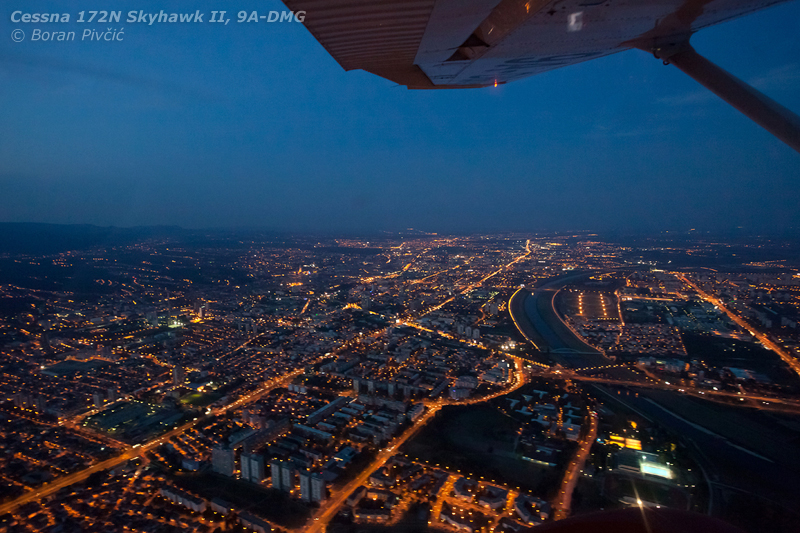
A splendid and calming view from the western edges of the city. The waning hours of the day are definitely the best time to be out and about and enjoy the simple beauty of flight - the scenery is even more beautiful than during the "full" dead of night...
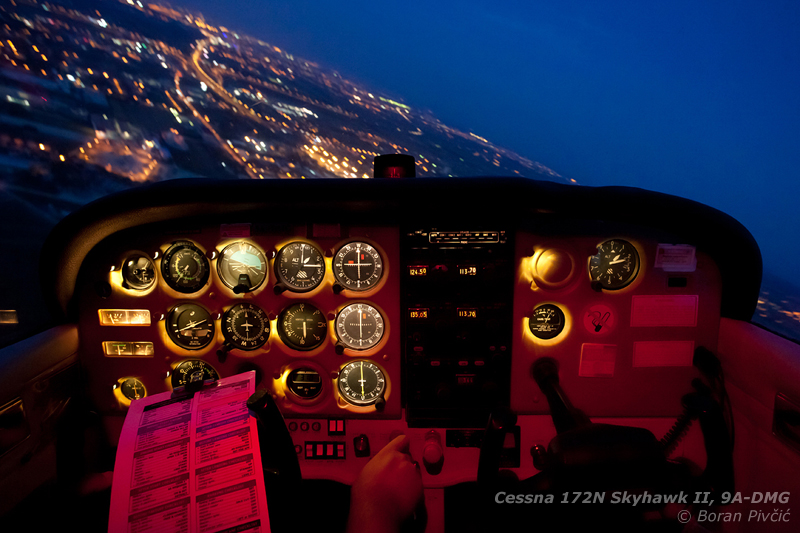
An, of course, the best view of them all, with all the Christmas lights turned on :). Almost looks like an image from a flight simulator rather than an actual aircraft... either way, pure magic! As you can see from the instruments, we were in a bit of diving turn - and with all our exterior lights blazing, we must have been quite a sight...
Whenever I happened to catch a Diamond Star rolling down Lučko’s rough, uneven runway, I’d always felt sorry for the little thing. Pitching and rolling and yawing like it was out of control, it had suddenly seemed fragile and very much out of its element – a sword at the proverbial gun fight, an aircraft that really should steer clear of all but the smoothest surfaces… in essence, and despite the type’s incredible underlying toughness and depth of engineering, almost an accident waiting to happen…
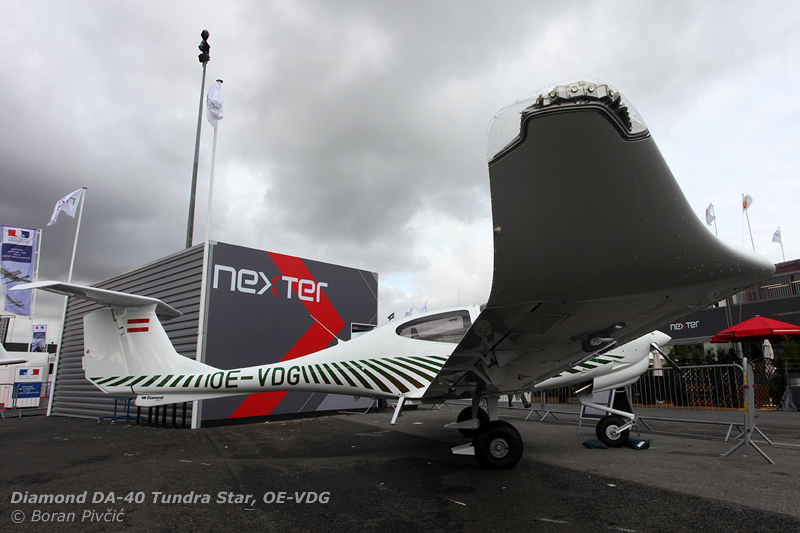
However, a casual stroll down the display line at the 2011 Paris Air Show would quickly prove my impressions wrong :). Sitting in the open away from the big jets and fighters was an oddly different, beefed-up, more purposeful looking Star – not quite like any I’d ever seen before. Its information board, largely ignored by passers-by, identified it simply as the DA-40 Tundra Star. Intrigued, I’d naturally stopped to take a look… 🙂
While it is no PC-6, the Tundra Star does look more than capable of handling the average dirt strip. It certainly does seem to be a nearly ideal mix for the owner who operates out of an unpaved runway, but desires the economy of the Diesel and the sophistication and cruise performance of the clean carbon-fiber Star...
One of the Tundra Star's party pieces is its engine, Diamond's own Austro Engines AE300 Diesel, spinning a three-blade constant speed prop. Developed in response to Thielert's Centurion 2.0, the AE300 is also a 2.0-liter automotive Diesel engine converted to run on Jet A - however, unlike the Centurion, the AE300 produces 168 HP (33 more) and can maintain this power all the way to 10,000 ft thanks to an improved turbocharger. Once settled into the cruise, it burns just 5.5 USG/h at 75% power (also a note about the HP rating: while 135 and 168 HP seem ludicrously small amounts for a four-seater, what actually matters here - and in every other prop - is the torque... and few engines have more of it than a turbo-ed Diesel 🙂 )
Another noticeable change was the new bubble canopy, previously seen only on the company's Airborne Sensing fleet. As well as improving overall visibility in tight spots, the new canopy also permits taller people - like myself - to finally sit comfortably up front 😀
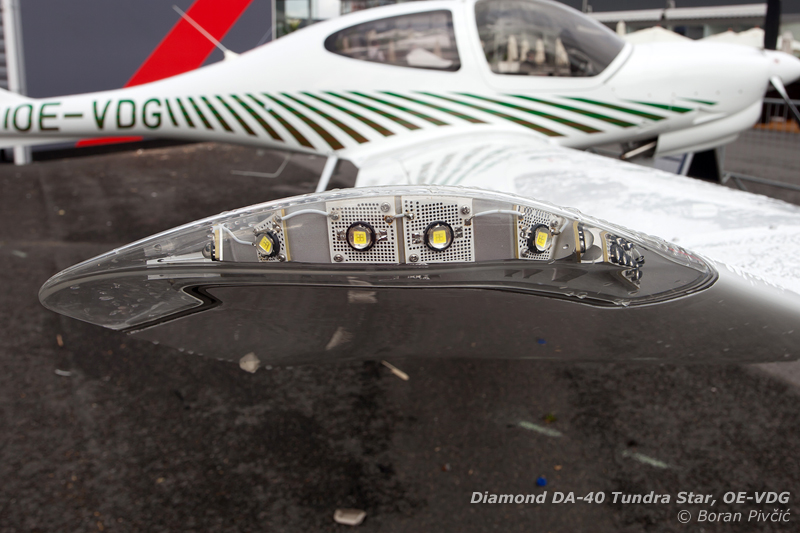
Like many modern light aircraft, the new-generation DA-40 has been fitted with LED nav and strobe lights, which significantly increase the aircraft's visibility in the air - but also, at the same time, noticeably reduce electrical consumption. This light cluster also includes the landing lights (visible to the right), which provide much better illumination than the old - and frequently temperamental - light bulbs 🙂
But the bread and butter of the Tundra Star is located under the fuselage :). The type's normal pavement tires have been replaced with large low-pressure units, which go a long way to absorbing the bumps of uneven runways. Their greater diameter has also added to ground clearance, while the increased contact surface has reduced the aircraft's surface loading, allowing it to operate from soft, damp or muddy strips (where the mud scrapers come into their own)
After a couple of years of driving ’round the various back roads that wind across the countries of former Yugoslavia, you get used really to seeing the oddest things by the side of the road… an old tank here, some deserted barracks there – and everything else up to the occasional motionless radar dish and overgrown abandoned bunker. Certainly, I myself have seen quite a few of these on my travels, and almost thought myself beyond surprise anymore – until, while rounding the crest of a small hill in central Croatia, I suddenly saw a silver T-33 Shooting Star rising up from the tall, unkempt farmland grass :D.
My surprise was not lessened even by the fact that I was actually looking for this specific aircraft – nor that I’d already been here several years ago, and had flown over this spot at low altitude more than a dozen times :). But, that first instant of seeing an abandoned aircraft, a piece of history, so much out of its element, is always a thrill – so much so that I was forced to apply liberal amounts of braking to avoid spearing off into the undergrowth :D.
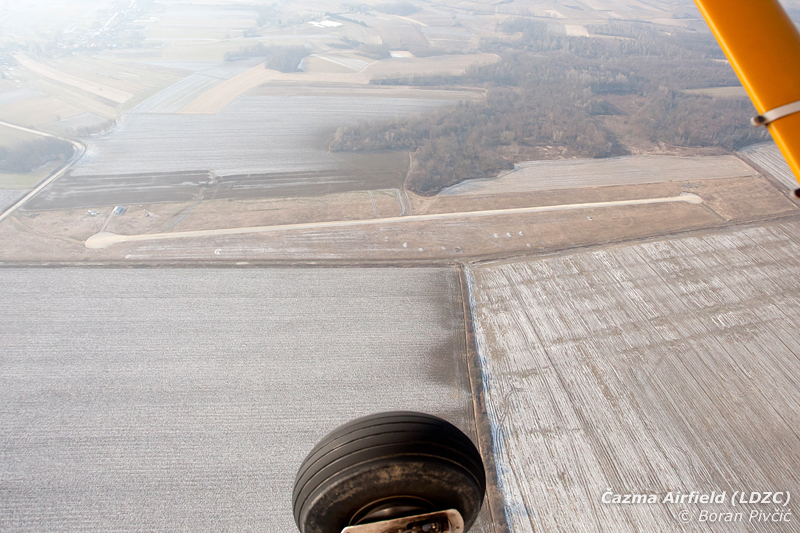
The location for this near-off was Čazma airfield (LDZC), an unassuming little strip located about an hour’s drive east of Zagreb. Overgrown and uncared for, Čazma had been established in 1944 as a supply airfield by the Yugoslav Partisans, and had after the war gone on to serve as a base for agricultural aircraft (surrounded, as it is, by the abundant farmland characteristic of this part of Croatia). Following the decline of cropspraying flights some years ago, Čazma had progressively become disused and forgotten, until it had even dropped off the aeronautical maps about a year ago (for reasons which vary depending on who you ask). For all intents and purposes abandoned, it is today visited only very rarely by light aircraft wanting to have a go at its tight, sloping 660×10 meter paved runway…
A strongly backlit overview of Čazma as it was back in February 2011. The runway - in pretty good shape it must be said - runs in a 01-19 direction, but its slope (sloping up RWY 19 by about 2 degrees) is not noticeable until you actually land...
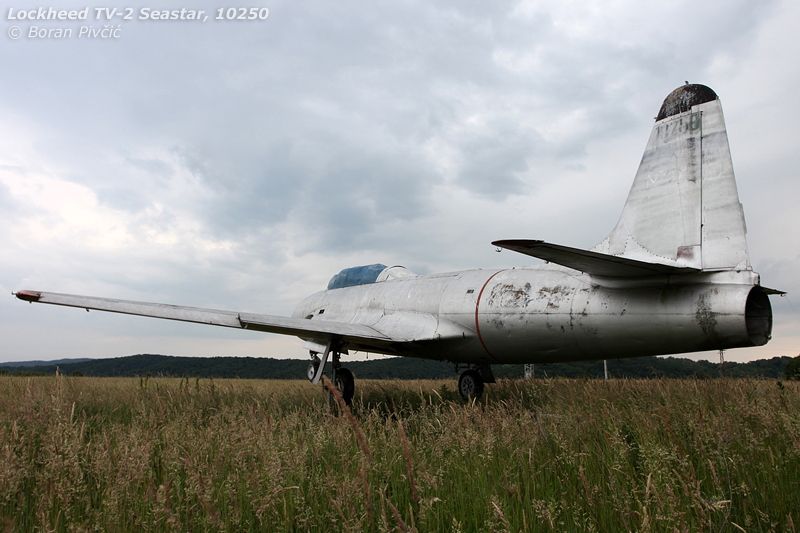
Sadly sharing the fate of the airfield, the Shooting Star that began this entry also has an interesting story to tell. Even though I’d labelled it as a T-33 purely for reasons of brevity, this ex-Yugoslav machine – coded 10250 – is actually a much rarer “TV-2 Seastar”, one of the T-33’s naval brothers. However, over the years these “brothers” have tended to cause some confusion, so for clarity’s sake it’ll help to clear them up first :).
Despite the dozens of names associated with them throughout their service history, there have only ever been two naval Shooting Star versions:
the TV-2 of 1949, at various times also known as the TO-2 and T-33B. Even though it was operated by the US Navy for the training of US Navy pilots, the TV-2 had remained a land-based aircraft, and had generally differed little from “standard” T-33As
and the T2V SeaStar, later known as the T-1 SeaStar. Made fully carrier-capable with the addition of catapult fittings and an arrestor hook, the T2V (developed in 1957) had also received new naval avionics, leading edge flaps (slats), a redesigned tail and rear cockpit, and significant structural enhancements to cope with the realities of shipborne operations. Interestingly, the T2V was also the originator of the “SeaStar” name, which had over the years also filtered – probably by association – down to the TV-2
Spot the differences: the carrier-based T2V SeaStar (foreground) with the land-based TV-2 (photo: Wikipedia)
Apart from adding yet more confusion to the already complicated world of the Shooting Star, the T2V’s entry into service had also, at a stroke, made many TV-2s redundant. Concurrently, a similar process was occurring within the USAF as well, as newer, more advanced aircraft slowly started to displace veteran T-33As. The combined effect was a market flooded with cheap, but essentially good trainers, just ripe for picking by smaller (friendly) air forces looking to modernize their fleets for the least amount of money :).
Yugoslavia – despite its socialist government – was no exception, and had by the early 60s snapped up more than 100 of these aircraft. The majority – about 55 by my count – consisted of TV-2s, with out example, 10250, being one of the last delivered… 🙂
Like many gate guardians in the country, 10250 is in a rather bad state - though it seems to have been spared more damage due to its remote location. As per what I've been able to find out, it's actually a relatively recent addition to the field, having been moved here around the year 2000. It had previously been located at Zagreb Intl. (LDZA) since its decommissioning in 1972 - and I believe I used to play on it as a kid back in the late 80s when my parents worked at the airport :D.
Very rarely used - except by the occasional lorry and light aircraft - the airfield's maintenance is essentially nonexistent, hence the overgrowth. The last time it had been used on any larger scale was back in 2006, when it was host to a local airshow
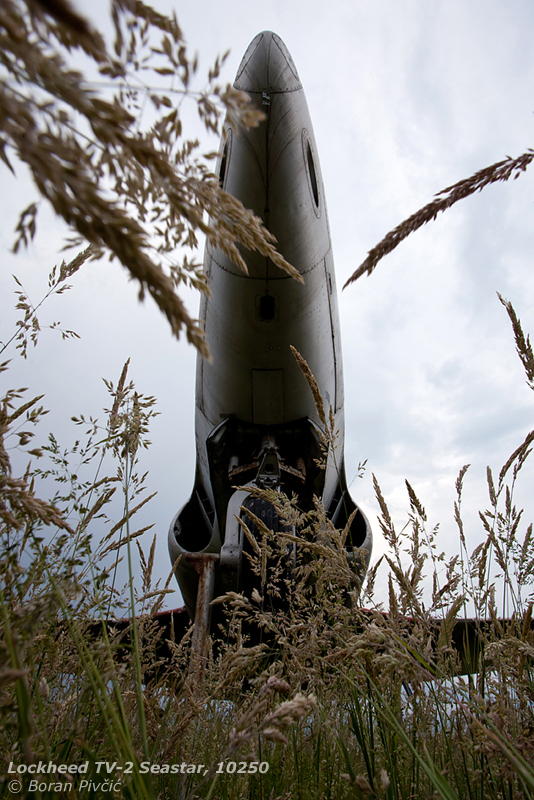
Definitely one of the most easily recognizable noses of the early jet era :). As well as "factory standard" TV-2s, T-33As and RT-33s, the Yugoslav AF had also operated the odd IT-33, a local reconnaissance modification broadly similar to the RT-33 (with I standing for "izviđač", or "scout")
Battered, but still proud, with an appropriate stormy background :). Only one other gate guardian Shooting Star remains in Croatia, located at Rijeka Airport (LDRI) on the island of Krk (though its status - and future - is rather bleak)
While ordinarily our quiet and inconspicuous Lučko airfield cannot claim to have much in the way of foreign visitors, a couple of days ago it had suddenly become the site of what I believe to be the first ever landing by the Dutch company KLM on Croatian soil – sort of :D. And even though a 737 or a Fokker 100 stuck on a muddy 800 meter long grass runway would definitely be a sight to see, the reality was much less ambitious – but none the less interesting! 🙂
Somewhat underwhelming as an "ambassador" for the company - but only at first glance :). In town not on official business, PH-WVO was four legs into a trans-European joyride, which had so far taken it from Amsterdam - Cannes (France) - Portorož (Slovenia) - Rijeka (Croatia) - Lučko, and will further take it to Zagreb Intl. - Balaton (Hungary) - Budapest (Hungary) - Prague (Czechia) and then back home to Holland. Not a flight - or a flying life - I'd object to! 😀
Like many larger airlines in Europe, KLM operates its own small aeroclub, where it's regular crews can rent out light aircraft for very low prices and "keep their hand in" or just have some good old fashioned GA fun. Alongside with WVO pictured here, KLM Aeroclub also operates another 172P (PH-KBA) and a Piper Archer II (PH-KAX), all of which are named "Whispering bird" :). And, as befits a company such as KLM, the aircraft are immaculate!
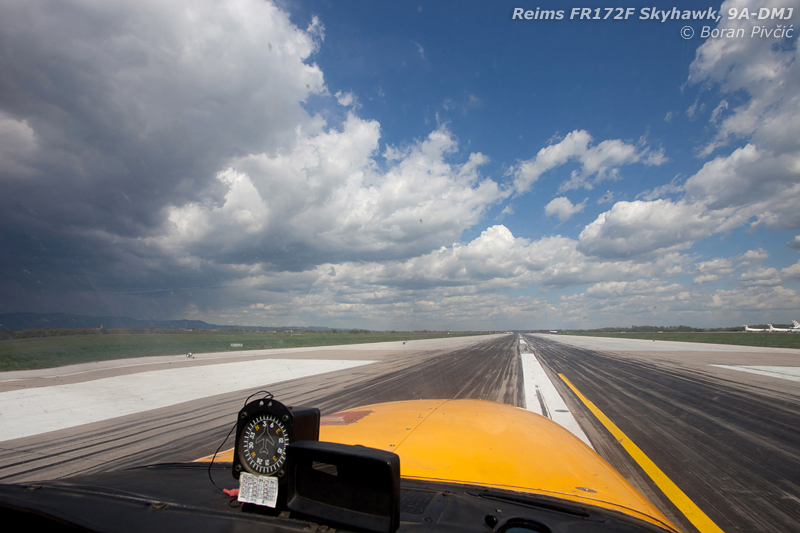
Despite the bad reputation enjoyed by rain in the aviation community (much of it quite rightfully earned), every once in awhile it does tend to have its bright moments – especially on these lovely, warm and invariably variable spring days :). Pretty much a common occurrence on the plains of Central and Southeastern Europe on clear and sunny days, heat and humidity tend to create imposing – but generally isolated – towering cumulus clouds that come with much pomp, but not that much rain. Traveling relatively slowly with whatever wind is prevailing at medium altitudes, on the ground they usually annoy people with alternations of sun and short-duration showers; but in an airplane – especially with a camera handy 😀 – they’re a wholly different experience…
A world of contrasts as we start our takeoff roll down Zagreb's RWY 05, with another TCu incoming from the north. While it is usually seen just as the last stage of development before the fully-grown cumulonimbus, on occasion the towering cumulus cannot develop further and ends up as a medium-sized raincloud, characterized by moderately intense - but rather short - showers
Admiring the view - somewhat 😀 - as we orbit near Zagreb Intl., waiting for the traffic to clear so we can pop in for some fuel
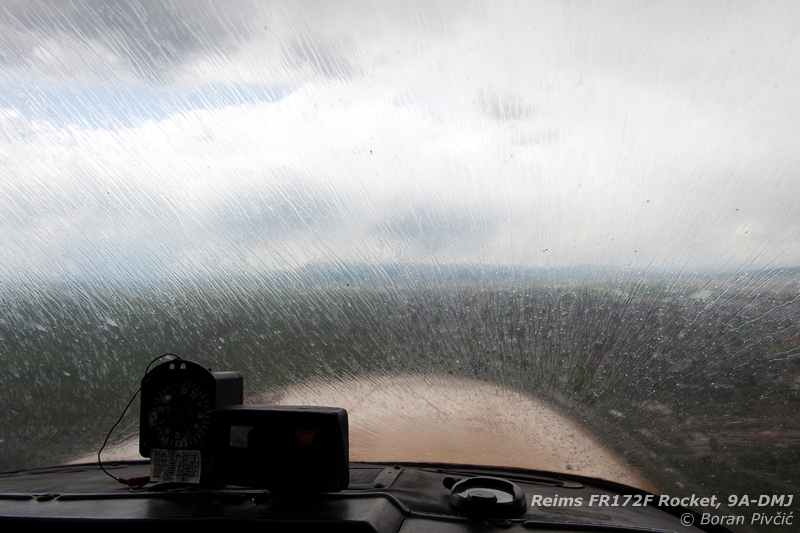
Receiving a free - and thoroughly ecological 🙂 - wash as we fly through the fringe rain of yet another TCu on our way back to Lučko. Carried on by the cloud's downdrafts, the rain can start some distance from the actual cloud - but, given the TCu's small area, you're usually in and out of it in a matter of seconds
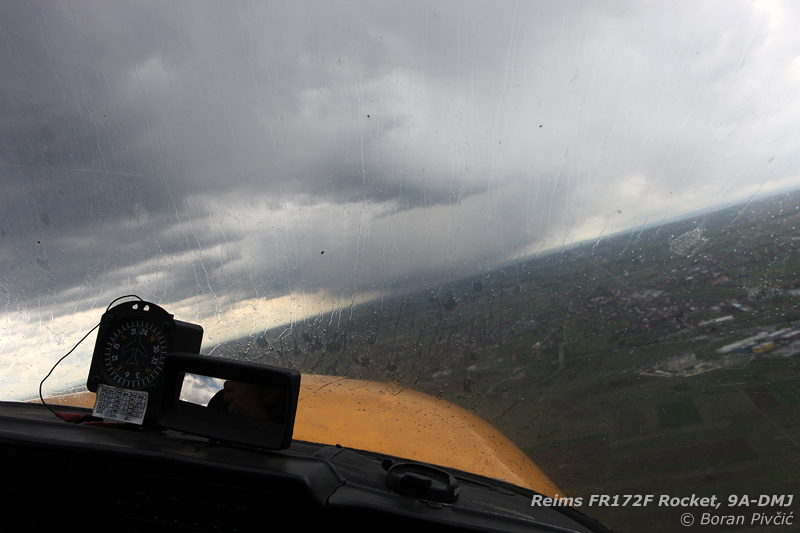
Ah, the intricacies of spring weather :). Shadows of scattered fair weather cumulus clouds pockmark the ground below while an ominous stormcloud descends from the slopes of Mount Medvednica...
With fine spring weather finally on the horizon (damn, I can’t complain about anything now! :D), it was high time to get back behind the controls – or the camera, depending on the circumstances – and do some proper cross-country flying/photography :). While we did have a few spells of nice weather during the previous months, they had only really allowed for relatively short hops in directions that avoid the mountains of Central Croatia – which had, for us on the continent, effectively put 50% of the country out of reach :). Apart from locally notorious winter up- and down-draughts, the terrain of central Croatia rules out anything below 5,000 ft – at the lowest – as a reasonable cruise altitude, one that is well within the freezing zone for a good quarter of the year. Throw in thick cloud cover, pretty common during the winter, hanging at just about those altitudes – and aircraft that lack even a rudimentary de-icing system – and flying across this area becomes a pretty unhealthy prospect :D.
Happily though, the arrival of clear skies and warm weather had pushed the 0° isotherm back up into the flight levels, allowing us to once again set our sights on one of the most beautiful parts of the country – the coast… 🙂
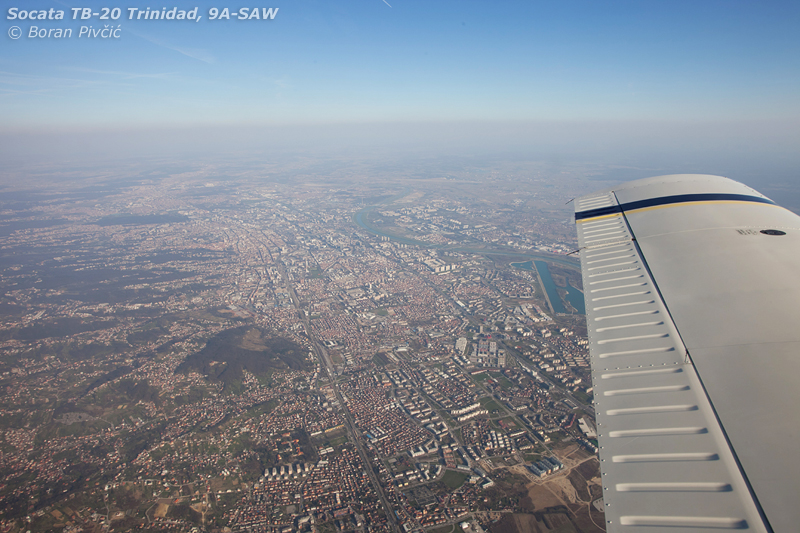
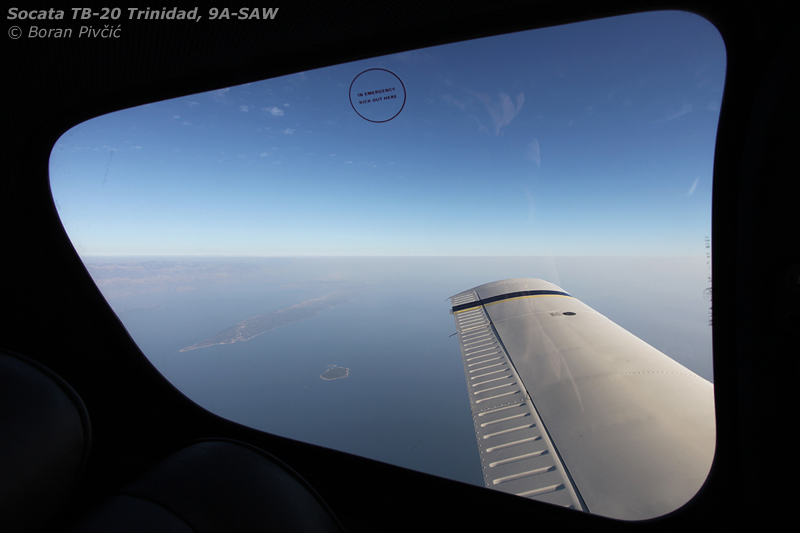
A view of the city of Zagreb from 7,000 ft, en-route from Varaždin (LDVA) in the north towards the coastal region of Kvarner. The aircraft (partially) in shot is a Socata TB-20, my first ever aircraft from this prolific French manufacturer :). And with that thin wing and panoramic windows, it is by far the best photography platform I’ve flown on 😀
Crossing the Velebit mountains at their lowest point, above the region of Gorski Kotar. As in a number of photos previously featured on this blog, you can easily see why this mountain range has a penchant for creating problems during periods of strong wind :). Note also how, in terms of weather, it splits the continent (on the left) from the coast (on the right)
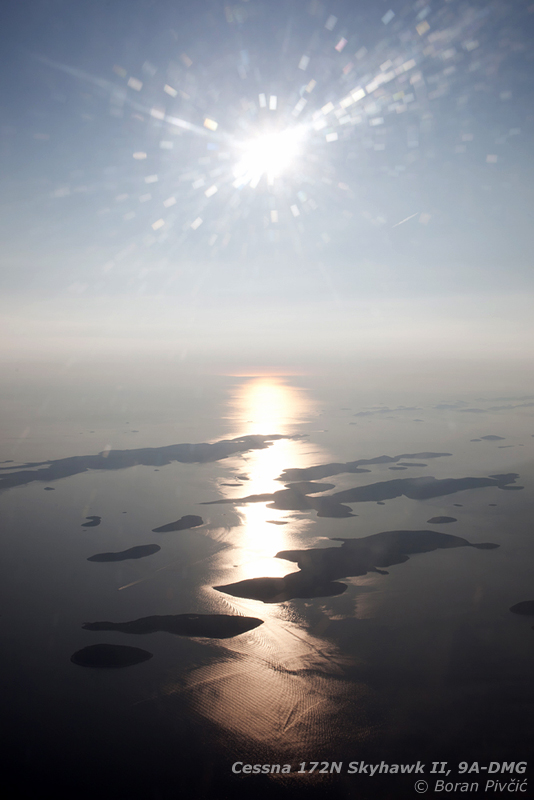
A First Class view as we cruise leisurely above the Northern Adriatic, heading west :). Riddled with more than 1,200 islands along its length, the Croatian side of the Adriatic is at least easy to navigate down. Interestingly though, only four of those islands – Unije, Lošinj, Brač and Hvar – have airfields (two of which are small grass strips)
This pretty much sums up why I love flying :). A sunset joyride above the coast, good company and the close and involved atmosphere of a light aircraft flight deck 🙂
The evening mist is already beginning to settle as we race the sun back home to Varaždin. And despite it being the end of March when this was taken, you can still see traces of snow on the lee-side slopes below. Another interesting tidbit here is that this is the first time I’d managed to get both the wing and the horizontal stabilizer in a single frame 😀
Back on the more… agricultural Skyhawk as we trundle from Zagreb (LDZA) towards Split (LDSP) at FL100. Flying IFR, we had to stick to published instrument airways, one of which had included an 18 NM hop over neighboring Bosnia, seen here to the left. In the center is the mountain of Plješevica at whose eastern base (again to the left) lies the now disused Željava airbase, one of the largest underground airbases in this part of Europe
Nothing like a bit of cloudhopping to brighten up a day’s flying :). While it is all very good fun, it also has a few serious advantages: when flying in IFR in clear skies, every now and again when you turn your head you’ll – unintentionally – catch a glimpse of the ground below and gain a visual confirmation of your attitude… which isn’t really what IFR is about. Deep within a cloud though that visual cue is gone, and you’re left to your own instrument flying skills
Another fantastic view of the Adriatic coast from 8,000 ft as we cruise back home to Zagreb via Zadar (LDZD) :). The mountains may be a welcome challenge to fly through, and the boring flat plains in the east of the country can do wonders for visual navigation skills… but nothing beats an afternoon flight above the sea :). For that short moment, you haven’t got a worry in the world!
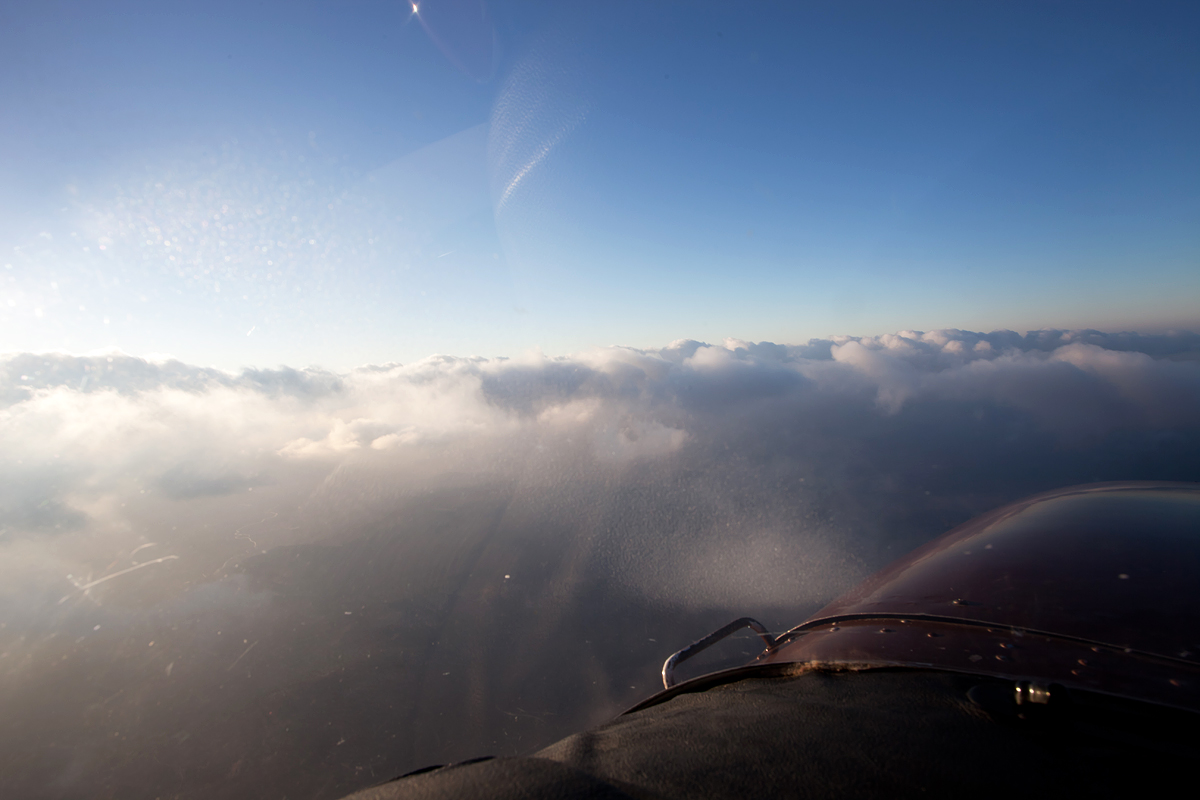
Back up at FL100 and finally above the clouds as the sun begins to set :). Flying in an area of increased humidity in sub-zero temperatures, we’d naturally picked up some frost along the way (visible on the lower windshield) – but the humidity content was not high enough for it to progress into “real icing”
More cloudhopping as the night draws near. Despite not being a fan of single-engine night flying – especially above the uneven terrain in this part of Croatia – I’d timed the flight so that night would overtake us some 15 minutes out from Zagreb… just to log my first ever night IFR landing 😀
I’ve been waiting for a long time to nail this photo :). Night had already arrived down at ground level, but nearly 3 km up, we still had some sunlight left 🙂
Even though, by most accounts, early February should have seen continental Croatia declared missing under a thick blanket of snow, this year’s odd weather patterns – already having thrown most long term forecasts into the rubbish bin – have decided to treat us to some unusually fine and warm weather instead :). After a month of dull, low overcast and sub-zero temperatures, this week’s clear sunny skies, just a whiff of cirrus clouds and temperatures hovering at around 15 Centigrade were a godsend – and having been deprived of flying for almost two months, I was eager to use this calm spell well and finally log my first few hours as a certified CPL pilot :).
But, there was a twist: in what had met with near universal shaking of the head, the operator of Lučko had failed to renew the airfield’s operational certificate at the end of 2010., leading the Civil Aviation Authority to quickly suspend most operations from the field. And while sport and private flights are still allowed on an “at your own risk” basis – despite the fact that not a single blade of grass is different than in 2010 😀 – commercial and training operations have been banned outright for an indefinite period of time. While it may seem that all is not yet lost, these operations account for the bread and butter of most aircraft operators at Lučko, forcing virtually the entire “fleet” to relocate to Zagreb Intl. (LDZA, locally known as Pleso) until everything is sorted out…
Airfield? This is more of a "ghostfield" if you ask me... only seven aircraft were at the field when I had last visited, two of which - being non-airworthy - were unable to do anything about it. Subsequently, two of the remaining four had flown over to Pleso, leaving Lučko empty and desolate...
However, flying out of an international airport does have its advantages – especially if you own a camera and do not hesitate to use it :D. The more vibrant and dynamic traffic picture at Pleso was bound to produce some interesting aircraft movements, while the 3+ kilometer paved runway meant you could operate at will and not have to worry about morning dew soaking up the notoriously mud-prone Lučko…
Now all we need to do is tie their tails together with some rope, put two canisters of avgas in front of each one and watch what happens next :D. With most of our Lučko fleet relocated to LDZA, the general aviation apron was becoming awfully cramped. So to make the best use of the limited space available, our parking solutions took a turn for the creative :D.
On final for RWY 05 after a pleasing afternoon aerial photography flight :). While not particularly impressive as an international gateway, Pleso has everything you really need for a smooth operations, including a CAT IIIb ILS and full runway and approach lighting (visible here are the last segment of the so called "Calvert approach lighting system"). The runway, 3252 by 45 meters, can accommodate anything up to and including the 747 and 777. The general aviation apron, easily recognizable by its darker pavement, is to the right of the photo
Milliseconds from touchdown right on the piano keys! Even though we have 3000+ meters of runway available, when landing on 05 we usually practice putting the aircraft down as soon as practically possible so we can hit the brakes and vacate the runway via taxiway Bravo, located 350 meters from the threshold. This not only moves us out of the way of much faster commercial traffic, but also allows us to taxi directly onto the general aviation apron without having to go past the entire main apron - again freeing up space for the big birds :).
The apron itself did not disappoint either :D. All lumps, bumps and antennae, this purposeful looking RC-12K Guardrail is actually a SIGINT - or "signals intelligence" - aircraft, whose mission is to prowl the skies listening for new and unknown frequencies of hostile search and fire control radars and/or intercepting communication transmissions over a wide range of frequencies (hence the antennae). Quite secretive otherwise, this example belongs to the US Army, and is based on the not-at-all warlike Beech King Air A200 executive turboprop (or more precisely its military utility version, the C-12 Huron) - and was in town most probably to participate in a NATO exercise over the mountains of central Croatia. Interestingly enough, only nine K models were ever made, and this specific example is the first of the lot 🙂
Looking beautiful at the small grass strip of Zvekovac (LDZE), some 15 minutes of flying time away from Zagreb. Calm and quiet, it was a perfect destination for a short flying getaway to catch some air outside the CTR :). The flock of sheep standing several meters behind me though were not amused by our rather noisy arrival :D.
Despite completely disregarding normal University working hours – neither the first nor the thing to do so 😀 – my ongoing Multi Crew Coordination (MCC) simulator course had turned out to be a more fulfilling activity than I had previously anticipated; not only has it introduced me to the essentials of operating multi-pilot aircraft, but its late-night five-hour simulator sessions – sometimes running into the wee hours of the morning – have also provided me with valuable insight into the odd working hours of the professional flight crew. But for the photographer in me, there was also the quiet satisfaction of having a deserted, dark hangar – and my always ready camera – to play with :D. And while there were very few photo opportunities – with most aircraft temporarily relocated to Zagreb Intl. – I decided to make the best of the situation… 🙂
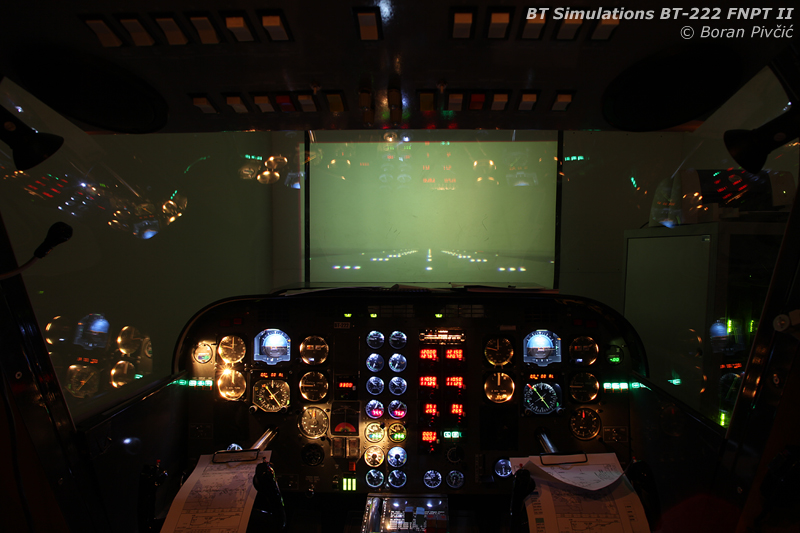
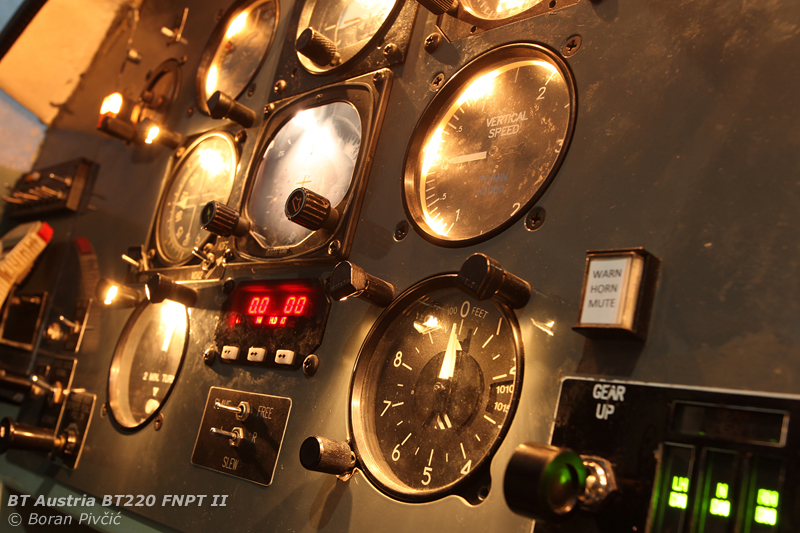
The Office :). Noticeably more complicated than the Seneca-based BT220 previously featured on this blog, the BT222 - produced by the same company, BT Simulations of Austria - is designed to simulate a "generic turboprop", but is in fact closely based on the Piper Cheyenne III
A slightly different view from "the jump seat". While not the most advanced or modern training device to see the light of day, the BT222 has all the ingredients required for the basic MCC course: dual instruments for both crew members, an autopilot to help reduce the workload - and numerous "failable" systems to keep you on your toes :). The approach charts you see clipped to the yokes are for Pula airport's (LDPL) VOR/DME approach for runway 27, which my teammate and I had just completed with flying colors (literally as you can see) 🙂
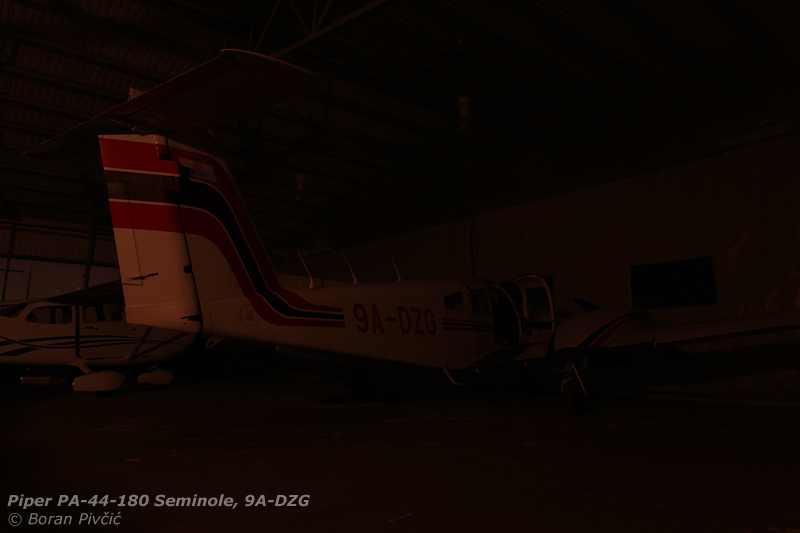
Lit only by the soft glow of the "Simulator run in progress" light, DZG and DZA (a Cessna Skyhawk SP) wait out another cold night in the hangar. Sitting here in the evening quiet, they keep reminding me of old, abandoned aircraft scattered in the underground tunnels common to several military bases in this part of the world...
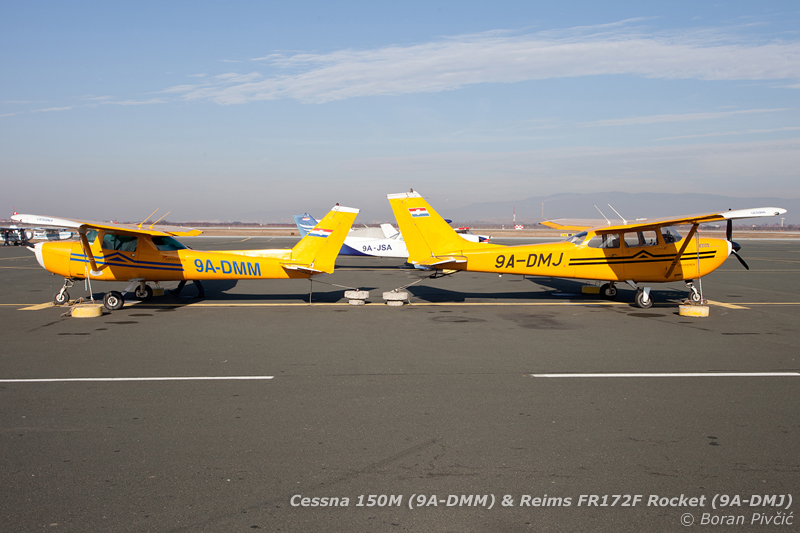
While it does little for raw cross-country performance, rumbling along at a 100 or so knots in your stock Skyhawk does have a raft of plus points – especially if you are a photographer :D. Flying mostly in good weather conditions, on an aircraft that is the definition of predictable, and at speeds about the same as those on the highway you are following, the sedate Skyhawk (or the C150) often allows you to wander around a bit, look outside and enjoy the scenery… and, if you already count your photo equipment as part of the plane’s empty weight, snap a few nice shots as well! 🙂
With this in mind – and with nothing new happening on the local aviation scene – I went back to my photo database in search of some interesting airborne shots, shots that show what the view is actually like up here :). And this is what I came up with…
Cruising leisurely westwards against a 20 knot headwind 1500 ft above the Slavonian flatlands. Croatia’s most important farmland region, Slavonija is not particularly exciting flying-wise; but it is rife with disused concrete airstrips formerly used by agricultural aircraft. Measuring at 600-660×10 meters, most are now in a poor state and not usable on a day-to-day basis… however, should your engine – your only engine! – decide to quit, they can come in very handy for an emergency landing (so much so that I’ve devoted this – and a few other flights – to scouting them out 🙂 )
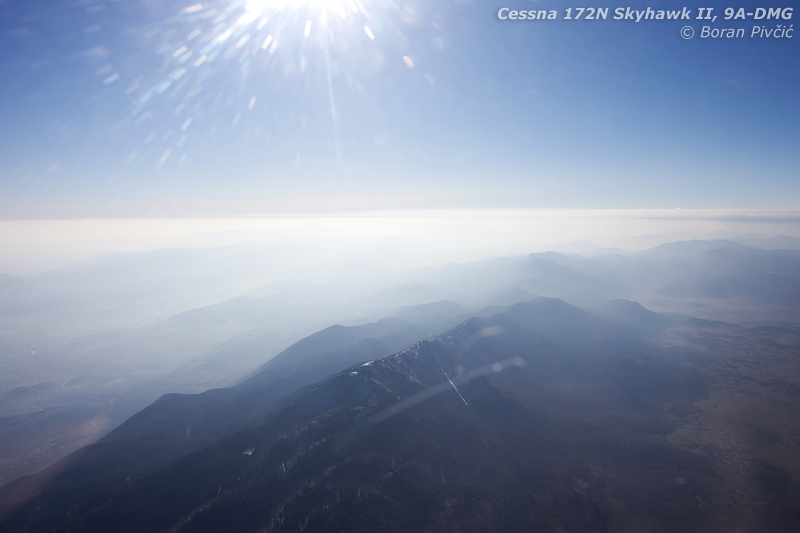
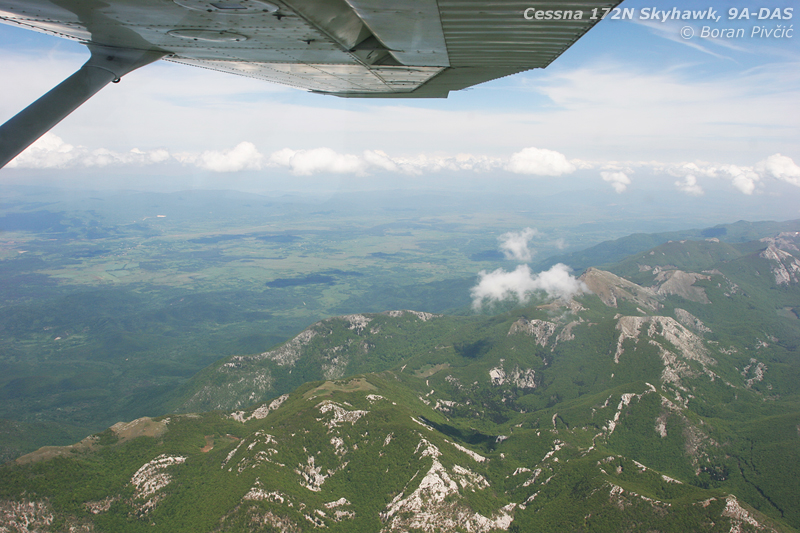
An interesting view of the Velebit mountain range during a prolonged and laborious climb to 8,000 ft on a very hot May day. One of the southern extensions of the Alps, the range peaks at about 6,000 ft, but rarely goes above 4,000 in most places (like here) – on the face of it, hardly impressive figures. However, running perpendicular to the two strong prevailing winds in this region, it can be very treacherous when the windspeed picks up…
Finally at 8,000 ft and preparing for a spot of light turbulence. The slope of the continental side – running northwest to southeast – gives an indication of the strength of the mountain’s infamous updrafts and downdrafts. Most pronounced during the “bora” northeastern wind – whose speeds often go above 50 knots – the very strong mountain waves created have over the years claimed dozens of lives… rising steeply on both sides, the Velebit range also splits this part of Croatia into two distinct weather systems: a mild Mediterranean climate on the coastal side, and a moderate continental on the other. The changes between them can be quite pronounced – you can fly in sub-zero temperatures, fog and low cloud on one end, and end up in +15 Centigrade, unlimited visibility and clear skies on the other – all in the space of about 10 miles…
Something less mountainous for a change :D. Flying 1,000 ft above the hilly region of Zagorje, on a beautiful – but very windy – day. One of the northernmost regions of the country – just 10 minutes from Lučko as the Skyhawk flies – Zagorje is the realm of the student pilot :). With its numerous small villages, abundant roads and railways, and mild terrain, it is almost perfect for every student’s first cross-country flight… (including the author’s)
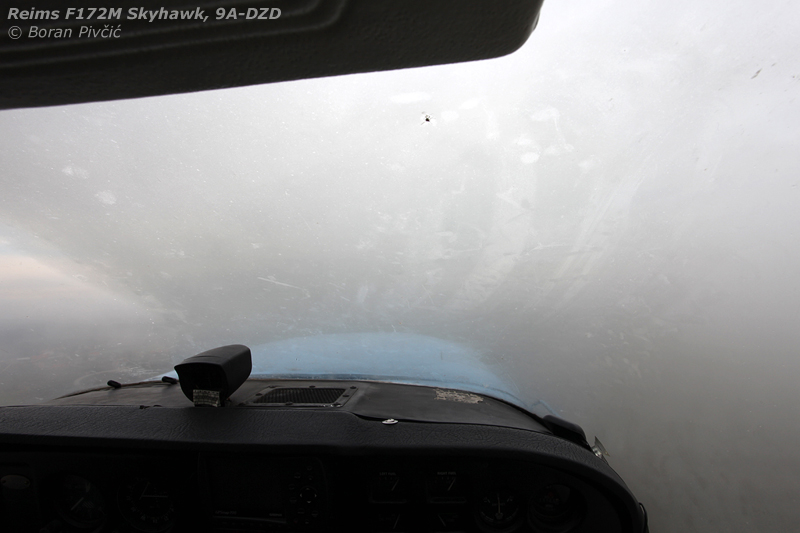
Instant instrument conditions – just add water :D. Taking off from Lučko on a cold and very humid morning, it was only a matter of time before the windshield fogged up. The warm air vent on the pilot’s side had immediately cleared the problem up – but in the copilot’s seat, I was left with less than impressive forward visibility 🙂
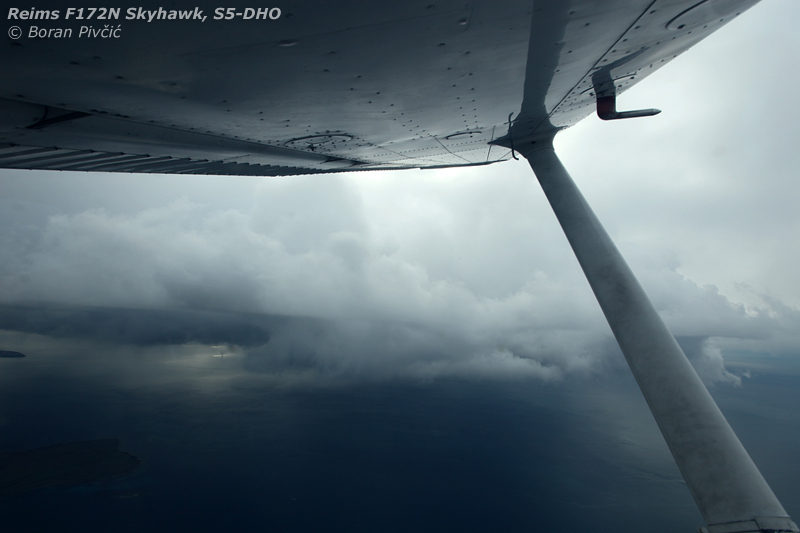
More dramatic weather photos as I skirt the edge of a stormcloud near Lošinj Island. The first sign of the approach of a huge front moving northwards across the Adriatic Sea, this particular CB is classified as “embedded”, that is hidden in other clouds and therefore virtually impossible to spot from a distance – unless it is pouring rain, like here 🙂
Sunset over the Bay of Trieste in Italy as I cruise at 5,000 back to base at Portorož in Slovenia :). The previously mentioned weather front can be seen approaching from the south, blending together sky and sea – perfect conditions for one of the biggest killers in aviation: loss of spatial orientation
Clear skies, clean air and not even a whiff of turbulence – what a wonderful day to go flying! Just trim the plane and let it fly itself… something I was very appreciative of that day while flying from Portorož to Venice :D. The unique airspace layout of northeastern Italy – defined in most part by the requirements of the famous Aviano airbase – means that the communications workload can be considerable: in the 45 minutes it took me to reach Venice, I was in contact with Portorož Tower/Approach, Trieste Radar, Aviano Radar, Treviso Radar, Venice Approach and finally Lido Information :D. Further adding to the workload was the dense traffic flying along the same coastal route as me, necessitating a continual scanning of the airspace around me
On the face of it, July was probably not the most enjoyable of times to have my Multi-Engine Class training. The summer’s record temperatures – once peaking at a toasty +55 Centigrade in the cockpit – really did us no favors at the best of times; and had certainly not done justice to our little, slightly underpowered Piper Seminole :). So keen to see what it – and I – could actually do given some favorable weather conditions, I was very much looking forward to my Multi-Engine Instrument training, slated to take place in the much more agreeable near-zero temperatures at the beginning of November…
Now, as mentioned in a previous post on the topic, flying a twin engine airplane is fairly easy – provided both engines are operating :D. When one decides to quit however, things can become interesting – still safe, but quite interesting nonetheless. The biggest and most immediate problem in this situation is the sudden lack of power – as my flight instructor had graphically put it, when you lose an engine, you don’t lose just 50% of the available power; in effect it’s as if you lose 75%, since you now also have the dead weight – and additional drag – of the inoperative engine. Specifically, it’s this drag that causes the biggest control problems: with one engine “dragging behind” and the other pulling forward, the airplane wants to yaw and bank around its center of gravity into the inoperative engine, a tendency that has to be neutralized by liberal application of opposite rudder (and possibly some aileron) :). With the rudder now deflected (at low speeds often fully), the drag increases yet again, forcing the airplane down to its speed for minimum drag (and hence minimum required power) – a flight regime that, especially during landing, requires considerable planning ahead…
When simulated for training purposes, this One Engine Inoperative situation also makes the aspiring student appreciative of the simplicity of the turboprop engine – especially if you’re flying a piston-engined Seminole, an aircraft seemingly designed to make your life then and there as complicated as possible :D. Given that many in-flight engine shutdowns are caused by small, easily-rectifiable problems rather than catastrophic failures, each aircraft has a specific set of “diagnostic” procedures the pilot needs to run through to verify whether one of the engines has indeed failed, identify the inoperative engine and – if all else fails (pun intended) – secure it. On the 100-cockpit-lever Seminole (though they’re broadly similar for other piston twins) these include:
moving both mixture levers forward into the Full Rich position – the idea being that maybe you’d forgotten to move them forward during descent and the fuel/air mixture had become too weak for the engine to run
moving both propeller levers forward. This may seem a bit odd given that one of the engines has failed or is in the process of doing so, but until you’re certain WHICH one it is, better have both props at their maximum
moving the throttles all the way to the Maximum Continuous Power setting, for the same reason
turning on the carburetor heaters (or opening the alternate air ports on fuel-injected engines) to see whether the problem is simply ice blocking the carburetor/air intake
turning on both auxiliary fuel pumps, in case the main engine-driven pumps had failed and no fuel is being drawn from the tanks
and then looking around to see whether you’d accidentally shut something off, like the fuel selectors or magnets
If once you’re done the inoperative engine still refuses to cooperate, you identify it and proceed with securing it – which is basically the reverse procedure to the above: close the throttle, feather the prop, cut the mixture and shut everything down related to the engine, such as magnetos, fuel pumps, alternators and the like… you may also have noticed that the above procedure is performed on both engines simultaneously; the rationale is that whatever plagues one engine can easily happen to the other – which is especially likely if the root cause is icing or incorrectly set mixtures.
Despite being a “screenfull”, out on the Seminole this procedure is pretty straightforward and comparatively simple – dare I say fun 😀 – in visual conditions: conditions where you always have a visible horizon and ground contact, and can afford to drift a bit off course while you get the hang of the airplane. In instrument conditions though that luxury is gone, with the only spatial reference you have provided by the instruments – which implies, in addition to everything stated above, continual scanning of the primary flight and navigation instruments and maintaining an image of your position and attitude in your head. Now factor in an ILS or VOR/DME approach and you have a party :D.
Given that during these flights I was want for a few more arms, I did not have the liberty to photograph at will as I usually do, so – after having drifted off course quite badly with this post 😀 – I thought I’d just throw together a small photo gallery of the ME/IR “tools of the trade”… 🙂
For us "modular course" types, the ME/IR rating also includes three hours on "the simulator" - our good ol', not-entirely-trusty BT220, produced by BT Simulations of Austria :). Though universally referred to as a simulator, the BT220 is actually a "Flight, Navigation and Procedures Trainer II" (FNPT II) - to be a fully fledged simulator, it'd have to be "full motion", that is be able to pitch, yaw and bank like the real aircraft
The copilot's view with the seats moved fully back. Representing (broadly) the Piper Seneca III, the BT220 has everything you really need for any sort of IFR training: an HSI and CDI, two ADFs, two DMEs - and an extensive list of failure options 😀
Cooling down after a grueling two-hour training session. Far from being just a cheap replacement for the real aircraft, "the sim" allows for very useful training for real life emergencies: during this session, we had multiple engine failures, system failures, instrument malfunctions, electrical and fuel issues, landing gear failures - not to mention weather related issues such as heavy icing, heavy turbulence, gusting wind and low-visibility operations. Though we'll probably never encounter such a pessimistic combination of conditions out in real life, the lessons learned from them can do wonders when something really does go wrong on the actual airplane...
Dripping wet after an hour's worth of flying though rain while shooting some ILS approaches. Apparently all of my instrument flights are doomed to either cloud and low visibility, heavy turbulence or pouring rain 🙂 (fitting, isn't it?)
At least we gave the Seminole a thorough - and thoroughly ecological 🙂 - wash! She was clean as a whistle when we were done!
Back in the dry in the University's hangar. Like many small twin-engine Pipers, the Seminole is equipped with contra-rotating propellers, eliminating the dreaded "critical engine" and all of its associated negative effects (at the expense of more costly maintenance)
9A-DMG, the Cessna 172N on which I'd passed my Single-Engine Instrument checkride, framed by 9A-DZG on which I'd passed my Multi-Engine Class, Instrument and CPL checkrides :). If they were people, I'd be thanking them now 😀
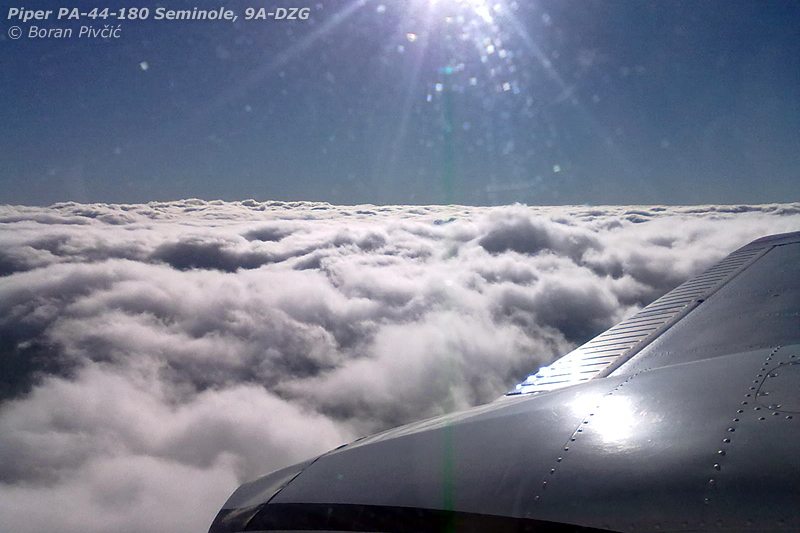
And finally, honorable mentions go to two photos I’ve snapped in flight with my mobile phone… due to a somewhat “expedited” departure from Pleso airport, I’d left my camera in the luggage compartment and couldn’t get at it in flight – so I had to use whatever I had at hand… 🙂
There really are very few things that are as enjoyable as a flight above the cloud deck :). Cruising at 6,000 ft in silky smooth air towards Maribor (ICAO: LJMB), the autopilot keeping the Seminole straight and true, and the scenery going from great to awesome!
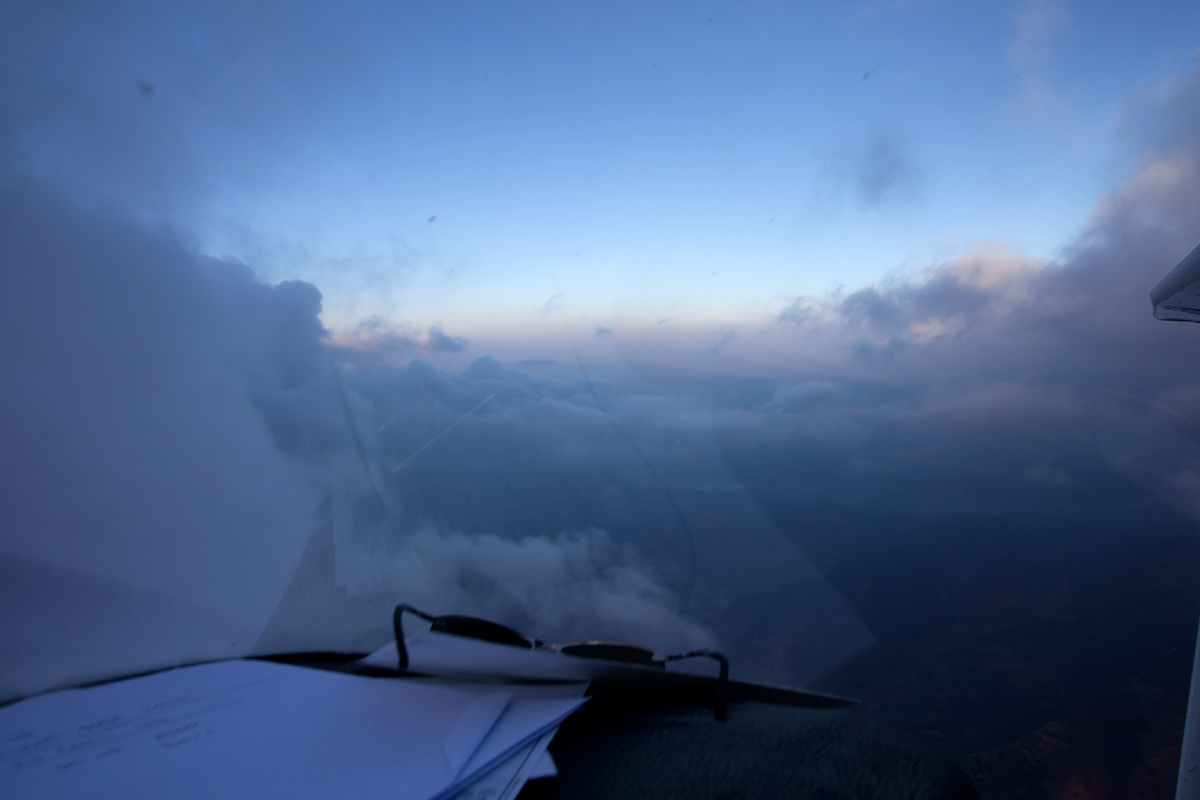
Moments before we break into the cloud deck at 140 knots on our return trip...





























 Achtung, Skyhawk!