While ordinarily our quiet and inconspicuous Lučko airfield cannot claim to have much in the way of foreign visitors, a couple of days ago it had suddenly become the site of what I believe to be the first ever landing by the Dutch company KLM on Croatian soil – sort of :D. And even though a 737 or a Fokker 100 stuck on a muddy 800 meter long grass runway would definitely be a sight to see, the reality was much less ambitious – but none the less interesting! 🙂
Somewhat underwhelming as an "ambassador" for the company - but only at first glance :). In town not on official business, PH-WVO was four legs into a trans-European joyride, which had so far taken it from Amsterdam - Cannes (France) - Portorož (Slovenia) - Rijeka (Croatia) - Lučko, and will further take it to Zagreb Intl. - Balaton (Hungary) - Budapest (Hungary) - Prague (Czechia) and then back home to Holland. Not a flight - or a flying life - I'd object to! 😀Like many larger airlines in Europe, KLM operates its own small aeroclub, where it's regular crews can rent out light aircraft for very low prices and "keep their hand in" or just have some good old fashioned GA fun. Alongside with WVO pictured here, KLM Aeroclub also operates another 172P (PH-KBA) and a Piper Archer II (PH-KAX), all of which are named "Whispering bird" :). And, as befits a company such as KLM, the aircraft are immaculate!
Despite the bad reputation enjoyed by rain in the aviation community (much of it quite rightfully earned), every once in awhile it does tend to have its bright moments – especially on these lovely, warm and invariably variable spring days :). Pretty much a common occurrence on the plains of Central and Southeastern Europe on clear and sunny days, heat and humidity tend to create imposing – but generally isolated – towering cumulus clouds that come with much pomp, but not that much rain. Traveling relatively slowly with whatever wind is prevailing at medium altitudes, on the ground they usually annoy people with alternations of sun and short-duration showers; but in an airplane – especially with a camera handy 😀 – they’re a wholly different experience…
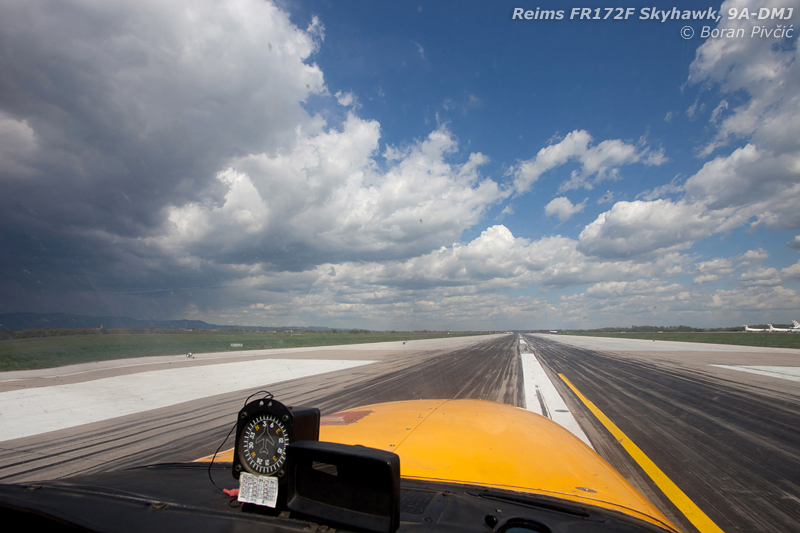
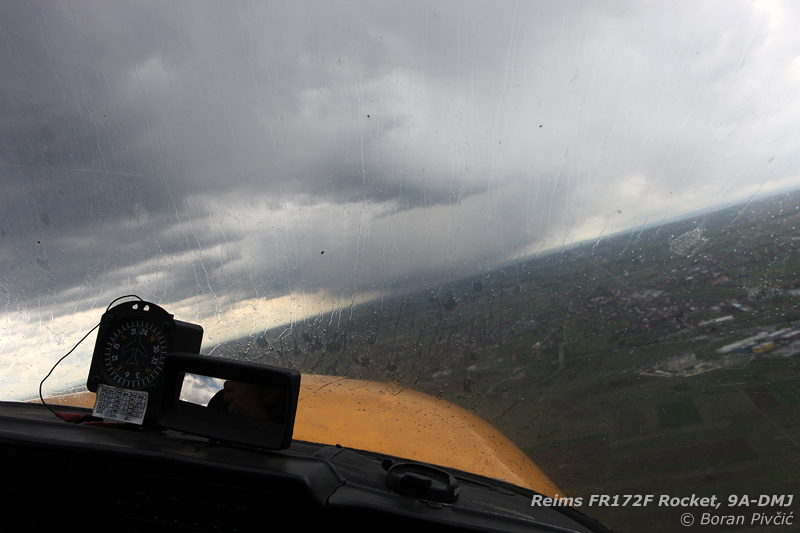
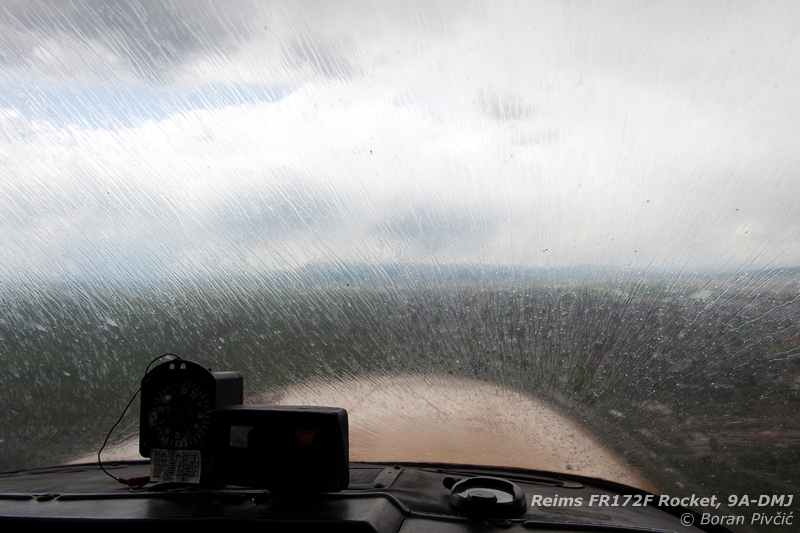
A world of contrasts as we start our takeoff roll down Zagreb's RWY 05, with another TCu incoming from the north. While it is usually seen just as the last stage of development before the fully-grown cumulonimbus, on occasion the towering cumulus cannot develop further and ends up as a medium-sized raincloud, characterized by moderately intense - but rather short - showersAdmiring the view - somewhat 😀 - as we orbit near Zagreb Intl., waiting for the traffic to clear so we can pop in for some fuelReceiving a free - and thoroughly ecological 🙂 - wash as we fly through the fringe rain of yet another TCu on our way back to Lučko. Carried on by the cloud's downdrafts, the rain can start some distance from the actual cloud - but, given the TCu's small area, you're usually in and out of it in a matter of secondsAh, the intricacies of spring weather :). Shadows of scattered fair weather cumulus clouds pockmark the ground below while an ominous stormcloud descends from the slopes of Mount Medvednica...
With fine spring weather finally on the horizon (damn, I can’t complain about anything now! :D), it was high time to get back behind the controls – or the camera, depending on the circumstances – and do some proper cross-country flying/photography :). While we did have a few spells of nice weather during the previous months, they had only really allowed for relatively short hops in directions that avoid the mountains of Central Croatia – which had, for us on the continent, effectively put 50% of the country out of reach :). Apart from locally notorious winter up- and down-draughts, the terrain of central Croatia rules out anything below 5,000 ft – at the lowest – as a reasonable cruise altitude, one that is well within the freezing zone for a good quarter of the year. Throw in thick cloud cover, pretty common during the winter, hanging at just about those altitudes – and aircraft that lack even a rudimentary de-icing system – and flying across this area becomes a pretty unhealthy prospect :D.
Happily though, the arrival of clear skies and warm weather had pushed the 0° isotherm back up into the flight levels, allowing us to once again set our sights on one of the most beautiful parts of the country – the coast… 🙂
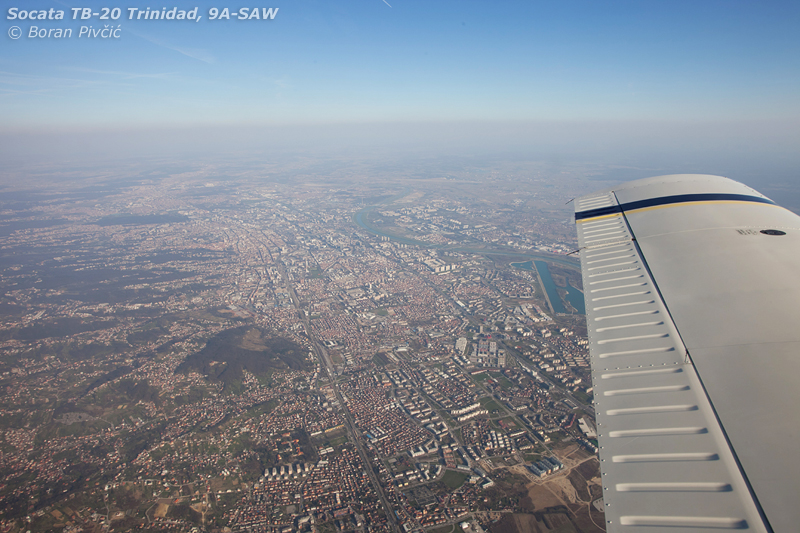
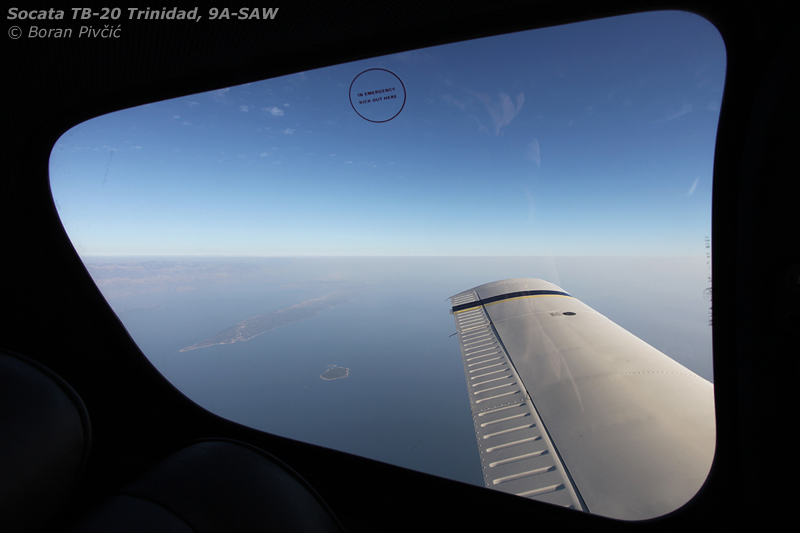
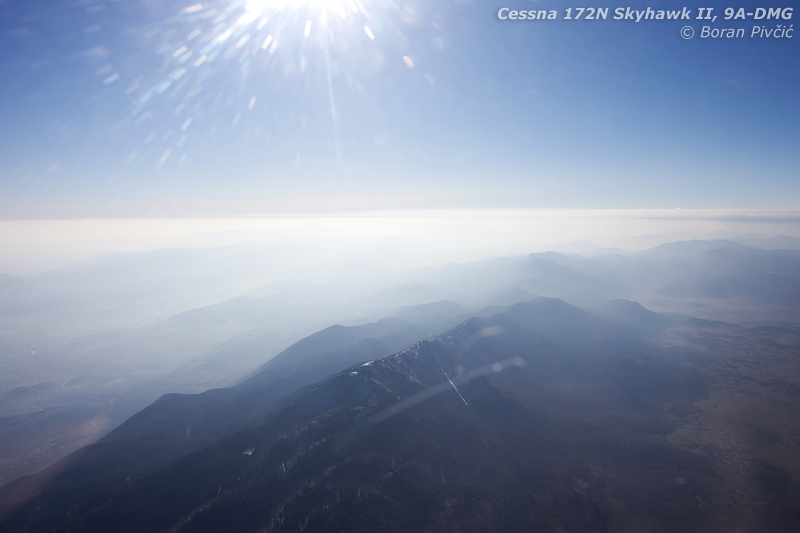
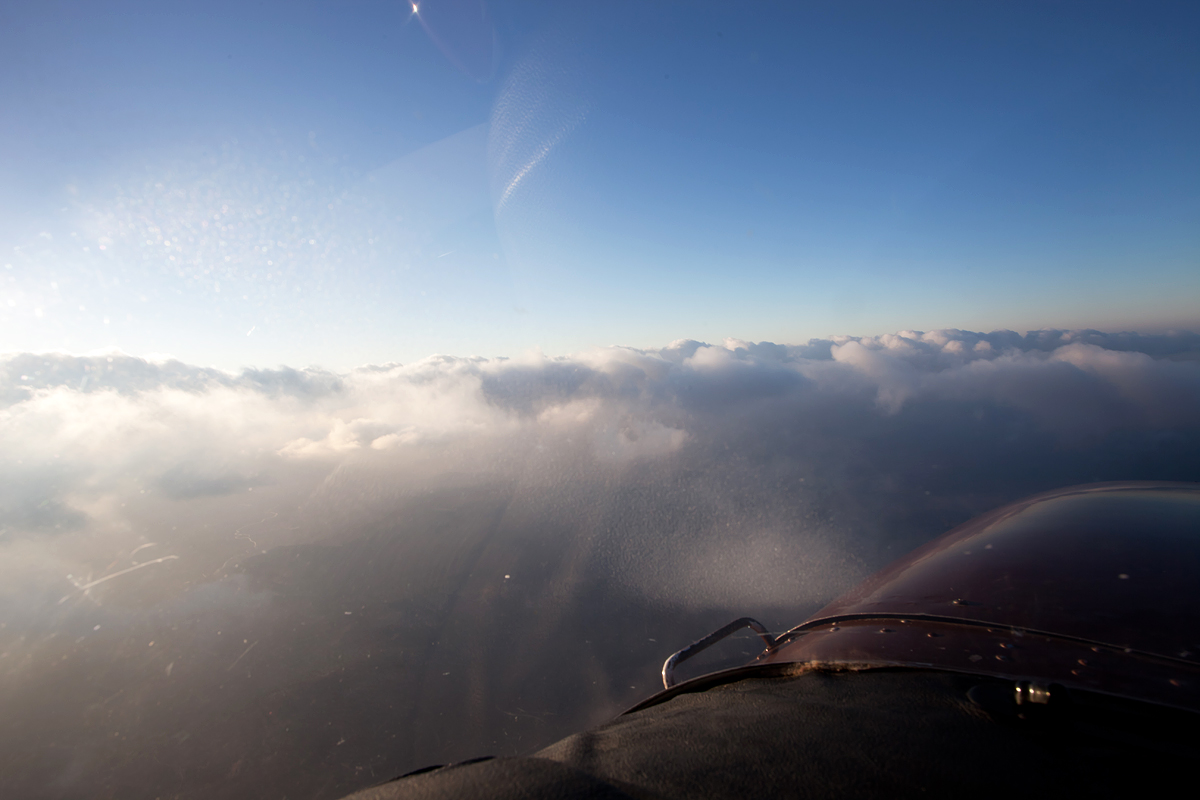
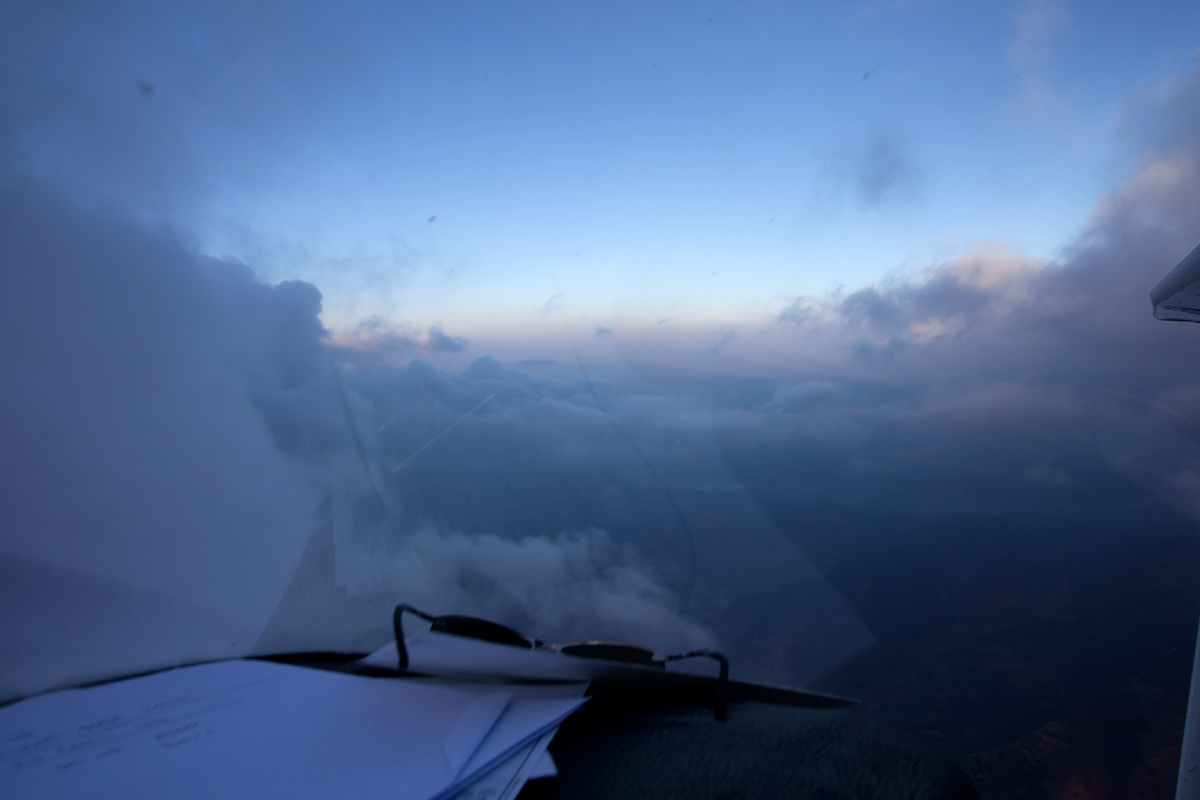
A view of the city of Zagreb from 7,000 ft, en-route from Varaždin (LDVA) in the north towards the coastal region of Kvarner. The aircraft (partially) in shot is a Socata TB-20, my first ever aircraft from this prolific French manufacturer :). And with that thin wing and panoramic windows, it is by far the best photography platform I’ve flown on 😀Crossing the Velebit mountains at their lowest point, above the region of Gorski Kotar. As in a number of photos previously featured on this blog, you can easily see why this mountain range has a penchant for creating problems during periods of strong wind :). Note also how, in terms of weather, it splits the continent (on the left) from the coast (on the right)A First Class view as we cruise leisurely above the Northern Adriatic, heading west :). Riddled with more than 1,200 islands along its length, the Croatian side of the Adriatic is at least easy to navigate down. Interestingly though, only four of those islands – Unije, Lošinj, Brač and Hvar – have airfields (two of which are small grass strips)This pretty much sums up why I love flying :). A sunset joyride above the coast, good company and the close and involved atmosphere of a light aircraft flight deck 🙂The evening mist is already beginning to settle as we race the sun back home to Varaždin. And despite it being the end of March when this was taken, you can still see traces of snow on the lee-side slopes below. Another interesting tidbit here is that this is the first time I’d managed to get both the wing and the horizontal stabilizer in a single frame 😀Back on the more… agricultural Skyhawk as we trundle from Zagreb (LDZA) towards Split (LDSP) at FL100. Flying IFR, we had to stick to published instrument airways, one of which had included an 18 NM hop over neighboring Bosnia, seen here to the left. In the center is the mountain of Plješevica at whose eastern base (again to the left) lies the now disused Željava airbase, one of the largest underground airbases in this part of EuropeNothing like a bit of cloudhopping to brighten up a day’s flying :). While it is all very good fun, it also has a few serious advantages: when flying in IFR in clear skies, every now and again when you turn your head you’ll – unintentionally – catch a glimpse of the ground below and gain a visual confirmation of your attitude… which isn’t really what IFR is about. Deep within a cloud though that visual cue is gone, and you’re left to your own instrument flying skillsAnother fantastic view of the Adriatic coast from 8,000 ft as we cruise back home to Zagreb via Zadar (LDZD) :). The mountains may be a welcome challenge to fly through, and the boring flat plains in the east of the country can do wonders for visual navigation skills… but nothing beats an afternoon flight above the sea :). For that short moment, you haven’t got a worry in the world!Back up at FL100 and finally above the clouds as the sun begins to set :). Flying in an area of increased humidity in sub-zero temperatures, we’d naturally picked up some frost along the way (visible on the lower windshield) – but the humidity content was not high enough for it to progress into “real icing”More cloudhopping as the night draws near. Despite not being a fan of single-engine night flying – especially above the uneven terrain in this part of Croatia – I’d timed the flight so that night would overtake us some 15 minutes out from Zagreb… just to log my first ever night IFR landing 😀I’ve been waiting for a long time to nail this photo :). Night had already arrived down at ground level, but nearly 3 km up, we still had some sunlight left 🙂
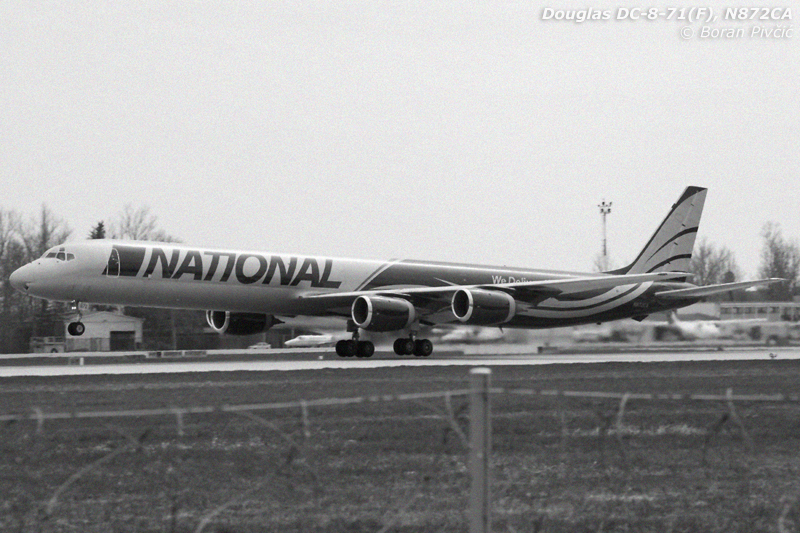
Though I’ve had my fair share of off-topic airliner posts on here recently, I decided I might just as well get away with another one before normal GA service is resumed 😀 (and with a lengthy in-flight photo post at that). The reason for this latest deviation from the norm is another very rare visitor that had popped into Zagreb just the other day – one of the most beautiful classic jetliners to ever take to the skies, the inimitable Douglas DC-8 :).
Even though I was naturally thrilled to see my first ever Diesel 8, I was a bit disappointed that it was not one of the “full fat” older generation models, but an upgraded DC-8-71(F) freighter operated by National Airlines of the US. Factory-modified with CFM International CFM-56 high-bypass turbofan engines – and I believe even an EFIS cockpit 🙂 – the -71(F) lacks the charisma and presence of the older JT3 turbojet models; but it was a DC-8 nonetheless, so I was naturally set and ready with my camera when it decided to depart :D.
The flying pencil rocketing out of Zagreb’s RWY 05, bound for Luxembourg :). Apart from its eye-catching fuselage length, the DC-8 appears quite small when viewed head on or from the back… and also quite gorgeous in a gloss paint schemeWhat it would have looked like back during the -8’s heyday in the 60s and 70s :). Note also the surprisingly flat takeoff attitude – flying empty and with little fuel, no dramatic rotation was necessary… I’m almost tempted to say that it takes off like a big An-2 – some noise, some movement and then it just starts going up 😀
On the face of it, 2011 hadn’t really gotten off to a flying start as far as local GA photography was concerned. Stuck in Limbo between an airfield that is closed and an airport that is – for all intents and photographic purposes – inaccessible, I was growing exasperated by the need to photograph something, anything, to satisfy my current bout of photography fever 😀 (like cabin fever, but more expensive!). However, a couple of weeks ago – as I was contemplating increasingly drastic measures for getting a few snaps in – I’d gotten some unexpected news: one of my best friends was getting married, and a couple of us from Zagreb were invited to his hometown of Warsaw, Poland for the wedding ceremony :). Apart from the fact that I’d finally see him after six long years, this had also implied a plane journey or two, which was just what the doctor had ordered! 😀
Much to my delight (and in a textbook case of misplaced priorities), I’d soon discovered that there were no direct flights between Zagreb and Warsaw during the winter, necessitating a stopover and plane change somewhere in Central Europe :D. What on any other occasion would have been a mild annoyance had this time become a chance to catch something rare and interesting among the dull and common ATRs and Airbii operated by ČSA, the Czech carrier we’ve chosen as our wings to the north :). And I was not disappointed: for waiting for us at the gate at Prague airport was a lovely little 737-500…
The last of the 737 “classics”, the 500 series is relatively a rare sight today, having never been much of a sales success in the first place – only 389 were ever made over a decade-long production run. Essentially a modernized 200 series (incidentally, the only other 737 variant I’d flown on 🙂 ), the 500 was upgraded with technologies seen on the preceding 300 and 400 series, most notably quieter and more efficient CFM-56 turbofans and a modern EFIS cockpit setup. Other improvements had also included increased fuel tankage for greater range and a few performance tweaks here and there, which had made it an altogether more capable – but not aurally as pleasing 😀 – aircraft than the basic 200 (the 500 would later also give rise to the 600, a further upgrade with goodies from the NG series – but that would suffer an even worse production fate).
However, while it had made sense during its debut in the late 80 and early 90s, the 500 would soon start to run up against increasingly stiff competition from the nascent regional jet. Carrying around 110 passengers (depending on configuration), the 737-500 was just too much of an aircraft for the capacity it had offered, rendering it uneconomical for all but a handful of operators who had the specific requirement for a low-capacity jet with extended range. The upgraded 600 – of which only 69 were built – had further underlined the variants’ newly-acquired “niche aircraft” status…
But the above was not the only thing that had made OK-XGD – “my” 737-55S that day 🙂 – interesting. As well as being among the first 735s flying in Europe (delivered in mid-1992), I believe it is also the second-to-last aircraft delivered to the old ČSA (Češkoslovenské Státní Aerolinie or Czechoslovak State Airlines), before the dissolution of former Czechoslovakia on 1 January 1993 – and is, along with Lufthansa’s examples, part of the the only 735 batch still flying with its original operator since delivery :)…
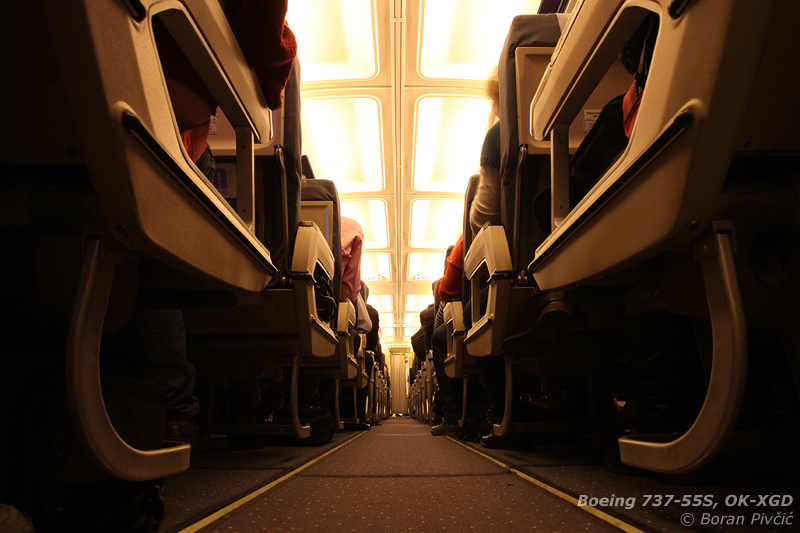
Leaving daylight behind as we cruise eastwards over Poland at 34,000 ftSeated right in the last row (row 29) I had a commanding view of the cabin... which I naturally decided to put to good effect :D. And while the cabin itself is clean and tidy, its dated design - especially the overhead passenger lights and vents - gives away the aircraft's ageAll calm and quiet as the cabin crew dim the lights for landing at Warsaw. I had dearly wanted to nag a visit to the cockpit, but the short duration of the flight - just a tad over 45 minutes - meant we just had time to climb, help ourselves to the drinks cart, and then prepare for arrival 🙂
Even though, by most accounts, early February should have seen continental Croatia declared missing under a thick blanket of snow, this year’s odd weather patterns – already having thrown most long term forecasts into the rubbish bin – have decided to treat us to some unusually fine and warm weather instead :). After a month of dull, low overcast and sub-zero temperatures, this week’s clear sunny skies, just a whiff of cirrus clouds and temperatures hovering at around 15 Centigrade were a godsend – and having been deprived of flying for almost two months, I was eager to use this calm spell well and finally log my first few hours as a certified CPL pilot :).
But, there was a twist: in what had met with near universal shaking of the head, the operator of Lučko had failed to renew the airfield’s operational certificate at the end of 2010., leading the Civil Aviation Authority to quickly suspend most operations from the field. And while sport and private flights are still allowed on an “at your own risk” basis – despite the fact that not a single blade of grass is different than in 2010 😀 – commercial and training operations have been banned outright for an indefinite period of time. While it may seem that all is not yet lost, these operations account for the bread and butter of most aircraft operators at Lučko, forcing virtually the entire “fleet” to relocate to Zagreb Intl. (LDZA, locally known as Pleso) until everything is sorted out…
Airfield? This is more of a "ghostfield" if you ask me... only seven aircraft were at the field when I had last visited, two of which - being non-airworthy - were unable to do anything about it. Subsequently, two of the remaining four had flown over to Pleso, leaving Lučko empty and desolate...
However, flying out of an international airport does have its advantages – especially if you own a camera and do not hesitate to use it :D. The more vibrant and dynamic traffic picture at Pleso was bound to produce some interesting aircraft movements, while the 3+ kilometer paved runway meant you could operate at will and not have to worry about morning dew soaking up the notoriously mud-prone Lučko…
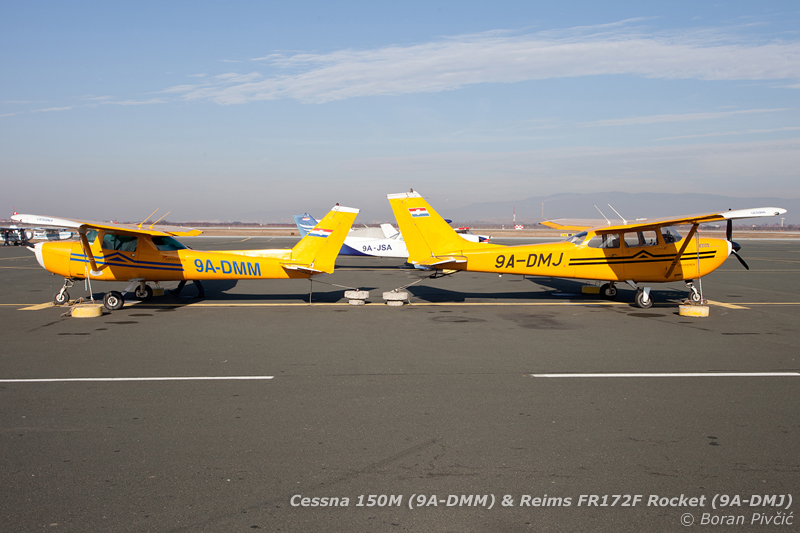
Now all we need to do is tie their tails together with some rope, put two canisters of avgas in front of each one and watch what happens next :D. With most of our Lučko fleet relocated to LDZA, the general aviation apron was becoming awfully cramped. So to make the best use of the limited space available, our parking solutions took a turn for the creative :D.On final for RWY 05 after a pleasing afternoon aerial photography flight :). While not particularly impressive as an international gateway, Pleso has everything you really need for a smooth operations, including a CAT IIIb ILS and full runway and approach lighting (visible here are the last segment of the so called "Calvert approach lighting system"). The runway, 3252 by 45 meters, can accommodate anything up to and including the 747 and 777. The general aviation apron, easily recognizable by its darker pavement, is to the right of the photoMilliseconds from touchdown right on the piano keys! Even though we have 3000+ meters of runway available, when landing on 05 we usually practice putting the aircraft down as soon as practically possible so we can hit the brakes and vacate the runway via taxiway Bravo, located 350 meters from the threshold. This not only moves us out of the way of much faster commercial traffic, but also allows us to taxi directly onto the general aviation apron without having to go past the entire main apron - again freeing up space for the big birds :).The apron itself did not disappoint either :D. All lumps, bumps and antennae, this purposeful looking RC-12K Guardrail is actually a SIGINT - or "signals intelligence" - aircraft, whose mission is to prowl the skies listening for new and unknown frequencies of hostile search and fire control radars and/or intercepting communication transmissions over a wide range of frequencies (hence the antennae). Quite secretive otherwise, this example belongs to the US Army, and is based on the not-at-all warlike Beech King Air A200 executive turboprop (or more precisely its military utility version, the C-12 Huron) - and was in town most probably to participate in a NATO exercise over the mountains of central Croatia. Interestingly enough, only nine K models were ever made, and this specific example is the first of the lot 🙂Looking beautiful at the small grass strip of Zvekovac (LDZE), some 15 minutes of flying time away from Zagreb. Calm and quiet, it was a perfect destination for a short flying getaway to catch some air outside the CTR :). The flock of sheep standing several meters behind me though were not amused by our rather noisy arrival :D.
Despite completely disregarding normal University working hours – neither the first nor the thing to do so 😀 – my ongoing Multi Crew Coordination (MCC) simulator course had turned out to be a more fulfilling activity than I had previously anticipated; not only has it introduced me to the essentials of operating multi-pilot aircraft, but its late-night five-hour simulator sessions – sometimes running into the wee hours of the morning – have also provided me with valuable insight into the odd working hours of the professional flight crew. But for the photographer in me, there was also the quiet satisfaction of having a deserted, dark hangar – and my always ready camera – to play with :D. And while there were very few photo opportunities – with most aircraft temporarily relocated to Zagreb Intl. – I decided to make the best of the situation… 🙂
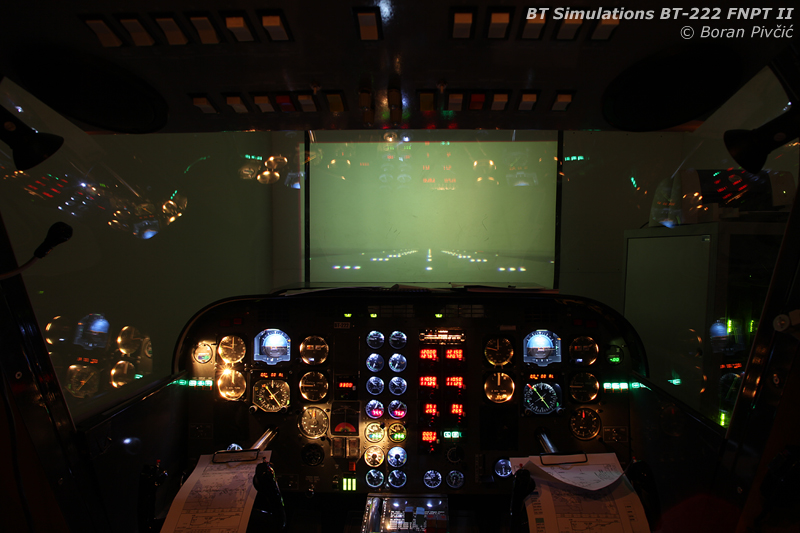
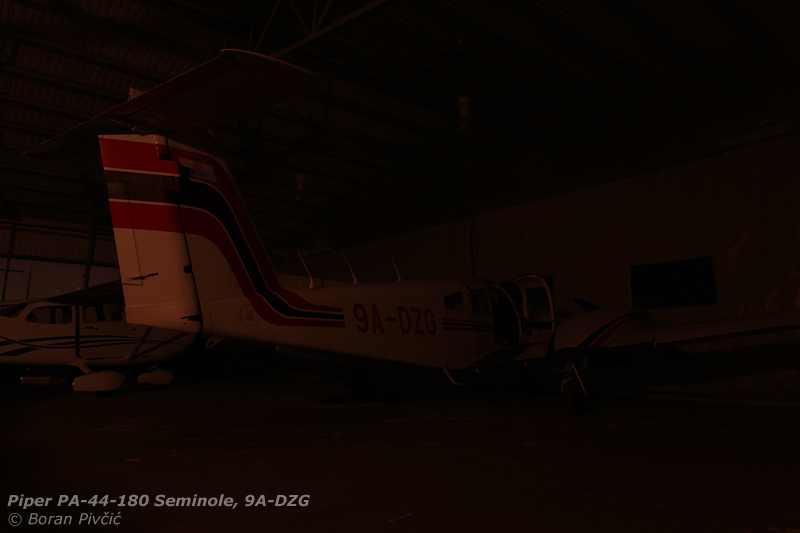
The Office :). Noticeably more complicated than the Seneca-based BT220 previously featured on this blog, the BT222 - produced by the same company, BT Simulations of Austria - is designed to simulate a "generic turboprop", but is in fact closely based on the Piper Cheyenne IIIA slightly different view from "the jump seat". While not the most advanced or modern training device to see the light of day, the BT222 has all the ingredients required for the basic MCC course: dual instruments for both crew members, an autopilot to help reduce the workload - and numerous "failable" systems to keep you on your toes :). The approach charts you see clipped to the yokes are for Pula airport's (LDPL) VOR/DME approach for runway 27, which my teammate and I had just completed with flying colors (literally as you can see) 🙂Lit only by the soft glow of the "Simulator run in progress" light, DZG and DZA (a Cessna Skyhawk SP) wait out another cold night in the hangar. Sitting here in the evening quiet, they keep reminding me of old, abandoned aircraft scattered in the underground tunnels common to several military bases in this part of the world...
Despite having stated on numerous occasions that I’m not much of an airliner person, every once in awhile I like to give the “guilty pleasure” of airliner photography another shot, especially if expecting to see something rare, interesting and exciting – or Russian, which essentially boils down to the same thing :D. So, feeling a bit photography deprived, on January 9th I decided to join my spotting colleagues on a short trip to Salzburg Airport (ICAO: LOWS) in Austria – an airport locally famous for its abundant Russian and CIS ski charters – and try to kill two birds with one stone… 🙂
However, while the words “Russian and CIS ski charters” tend to conjure up images of noisy, smoky and flaky Soviet-era jets, the actual traffic picture in Europe (or more precisely, the EU) is quite different. While the mentioned aircraft are still happily flying and making economic sense for their operators outside the European mainland – with cheap maintenance and (in most cases) readily available crews, spare parts and service networks offsetting their higher fuel consumption – the EU’s stringent noise and pollution requirements have banned many of them from operating in European skies. And while many CIS airlines are not losing any sleep over this – flying mostly in the lands of the former USSR – charter airlines that tend to operate a significant amount of flights into the EU have had to adapt and switch over to more modern equipment. Thus in the end these “Russian and CIS ski charters” have actually turned into an almost endless stream of A319/320/321s and 737s in virtually every imaginable variant – all fine and quiet, but hardly that exciting :).
And yet, “modern equipment” does not necessarily equate to “Western equipment”, so there still were a couple of gems to be found in the now bleak timetable – two of which were the very interesting, and very rare, Ilyushin Il-96-300 :).
Designed in the late ’80s, the Il-96 was conceived as a somewhat shorter, but thoroughly modernized, development of the earlier Il-86, the USSR’s first – and only the world’s second – widebody quad jet. Despite being a quantum leap in many respects over contemporary Soviet passenger aircraft, the Il-86 had still suffered from the same problems that had ailed the rest of the USSR’s aviation industry: a comparative lack of system automation, and inefficient engines. While the former was eventually rectified to an extent – with the Il-86’s original four-man crew eventually reduced to three – the latter issue proved to be much more troublesome. Even at the best of times, the four Kuznetsov NK-86 low-bypass turbofans had to labor hard at high throttle settings to move the rather heavy aircraft, while their low mass flow (as compared to modern high-bypass turbofans) did very little for fuel consumption and overall efficiency – not to mention noise levels. So when all was said and done, the large, imposing Il-86 had boiled down to just a thirsty, underpowered (but nevertheless reliable) medium-range airliner of limited usefulness outside the USSR.
While - with 106 airframes produced - it cannot be said that the Il-86 was a total failure, its outdated engines had certainly played a large part in this limited production run. Often referred to as a "bypass turbojet" rather than turbofan, the NK-86 was based closely on the earlier NK-8, an engine well-known for its distinctive - and fantastic 😀 - high-pitched while at idle. Powering too early versions of the Il-62 and Tu-154 - as well as, in modified form, the Tu-144 supersonic transport - the NK-8 was quite an innovative engine back when it was designed in 1961; but, despite its reputation for reliability, by the Il-86's time it was essentially an uncompetitive relic
1. Born on the 9th of December:*
Yet for all its faults, it was clear that the basic design still had some potential in it, and that what was really needed was to bring it up to date with an infusion of modern technology :). So in an attempt to cure the Il-86’s ills, in the mid-80s the Ilyushin design team took its basic shell, shortened it a bit, and then set about looking for the most advanced stuff they could screw into it…
The resulting Il-96-300 – first flying on 28 September 1988 – was as much of a leap in its own right as the old Il-86 had been back in the 70s, featuring technologies previously unseen in Soviet passenger aircraft; including a full triplex fly-by-wire control system, more efficient supercritical wings with composite flaps and winglets, and an all-new six-screen glass cockpit conforming fully to ICAO navigation and ATS requirements. But more importantly, the new aircraft had dispensed with “traditional” low bypass engines and gone with the far more modern, quiet and economical Aviadvigatel PS-90A high-bypass turbofan then just entering service.
And sure enough, all of this had immediately opened a lot of doors for the new aircraft: a maximum range of 12,000 km (6,500 NM) with some payload restrictions meant you could comfortably reach the edges of your route map – indeed, this was 2,000 km (900 NM) better than the USSR’s long-range champion, the Il-62M – while the quiet, Stage III-compliant PS-90 engines meant you could operate unhampered from noise-restricted major airports. Once there, the ILS CAT IIIa-certified avionics allowed you to land in virtually any weather, while the new FBW system assured you a safe and comfortable ride along the way :).
However, while the above should have been the making of a classic success story – at least where the USSR’s dominant airline, Aeroflot, was concerned – the Il-96 had nevertheless ran up against few issues that would ultimately turn it into a bigger commercial failure than the aircraft it was developed from. One of the lesser ones was the very glass cockpit that was (seen as) such a step forward from the Il-86: despite its six-screen, full-color splendor, the Il-96 flightdeck still retained a Flight Engineer, in charge of the aircraft’s numerous subsystems. While this may not seem like a show-stopping issue, it did underline a weakness of the Soviet-designed digital avionics – the still-present lack of automation and aircraft system integration. The system did a good job of presenting flight, navigation and some system data, and as such went a long way to improving safety; but that being the sum total of its functions – and lacking aircraft-wide “reach” and control ability – it was operationally and financially little better than a set of TV screens with some interesting features :). This was all the more evident when compared to Western attempts at “digitalization”, all of which had managed to turn three-man steam-gauge cockpits into simpler and cheaper to operate two-man EFIS units within the same aircraft type (as well as Airbus with the A300, McDonnell Douglas had managed to pull off the same trick with the little-known “MD-10”, standard DC-10Fs equipped with a glass cockpit and operated for a time by FedEx pending the arrival of the full-blown MD-11F. The parallel is even more striking when you consider that the upgraded Il-96-400 – sporting a more modern glass cockpit suite – is a two-man machine!).
While it may be lacking compared to similar Western solutions, the cockpit is also symptomatic of another – and diametrically opposed – “issue” that had a hand in the Il-96’s abysmal production run. This one could best be illustrated by comparing the Il-96 with your “everyday” Soviet airliner of the late 80s and early 90s, say a Tupolev Tu-154B. On one hand you have an aging 60s design with a three-man crew, analogue cockpit, and proverbially as much automation as a doorknob. Seemingly built from forged steel – and repairable by a hammer (and sickle :D) – it was designed with toughness rather than economy in mind, reflected too by the simple and reliable, but not even remotely economical, 60s engines out back. Noise and pollution probably didn’t even figure in the design stage. Then on the other end you have a refined modern design with digital avionics, upgraded systems and a wing designed for cruising efficiency rather than sheer survivability, built too using modern state-of-the-art materials. Underwing, you have a new generation of quiet, fuel-efficient, FADEC-controlled engines with little commonality to the engines used by a majority of the Union’s jets. For any (ex-)Soviet airline of the day, undertaking this seismic shift would have incurred a radical reorganization of maintenance, training, fleet management and so on. Spare parts – new and still expensive – would have to be distributed among maintenance bases and destinations, while whole airports may have to be upgraded to properly handle the new aircraft. Flight, cabin and ground crews would have to get to grips with the new aircraft and its systems – and this would take a lot of time… and even more money.
Why the above was an issue in the first place – given that the introduction of modern types into CIS airlines is commonplace today – leads to the Il-96’s biggest problem: the fact that it was born in the worst possible time… leading to and during the breakup of the USSR. Just a short year after the prototype’s first flight, the Eastern Block – and with it the USSR – would begin to rapidly crumble, taking most of the Union’s aerospace financing down with it. Quickly becoming just a shadow of its former self, Aeroflot – now split into almost 300 (!) regional companies and without the vast resources of the Union to call upon – found itself in no position to go on a shopping spree. Likewise, the hundreds of airlines it created – limited to a great extent by the still unstable economies of their respective countries – were in an even worse position, quickly falling back onto cheap, plentiful and proven Tu-154s, Il-62s and even the odd turboprop Il-18. So the modern and capable – but quite expensive – Il-96 had at a stroke become redundant…
* for those not aware of the significance of this date, 9 December 1991 was the day the USSR was officially dissolved
2. Cliffhanger:
This situation was short-lived however; by the end of 1992, things had started moving in a slight upward trajectory again, and the slowly recovering economy had allowed Aeroflot to finally introduce the type into regular service – if anything to cover the increasingly pressing need for a modern, competitive aircraft. But even this was beset by problems: while the economy was indeed recovering, it was doing so at a snail’s pace, and was unable to support anything more than an occasional trickle of new-build Il-96s. Indeed, by the turn of the century, only 12 production-standard -300 series aircraft were made, with an all time high of just three aircraft per year (in 1994) – and no aircraft at all between 1995 and 1997.
The seemingly final nail in the Il-96’s coffin, as far as commercial success was concerned, came ironically from the very economy that had started its low-key production in the first place, helping to save it from the garbage heap. By the time the financial situation in Russia (and the CIS) had picked up sufficiently to allow for a meaningful fleet renewal program – around the year 2000 – the market was now open to some serious competition from the West; the Il-96-300, still burdened by all of its issues, was now up against the technological and industrial might of both Airbus and Boeing. And despite being up to 30% cheaper than equivalent aircraft from the Big Two – and being home-grown – the outcome was rather predictable: faced with the technological superiority and operating economics of the 777, the Il-96-300 was once again made redundant.
And yet, despite knocking on the scrapman’s door for the second time running, the Il-96-300 had nevertheless managed to cling on – but just barely :). A new lease of life came in 2006 with an order for three aircraft from Cuba’s national airline Cubana – though, to be honest, this had less to do with the Il-96’s qualities as a machine than the fact that it was the only new long-haul aircraft available that could dodge the long-standing US embargo. A further infusion of orders came from Russia’s “secondary flag carrier”, Roosiya, which had ordered four aircraft in 2007 – an order still keeping the production line open (which says much about the rate of production).
Knowing full well – even before it came face-to-face with the 777 – that a lethargic production run like this could very well be the Il-96’s future, the engineers at Ilyushin had decided in the mid-90s to “pull an Il-96 on the Il-96” and put it on a crash course of serious modifications like they did with the old Il-86 :). To this end, they stretched the fuselage back to ’round about that of the Il-86 and – in what was one of the precedents of Russian-US cooperation at the time – went overseas to ask for tools to mend the aircraft’s other ills :). These eventually took the form of a highly advanced Western glass cockpit system – which had dispensed with the Flight Engineer once and for all – and Pratt & Whitney PW2337 turbofans to replace the still not-as-efficient PS-90As and give the aircraft a shot on the international market. Designated the Il-96M – for modifikovany, or modified, a common designation on Soviet/Russian/CIS aircraft – the aircraft had stood quite a good chance at being a viable local alternative to Western designs… right up until the still fluctuating economy in Russia caused American investors – who’d be financing the avionics and engines – to pull out of the program. So on all fronts, it was “Economy: 3, Il-96: 0.5”.
3. Fortune 400:
At this point, the Il-96 started making a name for itself not for its somewhat troubled, yet essentially solid design, but for its sheer refusal to give up and die :). Having seen what the Il-96M – and its projected cargo variant, the Il-96T – could have been, the Ilyushin team dreamed up the Il-96-400, and its cargo version, the Il-96-400T. In essence, this was an Il-96M fuselage that reverted back to the PS-90 engines (now in their A1 variant), but had included a far more modern and capable Russian glass cockpit that, like the one on the Il-96M, didn’t require a Flight Engineer.
First flying in cargo form in 1997, the -400 had at first seemed like another lame duck: indeed, only one -400T was completed in the 20th century, while the passenger version had failed to drum up any concrete interest whatsoever. But the design persevered – one really has to admire Ilyushin’s dogged persistence with this one 😀 – and in 2007 had finally caught some wind in its sails: six examples were ordered by cargo operator Polyot, with four still waiting for completion (according to the latest data)…
In the end, given what the whole Ilyushin team had been through with the Il-96, it makes for some sad reading that the total tally for the all marks stands at just 27 examples, including the three prototypes and test aircraft that were broken up following the end of the official acceptance tests. Of the production models, only 17 – 14 -300s and three -400Ts – are known to be flying, which makes catching one a tricky game of chance…
4. Skiing (charter) competition:
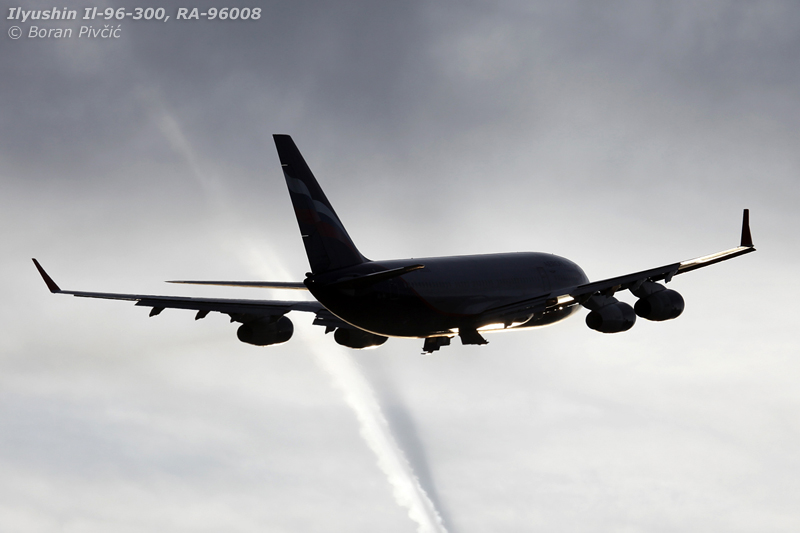
Back in Salzburg, we counted ourselves very lucky that we’d managed to catch two – and in a single day at that 😀 (that’s essentially 12% of the entire flying fleet). The aircraft in question were RA-96007 (mfd. 1992) and sister-ship RA-96008 (mfd. 1993), both stock Il-96-300s operated by Aeroflot as ski charters from Moscow’s Sheremetyevo airport. Of interest here is the unique registration system adopted for low-production aircraft in Russia/CIS: the first two digits represent the type, and the remaining three the aircraft’s place on the production line (note, this does not equate directly to the serial number; RA-96007 for example is the 7th Il-96 ever produced, but its serial of 74393201004 denotes it as the 4th production example. There can also be some major discrepancies: the Il-86 featured in the previous photo is registered RA-86124 – but there were only 106 produced, including three prototypes. The aircraft is actually the 92nd production example, and the 95th Il-86 produced).
So, having arrived in the wee hours of the morning – intent on getting some night photography in while we’re there – we quickly set to work… 🙂
There's no better way to start the day than with some Russian heavy metal :D. The first Il-96 of the day is seen here cooling down after its 5 AM arrival, ready to depart back to Moscow within the hour. Another interesting item is the aircraft's name, printed in Cyrillic underneath the cockpit. According to Aeroflot tradition, each aircraft is named after a famous Soviet/Russian person, with "professions" being assigned by aircraft type. Il-96s are named after pilots, with RA-96008 carrying the name of test pilot Yakov Moiseyev 🙂Cleaning her up after a spirited departure from RWY 16, with another high flyer providing a suitable background. "Schastlivago puti" - or have a nice trip - to them all!
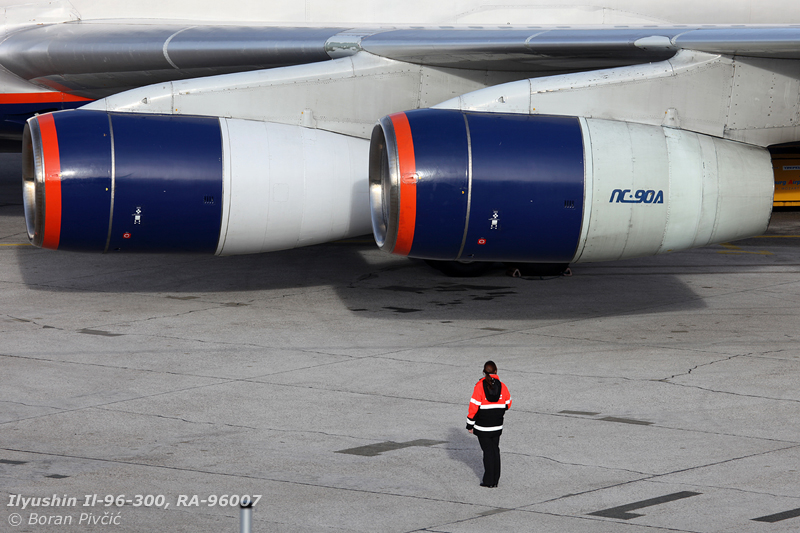
I don't know why, but "I'm a little teapot, short and stout" always pops into my mind when I see the Il-96 :D. Noticeably shorter than the Il-86, the Il-96 is quite handsome in a brutish sort of way. In keeping with the naming tradition explained above, RA-96007 is named after Alexey Mayorov, personal pilot of both Brezhnev and Gorbachov(Wo)man vs machine :). A ramp agent looks on at the port side PS-90As as the passengers begin to disembark. Apart from being one of the few "Eastern" engines to measure up to their Western counterparts, the PS-90 is also the first high bypass engine produced by the former Soviet engine industryAnother nose view. With its chunky, solid appearance - and painted in Aeroflot's fantastic color scheme - the Il-96 is hard to miss on any ramp :). It's a quiet thing too - not something you'd normally expect from something with an RA reg 😀
While it does little for raw cross-country performance, rumbling along at a 100 or so knots in your stock Skyhawk does have a raft of plus points – especially if you are a photographer :D. Flying mostly in good weather conditions, on an aircraft that is the definition of predictable, and at speeds about the same as those on the highway you are following, the sedate Skyhawk (or the C150) often allows you to wander around a bit, look outside and enjoy the scenery… and, if you already count your photo equipment as part of the plane’s empty weight, snap a few nice shots as well! 🙂
With this in mind – and with nothing new happening on the local aviation scene – I went back to my photo database in search of some interesting airborne shots, shots that show what the view is actually like up here :). And this is what I came up with…
Cruising leisurely westwards against a 20 knot headwind 1500 ft above the Slavonian flatlands. Croatia’s most important farmland region, Slavonija is not particularly exciting flying-wise; but it is rife with disused concrete airstrips formerly used by agricultural aircraft. Measuring at 600-660×10 meters, most are now in a poor state and not usable on a day-to-day basis… however, should your engine – your only engine! – decide to quit, they can come in very handy for an emergency landing (so much so that I’ve devoted this – and a few other flights – to scouting them out 🙂 )
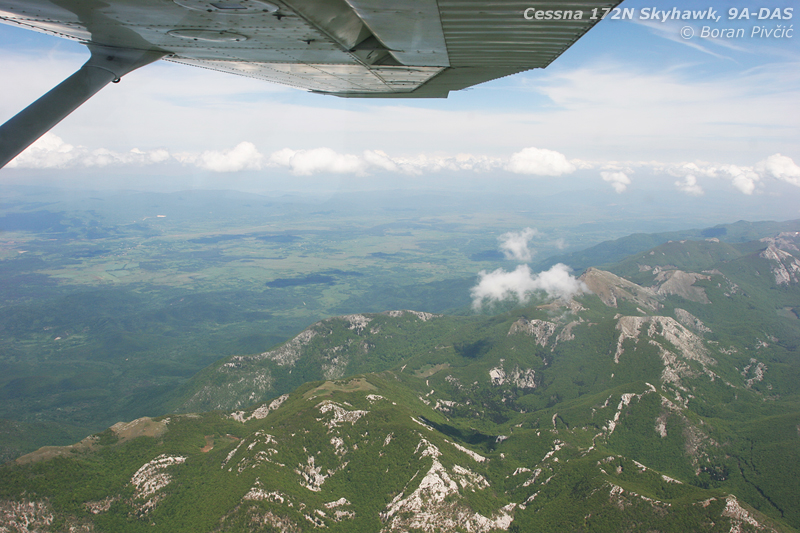
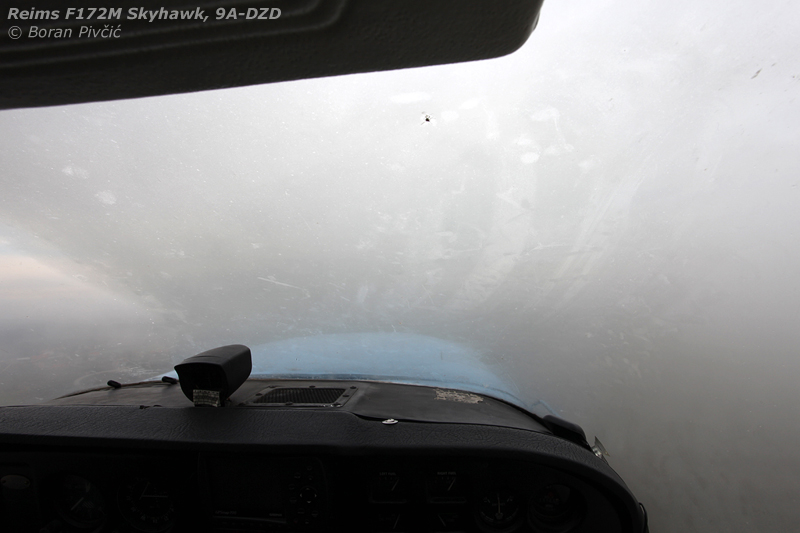
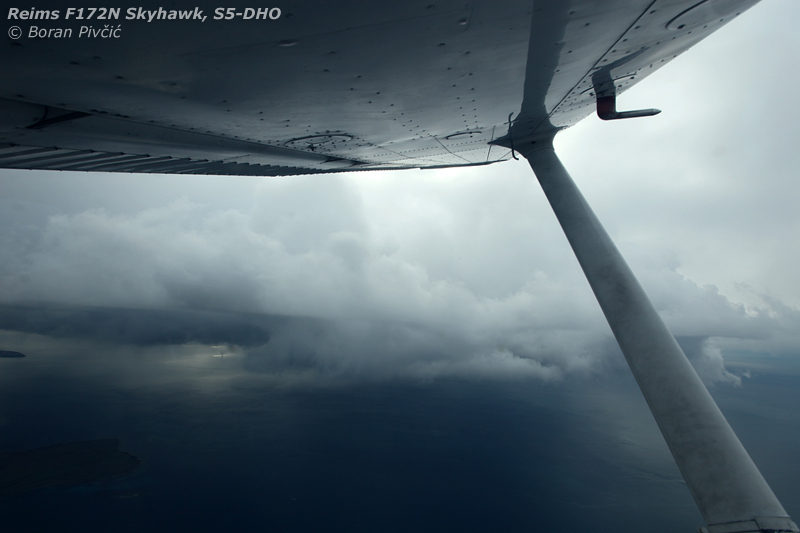
An interesting view of the Velebit mountain range during a prolonged and laborious climb to 8,000 ft on a very hot May day. One of the southern extensions of the Alps, the range peaks at about 6,000 ft, but rarely goes above 4,000 in most places (like here) – on the face of it, hardly impressive figures. However, running perpendicular to the two strong prevailing winds in this region, it can be very treacherous when the windspeed picks up…Finally at 8,000 ft and preparing for a spot of light turbulence. The slope of the continental side – running northwest to southeast – gives an indication of the strength of the mountain’s infamous updrafts and downdrafts. Most pronounced during the “bora” northeastern wind – whose speeds often go above 50 knots – the very strong mountain waves created have over the years claimed dozens of lives… rising steeply on both sides, the Velebit range also splits this part of Croatia into two distinct weather systems: a mild Mediterranean climate on the coastal side, and a moderate continental on the other. The changes between them can be quite pronounced – you can fly in sub-zero temperatures, fog and low cloud on one end, and end up in +15 Centigrade, unlimited visibility and clear skies on the other – all in the space of about 10 miles…Something less mountainous for a change :D. Flying 1,000 ft above the hilly region of Zagorje, on a beautiful – but very windy – day. One of the northernmost regions of the country – just 10 minutes from Lučko as the Skyhawk flies – Zagorje is the realm of the student pilot :). With its numerous small villages, abundant roads and railways, and mild terrain, it is almost perfect for every student’s first cross-country flight… (including the author’s)Instant instrument conditions – just add water :D. Taking off from Lučko on a cold and very humid morning, it was only a matter of time before the windshield fogged up. The warm air vent on the pilot’s side had immediately cleared the problem up – but in the copilot’s seat, I was left with less than impressive forward visibility 🙂More dramatic weather photos as I skirt the edge of a stormcloud near Lošinj Island. The first sign of the approach of a huge front moving northwards across the Adriatic Sea, this particular CB is classified as “embedded”, that is hidden in other clouds and therefore virtually impossible to spot from a distance – unless it is pouring rain, like here 🙂Sunset over the Bay of Trieste in Italy as I cruise at 5,000 back to base at Portorož in Slovenia :). The previously mentioned weather front can be seen approaching from the south, blending together sky and sea – perfect conditions for one of the biggest killers in aviation: loss of spatial orientationClear skies, clean air and not even a whiff of turbulence – what a wonderful day to go flying! Just trim the plane and let it fly itself… something I was very appreciative of that day while flying from Portorož to Venice :D. The unique airspace layout of northeastern Italy – defined in most part by the requirements of the famous Aviano airbase – means that the communications workload can be considerable: in the 45 minutes it took me to reach Venice, I was in contact with Portorož Tower/Approach, Trieste Radar, Aviano Radar, Treviso Radar, Venice Approach and finally Lido Information :D. Further adding to the workload was the dense traffic flying along the same coastal route as me, necessitating a continual scanning of the airspace around me
On the face of it, July was probably not the most enjoyable of times to have my Multi-Engine Class training. The summer’s record temperatures – once peaking at a toasty +55 Centigrade in the cockpit – really did us no favors at the best of times; and had certainly not done justice to our little, slightly underpowered Piper Seminole :). So keen to see what it – and I – could actually do given some favorable weather conditions, I was very much looking forward to my Multi-Engine Instrument training, slated to take place in the much more agreeable near-zero temperatures at the beginning of November…
Now, as mentioned in a previous post on the topic, flying a twin engine airplane is fairly easy – provided both engines are operating :D. When one decides to quit however, things can become interesting – still safe, but quite interesting nonetheless. The biggest and most immediate problem in this situation is the sudden lack of power – as my flight instructor had graphically put it, when you lose an engine, you don’t lose just 50% of the available power; in effect it’s as if you lose 75%, since you now also have the dead weight – and additional drag – of the inoperative engine. Specifically, it’s this drag that causes the biggest control problems: with one engine “dragging behind” and the other pulling forward, the airplane wants to yaw and bank around its center of gravity into the inoperative engine, a tendency that has to be neutralized by liberal application of opposite rudder (and possibly some aileron) :). With the rudder now deflected (at low speeds often fully), the drag increases yet again, forcing the airplane down to its speed for minimum drag (and hence minimum required power) – a flight regime that, especially during landing, requires considerable planning ahead…
When simulated for training purposes, this One Engine Inoperative situation also makes the aspiring student appreciative of the simplicity of the turboprop engine – especially if you’re flying a piston-engined Seminole, an aircraft seemingly designed to make your life then and there as complicated as possible :D. Given that many in-flight engine shutdowns are caused by small, easily-rectifiable problems rather than catastrophic failures, each aircraft has a specific set of “diagnostic” procedures the pilot needs to run through to verify whether one of the engines has indeed failed, identify the inoperative engine and – if all else fails (pun intended) – secure it. On the 100-cockpit-lever Seminole (though they’re broadly similar for other piston twins) these include:
moving both mixture levers forward into the Full Rich position – the idea being that maybe you’d forgotten to move them forward during descent and the fuel/air mixture had become too weak for the engine to run
moving both propeller levers forward. This may seem a bit odd given that one of the engines has failed or is in the process of doing so, but until you’re certain WHICH one it is, better have both props at their maximum
moving the throttles all the way to the Maximum Continuous Power setting, for the same reason
turning on the carburetor heaters (or opening the alternate air ports on fuel-injected engines) to see whether the problem is simply ice blocking the carburetor/air intake
turning on both auxiliary fuel pumps, in case the main engine-driven pumps had failed and no fuel is being drawn from the tanks
and then looking around to see whether you’d accidentally shut something off, like the fuel selectors or magnets
If once you’re done the inoperative engine still refuses to cooperate, you identify it and proceed with securing it – which is basically the reverse procedure to the above: close the throttle, feather the prop, cut the mixture and shut everything down related to the engine, such as magnetos, fuel pumps, alternators and the like… you may also have noticed that the above procedure is performed on both engines simultaneously; the rationale is that whatever plagues one engine can easily happen to the other – which is especially likely if the root cause is icing or incorrectly set mixtures.
Despite being a “screenfull”, out on the Seminole this procedure is pretty straightforward and comparatively simple – dare I say fun 😀 – in visual conditions: conditions where you always have a visible horizon and ground contact, and can afford to drift a bit off course while you get the hang of the airplane. In instrument conditions though that luxury is gone, with the only spatial reference you have provided by the instruments – which implies, in addition to everything stated above, continual scanning of the primary flight and navigation instruments and maintaining an image of your position and attitude in your head. Now factor in an ILS or VOR/DME approach and you have a party :D.
Given that during these flights I was want for a few more arms, I did not have the liberty to photograph at will as I usually do, so – after having drifted off course quite badly with this post 😀 – I thought I’d just throw together a small photo gallery of the ME/IR “tools of the trade”… 🙂
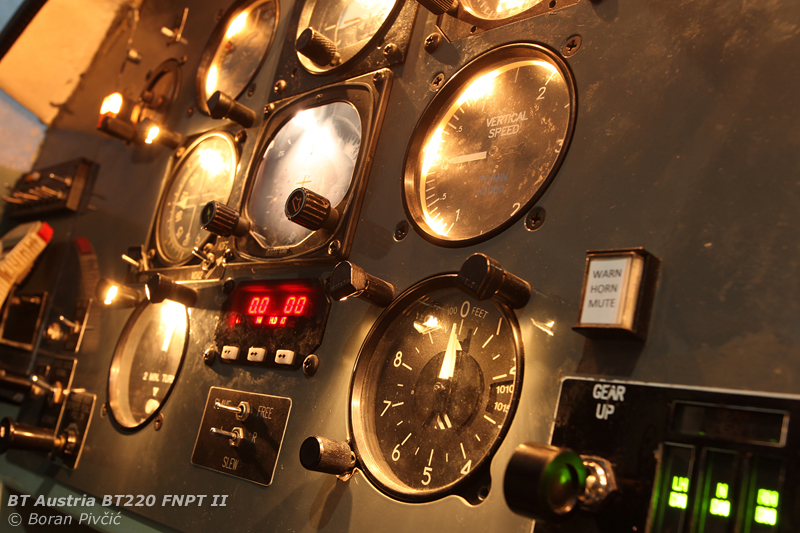
For us "modular course" types, the ME/IR rating also includes three hours on "the simulator" - our good ol', not-entirely-trusty BT220, produced by BT Simulations of Austria :). Though universally referred to as a simulator, the BT220 is actually a "Flight, Navigation and Procedures Trainer II" (FNPT II) - to be a fully fledged simulator, it'd have to be "full motion", that is be able to pitch, yaw and bank like the real aircraftThe copilot's view with the seats moved fully back. Representing (broadly) the Piper Seneca III, the BT220 has everything you really need for any sort of IFR training: an HSI and CDI, two ADFs, two DMEs - and an extensive list of failure options 😀Cooling down after a grueling two-hour training session. Far from being just a cheap replacement for the real aircraft, "the sim" allows for very useful training for real life emergencies: during this session, we had multiple engine failures, system failures, instrument malfunctions, electrical and fuel issues, landing gear failures - not to mention weather related issues such as heavy icing, heavy turbulence, gusting wind and low-visibility operations. Though we'll probably never encounter such a pessimistic combination of conditions out in real life, the lessons learned from them can do wonders when something really does go wrong on the actual airplane...Dripping wet after an hour's worth of flying though rain while shooting some ILS approaches. Apparently all of my instrument flights are doomed to either cloud and low visibility, heavy turbulence or pouring rain 🙂 (fitting, isn't it?)At least we gave the Seminole a thorough - and thoroughly ecological 🙂 - wash! She was clean as a whistle when we were done!Back in the dry in the University's hangar. Like many small twin-engine Pipers, the Seminole is equipped with contra-rotating propellers, eliminating the dreaded "critical engine" and all of its associated negative effects (at the expense of more costly maintenance)9A-DMG, the Cessna 172N on which I'd passed my Single-Engine Instrument checkride, framed by 9A-DZG on which I'd passed my Multi-Engine Class, Instrument and CPL checkrides :). If they were people, I'd be thanking them now 😀
And finally, honorable mentions go to two photos I’ve snapped in flight with my mobile phone… due to a somewhat “expedited” departure from Pleso airport, I’d left my camera in the luggage compartment and couldn’t get at it in flight – so I had to use whatever I had at hand… 🙂
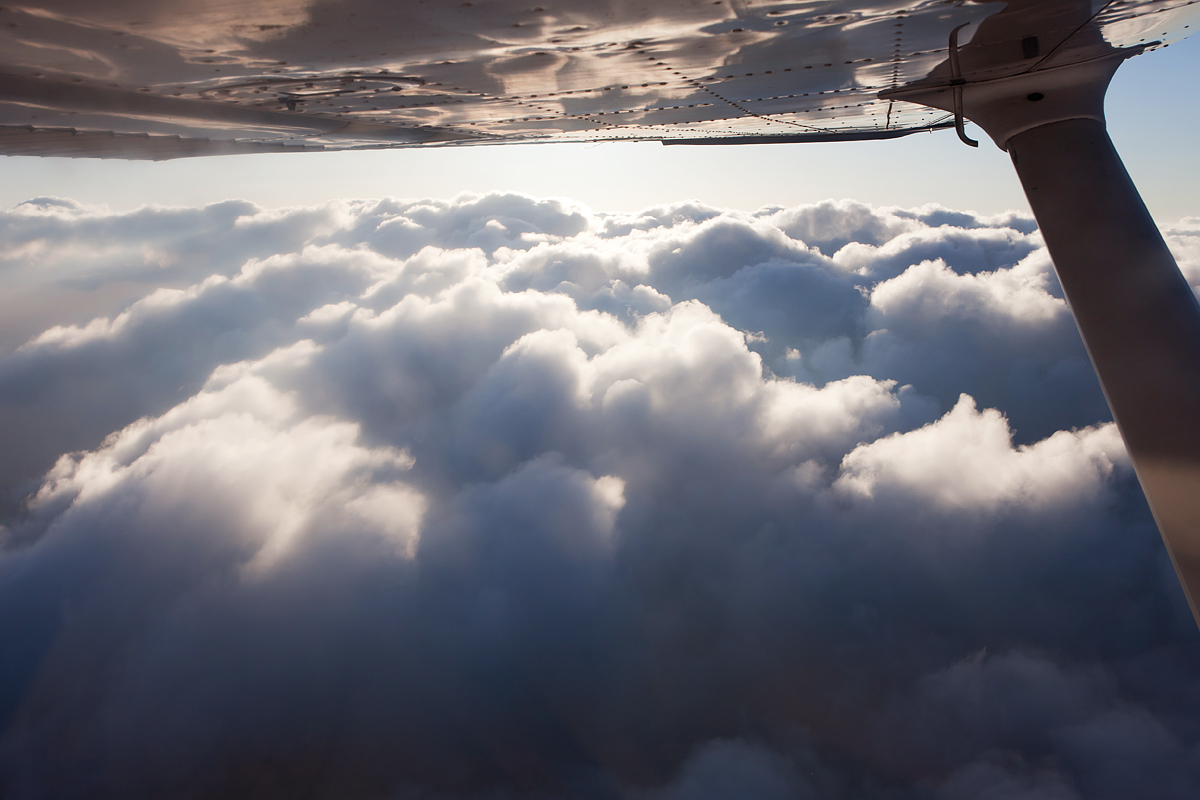
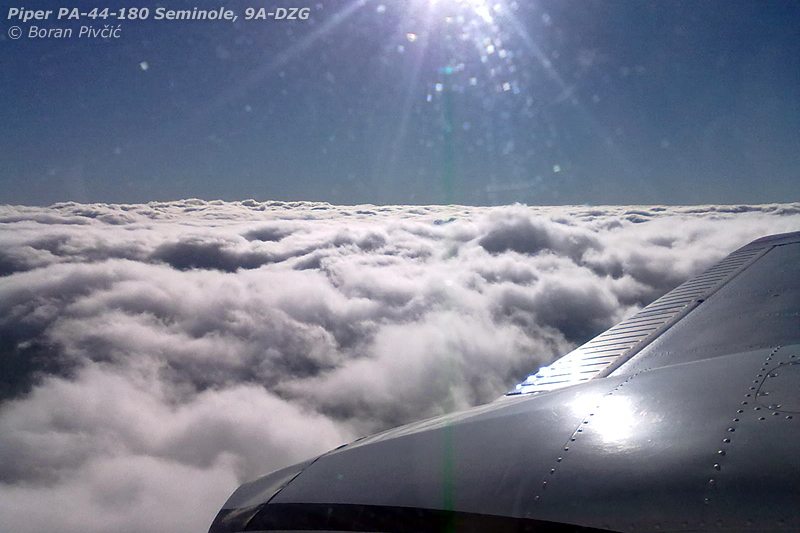
There really are very few things that are as enjoyable as a flight above the cloud deck :). Cruising at 6,000 ft in silky smooth air towards Maribor (ICAO: LJMB), the autopilot keeping the Seminole straight and true, and the scenery going from great to awesome! Moments before we break into the cloud deck at 140 knots on our return trip...
By me All photos me too unless otherwise stated, copyrighted
While this year’s game of Lučko Roulette – trying to fly your aircraft out before the field closes due to bad weather 😀 – has been generally successful, the constraints of the limited apron capacity at Zagreb Intl. meant that a few aircraft (notably those with a hangar above their heads) have nevertheless remained at the field. Faced with the prospect of them sitting idle in sub-zero temperatures until the runway melts and dries out – which can take awhile – the “flight ops department” of Aeroklub Zagreb had once again decided to clear out its hangar and give everything in there a thorough shakedown :).
While at first it may seem a bit pointless to fire up the engine, proverbially rev the bolts off it, and turn it off again without going anywhere, the procedure does have a host of beneficial effects. Primarily and most importantly, it allows the engine to periodically clear itself of all the deposits and substances that can (and will) accumulate in its piping and systems during a long stay on the ground. If left to settle firmly over the winter, these substances – the most common being carbon deposits on the spark plugs – can seize and/or severely damage the engine when it is finally started; but, if anticipated during these shakedown runs, they can be easily removed by simply revving the engine to raise the temperatures in the cylinders until the deposits burn away and the engine starts to run smoothly.
The same also applies to the oil system – which, on the face of it, is the very system that allows the engine to run in the first place. And while winter temperatures in Zagreb rarely go below -15 Centigrade – well above the temperature at which winter-grade oil thickens dangerously and freezes – the system itself has a number of moving parts (the most important being the oil pump) that are also susceptible to the above stated. Running the engine at a higher throttle setting allows the pump(s) to run up to speed and warm up, breaking off any deposits on their blades and bearings. In addition, the flow of oil through the system picks up any impurities that might have settled on the bottom of the pipes and deposits them on the (removable) oil filter, thus cleaning out the entire system.
The fuel system too needs some attention, mostly to purge it of water deposits that – inevitably 😀 – form in its low points. Being heavier and thicker than Avgas, water tends to sink and collect at the bottom of fuel tanks and pipes – and if ingested into the cylinders in a large enough quantity can cause a lot of (very expensive!) damage. By its very nature, water is incompressible; and when it winds up in the part of the engine DESIGNED to compress, something has to give… which is usually the piston 😀 (however, there are systems that inject water into the cylinders on purpose – but this is on a controlled and measured basis. These systems – usually known as Anti Detonation Injection, or ADI – squirt a small amount of water into the inlet pipes, which then absorbs excess heat in the cylinder and prevents uncontrolled spontaneous ignition, as well as providing a significant increase in power… as seen on the P-47 Thunderbolt 🙂 ). Thankfully, the unwanted water can be easily removed from the system by draining the bottom of the fuel tank using a special valve, as well as dumping the contents of the pipes at the low point of the system – usually just after the fuel selector normally mounted on the cabin floor – using a small lever in the engine bay.
Draining fuel from a wing tank drain valve on a Piper or Beech. A small amount of fuel is drained into a cup or bottle and checked for water, which would show up as a transparent sediment on the bottom – one of the reasons why Avgas is colored 🙂 (the other being that fuels of a different octane ratings are colored differently for easy visual recognition) (photo from: cdn.wn.com)
Less visible benefits of these high-power runs also include recharging of the battery, which will – again inevitably 🙂 – discharge or even go flat after awhile (as had happened to our Piper Warrior). The ready supply of electricity from the alternator allows too for a check of the aircraft’s other electrically-powered systems, such as the radios, flaps (where available), lights and so on…
However, before all of that, you first have to take care of one small detail – pushing everything out into the open :D. Normally this is not a problem – but our efforts that day were a tad complicated by the inch or two of fresh snowfall from the night before… 🙂
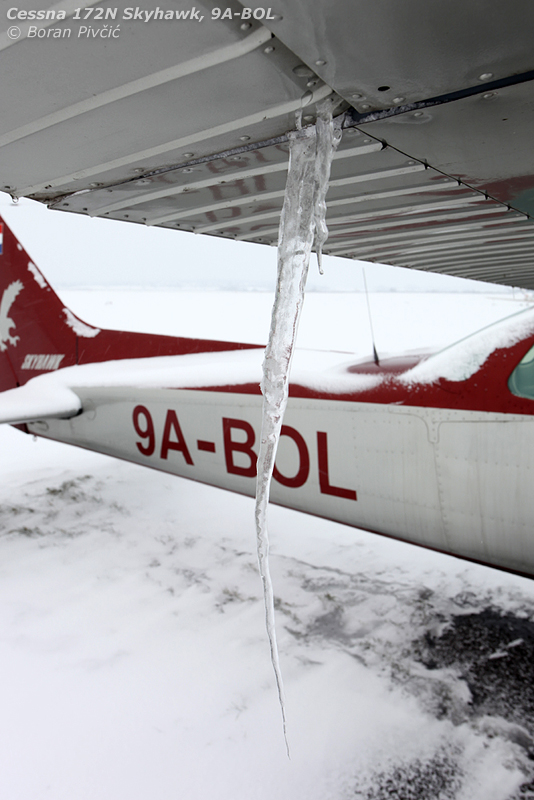
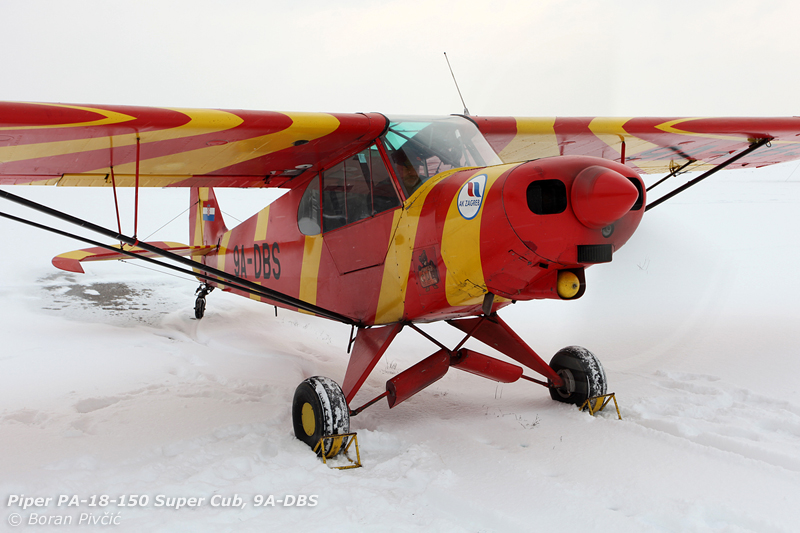
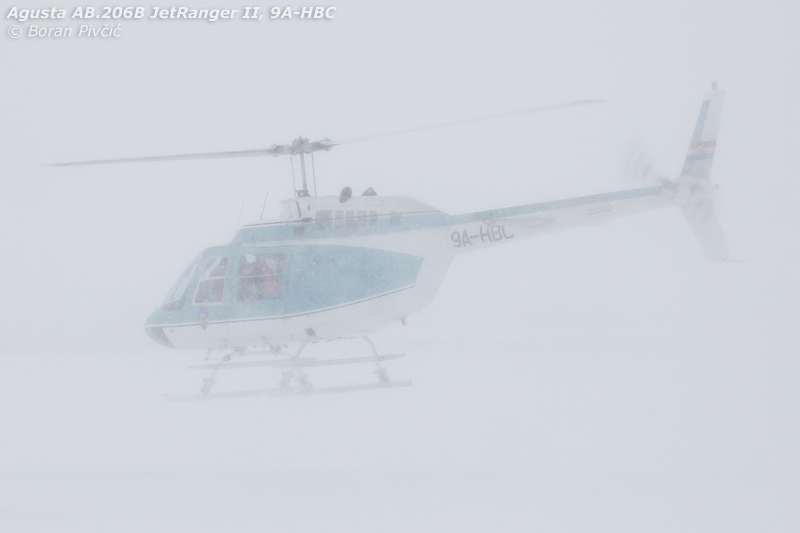
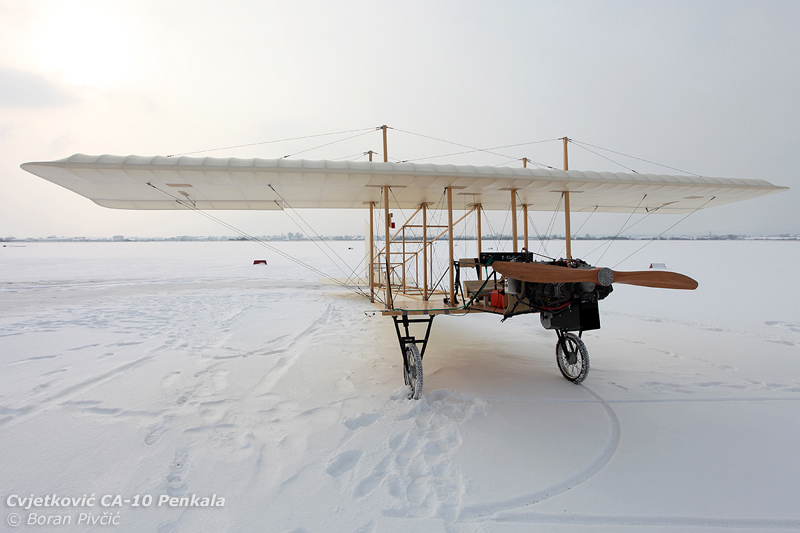
A welcome splash of color on an otherwise completely white Lučko. While it did us no favors with the main task of the day, last night’s snow – still ongoing at the time this photo was taken – did at least provide for some nice photo opportunities!The art of icing? 😀 Even more ironic given that this specific aircraft is usually based on the warm and sunny island of Brač on the Adriatic coast 🙂Preparing to fire up 9A-DDA, AK Zagreb’s very-rarely-seen Piper Warrior. Not having flown for ages, a flat battery is pretty much a permanent state on this aircraft, requiring the use of a Ground Power Unit for starting9A-DBS doing its best to clean up the airfield :D. Despite the odd childish impulse to gun the engine and see how big a cloud you’d create, these high-power shakedown runs have to be done with caution – especially on an aircraft like the Super Cub. With its high power-to-weight ratio, an unsecured Super Cub could – despite the brakes being locked full on – easily start sliding forward on the snow. To protect against that as much as possible, the wheels need to be secured with chocks, preferably dug into the snow (and if possible, it’d be a prudent move to tie the aircraft down)Complete and total whiteout as 9A-HBC lifts off from the main apron. Sporting a cabin full of Christmas presents – and even a helicopter-pilot-turned-Santa 🙂 – HBC was the centerpiece of a small celebration organized for the children of the Police helicopter squadron pilots. Now, what would an aviation-oriented kid have thought of that? a) look, Santa has flown in from the North Pole!, or b) look, Santa has been arrested by the Police for flying a multi-deer sled without a valid JAA license! 😀A modern replica of the first aircraft designed and built in Croatia – the Penkala P-3 of 1910 – looking gorgeous out on the snow during an ad-hoc photo shoot :). Not an exact one-for-one copy, the Cvjetković CA-10 Penkala has been modified with today’s aerodynamics knowledge (since the original hadn’t so much flown as hopped along) and an 80 HP Rotax, replacing the original 5-cyl radial :). Normally protected from the elements in the field’s various hangars, this was one of the few times 9A-XCA – as it had been registered a few months back – was seen out and about since September’s Lučko AirshowOil, smoke and fire as the I-3’s big M-14P radial labors into life. Not having ran for almost three months, the engine had normally put up quite a fight, spewing liberal amounts of oil from the exhaust during a number of previous startup attempts… also, like virtually all Russian/Soviet light aircraft, the I-3 uses a pneumatic system to start the engine – a system that normally depletes itself when not in use. To fill it up before the engine’s own compressor takes over, an external air source – such as the compressed air cylinder seen here – is necessaryCreating its own weather out back as the big prop revs to its maximum RPM. By the time the 10-minute run was finished, DOG had managed to clear half the apron 🙂
In a departure from my standard photographic norm, I’ve decided to try my hand at a “video report” and post a short clip (my first YouTube submission too :D) from an international flight I’d flown about a week or so ago. Having abandoned all attempts at completing my CPL time build in Zagreb’s increasingly horrendous weather, I soon retreated back to Portorož, Slovenia for the weekend, intent on nailing those four remaining hours while I still had my hand in with the local aircraft. While there, and looking for a creative way of burning two hours’ worth of Avgas, I decided I might as well head for Venice, Italy to finally see this fascinating city from the air (and notch up another international destination in my logbook 🙂 ).
Not really spoiled for choice landing-and-handling-tax-wise, my destination for the day was virtually self-selecting: the very interesting Lido Airfield (ICAO: LIPV) located on one of the city’s historic islands :). With a 1000×45 m grass runway, Lido – previously known as San Nicollo – is pretty much in the same class as my base airfield of Lučko, and is as such a popular and comparatively cheap destination for pilots flying into the city.
The only way to fully experience the architectural madness that is Venice is from the air :). Flying over the southern reaches of the city at 3,000 ft by grace of the fantastic air traffic controllers at Tessera airport (LIPZ), itself visible near the upper right hand corner of the shot. Also sorry for all the reflections... after several days of persistent rain the air was clean, the plane was clean, the windows were clean and the sun was out in force, all making for a technically challenging photo. Further complicating things is that I snapped this photo without proper aim, since I was holding the 1.5 kg camera at arm's length from the pilot seat (and hoping the settings I'd preselected worked) 🙂
And while my visit would amount to just 30 minutes on the ground – enough to stretch a bit and tidy up the mass of maps and charts littering the cockpit – it did give me the opportunity to make my first decent landing vid 😀 (however, my video editing skills and equipment are nowhere near their photo equivalents, so the quality does leave a lot to be desired). For a brief walk-through, the video starts at the end of the right-hand downwind leg for runway 05, goes through base (with a few views of Venice) and final, and ends when the uneven grass runway dislodges the camera from my makeshift stand on top of the panel :D…
































 Achtung, Skyhawk!