Photo File – One Engine For Short Haul

By me
All photos me too

While the met office tended to respond with much doom and gloom every time the summer of 2016 came up, out in the (air)field we had mostly been treated to beautiful flying weather all throughout the season, with gorgeous conditions from dawn all the way until the last dusk. This had particularly been true for the week preceding this article, with a large high pressure area over Europe responsible for skies clear as far as the eye could see (even from the flight levels).

Unsurprisingly, this turn of events had lured out many light aircraft all throughout the region, with plains, seas and hills alive with the sounds of pistons. By sheer good luck, this fine spell had seen me travel all over the place, allowing my camera to see what our little piston singles – and gliders – were up to… 🙂

One of only three aircraft on the Pula Airport (PUY/LDPL) apron greets a calm – and slightly foggy – morning. If you had a feeling that this is a bit too elegant to be a Cessna, you’d be entirely right… for despite the name, this is actually a Lancair LC-42-550RG Columbia, a speedy carbon fiber design that Cessna bought some years ago and started selling under its own brand. Like all Lancairs, the LC-42 is notable for its sleek aerodynamics, as well as an enviable power-to-weight ratio, with 310 HP hauling only 1500 kg of all-up mass. Coupled with a modern propeller, this ratio gives the Corvalis cruise speeds in the 340 km/h range – which puts this little “toy” in the same league with some turboprops…

A very welcome visitor to Lučko warming up prior to its afternoon hop to Vrsar Airfield (LDPV). Even though DYG looks at first like a stock late-model 172, details such as the three-bladed constant-speed prop, large exhaust and an air intake on the right side of the cowl reveal that it actually sports Thielert diesel muscle under the hood. A thorough rework of the 2 liter CDI unit out of the Mercedes A Class, the Centurion 2.0 can boast a maximum output of between 135 and 155 HP, and a consumption of only 20 liters per hour – significantly less than the 35+ of the standard avgas model. An additional benefit are the digital engine controls (FADEC), which replace the traditional levers fverniers for power, propeller RPM and mixture with only one jet-style lever…

Proof that even airline pilots are not immune to the call of light aircraft! Briefly swapping gas turbines for cylinders, the crew of OM-M902 prepares for a one hour joyride on and around Lučko. Still pretty rare in Europe, the Jabiru family ranks among the most successful Australian light aircraft programs in recent years, and already pretty much has a cult following in its home state. An interesting detail is that the majority of Jabiru models use the company’s own engine – in this case a 2.2 liter petrol four-cylinder engine developing 80 HP for takeoff.

A mint Reims-built C172P of the Motorfluggruppe Zürich potters calmly along taxiway Alpha at Zürich Airport (ZRH/LSZH) following an afternoon arrival into RWY 28. Despite the airport handling hundreds heavier aircraft every day – ranging from regional turboprops to intercontinental widebodies – it still manages to seamlessly integrate its resident GA population into the traffic flow. In what is almost a case study of Swiss efficiency, the airport manages this through IFR-style regulation of VFR traffic, including strict departure routes and procedures (intended to keep light traffic separated from the big boys and on known tracks) – and even VFR slots, specific periods during the day when commercial traffic is slow enough to permit unhampered operations on both sides.

The newest resident of Lučko just starting to roll towards RWY 28 for another skydive flight. The permanent replacement for C210 9A-DZP – which had been written off in a landing incident – G-MILN is also one of the most well-kept classic Cessnas in Croatia, and had accumulated only around 1300 flight hours since its completion in 1977 – and with only one owner at that. Equipped with a pretty modern avionics setup – including a Garmin GTN 650 touchscreen GPS – this machine will in future also receive a specialized skydive door and other ancillary equipment for such ops.

Easily concealing the fact that it already has more than three decades of service behind it, GOD prepares to wait out an incoming storm in the field’s main hangar. One of former Yugoslavia’s most popular gliders, the Vuk-T was conceived in the late 70s as an intermediate training type – most closely fitting the Standard Class – sporting an all-fiberglass body and a 15 meter supercritical airfoil wing. To make it suitable for its intended role, it had sacrificed ultimate performance for ease of handling and structural integrity – and even today has a reputation for toughness, durability, crashworthiness and simplicity of maintenance (some examples even pushing 6000 flight hours). Despite this, it still boasts a 1/38 glide ratio, and is cleared for maneuvers such as loops, wingovers and spins. Interestingly, the type was also one of the first Yugoslav aircraft designed using CAD tools – and the country’s first glider to be comprehensively tested in a wind tunnel. Another tidbit is its name: translated as “wolf-T”, it comes from a peculiar subdued howl it makes in high speed flight.

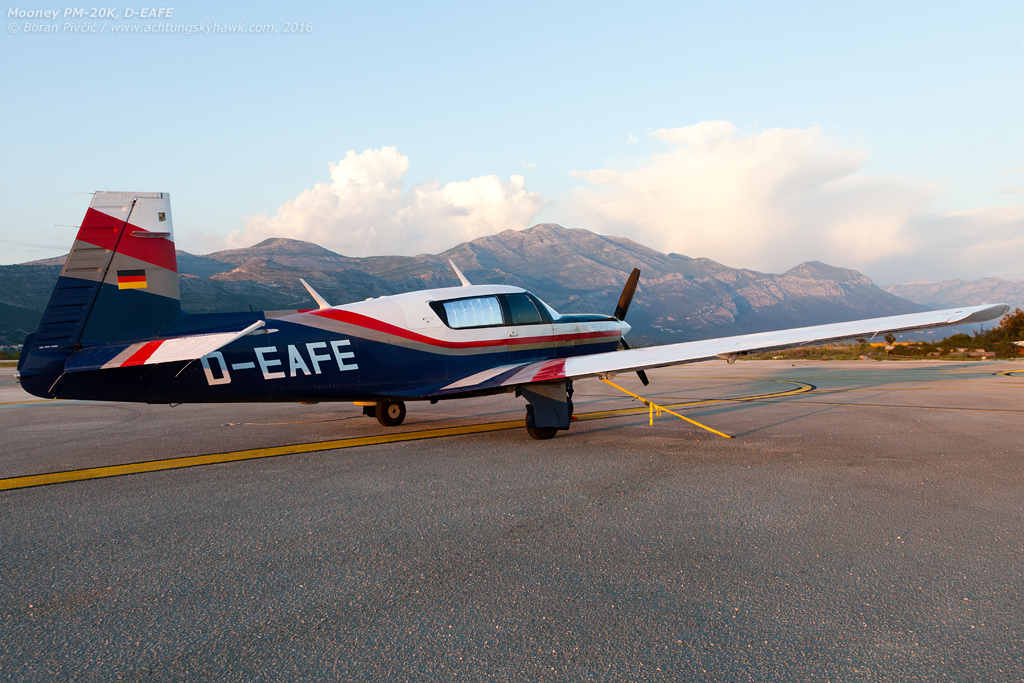
Photo File – Porsches to Caravans

By me
All photos me too, copyrighted

Despite only a month having passed since my last collection of GA photos from around Croatia, I am pleased to announce that I’ve already accumulated enough material for another one :D. The return of both the summer tourist and flying seasons – plus frequent hops to the country’s coastal airports – had pretty quickly resulted in several interesting and unusual finds, allowing for yet another burst of photos to keep Achtung, Skyhawk! lively until the completion of an extensive in-progress historical piece… 🙂

More than any other airport in Croatia, during the summer Dubrovnik (DBV/LDDU) is a real Mecca for general aviation! Conspicuous primarily due to its unusual vertical stabilizer, D-EAFE is notable for another quirk: its Porsche PFM 3200 engine. Conceived in the mid-80s as the company’s attempt to fully break into the aviation market, the PFM 3200 is in essence a thoroughly modified 3.2 liter boxer out of the 911, which – once FADEC was applied – produced 215 HP normally and 240 with a turbocharger. Though it had proved popular with European customers, the engine had nevertheless failed to grab a piece of the Lycoming and Continental pie, leading to the termination of production in 1991. Interestingly, the PM-20K is actually a “bastard”; the only Mooney meant to use Porsche power from the outset was the M-20L, with the PM being an aftermarket retrofit. As of 2016, only two are known to still be flyable…

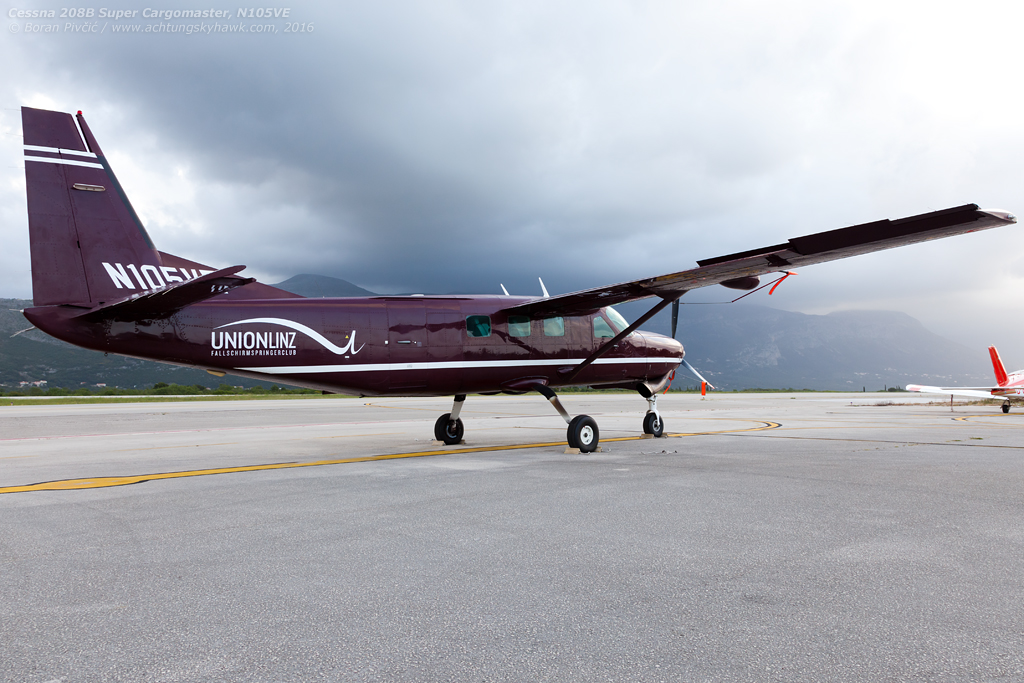
Though it is not as exotic as a Porsche-powered Mooney, another recent Dubrovnik visitor had nevertheless managed to catch my attention – if anything for its non-standard configuration. Owned by the Union skydive club based at Wels Airfield (LOLW) near Linz, Austria, N105VE had started out in life as a stock Cargomaster freighter, before being modified for skydive duties with the addition of a “skydive kit” (which includes internal and external handrails, footboards and a signalling system in the cabin). Interestingly, it had been retrofitted with six windows from the passenger model, giving it a secondary people carrying capability – the guise in which it had popped into town for a few days.

A full frontal view clearly shows just why had the diminutive Katana made such an impact on the two-seat trainer market. A Rotax in the nose for good economy, a composite structure for better efficiency – and a wing as if nicked off a glider for gentle and predictable handling… one of a total of five operational DA-20s in Croatia inadvertently posing for a cracking photo as it prepares to depart Lučko for its home base of Varaždin (LDVA).

Methinks we need to mow the lawn! While it does look like we urgently need a course in gardening at Lučko, this is actually part of a clever method of raising additional funds for the field’s maintenance. Left to freely grow in select areas (with the runways, taxiways, overrun and underrun areas regularly trimmed), the grass is split into grids which are then auctioned off to farmers and farming companies. When the bidding is completed, the winners use their own equipment to cut the grass – thus saving the airfield the costs of doing it itself, while at the same time bringing in some extra cash.

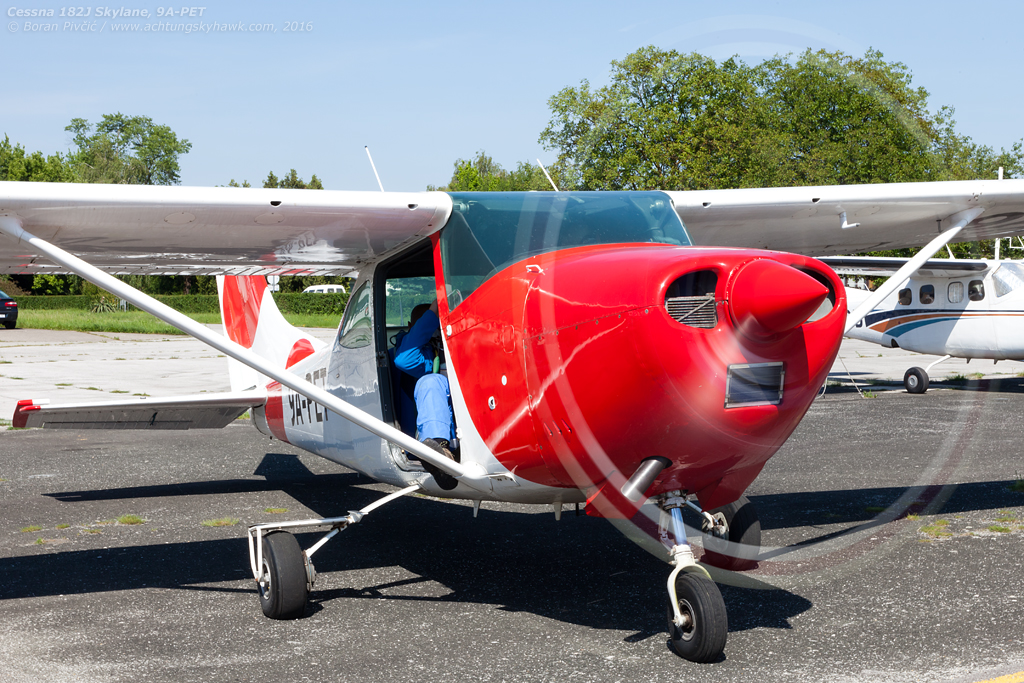
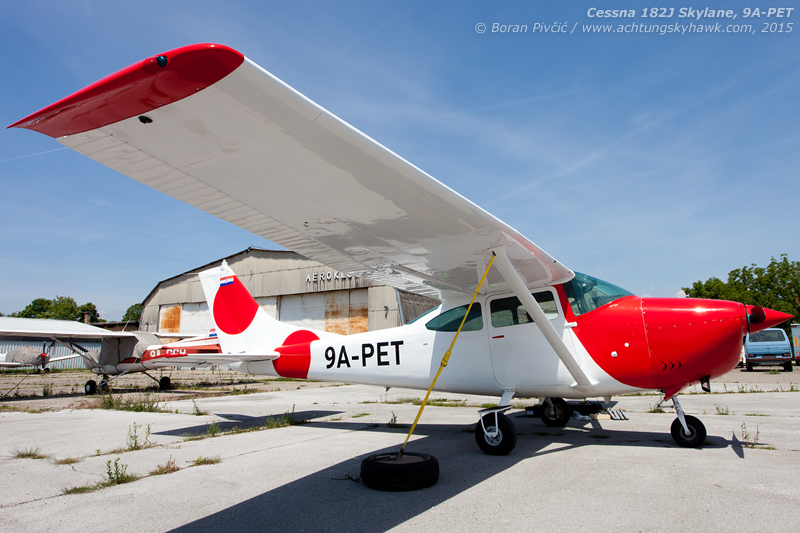
The replacement for the replacement of our sorely missed CarryAll 9A-BKS, “spotty” is seen warming up for its sole flight of the day. One of only two purpose-modified skydive C182s in Croatia, the 1967 PET is also among the oldest lighties of any sort in the country – which does not really stop it from clocking serious time during the summer season.

While the high wing, underslung turboprops, large tires and a rear loading ramp are nowadays a common configuration for light and medium tactical transports, this profile was still a novelty with the Transall entered service in the mid-60s. One of the most stubbornly long-lived transport aircraft ever made, the C-160 is also among the earliest instances of post-WW2 European cooperation, having come about as a joint project between France and Germany. With uninterrupted service spanning five decades, the Transall is still actively flying in France, Germany and Turkey – and had already in 2001 clocked up one million flying hours. Of interest, the Transall name is an amalgamation of “Transporter Allianz” – while the 160 is its wing area in square meters. 50+75 itself – pictured here at Split Airport (SPU/LDSP) – is one of the last first-generation examples (mfd in 1971), and had visited as part of a multinational exercise.

Photo File – Spring Is Coming…

By me
All photos me too, copyrighted

As is usual for this time of year, the ever-improving weather conditions (with the inevitable hiccup or two) have slowly started waking the local GA scene from its winter stupor. While operations are still very much in the 7 AM pre-coffee stage, life is nevertheless returning to airfields across the land, with planes, gliders and helicopters being dusted off for the coming spring. Naturally enough, I had once again decided to snoop around and check on proceedings, hoping to capitalize on the calm before the storm… 🙂

One happy little bear roaring away during a late-afternoon engine test. Even though Lučko had still been closed at this point (its grass runways soaked), AK Zagreb had decided to use the time well and send DBS through a post-overhaul shakedown…

Clean and tidy following deep servicing, GPA waits for its turn to be parked in the hangar after its first flight of the year. Even though it carries the Pilatus name and sports the designation PC-11, this type had actually originated in Germany in the mid-60s as a product of a small group of up-and-coming engineers. Initially called the B4 after Gert Basten – the owner of the factory that had manufactured the prototypes – the design had not entered series production until the mid-70s, when it was acquired by Pilatus. Praised for its simplicity, robustness and quality of manufacture, the AF version can boast respectable aerobatic capabilities, a role in which it is still used worldwide. GPA itself had been manufactured in 1977, and is today one of seven examples listed on the 9A register.

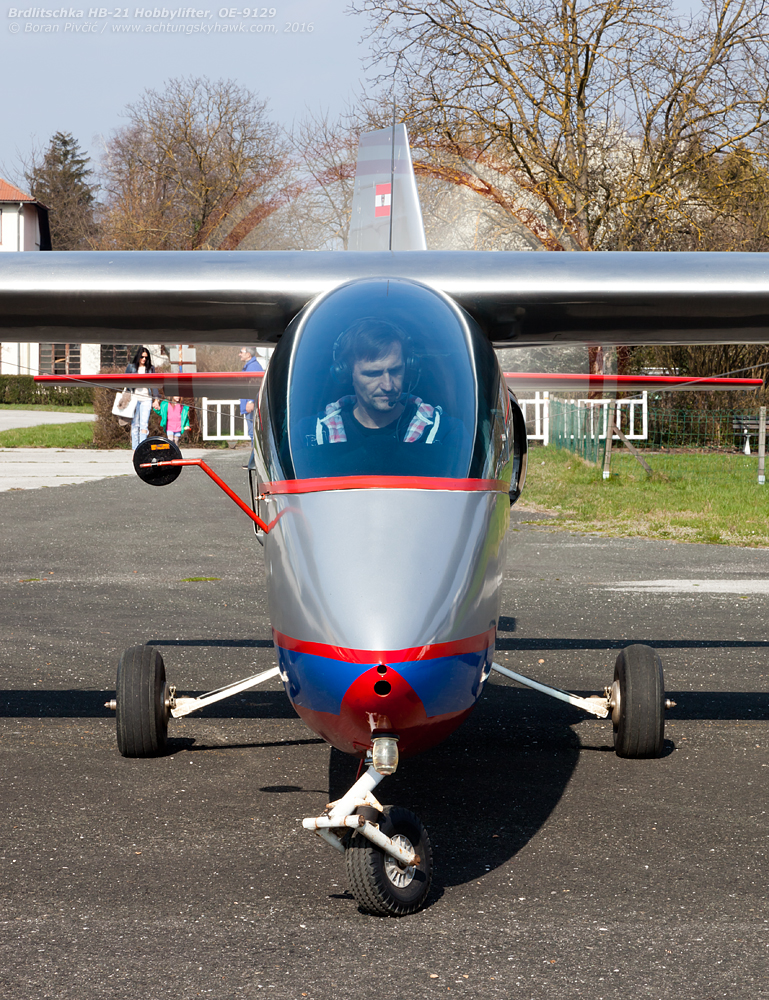
Hands down one of the most unusual aircraft that can be seen in Croatia, OE-9129 is seen firing up for an entire afternoon of glider towing. Essentially a motor glider itself, the HB-21 was conceived in Austria during the 60s, and is in this form powered by a 100 HP VW engine mounted behind the cabin – and driving a unique pusher prop arrangement integrated into the aircraft’s backbone.

When the sun sets and the temperature drops, normal pilots go home… but then, with the rising fog, come those who wander around with big cameras. Having a bit of fun with Piper PA-28RT-201 Arrow IV 9A-DCB and Cessna 172N 9A-DMG, on a December day – albeit not unlike many found in spring.

Instantly recognizable among Čakovec Airfield’s (LDVC) fleet of gliders, YU-CPE is seen providing a suitable metaphor for Yugoslav aviation as it waits out an uncertain fate by collecting bird droppings in the corner of the hangar. An aircraft much of 60s and 70s Yugoslavia had learned to fly on, the indigenous Aero 3 had over the years garnered a reputation as an unforgiving and sometimes difficult to handle trainer, which had over the years claimed a number of lives. Despite this, the design – made almost entirely of wood and powered by a 190 HP Lycoming O-435 – is viewed with today increasing nostalgia, resulting to several attempts at preservation and restoration. Sadly, given the lack of spares (only 100-ish having been built) and the financial requirements of such work, only one machine had been returned to airworthy state, with the rest left in limbo… (including its brother, Lučko’s own YU-CPC/9A-XPC)

Even though it was pretty much the only aircraft on the apron at Split Airport (SPU/LDSP), N828PA nevertheless proves that quality is still better than quantity! Still a rare type in Europe, the Eclipse 500 was the forerunner of the Very Light Jet (VLJ) category, “pocket” bizjets that were both simple and cheap enough for owners to fly themselves – while still providing better performance than traditional business turboprops. N828PA itself was completed in 2008, and is one of the last examples manufactured before the company filed for bankruptcy. It would eventually be restarted in 2009 under new ownership, rolling out an improved model – the Eclipse 550 – in 2013.

And finally, something that doesn’t really fit all that well into the GA category – but is nevertheless worthy of note! Soaking up the noon sun, 6M-BH of the Austrian Air Force had popped into Zagreb (ZAG/LDZA) to take on fuel before continuing northwards to Varaždin (LDVA), where it would provide transport for an Austrian presidential delegation attending a regional summit. An interesting detail here is its designation; even though the name “Black Hawk” is almost universally associated with “UH-60”, export models are often labelled as S-70, which is the manufacturer’s official designation for this type.

Photo File – Lighto

By me
All photos me too, copyrighted

Even though autumn is in full swing here in SE Europe – with “formal” winter only a month away – the weather had apparently not been informed of this development, with constantly clear & sunny skies, light winds and 20 degrees Centigrade at noon being pretty much the norm. Not wanting to let this beautiful opportunity go to waste – and having been away from GA for most of the summer – I’d decided to use my free time productively and drive around looking for lighties to photograph 😀 . While most of the stuff in my immediate vicinity had already been featured here (ad nauseam in some cases), a research drive for an upcoming article had seen me visit Novo Mesto Airfield (LJNM) in neighboring Slovenia, bringing some fresh material to table. Combined with a few snaps left over from the summer, this should be enough to bring my readers a fresh dose of light aviation on the Balkans… 🙂

A small, odd airplane + parked on grass with muddy tires + a background of rolling hills and autumn colors = love at first sight. The irreplaceable magic of light aviation in one photo as “Alpendohle” warms up its engine for departure from Novo Mesto. A design that tends to raise some eyebrows, the BO-208 is actually a German-built version of the Swedish MFI-9, created at the end of the 50s as a light touring aircraft with utility potential. Even though it is pretty obscure today, the MFI-9 was also the basis for the larger and more powerful SAAB MFI-15 Supporter, which is still used for training duties by several Scandinavian air forces…

Even though it already boasts aircraft from the USA, Germany, Austria, Czech Republic, Poland, Russia, France and former Yugoslavia, Lučko had recently also become home to a little bird (emu?) from Australia. One of the most well known products of Australia’s present-day aviation industry, the Jabiru line of two- and four-seaters is still a rarity in Europe, and are sometimes hard to find even at specialized GA shows. Even though it carries a Slovak registration, OM-M902 – manufactured in 2008 and powered by Jabiru’s own 2200 cc engine developing 80 HP – is actually a former resident of Vinkovac Airfield (LDOV) in the extreme east of Croatia.

An airfield by the coast, clear blue skies, pleasant summer temperatures – and three Cessnas soaking up the afternoon sun… a scene that just begs one to go flying! Even though it still wears its original German colors, D-EBXS (mfd. 1977) is nowadays a permanent resident of Medulin Airfield (LDPM) in Istria, and is frequently seen flying panorama flights up and down the peninsula.

Something that any proper airfield should be: a cafe and restaurant, good company, a full hangar and and interesting little aircraft parked outside (a Robin DR-400-180 Remorqueur, D-EOSR in this case).

C210 Squadron. The only two operational Centurions in Croatia together on the Lučko apron. However, even though they are only two letters apart, the 210L and P210N are actually significantly different machines: DZP is a simple, basic model whose equipment levels do not differ much from other single-engine Cessnas – while N50DD is a top-of-the-line version, equipped with a turbocharger, de-icing systems… and a pressurized fuselage.

One of the newest gliders on the Croatian register waiting for its turn to be put to bed in the field’s main hangar. Restored and assembled by hand, GKB wears this simple – but eye-catching – scheme, which is in fact a copy of a similar paint job seen on another Schleicher in the Netherlands.

And finally, one of those gems that can only be found by careful hangar trawling. Even though, from a numerical perspective, the L-13 Blanik is to gliders what the Cessna 172 is to piston singles, its younger brother – the L-23 Super Blanik seen here – is a somewhat different story. Designed on the basis of operational experiences with the L-13, the L-23 had received a completely new T-tail with swept fin, a slightly larger cabin with a two-piece canopy – and had lost its flaps as a weight-saving measure. Despite noticeably increased performance in all areas, the L-23 had not achieved the popularity of the original – but had nevertheless noted significant success in the USA, where it was also used in the Civil Air Patrol.

Photo File – Traveler’s Tales

By me
All photos me too, copyrighted

Having recently gotten into a position where I do a fair bit of air travel (to put it mildly!), I had suddenly (and somewhat unexpectedly) found myself being served with ever-increasing opportunities to snap – up close – various flying machinery operating out of Europe’s major airports. While these naturally tend to be of the airliner variety (and therefore not the default topic here), every once in awhile I do come across a true gem, something so fascinating, rare and unusual that it immediately warrants a feature at Achtung, Skyhawk! 🙂 .

Even though snaps of these machines are still few in number – with my definition of “fascinating” mostly to blame 😀 – I feel they are nevertheless numerous enough for me to cobble together a short, but hopefully interesting, post for my viewers’ pleasure. For a bit of added “weight”, I have also decided to add a couple of shots taken “en route”, showing that the journey to the destination airport can indeed be half the (photographic) fun!

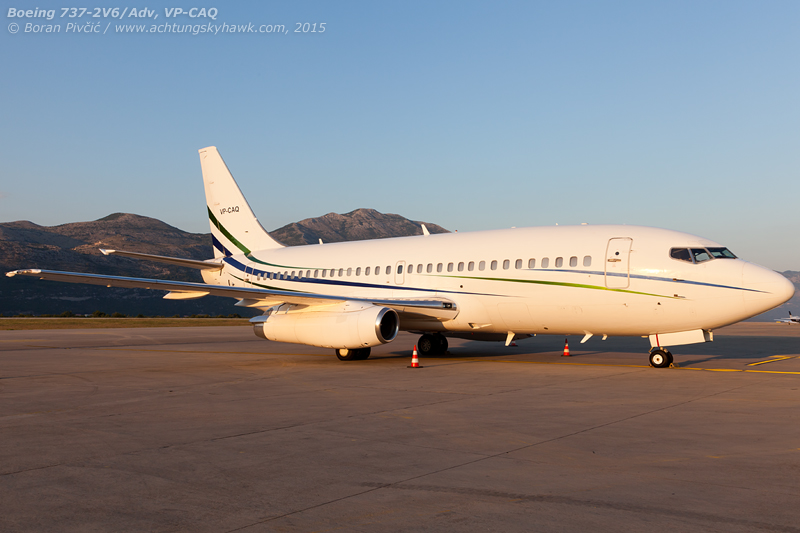
As a tool for doing business, a 737-200 bizjet may not really be the best of choices; but as a statement of style, very, very few machines come close! An absolutely stunning 1981 classic, VP-CAQ had – interestingly – never seen a day of passenger operations, having been delivered with an executive interior straight from the factory. Often seen flying all over Europe (despite the EU’s stringent noise regulations), at the time this photo was taken CAQ had already been parked at Dubrovnik Airport (LDDU) for several days, likely waiting on a client…

A photo that perfectly encapsulates a popular Croatian saying: “to have more luck than brains”! It’s not often one gets a spontaneous chance to photograph a VIP military transport on the apron of a major European aerodrome – without someone trying to chase you away! Enjoying the early morning sun on one of Vienna Airport’s (LOWW) remote aprons while waiting for Mr. John Kerry (who was in town to attend some nuclear talks).

An interesting visitor from the north easily standing out among the Citation and Falcon crowd at Zadar’s Zemunik Airport (LDZD). Operated by Germany’s Central Command for Maritime Emergencies, 57+05 is normally based by the North Sea and is used (as can be inferred from the titles on the fuselage) for detection and monitoring of sea pollution. Interestingly, this machine is not a classic Dornier-built example, but the NG model, produced in India by Hindustan Aeronautics and assembled in Germany by RUAG (the owner of the Do-228 type certificate).

Nature showing off what it can do as we maneuver around a growing towering cumulus near Zurich (LSZH), Switzerland. Easily visible are little pouch formations hanging beneath the cloud called “mammatus clouds”, which are an early indication that this cloud could eventually produce a heavy storm.

Enjoying the charming (and unbeatable) atmosphere of the cockpit at night as we cruise southwards across the Alps, roughly halfway between Munich (EDDM) in Germany and Klagenfurt (LOWK) in Austria…

Saluting the setting sun on another beautiful, calm and crisp summer evening. Traversing southbound above the Northern Adriatic Sea – just off the Istrian Peninsula and Pula Airport (LDPL) – we were treated to this fantastic view by a large high pressure area that had been parked over the region for several days…

Photo Report – Life at Lučko, June 2015

By me
All photos me too, copyrighted

As was the case (nearly) every year so far, the arrival of our continental summer has once again become the trigger for a sudden and rapid reawakening of the light aircraft scene at Lučko :). Even though the flying season itself had already started several months ago, the long hours of daylight, ample public holidays and fine flying conditions of June have given it a much-needed kick, with all operations – private, training and skydive – quickly shifting into high gear (while it all lasts). And while the gear in question is a notch lower than in previous years – with Croatia still knee-deep in the financial crisis – there was nevertheless still quite a bit to see and snap! 🙂

A little airplane that is not often seen at Lučko preparing for a short afternoon flight above Zagreb. Normally based at Varaždin Airfield (LDVA) in the north of the country, DVW is among the best “classic” 172s here on the continent, and has already seen off its fair share of student pilots…

Sporting a new set of clothes, PET gives no indication whatsoever that it is almost half a century old. Still active in skydive circles, it had recently been thoroughly overhauled, and will soon get a purpose-built carbon-fiber skydive door on the right side.

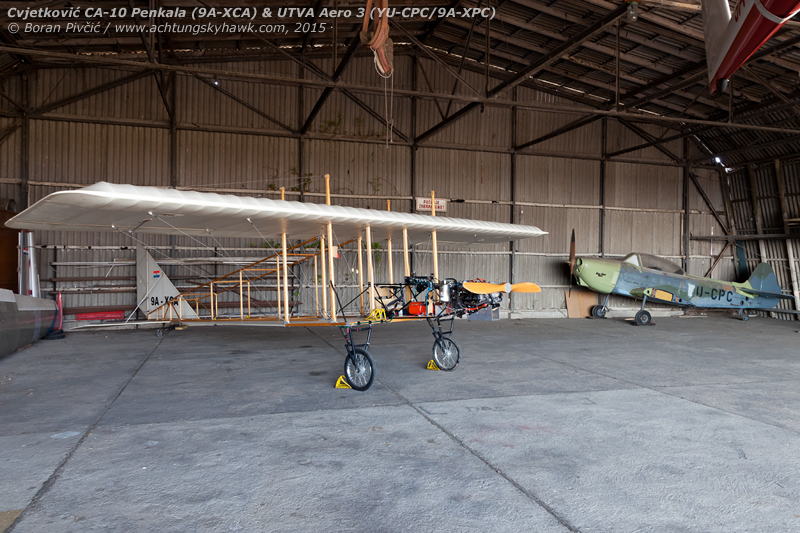
Several of the many bits of local aviation history hiding in plain sight all over the airfield: a replica of the first aircraft designed, built and flown in Croatia, alongside a type that had given wings to entire generations of local pilots – and both inside a hangar that had previously been home to Bf.109s and Fiat G.50s when it was located at Borongaj Airport in the 40s…

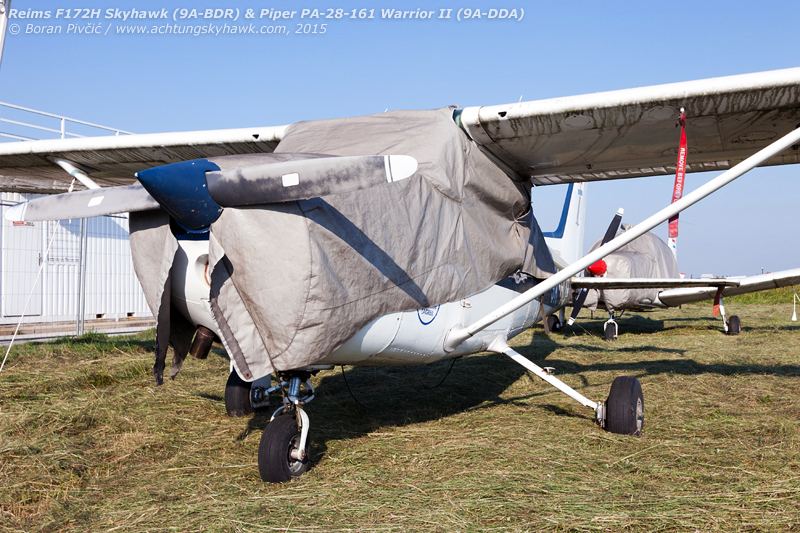
The “disintegrating squadron” catching some sun on its temporary parking position in front of the tower. Manufactured in 1967 and 1978 respectively, BDR and DDA had not been off the ground in ages, with the former last noted in the skies in 2003, and the latter sometime in 2006 or 2007…

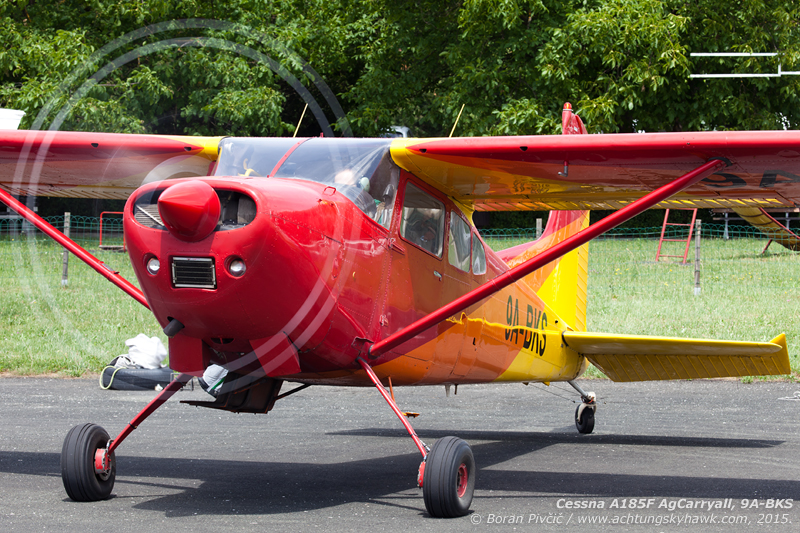
Always a welcome sight and sound, BKS is seen warming up for a skydive op in the nearby village of Kurilovec. Having to endure continuous operation at both high-power/low-speed and low-power/high-speed regimes, getting the engine’s internal temperatures into the green before flight is of vital importance – not only to preserve its stated service life, but also to prevent seizures and internal damage due to sudden temperature changes.

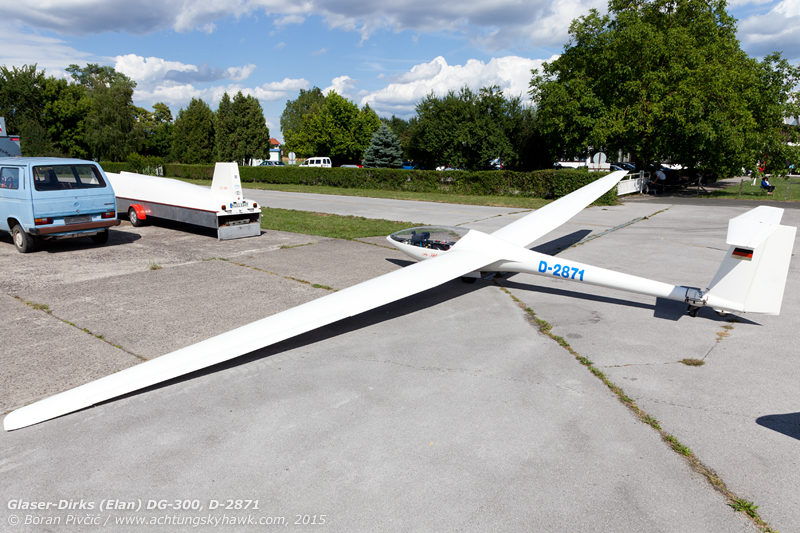
The newest resident of the airfield snapped after participation in a local precision landing championship. The only DG-300 in Croatia, 1985-vintage D-2871 is also one of the best-equipped gliders in the area, sporting two competition digital VSIs, a GPS unit – and even a FLARM system (a miniature ACAS designed specifically for use in gliders). Interestingly, despite being a German design, the DG-300 line was manufactured in Slovenia by the Elan works, famous locally for their extensive range of high-quality sporting equipment (particularly skis and sailboats).

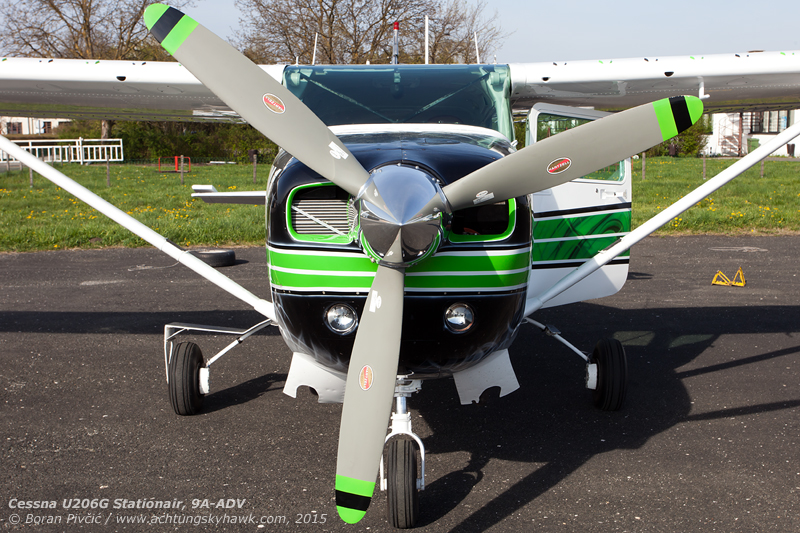
Photo Report – Going Up: Cessna U206G 9A-ADV

By me
All photos me too, copyrighted

Given that a number of my topics of late – Dash 8 flight simulators, 80s airport charts and the like – have strayed quite a bit into “commercial airspace”, I felt it would be about time to dip back into the little world of Croatian general aviation :). Even though the flying season has been slow to start this year – with aerial activities still sporadic at best – I’ve nevertheless quickly managed to find the perfect ticket for the job: a short, but pleasant afternoon shoot with one of the newest lighties on the country’s register, Cessna U206G 9A-ADV

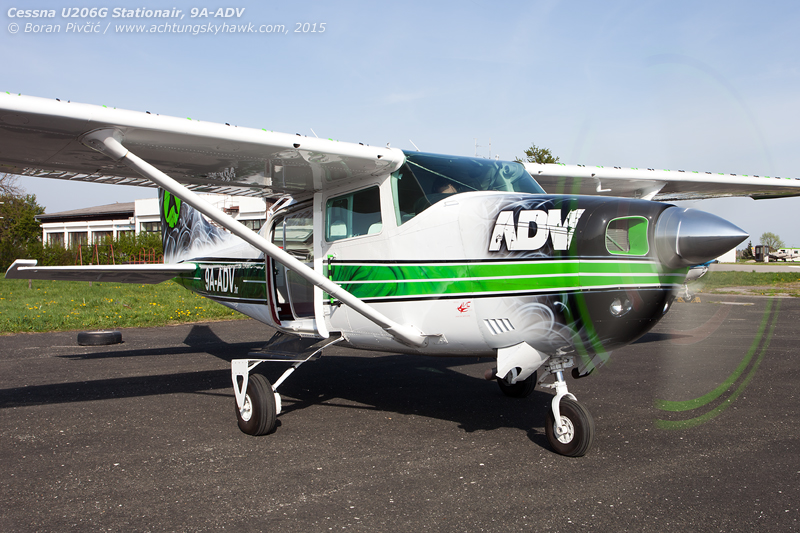
While a 206 in itself is (rarity-wise) nothing to write home about, this particular machine represents by far and away the most complete and best-equipped piston skydive platform in the country, which all on its own warrants some additional scrutiny :). Owned by local operator Adventure Driven Vacations (which pretty much does what its says on the tin), ADV is also a prime example of the last of the “old generation” Stationairs, having rolled off the production line in 1983 – just a short while before all piston single production at Cessna would go into a decade-long remission. Bestowed with serial U206-06796, it had actually been a seaplane in its original form, and would be known as N9986Z until 1988. Sold on to Norway in August that year, it would quickly become LN-AEZ and would – still on floats – continue to fly with a slew of local operators right up until its acquisition by ADV in March of 2013.

Before its move south, AEZ would first be converted into a conventional land-plane model, and then dispatched to Portugal (under its own power) to be re-fitted and equipped into a dedicated jump plane. Once the works were completed in July 2014, it would make its way (again with no “outside assistance”) across half the Mediterranean to Croatia, where it would then become only the fourth 206 currently on the register 🙂 (interestingly, this little group also contains a “new gen” 2006 U206H… as well as a fantastic 1966 P206B Super Skylane, the progenitor of the modern Stationair).

Even though it had been in-country and operational for close to nine months now, its normal base at Zemunik Airport (LDZD) – serving the coastal town of Zadar – had meant that it was generally out of range of my camera. However, the current dearth of skydive machines here at Zagreb had forced it inland, proving once more that if the photographer can’t go to the plane, the plane will come to the photographer… 😀

Looking splendid (and quite eye-catching) in its new colors as it cools down following the last flight of the day. A significant capacity increase for the Croatian skydive scene, the 206 is quite a step up from the more usual 182s and occasional 185…

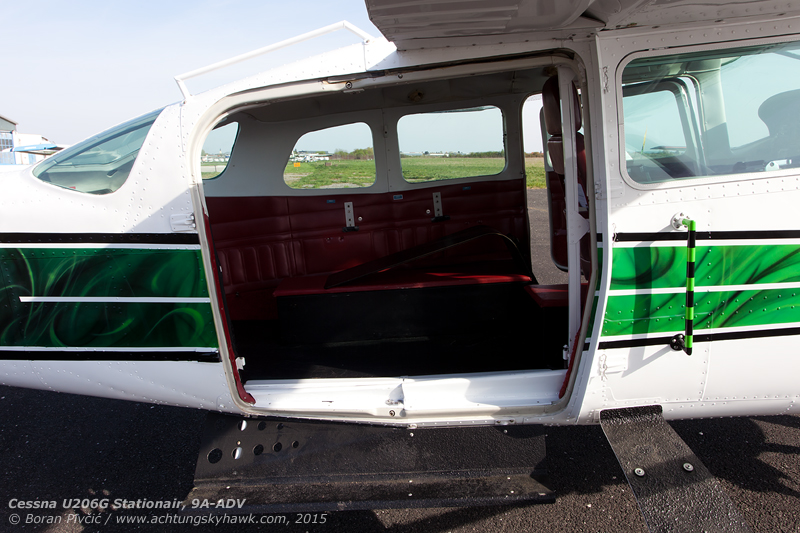
Central to ADV’s successful use as a skydive platform, the mods installed in Portugal include a sliding cargo door for easier egress, as well as several handles and steps to facilitate group jumps or tandems.

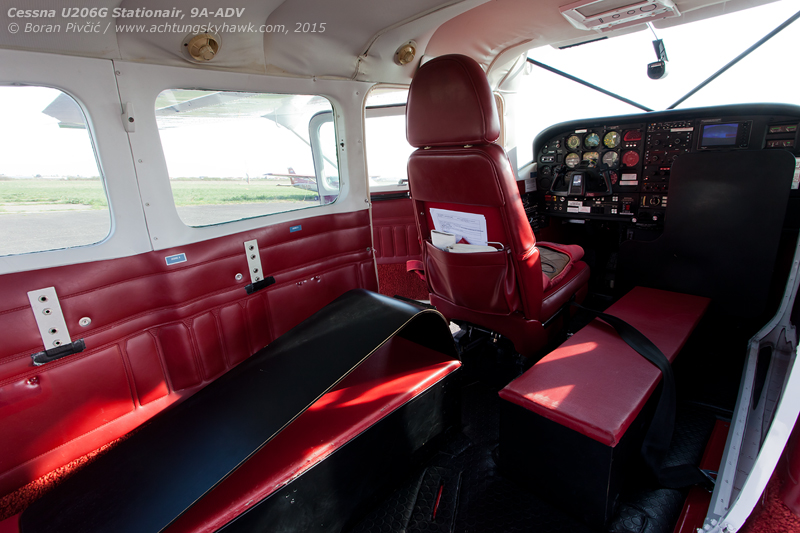
The interior is – by necessity – pretty spartan, since skydive ops are not really kind to fancy upholstery! Note also the two black panels (one set against the copilot’s station and one folded down behind the pilot’s seat) which permit skydivers to leisurely lean back during long climbs without fear of interfering with any of the aircraft’s controls.

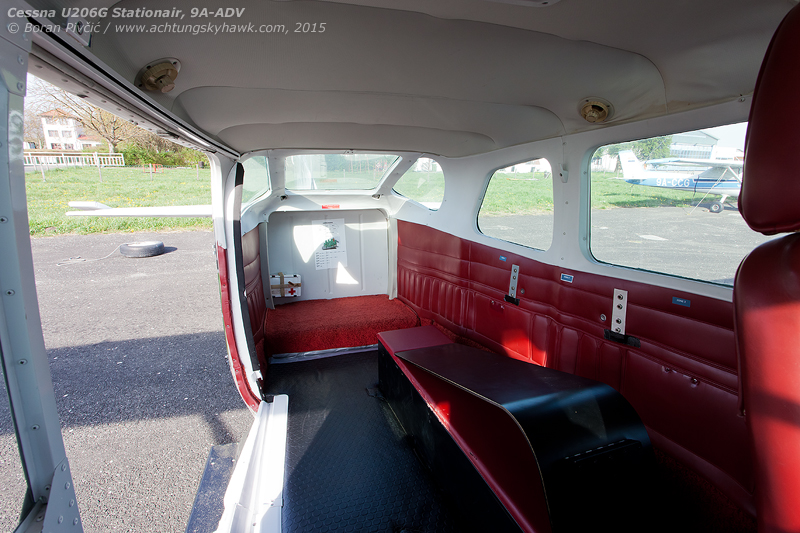
Like virtually all other skydive 206s, ADV accommodates six skydivers in addition to the pilot. Their sitting locations determine the sequence for jumping, which is further indicated by the note on the aft bulkhead.

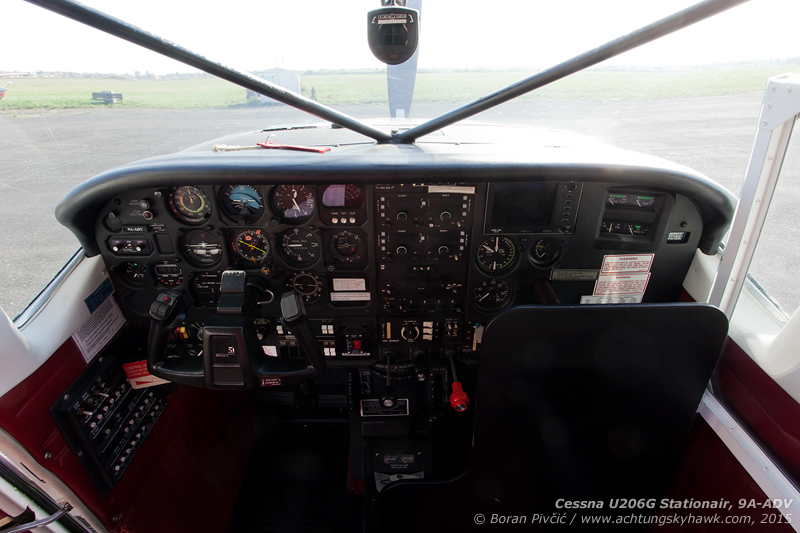
In addition to a full IFR suite w/ autopilot, the nicely equipped panel also includes several useful features for skydive ops, including a moving-map GPS (great for putting the jumpers right on target), EGT and CHT gauges (to avoid overheating the engine during prolonged high-power climbs in hot weather) – as well as a stormscope for avoiding summer CBs common in the region. An interesting detail are the two windshield crossbeams, a leftover from ADV’s seaplane days (also my apologies for the glare, the sun was low and I couldn’t bear to nag with re-orientating the aircraft).

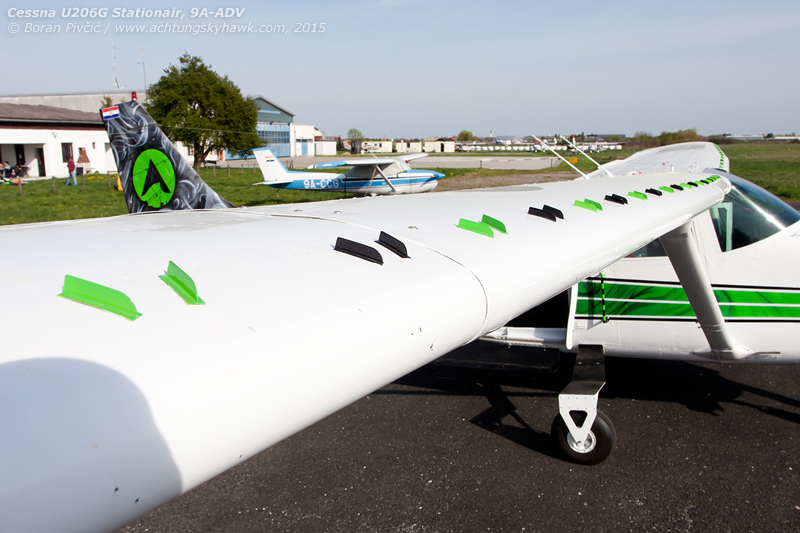
Another remnant from ADV’s seafaring days are the vortex generators, located along the upper leading edge of the wing and just in front of the rudder on the vertical stabilizer. By creating a turbulent flow of air just along the surface, they cause the flow to stick to said surface for longer than it normally would, enhancing its aerodynamic properties (at the expense of increased drag). On a seaplane they counter the various pitch and roll moments created by the floats (located well below the CG); on a landplane, they translate into reduced take-off and landing rolls, a lower stall speed and better stall response – and generally improved handling at high Angles of Attack (during low speed and/or high weight conditions).

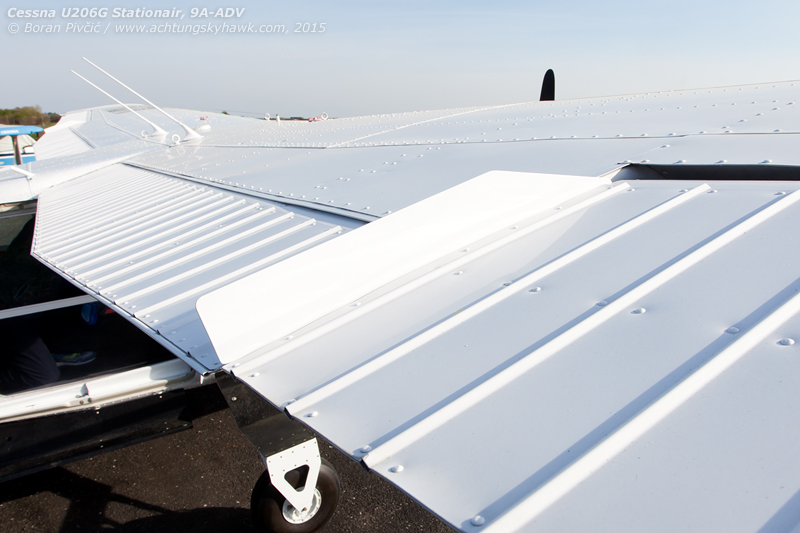
Also frequently seen on seaplanes, wing fences prevent the horizontal spill of air across the span of the wing, making the airfoil far more efficient. Interestingly, ADV’s seem modified, since on all 206 floatplanes that I’ve seen they extend forward across the wing for at least half its chord…

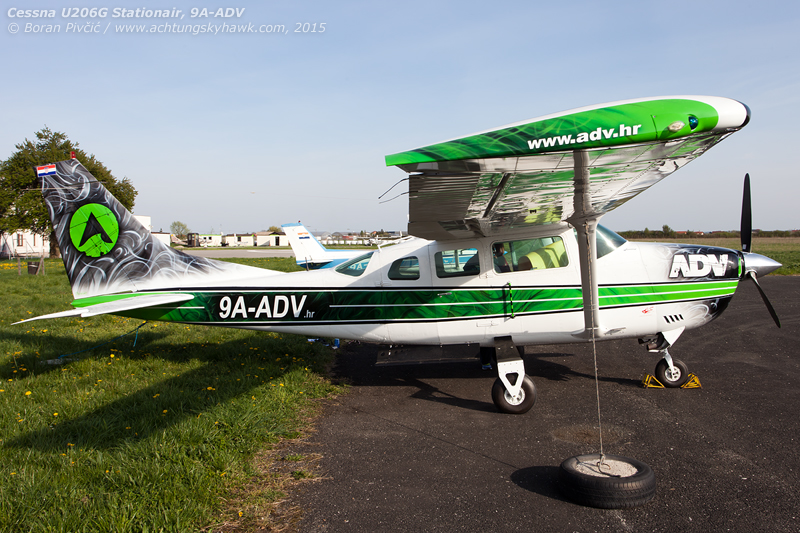
Repainted into the operator’s “house colors” in December 2014, ADV certainly stands out on the apron. The more eagle-eyed readers will also have noticed that the aircraft now sports the U206’s standard cargo doors; with the skydive version not being the most thief-proof option, the standard set is installed for each over-night stay out in the open.

Always a brutish looking thing, ADV’s high-contrast scheme makes it look even more purposeful and powerful.

I would also like to extend my sincere thanks to my flying colleague Mario Car – one of ADV’s pilots – who had given me a heads up and spent some time answering my nerdy Achtung, Skyhawk! questions!

Other sources:

  • Seabee.info – Norwegian seaplane database (LN-AEZ service history)

Photo Report – Life at Lučko, October 2014

By me
All photos me too, copyrighted

Possibly to compensate for its blatant refusal to play ball for most of the summer, the weather here in continental Croatia has been on its best behavior since my previous post, providing us (mostly) with the same clear blue skies, calm air and pleasant temperatures that we’d expected to see in months past :). Fearing that it may all go terribly wrong at any time and without much warning, out fleet at Lučko has been out and about from sunset to sunrise, getting in as much work as possible without bending any rules. Naturally, the same weather had lured me and my camera out as well, allowing me to present another snapshot of Life at Lučko… 🙂

Back home after an extended leave of absence due to a Cessna-mandated corrosion check, the legend of Lučko is back on the flying circuit. Parked – unusually – outside the hangar following its return from Varaždin (LDVA), BKS easily dominates the apron even in the dark…

Hands down one of the most interesting touring motor gliders (TMGs) in the region, the ungainly Vivat is actually based on the classic Let L-13 Blanik all-metal training glider, to which a 65 HP Walter Mikron III engine, side-by-side seating and a tougher, fully retractable landing gear have been added. Normally based at Sinj Airfield (LDSS) near Split, DSI had on this occasion popped into Lučko for some servicing, having suffered persistent issues with the engine starter.

A peek inside DSI’s clean and pleasant interior. Somewhat more complicated than a modern purpose-built TMG, the L-13SE contains almost as many controls as a standard light piston aircraft, including levers for the throttle, choke, elevator trim, airbrakes, wing flaps, cowl flaps and landing gear.

You could be forgiven for thinking that Lučko was having a helicopter theme day today! As well as HAT, HBA and HBB (the latter of which would later fly a short winch test), we’d soon be joined by Agusta-Bell AB.212 9A-HBM, which had – despite the day’s wind and in true Huey fashion – announced its arrival from miles away. Interestingly, the military side of the airfield was deserted for most of the afternoon, without a single Mi-8/171 to be seen (which in itself is quite unusual).

Definitely the most unusual new arrival into our little fleet, the Sova (“owl”) is an intriguing single-seat motor glider, designed and built by Mr. Marijan Ivanček. Among the many interesting details is the propeller – whirled by a two-stroke Rotax – that folds back under the action of a spring when the engine is not running, thus significantly reducing drag during soaring flight without the need to incur the weight penalty of a fully-retractable prop (of note, while the Sova is a glider with an engine, it does not fall into the same category as the Vivat from two photos above. Due to its ability to fly and operate like a “normal aircraft” during powered flight, the L-13SE is classified as a TOURING motor glider; the Sova however lacks that capability, and is thus labelled as an “engine-assisted glider”).

While for the most part the weather was just as fine as described in the introduction, several mornings – Sunday 19 October included – did let the side down. A common problem during autumn and winter (especially after prolonged rainy seasons such as this summer’s), Lučko, Pleso and indeed the whole of southern Zagreb can be blanketed by thick fog that can reduce visibility down to just 50 meters. While they tend to persist for days or even weeks during the winter, in October and early November they frequently disperse around noon, often leaving behind fantastic anticyclonic weather. On this occasion, a 125 meter visibility and 11 degrees Centigrade were replaced by clear blue skies, 23 Centigrade and just a hint of wind – all within one hour.

Once the fog did clear, flight ops had immediately picked up, including a few flights by the diminutive (and rarely seen) HMB – one of only two R-22s in Croatia and the only one still flying. The first series-produced design to come out of the pen of Frank Robinson – a world-renowned tail rotor expert – the R-22 had first flown way back in 1975 and has persisted in production to this day. HMB itself is an early Mariner version, equipped to carry inflatable floats on the skids for over-water operations and sporting an auxiliary 41 liter / 11 USG fuel tank located right behind the pilot. Interestingly, even though it is registered in Croatia and is operated by a Croatian company – Helimax – it is usually based at Ljubljana (LJLJ) in neighboring Slovenia.

Universally popular primarily due to their low acquisition costs and very agreeable operating economics, all R-22s are powered by variants of Lycoming’s O-320 four-pop – essentially the same engine fitted to the standard Cessna 172N. However, to prevent it from overloading the transmission system (and to assist with longevity), on the R-22 the engine has been de-rated from its nominal 160 HP to just 124. Another important modification – always the eyesore – is the forced cooling fan bolted to the rear of the engine, designed to blow cool, fresh air over the engine block and compensate for the lack of ram cooling in flight.
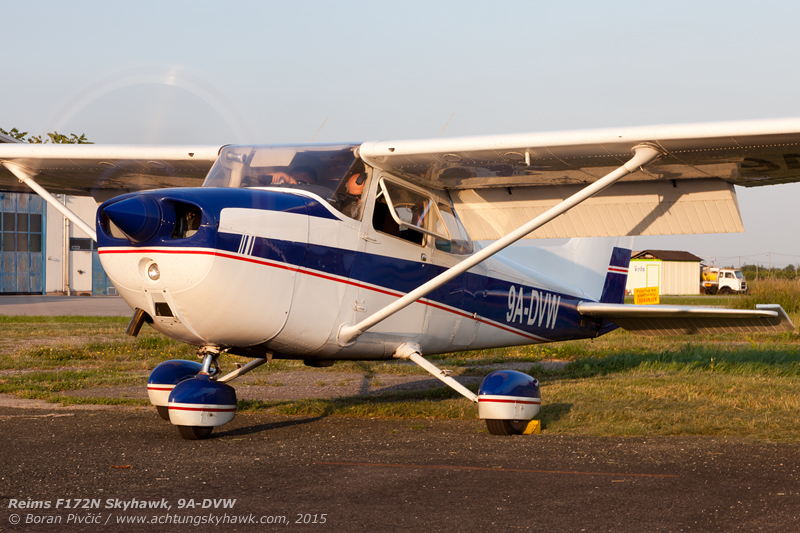
Photo Report – 24th Zagreb Kup Precision Landing Championship

By me
All photos me too, copyrighted

Looking back on it (even though it still has a month and a bit left to run), this year has, aviation-wise, been almost a complete joke. One of the rainiest years since record keeping began in Croatia some two centuries ago, it has produced no less than three major floods, interspersed with unusually frequent (and surprisingly violent) cyclones and depressions that had – in some cases – dumped a year’s worth of rain in just a few weeks. Scenes such as this and this had kept most of our grass airfields closed and flooded for days on end, trapping all of our money-making aircraft and rendering them unable to flee to the paved safety of the country’s major airports…

Likewise, man-made disasters had conspired against us as well, with the country’s long-standing economic crisis now running into its seventh consecutive year – with very little light only dimly visible at the end of the tunnel. Apart from a general reduction in life standard, spanners thrown into Croatia’s GA works include soaring fuel prices, increased maintenance costs – and, not least of all, stepped-up efforts by several operators of popular paved airports to collect increasingly exorbitant fees and charges in order to alleviate their own financial difficulties.

An yet, despite all of this, the local GA scene is operating like there’s no tomorrow (likely because if the weather continues like this, there probably won’t be 😀 ), with a new bizjet, new skydive Cessna, new glider and towplane all having arrived in country within the past few months. Flying clubs are on a roll as well, with mine already having beaten its previous flight time high, set – ironically – in 2013 :). Skydive flights, airshow performances, panoramic flights, private rentals… all seem to be coming back on track despite the worsening living standard (with only flight training letting the side down).

Much of the same could have also been seen during the 24th Zagreb Cup precision landing championship, held at Lučko Airfield (LDZL) on Saturday 11 October :). A yearly small-town event whose sole purpose is to have some good-natured fun (and enjoy a good BBQ afterwards 😀 ), the competition had this year attracted an all-time record in aircraft and competitors, numbering at four Cessna 150s, three Cessna 172s and 24 competing pilots respectively. While this doesn’t sound like much compared to some of the larger and more formal competitions held elsewhere in Europe, it is still of one of the main aviation (social) events of the season, and had this year easily topped the 2013 competition, where we had a showing of only five aircraft and just 18 pilots.

A handy visual guide to everything you need to know about the competition. Closest to me is the landing field used for the purpose, drawn up in lime powder on the right side of RWY 28L. 72 meters long in total, it is marked off in several 5 meter wide grids, plus a two meter wide “zero mark” that represents the ideal touchdown point. For 20 meters on either side, the grids are further split into one meter wide segments – as shown here – to aid the judges in determining the exact point of contact. Further back behind the field are three of the seven competition aircraft – parked on RWY 28R – with the competitors monitoring progress on the runway’s edge.
As nearly every year so far, the competition had been blessed with beautiful summer-like anticyclonic weather, sporting clear blue skies, temperatures of around 25 degrees Centigrade – and lighting conditions to die for. The only thing missing compared to last year was a stiff 15 knot crosswind, replaced this time by a light, variable and refreshing breeze – quite welcome when standing in the sun for several hours 😀 .

Even though this meant we’d miss out on the visually attractive landings of 2013, my shutter finger was not left to stand idly by, with my role as assistant judge allowing me the occasional opportunity to play around a bit… 🙂

The first group of competitors (minus C150 9A-DMI standing to my left) prepares for take-off down RWY 28L. Since they were departing individually, for reasons of safety the lead ship had to be the fastest of the group – C172 9A-DFH – with the three slower C150s at the back sequenced by their pilots’ precedence on the competition roster. Of note, since the competition field took up half the width of the runway, all competitors had to take off from an intermediate position – roughly 200 meters from the threshold – to avoid blowing the flags and lime away…

To avoid running over the above – and the occasional judge – on the way to the intermediate position, the competitors had to taxi past the field on the left side of the runway, which had conveniently brought them to within a few meters of my position – thus allowing me plenty of opportunity to play with various compositions as they rolled by. One of these had inadvertently ended up being a study of the minute differences and options available on the Cessna 150 during its production run…

One of life’s rare opportunities to stand in front of a (slowly) taxing aircraft on the primary runway of a (somewhat) busy airfield with a camera in one hand and a cool beverage in the other!

A crowd on final like we’re at a proper airport! Even though the competition specified a separation standard of one and a half minutes between successive aircraft – enough to have four machines evenly spaced around the circuit all at once – different piloting techniques and approaches had invariably eroded it from time to time…

“Caution wake turbulence”. They may not be fast jets and there’s no smooth tarmac under their tires, but it nevertheless makes one happy to see them! Interestingly, by the time CCG had turned onto the crosswind leg, the lead ship of the group – Cessna 172N 9A-DHL – was already turning final…

Even though it happens only rarely, it is not unseen for contestants to have occasional tailstrikes during these sorts of competitions. Thankfully, in this case the actual strike was very light and brief, with only the tail tie-down ring making contact with the ground. Had it not been there to kick up the grass, we likely would have never noticed…

Deja-vu from 2013… even though there was almost no wind for the entire duration of the competition, occasionally some of the contestant had made a hash of their final “no flaps, no power” approach, forcing them to stretch their glide as much as possible and plonk the aircraft down on its last few Newtons of lift. While this does look somewhat dramatic, the competition rules allow it up to a point, provided the wheel in the air is at a height less than its diameter and not for more than 5 meters horizontal distance.

Photo Report – News From The Realm

By me
All photos me too, copyrighted

Faced with a consistent lack of anything of note to write about – except the weather, which has been so poor lately that catching a good flying day is on par with winning the national lottery 😀 – I’ve decided to fill the void by cobbling together something of a “mix post”, combining the few recent photos from Lučko, Pleso and neighboring Slovenia into one convenient little package. It’s not really much to be honest, but hopefully it’ll provide for a bit of amusement until the arrival of an extensive, work-in-progress historical article… 🙂

The only (operational) Blanik at Lučko poses with its best friend while they wait on RWY 28R for their pilots to assemble. In the event, the first flight of the day would be with a future gliding student, who was given a short demo flight above the western end of town…

While it sounds deceptively simple, a proper aerotow take-off often requires a helping hand on the ground. Due to the absence of a conventional landing gear arrangement, most gliders – especially those boasting larger wingspans – require someone to hold the wingtip at the start of the take-off run. Intended to prevent it from scraping along the ground and possibly slewing the glider off course, this is only necessary during the first few seconds of the run, until the speed builds up sufficiently for the aerodynamic forces on the ailerons to take over.

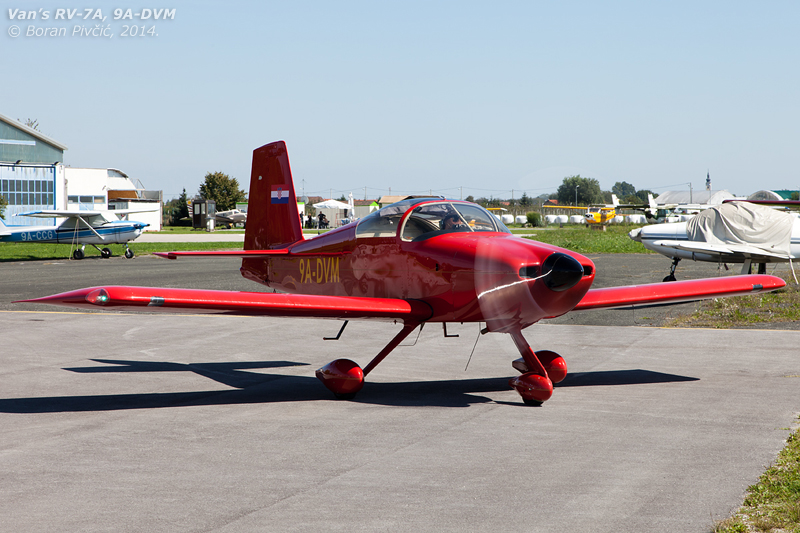
One of the most beautiful kit planes in Croatia is seen rolling towards RWY 10R after a short fuel stop. Part of the famous Van’s family of nippy two-seaters, DVM is the company’s only design registered here, and spends most of its time staying clear of the more frequented airfields (to the continuing disappointment of the author).

The simple and uncluttered cockpit contains everything one really needs for a good time aloft. Interestingly, even though it is powered by a four-cylinder engine developing 200 HP, DVM uses a fixed pitch propeller – something not generally seen on speedy homebuilt kits of this power range.

The “Grey aircraft only seem to fly in on grey days” photo series continues with the legendary Stratotanker, which had on this occasion hauled itself into Zagreb all the way from Minneapolis. A modernized version of the aircraft that many still consider to be THE tanker, the R model differs primarily by its powerplant, dispensing with the old J-57s in favor of the modern, economical – and significantly quieter – CFM56. An interesting detail is the frost on the wing underside, a common feature on original 717s* during humid days.

* and that isn’t a misprint. While the “717” is today associated exclusively with the re-branded McDonnell Douglas MD-95, the designator had actually been in use ever since the late 50s. Following the introduction of the Boeing 367-80 jet airliner prototype – the famous “Dash 80” – a number of interested civil operators had requested that the design’s slim fuselage be widened to accommodate a six-abreast seating configuration. Boeing had readily agreed, thus giving birth to the 707 as we know it today. However, the US military – also one of the interested parties – was satisfied with the Dash 80 as-was, lobbying that it too be put into production. Knowing that the American military establishment has always been a loyal – and well-paying 🙂 – customer, Boeing agreed to these terms as well, christening the new-old model the 717.

But, since the US military has always used its own original aircraft designators, the new aircraft was quickly labelled the C-135. As the years went on – and the design started making a name for itself in its military guise – the 717 brand had slowly begun to fade from people’s minds… so when Boeing bought MDD in 1997 and inherited the in-development MD-95, they simply recycled the old designator and pinned it to the venerable Maddog (more precisely, the -95 became known as the 717-200 to differentiate it from the original, which had been known within Boeing as the 717-100 since its inception) 🙂 .

To complicate matters even further, the US military has actually operated – and still operates – BOTH the 707 and the 717-100. The former (in its 707-300 version) had served as the basis for the E-3 Sentry, E-6 Mercury and E-8 JSTARS, while the latter covers everything with a -135 designator (including the KC-135, RC-135, OC-135, VC-135 and so on)…

Another of the year’s Globemasters to have visited Pleso, “Reach 574” is just about to put to an end its long flight from Mazar-i-Sharif in Afganistan. Transporting home soldiers of several NATO nations, it would eventually depart again towards Kogalniceanu Airport, serving the Romanian coastal city of Constanta.

A machine that gives no impression that it is actually 33 years old, DJM is one of the last Skylane RG models to have been manufactured by the renowned Reims works, located in the town of the same name up in northeastern France. Sporting retractable landing gear, full IFR equipment and the capability to carry four people with nearly full fuel tanks, the 182RG is probably one of the best cheap – but still capable – light touring aircraft nowadays available…

A bit of that Alpine feel as we climb along the MODRO 1W departure procedure following takeoff from RWY 30 at Ljubljana (LJLJ), Slovenia. While we were expecting (and hoping for) a bit of fog to test our instrument skills, by the time we’d gotten airborne it had already transformed into broken mid-altitude clouds, leaving us with an almost ideal late summer’s day (despite the frosty 12 C out on the apron!).

EDIT: after a lengthy struggle with an uncooperative piece of editing software, I’m also happy to bring you a short video clip to accompany the previous photo 🙂 . Mind you, it’s not really my best work to be honest, but I was handed a GoPro camera and told to have fun with it, so I tried to make the best of the situation (especially considering I did not get a suction mount to securely stick it to the window)…

Photo Report – Life at Lučko, June 2014

By me
All photos me too, copyrighted

With summer plowing onwards in good stead – and without any major meteorological disruptions so far – life at Lučko Airfield has pretty much continued unabated since my last post on the subject some two weeks ago 🙂 . Granted, the volume of traffic is outright appalling compared to the “golden years” of the last decade – but on the whole, things are still moving in vaguely the right direction 🙂 . And while we haven’t had much in the way of brand new or foreign visitors, I nevertheless did not end up short for a few interesting photo opportunities…

Another interesting resident of the Croatian civil register on a repeat visit to the field. Cessna’s sole purpose-built agricultural aircraft, the model 188 together with the Piper Pawnee and the Air Tractor constitutes the Big Three of the crop dusting world, and had proven itself most of all in the backwoods of Australia and New Zealand. BKP itself has however led a more sedate life, spending its entire existence hopping about eastern Croatia. Manufactured in 1977, it was part of a large batch of various Cessna models bought by the Yugoslav government in the late 70s, and has up until this point flown under only two other regs: N731GB during delivery, and YU-BKP until the dissolution of Yugoslavia in 1991…

An (internationally common) transport solution that has surely raised a few eyebrows on Croatian roads. More commonly of the closed box type, a trailer such as this is used to transport gliders to and from gliding sites – and was on this occasion used to move this fine Pirat from its home base at Buševec Airfield (LDZB, now closed indefinitely) to Lučko for an extended period of time.

Profiles that only Mother Mil could love – but which nevertheless clearly show the family connection shared by these two renowned designs. Another visitor from Divulje AB, 204 had flown only a few circuits today – but the “bambi bucket” located by one the helicopter start gates suggests that some firefighting training was also on the menu at some point…

A big rotor, two powerful engines and freshly mowed grass is all you need to show just how turbulent (and interesting) the flow of air and exhaust around a helicopter is…

The mighty heart of Cessna’s most sophisticated and capable single-engine model. It’s full name dragging out to “Continental TSIO-540-AF”, this engine is equipped with a turbocharger (TS – turbosupercharged) and direct injection (I – injected), while its six cylinders are arranged in a boxer pattern (O – opposed) and together give a cubic capacity of 540 cubic inches (8.8 liters). In this sub-version (AF) it produces 310 HP, while the design itself is capable of putting out anything between 260 and 375 HP.

The simple, uncluttered – and amazingly roomy – cockpit of the HB-21 motorglider. Featured here for the first time in my previous post, the HB-21 is an unusual pusher prop design, powered by a 2.4 liter Porsche/VW engine developing 100 HP. Light as a feather and with a wingspan that covers several post codes, the HB-21 has demonstrated an ability to tow gliders on par with that of the Super Cub – the very reason it was bought and brought to Croatia in the first place.

Photo Report – I have nothing to offer…

By me
All photos me too, copyrighted

… but sweat, dehydration, sunburn and flight hours 😀 . Okay, Churchill may not have had the spring/summer flying season at Lučko in mind when he uttered his famous phrase back in 1940, but in this custom form it does go a long way to describing events at the field these past few weeks 🙂 . With out traditional summer anticyclone parked very firmly over the entire region, we’ve been graced with fantastic flying weather for days on end, allowing out entire fleet to go out and stretch its wings. And while the temperatures did let the side down – with 40 Centigrade on the apron not even being newsworthy – we’ve nevertheless persevered, allowing me to bring you another photo series of life in Croatian GA (and beyond)… 🙂

The Carryall in its element: on grass under sunny skies on a beautiful spring day. An aircraft with a rich history in the country, BKS was produced back in 1977, entering service with local operator Pan Adria the same year. Used for tailwheel conversion training and crop dusting, it would pass to the Viša zrakoplova škola flight school a few years later, where it would serve as an IFR trainer. Following the school’s collapse in the late 80s, BKS would end up in the fleet of Aeroklub Zagreb, where it was stripped, lightened and turned into a skydive aircraft – a role it fulfills even today. An interesting personal detail is that this aircraft seems to follow my family around, starting with my dad who used to work in Pan Adria, mom who used to work at Viša zrakoplovna škola – and me currently flying it on behalf of AK Zagreb.

Another look at our charismatic fuel-to-noise converter. Powered by an 8.5 liter/520 cu in engine developing 300 HP and whirling a 208 cm/82 in diameter prop – which is well into the transsonic region on take off – BKS is not the most conspicuous machine around, and can – during favorable winds – be heard all the way to the center of Zagreb, some 10 km/5 NM away…

Definitely one of the more interesting aircraft I’ve come across over the years! Sporting an unusual configuration for what is essentially a motorglider, the HB-21 is quite the performer despite its frail looks, easily rivaling the Piper Super Cub in the climb. Indeed, OE-9129 was bought specifically to replace PA-18 9A-DBU in the glider tow role, with trials revealing it’s more than a match even when hauling a heavy glider such as the Let L-13 Blanik…

A scene straight out of WW I as one of Lučko’s most famous residents flies leisurely overhead. Lovingly crafted over a period of several years – mostly out of materials found in hardware stores – XCA is a modern replica of the first proper aircraft built in Croatia: the P-3 of 1910 (designed by inventor Slavoljub Penkala). Not exactly a one-for-one replica, the CA-10 includes a few aerodynamic improvements to make it easier to fly, as well as an 80 HP Rotax 912ULS in place of the extinct Laurin & Klement inline.

The (mostly) fine weather had also lured out the air force, allowing us to play a bit of spot the differences! Even though they are essentially the same aircraft underneath, the legacy Mi-8MTV-1 and the modern Mi-171 do diverge in a number of details – the most obvious being the 171’s flat rear ramp. Other more subtle changes include the additional forward fuselage door – which had necessitated the relocation of the aircon unit to the top of the fuselage – and the Doppler Navigator antenna array moved further back down the tail boom. Intended to also provide at least some of the capability of the country’s long decommissioned Mi-24 fleet, the 171s also sport some additional combat equipment, including bolt-on armor plating around the cockpit, flare dispensers (above the CroAF roundel on the rear fuselage), IR jammers (at the back of the gearbox assembly) and provisions for carrying up to four B8V unguided rocket packs.

Reasons for getting up at 4 AM to go flying: here’s #1… beautifully smooth air, absolute quiet on the frequency, an agreeable 26 Centigrade aloft – and a fantastic view of sleepy Zagorje as I ferry DMG to Varaždin for servicing at 5:30 AM.

Even though it is relatively busy even at the worst of times, on this morning Varaždin appeared to be host to a mini Cessna convention, with seven 172s, one 182 and one 210 lining the main taxiway and apron. The culprits for this threefold increase in Cessna numbers were the seven 172s from Bulgaria and Serbia, in country on a fox immunization contract and for the time being operating out of Varaždin…

Easily mistaken for a brand new Skyhawk SP, this mint 1978 172N is seen rolling gently towards the main hangar for some minor maintenance. Part of the aforementioned Bulgarian-Serbian fleet, AIA is equipped with a bare bones interior and a special pellet dispenser in place of the regular baggage door. In immunization operations, the aircraft is manned by a crew of two, with the second member manually feeding the dispenser with pellets from chilled boxes (kept overnight in a refrigerated truck trailer).