In another run through my database (lost count of them all 😀 ), I’ve seen I’ve got quite a few interesting shots from Pleso airport, our big bad international gateway (for our GA expectations anyway 🙂 ). Having often selflessly volunteered to fly there for fuel once our own station at Lučko closes for the day, I’ve had the chance to spend some quality time on the GA apron, snapping a few shots here and there while waiting for the bowser to trundle up. At other times I’ve taken my telephoto lens to the RWY 05 approach path, snapping a few landing photos before the police inevitably shoo me away :). So, while patiently waiting for something new, I’ve decided to compile a little collection of what can be seen operating in and out of our friendly little airport…
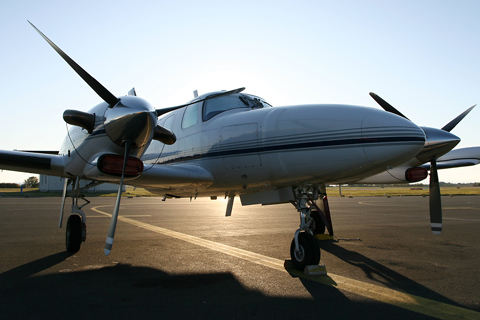
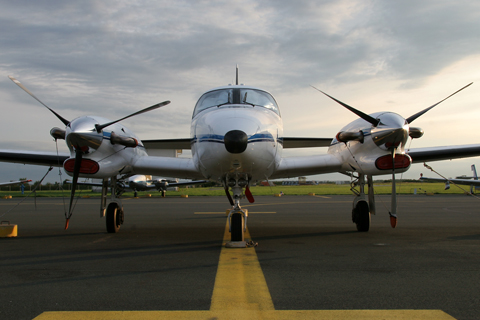
First up is 9A-CHC, a relative newbie to the Croatian register. A nowadays rather rare Cessna 501 Citation I/SP, it is operated by IVA-DOM Aviation, the country's first proper bizjet charter companyShot in some excellent light, 9A-CZG (formerly 9A-BZG) is a Piper PA-31T-500 Cheyenne I operated by Geo-Foto - a very well known local mapping company - in an aerial photography configurationSomewhat of a patriotic moment this as 9A-CRO, the presidential Canadair Challenger 604, glides in for landing on RWY 05My first Hawker 400! 🙂 CS-DMM, a 400XP, is operated by NetJets Europe out of PortugalAnother Cheyenne I, registered in Germany as D-IEMR, but operated privately in Croatia for a whileAnother new one for me here, what I believe is a Cessna 340, registered G-FEBE. Done quite a trip to get here...A prison view (almost! 🙂 ). Not a very good one at that, but my dad told me there was a Caravan at the airport - and I immediately rushed there to see it :D. Turns out it's the 1500th produced, N1276Y, here on an European tourAnd here's a very, very nice treat from Austria - a Piper PA-46-500TP Malibu Mirage (reg OE-KDM) on final for RWY 05The Swedes are bringing up the rear with an even rarer Citation than 9A-CHC, a non-single-pilot Citation 500 registered SE-DEGA view of the Pleso GA apron at night... and not even half full 🙂
As an afterthought, I’ve though I might add something a bit bigger as well :). Though most of the commercial traffic in and out of Pleso consists of boring Airbii, Boeings and Dash 8s, there are a few gems every now and then… big, smoky, Russian ones… 🙂
Lookie, twins! RA-76494 from Russia and UR-78786 from the Ukraine, both Ilyushin Il-76TDs, visiting Zagreb on a rare occasion. Shot with my old camera from the control tower 🙂One of the most graceful airliners ever built rocketing off RWY 23. Though still not all that uncommon, the Tupolev Tu-154 (M model here) is still a rare sight outside the former Eastern BlockNow this had really brightened that cold, windy March day - a very rare Ilyushin Il-86 charter on approach to RWY 05. The first true Soviet widebody, the Il-86 was produced in limited numbers, hampered all the way by a serious lack in power...
Down for the count pretty much since the time I’ve started this blog, 9A-BKS is the one remaining (and interesting) Lučko resident I’ve never profiled here. A very nice Cessna A185F Skywagon/Carryall, it had suffered a propstrike almost a year ago (if my count is correct), and was in never a presentable enough state to be featured here. However, with the onset of winter and a reduction in flying activities, it was decided to finally fix it up, giving it a complete service and refit along the way. Naturally, I was ready and waiting with my camera when it all started… 🙂
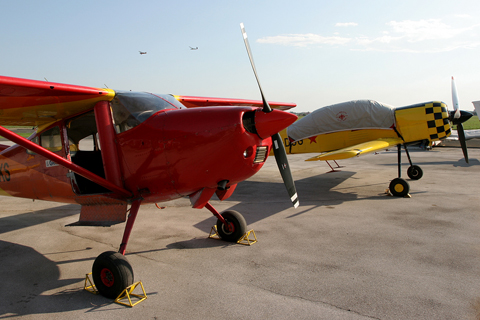
BKS back in happier days. Sporting a very distinctive high-vis paint scheme - and an equally distinctive transsonic prop - it was always an attention-grabber. Manufactured in 1985 and owned by AK Zagreb, it is used exclusively for skydive flightsOur small taildragger air force on a typical Lučko day - skydivers, aerobatic flights, training ops, glider flights...A bit less glamorous here in the present... though the aircraft itself had suffered no damage during the propstrike, the prop and engine were knackered and needed to be completely refurbished and rebuilt - so BKS had spent a considerable time looking less than dignifiedApparently the locals don't really like BKS flying above their heads :D. Showing just how many access panels there are on the 185's wing... the ones near the leading edge allow for relatively easy inspection of the electrical cabling for the wingtip lights and the wing strut joint, while the those nearer the fuselage give (some) access to the Pitot system, part of the gravity fuel system and the electric flap motors and their cables. The outboard and trailing edge ones give access to the aileron control cable, which was being inspected as part of the service (the aileron being removed first)Up front, the firewall had to be cleaned and sanded down before the engine could be mounted back on. Among the cables seen are the prop, mixture and throttle controls, as well as control & data cables for various engine instruments (RPM, manifold pressure, oil temp and pressure, EGT, CHT...)Inside, everything is nice and fluffy :). The sound and thermal insulation - some form of synthetic foam I think - normally hidden away beneath the upholstery (which will incidentally also be changed)Where the aileron should be. The actual control cable can be seen right by the single access panelCloseup of the right-hand flap, lowered to give easier access to its guide rails. Like most light Cessnas, the 185 uses Fowler flaps which, in addition to lowering, slide backwards to increase the effective wing area as well as the Angle of AttackInside the bare cabin. Configured for skydive flights, BKS usually only has a rear bench, maximizing the number of skydivers that could be carried while reducing weight for better performanceAlready featured in my previous piston engine post is BKS's (rebuilt) 8.5 liter six cyl IO-520-D, putting out approx. 300 HP
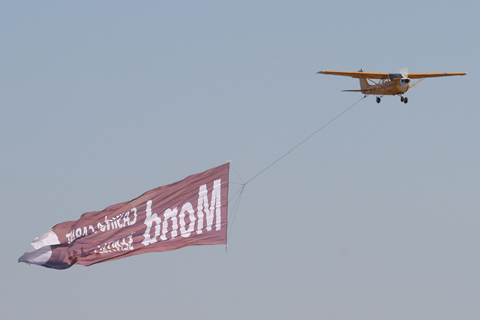
Looking back through all the articles I’ve posted here, I saw I’d made quite a few boastful promises about topics that in the end never materialized :). So, still waiting for something to happen here in the present, I’ve decided to clear my topic backlog, starting of with my first true air-to-air photo experience – banner towing :).
1. Fly-by-wire
While banner towing in flight seems – and is – a pretty straightforward affair, down on the ground, getting the thing airborne, is a different story altogether. Despite popular myth, taking off with the banner attached causes more problems than it solves, particularly on uneven grass runways such as at Lučko – where it would promptly be torn off and shredded, not to mention all the adverse effects it would cause for the unlucky towplane.
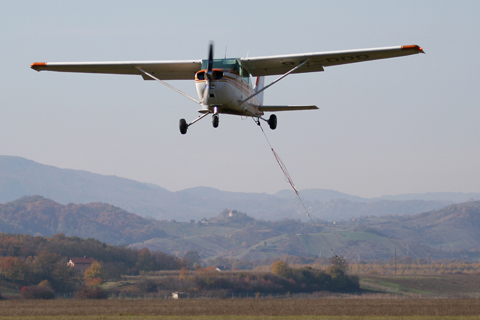
To get around this problem, somebody somewhere at some point had borrowed a WW2 method – why not snag the banner inflight? To quote Jeremy Clarkson of Top Gear, “How hard can it be?” :D. The idea is that the banner’s tow cable is suspended between two poles at some height above ground, usually about 2-3 meters. The towplane would then, trailing a hook on another cable, come down low and snag the banner, lifting it off the ground as it climbs away. Those of you who have seen images of Dakotas picking up troop transport gliders during WW2 will immediately see the similarities.
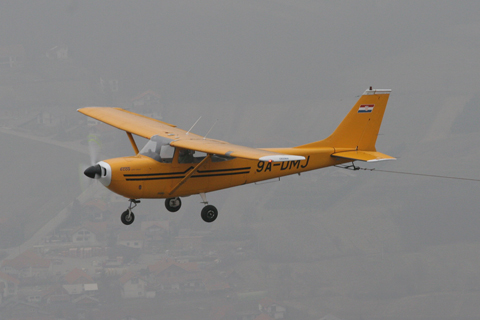
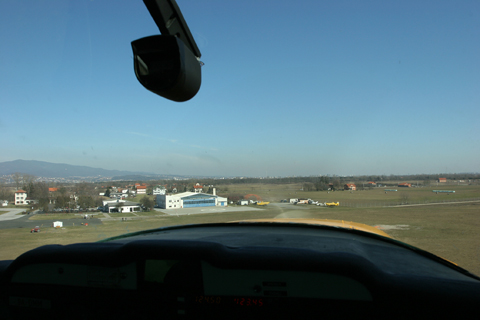
A visual illustration as 9A-DMJ goes down for a snag. Note also the hook cable attachment assembly at the base of the tail. Sorry for poor quality, but for the life of me I can’t find the original, so I had to take this one of my Facebook photo gallery 🙂9A-DDD going down for the pickup. The approach is usually flown at about 70 knots and 10 degrees of flaps in the Skyhawk. The speed has to kept at around that figure – any faster and the sudden drag and inertia of the banner will stress the airframe unnecessarily, while any slower means that when the banner yank does come, it can pull the aircraft very near the stall (with the added complication of the engine run-up delay at low throttle settings)During taxi and takeoff, the hook end of the cable is carried in the cabin by the second crew member. Once airborne, the hook is lowered into the airstream until all the slack in the cable is picked upA frontal view on a recent missionSide view. Note the reinforced cable mid-section that acts as a sort of bungee to absorb some of the forces and inertia during pickupA nice and clean hook up. Sometimes the hook and banner cables can tangle up, with the banner towed not by the hook, but by the tangled cables. This can be quite problematic if the knot untangles in flight – the banner then freely falling away – the reason for which there is always a “ground spotter” with a radio station observing the pickup. If the cables tangle up, the SOP is to jettison the entire thing and start overBanner snagging being pretty much a visual art, it is not uncommon to miss the banner cable altogether (by anything from inches to meters). In this case a go-around is executed for another attempt
After a successful snag and climb away, the rest of the flight becomes routine – with careful monitoring of the engine temperature gauges that is. Despite most banners weighing not more than 20-ish kilograms altogether, their large surface area creates a lot of drag. This necessitates a higher throttle setting and if not flying fast enough for sufficient engine cooling, it’s not really that difficult to overtemp the engine.
With the mission completed, the banner is then dropped from the aircraft during a slow, low pass. The release itself depends on the hook and tow mechanism, but in our case the whole cable – all the way from the attachment hook below the tail – is jettisoned, to be untangled and separated on the ground. This leaves the aircraft free to perform a normal, unencumbured landing.
Note that the entire cable is released, with only the fixed tail hook remaining in place. For many pilots, hitting an exact bull’s eye with the cable is almost a sport 🙂
2. A skiing competition, a casino and some fog
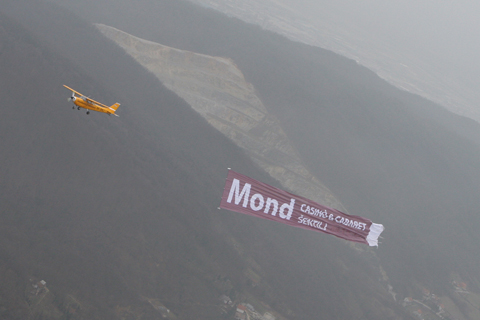
While all of the above is fine and dandy, back in the winter of 2008 my aeroclub had gotten a bit ambitious :). The mission was to tow the largest banner ever towed in Croatia, measuring 5 x 30-something meters. Doesn’t sound like much the first time you hear it, but in effect that’s a 150 square meter airbrake – more than three times the surface area of my apartment!
The venue was the Snow Queen skiing competition held on the northern slopes of the Medvednica mountain between 15. and 17. February 2008. And the customer – a large casino near Šentilj, on the border between Slovenia and Austria. Connection – I see none, but it didn’t matter since it got us up in the air with no questions asked :).
Fortunately for our towplane, the temperatures had plummeted during the weekend, down to around -15 Centigrade at the altitude at which we had expected to do our run. (round 2,000 ft) With such a draggy mass behind it, and the requirement to fly at 70-75 knots so people on the ground could actually read what was being towed, engine cooling was a serious issue, so the lower the outside temp, the better.
Now, the original plan was to do a run on the 15th, with DMJ acting as the towplane and DMM – with me on board – acting as the photo ship to immortalize the whole event :). However, even before leaving the ground we had run into a small problem…
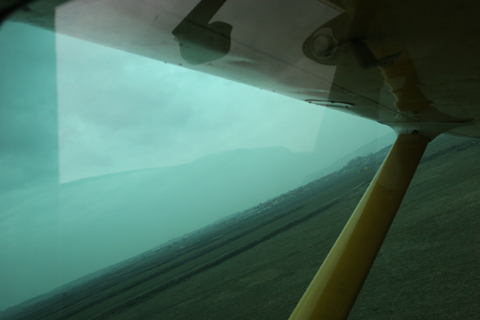
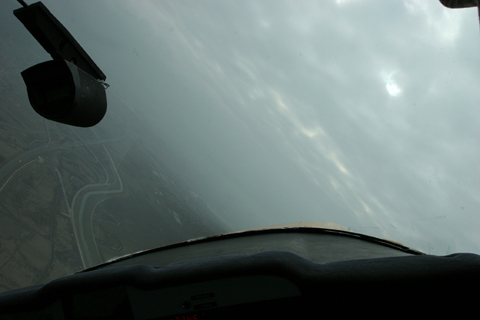
Going up! As you can see, the weather was, for our intents and purposes, crap. It was still okay here in the open, but north of Medvednica – where the wind kept blowing moisture up the slope – it was downright awfulRounding Medvednica from the west near Zaprešić. As you can see, the weather was steadily deteriorating, but undaunted we went ahead to see what’s what 🙂In an ironic twist, our 100 HP Cessna 150 turned out to be faster than the 210 HP Reims Rocket, so we had to orbit around a bit to let DMJ gain some distance before our photo run 🙂Lining up for another run, showing just how large that banner actually was :). While weighing just under 20 kilograms, its sheer area caused so much drag that DMJ – lightened, with half-full tanks and one person on board – needed to be run at near maximum continuous powerCloseup of DMJ while skirting the northern slopes of Medvednica. The visibility was still good compared to what we hit a few minutes later…
Pretty soon however we ran into problem #2. The ski track which we were supposed to fly over – a track very popular with local skiers – is quite narrow and tucked away between two mountain crests. To follow it, we’d have to fly up the through, climbing continuously, in formation and poor visibility, with one aircraft that was underpowered and another that was barely hauling itself as it was. Realizing conclusively that it would all end in a pretty big accident, we turned round and scurried back toward Zagreb, to try and at least save some of the mission there.
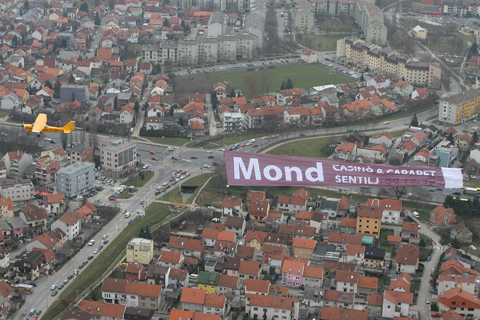
Following one of the city’s fast peripheral roads, with visibility mercifully increasingKeeping low above town. Though the minimum altitude for flyovers is 2,000 ft – about 1,600 AGL – during banner-towing missions this can be lowered by approval. We may have taken that a bit too seriously… 🙂A wide view of the historic city center, with the Cathedral and old Kaptol fortifications easily identifiable
So far so good as far as the towing was concerned, but my photo session was turning into a bit of a mess. The poor visibility and light, coupled with the turbulent downdraft from the mountain, meant I couldn’t really do much with my unstabilized telephoto lens, so to conserve fuel, we turned for home, leaving DMJ to fly two more short runs above town.
3. Cold, cold, cold!
While the results of the first run were mildly disappointing to say the least, the designated god of aviation – Murphy 😀 – allowed us to make it all up on the 17th, when the weather finally cleared. Beautifully clear skies, still air, visibility one can only hope for and an even lower temperature were just too good to pass up, so we saddled up and full of optimism decided to give it another shot…
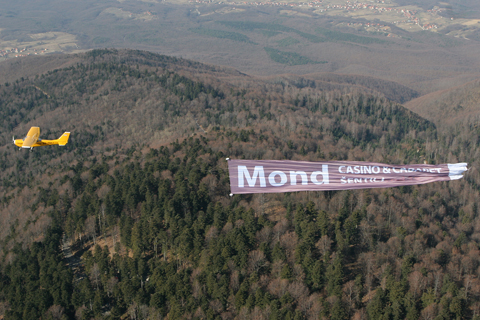
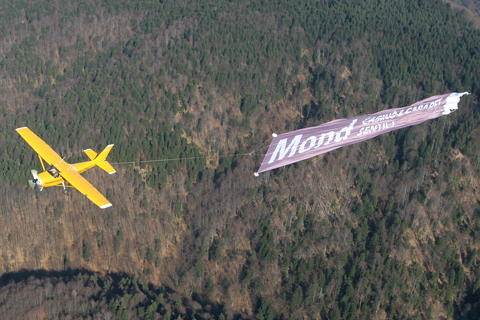
A spirited low-level departure above the field to kick off an excellent mission!Now this is more like it! 🙂 Shot with the window open – and -17 C outside – with a wide angle to give an impression of size and distanceWhat a beautiful setting for a photo shoot! Looking north above the northern foothills of Medvednica, with the track right behind us
Because the shoot was going so well, Mr. Murphy decided to intervene again and as we neared the ski track, our coordination sort of broke down :). The problem was that to get good shots, we had to fly to the left, above and somewhat in front of DMJ. This meant that my photopilot couldn’t see DMJ because I was in the way, DMJ couldn’t see us because it’s wing was in the way, and the need to maneuver around hills and keep station above the track meant that our graceful aerial ballet quickly degenerated into a left-footed cha-cha-cha as we tried to keep our little formation together.
My favorite shot of the day, just as DMJ is about to pass below us – without actually seeing us until we were right on top of it 😀A beautiful day, the throaty roar of the engine, and playing catch above the mountaintops. Can it get any better than this? 🙂
With my hands trembling and my skin cracked from the cold – -17 C at 70 knots in propwash without gloves, absolute genius on my part – and our mission completed (relatively, given there were few spectators out :D), we set course for home. As before, DMJ went to do a circuit of the town, while we proceeded directly to Lučko, so I could catch a shot from the ground as well 🙂 (I was having a photo field day).
Turning final for RWY 10 after one of my best photo experiences to date 🙂DMJ inbound for release. The angle exaggerates the size of the banner, but it looks cool 🙂
Unfortunately, getting some “inside” photos from the towplane is a bit difficult and impractical – mostly because both crew are busy with other things… and there’s honestly not much to see; most of the time the banner itself is outside the the crew’s field of view, so it pretty much looks far better from the outside :). I’m also hoping to get a good, systematic sequence of the pickup, but that will have to wait for some warmer weather… 🙂
With the winter clampdown at the field proceeding as planned despite the unusually warm weather – leading to some serious photo-deprivation – I thought I’d dig through my database and cobble together a short post to keep this blog going until something new happens :). And noticing that they’re strangely under-represented in my previous posts, I’ve decided to concentrate a bit on helicopters.
Despite Lučko being somewhat of a hub for general aviation in this part of Croatia, we don’t often see many civil helicopters. Apart from one local Robinson R-44 – and the five-strong Police squadron – we don’t have much of a choice here, the limiting factor being fuel availability. A vast majority of civil-registered helicopters in the country are turbine-powered, and the lack of Jet A at Lučko (except for military and police use) means we’re not all that interesting :). Nevertheless, I’ve given it my best shot and this is what I’ve come up with…
1. Sud SE.3130 Alouette III, 9A-HAT:
First on the list is a very rare 1961. Alouette III, by far and away the oldest helicopter in Croatia. Operated by Eudora Let Vodice based at Zemunik airbase (LDZD) near Zadar, this fascinating whirlybird is a rare visitor to Lučko, having last been here almost two years ago. Unfortunately, it was damaged about a week ago, when a drunk police officer crashed his car through the Zemunik perimeter fence (a public road crosses one of the taxiways) and caused significant damage among the aircraft on the apron – including totaling AK Zadar‘s C172.
Wearing a simple, all-over army green scheme, HAT looks like something that came out of M*A*S*H 🙂Almost like being serviced out in the field in 'Nam... To conserve the helicopter's limited service life remaining, non essential trips to various airfields are flown on the back of a low trailer :). Assembly/disassembly is relatively quick and painless, as you only need to detach the main rotor blades and you're done
2. Bell 206B JetRanger II, 9A-HBC:
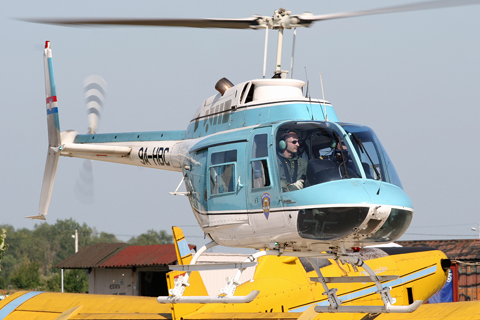
Second up is – what are the odds – the second oldest helicopter in the country, manufactured in 1973 :). A nowadays rather rare JetRanger II, 9A-HBC is operated by the Croatian Police, mostly used for training, personnel and liaison flights. One of my favorite helicopters here, it’s always a joy to catch it flying. It’s a very photogenic thing :).
Sporting a catchy 70s aquamarine scheme, HBC is seen sliding away from the Police helipad. Out back is the Ecos apron, as well as one of the now-sold Air Tractors previously featured herePlugged in and almost ready to fly after a prolonged period in the hangarHow not to get hit by a helicopter... While externally identical to the later JetRanger III, HBC is still somehow more interesting 🙂
3. Agusta-Bell AB.212, 9A-HBM:
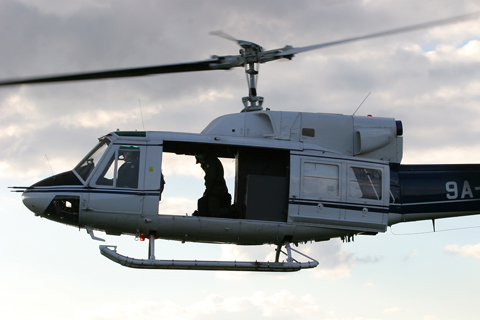
The “heavy” of the non-military helicopter world here, 9A-HBM is and remains the largest helicopter flying in the country, as well as one of only two twins. Produced by Agusta in Italy, HBM is also operated by the Police and is an active participant in SAR, EMS and firefighting missions down at the coast. The only helicopter with some hauling capacity, it is also used by special forces during rappelling missions.
Looking imposing on approach :). A big Huey, but still a Huey, its lines are instantly recognizableOff for some rappelling practice with the Alfas, the Police special unit team. The crew would lower two lines on either side of the helicopter, down which two men could descend at the same time (to maintain balance). In this photo, the Alfas are still not on board and would be picked up at the "drop zone" away from the main runway
4. Bell 206B-3 JetRanger III, 9A-HBZ and 9A-HDB:
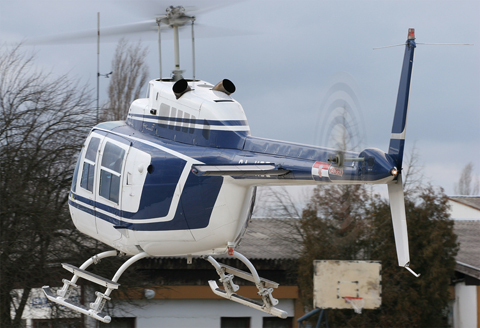
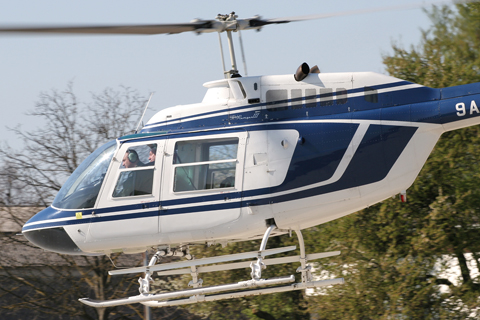
Representing the Police some more are 9A-HBZ and HDB, both JetRanger IIIs. Filling pretty much the same roles as HBC, they’re the most often seen Police helicopters, bearing the brunt of the squadron’s work.
HBZ approaching its pad in lighting I have been hoping for for ages :). Almost looks like there's no crew on boardDespite being cheap to operate (relatively), JetRangers are pretty much confined to transport, training and some utility roles. Lacking a second engine, they're not really suited for very much elseHBZ departing as aerial support and surveillance during a much-publicized local police action in March 2008HDB repositioning from Pleso during the afternoon. Before being finally supplied with their own bowser at Lučko, Police helicopters had to fly the 15 minutes to Pleso to refuelHigh speed low altitude departure after the fixed-wing traffic had quieted downHDB descending vertically down. I'm told that with a full load on a hot day this exercise isn't really fun in a JetRanger...
6. Robinson R-44, 9A-HDM and HWA:
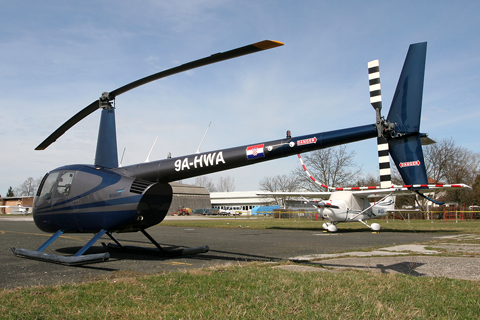
And to finish it all off, some piston power! 🙂 Alphabetically leading is our resident R-44 Clipper II owned by MD Heliko, these last few days happily flying aerial photography missions all afternoon. HWA, a Raven II, is a visitor from Varaždin owned by WinAir, a machine you’ve already had the chance to see in my CIAV airshow report :).
Pretty buttons and dials :). A closeup of HDM's clean and basic panel. Not visible here is a moving map GPS (I think a Bendix unit) mounted on top of the panelRevving up for a late-afternoon thermal imaging mission. Caught the rotor, caught the nav light, caught the crew... caught a cold in the downwash...Face to face on liftoff. The most produced helicopter of all time, the R-44 is becoming an increasingly common sight in Croatia. At one time there were three of them on the register, though one - 9A-HAS, Clipper - had been sold some time agoCaught on a rare visit to Lučko, parked next to HDM. Very nice paint scheme too 🙂Swooping in down RWY 28 for approach to the main apron :). Unlike fixedwings, helicopters normally approach the apron directly, as to avoid interfering with other traffic
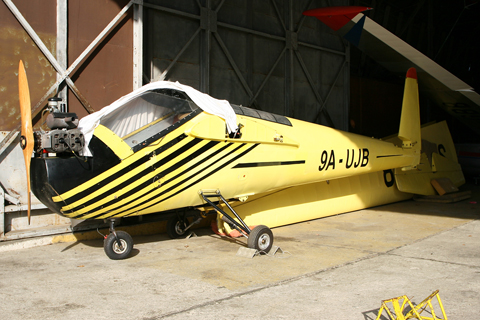
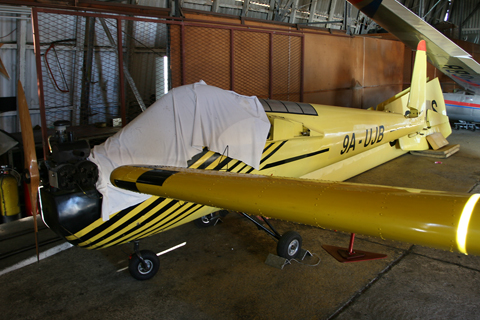
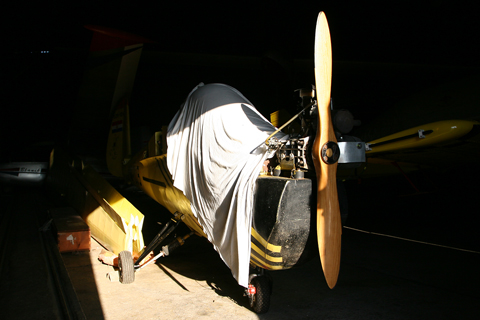
Just a quick update from today’s visit to the field :). With 9A-DOG out of the way and happily flying around, I got the chance to take a closer look at 9A-UJB – though I still ended up not all that wiser :D. What I did find out though was it’s old Polish registration, SP-1998, but a quick search on the net didn’t really turn up much info. Apart from that – and three photos more – all was quiet on the AK Zagreb hangar front…
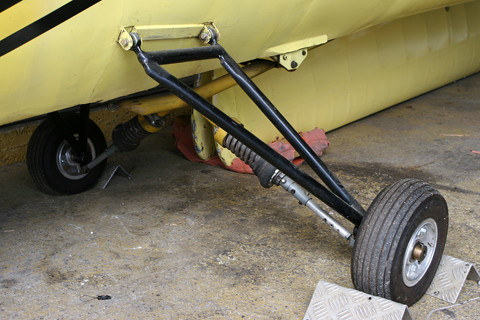
Still looks quite odd without wings and horizontal stabilizer :). A plaque in the cockpit reads "Aircraft restored and modified privately", which could mean this thing has had an interesting history...Apparently not destined to fly before the weather clears next year, UJB will probably be based at Zvekovac, a private field some 20 minutes flight away from LučkoA structural detail of the main landing gear
With the winter fast approaching and all our birds traditionally migrating south to the paved runways of Pleso and the ZTZ Zmaj maintenance facility, I had not expected to find anything new or interesting on today’s visit to Lučko. To be honest I hadn’t expected to find anything full stop – however I struck Achtung, Skyhawk! gold when, quite by accident, I peeked into the AK Zagreb hangar and found me a new and very interesting glider… 🙂
At first I couldn’t figure out what it was, thinking it may have been a homebuilt (it certainly looked like one), but my interest peaked when I saw SZD-12A written on the vertical stab, recognizing it as one of PZL-Bielsko’s early gliders. A Google search back home revealed it to be a very, very rare Mucha 100A, of which only a bit more than a 100 were built. This one was even more interesting as it had been turned into a motorglider, so I naturally got out the camera and went to work :).
You see my dilemma :). When I first saw it, with a stuck-on engine and no wings, I couldn't really make heads nor tails of it 🙂Out back, it all became clear :). A very, very rare wood & fabric glider, this one is apparently new to the Croatian register. The wings, lying to the side, still sport a numerical registration and though I couldn't see which, I presume it's from the Polish glider register (ex. SP-1234)Emerging into the sun with its odd engine and even odder installation. Don't know if it's visible in this shot, but the nose gear is equipped with an external disk brake, much like the one you can find on modern bicyclesThe color is pretty nice, suits it well :). Despite being a glider, which would have meant a G-prefixed registration, the engine installation - neither a factory mod nor certified - meant the aircraft had to be registered in the U-prefixed ultralight register (factory motorgliders are registered in the "normal" category D register)But the most interesting thing about 9A-UJB is the odd little engine, with it's two cylinders - and virtually everything else - on one side. I presume it's a two-stroke as well, but don't know about the power, guesstimating it at maybe 40-50 HPAnother side view :). The installation is pretty basic, but then again it needs to haul little weight. Looks like it might even be an antiquated car engine... maybe from a Trabant 🙂
Having been in doubt about the true identity of the Željava C-47 – mislabeling it as 212-something – I was pleasantly surprised to find out that someone had done some research where I haven’t :). After having posted one of the photos seen here on Airliners.net (link here), someone – to whom I’m very grateful – quickly corrected the registration to 71212.
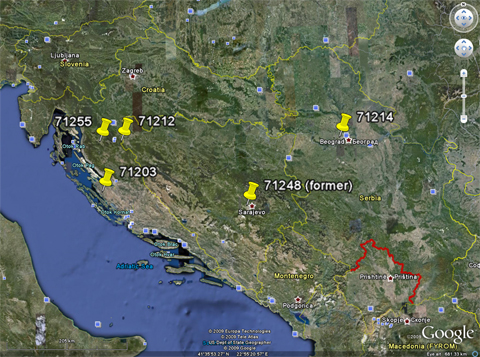
This got me thinking (by an odd, circuitous route): why not try and track down all the surviving Dakotas that were operated by the former Yugoslav Air Force (surviving being a very loose term here)? This of course necessitated some thorough research, so to start myself off, I decided to concentrate on the five examples I’m familiar with (having remembered another one yesterday and found the fifth in a magazine):
71203 at Zadar-Zemunik, Croatia
71212 at Željava, Croatia
71214 at Belgrade, Serbia
71248 formerly at Rajlovac near Sarajevo, Bosnia and Herzegovina, now at Merville, France
71255 at Otočac, Croatia
I believe that in the end these will probably represent the sum total of all the survivors – at least those still in Europe (some may have been sold overseas). Lacking proper aviation museums – except the Aeronautical Museum at Belgrade airport – many of these aircraft have either been sold, scrapped or dumped as gate guardians across the countries of former Yugoslavia, with little effort made to preserve them. But despite that – and the fact that an object the size of a C-47 is not all that easy to hide – I wouldn’t be surprised to find several more in out-of-the way backwoods places across the length and breadth of the western Balkans…
The Dakota Locator, Version 1 :). The locations of all the ex-Yu Daks I've been able to find so far (with the note that 71248 is now restored and in France)
Daks in the Jugoslovensko Ratno Vazduhoplostvo:
A bit of history first, to put it all into perspective. As far I’ve been able to find out while browsing though various magazines, the YuAF had acquired about 50 C-47s/DC-3s between 1945 and the mid-70s in two batches (in addition to 11 Li-2s/Li-3s). A number have been dismantled for spare parts outright – notably those from the second batch – while the rest were split between three squadrons:
the 675. transportna avijacijska eskadrila (transport aviation squadron), based at Batajnica airbase in Belgrade, which was a VIP outfit reserved for President Tito
the 677. transportna avijacijska eskadrila based at Niš in Serbia
and the 679. transportna avijacijska eskadrila based at “my own” Pleso airport here in Zagreb
All of these were phased out in 1976 (the Lisunovs in 1971) with the arrival of new Antonov An-26 turboprop transports, still used today by the Serbian AF.
1. 71203 / C-47… / cn unknown:
The first Dak on the list is a “new” one I’ve found while browsing through Aeronautika magazine. It is located at Zemunik airbase near Zadar, an active training base of the Croatian Air Force, but that’s as far as the information I have goes. Being on base, it is not freely accessible to the general public, so there’s – so far – very little chance of taking down its construction number and using the resources of the internet for something useful :).
2. 71212 / C-47B / cn unknown:
This C-47 you’re already familiar with from my previous post. The least-known of the lot, I think this may be the only B model here (though I have my doubts now about whether it may actually be a non-supercharged A version) and is arguably the worst one off. If it were just missing a couple of parts, it’d be okay, but some crossfire during the Balkan Wars has done its bit as well…
3. 71214 / C-47A-35-DK / cn 16472/33200:
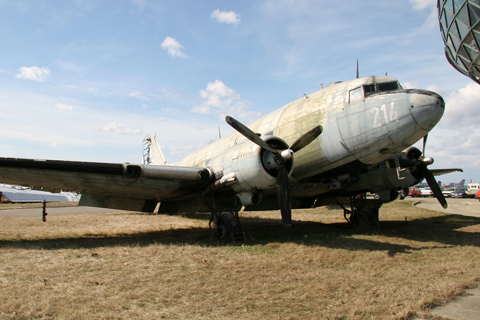
On the other side of the scale is the best preserved C-47 I’ve been able to find in the area, on permanent exhibit at the Aeronautical Museum at Belgrade airport. Thinking this was a B model as well – was given this information on a visit to the museum several years back – I subsequently found out it was an A model, which cast some doubts on whether 71212 was of the same sort, given that their Yugoslav AF serials were very close.
Another photo of 71214 - pretty much the same as the last :). The best-preserved example to remain in ex-Yu, 71214 is the only one fortunate to end up in a museum where it can be maintained at least somewhat
71214‘s history is still eluding me, but given that it was one of the most versatile aircraft of WW2, I’m sure it has a few interesting stories to tell :). Having the serial will also help during my upcoming thorough search…
4. 71248 / C-47A-80-DL / cn 43-15073:
The most fortunate Dakota from these parts is of course 71248, now happily living out its days, restored, in a proper aviation museum in Merville, France. Quite a famous machine, 71248 was originally the “SNAFU special” of the 440th Troop Carrier Group, 95th Troop Carrier Squadron, USAAF 9th Air Force, and has a combat record that makes for some very impressive reading – D-Day, Italy, Market Garden, the Ardennes and Operation Varsity, the last large-scale paratroop operation of WW2. Sold to the French Air Force after the war, by the early 70s it had found its way into the Yugoslav armory and survived the breakup of Yugoslavia as a sad, neglected derelict, sporting the locally-famous “MAY BE AIRLINES” sign.
Found in 2007. by enthusiasts from France, it was donated to the “SNAFU team” by the government of Bosnia and Herzegovina, and is now – after a year’s restoration and €90.000 euros invested – gracing the grounds of Normandy looking better than new! 🙂 You can find a lot of information and “Before” and “After” photos on the aircraft’s official website, www.the-snafu-special.com.
5. 71255 / C-47… / cn uknown:
The last on the list is another “mystery C-47”, which I believe may be an A model. Serving as a gate guardian at Otočac sport airfield in mid-Cro (ICAO location indicator: LDRO), this one is in a tiny bit better state than 71212 – differing in the fact that it was not shot at :). Its history is muddled too, with almost no information on it available after some cursory Googling – and very few good pictures, which I’m hoping to put right one day… 🙂
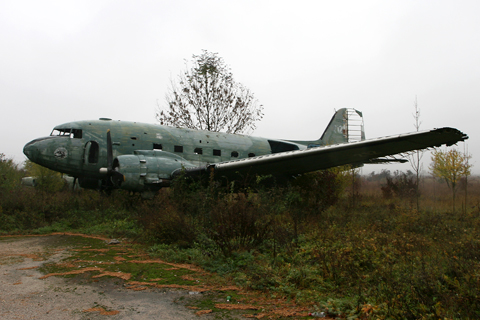
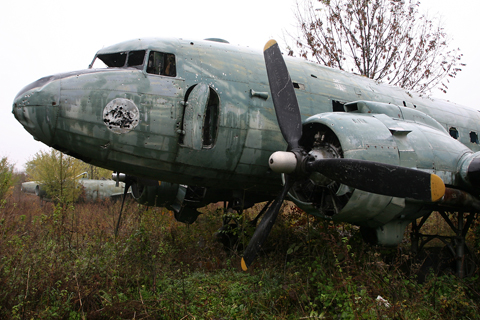
On my way back from Korenica, I had decided to stop at the abandoned Željava military airfield some 20-30 km away. I’ve always wanted to go there and now I was in the area, so what harm could a quick stop do. Quick, because 1. the weather was awful and 2. I wasn’t really prepared with maps, charts and a passport… but that’s another story, one which I will hopefully write soon, with many juicy photos :). In the meantime, I had wanted to bring you a couple of photos of one poor old classic bird I’ve found there – a nowadays rather rare B model of the venerable C-47 Dakota.
The C-47B was something of a niche model in the Dakota line, produced for one thing only – flying across “The Hump”, the western ranges of the Himalayas on the often perilous WW2 India-Burma supply route. To enable to it cope with the high altitudes and longer distances, the B was uprated with supercharged Pratt & Whitney R-1830-90 engines rated at the same 1,200 HP as the normally-aspirated variants, and additional fuel capacity. During WW2 they mostly served with the USAAF, while some were also transferred to the US Navy, where they served under the naval designation R4D-6 for cargo variants and R4D-7 for navigation trainers.
With the rapid downsizing of the Allies’ air forces after the war, many C-47s were disposed of at dirt-cheap prices, with the Socialist Federative Republic of Yugoslavia snapping up a few to complement it’s existing Lisunov Li-2s (DC-3s built under license in the USSR) and Li-3s (Yugoslav Li-2s re-engined with the DC-3 line’s original R-1830 engines). As far as I’ve been able to find out, most of these C-47s were B models…
One of these is our example, coded 212, so far the third ex-Yu C-47 I’ve been able to find (the others being at Otočac airfield and Belgrade airport). By the looks of it, it had been sitting here for quite awhile and is – according to a sketchy, Eyeball Mk.I analysis – beyond any reasonable repair, especially given that there are many other C-47s/C-53s/C-117s/R4Ds in better condition…
Dumped, damaged and forgotten, hidden out of everybody's way... the low cloud ceiling and drizzle fit the picture perfectlyThe classic C-47 shape in drab green still looks good even in this bad a state. The fabric covered control surfaces were the first to "go", while the rest of the structure seems to be holding on stillRiddled with bullet holes and chalked full of nationalistic graffiti, 212 is a reminder of the region's violent past. Situated in an area that saw considerable fighting during the Balkan Wars of the early 90s, Željava was destroyed in 1992 by retreating Yugoslav National Army forces. Useless as an airbase anymore, Željava saw some see-saw advances by various armies, which all left their mark on whatever was left on the base... out back, two Republic Thunderjets keep 212 some company as the elements do their workSeen just peeking through the foliage... the Thunderjets are quite a nice historical oddity. Despite being a socialist country, ex-Yugoslavia was one of the founding members of the Non-Aligned Movement, rejecting "membership" in either bloc. But being squeezed right in between them, in the immediate aftermath of WW2 both blocs vied for it, with the West upping the ante by supplying some first-generation combat jets, including a large number of North American Sabres. In the civil world too, JAT - the country's flag carrier - was the only European socialist state-owned airline to continually operate an all-Western fleet (Caravelle, B727, B737, DC-9, DC-10, ATR-42/72)And, as an added treat on the side, one photo of the Belgrade-based C-47B 214 :). Part of the Aeronautical Museum at Belgrade's Nikola Tesla/Surčin airport, this is the best-preserved of the three
(the third Otočac-based aircraft I still haven’t photographed, but here are some shots from Airliners.net:
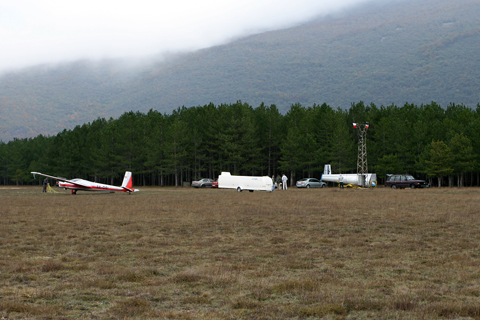
Now here’s something new from me – an airfield report! 🙂 And even better, a brand-new airfield report! Heard from a friend a few days ago that a new airfield was supposed to open Sunday (25th) out there in the hills of mid-Croatia. Desperately in need of some refreshing subjects to photograph – and not having much else to do – I sat in the car and went to see what’s what :).
1. Korenica – Bijelo polje (also known as “Zvonimir Rain”):
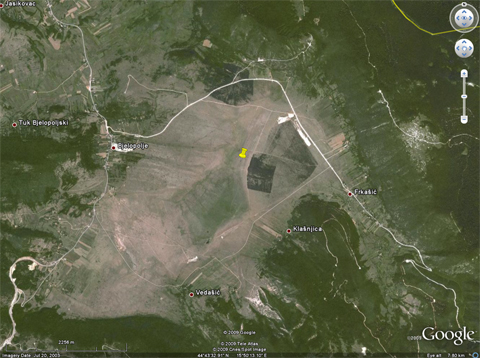
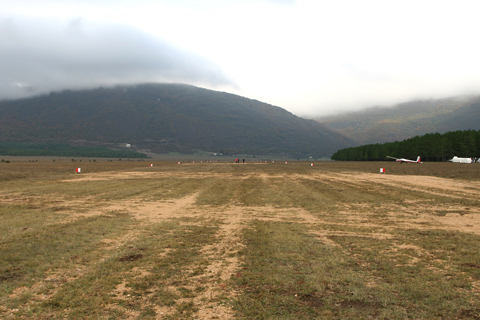
A bit about the airfield first: situated about 130 km south of Zagreb as the crow flies – or about 2 hours and 160 km by road – Bijelo polje was built on the site of a previous glider field, which had been closed some time ago (for reasons I’ve not been able to find out). The area itself has traditionally been very popular with glider pilots since the local terrain gives rise to some fantastic gliding conditions (primarily ridge lift), with almost all Croatian gliding records having been set here – including endurance and altitude records.
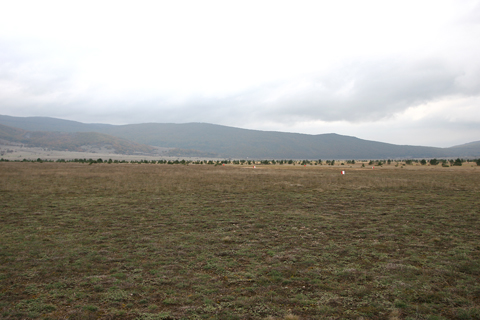
The airfield itself is located in the middle of Bijelo polje (directly translated as “White field”), which, at 2000 ft AMSL, is pretty much the lowest point of the surrounding terrain (as you’ll be able to see from the photos). The single grass runway stretches in a 02-20 direction – right into the prevailing bora wind – and is 500 meters long and a guesstimated 20 meters wide, more than enough for a Super Cub towplane :). Despite the high elevation and short runway – and hills on either end – beneficiary factors include relatively low temperatures and favorable winds, so it’s not as tight as it seems.
A Google Earth view of Bijelo polje. The location of the runway is "pinned down", though none of it will be visible in this dated shot 🙂A wider view. Note the field's proximity to Bosina and Herzegovina - it's literally on the other side of the hill 🙂
Since the field is small and still new, it had not yet received its ICAO Location Indicator nor a dedicated radio frequency, with all communications being done on the standard 123.500 MHz.
2. The opening:
Ideally, the way to make an entrance at an airfield opening ceremony is to dive in and screech to a halt in a Cessna :). However, the worsening autumn weather in this part of Croatia meant low ceilings, obscured mountain tops, high winds and moderate to strong turbulence – not really fun in a light Cessna, so the only option remaining was the car. It had proved to be a good choice when, halfway to the field and climbing through 1,100 meters, I entered cloud – on the road! – and stayed in it up till just 10-something km before Bijelo polje…
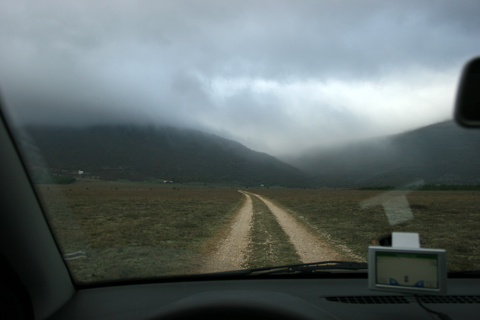
Once back in VMC past the town of Korenica, my next problem was to somehow get to the airfield itself. Though easily visible from the main regional road – seen snaking near the top of the GE image above – driving up to it proved to be not as straightforward, and eventually degenerated into an offroad session along random cobbled paths crossing the field :).
My only complaint about the whole field was the offroad driving needed to reach it :). Even my GPS was stumped...
Nailing the right path on my second try – with the help of some people also headed in my direction – I’ve finally arrived at the airfield, with my car’s lifespan considerably shortened :).
Now, the original plan had called for some glider ops to break the field in, but the aforementioned weather meant that a tiny, but significant component of that plan – the towplane – had failed to arrive. 9A-DBU, previously seen here and flying from Lučko, didn’t even bother taking off, while backup aircraft from neighboring Livno in Bosnia and Herzegovina and Rijeka in the northern Adriatic couldn’t break through the clouds and had to return. Of the three gliders present, this left only one capable of doing anything about it, a motorized L-13SE Vivat which ended up being the centerpiece of this report :).
With some beautiful scenery in the back, 9A-DSI is seen waiting for the strong, 20 knot wind to subdue. The other two gliders, a standard L-13 and a Pirat, didn't even bother getting off their trailers 🙂An oblique view down RWY 02 shows the hole this airfield is in - literally. However, the surrounding hills and mountains give some excellent ridge lift, with 4 hour flights not being all that uncommonLooking straight down the full 500 meters of the runway. The first 150 meters were made soft, presumably to ease airframe stress during landing. The nearness of the terrain here means that if you decide to fly in with something sporting an engine, it had better be STOL 🙂Another oblique view of the RWY 02 threshold, look west-southwest. The hills and mountains all around are part of the Dinaridi chain, which is in itself a lower and gentler extension of the AlpsUp close with 9A-DSI, my first L-13SE Vivat. A side-by-side modification of the popular L-13 Blanik, the Vivat was also equipped with a Mikron M III AE inverted four-cyl engine to circumnavigate the need for a towplane - something very useful on this day...Ready to fly! The beautiful scenery is quite a change from the boring dullness and flatness of LučkoA rare motorglider, a pine forest in the back, hills and low cloud - what more could you ask for an interesting photo? To me this looks more like it was taken in North America than in Mediterranean CroatiaA view toward the northwest, with gentler terrain in the distance
The Vivat aside, the infrastructure of the field is basically nil – but with the onset of winter and almost certain snow, in addition to the undemanding nature of gliders, one doesn’t need really need a lot of equipment hanging around, exposed to the elements. Even this unambitious opening was a one-time affair, since right after it the airfield had shut its doors till the spring gliding season. Maybe when the weather clears, I’ll be able to post a proper, airborne report on the it… 🙂
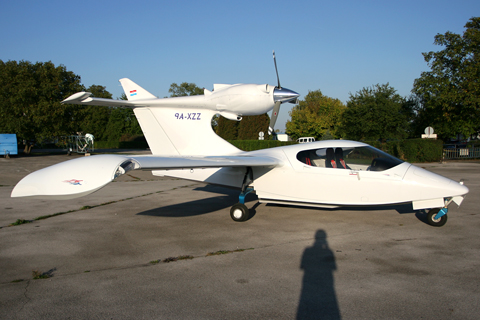
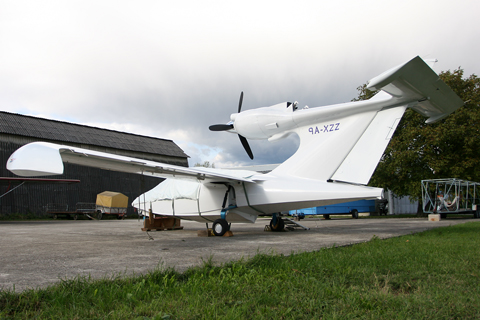
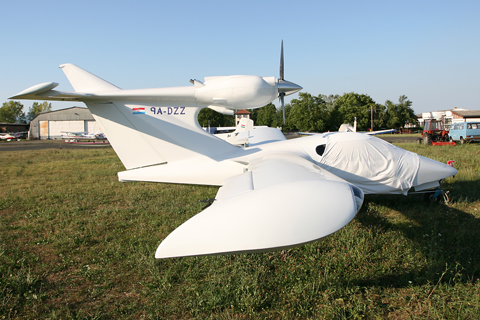
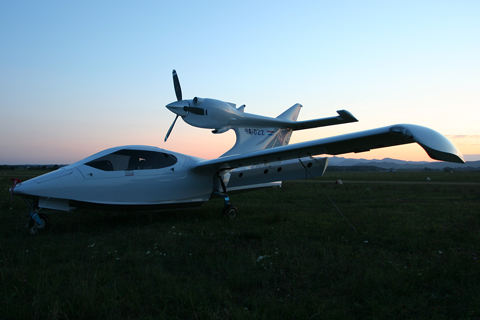
Seeing from my blog stats that the previously featured Seawind 3000 has been attracting a lot of interest (relatively), I’ve decided to put together another small gallery of more recent pictures :). Apart from adopting the experimental “X” registration prefix – a category that seems to appear and disappear on a regular basis – and undertaking a fast taxi run that didn’t end all that well (see captions below), it’s slowly but surely nearing first flight, albeit at a non-spectacular-photo pace :D.
Structurally complete and ready for some taxiing! 🙂 Now this looks more like it, complete with some color!A few days later however, I found it propped up and back under covers. It had transpired that the gear was significantly damaged during the fast taxi run (something or other with the hydraulics), but I was told the repair was relatively straightforward so we may see her move again soon 🙂Quite an oddly-shaped aircraft in profile view :). Try making this out of aluminium...Some night spotting for a change :). Still some way from completion at the time this photo was taken...
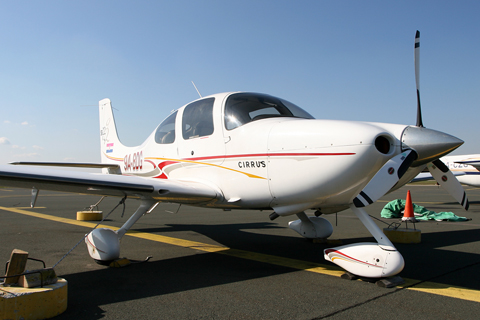
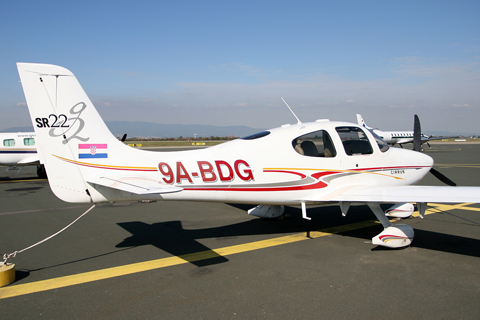
Arriving at the field a few days ago not expecting much to happen – just some quiet and calm flying around – I was pleasantly surprised when my flight instructor (who’d be flying with me for a checkup) informed me that instead of the usual dull circuits and maneuvers, we’d be heading to Zagreb Intl. to fire up a privately-owned Cirrus SR-22 that had been sitting on the ground for a spell and needed to be flown to Germany for maintenance. Having only been in a Cirrus once in my life – in a brand-new SR-22 G3 at the Paris Air Show – I was naturally through the roof, especially it being a beautiful and calm sunny day just begging for some camera work :).
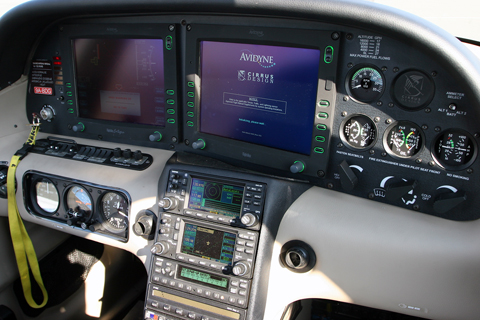
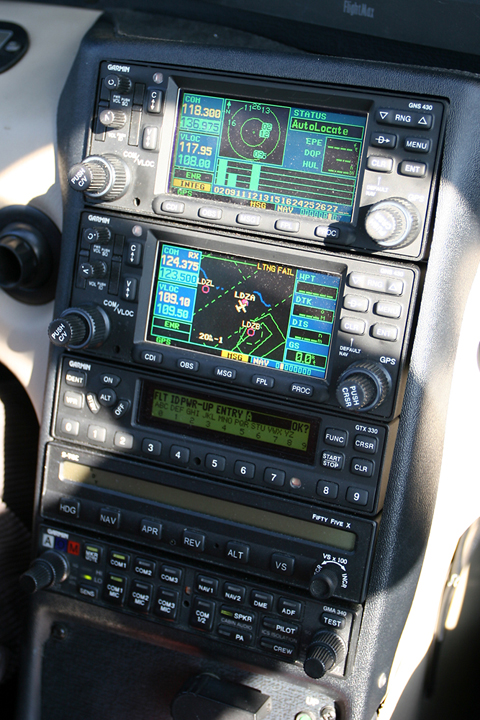
The aircraft in question is a SR-22 G2, registered 9A-BDG, bought new a couple of years ago (and had as such represented a quantum leap for Croatian general aviation :D). Our mission for the day was to fire it up and run the engine for about 10-15 minutes so it could “catch some air”. Not moving from the same spot, it gave us the opportunity to run through its excellent Avidyne Entegra FlightMax glass cockpit system – though, with the aircraft vibrating from the big six pack up front and me totally engrossed in the display, I didn’t take all that many photos…
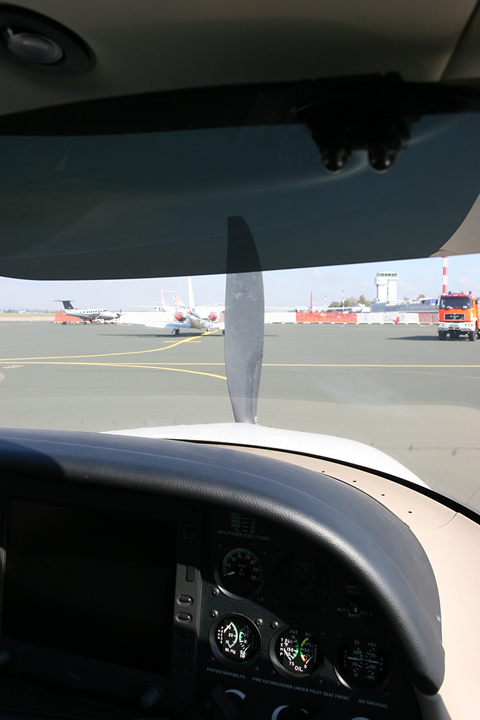
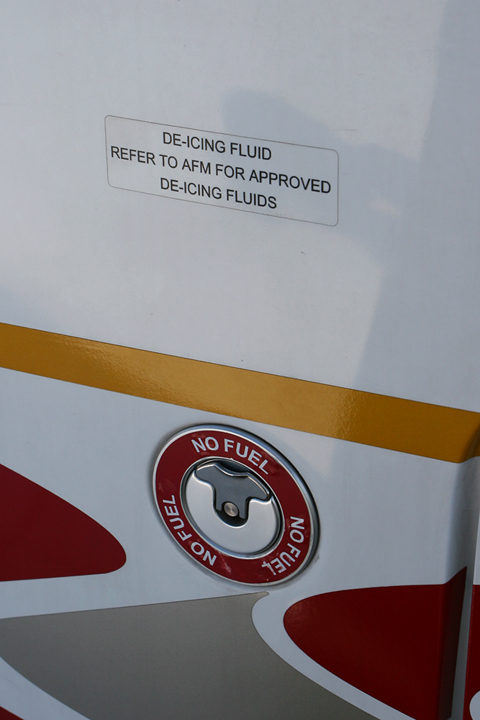
9A-BDG shining proudly in the mid-day sun. Though not as elegant as other similar aircraft - the Lancair ES comes to mind - the SR-22 is still a sight to look at. As you can see, the aircraft is lavishly equipped with deicing systems, including the state-of-the-art TKS fluid-based system on the wing and horizontal stab leading edgesRear quarterview. Completely fascinated by the Cirrus, I had completely failed to notice a much rarer Fairchild Metro in the background 😀The office :). There's a whole farm worth of cow in here :D. Unlike its follow-on, the G2 sports the Avidyne glass cockpit system, as opposed to the G1000-based Cirrus Perspective system on the G3. The sidesticks - which are also the trim controls - give the front seats a lot of roomWarming up the computer :). To feed all the electronics on board, the SR-22 has two alternators and two batteries, though as far as I've seen, Alternator No.2 comes online only at about 1500 RPM... presumably not to overburden the engine when it's running on idle. As you can also see, the G2 comes with a number of backups, including primary flight and complete engine instrumentsUnlike the G1000, the Entegra does not have comms and nav radios integrated into the system. Hence, two Garmin GNS 430 units provide the interface with the system, though which you can also load the flight plan to be followed using GPS. Below it is a juicy Garmin GTX 330 Mode S transponder, with an autopilot and audio selector panel situated belowAn artsy view of the PFD and MFD. Everything's in here - moving map, TCAS, strikefinder/stormscope, comprehensive engine information...A view from the passenger's seat. Firing up the engine for the first time in awhile, we had asked for a fire truck to keep watch nearby, should the 310 HP engine fail to cooperate...An interesting feature - the deicing system refuel valve :). The system has an autonomy of about 4 hours on the G2 I think (and 6 on the G3 if I'm not mistaken)
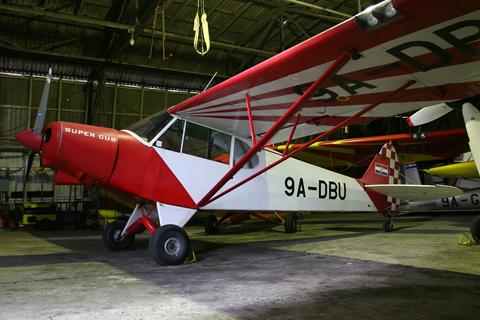
With a strong northern wind pinning everything down at the field for the past two days – and rapidly dropping temperatures killing any will to stand outside – I had decided to sniff though the hangar again in search of some inspiration :). And wouldn’t you know it – the Super Cub population had doubled! 😀 Normally parked outside the hangar – being a visitor while it’s base field of Buševec was undergoing some work – 9A-DBU, AK Velika Gorica’s towplane, took shelter alongside our resident 9A-DBS. So, with nothing better to photograph outside, here are the results!
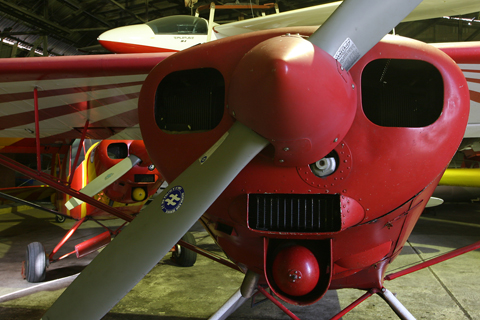
Despite it still being light outside - plenty of it between the storm clouds - we had lit up the interior as well :). A stock Super Cub, 9A-DBU is one of a number of such aircraft bought and imported at pretty much the same time for towing dutiesFull of natural and sodium light, this family photo shows that Cubs love stripes :). Related by more than just their type, DBU and DBS are twins, coming off the line one after the other :). DBU is serialled 7809169, while DBS 7809170Another shot toward "The Crack" (no rude hidden meaning intended 😀 ), the gap between two hangar door sections. Being quite old - almost 70 years - the hangar is becoming a bit shabby...Lined up and ready to go!















































 Achtung, Skyhawk!