Photo Report – High Seventy-Five: the Learjet 75 at Zagreb

By me
All photos me too, copyrighted

Anybody who has ever spent some time flying light aircraft – especially those part of smaller flying clubs – will no doubt have experienced what I’ve come to call the “cascading planning failure”. It’s the weekend, the weather is (nearly) perfect, the bird is operational and ready… and willing pilots can be found in their dozens. After several rounds of negotiation – and a hefty phone bill – you finally end up with a working plan, one that will both make everyone involved happy and keep the aircraft’s down time to a minimum. Excellent. All that remains now is one person to derail the entire works right at the outset… 😀

Such was the case on 13 April, when a planning meltdown kicked off my series of flights with an hour’s delay. What was a mild irritant at first had though quickly turned to excitement, proving conclusively (once again) that there really is a silver lining to every dark cloud! Rejoining the pattern at Zagreb Intl. – now well over two hours behind schedule – I happened to catch a transmission by an N-reg aircraft on approach, complete with a movie-set American accent. And while we do get quite a few N-numbers here in Croatia, most of them are aircraft actually based somewhere in Europe and operated by European companies and individuals – so catching an “authentic” US machine was immediate cause for excitement. Rolling lazily into the downwind leg, I scanned the skies for signs of the newcomer, expecting it to be a small business prop or the like… and then I saw it, dead abeam and 1000 ft lower – a pristine white Learjet gliding in towards the touchdown point.

Being a lifelong fan of the Learjet (thank you Microsoft Flight Simulator 98 😀 ), I was naturally through the roof, especially given my recent photographic dry spell. And while I couldn’t make out the exact model from the air, I’d assumed it was one of the established, “common” models like the 45 or 60. So you can imagine my surprise when, while holding on TWY B for the traffic to clear, a brand new Learjet 75 happened to roll by in front of my nose… 🙂

With their classic, speedy lines – hallmarks of the brand ever since the original model 23 of 1963 – Learjets definitely tend to stand out on the apron… even when sporting such a basic scheme as this!

Nip ‘n’ tuck

The newest operational member of the Learjet family (notwithstanding the recently problematic 85), the model 75 is not a new design per se, but rather a revamp and thorough upgrade of the best-selling model 45 (the aircraft included in the aforementioned Flight Simulator that had sparked my love affair with the brand 🙂 ). First flying in 1995, the 45 was conceived as the replacement for the superlative model 31 – for many the greatest of the classic Learjets – and had introduced a new, wider fuselage, reworked wing for higher cruise speeds and a new, state-of-the-art glass cockpit (the Honeywell Primus 1000 suite to be exact).

Despite being a clean sheet design, the 45 was nevertheless still a “proper Learjet” in every way – not the most commodious of aircraft, but one that could out-accelerate, out-climb and out-fly pretty much everything else in its category. And while its ceiling of 51,000 ft – known in the 60s and 70s as “Learjet country” – was neither that impressive nor unobtainable anymore, the way it got there had nevertheless still guaranteed it a healthy and loyal customer base.

However, by the early 2010s, the 45 was becoming increasingly hauled in by time, prompting Bombardier to put on its thinking cap and develop a modernized version. To that end, they took the basic 45 airframe and refitted it with new winglets (a design borrowed from the Global Express), more powerful Honeywell TFE731-40BR engines producing 17.1 kN of thrust each (versus the 15.57 of the 45’s TFE731-20s) and a completely redesigned cockpit featuring the newest in Garmin digital avionics. In this form, the new aircraft would become the model 75*, first flying in late 2012, with FAA certification following on in November 2013 🙂 .

* the same treatment would also be applied to the Learjet 40, the 45’s shorter brother. Fitted with the same suite of upgrades, it would become the model 70, with its certification still pending.

With the aircraft now ready for sale, all that was needed was to whip up a fully spec’d demonstrator and head out into the world. Such was the role of the titular aircraft, N446LJ, which had popped into Zagreb to take on fuel before continuing onwards to Denmark. Having rolled onto the GA apron just a few minutes later, I was at the plane in moments, camera naturally set and ready… 🙂
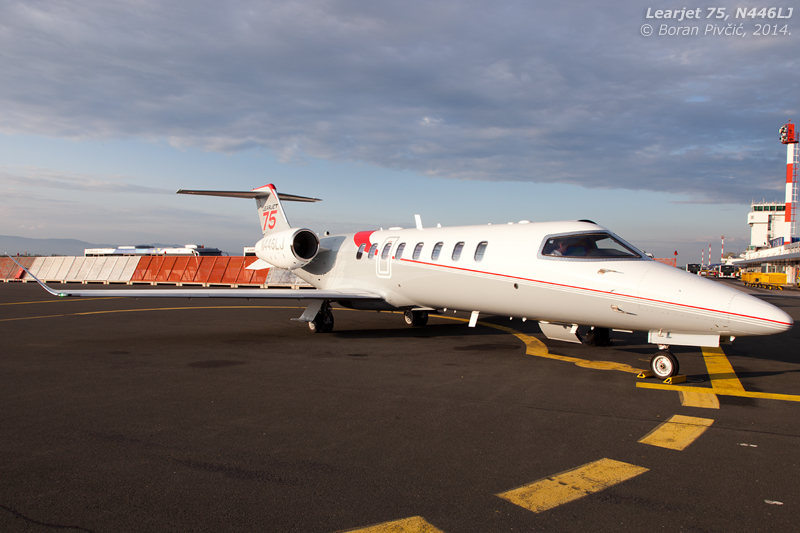
Looking stunning in the golden afternoon light. Even though it was in town for just half an hour on a “mere” technical stop, N446LJ’s visit was nevertheless quite the local exclusive, marking the type’s first ever appearance both in Croatia and South-Eastern Europe.

Many news here in the pointy end! Doing away with the Primus, the 75’s cockpit is based around the new Garmin G5000 suite which – in addition to all the usual features – also includes the Synthetic Vision System (SVS). Notably cleaner and less cluttered than those of previous Learjets, the 75’s flight deck actually feels more open and airy – despite the fact that it is of the same size as that on the 45 (also, sorry for the poor crop… the F/O was preparing the bird for its onward flight so I though it best to intrude as little as possible).

One of the reasons for the cockpit’s cleanliness lies in the relocation of the light switches to the overhead console – the first such panel ever fitted to a Learjet.
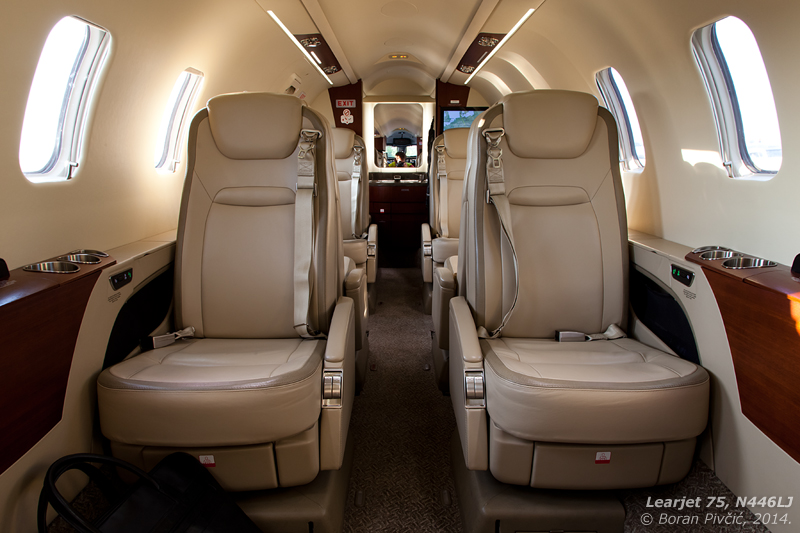
Like on all modern Learjets, the cabin of the 75 is comfortable – but not all that roomy. Updated along with the rest of the aircraft, it now features pop-up video monitors linked to touchscreen controllers installed at every seat, as well as several new trim options – the best of which is this pleasant and warm cream-wood combo.

A

A reverse view from the lavatory (which also doubles as the ninth passenger seat). At my 1.93 m /  6ft 3 in, navigating the cabin was a bit interesting – but not nearly as much trouble as I would have thought. Provided you’re not carrying a huge camera bag on your back, entry, seating and exiting is pretty straightforward, with very few objects you could snag with your limbs or clothes on the way.

While it is technologically far removed from the original 23 – and even the legendary 31 – the 75 still sports those evocative, exciting lines of the classic Learjet. With that narrow nose, short-span wing and short vertical stabilizer – plus a perfectly proportioned fuselage – it continues to dominate the business jet segment in sheer visual (and visceral) appeal. Also note the new winglets, installed at a significantly more obtuse angle than on the 45.

I would also like to extend my sincere thanks and appreciation to the crew of N446LJ for allowing me to snoop around and snap at will!

Additional information:

Short Photo Report – Spring at Lučko

By me
All photos me too, copyrighted

While many locals here in Zagreb have welcomed spring back with open arms – finally getting to enjoy clear skies, vegetation in bloom and more than reasonable temperatures – we one the GA side of things had something entirely different to be glad of 🙂 . After what seemed like eternity – exacerbated by odd weather patterns and even odder legal struggles – the flying season at Lučko Airfield (LDZL) is finally back up and running like clockwork! And while its start hasn’t been as bombastic as we would have liked, the airfield is nevertheless fully operational, with things on the whole progressing slowly forwards – a development that had lured back a number of light aircraft that had made their winter residence at nearby Zagreb Airport (LDZA).

And even though the apron is not nearly as full as in years past (yet), life has nevertheless finally returned to Lučko – a milestone that naturally warrants a small photo celebration! 🙂

Life, life at Lučko! The only airplane to have succeeded fighting against the day's very strong southwestern wind - with gusts peaking at 30 knots - N50DD is a long-time resident of various Zagreb airports, and is seen here cooling down after its repositioning flight from Pleso .
Life, life at Lučko! Flying in the very day the airfield had reopened, N50DD was the only airplane to succeed in the fight against the day’s strong crosswind, which had actually managed to touch the 30 knot mark at one point. Despite its reg, the aircraft is a long-time resident of various Zagreb airports, and is seen here cooling down after its 10 minute repositioning hop from LDZA.

ome of our birds at Lučko have started the new flying season like fish out of water . Out of the hangar for the first time in several months, AK Zagreb's Jantar will first receive a thorough wash, after which it'll be given back its wings and horizontal tail surfaces (stored away in the corner of the hangar)
Some of our birds though have started the new season like fish out of water! Out of the hangar for the first time in several months, AK Zagreb’s Jantar will soon receive a thorough wash, after which it’ll be given back its wings and horizontal tail surfaces (stored away in the corner of the hangar). By the end of the morning, it would be happily catching thermals above town.

A glider you really can't loose in a crowd! Despite its staggering similarity to the Polish-built PZL-Bielsko SZD-24 Foka - one of the world's most beautiful wooden gliders - the Delfin ("Dolphin") was actually designed and produced by the Vazduhoplovni tehnički centar ("Aircraft Technical Center") at Vršac in Serbia, well known locally for both its own and license-produced high performance gliders.
A glider you really can’t loose in a crowd! Despite its staggering similarity to the Polish-built PZL-Bielsko SZD-24 Foka – one of the world’s most beautiful wooden gliders – the Delfin (“Dolphin”) was actually designed and produced by the Vazduhoplovni tehnički centar (“Aircraft Technical Center”) at Vršac in Serbia, well known locally for both its own and license-produced high performance gliders.

The mass hangar clean-out had also given me the opportunity to visit our old Aero 3, usually inaccessible without serious aerobatic moves around and over several gliders . A remainder of better flying times, CPC had undergone restoration several years back, which had faltered due to a lack of funds. Expecting that it'll fly eventually, the aircraft had also received a Croatian reg, whose application had not progressed beyond appearing in the register...
The spring hangar cleaning session had also given me the opportunity to visit our old Aero 3, usually inaccessible without some serious aerobatic moves over and around several rows of gliders. One of the few remaining examples of the type, this machine had actually undergone restoration several years back – a process that had, sadly, been curtailed due to a lack of funds. Planned on being returned all the way to flying status, the aircraft had also received a Croatian registration, which had never actually been used outside the official register…

A sight to warm the heart! Blue skies, bright colors and a raft of lighties eager to fly.
A sight to warm the heart! Blue skies, bright colors and a raft of lighties eager to get off the ground. Leading the pack was our colorful gliding pair, consisting of Schleicher Ka-7 9A-GKA and the afore-pictured Delfin 9A-GHS. They would soon be joined by Pilatus B4 9A-GPA, seen just in front of the hangar doors.

A contrast that perhaps best of all illustrates why I love Lučko: we've got everything from gliders to transport helicopters, fun to security and dull grayness to cheerful colors.
A contrast that perhaps best of all illustrates why I love Lučko: we’ve got everything from gliders to transport helicopters, fun to security – and dull grayness to cheerful colors.

The only aerobatic aircraft at Lučko had also used this nice day well, firing up its engine for the first time after servicing (and several months on the ground). One of only three aerobatic machines on the Croatian register, DID is actually a kitplane, assembled from prefabricated components .
The field’s only aerobatic aircraft had also used the fine weather well, firing up its engine for the first time after some minor servicing (and several months on the ground). One of only three aerobatic machines on the Croatian register – and one of two physically in Croatia – DID is actually a “kitplane”, assembled by the end user from prefabricated components.

Photo Report – Life at Pleso #3

By me
All photos me too, copyrighted

With the weather finally turning for the better, I have come once again to the point where my (admittedly limited) flying duties see me visiting Pleso Airport (LDZA) on a near-daily basis (not that I’m complaining! 😀 ). The upshot of the situation is that my camera invariably visits with me, which – combined with generous apron access – often makes for some good and exciting photography. As I’d explained previously in another post on this very topic, Pleso’s status as the default gateway to Croatia is a surefire guarantee that something interesting will pop in every once in awhile, whether it be a heavy freighter, a fast military jet, or an unusual little prop 🙂 .

And while 2014 has so far been somewhat of a slow year for Achtung, Skyhawk!-worthy aircraft, a few oddballs have nevertheless flown in, providing me with enough material to satisfactorily continue this photo series… 🙂

f
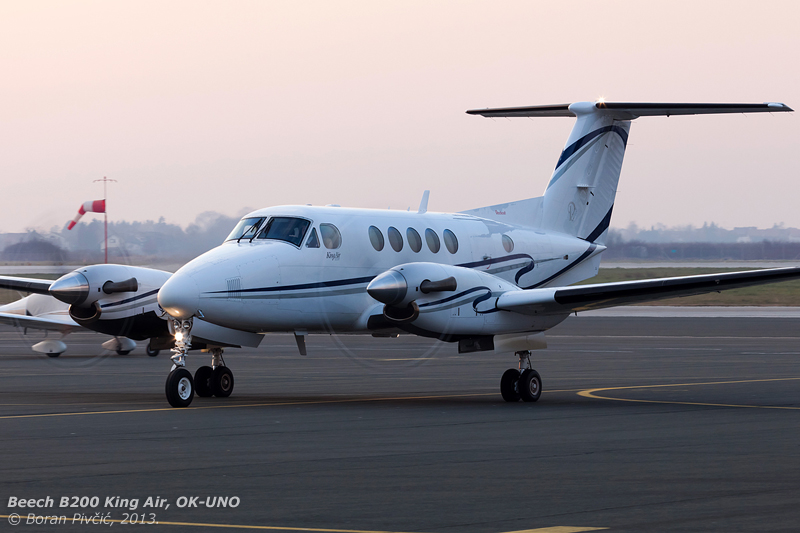
Another medical flight rolling in with the last light of day. In town to pick up a donor organ urgently needed for transplant somewhere in Europe, OK-UNO is part of a steady stream of similar flights arriving into Pleso throughout the year. In addition to “pure” organ transport, many of these also fly out people seeking medical treatment abroad – flights that are on the up since Croatia joined the EU in July 2013.

One of
One of the absolute highlights of the year so far is seen diving for RWY 05, flying in a volleyball team for a local championship. A lengthy – and hopefully educational – description is provided below!*

* definitely one of the most interesting aircraft to have come out of the Antonov works, the An-74 is an upgraded, Arctic-capable version of the An-72, both of which owe their unconventional looks to the application of the so-called “Coandă effect”. Named after its discoverer – Romanian aerodynamicist Henri Coandă – this effect describes the tendency of a moving gas to follow the shape and form of the surface it is flowing against. Recognizing its potential to drastically reduce an aircraft’s minimum approach and landing speeds, Antonov had in the mid-70s decided to implement it on an actual aircraft – the An-72 – in which the engine exhaust gasses flow over the flaps and inner sections of the wing, increasing their generated lift without necessitating an increase in flight speed (Boeing had applied the same principle on its YC-14 – an aircraft roughly identical in shape and function, and created round about the same time). Originally conceived as pure-blooded military transports, the An-72 and 74 would eventually also evolve into a number of passenger models, the first of which was the An-74TK-200 pictured above. Interestingly, the design had also served as the springboard for the modern An-148 and 158, which were derived from the visually nearly-identical An-74TK-300.

d
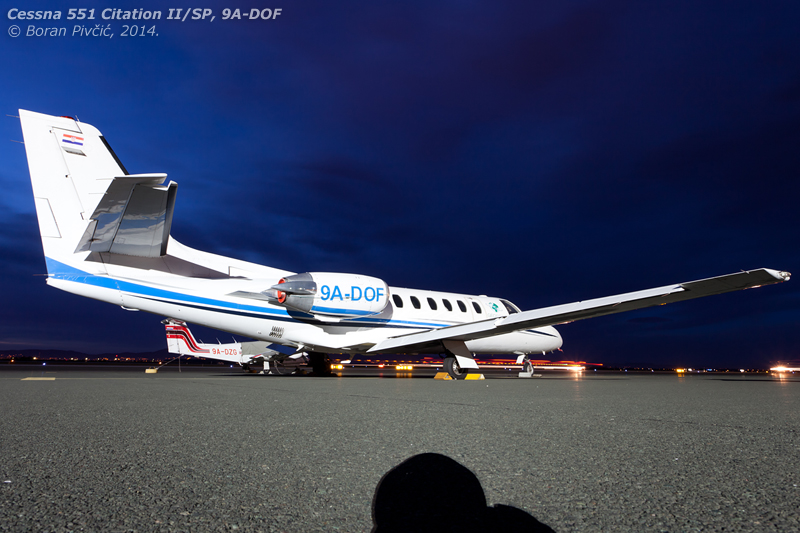
Sitting clean and pretty at the end of another fine winter’s day. Owned by Geofoto – a well-known local aerial imaging company – DOF had actually spent the last year or so on the ground due to various financial issues, with its only movement having been a tow from one side of the airport to the other. Said to be up for sale, the aircraft had been spruced up over the course of the winter – and even ran for a few minutes to clear the proverbial bats out of the engines.

f
A welcome sight and sound as “Knight 01” rolls briskly towards RWY 05 for a one-hour sortie. Looking worse for wear every time I see it, 121 is one of the last Croatian AF MiGs still in something resembling an operational status, with the rest of the fleet currently undergoing servicing and overhaul in the Ukraine. As part of the current QRA pair, 121 would normally be armed with two R-60 (AA-8 Alphid) heat-seeking missiles – but was on this occasion flying empty, with only the missile pylons in place…

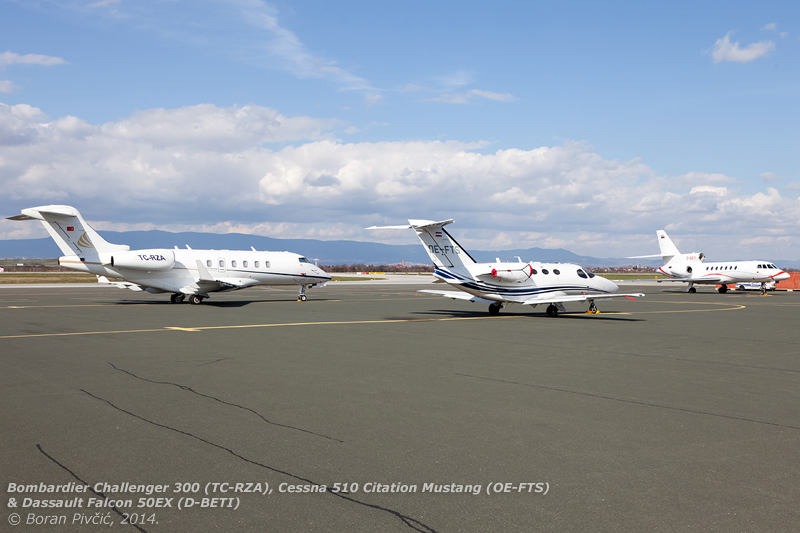
A selection for all tastes (and wallet sizes): the modern Challenger 300 for medium ranges, the classic and elegant Falcon 50EX for transoceanic flights - and the small and cheap Citation Mustang for popping into another country for a coffee
A selection for all tastes and wallet sizes: the modern Challenger 300 for “medium haul”, the timeless and elegant Falcon 50 for transoceanic hops – and the humble, cheap Mustang for popping over the border for a coffee. While not nearly as sizable or impressive as those seen across Western Europe, this little fleet – which had also included three more Citations out of shot – is definitely a sight to behold at Pleso…

Even though this weekend was not as interesting as the last, one could still find some interesting machines on the GA apron . An extremely rare type, the Citation VI is essentially a cheaper version of the base Citation III, Cessna's first swept-wing jet - and also the first Citation to turn out to be a sales disaster. Intended to offer solid performance at the bottom end of the market, the Citation VI would be sold in only 39 examples and pulled from the product offering after just a few years...
Even though the traffic situation the following weekend was not as varied as the one pictured above, one could still stumble upon some interesting machinery on the GA apron! One of the rarest bizjets around, the Citation VI was developed as a cheaper, softer version of the original Citation III, Cessna’s first swept-wing jet. Intended to offer solid performance and operating costs to the lower end of the market, the VI ended up being a huge sales flop, with only 39 examples made before production ceased in 1995… the first one I’ve ever seen up close, PH-MFX is operated by Holland’s Solid Air and is I believe one of just a handful of examples flying in Europe.

Photo Report – The Force 450 Gale: Serbia’s SILA 450 UL

By me
All photos me too, copyrighted

Back in 2012 while on a short visit to Belgrade, Serbia, a friend and I had decided – in true Achtung, Skyhawk! tradition 😀 – that we might as well do some proper sightseeing and head out to the old UTVA aircraft factory in Pančevo, a couple dozen kilometers up the main road. Once the powerhouse of Yugoslavia’s aircraft industry, this enormous factory was, among other things, responsible for the most ubiquitous light aircraft in the country’s history – the much maligned UTVA-75 – a machine that, despite all its faults, had quickly come to dominate aprons across the land (and the occasional newspaper accident column 🙂 ). Singularly robust machines – the DC-9s of the light single world – many 75s continue to soldier on even today, with a select few also having seen combat action as impromptu light attack aircraft during the turbulent 90s.

By 2012 however, the factory’s shine had long gone and its successes largely forgotten. A dilapidated ruin that had been heavily damaged during the 1999 NATO air strikes, the factory exists today as a rump facility at best, fiddling with a handful of low-scale projects on a thin shoestring budget. While a sad sight in its own right, the view that had greeted us had also represented a striking metaphor for former Yugoslavia’s aviation industry as a whole – and not least of all for the flat spin it had taken during the country’s violent disintegration. Largely scattered across the land, it would – unsurprisingly – take a crippling hit at the start of the 90s war, losing its supplier and customer bases virtually overnight. The widespread financial disasters that had succeeded the conflict never really gave the industry the breathing space it needed to recover, turning the whole aviation landscape into an archaeologist’s playground of abandoned factories, forgotten companies and rotting gate guards.

May the Force be With You

But, in what is a long-overdue resurrection of the region’s large(r) scale light aircraft industry, one manufacturer had nevertheless managed to part the red tape and defy the economic odds, adding its bit to putting the industry back on the proverbial map 🙂 . The company in question is Aero East Europe, a small but efficient unit operating out of a historic workshop in the southern town of Kraljevo, and nowadays well on its way to building up a respectable regional reputation for its original STOL ultralight designs. Fighting its way up the sales ladder against various copies and modifications of the legendary Zenair CH-701, the flagship of the fleet is the 450 kg / 992 lbs SILA 450, an example of which had popped into Varaždin Airfield (LDVA) on 18 January for a brief promotional visit. No prizes for guessing whether I was there… 😀

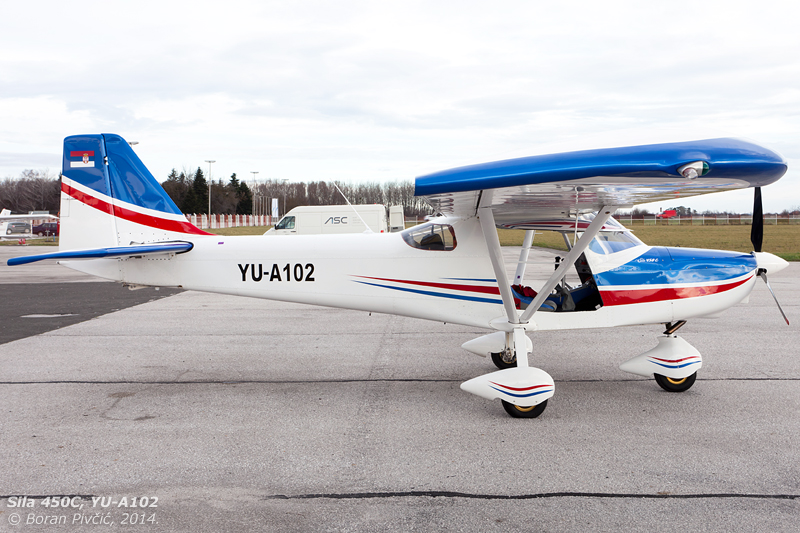
YU-A102 nice and clean - and ready for its first flight of the day
YU-A102 nice and clean – and ready for its first flight of the day.

Apart from a name that tends to raise eyebrows among Southern Slavic language speakers – literally meaning “force”, but in reality just short for Serbian Industry of Light Aircraft – the 450 appears largely unremarkable at first glance, sharing much of the visual cues of other high wing STOL ultralights. Its specs too (at least on paper) are not enough to set your blood racing; compared to the ICP Savannah XL, the 450’s latest iteration – the 450C – can carry five kg / 11 lbs less, cruises just 6 knots faster, and needs five meters / 16 ft less to take-off and 10 meters / 32 feet more to come to a full stop.

Up front there’s a 100 HP Rotax 912ULS whirling a three-blade ground-adjustable prop – hardly an exciting feature – while equipment-wise you’re looking at electrically actuated flaps, a ballistic parachute recovery system and an optional glass cockpit… essentially the same kit you can get from any other manufacturer out there.

However, once up close and past the preliminaries, a startling number of interesting – and unusual – details begin to emerge 🙂 . The wing, for example, is a mechanically simple affair that makes do without the slats, slotted controls and vortex generators seen on the CH-701 and its spin-offs. Instead, the 450 uses a plain but very thick airfoil profile that simplifies the wing’s internal structure, while at the same time preserving low speed handling and performance and noticeably reducing drag (which will always be high on a STOL wing). Indeed, the 450 can boast a lift-to-drag* ratio od 1/15, quite a bit up from the 1/11 of the Savannah XL (a number also shared with, of all things, the Cessna Skyhawk 🙂 ).

* a common measure of the aircraft’s aerodynamic efficiency, the lift-to-drag ratio – often abbreviated to L/D and sometimes also called the “finesse” – in effect shows how much horizontal distance would the aircraft, unpowered and gliding, be able to cover for each unit of vertical distance lost. The SILA’s 1/15 for example denotes that for every foot of altitude lost, it would be able to glide 15 feet in still air. Scaled up a bit, this means that for a 1,000 ft altitude decrease, it would cover 15,000 ft horizontally (roughly 4.5 km / 2.5 NM). Apart from quantifying the aircraft’s overall aerodynamic prowess, this number also comes in handy during flight planning, allowing you to pick out – in advance – suitable landing fields along your route for the event that your engine decides it has grown tired of working 🙂 .

Another interesting feature are the wingtip fences, which prevent high pressure air below the wing from spilling over the wingtip into the low pressure air above (similar to the winglets of a larger aircraft). Left uncontrolled, this spillover would eventually detach from the wing in the form of turbulence - the infamous wingtip vortex - drastically increasing aerodynamic drag. A similar setup is - uniquely - found on the horizontal stabilizer.
Another interesting feature are the wingtip fences, which prevent high pressure air below the wing from spilling over the wingtip into the low pressure air above (similar to the winglets of a larger aircraft). Left uncontrolled, this spillover would eventually detach from the wing in the form of turbulence – the infamous wingtip vortex – drastically increasing aerodynamic drag. A similar setup is – uniquely – found also on the horizontal stabilizer.

To compensate for the lack of slats and slotted controls at the lower end of the speed range, the 450 is fitted with drooping ailerons, which lower slightly as the flaps pass their halfway travel mark. Combined with the chunky airfoil, they give the aircraft an almost comically low minimum flying speed in the low 30-ish of knots – which was demonstrated to me graphically against the day’s stiff 30 knot headwind at altitude 😀 .

The combination had also acquitted itself well handling-wise, with the 450 displaying unexpectedly impressive flight characteristics in all regimes, high or low, slow or fast. Perhaps its biggest surprise – to a Cessna driver 🙂 – was not what it could do, but the way it did it, with an almost complete lack of aerodynamic drama, pussycat stall and post-stall response, and virtually no buffeting or waywardness anywhere in the standard part of the envelope*.

* in fairness though, I’ve not had much ultralight experience, so I can’t really make an objective handling comparison with other designs… but I can however draw parallels with the similarly sized (though heavier) Cessna 150, which the 450 – in a number of comparable respects – blows clear out of the water 🙂 .

Cabin Space – The Final Frontier

But, even before one gets a grip on the stick, he/she can notice a raft of other nice touches scattered all over the airframe. One that I – standing 1.93 m / 6 ft 3 in tall – can particularly appreciate is the wide and roomy cabin, almost an order of magnitude more spacious and comfortable than that of the 150. Entry and egress is unexpectedly easy from both sides, courtesy of an upward hinged door and wing struts positioned behind the doors, at the joints of the main gear legs.

A
Wide doors and a tall door frame make for remarkably easy entry and exiting – so even types of my height won’t be going around bumping into things. The only criticism I have here is that the sticks are too tall, which makes maneuvering to sit down a bit awkward if you have long legs (and can lead to some minor interior scraping if you’re a bit clumsy).

Once
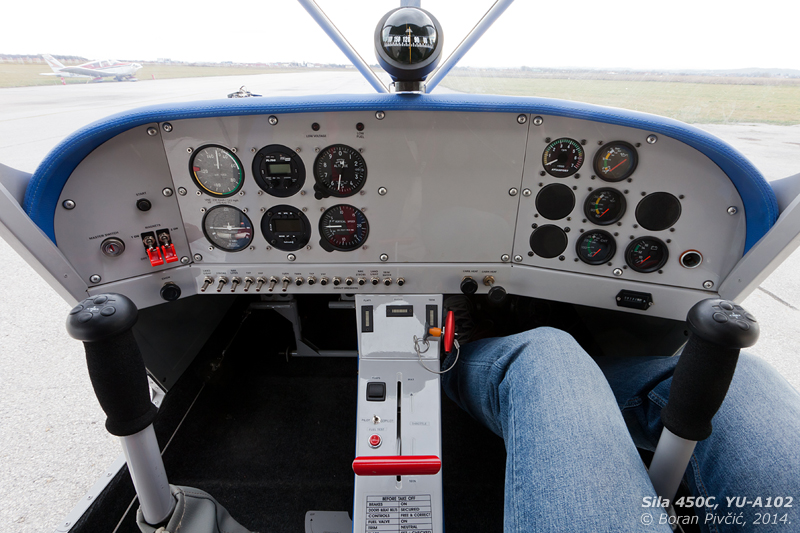
Once in, there’s plenty of room to stretch your legs and sit upright… though at the limit of the latter in my case. Simple and uncluttered, the cockpit of YU-A102 sported only a very basic avionics fit, tailored to the needs of the German market. Interesting features include the side panels canted towards the pilot, as well as the innovative system switches, which light up when activated (as could have been seen in the above video). The two guarded switches on the left panel are the magnets, while the key slot beside them is not the starter – but the battery master switch. The ominous red handle that sticks into the eye next to my knee activates the ballistic parachute system – and is also guarded for your wallet’s safety.

The view forwards in flight is pretty much on par with that of the 150; however, the large side windows, rear-mounted wing struts and smaller pillars mean the Sila excels when you want to look left, right or down. Like the Savannah, the design also features a small triangular window on the ceiling which helps with ambient lighting and provides some semblance of upward visibility.
The view forwards in flight is pretty much on par with that of the 150; however, the large side windows, rear-mounted wing struts and smaller pillars mean the SILA excels when you want to look left, right or down. Like the Savannah, the design also features a small triangular window on the ceiling which helps with ambient lighting and provides some semblance of upward visibility.

There’s other evidence of the design having been thoroughly thought out. The ailerons and elevators, for example, are actuated by pushrods rather than conventional cables (which are retained for the rudder only), giving a quicker control response and eliminating a number of maintenance issues (delaminating cables being one of them). The space behind the panel is remarkably clean as well, with plenty of legroom and none of the wiring, piping and mechanical whatnot frequently found on Cessnas and Pipers. And – what had caught my attention right from the start 🙂 – there’s a small double L mount hanging from the ceiling just aft of the windshield, allowing you to securely deposit your headphones when not in use*.

* while this is not much of an issue in the grand scheme of things – and certainly not the reason to choose the SILA over any other design – loose headphones can become quite a nuisance. In light Cessnas for example, you either have to hang them from the yoke (not the most practical solution in a small cockpit), leave them on the seat, or, worst of all, put them on top of the panel where they’re exposed to sunlight – and where their speaker magnets can play havoc with the magnetism of the compass.

These practical details continue on the outside as well. The fuel tank caps open, close and latch only with the master switch key, avoiding unintentional flight with the tanks unsecured (and, since we’re on the Balkans after all, also avoiding intentional fuel theft 😀 ). Up front, large access panels are provided on the cowl, allowing for quick inspections and repair without the need to dismantle the whole nose. And – unusually for an aircraft that has a small, light prop and barely treble digits of power – YU-A102 also came equipped with a rudder trim system, operated electrically (like its elevator equivalent) by push buttons located on the tops of both sticks.

Another interesting feature not seen on the CH-701/Savannah/similar is the cut-down rear fuselage, allowing for some semblance of rearward visibility. Two rear windows also give the cabin and airy and less claustrophobic feel. Note also the small black bag visible through the window, housing the ballistic parachute.
Another interesting feature not seen on the CH-701/Savannah/similar is the cut-down rear fuselage, making for decent rearward visibility. The two rear windows also give the cabin a brighter, airy and less claustrophobic feel. Note also the small black bag visible through the window, housing the ballistic parachute.

Certifiably good?

But, while everything said so far sounds very enticing, one other important item still remains – the naughty business of price 🙂 . What you’d eventually pay for one of these naturally depends on what equipment options you’d go for, but the base model – broadly identical to YU-A102 – would set you back about EUR 62,000. Around 30,000 more would get you the top-of-the-line version, equipped with digital avionics (a Dynon Skyview/Garmin G3x mix) and full interior night lighting.

From what I’ve seen while scouting through the European classifieds and various vendor sites, this is a fair bit (EUR 10,000+ to be exact) more expensive than the performance and engine-wise very similar Savannah XL. While at face value this does seem to be a mystery, the SILA’s higher purchase costs can be attributed to its certification ambitions,  having been designed to be fully compliant with the JAR VLA Part 21 standard – while already holding Germany’s own equivalent, the LTF-UL certificate.

But, will this paper be enough to overcome the higher price – and will the aircraft’s features manage to overcome the lingering stigma of its country of origin – still remains to be seen…

a
A soon-to-be familiar sight in ex-Yu skies?

Specifications:

Sila 450C manufacturer specs & detailed info

Manufacturer links:

Other links & sources:

Short Photo Report – Fly M for Maribor: a VFR Trip North

By me
All photos me too, copyrighted

In further proof that the weather here has completely lost its bearings, 12 January 2014 had dawned with clear skies, unlimited visibility and mild temperatures hovering at around 8 degrees Centigrade – a marked contrast to the low cloud, fog, two feet of snow and -10 we’re used to seeing at this time (as I had made abundantly clear on more than one occasion 😀 ). Naturally, such a fine day could not have been allowed to go to waste – especially since “proper” winter is likely preparing to pounce from around the corner – so a friend and I made arrangements for a short hop to neighboring Slovenia in our club’s wee Cessna 150.

Our target for the day was Maribor Airport (LJMB), a swell field serving the town of the same name and located near the northeastern tip of Slovenia, right between Croatia and Austria. One of the country’s three airports of entry, it sports a 2,500 m / 8,200 ft paved runway equipped with a host of instrument approaches, full night lighting, all relevant ground services – and virtually no large-caliber traffic 🙂 . Just 30-ish minutes of flight time from Zagreb, this had always made it an ideal training location and a practical alternative to busy Pleso – so much so that the majority of our local student pilots (especially those aiming for CPLs) have visited it at least once during their training 🙂 (I myself more than half a dozen times).

Our flight today was however a pure cross-country joyride, which gave me ample time to soak up the weather and enjoy the scenery – and naturally get busy with the camera 🙂 .

"Haha, I'm flying and you're not!". A visitor from Germany is preparing for takeoff down Maribor's RWY 14, while MD-82 S5-ACC slowly rots away in the background... a fixture of the airport for several years now, ACC had previously flown with Aurora Airlines, and was at the time said to be one of the better Mad Dogs in the area. Sadly, its current state leaves very little hope it could one day regain that reputation... (though - with any luck - it will be featured in a more extensive post later on)
“Haha, I’m flying and you’re not!”. A visitor from Germany is preparing for takeoff down RWY 14, while MD-82 S5-ACC slowly rots away in the background… a fixture of the airport for several years now, ACC had previously flown with Aurora Airlines, and was at the time said to be one of the better Mad Dogs in the area. Sadly, its current state leaves very little hope it could one day regain that reputation… (though – with any luck – it will be featured in a more extensive post later on)

The fine weather at Maribor had - like in Zagreb - immediately lured out most of the local training fleet, a fleet that had included everything from the old, Yugoslav-designed UTVA-75 to the modern, efficient Diesel Star. Filled to the brim, DOD has just started taxiing towards RWY 14 for a panorama flight above town, barely squeezing in among the other four aircraft in the circuit...
The fine weather at Maribor had – like in Zagreb – immediately lured out most of the local training fleet, a fleet that had included everything from the old, Yugoslav-designed UTVA-75 to the modern, efficient Diesel Star. Filled to the brim, DOD has just started taxiing towards RWY 14 for a panorama flight above town, barely squeezing in among the other four aircraft in the circuit…

The joys of sub-Alpine anticyclonic weather... our flight back home had also included a touch-and-go at Slovenj Gradec airfield, located in a valley on the opposite side of Maribor's Pohorje mountain range. You can probably guess how that plan had turned out... (to compound the issue, LJSG has no met station linked into the rest of the system - so when we'd asked the met office at Maribor for a brief, all they could do was slump their shoulders and extrapolate from existing data)
The joys of sub-Alpine anticyclonic weather… our flight back home had also included a touch-and-go at Slovenj Gradec airfield, located in a valley on the opposite side of Maribor’s Pohorje mountain range. You can probably guess how that plan had turned out… (to compound the issue, LJSG has no met station linked into the rest of the system – so when we’d asked the met office at Maribor for a brief, all they could do was slump their shoulders and extrapolate from existing data)

A large, unbroken stratus, beautiful sunshine on top, a light aircraft and a camera - what more could one want to be content?  (except a pair of gloves) Skirting the edge of an extensive sheet of stratus as the perfect cap to the whole flight.
A large, unbroken stratus, beautiful sunshine on top, a light aircraft and a camera – what more could one want to be content? (except a pair of gloves) Skirting the edge of an extensive sheet of stratus as the perfect cap to the whole flight.

Photo Report – 23rd Zagreb Kup Precision Landing Championship

By me
All photos me too, copyrighted

If any further proof was needed that the weather patterns in Zagreb have a mind of their own – something the author has been shy to mention in the past 😀 – one needs to look no further than Lučko’s annual Zagreb Kup precision landing championship, held this year on 20 October. One of a number of seasonal sporting events at the field (and the only one that manages to get us all together in the same place), the championship is nearly always blessed with sunny skies, moderate temperatures and generally all-round fine flying weather – often a curiosity among the month’s frequent rains, low clouds and general dreariness.

The 2013 event was – unsurprisingly – more of the same, with beautifully clear skies, uncharacteristically high temps and weather more suited to that of September. The odd man out though was a strong, gusting, 15 knot southwestern wind that had been blowing for a better part of the week – and which, coming in nearly perpendicular to Lučko’s runways 28L and R, had promised quite the spectacle 🙂 .

Tall tales of short approaches

However, while said spectacle was a delight for the photographer, for the pilots taking part it had represented a whole different kettle of fish. The more obvious – and more immediate – issue facing them was the heading correction necessary to compensate for the sideways motion of the air. While this is a perfectly straightforward procedure in level flight (especially when using a few neat mental formulas to calculate the exact correction needed), on a “competition” approach it does present a few interesting challenges 🙂 . Chief among these is the need to increase the heading correction as speed is decreased in order to provide the same level of compensation and stop the aircraft drifting away. By default, competition approaches imply low speeds* (to give the pilots time to judge their rate and angle of descent), which in turn translate into relatively large corrections necessary. Indeed, at 60 knots – a good approach speed for a Skyhawk – every knot of crosswind component has to be parried by a heading correction of one degree. At 15 knots then – conditions similar to those prevailing on 20 October – you would be looking at a 15 degree crab angle.

* however, it is not uncommon for contestants to dive into the ground effect and progressively bleed of excess speed there. Floating just a few inches off the ground, this allows them to set the aircraft down suddenly, quickly and precisely – but often requires impeccable timing and a very good feel for the specific aircraft being flown

Angles of this magnitude produce a distinctly visible sideways drift across the ground (especially in the last few hundred feet of the approach), which can play havoc with one’s perception of the aircraft’s true direction, speed and motion. An additional factor – albeit a smaller one – is the reduced forward visibility from the cockpit. With the nose swung over to the side, the pilot no longer has the luxury of staring at the landing spot straight down the nose; depending on the direction of the wind, he/she now has to either look out of the curved windshield side panels (in the case of a wind from the right), or worse, across the diagonal of the cowl with a wind from the left. Both of these effects combine to measurably influence the pilot’s depth perception – consequently affecting his/her ability to correctly judge the aircraft’s height and proper angle of descent.

A more subtle issue is the slight – but still noticeable – increase in the aircraft’s angle of descent. It is important to note here the difference between the angle of descent and the rate of descent. The rate of descent – grouped under the term “vertical speed” in everyday parlance 🙂 – is a measure of how much altitude the aircraft has lost in a unit of time (feet and minutes respectively being used in the West, and meters and seconds in the lands of the former USSR). The angle of descent on the other hand effectively shows the distance the aircraft has covered per unit of height lost.

To complicate matters further, these two measures are never on the same page when wind is concerned 🙂 . Consider an aircraft flying in still air at a constant 60 knots ground speed and descending at 500 feet per minute. Starting out at an altitude of 10,000 ft, it would need 20 minutes to reach the ground, during which time it would cover 20 nautical miles of horizontal distance. Fine. But now let’s set same aircraft flying into a 20 knot headwind, reducing its ground speed to 40 knots. Since it is still descending at 500 ft per minute, it’ll still need 20 minutes to get down; but the horizontal distance it will cover in that time will now be only 6.67 NM. So, while its rate was constant, its angle had increased dramatically 🙂 (to complicate things EVEN further, the “angle” does not refer to the aircraft’s pitch – which is the same in both cases – but rather to its flight path)*.

* when viewed “in reverse”, this also explains why aircraft have two distinct airspeeds for the climb: the best rate of climb speed (Vy) and the best angle of climb speed (Vx). Vy gives you the quickest time to altitude – that is, the highest vertical speed. Vx on the other hand gives you the highest increase in altitude per unit of horizontal distance covered – that is, the greatest flight path angle – and is used immediately after take-off to clear close-in obstacles 🙂 .

The same mechanism is at work during competition approaches. While I may say that the contestants faced “a crosswind” out of pure brevity, very few crosswinds are exactly 90 degrees on – most of the time there’s a headwind component (however small) reducing the aircraft’s ground speed by a few knots. While this hardly sounds like the end of the world (especially knowing you have an engine to compensate), the effect is still there and can be particularly troublesome on the competition’s second and third approaches which prohibit use of the throttle – and consequently decrease room for error in terms of flight path perception and aircraft control. Come in too low or too far out – like you would in still air – and you might not even make the landing zone, let alone the zero mark… 🙂

All of these effects – despite being almost negligible and easily compensated individually – had come together in force on 20 October, culminating in visually the most interesting (but also most exciting and challenging) competition we’d had in years… 🙂

g
One of our flight instructors using the ground effect to the fullest on his second approach, eventually scoring a perfect zero. The second approach itself allows the use of flaps but prohibits any throttle setting above idle, thus preparing the contestant for the imminent Big One: no flaps and no power.

Sadly
Sadly though, the next contestant had borne the brunt of the effects described above, ending his final approach woefully short of the landing area – and almost outside the runway itself. The main culprit was too long an approach, allowing the increased angle of descent to quickly erode the aircraft’s remaining altitude.

W
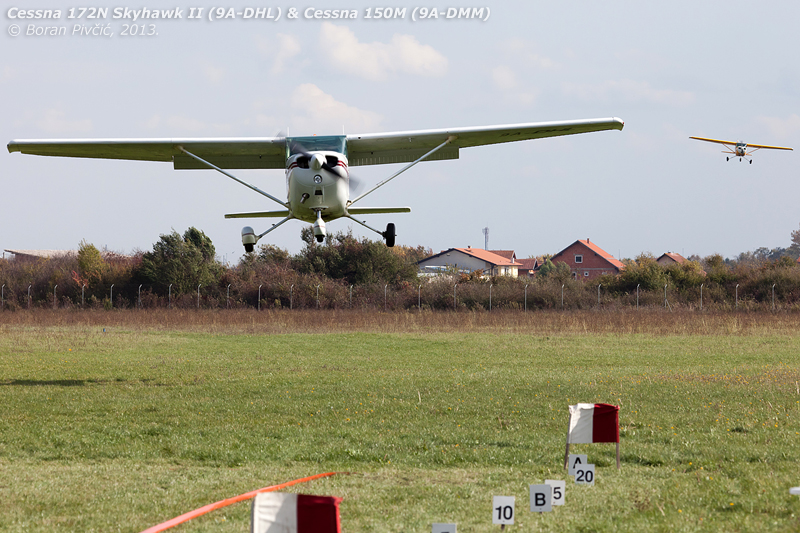
Welcome to Little Heathrow! While the separation between contestants would normally be greater, the differing speeds and maneuvering abilities of the aircraft involved had guaranteed that they would bunch up at some point in the competition. Thankfully, the 172 was coming in at a guesstimated 60 knots, while the 150 at a more pedestrian 50-ish, ensuring ample spacing between them. Note also the crab angle…

The
The day’s gusts had also created problems of their own. Having come in with a speed that was sufficient to counter both the current wind and any foreseeable increase, DMG was caught in a sudden calm a second or so before landing – a calm that had immediately turned that excess speed into a liability. Unable to safely shed all that extra lift, the pilot had kept the aircraft rolling on the left main wheel (leaning into the wind) until he was clear of the landing zone, where he was free to perform a proper liftoff and climb-out.

Tech – A Flying Fashion Victim: The PC-6 Engine Saga

By me

In a dazzling display of consistency, my research for a magazine article about S5-CAM – the Pilatus PC-6 that had visited Lučko some months ago – took only moments to veer completely off track, invariably as soon as I began to delve deeper into the type’s rich history :). The culprit for my deviation was the fantastic database at www.pc-6.com, documenting in amazing detail the life and times of this amazing aircraft.

Such huge collection of sometimes obscure information was right up my runway, so with my initial research goal completely forgotten, I began to read through the type’s version list. Pretty soon I began to notice that the PC-6 had a tendency to change engines as often as I change clothes, prompting me to dig even deeper and attempt to make a list of all the powerplants (and their evolutions) that had ever been fitted to the Porter… 🙂

From A to D

While the PC-6 is today universally – and pretty much exclusively – associated with the venerable PT6A turboprop, the design actually had much more humble beginnings, starting out in life as “just another piston”. First flying back in 1959, the original PC-6 had been equipped with a Lycoming GSO-480 engine, whose six supercharged (S prefix) cylinders, linked to a reduction gearbox (G prefix), produced around 340 HP (the reason why this series is also known as the PC-6/340). Despite the comparatively low power – and the piston engine’s well known anemia at altitude – the Porter prototype had nevertheless managed to capture the period record for the highest (successful 🙂 ) landing, touching down at an impressive 18,856 feet somewhere in the Himalayas.

However, the GSO-480 was quite a complicated and temperamental thing to run and maintain, leading pretty soon to the development of a simpler model called the PC-6/275, powered by a normally aspirated – but still geared – 250 HP GO-480. But the loss of 90 HP – a whopping 26% – over the equally heavy standard model had meant the performance suffered dramatically, spurring the introduction of the follow-on PC-6/350, equipped with a fuel injected (I prefix) IGO-480 developing a much more reasonable 350 HP.

The apex of the piston PC-6 however did not come until 1970 – rather late by large piston standards – with the brutal PC-6/D, powered by the monstrous eight cylinder Lycoming TIO-720 producing a sizable 400 HP. One of the more ludicrous ideas to come out of the Lycoming works, the 11.8 liter TIO-720 was created by joining together two IO-360s and then – for that little extra something – screwing on a massive turbocharger (T prefix). Despite the power and potency of the engine – which had also been used to great effect on the Piper PA-24-400 Comanche and the PA-36-375 Pawnee Brave – it was very heavy and its rear cylinders were notoriously prone to overheating. The superiority of turboprops – which had been introduced to the PC-6 line nine years earlier – had slammed the final nail into the coffin of the D model, the program being quietly dropped after just one prototype had been completed.

The French Connection

This “first contact” with the turbine came in 1961 with the 523 HP Turbomeca Astazou IIE, creating the PC-6/A, the first of the Turbo Porters. A very light, compact and durable engine, the Astazou would go on to become one of the world’s great small turboprops – but would sadly have a short and largely unremarkable career on the PC-6. The only major revamp in the period was the one-of PC-6/Ax, powered by the new Astazou X which had – through the addition of another compressor stage – been boosted to 573 HP. This model was followed by the very similar PC-6/A1 and PC-6/A2, which had only differed in engine versions (Astazou XII and XIVE respectively) with no change in power. All in all, only 43 Astazou-powered examples were ever built, all of which were eventually re-engined with the PT6A – thus confining the A models to the pages of history…

What would eventually become the PC-6 we know today had started emerging in the mid-60s, when the Astazou of one example was swapped for a 550 HP PT6A-6A, creating the enduring legend – the PC-6/B. This first foray into PT6 World was however short lived, with only 12 examples produced before the introduction of the definitive early B model, the PC-6/B1-H2, sporting the PT6A-20 of equal power output, but higher torque.

Like fine wine (or cheese 😀 ), the PT6 PC-6 would then take some time to mature – 17 years in fact until the arrival of the penultimate Turbo Porter, the PC-6/B2-H2 of 1984. Representing 80% of the way to today’s standard, the B2-H2 was fitted with a 680 HP PT6A-27, flat rated down to the “original” 550 HP. While this may seem like a questionable move, it does have a raft of benefits for a “hauler” designed for operations at high weights and in all weather conditions. The first advantage is the engine’s larger core, which gives a measurable increase in torque throughout its operating range without a (significant) increase in fuel consumption. Additionally, running slower and cooler than it was designed for means engine wear is noticeably reduced, boosting overall reliability and noticeably prolonging the engine’s service life.

However, the biggest advantage is a stable power output regardless of outside air temperature. In a conventional non-flat-rated system, the maximum power the engine can produce with the throttle wide open – the so called thermodynamic power – varies greatly with air density, itself a function of air temperature. The higher the temp, the lower the density and vice-versa. When the density is low, the mass flow through the engine is reduced, the combustion efficiency is reduced and the engine’s thermal limits are more constricting – all of which results in a reduced power output. Conversely, when the density is high – such as on a cold day – the mass flow is high, combustion efficiency is high and the engine runs cooler, allowing more fuel to be injected and thus produce more power. The upshot is that an engine producing, say, 1000 HP in standard conditions (15 degrees Centigrade, used for all performance specs) may produce upward of 1100 HP at 0 Centigrade and as low as 900 HP at 30 Centigrade – which complicates performance calculations and adversely affects the aircraft’s overall performance. Obviously enough, the more critical condition is at lower densities – since very few pilots will object to having additional pep at takeoff :D.

Flat rating systems get around this issue (up to a point of course) specifically by limiting the engine’s maximum power so they always have a reserve to compensate for any drop in output due to reduced density. In the case of the PC-6, the capacity to produce that additional 130 HP is used to compensate for the reduced efficiency at higher temperatures, allowing the engine to produce its stated 550 HP regardless of outside conditions. Additionally, since the same principle applies to the reduction in density with altitude, flat-rated engines have a lower power decay while climbing, and can produce their stated power to a higher altitude, helping out greatly in hot-and-high operations.

Having finally sorted the engine out (after decades of trying 😀 ), Pilatus then turned to the other remaining propulsion item – the propeller – replacing the usual three-blade unit with a new four-blade model, creating today’s production standard PC-6/B2-H4.

However, while Pilatus themselves had stopped fiddling with the powerplant, the Porter’s users had other ideas and decided to carry on the tradition themselves. An immensely popular skydive platform, the PC-6 had at time been found wanting for power in the climb, leading to the logical idea of refitting it with a more powerful engine. This was eventually achieved in 2001, when an old B2-H2 was upgraded with the 750 HP PT6A-34 (flat rated to 620 HP), becoming the progenitor of a series of 30 such conversions (both H2s and H4s), all done under a new Supplementary Type Certificate.

The Alpine Yank

But the “fulfillment” of the PT6A installation is not the whole of the PC-6 engine saga – not by a long shot :). The success of the first turboprop models had created a lot of interest on the other side of the Atlantic, where operators were keen on a home-grown version using locally-available components. Not oblivious to the huge potential of the aircraft on the American – and especially SOUTH American – market, Pilatus quickly complied with demand, and in 1964 struck a deal with Fairchild-Hiller to produce the aircraft under license in the States. Initially, the aircraft rolling off the line were stock B models – but it took the locals only a year to come up with their own version, the PC-6/C, powered now by the 575 HP Garrett (AiResearch) TPE-331-25D.

Generally “confined” to the US market, the C models would eventually rise to worldwide fame, thanks most of all to the PC-6/C2, known in military service as the AU-23A Peacemaker. A type still happily flying with the Royal Thai Air Force, the AU-23A is/was powered by the 665 HP TPE-331-1-101F, and had flown into the spotlight during its exploits in the skies of Vietnam, Laos and Cambodia. Another C2 had also landed in the record books, having performed an amazing 424 take offs and landings in a single day, a feat achieved over 21 consecutive hours without breaks (except for oil and fuel top ups)…

Chronologically out of tune, the last of the C models was the the PC-6/C1 of 1969, powered by a 576 HP TPE-331-1-100. Apparently a TPE conversion intended for the European market, the C1 eventually ended up being just a one-of model, with the PC-6 already having a suitable engine in the form of the PT6A :).

Overview – piston:

  • PC-6 (PC-6/340) – Lycoming GSO-480-B1A6 (340 HP) (1959)
  • PC-6/275 – Lycoming GO-480-D1A (250 HP) (1960)
  • PC-6/350 – Lycoming IGO-480-A1A (350 HP) (1961)
  • PC-6/D – Lycoming TIO-720-C1A2 (400 HP) (1970)

Overview – turboprop:

  • PC-6/A – Turbomeca Astazou IIE (523 HP) (1961)
  • PC-6/Ax – Turbomeca Astazou X (573 HP) (1964)
  • PC-6/A1 – Turbomeca Astazou XII (573 HP) (1967)
  • PC-6/A2 – Turbomeca Astazou XIVE (573 HP) (1967)
  • PC-6/B – Pratt & Whitney Canada PT6A-6A (550 HP) (1964)
  • PC-6/B1-H2 – Pratt & Whitney Canada PT6A-20 (550 HP) (1967)
  • PC-6/B2-H2 – Pratt & Whitney Canada PT6A-27 (680 / 550 HP flat rated) (1984)
  • PC-6/B2-H4 – Pratt & Whitney Canada PT6A-27 (680 / 550 HP flat rated) (1996)
  • PC-6/B2 (mod) – Pratt & Whitney Canada PT6A-34 (750 / 620 HP flat rated) (2001)
  • PC-6/C – Garrett (AiResearch) TPE-331-25D (575 HP) (1965)
  • PC-6/C2 – Garrett (AiResearch) TPE-331-1-101F (665 HP) (1967)
  • PC-6/C1 – Garrett (AiResearch) TPE-331-1-100 (576 HP) (1969)

Sources:

Rare Aircraft – Mountains and Savannas

By me
Photos as credited

There is a well established procedure among aviation enthusiasts of visiting an airshow simply to see one or two interesting aircraft types. I myself am guilty of this as well, often going to regional shows (ones not far enough away to be expensive) just for the sake of enjoying the sight and sound of a handful of rarities :). While larger shows such as Air Power in Austria and Kecskemet in Hungary have a lot of interesting jets and piston props to offer, back in June I’d set my sights slightly lower and popped ’round to the small air meet at Zvekovac airfield (LDZE), just a 20 minute hop by Skyhawk from Zagreb.

While most of the aircraft in attendance were quite familiar to me – having flown on roughly a fourth of them 😀 – one visitor in particular had piqued my interest ever since I saw it on the guest list: the diminutive Fuji FA-200 Aero Subaru :).

H
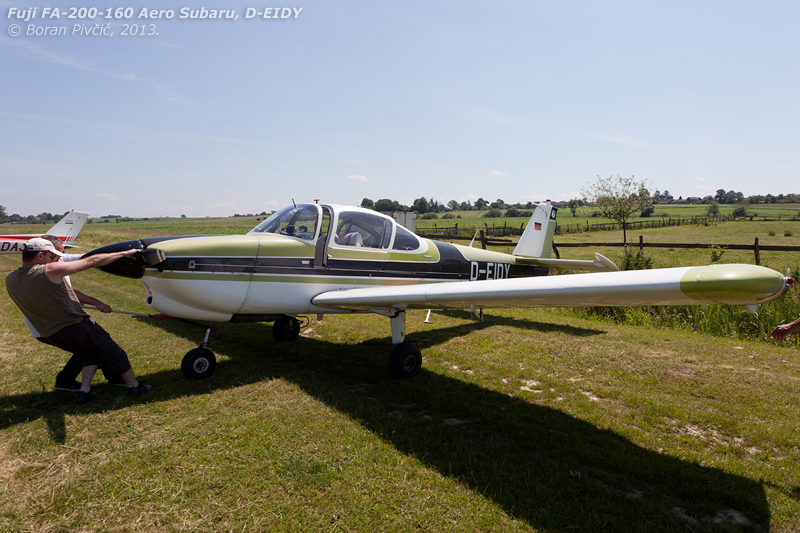
Heave! Backing the aircraft – registered D-EIDY – into its parking position required some manhandling by the crew, made all the more difficult by the pronounced slope… and the sizable ditch at the end

One of the very few light aircraft designed and produced by the Japanese aviation industry, the FA-200 is quite an odd machine, examples of which can in Europe be counted on the fingers of one hand. First conceived in the mid-60s – and reminiscent in concept to the Yakovlev Yak-18T – the Aero Subaru is a comfortable and spacious four-seat tourer – and at the same time an aerobatic-capable trainer. To add to this technically challenging mix, the design sports a 400 kg payload, on par even with some larger and more powerful tourers.

Relying more on aerodynamic efficiency than outright brute force, the design in its basic form – the FA-200-160 seen here – is powered by a 160 HP Lycoming O-320 driving a fixed pitch propeller, a setup nicked directly from the Piper Warrior (and/or Cessna Skyhawk). While this power is perfectly adequate for most needs, it did leave something to be desired in the aerobatic role, leading Fuji to introduce the more potent FA-200-180, powered by the 180 HP Lycoming IO-360 linked with a constant speed prop. Interestingly, the subsequent version – the FA-200-180AO – had kept the engine, but reverted once again to a fixed pitch prop, ostensibly to reduce costs and simplify maintenance.

g
Well cared for, D-EIDY spots a very clean and well equipped cockpit, including a Mode S transponder and a Garmin G3X multifunction unit. Note also the military trainer-style throttle lever, designed to fall more easily to hand and be more intuitive to use during maneuvers

In most other respects a solid design – done in the best tradition of Japanese heavy industry – the Aero Subaru had nevertheless failed to even dent the Big Three’s dominance in the GA market, ending its production run with just 275 examples built across all three versions. While on par in terms of quality with offerings from Beech, Cessna and Piper, the FA-200 lacked that “manufacturer’s prestige”, making it a risky choice from a company with little experience in general aviation and a virtually non-existent support network. However, despite these issues, several examples had made it out of Japan and are still happily flying all over the world 🙂 (with most of Europe’s examples concentrated in Hungary).

The same fate however had not befallen another interesting aircraft at the meet (which I’d stumbled upon quite by accident!): the ICP MXP-740 Savannah XL VG :). A name that will leave you short of breath during any attempt to pronounce it out loud, the MXP-740 is one of several spin-offs of the Zenair CH-701, an amazing STOL homebuilt ultralight whose takeoff and landing performance could have very well qualified it as a helicopter :D.

S
A bright & clean STOL aircraft with chunky tires and open doors, on a grass field in the middle of nowhere during a beautiful summer’s morning – a scene that simply begs you to go flying! Absolutely immaculate inside and out, 9A-DIS is one of the two or three best-built homebuilts in Croatia

While not a rare design in itself, the Savannah always warrants at least some attention – especially in this, the XL VG version on which the ICP people had really pushed the boat out :). The XL is pretty much self-explanatory; the VG however refers to vortex generators, small strips of metal on the upper wing surface specifically designed to disrupt the flow of air along the wing. Though this seems somewhat counterproductive, there is a finer underlying logic to it.

Vortex generators visible along the wing on another Savannah (photo from: rnzaf.proboards.com)

As with any fluid flowing along any surface, the airflow in the first inch or so above the wing forms what is known as the boundary layer, a thin area in which the flow speed drops due to air viscosity and surface friction. The behavior of the air in this layer is of great importance for the generation of lift, and is described using two terms: laminar flow and turbulent flow. As its name suggests, the laminar flow is smooth (and silky :D), flowing straight and true with no mixing or significant lateral speed or direction changes. This type of flow creates the least drag, which has made it a must for high performance aircraft – and especially gliders! – but requires a clean and smooth wing with no lumps or bumps :).

The turbulent flow on the other hand is as chaotic as it sounds, constantly being in a state of mix and suffering from continuous speed and direction changes – which, naturally, considerably increases drag. However, due to these characteristics, the turbulent flow sticks to the wing down more of its length, effectively increasing the wing area producing useful lift. This means that for the same wing area, the turbulent flow will create more lift than a laminar one; or, turning the premise around, the turbulent flow will create the same lift at a significantly lower speed. This is of course beneficial to STOL aircraft and trainers – and is one of the reasons why many light aircraft use dome instead of flush rivets on the wings and fuselage, which act as ready-made obstructions and prevent the formation of a laminar flow. However, they can only do so much, so on aircraft that really need proper low-speed handling, they are supplemented by “full blown” vortex generators :).

Vortex generators also enable the wing to reach higher Angles of Attack – which in turn means the aircraft can again maintain the required lift at a much lower speed (source: Aerospaceweb.org)

In concert with the thick low-speed wing, slotted flaps and slotted flaperons – ailerons that droop along with the flaps – these vortex generators give the Savannah a comically low stall speed of just 25 knots :). And with its MTOW of 560 kg pulled along by a 100 HP Rotax 912ULS engine, 9A-DIS can become airborne in just 35 meters (115 ft), with 50 meters (164 ft) needed to land and come to a halt.

A nice
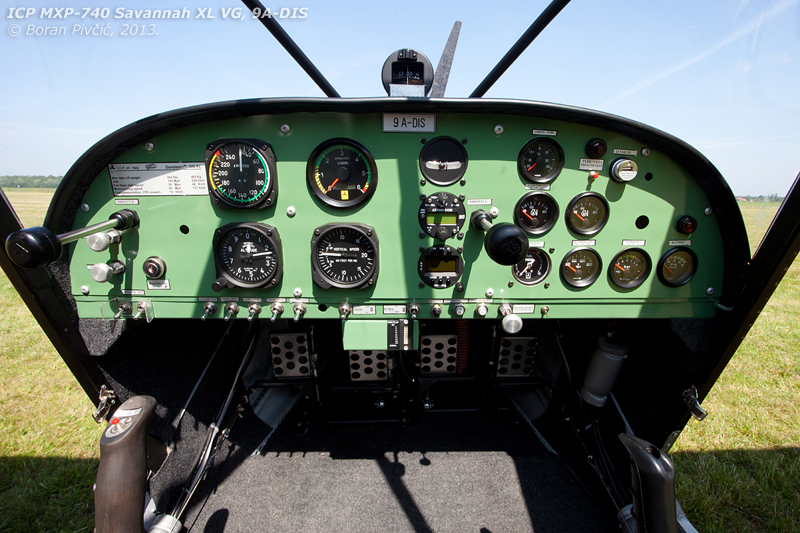
A nice and clean panel, with everything you really need in easy reach. The unusual green panel color is a throwback to the owner’s former workplace, the MiG-21 interceptor

Unfortunately, the aircraft was static only for the duration of the meet – being based at Zvekovac – but I’m told that it is definitely no hangar queen… 🙂

Photo Report – Of Diesels and Ukranians

By me
All photos me too, copyrighted

With the prolonged closure of Lučko effectively rendering it useless for aviation photography, one has no other option but to turn to the world of commercial aviation at nearby Zagreb Intl :). While the traffic picture there is mostly an endless succession of Airbii, 737s and Dashes of all sorts, the airport’s strategic location at the entry point to the Balkans often guarantees some interesting visitors.

The case was no different over the past few weeks, bringing in several interesting and very welcome visitors… ripe for me to photograph and enjoy! 😀

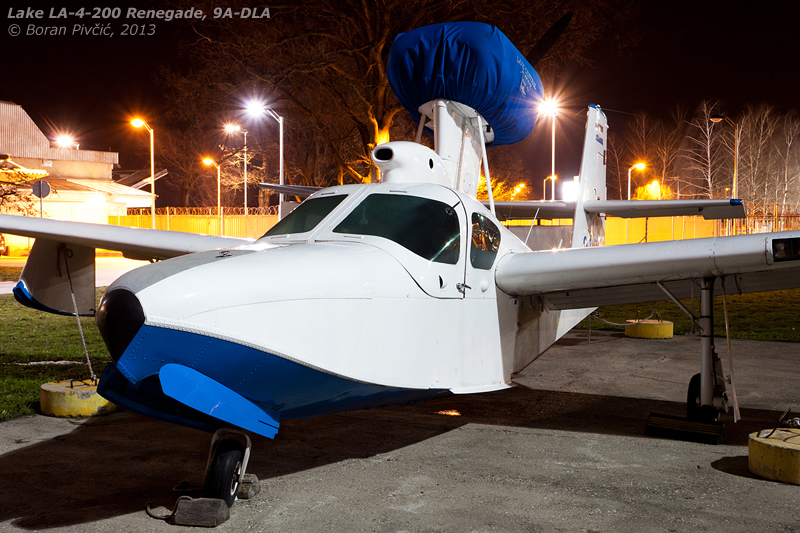
Operating out of Pleso with "my" Skyhawk, I've had plenty of opportunity to stop and snap a few shots on my way to the terminal. One of the more interesting subjects on that route is this Renegade, the only one in Croatia and, for the past few years, a permanent resident of Pleso. A remnant of several abortive attempts at starting inter-island floatplane services on the Croatian coast, this little thing hadn't flown in years, but is apparently regularly cleaned and maintained
Operating out of Pleso with “my” Skyhawk, I’ve had plenty of opportunity to stop and snap a few shots on my way to the terminal. One of the more interesting subjects on that route is this Renegade, the only one in Croatia and, for the past few years, a permanent resident of Pleso. A remnant of several abortive attempts at starting inter-island floatplane services on the Croatian coast, this little thing hadn’t flown in years, but is apparently regularly cleaned and maintained

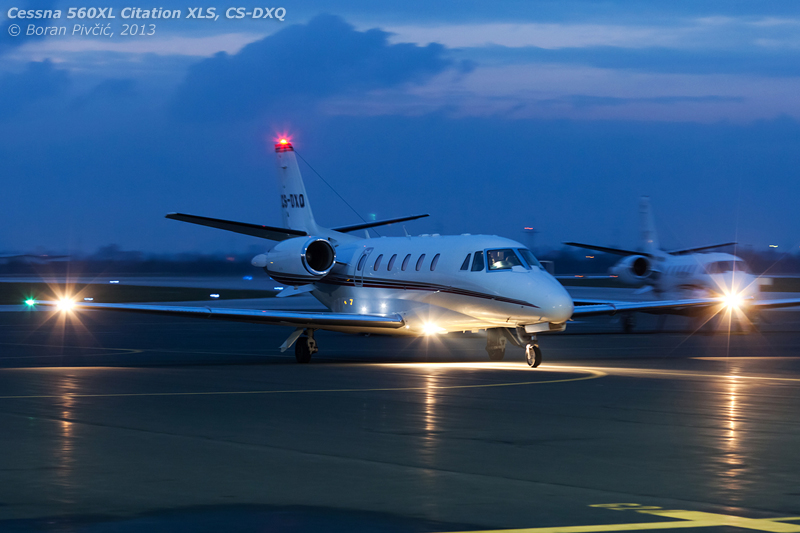
Opportunities for night photography had also abounded on 12 March, when heavy snows caused havoc in the skies over Western Europe. Reduction in airport capacities and long waits in holding patterns had seen almost a dozen bizjets and bizprops divert into Zagreb for fuel, including the two Citations pictured here. In just one hour, we’d seen three Citations, two Learjets and a King Air 350 – more biz traffic than Pleso gets in a whole day

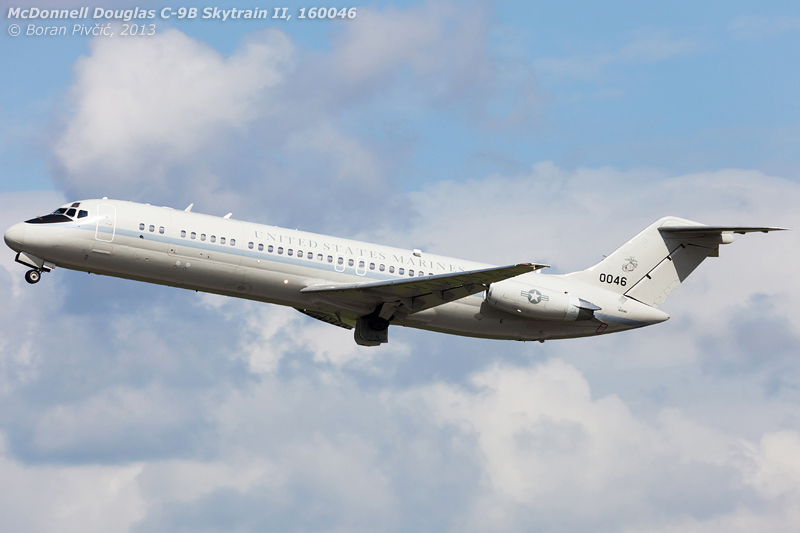
A far bigger attraction though was the sight and sound of a classic Diesel 9 - there really is not better way to start the day!
A far bigger attraction though was the very welcome sight and sound of the classic Diesel-9. Rumbling out of RWY 23 for the trip home to the States, this C-9 had spent several days flying through the region on unknown business, luckily stopping in Zagreb when the weather was just right

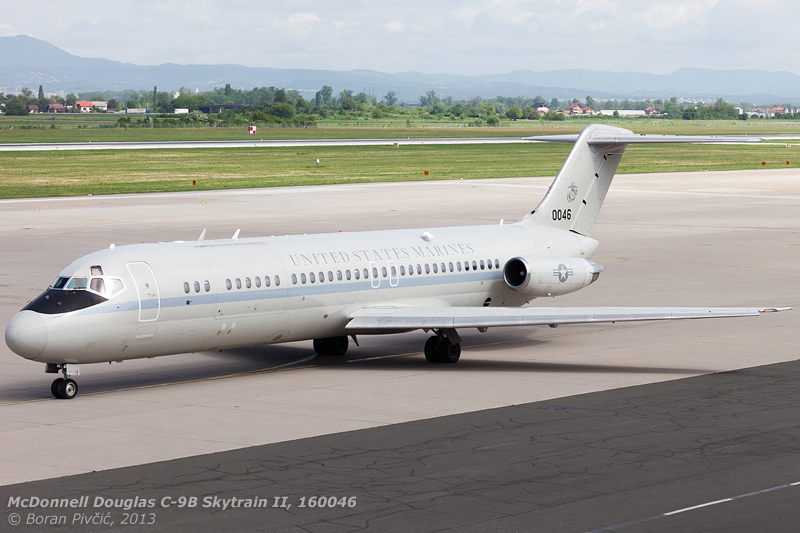
A military "combi" version of the DC-9-32, the C-9B
A “straight” combi version of the DC-9-32, the C-9B shares its family tree with the C-9A Nightingale, a medical evacuation model intended to transport wounded from operational bases to medical facilities far behind the lines, as well as the VC-9, a VIP transport for state staff

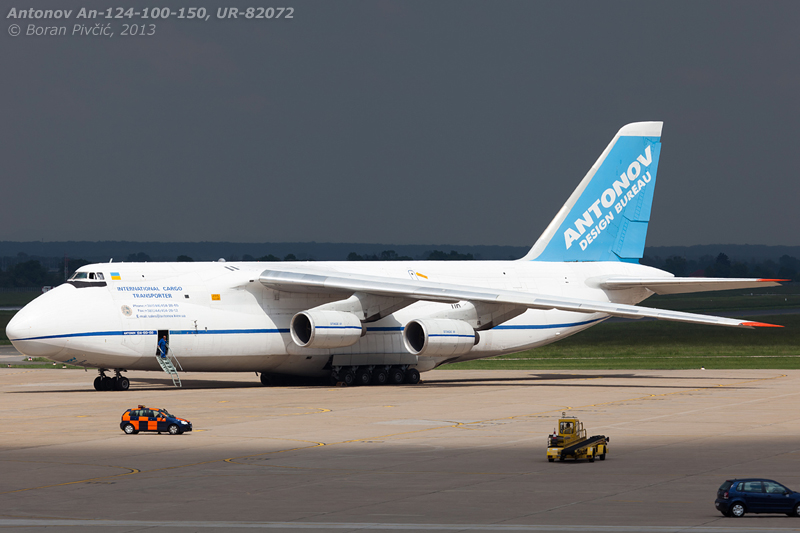
Mother Nature likes this! Bathed in a pool of light while rainclouds loom all around is the biggest visitor this year, the legendary Ruslan.
Mother Nature likes this! Bathed in a pool of light while rainclouds loom all around is the biggest visitor this year, the legendary Ruslan. In town on a technical stop, UR-82072 is today ferrying combat vehicles from Sarajevo to RAF Brize Norton in the UK following an international military exercise. Too heavy to meet climb requirements out of Sarajevo with full tanks, the aircraft had taken on just enough fuel to get to Zagreb, where it had topped up for the rest of its journey.

Weather Report – Skyfall

By me
All photos me too, copyrighted

As is the norm for the end of the year in continental Croatia, the weather had been up to its usual games lately, alternating between deep freeze and springtime, dull fog and depressing overcast – and naturally arid dryness and the full spectrum of winter precipitation :). Apart from the usual frost and freezing rain, the latter traditionally includes quite a bit of snow, which more often than not tends to fall suddenly and with a vengeance. True to character, the first week of December saw a short – but intense – burst of snowfall, which had dumped close to half a meter of snow in under 12 hours; an occurrence that hadn’t been recorded for more than half a century. It really did seem like the sky was falling down… 😀

The most visible manifestation of a particularly strong cold front that had passed through the area, this weather had ironically fully cleared the next day, resulting in beautifully calm, quiet and sunny conditions – the kind you see really on ski vacation posters. Inevitably – and though the roads still hadn’t been fully cleared – this turn of events had lured me to the airfield to see what had happened with the few planes still left there…

On some machines – notably military Gazelles – made out of titanium, the Fenestron’s high mass flow can make for some impressive handling (as the Gazelle itself demonstrates). Being smaller, the blades are also noticeably quieter and produce less vibration – but, due to their higher drag, tend to require more power to run and sap more energy from the main rotor during an engine-out autorotation
Vee One… Rotate! The weight of almost 50 cm of snow, pushing down onto the horizontal stabilizer’s long moment arm, had meant that virtually all of our birds had ended up on their tails overnight…

Despite the somewhat dramatic pose, the
However, contrary to appearances, this pose did not result in any damage to the aircraft itself. By the time enough weight had accumulated on the stabilizer, a cushion of snow several inches thick had already formed below it – so when the tail eventually did come down, its impact was quite gentle and uneventful

Th
The snowfall had also added insult to injury for our resident Skymaster as well. Having already struck the ground with its nose on landing a decade or so back, it had now ended up striking it with its tail as well…

f
With its big stabilizer located further aft than it is on the Skyhawk – and its CG already well back due to a stripped interior and cannibalized front engine – D-ICEC had probably ended up on its tail quite quickly. Fortunately, its stabilizers normally overhang beyond the edge of the apron – above grass – so it too has probably suffered no (further) damage

Who would have thought that there's an airfield somewhere under here...
Who would have thought that there’s an airfield somewhere under here…

Photo Intermission – Above the Cloud Tops

By me
The single photo me too, copyrighted

As is usual for this time of year here in continental Croatia, aviation activity slows down to a crawl as the late autumn weather starts to move in. Meteorologically-speaking certainly one of the year’s more unstable periods, October and November seem to turn into an alternating – and seemingly never-ending – sequence of rain, snow, fog and strong wind. However, every once in awhile, things tend to calm down for a few days (with varying results), giving our Skyhawks a shot at getting some air time… 🙂

There are surely few things in aviation as majestic as clipping the cloud tops on a calm and quiet autumn afternoon. A common occurrence later in the winter, the weather situation is dominated by low overcast stratus, clouds that can sometimes persist without breaks for two months

Photo Report – A Short Hop on a Classic PC-6

By me
All photos me too, copyrighted

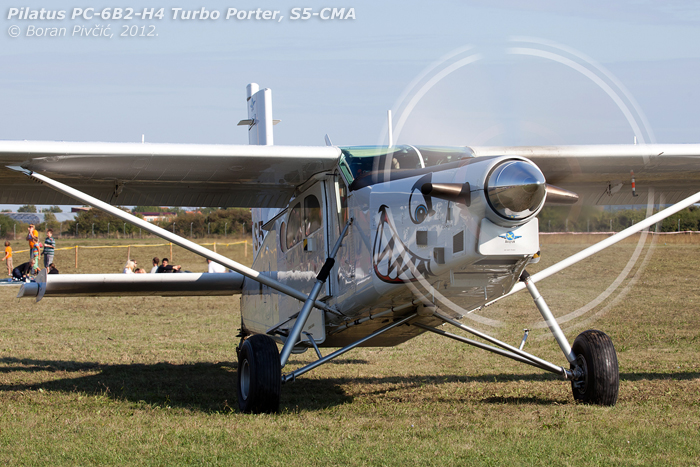
While the annual Lučko Airshow, held over the weekend of 15 & 16 September, was just as lackluster as expected, it did have one bright spark which had immediately drawn me in :). Among the usual blend of Cessnas, Pipers and gliders – most of which are native to the field – we’d also been graced by a visit from the second turboprop of the month, a mint white Pilatus PC-6/B2-H4.

Registered S5-CMA and owned by the air service provider Aviofun of neighboring Slovenia, this fantastically charismatic aircraft had been tasked with almost round-the-clock skydive operations at the show, and had stayed on an additional day to do the same during the follow-on skydive competition. Unfortunately for it, Lučko is completely dry as far as Jet A is concerned, which had necessitated several trips to nearby Zagreb Intl. to refuel. Fortunately for me though, a couple of friends and I had managed to hitch a ride on one of these flights – with many thanks to the pilot! – giving me my first opportunity to enjoy the PC-6 in flight… 🙂

The most interesting – and hardworking – aircraft at the show taxiing out for another skydive flight. Like the Caravan that visited during the run-up to Jackal Stone 2012, the PC-6 is incredibly quiet compared to our piston-powered skydive aircraft

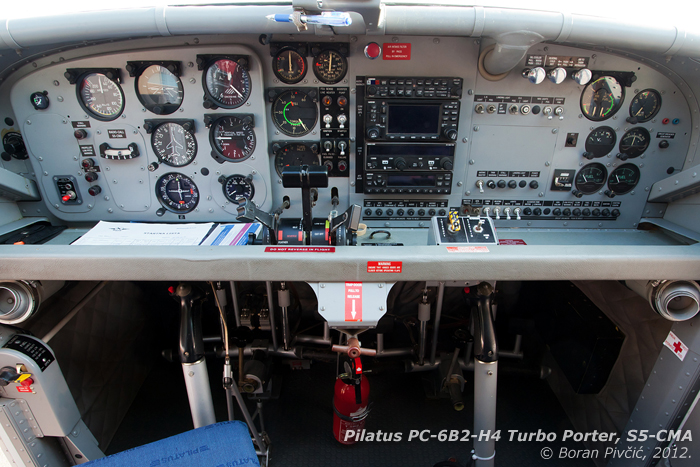
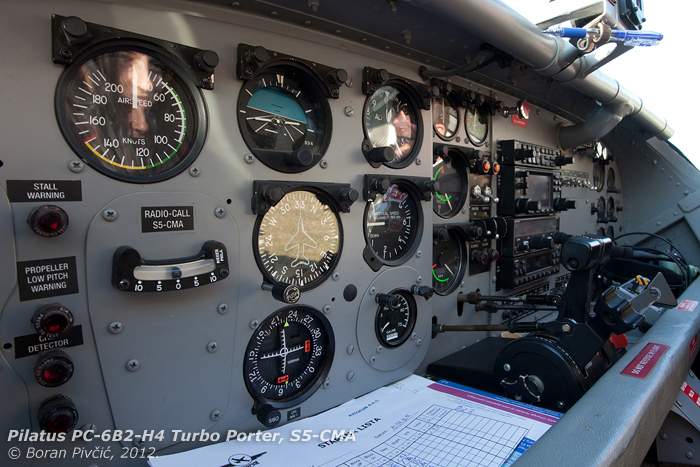
A clean, simple and neat cockpit. Part of an earlier iteration of the Turbo Porter, CMA sports slightly different instrument types and cockpit layout than newer-build PC-6s – a layout, reminiscent of the versions used during the Vietnam era, that actually gives it even more character

Despite its age, the cockpit looks almost brand new, and is equipped with a few extras – such as a Mode S transponder and a Garmin GNS430 unit – to help it cope better in today’s crowded airspace. Decidedly a VFR aircraft, CMA’s only radionavigation aid is the single CDI, which came in the same package as the GNS unit

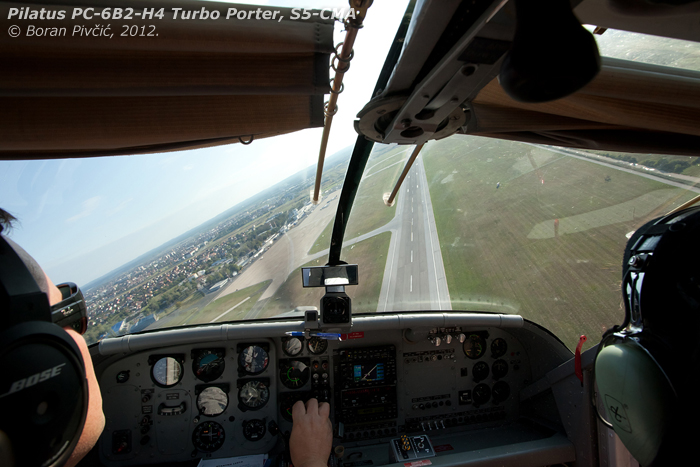
“Where we’re going we don’t need runways!” Diving on the midpoint of Pleso’s RWY 23 for a cracking landing on the last quarter of the 3252 meter strip. With the GA apron located at the extreme end of the airport right by the RWY 05 threshold (obscured here by the windshield frame), light aircraft often practice “long landings” when RWY 23 is in use, touching down on the last third of the runway to save on taxiing times. I myself, when flying in with a Skyhawk, usually start the flare when passing taxiway C (the nearest taxiway in the photo), leaving me enough space to comfortably land and coast up to taxiway B (middle one), which leads almost directly to the GA apron

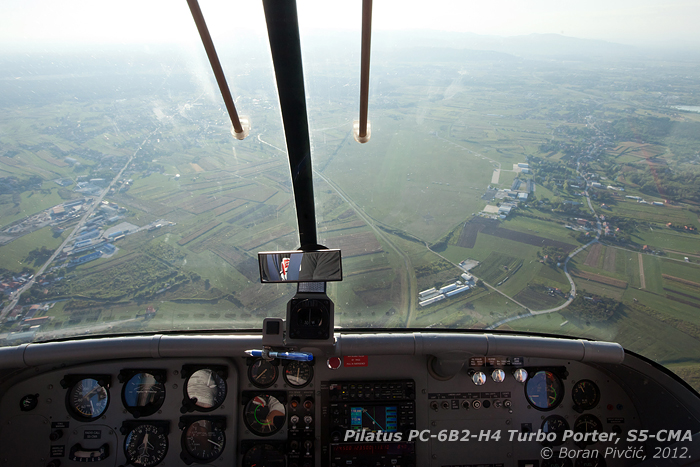
Entering final for Lučko’s RWY 28L at 3,000 ft (as opposed to the usual 900), full flaps, 120 knots indicated and going down 5,000 ft per minute for a perfect landing right on the threshold… welcome to PC-6 World!