As many of my readers might have already deduced from posts past, when operating out of Zagreb Intl (LDZA), chances are you’ll pretty quickly stumble upon one of the Croatian Air Force’s charismatic fuel-to-noise converters :). The aircraft in question are – of course – the MiG-21s, 70s manned missiles that are holding on as one of the last of their type still in front line service in Europe. And while we may have grown to taking them for granted through sheer exposure, they nevertheless still have a special – and resolutely unshakable – status on the local aviation scene. As I’ve already noted in a previous post, despite all their drawbacks, they’re still the rock stars of the skies, and have garnered a cult following that extends even outside the immediate aviation community (quite the achievement in a normally disinterested Croatia) :).
So too feel increasing numbers of photographers and enthusiasts from other lands, with the remaining few operational jets achieving close to “tourist trap” status :D. Given that they’ve been thrust back into the spotlight of late – primarily due to delays to their refurbishment in the Ukraine – I thought I might further their promotion a bit by cobbling together a collection of recent and already-featured (but hopefully still interesting) shots of the fleet going about its business. With one notable exception, I’ve decided to completely shy away from photos taken at various events and open days, preferring to stick to snapping them in their “natural operational habitat”… 🙂
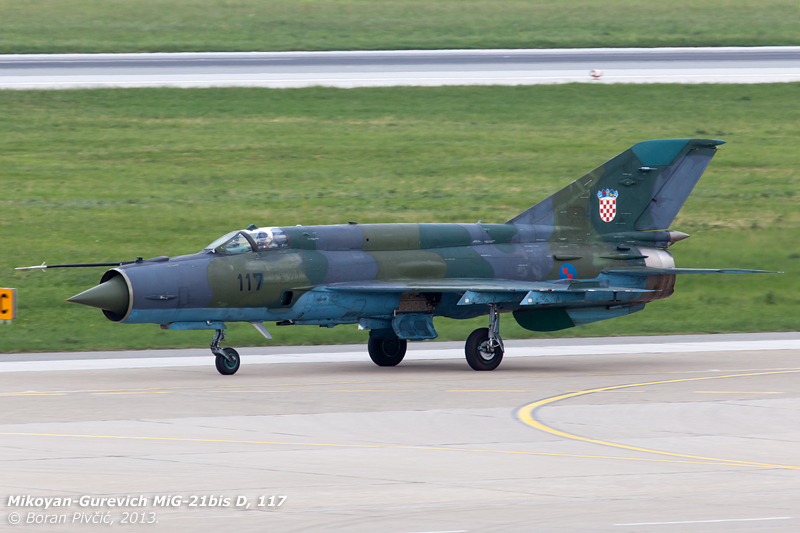
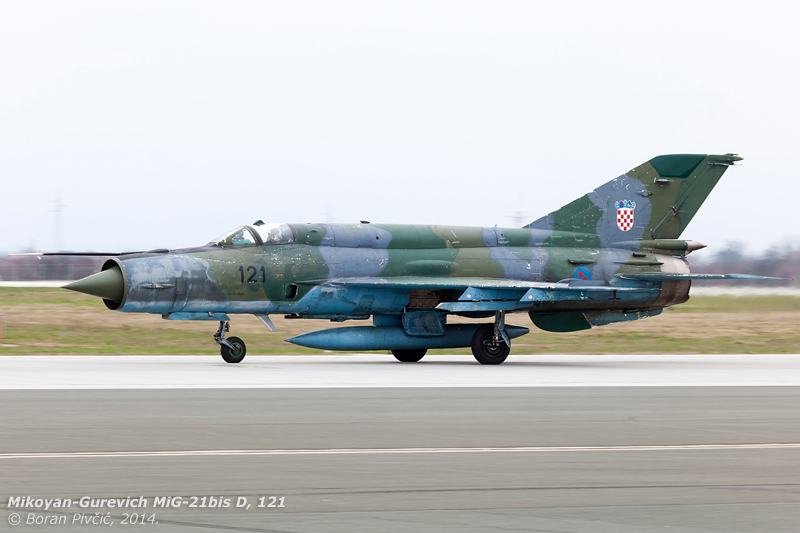
Up, up and away! Latterly the hardest working of all the jets in the fleet, 116 and 121 are seen rocketing out of RWY 23 in an unusually tight and attractive formation. Flying unarmed – and without the centerline fuel tank – would suggest they’re heading out on a simple training mission, rather than the more common Quick Reaction Alert (QRA) practice scramble.116 rocketing out on its own for another short training sortie. Essentially a piloted missile, the MiG-21 is (like the F-104 Starfighter) a pure-blooded interceptor, designed for acceleration, climb, and hit-and-run tactics in large numbers rather than the payload capability, versatility and persistence of an air superiority fighter like the Su-27 or F-15.A rarely seen member of the fleet, 117 taxis out towards RWY 05 for a test flight. Alongside Bulgarian and Romanian examples, CroAF machines are the last of the front-line MiG-21s flying in Europe – with the type also serving in limited secondary roles in Serbia. Interestingly, all of these operators fly slightly different versions of the jet, with Romania having its own MiG-21MF-based Lancers, Croatia it’s home-grown “bis D” upgrade – and Bulgaria sticking to the most capable examples of the stock bis family.121 performing a 200 knot wheelie as it returns back to base after a practice QRA scramble with sister ship 122. In the default CroAF intercept configuration, it is equipped with two R-60 (AA-8 Alphid) short-range heat-seeking missiles and the distinctive 800 liter / 211 USG BAK drop tank (giving it a usable endurance of slightly over an hour – which is not all that bad given the type’s notoriously short legs).Weathered and tired – but still infinitely charismatic – 121 is seen quietly sitting around in the background of the CroAF’s 22nd anniversary ceremony. Sadly, this is one of the last times we’ll be able to enjoy the distinctive camo scheme, with the fleet being progressively repainted into a customized NATO air superiority grey pattern… The workhorse of the fleet of late, 121 is seen rolling out for a one-ship practice scramble. Despite being part of the QRA pair, it is flying unarmed (but with the R-60 pylons still in place), retaining only the centerline fuel tank. The reasons for this are unclear, but likely have something to do with releasing the aircraft for a training mission with the minimum of fuss and operational complication.Seconds from touchdown on RWY 05 after another one-hour sortie. Buoyed by the recent arrival of the first of the “new” MiG-21s – five low-time examples bought from the Ukraine – the Air Force had started intensively flying armed pairs again, giving their pilots some much-needed air time – all while safe in the knowledge that they can use the jets’ little remaining lifetime to the fullest without fear of compromising the fleet’s operational availability.A rare venture outside by a twin-stick UMD (upgraded to the same local standard as the bis D). An endangered species, the UMDs had up until recently numbered just three operational examples, which were whittled down over the course of the summer to just 166. However, the remaining two currently being overhauled in the Ukraine, including 165, famous in song and story for its chessboard Croatian coat of arms paint scheme.
Anybody who has ever spent some time flying light aircraft – especially those part of smaller flying clubs – will no doubt have experienced what I’ve come to call the “cascading planning failure”. It’s the weekend, the weather is (nearly) perfect, the bird is operational and ready… and willing pilots can be found in their dozens. After several rounds of negotiation – and a hefty phone bill – you finally end up with a working plan, one that will both make everyone involved happy and keep the aircraft’s down time to a minimum. Excellent. All that remains now is one person to derail the entire works right at the outset… 😀
Such was the case on 13 April, when a planning meltdown kicked off my series of flights with an hour’s delay. What was a mild irritant at first had though quickly turned to excitement, proving conclusively (once again) that there really is a silver lining to every dark cloud! Rejoining the pattern at Zagreb Intl. – now well over two hours behind schedule – I happened to catch a transmission by an N-reg aircraft on approach, complete with a movie-set American accent. And while we do get quite a few N-numbers here in Croatia, most of them are aircraft actually based somewhere in Europe and operated by European companies and individuals – so catching an “authentic” US machine was immediate cause for excitement. Rolling lazily into the downwind leg, I scanned the skies for signs of the newcomer, expecting it to be a small business prop or the like… and then I saw it, dead abeam and 1000 ft lower – a pristine white Learjet gliding in towards the touchdown point.
Being a lifelong fan of the Learjet (thank you Microsoft Flight Simulator 98 😀 ), I was naturally through the roof, especially given my recent photographic dry spell. And while I couldn’t make out the exact model from the air, I’d assumed it was one of the established, “common” models like the 45 or 60. So you can imagine my surprise when, while holding on TWY B for the traffic to clear, a brand new Learjet 75 happened to roll by in front of my nose… 🙂
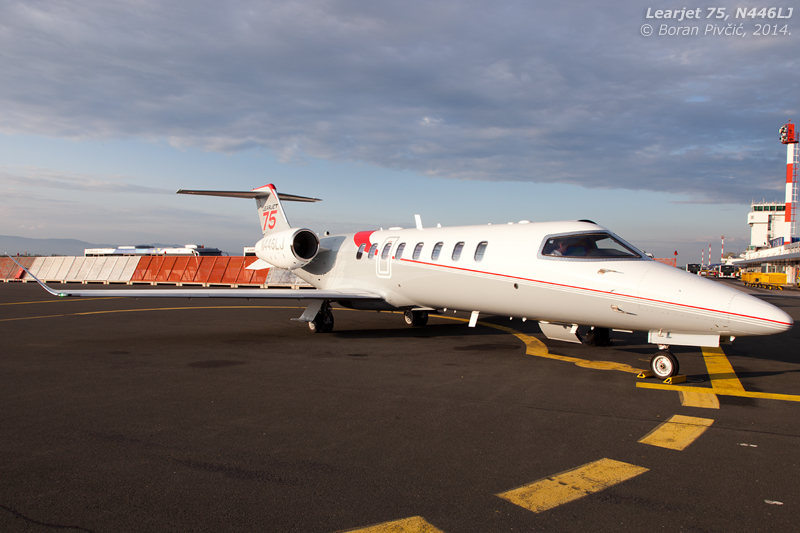
With their classic, speedy lines – hallmarks of the brand ever since the original model 23 of 1963 – Learjets definitely tend to stand out on the apron… even when sporting such a basic scheme as this!
Nip ‘n’ tuck
The newest operational member of the Learjet family (notwithstanding the recently problematic 85), the model 75 is not a new design per se, but rather a revamp and thorough upgrade of the best-selling model 45 (the aircraft included in the aforementioned Flight Simulator that had sparked my love affair with the brand 🙂 ). First flying in 1995, the 45 was conceived as the replacement for the superlative model 31 – for many the greatest of the classic Learjets – and had introduced a new, wider fuselage, reworked wing for higher cruise speeds and a new, state-of-the-art glass cockpit (the Honeywell Primus 1000 suite to be exact).
Despite being a clean sheet design, the 45 was nevertheless still a “proper Learjet” in every way – not the most commodious of aircraft, but one that could out-accelerate, out-climb and out-fly pretty much everything else in its category. And while its ceiling of 51,000 ft – known in the 60s and 70s as “Learjet country” – was neither that impressive nor unobtainable anymore, the way it got there had nevertheless still guaranteed it a healthy and loyal customer base.
However, by the early 2010s, the 45 was becoming increasingly hauled in by time, prompting Bombardier to put on its thinking cap and develop a modernized version. To that end, they took the basic 45 airframe and refitted it with new winglets (a design borrowed from the Global Express), more powerful Honeywell TFE731-40BR engines producing 17.1 kN of thrust each (versus the 15.57 of the 45’s TFE731-20s) and a completely redesigned cockpit featuring the newest in Garmin digital avionics. In this form, the new aircraft would become the model 75*, first flying in late 2012, with FAA certification following on in November 2013 🙂 .
* the same treatment would also be applied to the Learjet 40, the 45’s shorter brother. Fitted with the same suite of upgrades, it would become the model 70, with its certification still pending.
With the aircraft now ready for sale, all that was needed was to whip up a fully spec’d demonstrator and head out into the world. Such was the role of the titular aircraft, N446LJ, which had popped into Zagreb to take on fuel before continuing onwards to Denmark. Having rolled onto the GA apron just a few minutes later, I was at the plane in moments, camera naturally set and ready… 🙂
Looking stunning in the golden afternoon light. Even though it was in town for just half an hour on a “mere” technical stop, N446LJ’s visit was nevertheless quite the local exclusive, marking the type’s first ever appearance both in Croatia and South-Eastern Europe.
Many news here in the pointy end! Doing away with the Primus, the 75’s cockpit is based around the new Garmin G5000 suite which – in addition to all the usual features – also includes the Synthetic Vision System (SVS). Notably cleaner and less cluttered than those of previous Learjets, the 75’s flight deck actually feels more open and airy – despite the fact that it is of the same size as that on the 45 (also, sorry for the poor crop… the F/O was preparing the bird for its onward flight so I though it best to intrude as little as possible).
One of the reasons for the cockpit’s cleanliness lies in the relocation of the light switches to the overhead console – the first such panel ever fitted to a Learjet.
Like on all modern Learjets, the cabin of the 75 is comfortable – but not all that roomy. Updated along with the rest of the aircraft, it now features pop-up video monitors linked to touchscreen controllers installed at every seat, as well as several new trim options – the best of which is this pleasant and warm cream-wood combo.
A reverse view from the lavatory (which also doubles as the ninth passenger seat). At my 1.93 m / 6ft 3 in, navigating the cabin was a bit interesting – but not nearly as much trouble as I would have thought. Provided you’re not carrying a huge camera bag on your back, entry, seating and exiting is pretty straightforward, with very few objects you could snag with your limbs or clothes on the way.
While it is technologically far removed from the original 23 – and even the legendary 31 – the 75 still sports those evocative, exciting lines of the classic Learjet. With that narrow nose, short-span wing and short vertical stabilizer – plus a perfectly proportioned fuselage – it continues to dominate the business jet segment in sheer visual (and visceral) appeal. Also note the new winglets, installed at a significantly more obtuse angle than on the 45.
I would also like to extend my sincere thanks and appreciation to the crew of N446LJ for allowing me to snoop around and snap at will!
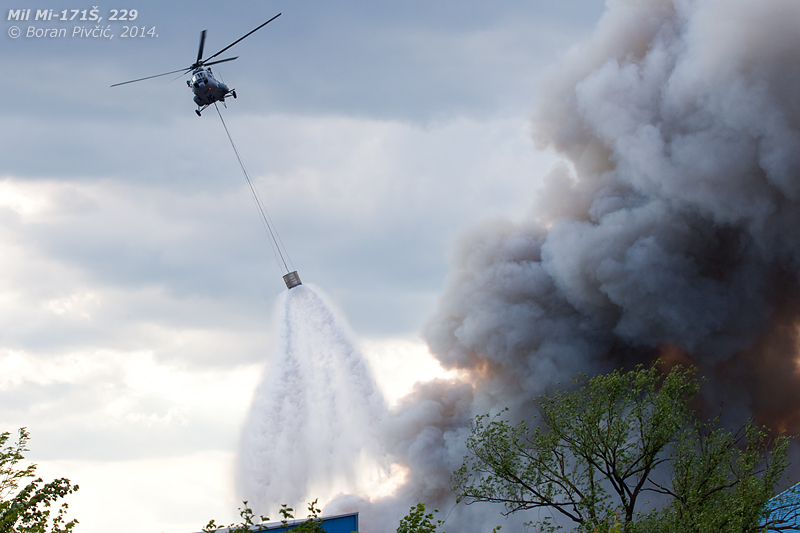
Once again I am interrupting my usual programing for a bit of breaking news… on 14 April at around 13:30 local, the CIOS recycling plant in Zagreb caught fire. Apparently the plant’s warehouse had gone up in flames, creating a smoke plume that has blanketed the entire town center and can seen for dozens of kilometers around. Given the magnitude of the blaze, the Croatian Air Force had been drafted in, sending a “bambi bucket” equipped Mi-171 to assist in operations…
229 attempting to control the blaze using a FLORY 2600 bambi bucket. Scooping up water in a nearby artificial lake, the crew were able to drop a load every few minutes – sadly without much effect.
On yet another run – one of a dozen I myself had witnessed, though the helicopter was at the scene for more than two hours. Thankfully, thunderstorms are inbound which should assist ground teams!
229 departing Lučko in a hurry before we knew what was going on. In the event, it was flying to the ZTC maintenance facility next to Zagreb Intl. to pick up the bambi bucket…
While many locals here in Zagreb have welcomed spring back with open arms – finally getting to enjoy clear skies, vegetation in bloom and more than reasonable temperatures – we one the GA side of things had something entirely different to be glad of 🙂 . After what seemed like eternity – exacerbated by odd weather patterns and even odder legal struggles – the flying season at Lučko Airfield (LDZL) is finally back up and running like clockwork! And while its start hasn’t been as bombastic as we would have liked, the airfield is nevertheless fully operational, with things on the whole progressing slowly forwards – a development that had lured back a number of light aircraft that had made their winter residence at nearby Zagreb Airport (LDZA).
And even though the apron is not nearly as full as in years past (yet), life has nevertheless finally returned to Lučko – a milestone that naturally warrants a small photo celebration! 🙂
Life, life at Lučko! Flying in the very day the airfield had reopened, N50DD was the only airplane to succeed in the fight against the day’s strong crosswind, which had actually managed to touch the 30 knot mark at one point. Despite its reg, the aircraft is a long-time resident of various Zagreb airports, and is seen here cooling down after its 10 minute repositioning hop from LDZA.
Some of our birds though have started the new season like fish out of water! Out of the hangar for the first time in several months, AK Zagreb’s Jantar will soon receive a thorough wash, after which it’ll be given back its wings and horizontal tail surfaces (stored away in the corner of the hangar). By the end of the morning, it would be happily catching thermals above town.
A glider you really can’t loose in a crowd! Despite its staggering similarity to the Polish-built PZL-Bielsko SZD-24 Foka – one of the world’s most beautiful wooden gliders – the Delfin (“Dolphin”) was actually designed and produced by the Vazduhoplovni tehnički centar (“Aircraft Technical Center”) at Vršac in Serbia, well known locally for both its own and license-produced high performance gliders.
The spring hangar cleaning session had also given me the opportunity to visit our old Aero 3, usually inaccessible without some serious aerobatic moves over and around several rows of gliders. One of the few remaining examples of the type, this machine had actually undergone restoration several years back – a process that had, sadly, been curtailed due to a lack of funds. Planned on being returned all the way to flying status, the aircraft had also received a Croatian registration, which had never actually been used outside the official register…
A sight to warm the heart! Blue skies, bright colors and a raft of lighties eager to get off the ground. Leading the pack was our colorful gliding pair, consisting of Schleicher Ka-7 9A-GKA and the afore-pictured Delfin 9A-GHS. They would soon be joined by Pilatus B4 9A-GPA, seen just in front of the hangar doors.
A contrast that perhaps best of all illustrates why I love Lučko: we’ve got everything from gliders to transport helicopters, fun to security – and dull grayness to cheerful colors.
The field’s only aerobatic aircraft had also used the fine weather well, firing up its engine for the first time after some minor servicing (and several months on the ground). One of only three aerobatic machines on the Croatian register – and one of two physically in Croatia – DID is actually a “kitplane”, assembled by the end user from prefabricated components.
With the weather finally turning for the better, I have come once again to the point where my (admittedly limited) flying duties see me visiting Pleso Airport (LDZA) on a near-daily basis (not that I’m complaining! 😀 ). The upshot of the situation is that my camera invariably visits with me, which – combined with generous apron access – often makes for some good and exciting photography. As I’d explained previously in another post on this very topic, Pleso’s status as the default gateway to Croatia is a surefire guarantee that something interesting will pop in every once in awhile, whether it be a heavy freighter, a fast military jet, or an unusual little prop 🙂 .
And while 2014 has so far been somewhat of a slow year for Achtung, Skyhawk!-worthy aircraft, a few oddballs have nevertheless flown in, providing me with enough material to satisfactorily continue this photo series… 🙂
Another medical flight rolling in with the last light of day. In town to pick up a donor organ urgently needed for transplant somewhere in Europe, OK-UNO is part of a steady stream of similar flights arriving into Pleso throughout the year. In addition to “pure” organ transport, many of these also fly out people seeking medical treatment abroad – flights that are on the up since Croatia joined the EU in July 2013.
One of the absolute highlights of the year so far is seen diving for RWY 05, flying in a volleyball team for a local championship. A lengthy – and hopefully educational – description is provided below!*
* definitely one of the most interesting aircraft to have come out of the Antonov works, the An-74 is an upgraded, Arctic-capable version of the An-72, both of which owe their unconventional looks to the application of the so-called “Coandă effect”. Named after its discoverer – Romanian aerodynamicist Henri Coandă – this effect describes the tendency of a moving gas to follow the shape and form of the surface it is flowing against. Recognizing its potential to drastically reduce an aircraft’s minimum approach and landing speeds, Antonov had in the mid-70s decided to implement it on an actual aircraft – the An-72 – in which the engine exhaust gasses flow over the flaps and inner sections of the wing, increasing their generated lift without necessitating an increase in flight speed (Boeing had applied the same principle on its YC-14 – an aircraft roughly identical in shape and function, and created round about the same time). Originally conceived as pure-blooded military transports, the An-72 and 74 would eventually also evolve into a number of passenger models, the first of which was the An-74TK-200 pictured above. Interestingly, the design had also served as the springboard for the modern An-148 and 158, which were derived from the visually nearly-identical An-74TK-300.
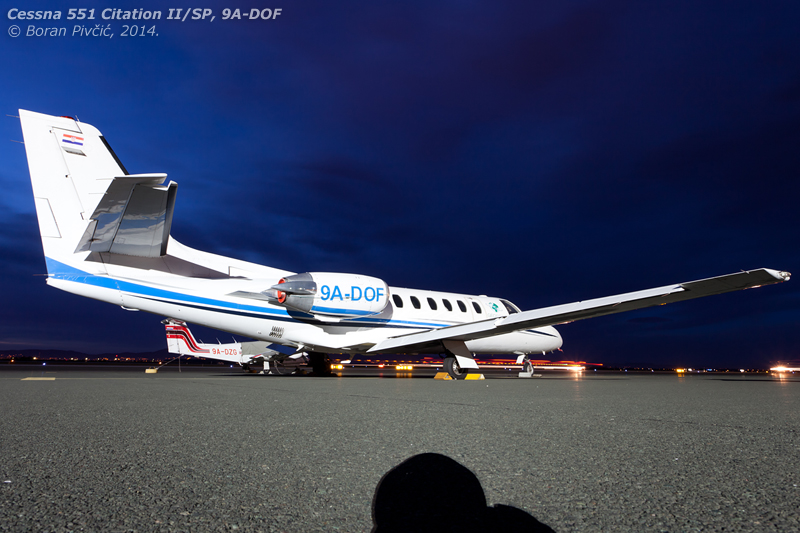
Sitting clean and pretty at the end of another fine winter’s day. Owned by Geofoto – a well-known local aerial imaging company – DOF had actually spent the last year or so on the ground due to various financial issues, with its only movement having been a tow from one side of the airport to the other. Said to be up for sale, the aircraft had been spruced up over the course of the winter – and even ran for a few minutes to clear the proverbial bats out of the engines.
A welcome sight and sound as “Knight 01” rolls briskly towards RWY 05 for a one-hour sortie. Looking worse for wear every time I see it, 121 is one of the last Croatian AF MiGs still in something resembling an operational status, with the rest of the fleet currently undergoing servicing and overhaul in the Ukraine. As part of the current QRA pair, 121 would normally be armed with two R-60 (AA-8 Alphid) heat-seeking missiles – but was on this occasion flying empty, with only the missile pylons in place…
A selection for all tastes and wallet sizes: the modern Challenger 300 for “medium haul”, the timeless and elegant Falcon 50 for transoceanic hops – and the humble, cheap Mustang for popping over the border for a coffee. While not nearly as sizable or impressive as those seen across Western Europe, this little fleet – which had also included three more Citations out of shot – is definitely a sight to behold at Pleso…
Even though the traffic situation the following weekend was not as varied as the one pictured above, one could still stumble upon some interesting machinery on the GA apron! One of the rarest bizjets around, the Citation VI was developed as a cheaper, softer version of the original Citation III, Cessna’s first swept-wing jet. Intended to offer solid performance and operating costs to the lower end of the market, the VI ended up being a huge sales flop, with only 39 examples made before production ceased in 1995… the first one I’ve ever seen up close, PH-MFX is operated by Holland’s Solid Air and is I believe one of just a handful of examples flying in Europe.
While I’ve frequently dabbled with Yugoslav Air Force Dakotas on this site – the hunt for which had led me across multiple countries and left me with a sizable stack of fuel bills 😀 – I’ve never really delved deeper into the lives of their civilian counterparts, flying passengers and mail for the national airline JAT (Jugoslovenski aerotransport, Yugoslav Air Transport). Birds of a feather, the Daks of both services had seen their fair share of action during the later stages of WW2 – some even having participated in the Normandy landings and operations at Arnhem – and were later given the task of restarting and re-energizing Yugoslavia’s war-torn logistic and passenger air services.
One of the very few color shots of the typical late-service JAT Dak (their paint schemes had constantly varied throughout their lifetimes). In use all the way up to the late 70s – well into the jet age – these machines were all WW2 veterans, some having even been passed down from the YuAF once the latter were done with them (photo from: http://www.dc3history.org)
But while the YuAF fleet had an auspicious debut here on Achtung, Skyhawk!, the introduction of the “Dakotaliners” starts, sadly, on a far more sombre note. Today completely forgotten and long buried by the sands of time (not to mention the period’s restricted freedom of the press), this opening story concerns Dak YU-ABC and its last ever flight into out very own Lučko airfield…
Its full name reading out as C-47A-25-DK, ABC had started out in life as 42-93352 of the USAAF, initially ordered in the 1942 fiscal year, but delivered – due to the immense backlog of orders – only in 1944, wearing the serial 13254. The finer details of its operational history are quite sketchy even on normally fastidious C-47 tribute sites, but it is known it had spent the entire war serving with the 3rd Combat Cargo Group initially stationed in India. A rag-tag formation cobbled together in a hurry during the spring of 1944, this unit was part of the so-called “Bond Project” (also known as “Project 90752”), and was intended to supply and relieve the British garrison in the mountain town of Imphal, at the time besieged by superior Japanese forces. Under this project, semi-trained and untested crews would be sent straight into the fray, where it was hoped they’d be brought up to standard as they went along by a cadre of experienced professional officers. Following their tour, the crews – now working together as tight teams – would be given additional advanced training and sent off into the more demanding and rigorous European hotspots.
Assigned to the unit’s 11th Combat Cargo Squadron, 42-93352 was commanded by (then) 2nd LT Duane B. Crites – who would later go on to fly F-86 Sabres, F-102 Delta Daggers and F-106 Delta Darts – and had quickly added its bit to the mass haulage of food, fuel and ammunition into Imphal. Abandoning the original plan of rotating the unit back to the States, the 3rd CCG would continue to operate in theater once the town had been secured, going so far as to even adding flights across the infamous “Hump” to its repertoire 🙂 . Following a spirited Allied advance near war’s end, the unit would eventually relocate into Burma in June 1945, becoming the 513th Troop Carrier Group along the way. However, 42-93352’s history beyond this point is unknown as far as the Internet is concerned; but, given that the unit was disbanded in April 1946 – and the JAT Dakota fleet formed in early 1947 – it is safe to say that it was part of the first batch of Daks acquired by Yugoslavia in the immediate aftermath of the war 🙂 .
A rare in-theater shot of 2nd LT Duane Crites (far right) kindly provided by his son, John. The magnitude of the task thrust upon aircrews in Burma – and especially those of the Bond Project – can best be illustrated by the final report issued by (then) Brigadier General William H. Tunner, commanding airlift operations in the theater: 509 aircraft lost, 1314 crew and passengers killed, 81 aircraft unaccounted for with 345 on board MIA, over a total of 1.5 million hours flown…
A line of CCG Dakotas wait for their next mission at Myitkyina in Burma as an unidentified P-47 beings its takeoff roll. Even though they did not have the supercharger upgrade of the C-47B – intended outright for operations at high altitude – the A models had nevertheless acquitted themselves well, operating successfully in the often dangerous and treacherous conditions predominant in the foothills of the Himalayas (photo from: http://www.cbi-history.com)
Having eventually been re-fitted with a passenger interior – and re-christened YU-ABC – the aircraft was quickly pressed into passenger service, flying scheduled flights across the width and breadth of former Yugoslavia. It would continue to do so until 21 September 1950, when it was lost with all passengers and most of its crew in one of Zagreb’s worst ever aviation incidents…
Despite the fact that it remains one of only two fatal, large-scale airline disasters to occur in the Zagreb area since the war, this event is – as near as makes no difference – completely forgotten today, limited only to the odd footnote in the occasional list of Yugoslav passenger aircraft (indeed, I myself had found out about it completely by accident while reading up on an unrelated topic). With searches on the net unexpectedly drawing mostly blanks, I’d decided to dig into the city archives and attempt to shed some light on the matter. Unfortunately though, the only thing I did manage to find were two short articles in the daily newspaper, which – while containing valuable information – were essentially just brief snippets. More interestingly, the results of the official inquiry – results stating a definite cause – were published already on 23 September, which strongly suggests that the whole issue was quickly swept under the carpet and that no in-depth report was ever made publicly available. A follow-on article from a few days later praising JAT and the development of the nation’s air transport system further cements the impression that the findings – which had surely been made in great detail – were kept classified and hidden from view since day one. Somewhat unsurprisingly, books on Yugoslav aviation incidents were similarly vague – while even correspondence with the Archives of the Republic of Serbia, Archives of SFR Yugoslavia, Air Serbia (the legal successor to JAT), Belgrade’s Aviation Museum and the Serbian Civil Aviation Directorate had failed to yield much in the way of usable results…
Nevertheless, after collating together all the information available from reliable sources, a clearer picture of ABC’s last flight began to emerge. On that fateful day, the aircraft was operating a scheduled flight from Belgrade, Serbia (LYBE) to Pula, Croatia (LYPL) with a stopover at Lučko (LYZL and at the time still the city’s primary passenger airport). The flight was operated by a crew of four, including:
captain Borivoje Marković (a former military pilot)
co-pilot Stevan Tot
flight mechanic Milorad Jovanović
radio operator Nikola Jovanović (no confirmed family link to the flight mechanic)
The loads for the flight were light – just seven passengers – including:
Bedžih Srega
Borivoj Stanić
Sava Ribić
Svetozar Ljubenović
Raka Ruben
Đuro Matijević
and Pavle Mihajlović
Approaching Zagreb on a westerly heading on the leg from Belgrade, ABC had either “descended into fog” (according to the initial article) or was “caught in a sudden change of weather” (as per the 23 September report)*. In the process, it had apparently deviated from its course, bypassed Lučko by several kilometers and impacted into the slope of the Medvednica mountain some 200 meters/656 ft below its 1,035 meter/3,395 ft peak of Sljeme**.
* knowing Zagreb’s often unusual autumn weather, both situations are possible – though the former scenario appears more likely. While late September is generally known for its unstable and fast-changing conditions, it is also frequently marked by thick and long-lasting morning and evening fog. Given the length of the entire Belgrade-Pula route – 570 km/307 NM one way as the crow flies, or about 2 hours 30 minutes at Dakota speeds – it is possible that the flight had arrived overhead Zagreb during the late morning or early noon, which would have left it plenty of time to load at Lučko, fly to Pula and then return the same way – with the same stop-over – before dark. This would have meant that it might have arrived well before the morning fog had time to fully clear. An additional factor is Zagreb’s extensive underground water table, which often causes unusual fog formation; one end of town can thus enjoy clear skies and excellent weather, while the other – not 10 km/5 NM away – can be mired in deep fog, with visibilities down in the double digits of meters.
** this would have given it a height above the city’s mean ground level of around 680 meters, or about 2,200 ft – above the usual fog depth. However, assuming that the crew did not spot the mountain at the last moment and pull up in an attempt to clear it, this opens the door to a third possibility – that they’d descended not into fog, but a low stratus layer formed with the fog lifts. These are usually between 500 and 1,000 ft deep and can sit for days at anything between 1,000 and 2,500 ft above ground.
A topographical representation of the distance between Lučko and YU-ABC’s impact site. This assumes that the aircraft had impacted on the south-eastern face of the mountain; it is possible – but highly unlikely – that it had actually hit on the opposite side, though this would have involved a lengthy detour around the town that would have added at least 15 minutes to the length of its flight and given very little operational benefit.
A 3D perspective from the approximate altitude of impact (800 m/2,600 ft above sea level). This view more-or-less also coincides with the likely direction of ABC’s approach to the city.
Of the 11 people on board, the only survivor was the radio operator Nikola Jovanović – 23 at the time – who’d suffered non life-threatening injuries. Indeed, in what is the only silver lining of the incident, he would remain with JAT after his recovery and eventually return to flying status, serving on the Ilyushin Il-14, Convair CV-440, Caravelle – and finally as the Flight Engineer on the Boeing 707 🙂 . Interestingly, he would be involved in another accident on 13 August 1972, when his 707-321 (YU-AGA) overran the runway at JFK during an aborted take-off*.
* on the take-off run, the copilot’s side window had opened with a loud bang, prompting the captain – who had assumed it could be an on-board bomb – to perform a rejected take-off even though the aircraft had passed V1 (decision speed) three seconds earlier. In the following overrun, the aircraft had struck a blast fence, with the left wing and engines #1 and #2 suffering damage by fire. Thankfully there were no fatalities among the 175 passengers and 11 crew, with only 15 light injuries reported during evacuation. The accident was also put down to an undetermined fault in the anti-skid system, which had disabled two of the 707’s eight wheel brakes, rendering it unable to stop in time. The aircraft was later repaired and returned to service 🙂 .
YU-AGA in its original guise in 1971, without the engine hush kits that would be fitted after its accident (photo from: Flickr, user Mike Didsbury)
Unfortunately, it is unlikely that more detailed information about YU-ABC might appear any time soon. As I’ve been told openly in more than one archive, many such documents from the period were either not diligently kept, were instantly classified – or outright lost and destroyed during the chaos of Yugoslavia’s dissolution in the early 90s (indeed, neither the Civil Aviation Directorate nor its accident investigation unit had anything on file about the incident). Lacking the high profile and international reach of the region’s other major air incident – the mid-air collision above ZAG VOR at Vrbovec in 1976 – means that digging up any subsequent report on ABC’s last flight could very well make “looking for a needle in a haystack” seem like child’s play…
I would also like to extend my sincere thanks to Mr. John Crites, son of the late Duane Crites, for information regarding his father’s service record!
While I have stated on more than one occasion that I’m not much of an airliner person, I’m nevertheless always on the lookout for rare and interesting examples of the breed – especially if they have a fair bit of history (and the odd plot twist) behind them 🙂 . Unfortunately though, the region’s traditionally fickle airline fortunes mean that “rare and interesting” is often synonymous with “abandoned and failed”, with a number of local airports home to disused aircraft in various states of (dis)repair that had been left behind when their parent companies went under. The very nature of these airlines – small, private start-ups fighting uphill for their place under the sun – had meant that these machines would inevitably be cheap members of the MD-80 family, with three such frames located within a 200 km radius from Zagreb.
One of these (and by far the best preserved) is the titular MD-82, nowadays displayed at Maribor Airport (LJMB) and briefly featured in one of my previous posts – where I’d pledged to give it a proper “work over” at some later date 🙂 . So, for another of my periodic returns to the world of commercial aviation, I’ve decided to make good on that pledge and – catching a break in our depressing winter weather – drove up there to see what’s what…
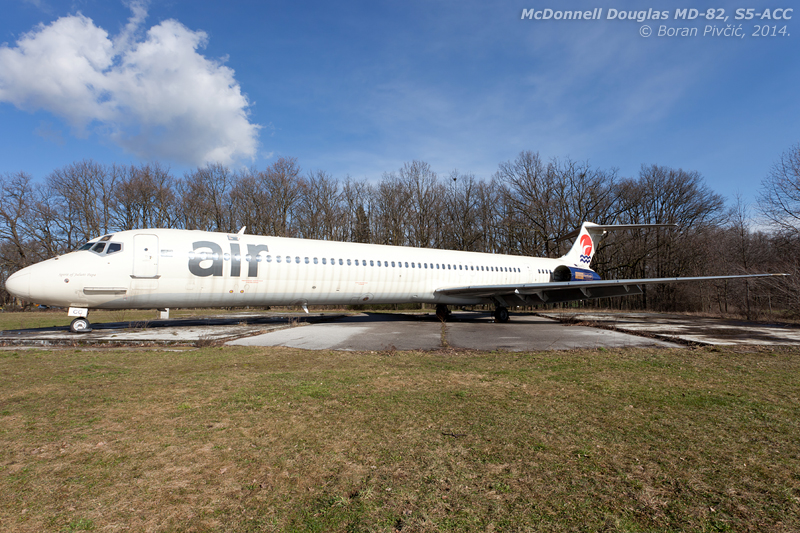
Just standing there, quiet and engineless, ACC was instant, “Grade A” Achtung, Skyhawk! material…
Mad Dog One
Following the universal path of the MD-80, ACC had led quite a varied and geographically diverse life, latterly changing operators more often than most people do socks 😀 . Sporting the serial 48095 and line number 1055, its story begins with first flight on 20 January 1982, soon after which – 23 April to be precise – it would join the fleet of Pacific Southwest Airlines (PSA) as N940PS. Interestingly – though I’ve been told this was not unusual among early Mad Dogs – N940PS had actually started out in life as an MD-81, to be reworked into its current MD-82 standard sometimes in the mid 80s. While both versions are visually identical inside and out, the 82 is fitted with more powerful Pratt & Whitney JT8D-217A engines – which produce 89 kN of thrust, versus the 82 kN of the -209 series fitted to the 81 – allowing for greatly improved performance in hot and high* conditions. The extra grunt had also led to a Maximum Take Off Mass (MTOM) increase of around three tons, even though fuel, passenger and cargo capacities had remained the same.
* a term that has pretty much entered everyday aviation conversation, “hot and high” refers to a specific set of atmospheric conditions created by a combination of high temperature and altitude. As the air warms up, its density begins to decrease, leading (among other things) to a reduction in engine efficiency and power. The same effect also occurs as altitude increases and is essentially one of the major factors that define an aircraft’s performance ceiling. Individually, either of these effects can be handled and overcome without undue problems by the majority of “regular” aircraft; however, when they combine, their total impact can be such that operations are only possible at very low weights – weights that imply a small payload and questionable operating economics. To overcome these conditions (found in many lucrative coastal areas around the world), several aircraft have been designed with higher than usual power-to-weight ratios and aerodynamics tailored to get as much out of thin air as possible. By far the most famous of these is the superlative 757, which, on a cold day at low altitude, can leave any other airliner for dead in the take off and climb 🙂 .
N940PS itself would continue to fly with PSA all the way into the beginning of April 1988, when the company merged with rival USAir (precursor to today’s US Airways). Retained in the new combined fleet, the aircraft would become N815US on 9 April, and would continue to serve staunchly until it left the fleet for good on 27 February 1997.
From there on end though, things start to get interesting 😀 . As far as the Internet is concerned, the aircraft had disappeared off the face of the planet for several years – in all probability spending some time in a desert somewhere – until it resurfaced back again in May 2003 as 9A-CBD 🙂 . Operated by Air Adriatic – one of the very few private airlines to have ever been formed in Croatia – it would fly various charter flights across the Balkans and Europe until August 2005, when it was wet-leased to Italian operator MyAir (keeping its Croatian registration as per the usual leasing rules). Sadly though, the realities of airline operations in Croatia – not to mention the complexities of their operating economics – had quickly caught up with Air Adriatic, which began shedding its eight-strong MD-82/83 fleet already by 2006 (the airline would eventually go under just a year later). Among the first to go, CBD was quickly acquired by Albanian low cost start-up Belle Air (which had commenced operations in 2005), where it became ZA-ARB on 1 February 2006.
But, even though the carrier was financially far sounder than Air Adriatic – and would, in fact, continue to operate for a further seven years before closing its doors in November 2013 – ARB still hadn’t experienced much in the way of smooth sailing. Having done its bit in giving Belle Air the initial kick it needed to get going, it would be pulled from the fleet just two years later, making way for the far more economical – and comfortable – A320.
Migrating back north once again, in early 2008 the jet would take on its current identity, serving now with Aurora Airlines, a Slovenian start-up operating out of Maribor 🙂 . Having spent much of the first half of the year on crew training duties, ACC would enter the commercial arena in September, flying on behalf of Air Kosova, a plane-less airline formed in the wake of Kosovo’s 17 February independence. Re-based at Priština Airport (BKPS) for this purpose, it would be used to connect Kosovo with several larger German cities, a traditionally sound choice given their wide variety of connection – as well as the presence of significant expat populations, in common with virtually every other Balkan nation.
However, given the new country’s economic climate and the population’s near-complete lack of purchasing power – Kosovo always having been one of the poorest regions of the Western Balkans – it was only a matter of time before Air Kosova too went under. And so it had happened near the end of the year, when the whole operation disappeared off the radar as quickly as it had appeared…
What was – with 20/20 hindsight – the final nail in ACC’s coffin, this development had left Aurora without any form of stable, sustainable work. Several charter contracts came and went – the last of which was for Hajj flights into Mecca – but pretty soon Aurora began to feel the same strain felt by Air Adriatic several years back; operating a cheap-to-buy but nowhere near cheap-to-run type on a shoestring budget, the company was pretty soon forced back against the wall. With bankruptcy staring it into the eyes, the company had no choice but to sell off its infrastructure while it could still be salvaged. Its second Mad Dog – MD-83 S5-ACE – was eventually sold, but ACC found no new home to go to. And so, on 14 January 2009, it had rolled up to a remote part of the Maribor apron and shut down its engines for good*…
* interestingly, this last flight – repositioning without passengers – was flown by two of my future CPL flight instructors, who’d once told me that despite its age and colorful working history, ACC was one of the finer Mad Dogs they’d flown…
A Trip to the Other Side
With those very engines now removed and sold, ACC was pretty much left to the elements. However, standing there for the better part of the year, it had caught the attention of the management of Letalski center Maribor (Maribor Flight Center), located on the opposite side of the runway. Deciding that it was not likely to go anywhere ever again – and that it could make for a nice addition to the center’s grounds – LCM had made a bid for the aircraft, eventually buying it outright in 2010 🙂 .
In what is perhaps the best tribute to both ACC, Aurora – and the MD-80 family as a whole – upon taking possession LCM had not gone down the path of turning the jet into a kitsch fairground attraction. Instead, they’d simply trucked it over to their side of the airport and preserved it (as much as possible) in its original shape and form 🙂 . Still in remarkably good nick, the aircraft is today open to visits by various school groups and enthusiasts – one of which had rocked up on 14 February with a huge camera and a mean-looking tripod… 😀
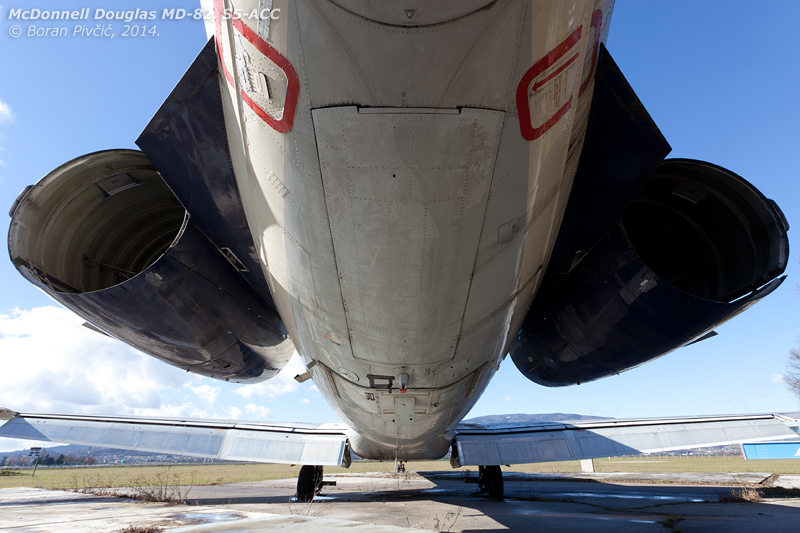
“Quiet” and “MD-80” – not words one is accustomed to seeing in the same sentence! The only Mad Dog hush kit fully approved by Pratt & Whitney, the Quiet Eagle mod includes an exhaust mixer, engine core sound insulation and a specially designed propelling nozzle and front fan case. Together, these elements quieten the MD-80 down to so-called “Stage 4 levels”, allowing it to fly into virtually all of Europe’s noise-restricted airports.
The party piece of the DC-9/MD-80 design, the rear air stairs were designed as a cheap and simple way of speeding up boarding without having to rely on your destination’s (sometimes questionable) ground equipment. However, after two well known incidents in the 70s – one on the DC-9 and one on the 727 – where hijackers parachuted out through this door, it was disabled and locked on most in-service machines (interestingly, the world-renowned Perris Valley Skydive center used to fly a short-body DC-9-21 on parachute flights). A good thing too, since my ears still have childhood traumas from the wail of the APU – located next to the right nacelle – while boarding JAT’s DC-9s in the late 80s… note also the protective tail skid just below the door, preventing tail scrapes on rotation.
Lightened by the absence of fuel – and never having to take the stresses of landing again – ACC is standing only on the number of legs it really needs (the two main wheels are actually stored nearby in LCM’s maintenance hangar).
A rare opportunity to steal a peak at the MD’s main wheel assembly. Even though it is not the most impressive unit around – not by a long shot – one cannot but be amazed by the size and robustness of all its components. A design built to true Douglas measure!
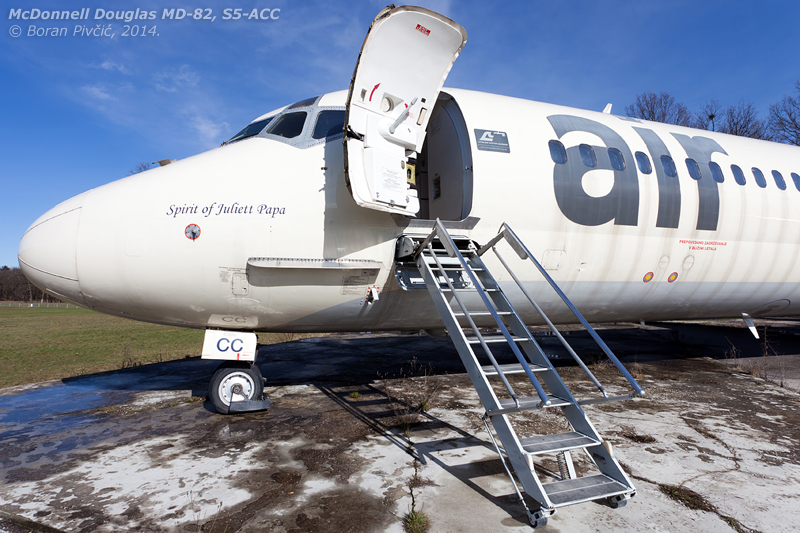
Like the rear door, the front is well equipped for operations from spartan airports (a trait shared with – among others – the 737). Of interest is also the jet’s name; while I have not been able to ascertain what exactly does “Juliett Papa” refer to, I have a sneaking suspicion it has something to do with JP, the IATA airline code for Slovenia’s national carrier Adria Airways (from which I believe a number of Aurora crew had transferred).
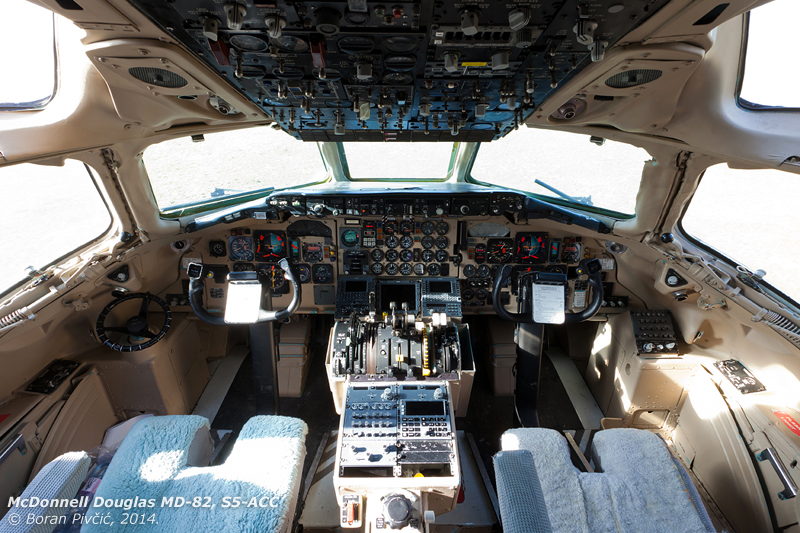
Probably one of the most famous offices in the history of aviation… simple and straightforward, the Diesel-9 and Mad Dog cockpits have weened generations and generations of airline pilots, and are as instantly recognizable as the jet itself. Interestingly, ACC’s cockpit is preserved in near-perfect condition, with only two altimeters and warning panels missing. Note also the unusual cockpit color, replacing the type’s traditional aquamarine.
Pure magic! While its essence is the same as that of the DC-9, the MD-80 cockpit is nevertheless significantly more advanced, mostly through the addition of more sophisticated avionics and systems. Compared with the average DC-9, the MD-80 includes an additional Inertial Navigation System (INS), a new digital autopilot panel and new digital radios, improved warning panels and digital fuel readouts. The later Mad Dogs – the 87 and 88 – had gone even further, ditching analogue engine gauges completely in favor of a 737-300/400 setup, and substituting the primary flight instruments with a basic EFIS system also used on said aircraft.
Like the cockpit, the rest of the interior has been preserved “as is” – even down to the food trolleys. The only things that are missing as far as I could see were various items of emergency equipment, which have either been sold (some being quite valuable) or removed for safety’s sake (such as crash axes). A walk down the cabin had also revealed that the passenger emergency oxygen system has been removed, another sensible safety precaution (since the MD-80’s “chemical candles” – which generate oxygen through a high-energy chemical reaction – are not the safest things to have lying around on an inert aircraft).
A shape that will likely never be forgotten. While there are far better and more sophisticated designs around, the whole DC-9 family has that special character and soul that is nigh on impossible to find today. Standing here, one cannot but feel respect and admiration for it – a true, unpretentious workhorse that has held its own for half a century now, standing shoulder-to-shoulder even with designs once set to replace it…
I would also like to extend my sincere thanks to Mr. Danilo Kovač of Letalski center Maribor for his time – as well as for opening ACC for me and sharing interesting snippets from its recent history!
Given that the local aviation scene is still throttled back pending stabilization of the weather (which is currently trying to make up its mind between winter snows and spring thaw), I though this would be the ideal time to revisit my old The View From Up Here photo series from 2011 🙂 . Having spend quite a bit of time aloft back then (ah, the joys of cheaper fuel!), I’d naturally accumulated a fair collection of photos along the way – photos that I had eventually cobbled together into a fairly popular two-part post (#1 & #2).
And while rising fuel prices in the intervening three years had taken their toll on my logbook, my camera and I have nevertheless still managed to catch some air with a semblance of regularity – this time substituting quantity with quality and doing away with the usual day VFR routine in favor of more exciting night and instrument practice. So, for the third installment of the series, here’s what my plane and I have been up to in the mean time… 🙂
Ah, the joys of night flying: the cockpit all lit up, quiet on the frequency, the reassuringly monotonous drone of the O-320 up front – and utter blackness outside. About to finally join our intended route after flying a (lengthy) instrument departure procedure from Zagreb Intl (LDZA).
Enjoying the fresh breeze at 5,000 ft as we rumble northwards above Slovenia. Pretty soon we’d turn west towards the Julian Alps – visible in the distance – where we’d pop up to 7,000 and switch to IFR for our night-time return home.
The fog I go on about so often seen from a slightly different perspective during another instrument departure from Zagreb Intl. Lying in a depression in the surrounding terrain – and built above an extensive underground water system – Zagreb can frequently disappear in visibilities as low as 50 meters… while a couple of miles out one can enjoy perfectly clear air and deep blue skies.
Enjoying life, nature and free fuel as we play about in the skies of Varaždin in an Aussie-built GA8 Airvan. Having stopped in town for the weekend on a promo tour of the region, the crew of VH-EZS were delighted to fly a few short demo flights for the assorted journalists – with myself naturally usurping the copilot seat on all of them.
Sharing the fun with DA-20A-1 9A-DAK as we try to formate in some beautiful scenery at 3,000 ft. It’s 100 HP Rotax woefully inadequate for the task, DAK was flying pretty much flat out trying to keep up with our 320 turbocharged horses.
Having become bored of the oppressive and never-ending greyness on the ground – Northern Croatia having been blanketed by low cloud for weeks – I’d decided I might as well check on conditions higher up… definitely wasn’t disappointed!
And finally to top it all off, two fresh ones I’ve nicked from a recent post of mine 🙂 …
The joys of sub-Alpine anticyclonic weather… our flight back to Zagreb had also included a touch-and-go at Slovenj Gradec airfield, located in a valley on the opposite side of Maribor, Slovenia’s Pohorje mountain range. You can probably guess how that plan had turned out… (to compound the issue, LJSG has no met station linked into the rest of the system – so when we’d asked the met office at Maribor for a brief, all they could do was slump their shoulders and extrapolate from existing data)
A large, unbroken stratus, beautiful sunshine on top, a light aircraft and a camera – what more could one want to be content? (except a pair of gloves) Skirting the edge of an extensive sheet of stratus as the perfect cap to the whole flight.
While I normally shy away from sombre themes, on this one occasion I’ve decided to make an appropriate exception. The unfortunate circumstance that had led to this change of tone is the fifth anniversary of the destruction of Cessna T303 9A-DLN, which had been lost with all on board in a ground impact accident on 5 February 2009.
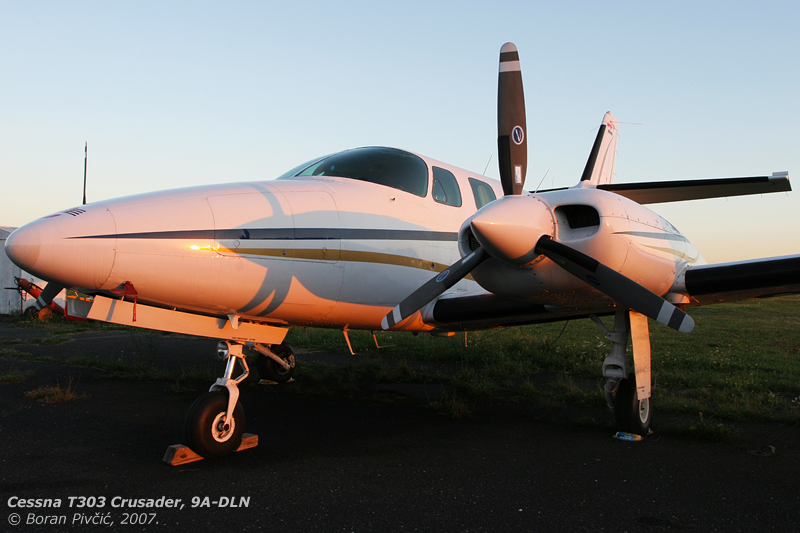
9A-DLN back in better times. One of two Crusaders to have been on the Croatian register – both of which were lost in fatal accidents – DLN was frequently used for multi-engine and instrument proficiency checks by experienced instructors and captains.
On occasion flying out of Zagreb Intl, DLN’s mission that day was a multi-engine proficiency check, which had called for a cross-country VFR flight to Zadar’s Zemunik Airport (LDZD). The on-board complement had included:
Miljenko Bartolić, Pilot-In-Command, a much-loved examiner and former agricultural and airline pilot who had given me my PPL wings back in 2002
Gerd Govejšek, instructor (manning the co-pilot’s seat), also well known to many generations of student pilots at Lučko
Aleksandar Walter, passenger, a highly experienced former Police helicopter pilot and CO
Zvonko Kelek, passenger, a private pilot with aviation experience dating all the way back to the 80s and Yugoslavia’s national carrier JAT
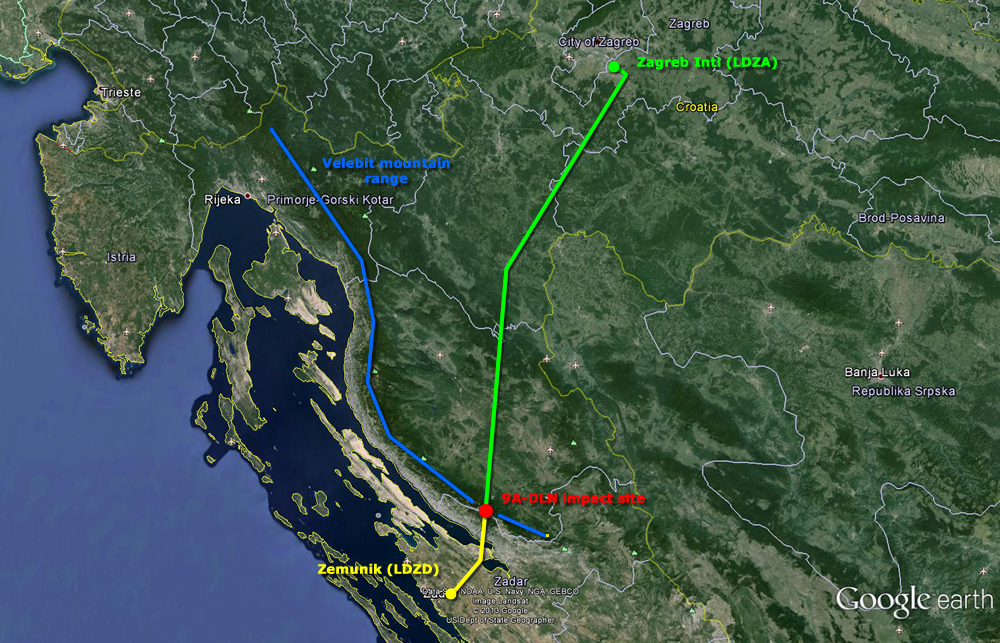
According to the official accident report – available, in Croatian, here – the flight had proceeded normally until reaching the vicinity of the town of Gospić, located near the foothills of the Velebit mountain range and about 5/6s of the way in towards Zadar. At this point, DLN had entered an extensive area of cloud, moderate icing and mountain waves, eventually ending up in continuous Instrument Meteorological Conditions (IMC). However, the crew had elected to continue their flight to Zadar without a change of route, altitude or flight rules, likely relying on the aircraft’s comprehensive IFR instrument suite and wing and tailplane de-icing systems.
One of the better-equipped twins in Croatia, DLN had sported a complete IFR navigation set, including a Garmin GNS 430 IFR GPS unit.
Approaching the Velebit range at 8,000 ft – a safe terrain clearance altitude even during moderate wind – the aircraft had entered an active military training zone (normally open to civilian traffic and only activated when the Air Force actually needs it), after which it was instructed to descend below the zone, whose lower boundary was at 6,500 ft. This new altitude had put DLN at between 800 and 1,300 ft above the approaching peaks.
Though there is still a degree of uncertainty acknowledged by the report, it states that the prolonged flight in cloud had led to extensive airframe icing, likely starting around the tail. Still flying at 6,500 ft, DLN had then entered an area of severe mountain waves, which had produced a strong and rapidly increasing rate of descent. Iced over and too heavy to counter it, the aircraft had quickly begun to plummet, impacting the mountainside at 4,734 ft, roughly 1,000 ft below Vaganski vrh (Vagan Peak). The final radar contact was recorded at 14:54 local time.
9A-DLN’s actual (green) and planned remainder (yellow) of the route.
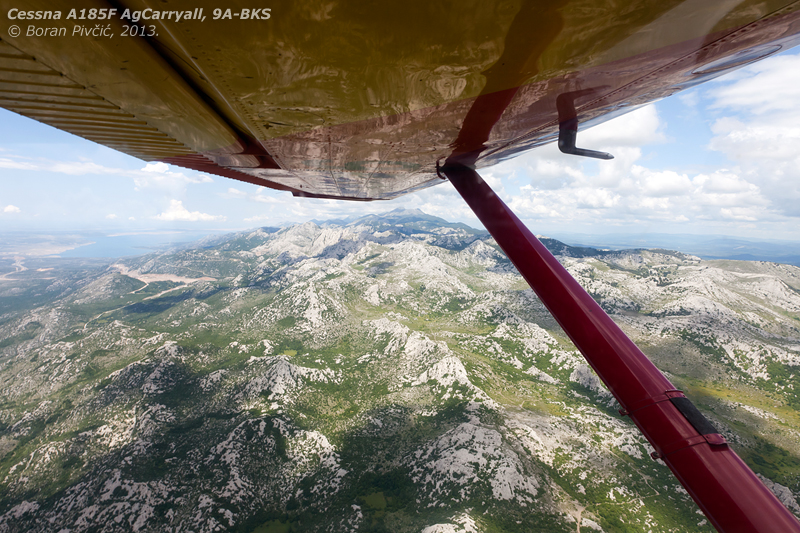
The southern end of the Velebit range (where the blue line in the map above ends), with Vaganski vrh visible just below and in front of the wingtip. The range’s steep slopes on both sides give a good indication of the kind of weather phenomena it is capable of producing when the wind picks up…
The report notes that the impact was so violent that the aircraft had virtually disintegrated. The search for the impact site – as well as the subsequent recovery of the wreckage and bodies – was hampered by bad weather for days, in addition to an avalanche that had buried most of the immediate surroundings.
Having lost four of its much loved members in an instant, the aviation community at large fell into a state of shock and bewilderment – a state that persists even today, five years on. The death of four experienced aviators – and the conditions into which they had flown – have left a lasting mark on all of us, now unable to look at the Velebit range the same way ever again…
Back in 2012 while on a short visit to Belgrade, Serbia, a friend and I had decided – in true Achtung, Skyhawk! tradition 😀 – that we might as well do some proper sightseeing and head out to the old UTVA aircraft factory in Pančevo, a couple dozen kilometers up the main road. Once the powerhouse of Yugoslavia’s aircraft industry, this enormous factory was, among other things, responsible for the most ubiquitous light aircraft in the country’s history – the much maligned UTVA-75 – a machine that, despite all its faults, had quickly come to dominate aprons across the land (and the occasional newspaper accident column 🙂 ). Singularly robust machines – the DC-9s of the light single world – many 75s continue to soldier on even today, with a select few also having seen combat action as impromptu light attack aircraft during the turbulent 90s.
By 2012 however, the factory’s shine had long gone and its successes largely forgotten. A dilapidated ruin that had been heavily damaged during the 1999 NATO air strikes, the factory exists today as a rump facility at best, fiddling with a handful of low-scale projects on a thin shoestring budget. While a sad sight in its own right, the view that had greeted us had also represented a striking metaphor for former Yugoslavia’s aviation industry as a whole – and not least of all for the flat spin it had taken during the country’s violent disintegration. Largely scattered across the land, it would – unsurprisingly – take a crippling hit at the start of the 90s war, losing its supplier and customer bases virtually overnight. The widespread financial disasters that had succeeded the conflict never really gave the industry the breathing space it needed to recover, turning the whole aviation landscape into an archaeologist’s playground of abandoned factories, forgotten companies and rotting gate guards.
May the Force be With You
But, in what is a long-overdue resurrection of the region’s large(r) scale light aircraft industry, one manufacturer had nevertheless managed to part the red tape and defy the economic odds, adding its bit to putting the industry back on the proverbial map 🙂 . The company in question is Aero East Europe, a small but efficient unit operating out of a historic workshop in the southern town of Kraljevo, and nowadays well on its way to building up a respectable regional reputation for its original STOL ultralight designs. Fighting its way up the sales ladder against various copies and modifications of the legendary Zenair CH-701, the flagship of the fleet is the 450 kg / 992 lbs SILA 450, an example of which had popped into Varaždin Airfield (LDVA) on 18 January for a brief promotional visit. No prizes for guessing whether I was there… 😀
YU-A102 nice and clean – and ready for its first flight of the day.
Apart from a name that tends to raise eyebrows among Southern Slavic language speakers – literally meaning “force”, but in reality just short for Serbian Industry of Light Aircraft – the 450 appears largely unremarkable at first glance, sharing much of the visual cues of other high wing STOL ultralights. Its specs too (at least on paper) are not enough to set your blood racing; compared to the ICP Savannah XL, the 450’s latest iteration – the 450C – can carry five kg / 11 lbs less, cruises just 6 knots faster, and needs five meters / 16 ft less to take-off and 10 meters / 32 feet more to come to a full stop.
Up front there’s a 100 HP Rotax 912ULS whirling a three-blade ground-adjustable prop – hardly an exciting feature – while equipment-wise you’re looking at electrically actuated flaps, a ballistic parachute recovery system and an optional glass cockpit… essentially the same kit you can get from any other manufacturer out there.
However, once up close and past the preliminaries, a startling number of interesting – and unusual – details begin to emerge 🙂 . The wing, for example, is a mechanically simple affair that makes do without the slats, slotted controls and vortex generators seen on the CH-701 and its spin-offs. Instead, the 450 uses a plain but very thick airfoil profile that simplifies the wing’s internal structure, while at the same time preserving low speed handling and performance and noticeably reducing drag (which will always be high on a STOL wing). Indeed, the 450 can boast a lift-to-drag* ratio od 1/15, quite a bit up from the 1/11 of the Savannah XL (a number also shared with, of all things, the Cessna Skyhawk 🙂 ).
* a common measure of the aircraft’s aerodynamic efficiency, the lift-to-drag ratio – often abbreviated to L/D and sometimes also called the “finesse” – in effect shows how much horizontal distance would the aircraft, unpowered and gliding, be able to cover for each unit of vertical distance lost. The SILA’s 1/15 for example denotes that for every foot of altitude lost, it would be able to glide 15 feet in still air. Scaled up a bit, this means that for a 1,000 ft altitude decrease, it would cover 15,000 ft horizontally (roughly 4.5 km / 2.5 NM). Apart from quantifying the aircraft’s overall aerodynamic prowess, this number also comes in handy during flight planning, allowing you to pick out – in advance – suitable landing fields along your route for the event that your engine decides it has grown tired of working 🙂 .
Another interesting feature are the wingtip fences, which prevent high pressure air below the wing from spilling over the wingtip into the low pressure air above (similar to the winglets of a larger aircraft). Left uncontrolled, this spillover would eventually detach from the wing in the form of turbulence – the infamous wingtip vortex – drastically increasing aerodynamic drag. A similar setup is – uniquely – found also on the horizontal stabilizer.
To compensate for the lack of slats and slotted controls at the lower end of the speed range, the 450 is fitted with drooping ailerons, which lower slightly as the flaps pass their halfway travel mark. Combined with the chunky airfoil, they give the aircraft an almost comically low minimum flying speed in the low 30-ish of knots – which was demonstrated to me graphically against the day’s stiff 30 knot headwind at altitude 😀 .
The combination had also acquitted itself well handling-wise, with the 450 displaying unexpectedly impressive flight characteristics in all regimes, high or low, slow or fast. Perhaps its biggest surprise – to a Cessna driver 🙂 – was not what it could do, but the way it did it, with an almost complete lack of aerodynamic drama, pussycat stall and post-stall response, and virtually no buffeting or waywardness anywhere in the standard part of the envelope*.
* in fairness though, I’ve not had much ultralight experience, so I can’t really make an objective handling comparison with other designs… but I can however draw parallels with the similarly sized (though heavier) Cessna 150, which the 450 – in a number of comparable respects – blows clear out of the water 🙂 .
Cabin Space – The Final Frontier
But, even before one gets a grip on the stick, he/she can notice a raft of other nice touches scattered all over the airframe. One that I – standing 1.93 m / 6 ft 3 in tall – can particularly appreciate is the wide and roomy cabin, almost an order of magnitude more spacious and comfortable than that of the 150. Entry and egress is unexpectedly easy from both sides, courtesy of an upward hinged door and wing struts positioned behind the doors, at the joints of the main gear legs.
Wide doors and a tall door frame make for remarkably easy entry and exiting – so even types of my height won’t be going around bumping into things. The only criticism I have here is that the sticks are too tall, which makes maneuvering to sit down a bit awkward if you have long legs (and can lead to some minor interior scraping if you’re a bit clumsy).
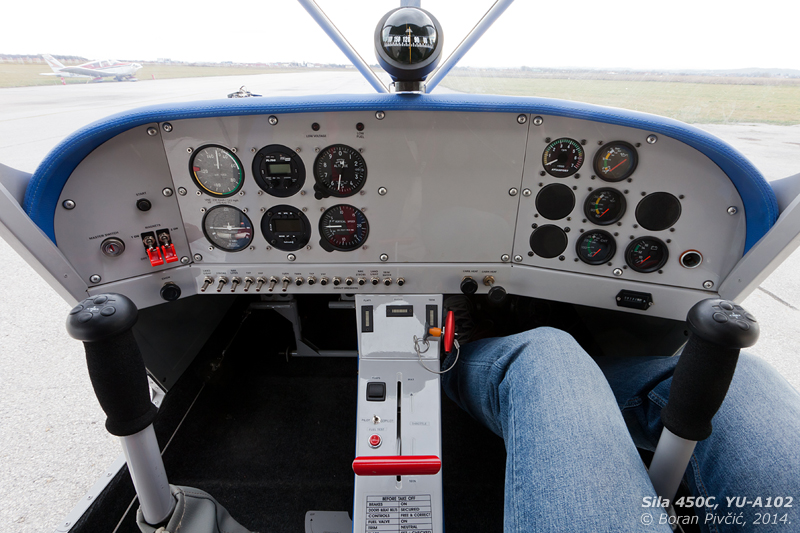
Once in, there’s plenty of room to stretch your legs and sit upright… though at the limit of the latter in my case. Simple and uncluttered, the cockpit of YU-A102 sported only a very basic avionics fit, tailored to the needs of the German market. Interesting features include the side panels canted towards the pilot, as well as the innovative system switches, which light up when activated (as could have been seen in the above video). The two guarded switches on the left panel are the magnets, while the key slot beside them is not the starter – but the battery master switch. The ominous red handle that sticks into the eye next to my knee activates the ballistic parachute system – and is also guarded for your wallet’s safety.
The view forwards in flight is pretty much on par with that of the 150; however, the large side windows, rear-mounted wing struts and smaller pillars mean the SILA excels when you want to look left, right or down. Like the Savannah, the design also features a small triangular window on the ceiling which helps with ambient lighting and provides some semblance of upward visibility.
There’s other evidence of the design having been thoroughly thought out. The ailerons and elevators, for example, are actuated by pushrods rather than conventional cables (which are retained for the rudder only), giving a quicker control response and eliminating a number of maintenance issues (delaminating cables being one of them). The space behind the panel is remarkably clean as well, with plenty of legroom and none of the wiring, piping and mechanical whatnot frequently found on Cessnas and Pipers. And – what had caught my attention right from the start 🙂 – there’s a small double L mount hanging from the ceiling just aft of the windshield, allowing you to securely deposit your headphones when not in use*.
* while this is not much of an issue in the grand scheme of things – and certainly not the reason to choose the SILA over any other design – loose headphones can become quite a nuisance. In light Cessnas for example, you either have to hang them from the yoke (not the most practical solution in a small cockpit), leave them on the seat, or, worst of all, put them on top of the panel where they’re exposed to sunlight – and where their speaker magnets can play havoc with the magnetism of the compass.
These practical details continue on the outside as well. The fuel tank caps open, close and latch only with the master switch key, avoiding unintentional flight with the tanks unsecured (and, since we’re on the Balkans after all, also avoiding intentional fuel theft 😀 ). Up front, large access panels are provided on the cowl, allowing for quick inspections and repair without the need to dismantle the whole nose. And – unusually for an aircraft that has a small, light prop and barely treble digits of power – YU-A102 also came equipped with a rudder trim system, operated electrically (like its elevator equivalent) by push buttons located on the tops of both sticks.
Another interesting feature not seen on the CH-701/Savannah/similar is the cut-down rear fuselage, making for decent rearward visibility. The two rear windows also give the cabin a brighter, airy and less claustrophobic feel. Note also the small black bag visible through the window, housing the ballistic parachute.
Certifiably good?
But, while everything said so far sounds very enticing, one other important item still remains – the naughty business of price 🙂 . What you’d eventually pay for one of these naturally depends on what equipment options you’d go for, but the base model – broadly identical to YU-A102 – would set you back about EUR 62,000. Around 30,000 more would get you the top-of-the-line version, equipped with digital avionics (a Dynon Skyview/Garmin G3x mix) and full interior night lighting.
From what I’ve seen while scouting through the European classifieds and various vendor sites, this is a fair bit (EUR 10,000+ to be exact) more expensive than the performance and engine-wise very similar Savannah XL. While at face value this does seem to be a mystery, the SILA’s higher purchase costs can be attributed to its certification ambitions, having been designed to be fully compliant with the JAR VLA Part 21 standard – while already holding Germany’s own equivalent, the LTF-UL certificate.
But, will this paper be enough to overcome the higher price – and will the aircraft’s features manage to overcome the lingering stigma of its country of origin – still remains to be seen…
In further proof that the weather here has completely lost its bearings, 12 January 2014 had dawned with clear skies, unlimited visibility and mild temperatures hovering at around 8 degrees Centigrade – a marked contrast to the low cloud, fog, two feet of snow and -10 we’re used to seeing at this time (as I had made abundantly clear on more than one occasion 😀 ). Naturally, such a fine day could not have been allowed to go to waste – especially since “proper” winter is likely preparing to pounce from around the corner – so a friend and I made arrangements for a short hop to neighboring Slovenia in our club’s wee Cessna 150.
Our target for the day was Maribor Airport (LJMB), a swell field serving the town of the same name and located near the northeastern tip of Slovenia, right between Croatia and Austria. One of the country’s three airports of entry, it sports a 2,500 m / 8,200 ft paved runway equipped with a host of instrument approaches, full night lighting, all relevant ground services – and virtually no large-caliber traffic 🙂 . Just 30-ish minutes of flight time from Zagreb, this had always made it an ideal training location and a practical alternative to busy Pleso – so much so that the majority of our local student pilots (especially those aiming for CPLs) have visited it at least once during their training 🙂 (I myself more than half a dozen times).
Our flight today was however a pure cross-country joyride, which gave me ample time to soak up the weather and enjoy the scenery – and naturally get busy with the camera 🙂 .
“Haha, I’m flying and you’re not!”. A visitor from Germany is preparing for takeoff down RWY 14, while MD-82 S5-ACC slowly rots away in the background… a fixture of the airport for several years now, ACC had previously flown with Aurora Airlines, and was at the time said to be one of the better Mad Dogs in the area. Sadly, its current state leaves very little hope it could one day regain that reputation… (though – with any luck – it will be featured in a more extensive post later on)
The fine weather at Maribor had – like in Zagreb – immediately lured out most of the local training fleet, a fleet that had included everything from the old, Yugoslav-designed UTVA-75 to the modern, efficient Diesel Star. Filled to the brim, DOD has just started taxiing towards RWY 14 for a panorama flight above town, barely squeezing in among the other four aircraft in the circuit…
The joys of sub-Alpine anticyclonic weather… our flight back home had also included a touch-and-go at Slovenj Gradec airfield, located in a valley on the opposite side of Maribor’s Pohorje mountain range. You can probably guess how that plan had turned out… (to compound the issue, LJSG has no met station linked into the rest of the system – so when we’d asked the met office at Maribor for a brief, all they could do was slump their shoulders and extrapolate from existing data)
A large, unbroken stratus, beautiful sunshine on top, a light aircraft and a camera – what more could one want to be content? (except a pair of gloves) Skirting the edge of an extensive sheet of stratus as the perfect cap to the whole flight.
While continental Croatia has, on the whole, been spared a visit by the Four Riders of the Winter Apocalypse – Freezing Cold, Low Cloud Base, Snow and Fog 😀 – the light aviation scene had nevertheless wound down for the season, existing now only in traces and a few sporadic pleasure flights flown over the weekend. Even though we’ve been graced with generally good visibility and temperatures of 10 to 15 Centigrade, few people are inclined to get some serious flying in, leading me to a serious (and worrying) deprivation of news and photo opportunities…
So, to fill the void – and wish my readers belated season’s greetings – here’s a photo of some helicopters in fog 😀 .
Blade Runner has “tears in rain”, while Lučko has “rotors in fog”. Slowly disappearing into the evening’s radiation fog, a selection of Mil helicopters prepares to go to bed. Leading the pack are three Mi-171Š transports, followed by a “legacy” Mi-8MTV-1, while in the distance – already nearly obscured – is a visiting Mi-35 gunship from the Czech Republic…
































 Achtung, Skyhawk!