Pretty much one of the hottest topics in the country of late, the recent presidential elections – which had seen the ascension of Croatia’s first ever female president – is not really the type of material I care for here at Achtung, Skyhawk!. However, being an international political event of some significance, the subsequent formal inauguration was certain to draw some interesting machinery to Zagreb Airport, machinery that would inevitably include some of my favorite photographic fare – bizjets :). Even though the final guest list had left something to be desired from a purely diplomatic standpoint – having stopped at just a tad over 10 delegations – the initial reports of the aircraft types expected had suggested an eclectic mix of both Western and Eastern designs, itself more than enough to pique my interest!
Thankfully, having managed to organize ourselves well ahead of time, several colleagues and myself had been able to secure access to the airport’s observation terrace (nowadays, sadly, permanently closed to visitors), allowing us to observe proceedings from the best available seats in the house. Unfortunately, Zagreb’s winter haze – and the (understandable) requirements of airport security with regards to parking positions – had interfered somewhat with our work, the results of which may not be up to my usual HQ standard…
The first arrival of the day – touching down before the morning mist has had time to fully clear – YU-BNA of Serbia really is a sight for sore eyes. One of the timeless classics of the already elegant Falcon family, the 50s was the world’s first proper business “tri-holer”, and would become Dassault’s passport into the high end of the segment. Even though these originals are nowadays few and far in between, the design lives on as the more modern 900 – two of which would also visit Zagreb within the hour.First a Falcon 50 and then a Learjet 60 – not a bad way to start the day! Crisp, clean and elegant, Z3-MKD was the second visitor to arrive, hailing from Macedonia (the country, not the Greek province).The good news had continued with visitor #3, which had taken the form of a Challenger 601-3A from the Czech Republic. Another classic, the 601 model was an important step up from the original 600 and 600S (the first ever Challengers), and had laid down the power plant, range and weight bases for today’s popular models 604 and 605.The biggest visitor though would fly in from Poland – with this not even being its first time at Zagreb. Together with its sister ship SP-LIH, LIG is actually owned by Polish flag carrier LOT – but is operated on behalf of the country’s government.Completely devoid of any registration markings on either side, the French Gov’t Falcon 900 strikes a nearly identical pose as YU-BNA (for a handy comparison). With the imminent arrival of Italy’s own example, we would soon have a whole Falcon Meet!The aforementioned Italian Falcon taxiing towards the GA apron. Given that Zagreb’s apron is not all that commodious – and space was needed for all the scheduled flights – the inauguration visitors were scattered all over the place, with some on the GA apron, some on the cargo/widebody positions – and one even on the Croatian government apron…Unfortunately, this had meant that the two most interesting machines of the day had ended up on the far side of the apron… hailing from Slovakia and Hungary respectively, OM-BYL and 407 were by far the loudest aircraft of the day, with the Yak-40 excelling during reverse – and the An-26 everywhere else…And finally, the last visitor of the day – and by far the most unexpected. Operated by the German Air Force, 14+02 is one of a significant number of military/VVIP/communications Globals in service worldwide – one of the few roles where it was able to outsell its fierce competitors, the Gulfstream IV/V and Embraer Legacy 600/650.Antonov, Bombardier (x2) and Yakovlev – not a bad day out I must say!
As could have been rightfully expected, 2013’s three-day visit of the An-225 to Zagreb had caused a stir of proportions unseen on the normally quiet and slow Croatian aviation scene. Spotters, photographers and enthusiasts from all over the country had flocked to town in their hundreds, while even the mainstream media – normally unimpressed by anything aviation – sat up and took notice, covering the entire visit with front-page news. Sensing a PR opportunity that it simply could not afford to miss, Zagreb Airport’s operating authority had gotten into the act as well, organizing a number of extended bus tours around the aircraft – and giving other visitors a virtual carte blanche to observe proceedings from the safe side of the airport fence. Inevitably, such freedom of movement had meant that enthusiasts with big cameras could roam the landside from end to end, snapping away at several normally inaccessible parts of the airport and the aircraft parked, stored and/or preserved there (though their relevance was, understandably, completely lost in the glory of the world’s biggest aircraft).
After the hubbub had died down a week or so later – once everybody had emptied their memory cards 😀 – photos of these other machines had slowly started surfacing on various social networks. Among them was a fine shot of a preserved Cessna 310R, painted in an early scheme used by national carrier Croatia Airlines and put up for display in front of the company’s (secluded) maintenance hangar. While some were already aware of its existence, for many it was nothing short of a revelation, with several even going on to question the authenticity of the paint job 🙂 . Pretty soon an interesting discussion had begun to unfold in the comments section, a discussion that would eventually reveal some fascinating – and hitherto little known – details of its time flying commercial services during Croatia Airlines’ formative years.
The little bird that had started all the trouble. The last and the best of all the 310s, the R model is nowadays somewhat of a rare sight, despite 1,332 examples having been produced.
Rather unsurprisingly, this had immediately set off a chain reaction here at Achtung, Skyhawk!, starting first of all with attempts to dig up as much history on the airframe as I could. My search was further spurred by the knowledge (previously… misplaced) that the company had actually started out in life with a handful of various Cessna piston twins, aircraft that had long been sold and nowadays completely forgotten by the general public. After a bit more digging – which had included extensive conversation with current and former Croatia Airlines staff – I was amazed to discover that the company had actually operated seven light aircraft, including even a lone Cessna Citation II. With this knowledge at my disposal, you can pretty much guess what happens next… 😀
I’m leaving on a jet plane
However, before we do get to the inevitable, I though it best to first run quickly through the company’s potted history. The country’s flag carrier ever since independence, Croatia Airlines – known to all by its ICAO code, CTN – can trace its roots back to 7 August 1989 and the formation of Zagreb Airlines (Zagal), a small cargo outfit created around a single Cessna 402. Flying feeder and nightly postal services on behalf of companies such as DHL and UPS, Zagal would in early 1990 undergo a program of rapid (and ambitious) expansion that would quickly see its fleet swell to include more than a dozen piston twins and singles – and even the odd business jet and turboprop.
This very ambition would soon extend to the creation of proper regional passenger services – using proper passenger aircraft – that would initially be known under the provisional name CROATIAirlines (at the time often stylized as CROATIAirlines). Re-branded into the now-familiar Croatia Airlines on 23 July 1990, this new unit would in May 1991 lease-in two McDonnell Douglas MD-82s (YU-ANC & YU-ANO) from Slovenia’s Adria Airways, kicking off operations with scheduled flights between Zagreb (LYZA at the time) and Split (LYSP). Further services would soon be established outwards to Europe, most of which would link Croatia with various cites in West Germany – and which would eventually account for the majority of the company’s traffic. In parallel, Zagal itself – having provided the necessary operational and regulatory foundations for the new airline – would be fully integrated into CTN by November, with its fleet (minus most of the piston singles) continuing to serve for awhile in its original roles.
YU-ANO basking in the sun at Split after its inaugural flight from Zagreb – the first ever scheduled passenger flight flown by Croatia Airlines.
However, as with everything else in those days, the violent dissolution of Yugoslavia in mid-1991 and the subsequent start of a four-year civil war would throw a huge spanner straight into CTN’s works. Following the Yugoslav Air Force’s 28 June attack on Ljubljana Airport (LYLJ) in Slovenia – one of the responses to Slovenia and Croatia’s simultaneous declarations of independence three days earlier – the two MDs would be immediately recalled back home, leaving Croatia Airlines with no machines with which to ply its trade. Things were equally bad for the lighties, whose duties had seen them scattered across the width and breadth of both countries. To protect them against anticipated hostile action, during September and November they were hurriedly (and occasionally in the face of small arms fire) ferried to safe ports in Austria, where they would stay until the following year.
To address the thorny issue of being an airline with no airliners to its name, CTN had in late 1991 and early 1992 made overtones with several manufacturers and various European airlines for the purchase of some of their used hardware. While a slew of types had been considered, the carrier’s new fleet would take on a pretty conventional look for the time, eventually coming to include:
five Boeing 737-230/ADVs (9A-CTA through CTE1), acquired from Lufthansa and delivered starting April 1992
two “quick change” ATR-42-300QCs (9A-CTS & CTT), fitted with around 400 kg worth of floor reinforcements to enable conversion to an all-cargo configuration, sourced new direct from ATR and delivered on 4 and 25 June 1993 respectively
and a lone ATR-42-320 (9A-CTU), sourced also from ATR, delivered on 31 May 1995
1 an interesting oddity that can still be found in period photos, three of the 737s (CTA, CTB & CTC) – as well as all of the lighties – had between April and July 1992 carried an unusual RC registration prefix. Decided and allocated by the International Telecommunications Union (ITU), these prefixes are used for all radio communications – not just aeronautical – so changing them naturally involves a fair bit of bureaucracy. However, with Yugoslavia now well and truly gone, there was no legal basis for using the old YU prefix anymore – while Croatia’s very recent recognition by the international community (9 January) implied a noticeable while while the ITU convened and decided what to do. To get around this issue, it was suggested from within CTN – and temporarily accepted in the corridors of power – that RC (Republic of Croatia) could be used until a permanent solution was found. The latter would take the form of the current 9A, not a bad choice overall considering that R prefixes are generally used by Russia, CR was allocated to Portugal’s overseas provinces – and HR (“Hrvatska”, the country’s local name) was already taken up by Honduras.
While they were a bit “old hat” even by the standards of the 90s, the noisy and infinitely charismatic 737s had nevertheless done sterling work throughout the war years and can – in retrospect – be credited for putting Croatia Airlines onto the proverbial map. However, while they were easy and cheap to buy, the certainly were not cheap to run. By the end of the decade, the post-war economic situation in Croatia was still wobbly at best, while the very visible scars of war were not really doing the country’s traditional economic staple – tourism – any favors. In this business climate, having a fleet of aging airliners that drank fuel like a burning oil refinery made increasingly little economic sense, prompting CTN to head out shopping once more.
A similar turn of events – albeit with a very different outcome – had also taken place among the lighties several years earlier. While all of them did have their uses and were not just standing idly around collecting dust, they nevertheless were considered to be an operational and financial burden – one that CTN, now preoccupied with airliners and scheduled operations, had soon decided it could do without. In trying to find a solution to this problem, suggestions were floated in 1993 and 1994 of separating the remaining bits of Zagal back into a standalone company similar in purpose to its 1989 original. However, this plan would have required CTN to part with a noticeable amount of manpower, a resource that a fledging airline trying to operate in the middle of a war could not really spare. Thus it was soon decided to sell off all but one of the remaining aircraft – the Cessna 310R mentioned in the opening entry – and eventually altogether close that chapter of the company’s history…
At this point, the 737s still had half a decade left to run – but the writing on the wall would become all the clearer on 29 May 1997, when CTN took delivery of its first truly modern airliner, the Airbus A320-211 🙂 . Registered 9A-CTF – and from then on affectionately known as “Tango Fox” – this 1992 machine was not actually bought outright, but rather taken under long-term dry lease, an arrangement under which it would operate for the next 16 years. But, having done its bit in paving the way for the type’s smooth introduction into service, CTF would – sadly – enter the history books once again as the first CTN aircraft to meet its maker, having been sentenced to death by scrapping after it ran out of service life in December 2013…
Always a sad sight: Tango Fox being slowly dismembered at Bergen op Zoom in the Netherlands in February 2014… (photo from: Dubrovački dnevnik)
While its demise did cause some tears to be shed on the local aviation scene, CTF was nevertheless still just the tip of an Airbus iceberg. Quickly gaining momentum, this iceberg would eventually come to include:
four A319-112s (CTG, delivered 21 January 1998 | CTH, delivered 4 June 1998 | CTI, delivered 15 June 1999 | CTL, delivered 23 June 2000)
and two A320-214s (CTJ & CTK), delivered 17 June 1999 and 9 June 2000 respectively
all of which were acquired mint-fresh straight from the Hamburg (A319) and Toulouse (A320) shop floors2.
2 however, even though the fleet would eventually grow to become ten strong – including four A319s, three A320s and three ATR-42s – the company would occasionally also lease-in additional machines to cater for seasonal traffic peaks. The first instance had involved BAe-146-200 G-FLTA, leased from British operator Flightline between April and June 2000; this would be followed by G-OZRH – also of Flightline – between April 2002 and September 2003; and finally, BAe-146-300 G-BPNT, which had taken over for G-OZRH during October of the same year. The choice of type would not be restricted to the Jumbolino however; the company would also take in Lufthansa’s own A319-114 D-AILH between April 2004 and 2005. A notable exception to this dynamic would become A320-211 9A-CTM, taken up in April 2005 after D-AILH’s departure and retained all the way till March 2010.
The second of the three Jumbolinos to serve with CTN. Like G-FLTA, G-OZRH would wear the company’s full livery for the duration of its employment (with only G-BPNT flying all-white due to the shortness of its lease)
As the first of these deliveries were taking place, the Boeings were already preparing to bid farewell to Croatia. With five Airbuses fully operational as mid-1999 dawned, all five of the 737s would depart the fleet in rapid succession between August and October, eventually making their way – some via roundabout routes – to operators in South Africa. As of December 2014, none are listed as being in flying condition anymore, with three permanently stored in SA, one stored (likely) in Pakistan, and one – ex. CTC – scrapped following its engine detaching at take-off from Cape Town in November 2007.
A similar fate – but (at first) without all the storage, scrapping and engines falling off – would eventually await the three ATRs as well, all of which would be gradually phased out between November 2007 and October 2008. Taking their place would be the larger and significantly faster Bombardier DHC-8-402 Dash 8 Q400, six of which (“classics” CQA through CQD, and Next Gens CQE and CQF) would join the fleet between May 2008 and April 2010. Like the Airbuses, these too would be new-build machines sourced direct from the factory – but would all be dry-leased for the long run (like CTF) rather than bought outright.
Like many early-gen ATR-42s, the Croatia Airlines Trio would eventually find new jobs in South America, criss-crossing Guatemalan and Honduran skies under the auspices of regional carrier Aviateca. In what is a delightful bit of irony, CTU would go on to fly under the flag on Honduras as HR-AUX, thus becoming the only (formerly) Croatian aircraft to wear the once-coveted HR registration prefix 😀 . CTU and sister ship CTT – now TG-TRG of Guatemala – would also come a full circle in 2015, returning back home to Zagreb for heavy maintenance. Unfortunately, various legal and economic issues within Aviateca had meant that they ended up standing here permanently, slowly deteriorating in the corner of the Croatia Airlines maintenance apron…
Relics of the past: Zagreb’s first control tower (long abandoned), Pan Adria’s mail-carrying Commander (mentioned later in the post) and CTU (sans a fair number of parts) – with CTT hiding away out of shot. The only 42 to escape the “737 curse” is CTS, now flying in Bangladesh as S2-AHI with Hello Airlines.
Dial C For Cessna
Interesting stories such as these though are not exclusive to just the airliner fleet – far from it in fact. Having operated at a time of great political and economic turmoil, the exploits and histories of the titular little birds often make for captivating reading, and more often than not provide unusual and unique insight into the early days of both Zagal and Croatia Airlines. Having served – in their own way – as stepping stones towards CTN as it is today, they have nowadays been mostly forgotten even by many ardent aviation enthusiasts, making it high time for their stories to be heard once again.
As had been noted in the opening entry, Croatia Airlines had operated seven light aircraft; however, that is there for brevity’s sake only, since the actual fleet composition since the creation of Zagal had varied all over the place, with each aircraft involved having a story that is impossible to untangle from that of the rest of the fleet. Therefore, to maintain clarity and coherence, I’ve decided to primarily focus on the said seven – but would, through the prism of their stories, also attempt to shed some light on the lives and times of the rest.
What follows then is as detailed an account of the fleet’s development as I could make it while relying solely on trustworthy sources. Given the troubled and politically-charged times in which both companies were created, it is a given that some information has been lost or corrupted, with scant records, missing details and the occasional withholding of information being just some of the issues I’ve ran into during research. Weaving this story together had thus required taking bits from multiple sources and stitching them together to form a continuous whole – a process that inherently carries the risk of omitting a detail or two. However, with the generous assistance of many of the people who were there – not to mention CTN itself – I’ve managed to put together what I believe to be an accurate, objective and aircraft-centered chronicle of the little fleet, which I hope will make for an interesting and stimulating read. So, without further ado, let me present the seven little aircraft that went on to make a big company… 🙂
Cessna 310R II, 9A-DFO:
Even though Zagal would come into being only in mid-1989, its genesis – and that of its fleet – can actually be traced back to 1987 and two (at the time unremarkable) Cessna 310R IIs registered YU-DFN and YU-DFO. Both manufactured not too far apart in 1978 and 1979 – sporting the serials 310R-1349 and 310R-1537 respectively – they would begin their service lives as N4018C and N5296C, temporary identities provided until their sale to an end customer. That customer would in the event become Yugoslavia, which had in the 70s and early 80s gone on a number of mass light aircraft acquisitions all throughout the West. Intended to support the country’s vibrant and rapidly-expanding aviation sector, these shopping sprees had involved the purchase of quantities of everything from the Cessna 150 to the Bell 212, the lot of which would subsequently be distributed to various state-owned flight schools, flying clubs, major companies – and even police air wings.
Our two C310s though would in 1980 be allocated to the Zagreb-based Obrazovni centar zračnog saobraćaja (Air Traffic Education Center, OCZS), from where they would in 1981 pass on to its successor, the Viša zrakoplovna škola (VZŠ) flight school – at the time one of Yugoslavia’s most famous and respected aviation institutions. Even though their primary role there had always been initial multi-engine training, from the mid-80s both would also be employed for various commercial operations under the auspices of the school, starting initially with on-demand passenger charters throughout the region (one of which would take DFO all the way to Alexandria, Egypt).
In June 1987, their operational portfolio would be further expanded with the addition of freight feeder and nightly airmail services, flown initially on behalf of DHL on the Zagreb – Vienna (VIE/LOWW) route. In January 1988, this service would be amended to also include an outbound-only stop at Graz (GRZ/LOWG), which would be discontinued in early 1989 for reasons I’ve not been able to determine (the whole run would eventually be cancelled a few months later). A further service would also be established to Budapest (BUD/LHBP), Hungary in December 1988, which would later go on to become the longest-running route of them all (having been operated right up until late 1991).
Unsurprisingly, the commitment needed by these contracts – coupled with existing training requirements – had put a ton of pressure onto both C310s, leading to the temporary addition of a rented Cessna 402C Businessliner (YU-BNF) in August 1988. With capacities now significantly increased, UPS would join the fray as well, establishing routes to Linz (LNZ/LOWL) and Belgrade (BEG/LYBE) in September 1989 – and, once DHL had vacated it, Vienna.
However, even before the implosion of Yugoslavia had begun, the whole operation had started encountering some turbulent air. Following VZŠ’s disbandment in late 1989, its entire fleet (at the time consisting of the two C310s, a lone Piper Cheyenne and 14 piston singles) would pass on to its major shareholder, Zagreb Airport. Included in this package were also the school’s cargo contracts, which the airport authority – seeing as they were running smoothly and in no need of further input – had decided to continue operating on its own. As before, DFN and DFO would bear all of the load – but could now, free of training requirements, be utilized to the full without interruptions in service. This arrangement would continue until December 1989, when Zagal would take up those flights on a permanent basis3.
3 at this point though, the fleet’s history becomes a bit confusing even to the attentive reader – so for clarity’s sake, I thought it best to first untangle that yarn before continuing on 🙂 . As mentioned, YU-BNF had joined the VZŠ fleet as a temporary measure only. Following the school’s closure, it would go back to its original owner, from where it would go on to play a pivotal role in the formation of Zagal (but more on that later).
In the mean time, Zagreb Airport would become one of Zagal’s founding members, eventually handing over control of the entire ex-VZŠ fleet to the new company. Formally, this transfer would occur only at the beginning of June 1990 (seven months after Zagal had started operations); however, it is unclear from the information I have whether the aircraft had been used “informally” prior to this date. Of the 17 aircraft inherited, the C310s would initially continue to fly alongside BNF in much the same manner as before, while the piston singles would be briefly used for training and then (bar two) sold on. This had only left the aforementioned Cheyenne – a PA-31T-500 registered YU-BKT – which had also presented the biggest problems of the lot. Manufactured in 1977 with the serial 31T-7720042 and temporary reg N82148, it too was one of the veterans of the 70s and 80s acquisitions, and was originally used by both OCZS and VZŠ to prepare students for the rigors of airline flying. However, it had spent the last four years sitting idle and unkempt in the corner of the apron due to the prohibitive costs of keeping it flying amid frequent mechanical issues. By the time it had ended up in Zagal’s court, it was in a pretty bad shape, requiring significant investment before it could fly again. While this option was considered, the major problem stalling it was one of practicality – due to its pressurized hull, the Cheyenne had ended up with only one service door, located at the rear of the fuselage. Once loaded up with cargo, the exit would be blocked, leaving the pilots with no means to vacate the aircraft (which would be an issue even during normal ops, let alone emergencies). Faced thus with both financial and operational hurdles to its use, Zagal had soon decided to part with BKT, selling it in late 1990 to Turkish operator Mono Air. Its service life there remains a mystery though; however, at some point it was returned to airworthy state and sold in June 1991 to French operator Pan Europeenne Air Service as F-GJPE. According to all available data as of 2026, it was scrapped some time ago, having last flown with operator Air Mont Blanc under the same reg.
A far more gloomy fate though would soon await DFN. While it did initially continue to fly with DFO and BNF as mentioned, in mid-March 1991 (on the 15th according to some sources) it would suffer a nose gear collapse at Ljubljana, following which it would be shipped back home to Zagreb and sold on to a private customer. Unfortunately, from this point on it would never fly again, spending the entire war (and many more years besides) rotting away at a remote location near one of Zagreb’s military hangars. It would finally be parted out and disposed of at some undetermined time in the mid-2000s…
DFO in its original Zagal guise. Of note is the Zagal logo, whose colors bear a lot of similarity to the proposed CROATIAirlines titles created at about the same time.
However, the demise of Yugoslavia and the subsequent start of hostilities would, as expected, bring all of the company’s commercial operations to an abrupt halt. UPS would be the first to cancel in July 1991 (citing increased risk to aircraft, crews and cargo), while DHL would follow suit at the end of August. Very soon though, this already elevated risk would increase tenfold, forcing the twin-engine fleet – by now five strong – to flee to the safety of the nearest neutral aerodrome. Located at the time in Zagreb, DFO would – in the company of two C402s – be flown first to Maribor (MBX/LYMB), Slovenia on 14 September, from where it would be ferried further north to Graz on 11 November (before this, however, it would get a quick taste of the war, flying into a blacked-out Zadar (ZAD/LYZD) during combat action in order to help the company’s unserviceable Citation to get out before any harm came to it).
Even though it was now in exile, DFO would not remain idle however, having occasionally been used for various state flights on behalf of the Croatian government, as well as the odd training session intended to keep the crews in shape. It was also at Graz that it would undergo the first of its identity changes, becoming RC-DFO when the temporary Croatian registration prefix went into effect at the beginning of April 1992.
The early months of the year would also see the situation in Northern Croatia improve somewhat, allowing the company to consider bringing the fleet back home to Zagreb (even though the war was still in motion elsewhere in the country). It was on the second return flight that DFO would be thrust into the spotlight, ending up playing what is definitely the most unusual role of its entire career. The fastest of the piston twins, it was tasked on 3 April with, simply, being the first aircraft of the day to fly from Graz to Zagreb. What would in any other situation have been an entirely forgettable 40 minutes was quite a different proposition at the time, since DFO’s main purpose was to see whether its flight would provoke a response from the Yugoslav Air Force (its nearest airbase being only 100 km / 55 NM away from Zagreb – a blink of an eye for the MiG-21). Even though the precedent – a successful, trouble-free landing – had already been set by BNF a few days earlier, DFO’s flight had the additional task of testing the air for the imminent arrival of CTN’s first own airliner, the 737 🙂 . Having landed without incident, DFO would then be followed by BNF (which had ferried crews to Graz earlier in the day) – and finally 737-200 RC-CTA…
However, this very event would also signal the beginning of the end of the little twin fleet. With the DHL and UPS contracts in shambles – and CTN pushing all-out towards the resumption of passenger operations – DFO would be left standing on the sidelines, eventually falling back to its original training duties and on-demand passenger and cargo charters. As these were always in short supply, the aircraft – known as 9A-DFO from August, even though the 9A prefix was introduced a month earlier – would occasionally complement the C402s on scheduled passenger services to Pula (PUY/LDPL), as well as the Split (SPU/LDSP) & Dubrovnik (DBV/LDDU) mail and newspaper run. From time to time, it would also find itself operating in support of the rest of the fleet, ferrying spares and mechanics where needed (mostly to under-equipped airports in the surroundings).
Most of these – minus the mail & newspaper services – would continue all the way until late 1998, when DFO would be withdrawn from service for good, following the development of complications (a financial nature) during a major landing gear inspection. Having managed to outlive the rest of the little fleet – and by a wide margin at that – it would end up being the only one not sold on, instead ending up parked at a remote corner of the apron (likely right next to DFN). Thankfully though, it would be spared the latter’s fate, having eventually been restored, repainted and set up as a gate guard on the grounds of the company’s maintenance base…
The only monument to the company’s early days, DFO was put up as a display piece sometime in 2008 or 2009. Unfortunately for visitors, it is located inside the maintenance base’s sterile area, where access and photography are subject to company (and security) permission.
Cessna 402C Businessliner, 9A-BNF:
Having been intertwined with the two C310s ever since the start of commercial operations at VZŠ, BNF would go on to lead an equally interesting life, part of which would (as noted) include playing a critical role in the formation of Zagal – one it had, however, been given not because of its qualities as an airplane, but simply because it was the only one available at the time. Its full story though would begin back in 1981, when it had rolled off the production line as a posh VIP-configured model with the serial 402C-0516. Originally allocated the provisional sales registration N68801, it too would eventually be picked up by Yugoslavia, where it would become YU-BNF with well-known Croatian construction company Montmontaža. Intended to be used for both corporate flights within the country and various sales and procurement trips abroad, BNF had never actually found much use there, leading to the decision to rent it out to VZŠ in exchange for the school taking up its complete maintenance work. Stripped of its frills, it would soon be converted into a dedicated cargo version and sent off to haul freight, even though it would retain a basic capability for carrying passengers – albeit without much of the luxuries and amenities of its original form.
One of the very few shots of BNF in its original guise. In the background is Hawker-Siddeley HS.125 YU-BME, which would also play a part in CTN’s story.
As mid-1989 came about – and VZŠ had all but finished slipping off the radar – Montmontaža would become one of the founders of Zagal, doing its bit to set the company rolling by contributing BNF as its very first aircraft. However, its return to commercial service was frustrated by a number of issues with Yugoslavia’s aviation administration, which had delayed the issuance of Zagal’s Air Operator Certificate (AOC) until the very end of November.
BNF in its Zagal freighter guise, parked near the old LDZA tower (nowadays part of Croatia Airlines’ maintenance base).
Once all of the papers were in order, the company was able to take over the feeder work from Zagreb Airport, a move that would go into effect already on 1 December. At the time, the route map had included four runs in total – Budapest for DHL, and Linz, Vienna and Belgrade for UPS – and would soon be expanded with the addition of a short hop to Ljubljana (LJU/LYLJ), also on behalf of UPS. All of these flights would be shared between BNF, DFN and DFO (with BNF generally taking Vienna and the C310s the rest, as dictated by required capacities on each route) until the fleet was bolstered by the arrival of two more C402s in November 1990 and June 1991 respectively.
The same November of 1990 would also see an expansion in DHL operations, starting with the introduction of the Zagreb – Ljubljana – Vienna run and the expansion of the Budapest route to also include a stop in Slovenia’s capital. Interestingly, there were a number of other services considered at around this time, including:
Zagreb – Thessaloniki (SKG/LGTS) – Athens (ATH/LGAT; the old Hellenikon airport),
Zagreb – Cologne/Bonn (CGN/EDDK),
Zagreb – Zadar – Split – Zagreb,
Zagreb – Osijek (OSI/LYOS) and
Zagreb – Ljubljana – Portorož (POW/LYPZ) – Zagreb
all of which would have been operated for UPS… and none of which would ever leave the drawing board.
In addition to the feeder contracts, the company – by now known as Croatia Airlines – had in early 1991 also instated a new airmail service based on an old postal system called NAPS (noćni avionski poštanski saobraćaj, Nightly Aircraft Postal Service in Serbian), ran by local carrier Pan Adria back in the 70s and 80s. Under the terms of this service, the company would fly mail and daily newspapers from Zagreb to Split and then onwards to Dubrovnik in the early hours of the morning, a task normally allocated to the higher-capacity C402s – but, as noted earlier, also occasionally ran by DFO (DFN having already been sold by this point).
Undergoing maintenance at the company’s service center and now wearing its final Croatian paint scheme. Note also the additional Croatian flag forward of the main door – a sign of things to come.
This very service would also cause BNF to briefly become caught up in the war, having been on the ground at Dubrovnik when the airport was closed by Yugoslav police units on 31 July. After a 22-day stay, BNF would finally manage to make it out of town on 21 August, flying a daring night-time escape straight through the heart of Serbia4. However, while Zagreb was its intended destination, it would be forced to divert to Budapest halfway through due to intensifying combat operations in and above Eastern Croatia. Following a two-day stay there, it would then head direct for Graz, where it would be joined by the rest of the fleet about two months later.
4 interestingly, the commander of that flight had told me he believes the plan worked primarily due to CTN’s remaining affiliation with DHL – or rather, the opposing side’s fear of making any threatening moves against an unarmed civil aircraft declared (with a flight plan no less!) to be flying on behalf of a US company (even though there was no actual cargo aboard). The fear of the same scenario – and the political and economic backlash that would follow in its wake – would also extend to DHL, with this flight having in fact been the trigger for the cancellation of its contract less than a week later.
As was the case with DFO, the C402s would not spend their time in Austria standing idly around, with all three having been used for various government purposes (including running several cargo flights to Bern (BRN/LSMB) in Switzerland). The fleet would occasionally also undertake some charter work, most notably ferrying members of the Mladost water polo team to various matches across Middle Europe.
As April 1992 dawned, BNF would become known as RC-BNF, the registration under which it would – for reasons undetermined – make its way back to Zagreb at the very beginning of the month, becoming the first CTN machine to successfully return home. As mentioned previously, it would then be used to ferry crews to Graz on the morning of 3 April, following which it would once again make the trip to Zagreb, being the second aircraft to test the would-be intentions of the Yugoslav Air Force prior to the arrival of the company’s first 737.
Once back home for good, it would end up facing pretty much the same problems as faced by DFO. With all of the prewar contracts nullified, the three C402s would end up being employed on scheduled passenger services to Pula (starting in May 1992) and on the old mail & newspaper runs to Split and Dubrovnik (once they’d been restarted in June). Essentially providing one of the very few reliable links to both cities, these flights would be mostly flown with the lights off and in radio silence, with the works turned on only in the final moments of approach to avoid attracting the attention of hostile forces located near both airports. However, since all of these flights were not enough to cover the fleet’s expenses, all three machines would also be employed on occasional medical flights and the few odd charters that could be scraped up in the middle of a war. It was also at this time that BNF would take on the new official Croatian registration prefix, becoming 9A-BNF in August.
Revving up at Zagreb in full commercial paint for what appears to be an engine test. By this time, CTN had introduced its new logo, combining a stylized representation of a wing with the Croatian “chessboard” coat of arms. Along with the blue bellies – representing the Adriatic Sea – introduced on the 737, this would quickly become the company’s most recognizable design feature.
Unfortunately, even this was not enough to keep the fleet afloat, forcing CTN – now with five 737s and three ATRs on its plate – to pull the plug on the entire operation in late 1994. However, having only been 13 years old at this point and with comparatively little time on the clock (despite most of it not being gentle), BNF was an attractive item on the used marked, being quickly picked up by US aviation broker Satellite Aero in December of the same year.
Re-registered N401SA for this purpose, it would be sold on to Canada in April 1996, becoming C-GOGP of the Ontario Provincial Government. Flying various law enforcement duties as part of the province’s Solicitor General’s office, it would in 1999 make its final operator change, passing on to charter outfit Lockhart Air Services (also of Ontario). However, its current status is up for debate, with some sources stating it is still active – while others that it had been withdrawn from use in 2012 and struck off the register…
Taking on fuel at Zagreb for its last ever flight from Croatian soil. With its new identity simply taped on, BNF would receive a new lick of paint (and a new interior) once safely across the Atlantic.
Cessna 402C Businessliner, 9A-BPV:
Since the simultaneous operation of five (soon to become seven) feeder routes with just three aircraft could very well end in tears, in November 1990 it was decided that another machine should be acquired as soon as possible. In order to keep maintenance and crewing costs down (as well as not delay entry into service), the only realistic option was to go with another C402 – one of which, registered F-GFZZ, was soon offered for sale in northwestern France.
Being inspected by a CTN delegation at Avranches Airfield on 14 November. Keeping out of sight in the background is one of the company’s 310s (unknown which, but likely YU-DFO), still wearing its old Zagal livery.
Operated and originally bought new by French charter company Valair, F-GFZZ was also a 1981 machine, carrying the serial 402C-0447. Following its successful acquisition and delivery to Zagreb, it would quickly be rechristened into YU-BPV, with its career path from then on pretty much mimicking that of BNF. Like the latter, it too would be forced into exile in 1991, having been one of the machines flown from Zagreb to Maribor on 14 September, and then further on to neutral Graz on 11 November.
In full Croatia Airlines colors, likely snapped just days or weeks before the start of hostilities…
Having stayed there with the rest of the fleet until April 1992, it too would quickly go through several changes of identity, becoming first RC-BPV the same month and then 9A-BPV in August. Again like the other C402s, it would spend the next two years flying passenger, mail and charter flights until being put up for sale in late 1994.
The moment of transformation from YU to 9A… interestingly, as far as I’ve been able to find out, even though the RC prefix was used in radio communications, it was never actually displayed on the aircraft (bar the 737s)
As with BNF, it would then be acquired by a US aviation broker – Capital Business Jets – in December, becoming N401SX in the process. Already in July of next year, it would find work with Primac Courier, a small cargo unit not unlike Zagal operating out of Ontario, Canada (where it would retain the US reg). A stint with Twin Cities Air Service – a small passenger charter operating throughout the northeastern US – would follow in December 2000, before it would pass on to famous C402 operator Cape Air in July 2013. Having joined the company’s world-renowned scheduled commuter services up and down the Eastern Seaboard, it would still be happily flying passengers in front-(air)line service at the time of writing.
Cessna 402C Businessliner, 9A-BPX:
The third and final C402 would join the fleet some seven months after BPV – and in pretty much the same general fashion. However, while the latter’s introduction was motivated by the requirements of the DHL and UPS contracts, the addition of this new aircraft was driven primarily by the needs of the NAPS-lookalike mail/newspaper service. As was the case with BPV, the choice of aircraft type was restricted to the C402 to keep costs and complexity down, factors especially relevant now that war was looming on the horizon. This time though, a suitable candidate was found all the way on the other side of The Pond in the form of N85PB, at the time (April 1991) owned by the Maine Aviation Corporation. Sporting the serial 402C-0606 and manufactured in 1981 like the other two, this aircraft had previously served only with Provincetown-Boston Airlines, a small (but long-lived) commuter airline that had in 1988 become one of the key components of today’s Continental Express.
However, by the time the aircraft was paid for and ready for delivery as YU-BPX (late June), the situation in Croatia had deteriorated noticeably, with hostile action already underway. Due to the closure of Zagreb Airport, the aircraft’s final destination was changed to Vienna just before its departure from the States, from where it would be flown to Austria in one go, with just the occasional technical stop for fuel and rest. It would not stay there for long though, since the CTN delegation sent to meet it had managed to persuade the captain to continue on to Zagreb at night, flying into the blacked-out airport in full radio silence and with all the lights off…
The escalation of war would, however, soon force it back to the safety of Austria, departing Zagreb with DFO and BPV on 14 September. Once at Graz, it would share in the government duties of the rest of the fleet, also being one of the aircraft involved in the aforementioned charter flights on behalf of the Mladost water polo team (in fact, the only photo of it I could find – hosted at Airliners.net – shows it at Prague (PRG/LKPR) in January 1992 during one such flight). Like the rest of the little fleet, it would then carry the familiar succession of identities, becoming first RC-BPX and then 9A-BPX. Following CTN’s return to Croatia in April, it would once again go on to participate in the commercial operations of the C402 fleet, until it too was listed in the classifieds in late 1994.
Sharing much of its subsequent life path with BPV, it would also be bought by Central Business Jets in December, becoming N402SX. In October 1995, the two machines would briefly part ways, with BPX being passed onto BNF’s original customer, Satellite Aero. They would come together once again a year later, when BPX was bought by Twin Cities Air Services, before also being passed on to Cape Air in July 2013 (where it would become N256CA in May of 2014).
Cessna 550 Citation II, 9A-BPU:
The penultimate entry on this list, CTN’s lone bizjet may not have been as influential or memorable as the rest of the fleet – but it nevertheless is by far the most intriguing. Like that of Zagal, its story would begin with a completely different actor from an earlier time, a beautiful Hawker-Siddeley HS.125-600B registered YU-BME. Manufactured in 1974 under the serial 256048, this machine was another veteran of Yugoslavia’s aeronautical shopping trips – but was one of the few aircraft not to have been acquired brand new. First serving as HB-VDS with Vaduz, Lichtenstein-based Fayair, in 1979 it would return back home to the UK as G-BHIE of Dismore Business Aircraft, before finally making it to Yugoslavia in April 1980. Becoming BME, it would then end up with INA Industrija nafte (Croatia’s only oil company), where it was intended to be used much in the same way as Montmontaža’s own BNF. However, like the latter, its utilization in this role was quite low, allowing it to be passed on to Zagal in early 1990 once INA became one of the company’s participating members.
Waiting for its next flight on the Zagal apron, while one of JAT’s DC-10s rolls down RWY 23.
But, while having such a jet in the fleet could be seen as quite a boon, BME’s potential use in service did present a number of operational and financial difficulties. On the one hand, in those early days Zagal was still first and foremost a cargo airline – and even though VIP charters were considered at the time, nothing would come out of it in the short term. This had meant that the aircraft would have to be reconfigured for the cargo role to be truly useful, a mission for which it wasn’t particularly suitable (being high off the ground and lacking a proper cargo door). On the other hand, the financial issues were mostly tempered by the two fuel-to-noise converters on the jet’s backside. Being a direct descendant of the original 60s Series 1 HS.125, BME was powered by a pair of Rolls-Royce Viper turbojets (the 601-22 model to be precise), the same powerplant used on many indigenous Yugoslav military designs. While it was a tough, sturdy and reliable no-nonsense engine, it was quite loud and had a tendency to drink like there’s no tomorrow. Coupled with the 125’s size and bulk – 11,300 kg / 24,900 lbs at MTOW – they made the aircraft extremely expensive to operate in the climate of the time, making it even more unsuitable for the freighter role.
However, the advantages of jet power were nevertheless very obvious, especially since UPS was willing to offer the company the chance to run a lucrative service straight to its main European distribution center at Brussels (BRU/EBBR) – a straight-line hop of 1,030 km / 557 NM that would be quite a daunting task (not to mention a huge wastage of time) on a C402. Since there was no easy or economic way to reconcile this requirement with what was available in the fleet, it was decided to trade BME in for a smaller and more fuel-efficient aircraft, which could also be modified outright for the transport of light cargo.
A suitable candidate for this role was found already in October 1990 in the form of Citation II5N220LA. Manufactured in 1980 under the serial 550-0128, this machine had up until this point served with a number of operators across the States, starting out as N536M of the Marathon Oil Company. Leaving its fleet in 1985, it would then go on to fly with operator Aircraft Trading Center, “trading up” to Larizza Industries in 1987 (where it would become N220LA a year later). Retaining the same reg, it would pass on to operator LA Air in September 1989, before finally ending up with O’Gara Aviation Company of Atlanta in June 1990.
5 interestingly, despite having (so far) been flown solely as a standard multi-crew model, N220LA had always had all the fittings necessary to operate as a single-pilot 551 Citation II/SP. The reason for this is not entirely clear, but I’m given to understand that the special crew certification requirements and associated airplane paperwork – plus restrictions on the type of operations that could be conducted – had made single-pilot ops too impractical and expensive for many small operators of the time.
Given that funds for an outright buy of this machine were in short supply at Zagal (now already in the process of becoming Croatia Airlines), O’Gara had eventually settled on a straight trade, swapping N220LA for BME. Despite its unsuitability for Zagal’s needs, BME still had a lot of life left in it at this point, remaining with O’Gara for the next two years as N6567G. A short stint with Ganntt Aviation would follow in July of 1992, before it would make its way back to European lands as TC-COS of Turkey’s Uray Technik. There it would stay until 2001, when it would hop to the States once more, becoming N852GA of General Aviation Services. Here it would be converted to the HS.125-600A standard in November 2002, before being sold to the Rivers Corporation in March 2003. Its final operator change would come in December of 2005, when it would pass into possession of Arnoni Aviation, a move that would eventually seal its fate. Stripped of useful parts in September 2009, it would be struck off the FAA registry in August of 2013, with its carcass interred to this day at the scrapyard of the famous Embry-Riddle Aeronautical University in Phoenix, Arizona (still carrying some of the Croatian-language placards from its Yugoslav service days)…
Out with the old, in with the new-ish… a CTN inspection delegation posing with N220LA shortly before its acquisition.
N220LA, however, would still spend some time on US shores before making its way to Croatia. As mentioned, the original premise for is acquisition was the ability to haul cargo at speed and over moderate distances; as CTN was beginning to take shape though, this would be expanded to include the retention of its passenger-carrying capability for use when needed (primarily in the VIP role as desired by Zagal on its formation). To satisfy both needs, the aircraft was dispatched into the workshop immediately after sale to be modified into an unusual “quick change” model, in which the interior could be swapped between the passenger and cargo configurations with a minimum of fuss and in very little time (some sources also hint that this mod had allowed the aircraft to be operated in a “combi” configuration, that is part passenger, part freight all at once).
An example of the all-cargo configuration originally intended to be fitted to N220LA.
Once this was complete, the aircraft would make the jump across the Atlantic, becoming YU-BPU upon its arrival into the fleet in December. Interestingly, this would also make it the first ever aircraft registered to CTN, with the rest of the lighties still nominally operated by Zagal (even though the two companies were all but merged at this point). In the few short months remaining until the start of hostilities, it would be employed on a few VIP passenger flights, with the Brussels idea having gone down the drain for reasons I’ve not been able to ascertain with certainty.
All three types in the fleet posing at some unspecified time either in late 1990 or early 1991. This is also the only shot I could find which includes both YU-DFN and DFO – though I can’t really tell which is which.
One of the most telling photos of Croatian aviation of the period: BPU proudly posing at Zagreb in a dual Croatian/Yugoslav identity, with CTN’s two leased MD-82s (YU-ANC & ANO) and a JAT 737-300 (reg unknown) waiting for passengers in the background…
The start of the shooting in mid-1991 would, however, quickly see BPU thrust into a vital logistical role, having been the only large(r) aircraft capable of operating into the surrounded and besieged city of Zadar (its small size, high maneuverability and impressive rate of climb providing the most protection against hostile anti-aircraft gunfire from batteries located around the city). But, the dangers of these operations – plus the increasing threat of aerial interception – would soon grow to become too great, forcing BPU to withdraw first to Ljubljana on 12 September and then to Graz the next day.
Like the piston twins, it would be kept busy with various state flights while there, often complementing the Croatian government’s own jet, Rockwell NA-265-70 Sabreliner 75 YU-BLY. Interestingly, when renamed into RC-BPU in April 1992, it would become the first ever aircraft to wear the RC prefix, thus also becoming the first aircraft formally registered in independent Croatia 🙂 . However, it would not hold on to this title for a second time when it became 9A-BPU in August.
Having returned back home with the rest of the fleet in mid-1992, BPU would change roles once again, taking to flying the Zagreb – Pula route alongside the piston twins, as well as the newly (re)established Zagreb – Split passenger run. However, as was the case with the C402s, all of these commercial duties did not translate into any sort of sustainable profit, with the jet racking up loss after loss. By early 1993, it was decided that there was no more hope for its case, leaving the company with no other option but to somehow unload it off its hands6.
6 before its departure from the fleet, BPU would also play a minor film role in the 1993 action move Detonator (known sometimes as Death Train), serving as the aircraft of the main protagonist under the guise of “N-BPU”. A very brief glimpse of it can seen in the first few seconds of this YouTube clip.
But, in what is a pleasing bit of circularity, BPU would not actually be sold outright, but rather traded in, providing part of the down payment for the company’s first ATR-42, 9A-CTS 🙂 . Having left the fleet in exactly the same manner as its precesessor YU-BME, BPU would in April pass to Air Group Finance – the leasing company financing CTS – where it would become F-WLEF. By November, it would find a new home in Dublin as EI-CIR (apparently still owned by AGF), from where it would be sent to the USA in March of 1994 for a thorough overhaul (becoming N60AR for its duration). The work would also entail the “legal activation” of its single-pilot capability, the consequence of which was a type and serial number change to 551 Citation II/SP and 551-0174 respectively. As such, it was returned to the Irish register under its previous identity in April of the same year, going on to fly with local operator Fast Air. In October 2010, it would be sold to operator Brisson 3 of France, becoming F-GJOB… after which its trail goes cold, save for a single appearace at Beziers Airport (BZR/LFMU) in 2020…
Lone propellers & war stories
And finally, all that remains are the little piston singles. The most numerous class of aircraft to be featured here (12 confirmed examples so far), they would also prove to be the most difficult and elusive to track down, creating more questions than answers all throughout my research. Pretty much temporary features wherever they appeared, they were likely considered to be a nuisance rather than a tool, having been completely unfit for the types of operations that had mattered most at both Zagal and CTN. The upsets of war and Croatia Airlines’ struggle for survival had pushed them still further out onto the sidelines – so far in fact that very few of the crews I’d talked to could even vaguely remember them.
This turn of events had eventually led me to dispatch inquiries to the Croatian CAA, Serbia’s Directorate for Civil Aviation (the legal heir of Yugoslavia’s aircraft registry) and Zagreb Airport – all of which would require diving deep into old paper records buried in various archives. Since this process would naturally take a long time (especially considering the disorder of the period) and this article has already been two months in the making, I’ve decided to skip the little singles this time around and leave them for a future follow-up story 🙂 .
This move also leaves the door open to another interesting opportunity. Conceived purely as an objective chronicle of both companies’ light machinery, this article actually tells only half the fleet’s story. Having operated in interesting times and under the constant threat of hostile action, all of the little aircraft – as well as their pilots – naturally have some unusual stories to tell, a number of which had already been hinted at over the course of this article. Since it is already very nearly as long as my diploma thesis, I though it best to also leave those stories for the same follow-up, where they can be properly and richly told as they deserve… 🙂
Twin & jet timelines and current status
Reg
Type
Entered CTN service
Left CTN service
Status (JAN 2026)
YU-BKT
PA-31T-500
JUN 1990
late 1991
F-GJPE • scrapped
YU-BME
HS.125-600B
mid 1990
NOV 1990
N852GA • stored
YU-BNF
C402C
AUG 1989
DEC 1994
C-GOGP • stored
YU-BPU
C550
DEC 1990
APR 1993
F-GJOB • unknown
YU-BPV
C402C
NOV 1990
DEC 1994
N401SX • operational
YU-BPX
C402C
JUN 1991
DEC 1994
N256CA • operational
YU-DFN
C310R II
JUN 1990
MAR 1991
YU-DFN • scrapped
YU-DFO
C310R II
JUN 1990
late 1998
9A-DFO • preserved
Acknowledgments
I would also like to extend my utmost and sincere thanks for their time and patience to:
Mr. Roman Gebauer, former Technical Director at Zagal and Senior Vice President of Maintance and Engineering at Croatia Airlines
Cpts. (retired) Antun Gabela, Slobodan Pukanić, Miroslav Meco & Borislav Radić, former Zagal and Croatia Airlines flightcrew
Cpt. Darko Klarić, former Zagal flightcrew
Ms. AnamarijaJurinjak, Head of the Promotions Department at Croatia Airlines
Mr. Davor Janušić, Croatia Airlines Spokeperson
Mr. Davor Bujan, Head of Engineering and Technical Support at Croatia Airlines
Ms. Tea Galić, Head of the Aviation Legislation and International Affairs department of the Croatian CAA
Change log
27 April 2016 – updated information on YU/RC/9A-BPU
12 October 2017 – updated info about ATR-42-300QCs
3 December 2017 – updated current state of ATR-42s; updated Q400 info; fixed typos
15 September 2021 – reformatted for the new site look; corrected 9A-CTU sub version
19 January 2026 – updated aircraft histories and changed minor errors for 9A-BPU
Sources
Mr. Gebauer’s photo collection & unpublished Zagal history booklet
Croatia Airlines’ PR department and various PR material
Possibly to compensate for its blatant refusal to play ball for most of the summer, the weather here in continental Croatia has been on its best behavior since my previous post, providing us (mostly) with the same clear blue skies, calm air and pleasant temperatures that we’d expected to see in months past :). Fearing that it may all go terribly wrong at any time and without much warning, out fleet at Lučko has been out and about from sunset to sunrise, getting in as much work as possible without bending any rules. Naturally, the same weather had lured me and my camera out as well, allowing me to present another snapshot of Life at Lučko… 🙂
Back home after an extended leave of absence due to a Cessna-mandated corrosion check, the legend of Lučko is back on the flying circuit. Parked – unusually – outside the hangar following its return from Varaždin (LDVA), BKS easily dominates the apron even in the dark…
Hands down one of the most interesting touring motor gliders (TMGs) in the region, the ungainly Vivat is actually based on the classic Let L-13 Blanik all-metal training glider, to which a 65 HP Walter Mikron III engine, side-by-side seating and a tougher, fully retractable landing gear have been added. Normally based at Sinj Airfield (LDSS) near Split, DSI had on this occasion popped into Lučko for some servicing, having suffered persistent issues with the engine starter.
A peek inside DSI’s clean and pleasant interior. Somewhat more complicated than a modern purpose-built TMG, the L-13SE contains almost as many controls as a standard light piston aircraft, including levers for the throttle, choke, elevator trim, airbrakes, wing flaps, cowl flaps and landing gear.
You could be forgiven for thinking that Lučko was having a helicopter theme day today! As well as HAT, HBA and HBB (the latter of which would later fly a short winch test), we’d soon be joined by Agusta-Bell AB.212 9A-HBM, which had – despite the day’s wind and in true Huey fashion – announced its arrival from miles away. Interestingly, the military side of the airfield was deserted for most of the afternoon, without a single Mi-8/171 to be seen (which in itself is quite unusual).
Definitely the most unusual new arrival into our little fleet, the Sova (“owl”) is an intriguing single-seat motor glider, designed and built by Mr. Marijan Ivanček. Among the many interesting details is the propeller – whirled by a two-stroke Rotax – that folds back under the action of a spring when the engine is not running, thus significantly reducing drag during soaring flight without the need to incur the weight penalty of a fully-retractable prop (of note, while the Sova is a glider with an engine, it does not fall into the same category as the Vivat from two photos above. Due to its ability to fly and operate like a “normal aircraft” during powered flight, the L-13SE is classified as a TOURING motor glider; the Sova however lacks that capability, and is thus labelled as an “engine-assisted glider”).
While for the most part the weather was just as fine as described in the introduction, several mornings – Sunday 19 October included – did let the side down. A common problem during autumn and winter (especially after prolonged rainy seasons such as this summer’s), Lučko, Pleso and indeed the whole of southern Zagreb can be blanketed by thick fog that can reduce visibility down to just 50 meters. While they tend to persist for days or even weeks during the winter, in October and early November they frequently disperse around noon, often leaving behind fantastic anticyclonic weather. On this occasion, a 125 meter visibility and 11 degrees Centigrade were replaced by clear blue skies, 23 Centigrade and just a hint of wind – all within one hour.
Once the fog did clear, flight ops had immediately picked up, including a few flights by the diminutive (and rarely seen) HMB – one of only two R-22s in Croatia and the only one still flying. The first series-produced design to come out of the pen of Frank Robinson – a world-renowned tail rotor expert – the R-22 had first flown way back in 1975 and has persisted in production to this day. HMB itself is an early Mariner version, equipped to carry inflatable floats on the skids for over-water operations and sporting an auxiliary 41 liter / 11 USG fuel tank located right behind the pilot. Interestingly, even though it is registered in Croatia and is operated by a Croatian company – Helimax – it is usually based at Ljubljana (LJLJ) in neighboring Slovenia.
Universally popular primarily due to their low acquisition costs and very agreeable operating economics, all R-22s are powered by variants of Lycoming’s O-320 four-pop – essentially the same engine fitted to the standard Cessna 172N. However, to prevent it from overloading the transmission system (and to assist with longevity), on the R-22 the engine has been de-rated from its nominal 160 HP to just 124. Another important modification – always the eyesore – is the forced cooling fan bolted to the rear of the engine, designed to blow cool, fresh air over the engine block and compensate for the lack of ram cooling in flight.
Looking back on it (even though it still has a month and a bit left to run), this year has, aviation-wise, been almost a complete joke. One of the rainiest years since record keeping began in Croatia some two centuries ago, it has produced no less than three major floods, interspersed with unusually frequent (and surprisingly violent) cyclones and depressions that had – in some cases – dumped a year’s worth of rain in just a few weeks. Scenes such as this and this had kept most of our grass airfields closed and flooded for days on end, trapping all of our money-making aircraft and rendering them unable to flee to the paved safety of the country’s major airports…
Likewise, man-made disasters had conspired against us as well, with the country’s long-standing economic crisis now running into its seventh consecutive year – with very little light only dimly visible at the end of the tunnel. Apart from a general reduction in life standard, spanners thrown into Croatia’s GA works include soaring fuel prices, increased maintenance costs – and, not least of all, stepped-up efforts by several operators of popular paved airports to collect increasingly exorbitant fees and charges in order to alleviate their own financial difficulties.
An yet, despite all of this, the local GA scene is operating like there’s no tomorrow (likely because if the weather continues like this, there probably won’t be 😀 ), with a new bizjet, new skydive Cessna, new glider and towplane all having arrived in country within the past few months. Flying clubs are on a roll as well, with mine already having beaten its previous flight time high, set – ironically – in 2013 :). Skydive flights, airshow performances, panoramic flights, private rentals… all seem to be coming back on track despite the worsening living standard (with only flight training letting the side down).
Much of the same could have also been seen during the 24th Zagreb Cup precision landing championship, held at Lučko Airfield (LDZL) on Saturday 11 October :). A yearly small-town event whose sole purpose is to have some good-natured fun (and enjoy a good BBQ afterwards 😀 ), the competition had this year attracted an all-time record in aircraft and competitors, numbering at four Cessna 150s, three Cessna 172s and 24 competing pilots respectively. While this doesn’t sound like much compared to some of the larger and more formal competitions held elsewhere in Europe, it is still of one of the main aviation (social) events of the season, and had this year easily topped the 2013 competition, where we had a showing of only five aircraft and just 18 pilots.
A handy visual guide to everything you need to know about the competition. Closest to me is the landing field used for the purpose, drawn up in lime powder on the right side of RWY 28L. 72 meters long in total, it is marked off in several 5 meter wide grids, plus a two meter wide “zero mark” that represents the ideal touchdown point. For 20 meters on either side, the grids are further split into one meter wide segments – as shown here – to aid the judges in determining the exact point of contact. Further back behind the field are three of the seven competition aircraft – parked on RWY 28R – with the competitors monitoring progress on the runway’s edge.
As nearly every year so far, the competition had been blessed with beautiful summer-like anticyclonic weather, sporting clear blue skies, temperatures of around 25 degrees Centigrade – and lighting conditions to die for. The only thing missing compared to last year was a stiff 15 knot crosswind, replaced this time by a light, variable and refreshing breeze – quite welcome when standing in the sun for several hours 😀 .
Even though this meant we’d miss out on the visually attractive landings of 2013, my shutter finger was not left to stand idly by, with my role as assistant judge allowing me the occasional opportunity to play around a bit… 🙂
The first group of competitors (minus C150 9A-DMI standing to my left) prepares for take-off down RWY 28L. Since they were departing individually, for reasons of safety the lead ship had to be the fastest of the group – C172 9A-DFH – with the three slower C150s at the back sequenced by their pilots’ precedence on the competition roster. Of note, since the competition field took up half the width of the runway, all competitors had to take off from an intermediate position – roughly 200 meters from the threshold – to avoid blowing the flags and lime away…
To avoid running over the above – and the occasional judge – on the way to the intermediate position, the competitors had to taxi past the field on the left side of the runway, which had conveniently brought them to within a few meters of my position – thus allowing me plenty of opportunity to play with various compositions as they rolled by. One of these had inadvertently ended up being a study of the minute differences and options available on the Cessna 150 during its production run…
One of life’s rare opportunities to stand in front of a (slowly) taxing aircraft on the primary runway of a (somewhat) busy airfield with a camera in one hand and a cool beverage in the other!
A crowd on final like we’re at a proper airport! Even though the competition specified a separation standard of one and a half minutes between successive aircraft – enough to have four machines evenly spaced around the circuit all at once – different piloting techniques and approaches had invariably eroded it from time to time…
“Caution wake turbulence”. They may not be fast jets and there’s no smooth tarmac under their tires, but it nevertheless makes one happy to see them! Interestingly, by the time CCG had turned onto the crosswind leg, the lead ship of the group – Cessna 172N 9A-DHL – was already turning final…
Even though it happens only rarely, it is not unseen for contestants to have occasional tailstrikes during these sorts of competitions. Thankfully, in this case the actual strike was very light and brief, with only the tail tie-down ring making contact with the ground. Had it not been there to kick up the grass, we likely would have never noticed…
Deja-vu from 2013… even though there was almost no wind for the entire duration of the competition, occasionally some of the contestant had made a hash of their final “no flaps, no power” approach, forcing them to stretch their glide as much as possible and plonk the aircraft down on its last few Newtons of lift. While this does look somewhat dramatic, the competition rules allow it up to a point, provided the wheel in the air is at a height less than its diameter and not for more than 5 meters horizontal distance.
It has always been a tradition at smaller airfields in the region – the kind where everybody knows everybody – to stick around after your daily flying is done and spend some time exchanging stories, banter and aviation gossip with whomever might be there. For many, this has always been the perfect time to sit back and enjoy the beauty of light aviation to the fullest, free from the nagging needs of planning, weather, paperwork, finance and other elements that sometimes conspire to take the joy out of flying…
In my case though, this has always been the ideal opportunity to snoop around the airfield a bit, wander into hangars, peek into cockpits – and, naturally, attempt to snap an interesting photo or two 😀 . A method that had served me well in compiling most of the material previously featured here, it had come through once again on 30 September, providing an effective cure for my recent photographic dry spell – the beautiful Sud Alouette II 9A-HAT, nowadays the oldest helicopter in Croatia… 🙂
Approaching one of Lučko’s eastern aprons as Scheibe Falke 9A-DBV shoots some touch & goes in the back. I’d been chatting with a friend and enjoying the sunset when I heard an unfamiliar rotor/engine combination… a quick sprint with my camera across the field had revealed that an already fine flying day was about to get much better!
The cat in the HAT
One of the most groundbreaking designs to have been borne by the French helicopter industry – despite looking like it had been cobbled together in a shed – the SE-3130 Alouette II can trace its roots back to the early 50s and the lessons learned with the similarly named (but mechanically only distantly related) SNCASE* SE-3120 Alouette of 1951. An open framework two-seater powered by a homegrown 200 HP piston engine, the Alouette was in essence the first properly usable French helicopter, combining a light, but strong airframe, good performance – and, for the first time, less than harrowing handling characteristics 🙂 . However, while it did well up in the air (even capturing the closed-circuit distance record for helicopters at 1,250 km / 675 NM), it was a nightmare to maintain and service, resulting in a rather limited production run of just two prototypes…
* apart from its long history of innovation, the French aviation industry is also known for its rather complicated family trees. The original Alouette was, as noted, produced by SNCASE, short for “Société Nationale de Constructions Aéronautiques du Sud-Est”, or “The National Society for Aeronautical Constructions of the South-East (of France)”. Mercifully, by the time the Alouette II went into production, this was shortened to the much more agreeable Sud Aviation. However, during the massive industry consolidation of 1970, Sud became part of a new, powerful conglomerate called Aerospatiale, which would pretty much dominate the continent’s helicopter industry until its 1999 merger with German equivalent MBB to form Eurocopter. Having been under the auspices of Airbus since its early days, this famous name would in early 2014 also head for the history books, to be replaced by the slightly sterile and bland Airbus Helicopters.Thankfully though, the Alouette II itself was spared much rechristening, having only ever been known under two names, the SE-3130 prior to 1967, and SA-313B after.
But, the Alouette’s demonstrated strengths were enough for the bright men of (now) Sud to keep beavering away at the design in an attempt to make it more appealing to both civilian and military customers. Well aware that the complexity and weight of the piston engine – not to mention its associated clutch – was the source of most of their troubles, the program’s chief engineer, Charles Marchetti, had soon decided that the only way forward was to go with the newly available turboprop engine. Even though this was still 1954, the idea was not really new in itself; helicopter visionary Charles Kaman had already gone down this road back in 1951, equipping one of his K-225 intermeshing rotor machines with a Boeing 502-2 turboshaft engine** developing 175 HP, thus creating the world’s first proper¹ turbine-powered helicopter.
** Kaman, being the genius that he was, would three years later also create the world’s first twin-engine turbine helicopter, swapping the R-1340 nine-cylinder radial of the HTK-1 (later to become the HH-43 Huskie) for two of the same 502-2s…
However, while the modified K-225 did manage to fly successfully – achieving a dramatic performance increase despite a 45 HP deficit over its previous 220 HP O-435 piston engine – it was still a very far cry from even a remotely operational turbine helicopter. Reports indicated that the engine, when used in a helicopter installation, was quite prone to compressor surge and power loss, rendering the single-engine K-225 pretty much unusable for any real-world application. The root cause was, understandably, the “early days syndrome”, brought on by the technology’s lack of maturity and parallel use in a novel application. Since there really were no physical barriers to the idea working, getting an operational helicopter onto the shelves had quickly turned into a simple race at who’d iron out all the bugs first 🙂 .
HATs off!
As 1955 had dawned, Sud was edging ever so closer to claiming the trophy. Its partnership with another French institution – the engine maker Turbomeca – had produced quite the positive result, with one of the company’s Artouste II turboshafts already being mated to the new SE-3130 Alouette II. A clean sheet design only vaguely based on the configuration of the original Alouette, the II still fell some distance short of the model we know today, sporting a cabin for only two (the rest of the space being occupied by the fuel tank) and commanding a modest 450 thermodynamic HP, de-rated in normal operations to just 350.
Flying for the first time on 12 March the same year, the prototype would soon begin to evolve towards a definitive production standard, gaining an elongated cabin seating five, a larger fuel tank located directly below the engine for an improved center of gravity – and a more powerful Artouste IIc engine developing 530 HP on full beans and 460 de-rated. In this guise, it would enter production in April 1956 – nearly three years ahead of the runner-up, the Bell XH-40, which would enter service in 1959 as the legendary UH-1 – thus winning the title of the world’s first series-produced turbine helicopter 🙂 .
However, the Alouette II’s list of firsts did not end there. The lesser of the rest was the distinction of being the first helicopter type to carry munitions, specifically the Nord SS.11s wire-guided anti-tank missile; however, the big one was the lead role in the first recognized helicopter air rescue, when test pilots Jean Boulet and Henri Petit airlifted a heart attack victim from the Valliot refuge on the slopes of Mont Blanc on 3 July 1956, flying in at an altitude of 4,362 meters / 14,311 ft – just 448 m / 1,470 ft shy of the top of Europe. A similar feat was again repeated on 3 January 1957, when two Alouette IIs rescued the entire crew of a downed Sikorsky S-58 searching for young mountaineers Jean Vincendon and François Henry (who had sadly perished after 10 days on the snow).
The magic HAT
9A-HAT’s life on the other hand was decidedly less heroic, even though it did get the chance to see a fair bit of Europe! An original Alouette II of the same make and breed as the early production examples outlined above, HAT was completed in 1963 with the serial 1841/475C. Intended outright for military service, it had briefly carried the test reg F-WJDD (reused on several machines during acceptance test), before passing to the Heersflieger – German Army Aviation – as PO139. Throughout its service in Germany it appears to have changed several squadrons and identities, including PY211 and 7696. Following the type’s withdrawal from German service, it was sold on to Portugal, where it continued flying with the Guardia Nacional Republicana – the country’s gendarmerie – as 9208.
Leaving the military for good in 1993, it was then taken up by French operator Héli-Loc as F-GNEA, where it flew unspecified missions on behalf of the country’s electrical power and gas administration until its sale to operator Aéro 34 in 1997. The dawn of the 21st century would see it transferred to operator Avia-Flap in Italy under the reg I-DLSP, from where it would pass to its current home in 2002 🙂 . Flying since that time for operator Eudora Let (based in the popular coastal town of Vodice), HAT is listed on the company’s Air Operator Certificate (AOC) as being used for air work and utility duties – including aerial photography and cinematography, roles which had on 30 September brought it to Lučko… 🙂
Cooling slowly down as it prepares for an overnight stop following an extended mission across the north of Croatia. A beautiful example of simple and straightforward design, the Alouette II is essentially made up only of a rudimentary cabin, a large fuel tank, some girders for the tail – and a compact, but very loud, Artouste bolted to its back…
Equally as simple as the exterior, the interior of HAT contains everything you really need for classic “day VFR” operations. The panel itself is a mix of instruments with German, French and English labels, a reflection of the colorful life it had led prior to its arrival to Croatia…
Quite a compact little package, the Artouste (in its original “Artouste I” version) was originally designed to serve as an Auxiliary Power Unit (APU) on larger aircraft – a role it ended up fulfilling only on the Vickers VC10. Realizing the sales potential of a light, low-power turboprop to power the next generation of light aircraft, Turbomeca squeezed more power out of it, added more sophisticated controls and renamed it the Artouste II…
A rare archive shot from the days HAT had still sported its original red-black scheme. Quality’s not the best, but at this point my first DSLR was still a year or so in the future…
I would also like to extend my sincere thanks to the owner (Mr. Zoran Matić) for allowing me to snoop around for a good half hour!
A bonus story:
¹ in reality, the first application – of any sort – of a gas turbine engine to a helicopter predates the K-225 by a few months, tracing its roots to the workshops of Sud’s sister company SNCASO (“Société Nationale de Constructions Aéronautiques du Sud-Ouest”, “The National Society for Aeronautical Constructions of the South-West (of France)”). As early as 1946, the company’s engineers had been working on designs using so called “jet blades”, blades with outlets at their tips through which compressed air (provided by the engine) would be blown at high speed, creating a propelling reaction in the same way as a jet engine – and thus turning the entire rotor without the need for a heavy and complicated transmission system. The company’s first two models – the SO-1100 Ariel I and SO-1110 Ariel II – were powered by piston engines, a particularly unsuitable type of powerplant given the need to power a big, heavy compressor that is not native to the engine. When the Turbomeca Artouste I prototype appeared in 1951, the company quickly seized the opportunity and stuck it into the Ariel II, creating the SO-1120 Ariel III. But while the gas turbine’s large mass flow did wonders for performance, the whole setup was still far too thirsty and inefficient compared to a traditional configuration, leading SNCASO to pull the plug on the Ariel family and focus on turning the III into an autogyro, the SO-1310…
Faced with a consistent lack of anything of note to write about – except the weather, which has been so poor lately that catching a good flying day is on par with winning the national lottery 😀 – I’ve decided to fill the void by cobbling together something of a “mix post”, combining the few recent photos from Lučko, Pleso and neighboring Slovenia into one convenient little package. It’s not really much to be honest, but hopefully it’ll provide for a bit of amusement until the arrival of an extensive, work-in-progress historical article… 🙂
The only (operational) Blanik at Lučko poses with its best friend while they wait on RWY 28R for their pilots to assemble. In the event, the first flight of the day would be with a future gliding student, who was given a short demo flight above the western end of town…
While it sounds deceptively simple, a proper aerotow take-off often requires a helping hand on the ground. Due to the absence of a conventional landing gear arrangement, most gliders – especially those boasting larger wingspans – require someone to hold the wingtip at the start of the take-off run. Intended to prevent it from scraping along the ground and possibly slewing the glider off course, this is only necessary during the first few seconds of the run, until the speed builds up sufficiently for the aerodynamic forces on the ailerons to take over.
One of the most beautiful kit planes in Croatia is seen rolling towards RWY 10R after a short fuel stop. Part of the famous Van’s family of nippy two-seaters, DVM is the company’s only design registered here, and spends most of its time staying clear of the more frequented airfields (to the continuing disappointment of the author).
The simple and uncluttered cockpit contains everything one really needs for a good time aloft. Interestingly, even though it is powered by a four-cylinder engine developing 200 HP, DVM uses a fixed pitch propeller – something not generally seen on speedy homebuilt kits of this power range.
The “Grey aircraft only seem to fly in on grey days” photo series continues with the legendary Stratotanker, which had on this occasion hauled itself into Zagreb all the way from Minneapolis. A modernized version of the aircraft that many still consider to be THE tanker, the R model differs primarily by its powerplant, dispensing with the old J-57s in favor of the modern, economical – and significantly quieter – CFM56. An interesting detail is the frost on the wing underside, a common feature on original 717s* during humid days.
* and that isn’t a misprint. While the “717” is today associated exclusively with the re-branded McDonnell Douglas MD-95, the designator had actually been in use ever since the late 50s. Following the introduction of the Boeing 367-80 jet airliner prototype – the famous “Dash 80” – a number of interested civil operators had requested that the design’s slim fuselage be widened to accommodate a six-abreast seating configuration. Boeing had readily agreed, thus giving birth to the 707 as we know it today. However, the US military – also one of the interested parties – was satisfied with the Dash 80 as-was, lobbying that it too be put into production. Knowing that the American military establishment has always been a loyal – and well-paying 🙂 – customer, Boeing agreed to these terms as well, christening the new-old model the 717.
But, since the US military has always used its own original aircraft designators, the new aircraft was quickly labelled the C-135. As the years went on – and the design started making a name for itself in its military guise – the 717 brand had slowly begun to fade from people’s minds… so when Boeing bought MDD in 1997 and inherited the in-development MD-95, they simply recycled the old designator and pinned it to the venerable Maddog (more precisely, the -95 became known as the 717-200 to differentiate it from the original, which had been known within Boeing as the 717-100 since its inception) 🙂 .
To complicate matters even further, the US military has actually operated – and still operates – BOTH the 707 and the 717-100. The former (in its 707-300 version) had served as the basis for the E-3 Sentry, E-6 Mercury and E-8 JSTARS, while the latter covers everything with a -135 designator (including the KC-135, RC-135, OC-135, VC-135 and so on)…
Another of the year’s Globemasters to have visited Pleso, “Reach 574” is just about to put to an end its long flight from Mazar-i-Sharif in Afganistan. Transporting home soldiers of several NATO nations, it would eventually depart again towards Kogalniceanu Airport, serving the Romanian coastal city of Constanta.
A machine that gives no impression that it is actually 33 years old, DJM is one of the last Skylane RG models to have been manufactured by the renowned Reims works, located in the town of the same name up in northeastern France. Sporting retractable landing gear, full IFR equipment and the capability to carry four people with nearly full fuel tanks, the 182RG is probably one of the best cheap – but still capable – light touring aircraft nowadays available…
A bit of that Alpine feel as we climb along the MODRO 1W departure procedure following takeoff from RWY 30 at Ljubljana (LJLJ), Slovenia. While we were expecting (and hoping for) a bit of fog to test our instrument skills, by the time we’d gotten airborne it had already transformed into broken mid-altitude clouds, leaving us with an almost ideal late summer’s day (despite the frosty 12 C out on the apron!).
EDIT: after a lengthy struggle with an uncooperative piece of editing software, I’m also happy to bring you a short video clip to accompany the previous photo 🙂 . Mind you, it’s not really my best work to be honest, but I was handed a GoPro camera and told to have fun with it, so I tried to make the best of the situation (especially considering I did not get a suction mount to securely stick it to the window)…
On the whole, I normally do not get much in the way of opportunity to scribble about the operational aspects of flying (and aviation in general) here in Croatia. Most of the time our pedestrian aviation scene simply doesn’t produce any material worth writing home about, while the country’s mostly pleasant terrain and climate – despite my regular rantings 😀 – also leave little in the way of excitement 🙂 .
On 30 July however, my hand was suddenly forced into action by the arrival of cyclone Melisa, another in an increasingly unusual string of low pressure systems to hit the region of late. Having made landfall on a broad front between the Adriatic towns of Pula and Zadar, Melisa had initially seemed to be a strong – but otherwise generally harmless – rainstorm, which would leave behind the occasional flooded street, but little else. However, news reports from Zadar had quickly revealed that this was no usual event, with the nearby island of Silba receiving 218 liters of rain per square meter in just 24 hours – an amount it normally gets in three months!
The red flags here in Zagreb were already beginning to come up by the time the cyclone had crossed the Velebit mountain range, having been replenished along the slopes by a strong, moist southern wind. Increasing in strength, the core of the storm had started turning slowly towards the city, prompting the Zagreb Airport (ZAG/LDZA) met office to issue a series of increasingly pessimistic TAFs – culminating in the dreaded +TSGR, thunderstorms with heavy hail…
The situation during the worst of it, as seen by the State Meteorological Institute weather radar in eastern Croatia (the city of Zagreb is denoted by ZG)…
A similar, but more colorful, snapshot from neighboring Slovenia. As you can see, the core of the cyclone had passed several miles south-east of the city center – rolling pretty much directly across the airport.
Though the hail had failed to materialize (at the airport at least), the torrential downpour that followed was about to launch ZAG into a world of issues. One of the day’s METAR reports perhaps best illustrates just what was going on out there:
measurement taken at Zagreb Airport on the 30th of the month at 13:00 UTC (15:00 local)
wind from 220 degrees, speed 38 knots (70 km/h), gusting to 48 knots (89 km/h)
meteorological visibility 400 meters
Runway Visual Range (RVR) down RWY 05 varying between 400 and more than 2000 meters, no significant change
RVR down RWY 23 varying between 50 and more than 2000 meters, no significant change
thunderstorm with heavy rain
few clouds at 1300 ft above ground, CBs covering 6/8 to 7/8 of the sky at 3000 ft above the ground
temperature 17 Centigrade, dew point 16 Centigrade
QNH 1006 hPa
weather imminently turning into a wind from 050 degrees, speed 10 knots (18 km/h), visibility greater than 10 km, few clouds at 1500 ft above ground, scattered clouds at 3000 ft above ground (they’d missed badly with this one!)
The first thing to go wrong was the runway midpoint transmissometer (one of three such units that measure RVR). This was not all that unexpected to be honest, since they also have a tendency to fail during heavy snows (and are an endless source of amusement during the winter 😀 ). Pretty soon however, the downpour became so severe that all operations were stopped dead in their tracks, eventually leading to the full closure of the airport (on top of the fact that even before the storm hit, flights were being delayed by 30 minutes due to anti-hale rocket activity in the area).
However, the worst was yet to come. Several minutes later, I was informed by a colleague – who’d been listening in on the tower and ops frequencies – that ZAG had suffered a “complete technical failure”. Tuning to the tower myself, I was to discover that pretty much the entire airspace surveillance system was down; Approach Control, Area Control, the works. Effectively, the whole of the Croatian ATC – with the exception of the individual Towers – had suddenly gone completely blind.
The issue that had caused the problem was later reported to be a leak in the Area Control Center main building, which had allowed rainwater to make it down into the surveillance system’s power supply, shorting it out instantly and plunging the ACC into darkness. While still unconfirmed officially, this had already sparked some local controversy, especially given that the building was purpose-built (at great cost) and commissioned only nine years ago…
EDIT: the cause was later revealed to not be just a mere leak, but a torrent of water that had suddenly flooded the master electronics room (located under the main ACC building). Subsequent reports had put the depth of the water there at between 1 and 1.5 meters…
A far more immediate problem though was the effect this failure was having on the flow of traffic through the country. Unlike its larger neighbors, Croatia has only one FIR – Flight Information Region, the area in which ATC provides its services – which covers its entire territory, and which is further subdivided into six “sectors” for easier management. However, all of these sectors are controlled and managed centrally from the same location, the ACC building at ZAG. With it out of the picture, there was no means to provide any form of control within the country’s airspace, leading Eurocontrol to impose the so called “zero flow rate” *.
* a common misconception is that a zero flow rate is equal to airspace closure. This is not so. When the airspace is closed outright, no flight is allowed to operate in it, be it an airliner, bizjet, private, IFR, VFR, training or any combination thereof. With a zero flow rate on the other hand, Eurocontrol’s Central Flow Management Unit (CFMU) simply does not approve any IFR flight plans that cross the target airspace. So, while the big birds were not allowed in, I could have taken my Skyhawk and gone flying without problems (apart from the rain obviously 🙂 ).
The first of Eurocontrol’s “non-availability” messages for Zagreb FIR (LDZO).
Eurocontrol’s Network Situation snapshot showing the average delay per FIR. Taken during the peak of the storm, it shows that even before the ACC failure the weather was beginning to have a severely adverse effect on the traffic picture.
By the time all flights had left Croatian airspace – or diverted to nearby airports – we’d gotten a scene we haven’t seen since the eruption of Ejyafjallajökull back in 2010… and right in the middle of one of South-Eastern Europe’s busiest corridors.
Activated at 13:40 UTC (15:40 local), the restriction was initially specified to last until 15:40 UTC, but was in the event extended to 16:40 and then finally 17:00. With the ACC restored to a minimal operational status, the restriction was lifted at 17:03, allowing traffic to resume using Croatian airspace. However, with the impetus being the get up and running as quickly as possible, the ACC had resumed operations with just three of its six sectors operational, each running at just 25% capacity – with expected effects on delay times…
50 minutes into the resumed operation, the delays were still in excess of 45 minutes. However, the priority was to get the flights on the ground back into the skies, as well as smooth out the flight paths of aircraft swerving to avoid both the storms and Croatian airspace.
Within the hour, all six sectors would be up and running, though still at just 25% of their nominal capacity. However, as the technicians worked their spanners off in the ACC, delays had started steadily dropping up until 21:00 UTC (23:00 local) when they dropped below the 15 minute mark and Croatia became grey again 😀 .
Other effects and consequences:
Unsurprisingly, Hungary had borne the brunt of the traffic diverted around Croatia. The high volume of aircraft suddenly crowing their airways – combined with the cyclone’s continued northward path – would cause a cascade effect, causing delays on par with those experienced in Croatia at the start of the storm (glowing bright red on the Network Situation snapshot). However, with only the west of the country affected, things had soon stabilized and delays dropped back to more manageable levels 🙂 .
Back at ZAG, other buildings had also suffered during the downpour. Drainage canals swamped by the sheer volume of water were responsible for the partial flooding of TWY F, ZAG’s only parallel taxiway and the only way to get to the RWY 23 without backtracking along the runway. The passenger terminal had suffered the same fate, though I’m told the flooding was on a very small scale and quickly taken care of…
With summer plowing onwards in good stead – and without any major meteorological disruptions so far – life at Lučko Airfield has pretty much continued unabated since my last post on the subject some two weeks ago 🙂 . Granted, the volume of traffic is outright appalling compared to the “golden years” of the last decade – but on the whole, things are still moving in vaguely the right direction 🙂 . And while we haven’t had much in the way of brand new or foreign visitors, I nevertheless did not end up short for a few interesting photo opportunities…
Another interesting resident of the Croatian civil register on a repeat visit to the field. Cessna’s sole purpose-built agricultural aircraft, the model 188 together with the Piper Pawnee and the Air Tractor constitutes the Big Three of the crop dusting world, and had proven itself most of all in the backwoods of Australia and New Zealand. BKP itself has however led a more sedate life, spending its entire existence hopping about eastern Croatia. Manufactured in 1977, it was part of a large batch of various Cessna models bought by the Yugoslav government in the late 70s, and has up until this point flown under only two other regs: N731GB during delivery, and YU-BKP until the dissolution of Yugoslavia in 1991…
An (internationally common) transport solution that has surely raised a few eyebrows on Croatian roads. More commonly of the closed box type, a trailer such as this is used to transport gliders to and from gliding sites – and was on this occasion used to move this fine Pirat from its home base at Buševec Airfield (LDZB, now closed indefinitely) to Lučko for an extended period of time.
Profiles that only Mother Mil could love – but which nevertheless clearly show the family connection shared by these two renowned designs. Another visitor from Divulje AB, 204 had flown only a few circuits today – but the “bambi bucket” located by one the helicopter start gates suggests that some firefighting training was also on the menu at some point…
A big rotor, two powerful engines and freshly mowed grass is all you need to show just how turbulent (and interesting) the flow of air and exhaust around a helicopter is…
The mighty heart of Cessna’s most sophisticated and capable single-engine model. It’s full name dragging out to “Continental TSIO-540-AF”, this engine is equipped with a turbocharger (TS – turbosupercharged) and direct injection (I – injected), while its six cylinders are arranged in a boxer pattern (O – opposed) and together give a cubic capacity of 540 cubic inches (8.8 liters). In this sub-version (AF) it produces 310 HP, while the design itself is capable of putting out anything between 260 and 375 HP.
The simple, uncluttered – and amazingly roomy – cockpit of the HB-21 motorglider. Featured here for the first time in my previous post, the HB-21 is an unusual pusher prop design, powered by a 2.4 liter Porsche/VW engine developing 100 HP. Light as a feather and with a wingspan that covers several post codes, the HB-21 has demonstrated an ability to tow gliders on par with that of the Super Cub – the very reason it was bought and brought to Croatia in the first place.
… but sweat, dehydration, sunburn and flight hours 😀 . Okay, Churchill may not have had the spring/summer flying season at Lučko in mind when he uttered his famous phrase back in 1940, but in this custom form it does go a long way to describing events at the field these past few weeks 🙂 . With out traditional summer anticyclone parked very firmly over the entire region, we’ve been graced with fantastic flying weather for days on end, allowing out entire fleet to go out and stretch its wings. And while the temperatures did let the side down – with 40 Centigrade on the apron not even being newsworthy – we’ve nevertheless persevered, allowing me to bring you another photo series of life in Croatian GA (and beyond)… 🙂
The Carryall in its element: on grass under sunny skies on a beautiful spring day. An aircraft with a rich history in the country, BKS was produced back in 1977, entering service with local operator Pan Adria the same year. Used for tailwheel conversion training and crop dusting, it would pass to the Viša zrakoplova škola flight school a few years later, where it would serve as an IFR trainer. Following the school’s collapse in the late 80s, BKS would end up in the fleet of Aeroklub Zagreb, where it was stripped, lightened and turned into a skydive aircraft – a role it fulfills even today. An interesting personal detail is that this aircraft seems to follow my family around, starting with my dad who used to work in Pan Adria, mom who used to work at Viša zrakoplovna škola – and me currently flying it on behalf of AK Zagreb.
Another look at our charismatic fuel-to-noise converter. Powered by an 8.5 liter/520 cu in engine developing 300 HP and whirling a 208 cm/82 in diameter prop – which is well into the transsonic region on take off – BKS is not the most conspicuous machine around, and can – during favorable winds – be heard all the way to the center of Zagreb, some 10 km/5 NM away…
Definitely one of the more interesting aircraft I’ve come across over the years! Sporting an unusual configuration for what is essentially a motorglider, the HB-21 is quite the performer despite its frail looks, easily rivaling the Piper Super Cub in the climb. Indeed, OE-9129 was bought specifically to replace PA-18 9A-DBU in the glider tow role, with trials revealing it’s more than a match even when hauling a heavy glider such as the Let L-13 Blanik…
A scene straight out of WW I as one of Lučko’s most famous residents flies leisurely overhead. Lovingly crafted over a period of several years – mostly out of materials found in hardware stores – XCA is a modern replica of the first proper aircraft built in Croatia: the P-3 of 1910 (designed by inventor Slavoljub Penkala). Not exactly a one-for-one replica, the CA-10 includes a few aerodynamic improvements to make it easier to fly, as well as an 80 HP Rotax 912ULS in place of the extinct Laurin & Klement inline.
The (mostly) fine weather had also lured out the air force, allowing us to play a bit of spot the differences! Even though they are essentially the same aircraft underneath, the legacy Mi-8MTV-1 and the modern Mi-171 do diverge in a number of details – the most obvious being the 171’s flat rear ramp. Other more subtle changes include the additional forward fuselage door – which had necessitated the relocation of the aircon unit to the top of the fuselage – and the Doppler Navigator antenna array moved further back down the tail boom. Intended to also provide at least some of the capability of the country’s long decommissioned Mi-24 fleet, the 171s also sport some additional combat equipment, including bolt-on armor plating around the cockpit, flare dispensers (above the CroAF roundel on the rear fuselage), IR jammers (at the back of the gearbox assembly) and provisions for carrying up to four B8V unguided rocket packs.
Reasons for getting up at 4 AM to go flying: here’s #1… beautifully smooth air, absolute quiet on the frequency, an agreeable 26 Centigrade aloft – and a fantastic view of sleepy Zagorje as I ferry DMG to Varaždin for servicing at 5:30 AM.
Even though it is relatively busy even at the worst of times, on this morning Varaždin appeared to be host to a mini Cessna convention, with seven 172s, one 182 and one 210 lining the main taxiway and apron. The culprits for this threefold increase in Cessna numbers were the seven 172s from Bulgaria and Serbia, in country on a fox immunization contract and for the time being operating out of Varaždin…
Easily mistaken for a brand new Skyhawk SP, this mint 1978 172N is seen rolling gently towards the main hangar for some minor maintenance. Part of the aforementioned Bulgarian-Serbian fleet, AIA is equipped with a bare bones interior and a special pellet dispenser in place of the regular baggage door. In immunization operations, the aircraft is manned by a crew of two, with the second member manually feeding the dispenser with pellets from chilled boxes (kept overnight in a refrigerated truck trailer).
The recent – and long overdue – return of sunny skies, summer temperatures and generally fine flying weather has naturally had a dramatic effect on the local GA scene, with operations shifting overnight into a gear completely at odds with the country’s current economic state 🙂 . Lured out by the first truly stable weather in months, our fleet of light aircraft has been all over the place these past two weeks, with airshows, training, skydive and cross-country flights becoming virtually daily occurrences.
All of this had naturally given me a lot to do, the consequence of which was a chronic lack of time for putting together proper quality content for Achtung, Skyhawk!. Help, however, had come to hand on 18 May, when Zagreb Intl (LDZA) became the three-day host to one of the more of history’s more charismatic passenger jets, Boeing’s legendary “tri-holer”… 🙂
A sight for sore eyes – and a sound for sore ears – as 4K-8888 roars into RWY 23. Flying direct from the Azerbaijani capital of Baku, this “727 bizjet” had brought in a trade delegation to discuss various high-yielding business deals with the locals. More importantly (for Achtung, Skyhawk! anyway), 4K-8888 had completed our legacy Boeing set, with the 707, 717, 727, 737, 747, 757, 767 and 777 all visiting over the past few years…
Looking as fresh as the day it had rolled off the production line, 4K-8888 had actually been completed in 1981, making it one of the last 727s produced. As with many of its siblings still flying today, it had received an aerodynamic upgrade in the form of winglets – as well as several bits of modern avionics needed for safe operation in today’s congested airspace.
With the Croatian Air Force’s newly-arrived MiG-21s quickly becoming all the rage on the local aviation scene, it really was just a matter of time before their daily rituals became the dominant photo material on Achtung, Skyhawk! 😀 . Not wanting to let both my readers and myself down, I’ve naturally spent quite some time on and around Zagreb Airport these past few days, trying to get that one perfect shot that I’d be proud and happy to hang up on my wall for all to see…
And while this does sound a bit OCD, it goes a long way to showing just how engrained the MiG-21 is in the Croatian collective aviation consciousness 🙂 . Pretty much part of the local aeronautical identity, the CroAF fleet has always been considered the elite of the flying world, spawning a cult following not unlike that of the rock stars of the 70s and 80s. Making up in charisma everything they lack in actual capability, the MiGs are instant show-stoppers wherever they appear, with the five “new” jets bought in the Ukraine quickly becoming the most anticipated and talked-about aircraft of the year.
Thanks to colleagues in the know, I’ve once again found myself near the cutting edge of developments, the upshot of which is an ever-increasing collection of shots of all forms and colors 🙂 . So, to introduce some law & order to proceedings, I’ve decided to open a single topic that will cover the fleet’s test flights and early operations, adding photos as I snap them. With two day’s worth of material already processed and ready, I’m delighted to present (eventually) Messrs 131, 132, 133, 134 & 135!
Monday, 5 May
Looking quite good seconds from landing on RWY 05. While the switch to Air Superiority Grey was unavoidable due to NATO standards, the AF had at least tried to make the new scheme a bit more lively, primarily through addition of the Croatian coat of arms to the fin and both upper and lower leading edges of the wing. Another very welcome touch is the return of the knight’s helmet nose emblem, made locally famous during the 90s civil war.
Wednesday, 7 May
Returning back home to RWY 23 after its first high-altitude supersonic flight. Flown at 64,000 ft (19,500 m), this mission had required some special equipment, most important of which was a high-altitude pressure suit and helmet (which, as can be seen in the shot, offers a very restricted field of view).
The morning’s sunny skies had also lured out 135, seen here ending its second post-assembly flight. Pretty stock except for a few bits of modern Western navigation equipment shoehorned in among ancient Soviet systems, both jets are nevertheless said to be a significant improvement of the existing fleet (though the latter will – the situation in the Ukraine permitting – soon undergo a thorough rejuvenation program).
Friday, 6 June
A bit of that familiar Tumansky whine to start the morning as “Knight 03” taxis towards RWY 05 for the first of the day’s training sorties. Nearly fully tested and released to service, 135 has spent most of the past week on training duties, giving the squadron pilots some welcome air time…
Letting the locals know – in no uncertain terms – that they live near an airbase, “Knight 03” is seen rocketing out for its 40 minute flight. In what is perhaps a fitting tribute to the breed, this decade marks 50 years of continuous MiG-21 operations at Zagreb, dating all the way back to the mid 60s and the Yugoslav Air Force’s original MiG-21F-13s. Now bolstered with these fresh examples, the current fleet is likely to push this up to 60, with plans to keep it in service for up to 10 more years…
Friday, 18 July
A welcome splash of color as an understated, conspicuous 165 grumbles in for landing after its second test flight. Pretty much the most recognizable of all the CroAF MiGs, “Kockica” – Croatian for “little square” – was part of the seven-strong batch of jets sent to the Ukraine for overhaul. So far, it is the only one to actually fly – and is currently the only operational twin-stick model in the fleet.
Monday, 4 August
Striking quite the photogenic pose, 165 recovers into RWY 23 after a training sortie. The lead ship of a three-jet formation – consisting also of 133 and 135 – Kockica had been on a practice flypast above the town of Knin in preparation for the Victory Day parade on 5 August.
Today’s outing had also allowed me to snap a good shot of the elusive 133. The first of the three to land, 133 was the newest single-seater to reach operational status.
Thursday, 18 December
Even though the horror stories of Zagreb’s fogs are known far and wide, sometimes they nevertheless have a silver lining. After the southern wind had blown the morning’s 200 meter visibility away, we’d ended up with an absolutely beautiful winter’s day, just perfect for flying. The CroAF was of the same opinion, sending out aircraft after aircraft all through the afternoon, including 166, Kockica, another single-seater and even a CL-415…
Wednesday, 14 January 2015
One of several CroAF flights of the day – which had eventually included two more MiGs, an AT-802 and Mi-171 – “Knight 96” is seen recovering home after another training flight. Interestingly, even though the fleet has been up to strength for some time now, this was one of 167’s few outings since refurbishment – indeed, this is the first shot of it have since its camo color days!
ADDENDUM: given that the new MiGs are still hot news here in Croatia (and abroad as well if this post’s view count is anything to go by!), I’ve decided to expand my little gallery with a short set of photos by Petar Mežnarek. A friend of mine and spotting colleague who works at (and lives near) Zagreb Intl., he has naturally had many more opportunities to observe the fleet in action – and given that he also sports a quality camera and lens setup is the perfect person to give this thread more substance 🙂 .
A sight that will likely never be seen again as 121 and 133 blast out of RWY 23 in a mismatched – but very attractive – formation. The final stage of 133’s acceptance tests, this mission would involve a radar system test on an actual aerial target, a role fulfilled by tired old 121…
The first instance of what will eventually become a common scene in Croatian skies – a grey-on-grey formation taking off for another local test flight (likely to tune the radar again).
Fresh out of the post-assembly test program, 135 leads 122 and 121 on a flypast down Lake Jarun during the 2014 Armed Forces Day. Then (1 June) still the acting QRA pair, 122 and 121 can be seen carrying the weapons pylons for their AA-8 heat-seeking missiles, as well as the MiG-21’s distinctive 800 liter centerline droptank.
And finally, one last goodbye for both the famous camo scheme and good old 122. Having borne the brunt of CroAF operations pending the arrival of 131 through 135, 122 was finally withdrawn from service about a month ago. Sadly though, 121 – trailing behind and the last “legacy” MiG-21 in service in July – will soon follow suit…
Fully kitted out to operational QRA specification, 131 and 135 blast out on one of their first practice scrambles. A sight we’ve been waiting to see for ages!
Even in rain, the -21 doesn’t fail to impress! 164 looking stunning as it returns home from a test flight during a brief shower…
Very few sounds at Pleso are as evocative as a MiG-21 at full chat. Even though the R-13 engine of the twin-stick UM is significantly less powerful than the meaty R-25 of the bis single-seater, it can still put up a show!
While flying past the smoke of a burning garbage heap may not be the most heroic of settings, it does however bring out some of the visceral appeal of the MiG-21. And despite its significant operational shortcomings (not to mention its general lack of sophistication in today’s terms), in the right hands the design can on occasion still put up a fight.
In a dazzling display of impeccable timing, my recent post about the Croatian Air Force’s few remaining MiG-21s had appeared here barely a week before the fleet was boosted by an eagerly-awaited new member :). The jet in question is MiG-21bis D 131, the first of five low-time examples bought from the Ukraine for the express purpose of keeping the fighter force operational until funds can be scraped together for a proper new machine :). Thoroughly overhauled in the port town of Odessa, these five would eventually be trucked piecemeal across Hungary to Zagreb, where they’ll be progressively tested out one by one and added to regular service (releasing hard-working 121 and 122 for servicing). The first of the lot to be completed, 131 was scrambled out today on its first ever flight from Croatian soil, an event eagerly anticipated by several men with very large cameras… 😀
Far from my best work, but an event that had to be captured at all costs – 131’s first ever take off from Croatian soil. Preceded by 121 and 122 in full QRA config, 131 would eventually stay aloft for 35 minutes, flexing its wings in the Lekenik Flight Test zone.
Quite an unusual sight after two decades of colorful camo schemes as 131 returns back home to RWY 05. While fresh from the outside, the jets have had some work on the interior as well, the biggest of which was the addition of a Garmin GNS430 GPS and a Sandel SN3500 EHSI.

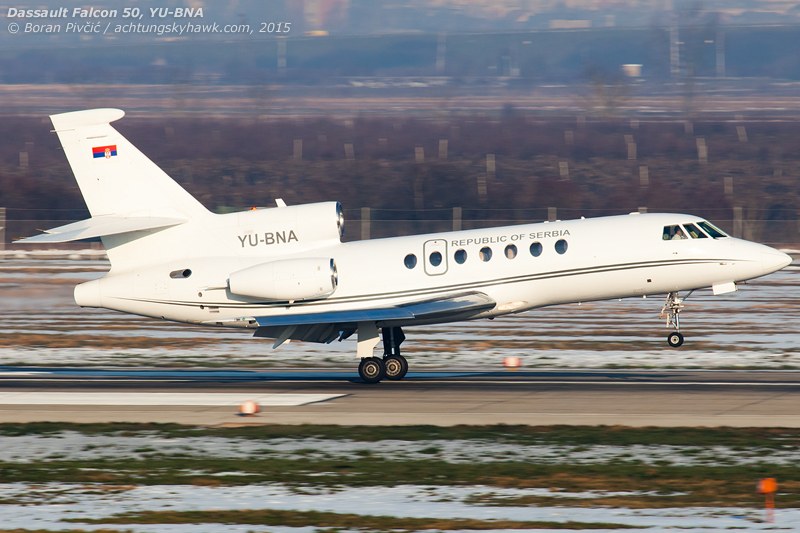
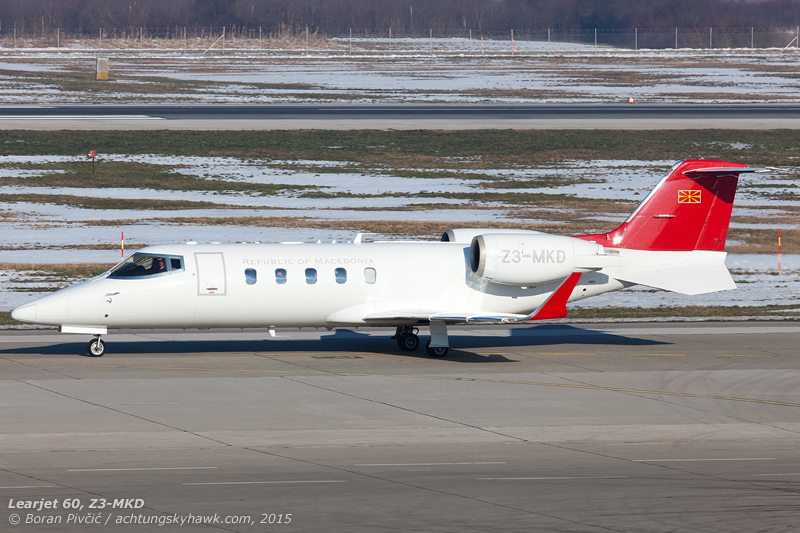
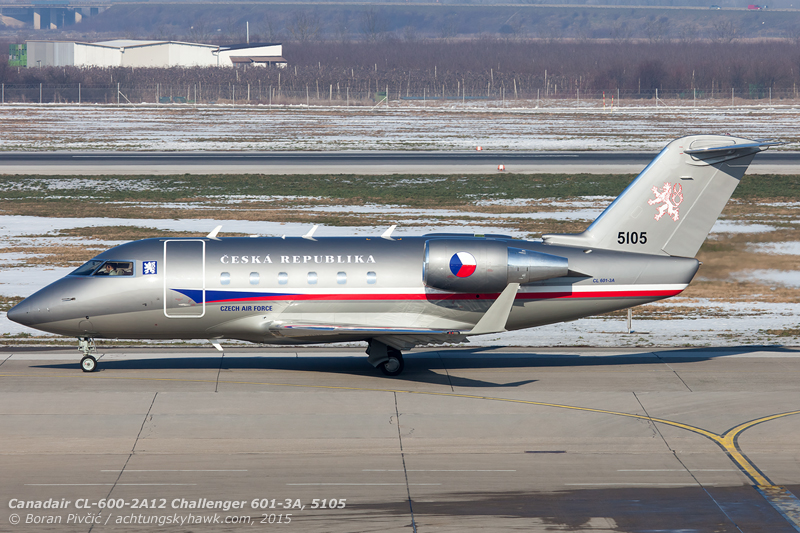
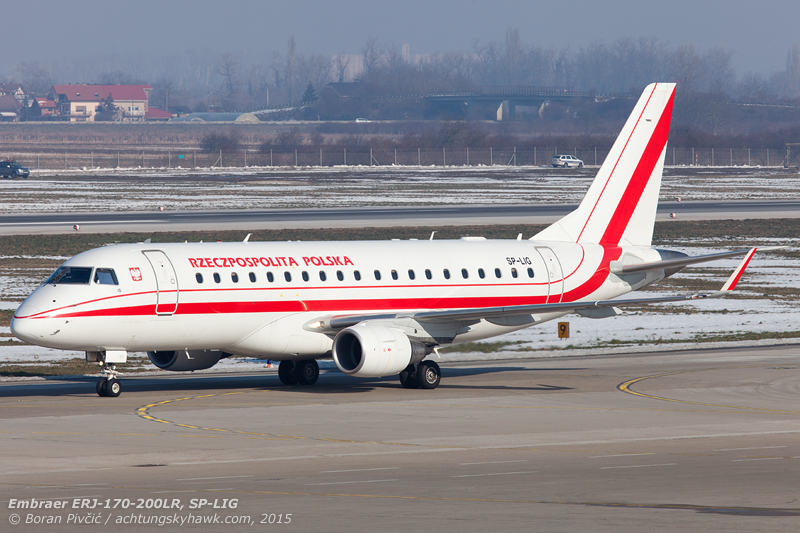
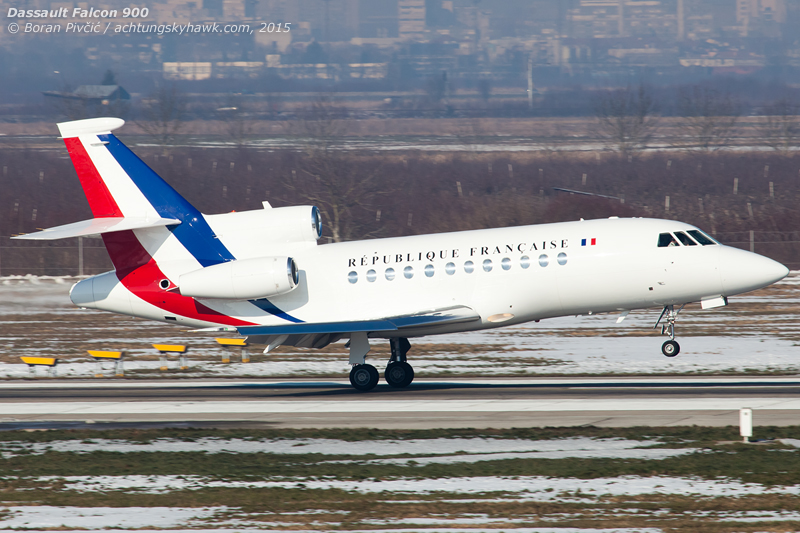
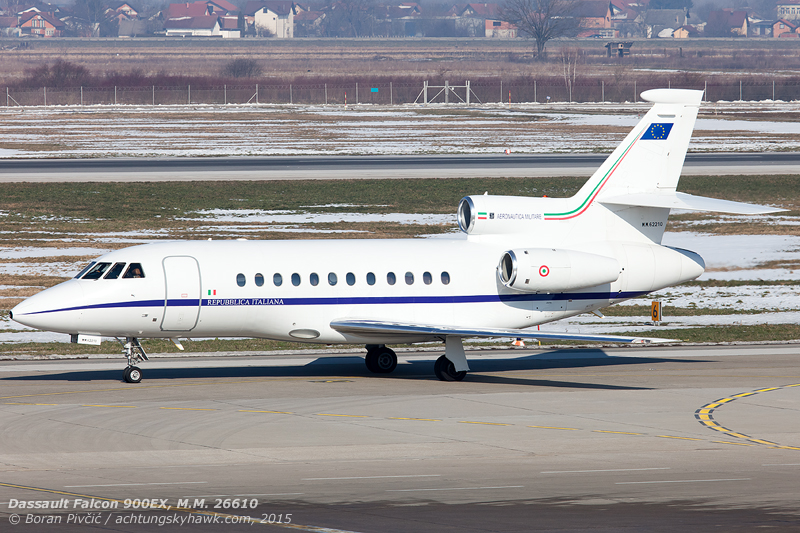
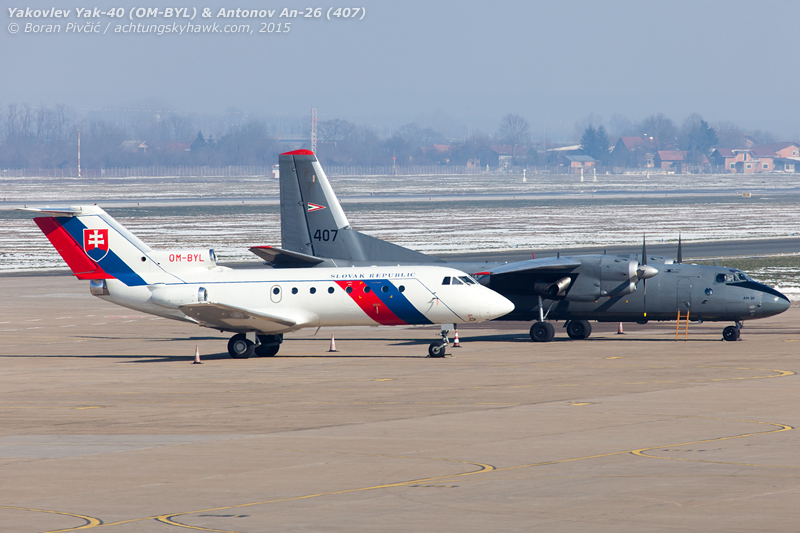
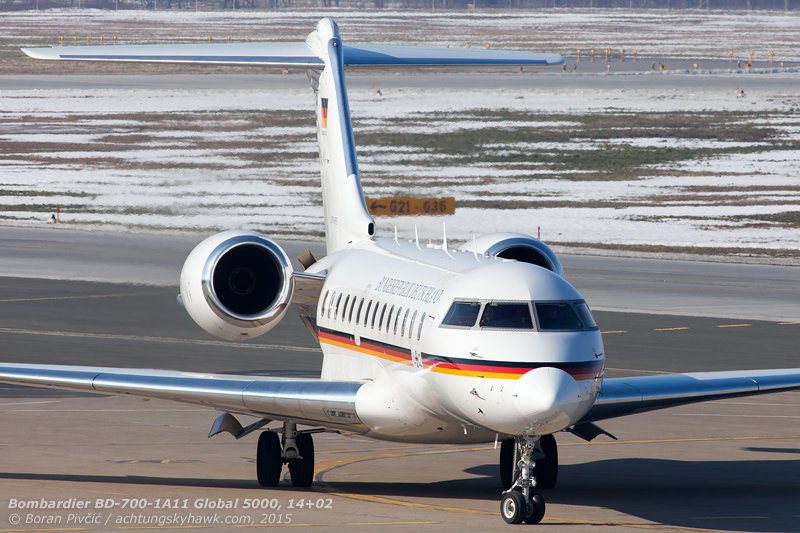

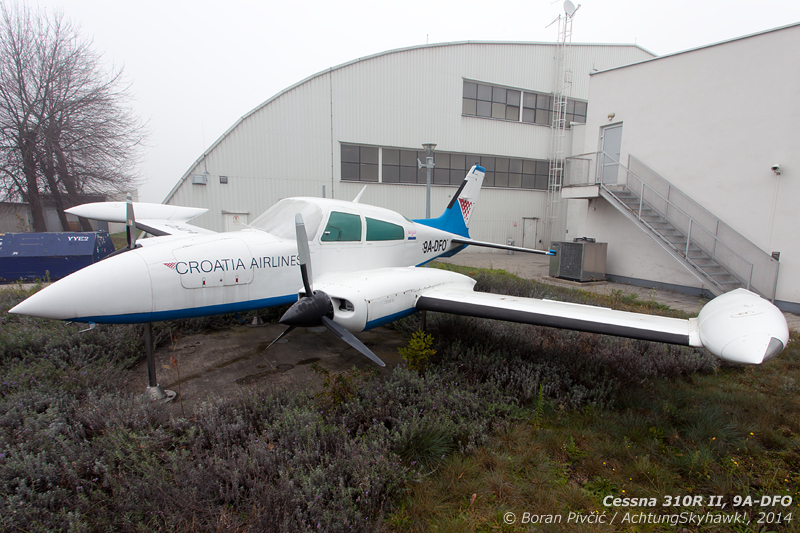
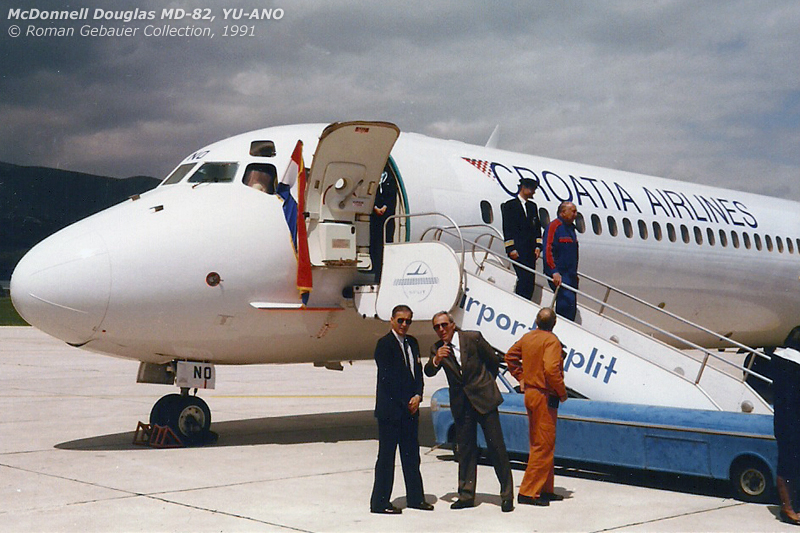
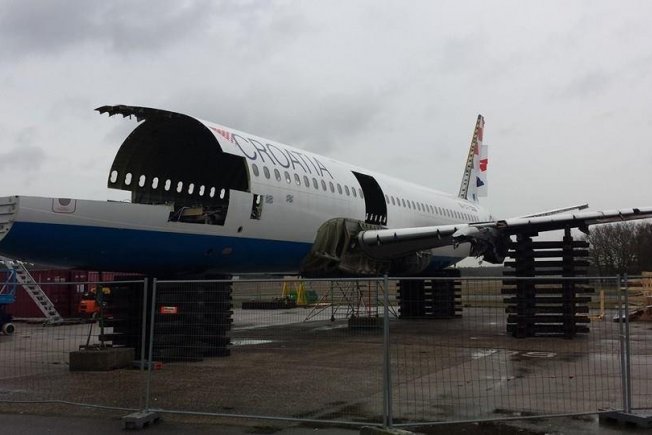
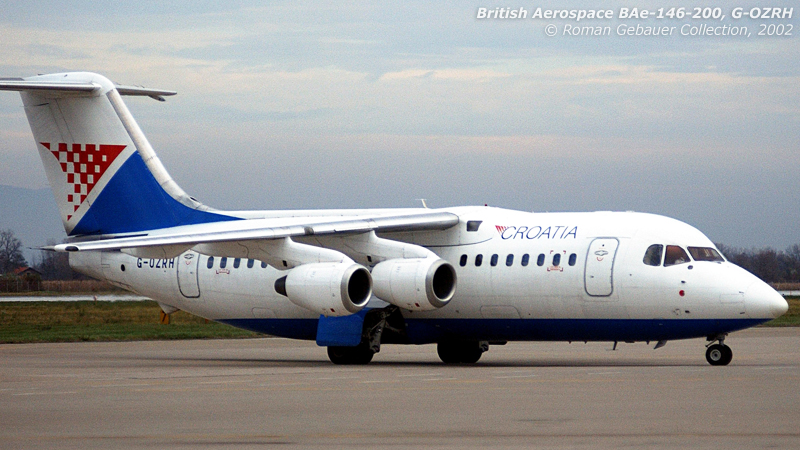


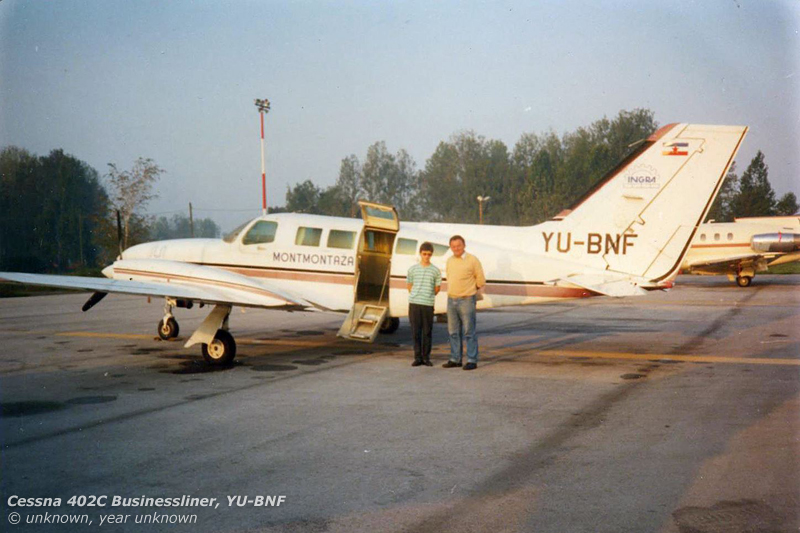


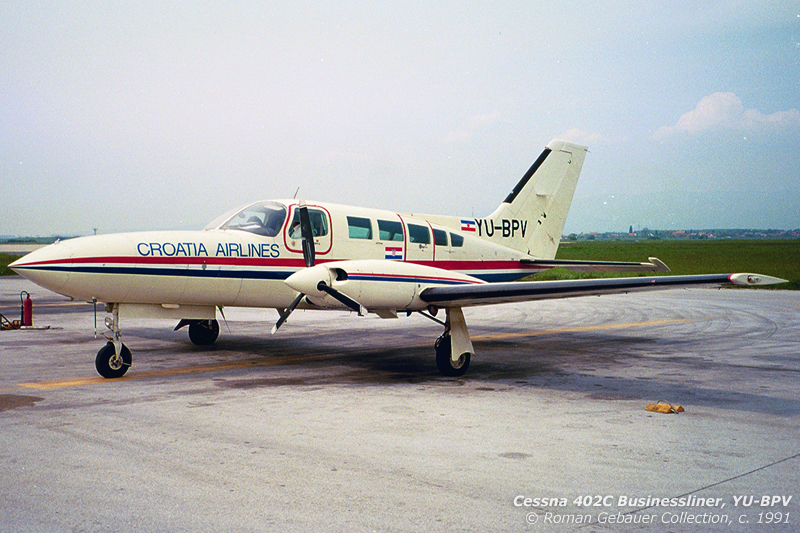


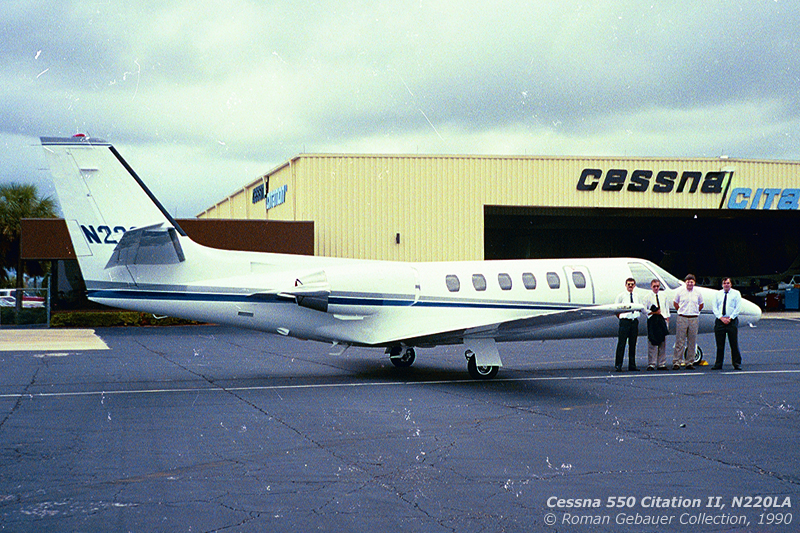


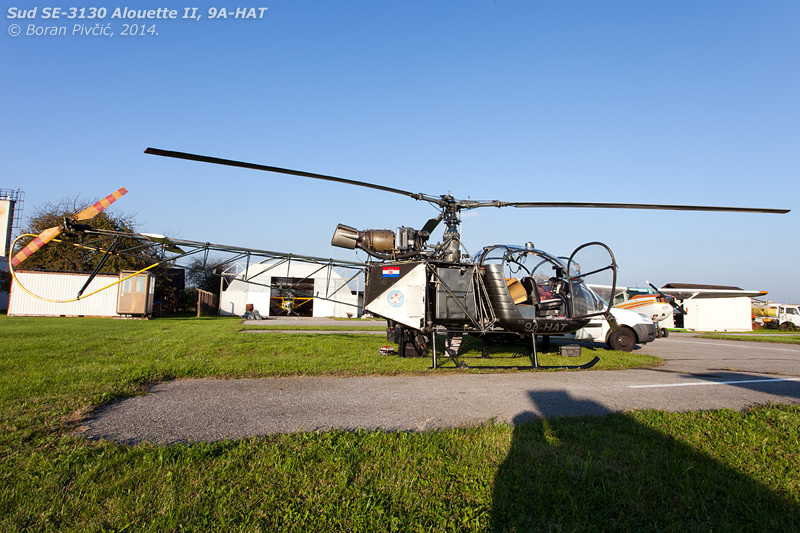


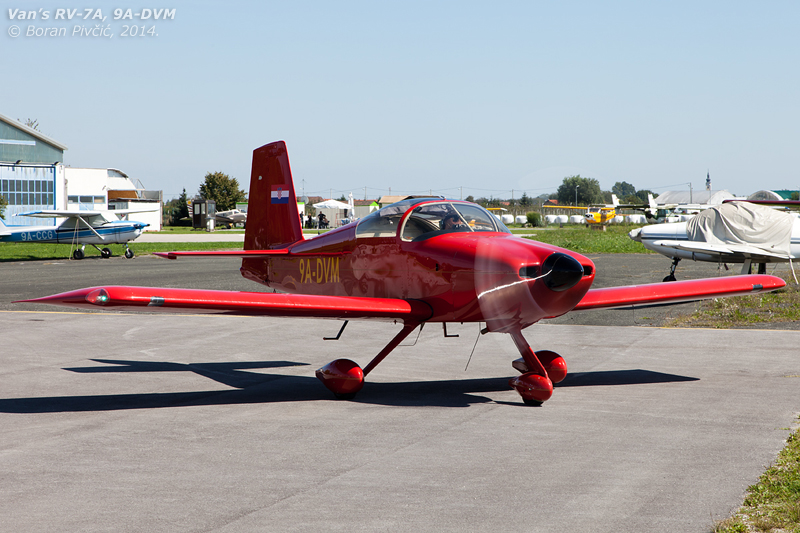


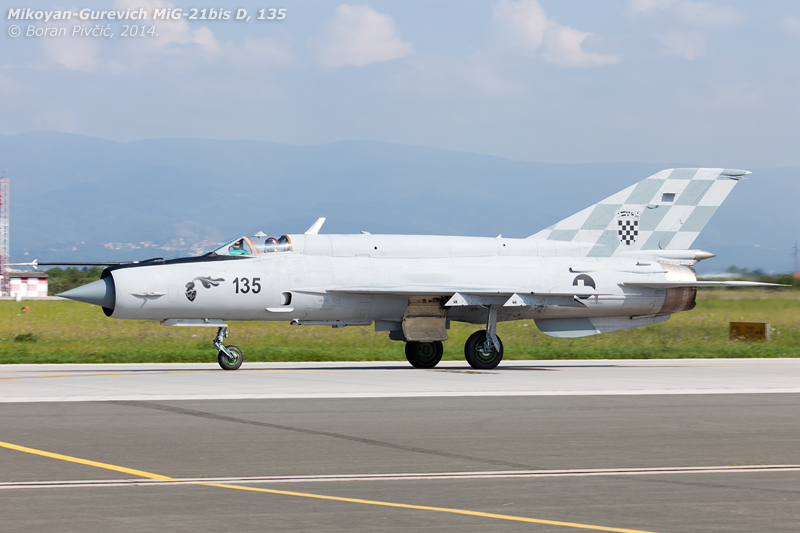


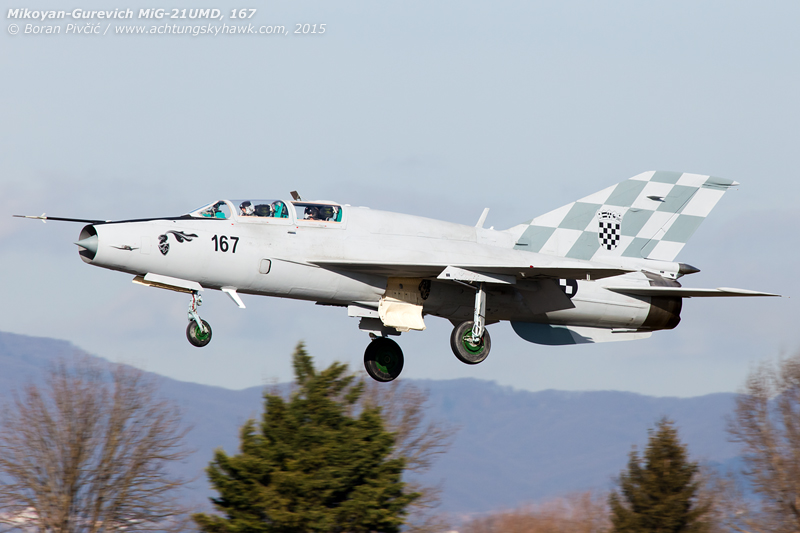




 Achtung, Skyhawk!