By me All photos me too unless otherwise stated, copyrighted
While (strictly) military aircraft are not something I usually cover on this blog, after reviewing some of my photos from a recent trip to Italy, I’ve decided I could make a slight exception – just this once :D. Namely, back in mid-November I had the opportunity to visit Thiene Airfield (ICAO: LIDH) in Northern Italy, where four colleagues and myself were scheduled to take the standard “ICAO English Proficiency” test required for the issue of our CPL licenses. And while the doom, gloom and torrential rain forecast the day before had seemingly precluded any effective outside photography, I’d nevertheless packed my 10-pound camera bag in the hope that I may stumble onto something interesting nonetheless… 🙂
A quaint grass strip situated a few miles north of the historic city of Vicenza, Thiene did indeed have a party piece for me, one I’d homed in on even from the airfield’s access road: a beautifully preserved F-104 Starfighter, the first one I’ve ever seen in person! 🙂 Its air superiority gray blending in perfectly with the dull, low overcast, its fuselage gleaming in the rain, it had immediately grabbed my attention – and after a short round of international diplomacy, the very kind airfield staff had allowed me to get up close and whip out my anti-aircraft Canon :D.
Standing in front of MM6914, it is hard to appreciate and even imagine the impact the Starfighter’s shape had in when it had first flown in 1954. WW2 had ended just nine years ago, propliners were still plying the skies, and even the world’s major air forces still had piston-engine fighters in frontline service… and then, out of nowhere, this needle-sharp, razor-winged jet-propelled missile appears, thundering past at twice the speed of sound and altitudes three times higher than any civil aircraft could reach. In a world still inspired by Buck Rogers and Flash Gordon, it wasn’t really hard to see how the 104 got its name :).
After more than half a century, this shape still turns a great many heads. Very, very few aircraft have come close to achieving the sheer look of out-and-out speed the F-104 so beautifully embodies (photo: unknown, from media.moddb.com)
And yet even today, 56 years after its maiden flight, the Starfighter’s stellar performance – pun intended 😀 – remains impressive. So impressive in fact that the type had – despite all its faults – remained in service until 2004, last flying with the inimitable Italian Air Force. One of these fascinating aircraft is our MM6914, whose full name drags out to Aeritalia F-104S ASA-M Starfighter – or in plain English, a license-built Italian-spec Starfighter that had received a weapons systems upgrade (the ASA-M bit) sometime during its service life :). The most capable of all the Starfighter marks, many of these aircraft had managed to evade the scrapman’s axe and are now adding their bit to the beautiful Italian landscape… 🙂
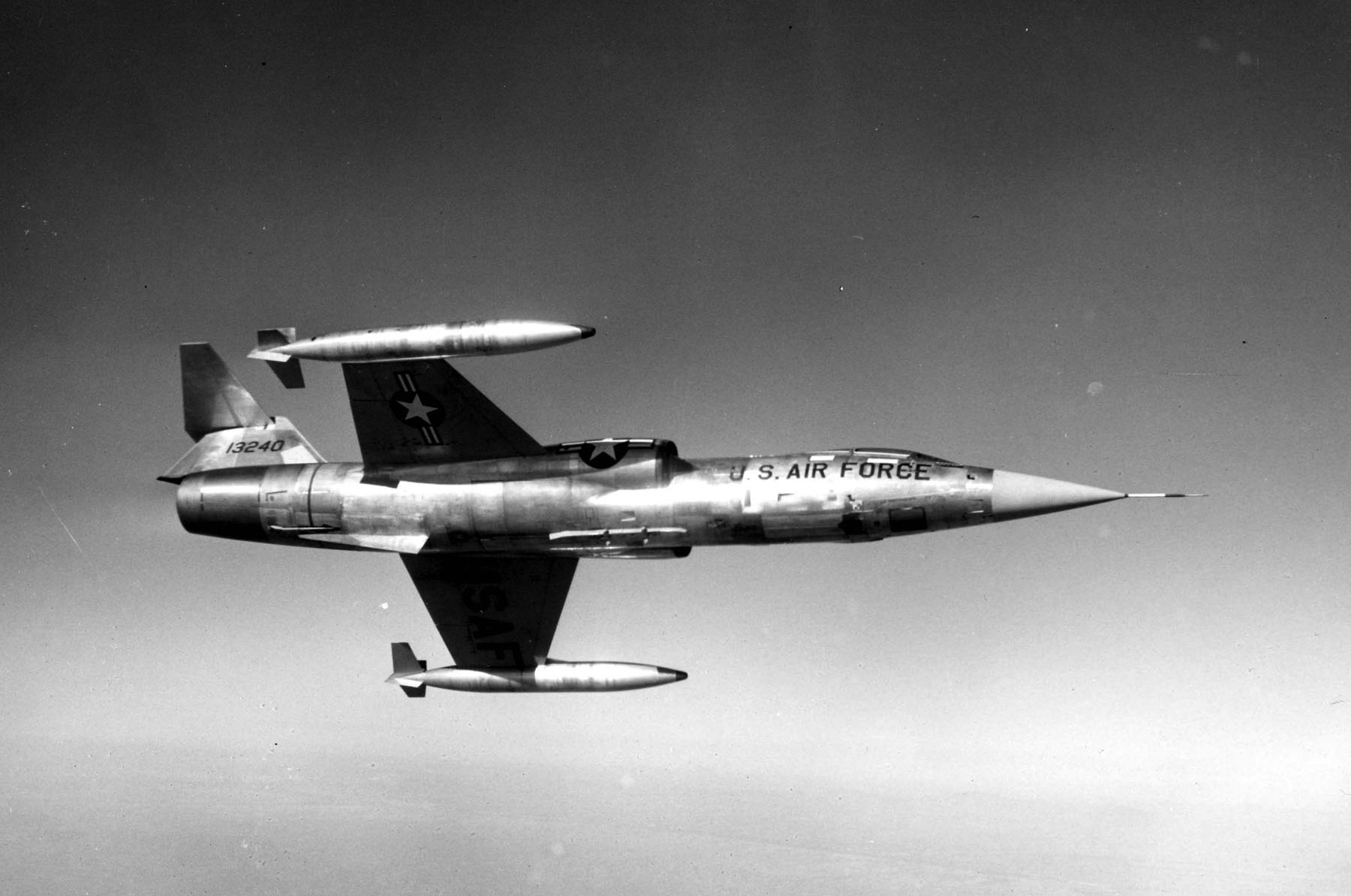
Quite possibly one of the most distinctive shapes of the Cold War. A short-range - but insanely fast - interceptor, conceptually the F-104 has a lot in common with the Soviet MiG-21, an aircraft designed to do pretty much the same thing. And having now seen both in the metal, I'm tempted to say that the 104 has a more... exciting appearance 🙂A shape that can hardly fail to set your pulse racing :). Note the extremely short-span anhedral wings: at 6.36 meters from tip to tip, they're almost HALF the span of those on the Cessna 172! Notice also the arrestor hook under the fuselage: though most commonly associated with carrier-based aircraft, it is also a standard feature on many, mainly Western, land-based fighters. With their high approach speeds - 350 km/h / 189 knots in landing configuration on the 104 for example - a brake system failure on landing could very well mean an overrun of the runway and loss of the aircraft (and maybe crew). To protect against this, many dedicated airbases have a system of arrestor cables similar to those seen on carriers, which the stricken aircraft can snag on landing and stop safely. However, given that the runway length available after the wires is much more generous than on a carrier deck, the land-based system is much more gentle on both the airplane and pilotAn unusual, faded-out view for a bit of atmosphere :). Not only the fastest, but also one of the most advanced aircraft of its day, the 104 was often nicknamed "A Missile With A Man In It" on account of its legendary high speed performance and head-snapping acceleration. Less flattering names though had included "Widow Maker" and "Flying Coffin" on account of its absolutely appalling - and equally (in)famous - low-speed handling characteristics. In German service, this - together with too hasty an introduction into service and too basic a training program - had resulted in the loss of a staggering 30% of the fleet and 110 pilots in various air and ground accidents... and yet, at the other end of the scale, the Spanish Air Force had operated 21 examples for seven years without a single loss or accident (which many attribute to the stable weather conditions in Spain, as opposed to the constantly shifting Baltic weather which made the 104 tricky to fly)You can easily see one of the keys to the 104's incredible speed - there really isn't much in the way of drag or weight to hold it back :).A view inside from the tailpipe. Like on many single-engined fighters of the era - including its "rival", the MiG-21 - removing the engine from a Starfighter was quite the procedure. Unlike on modern aircraft, where you simply slide the engine out of the airframe, here you have to remove the rear of the fuselage (the joint is marked by the yellow frame) to gain access to the engine mount points and then detach it from the rest of the aircraftThe said engine - a General Electric J79-GE-19 afterburning turbojet - preserved in the hangar of a local flight school, complete with its reheat and exhaust assemblies. Apparently, this is the very engine used by MM6914 🙂Hangar decorations to my liking! 😀 While some hangars have RC models or gliders hanging from the ceiling, this one has a pair of F-104 wingtip tanks :D. Frequently carried due to the aircraft's rather poor range, each tank could hold 1287 l / 333 US gal of fuel, complementing the 3391 l / 876 US gal carried internally. And I must admit that on their own they look a fair bit larger than when mounted on the aircraft 😀
With the weather here on the continent again going steadily from bad to worse – fog, snow, strong winds, the lot – and me in need of a few more flight hours to complete my CPL license requirements, I decided it might be a good idea to relocate myself down to the Adriatic coast for a few days and notch up some flight time where the worst the weather could throw at me was just an occasional shower and a cold northern wind :D. And despite the number of airports and airfields lining the Croatian coast, my chosen destination ended up being Portorož airport (ICAO: LJPZ) in neighboring Slovenia, a very nice – I could almost say “cute” – airport sitting almost right on top of the Adriatic Sea…
One of only three international airports in Slovenia, Portorož was always on my fly-to list – admittedly mostly because of its extremely fun, and steep, RWY 33 approach over the hills and the Croatia-Slovenia state border :D. But apart from this somewhat pikey attraction, this fantastic little airport has a lot more going for it, including a paved and lit 1300 m runway (whose one end ends in the hills and the other in the sea), customs, Avgas and Jet A1, and a quaint little terminal able to accept the odd regional prop during the summer. More importantly though, it also has a locator beacon (a low-power NDB) which allows for a non-precision instrument approach to RWY 15 – a simple approach, but an instrument approach nonetheless :).
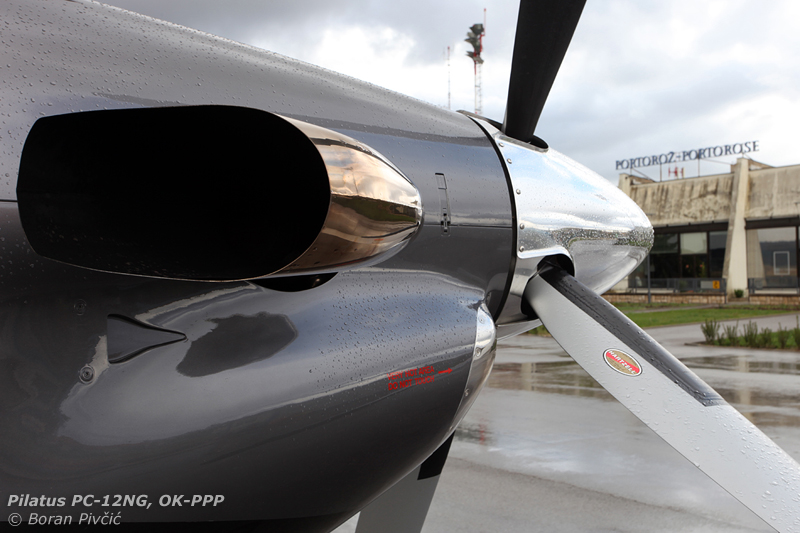
All of this makes for an attractive IFR destination for many aircraft owners visiting the coast; indeed, even during my scant five days there, I was witness to an impressive list of foreign singles and twins flying in and out at all times of the day. But by far the most impressive was a brand-new Czech-registered Pilatus PC-12NG, whose pilot had made the very rewarding decision – for me at least 😀 – to land right in between two thunderstorms… 😀
A simply stunning aircraft, no other word for it :). Even though I'm normally a fan of brighter, livelier colors on aircraft, I must admit that metallic gray and black had suited the moment perfectly!One of those shots where it all comes together - a PC-12, wet tarmac, and the sun shining through ominous clouds... 🙂Crisp, cool and elegant in what could easily pass as a textbook promotional image :D. The aircraft was being refueled at the time, hence the fuel hose and the static line connected to the nose gearThe PC-12's party piece, the 1200 HP PT6A-67P turboprop, set against the Portorož airport terminal :). Along with a similar arrangement on the Cessna Caravan, the PT6/PC-12 combination is often cited as concrete proof that "single-engine commercial IMC/night" operations are perfectly doable and safe - a topic of contention among the world's aviation organizations for almost a decade...Taxiing out for a sprightly departure down RWY 33. One of the few conditions where strong backlight and a contrasting skyscape can make for a good photo!
Deciding to further capitalize on the unusually warm and fine weather for a continental November – ten years ago, we would have been shoveling snow for a month already – I was out at the field again yesterday afternoon, camera ready to capture some (hopefully) glorious sunset shots :). However, by the time the sun had set sufficiently to make things interesting, the only traffic remaining flying was 9A-DTD, plying some late-afternoon skydive ops… and having found out that it will soon be flown away for winter storage, I decided to try and make the best of it while I still have the chance… 🙂
Taxiing in for its penultimate flight of the day. Note the upward-hinged passenger door, a relatively common modification on high wing Cessnas, designed to allow skydivers an easy way out in flight without having to actually remove the door. Once opened, it is held in that position by propwash - a feature that often enough leads to an annoying flapping up and down when you change power during taxiing...Idling away in front of a proper autumn background as another group of skydivers prepares to board 🙂Grrrrr! Looking mean and angry with its newly-applied dentures :D.
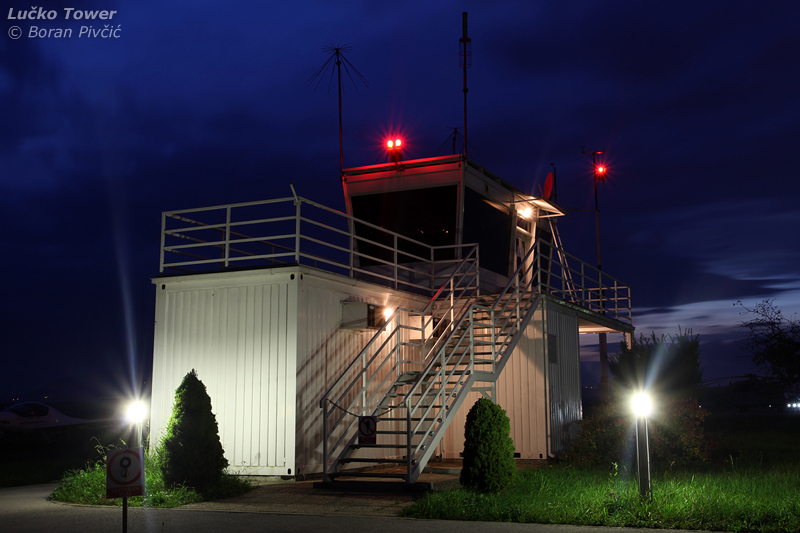
And to finish this up, I’ve decided to also include another Lučko (non-aircraft :D) shot I very much like, taken about two weeks ago…
Our little tower of power all lit up, with an unusually beautiful skyscape in the back 🙂
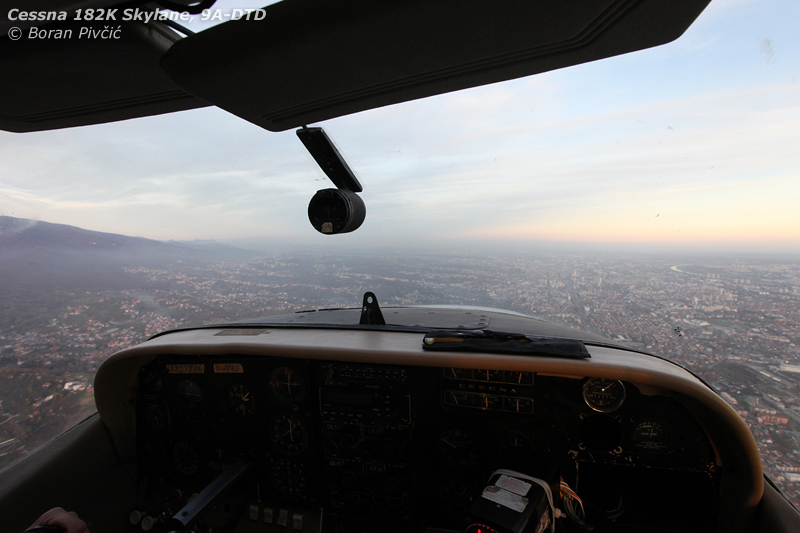
Having finally terminated my extended leave of absence from Achtung, Skyhawk! – brought on by a combination of flying and personal issues, mixed with a healthy dose of no spare time on my hands – I’ve decided to come back in style with a short photo report from a rather interesting flight I’ve had yesterday :). Having finally completed my 15 hour CPL module in the morning – only 10-odd hours remaining till my final checkride – I decided I might just as well stay at the field and mingle with my colleagues, enjoying the uncharacteristically warm and mild November weather. Apart from a generally good time, one of the results was also an invitation to fly shotgun on 9A-DTD, a skydive-modified Cessna 182K, on a short training flight – notching it up as my first ever skydive plane as well as my first 182 :D.
The aircraft in question – owned and operated by the skydiving club Slobodan pad (“freefall”) – is by far the oldest 182 in Croatia (out of the very few of any age in the country), having been produced in 1966 or 1967; but in all honesty that didn’t seem to slow it down in flight :D. And even though this training mission – merely a short afternoon panorama flight above town, nothing fancy – was already familiar to me (and photographed extensively), I too didn’t let that slow me down… 🙂
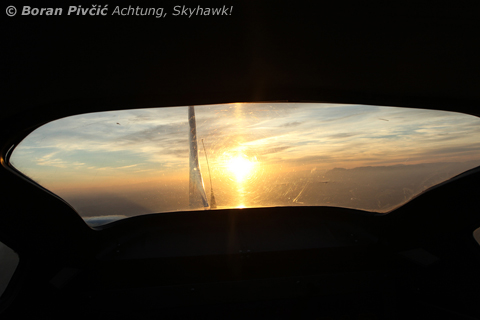
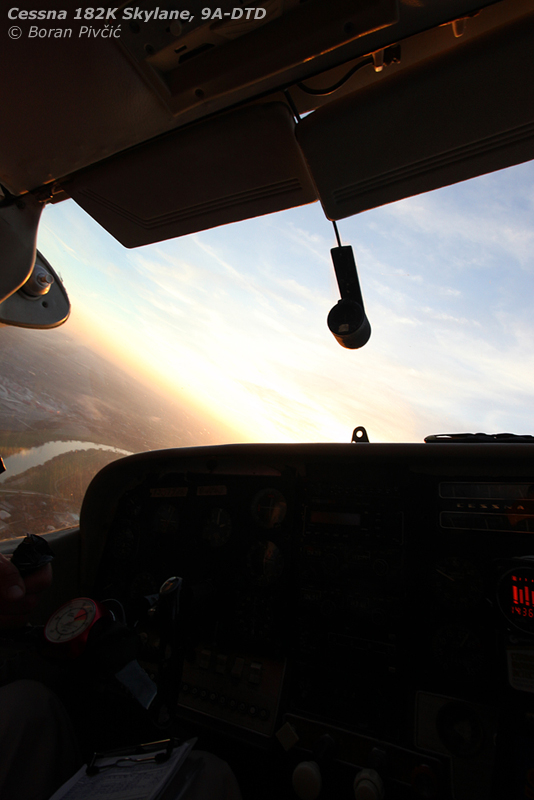
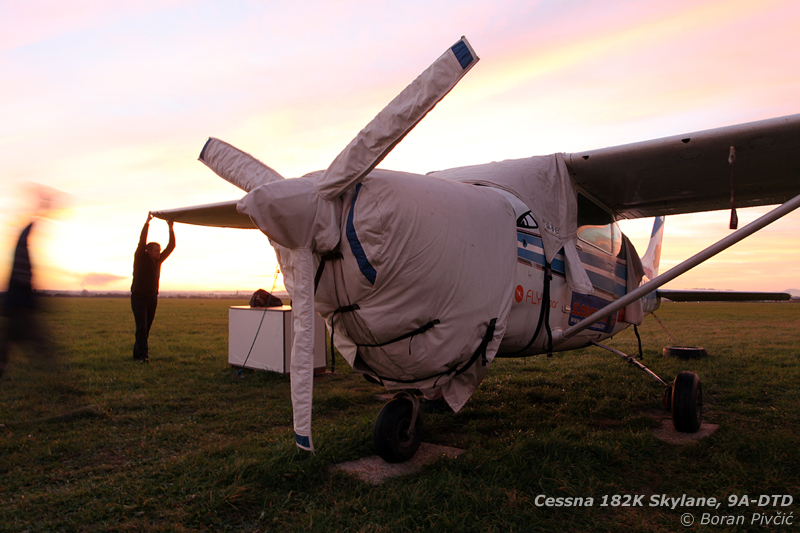
Just a whiff of altostratus and a trace of mist remain from the morning's thick fog as we leisurely cruise above the western districts of ZagrebSmooth skies, a beautiful ride, silence on the frequency, the setting sun and the thunder of the 230 HP O-470... scenes like this are what make it all worthwhile! 🙂Set the controls for the heart of the Sun :). Late afternoon flights never leave me disappointedOne of the advantages of the Skylane - an unobstructed view towards the back 😀Banking left to enter the pattern for landing back at Lučko :). Though not clearly visible, the aircraft's instrument setup has also been upgraded with a digital CHT/EGT monitor, as well as a skydiving altimeter on the pilot's yoke9A-DTD getting tucked in for the night, with an added impressive autumn background 🙂
With the thick fog alternating with heavy rain already signalling the unwelcome arrival of the continental autumn – and long term forecasts predicting a very cold and snowy winter – I’d though it best to get a move on with my flying and log as much of my required CPL time as practically possible before the year (or the flying season, whichever comes first) ends. To that end, and despite the doom and gloom of yesterday’s weather forecast, I was out at the field today for my SE/IR checkride, hoping that Murphy would have some mercy for just that one short hour :D.
And while in the end the weather could have cooperated just a bit more flying-wise – with the atmosphere becoming increasingly unstable by the minute – it did provide me with another splendid photo opportunity… 🙂
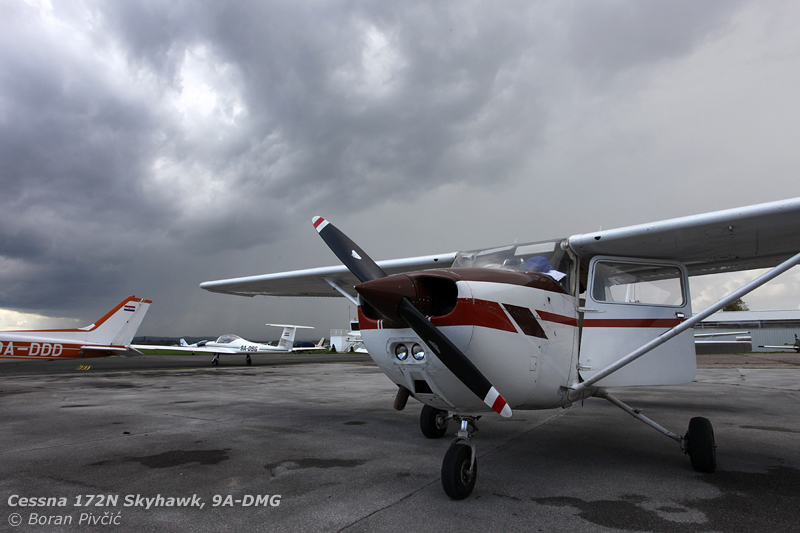
9A-DMG, my mount for the day, waiting patiently for the CB in the background to pass south of the field. In the event, I had ended up flying through its fringe rain four times while shooting a couple of instrument approaches at Pleso, which had - apart from some bumpy, but otherwise benign IMC conditions - resulted in one clean airplane! 😀
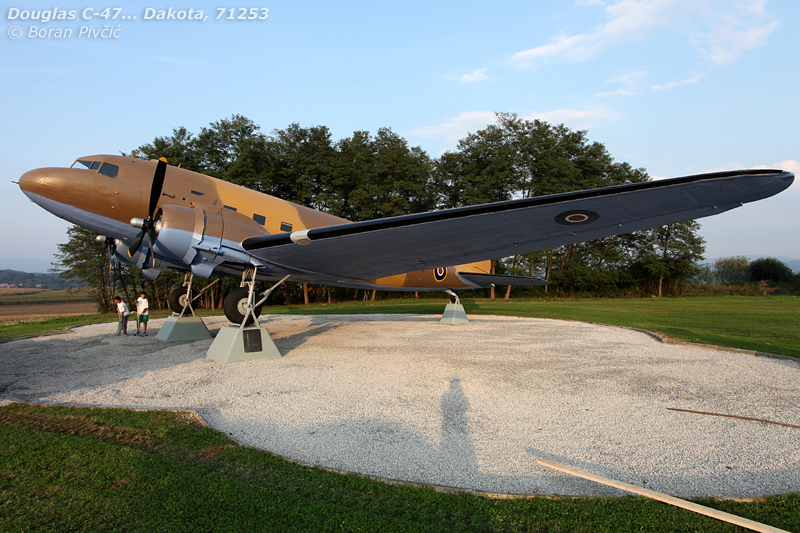
Despite wry and humorous remarks from the side about what am I going to do in life after I photograph the last known Dakota in the lands of former Yugoslavia, I was genuinely looking forward to finally seeing it at the first opportunity I got :D. Last weekend’s torrential downpour – and the occasional floods it had spurred in both Croatia and Slovenia – had ruled that out at the time, but this week’s clean, crisp air and sunny skies were just begging for some photo ops. So, catching a free afternoon (a Friday no less), I decided to finally make the leisurely 90 km drive to Otok pri Metliki, just a hop across the border away…
Now, given the track record established by our three surviving Daks in Croatia, all sad and broken, I had expected 71253 to be in pretty much the same state – especially since Google Earth imagery had shown it to be apparently isolated on a small hill, far from anything or anyone. However, driving up that hill, my view obscured by the crops on the sides of the road, I was in for quite a big surprise…
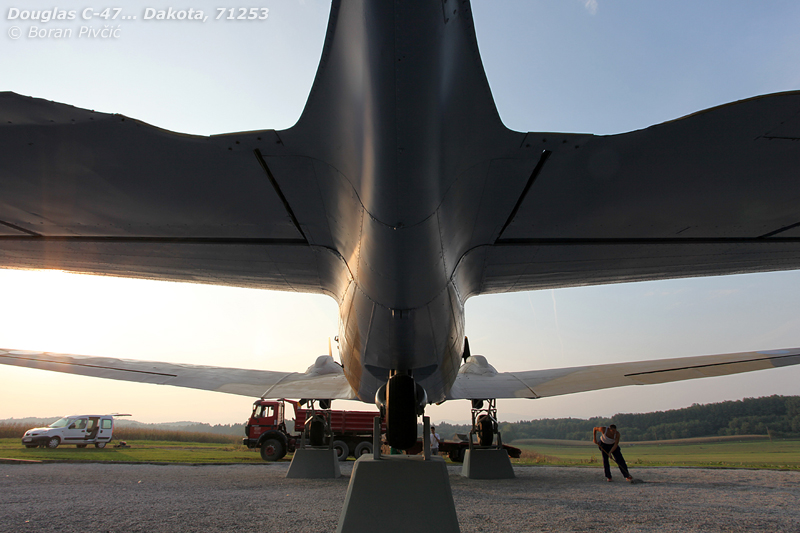
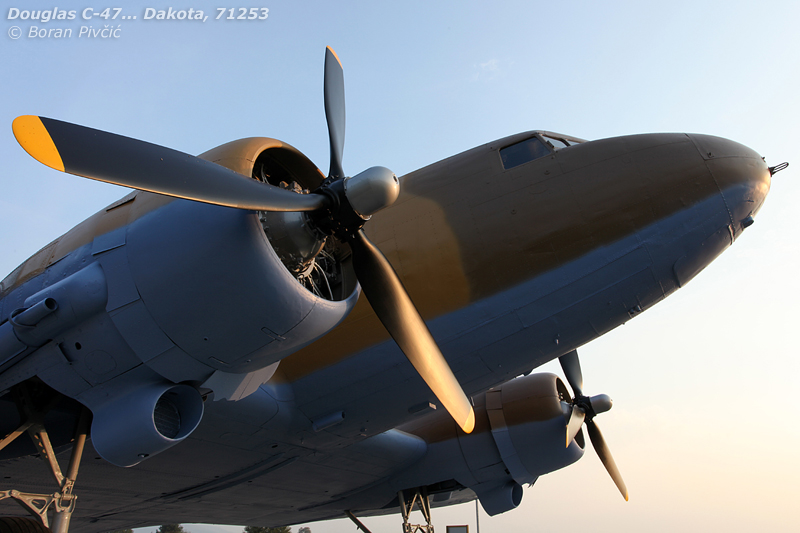
Looking absolutely brilliant and stunning in the pale afternoon light. In marked contrast to every YuAF Dak I've personally seen, 71253 has its own little display area and information plaques, all of which are regularly maintained - indeed, I had arrived just as the gravel was being leveled and evened outUp close and personal :). The details on this thing are fantastic - even the engine has been cleaned up and restored to show status! However, I'm told that the interior and cockpit have pretty much been ransacked a number of years ago, a fate that even the best open-air preserved exhibits apparently can't avoid...Interestingly enough, 71253 is wearing an RAF desert camo scheme used in the North African theater during WW2. Whether or not 71253 had indeed flown with the RAF in North Africa is not (yet) known - but either way, these colors have in many respects helped it avoid the fate of its sisters 71212 and 71215 at Željava and Otočac respectively. Having been painted in a variation of this scheme since 1986, 253 had already lost its Yugoslav identity by the time the Balkan Wars started in 1991, sparing it from the ensuing widespread destruction of all Yugoslav symbols (traces of which are abundant on 212 and 255)Quite a view from here :). Located at the site of a former WW2 improvised airstrip, 71253 was set up in December 1980 as a monument to the dozens of similar strips set up around Slovenia by Partisan forces during the conflict. Used to great effect by USAAF and RAF Dakotas - and in the later stages of the war also by Soviet Li-2s - for supply and evacuation missions, they offer an explanation of 71253's RAF paint scheme 🙂 (many of the aircraft operated by the RAF's Balkan Air Force wore desert camo... its Spitfires even sported air intake sand filters)From every angle the amount of effort involved in preserving and maintaining this fantastic aircraft is easily visible... the coat of paint seems to be very fresh too (and well applied)Even the landing gear bay - not the most often looked at part of the airplane it must be said - is beautifully done. It must have been quite a task to wire all this together...I had hoped that I would find at least some traces of 253's true (former) identity - like I did with 255 - but no luck, not a code or data plate in sight. Sometimes paint jobs are too well done 😀Still as evocative a sight as it was during WW2 🙂
Having finally passed all of my ATPL exams ( [/brag] 😀 ), I’ve decided to celebrate by heading out for the rest of the day to catch some well deserved fresh air. With a spot of sunny weather in an otherwise cloudy and dull week – and my photo finger getting very itchy – the airfield had naturally quickly made the shortlist; so in the afternoon, I set course for the field to see what, if anything, was new…
Nothing really was, to my disappointment; but nevertheless the afternoon’s high cirrus clouds and fading sun at least made for prime conditions in which to test out the low light capabilities of my new Canon 5D… 🙂
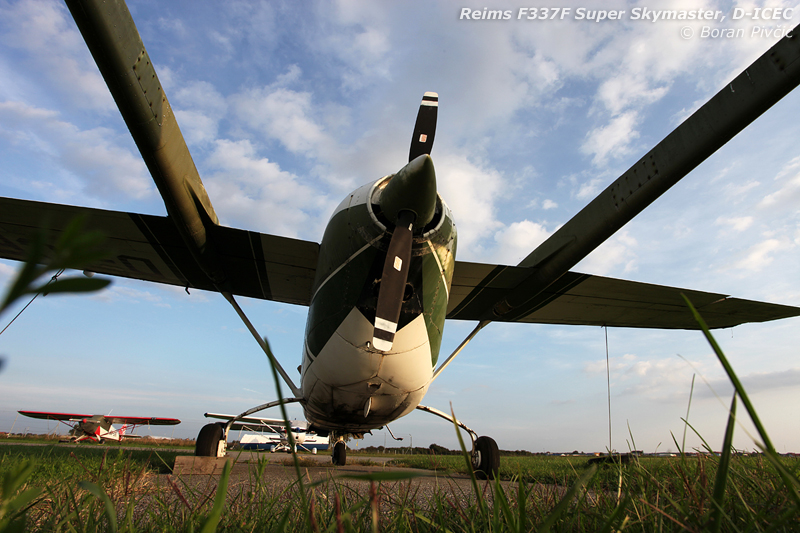
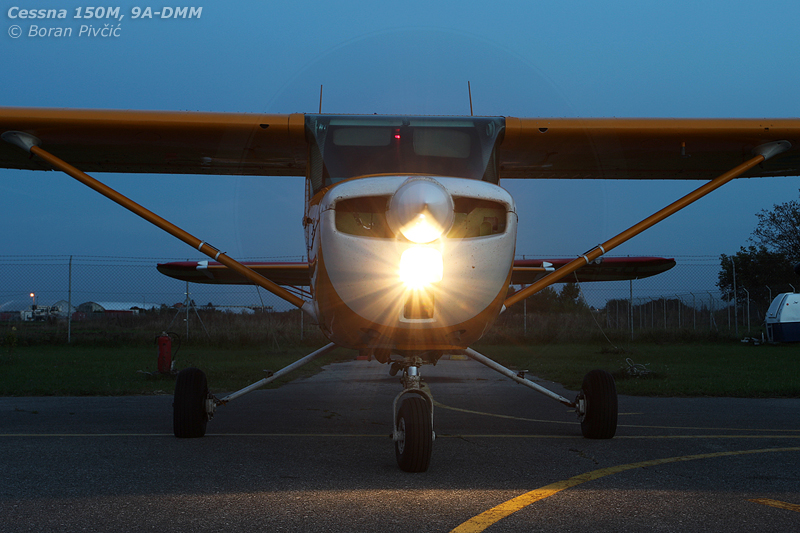
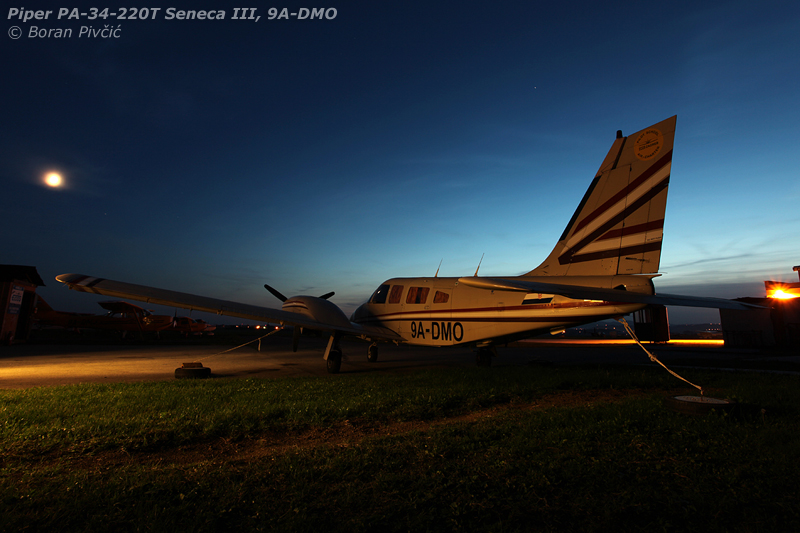
An ant's eye view of our poor old Skymaster as the afternoon draws to a close. Just below the lower prop blade you can see the main gear bay doors, fully closed to reduce drag when the gear is down. The unique Cessna gear retraction mechanism would first swing the gear legs down into the vertical and then fold them backwards into the fuselage - though I've been told that this creates more drag than a more conventional gear retraction sequence (click for larger version)Holding the camera above your head does help with the oddly-shaped and difficult-to-photograph Skymaster :). The extent of the prop damage, caused by a landing incident almost a decade ago, is fully visible here... (click for larger version)My attempt at making the Cessna 150 appear (far) bigger than it actually is :). Almost looks like a PC-6 from this angle... (click for larger version)Starting up for a short cross-country flight. These late afternoon flights are always a fantastic experience - the air is calm, there's little or no traffic and the scenery is often breathtaking (especially in the late summer and early autumn) (click for larger version)Very helpfully posing for me at the end of the flying day :). Having no night lighting whatsoever - despite continuing efforts by all aeroclubs to install it - life at Lučko effectively ends when the sun dips below the horizon (click for larger version)In night photography, you use whatever you can lay your hands on - even if it's just a spinner and standard room lighting 🙂 (click for larger version)The joys of night photography - almost a full palette of colors lighting up the background as 9A-DMO prepares for another calm and cool night at Lučko (click for larger version)Airport Cat is under your airplanes, ruining your compositions 😀 (click for larger version)
With my forthcoming ATPL exams – the last three, finally! – leaving me little time in which to get to grips with my next Rare Aircraft post (even though it’ll be comparatively short), I thought I should nevertheless break the silence on here with, if anything, a single photo :).
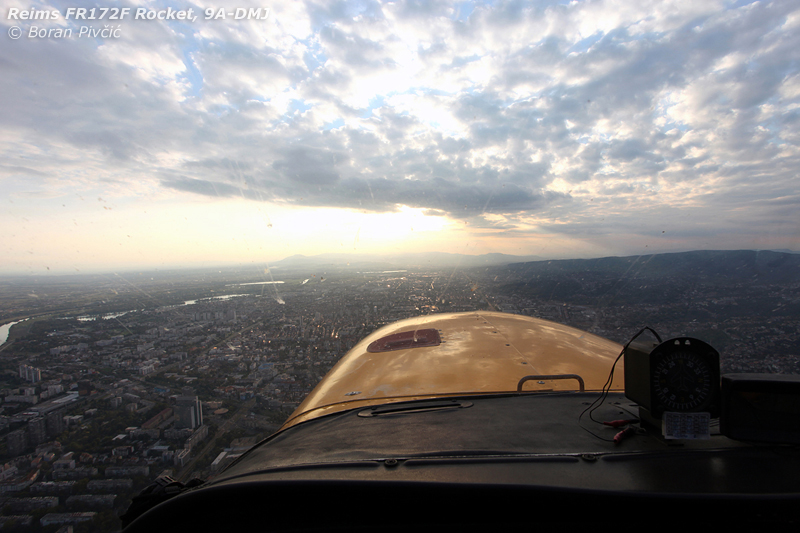
A couple of days ago, I’d finally got fed up with sitting around all day and drove off to the field to catch some sun and fresh air. Planning to just hang around a bit and play with my new Canon 5D Mk II, I had spotted a free slot on our aeroclub Reims Rocket (9A-DMJ) and decided I could just as well keep my hand in and relax in a proper manner :D. Nothing fancy, just a half-an-hour afternoon buzz above town, with my camera close by should a nice photo opportunity come up… 🙂
Cruising into the setting sun on a late afternoon joyride above the city of Zagreb :). The beautifully calm air this late in the day always makes flying a pleasure! Just trim her an she'll fly like on autopilot (also, premiering a new feature, you can click this photo for a larger, 800x533 pixel version)
While the traditional Lučko Airshow had often enough ended up being little more than a “village airshow” – despite the good intentions of everyone involved – this year’s event, celebrating the centenary of aviation in Zagreb, was showing a lot more promise from the get-go :). The initial participant list alone was enough to get the blood flowing – and the photo finger itchy 😀 – with the likes of the DeHavilland DH.89 Dragon Rapide, and the extremely rare ex-Yu Ikarus Kurir, on the headlines; not to mention the first public flight of a lovingly built replica of the first aircraft designed in Croatia, way back in 1910 :).
Even though a few organizational issues, and the dreary and foul weather on 28 August (the original show day), had distilled that list somewhat – the Dragon Rapide and Kurir sadly dropping out – there still remained a number of very interesting aircraft to see and photograph :). So on 29 August, hoping for clear skies and good light – and with the assistance of Ms. Matea Makek, manning my old Canon 20D 🙂 – I set course for the field to see what’s what…
This after all being "Achtung, SKYHAWK!", I had to start off with... well some Skyhawks :D. Incidentally, these three N models and one R - representing my university's aviation department - are all the 172s I've flown so far, with 9A-DDD (in the bottom right corner) the aircraft on which I've logged the most hours 🙂 (normally owned by Ecos Pilot School - where I got my wings - but currently on loan to the university)The afternoon's building cumulus clouds had provided some outstanding backdrops...... which were at all odds with the morning's thick fog and single digit temperatures (in August!). All covered up about four hours before the start of the show, this Mil Mi-171Sh - coded 227 - was the only Air Force aircraft up for display, the rest of the fleet being parked at the far end of the apron (out of harm's way 😀 )At long last, finally photographed in the air! 🙂 Even though it had first flown about two weeks ago, this is the first time I've seen it in flight. Makes a pretty nice noise too...But by far the biggest attraction of the show was the CA-10 "Penkala", a modern replica of the Penkala P-3, the first Croatian aircraft :). Designed by famed inventor Slavoljub Penkala - the father of the fountain pen - the P-3 had attempted to take off in 1910, but never made it beyond a few hops due to some deficiencies in its design. Intending to set that right, the CA-10 was conceived as "modernized" P-3, upgraded using today's aerodynamic laws (and an 80 HP Rotax, with four times the power of the 24 HP engine that Penkala had used). Interestingly enough, the whole aircraft was built by hand using only archive photos because the original blueprints have long been lost. Unfortunately, due to its paperwork not being ready, it had not flown at the show, a huge source of disappointment for many...Another beautiful sight: the first jet aircraft to land at Lučko in more than 20 years! 🙂 Part of the Stars aerobatic team hailing from Serbia, this Soko G-2 Galeb - the most famous aircraft produced by the Yugoslav aviation industry - was one of the absolute attractions of the show. Mind you, it did have less than an elegant entrance - especially for a type designed to operate from unpaved strips - when it ran over a huge bump on the runway, ramming its nose wheel strut all the way to its stop. But some manpower later - a couple of us to lift the nose and allow the strut to extend back into normal position - and all was right again! 🙂A shot inspired in part by a popular F-104 Starfighter photo on Airliners.net... 🙂Taxiing out for its display, with its nose strut again at its stop. Despite the G-2's fantastic low-speed abilities, YU-YAK had used up virtually every meter of Lučko's 880 m (2890 ft) runway for the takeoff run. Powered by a Rolls-Royce Viper turbojet - a design from the late 50s - the G-2 needs some time and distance to accelerate when on the ground... Another gem at the show was this Polikarpov Po-2 from neighboring Slovenia. The second most produced aircraft in history, the Po-2 is often nicknamed "The Flying Sewing Machine" due to the specific sound of its 125 HP 5-cyl Shvetsov M-11 radial. I've always thought that to be an understatement - until I first heard it... :D.Operated in great numbers by virtually every air force in the Eastern Bloc, the Po-2 can - despite its age - be often seen on airshow circuits in Eastern and South-eastern Europe. This example, registered S5-MAY, was produced in 1937 and is still happily flying 73 years later :).Further up the performance range, international aerobatics champion Zoltan Veres (Hungary) was showing off just what the fantastic MX Industries MXS could do. Seen here in a knife-edge flyby, with his right wing just a foot - confirmed! - off the ground...Mr. Veres tearing through the skies in the most impressive and exciting display of the showThe only participant with a mostly vertical display, Mr. Veres had also flown the impressive "pierced heart" maneuver - not at all easy to do when you have only one aircraft and little time before the smoke blows away!Up close with N540XX, painted in the shades of the Hungarian flag. One of the first aerobatic aircraft built entirely of carbon fiber - without an underlying metal structure - the MXS weighs less than 600 kg, but can have up to 350 HP up front, making for utterly bewildering performance in the vertical plane. Its agility in the horizontal is hardly less impressive, with a demonstrated roll rate of 450 degrees per second 🙂Willing to participate every time, the Air Force "Krila Oluje" aerobatic team had put on another fine display. Four of the team's Pilatus PC-9Ms are seen here holding under increasingly impressive skies while the team's two solos (out of shot) position themselves for a low-level crossing passAlways the show-stopper, "Kockica" - or "little square", named for its "ILS shack" Croatian coat of arms paint scheme - thunders loudly away at full bore :). One of the three remaining MiG-21 operators in Europe - with Romania and Bulgaria - Croatia is fast becoming one of the last sanctuaries of this fantastically charismatic jets on the continent...An elevated overview of the field an hour before the start of the show, with two beautiful classics, an UTVA Aero 3 (left) and the Po-2 (right) facing off across the main taxiway (with the former to be covered in more detail in my next post 🙂 ). Complimenting them is An-2 9A-DIZ in the background, while in the distance the Medvednica mountain range - and a wall of puffy cumulus clouds forming atop it - complete the scene
While few could have guessed from the sporadic activities so far that 2010 marks the first century of aviation in Croatia, preparations for a series of events to commemorate this centeniarry were nevertheless well underway as the end of August approached. As well as the traditional Lučko Airshow – which would this time also feature a flying replica of the first Croatian aircraft 🙂 – these events had also included the so called “Millennial Photo”, part of a project of the same name undertaken by well-known local photographer Šime Strikoman. Celebrating 100 years of a notable local event by photographing 100 of something involved with that event before or since (brilliant explanation, I know :D), the photo would this time celebrate 100 years of local aviation by photographing 100 aircraft in a single shot :).
Despite only managing to drum up 77 aircraft in the end (by my count), the photo itself had nevertheless come out very, very nicely, and can be seen here. Yours truly is somewhere down there as well, by the red-tailed aircraft (Cessna 150, 9A-CCH) on the outside of the last zero to the right, waving to the camera helicopter :).
But apart from looking invisible, my contribution to this event had also included physical assistance in moving everything out of the hangar (and back), a task which had also given me ample opportunity to see a number of very interesting aircraft that are hidden away for most of the time. Unfortunately, since pushing and taxiing this lot around was a time consuming task – and I couldn’t really roam around at will, slacking off – I decided to give my new Canon 5D Mk.II camera a small shakedown by just photographing two very unique and rare gliders… 🙂
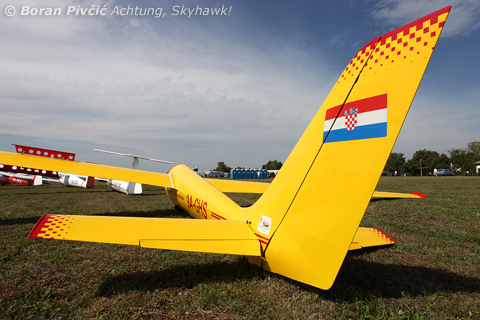
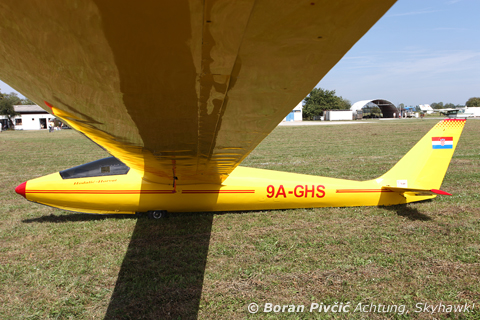
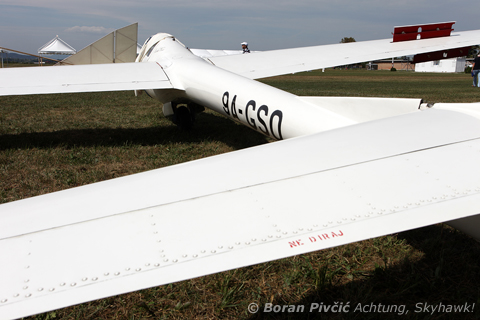
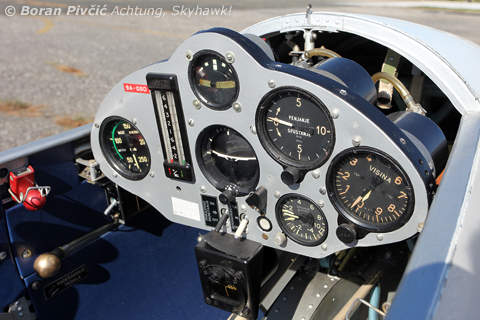
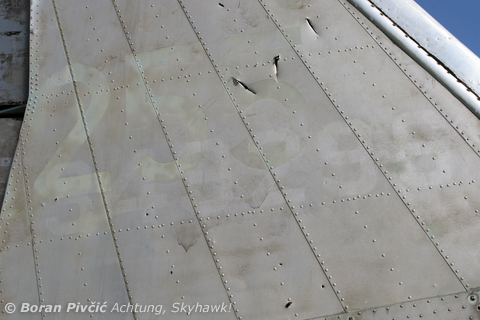
First up is this one-of-a-kind homebuilt glider, called “Delfin” and registered 9A-GHS. Though at first I’d thought it was a Polish SZD-24 Foka – surely one of the most beautiful gliders ever built – a closer inspection revealed that it was actually designed and built in Yugoslavia back in the early 60s 🙂A simple, but elegant design, the Delfin is a 15 meter Standard class glider, pretty much the same category as the Pilatus B4s and SZD-30 Pirats abundant at the field (from which it may draw some design cues)Yellow does indeed look good on gliders :). Easily one of the most catchy light aircraft that day!The second candidate is the ex-Yugoslav Ikarus Meteor 57, already featured in a number of previous posts. Designed in 1957 and intended to test construction solutions for jet trainers, the 20-meter all-metal Meteor was built so strongly that it effectively had no structurally-limited top speed (in the speed ranges it could achieve due to gravity and drag)… in one test flight, it had even managed to reach 500 km/h (270 knots/311 mph) in a steep dive!A look at the office, currently undergoing some work :). One of the most interesting bits here is the antique Cosim vertical variometer :D. Also, you’ll notice a Turn and Bank Indicator on top of the panel: in common with a number of Eastern European gliders, the Meteor dispensed with the yaw string on the canopy in favor of a more precise electrically-powered TBIBut by far the most interesting feature here is the apparently normal airspeed indicator. If you look closely, you will see that it has no red line (indicating the never exceeded speed)! 🙂 You can imagine what impact this aircraft made in the wood-and-fabric glider world of late 50s… it had also set a close-circuit average speed of 97 km/h (52.3 knots/60 mph) in 1958, an impressive performance for the time…
On somewhat of a discovery spree lately with my YuAF Dakotas – buoyed by finally having photographed 71203 and 71255 🙂 – I decided to carry on browsing the reaches of the Net and see what other interesting things I would inevitably stumble upon. I didn’t have to go far before I fell flat on my face, because within a minute or two of Googling I’d found an interesting list of the various C-47s and DC-3s operated by the YuAF at one time or another. Despite being rather vague with the airframe details – rarely listing anything more than their YuAF code and possible location – and out of date, it did bring my attention to two more easily traceable examples :)…
The Dakota Locator v1.1, now with 71253 on the scope 🙂
1. 71253 / C-47… / cn unknown:
Located just outside the small town of Otok near Metlika in south-eastern Slovenia (there’s an NDB there too), not much is known about this aircraft – and a cursory search revealed that the rest of the Net was not much wiser either. The only photo I managed to find (a Panoramio photo from Google Earth) showed it to be in an apparently good state, which makes it a prime target for my next photo mission :D. It’s not really that far away either…
2. 71288 / C-47A-20-DK / cn 12830:
A much more debatable example is 71288, now residing in the “Rahmi Koc Industry Museum” in Istanbul, Turkey (the latest on the long list of reasons to finally go there 😀 ). According to a number of online sources, it had started life as 42-92970 of the USAAF, before changing a raft of N-numbers in the years after WW2, to finally become TC-ALI in 1991. Interestingly, only two sources mention its YuAF service, so this should be treated with suspicion until verified :). Be that as it may, a photo on Airliners.net mentions that it had been converted to DC-3 standard at some point in its life, while another photo on JetPhotos.net shows that it definitely had a well-appointed cockpit for a Dak :D.
Up to 10 examples now, or about a third of the way there. To make navigation among the ever increasing number of posts a bit easier, I’ve linked each code to the post in which it is covered, but given that my posts tend to be a bit… long, you may have some scrolling to do :).
Having been in doubt about the history of 71255, in my previous post on the subject I’d stipulated that it had actually flown in French service before bought by the Yugoslav AF in the early or mid 70s. What gave me this hunch was a very faint code on the tail, almost barely visible through successive layers of paint: 349296. So, to try and clear this up and see what’s what, I ran this code through Google – and interestingly enough, got a match almost immediately :).
Sloppy paint jobs finally have an advantage!
It turns out that 71255 is actually a C-47B-15-DK, manufactured in 1943 under the serial 15112/26557. Its first service was with the RAF as a Dakota Mk.IV coded KK107 until 1947, when it was returned to the USAAF. Indeed sold to the French Air Force soon afterwards (I think maybe the same year), it then became 349296, also known by its radio callsign of F-RAVA. Flying in this guise for more than twenty years, it had been transferred to the Yugoslav AF in the early 70s as 71255, most probably operating out of our very own Zagreb airport :). The records are moot from that point on, and I haven’t (yet 😀 ) been able to determine when it was withdrawn from service…
Photos are even harder to find, but once again Airliners.net came to the rescue:
EDIT: with many thanks to Marko Beloglavec for the heads up, I’ve managed to confirm that 71255 had actually been produced on 8 November 1944, and not in 1943 as I had previously thought. A more detailed search under its temporary USAAF serial of 43-49296 – and with some very helpful input from Marko – revealed that the ’43’ in the serial is actually the fiscal year in which it was ordered; but given the huge backlog of orders, the aircraft had left the production line only at the end of 1944…




























 Achtung, Skyhawk!