A couple of years ago when I first started this blog, I made mention of a skydive-configured Cessna 185 Carryall that had been involved in a landing accident awhile back, and had remained confined to the corner of the hangar ever since. The topic of one of my early Plane’s Anatomy posts, this specific, slightly understated ( 😀 ) aircraft had recently been thrust into the local spotlight again, this time when it finally coughed back to life after its long rest.
Overall not a particularly interesting or exciting aircraft by any objective measure – just a regular 185 – 9A-BKS is nevertheless one of the most endeared and endearing aircraft at Lučko; a charismatic fuel-to-noise converter that had at one point or the other served as a jump platform for virtually every skydiver in the area. Quite a loud aircraft, sporting a two-blade transsonic prop, BKS had cut a distinctive high pitched noise that could be heard all the way to the suburbs of Zagreb – some 10 km away – and pretty much represented the main symbol of the airfield.
The noise stopped however at the beginning of 2008, when BKS’ pilot braked a bit too hard on landing, sending the prop tips into the ground. While the aircraft itself had suffered no damage, the propeller was ruined and the engine overstressed by the sudden stop, both necessitating a thorough – and thoroughly expensive – overhaul. These costs, coupled with the operator’s poor financial state (which continues to this day) had dragged repairs through more than four years, until BKS finally fired up on 10 June this year 🙂 .
Naturally, I was ready to immortalize the event with my camera – even though it had meant a whole day of waiting at the airfield on an empty stomach 😀 – and even decided to shoot a spot of video to capture the moment.
But, “first start” was much overshadowed by the death of one of our most beloved skydivers, who tragically died on a jump at a county fair while we were preparing to light BKS. In view of that, both the following photo and video are dedicated to our dear Jasna 😦 .
Trying to avoid a “Carryall haircut” as I attempt to bring out the raw power and poise of the 185. Ran for the first time since overhaul, the engine had lost most of it characteristic deep roar, sounding for awhile like an 8.5 liter sewing machine. With just a few minutes of operation on the clock when this was taken, the engine still hadn’t fully drawn in oil and lubricated all of its parts – most notably the valves and valve seats – leaving it clanking like it’s falling apart
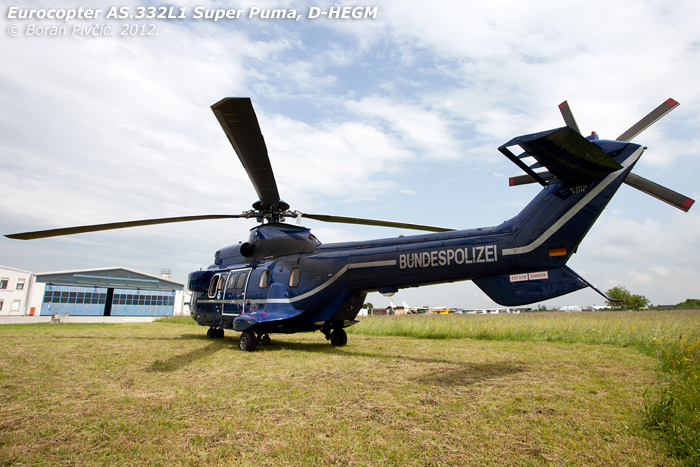
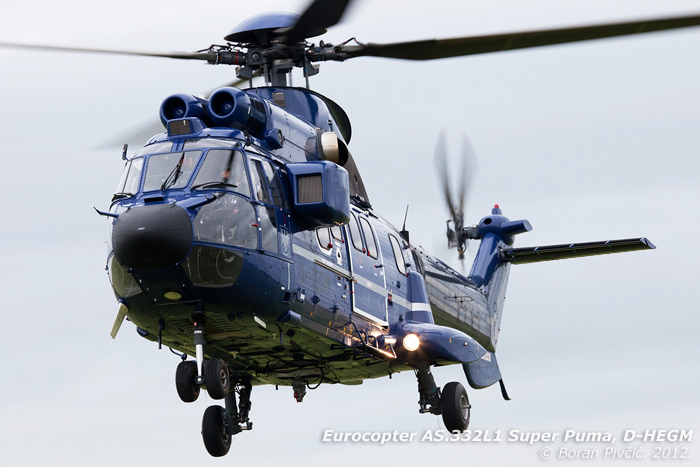
While foreign aircraft at my base airfield of Lučko are not really uncommon – and usually take the form of various skydive aircraft from neighboring countries – 2012 has seen something of a spike in the number of “higher ranking” and government rotary visitors :). Following closely on the heels of the US Navy MH-60 Knighthawk seen here earlier, a couple of months ago we’d been visited by a German Super Puma, in town for a week during an international rescue exercise.
Quite an eye-catching and striking machine, parked – appropriately – in front of the Croatian Police hangar, home to its four strong Bell fleet
Operated by the Bundespolizei – Germany’s Federal Police – D-HEGM was tasked with providing aerial support during the IPA-CRO FLOODS 2012 international civil defense exercise, held in May on several artificial lakes close to the airfield. Interestingly, back in March 2011 – when it was just a year old – this helicopter had suffered a double engine flameout while transporting German chancellor Angela Merkel. The cause was determined to be intake icing, necessitating a – thankfully safe – forced landing :).
Quite a purposeful looking machine, the Puma is still one of Western Europe’s most popular helicopters – despite its 47 years of age. Like its Soviet counterpart, the legendary Mi-8, the Puma has outlived many of its intended replacements, and has over the years evolved into several versions, including the Cougar military transport and EC-725 Caracal gunship
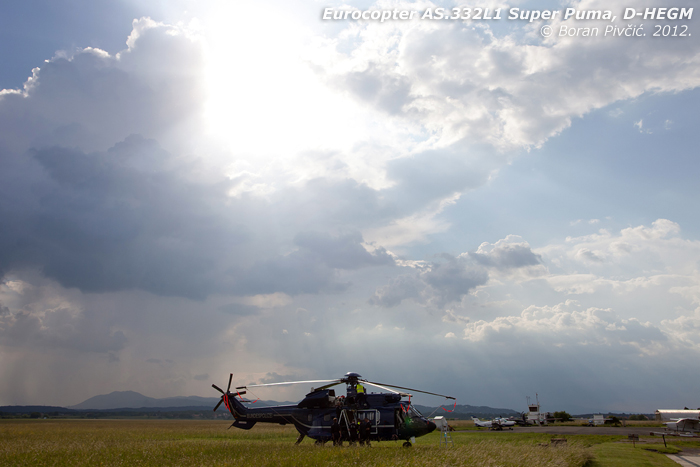
Packing her up after the last flight of the day as ominous storm clouds roll in from the west. Cursed with unstable weather all week, the crew had had to curtail several flights when the winds and rain turned for the worst
Even though most large airshows on the European continent seem little affected by the world’s economic woes, out here on the periphery things are not going so well. Despite 2012 marking the centenary of aviation in many countries of the Balkans (as did the preceding 2011), celebrations are by economic necessity curtailed, unimpressive and in many cases held just for form’s sake. Case in point in Croatia is the yearly Lučko Airshow, which will – by most accounts – be degraded this year to a “rump airshow”, held simply to avoid breaking its continuity :D.
However, one event that has always seemed more resilient is the Batajnica Airshow, held at Batajnica Airbase (LYBT) just outside Belgrade, Serbia. Like Hungary’s own Kecskemet Airshow – held just a hundred or so kilometers north – Batajnica is primarily a military affair, though civilian aircraft do make up a sizable amount of the static display. Having been deprived of any serious airshow all year – the last one being MAKS in August 2011 – I was naturally quick to plan a trip east and see what has the Serbian AF managed to cook up for its de facto 100th birthday… 🙂
MiGs at 6 o’clock!
In common with many air forces on the Balkans, the chief attraction of the Serbian AF is the rarity of its aircraft, most of which are of Soviet and Yugoslav make. Alongside various transports such as the An-26 – which can still be occasionally seen on cargo runs across Europe – the SerbAF also operates a handful of much rarer MiG-21 and MiG-29 fighters, types which are nowadays generally endemic to the Balkans. To drive the point – and attraction – home, in Europe airworthy (more-or-less :D) MiG-21s can only be found in Croatia, Serbia, Romania and Bulgaria, while the potent MiG-29 only in Serbia, Bulgaria and Poland. Locally-produced types from the heyday of Yugoslav aviation are hardly less attractive and feature some of the world’s last airworthy Soko G-2 Galeb (seagull) and G-4 Super Galeb trainers, and the Jaguar-lookalike J-22 Orao (eagle) strike aircraft.
However, while the above list sounds juicy even to the locals, accustomed to seeing these aircraft on a frequent basis, there is a catch attached: like their counterparts in other air forces of the region, SerbAF combat aircraft are quite old and near the ends of their service lives (a mounting problem faced by the Croatian MiG-21 fleet as well). Consequently, their crews have neither the available flight hours nor the mechanical security to take the aircraft to their limits, resulting mostly in tame and lackluster displays (as was most evident during the MiG-29 interception demo).
Snap Inspection
But, flight routines aside, the show is still an excellent opportunity to simply enjoy the sight, sound – and smell 😀 – of some good ol’ proper aircraft :). And while there were some obstructions to quality photography even with generous access – lots of visitors swarming around static aircraft and horrid heat haze out on the runway – the following gallery I believe captures the essence of the show and its aircraft quite nicely…
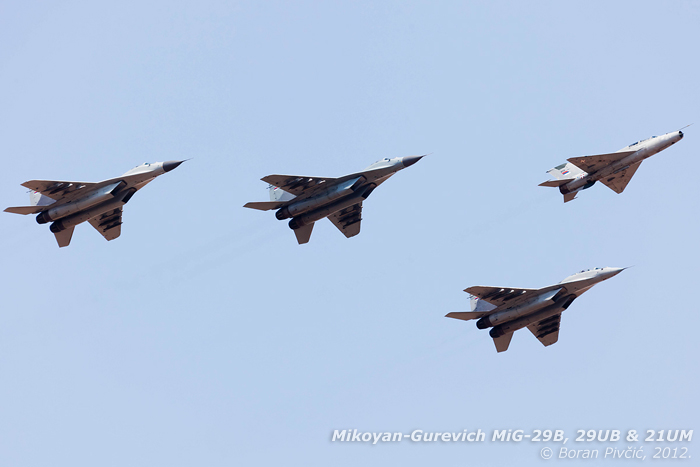
A formation that hasn’t been seen in European skies for a long time. A twin-stick MiG-21UM is seen leading an echelon formation including two single-seat MiG-29Bs and a two-seat MiG-29UB. The only remaining examples in Europe (and its proximity), B models are downgraded export versions, and feature a less powerful radar and simpler avionics
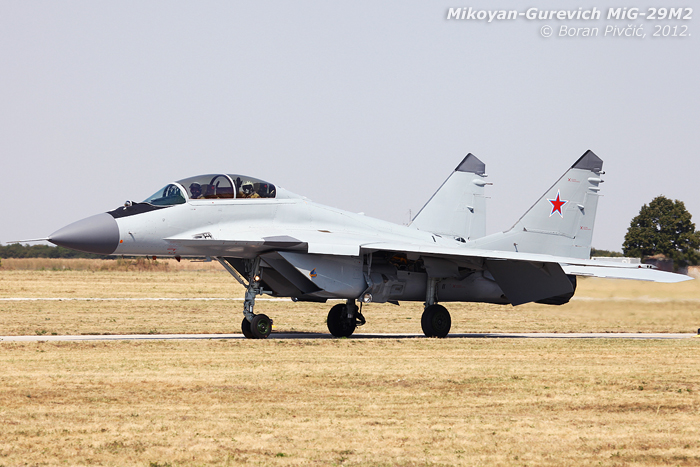
In contrast to the B model, this unmarked M2 – operated by the Russian AF – represents the opposite side of the MIG-29 spectrum. A comprehensive, new-built rework of the classic MiG-29, the M2 – sometimes known as the MiG-33 – includes fly-by-wire controls, improved aerodynamics, more powerful and (slightly) less smoky engines and vastly improved avionics that can carry a wider range of modern air-to-air and air-to-ground weapons. The M2 also addresses the Achilles’ heal of the original design, its woefully poor range, by introducing a larger fuel capacity
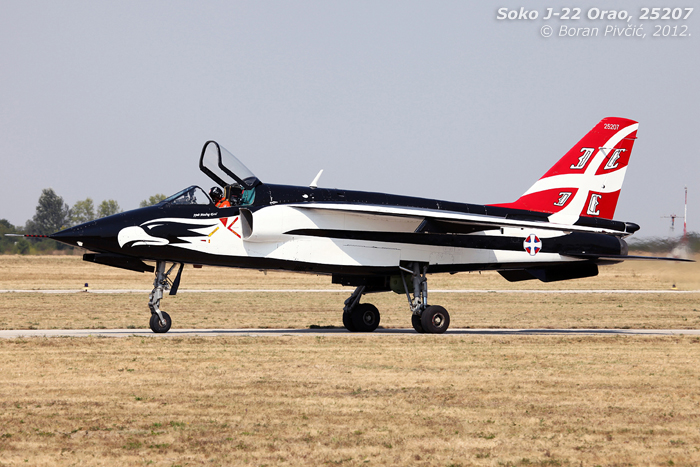
Looking resplendent in its special paint scheme, the SerbAF solo display J-22 Orao is seen taxiing past the press area on its way to the main apron. A design outwardly very similar to the Anglo-French SEPECAT Jaguar, the J-22 was designed as a lightweight, low-level strike aircraft that would use the maximum amount of “home-grown” technologies. Developed in cooperation with IAR of Romania – whose own version is called the IAR-93 Vultur – the Orao is powered by two Rolls-Royce Viper Mk.22 turbojet engines, produced locally under license and fitted with a locally-developed reheat system. Subsonic like the Jag, the Orao is in service only with the Serbian and Bosnian AF, and is one of the last dedicated ground attack aircraft serving anywhere in Europe
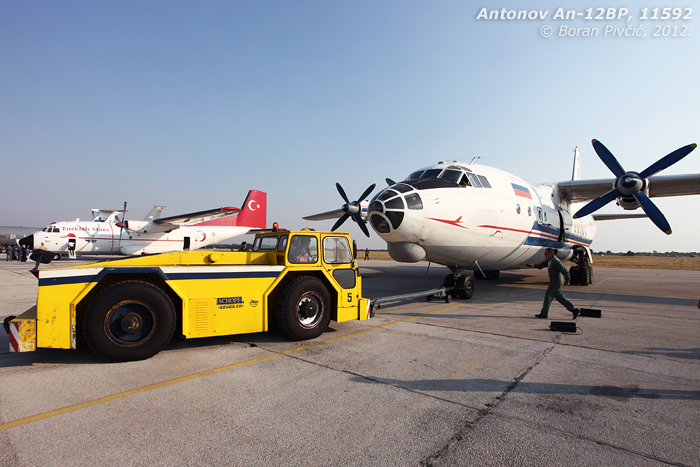
Following the MiG-29M2 wherever it goes is this shabby-looking An-12 transporter, operated by the MiG design bureau. One of the Soviet Union’s most successful turboprop workhorses, the An-12 can still be seen at Europe’s cargo hubs, flying freight charters to and from Africa and the CIS
By contrast, this Il-76 support aircraft is immaculate, seeming like it had just rolled off the production line. The most successful Soviet transporter, the Il-76’s successes and exploits – as well as its durability and versatility – is on par to that of the C-130 Hercules
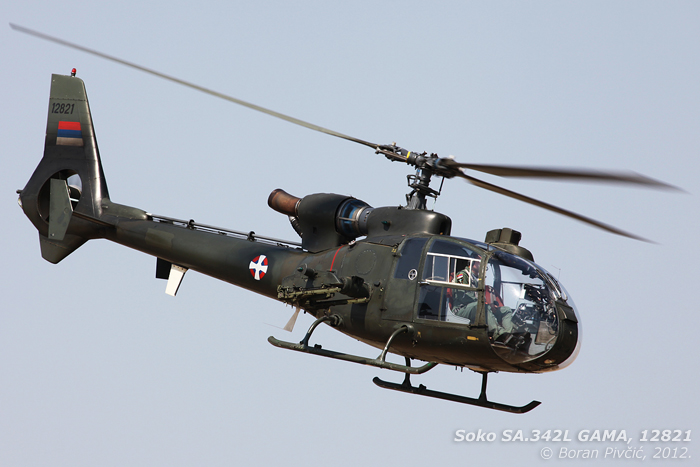
Fast, agile, tough and armed – quite a combination for a light combat helicopter. A license-built version of the venerable Aerospatiale Gazelle, the GAMA – a contraction of “GAzela MAljutka” – can be armed with four 9M14M Malyutka wire-guided anti tank missiles, known in the West as the AT-3 Sagger. Quite probably the Soviet Union’s most successful light anti-tank missile, the 9M14M has also been license produced in Serbia, making the GAMA almost a fully “self contained” product
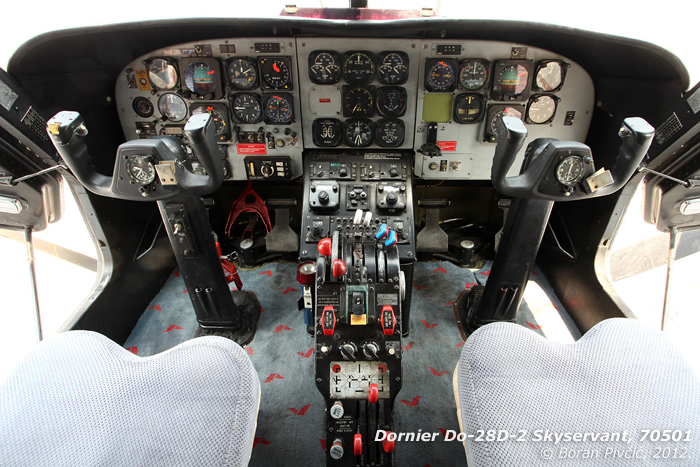
For a hopeless GA geek like me, a visit to this cockpit was more attractive than seeing a MiG-29. One of Germany’s first post-WW2 aircraft, the twin-engine Skyservant is an incredibly rare sight today. This example is still airworthy (just) and is normally used for surveillance and aerial mapping. Quite a clean shot otherwise, this photo was ruined unfortunately by dust on my UV filter (very dusty conditions), which I’d failed to notice until after taking the photo…
A couple of years ago when I was starting this YuAF Dakota feature, I believe I’d mentioned one further example rumored to be rotting away at an automotive junk yard somewhere in Serbia. Preciously few information about this machine had then been available on the Net, so on a week-long pleasure trip to Belgrade with a friend back in January, I decided I might just as well set this right :). Surprisingly – proof that the Internet is still not omnipotent – we’d found the exact location out within an hour or so of first asking, and with a break in the day’s snow, we set out to find it…
We all live in a green submarine... wingless and tailless, this poor thing really does look like a sub - and will most likely become one once the snow starts to melt :).
Indeed located at a scrap yard on the Ibarska magistrala, a regional fast road leading south out of Belgrade, this poor-looking thing is most likely coded 71245 – but given the snow and the ad-hoc paint job, it’s really hard to tell for sure. Its exact version, series and serial number are also unknown – but given previous Dakotas, I’m inclined to believe it is a B model.
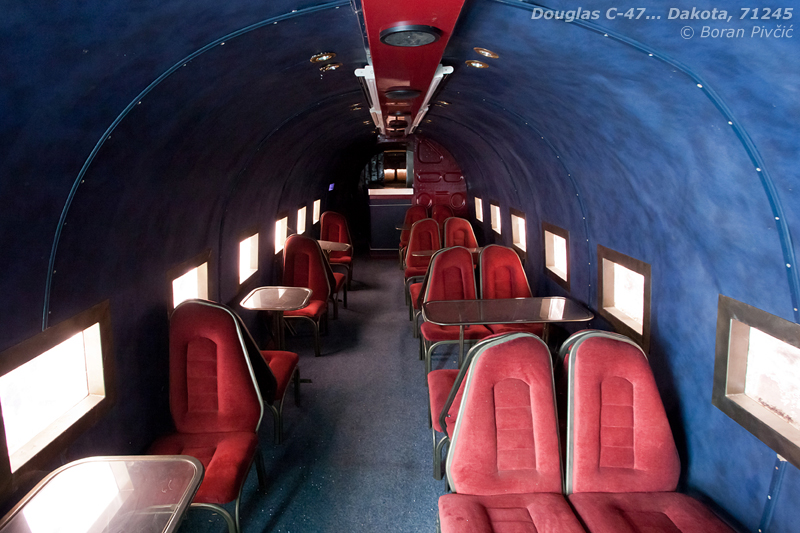
Despite its apparent sorry state – and significant dismemberment – the aircraft is actually in pretty good nick, no doubt helped by its location on fenced-off private property. Its life story is a bit muddled, but at some point in the not-too-distant past it had been turned into a cafe by the owner of the scrap yard (but was never used in that capacity). Interestingly, the owner had kept most of its major components, and even a handful of cockpit instruments and internal fittings. The largest missing piece of this puzzle, the engines – which were said to have had only 1100 hours total time on them – had been bought by a well-known local pilot and collector, and are today preserved in his hangar some 150 km south of Belgrade.
The yard - in various places - also contains most of the aircraft's major components, including the central wing box (seen here), both wings and the horizontal and vertical stabilizers.
During its conversion, the interior had been stripped of all original equipment - with the cockpit, rather fittingly, becoming the bar :D. However, since the aircraft had never been used in this capacity, the furnishings are in near mint state (save for some dust and dirt).
The tally:
Realistically probably the last Dak to be found in the lands of former Yugoslavia – here’s to hoping I’m wrong! – 71245 had brought the total score up to 11 examples accounted for:
71203: derelict at Zemunik Airbase near Zadar, Croatia
71212: derelict at the former Željava Airbase, Croatia
71214: preserved at the Aeronautical Museum at Belgrade Airport
71237: still flying as a turboprop C-47TP in South Africa
Well, here I am, back again from another extended leave of absence from taking care of this blog :). In my defense though, very little has happened at my little airfield these past few months – certainly nothing that bears writing about. Caught in a bureaucratic tango with the local CAA over its on-off operational certificate, Lučko had pretty much become a “ghostfield”, with fixed-wing operations few and far in between. Even the fine weather we’ve been having of late had lured back only a handful of aircraft, with most owners sticking to the administrative security of nearby Zagreb Intl. until the paper storm blows over.
This turn of events had, thankfully, made no impact on military helicopter ops – a good thing too, given what had popped into the field one day… 🙂
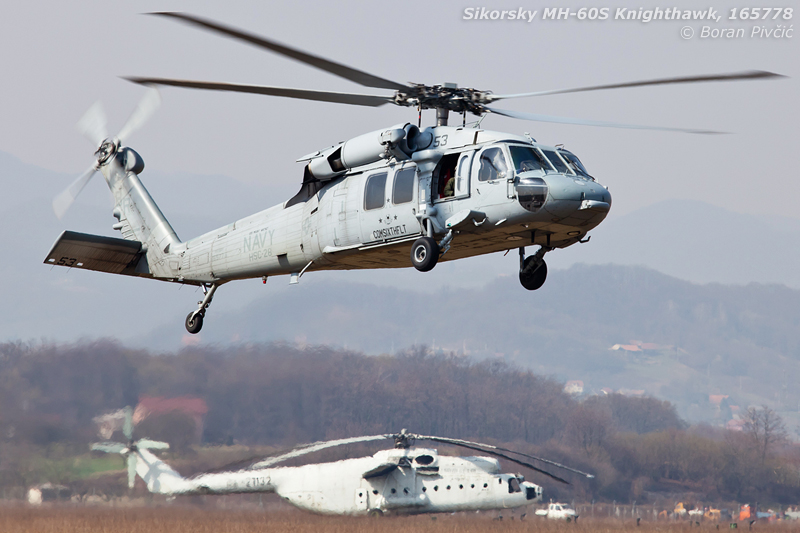
East meets West as a distinguished visitor to our sleepy little airfield floats past is derelict Mi-6... drawing quite a crowd, this was definitely one of the most interesting - if not the most interesting - aircraft to visit in years :). Probably the first naval machine too...
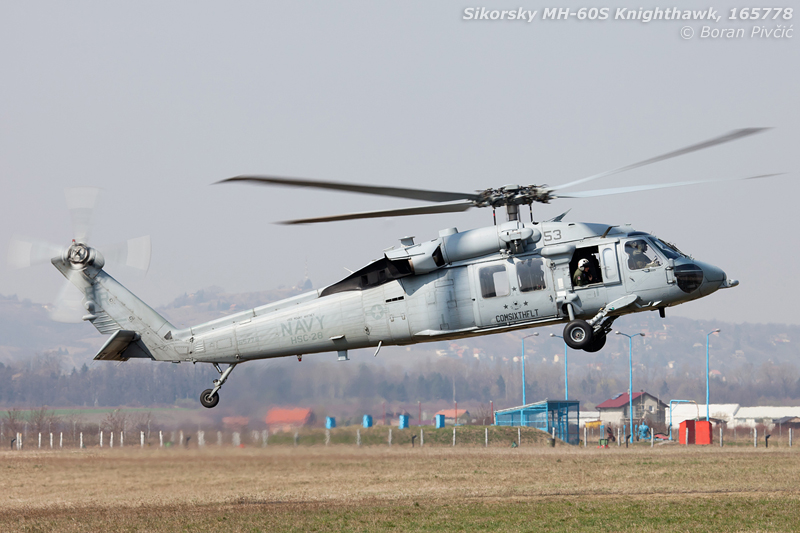
A very rare machine in these parts – regarded with as much awe and fascination as an Mi-8 would be in the West – 165778 is much more than yer stock Blackhawk. Actually an MH-60S Knighthawk – one of the Blackhawk’s many naval cousins – the type is most often found aboard smaller, faster ships and is primarily used for so called “vertical replenishment”, or VERTREP – which involves the airlifting of cargo between supply vessels and warships at sea. While this sounds harmless enough on screen, the actual endeavor involves the two ships sailing side by side – usually at speed and distances of just a couple tens of meters – with the MH-60S lifting underslung pallets of supplies between them. Add in high weights, small decks and a bit of rough seas and you can get a pretty good impression of what these machines go through…
165778 probably lives a more sheltered life, since it hails from the USS Mount Whitney, the command ship – and nerve center – of the US Navy’s Sixth Fleet (hence the cryptic COMSIXTHFLT title on the door). The ship itself had arrived to Croatia several months ago for a major overhaul, so that may bear some relation to 165778’s visit…
On short final for the military helipad. Even though it strongly resembles a stock land-based UH-60, the MH-60S is actually a development of the SH-60 Seahawk, the H-60 family designed specifically for operations from ships. Oddly, while the SH-60 has its tailwheel mounted closer to the middle of the fuselage - to facilitate operations from smaller helipads on ships - the MH-60 has reverted to the classic layout seen on "continental" models...
Had anybody ever observed me leaving for any European airshow, he/she would have probably noticed that every time I’d cast a glance over my shoulder in the direction of Moscow, with an expression that begs to be captioned “Soon” :D. For a full decade, ever since it had first started, the Mezhdunarodnyj aviacionno-kosmicheskij salon – MAKS – held near Moscow had, for me, been the Holy Grail of airshows on the European mainland. Each time I’d wanted to go, but each time I’d been held back by either university obligations or economic reality, leaving me with little choice but to attend some of the more predictable airshows in the West (not that I’m complaining).
However, thanks to a good friend who’d managed to organize some inexpensive accommodation in (and transport to) the city, last August I was able to set my/Aeroflot’s sights on Moscow and finally head for nirvana at MAKS 2011! 🙂
Even the car park was amazing – and came in the form of the old Bykovo Airport (UUBB) :). Closed in 2009 due to the approaching urban development seen in the back, Bykovo is still littered with the carcases of Antonovs, Ilyushins, Tupolevs and Yakovlevs – like this Yak-42D – that had made it to the airport, but no further
While the full list – and particularly the peculiarities – of the aircraft on display could fill several volumes, one particular aircraft had immediately stolen the show for me – and all it did was have itself towed around the apron… 🙂
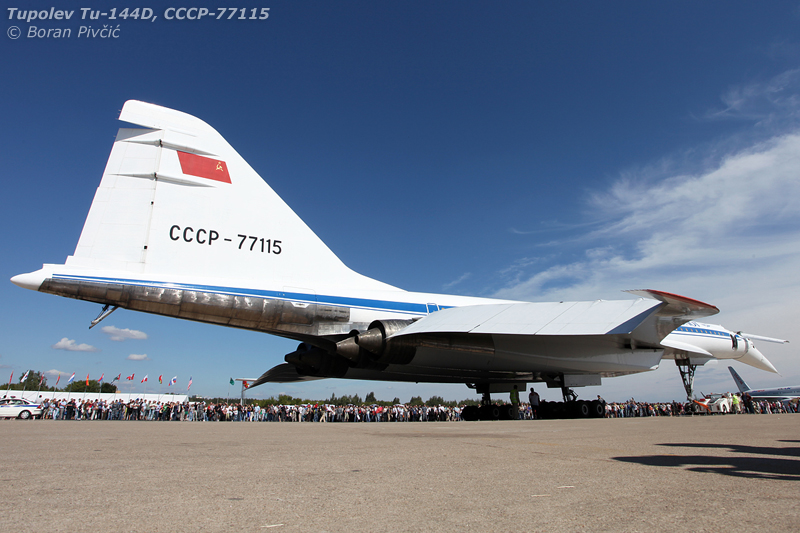
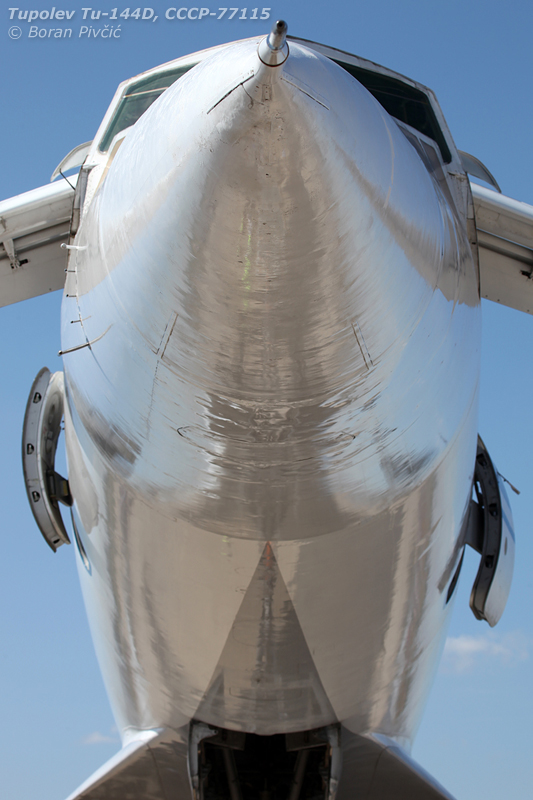
Freshly repainted in period colors – and with a period registration – CCCP-77115 was an instant head-turner. Despite all the interesting aircraft at the show – including the first visit by the A380 – the police had to intervene to keep the crowd away when this was towed to the static park 🙂
1. The tortoise and the hare:
Still a sensation even in its old age, the Tu-144 was always a curious aircraft. Often nicknamed “Concordeski” due to its high degree of similarity to the Concorde (the jury’s still out on how big a part had industrial espionage played in its design), it made global headlines on 31 December 1968 when it became the first supersonic airliner type to fly – beating the Concorde to the punch by a tad over two months. It made headlines again, for completely the wrong reasons, at Paris in 1973, when its highly-publicized (and still partially unexplained) crash started its long decline into obscurity and infamy. Relegated in its last years to plying mail routes around the USSR, by any objective measure the Tu-144 could today be judged a commercial failure – a hare that had sprinted for first place, but had quickly been overtaken by the more refined Anglo-French tortoise.
And yet, despite this, the Tu-144 has – dare I say it? – even more charisma and character than the already opulent Concorde. Like the Concorde, it was a brilliant, but flawed design, a design that combined cutting-edge, out-of-the-box thinking with inept government bureaucracy and under-the-table political scheming. And like the Concorde, one cannot help but think of it as a person, a pioneer held back against its will, and not just as a machine doing a job :).
Back to the Future. A shape so futuristic that it’s old…
The main reasons of the -144s “flawedness” lie – as they often do – under the wings. The aircraft’s eternal Achilles’ Heel, the -144’s engines have always lagged behind the times in terms of performance, and are arguably the single biggest contributor to the type’s demise.
The soap opera to-be first started with the prototype’s Kuznetsov NK-144 reheated turbofans, grouped together under the rear fuselage. A design specifically intended for the Tu-144 – hence the designation – the NK-144 on the face of it seemed to be a winner; while the Yanks, Nigels and Frogs were wasting their time with turbojets, the Tu-144 would be whisked along by futuristic turbofans of the type seen on today’s fast military jets. However, while this sounded fine in theory, behind the scenes the engine had some serious issues. Despite its futuristic layout, the core of the engine was of a dated and unsophisticated design, which had, all on its own, nullified the advantages of the front fan. A far bigger problem was that the engine could not sustain supersonic speeds without the use of reheat, unlike the more refined Rolls-Royce Olympus turbojets used by the Concorde. The end result was an incredibly noisy engine, whose ambition was matched only by its fuel consumption. At Concorde speeds, the NK-144 drank up to three times the fuel of the Olympus, reducing the Tu-144’s range – always a premium on supersonic aircraft – to unsustainable levels of just 2,900 km; an astounding 4,300 km short of its Western counterpart.
The only way was up, so Kuznetsov engineers set to work on an upgraded model called the NK-144A, to be used on the production-standard Tu-144S. Slightly more powerful than the Olympus, the new engine went some way to increasing the aircraft’s range, which was now pegged at 3,600 km with a reduced payload – still woefully behind the Concorde. With a full cabin the news were even more demoralizing, with the total range boost amounting to just – 200 km.
With a radical rethink deemed the only solution before the -144’s fuel bills ate up half the Union’s budget, the NK-144 was ditched in favor of the Kolesov RD-36-51, creating the second-series Tu-144D (D for dalniyy, or “long range”) – a series that had also included CCCP-77115. A turbojet this time, the RD-36-51 was a modification of the engine used on several Soviet supersonic bomber prototypes, including the stillborn Su-100.
Both the Tu-144D and its RD-36 engines are easily differentiated from other marks by the pronounced engine exhaust cones. These helped accelerate the exhaust gasses as they left the jetpipe, but did little for noise attenuation 🙂
And while the RD-36-51 was a quantum leap over the old NK-144, problems nevertheless remained. Supersonic flight was still not available without continuous use of reheat, though the range hit was slightly lower this time – with a reduced payload the aircraft could manage up to 6,200 km, dropping to about 5,300 when full. Still in the Concorde’s wake, but in another league compared to the NK-144 :). Plans to address this even further – though by removing the symptoms rather than curing the disease – were made in the late 80s, whereby the RD-36-51’s 15% higher thrust than the NK-144 would be used to haul more fuel in the tanks, increasing the range up to a theoretical 7,500 km. Christened the Tu-144DA, this project had – like the Tu-144 itself – nosedived into the dirt during the collapse of the USSR.
Raw power, pure and simple. The grouping of the engines changed significantly from the first prototype, with the engines now grouped into two pairs to reduce the heat strain on the rear fuselage. Interestingly – and again unlike the Concorde – no Tu-144 version was equipped with thrust reversers; though plans were in place to fit them to the outer engine on each wing, the aircraft had ended up using an old-fashion braking parachute
The -144’s final engine change was the most impressive though – but it had come a decade too late to save the old jet. Faced with the need for a large platform on which to test solutions for future trans- and supersonic airliners (a nod to the Sonic Cruiser there), NASA and Boeing had in 1996 teamed with Tupolev to bring one mothballed Tu-144 back into airworthy state (the type having been withdrawn from use more than eight years prior). As part of its refit, the chosen aircraft – RA-77114, the last -144 completed – had been re-engined with the Kuznetsov NK-321 turbofan carried by the Tu-160 supersonic bomber. Producing 25% more thrust than the Tu-144D – and a fantastic 45% more than the original Tu-144S – the Tu-144LL (letuschayalaboratoriya, or “flying laboratory”) had managed to achieve and maintain an incredible Mach 2.35; that’s faster than the F-22, on par with the F-14 and Su-27 and lot much less than the F-15, one of the fastest jets in the sky :).
Having flown 26 test flights in total, RA-77114 made its final landing – and marked the final flight of the Tu-144 – on 14 April 1999. Like CCCP-77115, today it is resident of Zhukovsky Air Base (the venue for MAKS) but is languishing in a poor state at a remote apron… out of reach of my camera 😦 (but not out of reach of this one: Airliners.net link).
2. The precision pile driver:
While all this talk of engines and reheat and range may leave the impression that the Tu-144 was little more than a crude Soviet pile driver, the truth is much more complicated – and is actually what gives the type its distinctive charm :). From nose to tail, the Tu-144 has none of the uniformity of sophistication that we’re used to seeing on the Concorde; instead it seems to be a hodge-podge of old 50s technology and 60s forward thinking. And nowhere is this more evident than in its aerodynamics…
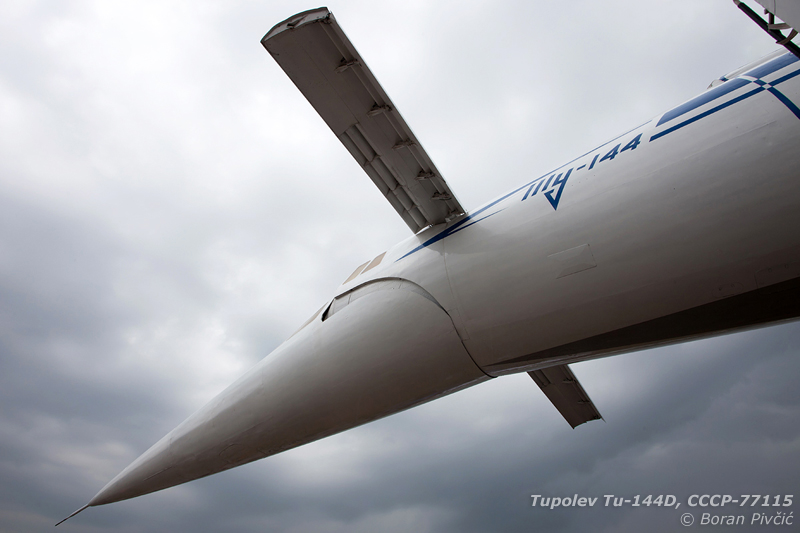
Out back, the angular double-delta wing comes from the same family tree as the Concorde’s more elegant ogival delta – but is simpler, cheaper and easier to produce and maintain. However, at the front, to compensate for the wing’s inferior performance at lower speeds, the Tu-144 has an elaborate set of retractable canards whose aerodynamic sophistication exceeds any similar systems in the West.
Canards that are more sophisticated than the wing of a Skyhawk :D. As well as trailing edge flaps, the canards are also equipped with two sets of leading edge slots, which channel air onto and down the airfoil at high Angle of Attack. This helps the air stick to the surface, delaying any potential stall. The canards themselves were fully automatic and retracted into recesses in the fuselage (faintly visible on top) above a certain speed (usually 450 km/h). Despite the simpler wing, the Tu-144 had a 30 km/h lower landing speed than the Concorde, and its maximum landing weight – in part limited by approach speeds – was 9 tons higher
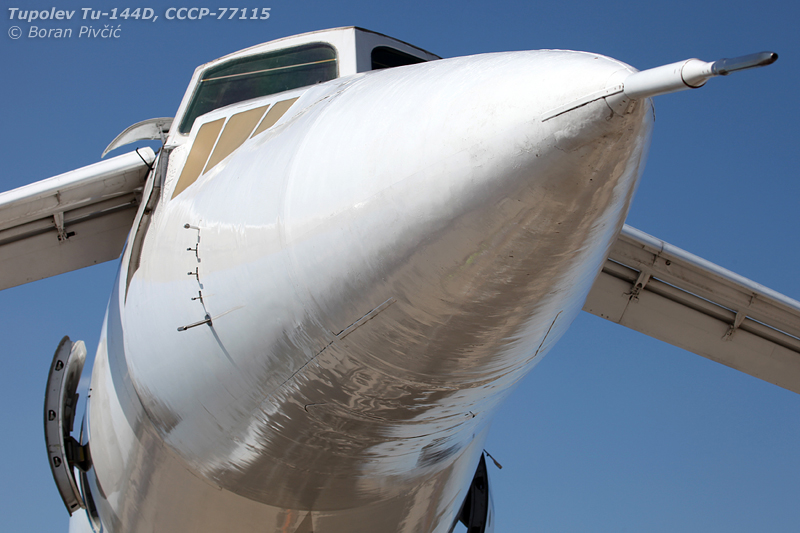
The drooping nose too was a “cheap & cheerful” setup. Whereas the Concorde had a split nose and visor, the Tu-144 had combined them into a single element. The immediately apparent disadvantage was the poor forward visibility at subsonic speed, when the nose has to be raised, but the speed is not high enough to warrant use of the visor. However, this was not thought to be an issue, since unlike the Concorde – which was limited by flight over densely populated areas – the Tu-144 could immediately accelerate to supersonic speeds. The angle of droop was also higher, 17° vs 12.5° for the Concorde
This trend had continued in a similar vein inside the fuselage. The passenger cabin was the typical, simple and unsophisticated affair found on many Soviet airliners of the time – but with one key difference: unlike virtually all other passenger aircraft of the Union, the Tu-144 had featured a two-class layout, with a five-abreast economy section in the rear of the cabin, and a four-abreast business section up front. Due to the “sardine can” conditions out back, the Tu-144 could also squeeze in more passengers, 140 vs. a maximum 120 for the Concorde.
At the pointy end though, the Tu-144 was – by some accounts – on par with the Concorde, though many of the aircraft’s cockpit systems remain obscure even to this day. Apart from the unorthodox instrument layout, traditional aquamarine panel (proven to relieve stress) – and the irreplaceable cooling fans 😀 – the cockpit was very much of the period, sporting a three-man crew and the latest in (indigenous) automatic flight control systems and various navigation devices.
The performance – fuel consumption aside – was surprising as well. Despite the crude engines and simple wing, the Tu-144 had a 65,000 ft ceiling, about 5,000 higher than the Concorde. Maximum speeds were unexpected too, with the original S model capable of Mach 2.3 and the D of 2.17 or thereabouts – both significantly faster than the M2.02 that the Concorde could do at full chat. This turn of speed was achieved despite inefficient engine intakes that were far inferior to the electronically-controlled ones designed, from the ground up, for the Concorde.
The intakes themselves had also given rise to another unique feature – the aircraft’s distinctive landing gear. In order to compensate for the lack of digital intake controls (which were required to slow the air down to subsonic speeds before it reached the compressor), the designers at Tupolev lengthened the intakes (which, roughly, achieved the same effect). However, the length required meant that there was space for them only under the fuselage and – as seen on production models – at the very root of the wing. This left no room for traditional landing gear, with its few, but large, wheels. The solution involved a complex system of eight smaller wheels on each leg that would, as the gear retracted, rotate through 90 degrees to the side and slot themselves vertically into recesses between the two engines.
Unsurprisingly, this wheel arrangement had also allowed the weight of the aircraft to be distributed over a larger area, thus reducing the load on the surface; which, combined with the large-diameter gear legs, made the Tu-144 fully rough-field-capable – as was actually demonstrated by one example during flight tests :).
3. Fly fast, die young:
Sadly though, the opportunities to use these capabilities in actual service had proved to be few and far in between. The sheer economic inefficiency of those engines – even by the standards of the Union – and the huge R&D costs the program had accrued had at the outset relegated the Tu-144 to a mostly ceremonial role, flying a few lonely domestic routes for prestige’s sake. In a final insult to its design, this pioneering aircraft, an aircraft that had so much unused potential and promise, had ended its commercial service flying mail between Moscow and Alma-Aty in Kazakhstan…
A supersonic dream that had quickly turned into an economic nightmare. Apart from its exorbitant direct costs, in service the Tu-144 had also suffered from several significant operational problems. The lesser was that – faced with the vast spaces of the Union – the aircraft never really had the legs to get to any distant destination in one hop. More serious was that its range had severely limited its choice of alternate destinations if the primary had to be abandoned for any reason (like weather) – in a country where large airports are rarely close by
Even more saddening (though understandable) is that by the time its commercial service had ended in the late 80s, the Tu-144 fleet – at that point made up of D models built at the beginning of the decade – had clocked up what could only be described as a pitiful amount of flight hours. Indeed, I was quite surprised when I found out that “our” CCCP-77115 (the penultimate aircraft completed) was retired with just 38 hours and 34 minutes on the clock!
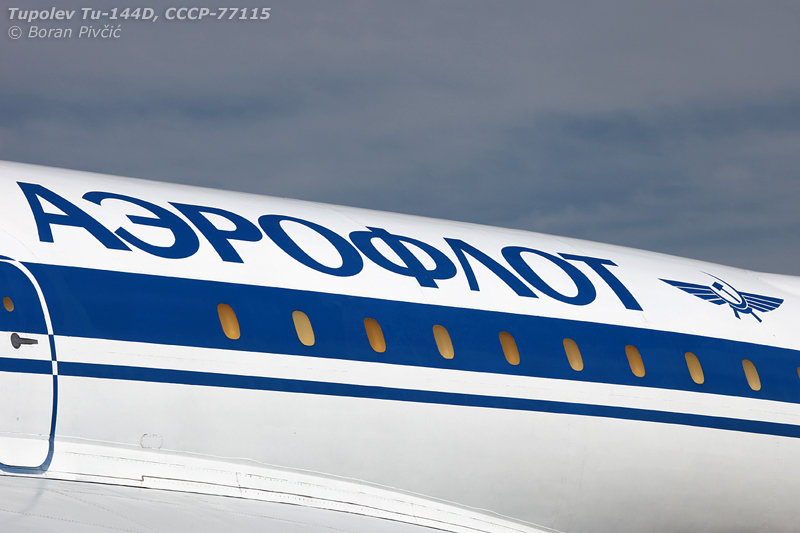
Interestingly, none of that time was logged in Aeroflot service, despite the full Aeroflot paint scheme the aircraft had worn throughout its lifetime. With the wind-down of supersonic commercial services in the USSR all but complete, this aircraft – pretty much fresh from the factory – had been sidetracked into the expanding Buran orbiter program. The closest an aircraft could be to an actual orbiter, CCCP-77115 had been used to train the program’s future pilots, until both were dragged under overnight by the dissolution of the Union.
The spectre of what could have been… slightly larger – and infinitely more imposing – than the Concorde, the Tu-144 is an eye-catcher from any angle
Summing then the Tu-144 up is hard. In parts a brilliant design, it had been stifled by the USSR’s need to be there first, to get up the West’s nose. A design that could have matured nicely given some more development time, it’d been pushed into failure by politics rather than its shortcomings as a machine. And, as I said at the beginning of this post, somehow that makes it just a bit more human… 🙂
Concorde or Tu-144? 🙂 A shape from the future that on its own tells the story of two of aviation’s great icons, aircraft that were just that bit ahead of their time…
With monotonous inevitability and regularity, winter weather has returned to Croatia. While to many this may evoke images of white landscapes, snow flurries and fluffy clouds, the harsh reality was somewhat different – fog, more fog and – when the fog decides to lift – low cloud :D. With visibilities at our continental airports rarely above 200 meters – dropping to 50 in the mornings – GenAv flying ops have normally been stopped dead in their tracks, so there’s actually little to report on… however, hope remains that it may clear, so in the mean time, here’s a shot of the average day at Lučko…
For some odd reason, nobody was flying this day :D. To give a measure of the thickness of the Zagreb Winter Fog, the control tower - barely visible in the back - is just 90 or so meters away from me...
Any regular readers of this blog may have noticed that my base airfield tends to have quite a lot of skydive aircraft for its size (ignoring for a moment the issue of their airworthiness – or lack thereof :D). However, most of these are members of the Cessna 18X family, and while cheap to operate, they do not have much in the way of carrying capacity for anything but the most basic skydive operations. Historically this had been addressed by temporary leases of larger aircraft (mostly L-410s and An-2s) from neighboring countries, but it has been quite awhile – more than a year in fact – since we’d seen the last of them…
Thankfully, this had changed for the better a couple of weeks ago when Lučko became host to a very interesting Cessna Stationair from Germany – a still-rare Turbine 206 :).
The long, narrow nose and the big three-bladed propeller had instantly hinted of the power hiding under the bonnet... 🙂
Converted to this configuration by Soloy of the US, the Turbine 206 is essentially an older, paid-off and cheap 206 airframe re-engined with a 450 HP Allison 250-C-series turboprop – the same engine, albeit with a different gearbox, that powers the Bell JetRanger helicopter. With 50% more horsepower on tap than the standard Stationair – not to mention the huge increase in torque – the Turbine 206 is a stellar climber and had quickly become a favorite of every skydive club… that could afford it :D. The example pictured here, owned by Aeroclub Walldorf and registered D-ETHW, had started life out as a stock U206G, before being converted to the Turbine 206 Mk. I standard (based on the Allison 250-C20S) sometime in the early 2000s.
Warming up for the first skydive flight of the day. While its looks are at best questionable, there's no denying its awesome performance: with a full load of skydivers, it had managed to climb to 1500 ft AGL before the second turn of the traffic circuit - and on a 30 Centigrade day at that!
And even though I’m well familiar with the distinctive start-up sound of the 250C – the deep whine, the clicks of the igniters and the rising screech as the compressors spool up – I couldn’t resists taking a few videos as it went about its business… 🙂
By me All photos me too, copyrighted, w/assistance from Google Earth
The sudden arrival of the county prefect, no less, had signaled an anticipated change in tempo. All morning journalists and TV crews – some even from national TV – were milling around the open field, filming and interviewing whomever important they could find. A brass band was playing gently in the background. Well before the start of the festivities, the caterers had broken out local wines and beer, and everything had taken on a jolly tone. Now, eyes and cameras pointing skyward, the hundred or so people attending turned toward the drone of an incoming aircraft, tracking it intently as it landed at the far end of the runway. Taxiing up to the crowd, the plane shut off its engine and moments later, an unfazed prefect stepped out to greet the press…
What could definitely pass for a grand opening of a major international airport was, in fact, just the official opening of Croatia’s newest sport airfield near the village of Gubaševo :D. Marked with quite a bit of (perhaps unwarranted) pomp and circumstance, Gubaševo is the first proper, permanent airfield in the area, and a source of much local pride :). Located in the rolling hills of the region of Zagorje, just a dozen miles north of Zagreb, the field is intended primarily for use by gliders, capitalizing on the area’s frequent and strong thermals, occasional mountain waves – and an almost a complete lack of strict altitude and airspace restrictions. Away from any major airports and well below their approach paths, the field features a single grass runway measuring 650 x 30 meters, and stretching in a 36-18 direction at an elevation of 450 ft AMSL.
Still just an open field in this dated image on Google Earth, Gubaševo is conventiently located near one of the country's main highways (visible bottom right) and easily and quickly accessible - the drive from my house to the field had taken just a tad over 40 minutes along local cheapskate-avoid-toll roads, while along the highway it takes as little as 25 minutes...
Interestingly enough, and despite the fact that it had been officially opened this day (24 September 2011), the field is not yet fully certified, and landings there are still treated as off-field operations (though with the blessing of the CAA). For the same reason, Gubaševo still hasn’t got an ICAO location indicator, but it is hoped that one will be allocated in the future :).
However, none of this had dampened the spirits at the ceremony itself, which, after the formalities had been handled, had kicked off to a mass gliding session by pilots of Aeroklub Zagreb and Zagorski aeroklub :)…
The first powered aircraft ever to land at Gubaševo - and incidentally the aircraft on which I'd logged the most flight hours 🙂 - Triple Delta is seen taxiing towards the waiting crowd, with the prefect of the Krapinsko-zagorska županija (county) on board. Officially named Krapinsko-zagorski aerodrom Gubaševo (roughly translated as "Krapina's and Zagorje's airport Gubaševo"), the airfield was quite a big thing that day :).
AK Zagreb's C150 lined up on RWY 18, posing for a perfect postcard shot with typical Zagorje scenery in the back - low cut grass, corn/maize fields, wooded rolling hills, the inevitable church (every town has one)... and, normally, gazebos with plenty of local wine :D.
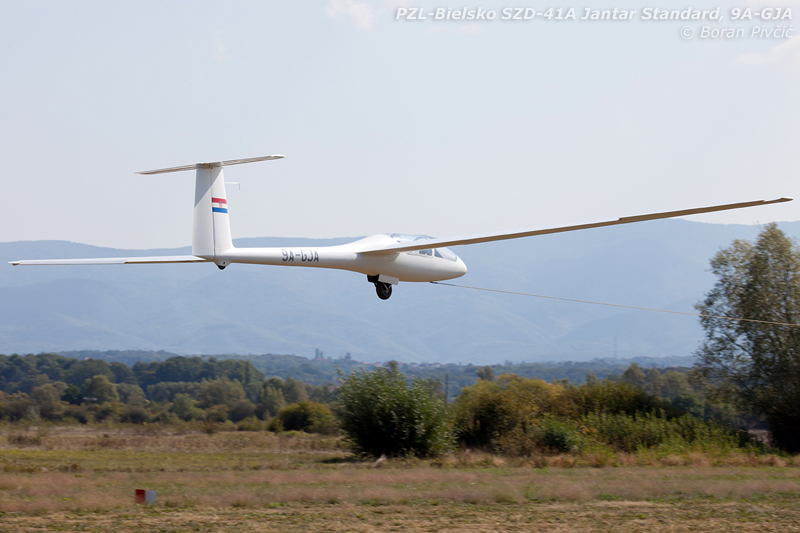
One of the day's many aerotows climbing up slowly - but surely - from RWY 18. The glider in tow is a Polish-designed and built PZL-Bielsko SZD-41A Jantar Standard - the only one of its type in the country - registered 9A-GJA.
Caught in an almost perfect profile shot while landing on RWY 36 :). Though 650 meters may seem a bit short, identical aerotow operations from Lučko - with the same gliders and the same towplane, at roughly the same elevation (404 ft vs 450) - need pretty much the same runway length.
Eat my dust? Kicking up clouds of loose cut grass on the takeoff run, far from an ideal operating environment for an aerotow. Apart from reducing visibility in the cockpit of the glider - Zagorski aeroklub's Ka-7 in this instance - this also increases the pair's takeoff run by increasing surface friction.
Freshly refurbished, 9A-GZA is seen returning from a joyride. Coming from an airfield where airspace and altitude restrictions rarely allow flights of more than 20-30 minutes in duration, pilots from Lučko were having a ball here, with individual flights having had to be curtailed to one hour in length to allow others to have a go :D. The gliding situation was so good in fact that I've seen - for the first time with my own two eyes - four gliders circling in the same thermal :).
Launching out of RWY 18 for an hour-long joyride. The mountain in the background is Medvednica, at whose opposite base lies the city of Zagreb... and a bit to the right, out of shot, Lučko :).
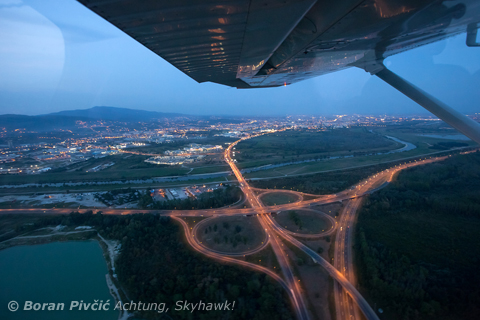
Having become slightly stir crazy with the pedestrian pace of general aviation in Croatia of late, a friend of mine and I decided it might be a good idea to go and unwind a bit in the wild blue above the country’s capital of Zagreb :). Growing bored of constantly overflying the city by day, we decided we might just as well enjoy the view during sunset – so timing it just right on a beautifully calm summer afternoon, we fired up our trusty C172 and headed out of the quiet field…
Overflying one of the city's main highway junctions, where two important routes to Middle Europe meet. As you can see, our "sunset" flight turned into a non-event due to increasing haze in the distance, but we decided to make the best of it and enjoy some near-night photography :).
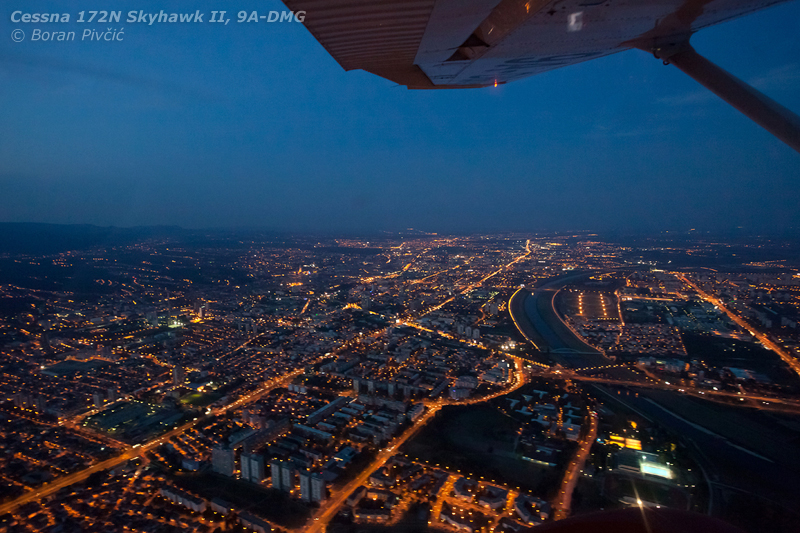
A splendid and calming view from the western edges of the city. The waning hours of the day are definitely the best time to be out and about and enjoy the simple beauty of flight - the scenery is even more beautiful than during the "full" dead of night...
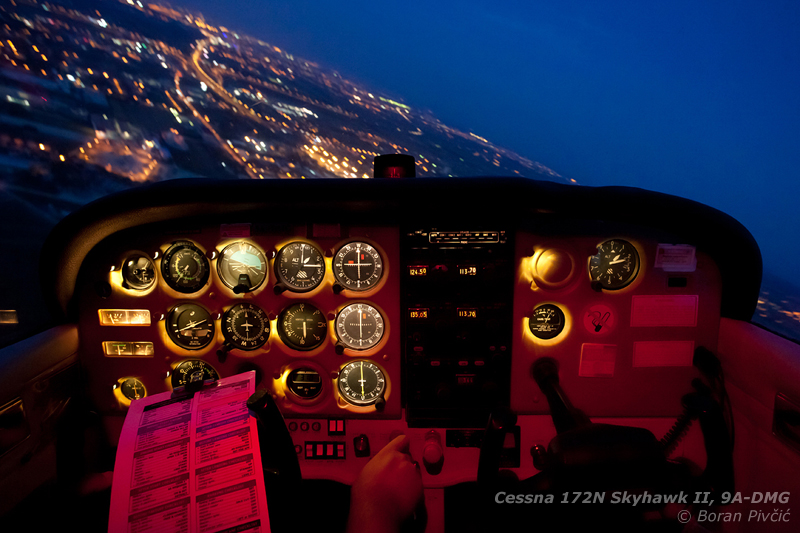
An, of course, the best view of them all, with all the Christmas lights turned on :). Almost looks like an image from a flight simulator rather than an actual aircraft... either way, pure magic! As you can see from the instruments, we were in a bit of diving turn - and with all our exterior lights blazing, we must have been quite a sight...
Whenever I happened to catch a Diamond Star rolling down Lučko’s rough, uneven runway, I’d always felt sorry for the little thing. Pitching and rolling and yawing like it was out of control, it had suddenly seemed fragile and very much out of its element – a sword at the proverbial gun fight, an aircraft that really should steer clear of all but the smoothest surfaces… in essence, and despite the type’s incredible underlying toughness and depth of engineering, almost an accident waiting to happen…
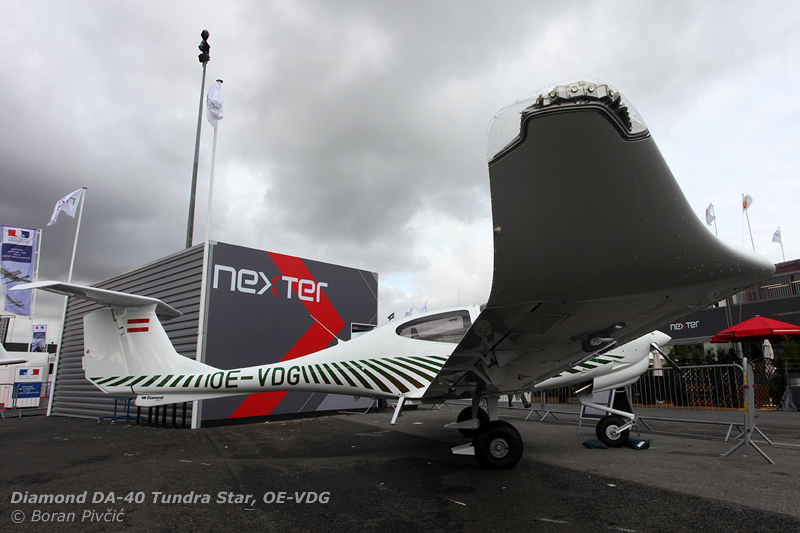
However, a casual stroll down the display line at the 2011 Paris Air Show would quickly prove my impressions wrong :). Sitting in the open away from the big jets and fighters was an oddly different, beefed-up, more purposeful looking Star – not quite like any I’d ever seen before. Its information board, largely ignored by passers-by, identified it simply as the DA-40 Tundra Star. Intrigued, I’d naturally stopped to take a look… 🙂
While it is no PC-6, the Tundra Star does look more than capable of handling the average dirt strip. It certainly does seem to be a nearly ideal mix for the owner who operates out of an unpaved runway, but desires the economy of the Diesel and the sophistication and cruise performance of the clean carbon-fiber Star...
One of the Tundra Star's party pieces is its engine, Diamond's own Austro Engines AE300 Diesel, spinning a three-blade constant speed prop. Developed in response to Thielert's Centurion 2.0, the AE300 is also a 2.0-liter automotive Diesel engine converted to run on Jet A - however, unlike the Centurion, the AE300 produces 168 HP (33 more) and can maintain this power all the way to 10,000 ft thanks to an improved turbocharger. Once settled into the cruise, it burns just 5.5 USG/h at 75% power (also a note about the HP rating: while 135 and 168 HP seem ludicrously small amounts for a four-seater, what actually matters here - and in every other prop - is the torque... and few engines have more of it than a turbo-ed Diesel 🙂 )
Another noticeable change was the new bubble canopy, previously seen only on the company's Airborne Sensing fleet. As well as improving overall visibility in tight spots, the new canopy also permits taller people - like myself - to finally sit comfortably up front 😀
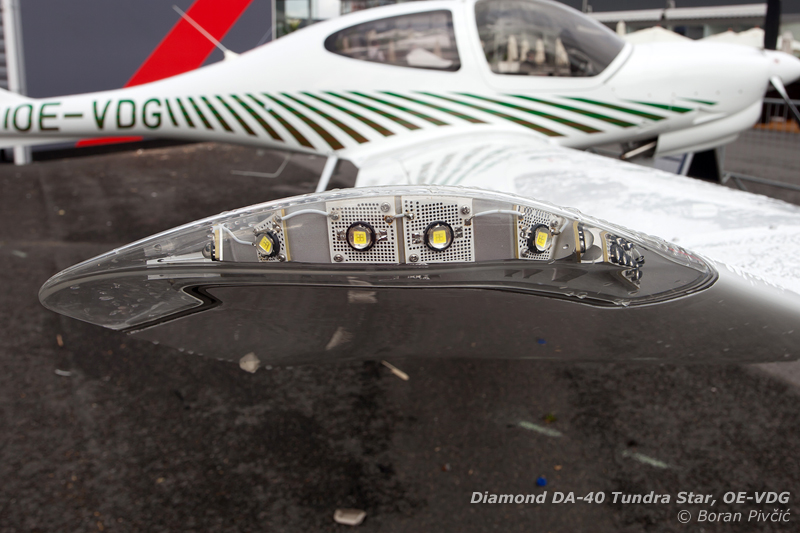
Like many modern light aircraft, the new-generation DA-40 has been fitted with LED nav and strobe lights, which significantly increase the aircraft's visibility in the air - but also, at the same time, noticeably reduce electrical consumption. This light cluster also includes the landing lights (visible to the right), which provide much better illumination than the old - and frequently temperamental - light bulbs 🙂
But the bread and butter of the Tundra Star is located under the fuselage :). The type's normal pavement tires have been replaced with large low-pressure units, which go a long way to absorbing the bumps of uneven runways. Their greater diameter has also added to ground clearance, while the increased contact surface has reduced the aircraft's surface loading, allowing it to operate from soft, damp or muddy strips (where the mud scrapers come into their own)
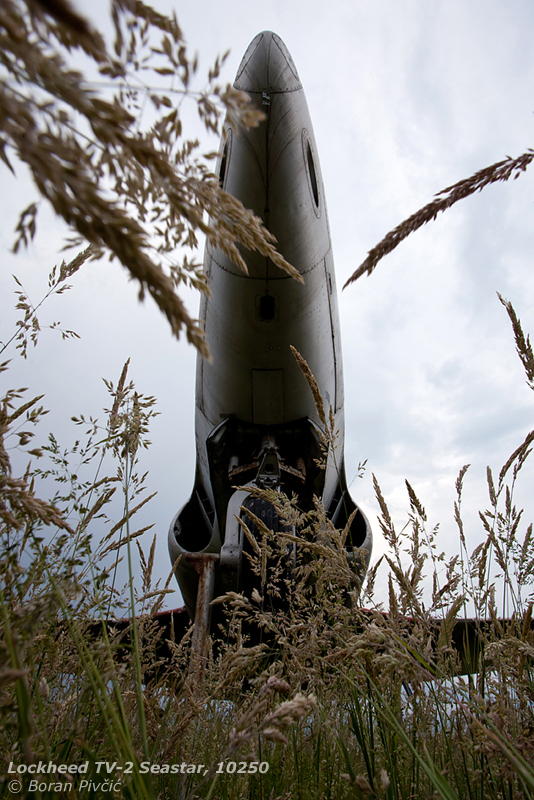
After a couple of years of driving ’round the various back roads that wind across the countries of former Yugoslavia, you get used really to seeing the oddest things by the side of the road… an old tank here, some deserted barracks there – and everything else up to the occasional motionless radar dish and overgrown abandoned bunker. Certainly, I myself have seen quite a few of these on my travels, and almost thought myself beyond surprise anymore – until, while rounding the crest of a small hill in central Croatia, I suddenly saw a silver T-33 Shooting Star rising up from the tall, unkempt farmland grass :D.
My surprise was not lessened even by the fact that I was actually looking for this specific aircraft – nor that I’d already been here several years ago, and had flown over this spot at low altitude more than a dozen times :). But, that first instant of seeing an abandoned aircraft, a piece of history, so much out of its element, is always a thrill – so much so that I was forced to apply liberal amounts of braking to avoid spearing off into the undergrowth :D.
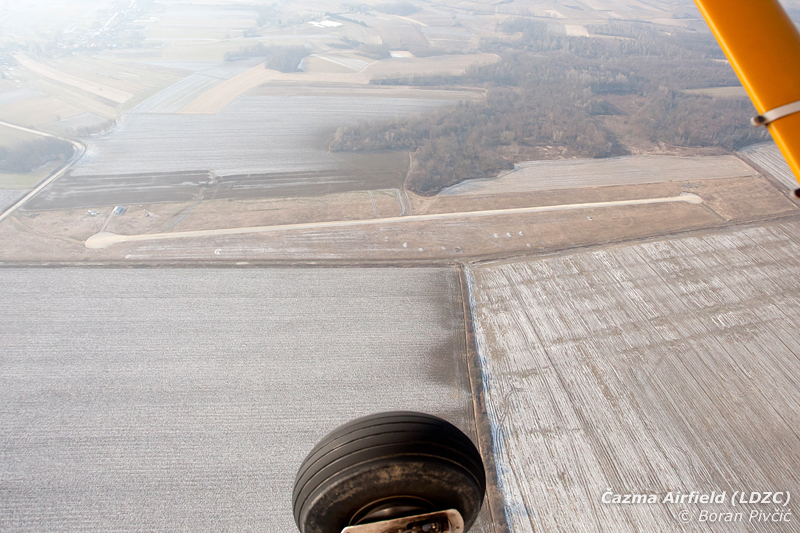
The location for this near-off was Čazma airfield (LDZC), an unassuming little strip located about an hour’s drive east of Zagreb. Overgrown and uncared for, Čazma had been established in 1944 as a supply airfield by the Yugoslav Partisans, and had after the war gone on to serve as a base for agricultural aircraft (surrounded, as it is, by the abundant farmland characteristic of this part of Croatia). Following the decline of cropspraying flights some years ago, Čazma had progressively become disused and forgotten, until it had even dropped off the aeronautical maps about a year ago (for reasons which vary depending on who you ask). For all intents and purposes abandoned, it is today visited only very rarely by light aircraft wanting to have a go at its tight, sloping 660×10 meter paved runway…
A strongly backlit overview of Čazma as it was back in February 2011. The runway - in pretty good shape it must be said - runs in a 01-19 direction, but its slope (sloping up RWY 19 by about 2 degrees) is not noticeable until you actually land...
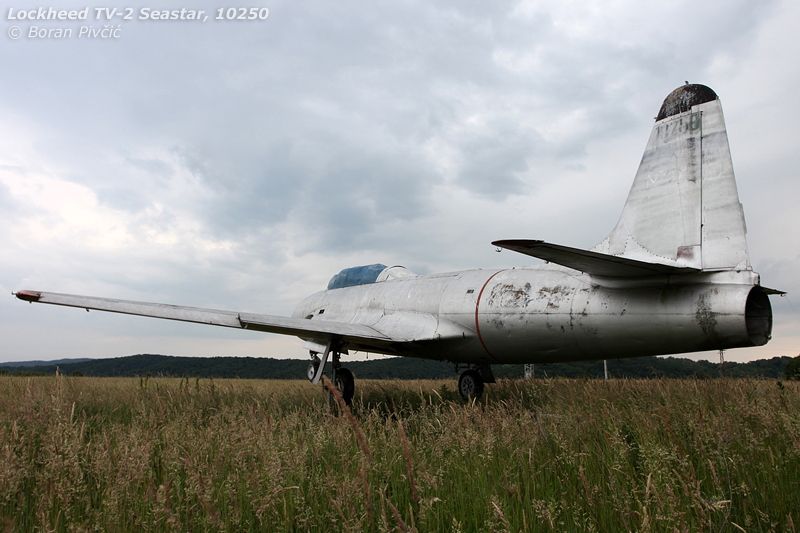
Sadly sharing the fate of the airfield, the Shooting Star that began this entry also has an interesting story to tell. Even though I’d labelled it as a T-33 purely for reasons of brevity, this ex-Yugoslav machine – coded 10250 – is actually a much rarer “TV-2 Seastar”, one of the T-33’s naval brothers. However, over the years these “brothers” have tended to cause some confusion, so for clarity’s sake it’ll help to clear them up first :).
Despite the dozens of names associated with them throughout their service history, there have only ever been two naval Shooting Star versions:
the TV-2 of 1949, at various times also known as the TO-2 and T-33B. Even though it was operated by the US Navy for the training of US Navy pilots, the TV-2 had remained a land-based aircraft, and had generally differed little from “standard” T-33As
and the T2V SeaStar, later known as the T-1 SeaStar. Made fully carrier-capable with the addition of catapult fittings and an arrestor hook, the T2V (developed in 1957) had also received new naval avionics, leading edge flaps (slats), a redesigned tail and rear cockpit, and significant structural enhancements to cope with the realities of shipborne operations. Interestingly, the T2V was also the originator of the “SeaStar” name, which had over the years also filtered – probably by association – down to the TV-2
Spot the differences: the carrier-based T2V SeaStar (foreground) with the land-based TV-2 (photo: Wikipedia)
Apart from adding yet more confusion to the already complicated world of the Shooting Star, the T2V’s entry into service had also, at a stroke, made many TV-2s redundant. Concurrently, a similar process was occurring within the USAF as well, as newer, more advanced aircraft slowly started to displace veteran T-33As. The combined effect was a market flooded with cheap, but essentially good trainers, just ripe for picking by smaller (friendly) air forces looking to modernize their fleets for the least amount of money :).
Yugoslavia – despite its socialist government – was no exception, and had by the early 60s snapped up more than 100 of these aircraft. The majority – about 55 by my count – consisted of TV-2s, with out example, 10250, being one of the last delivered… 🙂
Like many gate guardians in the country, 10250 is in a rather bad state - though it seems to have been spared more damage due to its remote location. As per what I've been able to find out, it's actually a relatively recent addition to the field, having been moved here around the year 2000. It had previously been located at Zagreb Intl. (LDZA) since its decommissioning in 1972 - and I believe I used to play on it as a kid back in the late 80s when my parents worked at the airport :D.
Very rarely used - except by the occasional lorry and light aircraft - the airfield's maintenance is essentially nonexistent, hence the overgrowth. The last time it had been used on any larger scale was back in 2006, when it was host to a local airshow
Definitely one of the most easily recognizable noses of the early jet era :). As well as "factory standard" TV-2s, T-33As and RT-33s, the Yugoslav AF had also operated the odd IT-33, a local reconnaissance modification broadly similar to the RT-33 (with I standing for "izviđač", or "scout")
Battered, but still proud, with an appropriate stormy background :). Only one other gate guardian Shooting Star remains in Croatia, located at Rijeka Airport (LDRI) on the island of Krk (though its status - and future - is rather bleak)


























 Achtung, Skyhawk!