Even though the Croatian Police’s drive to re-equip its air wing is pretty much old news here – with the first two additions, EC-135s 9A-HBA and HBB, having been flying their Fenestrons off for two years now – announcements of the impending arrival of a third machine had once again considerably piqued interest here at Achtung, Skyhawk!. The excitement was all the greater since the whirlybird in question was of a somewhat higher caliber than all the others, taking the form of the imposing (and loud!) AgustaWestland AW139 – in short, the largest and most powerful Western-built helicopter ever operated by a Croatian law enforcement agency.
Predictably enough, the magnitude of its arrival was not lost on me – so it was a given that I would be there to greet it when it alighted at Zagreb Airport (ZAG/LDZA) on 20 January for its formal handover ceremony… 🙂
Looking impressive and powerful in front of the Croatian Gov’t hangar following the formal end of the ceremony. Though this was I-EASM’s first visit to Zagreb, it was not its first time in country, having spent the previous night at Pula Airport (PUY/LDPL) halfway into its delivery flight from Varese in Italy.
Completed in December 2015 with the serial 31715, I-EASM will eventually carry the identity 9A-HRP, thus becoming the sixth distinct helicopter type operated by the Police since Croatia’s independence in 1991 (and the seventh overall since the formation of the air wing in the 60s). Unlike the aforementioned EC-135s, the AW139’s raison d’être is solely border surveillance, being part of an extensive assistance package from the EU to help reduce the porosity of what is now the Union’s second largest land border with non-EU lands (at 1198 km/745 miles, just 115 km/71 miles short of Finland’s border with Russia). Interestingly, current plans also call for a second example, which is intended to join the fleet likely in July 2016… 🙂
Rolling in slowly for the benefit of the press while the morning haze does its best to spoil the lighting. Despite being intended primarily for patrolling the country’s long land border, I-EASM is also equipped with a powerful winch on the right side of the fuselage, enabling it to provide a secondary sea rescue capability (which also falls under the header of border security).
While the AW139 may not have the most elegant fuselage cross-section around, its boxy shape makes it a good practical hauler, with lots of space, easy entry and egress and the ability to haul bulky cargo – or, in HEMS/SAR ops, a lot of vital equipment.
In addition to a nose-mounted EO/IR (Electro Optical/Infra Red) turret cam – a must-have item for any serious patrol duty – I-EASM is also fitted with a Trakka A800 IR spotlight, which greatly increases the precision and quality of both IR cameras and night vision systems (and can even “illuminate” underwater areas up to a depth of 5 meters).
Up front, business is as usual for a machine of this size and sophistication, with advanced digital avionics and automation prevalent throughout. Despite this, the machine’s controls are still a handful, with the collective (out of shot) particularly notable for its number of switches and pushbuttons.
A peek inside the voluminous cabin, rivaling – or even exceeding – that of the AB.212 9A-HBM which had so far held the title of the Police’s largest whirlybird. Of particular interest is the surveillance system operator’s station, which controls and integrates the turret cam, IR spotlight – and a very powerful surface search radar housed in the nose that boasts an effective range in excess of 200 NM. Despite its small size, it has been described as a very powerful system – which is pretty much the heart of the AW139 in this configuration.
Whatever the mission, entry and egress are made quite easy by large sliding doors that remain flush with the fuselage – and bear a resemblance to those of the legendary Huey. Another detail – though impossible to see here – is a integral flotation system for over-water operation, charged by two (very large!) nitrogen bottles located right behind the doors.
Brothers in… rotors. With the ceremony long over, I-EASM prepares to be pushed into the gov’t hangar, while HBB – preceded a few seconds earlier by HBA – hovertaxis out for its return to Lučko. The participation of both new Police helicopter types may have been somewhat of a “marketing gimmick” – but it nevertheless made for a smashing photo op!
Current Police fleet strength:
Agusta AW139: AW139 (9A-HRP)
Bell 206 JetRanger: 206B-3 (9A-HDB, 9A-HBZ) & AB.206B (9A-HBC)
Bell 212: AB.212 (9A-HBM)
Eurocopter EC-135: EC-135P-2+ (9A-HBA, 9A-HBB)
Update – 25 March:
As of mid-March, 9A-HRP has officially entered active duty, operating out of both Zagreb and the standard Police squadron base at Lučko Airfield (LDZL). Even though it had spent most of the subsequent days flying up and down the country on familiarization and training flights, some persistent camping at the field had nevertheless provided me with the opportunity to snap it in the act… 🙂
Approaching its helipad on a crisp spring afternoon following a two-hour flight from Dubrovnik (DBV/LDDU) in the extreme south of the country.
Even though autumn is in full swing here in SE Europe – with “formal” winter only a month away – the weather had apparently not been informed of this development, with constantly clear & sunny skies, light winds and 20 degrees Centigrade at noon being pretty much the norm. Not wanting to let this beautiful opportunity go to waste – and having been away from GA for most of the summer – I’d decided to use my free time productively and drive around looking for lighties to photograph 😀 . While most of the stuff in my immediate vicinity had already been featured here (ad nauseam in some cases), a research drive for an upcoming article had seen me visit Novo Mesto Airfield (LJNM) in neighboring Slovenia, bringing some fresh material to table. Combined with a few snaps left over from the summer, this should be enough to bring my readers a fresh dose of light aviation on the Balkans… 🙂
A small, odd airplane + parked on grass with muddy tires + a background of rolling hills and autumn colors = love at first sight. The irreplaceable magic of light aviation in one photo as “Alpendohle” warms up its engine for departure from Novo Mesto. A design that tends to raise some eyebrows, the BO-208 is actually a German-built version of the Swedish MFI-9, created at the end of the 50s as a light touring aircraft with utility potential. Even though it is pretty obscure today, the MFI-9 was also the basis for the larger and more powerful SAAB MFI-15 Supporter, which is still used for training duties by several Scandinavian air forces…
Even though it already boasts aircraft from the USA, Germany, Austria, Czech Republic, Poland, Russia, France and former Yugoslavia, Lučko had recently also become home to a little bird (emu?) from Australia. One of the most well known products of Australia’s present-day aviation industry, the Jabiru line of two- and four-seaters is still a rarity in Europe, and are sometimes hard to find even at specialized GA shows. Even though it carries a Slovak registration, OM-M902 – manufactured in 2008 and powered by Jabiru’s own 2200 cc engine developing 80 HP – is actually a former resident of Vinkovac Airfield (LDOV) in the extreme east of Croatia.
An airfield by the coast, clear blue skies, pleasant summer temperatures – and three Cessnas soaking up the afternoon sun… a scene that just begs one to go flying! Even though it still wears its original German colors, D-EBXS (mfd. 1977) is nowadays a permanent resident of Medulin Airfield (LDPM) in Istria, and is frequently seen flying panorama flights up and down the peninsula.
Something that any proper airfield should be: a cafe and restaurant, good company, a full hangar and and interesting little aircraft parked outside (a Robin DR-400-180 Remorqueur, D-EOSR in this case).
C210 Squadron. The only two operational Centurions in Croatia together on the Lučko apron. However, even though they are only two letters apart, the 210L and P210N are actually significantly different machines: DZP is a simple, basic model whose equipment levels do not differ much from other single-engine Cessnas – while N50DD is a top-of-the-line version, equipped with a turbocharger, de-icing systems… and a pressurized fuselage.
One of the newest gliders on the Croatian register waiting for its turn to be put to bed in the field’s main hangar. Restored and assembled by hand, GKB wears this simple – but eye-catching – scheme, which is in fact a copy of a similar paint job seen on another Schleicher in the Netherlands.
And finally, one of those gems that can only be found by careful hangar trawling. Even though, from a numerical perspective, the L-13 Blanik is to gliders what the Cessna 172 is to piston singles, its younger brother – the L-23 Super Blanik seen here – is a somewhat different story. Designed on the basis of operational experiences with the L-13, the L-23 had received a completely new T-tail with swept fin, a slightly larger cabin with a two-piece canopy – and had lost its flaps as a weight-saving measure. Despite noticeably increased performance in all areas, the L-23 had not achieved the popularity of the original – but had nevertheless noted significant success in the USA, where it was also used in the Civil Air Patrol.
Having recently gotten into a position where I do a fair bit of air travel (to put it mildly!), I had suddenly (and somewhat unexpectedly) found myself being served with ever-increasing opportunities to snap – up close – various flying machinery operating out of Europe’s major airports. While these naturally tend to be of the airliner variety (and therefore not the default topic here), every once in awhile I do come across a true gem, something so fascinating, rare and unusual that it immediately warrants a feature at Achtung, Skyhawk! 🙂 .
Even though snaps of these machines are still few in number – with my definition of “fascinating” mostly to blame 😀 – I feel they are nevertheless numerous enough for me to cobble together a short, but hopefully interesting, post for my viewers’ pleasure. For a bit of added “weight”, I have also decided to add a couple of shots taken “en route”, showing that the journey to the destination airport can indeed be half the (photographic) fun!
As a tool for doing business, a 737-200 bizjet may not really be the best of choices; but as a statement of style, very, very few machines come close! An absolutely stunning 1981 classic, VP-CAQ had – interestingly – never seen a day of passenger operations, having been delivered with an executive interior straight from the factory. Often seen flying all over Europe (despite the EU’s stringent noise regulations), at the time this photo was taken CAQ had already been parked at Dubrovnik Airport (LDDU) for several days, likely waiting on a client…
A photo that perfectly encapsulates a popular Croatian saying: “to have more luck than brains”! It’s not often one gets a spontaneous chance to photograph a VIP military transport on the apron of a major European aerodrome – without someone trying to chase you away! Enjoying the early morning sun on one of Vienna Airport’s (LOWW) remote aprons while waiting for Mr. John Kerry (who was in town to attend some nuclear talks).
An interesting visitor from the north easily standing out among the Citation and Falcon crowd at Zadar’s Zemunik Airport (LDZD). Operated by Germany’s Central Command for Maritime Emergencies, 57+05 is normally based by the North Sea and is used (as can be inferred from the titles on the fuselage) for detection and monitoring of sea pollution. Interestingly, this machine is not a classic Dornier-built example, but the NG model, produced in India by Hindustan Aeronautics and assembled in Germany by RUAG (the owner of the Do-228 type certificate).
Nature showing off what it can do as we maneuver around a growing towering cumulus near Zurich (LSZH), Switzerland. Easily visible are little pouch formations hanging beneath the cloud called “mammatus clouds”, which are an early indication that this cloud could eventually produce a heavy storm.
Enjoying the charming (and unbeatable) atmosphere of the cockpit at night as we cruise southwards across the Alps, roughly halfway between Munich (EDDM) in Germany and Klagenfurt (LOWK) in Austria…
Saluting the setting sun on another beautiful, calm and crisp summer evening. Traversing southbound above the Northern Adriatic Sea – just off the Istrian Peninsula and Pula Airport (LDPL) – we were treated to this fantastic view by a large high pressure area that had been parked over the region for several days…
By me All photos credited and copyrighted as noted
Even though, with all the fine flying weather we’ve been having, one would expect GA to be the talk of the town at Achtung, Skyhawk!, the end of July would see its crown briefly stolen (and in spectacular fashion) by the Croatian Air Force, which had suddenly – and seemingly out of the blue – gone on a PR offensive unseen in recent times 🙂 . While it often finds its way into the media one way or another, the AF had particular reason to be friendly this summer, first having finally completed its reformed MiG-21 force – and then having been given center stage in two major military parades scheduled for the beginning of August.
Wanting to make the best of all three occasions and improve the AF’s somewhat tarnished image, the Ministry of Defense had readily opened up its doors to journalists from all sides, allowing for yet another glimpse at its nowadays rare – but always fascinating – flying machinery… 🙂
Fleet In One
The first event off the blocks was the 22 July presentation of the reinvigorated MiG-21 fleet, fully overhauled and bolstered back to full strength by the acquisition of five second-hand examples from the Ukraine in 2013/2014. Now sporting 12 jets in total – four twin-stick UM models and eight single-seat bis variants – the fleet represents the largest concentration of combat aircraft seen here since the 90s civil war, and is slated to remain in service well into 2018 (when it is due to be replaced by a newer Western type). Brought up to partial NATO standard by the addition of a few bits of modern avionics – as well as equipment allowing them to safely operate in civilian airspace – all of the MiGs have been very active ever since cleared for duty, often flying multiple sorties a day, every day… a situation that had been nearly unimaginable during the fleet’s low period in the early 2010s 🙂 .
This renewed disposition – as well as a more relaxed attitude towards conserving the jets’ service lives – has allowed them to be utilized more aggressively and in more roles than before, with at least one flight per day pretty much the norm now. Apart from the obvious training (and photographic 😀 ) benefits, this had also increased the fleet’s reliability in its primary mission – the protection of Croatian airspace – which the MoD was keen to stress during that July morning at Pleso Air Base (ZAG/LDZA)…
NOTE: sadly though, I was prevented by flying commitments from attending myself, relegating my spot to Mr. Petar Mežnarek, a colleague of mine who had previously collaborated with me on another of my MiG-related posts.
Having limited offensive capabilities (a consequence of both age and cost), the fleet’s primary mission is defensive in nature, and centers around the tasks of “air policing”. Among other things, this involves the establishment of a Quick Reaction Alert (QRA) system, in which one or more armed jets (two in the CroAF’s case) are at readiness to take off on several minutes notice to intercept any unidentified or intruding aircraft within the country’s airspace. This capability was on this day demonstrated with a simulated mission, called a Tango (training) Scramble in military parlance. Note the ground start truck to the right, as well as replenishment air cylinders for the -21s pneumatic braking system.
133 and sister ship 132 (out of frame) rolling in after completion of the demonstration. In the standard QRA configuration, each jet sports two Monlya R-60 (AA-8 Alphid) short-range IR-homing missiles, and the distinctive BAK 800 liter (211 USG) droptank for increased operational range.
As good a place as any to catch some shade! Even though its bulbous circular fuselage gives an impression of size and bulk, the MiG-21 is actually a pretty small aircraft. While this limits the amount of fuel and armament that can be carried, it pays off in speed, climb ability and agility – though the latter may not be evident at “non-combat” speeds…
While it is a capable model in its own right, the twin-stick -21 certainly does look less threatening from this angle. The most obvious differences from the post-F-13 single-seat models are the smaller intake and intake centerbody (this version lacking a radar), only two pylons per wing, a less powerful R-13 engine with a different reheat system – and reduced fuel capacity due to the instructor’s cockpit taking up part of the space for the tank.
Even though it’s visually little more than a tube with wings, there’s something about the single-seat MiG-21 that never fails to excite the senses! Note also the matte black finish on top of the fuelage; a common feature on long-nosed aircraft, its purpose is to reduce glare from the paint job during operations in strong sunlight.
A sight that had – sadly – mostly gone from Europe’s skies. Among the last operational -21s on the continent, Croatian examples may eventually outlive all their contemporaries – though their respite from the chopping block is only short-lived…
And given that this is Achtung, Skyhawk! after all, where would we be without at least one light aircraft? Parked at the very end of the apron, this good looking Huron – sporting callsign “Duke 64” – had brought in Frank Gorenc, commander of the US Air Forces in Europe, for an inspection of the fleet.
Parade Lap
Even though the MiGs would be the stars there as well, the second and third events mentioned above would be of a different scope altogether, being based around the 20th anniversary of Operation Storm, a significant military action undertaken in August 1995 during the closing stages of the war. While yearly celebrations of this event are traditionally held on 5 August in the mountain town of Knin – the retaking of which was one of the main goals of the operation – the anniversary had this year also included a mass parade down one of Zagreb’s main streets (held a day earlier on 4 August), for which the Air Force (and even the Police) had been tasked with providing the aerial component.
And while both the original operation and the parade itself remain somewhat controversial in political terms, the latter had nevertheless promised to be quite a spectacle for the photographer, with the AF planning on bringing three examples of each of its aircraft types to the table (with the Police contributing three more machines). However, due to their sheer numbers – with seven types in the AF inventory and three with the Police – the logistics of accommodating them at a single air base had proven to be troublesome, leading to the decision to split them between Pleso (ZAG/LDZA), Lučko (LDZL) and Zemunik (ZAD/LDZD)*, depending on the infrastructure required by each type.
* these seven types also include the AF’s firefighting forces, consisting of the Air Tractor AT-802 and Canadair CL-415. However, due to extensive construction works (and the subsequent lack of space) at Pleso – and the inadequate runway at Lučko – neither could be accommodated at any airport in the Zagreb area, forcing them to operate from their home base at Zemunik, 190 km/103 NM away by the coastal town of Zadar.
Eschewing the parade grounds themselves for some up-close action – and not wanting to let either side down – I’d once again called on Petar Mežnarek for help, with him taking station at Pleso, and me (generally) camping out at my little grass airfield on the edge of town… 🙂
Base Lučko:
Agusta AB.212
Bell 206B-3 JetRanger III
Eurocopter EC-135P-2+
Mil Mi-8MTV-1 & Mil Mi-171Š
Zlin Z-242L
Three very welcome visitors – and the only airplanes to be based at Lučko – being checked out by ground staff prior to their participation in the general rehearsal on 2 August. Likely visiting the airfield for the first time, 402, 403 and 405 are normally based at Zemunik, and are – along with two other Z-242s – used for initial pilot training.
Firing up for their run in the parade itself. This had also marked the end of their visit to the airfield, with all three aircraft having proceeded direct to home to Zadar once their flypast had been completed…
You know your formation is good when even Mother Nature approves (despite the appalling weather during the rehearsal)! Though Storm itself was a strictly military affair, the parade had also included the presence of the firefighters and police, the latter represented by a three ship group composed of every type operated by the force. Of particular note for the occasion was the AB.212, itself a war veteran and participant to numerous medevac and SAR missions during the entire conflict (a significant few of which under fire).
The old and the new on approach to the Police helipad after their participation in the parade. Despite having been in country for two years now, the EC-135s are still a novel sight, and are often participants to every aerial event the Police is invited to. Despite their modern, gleaming looks, they are still often outshone by the old Bells, all of which had previously served with the the prewar Yugoslav Police – and in many cases, in front line service during the war.
Not that much different from an ordinary day around here! Even without the fleet returning from the parade, this is a perfect juxtaposition of Lučko: civilians, police & military in (almost) perfect harmony. However, 2 and 4 August had likely broken a few records, with the airfield witnessing five Mi-171s, five Bell JetRangers, three Z-242Ls and one each of the Agusta AB.212 and EC-135 – all starting up at once…
Sometimes keeping away from the epicenter of events can be a good thing. Saluting Lučko along the way, 131 and 132 are seen swinging back towards Pleso as the second of three pairs participating in the final flypast…
And, as a bonus, a badly-executed ad-hoc video clip from the 2 August general rehearsal, showing pretty much how would Apocalypse Now look like in a Croatian edition 😀 (and which features some whirlybirds I hadn’t been able to photograph in good light, the Air Force’s JetRanger IIIs).
Base Pleso:
Pilatus PC-9M
Mikoyan-Gurevich MiG-21bis & UM
A scene that had draw in visitors from Italy, Germany – and even the UK. Flying the first afternoon practice sortie on 1 August, 165 had left by far the best impression of the three MiGs out at that time, treating both spotters on the fence and in the tower to two memorable low passes. Interestingly, on all occasions, 165 would be piloted by Ivan Selak, with Ivica Ivandić riding in the back seat – who were two of the four Croatian pilots who had defected from the Yugoslav AF at the outset of the war.
The 1 August practice run had also included an appearance by the PC-9, transferred – like the Zlins – from Zadar to Zagreb for the duration of the parade. Nicknamed “Zubonja” (or “toothy” in loose translation, a generic name for CroAF combat aircraft sporting shark mouths), this particular machine was quite a treat, sporting celebratory markings for the type’s first 50,000 hours of operations in Croatia.
The traditional centerpiece of any larger aeronautical event in Croatia is the Krila Oluje (Wings of Storm) aerobatic team, which actually owes its name to the operation being celebrated. Even though there have been some upsets with the team of late – with a number of pilots leaving for better paid flying positions abroad – the replacement crews have gotten into their stride quite quickly, enabling the team to continue the team’s packed display schedule without major disruption.
Rocketing out of RWY 05 as the second of three pairs participating in the parade’s opening flypast. Due to the complexities of MiG operations – and their notoriously small fuel tank capacity – the whole airport had been closed to all non-military traffic for the duration of the event (roughly two hours).
The last of the six MiGs participating in the final flypast is seen touching down onto RWY 05 during the last minutes of the golden hour. Even though the estimates for the number of jets to be airborne had varied between three and eight, the final six had nevertheless not left anyone indifferent!
As was the case (nearly) every year so far, the arrival of our continental summer has once again become the trigger for a sudden and rapid reawakening of the light aircraft scene at Lučko :). Even though the flying season itself had already started several months ago, the long hours of daylight, ample public holidays and fine flying conditions of June have given it a much-needed kick, with all operations – private, training and skydive – quickly shifting into high gear (while it all lasts). And while the gear in question is a notch lower than in previous years – with Croatia still knee-deep in the financial crisis – there was nevertheless still quite a bit to see and snap! 🙂
A little airplane that is not often seen at Lučko preparing for a short afternoon flight above Zagreb. Normally based at Varaždin Airfield (LDVA) in the north of the country, DVW is among the best “classic” 172s here on the continent, and has already seen off its fair share of student pilots…
Sporting a new set of clothes, PET gives no indication whatsoever that it is almost half a century old. Still active in skydive circles, it had recently been thoroughly overhauled, and will soon get a purpose-built carbon-fiber skydive door on the right side.
Several of the many bits of local aviation history hiding in plain sight all over the airfield: a replica of the first aircraft designed, built and flown in Croatia, alongside a type that had given wings to entire generations of local pilots – and both inside a hangar that had previously been home to Bf.109s and Fiat G.50s when it was located at Borongaj Airport in the 40s…
The “disintegrating squadron” catching some sun on its temporary parking position in front of the tower. Manufactured in 1967 and 1978 respectively, BDR and DDA had not been off the ground in ages, with the former last noted in the skies in 2003, and the latter sometime in 2006 or 2007…
Always a welcome sight and sound, BKS is seen warming up for a skydive op in the nearby village of Kurilovec. Having to endure continuous operation at both high-power/low-speed and low-power/high-speed regimes, getting the engine’s internal temperatures into the green before flight is of vital importance – not only to preserve its stated service life, but also to prevent seizures and internal damage due to sudden temperature changes.
The newest resident of the airfield snapped after participation in a local precision landing championship. The only DG-300 in Croatia, 1985-vintage D-2871 is also one of the best-equipped gliders in the area, sporting two competition digital VSIs, a GPS unit – and even a FLARM system (a miniature ACAS designed specifically for use in gliders). Interestingly, despite being a German design, the DG-300 line was manufactured in Slovenia by the Elan works, famous locally for their extensive range of high-quality sporting equipment (particularly skis and sailboats).
As I had already noted in a previous post, the world of social media – while often tenuous – can on occasion also be a fantastic (and nearly inexhaustible) source of inspiration and information on pretty much any topic conceivable. Having already been responsible for two of my historic articles to date, Facebook (for one) must take the plaudits for #3 as well, having led me (by a roundabout way) to probably one of the most interesting aeronautical projects in the region 🙂 .
While browsing a local aviation group one day, I chanced to stumble upon an unusual photo of a partially-disassembled North American F-86 Sabre wearing the tell-tale colors of the Yugoslav Air Force. Instantly intrigued, I’d started digging a bit deeper, eventually discovering that it is actually an in-progress restoration job going on next door in neighboring Slovenia. Naturally enough, it did not take me long to find and bother the people responsible, eventually managing to set my sights/viewfinder) for the towns of Kranj and Pivka in the hilly west of the country…
Boran in Wonderland
While it cannot match the scale (nor financial backing) of similar endeavors further out west, this project is nevertheless a sight for sore eyes, and represents one of the most detailed aviation preservation works undertaken since the fall of Yugoslavia. Headed in the hands-on department by Mr. Alojz Potočnik, the Sabre’s restoration is actually part of a much larger museum drive jointly led by several notable Slovene institutions, including:
the Pivka Park of Military History (Park vojaške zgodovine Pivka), which has been given long-term use of the aircraft and will display it in its own collection
the Slovenian Army Military Museum (Vojaški muzej Slovenske vojske), which is formally the owner of the aircraft and whose custodian – Mr. Matjaž Ravbar – is responsible for the historical and technical accuracy of the restoration
the Slovenian Army (Slovenska vojska), which has provided some of the workforce for the restoration work
and the Pivka Municipality, which has – in this instance – fronted part of the restoration costs, with the rest having been made up from various EU funds
Though the Sabre was the one item that had initially caught my eye, the project also includes the preservation and display of several other aircraft that had previously flown with the Yugoslav Air Force – or had played their part in the defense of Slovenia during Yugoslavia’s violent dissolution in 1991. Numbering at four machines so far – two already displayed and two (the Sabre included) still in the works – this project is well on its way to becoming one of the highest-quality aeronautical collections in the region, and is already beginning to draw in an ever increasing number of visitors – some even from well outside the former borders of Yugoslavia. One of these, however, had decided to askew the normal tour program, electing instead to start straight at the source: the workshop of Mr. Potočnik 😀 .
The place where a number of the Park’s non-winged exhibits also came from, it was on this day home to two aircraft which, on the face of it, should not really rate all that high on the rarity list: the West’s most produced jet fighter – the Sabre – and the world’s most produced fighter, the MiG-21 🙂 . Standing at 9,680 and 10,645 examples produced respectively (excluding Chinese-built versions for the latter), both are still present in significant numbers on the airshow circuit, with the -21 still clinging on in front-line service even with several forces in the European Union*.
* Bulgaria, Croatia and Romania to name them. While the type is also in use in Serbia, it has been relegated to secondary roles and exists today in small numbers only.
However, the actual machines present here were of a different class altogether, representing first the exceedingly rare IF-86D – a Yugoslav home-brewed reconnaissance version of the “big Sabre” – and then the MiG-21F-13, the type’s first ever operational variant. In various stages of restoration (with the MiG significantly closer to completion), they had both promised to provide fantastic insight into the restoration process – as well as allow me to sneak a peek at some of their inner workings… 🙂
1. North American IF-86D-41-NA Sabre, 14325
Even though it shares the name, designation and general stature of one of the West’s most prominent fighters, the first machine to be featured here is actually somewhat of a black sheep within the extended Sabre family tree. Longer, wider, heavier and faster than all of the originals, the D model – often called the Sabre Dog – is in reality a separate type altogether, owing only its basic configuration (and various other bits of DNA) to the stock F-86…
Even without most of its extremities, the Sabre Dog is still a sizable piece of machinery. While it may look compact (like the original Sabre), it actually stands 12 meters from nose to tail – more than the wingspan of the Cessna 172.
Originally intended to be called the F-95, the D model can trace its roots back to the end of the 40s and attempts to turn the day-only Sabre into an advanced, all-weather fighter that could cope with the masses of Soviet bombers anticipated to eventually head for US borders. Faced with the need to carry both advanced weaponry and a bulky early-gen radar – AND then get both up to intercept altitude in a reasonable period of time – the new aircraft had immediately warranted a significantly more powerful engine, as well as a modified fuselage to accommodate the lot. Dispensing with the 23 kN General Electric J47-GE-13 of the later A models, the D would solve the first problem by being fitted with a reheated version of the same engine – the 33 kN J47-GE-17, later replaced by the 34 kN -33 – whose long reheat system and exhaust pipe had necessitated a one-meter fuselage stretch.
Its intended task as a bomber hunter had also brought about a rethink of its armament solutions. Rather than rely on old-fashioned guns – which were considered to be ineffective against dense, clumped masses of heavy aircraft – the Sabre Dog was to be armed with 24 70-mm “Mighty Mouse” Folding Fin Aerial Rockets (FFARs), housed in an unique retractable tray located on the underside of the fuselage. Wide by necessity – in order to accommodate the largest number of rockets possible without being too tall – the tray too had come to define some of the dimensions of the fuselage, being responsible for a small (but nevertheless noticeable) increase in the D model’s girth 🙂 .
In order to be able to find the bombers it would fire its mice at, the Sabre Dog was also fitted with an AN/APG-36 search radar, housed in a distinctive radome on the upper lip of the intake. With an effective range of some 55 km (30 NM), the radar was slaved to an (at the time) advanced fire-control system, allowing the aircraft to zoom in behind an enemy formation, discharge its rockets in a pattern calculated to inflict the maximum amount of damage – and then zoom out while still remaining (more or less) outside the presumed range of the formation’s defensive guns.
But, while all of this may sound solid in theory, in practice the aircraft had suffered from a number of serious shortcomings – all of which were a consequence of its transformation into something the original Sabre was never designed to be. The Mighty Mouse system, for example, was shown during tests to be inaccurate and ineffective; the aircraft’s sheer bulk had required a high landing speed and, by association, a long runway; the J47’s add-on reheat system was prone to malfunction – and the aircraft was generally too complex to handle by the average single pilot. All of this had, in fact, earned it the unflattering nickname Sabre Dog – alluding more to it being an under-performing “dog” than a separate model of the F-86 🙂 .
Nevertheless, between 1957 and 1961, the F-86D would be one of the mainstays of the US’ aerial defenses, until being supplanted and eventually replaced both by new aircraft types and upgraded versions of itself (most notably the much-improved F-86L). Its withdrawal from service had immediately led to a strong export drive, intended partly to recuperate as many of the funds invested into its acquisition as possible – but mostly to help shore up Europe’s WW2-battered defenses against the threat of the USSR**.
** following the formation of NATO as a functioning force, the US had instantly sought to strengthen the edges of Western Europe – and create a protective buffer for itself along the way – should the Union’s sabre rattling suddenly become less benign. Still not having caught their industrial breath following the ravages of WW2, countries such as Italy and West Germany were thought to be particularly vulnerable, leading to the decision to sell them – often for next to nothing – both surplus hardware from the war, and newer metal that could achieve a measure of parity with whatever the USSR could throw at them. Known as the Mutual Defense Assistance Program – MDAP – this project would eventually be responsible for most of the US machinery operated by West European forces throughout the 60s and early 70s.
Even though it was somewhat on the wrong side of world politics, one of the type’s customers was also Yugoslavia, at the time looking to modernize its leftover WW2 fighter and ground attack forces (then made up of an eclectic mix of local, US, British, German, Italian and Russian machinery). Even though the 1961 sale of 130 examples (comprising 36, 41, 45 and 50 series jets) to a communist country had caused a bit of an uproar at home, the US government was nevertheless quite forthcoming, especially since Yugoslavia had already operated the Lockheed T-33, Republic F-84 and Canadair-built “straight” Sabres – all important bits in trying to lure the country (which has always been non-aligned) to its side of the Iron Curtain.
While all of these jets would go on to lead variously interesting lives – some having already been earmarked for cannibalization on arrival – the ones of special interest to us were the 32 examples intended for conversion into home-grown photo reconnaissance platforms 🙂 . Done by the Jastreb (goshawk) works of Zemun, Serbia, this modification had quickly become known as the IF-86D (I – izviđač, scout), and had entailed the replacement of the Mighty Mouse system and its launch tray with a custom fit of three Kodak K-24 downward-facing cameras***, as well as the addition of underwing mounting points for target illuminating flash bombs. Apart from this, the jets would remain the same in all other aspects in order to keep maintenance costs down to a minimum.
*** interestingly, the Sabre Dogs would not be the only machines to receive this treatment. Another notable type to be modified so was the TV-2/T-33B, designated the ITV-2 and IT-33
However, how and where 14325 fits among them is still subject to some confusion, since the machine’s true identity and lineage have not yet been conclusively established. Upon their arrival into the YuAF inventory, all 130 jets had been allocated codes in the 14001 to 14130 range; however, one modified into the IF-86 standard, the 32 jets selected were re-coded as 14301 through 14332. While the serials for all 130 are available through public channels, they are referenced only to the original codes, and are not correlated with the IF “re-branding” – making even the Park and Museum unaware of 14325’s full and complete history. The level of uncertainty is such that in some channels the aircraft was rumored to actually be 14307 – though this had been disproved by the Museum.
Whatever its case, a helpful fact is that all of the recce Sabres had stuck together their entire lives, flying first with the 184th Reconnaissance Aviation Regiment from 1963, and then with the 352nd Reconnaissance Aviation Squadron when the former disbanded in February 1966 – both of which had been based at my home airport, Zagreb (ZAG/LDZA) 🙂 . Interestingly, the IF would have relatively short service lives, having been withdrawn from use already in 1967, formally struck of the active inventory list in 1968 – and then replaced by MiG-21Rs when the squadron moved to Željava Airbase on the border of Bosnia and Croatia****. As was the case with other types being pulled completely from service, several IF-86s had soon ended up as gate-guards across former Yugoslavia, with 14325 being posted at Ljubljana’s Brnik Airport (LJU/LJLJ). Interestingly, once displayed, it would be given the code 14146, a fictitious out-of-sequence identity never used in actual service.
**** an interesting side-story is that the squadron, its aircraft and new base would later go on to play an important part in modern Croatian history. On 25 October 1991, (then) captain 1st class Rudolf Perešin would fly the squadron’s MiG-21R 26112 to Klagenfurt, Austria during a reconnaissance sweep of Slovenia, becoming the first Croatian pilot to defect from the YuAF during the 90s civil war.
It would then stay at Brnik for the better part of 40 years, being forced to endure the fate of nearly all non-museum aircraft in the region – a slow death by atmospheric wear and sheer neglect. By the time it had been taken under Mr. Potočnik’s wing in 2014, 14325 had suffered extensive corrosion to parts of its structure, a tear in the lower aft fuselage – and the attentions of local scavengers and scrap-metal dealers. Thankfully though, all of the damage was deemed repairable (albeit with a lot of work!), making the aircraft an ideal candidate for restoration and display at the Park…
Even though they were dissimilar in a number of respects, the biggest differences between the normal and Dog Sabres were up at the front. Far more complicated than its gunsight & guns-only little brother, the F-86D had in reality needed a second crew member to operate efficiently; however, the Sabre’s front fuselage was ill-fitting for the addition of another seat, forcing North American to equip the Dog with some of the first computer systems ever fitted to a combat aircraft in order to keep it functioning as a single-man machine…
A close-up of the custom camera fit. An American modification of the 1920s British F24 device, the K-24s were also used on the IT-33, and had likely been obtained cheap during one of the West’s post-war “junk sales”.
Perhaps the most surprising detail on the F-86D is the sheer size of its engine. Complete from the tip of the intake centerbody to the exit of the tailpipe, the J47-GE-17B stands at 1.8 tons in mass – quite an increase from the original 1.5 ton J47-GE-13 of the regular Sabre.
2. Aero S-106, 22542
The second aircraft present in the shop though was perhaps even the more attractive one – if anything for the visceral appeal of the MiG-21 shape to a person used to seeing it his entire life 🙂 . Looking like it had just rolled off the production line, its sleek curves accentuated by the bare-metal finish, 22542 will eventually become one of only two F-13s displayed in the lands of former Yugoslavia – and one of the preciously few first-gen models of any sort to be found in this part of Europe…
Quite an evocative sight even without its wings! While keeping track of all the myriad MiG-21 versions can be a daunting task, the elegant F-13 can easily be recognized by its smaller intake and intake centerbody (lacking the radar of the later models), the smaller dorsal hump (which would on subsequent models be enlarged to include additional avionics and fuel), the forward-hinged one-piece canopy – and the Pitot-static tube located under the intake (not fitted here).
However, while it may look, smell and feel like a genuine YuAF example, 22542 is in reality a former Czechoslovak machine – which actually makes it an S-106, a MiG-21F-13 produced under license by the Aero Vodochody works near Prague (makers of the superb L-39 Albatros trainer) 🙂 . Having never had anything to do with Yugoslavia throughout its service life, now-22542 was manufactured in 1965 with the serial 560313, becoming 0313 when delivered to the Czechoslovak AF on 6 December of the same year.
Destined to spend its entire flying career on training duties, 0313 was first allocated to the Air Force Training Center at Přerov Airbase (PRV/LKPO), from which it would be transferred to the 1st Training Regiment (based at the same base) upon the latter’s formation in September 1973. Second in longevity only to Albania’s Chengdu-manufactured F-7s, 0313 and its squadron mates would eventually go on to become some of the oldest F-13s still flying in Europe, with 0313 itself struck off the military registry only on 19 June 1990 – and with just shy of 1,393 hours on the clock. Shortly afterwards – on 17 July to be precise – it would be transferred to the military aviation museum at Prague’s Kbely Airport (LKKB), where it would remain until acquired by the Military Museum in 2011 and picked up by Mr. Potočnik in 2014.
While the original intent had always been to restore an authentic Yugoslav machine, the inability to acquire one had forced the restoration team to think laterally and look elsewhere for a replacement. However, while they now had an aircraft to paint, its lack of a “Yugoslav pedigree” had meant that giving it an actual YuAF code would have been stretching history and accuracy to their limits – leading to the decision to simply give it a fictitious identity.
The task of choosing this new ID was – interestingly – pretty straightforward. Known in service as the L-12 (L – lovac, hunter), the YuAF had operated a total of 41 F-13s, all delivered between 1962 and 1966 – and designated 22501 through 22541. Slotting itself nicely into the sequence without causing too much historical disruption, the new addition was simply christened 22542 🙂 . Near completion at the time of writing, the aircraft will soon join the Park’s collection, and be displayed alongside the Sabre and two other machines in a new, purpose-built museum hall.
Very near its final form, outstanding items on 22542 include fitting the wings (which are already refurbished), slotting in its original engine and completing the restoration of the cockpit.
However, a close-up view maybe best illustrates the level of effort and attention to detail invested in the work: all of the ground crew instruction labels from nose to tail (and there are a lot of them!) have been reproduced in both the correct font and terminology… some rough parts still remain, but I’ve been told they’d be smoothed out before the aircraft goes on display.
Not the best of shots, but gripping a ladder with one hand and the camera with the other doesn’t leave you much in the way of options! One of the major sections still needing work, the cockpit will eventually be completed to in-service YuAF specs. But even as it is, it’s in quite a good nick given the difficulties of obtaining proper equipment for early generation models…
Looking remarkably like someone had sunk a MiG-25 into the ground, 22542’s wings wait to be mated to the airframe. Fully completed, they only lack their weapons pylons (one per wing), which are stored in a nearby garage.
A Walk in The Park
But, to fully appreciate just where these two restorations are going – and how much effort will yet be put into their work – one also needs to see and admire some of the “finished products” :). As mentioned in the opening entry, two completed machines – restored during an earlier phase and financed by the Army – are already displayed at the Pivka, and kept under the watchful eye of the Park’s expert associate, Mr. Boštjan Kurent. Continually maintained and meticulously cared for, both aircraft go quite some distance beyond normal museum specs and retain pretty much all of their operational fittings – including the engines and complete cockpit setups…
3. Republic F-84G-31-RE Thunderjet, 10642
The first of the pair to be featured, 10642’s story in many respects closely parallels that of the IF-86. However, while it too was produced in significant numbers – with 7,254 examples completed – the Thunderjet is nevertheless a much rarer sight today, with virtually all of the few surviving examples confined to a couple of (distant) museums in the West. Even more astounding is the realization that of the 231 (!) F-84s delivered to the YuAF, only 10642 and 10525 (of the Aeronautical Museum in Belgrade) still stand as display-grade examples, with most of the rest having either been sold or scrapped ages ago…
An odd-looking thing from any angle, the F-84 was once the spearhead of the Yugoslav Air Force’s modernization drive, and could be found at pretty much every significant airbase. Quite an irony then that existing examples have been whittled down to just 1% of the original fleet…
Looking quite fresh for its age (which says a lot about the quality of the restoration work!), 10642 had rolled off the production line in 1953 as part of the type’s third production series. Sporting the factory serial 3050-1829B and provisional USAF identity of 52-2910, it would be delivered the same year to the Italian Air Force, becoming MM52-2910 of the 5 Aerobrigata.
Following the end of Italian F-84 operations in May 1957, 10642 would be transferred to the Yugoslav Air Force as part of the continuation of MDAP, where it would take up its current identity as part of either the 82nd or 172nd Aviation Regiment of the 21st Division (the details are a bit hazy) based at Zemunik Airbase (ZAD/LDZD) on the Adriatic coast. Like virtually all newly-acquired aircraft at the time, 10642 would for awhile sport the original colors of its previous operator – bare metal in the case of the Italian AF – before being repainted into YuAF’s standard camouflage pattern some years down the line (as more funds became available).
At some point during its lifetime, 10642 would be transferred to the 82nd Air Brigade stationed at Cerklje ob Krki Airbase, Slovenia (LJCE), where it would continue to serve until its retirement in 1971. As was the standard modus operandi at the time, a couple of the type were picked up and placed as gate-guards at various locations of note, with 10642 having been allocated to Brnik alongside Sabre 14325 – gaining, like the latter, a non-existing identity (10914) in the process. Here it would remain unkempt for the next thirty or so years, before finally being rescued by Mr. Potočnik and the Museum in 2008.
Having been exposed to the elements – including high winds and snows – for more than three decades, the aircraft was, unsurprisingly, in a pretty poor state, requiring an extensive ground-up restoration that would continue well into 2013. Emerging from it looking like it had just rolled off the production line, 10642 was then placed in the open in the Park – from where it will move to the aforementioned permanent indoor location in September of 2015.
As was the case with the -21, 10642’s restoration had gone far beyond just making the aircraft look presentable. Accurate down to the millimeter, the refreshed scheme even includes all of the ground crew handling instructions – what I was told was one of the hardest part to get bang-on right.
4. Soko HO-42 Gazelle, TO-001
Conversely, the last machine on the list doesn’t really have much in the way of rarity on its side; however, what it lacks in that department it certainly makes up for in historical significance 🙂 . The Park’s only rotary-winged exhibit, TO-001 is often hailed as one of the most important aircraft in newer Slovene history – and is still ranked as one of Mr. Potočnik’s (and his team’s) best restorations…
The instantly recognizable shape of the Gazelle sticks out with ease even in a room full of armored vehicles! An intriguing exhibit, this part of the Park is devoted to the beginnings of the Slovenian military in 1991, and illustrates well the unavoidable mismatch in ground and air equipment that had been the case in Croatia as well…
Locally still considered to be one of the very few aircraft of any sort to fully live up to its name, the superlative Gazelle has always had a special connection to Yugoslavia, having been the mainstay of its light helicopter forces ever since its introduction into the YuAF in 1973. Still flying on the front lines in Serbia and Bosnia and Herzegovina today, the SA-341 is pretty much part of the aeronautical landscape, a reputation no doubt due to both its stellar flight performance – and its long-lasting license production***** by the Soko works in Mostar, Bosnia.
***** of interest, during the 70s and early 80s, Yugoslavia had gone on a number of mass hopping sprees all throughout the West, purchasing significant batches of everything from the Cessna 150, via the Bell 212, to the HS.125 bizjet. Numbering well into the treble digits of machines, the intent of these acquisitions was to prop up the country’s aviation sector by equipping flying clubs, schools, government agencies, larger companies – and even police air units – with modern, capable Western hardware.
Interestingly, all throughout the deal, the country’s purchasing committees had always shown a clear preference for aircraft designed in the US, but if at all possible manufactured somewhere in Europe – or even at home, if the production capabilities so allowed. Thus most of the smaller Cessnas bought were actually Reims machines – and most Bell helicopters were in fact Agustas (the only exceptions were aircraft not produced anywhere but in the States). Eventually, the only type to be built whole in Yugoslavia was the Gazelle (starting in 1978 from knock-down kits) – though license manufacture of various components (such as the Bristol-Siddeley/Rolls-Royce Viper turbojet) had been relatively widespread.
To differentiate them from original French-built examples (only 21 of which had ever been delivered to Yugoslavia), Mostar-produced examples came in a variety of designations******, including:
HO-42: a basic version equivalent to the military-export SA-341H (HO – helikopter opšti, general-purpose helicopter)
HI-41 Hera: a reconnaissance and artillery-fire correction model based on the HO-42 and equipped with the Hera gyro-stabilized laser range-finding system (HI – helikopter izviđački, scout helicopter)
HS-42: a MEDEVAC version based on the HO-42 (HS – helikopter sanitetski, sanitary helicopter)
NH-42M GAMA: an armed SA-341 sporting the 9M14M Malyutka wire-guided anti-tank missile and the Strela-2M air-to-air missile (NH – naoružani helikopter, armed helicopter; GAMA – GAzela MAljutka)
HO-45: another basic version, but based on the more powerful SA-342L
NH-45M GAMA: the same as the NH-42M, but based on the HO-45
****** another interesting tidbit is that the Yugoslav military designation system had often contained numerical references to WW2. The 41 in HI-41 thus refers to the start of the war in Yugoslavia (initiated by the Axis invasion on 6 April), while the 42 in HO-42 refers to the year Partisan forced had first really made themselves felt in their fight against the German Army. And the 45 is rather obvious 😀 .
One of 157 examples made in total, TO-001 can trace its roots back to the second production batch of HO-42s, leaving the factory floor in 1979 with the serial 028 and YuAF code 12660. There follows a two-year gap in activity that I could not account for, but in 1981 it would be allocated to the 894th Helicopter Squadron for Reconnaissance and Signals based at Brnik. Its subsequent history would be relatively uneventful (apart from a minor landing incident in 1984) all the way until 25 June 1991, when all helicopters based at Ljubljana were transferred to the Šentvid Barracks north of town – just days before one of the opening shots of the 90s war, the 28 June aerial attack on Brnik.
Two days later on 27 June – the day Slovenia had declared its independence from Yugoslavia – the unit was deployed east to monitor the Slovenian-Croatian border, with 12660 additionally tasked with airlifting an injured soldier to hospital in the town of Maribor, located in the north-eastern corner of the country. The next day – 28 June – when piloted by captain 1st class Jože Kalan and aviation technician sergeant-major 1st class Bogo Šuštar, 12660 had defected to the Slovenian Territorial Defense forces, flying west out of Maribor at high speed along the Slovenian-Austrian border, and onwards to the Golte forest where it landed at a winter sports facility and surrendered.
Having subsequently been moved several times to confuse enemy intelligence – even hiding on farms on occasion – the helicopter would, in the event, play no further part in the war. Nevertheless, it would soon be rechristened TO-001 (TO – teritorijalna obrana, territorial defense) and named Velenje, a homage to the Slovene town of the same name whose TO ground units were tasked with its protection while on the run. In 1992 though, it would be transferred to the civil register as SL-HAA (SL being Slovenia’s first post-independence prefix, before being allocated the current S5) and repainted into an aquamarine scheme reminiscent of 70s Bell JetRanger factory colors. It would then continue to fly with the 15th Brigade of the nascent Slovenian Air Force, serving mostly in various training and light transport roles.
All of this would come to an end however on 21 June 1994, when (now) S5-HAA had suffered a landing accident at Kočevski rog in the south-east of the country. Deemed to be beyond economical repair (as the only one of its type in-country), it was instead restored to display status and in 1996 installed as a gate guard in front of the 15th Brigade’s HQ at Brnik. But, like Thunderjet 10642 and Sabre 14325, it had suffered greatly from its exposure to the weather (even though it was outside for a “mere” decade only), leading to a drive to restore and preserve it once again as an important part of the country’s recent history.
Taking place from August 2008 to its unveiling at Pivka on 27June 2012, the restoration effort is still hailed as one of the biggest aeronautical history projects in Slovene history, and had involved a sizable team of 26 people – including numerous active military personnel and the crew that had flown it over on 28 June 1991 🙂 . As is the case with the Thunderjet, the work had gone far beyond the usual museum standards, going on to include the entire cockpit, all ancillary equipment – and the complete Astazou IIIA engine…
Attention to Detail 101. In order for the scheme to be as historically accurate as possible, during restoration TO-001 was first painted in its 12660 guise – and then its markings were covered up and superficially repainted in nearly exactly the same manner as in 1991…
I would also like to extend my sincerest thanks to: Messrs Potočnik and Kurent for their time, friendliness and forthcoming assistance; Mr. Svetozar Jokanović of the “YU vazuhoplovna istorija” group for information about the YuAF recce Sabres and their service lives; and Mr. Tomaž Perme for information on the project’s organization and various corrections of the machines’ individual histories!
When I had published my first derelict MD-80 story back in February of 2014 – featuring Maribor-based MD-82 S5-ACC – I had pretty much believed that to be that as far as this whole topic was concerned. And while there were several other abandoned Mad Dogs scattered throughout the region (two of which were in Croatia), all of them were pretty much inaccessible, shoved away into some remote corner of a commercial aerodrome and left to the elements. Sometimes of uncertain legal status and often with a fair bit of notoriety to their names, I had half expected them to either be broken up and scrapped – or disintegrate on their own – before I ever got the chance to snap them up close…
As it happens, I was somewhat wrong on that account, since one machine did indeed survive to be used again – sort of 🙂 . The aircraft in question is universally known to the locals as 9A-CBG, and had once flown with one of Croatia’s first post-independence private carriers, Air Adriatic (once also the parent of S5-ACC, known then as 9A-CBD). Unlike the latter though, CBG had changed considerably over the years, transforming from a sad, rotting hulk – and into a smoky, and quite interesting, firefighting trainer 🙂 .
No guts, no glory… and no engines, wings or interior either! Still wearing its given name from the days of Air Adriatic, CBG is nowadays named for irony!
Fire in the hole… hold!
Unlike most members of the MD-80 family, CBG had led a positively dull life, only ever flying with two operators – quite the anomaly in the Mad Dog world 😀 . Wearing the serial 49430 and line number 1334, CBG would first take to the skies on 11 November 1985, sporting an unknown (but likely subsequently reused) test registration. Interestingly, it would be more than a year before it appears in any online fleet list, joining the ranks of Italy’s flag carrier Alitalia in the very last days of December 1986. Taking on the identity of I-DAVI, it would remain in Italian service for nearly 20 years*, before finally being transferred (via leasing provider Azzure Holdings Ltd) to a rapidly expanding Air Adriatic in January 2005 🙂 .
* I-DAVI would not be the only Alitalia example to head east. The Air Adriatic fleet had also included ex I-DAVH (9A-CBF, 49221/1330) and I-DAVG (9A-CBH, 49220/1319).
Like its sister ships, CBG (now named “No guts, no glory”) would be put to use in the carrier’s various charter operations, where it would remain until September 2005. It would then return briefly to Italy, having been wet-leased to operator MyAir (along with the aforementioned 9A-CBD/S5-ACC) until November of the same year.
However, the difficult operating economics – among other unfavorable realities – of airline flying in Croatia at the time head meant that pretty soon the carrier had found itself in an increasingly unenviable financial position. With its back being pressed ever more firmly against the wall, Air Adriatic had started shedding its (by now) eight-strong MD-82/83 fleet already in late 2005, entering 2006 with just five machines on its record. The company’s downward spiral had continued all throughout the year, until – with just three MDs to its name – it had lost its Air Operator Certificate (AOC) in March of 2007…
The final nail in the carrier’s coffin, the revocation of its AOC had firmly grounded the remaining jets where they stood. In the case of CBG, this was Rijeka Airport (RJK/LDRI), a small regional gateway located on the island of Krk and serving the coastal town of Rijeka – once home to Air Adriatic’s HQ. Unfortunately though, even though it was stuck on the company’s doorstep, there would be no reprieve for CBG, since the company’s financial collapse – and its subsequent inability to honor lease and operating payments – had meant that the aircraft would certainly end up embroiled in long and complicated legal proceedings. And so it came to be: caught in no man’s land, CBG would be left to rot and disintegrate in the corner of the apron…
Though it had not had the good fortune of its former sister ship CBD/S5-ACC, CBF would nevertheless eventually manage to find a new meaning in life :). Scrapped in November 2012 according to some sources, the aircraft was actually modified into an unusual low-budget firefighting trainer for the Rijeka Airport firefighting brigade. Now called the Dim-12 (“Smoke-12”), CBD’s conversion had primarily entailed a drastic shortening of the fuselage, a clean strip of all interior fittings – and its mounting on a trolley so it can be towed to whichever part of the airport it is needed at. Thankfully for me, at the time of my visit to the airport it was not engulfed in smoke, allowing me and my camera a closer inspection… 🙂
Gives a whole new meaning to the term “short-body DC-9”! Constrained by the lack of apron space at Rijeka, CBG has been shortened to almost comic proportions by the removal of the entire fuselage section from the 1L passenger door to aft of the wing joint. However, the cut was done with forethought, since in this form the Dim-12 includes access both through a normal passenger door, the aft airstairs and the right-hand side baggage hold door – allowing firefighters to train for quite a number of contingencies.
A peek inside. Cleaned out to the bone, the interior only contains those elements which require firefighting practice. Being a cheap-and-cheerful job, the Dim-12’s smoke system consists of portable smoke generators, requiring minimal conversion of the airframe.
A closer (though sadly backlit) view of the joint between the aft fuselage and nose section. The oval area at the bottom would on normal MDs be covered by the aft wing mount fairing.
I would also like to extend my sincere thanks to both the Rijeka Airport ground team and firefighting service for the opportunity to snoop around!
Even though this year’s flying season has already started to pick up at Lučko – albeit slowly – there’s still not all that much going on to provide for a steady stream of quality photo material. Having been invigorated by several days of straight sunshine and 20-odd Centigrade temperatures, I was, however, desperately itching to photograph something with wings, be it big, small, fast or slow. Not unexpectedly, this desire had in the end taken me to Pleso (LDZA), which – while a bit weak on the GA front – nevertheless has a number of other gems at its disposal… 🙂
One of several MiG-21 flights of the day, “Knight 96” is seen recovering into RWY 23 after a training flight. The morning had also seen sorties by the Croatian AF’s AT-802 and Mi-171Š, making for a thoroughly impressive spectacle!
A little visitor from Germany that will eventually become the newest resident of the Croatian register. A type that’s not all that common in around here – its population standing at just two examples – the Arrow is one of Piper’s most popular newer-generation singles, and combines retractable gear, a constant speed prop and (in the Turbo version) a turbocharger into one relatively cheap package. D-EPAP seems to be one of the better examples, having been manufactured in 1982 and equipped with a full IFR suite, Garmin GNS430 moving map GPS, stormscope and digital CHT/EGT gauges.
Another very interesting visitor caught taxiing towards RWY 05 for departure to Munich under callsign “RAFAIR 7160”. While not the first Chinook to visit Zagreb, ZA704 is definitely one of the more interesting ones, being in fact a “composite” airframe sporting the rear rotor boom of CH-47D ZH257. The latter is a nugget as well, having originally flown with the Argentinian military as AE-520 – and captured by the British on the Falklands in 1982. Going on to serve as an instructional airframe, it would donate its behind to ZA704 following the latter’s tail rotor strike in Oman in 1999.
A far more dynamic scene than in real life as ZA704 accelerates after lift off from RWY 05. Like all other RAF Chinooks, it is based at RAF Odiham in central England, a straight-line distance of 1,400 km from Zagreb… meaning ZA704 has quite a bit more to fly yet!
Pick your turboprop! From the big and fast to the small and slow, we have it all! Representing 75% of the companies engaged in commercial passenger transport in Croatia, this lineup consists of Dash 8 Q400 9A-CQB (flown by Croatia Airlines), ATR-42-300 OY-CHT (owned by Fly Denim, but operated on behalf of Air Croatia) and Embraer EMB-120 HA-FAL (flown for local carrier Trade Air).
While not really a rare aircraft in itself, Air Croatia’s sole ATR-42 nevertheless deserves some mention – if anything because of the operational mash-up behind its existence. While it does say “Croatia” on the tin, Air Croatia is actually a Swedish-owned company – and is in fact not an airline, but a tour operator just selling tickets. The flights themselves are operated by Fly Denim of the Netherlands (with its own Air Operator Certificate), using an aircraft registered in Denmark and flown by a cockpit crew provided by Spanish company Aeronova…
Given that a number of my topics of late – Dash 8 flight simulators, 80s airport charts and the like – have strayed quite a bit into “commercial airspace”, I felt it would be about time to dip back into the little world of Croatian general aviation :). Even though the flying season has been slow to start this year – with aerial activities still sporadic at best – I’ve nevertheless quickly managed to find the perfect ticket for the job: a short, but pleasant afternoon shoot with one of the newest lighties on the country’s register, Cessna U206G 9A-ADV…
While a 206 in itself is (rarity-wise) nothing to write home about, this particular machine represents by far and away the most complete and best-equipped piston skydive platform in the country, which all on its own warrants some additional scrutiny :). Owned by local operator Adventure Driven Vacations (which pretty much does what its says on the tin), ADV is also a prime example of the last of the “old generation” Stationairs, having rolled off the production line in 1983 – just a short while before all piston single production at Cessna would go into a decade-long remission. Bestowed with serial U206-06796, it had actually been a seaplane in its original form, and would be known as N9986Z until 1988. Sold on to Norway in August that year, it would quickly become LN-AEZ and would – still on floats – continue to fly with a slew of local operators right up until its acquisition by ADV in March of 2013.
Before its move south, AEZ would first be converted into a conventional land-plane model, and then dispatched to Portugal (under its own power) to be re-fitted and equipped into a dedicated jump plane. Once the works were completed in July 2014, it would make its way (again with no “outside assistance”) across half the Mediterranean to Croatia, where it would then become only the fourth 206 currently on the register 🙂 (interestingly, this little group also contains a “new gen” 2006 U206H… as well as a fantastic 1966 P206B Super Skylane, the progenitor of the modern Stationair).
Even though it had been in-country and operational for close to nine months now, its normal base at Zemunik Airport (LDZD) – serving the coastal town of Zadar – had meant that it was generally out of range of my camera. However, the current dearth of skydive machines here at Zagreb had forced it inland, proving once more that if the photographer can’t go to the plane, the plane will come to the photographer… 😀
Looking splendid (and quite eye-catching) in its new colors as it cools down following the last flight of the day. A significant capacity increase for the Croatian skydive scene, the 206 is quite a step up from the more usual 182s and occasional 185…
Central to ADV’s successful use as a skydive platform, the mods installed in Portugal include a sliding cargo door for easier egress, as well as several handles and steps to facilitate group jumps or tandems.
The interior is – by necessity – pretty spartan, since skydive ops are not really kind to fancy upholstery! Note also the two black panels (one set against the copilot’s station and one folded down behind the pilot’s seat) which permit skydivers to leisurely lean back during long climbs without fear of interfering with any of the aircraft’s controls.
Like virtually all other skydive 206s, ADV accommodates six skydivers in addition to the pilot. Their sitting locations determine the sequence for jumping, which is further indicated by the note on the aft bulkhead.
In addition to a full IFR suite w/ autopilot, the nicely equipped panel also includes several useful features for skydive ops, including a moving-map GPS (great for putting the jumpers right on target), EGT and CHT gauges (to avoid overheating the engine during prolonged high-power climbs in hot weather) – as well as a stormscope for avoiding summer CBs common in the region. An interesting detail are the two windshield crossbeams, a leftover from ADV’s seaplane days (also my apologies for the glare, the sun was low and I couldn’t bear to nag with re-orientating the aircraft).
Another remnant from ADV’s seafaring days are the vortex generators, located along the upper leading edge of the wing and just in front of the rudder on the vertical stabilizer. By creating a turbulent flow of air just along the surface, they cause the flow to stick to said surface for longer than it normally would, enhancing its aerodynamic properties (at the expense of increased drag). On a seaplane they counter the various pitch and roll moments created by the floats (located well below the CG); on a landplane, they translate into reduced take-off and landing rolls, a lower stall speed and better stall response – and generally improved handling at high Angles of Attack (during low speed and/or high weight conditions).
Also frequently seen on seaplanes, wing fences prevent the horizontal spill of air across the span of the wing, making the airfoil far more efficient. Interestingly, ADV’s seem modified, since on all 206 floatplanes that I’ve seen they extend forward across the wing for at least half its chord…
Repainted into the operator’s “house colors” in December 2014, ADV certainly stands out on the apron. The more eagle-eyed readers will also have noticed that the aircraft now sports the U206’s standard cargo doors; with the skydive version not being the most thief-proof option, the standard set is installed for each over-night stay out in the open.
Always a brutish looking thing, ADV’s high-contrast scheme makes it look even more purposeful and powerful.
I would also like to extend my sincere thanks to my flying colleague Mario Car – one of ADV’s pilots – who had given me a heads up and spent some time answering my nerdy Achtung, Skyhawk! questions!
Other sources:
Seabee.info – Norwegian seaplane database (LN-AEZ service history)
Even though I have stated time and again that I generally do not deal with “large aviation” topics here at Achtung, Skyhawk!, I was nevertheless always glad to deviate from this rule if the material I’d come across was unusual or interesting enough. Somewhat predictably given the above, I am about to do so once again, having recently gotten the opportunity to dive into one aspect of modern aviation that few enthusiasts (sadly) get to see: the fascinating world of “proper” flight simulators 🙂 .
The last link in the commercial aviation training chain – and just one short step away from the actual cockpit – these devices are often subject to a great deal of naming confusion, so I thought it best to clear the air first before proceeding on. Even though pretty much any replica of an aircraft (or its systems) intended for training is generically labelled a “simulator”, the word is technically reserved only for those devices that provide:
an accurate physical representation of the cockpit with working controls throughout
fully simulate in detail all of the aircraft’s systems (including those not in the cockpit itself)
emulate the aircraft’s flying characteristics to a very high degree of accuracy (90+ %)
provide the pilots with a seamless wide field of view outside the cockpit
and, most important of all, provide a sense of motion around all three axes to complete the immersion
When all of the above is ticked, the device in question becomes a “proper” simulator, known more accurately as either a Full Flight Simulator (FFS) or a Level D Simulator (the latter being more informal and taken from the name of the standard defining the requirements for civilian units). Devices which do not simulate motion – no matter how advanced they may be in other respects – are called Flight, Navigation and Procedures Trainers (FNPT), often shortened to just “procedural trainers”. However, both forms of the latter have shown themselves to be unwieldy to use in casual conversation, leading to their replacement – by popular choice – with the plain old “simulator” 🙂 .
The device I’ve had the chance to use is a Full Flight Simulator for the Bombardier Dash 8 Q400, owned and operated by the world-renowned Flight Safety International training organization, and located in the equally-famous UK town of Farnborough. A very sophisticated piece of kit that can cost upwards of EUR 10,000,000 – almost half a real Q400 in its most basic form 🙂 – this particular FFS is approved for use for both recurrent and initial (type rating) training, and is I believe one of only three or four Q400 units located in Europe. Given the number of Dash 8 operators gravitating towards the region, this had naturally meant that its schedule was quite busy at times, leaving little to no breathing space between successive runs; nevertheless, my camera and myself were undeterred, using whatever breaks we had to have a look around… 🙂
A view of just part of ONE OF the simulator halls at the FSI training center, located at the northern end of Farnborough Airport. With space for five units, this hall contains devices for the King Air B200 (where a party is currently in progress), Hawker 400XP and the Dash 8 Q400, with a Gulfstream 450/550 located behind me. There’s also a separate hall reserved solely for various Citation models – and another which contains, among others, units for the Sikorsky S-92 Helibus and the C-17 Globemaster.
A look at what hides inside the white cube of the Full Flight Simulator. Pretty spacious and comfortable (often more so than the actual aircraft!), higher-grade FFSs contain an inch-perfect replica of the real cockpit, complete with fully-simulated systems – as well as a control panel for the instructor, which allows control over all aspects of the simulation.
A close-up of the instructor’s panel. Even though it doesn’t look like much at first glance, the control and recording system behind it is very sophisticated, and when paired with networked computers in on-site classrooms, allows detailed analyses of the exercise from all aspects. Interestingly, the “soft” simulation parameters – position, traffic, weather, system failures and so on – are controlled via touchscreens, while elements such as the crew interphone and interior cockpit lighting by hard switches on the right sidewall.
Having a bit of creative fun between two training sessions. Since Bombardier offers several avionics options for the Dash 8 – including one or two FMS units, different flight director visual styles and imperial or metric weight measurements – the FFS can also be configured to simulate all possible setups, which are then tailored to the needs of specific operators using the sim.
And for reference to the above, a similar (but not quite there) daylight shot from an actual Q400 sporting the same avionics and equipment setup.
An important part of every simulator and FNPT is the visual system, which is responsible for the view outside. The Vital 9 unit used for the Dash 8 FFS provides a field of view of 180 degrees horizontally and 40 degrees vertically, with the picture provided by three cross-mounted projectors located on the top of the cab. And while the graphics quality may be inferior even to PC-based games, for training purposes it is more than enough, since most of the time the crew need look out only on take-off, approach and landing (where the runway and its lighting systems are the most important cues).
Along with the aircraft simulation, one of the most important parts of the FFS is the motion system, seen here pitching down on the aforementioned Gulfstream 450/550 unit (which is broadly identical to the one on the Q400). Intended to simulate a number of forces felt aboard the actual aircraft, this system is actually far more clever than it initially appears to be, and uses the fact that the occupants have no visual reference to the simulator hall to trick their senses into believing the aircraft is continually accelerating, braking or maneuvering. As most modern systems, this one is electrically powered, as indicated by the motors on each suspension leg.
NOTE: some of the shots may not be up to my usual standard – however, the lighting situation in both the FFS and the simulator hall itself was (as can be noticed) not ideal, and due to “baggage weight saving measures” I was forced to work without a tripod…
Even though the world of modern social media may leave a lot to be desired, it nevertheless does occasionally have its bright and interesting moments :). While the definition of the latter could produce enough material for a whole book (not to mention the odd philosophical brawl), for me they mostly concern the occasional serious aeronautical discussions, all of which rarely fail to intrigue even the most basic aviation enthusiast. Having brought together in one place everyone from aspiring young aviators to experienced airline captains, these threads are always a gold mine of fantastic information and material – and had even served as an inspiration for my most detailed article to date, the extensive review of Croatia Airlines’ light aircraft, published a month or so ago 🙂 .
Rather unsurprisingly given the results, it would only be a matter of time before some new post or photo on Facebook would pique my interest once again. In the event, I did not have to wait long; already at the beginning of March, a member had put up a series of fantastic (and fantastically rare) photos taken from the Zagreb Airport (LDZA/ZAG) tower back in the 80s, covering everything from JAT’s DC-10s to the odd PanAm 737-200. Naturally enough, I was through the roof, and had immediately started digging through my own aviation collection for any other interesting bits from the period. However, having been born only in 1985, I could not produce any of my own material – so I had instead decided to dig up my dad’s old Jeppesen manuals, dust-covered reminders of his days as a dispatcher with Pan Adria in the early 80s 🙂 .
With five full binders now at my disposal – covering most of Europe, North Africa and the western edges of the USSR – I was at a quandary of where to begin… the East German corridors towards Berlin, Munich’s old Riem Airport, Athens’ half-buried Hellenikon, or the 80s versions of Schipol, Heathrow and Charles de Gaulle… however, in the end I’d decided to stick close to home and take a 30 year trip back in time to the second airport I call home… 🙂
Chronologically out of order, the most interesting chart of them all is the Airport Chart, showing what ZAG had looked like at the end of 1982. While at first glance it doesn’t appear to have changed much in the intervening 33 years, there are a few notable differences: there’s no GA apron (which would be added in the early 2000s as an extension of the main apron to the south), the parking positions for large aircraft are at the apron’s southern end (nowadays they’re at the northern, which had also been widened to be flush with the remainder) and the main parallel taxiway is designated M (changed to F sometime in the 90s).
A glimpse into times where reliable area navigation was still years in the future and waypoints were few and far in between, the STAR Chart makes for fascinating viewing. Far, far more complex in modern times (featuring several times as many arrival routes), the chart also shows another anachronism: the KOS NDB in the lower right corner, dismantled and shut down at the beginning of the 90s during the civil war.
The first of the SID charts illustrates a fascinating mix of old fashion NDB navigation and “newfangled” waypoints. VALLU (in the top procedure) still exists, while PAPA (in the lower procedure) would later become MACEL. The latter was actually located a few miles inside Slovenia (even though it was a border point), which would in the early 2000s lead to its replacement by point PODET located right on the border.
Another departure (and another chart that is far more cluttered in 2015). Among the many other notable differences, the point INNA from the upper procedure no longer exists, while the locator PI from the lower procedure is now a “full-blown” NDB called PIS and operating on 424 kHz.
The waypoints of the third SID page are, however, mostly correct today: KOPRY and NASSY are still used, with only BEREK having been withdrawn.
The final SID page is pretty much completely invalidated today due to the aforementioned removal of KOS NDB. As a consequence, airways B9 and UB9 (on the rightmost departure track) have been abolished, with their replacements – L187 and UL187 – using a nearby point called TEBLI.
The approaches themselves had, however, undergone the most change. What was just a “lowly” CAT I ILS in 1982 is nowadays a CAT IIIb system with DME (installed in the early 2000s), operating on the same frequency but with a final approach course of 044 degrees to cater for 33 years of magnetic variation change. With the aforementioned exception of PI, all of the radionav frequencies had stayed the same – though we’d recently gained another DME (LUK, 109.85), collocated with the outer marker. The communications frequencies have undergone a change as well, with Approach now using 120.700 as the primary and 118.500 as backup.
On the opposite approach, things have stayed more or less the same, with the major exception being an ILS frequency change to 109.10 (plus the final approach course change due to magnetic variation).
The ninth and final chart in the set (quite a bit less than the modern 15!). Even though PI has been upgraded, the locator approach still exists – with two having also been added for the RWY 23 end.
Another break from my regular programming for a current GA development at Zagreb Airport; at 15:17 local (14:17 UTC), Piper PA-23-250 Turbo Aztec E registered 9A-DAT had suffered a nose gear collapse/failure while landing on RWY 23. Information currently available does not specify whether the aircraft had landed with the nose gear retracted, or the gear had snapped/unintentionally retracted on runway contact.
The aircraft had come to a stop with its nose dragging along the runway, with no other damage reported as of yet. No information on casualties, but judging by the presence of firefighting vehicles only – and the fact that it had been towed off without much effort – suggests there have been no injuries nor loss of structural integrity. The number of persons on board is not known.
The flight had originated in Maribor, Slovenia (LJMB) and had been flying under VFR rules along the way. As of 16:20 local (15:20 UTC), it had been removed off the runway*.
* during the removal process, the runway had been briefly closed as per the following NOTAM: NEW TODAY TIL 1502211545 RWY05/23 CLOSED.
DAT snapped just a month ago at LDZL, which became its new home in the latter part of 2014.
More information soon…
16:45 local: according to archived ATC communication recordings made by LiveATC, the tower controller on duty had informed other traffic that “a light GA aircraft has had a nose gear collapse on the runway”.
17:00 local: additional information about the aircraft itself from personal research: sporting serial 23-7554060, DAT is one of the late-production Aztec models, manufactured back in 1975. Its only previous reg was OY-BLK of Denmark, from where it came to Croatia in the mid-2000s. Up until its sale to a private owner here in Zagreb in the latter part of 2014, it had been operated by Zadar (LDZD)-based Eudora Let.
22 FEB, 09:50 local: the first photo of the event has surfaced on the Net, though in low quality (and from an unknown author). However, it does seem to confirm that the aircraft’s structure had essentially suffered only light damage to the nose underside, with the biggest items on the repair bill likely being the bent props**…
** however, the engines will have to be examined as well to see whether they had sustained any ill effects from their sudden stop as the props hit the ground.
Snapped apparently still on the runway before removal. Author unknown; all credits to him/her.
22 FEB, 10:15 local: another shot, snapped at 16:25 local, a minute or two after the aircraft had come to a stop (and before the arrival of the firefighting services).
The aircraft had apparently turned towards the left edge of RWY 23 as it ground to a halt; however, the distance and angle make it hard to tell for certain. Many thanks to Ljiljana Medved!

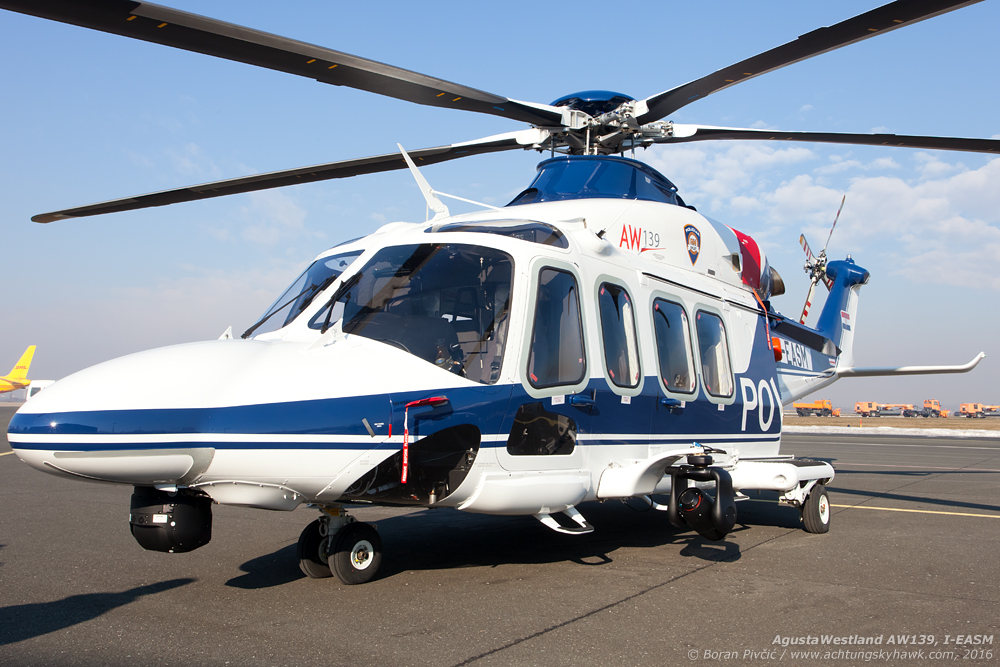


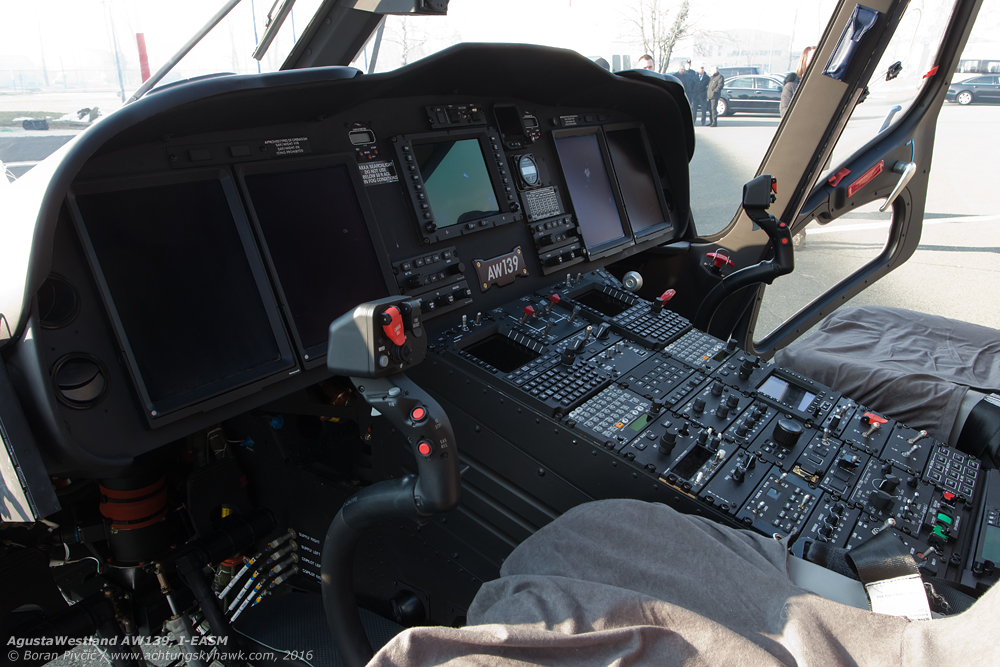


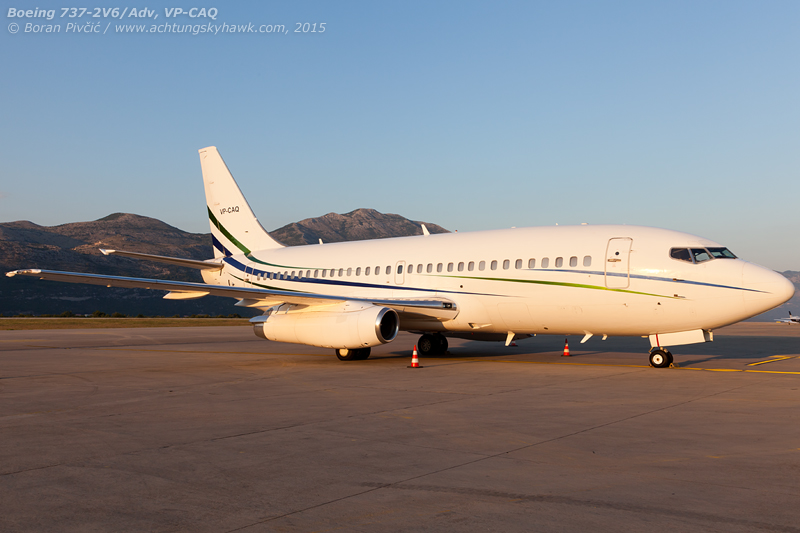


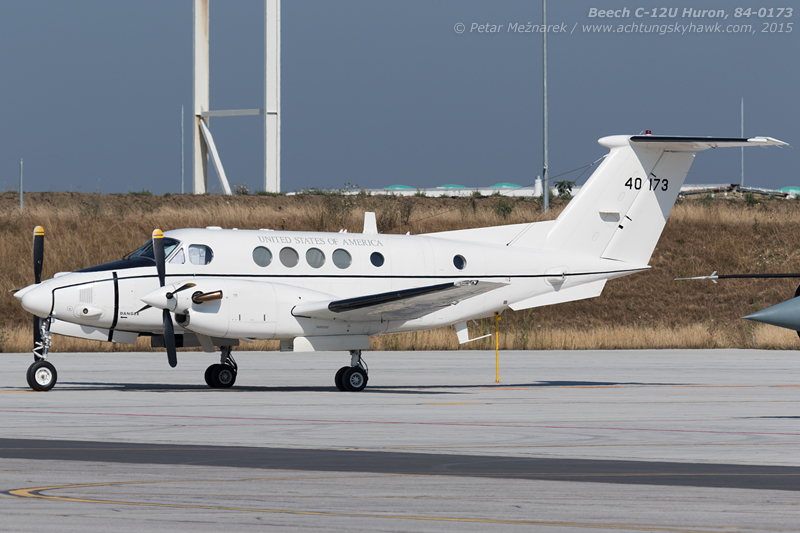


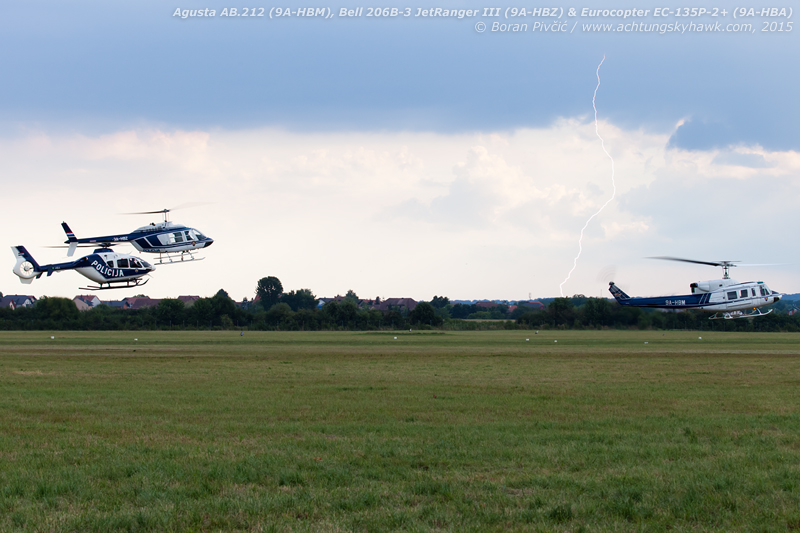


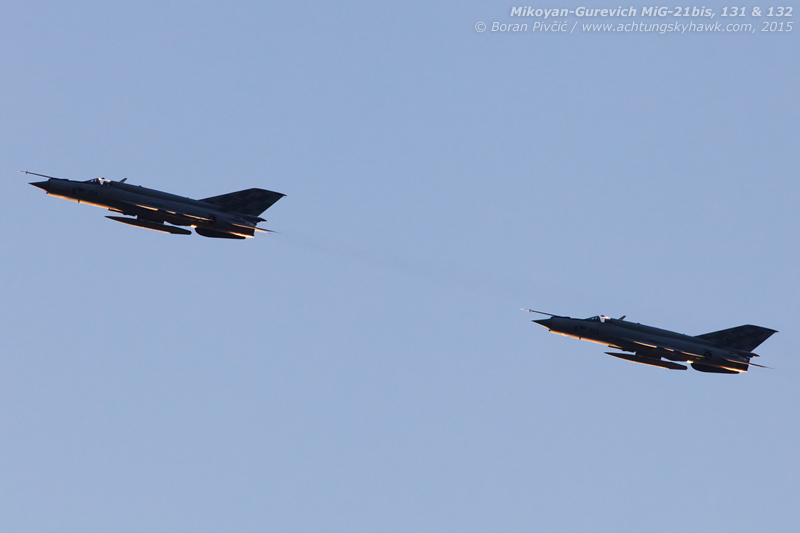

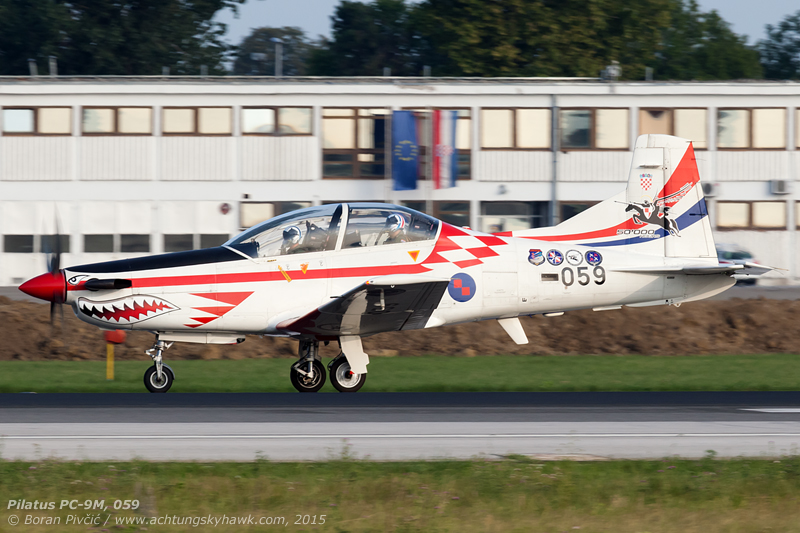
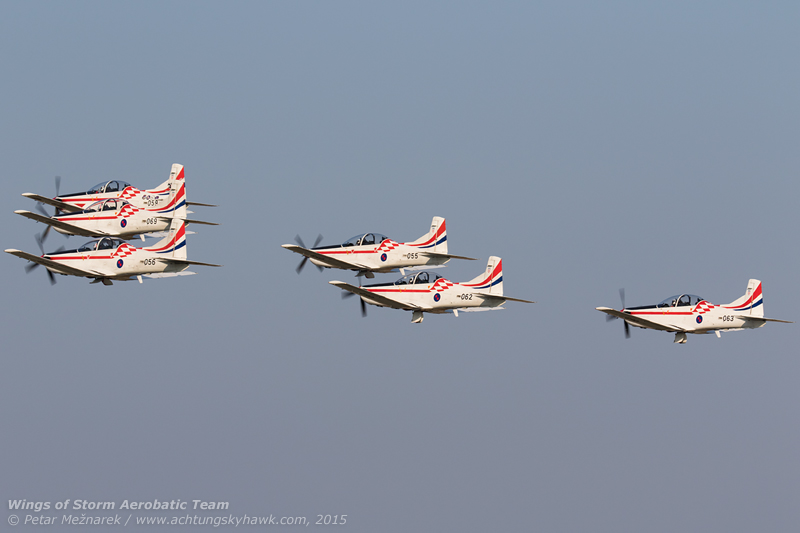

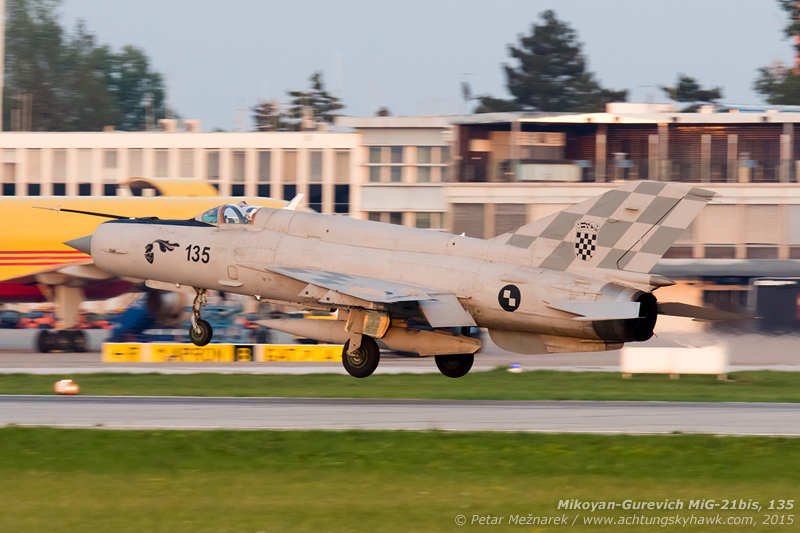

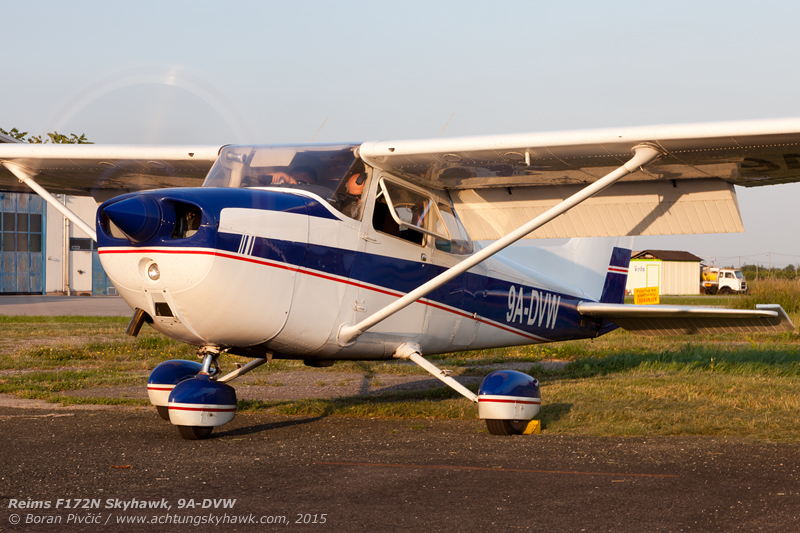
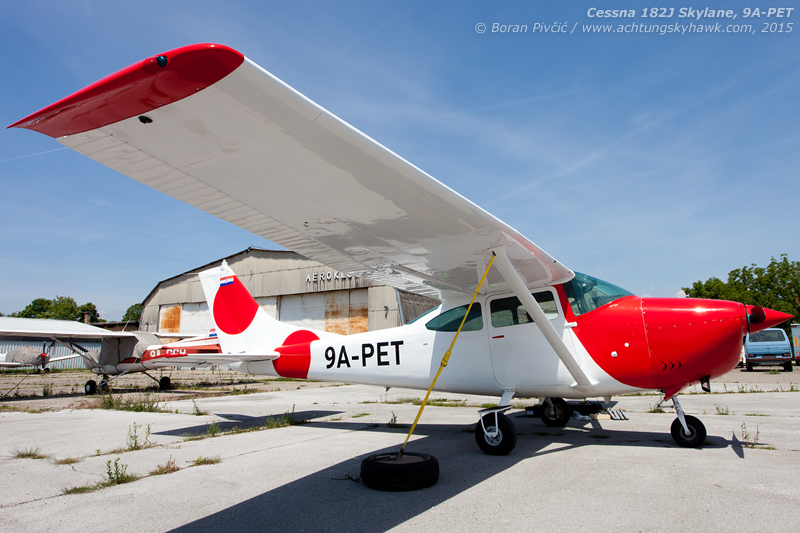
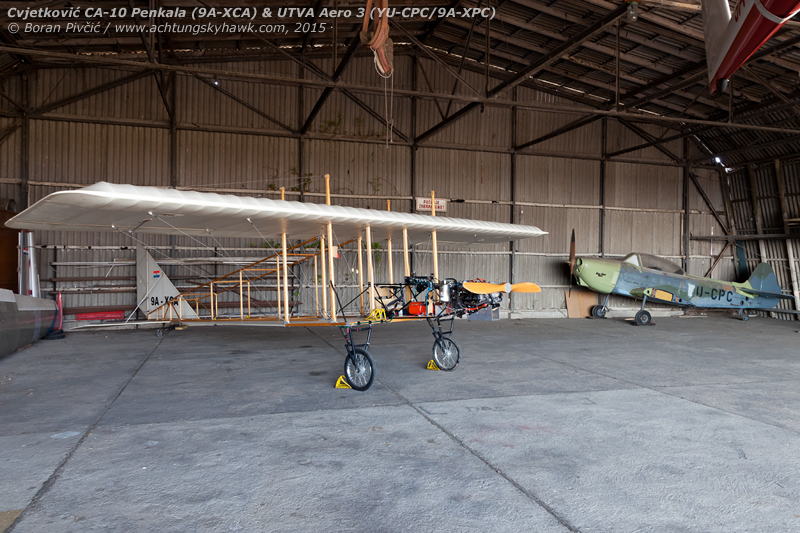
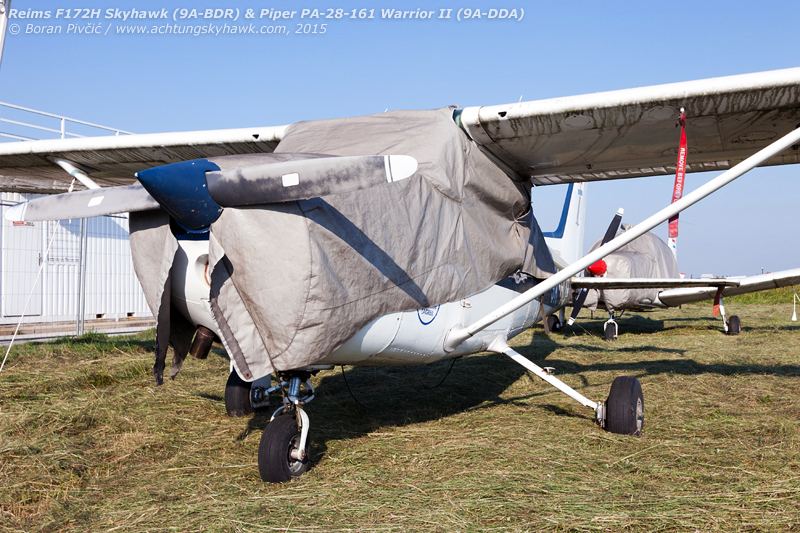
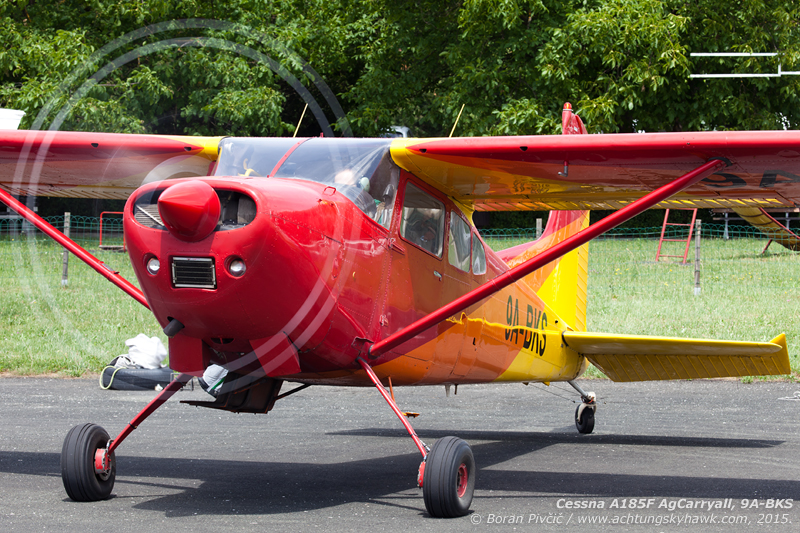
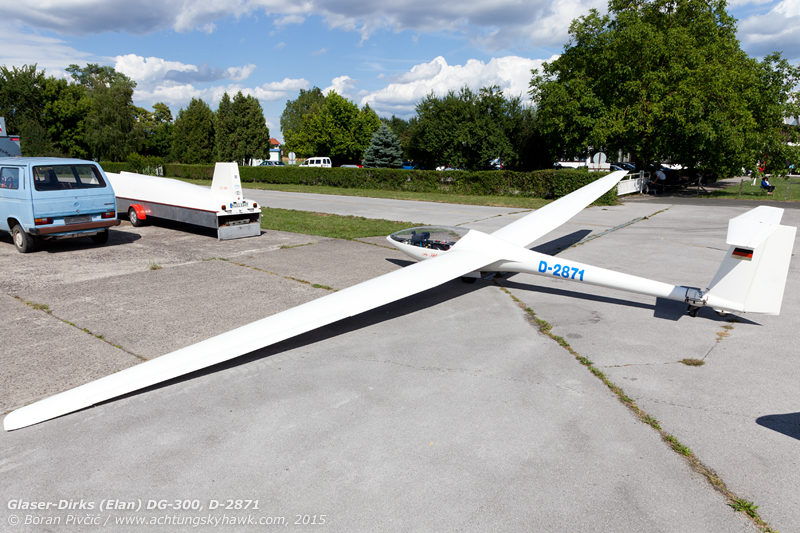


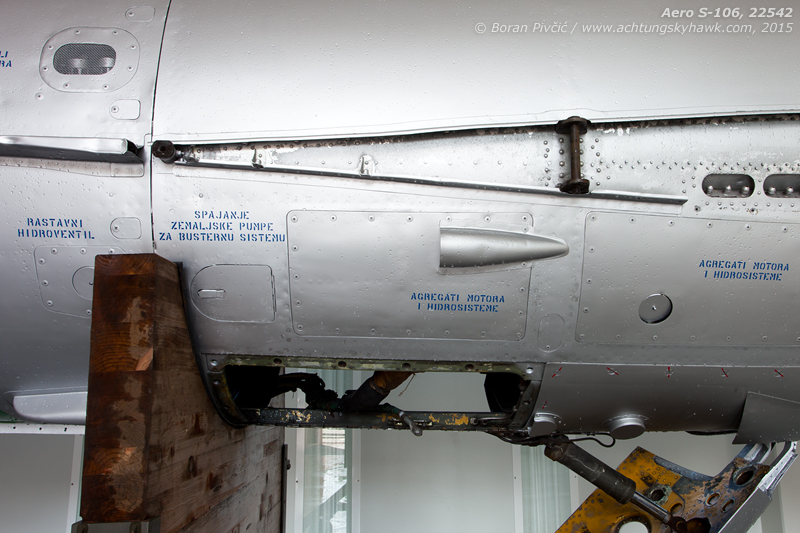


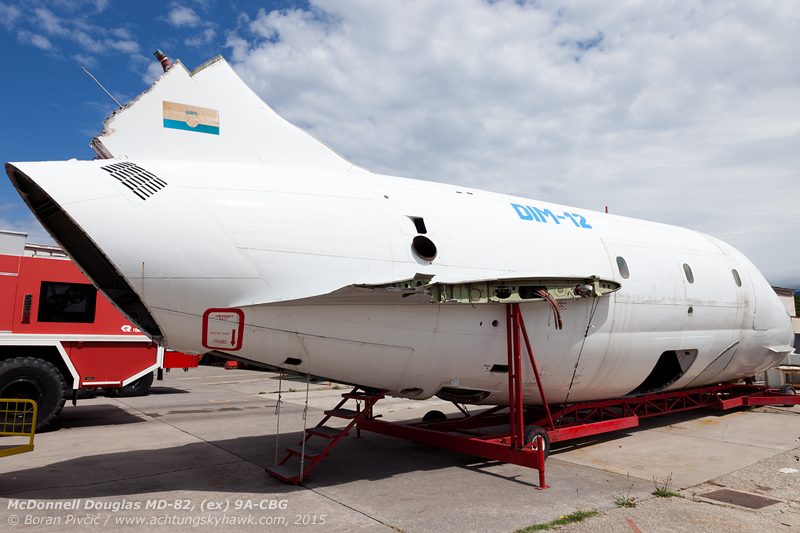
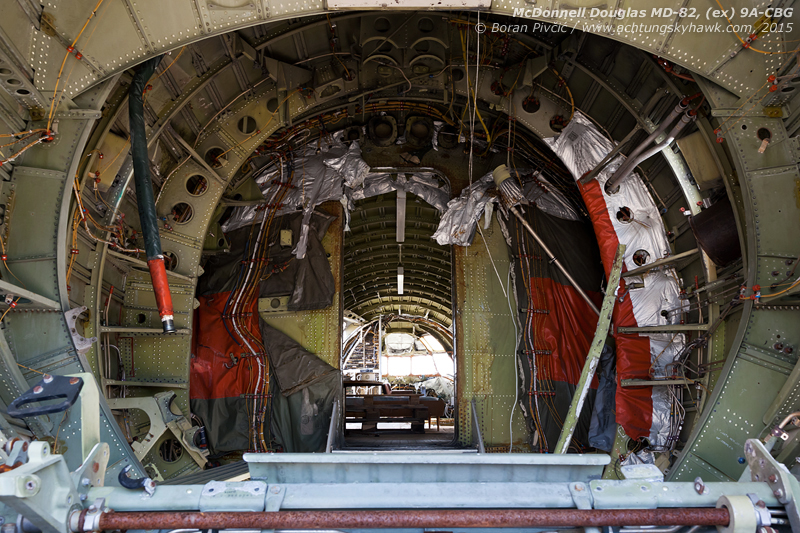


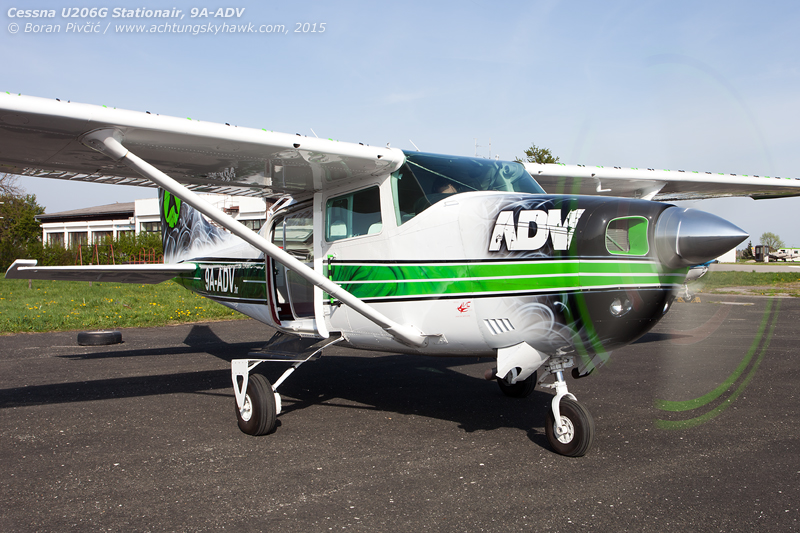
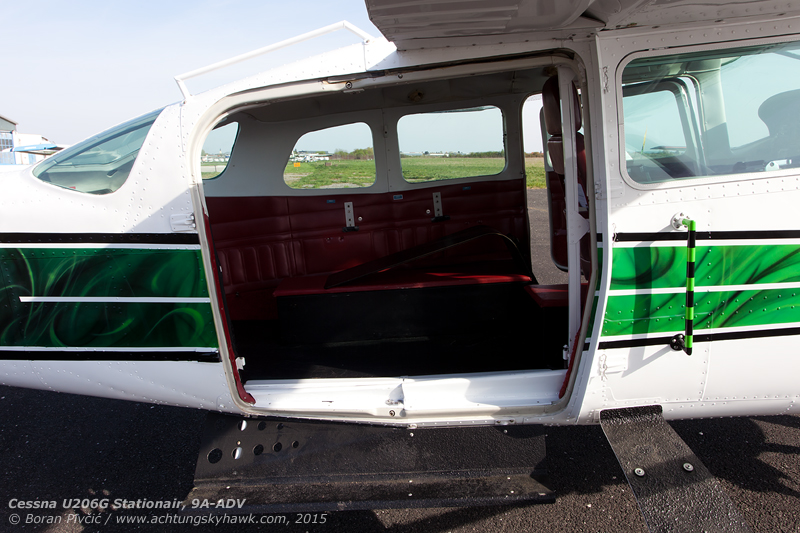
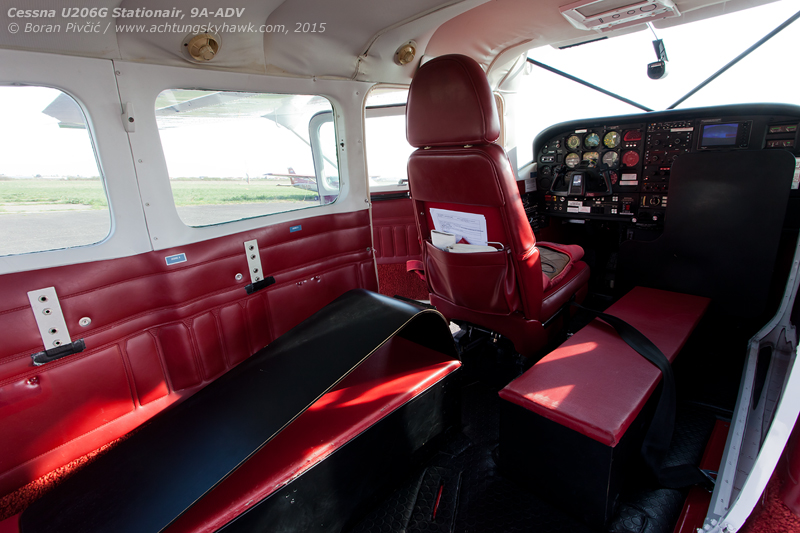
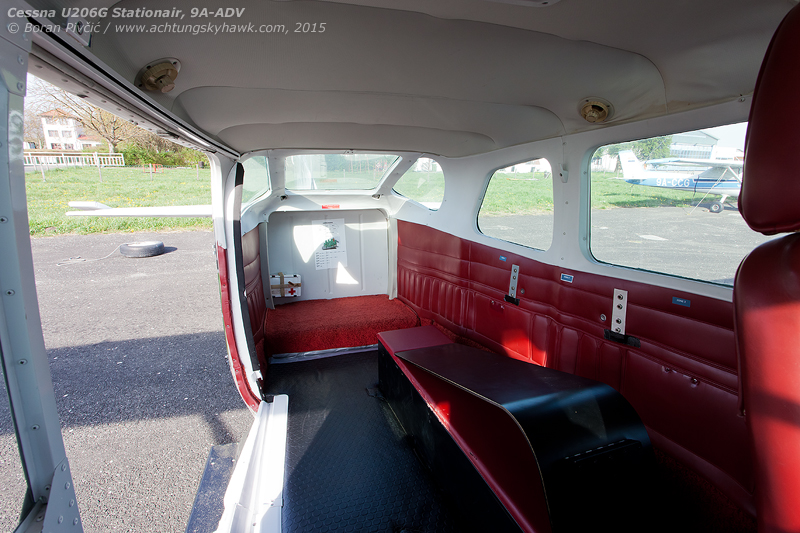
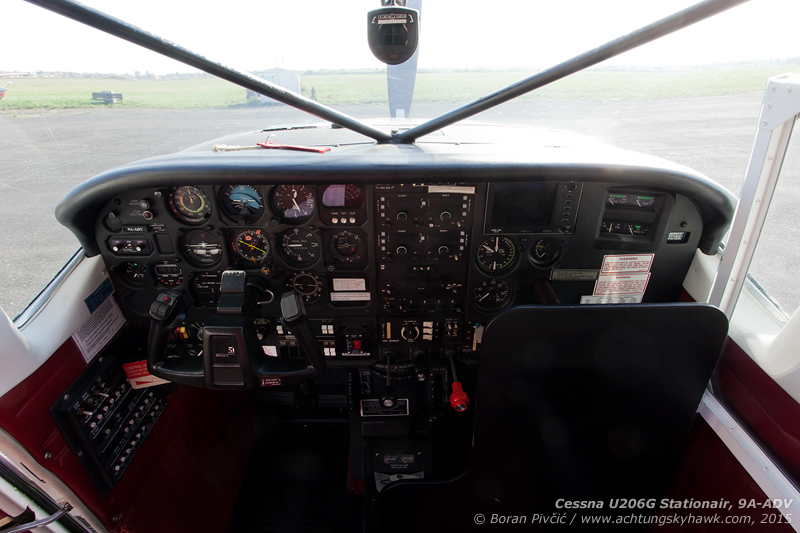
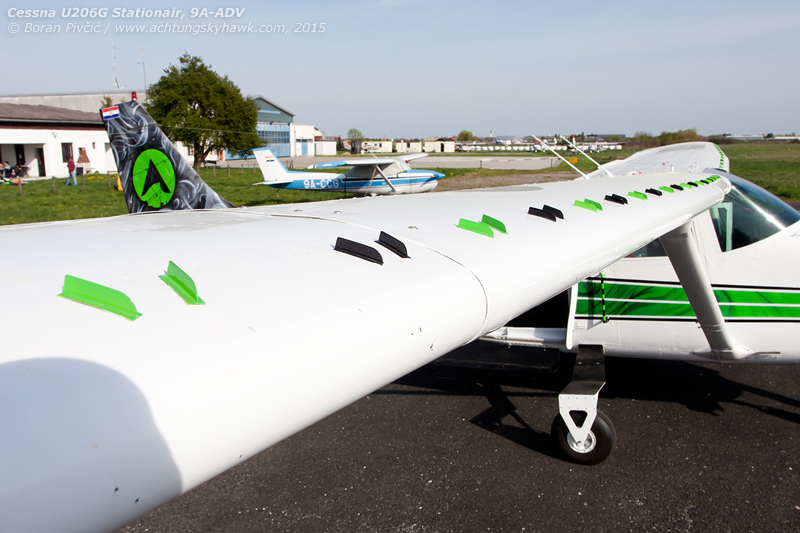
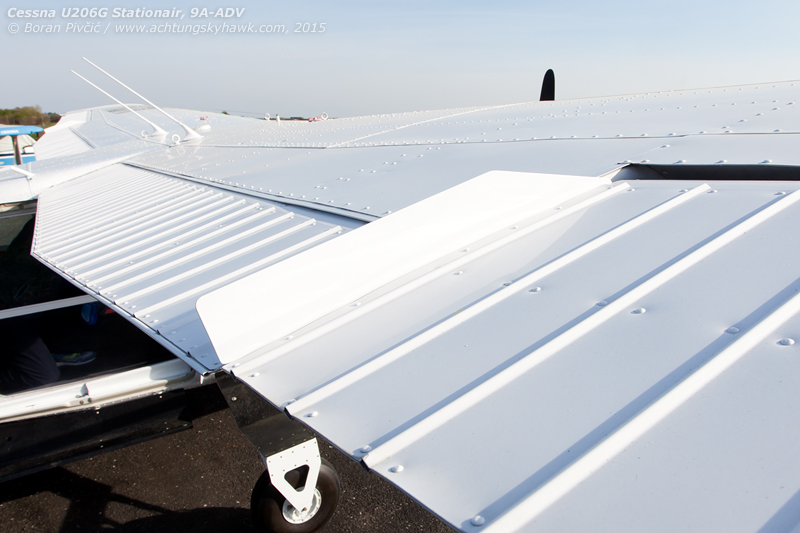
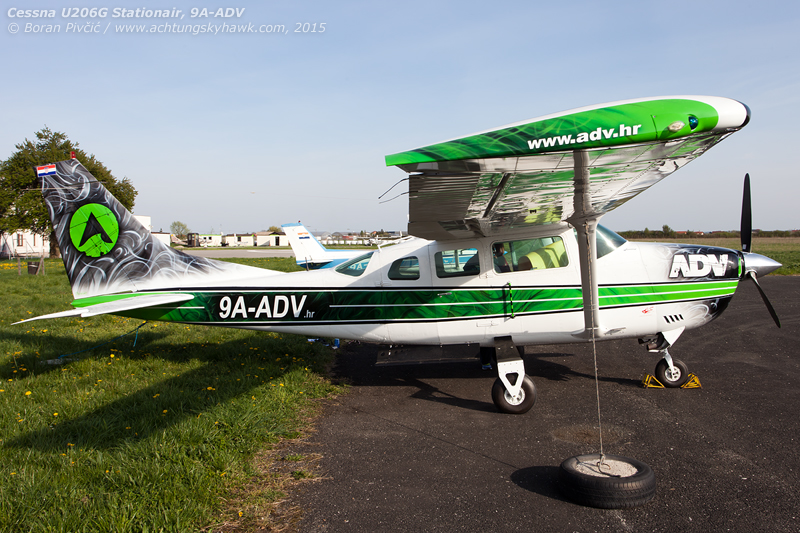
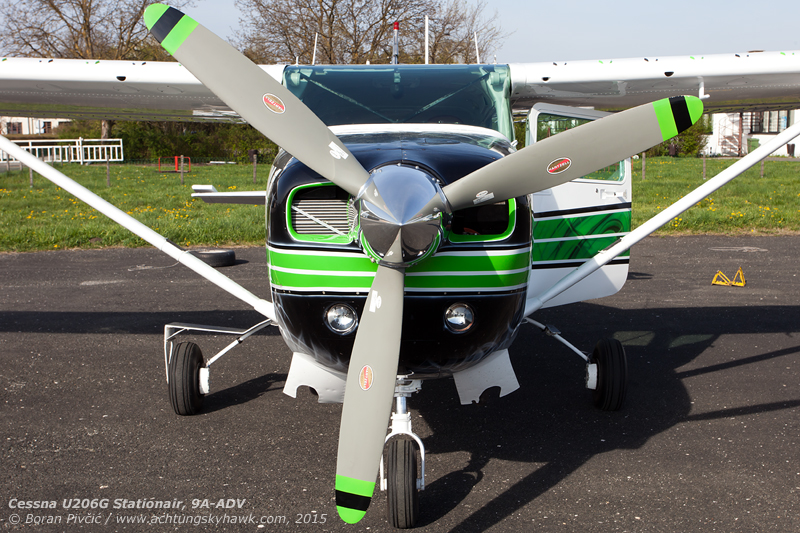



 Achtung, Skyhawk!