Rare Aircraft – Piper’s Fastest

By Boran Pivčić

Of course, Cessna is not the only one to have a couple of oddballs in its lineup. Piper ranks high up there as well, with a number of significant or interesting aircraft that had the misfortune of being unjustly forgotten. To make things more interesting, Piper also has a tendency to cram a lot of power into some versions of their popular models, creating fascinating hot ships that are today both very rare and highly prized.

The three aircraft I’ve chosen – again after extensive digging through the Airliners.net database these past few years – represent a mix of singles and twins, both piston and turbine, all variations of some of Piper’s most famous aircraft: the Comanche 400, Pressurised Navajo and the monstrous Cheyenne 400 (I had thought of including the PA-60 Aerostar as well, but that plane is a story in itself 🙂 ).

1. Piper PA-24-400 Comanche 400:

Years produced: 1964

Piper PA-24-400 at Airliners.net
Another PA-24-400 at A.net

Often called the “Queen of the Comanches”, the 400 was Piper’s attempt at making a high-speed single engine tourer. The subtle clean aerodynamics approach of today’s Lancairs was obviously frowned upon, because the 400 – as it’s name says – sports an incredible 400 HP! The power comes from an engine as unique as the aircraft itself, the eight cylinder Lycoming IO-720. That’s 720 cubic inches of capacity, or an impressive 11.8 liters. Those of you with experience in GA may have already seen that a 400 HP IO-720 nicely divides into two 200 HP IO-360s – one of the most popular four cyl engines of modern times – and you’re right: the IO-720 is basically two IO-360s stuck together at the crankshaft :). Ingeniously simple – though there were some problems with cooling the rear cylinders in flight (unlike other 6+ cylinder non-radial engines which are water cooled, the IO-720 remained air cooled).

To control the extra power, the Comanche 400 was fitted with a strengthened rear fuselage and completely new rear control surfaces taken off the Aztec and Twin Comanche. Fuel tanks were also increased to cater for the thirstier engine and thicker wing skins were provided, but otherwise the rest of aircraft is generally identical to the standard Comanches.

However, the Comanche 400 was not without its problems… it wouldn’t be in this post otherwise. A cruise speed of only 185 knots, when leveled against a fuel consumption of 23 gallons per hour at high cruise power, isn’t all that impressive, which made the aircraft quite expensive to operate even back in its day (though it was the fastest normally aspirated single back then). The aforementioned  modern Lancairs have significantly higher cruise speeds (by up to 30-40 knots) with 20-25% less power – and fixed landing gear to boot – which makes them far simpler and cheaper to fly and maintain. But on subjective terms, a 60s tourer with four Cessna 150s under the hood still keeps its charm, and the survivors of the 148 built are in high demand today.

Specs (Plane & Pilot Magazine): http://www.planeandpilotmag.com/aircraft/specifications/piper/1964-piper-comanche-400.html

2. Piper PA-31P-425 Pressurized Navajo:

Years produced: 1970-1984

PA-31P-425 at Airliners.net
Another flying at Airliners.net
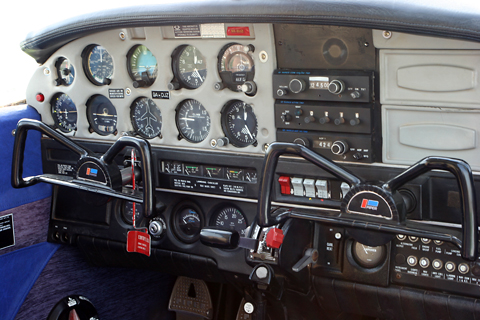
PA-31P-425 cockpit shot (with rare, old avionics) at Airliners.net

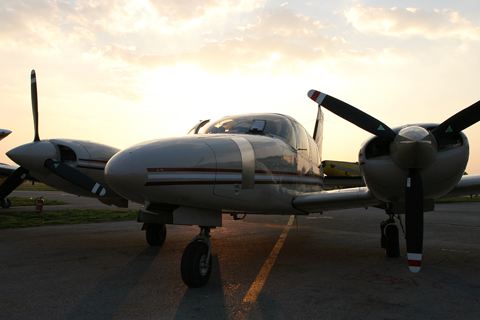
Another interesting (to me fascinating) and rare aircraft to come from the Piper works is the PA-31P-425, a unique Navajo modification that is the only Piper pressurised piston twin. You’ve probably noticed by now it’s striking resemblance to the turboprop Cheyenne I and II – though they’re not directly related. Same problems warrant same solutions, hence two aircraft that look almost the same. In reality, they were developed almost concurrently from the basic PA-31-350, sharing components to add a pressurisation system, the needed fuselage changes and various structural and landing gear updates to handle the increased weight.

A rare - and still good looking - Pressurised Navajo operated by the Croatian Air Force, coded 014. The only one of it's type in Croatia, it unfortunately rarely - if ever - flies (photo: myself)
One could be fooled into thinking this is a Cheyenne with piston engines...
One could easily be fooled into thinking this is a Cheyenne with piston engines... (photo: myself)

As the pressurisation system saps quite a lot of engine power, the haul itself at a respectable speed the Pressurised Navajo was equipped with massive TGIO-541-E1A engines – turbocharged, geared and fuel injected – producing 425 HP. With all of this power – 850 HP in total – you’d believe the P-Navajo could touch Mach 1, but as mentioned, most of the excess power was spent on spinning the massive turbocharger, which needed to be large enough to both charge the engine and pressurise the cabin with bleed air. But, like the Beech 60 Duke that had a similar system, this led to a highly complex engine (the Duke – which was labelled as very maintenance intensive – didn’t even have geared engines), which consequently kicked the operating price up.

All of this – combined with a production run of only 259 aircraft – make the P-Navajo a prized aircraft with a unique character, pretty much the case as with the Comanche 400. Sadly, if the Airliners.net database is anything to go by, few appear to be flying nowadays.

Specs (Airliners.net): http://www.airliners.net/aircraft-data/stats.main?id=311

3. Piper PA-42-1000 Cheyenne 400:

Years produced: 1984-1993

PA-42-1000 at Airliners.net
Another 400 at Airliners.net
And another from the same source

What better way to finish this post than with the awesome Cheyenne 400 – in a nutshell, the biggest, fastest and most powerful aircraft that Piper has ever built. A modification of the standard PT6-powered PA-42-720 Cheyenne III, the 400 sports two 1,000 HP Garrett TPE331 turboprops, driving imposing four-blade composite propellers, which together give it a cruise speed of an impressive 335 knots – almost 60 knots faster than the equivalently-sized (and far more expensive) Beech King Air 200. At maximum cruise, the 400 can outrun even the Big Brother King Air, the 350, by a comfortable 20 knots.

With almost 30% more power – but only 6% more weight and the same dimensions – than the Cheyenne III, the 400 (originally designated the Cheyenne IV and 400LS) was designed to compete with smaller bizjets such as the Cessna Citation I and II. In the event, only 43 were ever made, making it one of the rarest  and unique production aircraft in the world today.

Specs (Rising Up Aviation): http://www.risingup.com/planespecs/info/airplane363.shtml

The “Rare Aircraft” Series

Digging through my photo database – as well as Airliners.net – I stumbled across this idea for an informative series of articles about aircraft that aren’t all that famous anymore.

You’ve already seen the first installment – Cessna’s Oddballs – and there’s more coming! So far, apart from this one, there’ll be three other articles, one published every second day. If it works, I may turn it into a regular thing, especially if I have the photos to spice it all up :).

Rare Aircraft – Cessna’s Oddballs

By Boran Pivčić

Every now and then, I get the urge to dig through the Airliners.net database looking for “oddball” aircraft – aircraft that almost made it to life, made it but sank into obscurity, or simply served as platforms for famous aircraft before being forgotten and discarded. My fascination with the above almost always centers on the Big Three – Beechcraft, Cessna and Piper – big corporations that produced some of the most famous aircraft of all time… and naturally had some upsets along the way.

Cessna – with their diverse line of everything from the 150 to the Citation X – naturally caught my attention first and it didn’t take me long to find three candidates that perfectly fit my criteria. As such, these aircraft had to be mass produced at some point in their lives and sold to civilian customers, but be little known and quite rare today. The list could have gone on for awhile, but I chose the 175 Skylark, 205 Super Skylane and the 336 Skymaster.

1. Cessna 175 Skylark:

Years produced: 1958-1962

Cessna 175 at Airliners.net
Cessna 175A at Airliners.net
Another 175A at Airliners.net
Cessna 172B at Airliners.net
Cessna 175C at Airliners.net

The most common of the three aircraft chosen, the 175 was designed to fill the gap bewteen the Cessna 172 – then still in infancy, with just two years of production behind it – and the larger and significantly more powerful 180. As such, it is an evolution of the 172 designed to accept the more powerful Continental GO-300 engine. Rated at 175 HP (versus the 145 HP of early Skyhawks), this engine was a bit of an oddity for a single engined plane, being geared (the G prefix) rather than direct drive as most piston engines are. A common solution on high-power twins of the era, geared engines had a reduction gearbox between the crankshaft and the propeller, allowing the engine to spin at a higher RPM while keeping the prop at lower speeds. Depending on your wishes, this allowed you to either crank the engine up to a higher speed to give more power while keeping the propeller tips below the speed of sound, or reducing prop RPM to make the plane quieter (or a combination of both as in the case of the 175).

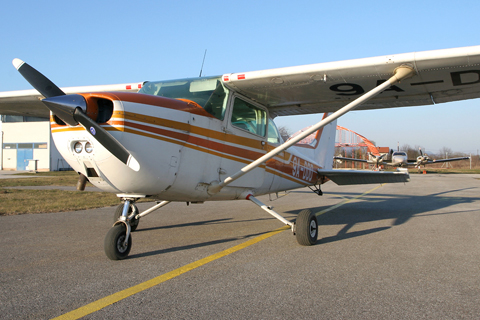
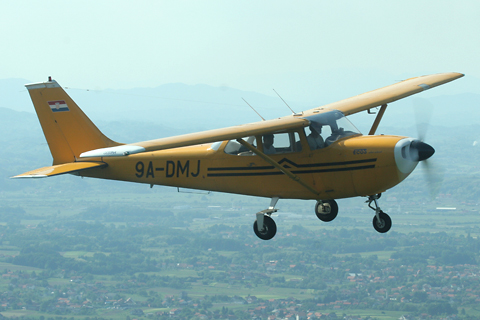
Apart from the engine – and the redesigned cowl to accept the gearbox mechanism – the 175 incorporated some minor differences, but pretty much from the exterior looked like any 172 of the era. A little known fact is that the later, higher-powered 172 versions – such as the 195 HP Hawk XP, the 210 HP Reims Rocket, the military T-41 and the retractable 172RG – were evolutions of the 175 design, rather than the basic 172. Fitted with Cessna’s “Omni-Vision” rear windows and direct drive engines, these aircraft were all based on the later-model 175, but marketed as 172s. Indeed, I’ve personally often been in a position to compare the two, flying 9A-DDD, a stock 172N, and 9A-DMJ, an early model FR172F Rocket. DMJ, being based on the 175 which is based on the 172 and 172A, has the narrower and taller undercarriage and tighter cabin, while DDD, produced when the 172 design pretty much froze, has the wider track and lower main gear and more spacious cabin (when I started flying these two, I’ve often wondered why I couldn’t see as much of the main gear from the cabin in DMJ as I could in DDD).

Despite the increased grunt, the 175 was not a major success, with about 2,100 built. The main culpit was the GO-300, which proved to be a bit unreliable – though many now say that it was more the fault of operating technique than the engine itself.  Many pilots without experience on geared engines ran the GO-300 in the lower 2,000 RPM range common on direct drive engines. Designed for the higher 2,000s – around 2,800 as recommended by 175 type clubs – the engine didn’t get all the cooling it needed, leading to frequent breakdowns and relability issues.  A number of sources say that some owners have even switched to larger-displacement direct drive engines, partly due to the added costs of servicing the gearbox (and the fact that parts and rated mechanics for these nowadays very rare engines are increasingly hard to find).

(of note: unlike today, where both the model number and model name are part of the designation, in the 50s and early 60s, Cessnas designated with just the model number were the basic versions, while those with a model name were the deluxe models. So, the “175” was a cheapo model, while the “175 Skylark” was the full-option version. The same was with the first few models of the 172)

Specs for basic, A and B models (Rising Up Aviation): http://www.risingup.com/planespecs/info/airplane279.shtml
Specs for C model (Rising Up Aviation): http://www.risingup.com/planespecs/info/airplane278.shtml

2. Cessna 205 Super Skylane:

Years produced: 1963-1964

Cessna 205 (210-5) at Airliners.net
Another 205 at Airliners.net
Cessna 205A (210-5A) at Airliners.net

While the 175 is not all that obscure, the next aircraft on the list could certainly qualify – despite being the stepping stone to one of Cessna’s most famous piston singles. With a family tree stretching back to the 182 Skylane, the 205 was essentially a 210 Centurion (itself a beefed-up 182) with a fixed undercarriage and an interior optimised for utility, rather than comfort. Evidence to that is it’s official Cessna designation, 210-5, as well as the chin on the front cowl where the nose wheel would have been stowed on the early 210 models – some sources say this was later used to house radio equipment, though one would wonder about the heat from the engine.

That took the form of the six cyl normally aspirated Continental IO-470 from the 210B, rated at 260 HP, driving a constant speed propeller (usually three-blade, but photo evidence shows a number of two-blade models as well). Like the early 210, the 205 did not have the split rear doors that would debut on its follow-up, the famous 206 Super Skywagon/Stationair (early versions of which still had the cowl chin).

The small production run of just under 600 aircraft over two years meant the 205 was offered in just two versions, the basic 205 and the touched up 205A of 1964. Being a converted tourer, it wasn’t all that practical for utility work and was replaced the same year by the more powerful and purposeful 206.

Specs (Rising Up Aviation): http://www.risingup.com/planespecs/info/airplane233.shtml

3. Cessna 336 Skymaster:

Years produced: 1963-1964

Cessna 336 at Airliners.net
Another 336 at Airliners.net
And another at the same site

A Skymaster you say? But they’re not obscure… despite clearly deserving the “oddball” epythet any way you put it :). Indeed, the 337 Super Skymaster is a relatively common sight today, but it’s predecessor, the “normal” 336 Skymaster, is a first class rarity today as it was during its production run.

On the ground, it’s hard to tell them apart at a single glance (despite the 336 being a tad smaller) and only the most astute will notice a most interesting oddity on the 336 – the fixed undercarriage. An unusual configuration for a twin, I must admit I was instantly interested when I learnt of this a couple of years back – despite the Italian Partenavia (former Vulcanair) P.68 light twin sharing the same trait.

Initially, the 336 was designed as a four seater, built around two 175 HP GO-300 engines, the same as on the Skylark. Only the prototype was built in this configuration however, the design being changed to accommodate six, as well as  new 195 HP direct drive IO-360 engines, before deliveries began. Other changes included larger vertical stabilizers, revised wings and some other minor changes to improve handling.

Like the 205, the 336 had a short life and only 195 were produced in a single version before production switched to the bigger, more powerful – and retractable – 337 Super Skymaster (the Super later being dropped).

Specs and performance comparison with 337s (Skymaster.org.uk): http://www.skymaster.org.uk/perform.asp

The View From Above – Zagreb From The Air

By Boran Pivčić
Photos by myself and Šime Lisica (where stated)

After the smogarsbord of aircraft and their various bits I’ve posted here, I thought it’d be a nice change to post some scenery instead, swapping details of 40+ year old aircraft for some soothing airborne shots. For the first subject I’ve decided on the city of Zagreb – not on any sentimental grounds, but because I fly over it often and have the time – or copilots – to snap a few shots here and there :).

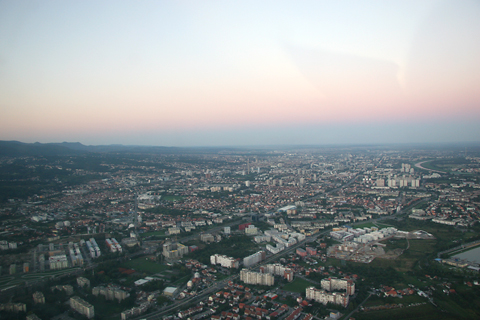
Most of the photos shown have been taken from 1,500-2,000 feet AMSL, which is about 1,000-1,500 feet AGL –  (usually) the minimum altitude at which we can fly above town – following the standard panorama flight route which takes about 25 minutes from startup to shutdown. Zagreb isn’t all that big a place – 750,000 inhabitants – so everything is over pretty quickly (to the great fortune of some of my passengers 🙂 ). But on a summer’s afternoon, when the air is calm, the traffic light and the sun just dipping below the horizon, it’s majestic…

Climbing through about 1,500 feet toward the district of Črnomerec in the western part of town, with the sun just about to set
Climbing through about 1,500 feet toward the district of Črnomerec in the western part of town, with the sun just about to set (Šime Lisica)
This is what it's all about!
This is what it's all about! (Šime Lisica)
An architectural detail of the city centre. The main city square - Trg Bana Jelačića - can be seen to the right of shot, while the Cathedral - one of the city's landmarks - dominates the shot to the left
An architectural detail of the city centre. The main city square - Trg Bana Jelačića - can be seen to the right of shot, while the Cathedral - one of the city's landmarks - dominates the shot to the left (Šime Lisica)
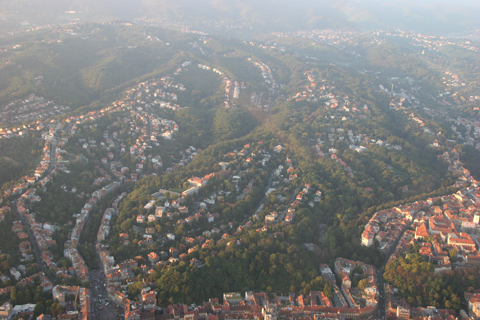
Stretching up along the foothills of Medvednica, the northernmost part of town is home to the well-off slash elite districts
Stretching up along the foothills of Medvednica, the northernmost part of town is home to the well-off slash elite districts (Šime Lisica)
The main city stadium at Maksimir park. The main venue for large and/or important football matches and numerous concerts, it is seen here about 10 minutes before a Croatia-England match on October 11th, 2006
The main city stadium at Maksimir park. The main venue for large and/or important football matches and numerous concerts, it is seen here about 20 minutes before a Croatia-England match on October 11th, 2006 (Šime Lisica)
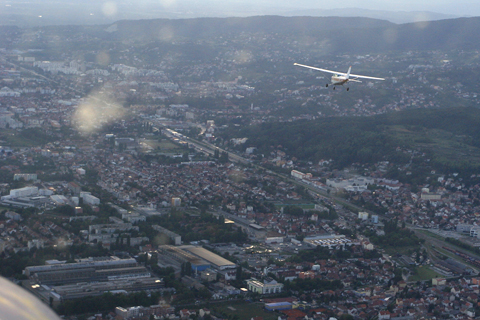
A wide view of the city centre from above the western districts. The nose belongs to 9A-DDD, our favourite ship for panorama flights (myself)
Strafing the railbridge :). Though DMM is no WW2 fighter, the bridge was indeed a valid target during WW2, here recrated in a dramatic (irony) dive on a dull afternoon (myself)
Strafing the railbridge :). Though DMM is no WW2 fighter, the bridge was indeed a valid target during WW2, here recrated in a dramatic (sarcasm) dive on a dull afternoon (myself)
Chasing DDD during a formation panorama (!) flight (a turning dogfight) above Zagreb. Though DMM was not up to the task speed-wise, this was by far the most interesting panorama I've ever flown :) (Šime Lisica)
Chasing DDD during a formation panorama (!) flight (a turning dogfight) above Zagreb. Though DMM was not up to the task speed-wise, this was by far the most interesting panorama I've ever flown 🙂 (Šime Lisica)
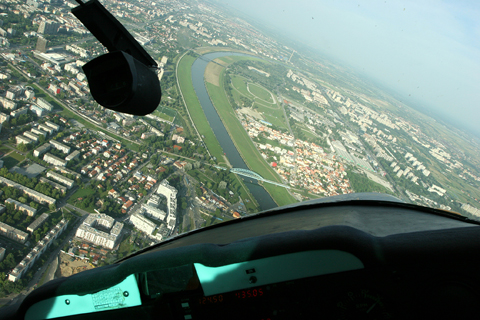
Another wide view from a climb to altitude. The Jarun lake - a major sports centre and the favorite exercise ground for the citizens of town - an be seen not far away
Another wide view from a climb to altitude. The Jarun lake - a major sports centre and the favorite exercise ground for the citizens of town - an be seen not far away (Šime Lisica)
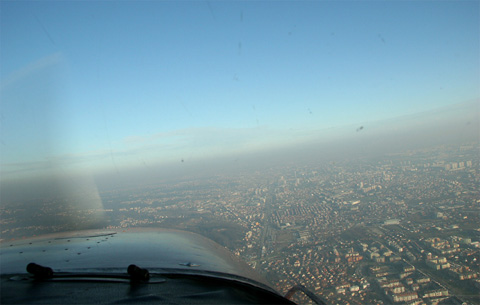
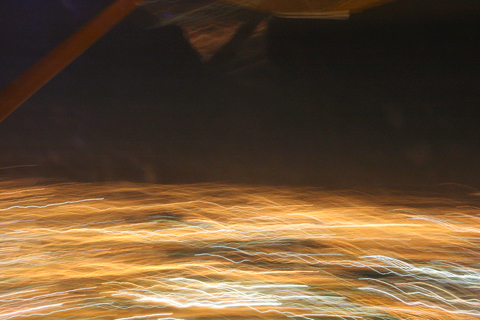
Something a little different :). A motion-blurred Zagreb from 3,000 feet during Night VFR training
Something a little different :). A motion-blurred Zagreb from 3,000 feet during Night VFR training (myself)
The southernmost edge of town - as well as nearby Velika Gorica - seen over the tail of DMJ during a climbout from Zagreb Intl.
The southernmost edge of town - as well as nearby Velika Gorica - seen over the tail of DMJ during a climbout from Zagreb Intl. (myself)

Post Update – GA Oldies at Lučko

By Boran Pivčić
All photos author

I’ve been out and about at the field today and I’m happy to report (to those one or two interested) that I’ve managed to nail 9A-DJZ with my big bad Canon during its visit to Zagreb, so now I have some quality photos to go with the article. They’re not very artsy, but then it was a very hot and humid day and jumping around the grass in sweat-soaked clothes was not high on my priorities list :). So here goes…

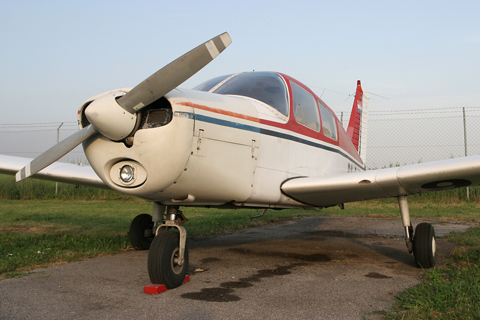
Classic front quarterview. Like the last time I shot it, DJZ had seen better days...
Note the difference in gloss between the paint on the fuselage and vertical stab
Rear quarterview. Like almost all (if not all) light Pipers, the PA-28 has an all-moving horizontal stabiliser
Full profile view
Full profile view
Note that the prop is canted a bit to the right. A pretty common solution on high-power aircraft (to offset a bit the P factor), this is the first time I noticed this on a PA-28

Airshow Report – Susreti Za Rudija, Gornja Stubica, May 10, 2009.

By Boran Pivčić
All photos author

While not a “proper airshow” in itself, the “Susreti Za Rudija” (roughly translated as “Meetings for Rudi”) commemoration includes a strong air presence, which traditionally comprises a number of light aircraft, in addition to the airforce fast jets and helos. This year – after missing out last time – I finally managed to hitch a ride on two of our club airplanes that were scheduled to take part in the proceedings. Naturally, my camera never left my side so, with plenty of photographic evidence, here goes…

1. Background to the show

The “Susreti Za Rudija” event first started several years ago to commemorate Rudolf “Rudi” Perešin, our most famous military pilot. Born in the town of Gornja Stubica near Zagreb, he was one of the best MiG-21 pilots in the former Yugoslav Air Force, who in 1991. (at the start of the Yugoslav Civil Wars) defected to Croatia with his MiG-21R. Unfortunately, he couldn’t land at Zagreb’s Pleso airport, so low on fuel – when isn’t a MiG-21 low on that? – he proceeded, without any form of clarance, to Klagenfurt, Austria and landed there. His jet, coded 26112, was impounded, but Rudi was allowed to return to Croatia where he continued flying for the nascent Croatian Air Force.

Airliners.net photo of 26112, now in a museum in Vienna

He was killed on May 2, 1995. when his MiG-21bis was hit by AAA near the town of Stara Gradiška during Operation Flash. Flying close to the ground, he ejected at low altitude, but hit the surface of the Sava river before his chute opened.

The present day meet consists of a wide variety of activities, including the aforementioned air program, which was for this occasion to include flypasts by Air Force MiG-21s and Mi-8/171 helicopters, a police and military parachute team demo, aerobatic flights – and light aircraft flypasts, where we come in.

2. Showday – the aircraft

Despite the flying program scheduled to start at 15:00 – with our first takeoff around 16:00 PM – a friend and I arrived at the field early at 9:00, hoping to make ourselves useful in the mean time. The day for one of our airplanes – Cessna 172N 9A-DDD – was packed full in addition to appearing in the flypast, so we came early to prep the birds and start things off as soon as possible. All in all, three of our planes were due to take part in the show: 9A-DDD, 9A-DMJ and our Seneca III, 9A-DMO.

Registration: 9A-DDD (ECOS Pilot School)
Type: Cessna 172N Skyhawk II
Mfd.: 1980.
Engine: Continental O-320, 4 cyl, normally aspirated @ 160 HP, driving a two-blade fixed pitch prop

Registration: 9A-DMO (ECOS Pilot School)
Type: Piper PA-34-220T Seneca III
Mfd.: 1981.
Engines: 1x Continental TSIO-360, 6 cyl, turbocharged @ 220 HP, driving a three-blade constant speed prop & 1x Continental LTSIO-360 with the same specs but spinning in the opposite direction

And you’re already familiar with 9A-DMJ from a previous post :).

3. Showday – scenes from Lučko

Since most – if not all – aircraft involved in the meet would be launching from Lučko, I got the opportunity to catch several of them during either practice or departure.  Though most of the types involved would be GA birds, I’ve decided to skip over them – for despite this being a GA blog, I’ll be the first to admit that prepping a C172 isn’t all that a thrilling experience. Much more interesting were the various military and police helicopters that decided they might just catch some air on this beautiful – though humid – spring day.

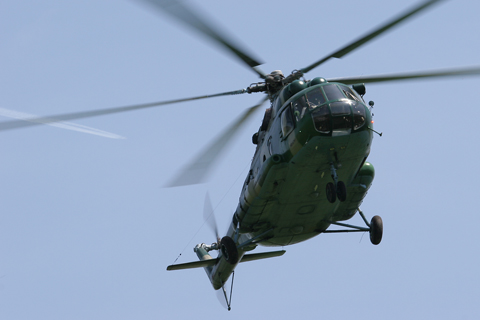
Mil Mi-8MTV-1, coded H-211, crossing low overhead during an ingress/egress practice session
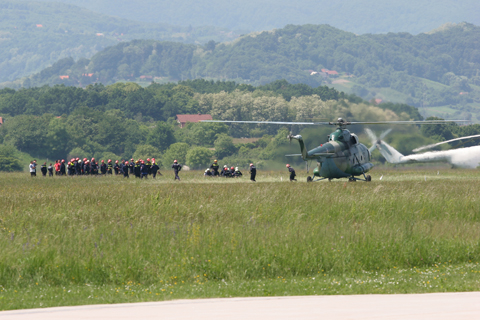
Waiting for their bus :). Almost 50 army skydivers wait patiently in line during rapid entry/exit exercises. As a bonus they would also get to fly a bit, as the air force prudently combined their exercises with the aforementioned ingress/egress flights to keep the pilots on their toes
A newer Mil Mi-171Sh blasts low over the field toward Gornja Stubica to catch its display slot. Unlike the stock airforce Mi-8MTV-1s, the -171Sh - Sh for "shturmovoj", or attack - can carry four B8V 80 mm rocket packs under removable pylons. Only equipped as such once - during their unveiling ceremony - they now mostly fly completely unarmed
Lifting off with a company B.206B-3 in the background warming up. Both helos were on the invited list
A Police AB.212 lifting off with a company B.206B-3 in the background warming up. Both helos were on the invited list

4. Showday – the first run

Normally, an airshow wouldn’t be an airshow if it ran flawlessly :). Due to the way the meet was organised, each participant would be performing solo – which meant that all three of our planes would fly their displays individually and at different times. DDD would be first with a flyover at 16:05, DMJ second at 16:40 and DMO last at 17:55 to close the show. Though it certainly appears a bit nonsensical – having 5-6 Skyhawks pass one at a time over a stadium that was sure to attract a significant number of people – the reason behind it was that the aircraft would get points for being on time over target, points that would be added to their scores in the upcoming precision landing championship to be held at Lučko in two weeks. In the end – as is usually the case – it all went awry quite early in the game :).

As previously mentioned, DDD had a full day in addition to this, with several panorama flights and a banner towing mission stacked end to end. Due to a breakdown in coordination, a skydive flight also appeared out of nowhere, necessitating the use of the more powerful DMJ – which then, by some mechanism that I didn’t quite get, threw the whole plan into disarray. In the end, DDD missed its display slot, but with a quick call to the organisers, we managed to squeeze it in along with DMJ in the latter’s slot. This in the end was fortunate for me, because apart from securing myself a seat on DDD, I’d get another chance for some air-to-air action :). And I desperately needed to get into the front seat of something, as I hadn’t flown for a couple of months and wanted to get my bearings back :).

The route we were to fly is pretty similar to the one we flew in the last Trip Report I posted, but significantly shorter. Gornja Bistra is just behind the Medvednica mountain, a pifling 10-15 minutes away as the Skyhawk flies. After passing Zaprešić – or November point, the exit out of Lučko CTR (I should really post a map here) – just turn right and keep low for the next 5 minutes… and you’re there.

Our departure was scheduled for around 16:20 and surprisingly we made it on time! Given the manageable difference in performance between DDD and DMJ, our formation takeoff was more successful than last time, with DMJ leading the way up until halfway to Zaprešić. There we switched roles and the slower DDD took up the lead.

The well-worn route to Zaprešić. Some beautiful weather up front - excellent news after the rainshower we went through right behind us...

Unfortunately, DMJ came up on our left, so I couldn’t get a clear shot of it – not through an open window as I had originally hoped. But the short flight time to Stubica – as well as continual communication and sequencing with a provisional ATC unit set up down there – meant we really didn’t have time for fooling around, so I had to make do with what I had.

Holding station to our left. With half tank and two people aboard, DMJ can keep up with anything we could throw at it :). And the green tint to the photo is from the green rear windows on DDD, didn't want to manipulate the photo much to get rid of it
Holding station to our left. With half-full tanks and two people aboard, DMJ could keep up with anything we could throw at it :). And the green tint to the photo is from the green rear windows on DDD, didn't want to manipulate the photo much to get rid of it
A little dynamic break to spicen up a tight formation

The event itself was held at a sport stadium, which is quite difficult to find if you’ve never been there before. Even aerial photos with drawn approach and flyover routes aren’t of much help, but thankfully both pilots had been here a number of times before, so it was a relatively straightforward job of lining up for the run. The only problem is that apparently nobody notified the ATC that we’d be coming in formation, so there were a couple of on-frequency changes in lineup to be made.

Keeping a stacked holding pattern while we wait for some slot problems to be sorted out... we were supposed to wait more than 10 minutes for some reason, but finally managed to get our 16:40 slot

As we lined up for our run, our formation – predictably I could say – broke up and we ended up chasing each other down toward the stadium, DDD first and DMJ about 100-200 meters behind us (as far as I could see over the tail). Don’t know how it looked like from the ground, but from up here the whole flypast – as well as the next two ones – looked a bit shabby.

Diving on the stadium that can be seen just above the nose
Approaching from the east this time, as opposed to the Souther Approaches from the past photo :)
Approaching from the east this time, as opposed to the Southern Approaches from the past photo 🙂

Between snapping a few photos and constantly craining my neck and looking for DMJ, I didn’t pay much attention to the rest of the display, but it involved normal flypasts at Warp Skyhawk – in other words, slow :). The presence of numerous hills on all sides of Gornja Stubica percluded anything more aggressive, especially in an relatively underpowered Skyhawk on a hot +25 C day. Our time slot of just 4 minutes didn’t help either, so after our three passes, we set back for Lučko.

DMJ on our left again - after a brief fast pass to our right - with the Sljeme TV and radio tower visible in the distance

5. Showday – the second run

After we landed, I harrassed my flight instructor – who was supposed to fly DMO – to hitch a ride on it as well, as the first run didn’t really live up to my expectations. Thankfully, little persuation was necessary, so I found myself in the front right cabin seat at our revised 18:10 launch (I wanted to be up front, but a Seneca-rated pilot from our club was flying the left seat, with my CFI on the right). With four of us aboard and about 3/4 fuel, the takeoff run was more lively than I expected and we were soon off the ground and keeping our heads low toward Zaprešić.

Flying low at around 1500 ft above western Zagreb. Traffic returning from the show normally kept at 2000 feet, so this was a welcome bit of separation
Flying low at around 1500 ft MSL (1000 AGL) above western Zagreb. Traffic returning from the show normally kept at 2000 feet, so this was a welcome bit of separation

As the traffic around Gornja Bistra had already cleared, we proceeded pretty much straight in, with no holding or orbits – picking up speed along the way for a smashing high-speed low pass.

Diving down toward the stadium, with the airspeed needle creeping into the yellow arc. On our first pass we hit in excess of 185 knots indicated
Tight right after the first high-speed pass. The hills around the stadium meant we had to pull some G getting out and I'm pretty sure this was in the 3-3.5 range

As is standard for every DMO display, the first pass was followed by a slower “dirty” flyover with flaps and gear extended, while the third – and last in this case – was a surprise low pass from a different direction.

Trees!
Trees!
Going up. Bleeding off airspeed from the fast pass

After the third pass – and the impressive-ish climb after it – our work was done, so we set off back to Lučko for another 10 minutes of uneventful flying. The total flight time for this run – calculated from the photo timecodes – was about 35 minutes, bringing the overall time up to 1 hour 15 minutes.

Another nice spring afternoon in flight

Post Update – Plane’s Anatomy, AT-402 Episode

Everything by me, as usual

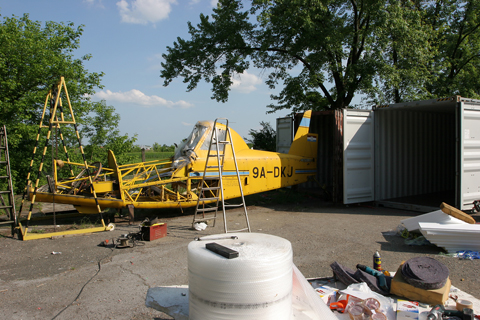
Just wanted to add a small update to my previous AT-402 anatomy post. Driving to the field today, I came across 9A-DKJ being packed into a freight container for a trip to somewhere. Not waisting the opportunity, I snapped a quick photo…

How to pack an airplane... as noted before, the engines and prop had already been removed for overhaul, so all that was left was to take down the wings and landing gear (which are to the left outside the photo)

(Another) Photo Dossier – Some GA Oldies Spotted At Lučko

By Boran Pivčić
All photos author

Going through my photo database – a Herculean task I must say – I’ve noticed that there are quite a few old model Cessnas and Pipers in Croatia, pre-1970s vintage. Though somewhere else they might be considered normal and ordinary – Australia and New Zealand spring to mind – here they’re a bit of a rarity. So, in a an obvious lack of inspiration to write anything else, here’s a short run through a couple of these odd-balls :).

(unfortunately, I’ve not been able to find out the manufacture year for most of these aircraft. Their data plaques were most uninformative, while serial number searches on the net turned up little useful info. This list is then primarily based on their version letters)

1. 9A-DAH, Reims (Cessna) F150K

Serial No.: F150-0631
Operated by: Aeroklub Krila Kvarnera

Based at Grobnik airfield (LDRG) just outside of Rijeka on the coast, this early model 150 – French-built no less – is the oldest 150 model I’ve seen in Croatia. Most others are either L or M versions (both Wichita- and Reims-built) so catching this one on a surprise visit was of relatively high priority :).

Preparing to fire up for an afternoon departure back to Grobnik. The plane had seen better days, but I was told - through feedback from a different photo on Airliners.net - that it got a new coat of paint not soon after this was taken
Rear quarterview. From this angle, the K version can be distinguished from the much more numerous L and M models by the short dorsal fin connecting the vertical stab with the fuselage
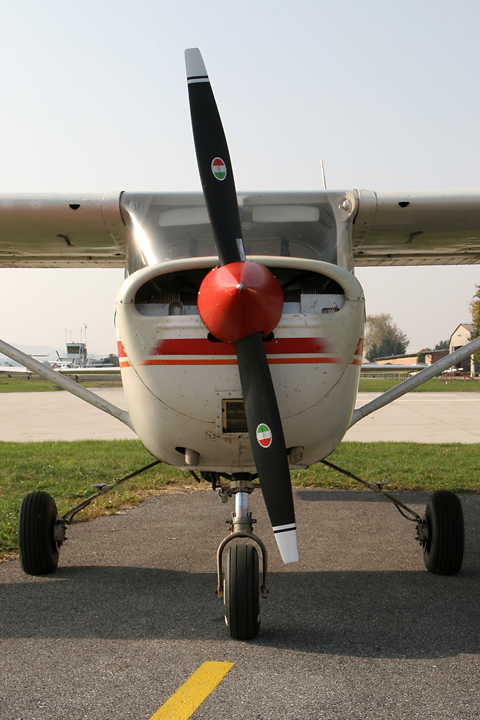
From the front, recognition is even easier. The K model was the last to have the relatively flat nose and assymetrical cooling ducts (don't even know how to call those in English...)

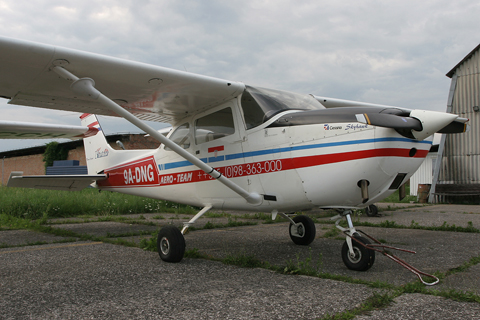
2. 9A-DNG, Reims (Cessna) F172F Skyhawk

Serial No.: 0111
Operated by: Air Mravinac

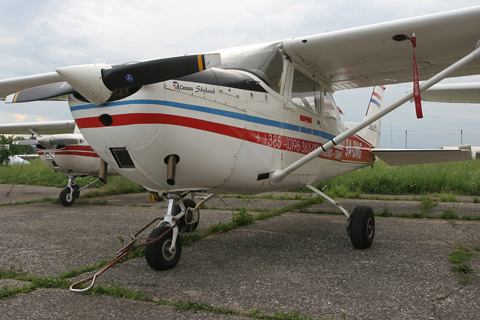
Our second oldie is what I believe to be the oldest Skyhawk in Croatia. Based at Čepin airfield (LDOC) near Osijek in eastern Croatia, this gem still has the early – and nowadays very rare – 6 cylinder O-300 engine of 145 HP (with a fixed pitch prop), in more modern Skyhawks replaced by the 160 HP 4 cyl O-320 or 180 HP IO-360.  Was very excited to catch this one, didn’t know we even had one on the register…

Finally a real oldie :). The longish nose gives away the 6 cyl O-300 underneath. To my additional good fortune, it's not the stock Lycoming or Continental, but a Rolls-Royce licence built model. Despite the engines being identical, having the R-R on the engine is a thing of prestige :)
Finally a real oldie :). The longish nose gives away the 6 cyl O-300 underneath. To my additional good fortune, it's not the stock Lycoming or Continental, but a Rolls-Royce licence built model. Despite the engines being identical, having the R-R on the engine is a thing of prestige 🙂
She's in pretty good shape for her age :). In town for some light servicing. Note also the different nose profile, common on early model Skyhawks
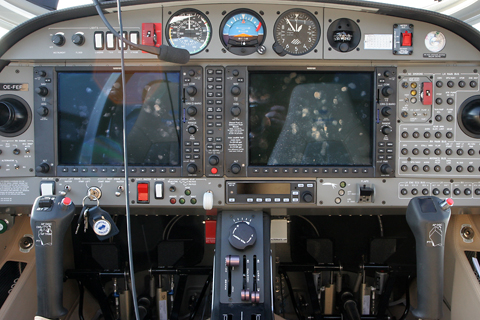
And a very nice cockpit to round it up. The "place 'em where you can" instrument layout is also typical of early Cessna singles in general. An interesting addition is the German WW2-style manifold pressure gauge to the right of the tachometer. Like its counterparts on Messerschmitts and Focke-Wulfs of old - from whom it may even come - the gauge measures in atmospheres, rather than inches of mercury. Takes some getting used to, but it's very simple: 29.92 inHg = 1013.25 hPa = 1 atmosphere

3. 9A-DJZ, Piper PA-28-140 Cherokee Cruiser

Serial No.: 28-7425212
Operated by: private

Third on the list is the precursor to the very popular Piper Warrior – the small and simple Cherokee. Sharing the same family tree, the Cherokee was the smallest of the PA-28 line, powered by a 140 HP engine (in contrast to the 160 HP on later Cherokee models and the 180 HP on the Warrior). Based at Dubrovnik in the extreme south of the country, DJZ rarely ventures here to the north – who would with 140 HP and 3+ hours of flight time – so the only photos I have of it were taken back in 2005 with my old Fuji S5000 camera.

Though small and relatively underpowered, the early Cherokees are classics today. This is the only one in Croatia as far as I'm informed
From any angle, the Cherokee Cruiser is a diminutive aircraft. At my height, I wonder how would I fit in it :)
From any angle, the Cherokee Cruiser is a diminutive aircraft. At my height, I wonder how would I fit in it 🙂
The typical Piper cockpit. Though not much of a looker from the outside, in here DJZ was equipped rather nicely. You had a transponder, VOR and ADF, pretty much everything you needed for any form of VFR flying

4. 9A-DTD, Cessna 182K Skylane

Serial No.: 182-57946
Operated by: private

The last on the list for this post is a relative newcomer, first spotted by me in October 2008. A mid-model Skylane, DTD was configured in a skydive configuration with an upward opening door modification I’ve frequently seen on dedicated-but-not-built-as-such skydive aircraft (including HA-SVH, the Cessna 185 featured a couple of posts back).  Bought for that purpose, DTD is one of the few Skylanes of any model in the country.

Parked away from the main apron on a beautiful autumn afternoon. Easily recognisable as an mid model by the oldie cowl, from the firewall back it generally looks like any other Skylane
Showing off its right hand door mod. Like most Skylanes, DTD has a presence when viewed from the front, the large three-blade prop certainly helping matters. The aperture you see in the right cooling duct is the oil cooler
An artsy perspective of the panel. Though a bit vintage, it has everything you need - and skydive ops are hardly avionics-intensive :)
An artsy perspective of the panel. Though a bit vintage, it has everything you need - and skydive ops are hardly avionics-intensive 🙂

(Short) Photo Dossier – Bell 427, 9A-HTI

By Boran Pivčić
All photos author

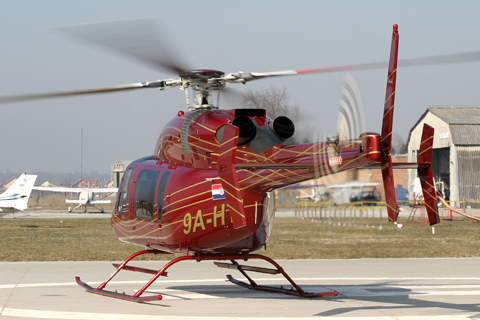
Here is some living proof that the early bird catches the worm – or in this case, helicopter. I’ve been wanting to nail this thing for awhile now, ever since it came on the Cro register about a year or two back. Owned by a prominent local industrialist who had traded it in for his former Bell 407 (recession? Is that something you eat? 🙂 ), it happened to be at the field on a February 2009 (early) morning when I was present at an inspection of the two AT-402s featured a couple of stories back. Normally it operates from a private helipad in eastern Zagreb, but on this occasion it was at Lučko – probably undergoing light maintenance with the Police squadron, which operates an almost all-Bell fleet (the odd helicopter out being a Robinson R.22) and has experience with Bell types.

Unfortunately, being otherwise engaged with a screwdriver and a rusted bolt, I failed to take any photos of it while it was being rolled out from the hangar (where I’m told it sometimes spends some time – but not on drunk flying charges 🙂 ). When I saw that they indeed meant to go flying soon, I dropped my tools and picked up the camera just in time to catch it after startup – and here are the results:

Serial number: 56056
Former reg: N8010J (Bell factory test registration)

What do all the tube thingies do?
What do all the tube thingies do? Mechanics checking the engines out - with them running - before departure. Despite its 2x 710 HP, pilots on the type say the 427 sometimes runs out of breath in hot and high conditions
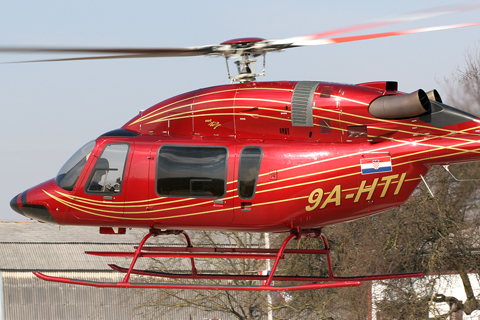
Despite being large and relatively intimidating, you can still trace the 427's JetRanger heritage
Though large and relatively intimidating, you can still trace the 427's JetRanger (or rather LongRanger) heritage underneath all the exhausts and stabilizers
Gently lifting off from the Police helipad
Gently lifting off from the Police helipad. Strangely enough, apart from the Police Agusta-Bell AB.212, this is the only twin-engined civil helicopter in the country
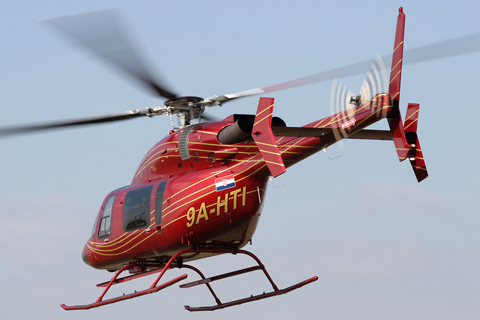
And the paintscheme is subtle too :)
And the paintscheme is subtle too 🙂
Departing to the west rather quickly at low level
Departing the field rather quickly at low level
The aforementioned Bell 407. Notice the similar reg - HIT vs HTI, T and I being the initials of the owner, while H is the generic prefix for civil helicopters
The aforementioned Bell 407, 9A-HIT. Notice the similar reg - HIT vs HTI, T and I being the initials of the owner, while H is the generic prefix for civil helicopters

Tech – Where Little Planes Come From: A Visit to the Diamond Aircraft Factory, February 2008

By Boran Pivčić
All photos author

There always comes the time when young pilots ask their senior instructors: “Where do little planes come from?” :). In an attempt to answer that question, I was sent – as part of Aeronautika, a local aviation mag I write for – to the Diamond Aircraft works in Wiener Neustadt, Austria, a nice 4 hour hop by bus (a very nice one at that) away from Zagreb.

1. The factory

Diamond’s main works – as well as the main admin center – is located at the small airfield of Wiener Neustadt-Ost (ICAO location indicator: LOAN) just outside the small town of the same name, some 50 km south of Vienna. Though not as famous as the company’s London works in Ontario, Canada, this is the site where Diamond aircraft first came into being – and were first produced for a number of years.

Wiener Neustadt-Ost and the complex that has grown around it. The factory itself consists of just a couple of buildings running parallel to the runway - everything else has been built around the (economic success) of the factory, and even includes a shopping mall and swimming pool :)
Wiener Neustadt-Ost and the complex that has grown around it. The factory itself consists of just a couple of buildings running parallel to the runway - everything else has been built around the (economic success) of the factory, and even includes a shopping mall and swimming pool 🙂

The site itself was also well known for one the bigger Messerschmitt factories outside of Germany proper during WW2. The actual buildings though were leveled late in the war by USAAF’s 15th Air Force aircraft based in Italy, but one of the aircraft produced here has managed to survive the war and is now part of Diamond’s aircraft museum, located on the present factory grounds.

A beautifully preserved Bf.109G-6 at the Diamond museum

The modern complex is designed to provide everything needed for aircraft production, from basic materials and components all the way through to final assembly and painting. Outsourcing is a no-no here :). Christian Dries, the man behind Diamond Aircraft, half-jokingly told us that the only thing in this factory they hadn’t made themselves are the aircon units – even the tables were designed and built in house. Sounds like an expensive approach, but ask Boeing about their current experiences with letting other people make your planes… :). This in-house system not only reduces production errors, but considerably speeds up construction as well, which can now be done at the same standard of quality throughout.

Oh my God, it's full of Stars! A view down the LOAN ramp is enough to make even the hardest man drool...

As of late 2008., the factory complex also includes Diamond’s own engine manufacturing facility, where the new AustoEngines piston Diesels – naturally, Diamond-designed – will be built. Though it may appear that the whole AustroEngines venture is a direct response to Thielert’s recent financial woes, Mr. Dries told us (back in February) that they’re just finishing the paperwork for an engine production line – so it may have been on the cards for awhile now.

2. The aircraft

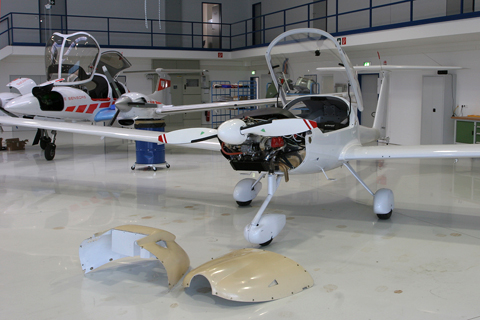
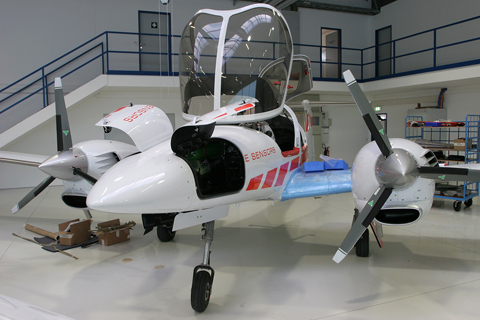
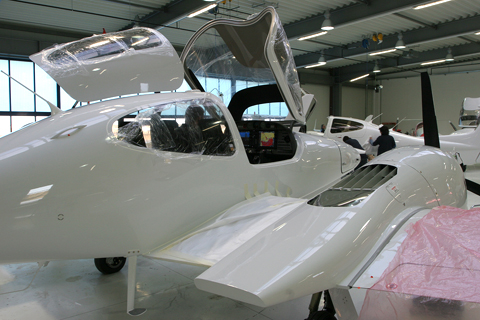
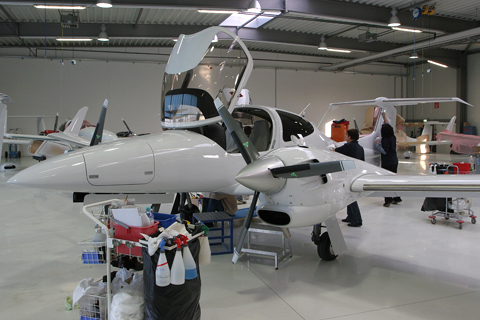
The majority of the aircraft built at this site are DA-40 Stars and DA-42 Twin Stars, as well as their Airborne Sensors modifications (there’ll be a follow-up on that division here soon 🙂 ). At the time of our visit, most of the aircraft on the assembly line were Twin Stars, so I’ll concentrate on them.

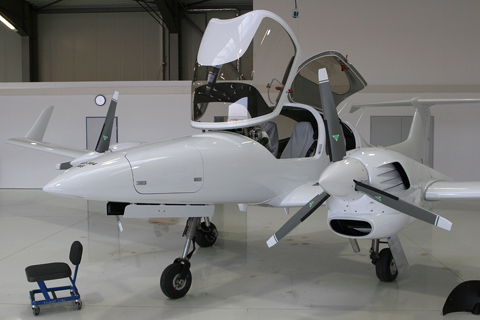
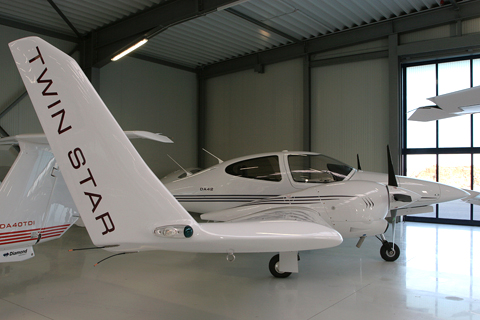
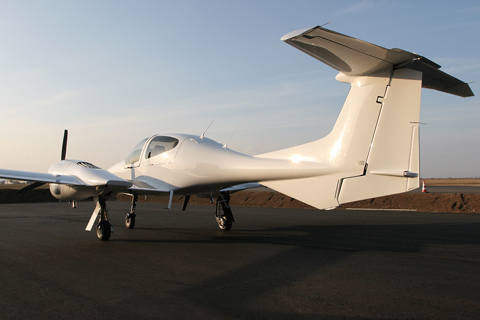
Basically a Star with an additional engine, hidden behind some modifications, the Twin Star was the first twin-engined aircraft designed from the outset to use Diesel principle engines. Ironically, it’s the only Diesel aircraft that received a avgas piston conversion (with two 180 HP IO-360s as seen on the Piper Seminole), but those are few in number despite the waxing and waning fortunes of Thielert, the German company that supplied the first mass produced Diesel engines, the Centurion 1.7 and 2.0.

Sharing pretty much the same basic fuselage as the Star, the DA-42 is a four seater – and along with the aforementioned Seminole, the only twin in this configuration in production today. While the front of the cabin is roomy and airy thanks to that extensively glazed canopy, the rear is a bit claustrophobic and cramped I must say – but at my 1.92 meters, many aircraft are :). But, with twin engine safety and a total fuel burn of a Cessna 172, we can forgive it that :). The Garmin G1000 glass cockpit suite is a standard and playing with it on the demo aircraft I must say it has some amazing features – but this, coupled with FADEC-controlled engines, in my opinion makes the Twin Star a bit too easy to fly. It’s like playing a flight simulator, which may lead to a bout of unfounded self confidence and an erosion in basic piloting (and common sense) skills. The Twin Star almost thinks by itself…

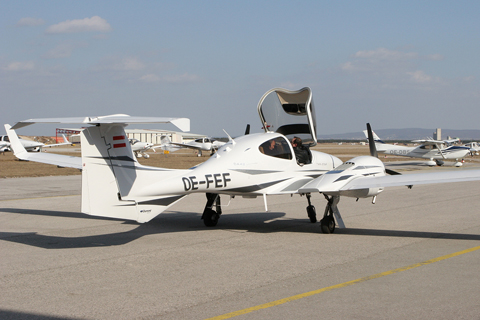
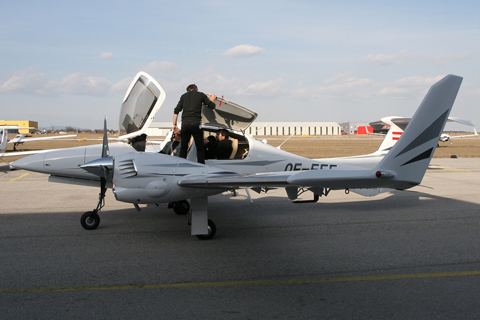
OE-FEF, a specced-up Platinum demo model that I got a ride on later

For the Twin Star’s specs, you can visit Diamond’s website at: http://www.diamond-air.at/da42_twin_star+M52087573ab0.html
3. The production process

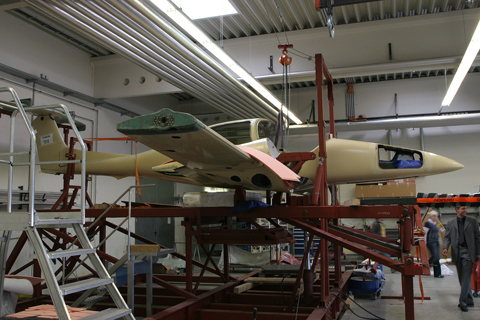
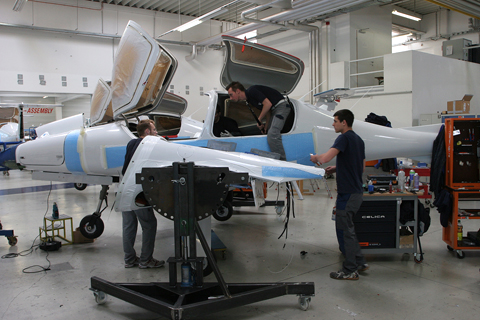
The tour, led by Mr. Dries, took us – as mentioned – through the whole production process. We were allowed to photograph everything we wanted – except the starting procedure for molding and preparing the composites. Though this is a significant process – because all the major components, wings, tail, fuselage, are built here – there’ll still be plenty to see as all of those are put together.
It all begins here. Composite materials like fiberglass (green) and carbon fibre (black) are moulded, shaped and impregnated separately before being put together into their final shape, as seen here. After this is complete, the aircraft will be disassembled again for painting and systems installation
It all begins here. Composite materials like fiberglass (green) and carbon fibre (black) are molded, shaped and impregnated separately before being put together into their final shape, as seen here. After this is complete, the aircraft will be disassembled again for painting and systems installation

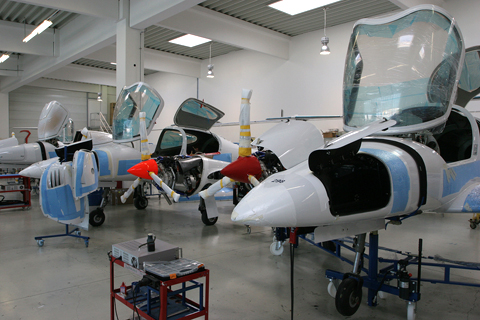
As the aircraft is being built, it progresses through the several interconnected hangars, coming out finally at the other side of the airfield. This ensures a steady and clean flow through the factory and prevents… traffic jams :).

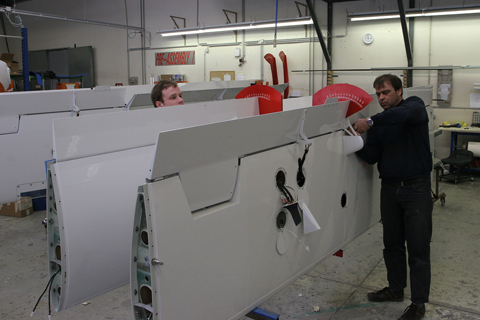
Inner (I think) wing elements, with flaps being fitted and calibrated.
Outer wing elements, with flaps being fitted and calibrated.
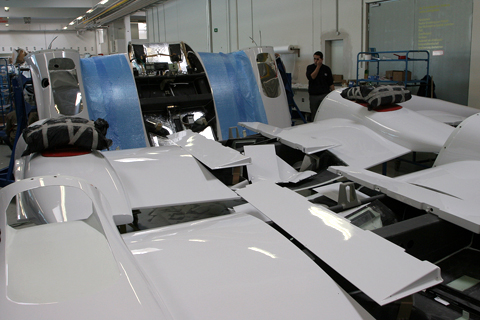
A jigsaw puzzle. Wingroots, engine bays and control surfaces are shown here, painted and ready for reassembly onto the aircraft.
The jigsaw puzzle. Wingroots, engine bays and control surfaces are shown here, painted and ready for reassembly onto the aircraft.
A bit of the same here. These fuselage joint elements bear most of the dynamic loads on the aircraft in flight, as they transfer the lift generated by the wing onto the fuselage
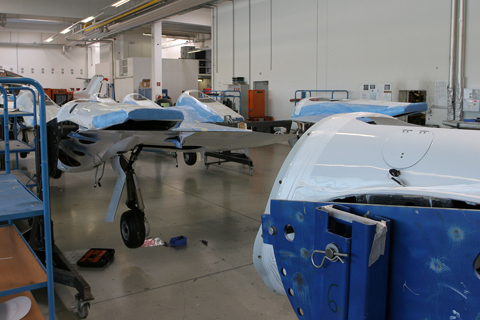
Starting to grow into a recogniseable aircraft again. The elements from the previous photos are here being joined to the rest of the fuselage
Starting to grow into a recognizable aircraft again. The elements from the previous photos are here being joined to the rest of the fuselage, while on the inside the G1000 system and some avionics would soon be fitted
Next, mounting the engines on the frame. Once properly loaded, the aircraft can lowered onto their landing gear and stand on their feet freely like the example in the background
Next, mounting the engines on the frame. Once properly loaded, the aircraft can be lowered onto their landing gear and stand on their feet freely like the example in the background
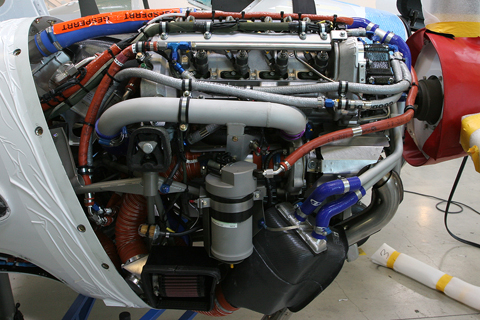
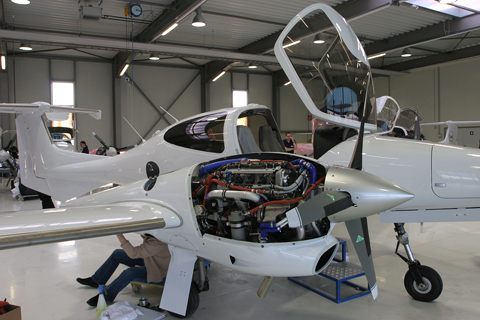
The Twin Star's piece de resistance - the Thielert Centurion 2.0 engine. Both the 1.7 and 2.0 develop the same 135 HP, the difference being in capacity - 1.7 vs 2.0 liters, far less than an equivalent avgas engine - and some changes to the turbocharger system. A condensed mass of wires and pipes, this is not a purpose-built aircraft engine, but a converted and heavily-modified Mercedes roadcar Diesel tweaked to accept more volatile Jet A fuel
The Twin Star's (former) piece de resistance - the Thielert Centurion 2.0 engine. Both the 1.7 and 2.0 develop the same 135 HP, the difference being in capacity - 1.7 vs 2.0 liters, far less than in an equivalent avgas engine - and some changes to the turbocharger system. A condensed mass of wires and pipes, this is not a purpose-built aircraft engine, but a converted and heavily-modified Mercedes roadcar Diesel tweaked to accept more volatile Jet A fuel. Despite that, the fuel consumption is less than half of that of similar avgas engines, with the additional benefit that - at least in Europe - Jet A is considerably cheaper than avgas
With the wings on, the aircraft are towed to the next hangar for systems assembly. Most of the basic framework for the electrics, as well as the G1000 suite, had already been fitted during structural assembly
With the wings on, the aircraft are towed to the next hangar for systems assembly. Most of the basic framework for the electrics had already been fitted during structural assembly
Nearing completion. This DA-42MPP - Multi-Purpose Platform - will eventually join the Diamond Airborne Sensing fleet also stationed at Wiener Neustadt
Engine controls and instruments being connected to the engine
Engine controls and instruments being connected to the engine. Unlike the Star and Twin Star, the DA-20 Katana sports a Rotax 4 cyl avgas engine, which comes in 80 and 100 HP normally aspirated versions, and a "top-of-the-line" 115 HP turbocharged model (though I must admit I've never seen that one on a Katana)
Almost done. Systems test, checking whether everything works as advertised
Almost done. Systems test, checking whether everything inside works as advertised
With the diagnostics done, the aircraft is essentially complete - and just in time for a wash to clean up residue, oil and fingerprints. Once fully done in the factory, it will be flight tested by a test pilot to see whether everything actually works in flight, which will also give the engines a chance to deconserve
With the diagnostics done, the aircraft is essentially complete - and just in time for a wash to clean up residue, oil, grease and fingerprints. Once fully done in the factory, it will be flight tested by a test pilot to see whether everything actually works in flight, which will also give the engines a chance to deconserve
Final checks on another example. The grey stripes on the wing and stabilizers are the de-icing system elements
Final checks on another example. The grey stripes on the wing and stabilizers are the de-icing system elements, permitting the little Twin Star to boldly go where even bigger aircraft can't
Set and done. Depending on the customer's wishes, the aircraft can now be painted in a number of stock or custom paintschemes
One such example already painted - and costing €700.000 :)
One such example already painted - and costing €700.000 🙂
The end product shining in the afternoon light

4. Aboard the Twin Star

As well as being shown around the place, all of us – assorted journalists and wannabes like me 🙂 – got a demo flight on the previously pictured OE-FEF Platinum Twin Star. The flight, though short at about 15 minutes, was designed to showcase the G1000 suite, as well as the aircraft’s handling and engine-out characteristics. Being just a photographer – and not a cameraman – I was relegated to the back seat with a friend, denying me the opportunity I had dearly wanted: to fly the TStar myself. But be it as it may, the rear seat wasn’t all that bad – apart from being a bit cramped for a person my size as I already menioned.

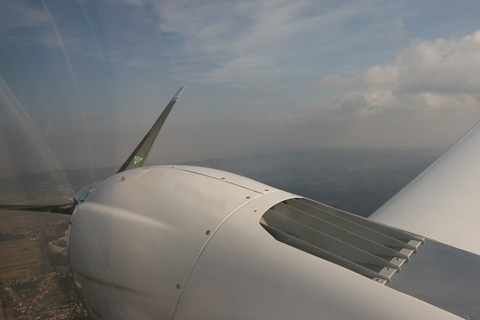
Lifting off Wiener Neustadt's 1,067 m runway 10 to the sight of six brand new, factory fresh Twin Stars waiting outside after assembly. The big grille you see on the nacelle is the coolant system radiatior - being originally a car engine, the Centurion is water cooled.
Lifting off Wiener Neustadt's 1,067 m runway 10 to the sight of six brand new, factory fresh Twin Stars waiting outside after assembly. The big grille you see on the nacelle is the coolant radiator - being originally a car engine, the Centurion is water cooled

The takeoff performance was very good even fully loaded – and don’t let the puny 135 HP engines fool you. When you have to turn a prop up front, torque is what you need. The more torque you have, the bigger the prop you can turn, making better use of the available power. And a turbocharged Diesel has enough torque to go around, so the takeoff and climb performance shouldn’t be surprising.

Another subjective observation I made is that the Twin Star appears to be fairly loud in the cabin. I’ve flown on our aeroclub Piper Seneca III – an old, 70-tech aircraft with big, mean six cylinder engines and soundproofing from the Ford Model T – and it was noticeably quieter than the TStar. The excellent David Clark headphones in OE-FEF, wired into a comprehensive intercom system, greatly helped matters though, but one would have expected the aircraft to be somewhat quieter.

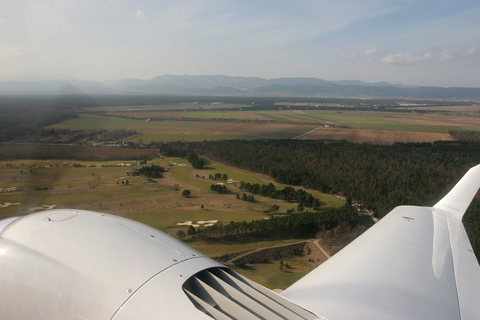
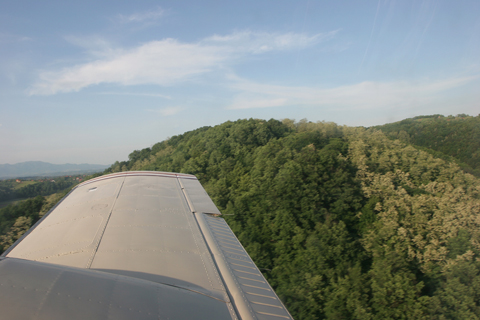
A view of the picturesque Austrian countryside, with the foothills of the Alps in the distance

While we were climbing, our pilot showed off some of the G1000’s capabilities. Describing those would take a couple of dozen pages – and is common knowledge on the net – so I’ll skip that. But suffice to say that everything you really need, you’ll find it in there somewhere. But I stay by my earlier comment that a glass cockpit of this sophistication can be a double-edged sword, despite its cool factor and greatly increased reliability over the old steam gauge cockpits. It’s easy to forget basic navigation and flying skills when you have a computer running the show.

Typical composite reflections add to a general feel of "clean" and "precise" of the TStar
Typical composite reflections add to a general feel of "clean" and "precise" about the TStar

After we’ve reached what I judged to be about 3,000 feet (didn’t bother to look at the altitude readout on the G1000), the real demonstration started – what good is a twin if you can’t kill off an engine inflight? 🙂 Not being a display of showing off, but a very worthwhile safety demo – international aviation regulations state that all twin engined aircraft have to be able to maintain altitude on the power of one engine. Naturally, that altitude is lower than with both engines, but it’s better than losing it you’ll agree.

What would have been a worrying sight in normal cirumstances is here an excellent display of the TStar's fine engine-out handling.

After that was done with, the pilot flew a some random gentle maneuvers in the aerodrome zone above LOAN and offered the controls to the almost pale cameraman sitting upfront – who promptly declined. I was about to explode at that point, cause I had wanted to do that, but was ousted by someone with better credentials and a third of the guts (though – to compensate – the guy had trice my girth 🙂 ).

Some flying fun after the serious stuff had been taken care of
Some fun flying after the serious stuff had been taken care of

Soon enough, our 15 minutes were up, so the we turned back to the field. Either to demonstrate the TStar’s descent capabilities with everything hanging out – gear and full flaps – or simply to shave off some time, the pilot flew a tight, high speed descending turn toward RWY 10, lining up less than 500 meters from the threshold.

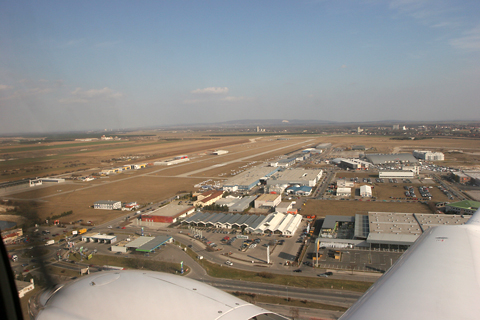
Tight right base for RWY 10, with both the runway and the Diamond works easily and clearly visible
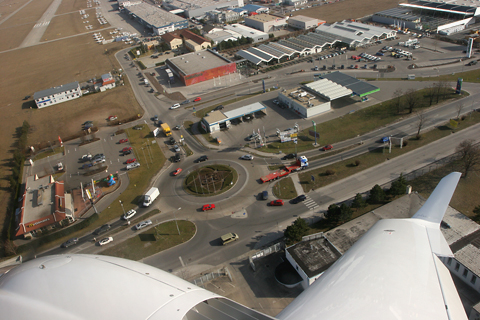
Going down the fast way. You can see the proximity of the runway to the rest of the town... there must be some awesome spotting positions here :)
Going down the fast way. You can see the nearness of the runway to the rest of the town... there must be some awesome spotting positions here 🙂

Given the TStar’s low weight and some glider-ish characteristics inherited from the Star – which inherited those from the Katana, which itself dates back to the HK-36 Dimona motorglider – landing was predictably soft with little flaring needed. Despite the diminutive size of the wheels, I remember the brakes being quite powerful, with the aircraft stopping in about 300-350 meters (though it could do better I presume if you really hit the pedals).

There being still a few people in line for the flight, we got out of the aircraft pretty quickly, but not before I managed to snap a shot of the panel (unfortunately with the G1000 off).

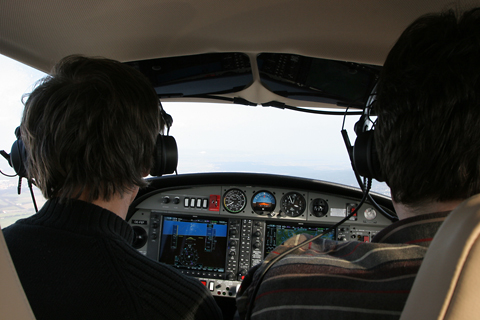
The simple and uncluttered cockpit of the TStar. You don't really have much to push or play with in there, a single throttle level for each engine - the prop and mix being FADEC-controlled - a starting switch or two and lights and heating. Excuse the prints, but in the process of showing of various bits of info on the displays, touching them is inevitable
The simple and uncluttered cockpit of the TStar. You don't really have much to push or play with in here, a single throttle level for each engine - the prop and mix being FADEC-controlled - a starting switch or two and lights and heating. Excuse the prints, but in the process of showing of various bits of info on the displays, touching them is inevitable
Getting ready to go back out there after a two-minute turnaround
Getting ready to go back out there after a quick two-minute turnaround

All in all, the TStar is a sweet little machine and an excellent showcase of what is possible with present technology, brining single-engine economy into the reliable twin engine world. Coupled with the G1000 and docile and forgiving handling, the Twin Star is well on the way to becoming  a very popular tourer, possibly reactivating a the four-seat twin niche that many manufacturers have abandoned some years ago. But – and I’m sorry about restating this again and again – it’s too… protective of its pilot, both in handling and pilotage, to be the ultimate tourer in my book.

Plane’s Anatomy – Air Tractor AT-402

By Boran Pivčić
All photos (and some screwdriver work) author

About a month or so back, I got the almost-unique opportunity to peek into the internal workings of two Air Tractor AT-402 cropdusters (9A-DKG and -DKJ) sitting around at Lučko. Having been parked there for a good part of eight years, they finally went up for sale and some prospective buyers wanted to have a looksee under the hood. Through a long chain of events, I ended up being there – and of course didn’t miss the opportunity to have a photo field day :). Going to the airfield without my camera… bah!

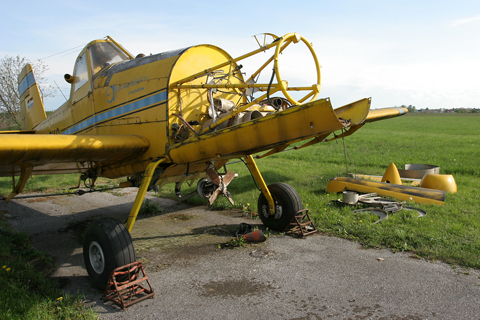
A bit about the planes themselves first – as their name suggests, these are rough-and-tough utility machines, designed for continuous 24/7 back-water, dirt-strip torture. As such, they’re built to last, utilising proven, classic technology. Designed to be dismantled with little more than a screwdriver (and liberal amounts of WD40 in our case), ATs of all marks – 300s, 400s, 500s and 800s – hold few surprises under the skin. But they’re simple and uncluttered and a good showcase of aircraft structural solutions.

The 402 version came about when someone decided to ditch the earlier versions’ 600 HP Pratt&Whitney R-985 9 cyl piston radial and replace it with a more reliable – and far simpler – turboprop. Since the 400 series, all ATs have been produced in this configuration, with engines of varying outputs to cater for increasing weights. The current standard is the AT-802 wheeled model and the AT-802AF Fire Boss amphibian. Despite being designed primarily for cropdusting, most 802s today are used for firebombing. Indeed, the Croatian Air Force operates both variants down at the coast (one wheeled, three Fire Bosses) with notable success.

And now, a step-by-step condensed lesson in aircraft structures :).

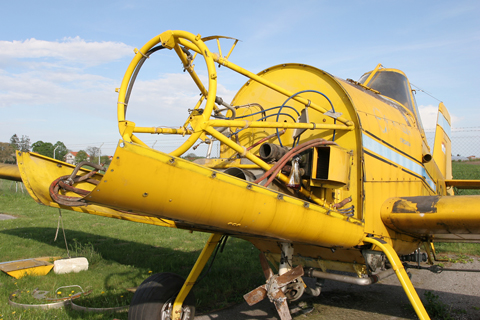
The naked plane. A general overview of the 402 (9A-DKG) with all side panels removed. Despite its imposing size, the AT is basically full of hot air :). Of note is the thick and juicy wing profile, providing a lot of lift at low speeds. The consequence of this increased lift - drag - is not so important here, as speed and cruising efficiency were not high on the design priorities list
Rear quarterview showing some of the internal structure. Like most light aircraft, the AT series uses a frame construction, much like the one you see on construction cranes. The frame - which absorbs all inflight loads and holds the structure together - is covered by panels to make the whole thing aerodynamic. These "panels" can be made from a wide range of materials, wood and fabric in the olden days and aluminium today - though composites and glass and carbon fibre are becoming increasingly common
Removing the other side panel adds some clarity to the shot. Easily visible now is the control linkage, linking the control stick and pedals in the cockpit with the rear control surfaces. The rod you can see going through the structure controls the elevator, while the thin gray cables running along the outside of the structure are linked to the rudder
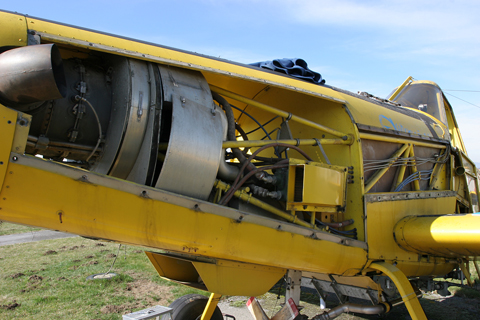
Turbo power! Up close with the Pratt&Whitney PT6A-15AG 715 HP turboprop. Like all turboprops, the PT6 is a small package for the power it delivers, with most of the space in the back taken up by auxilliary and ancilliary devices such as the starter, generator, oil pumps, control links, air intake and the odd cooler or two
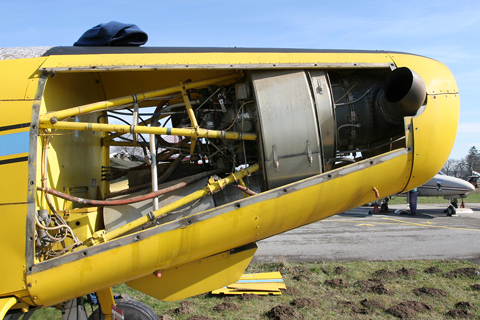
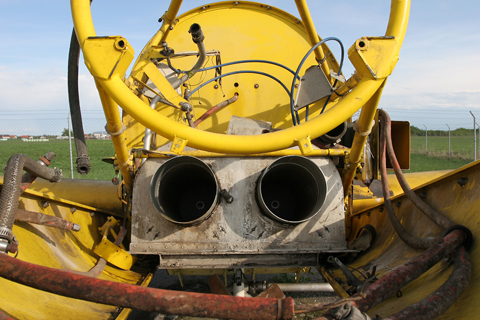
View from a different angle. Again like most turboprops, the PT6 is a free-turbine reverse-flow engine, meaning it's installed ass backwards :). To avoid going into detail, this makes the engine lighter and hence more efficient - and explains why the exhaust pipes are located up front: the back of the engine is thre. Because its front is now deeper in the engine bay, it has to be fed by the air intake visible under the nose
View from a different angle. Again like most turboprops, the PT6 is a free-turbine reverse-flow engine, meaning it's installed ass backwards :). To avoid going into detail, this makes the engine lighter and hence more efficient - and explains why the exhaust pipes are located up front: the back of the engine is there. Because its front is now deeper in the engine bay, it has to be fed by the air intake visible under the nose
A wider view of the nose. Despite looking thin and whimpy, the landing gear is QUITE strong. During factory testing, the designers mounted a four-ton cement block on top of the landing gear assembly (just the gear, not the whole plane) and let it drop from a height of two-three meters (4 tons corresponding to the maximum takeoff weight of the plane). After spreading out and absorbing the weight, the gear sprung - sprung, with a four-ton block on it's back! - back into its original shape... on another note, the brownish thing between the engine bay and cabin is the hopper, with a capacity of 1,500 liters. During cropdusting, this would have contained the cropspray solution, while during firefighting either water or, more commonly, fire retardant
A more recent photo of DKG with its engine and prop removed for overhaul. Only when you disconnect all the pipes, cables and wires do you realise how big a mess the engine bay can be
Closeup of the engine mount. This is basically all that holds the engine connected to the rest of the plane :). But, like the landing gear shown previously, this is built to last. Also visible is the back of the bay is the firewall, "the part of the plane specifically designed to let in fire and smoke" as the joke goes :). In serious-world, it prevents any fire in the bay from reaching the rest of the plane, be it the chemical hopper, cabin or any part of the structure
And last but not least, a view down the lower engine bay. The air filter that feed the engine with nice, clean air is the most imposing feature. Despite the turboprop's somewhat higher resistance to dust than piston engines, bad filtering can lead to a rapid decrease in engine performance and more often than not serious damage to the compressor

Photo Dossier – Piper PA-18-150 Super Cub, 9A-XLJ/9A-DLJ

By Boran Pivčić
All photos author

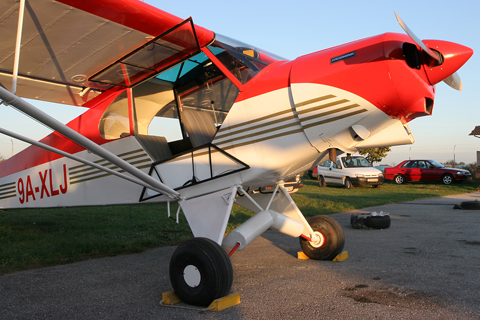
It’s about time I got to grips with this little aircraft here. Despite outwardly being just a normal Super Cub, this specific little machine has a very interesting story behind it. It was assembled by hand by Mr. Vlaho Ljubić, who spent six years working on it – literally from the ground up, when it was still a random collection of bolts and structural components.

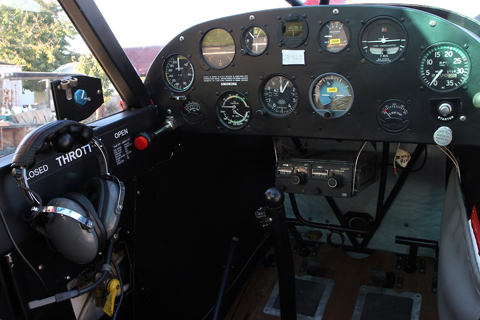
The aircraft is basically a stock PA-18-150 without any modifications, the only difference being the instrument panel layout – but that varied between batches in factory-built models, so we can’t hold that against it :). It is painted in a scheme taken off the Cub Crafters CC18 replica of the Super Cub, but in lighter tones (the original scheme can be seen here: http://www.airliners.net/photo/CC18-180/1423224/L/). Its first post-assembly fight was on October 12th, 2008., on a lovely warm and calm afternoon. The following pictures go out to Mr. Ljubić, who generously allowed me to crawl over every inch of the plane :).

(an additional note about the reg – initially, the aircraft was registered as 9A-XLJ, X being the prefix for the experimental register. However, being in essence a stock, factory design – and given that the whole experimental thing is still wobbly in Croatia – it was transferred to the standard GA register – prefixes B, C (rarely) and D – becoming 9A-DLJ)

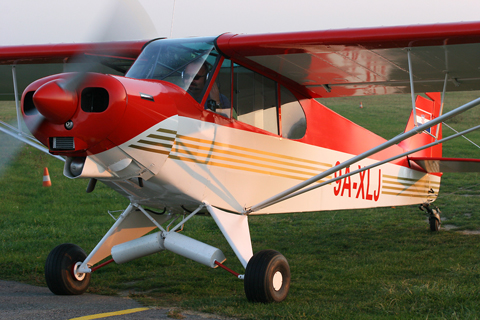
Shining nicely in the autumn sun a couple of days before its first flight
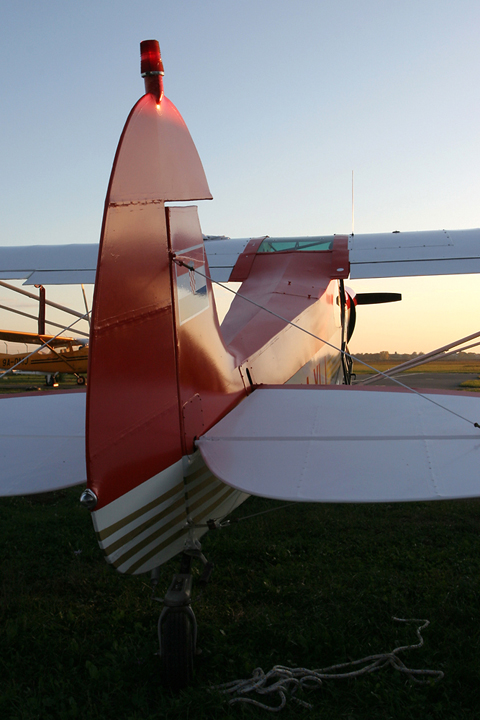
Like all Cubs - Super or otherwise - this one is mostly fabric covered, with a metal frame structure underneath. The resulting decrease in weight compared to traditional aluminium structures offsets the need of periodically replacing the fabric
The aforementioned panel. Simple and uncluttered, it contains all you really need for VFR flying.
Final engine inspection before its first post-assembly flight. Like the majority of all Super Cubs, this one has the O-320 150 HP engine which does wonders for an aircraft as light as this. Some Super Cubs have smaller 95 and 105 HP engines, while a few - mostly glider-towing ones operating at higher altitudes - have been modified with up to 180 HP.
Revving up the engine for a running check. Thankfully for me, the brakes were working perfectly :).
Taxiing out for its first flight!
Go little Cub, go!
Go little Cub, go!
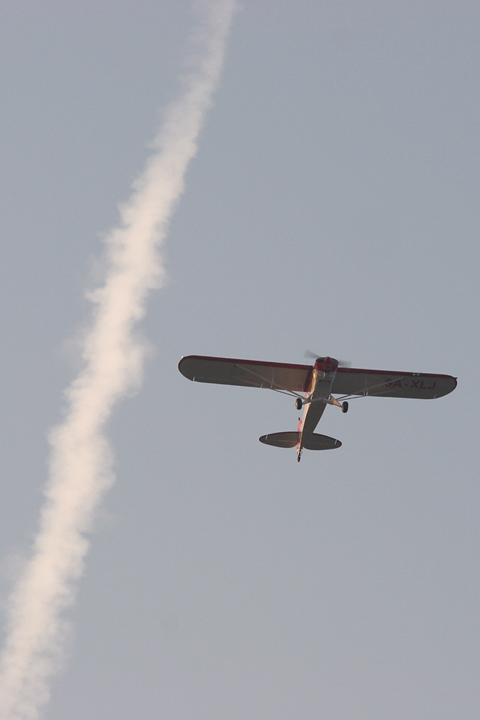
Trundling by at 70 knots while high overhead something zips by at 500+ :)
Trundling by at 70 knots while high overhead something zips by at 500+ 🙂
Taxiing in back home. The smile says it all!
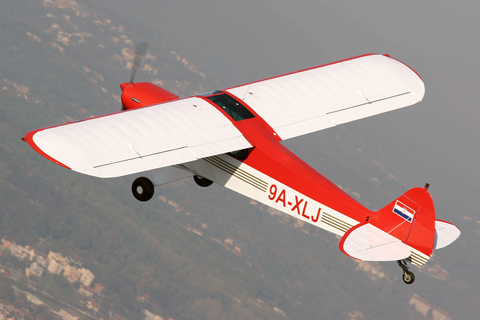
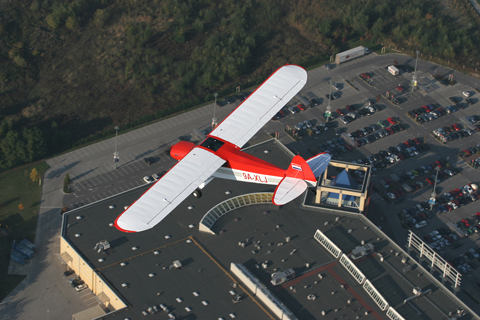
Banking left, banking left! :) An air-to-air session on the aircraft's fourth flight (I think). 9A-DMI served as my trusty photo ship once more
Banking left, banking left! 🙂 An air-to-air session on the aircraft's fourth flight (I think). 9A-DMI served as my trusty photo ship once more
Approaching to form off our right wing above the city of Zagreb
Sliding in alongside and looking beautiful!
Going shopping. Diving away from us above King's Cross, one of the largest shopping centers in Zagreb
Cooling down in the afternoon