Tech/Photo Report – More Multi-Engine (Instrument) Fun

By me
All photos me too, copyrighted

On the face of it, July was probably not the most enjoyable of times to have my Multi-Engine Class training. The summer’s record temperatures – once peaking at a toasty +55 Centigrade in the cockpit – really did us no favors at the best of times; and had certainly not done justice to our little, slightly underpowered Piper Seminole :). So keen to see what it – and I – could actually do given some favorable weather conditions, I was very much looking forward to my Multi-Engine Instrument training, slated to take place in the much more agreeable near-zero temperatures at the beginning of November…

Now, as mentioned in a previous post on the topic, flying a twin engine airplane is fairly easy – provided both engines are operating :D. When one decides to quit however, things can become interesting – still safe, but quite interesting nonetheless. The biggest and most immediate problem in this situation is the sudden lack of power – as my flight instructor had graphically put it, when you lose an engine, you don’t lose just 50% of the available power; in effect it’s as if you lose 75%, since you now also have the dead weight – and additional drag – of the inoperative engine. Specifically, it’s this drag that causes the biggest control problems: with one engine “dragging behind” and the other pulling forward, the airplane wants to yaw and bank around its center of gravity into the inoperative engine, a tendency that has to be neutralized by liberal application of opposite rudder (and possibly some aileron) :). With the rudder now deflected (at low speeds often fully), the drag increases yet again, forcing the airplane down to its speed for minimum drag (and hence minimum required power) – a flight regime that, especially during landing, requires considerable planning ahead…

When simulated for training purposes, this One Engine Inoperative situation also makes the aspiring student appreciative of the simplicity of the turboprop engine – especially if you’re flying a piston-engined Seminole, an aircraft seemingly designed to make your life then and there as complicated as possible :D. Given that many in-flight engine shutdowns are caused by small, easily-rectifiable problems rather than catastrophic failures, each aircraft has a specific set of “diagnostic” procedures the pilot needs to run through to verify whether one of the engines has indeed failed, identify the inoperative engine and – if all else fails (pun intended) – secure it. On the 100-cockpit-lever Seminole (though they’re broadly similar for other piston twins) these include:

  • moving both mixture levers forward into the Full Rich position – the idea being that maybe you’d forgotten to move them forward during descent and the fuel/air mixture had become too weak for the engine to run
  • moving both propeller levers forward. This may seem a bit odd given that one of the engines has failed or is in the process of doing so, but until you’re certain WHICH one it is, better have both props at their maximum
  • moving the throttles all the way to the Maximum Continuous Power setting, for the same reason
  • turning on the carburetor heaters (or opening the alternate air ports on fuel-injected engines) to see whether the problem is simply ice blocking the carburetor/air intake
  • turning on both auxiliary fuel pumps, in case the main engine-driven pumps had failed and no fuel is being drawn from the tanks
  • and then looking around to see whether you’d accidentally shut something off, like the fuel selectors or magnets

If once you’re done the inoperative engine still refuses to cooperate, you identify it and proceed with securing it – which is basically the reverse procedure to the above: close the throttle, feather the prop, cut the mixture and shut everything down related to the engine, such as magnetos, fuel pumps, alternators and the like… you may also have noticed that the above procedure is performed on both engines simultaneously; the rationale is that whatever plagues one engine can easily happen to the other – which is especially likely if the root cause is icing or incorrectly set mixtures.

Despite being a “screenfull”, out on the Seminole this procedure is pretty straightforward and comparatively simple – dare I say fun 😀 – in visual conditions: conditions where you always have a visible horizon and ground contact, and can afford to drift a bit off course while you get the hang of the airplane. In instrument conditions though that luxury is gone, with the only spatial reference you have provided by the instruments – which implies, in addition to everything stated above, continual scanning of the primary flight and navigation instruments and maintaining an image of your position and attitude in your head. Now factor in an ILS or VOR/DME approach and you have a party :D.

Given that during these flights I was want for a few more arms, I did not have the liberty to photograph at will as I usually do, so – after having drifted off course quite badly with this post 😀 – I thought I’d just throw together a small photo gallery of the ME/IR “tools of the trade”… 🙂

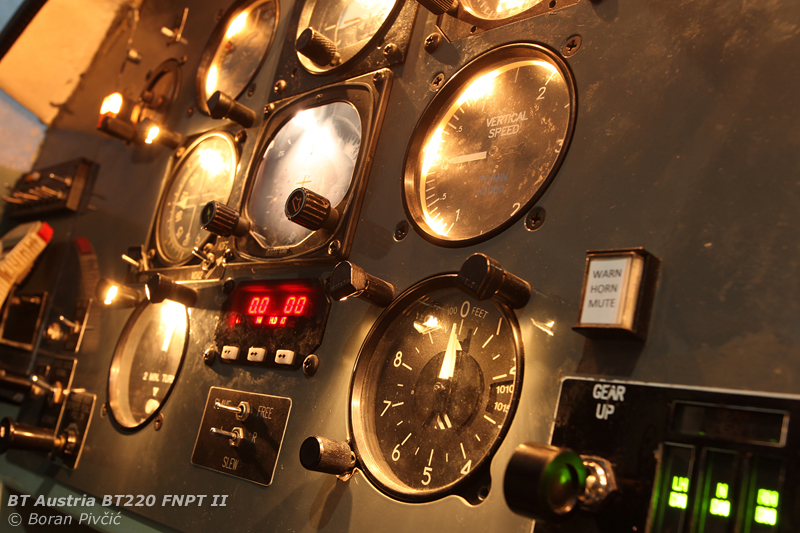
For us "modular course" types, the ME/IR rating also includes three hours on "the simulator" - our good ol', not-entirely-trusty BT220, produced by BT Simulations of Austria :). Though universally referred to as a simulator, the BT220 is actually a "Flight, Navigation and Procedures Trainer II" (FNPT II) - to be a fully fledged simulator, it'd have to be "full motion", that is be able to pitch, yaw and bank like the real aircraft
The copilot's view with the seats moved fully back. Representing (broadly) the Piper Seneca III, the BT220 has everything you really need for any sort of IFR training: an HSI and CDI, two ADFs, two DMEs - and an extensive list of failure options 😀
Cooling down after a grueling two-hour training session. Far from being just a cheap replacement for the real aircraft, "the sim" allows for very useful training for real life emergencies: during this session, we had multiple engine failures, system failures, instrument malfunctions, electrical and fuel issues, landing gear failures - not to mention weather related issues such as heavy icing, heavy turbulence, gusting wind and low-visibility operations. Though we'll probably never encounter such a pessimistic combination of conditions out in real life, the lessons learned from them can do wonders when something really does go wrong on the actual airplane...
Dripping wet after an hour's worth of flying though rain while shooting some ILS approaches. Apparently all of my instrument flights are doomed to either cloud and low visibility, heavy turbulence or pouring rain 🙂 (fitting, isn't it?)
At least we gave the Seminole a thorough - and thoroughly ecological 🙂 - wash! She was clean as a whistle when we were done!
Back in the dry in the University's hangar. Like many small twin-engine Pipers, the Seminole is equipped with contra-rotating propellers, eliminating the dreaded "critical engine" and all of its associated negative effects (at the expense of more costly maintenance)
9A-DMG, the Cessna 172N on which I'd passed my Single-Engine Instrument checkride, framed by 9A-DZG on which I'd passed my Multi-Engine Class, Instrument and CPL checkrides :). If they were people, I'd be thanking them now 😀

And finally, honorable mentions go to two photos I’ve snapped in flight with my mobile phone… due to a somewhat “expedited” departure from Pleso airport, I’d left my camera in the luggage compartment and couldn’t get at it in flight – so I had to use whatever I had at hand… 🙂
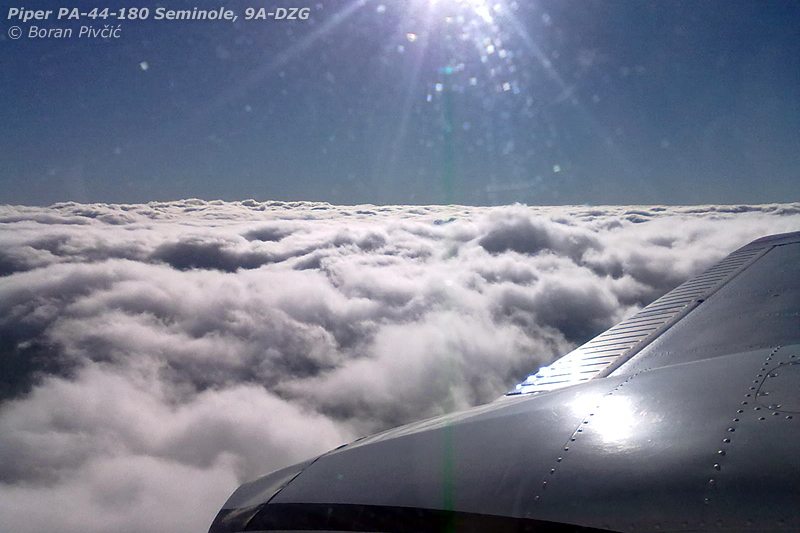
There really are very few things that are as enjoyable as a flight above the cloud deck :). Cruising at 6,000 ft in silky smooth air towards Maribor (ICAO: LJMB), the autopilot keeping the Seminole straight and true, and the scenery going from great to awesome!
Moments before we break into the cloud deck at 140 knots on our return trip...

Photo Report – Can’t Snow Me Down: A Winter Shakedown at Lučko

By me
All photos me too unless otherwise stated, copyrighted

While this year’s game of Lučko Roulette – trying to fly your aircraft out before the field closes due to bad weather 😀 – has been generally successful, the constraints of the limited apron capacity at Zagreb Intl. meant that a few aircraft (notably those with a hangar above their heads) have nevertheless remained at the field. Faced with the prospect of them sitting idle in sub-zero temperatures until the runway melts and dries out – which can take awhile – the “flight ops department” of Aeroklub Zagreb had once again decided to clear out its hangar and give everything in there a thorough shakedown :).

While at first it may seem a bit pointless to fire up the engine, proverbially rev the bolts off it, and turn it off again without going anywhere, the procedure does have a host of beneficial effects. Primarily and most importantly, it allows the engine to periodically clear itself of all the deposits and substances that can (and will) accumulate in its piping and systems during a long stay on the ground. If left to settle firmly over the winter, these substances – the most common being carbon deposits on the spark plugs – can seize and/or severely damage the engine when it is finally started; but, if anticipated during these shakedown runs, they can be easily removed by simply revving the engine to raise the temperatures in the cylinders until the deposits burn away and the engine starts to run smoothly.

The same also applies to the oil system – which, on the face of it, is the very system that allows the engine to run in the first place. And while winter temperatures in Zagreb rarely go below -15 Centigrade – well above the temperature at which winter-grade oil thickens dangerously and freezes – the system itself has a number of moving parts (the most important being the oil pump) that are also susceptible to the above stated. Running the engine at a higher throttle setting allows the pump(s) to run up to speed and warm up, breaking off any deposits on their blades and bearings. In addition, the flow of oil through the system picks up any impurities that might have settled on the bottom of the pipes and deposits them on the (removable) oil filter, thus cleaning out the entire system.

The fuel system too needs some attention, mostly to purge it of water deposits that – inevitably 😀 – form in its low points. Being heavier and thicker than Avgas, water tends to sink and collect at the bottom of fuel tanks and pipes – and if ingested into the cylinders in a large enough quantity can cause a lot of (very expensive!) damage. By its very nature, water is incompressible; and when it winds up in the part of the engine DESIGNED to compress, something has to give… which is usually the piston 😀 (however, there are systems that inject water into the cylinders on purpose – but this is on a controlled and measured basis. These systems – usually known as Anti Detonation Injection, or ADI – squirt a small amount of water into the inlet pipes, which then absorbs excess heat in the cylinder and prevents uncontrolled spontaneous ignition, as well as providing a significant increase in power… as seen on the P-47 Thunderbolt 🙂 ). Thankfully, the unwanted water can be easily removed from the system by draining the bottom of the fuel tank using a special valve, as well as dumping the contents of the pipes at the low point of the system – usually just after the fuel selector normally mounted on the cabin floor – using a small lever in the engine bay.

Draining fuel from a wing tank drain valve on a Piper or Beech. A small amount of fuel is drained into a cup or bottle and checked for water, which would show up as a transparent sediment on the bottom – one of the reasons why Avgas is colored 🙂 (the other being that fuels of a different octane ratings are colored differently for easy visual recognition) (photo from: cdn.wn.com)

Less visible benefits of these high-power runs also include recharging of the battery, which will – again inevitably 🙂 – discharge or even go flat after awhile (as had happened to our Piper Warrior). The ready supply of electricity from the alternator allows too for a check of the aircraft’s other electrically-powered systems, such as the radios, flaps (where available), lights and so on…

However, before all of that, you first have to take care of one small detail – pushing everything out into the open :D. Normally this is not a problem – but our efforts that day were a tad complicated by the inch or two of fresh snowfall from the night before… 🙂

A welcome splash of color on an otherwise completely white Lučko. While it did us no favors with the main task of the day, last night’s snow – still ongoing at the time this photo was taken – did at least provide for some nice photo opportunities!
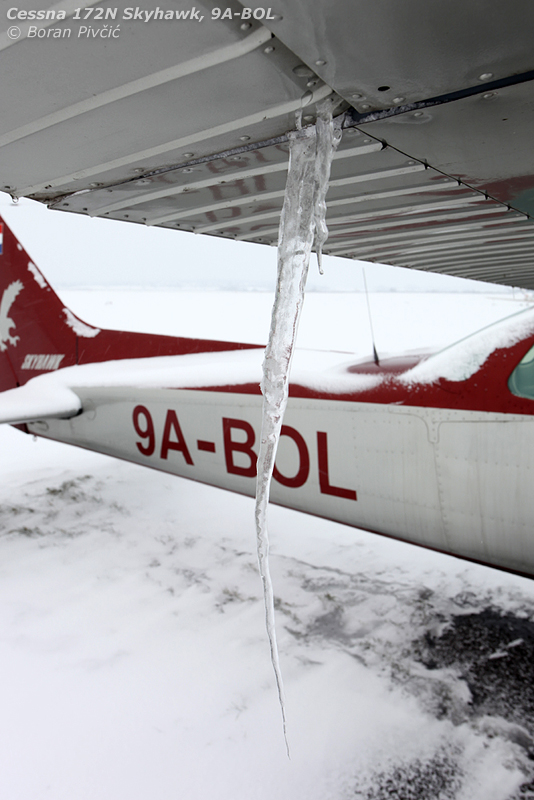
The art of icing? 😀 Even more ironic given that this specific aircraft is usually based on the warm and sunny island of Brač on the Adriatic coast 🙂
Preparing to fire up 9A-DDA, AK Zagreb’s very-rarely-seen Piper Warrior. Not having flown for ages, a flat battery is pretty much a permanent state on this aircraft, requiring the use of a Ground Power Unit for starting
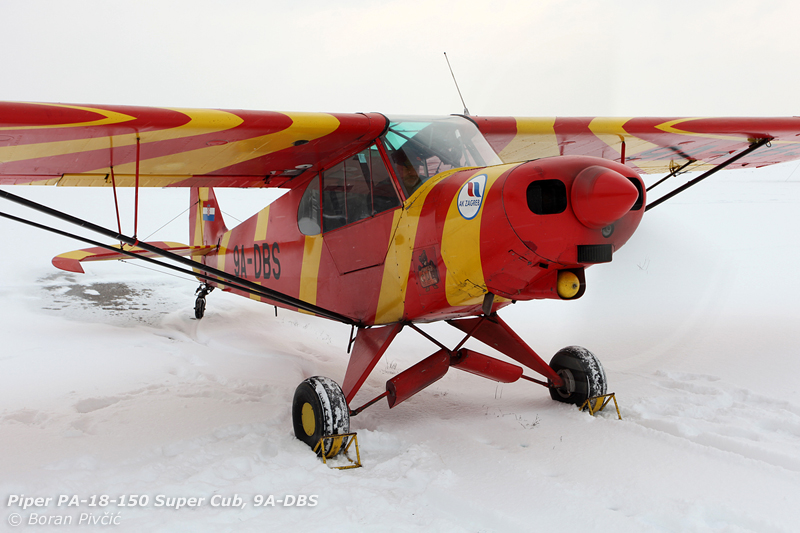
9A-DBS doing its best to clean up the airfield :D. Despite the odd childish impulse to gun the engine and see how big a cloud you’d create, these high-power shakedown runs have to be done with caution – especially on an aircraft like the Super Cub. With its high power-to-weight ratio, an unsecured Super Cub could – despite the brakes being locked full on – easily start sliding forward on the snow. To protect against that as much as possible, the wheels need to be secured with chocks, preferably dug into the snow (and if possible, it’d be a prudent move to tie the aircraft down)
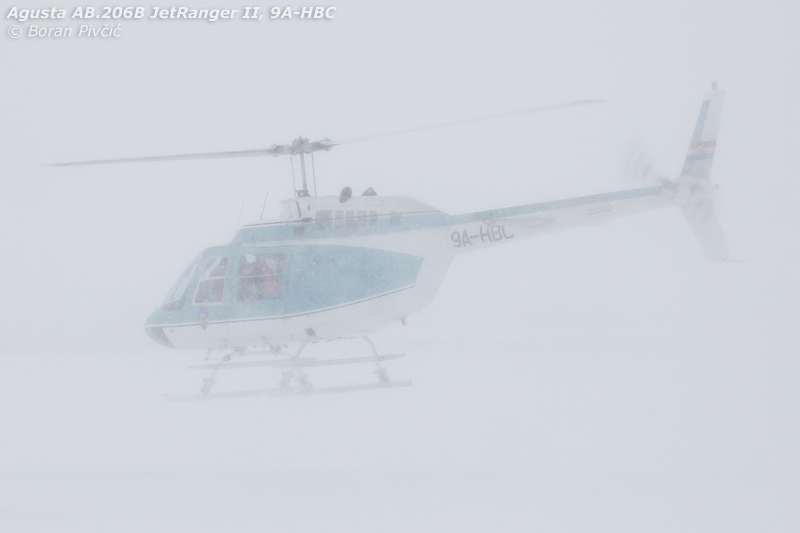
Complete and total whiteout as 9A-HBC lifts off from the main apron. Sporting a cabin full of Christmas presents – and even a helicopter-pilot-turned-Santa 🙂 – HBC was the centerpiece of a small celebration organized for the children of the Police helicopter squadron pilots. Now, what would an aviation-oriented kid have thought of that? a) look, Santa has flown in from the North Pole!, or b) look, Santa has been arrested by the Police for flying a multi-deer sled without a valid JAA license! 😀
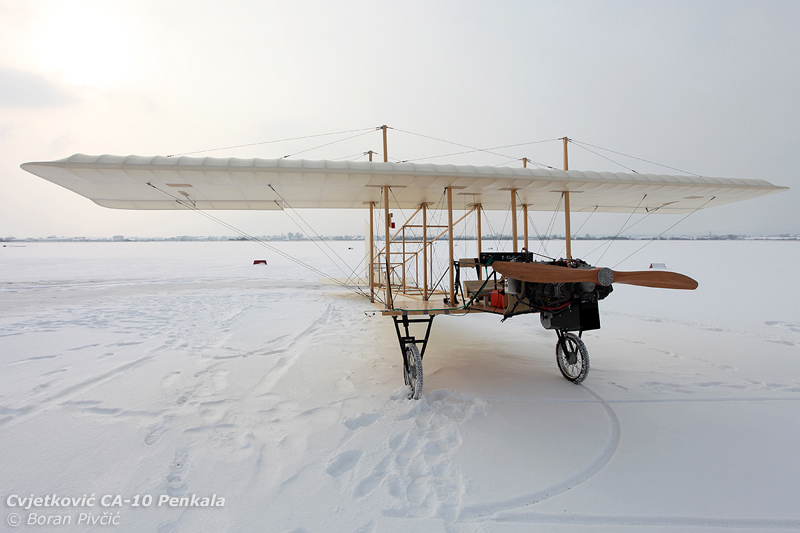
A modern replica of the first aircraft designed and built in Croatia – the Penkala P-3 of 1910 – looking gorgeous out on the snow during an ad-hoc photo shoot :). Not an exact one-for-one copy, the Cvjetković CA-10 Penkala has been modified with today’s aerodynamics knowledge (since the original hadn’t so much flown as hopped along) and an 80 HP Rotax, replacing the original 5-cyl radial :). Normally protected from the elements in the field’s various hangars, this was one of the few times 9A-XCA – as it had been registered a few months back – was seen out and about since September’s Lučko Airshow
Oil, smoke and fire as the I-3’s big M-14P radial labors into life. Not having ran for almost three months, the engine had normally put up quite a fight, spewing liberal amounts of oil from the exhaust during a number of previous startup attempts… also, like virtually all Russian/Soviet light aircraft, the I-3 uses a pneumatic system to start the engine – a system that normally depletes itself when not in use. To fill it up before the engine’s own compressor takes over, an external air source – such as the compressed air cylinder seen here – is necessary
Creating its own weather out back as the big prop revs to its maximum RPM. By the time the 10-minute run was finished, DOG had managed to clear half the apron 🙂

Video – Landing At Lido Airfield (LIPV), Venice

By me
Video and photos me too

In a departure from my standard photographic norm, I’ve decided to try my hand at a “video report” and post a short clip (my first YouTube submission too :D) from an international flight I’d flown about a week or so ago. Having abandoned all attempts at completing my CPL time build in Zagreb’s increasingly horrendous weather, I soon retreated back to Portorož, Slovenia for the weekend, intent on nailing those four remaining hours while I still had my hand in with the local aircraft. While there, and looking for a creative way of burning two hours’ worth of Avgas, I decided I might as well head for Venice, Italy to finally see this fascinating city from the air (and notch up another international destination in my logbook 🙂 ).

Not really spoiled for choice landing-and-handling-tax-wise, my destination for the day was virtually self-selecting: the very interesting Lido Airfield (ICAO: LIPV) located on one of the city’s historic islands :). With a 1000×45 m grass runway, Lido – previously known as San Nicollo – is pretty much in the same class as my base airfield of Lučko, and is as such a popular and comparatively cheap destination for pilots flying into the city.

The only way to fully experience the architectural madness that is Venice is from the air :). Flying over the southern reaches of the city at 3,000 ft by grace of the fantastic air traffic controllers at Tessera airport (LIPZ), itself visible near the upper right hand corner of the shot. Also sorry for all the reflections... after several days of persistent rain the air was clean, the plane was clean, the windows were clean and the sun was out in force, all making for a technically challenging photo. Further complicating things is that I snapped this photo without proper aim, since I was holding the 1.5 kg camera at arm's length from the pilot seat (and hoping the settings I'd preselected worked) 🙂

And while my visit would amount to just 30 minutes on the ground – enough to stretch a bit and tidy up the mass of maps and charts littering the cockpit – it did give me the opportunity to make my first decent landing vid 😀 (however, my video editing skills and equipment are nowhere near their photo equivalents, so the quality does leave a lot to be desired). For a brief walk-through, the video starts at the end of the right-hand downwind leg for runway 05, goes through base (with a few views of Venice) and final, and ends when the uneven grass runway dislodges the camera from my makeshift stand on top of the panel :D…


Photo Report – Lockheed F-104 Starfighter, MM6914

By me
All photos me too unless otherwise stated, copyrighted

While (strictly) military aircraft are not something I usually cover on this blog, after reviewing some of my photos from a recent trip to Italy, I’ve decided I could make a slight exception – just this once :D. Namely, back in mid-November I had the opportunity to visit Thiene Airfield (ICAO: LIDH) in Northern Italy, where  four colleagues and myself were scheduled to take the standard “ICAO English Proficiency” test required for the issue of our CPL licenses. And while the doom, gloom and torrential rain forecast the day before had seemingly precluded any effective outside photography, I’d nevertheless packed my 10-pound camera bag in the hope that I may stumble onto something interesting nonetheless… 🙂

A quaint grass strip situated a few miles north of the historic city of Vicenza, Thiene did indeed have a party piece for me, one I’d homed in on even from the airfield’s access road: a beautifully preserved F-104 Starfighter, the first one I’ve ever seen in person! 🙂 Its air superiority gray blending in perfectly with the dull, low overcast, its fuselage gleaming in the rain, it had immediately grabbed my attention – and after a short round of international diplomacy, the very kind airfield staff had allowed me to get up close and whip out my anti-aircraft Canon :D.

Standing in front of MM6914, it is hard to appreciate and even imagine the impact the Starfighter’s shape had in when it had first flown in 1954. WW2 had ended just nine years ago, propliners were still plying the skies, and even the world’s major air forces still had piston-engine fighters in frontline service… and then, out of nowhere, this needle-sharp, razor-winged jet-propelled missile appears, thundering past at twice the speed of sound and altitudes three times higher than any civil aircraft could reach. In a world still inspired by Buck Rogers and Flash Gordon, it wasn’t really hard to see how the 104 got its name :).

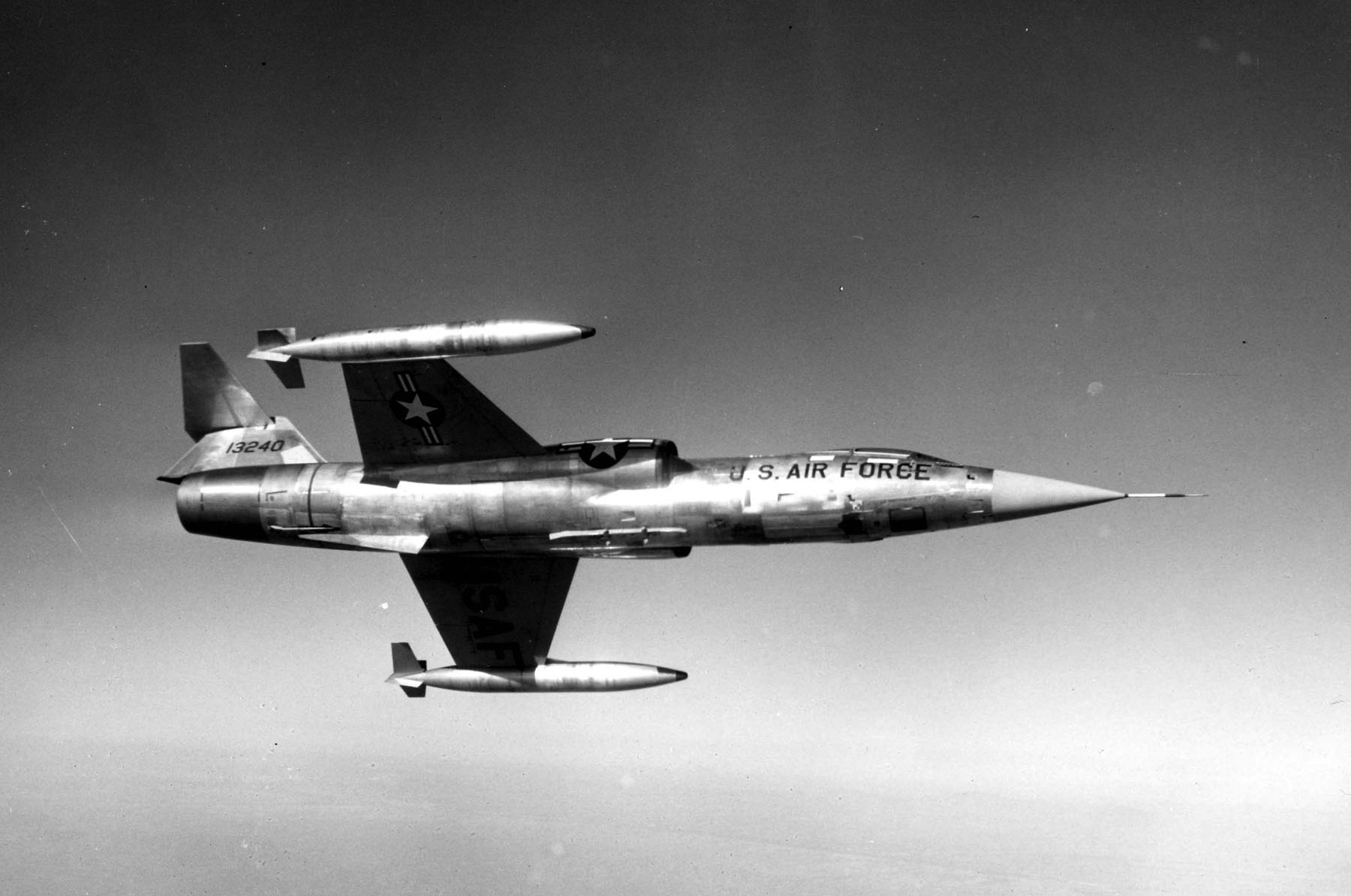
After more than half a century, this shape still turns a great many heads. Very, very few aircraft have come close to achieving the sheer look of out-and-out speed the F-104 so beautifully embodies (photo: unknown, from media.moddb.com)

And yet even today, 56 years after its maiden flight, the Starfighter’s stellar performance – pun intended 😀 – remains impressive. So impressive in fact that the type had – despite all its faults – remained in service until 2004, last flying with the inimitable Italian Air Force. One of these fascinating aircraft is our MM6914, whose full name drags out to Aeritalia F-104S ASA-M Starfighter – or in plain English, a license-built Italian-spec Starfighter that had received a weapons systems upgrade (the ASA-M bit) sometime during its service life :). The most capable of all the Starfighter marks, many of these aircraft had managed to evade the scrapman’s axe and are now adding their bit to the beautiful Italian landscape… 🙂

Quite possibly one of the most distinctive shapes of the Cold War. A short-range - but insanely fast - interceptor, conceptually the F-104 has a lot in common with the Soviet MiG-21, an aircraft designed to do pretty much the same thing. And having now seen both in the metal, I'm tempted to say that the 104 has a more... exciting appearance 🙂
A shape that can hardly fail to set your pulse racing :). Note the extremely short-span anhedral wings: at 6.36 meters from tip to tip, they're almost HALF the span of those on the Cessna 172! Notice also the arrestor hook under the fuselage: though most commonly associated with carrier-based aircraft, it is also a standard feature on many, mainly Western, land-based fighters. With their high approach speeds - 350 km/h / 189 knots in landing configuration on the 104 for example - a brake system failure on landing could very well mean an overrun of the runway and loss of the aircraft (and maybe crew). To protect against this, many dedicated airbases have a system of arrestor cables similar to those seen on carriers, which the stricken aircraft can snag on landing and stop safely. However, given that the runway length available after the wires is much more generous than on a carrier deck, the land-based system is much more gentle on both the airplane and pilot
An unusual, faded-out view for a bit of atmosphere :). Not only the fastest, but also one of the most advanced aircraft of its day, the 104 was often nicknamed "A Missile With A Man In It" on account of its legendary high speed performance and head-snapping acceleration. Less flattering names though had included "Widow Maker" and "Flying Coffin" on account of its absolutely appalling - and equally (in)famous - low-speed handling characteristics. In German service, this - together with too hasty an introduction into service and too basic a training program - had resulted in the loss of a staggering 30% of the fleet and 110 pilots in various air and ground accidents... and yet, at the other end of the scale, the Spanish Air Force had operated 21 examples for seven years without a single loss or accident (which many attribute to the stable weather conditions in Spain, as opposed to the constantly shifting Baltic weather which made the 104 tricky to fly)
You can easily see one of the keys to the 104's incredible speed - there really isn't much in the way of drag or weight to hold it back :).
A view inside from the tailpipe. Like on many single-engined fighters of the era - including its "rival", the MiG-21 - removing the engine from a Starfighter was quite the procedure. Unlike on modern aircraft, where you simply slide the engine out of the airframe, here you have to remove the rear of the fuselage (the joint is marked by the yellow frame) to gain access to the engine mount points and then detach it from the rest of the aircraft
The said engine - a General Electric J79-GE-19 afterburning turbojet - preserved in the hangar of a local flight school, complete with its reheat and exhaust assemblies. Apparently, this is the very engine used by MM6914 🙂
Hangar decorations to my liking! 😀 While some hangars have RC models or gliders hanging from the ceiling, this one has a pair of F-104 wingtip tanks :D. Frequently carried due to the aircraft's rather poor range, each tank could hold 1287 l / 333 US gal of fuel, complementing the 3391 l / 876 US gal carried internally. And I must admit that on their own they look a fair bit larger than when mounted on the aircraft 😀