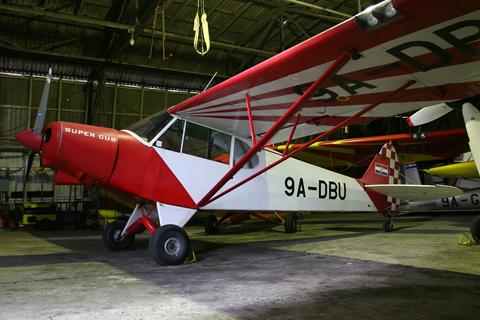
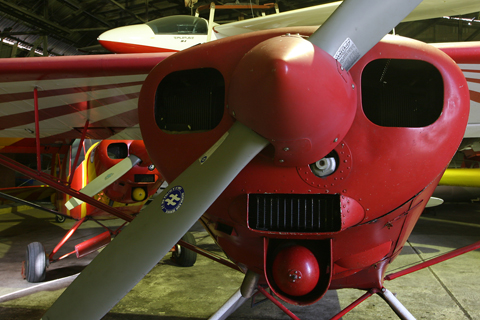
With a strong northern wind pinning everything down at the field for the past two days – and rapidly dropping temperatures killing any will to stand outside – I had decided to sniff though the hangar again in search of some inspiration :). And wouldn’t you know it – the Super Cub population had doubled! 😀 Normally parked outside the hangar – being a visitor while it’s base field of Buševec was undergoing some work – 9A-DBU, AK Velika Gorica’s towplane, took shelter alongside our resident 9A-DBS. So, with nothing better to photograph outside, here are the results!
Despite it still being light outside - plenty of it between the storm clouds - we had lit up the interior as well :). A stock Super Cub, 9A-DBU is one of a number of such aircraft bought and imported at pretty much the same time for towing dutiesFull of natural and sodium light, this family photo shows that Cubs love stripes :). Related by more than just their type, DBU and DBS are twins, coming off the line one after the other :). DBU is serialled 7809169, while DBS 7809170Another shot toward "The Crack" (no rude hidden meaning intended 😀 ), the gap between two hangar door sections. Being quite old - almost 70 years - the hangar is becoming a bit shabby...Lined up and ready to go!
By me All photos me too Cleaning, complaning and cursing me and Dean T.
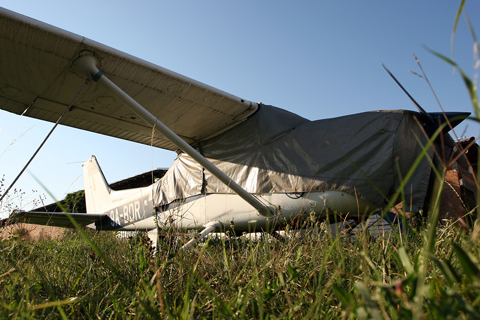
Deciding to be useful for once, I offered Dean T. – who’s always been my man for the job for access round Lučko – to come one day over the weekend and help out with the various odd jobs that inevitably pile up around the field. And sure enough, I had just arrived at 10 AM one Saturday when I saw him pulling an old, neglected Skyhawk out of the tall grass. An odd look and a couple of questions later, it had transpired that the aircraft – on the ground for the past 6+ years – was probably going up for sale and needed to be spruced up as much as possible…
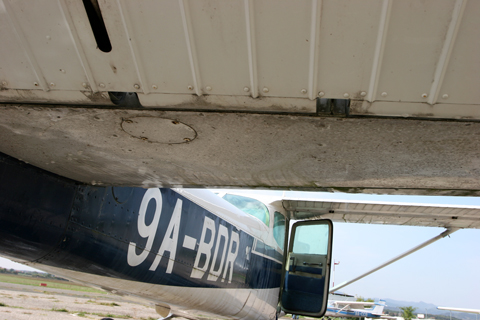
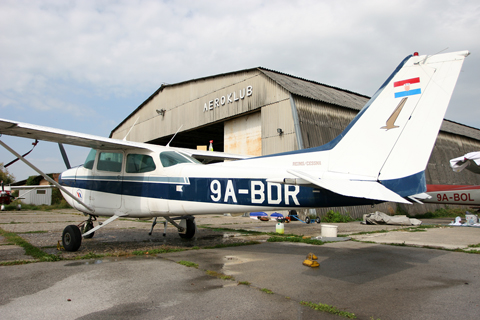
Shot about two months earlier, 9A-BDR - a Reims F172M or N - was a forlorn sight, tucked away in the corner of the apron. With a Certificate of Airworthiness that had expired in 2003., this poor thing hadn't moved from this spot in ages
It was a warm and humid day and, in need of refreshment and fun, we threw ourselves into it. However, a quick survey of equipment showed our total inventory at just three sponges, some detergent and a special wiping cloth. Not much to go on, given the magnitude of the task…
The typical BEFORE shot :). Rolled forward for the first time in years, the first thing on the list was to pump up the tires to make maneuvering on the ground easier. That didn't help much as apparently one of the brakes had locked onNext, we had to remove the covers... something we regretted a moment later. They apparently hadn't been lifted once in the past six years and in the heat all of the dust and dirt under them "baked" onto the fuselage. The wings - thankfully uncovered - were just plain dirty 🙂Exposed to the elements for as long as it was, we were surprised that this was the only paint peeling off
We were curiously optimistic about the task, as it soon transpired that much of the dirt on the wings and fuselage was quite easy to wipe off. A bit of an oddity really, but it made our life considerably easier :). The only problem was that we couldn’t get at all the tiny places and openings normally found around the controls – and lacking a high-pressure water source, we couldn’t even try and wash them out with by brute force…
Contrast; a definition :). While Dean started on the left wing, I got to grips with the cowl and soon got it glowingThe scale of the problem on top. In the long run the covers did more damage than the elements...Cleaning out the control surfaces. Despite appearances, everything down here came off easily in just one pass
The major constraint was that this was basically a cosmetic, outside makeover – which ruled out any possibility of opening a panel or two to check out the structure and control lines underneath. I has also wanted to crank the engine to give it some air and clean out the cylinders, but a quick yank on the prop – which had gone round surprisingly easy despite the magneto switch being off – scratched that as well. Upon further questioning and investigation, I had found out that, aside from a full oil tank, the engine had no alternator, starter, magnetos or battery. While we could have done without the alternator – and even the magnetos – we’d need the starter and battery (an external power supply wouldn’t have helped, as it has to go through the battery itself).
And, if the more eagle-eyed readers noticed, we had to change the position and orientation of the aircraft every once in awhile due to a very short water hose :). Having to manhandle it around the tail and landing gear, we though it simpler just to re-orient the whole aircraft.
A lunch break gave me an opportunity to peek inside while we let the upholstery breathe a bit. The panel was in a surprisingly good state, well equipped and with only the ADF radio and indicator missing. Though this is all academic, the instruments having certainly ran out of service life after having been neglected for six yearsGetting there bit by bit... 🙂 You can still see the remnants of the aircraft's old registration under the current one: YU-BDR. After the breakup of Yugoslavia back in 1991., all aircraft registered in Croatia were re-registered with the country's new prefix, 9A (with a temporary RC prefix in the meantime). On many aircraft this change was hastily done by simply painting the YU over and applying 9ANow this looks more like it :). Cleverly choosing a point of view that hid the paint damage, I could have been fooled into (briefly) thinking this aircraft was actually well maintained 🙂
And five hours, one pizza and two liters of coke later, we reckoned we’d done it! Though the faded paint job was a distraction, we felt it came out beautifully in the end – cleaner at any rate than some of aircraft that fly every day :). And by a twist of irony, half an hour later it was back in the same place it spent the past six years, still waiting for a buyer…
By me All photos me also Driving me across the whole field Dean T.
Looking to profile all the interesting aircraft at Lučko, I keep passing over one that has almost become a permanent fixture of the field, pretty much part of the landscape. Despite being huge, we’re so accustomed to seeing it in the distance that we don’t pay it much (or any) attention anymore – which is a shame, since it’s a very interesting and nowadays rare piece of (formerly) flying machinery. The subject is, of course, our old white whale, RA-21132, a Mil Mi-6 heavy transport helicopter.
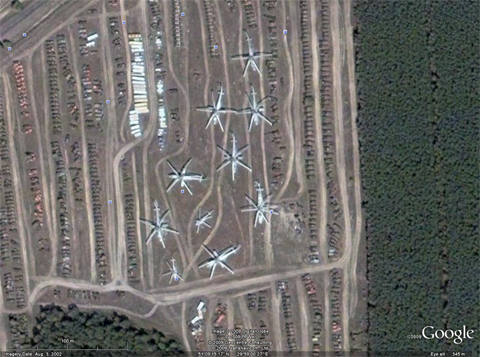
Once the largest helicopter to see mass production and regular service, the Mi-6 is an imposing and awe-inspiring aircraft from any angle, today beaten only by it’s more powerful and modern brother, the Mi-26. Powered by two Soloviev D-25V turboshaft engines delivering 5,500 HP each, the Mi-6 weighed in at an astounding 42,500 kg at maximum takeoff weight, equivalent to TWO Dash 8 Q400 70-seat turboprops (or one 90 seat DC-9-10). At its cruise speed of 250 km/h – a not at all shabby 135 kts – it could haul 90 passengers or 12 tons of cargo over a distance about 600 km. Normally this was put to good use, and the Mi-6 was over time produced in a number of versions, including electronic warfare, airborne command post, anti-submarine, firefighting, SAR and AWACS models among others. However, the Mi-6’s most famous use was during the ’86 Chernobyl nuclear powerplant disaster, when several aircraft were used to douse the still-burning reactor core immediately after the accident. Irradiated and now useless, they were dumped in the Chernobyl vehicle graveyard and can be easily seen using Google Earth.
The Chernobyl vehicle graveyard, with several Mi-6s clearly visible - they can hardly fail to be given their size. The image coordinates are: N51° 09' 15.42'' E029° 58' 59.68''
Not at all bad for a machine first flown in 1957, just 17 years after Igor Sikorsky demonstrated the single-seat VS-300, the first helicopter that actually worked and flew like the helicopters of today. Even today it’s rotor and gearbox system components are considered advanced and have been put to great use in the subsequent Mi-26 (which is – unbelievably – an even more impressive aircraft).
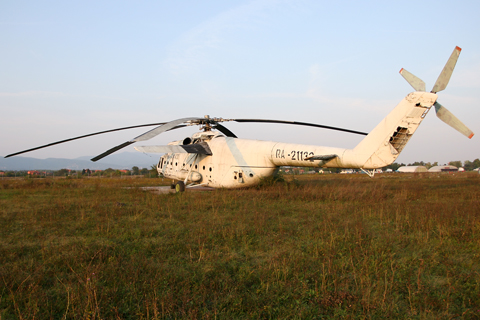
Meanwhile, back in Croatia, RA-21132 is having far less success. A stock, early-model Mi-6 with the serial 2402, it is now sitting at the far end of the field on the furthermost military helicopter pad, alone and forgotten. The lettering on the fuselage suggests it had once been operated by Aeroflot – though this is questionable, given the Soviet Air Force’s habit of operating transport aircraft in civilian Aeroflot colors. As this appears to be a non-passenger version, we can safely assume that it has had a military background (at least at some point in its life).
How it got here and why is an even bigger question and there is not clear agreement on that front. The most plausible version is that it was bought during the Civil war of the ’90s (the RA- prefix would suggest a post-1991/92 acquisition) at the end of its service life, flown here and dumped when its resources ran out and the subsequent UN armament embargo on Croatia meant spares would be impossible to come by. Whatever the case, it has been sitting here for more than 15 years, stripped of everything useful that could be carried away without heavy machinery (the engines are still up there, which could rule out any systematic and organized cannibalization).
Because it’s at the other end of the field – and the only way to reach it would be via the military base or a long trek through the grass right across the field – we don’t visit it often, but vandals do not seem to mind the exercise, as the helicopter is in a ever-worsening state every time I visit. That not being often, I’ve put together a collection of photos taken in 2005, 2006 and a couple of days ago (and many thanks to Dean T. for the drive in the AK Zagreb van 🙂 ), of varying quality and taken with various cameras… but with the key points covered :).
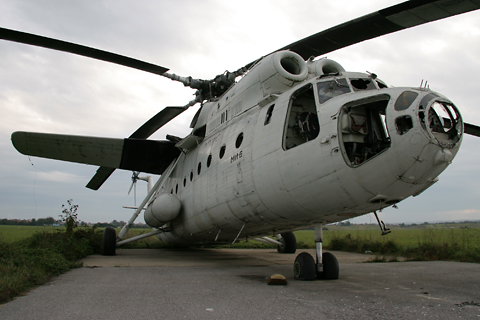
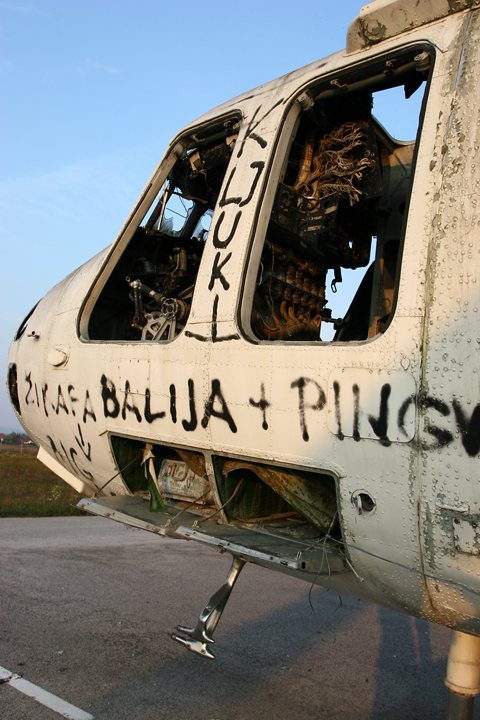
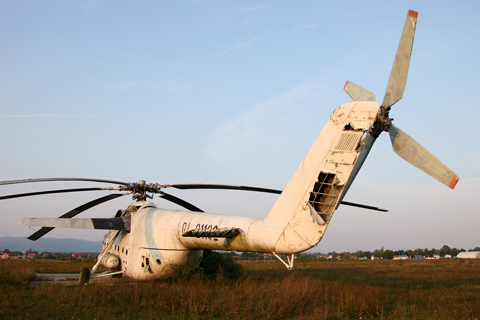
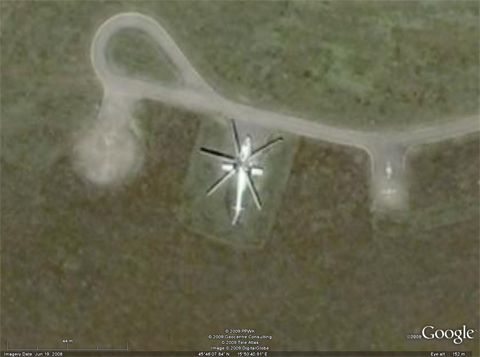
With an overall length of 33 meters and a rotor diameter of 35 meters, this is one huge machine! Shot in 2005 with my old Fuji S5000 while I was helping with a precision landing championship at the RWY 10 endUp close a year later. From right beside, the Mi-6 is more impressive than the A380 - especially given it's a helicopter. To improve cruising efficiency and get some load off the main rotor, the Mi-6 was fitted with not-at-all-insignificant span wings, which were removed on both the firefighting version and the follow-on Mi-26More akin to a fixed-wing aircraft than a helicopter, the Mi-6 required a six-man crew, including a pilot (who sat on the left), copilot, two flight engineers, a navigator and radio operator. During military and cargo ops, this could swell to even more when you add the Soviet equivalent of the loadmasterThe main rotor hub. A complicated - and very advanced - piece of machinery turning the giant five-blade rotor. Much like on the An-225, during takeoff the blades have to lift themselves first before they get to grips with the 40-odd tons of fuselage and cargo remainingTaken a week ago, with RA-21132 looking a lot worse for wear. The fabric covering the vertical stabilizer was torn off, while pointless nationalistic graffiti on the fuselage side dealt a further blow to the dignity of this fascinating machineUp close, the size of the Mi-6 becomes more apparent - when you can compare it to known details such as doors and windows. Like most Soviet helicopters, the Mi-6 carries its fuel tanks externally, seen here strapped to the mid fuselageInviting, but I decided not to climb aboard. The military might have had some objections and given the state on board, I didn't want to risk falling over - or through - something. Pictured are the pilot's and one of two flight engineer stations. The two compartments below the cabin look very much like avionics baysThere were some halfhearted suggestions to turn RA-21132 into something useful, like a restaurant, but it appears destined to rot here for a long time to come. A sad end for an impressive machine, beyond any meaningless repair...Sitting isolated and all alone at Lučko.... image coordinates: N45° 46' 07.92'' E015° 50' 40.73''













 Achtung, Skyhawk!