As much as the art of marketing can be frustrating to those on the receiving end, its nuances, quirks – and not least of all its failures – rarely fail to add an interesting back story to the product it is trying to promote. Among the many fascinating examples out there is that of a Cessna 206 I’d come across at Vrsar Airfield (LDPV), an aircraft with a story so complicated it makes the whole airplane all that more interesting – though likely not in the manner that Cessna’s PR men had envisioned :D.
The aircraft in question is the fantastically rare P206B Super Skylane, one of the direct ancestors of today’s 206 Stationair family :). Though it has always been assumed that the Stationair had been created from scratch using a Cessna design template, the entire line actually has very muddled beginnings, marked with several configuration changes – and not just a few identity crises…
Its story thus begins not with a blank piece of paper, but the model 210 Centurion, Cessna’s posh high-performance tourer. First flown in 1957, the original 210 was quite unlike the luxury model that it is today, having started out in life as just a high-performance version of the model 182 Skylane. Based on the fuselage of the early 182 models, the 210 had included new tail surfaces and wings (strutted, its famous cantilever design still a decade away), a more powerful 260 HP engine – and, most importantly, retractable landing gear. Pretty hard to tell apart from a regular 182 at a distance, this first 210 would remain in production until 1960, when it would be replaced by the upgraded 210A, which featured a wider and longer fuselage with space for six instead of the 182’s four.
With this, 30 HP more and retractable gear, the 210’s performance and price lead over the 182 had soon grown too large for the liking of Cessna’s marketing division, so it was decided to slot in a simpler and cheaper model between the two. Avoiding much undue fiddling, Cessna’s engineers simply took the 210A, swapped its retractable gear for a fixed system, cut down the internal trim levels and equipment options and created the model 210-5, the first foundation for the model 206 :). This rework was so “cheap and cheerful” in fact that the aircraft retained the 210’s characteristic “chin” under the cowling, which would have housed the nose wheel when retracted…
However, with the model number still alluding to the expensive and exclusive Centurion, Cessna’s PR team had had another rethink, eventually renaming the new aircraft into the model 205. To dilute its “posh” heritage even further, this model would also become known as the Super Skylane, hopefully leading buyers to believe it was just a Skylane with two extra seats 🙂 (Cessna would pull the same trick off once more in the late 60s, marketing the 210 HP Reims Rocket, the 195 HP Hawk XP and the retractable Cutlass as 172s rather than the more expensive and troublesome 175 Skylark on which they were actually based). Nowadays a very rare bird – I myself know of only one example in the region – the 205 was produced for only two years, being dropped in 1964 in favor of the upgraded 206 :).
On the surface at least there seemed to be little in it between them. The same size and with the same passenger capacity, the 206 seemed to be more of the same from the marketing squad – but was in fact a clever re-think of the design, one that would have quite an impact on today’s 206 family. Under the skin, the most obvious change was an increase in power, up from the 260 HP of the 205’s Continental IO-470 to a juicier 285 HP of the 206’s larger and torque-ier IO-520. The other important detail was the diversification of the 206 line into several sub-versions, each with a different role. The most famous of these (and the only one to survive till today) was the U206 – U for “utility” – which would be the first model to feature the type’s distinctive split rear cargo doors, designed for ease of loading and unloading of cargo far, far in the backwoods :).
A version more pertinent to this article was the P206, with P standing not for “pressurized” but “passenger” (an eyebrow-raising moment this 😀 ). This version retained the door arrangement of the 210A, 210-5 and 205; namely, two large passenger doors on either side of the front cabin. The only Cessna model to ever use P for anything other than pressurized, the P206 was relatively short lived, produced only between 1965 and 1970 in a slew of versions (up to the P206E), including even a turbocharged model called the TP206 :). Like the 205, it had retained the Super Skylane moniker, in line with its sales image as a six-seat 182.
Still airworthy – and unusually clean – DER is the only first-gen 206 in Croatia and still leads an active life in passenger and occasional skydive ops. Note also the 210’s “chin”, which would be retained for several more production yearsBeing a 60s model, DER’s the panel layout makes little sense by today’s standards, with instruments scattered seemingly at random. But, in a way this gives it so much charm that I wouldn’t have any reservations about taking it for a spin! (also sorry for the glare outside, the sun was high and the interior quite dark)
These original “quirky” 206s would in the event remain in production until the early 70s, by which time the type – now renamed yet again into Stationair – would slowly start to transform into the aircraft we know today. After the U206D had introduced the 300 HP power rating – still used today – the U206F would finally smooth out the lower cowl, erasing the last obvious trace of the 210’s DNA. And the rest is history… 🙂 (unless they manage to re-brand that as well!)
There is a well established procedure among aviation enthusiasts of visiting an airshow simply to see one or two interesting aircraft types. I myself am guilty of this as well, often going to regional shows (ones not far enough away to be expensive) just for the sake of enjoying the sight and sound of a handful of rarities :). While larger shows such as Air Power in Austria and Kecskemet in Hungary have a lot of interesting jets and piston props to offer, back in June I’d set my sights slightly lower and popped ’round to the small air meet at Zvekovac airfield (LDZE), just a 20 minute hop by Skyhawk from Zagreb.
While most of the aircraft in attendance were quite familiar to me – having flown on roughly a fourth of them 😀 – one visitor in particular had piqued my interest ever since I saw it on the guest list: the diminutive Fuji FA-200 Aero Subaru :).
Heave! Backing the aircraft – registered D-EIDY – into its parking position required some manhandling by the crew, made all the more difficult by the pronounced slope… and the sizable ditch at the end
One of the very few light aircraft designed and produced by the Japanese aviation industry, the FA-200 is quite an odd machine, examples of which can in Europe be counted on the fingers of one hand. First conceived in the mid-60s – and reminiscent in concept to the Yakovlev Yak-18T – the Aero Subaru is a comfortable and spacious four-seat tourer – and at the same time an aerobatic-capable trainer. To add to this technically challenging mix, the design sports a 400 kg payload, on par even with some larger and more powerful tourers.
Relying more on aerodynamic efficiency than outright brute force, the design in its basic form – the FA-200-160 seen here – is powered by a 160 HP Lycoming O-320 driving a fixed pitch propeller, a setup nicked directly from the Piper Warrior (and/or Cessna Skyhawk). While this power is perfectly adequate for most needs, it did leave something to be desired in the aerobatic role, leading Fuji to introduce the more potent FA-200-180, powered by the 180 HP Lycoming IO-360 linked with a constant speed prop. Interestingly, the subsequent version – the FA-200-180AO – had kept the engine, but reverted once again to a fixed pitch prop, ostensibly to reduce costs and simplify maintenance.
Well cared for, D-EIDY spots a very clean and well equipped cockpit, including a Mode S transponder and a Garmin G3X multifunction unit. Note also the military trainer-style throttle lever, designed to fall more easily to hand and be more intuitive to use during maneuvers
In most other respects a solid design – done in the best tradition of Japanese heavy industry – the Aero Subaru had nevertheless failed to even dent the Big Three’s dominance in the GA market, ending its production run with just 275 examples built across all three versions. While on par in terms of quality with offerings from Beech, Cessna and Piper, the FA-200 lacked that “manufacturer’s prestige”, making it a risky choice from a company with little experience in general aviation and a virtually non-existent support network. However, despite these issues, several examples had made it out of Japan and are still happily flying all over the world 🙂 (with most of Europe’s examples concentrated in Hungary).
The same fate however had not befallen another interesting aircraft at the meet (which I’d stumbled upon quite by accident!): the ICP MXP-740 Savannah XL VG :). A name that will leave you short of breath during any attempt to pronounce it out loud, the MXP-740 is one of several spin-offs of the Zenair CH-701, an amazing STOL homebuilt ultralight whose takeoff and landing performance could have very well qualified it as a helicopter :D.
A bright & clean STOL aircraft with chunky tires and open doors, on a grass field in the middle of nowhere during a beautiful summer’s morning – a scene that simply begs you to go flying! Absolutely immaculate inside and out, 9A-DIS is one of the two or three best-built homebuilts in Croatia
While not a rare design in itself, the Savannah always warrants at least some attention – especially in this, the XL VG version on which the ICP people had really pushed the boat out :). The XL is pretty much self-explanatory; the VG however refers to vortex generators, small strips of metal on the upper wing surface specifically designed to disrupt the flow of air along the wing. Though this seems somewhat counterproductive, there is a finer underlying logic to it.
Vortex generators visible along the wing on another Savannah (photo from: rnzaf.proboards.com)
As with any fluid flowing along any surface, the airflow in the first inch or so above the wing forms what is known as the boundary layer, a thin area in which the flow speed drops due to air viscosity and surface friction. The behavior of the air in this layer is of great importance for the generation of lift, and is described using two terms: laminar flow and turbulent flow. As its name suggests, the laminar flow is smooth (and silky :D), flowing straight and true with no mixing or significant lateral speed or direction changes. This type of flow creates the least drag, which has made it a must for high performance aircraft – and especially gliders! – but requires a clean and smooth wing with no lumps or bumps :).
The turbulent flow on the other hand is as chaotic as it sounds, constantly being in a state of mix and suffering from continuous speed and direction changes – which, naturally, considerably increases drag. However, due to these characteristics, the turbulent flow sticks to the wing down more of its length, effectively increasing the wing area producing useful lift. This means that for the same wing area, the turbulent flow will create more lift than a laminar one; or, turning the premise around, the turbulent flow will create the same lift at a significantly lower speed. This is of course beneficial to STOL aircraft and trainers – and is one of the reasons why many light aircraft use dome instead of flush rivets on the wings and fuselage, which act as ready-made obstructions and prevent the formation of a laminar flow. However, they can only do so much, so on aircraft that really need proper low-speed handling, they are supplemented by “full blown” vortex generators :).
Vortex generators also enable the wing to reach higher Angles of Attack – which in turn means the aircraft can again maintain the required lift at a much lower speed (source: Aerospaceweb.org)
In concert with the thick low-speed wing, slotted flaps and slotted flaperons – ailerons that droop along with the flaps – these vortex generators give the Savannah a comically low stall speed of just 25 knots :). And with its MTOW of 560 kg pulled along by a 100 HP Rotax 912ULS engine, 9A-DIS can become airborne in just 35 meters (115 ft), with 50 meters (164 ft) needed to land and come to a halt.
A nice and clean panel, with everything you really need in easy reach. The unusual green panel color is a throwback to the owner’s former workplace, the MiG-21 interceptor
Unfortunately, the aircraft was static only for the duration of the meet – being based at Zvekovac – but I’m told that it is definitely no hangar queen… 🙂
With the prolonged closure of Lučko effectively rendering it useless for aviation photography, one has no other option but to turn to the world of commercial aviation at nearby Zagreb Intl :). While the traffic picture there is mostly an endless succession of Airbii, 737s and Dashes of all sorts, the airport’s strategic location at the entry point to the Balkans often guarantees some interesting visitors.
The case was no different over the past few weeks, bringing in several interesting and very welcome visitors… ripe for me to photograph and enjoy! 😀
Operating out of Pleso with “my” Skyhawk, I’ve had plenty of opportunity to stop and snap a few shots on my way to the terminal. One of the more interesting subjects on that route is this Renegade, the only one in Croatia and, for the past few years, a permanent resident of Pleso. A remnant of several abortive attempts at starting inter-island floatplane services on the Croatian coast, this little thing hadn’t flown in years, but is apparently regularly cleaned and maintainedOpportunities for night photography had also abounded on 12 March, when heavy snows caused havoc in the skies over Western Europe. Reduction in airport capacities and long waits in holding patterns had seen almost a dozen bizjets and bizprops divert into Zagreb for fuel, including the two Citations pictured here. In just one hour, we’d seen three Citations, two Learjets and a King Air 350 – more biz traffic than Pleso gets in a whole dayA far bigger attraction though was the very welcome sight and sound of the classic Diesel-9. Rumbling out of RWY 23 for the trip home to the States, this C-9 had spent several days flying through the region on unknown business, luckily stopping in Zagreb when the weather was just rightA “straight” combi version of the DC-9-32, the C-9B shares its family tree with the C-9A Nightingale, a medical evacuation model intended to transport wounded from operational bases to medical facilities far behind the lines, as well as the VC-9, a VIP transport for state staffMother Nature likes this! Bathed in a pool of light while rainclouds loom all around is the biggest visitor this year, the legendary Ruslan. In town on a technical stop, UR-82072 is today ferrying combat vehicles from Sarajevo to RAF Brize Norton in the UK following an international military exercise. Too heavy to meet climb requirements out of Sarajevo with full tanks, the aircraft had taken on just enough fuel to get to Zagreb, where it had topped up for the rest of its journey.
Author’s note: while not a new topic per se, the Bf.108 has turned out to be quite a popular item on this blog, with my previous post rising to an all time high viewcount. In view of that – and my “temporary”, two-year-old promise to finally sort out the post’s missing images – I’d decided I might refresh it, and post it in a format consistent with the new look of this site 🙂 .
When the first Bf.109s faced their German rivals in mock dogfights in the mid 30s, few observers – in any country – were left in doubt about the capability and raw potential of Messerschmitt’s first fighter design. International flying competitions during the run-up to WW 2 had only confirmed these impressions – but it would take the type’s impressive (though in later years somewhat diluted) wartime service record to finally remove all doubt. Lasting more than a decade in one form or another, the type’s all-up production run had encompassed more than 35,000 examples, spanning everything from the prewar lightweight Bf.109B Berthas to the post-war Merlin-engined Hispano Buchons.
A very advanced design by contemporary standards, the Bf.109 was not actually ground breaking per se; when all was said and done, it had not really introduced anything new or revolutionary into world of interwar fighter design. Rather, what it did – and did brilliantly – was to combine all the cutting edge technologies available at the time into a single aircraft: the monoplane configuration with its high wing loading; the powerful liquid-cooled V engine and its variable pitch prop; fully retractable hydraulically-actuated landing gear; the enclosed cockpit…
Other design features – which soon became the type’s hallmarks – had also included automatic leading edge slats and an innovative construction technique that had made the aircraft extremely light by the fighter standards of the day. The latter had also made the 109 simple and cheap to build, quick and easy to service – and especially tough, durable and reliable under actual combat conditions (though the rigors of the Soviet campaign would put its mettle fully to the test). And while the big engines and retractable landing gear and the monoplane configuration could easily be traced to some of the eminent fighter aircraft of the era, the above features were inherited from a decidedly more peaceful source – the lowly Bf.108 tourer 🙂 .
The aircraft that would eventually lend its technical solutions – not to mention most of its airframe – to the Bf.109 had started out in life as the four-seat* M.37 tourer prototype of 1934. Designed by the young Willy Messerschmitt, Bayerische Flugzeugwerke‘s chief designer, the M.37 was conceived primarily to compete in the 4th Challenge de Tourisme Internationale being held the same year. This interesting – and I’m sure sorely missed – general avation competition was intended to promote and spur the development of light touring aircraft, and had included such competition categories as “Short Takeoff”, “Short Landing”, “Fuel Consumption”, “Minimum Speed”, “Maximum Speed” and “Technical Trial”. Topped by an (at the time) grueling and arduous 9,500 km rally across the diverse spaces and climates of Europe and North Africa (stopping also in Zagreb 🙂 ), this competition was intended – much like the 24 Hours of Le Mans in the automotive world – to weed out inferior designs and encourage quality solutions for future touring aircraft.
* though designed as four-seaters, the M.37 and the early Bf.108 were actually flown as two-seaters, with the rear seats permanently removed to provide some storage space. With virtually all pre-series production versions having been used for competitions and proving flights, this gave impression that they were designed outright just for two…
Based in part on Messerschmitt’s previous M.29 tourer – designed in a similar manner for the 1933 competition, but never taking part due to a spate of crashes – and the M.35 aerobatic trainer prototype, the M.37 was a sleek and elegant all-metal, stressed-skin low-wing monoplane, sporting retractable main gear, an enclosed (and heated) cockpit, full-span flaps – with roll control provided by roll spoilers (in 1934!) – and a variable pitch prop… all of which had immediately made it stand out like a sore thumb in the wood & fabric biplane crowd of the time 🙂 . This brazen level of unorthodoxy had continued under the skin as well, with the wing being built around only one spar – a design that was made to work thanks primarily to Messerschmitt’s extensive glider building experience gained during the restrictions of the Versailles Treaty. The innovative mechanical leading edge slats could be extended manually to improve the airflow over the wing’s outer sections – which were likely to stall first – reducing the stall speed to just 61 km/h (33 knots). This in turn helped to significantly shorten the aircraft’s take off roll – not to STOL levels, but not far above either – and dramatically increased low-speed maneuverability, handling at high Angles of Attack, and behavior in, during and after a stall.
The leading edge slats on a production Bf.109. Interestingly enough, the slats were a British innovation, patented by Handley-Page several years prior their use on the M.37. To use them, Willy Messerschmitt had traded in his own patent, the single-spar wing (photo source: German Bundesarchiv via Wikimedia)
As with the wing, the whole design philosophy was to make the aircraft as simple as possible, using the fewest realistic number of parts needed to make a light and durable airframe. Pure functional minimalism. And it had worked, and worked well – compared to similar designs of later dates, the M.37 was indeed among the lightest and best performing. Official flight testing prior to the 4th CdTI was marked by the general enthusiasm of all pilots that had flown it, prompting the German Aviation Ministry – the Reichsluftfahrtministerium, or RLM – to give the aircraft a tentative green light as the Bf.108*.
* of note here is the oft-confused and misinterpreted designation. Popularized by the 109, the “Bf” prefix stood for the initials of “Bayerische Flugzeugwerke” (itself often shortened to BFW); however, when the company was renamed to “Messerschmitt Flugzeugwerke” in 1938, all subsequent designs were given the new “Me” prefix. The designs that had been produced before the name change had retained their original prefixes through the war – so there never was an “Me-108” as is claimed by some Internet sources.
However, despite the praise and the design’s undoubted qualities, one feature of the 108 had never really sat well with some of the test pilots: the roll spoilers. With the full length of the wing’s trailing edge taken up by the flaps – which increased the wing area by a significant 8% when fully extended – there was no space for traditional ailerons; roll control was instead provided by roll spoilers located on the wing upper surface, whose extension would create a difference in lift along the span of the wing. For example, if you had wanted to roll left, the spoilers on the left side would extend, dumping lift on that part of the wing. The wing’s ride side would now be producing more lift, which would roll the aircraft left around its center of gravity in the same manner as the ordinary aileron. This was fine in theory – and is today still used to provide additional roll control on a number of civil and military designs – but back in the 30s it was viewed with suspicion and more than its fair share of antagonism. This came to a head when test pilot von Dungern was killed while testing the spoilers, presumably somewhere near the edge of the envelope.
With the RLM’s well documented dislike of Willy Messerschmitt threatening to ground the Bf.108 – like it had the M.29 a year before – there was no other option but to revert to a conventional aileron arrangement. “Conventional” though should be taken with a grain of salt when Willy is concerned, because the resulting arrangement had still managed to raise an equal number of eyebrows… 🙂
You can see that Messerschmitt was adamant with his high lift devices: shortening the flaps a bit, he just managed to squeeze in two small 30 cm wide ailerons, lengthened to compensate for their lack of span. Note also the upper tailplane bracing that would be removed on production versions. The aircraft pictured here was one of four intended for the 4th CdTI – and one of three to actually compete – wearing its race number “11” (photo source: http://www.network54.com/forum)
In this form the aircraft became known as the Bf.108A, the designation under which it would be entered in the competition. Sadly, its beautiful handling and avantgarde features did not really help its case there, with the far lighter, nimbler and simpler wooden biplanes wiping the floor with it for most of the competition…
However, the 108 did eventually notch up several notable wins, all of which would eventually steer its development into the aircraft we know today. The top three aircraft in the “Fuel Consumption” category for example were all 108s – with the winner registering an impressive 10 kg (14 l) / 100 km. This figure – nowadays exceeded even by a basic SUV – was made even more impressive by the fact that the 108A was not powered by a small, frugal, fuel-sipping engine, but a 220 HP Hirth HM 8U inverted V8 (a proper GA engine 😀 ). Its power and torque had also helped in the “Maximum Speed” event, where the 108s again took the whole podium, with the slowest – at 283 km/h (153 knots) – being 30 km/h (16 knots) faster than the next contender. The trans-European rally was less of a success though, with the 108’s best result posted by Theo Osterkamp, who placed fifth. However, this poor showing was more due to the scoring system – and external influences such weather and poor navigation – than any faults with the aircraft themselves. Points were awarded based on total average speed, BOTH moving and stationary; this had meant that a fast aircraft grounded by weather for extended periods would score less points than a slow aircraft that had managed to evade the worst of it and continue flying. When everything fell in place though, the 108s had regularly posted the fastest average flying speeds – including on the legs to and from Zagreb 🙂 .
In the end, when the tally was done, the 108s had placed 5th, 6th and 10th out of a grand total of 19 contenders. But more importantly, their demonstrated low fuel consumption, high cruise speeds and beautiful handling – not to mention a leather upholstered and heated cockpit! – had immediately lent them well to cross-country touring. A clean, aerodynamic airframe, able to zip along on comparatively little power – sounds much like the Lancairs and Cirruses of today, doesn’t it? 🙂
Another quarter view of “11”. The early pre-production Bf.108As were the only models to sport the three-bladed VDM propeller (photo source: http://www.network54.com/forum)
This did not slip past the cash-strapped BFW, where Messerschmitt had decided to capitalize on the type’s competition success by adapting it for series production. To this end, a batch of pre-production Bf.108B-0 models was made (though they were still commonly known as the Bf.108A), with each successive aircraft representing a slight step toward a definitive production standard.
By 1935, these aircraft had already started making a name for themselves – some quite literally 🙂 . Well established as the fastest tourers in the sky, one example was chosen by famous German aviatrix Elly Beinhorn for her record breaking flight from Berlin to Constantinopole (now Istanbul, Turkey) and back. Her little Bf.108B-0 had more than lived up to its Taifun nickname when it took just 13 and a half hours to do the 3,470 km trip, flying along at an average ground speed of 257 km/h (139 knots) – a respectable result even by today’s standards.
Ms. Beinhorn and “Taifun” posing after their long flight. Easily seen here is the A/B-0 models’ bathtub cowling for the Hirth engine (photo source: http://www.luftarchiv.de)Like most 108s of the era, “Taifun” – the exact aircraft illustrated here – wore this simple gloss white paint scheme for its record flight (photo source: http://www.aviation-ancienne.fr)
This very convincing – and, at a time when the nation was hungry for records, very public – success had immediately opened the floodgates, and the 108’s already significant popularity skyrocketed overnight. As was the case with its showing at the 4th CdTI, this had not gone unnoticed at BFW, where Willy Messerschmitt increased efforts to finalize the Bf.108B-0 into a definite, production, high performance cross-country tourer. The end result was the Bf.108B-1, now adopting Taifun into its official name 🙂 .
Ms. Beinhorn posing in an early-production Bf.108B-1, sporting the type’s distincive logo (photo source: http://www.ctie.monash.edu.au)
While there was nothing really wrong with the original A series (and the early B-0s) performance-wise, they did have several features that were judged to be unfit for a production version. The whole idea behind the B-1 was to make the aircraft more production- and consumer-friendly, so the first item to go was the original’s powerplant. The expensive and hard-to-come-by VDM three-blade variable-pitch propeller was replaced by a simpler and cheaper two-blade fixed-pitch prop (although Messerschmitt’s own P7 variable-pitch unit was offered as an option), while the HM 8U engine was swapped for the more readily available Argus Ar 10C inverted V8, producing 240 HP. The wing was a bit dulled down as well by a reversion to a fully conventional aileron and flap arrangement – but had compensated for it by gaining a folding mechanism that allowed it to be tucked close to the fuselage for easier transport by road and rail.
Additional minor changes included the removal of the upper tailplane bracing mentioned previously, the replacement of the next-to-useless tailskid with a non-retractable, freely castoring tailwheel, and the shortening of the glazed canopy over the rear seats.
In this shape and form, the aircraft had continued to participate in international competitions, rallies and fairs (and, most notably, the 1936 Summer Olympics in Berlin) – but now under the increasingly ominous banner of Nazi propaganda. Indeed, soon after its initial competition successes, the fast-growing Luftwaffe had started eying the 108 as a liaison and communications aircraft to replace the obsolete, lumbering biplanes then being used.
A Bf.108B-1 in a prewar civil scheme, showing off some of the changes from the A model. Note the shallower, oval cowling, the modified canopy and the tall tailwheel (photo source: http://www.network54.com/forum)
However, the 108’s biggest contribution to the Wehrmarcht’s war effort was as the basis and jumping-off point for the impressive Bf.109 – a fact that in itself further underscores the essential quality of the Taifun’s design. In a fantastic display of lateral thinking, in 1934 Messerschmitt had simply taken the plans for the 108A and modified the design into a single-seater with a narrower fuselage, a big V12 up front – a “right way up” Rolls-Royce Kestrel on the first prototype (oh, the irony 😀 ) – and some firepower in the slightly modified wings (which too had reverted to a conventional aileron/flap arrangement). Apart from other smaller changes needed to fit all of this together, the rest of the new aircraft was a straight 108 🙂 .
Neatly showing off its 108 lineage is the third Bf.109 prototype – the Bf.109V3 – which had also served as the starting point for the B family (the type’s first production series). Apart from the complete tail unit, the 108’s DNA was also evident in the pilot position, which was exactly where the 108’s rear seats would be. Also not the cut-off spinner, a nearly design feature to facilitate the installation of the nose canon (photo source: www.network54.com/forum)A production-standard Bf.109B of the Legion Condor during the Spanish Civil War. The coolant and oil radiators on these early versions were mounted under the nose, giving this version a clearer 108 lineage (photo source: http://www.hrvatski-vojnik.hr)
While the wildly differing roles of these two aircraft may have raised some eyebrows – not to mention questions about Willy Messerschmitt’s command of his senses – the 108 was actually an amazingly suitable base for the 109. The Taifun’s advanced construction meant that the 109 could be light and maneuverable – as was demonstrated on more than one occasion over the next decade – and its relatively low part count meant it was simple to maintain and repair in the field with whatever facilities were on hand. Lacking complicated construction components also meant that it was very tolerant of combat damage, and the low number of critical design points made disabling it with a “lucky shot” quite the enterprise. At the same time, the clean airframe sliced through the air with relative ease, meaning the 109 could do with relatively little power and a smaller, more economical engine – quite a welcome feature given its notoriously short range and pitiful combat radius.
Achtung… Messerschmitt?
But an interesting and varied operational history was not just the prevue of the 109. Having had the (mis)fortune of being the most advanced light aircraft in the world during a period of significant – and often rapid – political changes, the Taifun had naturally accumulated its fair share of odd operators. Apart from the “usual” Axis users such as Bulgaria, Romania and Japan, there were also a few unexpected ones like China – and the Royal Yugoslav Air Force. The dozen or so B-1s acquired in 1939 were part of a larger batch of aircraft that had also included 60 Bf.109Es and quantities of spare parts – all paid for not with actual money, but in strategic materials such as iron, copper, aluminum and coal… materials abundant in the Kingdom of Yugoslavia, but scarce and badly needed for the military buildup in Germany.
And while the 108s would go on to lead rather uneventful lives in training and liaison roles, the 109s would pretty soon enter the history books 🙂 . The most potent fighter aircraft fielded by the Royal Yugoslav AF at the time of the German invasion in 1941, these machines would go down in history as the only 109s to ever face other 109s in outright combat, clashing violently during the spirited – but ultimately futile and short-lived – defense of Belgrade.
Š-08 (Š for “školski”, literally “training type”) at an airfield that could very well be Borongaj or Lučko (photo source: http://www.network54.com/forum)Yugoslav 108s were well known for their interesting paint schemes, with the above camouflage pattern being the most prevalent (photo source: http://www.network54.com/forum)
Next on the scale of the improbable was – the US military 🙂 . While it was quite common for the USAAF to fly and evaluate captured Axis aircraft, the single Bf.108B-1 it had operated had never even left Germany – and was actually peacefully bought, rather than forcefully captured. Designated the XC-44, this interesting aircraft had been based in Berlin and used as a high-speed staff transport by the US Military Air Attache up until 1941, when it was repossessed by the German government following the United States’ declaration of war against Germany and its allies.
Quite possible one of the rarest – and most ironic – paint job ever applied to an in-service Messerschmitt! (photo source: http://www.network54.com/forum)
Equally improbable – and, if anything, even more interesting – were the four Bf.108B-1s brought into the UK before the war. Bought on the “open market” just like the XC-44, but operated by civilian users, these examples were quickly impounded and pressed into RAF service at the start of hostilities, becoming the Messerschmitt Aldon. Used – like contemporary Luftwaffe examples – in the communications role, they were capable of comfortably outrunning every liaison type in the UK – though their shared family tree with the Bf.109 had often caused identification problems among defending fighters…*
* for those wondering how could the 108 be so easily mistaken for the obviously different 109: the first of the Griffon-engined Spitfires, the Mk XIIs, had been delivered with clipped wingtips intended to improve roll rates and increase maximum speeds at lower altitudes – a feature already well known at the time, and seen on virtually all Spitfires marks since the Mk V. On the ground, the Spit’s famous elliptical wing planfom was still very much obvious; up in the air however, things were somewhat different. On their first few sorties, only the mark’s new-found speed advantage had kept it safe from the attentions of patrolling Hawker Typhoons, which had mistaken their long noses and cut-off wings for those of attacking 109s…
A rare photo of one of the four Aldons – a shape that really is not difficult to confuse with that of the 109 in the heat of combat (photo source: Wikipedia)The 108 does ineed look striking in RAF camo colors! An interesting feature of this scheme is the bright yellow underside: even more so than from the sides or top, from the bottom the 108 can be virtually indistinguishable from the 109 when viewed from a distance. So to prevent the Aldons from being fired upon by nervous AA gunners – who may or may not have noticed the RAF roundels – it was considered prudent to make them as visible as possible from that angle… (photo source: http://www.network54.com/forum)Another catchy scheme – which again didn’t help much with identification (photo source: http://www.network54.com/forum)
The postwar period too saw its share of unusual operators, including Czechoslovakia (where the type was known as the K-70), Poland and even the Soviet Union, all of which had flown examples captured during the final days of the war. Another interesting operator – well known now for their very colorful 108s – was Spain, which had acquired several batches of the type during the Spanish Civil War and Franco’s subsequent ascension to power.
For the full photo history of the 108’s civil and military service around the world, you can visit the excellent pages below, a gold mine of fantastic information from which I’ve linked many of the photos above 🙂 .
Unlike its armed cousin though, the 108 did not go through new versions like pairs of socks. Apart from the B series, there was only one major production version, the D; equally, experimental and test versions were also few in number. However, what the latter lacked in quantity, they’d definitely made up in quality… 🙂
By far the most normal – and sensible – of these was the Bf.108C-1, an ungainly 1936 modification that had seen a B-1 airframe refitted with a Siemens Sh 14A-7 seven cylinder radial. Coupled with its increased frontal area and drag, the engine’s rather pitiful 160 HP – 80 HP, or 33%, less than the type’s standard Argus Ar 10 – made for some appalling performance, which saw the aircraft remain a one-of. However, while this version seems to be an unnecessary step backwards, there appears to have been some method in Messerschmitt’s madness after all. While there’s little concrete technical info available on the mark, the C-1 was most likely an insurance policy for the event that Ar 10 production became disrupted or sidetracked to other more important projects – a policy not unlike that later employed by Avro with the Bristol Hercules-engined Lancaster B II.
Used solely for promotional purposes during the 1936 Winter Olympics, the C-1 had managed to clock 21,600 km without incident, shuttling film roles of the games between Berlin and Stockholm. Abysmally underpowered, the aircraft was later re-engined back to the standard Ar 10 (photo source: http://www.network54.com/forum)
At the other end of the spectrum was a stillborn version that some sources also label as a C-1 – which, given the German aeronautical industry’s policy of reusing designations of failed models, was entirely possible. Diametrically opposed to the Siemens-engined version, this C-1 was to have been a high-speed model, fitted with a Hirth HM512 inverted V12 that would have developed an astounding 400 HP on takeoff! 🙂 Ground testing in 1938 though had quickly revealed that noticeable airframe vibration and buffeting was to be expected above 325 km/h, which would progressively become so severe that it could even tear the airframe apart. Given the scope of engineering changes that would be needed to make this version work – and the impending shift of the German military industry into high gear – meant the project was quietly dropped…
That the only way was up was quite literally demonstrated in 1939 by a specially-modified high-altitude Bf.108B-1 (lacking a special designation), built to capture the world altitude record for its class. Fitted with a supercharged Hirth HM508 inverted V8 producing 270 HP – and also providing air to pressurize the cabin – this aircraft had reached an impressive 9,125 m (29,930 ft) in the hands of Hirth’s managing director, Herman Illg.
Series production models were however less interesting – and had pretty soon started suffering from an acute case of Skyhawk-itis 😀 . If you took ten C172s of the same model and same production year and lined them all up, you’d be able to spot – with very little effort – at least one difference or unique feature on each aircraft… a different landing light here, a static port moved to there, a panel layout tweaked just so… and so on. As production ramped up, the Bf.108 became no different, with options and features freely flowing between versions. This had made sorting them by model a bit difficult and vague; however, after roving the Internet far and wide, I think I’d managed to hit the nail on the head in general terms:
B-1: the already-described base model
B-2: generally very similar, but with the wing fold system removed and the variable pitch P7 prop – offered as an option on the B-1 – fitted as standard. This version could easily be recognized by its thinner prop blades and slightly different propeller hub
D-1: debuting in 1941, this was the first model produced outright for military use, and had featured a modified vertical stabilizer, improved fuel feed system, more powerful electrics, a windscreen wiper and a new constant speed prop, being turned by an Ar 10R engine of the same power output as the C (of note here is that “variable pitch” and “constant speed” propellers are not the same thing. A constant speed propeller – standard today – automatically varies the pitch of its blades to maintain the same RPM regardless of throttle setting; the variable pitch prop however was fully manual, with the pitch having to be readjusted with every change of throttle or airspeed. The 108’s variable pitch prop was operated by a large circular handle in the middle of the panel – known among the type’s pilots as the “coffee grinder” – and had added quite a bit to the crew’s workload)
A fine photo of a B-1 fitted with its original fixed pitch prop. Somewhat rare even in the 40s, a majority of these versions were later refitted with the variable pitch P7 – though at least one surviving example, D-EBFW, had retained the original well into the 2000s (photo source: Flickr.com, user “kitchener.lord”)The more common P7 fitted to Messerschmitt Stiftung’s Bf.108B-1. In this guise, the B-1 was externally indistinguishable from the B-2 (photo source: Wilbergair.com)Photos of “proper” D-1s are nigh impossible to find, so I’ll just have to improvise a bit… the mark’s most distinctive feature was the “crowned” spinner for the new constant speed system, beautifully modeled here by a B-1. Like the P7, this unit was eventually retrofitted to some examples of the B-1 and B-2 (photo source: http://www.ampa.ch)Not much quality-wise, this was the best photo I could find that nicely shows the D-1’s other unique structural feature. Dispensing with the rudder horn balance seen on the B series, the D-1 used a slightly modified counterweight arrangement that was supposed to give slightly more rudder authority and better stability. Also note the B-1’s fixed pitch prop; whether this aircraft had actually been produced with it, or had the unit been fitted later, is unknown (photo source: Wikimedia)
The D-1 would also signal the last of German Bf.108 production before the whole works were transferred to France at the beginning of 1942. In a bid to free up domestic production capacity for badly needed Bf.109s, the B-2 and D-1 were allotted to the factory of the Société Nationale de Constructions Aéronautique duNord – SNCAN, or simply Nord – just outside Paris, where they would remain until the end of the war in France – with interesting consequences.
Following the country’s liberation in the summer of 1944, SNCAN – having produced just 170 aircraft out of the type’s total production run of about 880 – found itself with a significant number of uncompleted airframes and engines. Deciding it would be a waste to just throw them all away – and desperate to gain a foothold in the country’s recovering economy – the top brass elected to restart production of the 108 in the guise of the Nord Pingouin (what a demotion – from an impressive meteorological phenomenon to a cute polar animal 😀 ). The first model, the 1000 Pingouin, was virtually identical to the Bf.108B-2, save for the reintroduction of the B-1’s folding wings and the refitting of the D-1’s improved vertical stabilizer.
Apart from a French scheme, there was little to distinguish the early Pingouin from a regular Bf.108 – or rather from the smorgasbord of version features the late-war models had become (photo source: http://www.network54.com/forum)
Once these stocks had been exhausted, it was a relatively straightforward matter to re-manufacture the airframes from the original plans, the WW 2 production tooling having already been set up and waiting. However, the engines had proved to be a bigger challenge, having been produced in – and imported from – Germany during the war. The only way around this was to use a local engine of similar power; but the only unit available was the Renault 6Q family of six cylinder inverted inlines, a powerplant considerably longer than the compact Ar 10. But having no realistic alternative, SNCAN went ahead with the redesign, creating the long-nose 1001 Pingouin I. Powered by the 233 HP 6Q-11, this model was quickly followed by the 1002 Pingouin II, which upgraded to the slightly more powerful 240 HP 6Q-10 – and which would eventually become the most common of all the Pingouins.
These would eventually number at 286, bringing the 108’s overall total to a tad over 1,100 aircraft. However, I was unable to confirm with absolute certainty when French production had actually ceased – but given the type’s low rate of production, I’d guesstimate the aircraft had disappeared from the production lines during the early 50s.
One of the very few airworthy Pingouins still using the Renault engine, this handsome 1002 is seen sporting a prewar 108 paintscheme of the type worn during aviation competitions of the 30s. Note the extended nose for the long, but comparatively narrow, 6Q (photo source: http://www.airventure.de)
Note: some of the surviving aircraft have since been retrofitted with standard Lycoming and Continental engines, and have shorter, broader and more oval cowlings. For the sake of simplicity, I decided only to represent the original Renault-powered models here.
A (third) leg to stand on
However, the end of the Pingouin was not the end of France’s 108 connection 🙂 . Back in 1943, SNCAN – under prompting and guidance from Messerschmitt – had started working on an experimental tricycle version of the Bf.108B-2, which would have been known as the Me-208 (since this version was conceived after the creation of the Messerschmitt Flugzeugbau, it was allocated the Me prefix). Two prototypes were built during the last days of the occupation of France, but only one would actually survive to its end, later to become known as the Nord 1100 Noralpha. As in the case of the 108, SNCAN had decided to see the design though to the end – having already done 90% of the work – and market it under its own name. The result was the 6Q-10 engined 1101 Noralpha (known in French military service as the Nord Ramier, or “dove”), whose production ran to the 205 mark.
One of the surviving Noralphas in a tipsy landing. Though very similar to the intended Me-208, the design was already starting to significantly depart from the clean lines of the 108 (photo source: http://www.flugzeuginfo.net)
Much like the 108, the Noralpha did not see much in the way of different versions, but had compensated for it by a history of use as an engine testbed 🙂 . The first (rather conservative) iteration was the planned, but never built, 1102 Noralpha II, which would have been powered by the 6Q-11 seen on the Pingouin I. This version was followed by the slightly more successful 1104 – which had actually made it to the prototype stage, but no further – powered by a Spanish Potez 6Dba engine of the same configuration and power output as the 6Q-10.
However, the ultimate expression of power – and arguably of the entire 108 line – came in the form of two 1959 SFERMA-Nord 1110 Nord-Astazous. A project of the equally long-named Société Française d’Entretien et de Réparation de Matériel Aéronautique – SFERMA, a company formed in 1949 for the purpose of repairing and overhauling civil and military aircraft – the 1110s were conceived as testbeds for the in-development Turbomeca Astazou turboprop. The first example started out in life as the 150th 1101 Ramier produced, and was initially fitted with the 467 HP Astazou I. A bit later in the program, this aircraft – along with an additional 1101 – was re-equipped with the more powerful 550 HP Astazou II, as well as a host of other modifications including shorter span wings with cut off wingtips and vertical tail surfaces of increased size (to provide more stability at higher speeds).
Defined by the unconventional shape of the Astazou, the first 1110 was an even odder looking machine than the original 1101. However, with almost double the power of the piston models – and aerodynamic refinements that removed the high-speed effects first experienced by the second Bf.108C-1 – the 1110 easily took the title of the fastest Nord single prop in the sky (photo source: 1000aircraftphotos.com)
Like the Me-208 though, only one of these amazing aircraft would actually survive to fly another day once the Astazou test program came to an end. Owned and operated by the Association Antilope under the reg F-AZNR, the above pictured example is still airworthy and beautifully maintained, happily plying the airshow circuit in France on a regular basis 🙂 .
A beautiful atmospheric shot of F-AZNR by Mr. Eric Hannequin (photo source: Mr. Hannequin’s Flick gallery)
The wind that keeps on blowing
While the type’s prime – in any version – had passed a long time ago, its status as one of the preeminent touring aircraft of the 30s had naturally had an effect on its current status of a desirable WW 2-era warbird 🙂 . Most estimates suggest that somewhere between 25 and 30 Taifuns and Nords are still airworthy today – a number of which are, unsurprisingly, operated in Germany. Aside from Messerschmitt’s own historic flight – the previously mentioned MesserschmittStiftung, part of the EADS consortium – another famous 108 operator is Lufthansa’s vintage aircraft division, the Lufthansa Stiftung. Possibly the best known of all surviving 108s, the company’s silver B-1 – registered D-EBEI – also shows that there’s still some mischevous spirit left in one of the world’s most serious companies; for a Taifun named Elly Beinhorn was just too good an opportunity to pass up 😀 .
Looking resplendent in a period scheme. Like several surviving examples – some of which still tend to clock up decent flying time – D-EBEI was refitted with a modern propeller and constant speed unit, to avoid wearing out the nowadays hard-to-come-by Me P7 (photo source: D-OTTI gallery at arcor.de)
For photos of other flying – and museum – examples, some of which are too good to cram in here, you can visit these galleries at Airliners.net, which I’d sorted by type 🙂 :
A table view of the specs of the Bf.108B-1, B-2 and D-1 (Pingouin numbers were broadly similar). Click the image to go to the bigger version (source: http://www.network54.com/forum; or simply click on the Aeronet Aviacion Part 1 link)
Version overview
Since keeping track of all the 108 versions can be a handful – and was quite a frustration for me as I was writing (and rewriting) this 🙂 – I’ve decided it would be prudent to sum them all up in one place, along with a few of their distinguishing features:
M.37
the first prototypes, used for initial flight testing and equipped with roll spoilers
Bf.108
the designation adopted during acceptance tests, identical to the M.37
Bf.108A
1934 competition version, modified with short-span ailerons
Bf.108B-0
pre-production series, each aircraft incorporating slightly different features
Bf.108B-1
the first production version with folding wings, Argus Ar 10C engine and fixed-pitch prop (Me P7 variable-pitch as an option)
Bf.108B-2
B-1 with folding wings removed and the P7 fitted as standard
Bf.108C-1
initially a Siemens radial version; later reused on the proposed HM502 V12 high-speed model
Bf.108D-1
final German production version fitted with a constant-speed prop, Ar 10R engine, more powerful electrics, improved fuel system and a modified vertical stabilizer; produced mostly in France
Nord 1000 Pingouin
post-liberation Bf.108B-2s, incorporating the B-1’s folding wings and the D-1s vertical stabilizer
Nord 1001 Pingouin I
new-build 1000s fitted with the 233 HP Renault 6Q-11 engine
Nord 1002 Pingouin II
new-build 1000s fitted with the 240 HP Renault 6Q-10 engine
Me-208
two prototypes of the Bf.108B-2 modified with tricycle gear, designed in France
Nord 1100 Noralpha
the post-war designation of the only Me-208 prototype to survive the occupation of France
Nord 1101 Noralpha I / Nord Ramier
production-standard 1100s fitted with the 6Q-10 engine
Nord 1102 Noralpha II
proposed 6Q-11 model, never built
Nord 1104
1101 modified with the Potez 6Dba engine, one built
SFERMA-Nord 1110 Noralpha-Astazou
two 1101s modified as testbeds for the early Turbomeca Astazou tubroprop
Even though sleepy rural airfields – the sort with just an odd Skyhawk or Super Cub about – do not really sound like exciting places to be (especially at -10 degrees Centigrade 😀 ), some careful exploration reveals that this is not always the case. Guided by this thought on one of my previous visits to Serbia, I’d decided to pop down to the Lisičji jarak (LYBJ) airfield just north of Belgrade and see if I could dig up something of interest. And sure enough, just 10 minutes into my self-guided tour, I turned a corner behind an isolated, out-of-the-way building and stumbled upon one of the rarest – and oddest – production piston singles built: the Aermacchi-Lockheed AL-60 :).
YU-BCZ was progressing significantly backwards since the last photo I saw of it on Airliners.net. Stripped of virtually all components that could be taken down, the aircraft is undergoing a slow – but thorough – process of repair and restoration
No country for new planes
Lockheed’s only foray into the light general aviation market, the AL-60 – originally known as the L-402 – was designed in the late 50s by the legendary Al Mooney, and intended to serve as a cheap and cheerful – but still tough and durable – backwater utility aircraft. Interestingly – and possibly uniquely at the time – it was fully tailored to the specifics and requirements of the growing South American market, and was never intended to be produced in the US (save for the prototype and eventual development aircraft).
Mass production was instead shifted south of the border (irony anyone? 🙂 ) to a brand new plant in San Luis Potosi, Mexico, operated by Lockheed’s subsidiary Lockheed-Azcarate SA, a company created specifically for the purpose. The move had also implied a change of name of the aircraft itself, which quickly became known as the LASA-60, derived from the initials of the subsidiary and the year in which the design was fully certified.
However, despite its robustness and quality of design, the aircraft had fared rather poorly when faced with designs from established GA manufacturers such as Cessna. Their proven 182 – and the incoming 185 and 206 – had all offered roughly similar performance, size and capability, but with a pedigree and support network that the one-of LASA-60 simply could not match. This disparity soon reached such proportions that after only a dozen or so examples built, Lockheed started looking for a way to offload the LASA-60 and salvage as much of the funds invested as possible.
In a fortunate turn of events – for both Lockheed and the design itself – Aermacchi of Italy was at that time looking around for a utility machine to add to its successful line of light tourers and trainers. Believing they’d found what they were looking for in the LASA-60, the company bought the type’s production license and tooling – which had churned out only 18 aircraft in total – and transferred them to Varese in Italy. Once set up there, the design became the AL-60 Santa Maria, named in honor of the town of Santa Maria in California that was home to Lockheed’s – and still is home to Lockheed Martin’s – headquarters :).
Never staying put for long, the design’s final – albeit only partial – move was to South Africa in 1974, by which time the production rights had probably covered more miles than the actual aircraft :D. Produced by Atlas – known for the Cheetah, a modification of the Dassault Mirage III, and the Impala, a license-built Aermacchi MB-326 – the aircraft became known as the C4M Kudu (named after a local antelope-like animal), and was the last version to roll of the assembly lines, Italian production having stopped in 1972.
Mooneying me
While this constant changing of hands would have implied the existence of a host of different versions – as each new owner adapted the design to his markets’ requirements – the AL-60 had in reality borne only three major series: the original LASA-60 and the AL-60B and C families, the latter of which also includes South Africa’s Kudus.
Structurally mostly identical across all versions – the major difference being the C series’ taildragger configuration – the AL-60 could provide seating for 4-6 passengers, an equal number of skydivers, or space enough for two stretchers in an ambulance configuration. A versatile, well-thought-out Mooney design, the aircraft’s simple interior and its regular rectangular shape allowed for numerous other variations – including an aerial photography setup – which could be switched at will with the minimum amount of effort and time.
Like any good bush plane, the AL-60 could also be equipped with skis or floats (but no amphibian versions were offered), though it is highly questionable whether any aircraft were actually delivered in these configurations – or otherwise retained them to this day.
All available evidence points to the wheeled versions (tricycle and tailwheel) as the only ones to have seen production. Another of Al Mooney’s touches – and one of the type’s distinctive features – the main gears of the tricycle models were designed so that the legs do not obstruct access to the cargo doors, while still providing a wide track and keeping the wheels sufficiently aft
What did vary significantly between versions were the engines. The original LASA-60s and the first of the Santa Marias – the four-strong AL-60B-1 series – were powered by the naturally aspirated Continental IO-470 flat six, developing 250 HP. While the same engine was also used to great effect on early versions of the Cessna 185, its power output on the AL-60 was described as inadequate by a number of pilots, who used to joke (and still do) that the only reason the AL-60 ever got airborne was due to the curvature of the Earth (latterly often applied to certain versions of the Airbus A340) :).
To try and address this issue, the first major production version, the AL-60B-2 – which ended up being the most common of all AL-60s, numbering 81 built – was refitted with a turbocharged version of the same engine, the TSIO-470, now developing 260 HP. While its performance at altitude – and especially during takeoff from low density hot-and-high conditions – improved significantly, the pitiful 10 HP of additional power still made little difference in normal, everyday operations.
A significant increase in power first came with the taildragging C series, originally designed to meet an Italian Army requirement for a liaison aircraft with transport capability (a requirement that eventually fell through). The resulting AL-60C-4 was whisked along by a Lycoming GSO-480 supercharged and geared (for that little extra something :D) flat six, developing a more potent 340 HP. Produced mostly by Piaggio, this version later matured into the AL-60C-4M – also known as the AL-60C-5 Conestoga, and, erroneously, the Trojan – which would in 1974 become South Africa’s C4M Kudu (hence the designation).
Apparently, in some quarters it was felt that even this was too little power, so the design was further developed into the “standalone” AL-60F-5 Trojan (the real one this time). Offered in both tricycle and tailwheel configurations, the Trojan was powered by the brutishly impressive Lycoming IO-720 flat eight, essentially two IO-360 stuck together at the drive shaft and producing a hefty 400 HP (this engine would later rise to fame as the powerplant of the Piper PA-24-400 Cherokee 400 four seat tourer and the PA-36 Pawnee Brave cropduster). And while it lacked charging, it’s raw power – and more importantly, torque – had made the Trojan an excellent climber and hauler, which had lent it to good use in the humid, hot-and-high environment of Central and Southern Africa.
Design freeze
Back in the dry, low-and-cold environment of Central Serbia however, YU-BCZ was doing less well. Completely devoid of any markings and data plaques, its identity was only confirmed after an Internet search, which had also revealed that it belongs to the original B-2 series – which would put its birthday sometimes in the mid 60s. Other information floating around also suggests that it was one of four registered in former Yugoslavia, and had – prior to the country’s dissolution – been based at Čepin Airfield (now LDOC) in Eastern Croatia :).
As noted previously – and evident in the photos – in the present the aircraft has been almost completely stripped of all external components, some of which were crammed into the cabin. Between them, glimpses of the panel had also indicated that it had been cleaned out, but otherwise seemed in good shape. Word on the apron is that the aircraft is being slowly restored to flying status by a team of experts after spending a lengthy 22 years on the ground – and the precision, thoroughness and purposefulness of its dismantling (as well as the carefully stripped paint) would certainly seem to confirm this.
With its status as one of the very few remaining examples in Europe – and likely the only Yugoslav survivor – we can only hope to see it back in the skies soon… 🙂
With most of its extremities gone, it had taken me a few seconds to recognize what this was – though the main gears were a dead giveaway. Of completely conventional all-metal construction, the AL-60 was a robust aircraft, on par with the analogous – but much more successful – Cessna 206Discarded by the side and half sank into snow, BCZ’s cowl makes for an oddly saddening sight. Of somewhat questionable aerodynamics – and with its eternal engine power woes (sporting 50 HP less than the similarly sized C206) – the original AL-60 was never a sales success, and had slipped into relative obscurity even while it was still being produced. Nevertheless, with a bit more power it had proven itself to be a solid aircraft – by which time the sales ship had passed – still serving in Kudu form with the South African AF
Well, here I am, back again from another extended leave of absence from taking care of this blog :). In my defense though, very little has happened at my little airfield these past few months – certainly nothing that bears writing about. Caught in a bureaucratic tango with the local CAA over its on-off operational certificate, Lučko had pretty much become a “ghostfield”, with fixed-wing operations few and far in between. Even the fine weather we’ve been having of late had lured back only a handful of aircraft, with most owners sticking to the administrative security of nearby Zagreb Intl. until the paper storm blows over.
This turn of events had, thankfully, made no impact on military helicopter ops – a good thing too, given what had popped into the field one day… 🙂
East meets West as a distinguished visitor to our sleepy little airfield floats past is derelict Mi-6... drawing quite a crowd, this was definitely one of the most interesting - if not the most interesting - aircraft to visit in years :). Probably the first naval machine too...
A very rare machine in these parts – regarded with as much awe and fascination as an Mi-8 would be in the West – 165778 is much more than yer stock Blackhawk. Actually an MH-60S Knighthawk – one of the Blackhawk’s many naval cousins – the type is most often found aboard smaller, faster ships and is primarily used for so called “vertical replenishment”, or VERTREP – which involves the airlifting of cargo between supply vessels and warships at sea. While this sounds harmless enough on screen, the actual endeavor involves the two ships sailing side by side – usually at speed and distances of just a couple tens of meters – with the MH-60S lifting underslung pallets of supplies between them. Add in high weights, small decks and a bit of rough seas and you can get a pretty good impression of what these machines go through…
165778 probably lives a more sheltered life, since it hails from the USS Mount Whitney, the command ship – and nerve center – of the US Navy’s Sixth Fleet (hence the cryptic COMSIXTHFLT title on the door). The ship itself had arrived to Croatia several months ago for a major overhaul, so that may bear some relation to 165778’s visit…
On short final for the military helipad. Even though it strongly resembles a stock land-based UH-60, the MH-60S is actually a development of the SH-60 Seahawk, the H-60 family designed specifically for operations from ships. Oddly, while the SH-60 has its tailwheel mounted closer to the middle of the fuselage - to facilitate operations from smaller helipads on ships - the MH-60 has reverted to the classic layout seen on "continental" models...
Had anybody ever observed me leaving for any European airshow, he/she would have probably noticed that every time I’d cast a glance over my shoulder in the direction of Moscow, with an expression that begs to be captioned “Soon” :D. For a full decade, ever since it had first started, the Mezhdunarodnyj aviacionno-kosmicheskij salon – MAKS – held near Moscow had, for me, been the Holy Grail of airshows on the European mainland. Each time I’d wanted to go, but each time I’d been held back by either university obligations or economic reality, leaving me with little choice but to attend some of the more predictable airshows in the West (not that I’m complaining).
However, thanks to a good friend who’d managed to organize some inexpensive accommodation in (and transport to) the city, last August I was able to set my/Aeroflot’s sights on Moscow and finally head for nirvana at MAKS 2011! 🙂
Even the car park was amazing – and came in the form of the old Bykovo Airport (UUBB) :). Closed in 2009 due to the approaching urban development seen in the back, Bykovo is still littered with the carcases of Antonovs, Ilyushins, Tupolevs and Yakovlevs – like this Yak-42D – that had made it to the airport, but no further
While the full list – and particularly the peculiarities – of the aircraft on display could fill several volumes, one particular aircraft had immediately stolen the show for me – and all it did was have itself towed around the apron… 🙂
Freshly repainted in period colors – and with a period registration – CCCP-77115 was an instant head-turner. Despite all the interesting aircraft at the show – including the first visit by the A380 – the police had to intervene to keep the crowd away when this was towed to the static park 🙂
1. The tortoise and the hare:
Still a sensation even in its old age, the Tu-144 was always a curious aircraft. Often nicknamed “Concordeski” due to its high degree of similarity to the Concorde (the jury’s still out on how big a part had industrial espionage played in its design), it made global headlines on 31 December 1968 when it became the first supersonic airliner type to fly – beating the Concorde to the punch by a tad over two months. It made headlines again, for completely the wrong reasons, at Paris in 1973, when its highly-publicized (and still partially unexplained) crash started its long decline into obscurity and infamy. Relegated in its last years to plying mail routes around the USSR, by any objective measure the Tu-144 could today be judged a commercial failure – a hare that had sprinted for first place, but had quickly been overtaken by the more refined Anglo-French tortoise.
And yet, despite this, the Tu-144 has – dare I say it? – even more charisma and character than the already opulent Concorde. Like the Concorde, it was a brilliant, but flawed design, a design that combined cutting-edge, out-of-the-box thinking with inept government bureaucracy and under-the-table political scheming. And like the Concorde, one cannot help but think of it as a person, a pioneer held back against its will, and not just as a machine doing a job :).
Back to the Future. A shape so futuristic that it’s old…
The main reasons of the -144s “flawedness” lie – as they often do – under the wings. The aircraft’s eternal Achilles’ Heel, the -144’s engines have always lagged behind the times in terms of performance, and are arguably the single biggest contributor to the type’s demise.
The soap opera to-be first started with the prototype’s Kuznetsov NK-144 reheated turbofans, grouped together under the rear fuselage. A design specifically intended for the Tu-144 – hence the designation – the NK-144 on the face of it seemed to be a winner; while the Yanks, Nigels and Frogs were wasting their time with turbojets, the Tu-144 would be whisked along by futuristic turbofans of the type seen on today’s fast military jets. However, while this sounded fine in theory, behind the scenes the engine had some serious issues. Despite its futuristic layout, the core of the engine was of a dated and unsophisticated design, which had, all on its own, nullified the advantages of the front fan. A far bigger problem was that the engine could not sustain supersonic speeds without the use of reheat, unlike the more refined Rolls-Royce Olympus turbojets used by the Concorde. The end result was an incredibly noisy engine, whose ambition was matched only by its fuel consumption. At Concorde speeds, the NK-144 drank up to three times the fuel of the Olympus, reducing the Tu-144’s range – always a premium on supersonic aircraft – to unsustainable levels of just 2,900 km; an astounding 4,300 km short of its Western counterpart.
The only way was up, so Kuznetsov engineers set to work on an upgraded model called the NK-144A, to be used on the production-standard Tu-144S. Slightly more powerful than the Olympus, the new engine went some way to increasing the aircraft’s range, which was now pegged at 3,600 km with a reduced payload – still woefully behind the Concorde. With a full cabin the news were even more demoralizing, with the total range boost amounting to just – 200 km.
With a radical rethink deemed the only solution before the -144’s fuel bills ate up half the Union’s budget, the NK-144 was ditched in favor of the Kolesov RD-36-51, creating the second-series Tu-144D (D for dalniyy, or “long range”) – a series that had also included CCCP-77115. A turbojet this time, the RD-36-51 was a modification of the engine used on several Soviet supersonic bomber prototypes, including the stillborn Su-100.
Both the Tu-144D and its RD-36 engines are easily differentiated from other marks by the pronounced engine exhaust cones. These helped accelerate the exhaust gasses as they left the jetpipe, but did little for noise attenuation 🙂
And while the RD-36-51 was a quantum leap over the old NK-144, problems nevertheless remained. Supersonic flight was still not available without continuous use of reheat, though the range hit was slightly lower this time – with a reduced payload the aircraft could manage up to 6,200 km, dropping to about 5,300 when full. Still in the Concorde’s wake, but in another league compared to the NK-144 :). Plans to address this even further – though by removing the symptoms rather than curing the disease – were made in the late 80s, whereby the RD-36-51’s 15% higher thrust than the NK-144 would be used to haul more fuel in the tanks, increasing the range up to a theoretical 7,500 km. Christened the Tu-144DA, this project had – like the Tu-144 itself – nosedived into the dirt during the collapse of the USSR.
Raw power, pure and simple. The grouping of the engines changed significantly from the first prototype, with the engines now grouped into two pairs to reduce the heat strain on the rear fuselage. Interestingly – and again unlike the Concorde – no Tu-144 version was equipped with thrust reversers; though plans were in place to fit them to the outer engine on each wing, the aircraft had ended up using an old-fashion braking parachute
The -144’s final engine change was the most impressive though – but it had come a decade too late to save the old jet. Faced with the need for a large platform on which to test solutions for future trans- and supersonic airliners (a nod to the Sonic Cruiser there), NASA and Boeing had in 1996 teamed with Tupolev to bring one mothballed Tu-144 back into airworthy state (the type having been withdrawn from use more than eight years prior). As part of its refit, the chosen aircraft – RA-77114, the last -144 completed – had been re-engined with the Kuznetsov NK-321 turbofan carried by the Tu-160 supersonic bomber. Producing 25% more thrust than the Tu-144D – and a fantastic 45% more than the original Tu-144S – the Tu-144LL (letuschayalaboratoriya, or “flying laboratory”) had managed to achieve and maintain an incredible Mach 2.35; that’s faster than the F-22, on par with the F-14 and Su-27 and lot much less than the F-15, one of the fastest jets in the sky :).
Having flown 26 test flights in total, RA-77114 made its final landing – and marked the final flight of the Tu-144 – on 14 April 1999. Like CCCP-77115, today it is resident of Zhukovsky Air Base (the venue for MAKS) but is languishing in a poor state at a remote apron… out of reach of my camera 😦 (but not out of reach of this one: Airliners.net link).
2. The precision pile driver:
While all this talk of engines and reheat and range may leave the impression that the Tu-144 was little more than a crude Soviet pile driver, the truth is much more complicated – and is actually what gives the type its distinctive charm :). From nose to tail, the Tu-144 has none of the uniformity of sophistication that we’re used to seeing on the Concorde; instead it seems to be a hodge-podge of old 50s technology and 60s forward thinking. And nowhere is this more evident than in its aerodynamics…
Out back, the angular double-delta wing comes from the same family tree as the Concorde’s more elegant ogival delta – but is simpler, cheaper and easier to produce and maintain. However, at the front, to compensate for the wing’s inferior performance at lower speeds, the Tu-144 has an elaborate set of retractable canards whose aerodynamic sophistication exceeds any similar systems in the West.
Canards that are more sophisticated than the wing of a Skyhawk :D. As well as trailing edge flaps, the canards are also equipped with two sets of leading edge slots, which channel air onto and down the airfoil at high Angle of Attack. This helps the air stick to the surface, delaying any potential stall. The canards themselves were fully automatic and retracted into recesses in the fuselage (faintly visible on top) above a certain speed (usually 450 km/h). Despite the simpler wing, the Tu-144 had a 30 km/h lower landing speed than the Concorde, and its maximum landing weight – in part limited by approach speeds – was 9 tons higherThe drooping nose too was a “cheap & cheerful” setup. Whereas the Concorde had a split nose and visor, the Tu-144 had combined them into a single element. The immediately apparent disadvantage was the poor forward visibility at subsonic speed, when the nose has to be raised, but the speed is not high enough to warrant use of the visor. However, this was not thought to be an issue, since unlike the Concorde – which was limited by flight over densely populated areas – the Tu-144 could immediately accelerate to supersonic speeds. The angle of droop was also higher, 17° vs 12.5° for the Concorde
This trend had continued in a similar vein inside the fuselage. The passenger cabin was the typical, simple and unsophisticated affair found on many Soviet airliners of the time – but with one key difference: unlike virtually all other passenger aircraft of the Union, the Tu-144 had featured a two-class layout, with a five-abreast economy section in the rear of the cabin, and a four-abreast business section up front. Due to the “sardine can” conditions out back, the Tu-144 could also squeeze in more passengers, 140 vs. a maximum 120 for the Concorde.
At the pointy end though, the Tu-144 was – by some accounts – on par with the Concorde, though many of the aircraft’s cockpit systems remain obscure even to this day. Apart from the unorthodox instrument layout, traditional aquamarine panel (proven to relieve stress) – and the irreplaceable cooling fans 😀 – the cockpit was very much of the period, sporting a three-man crew and the latest in (indigenous) automatic flight control systems and various navigation devices.
The performance – fuel consumption aside – was surprising as well. Despite the crude engines and simple wing, the Tu-144 had a 65,000 ft ceiling, about 5,000 higher than the Concorde. Maximum speeds were unexpected too, with the original S model capable of Mach 2.3 and the D of 2.17 or thereabouts – both significantly faster than the M2.02 that the Concorde could do at full chat. This turn of speed was achieved despite inefficient engine intakes that were far inferior to the electronically-controlled ones designed, from the ground up, for the Concorde.
The intakes themselves had also given rise to another unique feature – the aircraft’s distinctive landing gear. In order to compensate for the lack of digital intake controls (which were required to slow the air down to subsonic speeds before it reached the compressor), the designers at Tupolev lengthened the intakes (which, roughly, achieved the same effect). However, the length required meant that there was space for them only under the fuselage and – as seen on production models – at the very root of the wing. This left no room for traditional landing gear, with its few, but large, wheels. The solution involved a complex system of eight smaller wheels on each leg that would, as the gear retracted, rotate through 90 degrees to the side and slot themselves vertically into recesses between the two engines.
Unsurprisingly, this wheel arrangement had also allowed the weight of the aircraft to be distributed over a larger area, thus reducing the load on the surface; which, combined with the large-diameter gear legs, made the Tu-144 fully rough-field-capable – as was actually demonstrated by one example during flight tests :).
3. Fly fast, die young:
Sadly though, the opportunities to use these capabilities in actual service had proved to be few and far in between. The sheer economic inefficiency of those engines – even by the standards of the Union – and the huge R&D costs the program had accrued had at the outset relegated the Tu-144 to a mostly ceremonial role, flying a few lonely domestic routes for prestige’s sake. In a final insult to its design, this pioneering aircraft, an aircraft that had so much unused potential and promise, had ended its commercial service flying mail between Moscow and Alma-Aty in Kazakhstan…
A supersonic dream that had quickly turned into an economic nightmare. Apart from its exorbitant direct costs, in service the Tu-144 had also suffered from several significant operational problems. The lesser was that – faced with the vast spaces of the Union – the aircraft never really had the legs to get to any distant destination in one hop. More serious was that its range had severely limited its choice of alternate destinations if the primary had to be abandoned for any reason (like weather) – in a country where large airports are rarely close by
Even more saddening (though understandable) is that by the time its commercial service had ended in the late 80s, the Tu-144 fleet – at that point made up of D models built at the beginning of the decade – had clocked up what could only be described as a pitiful amount of flight hours. Indeed, I was quite surprised when I found out that “our” CCCP-77115 (the penultimate aircraft completed) was retired with just 38 hours and 34 minutes on the clock!
Interestingly, none of that time was logged in Aeroflot service, despite the full Aeroflot paint scheme the aircraft had worn throughout its lifetime. With the wind-down of supersonic commercial services in the USSR all but complete, this aircraft – pretty much fresh from the factory – had been sidetracked into the expanding Buran orbiter program. The closest an aircraft could be to an actual orbiter, CCCP-77115 had been used to train the program’s future pilots, until both were dragged under overnight by the dissolution of the Union.
The spectre of what could have been… slightly larger – and infinitely more imposing – than the Concorde, the Tu-144 is an eye-catcher from any angle
Summing then the Tu-144 up is hard. In parts a brilliant design, it had been stifled by the USSR’s need to be there first, to get up the West’s nose. A design that could have matured nicely given some more development time, it’d been pushed into failure by politics rather than its shortcomings as a machine. And, as I said at the beginning of this post, somehow that makes it just a bit more human… 🙂
Concorde or Tu-144? 🙂 A shape from the future that on its own tells the story of two of aviation’s great icons, aircraft that were just that bit ahead of their time…
Despite having stated on numerous occasions that I’m not much of an airliner person, every once in awhile I like to give the “guilty pleasure” of airliner photography another shot, especially if expecting to see something rare, interesting and exciting – or Russian, which essentially boils down to the same thing :D. So, feeling a bit photography deprived, on January 9th I decided to join my spotting colleagues on a short trip to Salzburg Airport (ICAO: LOWS) in Austria – an airport locally famous for its abundant Russian and CIS ski charters – and try to kill two birds with one stone… 🙂
However, while the words “Russian and CIS ski charters” tend to conjure up images of noisy, smoky and flaky Soviet-era jets, the actual traffic picture in Europe (or more precisely, the EU) is quite different. While the mentioned aircraft are still happily flying and making economic sense for their operators outside the European mainland – with cheap maintenance and (in most cases) readily available crews, spare parts and service networks offsetting their higher fuel consumption – the EU’s stringent noise and pollution requirements have banned many of them from operating in European skies. And while many CIS airlines are not losing any sleep over this – flying mostly in the lands of the former USSR – charter airlines that tend to operate a significant amount of flights into the EU have had to adapt and switch over to more modern equipment. Thus in the end these “Russian and CIS ski charters” have actually turned into an almost endless stream of A319/320/321s and 737s in virtually every imaginable variant – all fine and quiet, but hardly that exciting :).
And yet, “modern equipment” does not necessarily equate to “Western equipment”, so there still were a couple of gems to be found in the now bleak timetable – two of which were the very interesting, and very rare, Ilyushin Il-96-300 :).
Designed in the late ’80s, the Il-96 was conceived as a somewhat shorter, but thoroughly modernized, development of the earlier Il-86, the USSR’s first – and only the world’s second – widebody quad jet. Despite being a quantum leap in many respects over contemporary Soviet passenger aircraft, the Il-86 had still suffered from the same problems that had ailed the rest of the USSR’s aviation industry: a comparative lack of system automation, and inefficient engines. While the former was eventually rectified to an extent – with the Il-86’s original four-man crew eventually reduced to three – the latter issue proved to be much more troublesome. Even at the best of times, the four Kuznetsov NK-86 low-bypass turbofans had to labor hard at high throttle settings to move the rather heavy aircraft, while their low mass flow (as compared to modern high-bypass turbofans) did very little for fuel consumption and overall efficiency – not to mention noise levels. So when all was said and done, the large, imposing Il-86 had boiled down to just a thirsty, underpowered (but nevertheless reliable) medium-range airliner of limited usefulness outside the USSR.
While - with 106 airframes produced - it cannot be said that the Il-86 was a total failure, its outdated engines had certainly played a large part in this limited production run. Often referred to as a "bypass turbojet" rather than turbofan, the NK-86 was based closely on the earlier NK-8, an engine well-known for its distinctive - and fantastic 😀 - high-pitched while at idle. Powering too early versions of the Il-62 and Tu-154 - as well as, in modified form, the Tu-144 supersonic transport - the NK-8 was quite an innovative engine back when it was designed in 1961; but, despite its reputation for reliability, by the Il-86's time it was essentially an uncompetitive relic
1. Born on the 9th of December:*
Yet for all its faults, it was clear that the basic design still had some potential in it, and that what was really needed was to bring it up to date with an infusion of modern technology :). So in an attempt to cure the Il-86’s ills, in the mid-80s the Ilyushin design team took its basic shell, shortened it a bit, and then set about looking for the most advanced stuff they could screw into it…
The resulting Il-96-300 – first flying on 28 September 1988 – was as much of a leap in its own right as the old Il-86 had been back in the 70s, featuring technologies previously unseen in Soviet passenger aircraft; including a full triplex fly-by-wire control system, more efficient supercritical wings with composite flaps and winglets, and an all-new six-screen glass cockpit conforming fully to ICAO navigation and ATS requirements. But more importantly, the new aircraft had dispensed with “traditional” low bypass engines and gone with the far more modern, quiet and economical Aviadvigatel PS-90A high-bypass turbofan then just entering service.
And sure enough, all of this had immediately opened a lot of doors for the new aircraft: a maximum range of 12,000 km (6,500 NM) with some payload restrictions meant you could comfortably reach the edges of your route map – indeed, this was 2,000 km (900 NM) better than the USSR’s long-range champion, the Il-62M – while the quiet, Stage III-compliant PS-90 engines meant you could operate unhampered from noise-restricted major airports. Once there, the ILS CAT IIIa-certified avionics allowed you to land in virtually any weather, while the new FBW system assured you a safe and comfortable ride along the way :).
However, while the above should have been the making of a classic success story – at least where the USSR’s dominant airline, Aeroflot, was concerned – the Il-96 had nevertheless ran up against few issues that would ultimately turn it into a bigger commercial failure than the aircraft it was developed from. One of the lesser ones was the very glass cockpit that was (seen as) such a step forward from the Il-86: despite its six-screen, full-color splendor, the Il-96 flightdeck still retained a Flight Engineer, in charge of the aircraft’s numerous subsystems. While this may not seem like a show-stopping issue, it did underline a weakness of the Soviet-designed digital avionics – the still-present lack of automation and aircraft system integration. The system did a good job of presenting flight, navigation and some system data, and as such went a long way to improving safety; but that being the sum total of its functions – and lacking aircraft-wide “reach” and control ability – it was operationally and financially little better than a set of TV screens with some interesting features :). This was all the more evident when compared to Western attempts at “digitalization”, all of which had managed to turn three-man steam-gauge cockpits into simpler and cheaper to operate two-man EFIS units within the same aircraft type (as well as Airbus with the A300, McDonnell Douglas had managed to pull off the same trick with the little-known “MD-10”, standard DC-10Fs equipped with a glass cockpit and operated for a time by FedEx pending the arrival of the full-blown MD-11F. The parallel is even more striking when you consider that the upgraded Il-96-400 – sporting a more modern glass cockpit suite – is a two-man machine!).
While it may be lacking compared to similar Western solutions, the cockpit is also symptomatic of another – and diametrically opposed – “issue” that had a hand in the Il-96’s abysmal production run. This one could best be illustrated by comparing the Il-96 with your “everyday” Soviet airliner of the late 80s and early 90s, say a Tupolev Tu-154B. On one hand you have an aging 60s design with a three-man crew, analogue cockpit, and proverbially as much automation as a doorknob. Seemingly built from forged steel – and repairable by a hammer (and sickle :D) – it was designed with toughness rather than economy in mind, reflected too by the simple and reliable, but not even remotely economical, 60s engines out back. Noise and pollution probably didn’t even figure in the design stage. Then on the other end you have a refined modern design with digital avionics, upgraded systems and a wing designed for cruising efficiency rather than sheer survivability, built too using modern state-of-the-art materials. Underwing, you have a new generation of quiet, fuel-efficient, FADEC-controlled engines with little commonality to the engines used by a majority of the Union’s jets. For any (ex-)Soviet airline of the day, undertaking this seismic shift would have incurred a radical reorganization of maintenance, training, fleet management and so on. Spare parts – new and still expensive – would have to be distributed among maintenance bases and destinations, while whole airports may have to be upgraded to properly handle the new aircraft. Flight, cabin and ground crews would have to get to grips with the new aircraft and its systems – and this would take a lot of time… and even more money.
Why the above was an issue in the first place – given that the introduction of modern types into CIS airlines is commonplace today – leads to the Il-96’s biggest problem: the fact that it was born in the worst possible time… leading to and during the breakup of the USSR. Just a short year after the prototype’s first flight, the Eastern Block – and with it the USSR – would begin to rapidly crumble, taking most of the Union’s aerospace financing down with it. Quickly becoming just a shadow of its former self, Aeroflot – now split into almost 300 (!) regional companies and without the vast resources of the Union to call upon – found itself in no position to go on a shopping spree. Likewise, the hundreds of airlines it created – limited to a great extent by the still unstable economies of their respective countries – were in an even worse position, quickly falling back onto cheap, plentiful and proven Tu-154s, Il-62s and even the odd turboprop Il-18. So the modern and capable – but quite expensive – Il-96 had at a stroke become redundant…
* for those not aware of the significance of this date, 9 December 1991 was the day the USSR was officially dissolved
2. Cliffhanger:
This situation was short-lived however; by the end of 1992, things had started moving in a slight upward trajectory again, and the slowly recovering economy had allowed Aeroflot to finally introduce the type into regular service – if anything to cover the increasingly pressing need for a modern, competitive aircraft. But even this was beset by problems: while the economy was indeed recovering, it was doing so at a snail’s pace, and was unable to support anything more than an occasional trickle of new-build Il-96s. Indeed, by the turn of the century, only 12 production-standard -300 series aircraft were made, with an all time high of just three aircraft per year (in 1994) – and no aircraft at all between 1995 and 1997.
The seemingly final nail in the Il-96’s coffin, as far as commercial success was concerned, came ironically from the very economy that had started its low-key production in the first place, helping to save it from the garbage heap. By the time the financial situation in Russia (and the CIS) had picked up sufficiently to allow for a meaningful fleet renewal program – around the year 2000 – the market was now open to some serious competition from the West; the Il-96-300, still burdened by all of its issues, was now up against the technological and industrial might of both Airbus and Boeing. And despite being up to 30% cheaper than equivalent aircraft from the Big Two – and being home-grown – the outcome was rather predictable: faced with the technological superiority and operating economics of the 777, the Il-96-300 was once again made redundant.
And yet, despite knocking on the scrapman’s door for the second time running, the Il-96-300 had nevertheless managed to cling on – but just barely :). A new lease of life came in 2006 with an order for three aircraft from Cuba’s national airline Cubana – though, to be honest, this had less to do with the Il-96’s qualities as a machine than the fact that it was the only new long-haul aircraft available that could dodge the long-standing US embargo. A further infusion of orders came from Russia’s “secondary flag carrier”, Roosiya, which had ordered four aircraft in 2007 – an order still keeping the production line open (which says much about the rate of production).
Knowing full well – even before it came face-to-face with the 777 – that a lethargic production run like this could very well be the Il-96’s future, the engineers at Ilyushin had decided in the mid-90s to “pull an Il-96 on the Il-96” and put it on a crash course of serious modifications like they did with the old Il-86 :). To this end, they stretched the fuselage back to ’round about that of the Il-86 and – in what was one of the precedents of Russian-US cooperation at the time – went overseas to ask for tools to mend the aircraft’s other ills :). These eventually took the form of a highly advanced Western glass cockpit system – which had dispensed with the Flight Engineer once and for all – and Pratt & Whitney PW2337 turbofans to replace the still not-as-efficient PS-90As and give the aircraft a shot on the international market. Designated the Il-96M – for modifikovany, or modified, a common designation on Soviet/Russian/CIS aircraft – the aircraft had stood quite a good chance at being a viable local alternative to Western designs… right up until the still fluctuating economy in Russia caused American investors – who’d be financing the avionics and engines – to pull out of the program. So on all fronts, it was “Economy: 3, Il-96: 0.5”.
3. Fortune 400:
At this point, the Il-96 started making a name for itself not for its somewhat troubled, yet essentially solid design, but for its sheer refusal to give up and die :). Having seen what the Il-96M – and its projected cargo variant, the Il-96T – could have been, the Ilyushin team dreamed up the Il-96-400, and its cargo version, the Il-96-400T. In essence, this was an Il-96M fuselage that reverted back to the PS-90 engines (now in their A1 variant), but had included a far more modern and capable Russian glass cockpit that, like the one on the Il-96M, didn’t require a Flight Engineer.
First flying in cargo form in 1997, the -400 had at first seemed like another lame duck: indeed, only one -400T was completed in the 20th century, while the passenger version had failed to drum up any concrete interest whatsoever. But the design persevered – one really has to admire Ilyushin’s dogged persistence with this one 😀 – and in 2007 had finally caught some wind in its sails: six examples were ordered by cargo operator Polyot, with four still waiting for completion (according to the latest data)…
In the end, given what the whole Ilyushin team had been through with the Il-96, it makes for some sad reading that the total tally for the all marks stands at just 27 examples, including the three prototypes and test aircraft that were broken up following the end of the official acceptance tests. Of the production models, only 17 – 14 -300s and three -400Ts – are known to be flying, which makes catching one a tricky game of chance…
4. Skiing (charter) competition:
Back in Salzburg, we counted ourselves very lucky that we’d managed to catch two – and in a single day at that 😀 (that’s essentially 12% of the entire flying fleet). The aircraft in question were RA-96007 (mfd. 1992) and sister-ship RA-96008 (mfd. 1993), both stock Il-96-300s operated by Aeroflot as ski charters from Moscow’s Sheremetyevo airport. Of interest here is the unique registration system adopted for low-production aircraft in Russia/CIS: the first two digits represent the type, and the remaining three the aircraft’s place on the production line (note, this does not equate directly to the serial number; RA-96007 for example is the 7th Il-96 ever produced, but its serial of 74393201004 denotes it as the 4th production example. There can also be some major discrepancies: the Il-86 featured in the previous photo is registered RA-86124 – but there were only 106 produced, including three prototypes. The aircraft is actually the 92nd production example, and the 95th Il-86 produced).
So, having arrived in the wee hours of the morning – intent on getting some night photography in while we’re there – we quickly set to work… 🙂
There's no better way to start the day than with some Russian heavy metal :D. The first Il-96 of the day is seen here cooling down after its 5 AM arrival, ready to depart back to Moscow within the hour. Another interesting item is the aircraft's name, printed in Cyrillic underneath the cockpit. According to Aeroflot tradition, each aircraft is named after a famous Soviet/Russian person, with "professions" being assigned by aircraft type. Il-96s are named after pilots, with RA-96008 carrying the name of test pilot Yakov Moiseyev 🙂Cleaning her up after a spirited departure from RWY 16, with another high flyer providing a suitable background. "Schastlivago puti" - or have a nice trip - to them all!
I don't know why, but "I'm a little teapot, short and stout" always pops into my mind when I see the Il-96 :D. Noticeably shorter than the Il-86, the Il-96 is quite handsome in a brutish sort of way. In keeping with the naming tradition explained above, RA-96007 is named after Alexey Mayorov, personal pilot of both Brezhnev and Gorbachov(Wo)man vs machine :). A ramp agent looks on at the port side PS-90As as the passengers begin to disembark. Apart from being one of the few "Eastern" engines to measure up to their Western counterparts, the PS-90 is also the first high bypass engine produced by the former Soviet engine industryAnother nose view. With its chunky, solid appearance - and painted in Aeroflot's fantastic color scheme - the Il-96 is hard to miss on any ramp :). It's a quiet thing too - not something you'd normally expect from something with an RA reg 😀
While few could have guessed from the sporadic activities so far that 2010 marks the first century of aviation in Croatia, preparations for a series of events to commemorate this centeniarry were nevertheless well underway as the end of August approached. As well as the traditional Lučko Airshow – which would this time also feature a flying replica of the first Croatian aircraft 🙂 – these events had also included the so called “Millennial Photo”, part of a project of the same name undertaken by well-known local photographer Šime Strikoman. Celebrating 100 years of a notable local event by photographing 100 of something involved with that event before or since (brilliant explanation, I know :D), the photo would this time celebrate 100 years of local aviation by photographing 100 aircraft in a single shot :).
Despite only managing to drum up 77 aircraft in the end (by my count), the photo itself had nevertheless come out very, very nicely, and can be seen here. Yours truly is somewhere down there as well, by the red-tailed aircraft (Cessna 150, 9A-CCH) on the outside of the last zero to the right, waving to the camera helicopter :).
But apart from looking invisible, my contribution to this event had also included physical assistance in moving everything out of the hangar (and back), a task which had also given me ample opportunity to see a number of very interesting aircraft that are hidden away for most of the time. Unfortunately, since pushing and taxiing this lot around was a time consuming task – and I couldn’t really roam around at will, slacking off – I decided to give my new Canon 5D Mk.II camera a small shakedown by just photographing two very unique and rare gliders… 🙂
First up is this one-of-a-kind homebuilt glider, called “Delfin” and registered 9A-GHS. Though at first I’d thought it was a Polish SZD-24 Foka – surely one of the most beautiful gliders ever built – a closer inspection revealed that it was actually designed and built in Yugoslavia back in the early 60s 🙂A simple, but elegant design, the Delfin is a 15 meter Standard class glider, pretty much the same category as the Pilatus B4s and SZD-30 Pirats abundant at the field (from which it may draw some design cues)Yellow does indeed look good on gliders :). Easily one of the most catchy light aircraft that day!The second candidate is the ex-Yugoslav Ikarus Meteor 57, already featured in a number of previous posts. Designed in 1957 and intended to test construction solutions for jet trainers, the 20-meter all-metal Meteor was built so strongly that it effectively had no structurally-limited top speed (in the speed ranges it could achieve due to gravity and drag)… in one test flight, it had even managed to reach 500 km/h (270 knots/311 mph) in a steep dive!A look at the office, currently undergoing some work :). One of the most interesting bits here is the antique Cosim vertical variometer :D. Also, you’ll notice a Turn and Bank Indicator on top of the panel: in common with a number of Eastern European gliders, the Meteor dispensed with the yaw string on the canopy in favor of a more precise electrically-powered TBIBut by far the most interesting feature here is the apparently normal airspeed indicator. If you look closely, you will see that it has no red line (indicating the never exceeded speed)! 🙂 You can imagine what impact this aircraft made in the wood-and-fabric glider world of late 50s… it had also set a close-circuit average speed of 97 km/h (52.3 knots/60 mph) in 1958, an impressive performance for the time…
Apart from arriving in questionable style – a 30 year old Skyhawk is not the most elegant of aircraft it must be said 😀 – an added benefit of flying to the coast during the tourist season is that you can always find some interesting aircraft when you get there. Being quite close to the central European mainland, Croatia’s five coastal international airports and three port-of-entry airfields offer a convenient way of reaching the Adriatic without much undue hassle, providing the locals with a steady and varied flow of interesting light (and occasionally heavy) aircraft :).
And while by the end of May the season had still not reached full steam – with the aftershocks of the recession still being felt across Europe – I was confident that, for my last Instrument Rating training flight, I’d be rewarded with something really nice :D. My destination for the day, Zadar’s Zemunik Airbase/Airport, has a history of interesting GA aircraft, its strategic location at the midpoint of the country’s coast providing easy access to a number of well known and frequently visited destinations – all the places that a man with a plane might visit :).
With that in mind, I had crossed my fingers and hoped for the best. Thankfully, my luck held out, and this is what I’d found… 🙂
My first ever Twin Comanche! 🙂 Developed from the PA-24 Comanche single - in it's -400 series for a long time one of the fastest piston singles ever produced - the PA-30 is powered by two Lycoming IO-320s, each developing 160 HP from four cylinders. In essence the same engines that power - among other things - the Skyhawk and Piper Warrior, coupled with constant speed props they give the PA-30 a cruise fuel consumption of just 16 GPH, making it one of the most economical aircraft in its classUnlike similar single-to-twin conversions (such as the Beech TravelAir developed from the Bonanza), the Twin Comanche was developed out-of-house by Ed Swearingen, a man well known for his high-speed piston twin modifications. Designed to replace Piper's own Apache twin - whose big brother, the Aztec, can be barely seen in the background - the normally aspirated Twin Comanche can zip along at 172 knots and 20,000 ft, and with a full 120 gallons aboard continue on for more than a 1000 NM. A pretty solid set of numbers for a "weedy" 320 HP!Alongside the normally aspirated models (which I believe this one is, couldn't find its data plaque), the PA-30 was also offered in turbocharged and turbonormalised versions (see bottom of post). Some models were also offered with 200 HP engines, while the later PA-39 Twin Comanche C/R (the 39 is no typo 🙂 ) received engines spinning in opposite directions (C/R = counter-rotating) to remove the "critical engine" effect during a single engine failureLooking quite good in its simple, retro scheme. Though registered in the USA, it is possible that N55AG is permanently based in Europe (most probably the UK), but for various reasons kept on the US register
Time again for a little (engine) digression to make sense of all the turbo- terminology :D. Essentially, all piston engines have two key parameters that define their power output: the RPM and the manifold pressure, the pressure of air in the intake manifold (part of the intake system) – and consequently the cylinders. On a normally aspirated (atmospheric) engine at sea level, the maximum manifold pressure, achieved at full throttle, will never exceed about 28-30 inches mercury – or, more plainly, atmospheric pressure. As the aircraft climbs however, the air pressure drops and the manifold pressure drops with it. This results in a progressive decrease in power until the altitude at which the power produced is just sufficient to hold the aircraft in the air without sinking. This altitude is – in a nutshell – the fabled ceiling, above which the aircraft cannot climb no matter how much the pilot wants it to :). Depending on the displacement and HP of the engine – and the power requirements of its associated aircraft – for normally aspirated engines this altitude is between 10 and 20,000 ft.
If you had wanted to increase this altitude, the most practical way would simply be to either delay the manifold pressure drop so that it doesn’t start immediately after sea level but somewhere higher up, or widen the manifold pressure range so that you have more “pressure reserve” before you reach the point above which you cannot climb.
On modern engines, both of these are achieved by use of the turbocharger. A familiar component from automobile engines – especially Diesels – this is a high-speed compressor ramming air into the cylinders at high pressure, and is driven by a turbine (a glorified windmill 😀 ) spun by the engine’s exhaust gasses (hence the much-misused “turbo” prefix). In aviation applications, the turbocharger is always variable-speed, controlled by a component known as the waste gate, which controls the amount of exhaust gas ducted over the turbine, hence varying its speed. As the aircraft starts climbing from sea level, the waste gate progressively increases the speed of the compressor – thus increasing the amount of air rammed into the cylinders – to keep maximum manifold pressure attained at sea level regardless of the drop of atmospheric pressure and density.
If the climb continues when the compressor reaches its maximum speed, it can no longer compensate for the decreasing pressure, and the manifold pressure starts to drop (the compressor remains spinning at top speed). The altitude at which this occurs is called the critical altitude, and for most modern turbocharged pistons it is between 8,000 and 10,000 ft (though on pressurized aircraft, with their big high-volume compressors, this can be as high as 15-17,000 ft).
Because the turbocharger also widens the manifold pressure range, the pressure now has a longer way to fall before it reaches the point where the power produced is equal to the power needed (though, depending on type, turbocharged engines may have a higher minimum manifold pressure in order to produce enough exhaust gasses to keep the compressor spinning at max. speed). For example, the TSIO-360 engines on the Piper Seneca III have a maximum manifold pressure of 40 in Hg, roughly 10 more than atmospheric pressure. A more extreme example were the big radials of WW2 which could sustain up to 70 in Hg for short periods! A side effect of this is that the increased amount of air in the cylinders means that the amount of fuel has to be increased as well to keep the fuel-air mixture stable, which can significantly increase available power.
When both of these effects combine, the ceiling can increase to over 30,000 ft – though more often than not aircraft are limited to a lower altitude due to other design factors. For example, the Beech Duke has an absolute ceiling of a tad over 30,000 ft; but it is limited to 25,000 ft operationally because of limits of its pressurization system.
For all the turbocharger’s plus points there’s naturally a raft of minuses – the biggest being the aforementioned increase in the amount of fuel injected, meaning an increase in fuel consumption. This is exacerbated by the fact that while a normally aspirated engine gradually uses less fuel as it climbs (due to the dropping manifold pressure), the turbocharged engine does not and burns the same amount as at sea level. Only after passing the critical altitude – when the manifold pressure starts to drop – does the consumption start reducing with altitude “as it should” :).
Another problem is engine wear and tear. Most of today’s turbocharged piston engines – especially the lower displacement ones – are derived from normally aspirated models that operate at significantly lower pressures and temperatures. And while virtually all of these “mainstream” piston engines are designed and built with the possibility of turbocharging in mind, this is somewhat of a “jack of all trades, master of none” solution – if you make the engine turbo-proof, it’ll most probably be heavy and uncompetitive in the normally aspirated market; if you make it to sweep away the normally aspirated competition, it may be too light and brittle to withstand a lifetime of turbocharging. Another issue is cooling – the rarefied air at altitude is not so good at carrying away heat as the dense air near the surface. On a normally aspirated engine, the engine temps reduce with altitude, so the rarer air can still do its cooling job effectively. On a turbocharged engine, you have the same reduced cooling but – up until the critical altitude – just as much heat produced as at sea level.
Most engines have struck a good balance between the two, though the price to pay is a reduced Time Between Overhaul (TBO) and a slight reduction in service life due to the stress the whole engine block has to absorb (this is the reason why automotive Diesel engines – which work at much higher pressures than petrol engines – are made out of steel instead of aluminium). Some engines even have to have special operating procedures to enable them to meet their TBOs: for example, the Mooney Bravo – powered by the Turbocharged Lycoming Sabre (TLS) sporting a whopping great compressor – has to descend at a high throttle setting and airbrakes extended to avoid shock-cooling the engine!
And that’s all fine and dandy – but what if all you wanted was better altitude performance and to avoid all the hassles and problems stated above? What if you live in Switzerland and your airfield’s pattern altitude is 15,000 ft? 😀 Or, on a more serious note, in Croatia where you want to jump as high as practicable above the Velebit mountain range on a 35 C day, but generally don’t need the extra power?
One practical, working solution is the turbonormalised engine. Identical in design, operation and construction to the standard turbocharged engine, it nevertheless differs in one significant detail: while turbocharged engines increase the manifold pressure above normal atmospheric, turbonormalised ones do not, operating continually in the 28-30 in Hg range until the critical altitude. While this may sound less significant than it is made to be – and even appear to be a step back, given that there is no power increase – it does neutralize some of the standard engine’s operational problems, most notably increased wear and tear. With the engine now continually operating within normally aspirated pressure limits, the TBO penalty can be significantly reduced – but not completely removed, since cooling (as described above) is still an issue, but on a lower scale.
Because the engine is now operating in a lower pressure range, the direct fuel consumption is also reduced and at its greatest pretty much equals what the normally aspirated engine would burn at maximum throttle at sea level. But, as before, this fuel burn is kept to a higher altitude, so it’s not as rosy as it sounds, especially if – as in the situations described above – you just need the extra altitude performance to clear obstacles, but normally spend your time below the engine’s critical altitude at sea level consumption.
Despite this, the turbonormalised engine has met with some success, mostly on small displacement engines of light singles and twins – but, being somewhat of a niche product designed for a specific application, hasn’t become as widespread as the normal turbo (yet). To many people, just the ceiling increase and slightly better performance do not offset the added maintenance costs of the compressor and turbine, leading many manufacturers to simply select the “full package” classic turbo – or go turboprop – giving their customers more for their money…
Okay, this little and short digression has gotten a bit out of hand :D. Consider it as a bonus feature to the original photo report… 😀
NOTE: for more detailed information on turbonormalised engines – my text being somewhat abbreviated for simplicity’s sake – you can go to here
While idly browsing the BBC News website a few days ago, I came across an interesting article featuring Mr. Tim Peake, the first UK resident accepted into the European Space Agency (ESA) as an astronaut-trainee. A former Royal Army helicopter pilot, he has made a rather unusual jump into spaceflight, becoming part of new multinational European crew – currently undergoing microgravity and zero G training – slated to man the expected 2013-2014 mission to the International Space Station.
Alongside Mr. Peake’s fantastic personal achievement, the centerpiece of the article – posted here – was the unusual Airbus A300 used for the group’s training, getting a new lease on life as a zero G simulation platform. And having had the great privilege of visiting the said aircraft at last year’s Paris Air Show, I thought I could just as well do a short feature on it, to break my single-engine piston trend of late :).
Operated by the French company Novespace on behalf the government space agency Centre National d’ÉtudesSpatiales (CNES) and ESA, F-BUAD is a very interesting Airbus. A very rare first-generation A300B2-103 from 1973, it is the third A300 – and the third Airbus of any sort – ever produced. The first production-standard A300, it is also the oldest Airbus aircraft still flying, which is, given its current age and mission, a more than impressive testament to the design’s durability and reliability.
Since the BBC article explains its mission and flight profile in greater detail than I could achieve here – including a handy graph that says a thousand words 🙂 – I’ll skip that and head straight for the juicy bits: the photos :D.
Banking left for a "dirty" low pass during one of the show's trade days. Despite being built 37 years ago, F-BUAD still looks sharp, courtesy of a thorough maintenance program carried out by Sabena Technics in Belgium. Lacking the later models' central fuselage fuel tank, the B2-100 series were the lightest of all A300s, which made them suitable for various test work - indeed, at one point in its life, F-BUAD had served with General Electric as an engine testbedSize does matter? 🙂 Dwarfing the small CH650, F-BUAD easily dominated this part of the ramp. Even by airshow visit standards, this aircraft was absolutely spotless!According to an aircraft register I've found, F-BUAD has never flown with an air carrier in regular commercial service. Owned for most of its life by Airbus, then GE and now Novespace, it appears to have been used exclusively for promotional and test flights, which probably means that - despite its "advanced" age - it is one of the lower-time A300s remaining...While it still looks like the run-of-the-mill A300 outside, inside it's a different story. From the second passenger door back, the cabin has been cleared and lined with soft padding. Configured depending on the needs of the mission (which can also include experiments requiring microgravity), here it is set up for astronaut training - which, for very understandable reasons, includes covering up the windows 😀Front of the doors, the cabin looks more familiar, and is intended to accommodate both the "passengers" and tech staff - as well as additional crew if required - during non-mission flight phases such as takeoff, landing, climb and descent. A similar arrangement is also set up in the back of the aircraftQuite understandably, almost every panel and station on board is equipped with a G meter 🙂 (small multicolor gauge in the center). Though missions are flown between 0-1.8G, the safe limits for the aircraft are -1 to 2.5G, leaving plenty of room to spare. The station pictured is (I think) the main mission control station, used - among other things - to monitor the aircraft's flight path. Note also the floppy disk drive above the left screen 😀A view backwards showing how commodious an airliner actually is when you remove the stuff inside. At Paris, short tours were offered to a limited number of people per day, one of which - combined with press accreditation and my mediocre knowledge of French 😀 - had allowed me to snoop a bit more around this fantastic aircraftNow this is a cockpit! 🙂 The piece de resistance of my extended tour, this was my first visit to a widebody flight deck (excluding the DC-10 I was too young to remember). Flown like all early A300s with a crew of three - including a flight engineer - F-BUAD has however been modernized with two Garmin IFR-approved GPS units, a TCAS system and a Mode S transponder - all needed to make the aircraft compatible with today's congested air traffic system. It's current mission too required some upgrades of it own, including additional reinforced controls 🙂Further additions include omnipresent G meters, seen here to the right of the artificial horizon, provided for both the pilot and copilot. As I've been told at Paris, the aircraft is normally flown by three experienced test pilots of the French state arms procurement company. Because of the high stick forces during parabolic flight, both the pilot and copilot have their hands full with the yokes (hence the reinforcements), leaving the third pilot - who acts as the flight engineer - to operate the throttles. Due to the sheer physical effort required for this maneuver, the crew rotates between stations (pilot, copilot, engineer) every 2-3 parabolas. A standard astronaut training zero G mission could see anything up to 20 parabolas in one flight, giving a total zero G time of about 7 minutesAs always a bewildering sea of dials and switches, the flight engineer station is not for the weak of heart :D. Replaced on the more modern A300-600 by a comprehensive electronics suite linked to an EFIS system, this station provides thorough insight into the minute workings of each part of the aircraft. Despite not being manned by a "proper" flight engineer during parabolic flights, all three pilots - being some of the best test pilots in Europe - had naturally received thorough training in the A300's systems
And finally, to illustrate how all of this comes together, I’ve found three suitable YouTube videos – the first of which was played in the aircraft itself at Paris – that show what no amount of words can :):
Aching to get away – at least for awhile – from the unchanging selection of aircraft at Lučko, I had immediately jumped at the chance to visit Murska Sobota airfield (LJMS) in neighboring Slovenia as part of a photo op for Aeronautika, the aviation mag I write for. Bearing in mind the richness and variation of general aviation aircraft in Slovenia, I was naturally expecting to find at least one interesting aircraft there – and despite the field’s small size, I was not disappointed :).
Thanks to the very friendly and welcoming local pilots, after our op was done (more on that in another post) I was allowed to snoop around the field’s hangars – which, by the way, house five times as many aerobatic aircraft than there are in the whole of Croatia (5 vs 1) :D. Much to my (childish) delight, I had immediately homed onto a very, very rare Zlin Z-50M – an aircraft I’d been told (some years ago) was lurking around this field…
As aerobatic aircraft go, the Z-50 family is not a particularly rare sight today, being one of the most popular intermediate single-seaters in Europe (and in some cases beyond). A very advanced little design from the mid-70s, it was one of the first light aircraft to benefit from computer-aided design and optimization – and was also the world’s first composite material aerobatic aircraft. Despite its apparently diminutive size (it does appear to be smaller than it actually is), it was and still is a stellar performer, thanks in part to the 260-300 HP (depending on the version) Lycoming AEIO-540 flat six.
However, all that power in an aircraft with a maximum take-off weight of just 650 kg meant that the Z-50L – L for Lycoming – was a bit of a handful for the novice pilot. This became a slight problem at the end of the 80s when the need appeared to replace the popular basic aerobatic Z-526s in their single-seat versions, more and more of which were being relegated to non-aerobatic duties because of age. With the Z-50 being the only modern aerobatic design available at Zlin at the time, it was decided to “water it down” a bit to try and fill this niche – if anything as a stop-gap measure until something more appropriate could be designed.
To this end, the new Z-50M was re-engined with a 180 HP Walter M-137AZ inverted straight four, driving a two-blade constant speed propeller – pretty much the same configuration as seen on the Z-526. While this may seem like a big step back, it had made a lot of sense back then: for the target market was already well versed with that engine and had a developed maintenance and overhaul system. On the other hand, acquiring parts and finding licensed mechanics for the Lycoming engine was an expensive affair, which had immediately put any alternative Western engine out of the reach of many existing aerobatic pilots.
For visual recognition: a "standard" Zlin Z-50LX, flown here by a member of the Flying Bulls aerobatic team. Note the three-blade prop and the broad, oval cowling of the comparatively wide AEIO-540...
In the event, only eight Z-50Ms were ever made and preciously few are still flying. “My” example, S5-DET – the only one outside the Czech Republic I think – is one of the lucky ones, still being cared for and regularly flown… 🙂
Instantly recognisable from a mile away :). Looking quite handsome in its retro lively, S5-DET - serial number 0079 - is seen here undergoing some maintenance. I was told that within a few weeks it should be back in the air!With the long Walter - and its cooling grills - up front, the normally pleasing and curvy design of the Z-50 seems to me a bit - agricultural :). But narrow and streamlined, it does have a certain grace and purposefulness about it. Note also the crowned spinner characteristic to Czech designs (or more precisely their engines)Apart from the pointy nose, the M version differs little externally from the rest of the family. Underneath there are some significant operational changes though, most notably regarding the G limits, which are reduced to +7/-5 from the L's +8/-6Rearing up and willing to fly :). I also adore the polished prop and main gear legs, they just look right on this...Almost looks like a model alongside the big An-2 in the background. Note also how the engine is canted to the left to offset its adverse effects when spinning


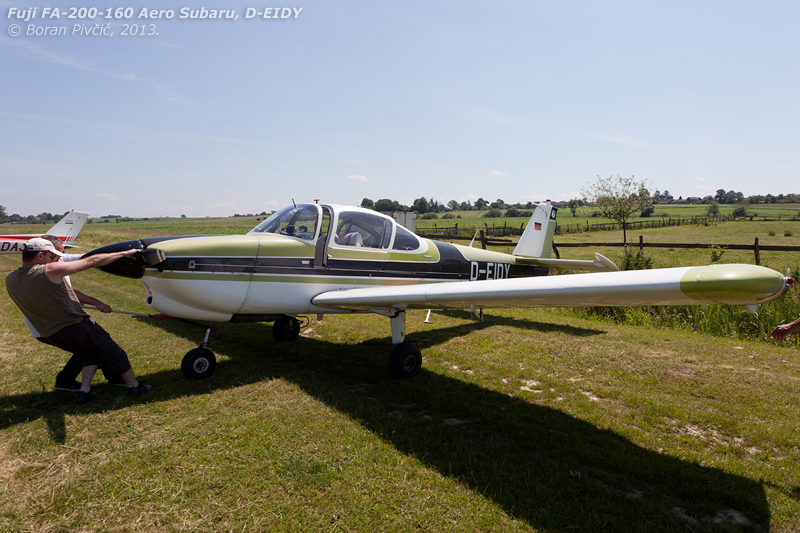


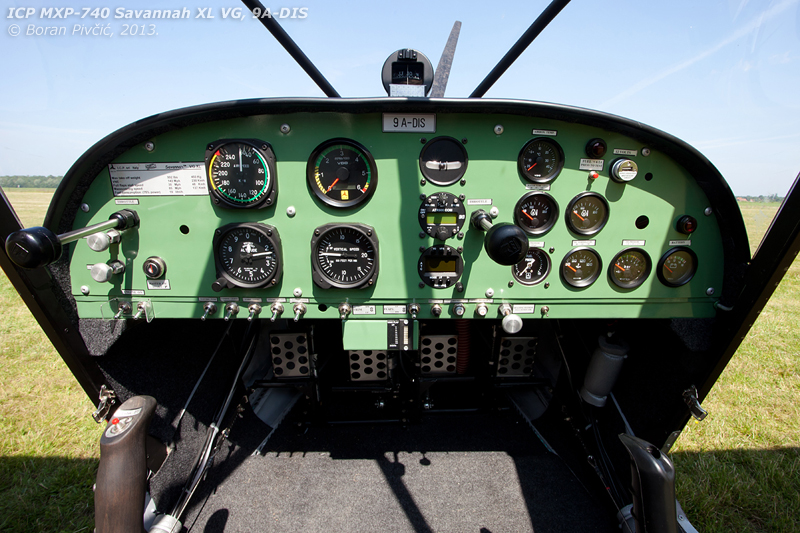

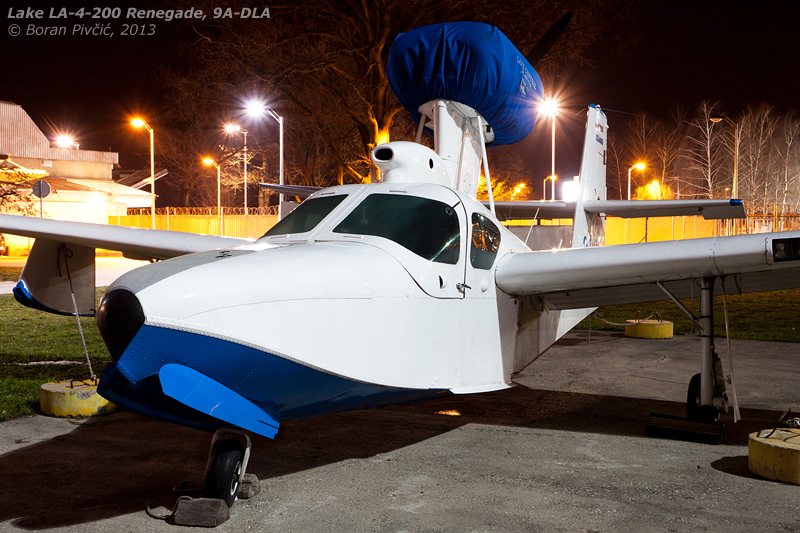


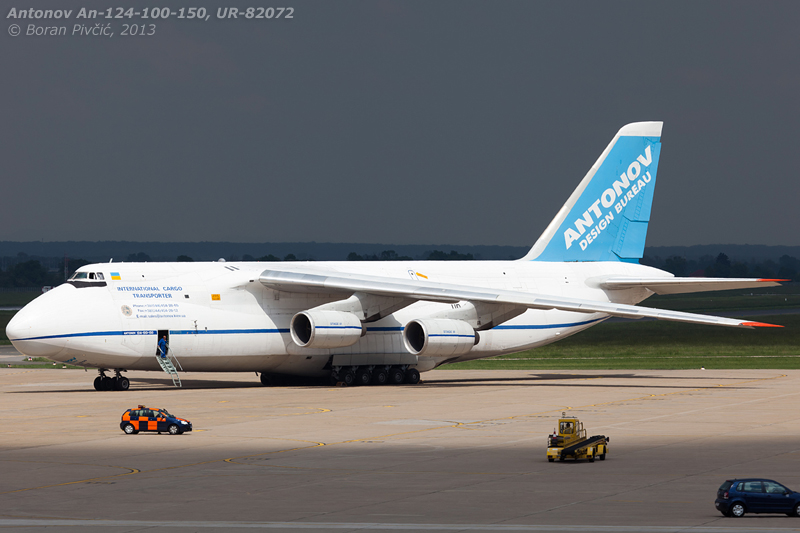


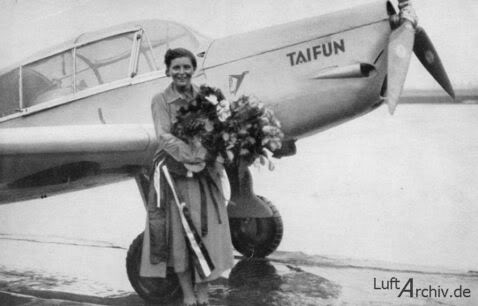


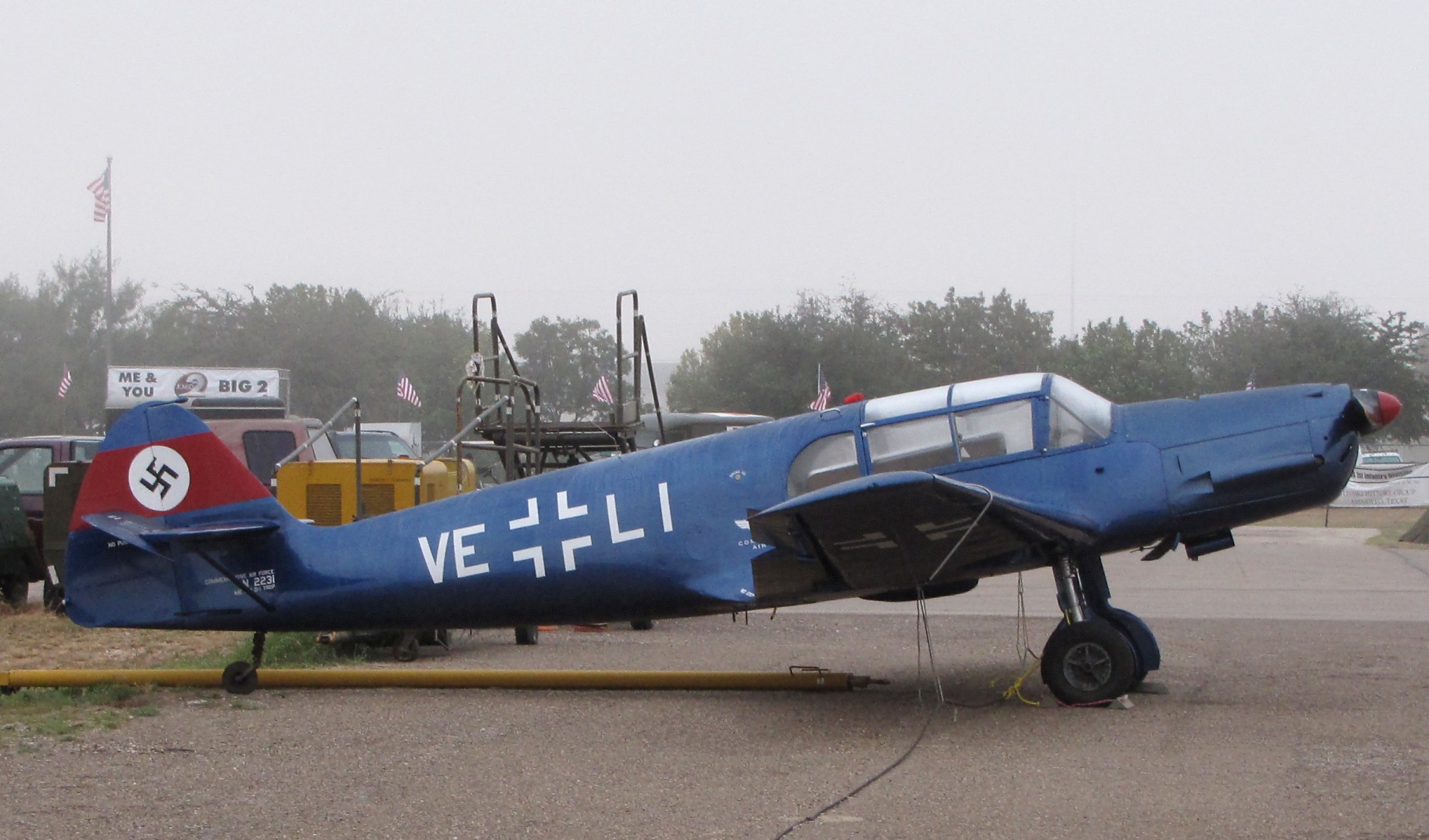



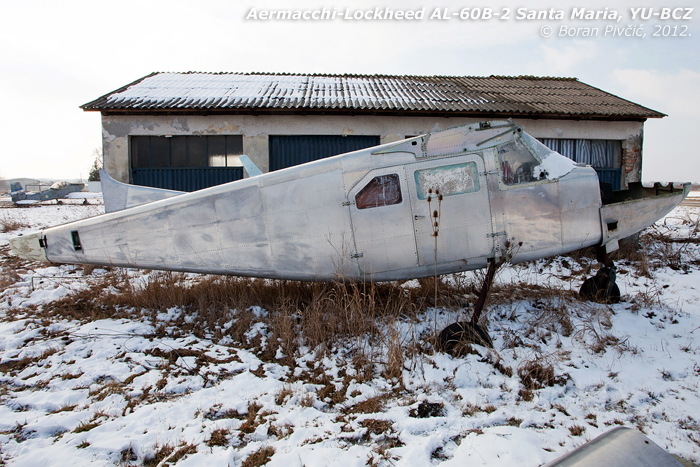
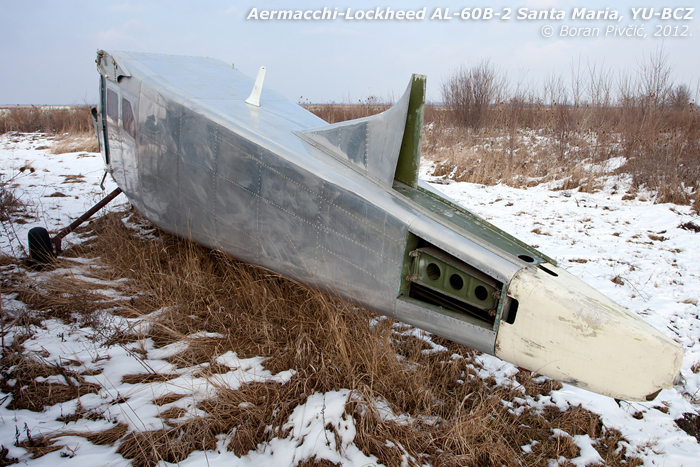
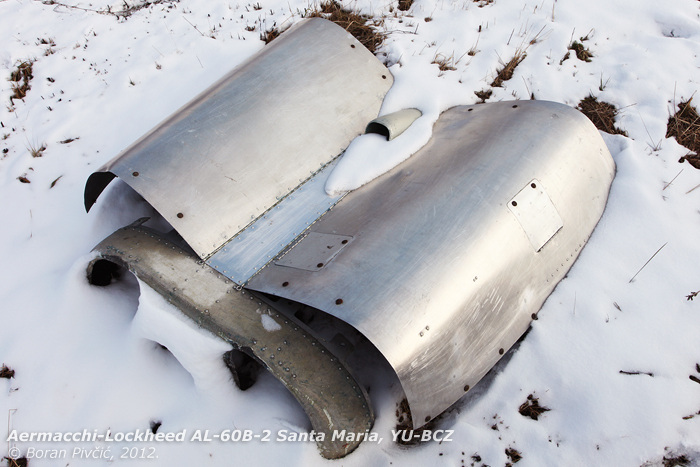

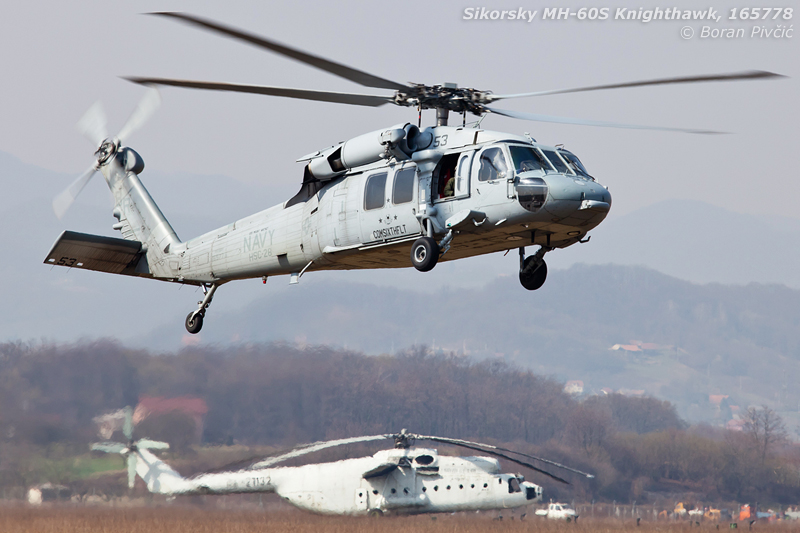
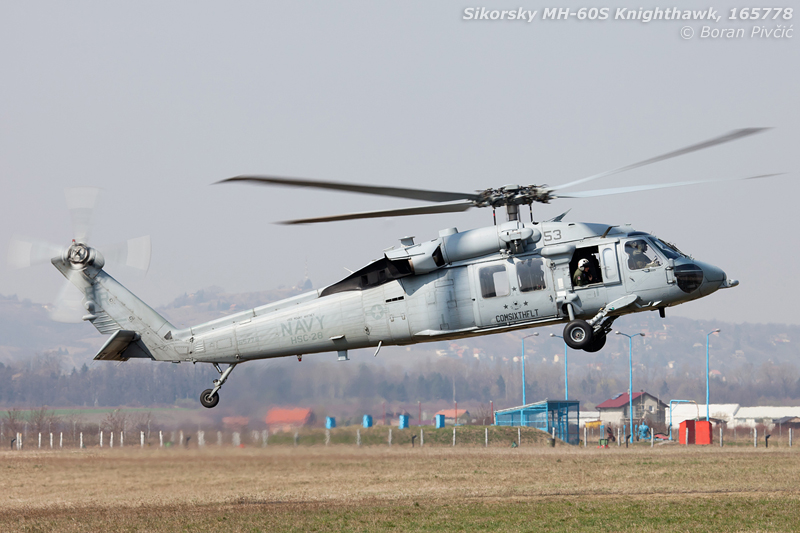


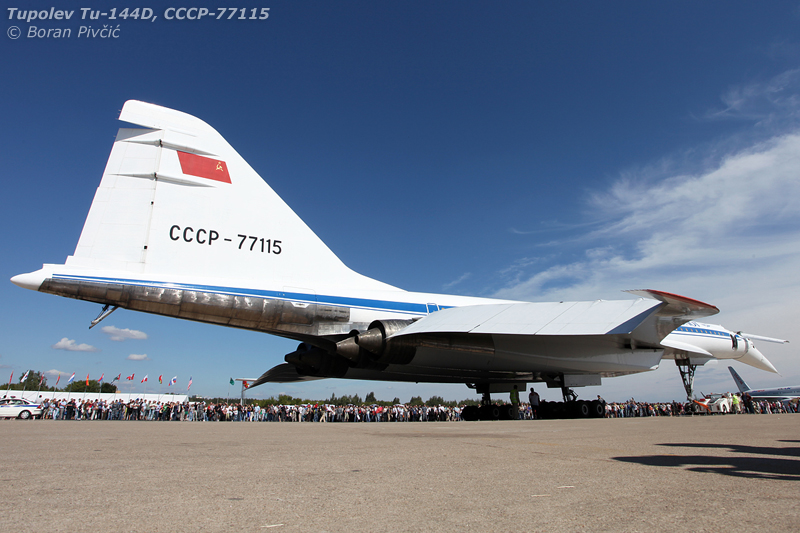


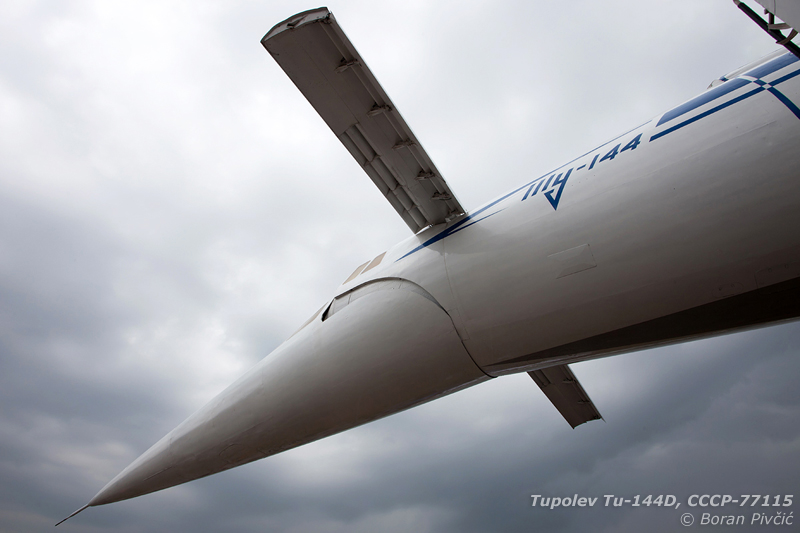
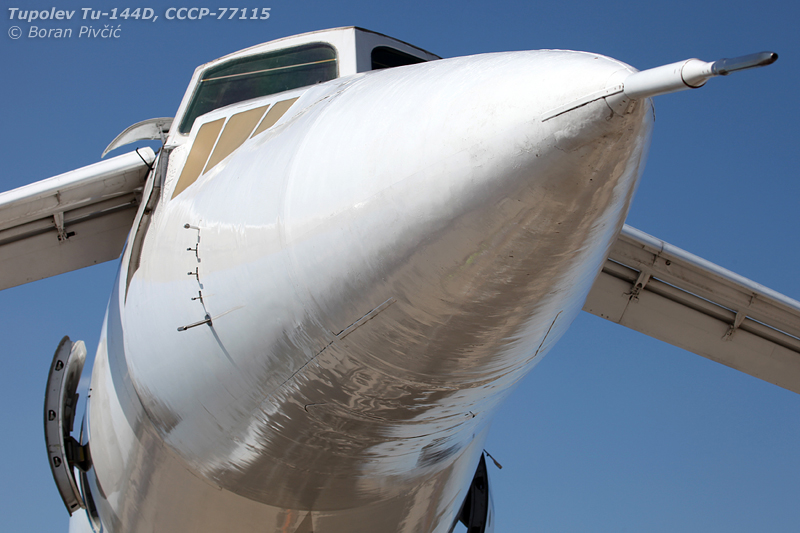
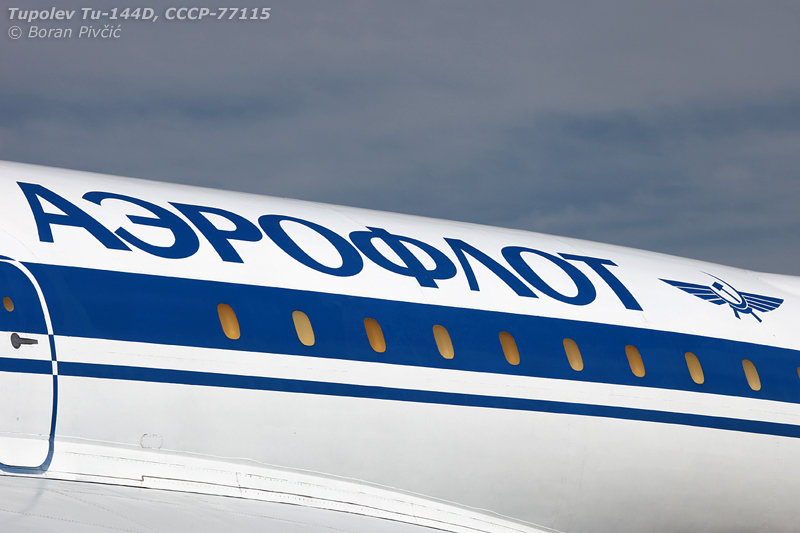

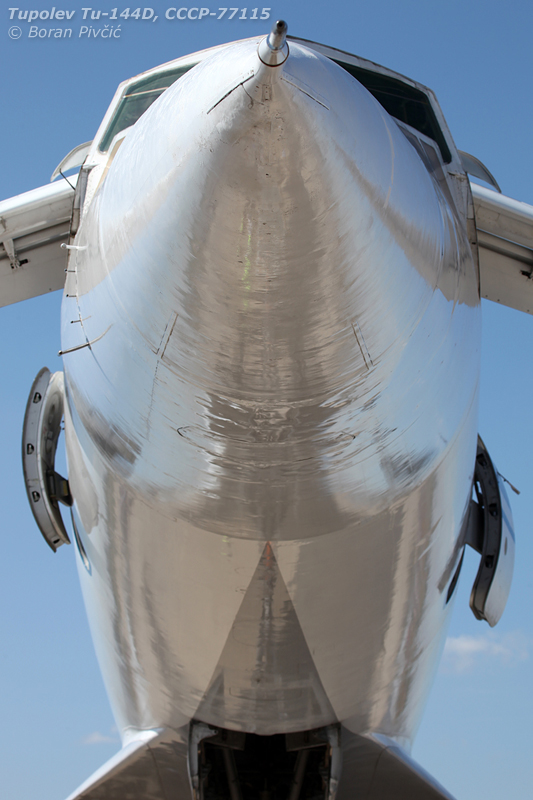


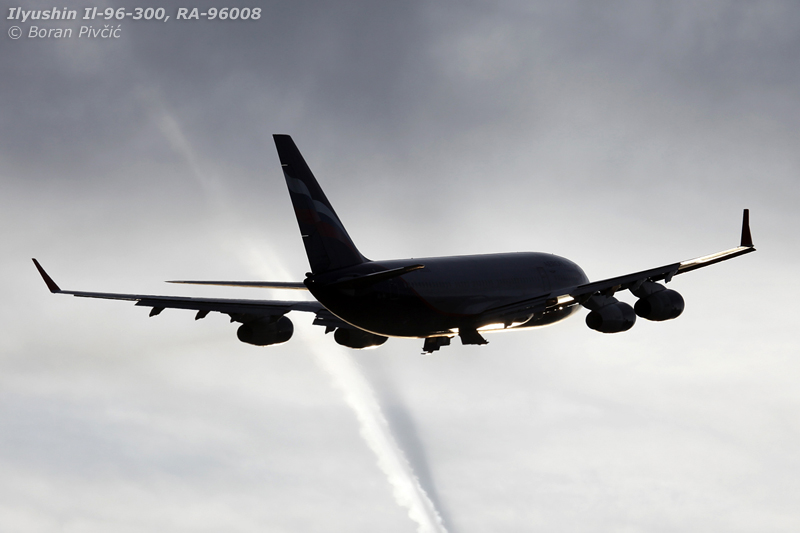

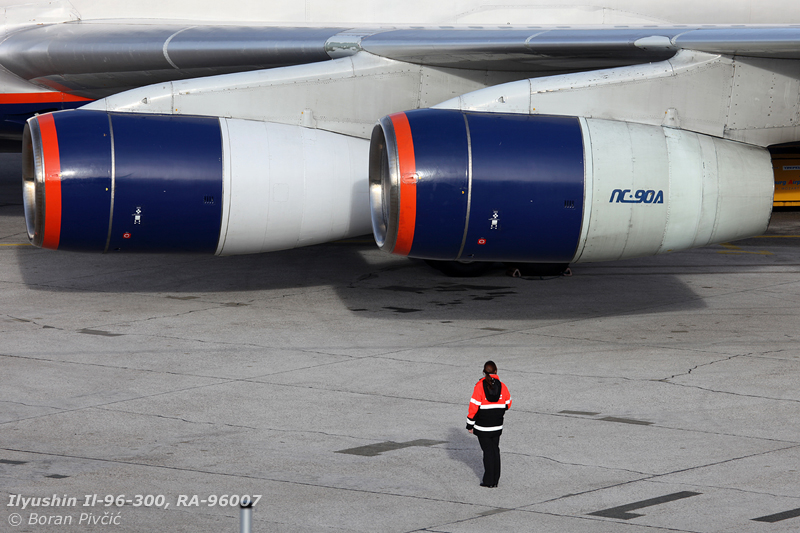


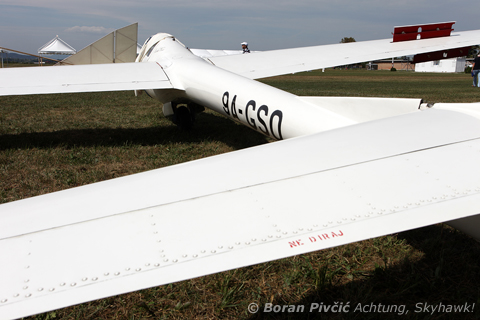
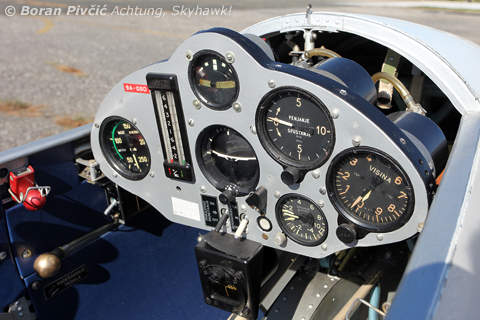


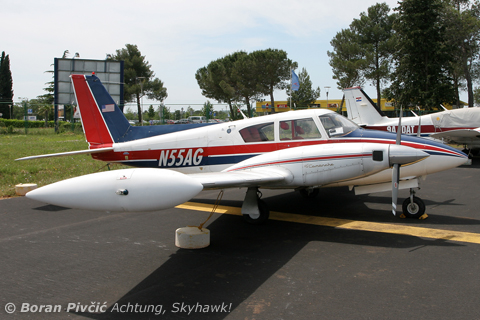

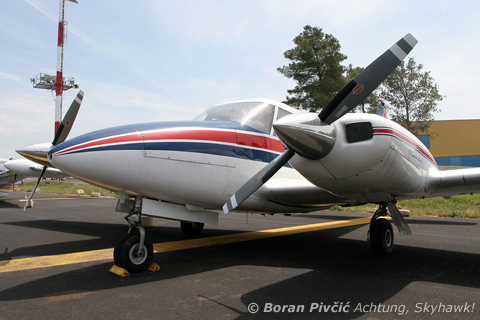
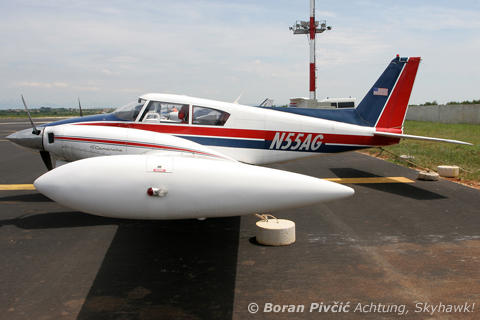

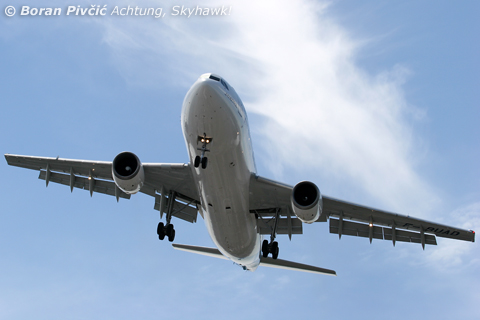


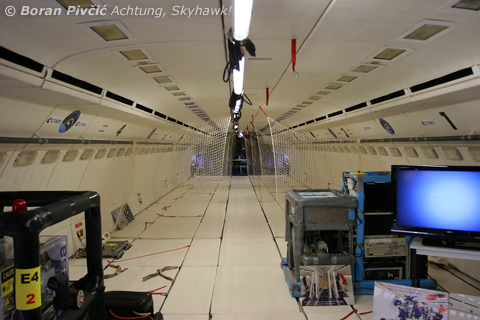


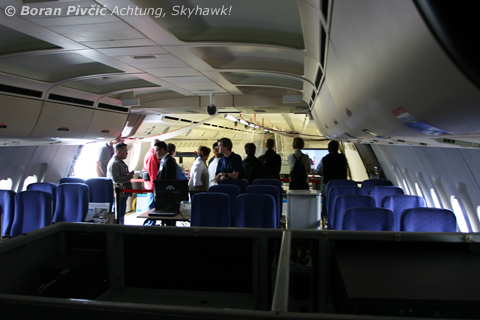





 Achtung, Skyhawk!