Photo Report – Can’t Snow Me Down: A Winter Shakedown at Luฤko

By me
All photos me too unless otherwise stated, copyrighted

While this year’s game of Luฤko Roulette – trying to fly your aircraft out before the field closes due to bad weather ๐Ÿ˜€ – has been generally successful, the constraints of the limited apron capacity at Zagreb Intl. meant that a few aircraft (notably those with a hangar above their heads) have nevertheless remained at the field. Faced with the prospect of them sitting idle in sub-zero temperatures until the runway melts and dries out – which can take awhile – the “flight ops department” of Aeroklub Zagreb had once again decided to clear out its hangar and give everything in there a thorough shakedown :).

While at first it may seem a bit pointless to fire up the engine, proverbially rev the bolts off it, and turn it off again without going anywhere, the procedure does have a host of beneficial effects. Primarily and most importantly, it allows the engine to periodically clear itself of all the deposits and substances that can (and will) accumulate in its piping and systems during a long stay on the ground. If left to settle firmly over the winter, these substances – the most common being carbon deposits on the spark plugs – can seize and/or severely damage the engine when it is finally started; but, if anticipated during these shakedown runs, they can be easily removed by simply revving the engine to raise the temperatures in the cylinders until the deposits burn away and the engine starts to run smoothly.

The same also applies to the oil system – which, on the face of it, is the very system that allows the engine to run in the first place. And while winter temperatures in Zagreb rarely go below -15 Centigrade – well above the temperature at which winter-grade oil thickens dangerously and freezes – the system itself has a number of moving parts (the most important being the oil pump) that are also susceptible to the above stated. Running the engine at a higher throttle setting allows the pump(s) to run up to speed and warm up, breaking off any deposits on their blades and bearings. In addition, the flow of oil through the system picks up any impurities that might have settled on the bottom of the pipes and deposits them on the (removable) oil filter, thus cleaning out the entire system.

The fuel system too needs some attention, mostly to purge it of water deposits that – inevitably ๐Ÿ˜€ – form in its low points. Being heavier and thicker than Avgas, water tends to sink and collect at the bottom of fuel tanks and pipes – and if ingested into the cylinders in a large enough quantity can cause a lot of (very expensive!) damage. By its very nature, water is incompressible; and when it winds up in the part of the engine DESIGNED to compress, something has to give… which is usually the piston ๐Ÿ˜€ (however, there are systems that inject water into the cylinders on purpose – but this is on a controlled and measured basis. These systems – usually known as Anti Detonation Injection, or ADI – squirt a small amount of water into the inlet pipes, which then absorbs excess heat in the cylinder and prevents uncontrolled spontaneous ignition, as well as providing a significant increase in power… as seen on the P-47 Thunderbolt ๐Ÿ™‚ ). Thankfully, the unwanted water can be easily removed from the system by draining the bottom of the fuel tank using a special valve, as well as dumping the contents of the pipes at the low point of the system – usually just after the fuel selector normally mounted on the cabin floor – using a small lever in the engine bay.

Draining fuel from a wing tank drain valve on a Piper or Beech. A small amount of fuel is drained into a cup or bottle and checked for water, which would show up as a transparent sediment on the bottom – one of the reasons why Avgas is colored ๐Ÿ™‚ (the other being that fuels of a different octane ratings are colored differently for easy visual recognition) (photo from: cdn.wn.com)

Less visible benefits of these high-power runs also include recharging of the battery, which will – again inevitably ๐Ÿ™‚ – discharge or even go flat after awhile (as had happened to our Piper Warrior). The ready supply of electricity from the alternator allows too for a check of the aircraft’s other electrically-powered systems, such as the radios, flaps (where available), lights and so on…

However, before all of that, you first have to take care of one small detail – pushing everything out into the open :D. Normally this is not a problem – but our efforts that day were a tad complicated by the inch or two of fresh snowfall from the night before… ๐Ÿ™‚

A welcome splash of color on an otherwise completely white Luฤko. While it did us no favors with the main task of the day, last night’s snow – still ongoing at the time this photo was taken – did at least provide for some nice photo opportunities!
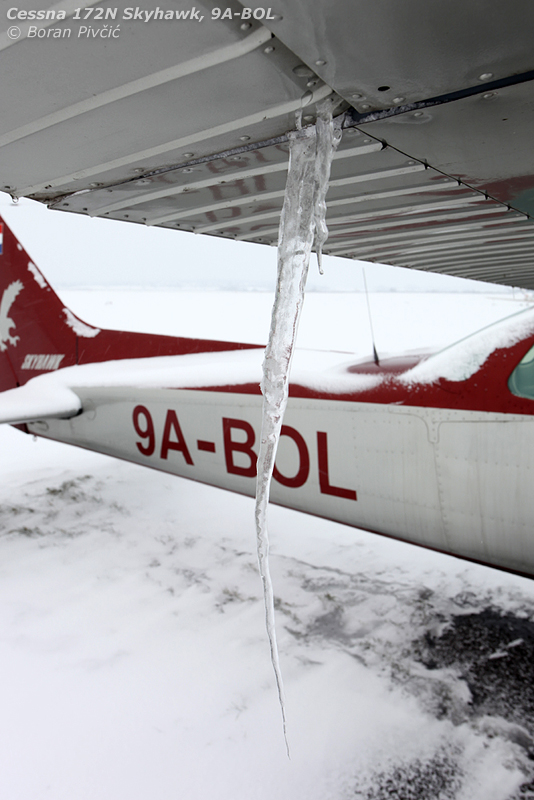
The art of icing? ๐Ÿ˜€ Even more ironic given that this specific aircraft is usually based on the warm and sunny island of Braฤ on the Adriatic coast ๐Ÿ™‚
Preparing to fire up 9A-DDA, AK Zagreb’s very-rarely-seen Piper Warrior. Not having flown for ages, a flat battery is pretty much a permanent state on this aircraft, requiring the use of a Ground Power Unit for starting
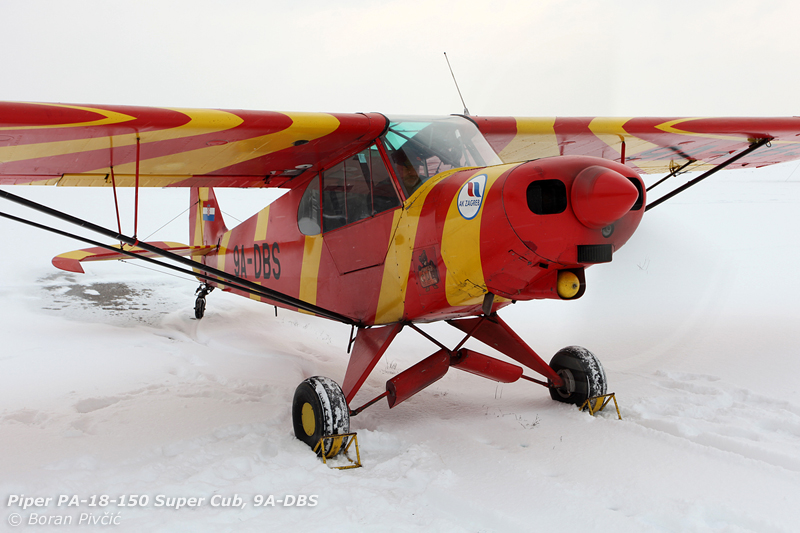
9A-DBS doing its best to clean up the airfield :D. Despite the odd childish impulse to gun the engine and see how big a cloud you’d create, these high-power shakedown runs have to be done with caution – especially on an aircraft like the Super Cub. With its high power-to-weight ratio, an unsecured Super Cub could – despite the brakes being locked full on – easily start sliding forward on the snow. To protect against that as much as possible, the wheels need to be secured with chocks, preferably dug into the snow (and if possible, it’d be a prudent move to tie the aircraft down)
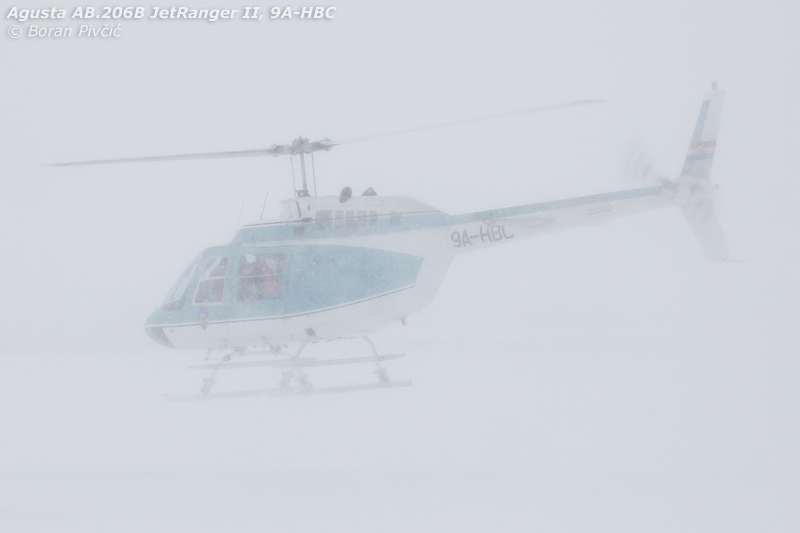
Complete and total whiteout as 9A-HBC lifts off from the main apron. Sporting a cabin full of Christmas presents – and even a helicopter-pilot-turned-Santa ๐Ÿ™‚ – HBC was the centerpiece of a small celebration organized for the children of the Police helicopter squadron pilots. Now, what would an aviation-oriented kid have thought of that? a) look, Santa has flown in from the North Pole!, or b) look, Santa has been arrested by the Police for flying a multi-deer sled without a valid JAA license! ๐Ÿ˜€
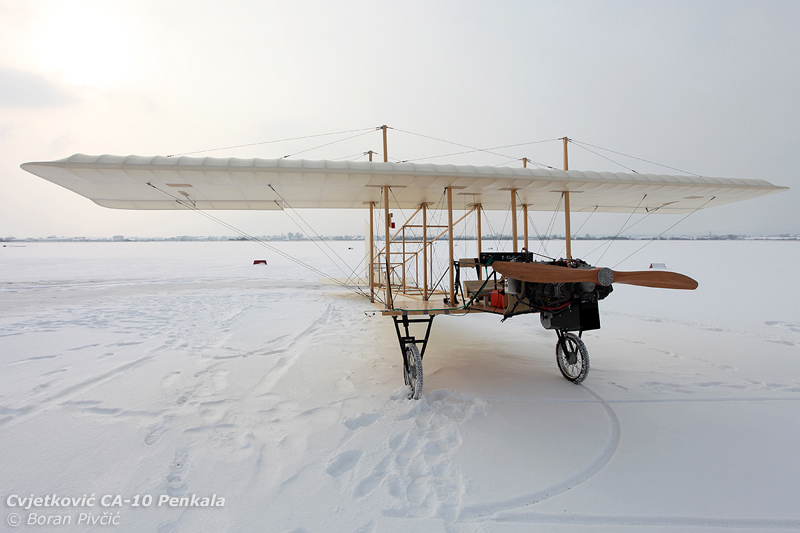
A modern replica of the first aircraft designed and built in Croatia – the Penkala P-3 of 1910 – looking gorgeous out on the snow during an ad-hoc photo shoot :). Not an exact one-for-one copy, the Cvjetkoviฤ‡ CA-10 Penkala has been modified with today’s aerodynamics knowledge (since the original hadn’t so much flown as hopped along) and an 80 HP Rotax, replacing the original 5-cyl radial :). Normally protected from the elements in the field’s various hangars, this was one of the few times 9A-XCA – as it had been registered a few months back – was seen out and about since September’s Luฤko Airshow
Oil, smoke and fire as the I-3’s big M-14P radial labors into life. Not having ran for almost three months, the engine had normally put up quite a fight, spewing liberal amounts of oil from the exhaust during a number of previous startup attempts… also, like virtually all Russian/Soviet light aircraft, the I-3 uses a pneumatic system to start the engine – a system that normally depletes itself when not in use. To fill it up before the engine’s own compressor takes over, an external air source – such as the compressed air cylinder seen here – is necessary
Creating its own weather out back as the big prop revs to its maximum RPM. By the time the 10-minute run was finished, DOG had managed to clear half the apron ๐Ÿ™‚

Short Photo Report – Pilatus PC-12NG, OK-PPP

By me
All photos me too, copyrighted

With the weather here on the continent again going steadily from bad to worse – fog, snow, strong winds, the lot – and me in need of a few more flight hours to complete my CPL license requirements, I decided it might be a good idea to relocate myself down to the Adriatic coast for a few days and notch up some flight time where the worst the weather could throw at me was just an occasional shower and a cold northern wind :D. And despite the number of airports and airfields lining the Croatian coast, my chosen destination ended up being Portoroลพ airport (ICAO: LJPZ) in neighboring Slovenia, a very nice – I could almost say “cute” – airport sitting almost right on top of the Adriatic Sea…

One of only three international airports in Slovenia, Portoroลพ was always on my fly-to list – admittedly mostly because of its extremely fun, and steep, RWY 33 approach over the hills and the Croatia-Slovenia state border :D. But apart from this somewhat pikey attraction, this fantastic little airport has a lot more going for it, including a paved and lit 1300 m runway (whose one end ends in the hills and the other in the sea), customs, Avgas and Jet A1, and a quaint little terminal able to accept the odd regional prop during the summer. More importantly though, it also has a locator beacon (a low-power NDB) which allows for a non-precision instrument approach to RWY 15 – a simple approach, but an instrument approach nonetheless :).

All of this makes for an attractive IFR destination for many aircraft owners visiting the coast; indeed, even during my scant five days there, I was witness to an impressive list of foreign singles and twins flying in and out at all times of the day. But by far the most impressive was a brand-new Czech-registered Pilatus PC-12NG, whose pilot had made the very rewarding decision – for me at least ๐Ÿ˜€ – to land right in between two thunderstorms… ๐Ÿ˜€

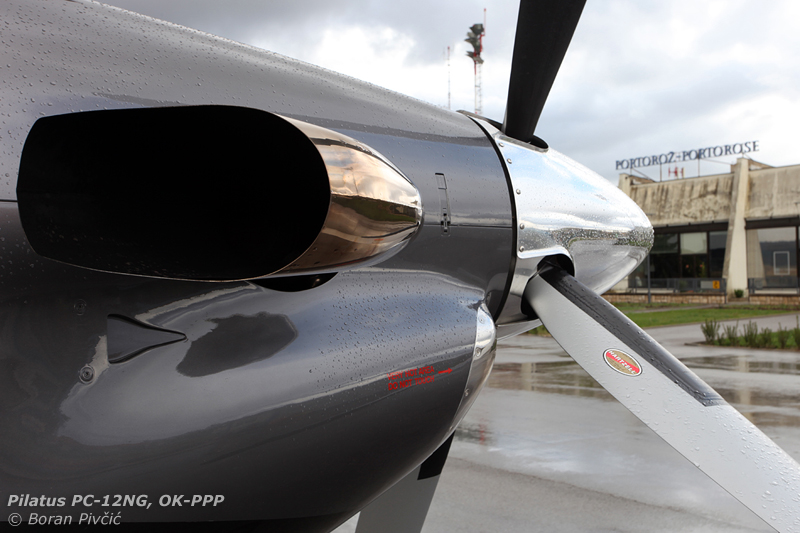
A simply stunning aircraft, no other word for it :). Even though I'm normally a fan of brighter, livelier colors on aircraft, I must admit that metallic gray and black had suited the moment perfectly!
One of those shots where it all comes together - a PC-12, wet tarmac, and the sun shining through ominous clouds... ๐Ÿ™‚
Crisp, cool and elegant in what could easily pass as a textbook promotional image :D. The aircraft was being refueled at the time, hence the fuel hose and the static line connected to the nose gear
The PC-12's party piece, the 1200 HP PT6A-67P turboprop, set against the Portoroลพ airport terminal :). Along with a similar arrangement on the Cessna Caravan, the PT6/PC-12 combination is often cited as concrete proof that "single-engine commercial IMC/night" operations are perfectly doable and safe - a topic of contention among the world's aviation organizations for almost a decade...
Taxiing out for a sprightly departure down RWY 33. One of the few conditions where strong backlight and a contrasting skyscape can make for a good photo!

Short Photo Report – More 9A-DTD Fun

By me
All photos me too, copyrighted

Deciding to further capitalize on the unusually warm and fine weather for a continental November – ten yearsย  ago, we would have been shoveling snow for a month already – I was out at the field again yesterday afternoon, camera ready to capture some (hopefully) glorious sunset shots :). However, by the time the sun had set sufficiently to make things interesting, the only traffic remaining flying was 9A-DTD, plying some late-afternoon skydive ops… and having found out that it will soon be flown away for winter storage, I decided to try and make the best of it while I still have the chance… ๐Ÿ™‚

Taxiing in for its penultimate flight of the day. Note the upward-hinged passenger door, a relatively common modification on high wing Cessnas, designed to allow skydivers an easy way out in flight without having to actually remove the door. Once opened, it is held in that position by propwash - a feature that often enough leads to an annoying flapping up and down when you change power during taxiing...
Idling away in front of a proper autumn background as another group of skydivers prepares to board ๐Ÿ™‚
Grrrrr! Looking mean and angry with its newly-applied dentures :D.

And to finish this up, I’ve decided to also include another Luฤko (non-aircraft :D) shot I very much like, taken about two weeks ago…

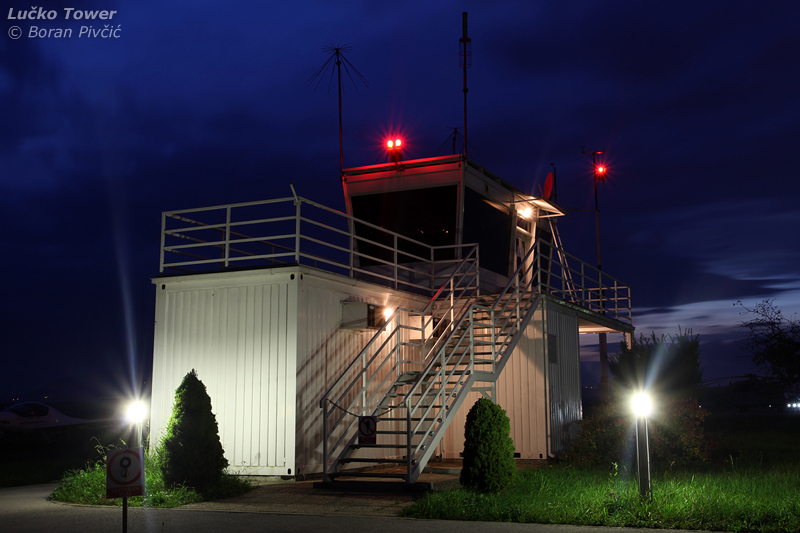
Our little tower of power all lit up, with an unusually beautiful skyscape in the back ๐Ÿ™‚

Short Photo Report – A Ride On A Skydive 182

By me
All photos me too, copyrighted

Having finally terminated my extended leave of absence from Achtung, Skyhawk! – brought on by a combination of flying and personal issues, mixed with a healthy dose of no spare time on my hands – I’ve decided to come back in style with a short photo report from a rather interesting flight I’ve had yesterday :). Having finally completed my 15 hour CPLย module in the morning – only 10-odd hours remaining till my final checkride – I decided I might just as well stay at the field and mingle with my colleagues, enjoying the uncharacteristically warm and mild November weather. Apart from a generally good time, one of the results was also an invitation to fly shotgun on 9A-DTD, a skydive-modified Cessna 182K, on a short training flight – notching it up as my first ever skydive plane as well as my first 182 :D.

The aircraft in question – owned and operated by the skydiving club Slobodan pad (“freefall”) – is by far the oldest 182 in Croatia (out of the very few of any age in the country), having been produced in 1966 or 1967; but in all honesty that didn’t seem to slow it down in flight :D. And even though this training mission – merely a short afternoon panorama flight above town, nothing fancy – was already familiar to me (and photographed extensively), I too didn’t let that slow me down… ๐Ÿ™‚

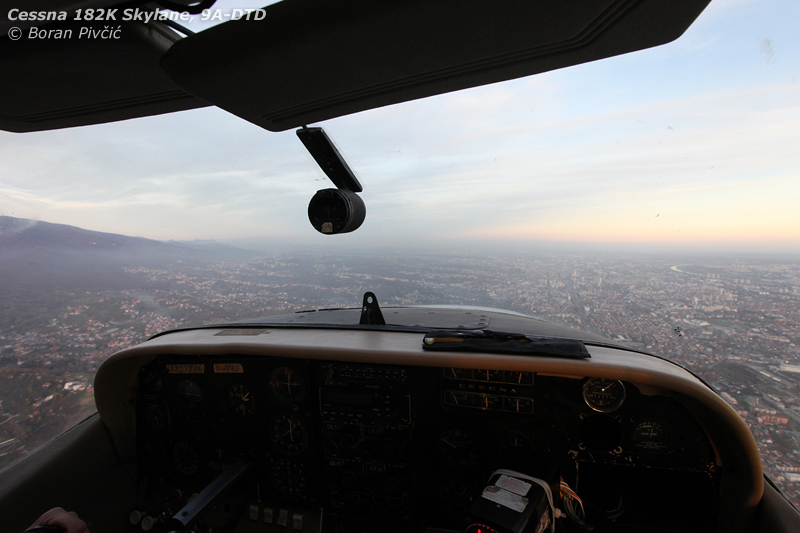
Just a whiff of altostratus and a trace of mist remain from the morning's thick fog as we leisurely cruise above the western districts of Zagreb
Smooth skies, a beautiful ride, silence on the frequency, the setting sun and the thunder of the 230 HP O-470... scenes like this are what make it all worthwhile! ๐Ÿ™‚
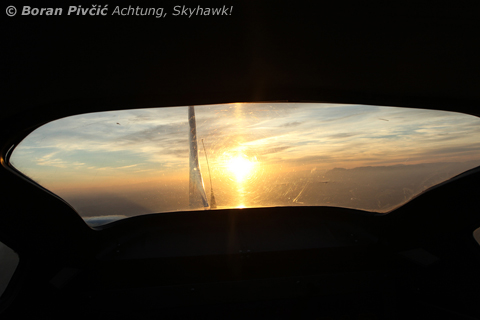
Set the controls for the heart of the Sun :). Late afternoon flights never leave me disappointed
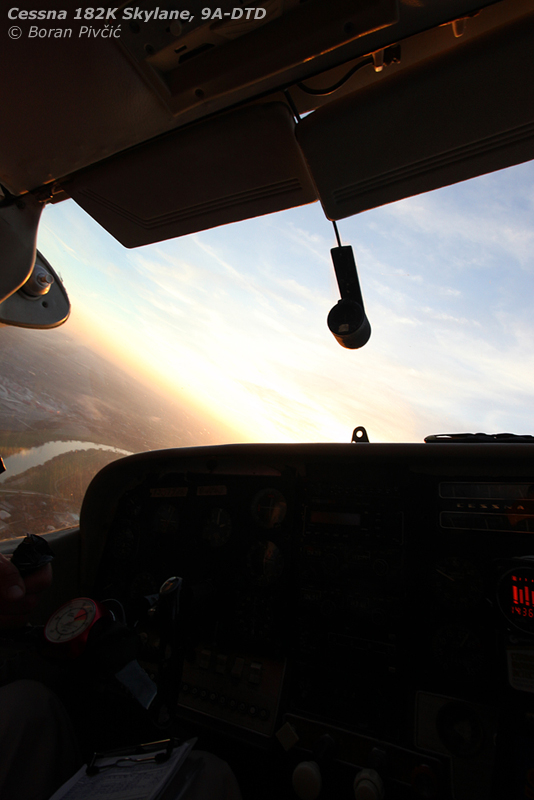
One of the advantages of the Skylane - an unobstructed view towards the back ๐Ÿ˜€
Banking left to enter the pattern for landing back at Luฤko :). Though not clearly visible, the aircraft's instrument setup has also been upgraded with a digital CHT/EGT monitor, as well as a skydiving altimeter on the pilot's yoke
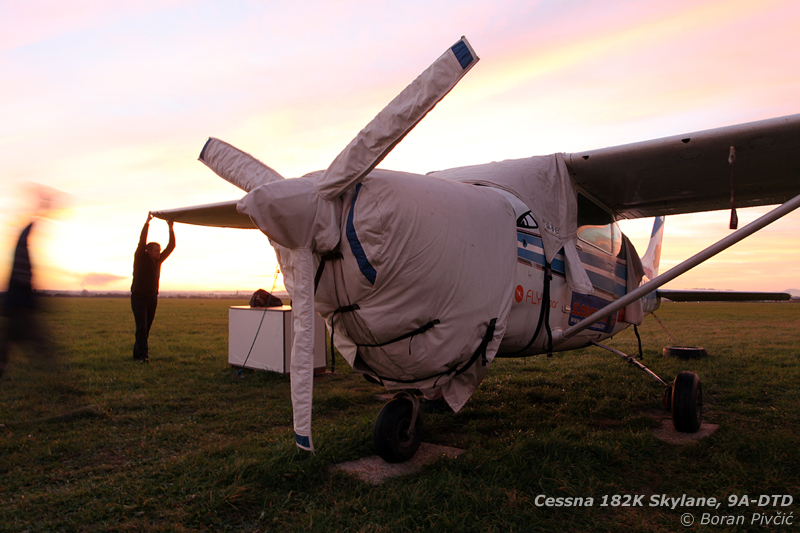
9A-DTD getting tucked in for the night, with an added impressive autumn background ๐Ÿ™‚

Photo Report – Some More Scenes From Luฤko

By me
All photos me too, copyrighted

Having finally passed all of my ATPL exams ( [/brag] ๐Ÿ˜€ ), I’ve decided to celebrate by heading out for the rest of the day to catch some well deserved fresh air. With a spot of sunny weather in an otherwise cloudy and dull week – and my photo finger getting very itchy – the airfield had naturally quickly made the shortlist; so in the afternoon, I set course for the field to see what, if anything, was new…

Nothing really was, to my disappointment; but nevertheless the afternoon’s high cirrus clouds and fading sun at least made for prime conditions in which to test out the low light capabilities of my new Canon 5D… ๐Ÿ™‚

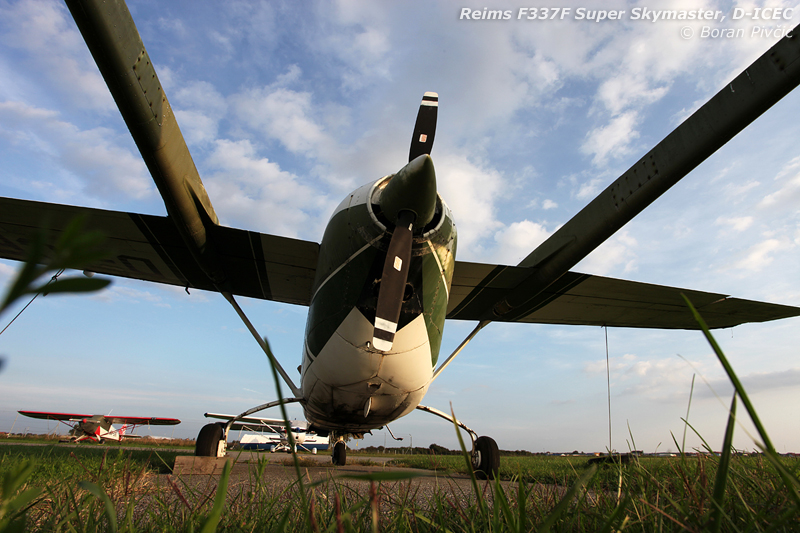
An ant's eye view of our poor old Skymaster as the afternoon draws to a close. Just below the lower prop blade you can see the main gear bay doors, fully closed to reduce drag when the gear is down. The unique Cessna gear retraction mechanism would first swing the gear legs down into the vertical and then fold them backwards into the fuselage - though I've been told that this creates more drag than a more conventional gear retraction sequence (click for larger version)
Holding the camera above your head does help with the oddly-shaped and difficult-to-photograph Skymaster :). The extent of the prop damage, caused by a landing incident almost a decade ago, is fully visible here... (click for larger version)
My attempt at making the Cessna 150 appear (far) bigger than it actually is :). Almost looks like a PC-6 from this angle... (click for larger version)
Starting up for a short cross-country flight. These late afternoon flights are always a fantastic experience - the air is calm, there's little or no traffic and the scenery is often breathtaking (especially in the late summer and early autumn) (click for larger version)
Very helpfully posing for me at the end of the flying day :). Having no night lighting whatsoever - despite continuing efforts by all aeroclubs to install it - life at Luฤko effectively ends when the sun dips below the horizon (click for larger version)
In night photography, you use whatever you can lay your hands on - even if it's just a spinner and standard room lighting ๐Ÿ™‚ (click for larger version)
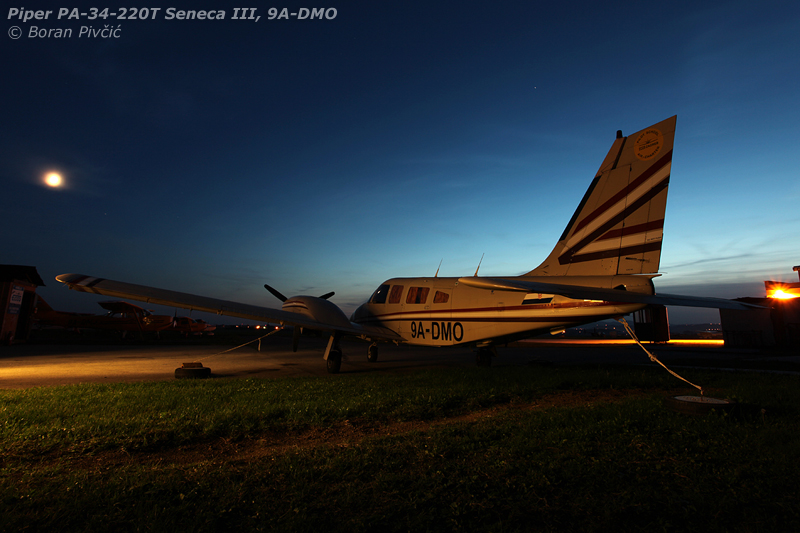
The joys of night photography - almost a full palette of colors lighting up the background as 9A-DMO prepares for another calm and cool night at Luฤko (click for larger version)
Airport Cat is under your airplanes, ruining your compositions ๐Ÿ˜€ (click for larger version)

Photo Report – Luฤko News in Photos

By me
All photos me too, copyrighted

Having finally caught some breathing space in between the flying and studying – and the abundant paperwork and pleasant conversations with government officials that inevitably go with them – I decided to finally venture out of my +35 Centigrade room and treat myself to a spot of well-deserved aviation photography :). Being mostly “in transit” at Luฤko during the past few weeks – either in planning, briefing, debriefing or running to my car to turn on the aircon after a flight in the scalding hot Seminole ๐Ÿ˜€ – I had never taken the time to notice that the aircraft population at Luฤko had increased substantially, and was sitting idly around, unphotographed. So, keen to set that right, I packed up the camera – along with half a dozen liters of water – and set to work! ๐Ÿ˜€

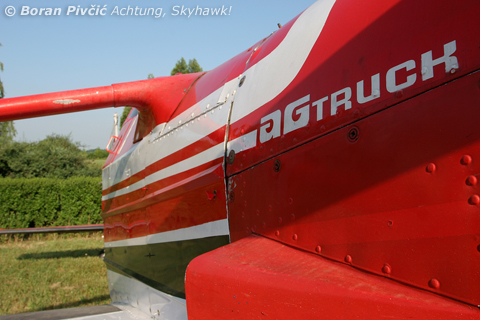
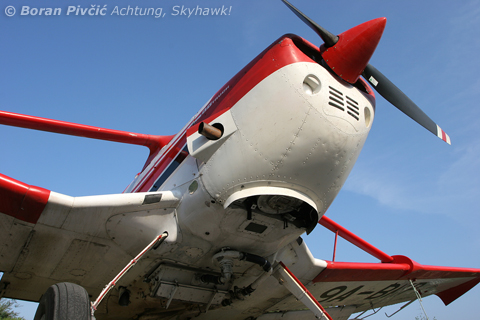
First up is a very interesting transient visitor, in town for some maintenance. When I saw it in my university's hangar undergoing some minor work, I must admit I briefly hoped that our air wing had diversified, but was disappointed soon afterwards :D. One of the preciously few Cessna 188s in Croatia, 9A-BKP - an A188B AgTruck - hails from Daruvar in the country's eastern agriculture-rich flatlands
Mean and substantial, the 188 represents Cessna's only venture into the agricultural market (apart from an interesting crop-spraying 185 conversion). Lacking a unified type name, various 188 versions bore the AgWagon, AgPickup, AgHusky and AgTruck names, with the A188B AgTruck being the last and most powerful normally-aspirated model
Designed to haul. Built in the 60s using extensive inputs from ag pilots and operators, the 188 embodies all the characteristics of a proper cropsprayer: a big, thick low speed wing, massive flaps, a high, crash-resistant cockpit - and every component made big and chunky, just in case ๐Ÿ˜€
Interestingly, despite its substantial appearance, the 188 is quite light: only 980 kg empty when equipped with a dispersal systems. Even with a 1060 liter hopper tank aboard, the MTOW in the restricted category never climbs above 1800 kg (with 1450 being normal) - which, with 300 HP up front, probably makes for some spirited flying ๐Ÿ˜€
More potent than the standard Piper Pawnee and more manageable than the Air Tractor, the 188 was a significant sales success with close to 4000 sold, but oddly enough few remain flying today (especially in Europe). With production having ended in 1983, they've been slowly phased out of their primary role, while their big, all-metal bulk and thirsty engine do not lend them well to secondary roles such as glider towing, where the simpler, cheaper Pawnee still enjoys a lot of success
Next up is something much fairer and rarer: the Glaser-Dirks DG-200 single-seat glider :). Produced in only 190-ish examples, the 15-meter DG-200 is nevertheless a capable glider - with a glide ratio of 1/42 - equipped with both flaps and water ballast tanks. As is common on European gliders, its flight instruments are metric, which requires some quick mental calculation when dealing with ATC ๐Ÿ™‚
Assembly after transport - the most fun you can have short of actually flying :D. Of classic layout for single-seat higher-performing gliders, the DG-200 cockpit is clean and well laid out, covered by a practical one-piece canopy. Getting in though can be a bit of a palaver if your gymnastic skills are not up to scratch ๐Ÿ˜€
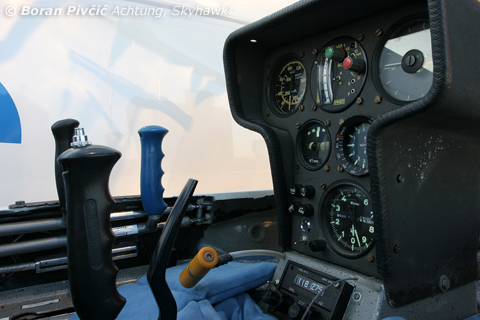
More equipment means more handles :). Apart from the stick (and its wheel brake trigger) in the foreground, you have the yellow towrope release handle, the blue spoiler and the black flaps selector. Out of shot is the gear retraction handle, while on the opposite side are the water ballast tank valves and the emergency canopy release - and all without a bit of electricity ๐Ÿ™‚
And finally, an artsy view of our latest resident, 9A-JSA. Behind the unusual custom registration is a stock - but freshly repainted - 172N operated by a new company called JungSky and flown by a former member of our aeroclub and a current Fokker 100 captain ๐Ÿ™‚

Photo Report – A Visit To The Neighbors: Spotting at Ljubljana, Slovenia

By me
All photos me too, copyrighted

Though I’m not really in the “business” of photographing airliners – at least not those that are common and plain enough – a few days ago I had happily accepted an invitation from two of my spotting colleagues to visit Brnik airport (LJLJ) in neighboring Slovenia for some international spotting :). And while the traffic picture at Slovenia’s main airport, serving the capital Ljubljana, isn’t in essence all that different from that of Zagreb – an endless stream of CRJs punctuated by some GA and an odd Airbus – the airport’s crisp, clear and unpolluted highland air, stunning mountain backdrops and very accessible spotting positions (not to mention very friendly local spotters) were ideal conditions for some photographic practice and experimentation :). Plus, given that the subjects at an international airport tend to move quite a lot faster than the GA lighties I usually photograph, it was all good panning and tracking practice :D. In the event, we even managed to nail two quite rare birds along the way…

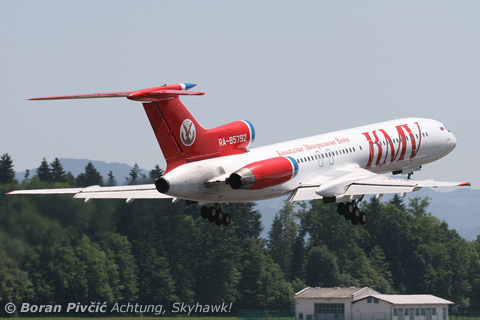
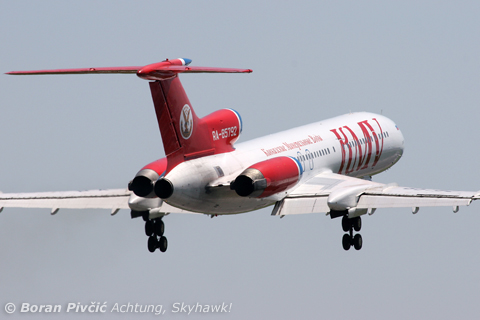
A beautiful - and freshly repainted! - KMV Tu-154M just starting its gear retraction sequence after a noisy RWY 13 departure, bound for Moscow. Ever since Aeroflot pulled the 154 from commercial service, they've become an increasingly rare sight, European spotters now having to make do with occasional charters such as this one...
Climbing out with the 154's typical shallow profile, intended to quickly accelerate the aircraft to its 550 km/h (296 kt) optimal climb speed. Little known outside the lands of the former USSR, KMV actually stands for "Kavkazskie Mineralnye Vody" - or "Caucasian Mineral Waters". The name makes more sense when you know that the airline is based in the Russian town of Mineralnye Vody, located on the Caucaus, in an area known for its abundant mineral springs ๐Ÿ™‚

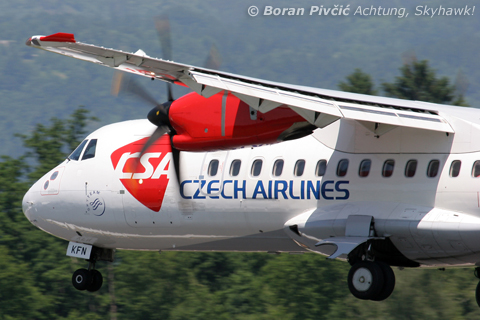
"What's In A Name" continues with this somewhat less exciting Czech ATR-42-500 flying in from Prague. Nowadays never expanded, "CSA" actually stands for "ฤŒeskoslovenskรฉ Stรกtnรญ Aerolinie", or "Czechoslovak State Airlines", formed in 1923 in then-Czechoslovakia as one of the world's oldest airlines. By the time Czechoslovakia dissolved in the early 90s, the CSA brand (and especially the acronym) had become well known and established, prompting the company's new owner - the government of the Czech Republic - to keep it, thus forming "CSA Czech Airlines"
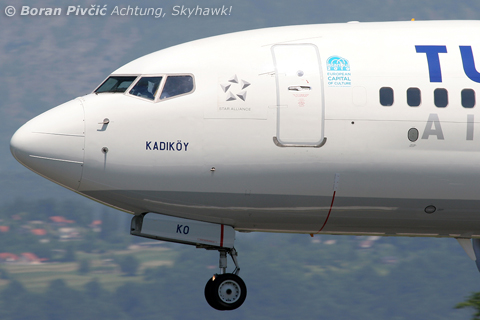
This shot made my day - and was worth the searing heat and scalding sun of a summer noon spent standing outside :D. Intense concentration in the cockpit of "Kadikรถy", a Turkish Airlines Boeing 737-752, as it crosses the numbers on RWY 31 for a smooth and gentle landing
Sparkling white - maybe it's a vampire aircraft? (bad pop culture joke) - and clean, even an A319 can be made interesting given the right conditions :). Lining up on RWY 31, this example is operated by Slovenian national carrier Adria Airways, another company with a long history stretching back to 1961...
One more Embraer for me :). Contrasting brilliantly with the dark woods - further enhanced by the crisp mountain air - this ERJ-145 is operated on behalf of Air France by a small French company called Regional Airlines, and with its sister ships can often be seen at Zagreb airport as well...
Type-wise a common enough CRJ-200, VT-SAS was nevertheless the most interesting visitor of the day, hailing all the way from - India! ๐Ÿ˜€ Operated by JetLite, an Indian domestic carrier, SAS had flown in from Budapest on unknown business, though speculation includes servicing or a C check by Adria Airways' maintenance department... also, the white sphere behind the aircraft is the airport's Doppler weather radar ๐Ÿ™‚
I'd say that "Boka" could do with a wash... named after Boka Kotorska, a bay on the Adriatic Sea shared by Montengero and Croatia, this Montenegro Airlines Fokker 100 from Podgorica was one of the last interesting arrivals of the day. Formerly sharing the YU registration prefix with Serbia (back when the two countries were part of the "Serbia and Montenegro" union), Montenegrin aircraft have been allocated their unique identifier - 4O - joining the alphabet soup of other ex-Yugoslav country prefixes (9A, S5, E7, Z3, ...)
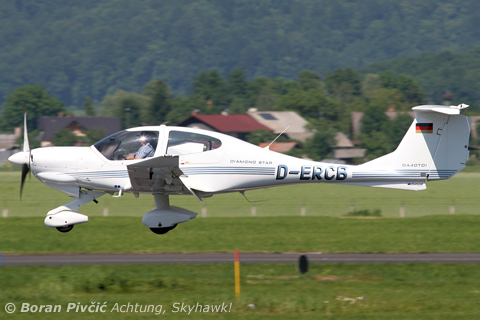
Yay, lighties! ๐Ÿ˜€ An almost perfect profile view of a Jet-A powered Diamond Star as it aims for the touchdown markings on RWY 31
A welcome break from the steady string of CRJs arriving during the early afternoon rush hour. Rising sharply upwards less than a dozen kilometers away, the Kamnik mountains - the foothills of the Julian Alps - provide an excellent backdrop, especially during the winter
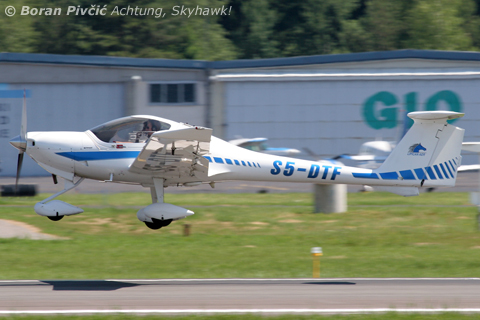
And finally, a small twist on the ubiquitous Diamond Katana. Unlike most Katanas flown in Europe, S5-DTF is a C1 model, powered by a 125 HP Teledyne Continental IO-240 engine spinning a two-blade fixed-pitch prop instead of the standard Rotax. The first C1 I've seen, they seem to be widespread in the USA...

Photo Report – Stormy Skies Above Luฤko

By me
All photos me too, copyrighted

Every year at around this time, our normally predictable continental weather has one of its oddball episodes and goes completely haywire. A fascinating study in meteorology, in the space of a single day you can experience anything from a 20 Centigrade temperature variation to clear skies alternating with hourly thunderstorms (and sometimes hail), dead calm to 20-knot winds, and pressure changes that would perplex even the most advanced barometer.

Today though we were blessed with just a mild outburst of the above, which was a perfect opportunity to head out to the field and do some photography. Bored of either clear skies or dull overcast, I found a backdrop of menacing thunderstorm clouds punctuated by bright sunshine to be much more exciting, and with flight activities getting finally up to speed was assured of at least some good results. In the end – after snooping around for five hours – I must say I was quite content with the results… ๐Ÿ™‚

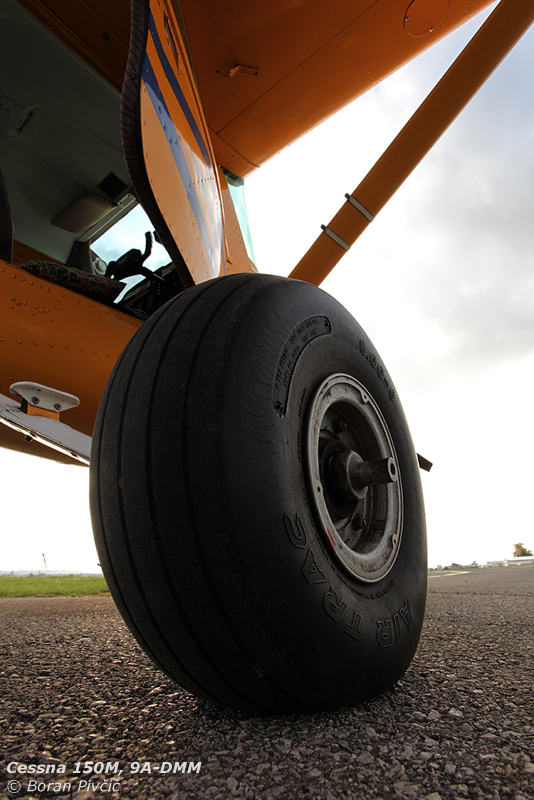
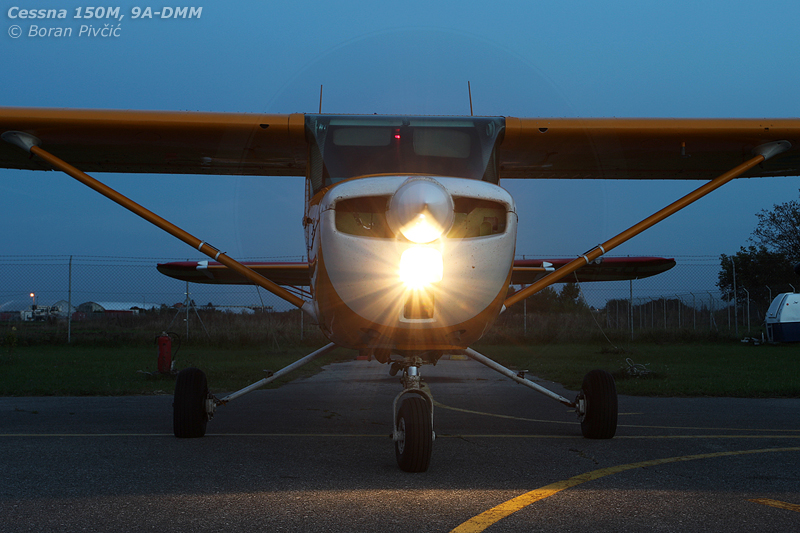
Fresh raindrops glisten on 9A-DMM's wing, having landed just minutes before the first shower of the day. This trusty and lovable Cessna 150M is a favorite subject of mine (though rarely featured here), being the aircraft on which I got my wings eight years ago ๐Ÿ™‚
Our old Skymaster blending in remarkably well with both the lush spring grass and the ominous CB moving away towards the city...
The day's thunderstorm activity was indicative of strong thermals in the area - which were immediately put to good use :). Seen here are 9A-GBA and GBB - both Let L-13 Blaniks - being towed out to the runway for an afternoon-long aerobatics training session
Not far behind was AK Zagreb's inconspicuous Super Cub towplane, 9A-DBS, out and about for the first time in awhile. Looks like one of its landing gear bungees is misbehaving...
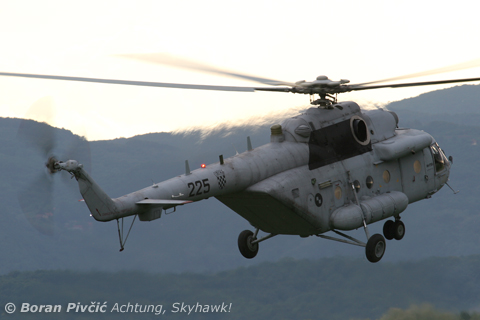
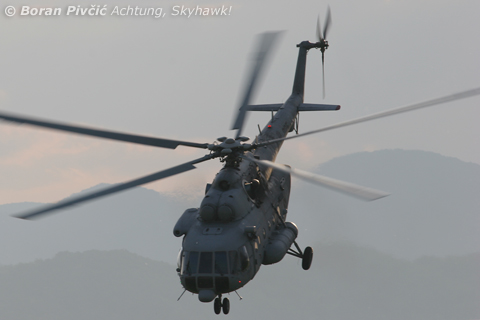
The air force too ran a few flights between (and during) showers. Based at Luฤko - itself actually a joint civil-military airfield and the largest helicopter base in Croatia - these medium-lift Mil Mi-171Shs are a common, everyday sight (and do provide some welcome variety)
Showoff :D. Departing the military pad with all haste - and more than a little show - as another shower approaches from the west
It was well worth staying around until things calmed down :). Setting through a broken layer of stratus cloud, the sun had finally provided me with one of its (at the field) rare glorious moments...

Photo Report – Let L-410MA Turbolet, OM-PGD

By me
All photos me too, copyrighted

The sudden appearance of An-2 9A-DIZ at Luฤko – usually a sign of impending parachute activity – should have warned me that a foreign visitor, hired for the same purpose, would probably follow suit. It didn’t, so I was pleasantly surprised this morning to come across a sharp-looking Turbolet visiting the field for the first time, just waiting – begging ๐Ÿ˜€ – to be photographed :D. Despite being a relatively common aircraft in these parts, I was naturally at it within minutes and soon discovered that it was not as ordinary as I had first thought…

Registered in Slovakia, OM-PGD was – like OK-SAS, the last Turbolet to visit – in town for some parachute ops, substituting for AK Zagreb’s poor old Cessna 185 which, more than a year after its unfortunate propstrike, is still nowhere near airworthy status. And while externally identical at a glance to any other Turbolet out there, PGD is in fact a rather rare early MA model, one of the first Turbolet marks produced in any significant quantity – and one of the few non-STOL models still flying today…

Designed from the outset to be powered by the Czech Walter M601 turboprop – the PT6 of the Eastern Block – that was in development at the time, the first production L-410s got off to a slightly more ironic start when M601 development delays and problems forced the temporary selection of another engine. The only one suitable and available was the PT6 itself, so to avoid any further disruptions, the first production series – the 28-strong L-410A – was fitted with two PT6A-27s and sent on its way.

In the mean time, the basic M601 design had matured into the slightly larger and more powerful 700 HP M601A which – coupled with an Avia V508 three-blade propeller – was deemed ready for the L-410. In this form the aircraft became the slightly-less rare L-410M, of which about 108 were produced.

What can today be considered as the “bog standard” Turbolet – the UVP – differed in some respects from the M model from which it was developed, including a slightly longer fuselage, larger wings, a taller vertical stabilizer and 730 HP M601B engines. And while the M didn’t have what you’d describe as a long take-off run, the UVP was the first model to introduce the STOL capability for which the design is now famous (500 m with a 1800 kg payload!).

The MA though was a mix of the two worlds, being the basic L-410M powered by the UVP’s M601B engines. Where it fits into the design lineage I’m not sure, but given that almost all M versions flying today are MAs, it is safe to assume that this version is a retrofit. Be that as it may, it represents the last of the L-410 “originals” and was sufficiently rare to get my full attention :D.

Even when looking at it for awhile, it's hard to distinguish it from the "normal" UVP... only the slightly shorter fuselage is a giveaway...

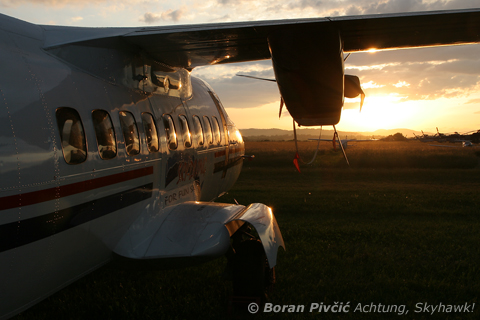
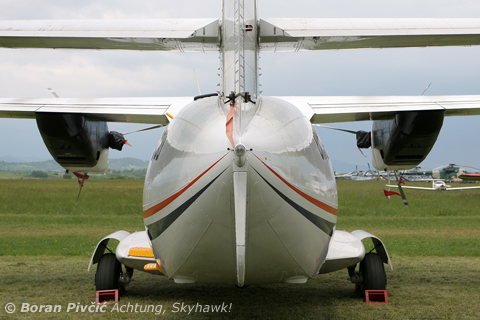
That's a pretty large behind! ๐Ÿ˜€ Despite its questionable aesthetics when viewed from this angle, the fuselage is commodious and very practical - and I'm told well suited for and liked by parachutists
Blending well with the dull overcast... like on many parachute versions, the standard doors had been removed and fitted with a much more practical "garage door"
Ready to go off road :). The unusual landing gear bay arrangement frees up space within the cabin - making it simpler and structurally sounder - while also allowing the main wheels to have a wider track, which is very useful on uneven terrain
To handle the rough stuff, L-410s of all marks are fitted with large low pressure tires and very, very powerful "packet" disk brakes. Unlike brakes on smaller aircraft - which usually have only one small brake pad and caliper - the "packet" brake consists of a full-size circular pad, providing friction across the whole disk. To press it in, the L-410 uses seven pistons, which make the brake forces very strong and enable a lot of hard breaking before the brakes lock up. Note also the red line painted across the wheel and tire: this is a handy way of checking whether the tire is properly inflated when you don't have a manometer handy. Should the tire become significantly under-inflated, on takeoff and landing it would start to rotate around the wheel itself, moving the mark out of alignment
Though not as extensive as on other STOL aircraft, the windscreen provides a very good field of vision for both crew. Windscreen wipers are a must for all-weather operations
Two of the L-410's unusual features are the copilot side door, just below the side window, and the confusing black fuselage stripe. This thin layer of rubber is necessary protection of the fuselage - and especially the joint between two fuselage sheets - from bits of ice shot off the prop when its deicer is in operation. On many light aircraft - I've especially noted this on Piper twins - this protection is a metal sheet and is usually painted over so it is not easily noticeable
A generation apart... one of the L-410's design aims was to replace the An-2 in many of its transport roles; but it ended up just supplementing it, as the venerable Anushka almost outlasted the L-410 in production...

Photo Report – Murska Sobota airfield (LJMS), Slovenia

By me
All photos me too, copyrighted

As an extension of my previous Z-50M post, I though I’d also cobble together a small additional feature showcasing some of the other interesting aircraft I’d come across while roving the hangars last week. While the field doesn’t have all that many aircraft – I had counted about 15 all in all – there are quite a few gems among them; but unfortunately, being all packed in two hangars (at least they’re protected from the elements), I couldn’t get at each one. So, using what I managed to snap, here goes… ๐Ÿ™‚

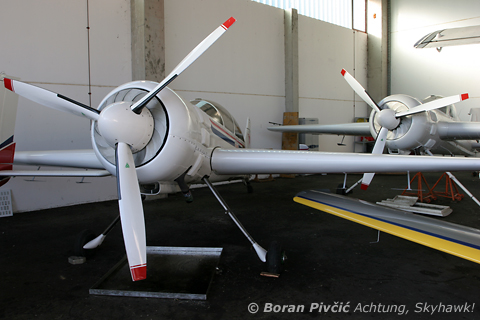
To kick off, some Russian radial power! ๐Ÿ™‚ Looking remarkably alike at a first glance, these two very different aircraft demonstrate that old adage, "same problems, same solutions". Up front is a relatively common Sukhoi Su-29 two-seater, registered RA-3423K; but out back is a juicy rarity, the single-seat mid-wing Technoavia SP-55 RA-3221K, a modified Yakovlev Yak-55M produced under license. Differing from the 55M in composite control surfaces and somewhat lower weight, the SP-55 is one of the preciously few Yak designs still being produced
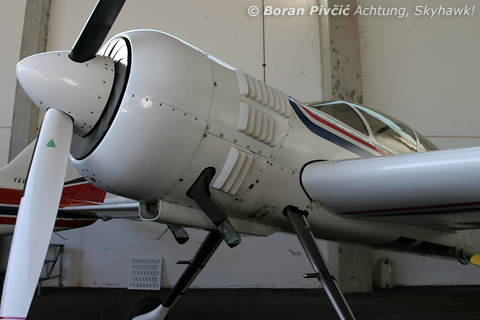
Like virtually all Soviet/Russian aerobatic designs, the Su-29 is powered by the indestructible Vedeneyev M-14 9 cylinder radial, one of the world's great GA engines. Along with its modified high-power derivative, the M-9, this is the only radial still being produced on a significant scale and is available with anything from 360 to 480 HP - not bad for a design from 1933! ๐Ÿ˜€
Up close and personal with an ex-Yu UTVA-66, S5-DCO. Comparable to the Cessna 180 in size and purpose, the STOL-capable 66 is a rare sight today, with only a handful still flying. But the type's characteristic utilitarian, no-nonsense looks make it noticeable wherever it goes ๐Ÿ™‚
Like many ex-Yu aircraft, the 66 made use of the uncommon 270 HP six cylinder Lycoming O-480 - a noisy, but I'm told pretty tough and durable package
Easily the most famous and successful light piston from former Yugoslavia is the UTVA-75, a large - but very durable - two-seater powered by a 180 HP Lycoming IO-360 flat four. Once a stalwart of virtually civil and military all flight training, they are fast becoming a common sight again, with more and more examples - pressed into military service during the 90s civil war - being returned to their original operators
While capable of limited aerobatics, the UTVA-75 had proved itself to be relatively unpopular in that role - so much that there is a joke that says a lot about what pilots thought of its aerobatic capabilities: "how do you get a 75 out of a spin? With a shovel". The problem stems from a center-of-gravity issue discovered when the first prototypes had already flown. Apparently, the CG was too far forward, so to solve this the designers needed to move some weight to the back of the plane. The only convenient item that could be readily moved was the battery, which had been relocated to the tail cone. This had in turn shifted the CG a bit too far back, so more often than not any violent, high angle-of-attack maneuver would end up in a spin... on a different note, notice the type's interesting air filter arrangement above the landing light ๐Ÿ™‚
At the other end of the scale is S5-NBW, the fascinating Zenair CH-701SP. One of the most popular homebuilt ultralights today, the CH-701 boasts truly impressive STOL performance, with a takeoff run of just 28 meters! Powered by a 100 HP Rotax 912 turning a variable pitch prop, this is really a get-in-anywhere-anytime aircraft...
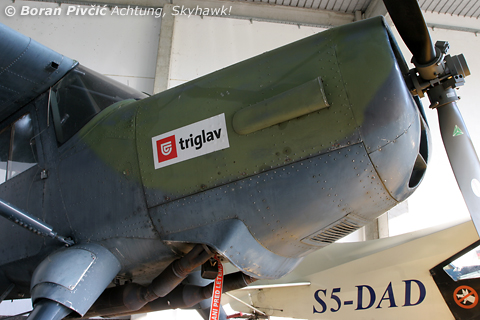
And finally, a sunset peek into the main hangar. Next to the aforementioned UTVA-66 is S5-DAD, a STOL Maule MX-7, and an unidentified Zlin Z-526 80% scale (I think) replica. Quite a nice collection!

Aviation Art Attack – How To Make A Russian Tachometer Interesting

By me
All photos me too, copyrighted

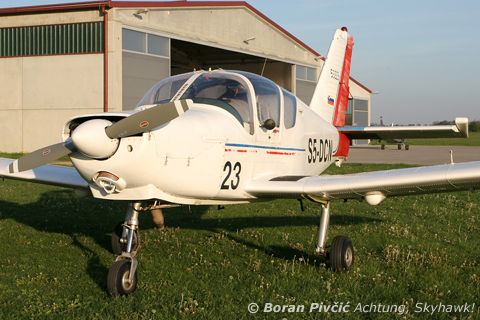
While this doesn’t really fit the bill of a proper Achtung, Skyhawk! topic, the interlude between my last post here and the next Rare Aircraft series (currently “in production” ๐Ÿ™‚ ) was becoming a bit longer than I had originally anticipated (my ATPL exams and IFR flight sim are taking up quite a lot more time than I had expected). So, the break the monotony – and add a splash of color – I though I might just as well post my latest bout of aviation artsyness :D.

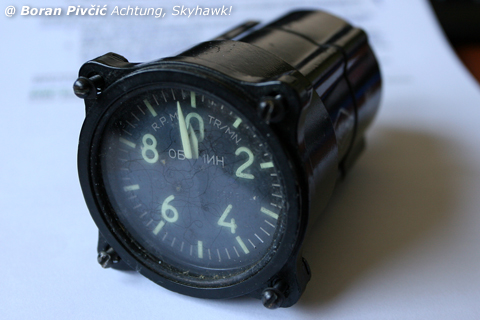
Namely, a few days ago at the field I had come across – completely by chance – an old Soviet/Russian tachometer, which I had initially presumed to be from our old Yakovlev Yak-52, 9A-BUG. A quick counter through my photos of the said aircraft later revealed that this might not be the case, but I still found this little instrument interesting – and before consigning it to the role of an attractive paper weight, I thought I might as well see if it was a worthy photo subject…

Reminiscent of old tachometers on early jet aircraft - with the main dial showing 100s of RPM and the smaller hand 1000s - this one could theoretically go up to 10,000 RPM... though no aviation piston engine even goes near even a third of that. The lettering on the instrument face denoting what it measures is here written in three languanges - OB/MIN (Russian Cyrillic), R.P.M. (English) and TR/MIN (Tours/Minute, French) - which was/is quite common on light Russian aerobatic aircraft. It's small size for such an important instrument - conforming to the 2ATI specification, that is two inches across - is puzzling though, with such instruments normally being at least an inch wider, leading me to believe this could have possibly been a backup instrument in the rear cockpit...
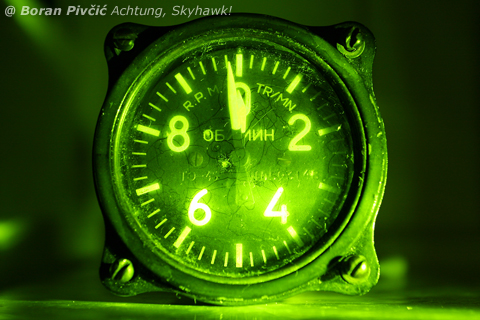
Having noticed - again by accident ๐Ÿ˜€ - that the dials and numbers are florescent, I though I'd try and bring that out with some backlighting, provided by my orange-filtered night flying torch ๐Ÿ™‚
This is more like it, almost like a true Russian cockpit :D. Though green cockpit lighting is not used often in normal circumstances, it is becoming increasingly common in combat aircraft - especially helicopters and transporters - where it was found to be compatible with cockpit night vision systems
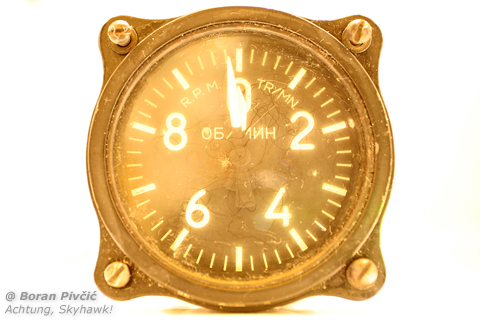
A more common cockpit lighting color, though still a bit too bright for an actual cockpit. To get both this and the previous green light, I resorted to shining my orange lamp through a pair of old 3D glasses :D. Finally found a use for those...
And finally, a golden tachometer - proof that some of the most interesting photos often come about unintentionally! ๐Ÿ˜€ Except the first one, all of these shots had been taken in a completely darkened room, requiring long exposures, usually of 25 or 30 seconds... for this shot, I had set the orange torch to shine directly into the instrument face and activated the camera... however, at one point, maybe 10 seconds into the exposure, I had accidently knocked the torch onto the floor. Scrubbing the shot, I turned on the room lights to find it, and waited for the exposure to finish. But what I got in the end was awesome - the room lights had completely overexposed the shot, but the camera had registered enough of the orange light to make the tach visible. And voila - 0% Photoshop! ๐Ÿ˜€

Photo Report 2 – Some More Uneventful Spotting At Pleso

By me
All photos me too, copyrighted

Deciding to forsake the wonderful world of aircraft instrumentation for some sun, fresh air and photography, I thought I’d kill two birds with one stone by giving spotting at Pleso another shot, after the previous week’s somewhat disappointing results. Now that the sterling work of my colleagues at the Croatian Aviation Forum was beginning to pay dividends in spotter-security relationships, a friend from the said Forum and I made arrangements to camp out unstressed under the RWY 05 approach path and see if something unusual – something not on the timetables – might show up. A recent visit by an Omani C-130 Hercules tanker – and a Qatari A340 and Jordanian A310 before it – kept our spirits up, so we set out to see whether our luck was to be match as our optimism… ๐Ÿ˜€

Whopee, a Dash... (irony + sarcasm) ๐Ÿ˜€ Part of a steady stream of Dash 8s and A320s, Croatia Airlines' newest Dash 8 - the aforementioned 9A-CQF - might have gone unnoticed had I not checked the reg after taking the shot. Its unusual "Croatia 7F" callsign could indicate that this was either a training or shakedown flight (normally, callsigns are the same as the flight number, which is made up of three digits if the flight is scheduled, or four if it's a charter - which is standard practice at carriers around the world. However, to avoid confusion between similar callsigns, or denote special flights, these can be modified into various alphanumeric forms)
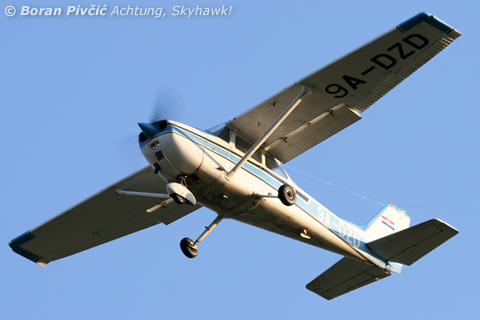
Our own Luฤko resident, 9A-DZD was one of the just three GA movements in the three hours we were there
Somebody wash me! Looking a bit worn out, the Faculty of Transport Sciences Seminole trainer was out bashing the circuit for an hour or so. If all goes well, that should be me up there in a couple of months ๐Ÿ™‚
An unidentified Croatia Airlines Dash 8 (could be 9A-CQC) just crossing the middle marker, while high above an Emirates 777 zips to the Middle East. As is always the case, the upper flight levels are more interesting than the Zagreb approach, with heavies of all sorts a regular occurence (on some days you can see an Emirates A380 followed a bit later by two company 777s in trail ๐Ÿ™‚ )
The only genuinely interesting movement of the day - and that says much about our expectations ๐Ÿ˜€ - was another very handsome Budapest Aircraft Service EMB-120 Brasilia on the daily flight from Budapest. A very rare - and very welcome - aircraft in this part of Europe... (and Europe in general)
A splash of colour on approach. Anybody see a pattern with my previous post? Dash 8, EMB-120, Wizz A320... ๐Ÿ™‚
Finally got N50DD in flight! ๐Ÿ˜€ The country's only Cessna P210N Centurion (and one of only three Centurions of any mark), N50DD is - despite the reg - permanently based at either Pleso or Luฤko, depending on the weather. This is the first time in quite awhile that I've seen it in flight. Not the characteristic Cessna piston single rearward-retracting main gear and the strutless wing (in the Cessna singles lineup seen only on the 177 and 210)
And finally an increasingly rare Fokker 70, operated by Austrian Airlines. Note the type's powerful clamshell airbrakes, first seen on the Fokker F-28 Fellowship from which the 70 was developed. These, coupled with very powerful wheel brakes and thrust reversers, mean the 70 (and the bigger 100) can stop in ridiculously short distances for an airliner - another throwback to the F-28's incredible STOL performance. This same airbrake concept would find its way onto the Avro/BAe 146 regional quad 20 years later