As it so often happens, the things that are closest to you in the end turn out to be the furthest ones away. You always think “naw, it’s close, I can visit any time” and you never do, as it inevitably slips your mind, shoved aside by the more exotic, distant places. Case in point is 71255, one of the ex-Yugoslav AF C-47s that I’ve wrote about in a number of previous posts (readable here). Located at Otočac airfield, it is pretty much a stone’s throw away from the country’s biggest north-south highway, a highway I go down at least 5-6 times a year. In a dazzling display of consistency, I’ve never ever stopped to photograph it, reckoning “it’s just an hour’s drive away, I can visit it anytime”…
Well, today I’ve finally decided to make good on that promise :D. Returning from an Open Day celebration at Zadar’s Zemunik airbase with a couple of friends, we unanimously decided that, while we’re there and having plenty of time to spare, we can just as well finally get it over with :). And this is what we’ve found…
In a much better state than poor old bullet-riddled 71212 at Željava - but still a sad sight nevertheless...Mired deep into the ground from its long stay... also looks like the aircraft had some sort of muffler installation fitted, which could mean that it had remained in service for a comparatively long timeWeathered and beaten, 71255 retains pretty much only its basic parts. Everything of any use that could be taken away was hauled off, leaving the aircraft an empty shell (save for the engines, which seem to be in a better condition). Notice also the tear running down the fuselage...A classic DC-3 shot as seen on Airliners.net :). The clear air and an excellent cloud backdrop contributed to give this poor old bird a more lifelike appearance...Inside, the situation is even worse... up front, near the navigator's station, even the floorboards had been ripped out!A view outside from the first cabin window is hardly better... almost reminds of an engine fire...Looking back from the navigator's station... the only piece of usable "furniture" remaining was an old wooden desk that would not look out of place in a schoolroom... hardly a fitting piece of equipment for such a famous aircraftJust one of those shots where everything - the subject, the terrain, the sky, the light - line up perfectly! 🙂Years of neglect have - as usual - resulted in years of vandalism... quite a contrast between the precise, purposeful propeller serial numbers and the random, useless doodles that people have the need to leave behind...Traces of its former identities can still be seen faded-out on the vertical stabilizer. Given that many of the YuAF C-47s were bought from France - which had operated them after WW2 in both civil and military roles - it is possible that the fainter 349296 code may be a remnant of 71255's French AF serviceA touch of pure symbolism through and through - the roundel of the former YuAF shot and faded, a stirring representation of the violent breakup of former YugoslaviaA roundel in a much better shape underneath the starboard wing. Fifteen years after the end of the war, this is fast becoming a rare sight...Reaching for the skies, one last time...
EDIT: using the power of my 400 mm anti-aircraft Canon ( 😀 ), I’ve also managed to nail Zadar’s 71203 at extreme range while at the base during the Open Day. Distorted by heathaze, it isn’t up to my usual standard, but for now it’ll do :).
Close to 600 meters away, this was the best that I could do. But even despite the questionable photo quality, you can see that 71203 is in by far the worst shape of all the Daks I've seen. Looks like the left upper engine mount has cracked, with the engine sagging downward. For some reason, the aircraft has the "312" code painted on the tail, though this may also be part of its former identity...
Having finally caught some breathing space in between the flying and studying – and the abundant paperwork and pleasant conversations with government officials that inevitably go with them – I decided to finally venture out of my +35 Centigrade room and treat myself to a spot of well-deserved aviation photography :). Being mostly “in transit” at Lučko during the past few weeks – either in planning, briefing, debriefing or running to my car to turn on the aircon after a flight in the scalding hot Seminole 😀 – I had never taken the time to notice that the aircraft population at Lučko had increased substantially, and was sitting idly around, unphotographed. So, keen to set that right, I packed up the camera – along with half a dozen liters of water – and set to work! 😀
First up is a very interesting transient visitor, in town for some maintenance. When I saw it in my university's hangar undergoing some minor work, I must admit I briefly hoped that our air wing had diversified, but was disappointed soon afterwards :D. One of the preciously few Cessna 188s in Croatia, 9A-BKP - an A188B AgTruck - hails from Daruvar in the country's eastern agriculture-rich flatlandsMean and substantial, the 188 represents Cessna's only venture into the agricultural market (apart from an interesting crop-spraying 185 conversion). Lacking a unified type name, various 188 versions bore the AgWagon, AgPickup, AgHusky and AgTruck names, with the A188B AgTruck being the last and most powerful normally-aspirated modelDesigned to haul. Built in the 60s using extensive inputs from ag pilots and operators, the 188 embodies all the characteristics of a proper cropsprayer: a big, thick low speed wing, massive flaps, a high, crash-resistant cockpit - and every component made big and chunky, just in case 😀Interestingly, despite its substantial appearance, the 188 is quite light: only 980 kg empty when equipped with a dispersal systems. Even with a 1060 liter hopper tank aboard, the MTOW in the restricted category never climbs above 1800 kg (with 1450 being normal) - which, with 300 HP up front, probably makes for some spirited flying 😀More potent than the standard Piper Pawnee and more manageable than the Air Tractor, the 188 was a significant sales success with close to 4000 sold, but oddly enough few remain flying today (especially in Europe). With production having ended in 1983, they've been slowly phased out of their primary role, while their big, all-metal bulk and thirsty engine do not lend them well to secondary roles such as glider towing, where the simpler, cheaper Pawnee still enjoys a lot of successNext up is something much fairer and rarer: the Glaser-Dirks DG-200 single-seat glider :). Produced in only 190-ish examples, the 15-meter DG-200 is nevertheless a capable glider - with a glide ratio of 1/42 - equipped with both flaps and water ballast tanks. As is common on European gliders, its flight instruments are metric, which requires some quick mental calculation when dealing with ATC 🙂Assembly after transport - the most fun you can have short of actually flying :D. Of classic layout for single-seat higher-performing gliders, the DG-200 cockpit is clean and well laid out, covered by a practical one-piece canopy. Getting in though can be a bit of a palaver if your gymnastic skills are not up to scratch 😀More equipment means more handles :). Apart from the stick (and its wheel brake trigger) in the foreground, you have the yellow towrope release handle, the blue spoiler and the black flaps selector. Out of shot is the gear retraction handle, while on the opposite side are the water ballast tank valves and the emergency canopy release - and all without a bit of electricity 🙂And finally, an artsy view of our latest resident, 9A-JSA. Behind the unusual custom registration is a stock - but freshly repainted - 172N operated by a new company called JungSky and flown by a former member of our aeroclub and a current Fokker 100 captain 🙂
Having been warming the chair with my ATPL studies for a good part of the month – not the most fulfilling of activities I must say, especially since it’s 35 Centigrade outside… and probably more inside – I was naturally through the roof when my name finally came up on the multi-engine training roster :). Eager to fly (and photograph :D) any day of the week, I was doubly excited this time, since I’d finally get to try my hand at the university’s sole Piper Seminole – in a nutshell my first Piper, first low-wing and first twin 🙂 (greetings from fixed-gear Cessna land!).
The aircraft in question is 9A-DZG, a trusty 1978 normally-aspirated Seminole that has pretty much passed through the hands of almost every multi-engine qualified pilot in Croatia in the last few years. Powered by two 180 HP Lycoming O-360s, it may not be the most exciting or high performing aircraft in the world – but after half a dozen Skyhawks, it is pretty much the top of the line :D.
Training-wise, first up was the Multi Engine Class rating, done under VFR (thankfully we’ve been having some excellent VMC lately). This pretty much revolves around the most important skills multi-engine aircraft require – the ability to fly on only one of those engines. As well as zone work – to familiarize ourselves with the aircraft and its handling characteristics – the course includes a broad range of “one engine inoperative” (OEI) situations, such as in cruise, during landing, during takeoff, after takeoff and on go-around. Lacking any navigation elements (such as IFR flying), we could have done the course at Lučko or Pleso – but given that they do have a lot of traffic nowadays, and OEI ops tending to disrupt the normal traffic flow, we decided to head somewhere else, most often the coast :).
To compensate for the increased transit time, time we could spend on honing our OEI skills, we usually flew in pairs of two students, where one would fly outbound and do his/her training, after which we’d land and swap places. The other student would then do a similar set of exercises and fly the return leg, while the backseater would observe and learn… and in my case, snap a photo or two :D.
Heading for Rijeka (LDRI) on the coast, climbing to 5500 ft. Given the recent heatwave, forming cumulus clouds were a common occurrence. Many never developed far enough to carry any rain, but the few that did ended up wreaking havoc all round... (at Lučko two Skyhawks - including one I flew on my IFR course - were damaged when the sudden wind tipped them onto their wingtips)A busy view up front as we near the first substantial clouds near the Velebit mountain range. Blowing perpendicular to it, the week's north-easterly wind was the perfect trigger for the formation of vertical cloudsOn approach to Rijeka's RWY 32. Situated on Krk, one of the largest islands on the Adriatic Sea, the airport's comparatively low traffic volume, a long runway and an abundance of radionavigation aids (not to mention it being just 30 minutes flight away) makes it a popular training destination 🙂On any of the Cessnas I normally fly, this sight would be cause for immediate - and considerable! - alarm :D. However here, with the other engine still pulling, you can breathe a bit easier :). Normally, engine-out training is simulated - with the throttle on one engine retarded - but in some cases the instructor will actually shut the engine down completely. The propeller is then feathered (turned parallel with the airflow) to keep the drag - and all of its unwanted side-effects - down to a minimum. Also, the small mirror on the cowl is provided for the pilot to visually confirm that the nose gear is down (generally, if the nose gear is down, probably the mains are as well).Encountering a spot of rain on the way back with me at the controls. Photo courtesy of the aircraft's autopilot :D. While I generally prefer hand-flying - sharpens the skills - a (finally) functioning autopilot was just too good an offer to pass up 😀Still more working atmosphere on day 2 :). Flying back home from Zadar along the islands, the long - but far more pleasant - way around. Capitalizing on the fine weather, the military had activated several of its training zones - which basically cover the entire Velebit range - so to avoid close encounters with supersonic MiG-21s, we were routed around themAaah, the sea! Always a beautiful sight for us landlubbers :).DZG ticking itself cool - as much as it could have, given it was +40 on the apron - at Banja luka airport in neighboring Bosnia :). For our final multi-engine class flight, we'd decided to go international - which, to add to a list of firsts, this was my first ever international flight as pilot :). Succumbing to the traditional culinary delights of Bosnia - "čevapi" for any locals who might read this 😀 - we decided to stay in town for lunch. In the end, this turned out to be by far the tastiest training flight I've ever had!Some more dramatic weather at 6,000 ft on our flight back to Zagreb
Like many Spitfire enthusiasts, over the years I had gone through all the “fan-boy” motions: I’ve watched the movies, read the books, saw the photos… collected a bit of memorabilia even, the lot. But, as is often the case with these things, my involvement with the Spit had always stopped short of actually seeing a real, flying example. Sure, I’ve seen one in a museum – an ex-Yugoslav Mk.Vb in Belgrade’s Aeronautical Museum – but static, toy-like and lifeless, its beautiful Merlin silent, it just didn’t cut it at all.
Determined for years to right that wrong, last Saturday (26 June) I sat in the car and set off for La Comina airfield in Northern Italy. Just a few miles south of Aviano airbase, this small grass field – one of the oldest in the country – was the venue for the La Comina 100 airshow, part of a series of shows across the width and breadth of Italy, celebrating its first century of (practical :D) aviation. On this occasion, the aircraft line-up had included a mouth-watering selection of precious warbirds, including my “target for the day”, my first ever flying Spitfire! 🙂
Owned by the Jacquard Collection of France, F-AZJS – a post-war photo-reconnaissance PR.19 – is perhaps not the most exotic Spitfire around, but it is among the very few surviving examples of what some call the most capable Spitfire mark of them all. The last of the land-based Spitfires – powered by the monstrous 2035 HP Rolls-Royce Griffon 65 borrowed from the 1944-vintage Mk.XIV – the light, unarmed PR.19 can zip along at a fantastic 740 km/h, along the way touching altitudes in excess of 50,000 ft; heights that put most modern civil jets to shame! 🙂
That day though, F-AZJS would (thankfully) be touching just – 500 ft :D. Already excited out of my skin – and set and ready to experience the grace, power and charisma of the immortal Spit – I had readied the camera and waited…
I learned an important lesson that day - NEVER EVER stand behind a WW2 fighter when it is starting up :D. It might not be so bad behind a meek Cessna, but behind a Spitfire with its huge five-blade prop...Looking very imposing and purposeful with its long, pointy nose :). As well as being the fastest of all the Spitfires in level flight, the PR.19 also holds the title of the fastest Spitfire in any sort of flight - as demonstrated by a one example operating above Hong Kong in 1950 :D. During an inadvertent dive from 50,000 down to 2,000 ft, the aircraft had managed to reach a whopping Mach 0.94 - without suffering any structural damage whatsoever!Surely one of the most famous shapes to ever take to the skies! And I must admit it's larger than I thought...North Italy or North Africa? :)... Despite being significantly more powerful than the Merlin, Rolls Royce had managed to make the Griffon only a third larger, allowing it to be installed in the tight airframe of the Spitfire. Apart from the big spinner and five-blade prop, the most obvious resulting changes were the raised humps on the upper cowl, accommodating the taller engine block
As an added bonus feature – and in the interest of serving a balanced dose of irony 😀 – I’ve also decided to include a few shots of the unique Fiat G.59-4B two-seater that had also appeared at the show, currently the only flying example in existence. Though it outwardly looks like a bastard cross between a Spitfire, Bf.109 and Yak-1, it is actually based on the curvy Fiat G.55 Centauro, hailed by many as the best Italian wartime fighter. Powered by a 1475 HP Fiat Tifone inverted V12 – a license-built version of the Daimler-Benz DB 605A-1 – it had proved to be a formidable opponent, taking on Spitfires and Mustangs without a second thought. Stunningly maneuverable – but slightly under-armed – the G.55 had some notable combat successes, but their low numbers meant that the type couldn’t make much of a dent in Allied air fleets.
An advanced design that was ahead of its time in a number of respects, the G.55 was – like the Bf.108 previously featured here – returned to production following the end of WW2. However, again like the Bf.108, it soon started facing a serious shortage of engines, with the stockpiles of WW2-vintage Tifones – and even imported DB 605s – dwindling fast. In a bid to keep the production lines open, the design team started looking for a replacement engine – but, unlike with the Bf.108, their choices were very limited. The only realistic option in the required power range was none other than – the RR Merlin :D.
Re-designated as the G.59, the new aircraft was comparatively successful, though was in the end built only in modest numbers (with almost half intended for Argentina and Syria, the type’s only foreign customers). Two versions were produced, the single-seat A models and the two seat Bs, to whose last batch our example – I-MRSV – belongs…
Its G.55 heritage completely blurred under the "right-way-up" Merlin and extended canopy, the G.59 almost looks like a disordered mess. However, with only 10 G.59-4B's ever produced, I-MRSV is pretty much a bigger attraction than the Spitfire 😀Rolling gently onto its back amid the roar of the mighty Merlin. Quite an interesting combination too...Almost looks like a Yak-1 from this angle...
By me Photos me too unless otherwise indicated, copyrighted
With a click and unwilling grunt, the imposing four blade prop slowly catches the air. Protesting now with an ever-louder series of coughs and bangs, the big engine comes to life, spewing clouds of white smoke to show its displeasure at being so rudely awoken. The characteristic whiff of petrol and grease spreads through the air as the whine of the huge supercharger builds up, almost inaudible beneath the increasing bass roar of nine cylinders. Spewing drops of oil from the single exhaust pipe, the unruly engine looks and sounds like it can barely hold itself together, like it might fall apart any second without warning.
And with its belly already smeared in oil, its fuselage stained by exhaust and its metal skin shuddering in the propwash, the big biplane doesn’t inspire much confidence in the casual observer. And yet, for all its farmyard machinery appearance, this beautifully ugly airplane still has an obvious air of competence, durability and purposefulness around it… but that really should not be very surprising; for after all it is one of aviation’s greatest legends – the fantastically charismatic, and damn near indestructible, Antonov An-2 :).
A cough, a puff and a roar - is there a more exciting spectacle than a big radial being started? 🙂
1. Future-proof:
Lumbering unhurriedly along in the lower levels – comically too in any stiff headwind – it’s hard to see at first what made the Anushka into one of the world’s great aircraft. As sophisticated as a telegraph pole, this noisy, ungainly, uneconomical biplane is a stereotypical anachronism, looked at by many with the same mix of fondness and patronization as an exhibit in a WW1 museum. Sort of like “you gave it your best shot, but it now time to move on to newer things”…
Yet, despite all its apparent crudeness, the An-2 is a true masterpiece of design. Understated, it has gone quietly about its business for more than 60 years, never blowing its trumpet even though it had a million reasons to do so. From deserts to polar wastelands, often operating in conditions that would shame most other designs, the An-2 has soldiered on without fuss or pomp, setting records for machine and man achievements that, more than anything else, show what aviation is really about :).
And therein lies the answer to the main question: what makes the An-2 great is the same thing that made the DC-3/C-47, the C-130 Hercules, and the Twin Otter great – the ability and capability to do anything and everything, to be adapted to every required role and do it brilliantly. And like the DC-3, C-130 and DHC-6, it has outlived all of its intended replacements, finding none equal even in today’s world of glass cockpits, carbon fiber and super-efficient jet engines…
The An-2 on holiday in the mountains - considerably less exciting than the places it normally frequents 😀
But to find out the story of this amazing aircraft, to see what makes it tick so well, we first have to turn to the birds and the bees… and the badgers, mosquitoes, bears, goats and whatnot else the Soviet Ministry of Agriculture and Forestry had to deal with in the immediate aftermath of WW2. Faced again with the age-old problems of administering the USSR’s vast open areas, in 1947 the Ministry had issued a specification outlining a simple and dependable utility aircraft that could be used for this purpose. Required from the outset to operate pretty much out of open fields far from large population centers, the new aircraft had to have a demanding mixture of characteristics, not least of which was full rough-terrain STOL capability. But more critically, it also had to be almost completely self-sufficient once on the ground, and uncomplicated and intuitive enough to be maintained with a minimum of basic equipment by whatever crews could be scraped together from the local populace.
In addition, the aircraft had to be easily adaptable to a variety of secondary roles – one of the most important being cropdusting – and be easy and forgiving to fly in all conditions. And it had to be able to do all of this in a bewildering range of climates found across the former USSR, from the hot deserts and steppes of Asia, to the vast taiga of Siberia and the snow and ice of the Arctic circle…
In the spirit and general optimism surrounding the new aeronautical technologies developed and refined during WW2 – jet engines, advanced liquid-cooled V-block pistons, monoplanes, retractable gear – Oleg Antonov’s solution to this challenging requirement took a number of people by surprise. Fresh from the Yakovlev design bureau, this talented engineer – responsible in no small part for the superlative Yak-3 fighter – had quickly gained a reputation for innovation, thoroughness, and not a small amount of design boldness. So it came as a bit of shock that, tackling such a stimulative specification, he had only managed to come up with a lumbering, antiquated biplane – a design considered by many to be outdated before it had even flown…
However, like with every aircraft he had designed, Antonov had put a lot of thought into what the future An-2 should really be. Already an experienced designer, he was well aware of the problems the USSR’s great, sparsely populated open ranges presented. He had also observed the sometimes crippling effects the Russian winter – and generally the hard going – had on the sophisticated German fighters of WW2, and how the comparatively simpler Soviet aircraft seemed to suffer a great deal less, happily flying when their counterparts were grounded for days on end.
With this in mind, it soon became apparent to Antonov that these new technologies the world was on about would simply not cut it in the Soviet backwoods (at least not just yet). Leaving aside the extremes of the weather, where would one find a qualified mechanic for a liquid-cooled V12 in a remote village in Siberia or on the wind-swept plains of Kazakhstan? Or the workshops and materials to repair a high-loading monoplane wing or a retractable gear leg when you’re operating out of a forest clearing on the rim of the Arctic circle?
How would you repair and maintain your shiny new state-of-the-art aircraft miles from anywhere and with the sun about to set?
The way forward therefore was backwards. What Antonov saw as the key to making the An-2 work – and with 20/20 hindsight we can agree he was spot on – was to use older tried-and-tested technologies to make the aircraft so dependable and simple that there wouldn’t be anything on it to break… and if it did, it could be fixed with a spanner and some tape.
But the resulting design – first flying, to considerable chaffing, on 31 August 1947 – was anything but a mere collection of bits the Wright brothers could have used; indeed, the An-2 still stands today as a shining example of intelligent, purpose-built and minimalistic design. Far from being just another biplane, it is brimming with solutions and ideas that show just how much thought, planning and old-fashioned common sense went into its design…
2. Go Ugly Early:
For starters, there’s its trademark biplane layout. While this does pay a high price in drag – with the An-2 pegged at just 140 knots, despite the 1000 HP up front – it reaps huge benefits in the low-end of the speed range. The large wing area – 71.5 m2 (770 ft2) – means that enough lift can be generated down to very low speeds, which, combined with its clever airfoil shape, gives the An-2 a comically low minimum flight speed of just 49 knots! 😀 (for reference, that’s also the clean configuration stall speed of the Cessna 172)
Slowing down further from this speed, the unknowing pilot would find himself/herself quite surprised by the An-2’s stubborn refusal to stall (though I feel the novice pilot would be very appreciative of this feature 🙂 ). Indeed, should the aircraft for whatever reason find itself at such a low speed in level flight, the spring-loaded leading edge slats on the upper wing would extend, keeping the airflow glued to the wing, and the whole thing would simply descend gracefully under full control at a “parachutists rate” and just 30 knots of forward speed :D. The big, chunky landing gear would absorb the impact and, more often than not, the crew would just walk away with very little damage to the aircraft… as a consequence the aircraft – uniquely – has no concrete published stall speed in The Book* (and I’ve checked this).
* however, the whole stalling issue is a minefield. The popular idea is that the stall is caused by a lack of speed. This is not so – a stall is caused by a disruption to the airflow around the wing. Low speed does indeed cause a stall – because to maintain level flight the aircraft has to continually increase the Angle of Attack as it slows down, until it becomes so large that the airflow separates from the upper surface of the wing and lift is lost. However, you can stall an aircraft going at full speed, in a climb, dive, turn, loop, you name it. You just have to pull on the commands with such force that the aircraft rotates so quickly in a short period of time that airflow breaks off the upper surface. So the An-2 can stall – but in level flight its aerodynamics allow it to be flown in such a manner that the airflow sticks to the wing at all times.
But its low speed capability is best evident in the takeoff run, which is a spectacle that can best be described as – interesting. On most aircraft, the takeoff is a visually striking event, with the charge down the runway, the purposeful rotation and powerful climb-out… the An-2 though just slowly accelerates – with the inevitable misfire or two – and after two hundred meters starts slowly going up, no rotation, and rumbles away like it’s not in any sort of hurry…
To make it handle well at these low speeds, the An-2 has slotted flaps and ailerons. The slots direct the airflow down the upper flap/aileron surface at high angles of attack, retaining positive control and maneuverability. The flaps - seen here - are fitted to both the upper and lower wings, augmented further by differential ailerons that droop with them down to 20°. With this many high lift devices, you can imagine why the An-2 can fly at 30-40 knots! 🙂
The third factor contributing to the An-2’s low speed prowess is the wing loading – or simply put, how much weight does each unit of wing area have to support in flight. Normally, this is used as a measure of aircraft handling, with the lower the value, the more docile and easier to fly the aircraft is.
And despite looking like a jolly mass of airplane, the An-2 weighs just 5.5 tons at MTOW, which is spread over the aforementioned 71.5 m2 of wing area. This gives a wing loading of 77 kg/m2, which compares very favorably to the 87 kg/m2 of the Cessna 182T – and is not that far above the the 172R’s loading of 70 kg/m2, which pretty much ticks the “easy handling” box :).
Another interesting side-effect of the this biplane configuration may not be readily apparent to us at our big airports, but is probably much appreciated in the areas where the An-2 is “at home” – namely, neither wing has a very large span, which means the Anushka can happily operate in tight, confined areas outside normal airports and airfields. The comparatively narrow main gear span too means that its turning circle is quite small (for an aircraft its size anyway), which helps in maneuvering on the ground.
An overview of the Anushka's controls and high lift devices: running down the length of the upper wing leading edge are the spring-loaded slats, operated in part by the air pressure acting on them, though they also extend automatically with the flaps. The ailerons occupy the outboard trailing edge, with the upper flaps inboard. The lower wing is mechanically simpler, with just full-length flaps. You can also see the large cowl flaps needed to keep the big engine cool (especially important in the lower end of the speed range, where the airflow doesn't provide all that much cooling)
The engines too were given a good deal of thought, even though Antonov was not really spoiled for choice in this department. Jets were still just getting off the ground, it’d be years before the first turboprops left the drawing boards, and V-blocks were just too complicated and frail for a lifetime of torture – and dubious maintenance practices – they’d be subjected to. So, the only remaining option was to go radial :).
The first choice, beginning the An-2’s “third cousin removed” relationship with Wright Engines of the US, fell on the Shvetsov ASh-21 (or more accurately, AŠ-21), a 7-cyl radial producing about 780 HP. In essence, this was a single-row version of the company’s twin-row 14-cyl ASh-82, an engine based on the knowledge, experience – and a fair number of structural parts – of the M-25, a Soviet license-built Wright R-1820 Cylcone 9, one of the great radials of WW2. Finding out that the An-2 prototypes could do with a bit more poke, the engine was changed on the production versions to the ASh-62, which was – again – a distant relation of the R-1820, being based on the same M-25. Quite a bit more potent than both the ASh-21 and the Cyclone, the ASh-62 was able to produce 1000 HP out of nine cylinders, which was deemed enough for the new aircraft.
Dusty - and with a few parts missing - the ASh-62 is still an imposing sight. The radial's large frontal area doesn't really help with aerodynamics, but it does allow the engine to be air-cooled, deleting the need for a liquid cooling system that is vulnerable to damage - and when damaged can take out the entire engineAn artsy shot of the ASh-62IR on an airworthy An-2 🙂
While selection of the ASh-62 would have been a foregone conclusion based on its rated power alone, it did have several other beneficial – and I’m inclined to believe intended – consequences, which would have fit right in with Oleg Antonov’s vision for the An-2. Like the Cyclone on which they are based, the ASh-62 and 82 were as common as trees, powering a number of famous aircraft such as the Polikarpov I-16, the Lisunov Li-2, Tupolev Tu-2 and all the Lavochkin fighters – aircraft common to virtually every corner of the USSR. Indeed, both engines were intended to remain in widespread service for years to come, so finding someone qualified to repair one was sufficiently likely even in the most remote of airfields.
And despite the fact that the ASh-62 and 82 were different engines only partially based on the Cyclone, they still carried part of the R-1820‘s DNA – or more specifically, its technologies and lessons learned, most of which the hard way. And when it’s chosen to power the B-17, DC-2, DC-3, the Dauntless divebomber, the Wildcat and many others, it definitely must be good :D.
3. The Devil is in the Details:
But if anything, it was the little things that really showed how much thought was invested into the basic An-2 concept. The cockpit for example is very airy and roomy, while extensive glazing provides a good view in all directions – something especially important if you were slated to spend most of your life rumbling at low levels, never mind the slow speed.
Even with the big radial up front, the view forward is excellent for such a large taildragger. The high tail, and the positions of the pilot and copilot offset to the sides of the cockpit, mean that crews do not have to bother with tiring and wearisome S-turns on rough ground and in tight spaces. In flight, the bulging side windows (not visible in this shot) allow the crew a good view straight down, which also comes in very handing on landing, especially if a tight, narrow runway is involvedSimple and uncluttered, the An-2 cockpit has all that you really need, with everything - except the ADF, to the right of the central pedestal - in easy reach. And while the instrument layout leaves something to be desired, the panel position - moved low to improve forward vision - is a helpful touch. You will also notice that the pilot's lower panel is tilted back a bit, to reduce the effect of parallax when looking at the instruments from above. In addition, all the controls and switches are chunky and large so they can easily be operated in thick gloves
Out back, the main cabin is similarly utilitarian – but for the An-2, this is a compliment if anything :). Almost perfectly rectangular in cross-section, it can be – and was 😀 – adapted to countless applications, while its comparatively high floor strength means you can load up a lot of cargo without undue worry. Other interesting touches also include cabin walls lined with glass-wool to reduce noise – which can be considerable, it must be said – and, on some passenger models, even a toilet!
Underneath the skin though, away from criticizing eyes, the An-2 starts to show off its true colors – starts to show off just how cleverly it was really designed. For example:
despite its dated biplane format – which would have probably suggested otherwise – the An-2 is built almost entirely of metal. The entire fuselage structure is a stressed-skin semi-monocoque – as seen on passenger airliners – rather than the simple frame used on similar aircraft (including many light aircraft of all sorts still produced today). As mentioned in a previous post, in the semi-monocoque construction the loads exerted on the fuselage in flight are spread between both the basic structure and its metal shell. This was a boon for pressurized airliners, because it provided a light, yet durable and strong airframe, which could easily absorb the stress created by pressurization. In the unpressurized An-2’s case, this structure can absorb significant forces – for example during a hard landing – and distribute them evenly over the entire airframe (including the skin), reducing stress on specific components
on the other hand, all the flying controls – rudder, elevators, flaps, ailerons – as well as the entire wing aft of the main spar, were – fabric covered. An odd pair with the advanced metal structure, this common WW2 solution was (cleverly) chosen for practical reasons: the “hybrid” wing allowed the leading edge – and ergo the spar, the wing’s most important element – to be protected from frontal impact. At the same time, any damage caused by debris thrown at the wing and the controls by the wheels – which was sure to happen on a daily basis – would be easy and inexpensive to repair out in the field (one of the reasons you may often see An-2s with control surfaces painted in a scheme completely different from the rest of the aircraft)
but the feature that shows most of all just how pessimistic – or realistic – Oleg Antonov was about the ground infrastructure the An-2 would have available is the refueling system. Nothing as old-fashioned as a man climbing on a ladder and pouring fuel into the tanks, the Anushka instead uses a powerful on-board pump that draws fuel from any fuel canister and flushes it into the tanks :). The whole procedure consists in simply rolling a barrel of fuel up the aircraft, dropping a special hose into the barrel and turning the pump on – and presto!
Why bother with clumsy things such as pouring in fuel? Let the airplane do that for you! 🙂
Another interesting feature on the An-2 is its use of a pneumatic system instead of a hydraulic one normally used in the West. Common to virtually all Soviet light aircraft before or since, the pneumatic system works and functions exactly like a hydraulic one, but uses air as the working medium instead of hydraulic fluid. While this may appear to be an insignificant change – and even a complication – it does have a number of advantages when used in the conditions the An-2 was designed for:
first and foremost is its lower weight when compared to the hydraulic system. Because the air in the installations is at very high pressure, smaller diameter pipes are necessary to produce the same force, which drives the overall weight of the system down
the system can also be easily replenished. The An-2 for example has an air line fitted to a special compressor in the engine bay, which can refill all of its pneumatic systems – the brakes, tailwheel lock, shock-absorbers and even the tires – which are normally charged from an 8 liter compressed air cylinder. This has a raft of benefits, the greatest being that it negates the need to carry reserve hydraulic liquid around. Also, the pneumatic system is replenished without human intervention – apart from opening the air line – which also means one time-consuming task less for the mechanics
the last major benefit is that air is much more forgiving that hydraulic fluid (which is usually a special synthetic oil) in temperature ranges as diverse as the ones the An-2 would see – especially at low temperatures, where the viscosity of the oil increases and the system loses power (not to mention the possibility of the oil freezing)
The pneumatic system does have some disadvantages however, the biggest being the inherent hazards of handling compressed air cylinders – but this pretty much applies to any compressed gas or liquid. The other major disadvantage is that the pneumatic system is much more coarse when it comes to metering out the force to be applied, which can lead to imprecise system performance and usage. However, this is only a small setback as far as the An-2 is concerned: considering its most important pneumatic system – the brakes – you either have to stop so quickly that just slam the brakes full on, or you have a long enough runway on which the An-2’s STOL characteristics mean that stopping distance isn’t an issue :D.
4. Revenge of the Write-Offs:
Naturally, with a design as thought-out as this one, it was only a matter of time before the humble Anushka outgrew its original specification – and before Oleg Antonov started catching breath for the last laugh. And while transport and cropdusting had indeed remained among its primary missions even to this day, the aircraft’s durability, adaptability and stunning range of capability had immediately lent it to a host of other – and often diametrically opposed – duties.
Among the aircraft's many nicknames - earned through a lifetime of cropdusting and agricultural work - is "kukuruznik", the name for a maize/corn field worker during the Soviet era. A fitting picture then! 😀
To cater for these, a number of versions and sub-versions were developed, which progressively grew in number until only the most fastidious An-2 fans could even being to count them all up. Further complicating the matter is that in 1960, the majority of An-2 production was moved from the Ukraine to PZL-Mielec in Poland (along with production of the ASh-62 to PZL-Kalisz), which would eventually cause some linguistic problems as aircraft with different roles were allocated the same designations. And cataloging Chinese production – where it was known as the Shijiazhuang/Nanchang Y-5 – is a similarly herculean task. However, in the interests of a balanced post, I’ll post a link to the full list on Wikipedia (and for once, a list made from a reliable source) and single out a couple of the most interesting ones:
An-2A – developed to intercept US reconnaissance balloons (now there’s a novel usage), this interesting version was equipped with a dorsal gun turret and a more powerful, turbocharged version of the ASh-62 engine
An-2E – two ekranoplan (wing-in-ground-effect) versions sharing the same designation. Though Boeing had touted loudly a few years ago about its innovative Pelican concept – which would have been a massive transporter “flying” a few feet above the water – the original technology was developed in the USSR in the 60s by famous scientist Rostislav Alekseyev, who had also developed the Alekseyev KM, a humongous 10-engine ekranoplan that even today remains one of the largest flying objects ever built… despite the fact that it’s currently at the bottom of the Caspian Sea
An-2F – among the three versions to use this designation, by far the most fascinating was a proposed VTOL version, with an AM-9 turbojet in the rear fuselage
An-2PD-5 – an executive version provided with a bar and pantry 😀
An-2PRTV – modified as a TV broadcast relay for the Polish Radio and Television Company
An-2RT – a single An-2 converted to receive and record telemetry from test missiles
An-2V – in the first use of that designation, a floatplane 😀 (photo @ Airliners.net)
An-6 Meteo – a high altitude weather reconnaissance aircraft that had even taken an altitude record for its class at 36,902 ft
Y-5C – one up from the An-2V, the Y-5C is actually an amphibian 🙂 (photo @ Airliners.net)
What can be considered to be the ultimate development of the An-2 though – a development that actually worked, sort of – was saved for last: the An-3. Re-engined in the 80s with a 1433 HP Glushenkov TVD-20 turboprop, the An-3 was intended as a cheap, off-the-shelf replacement for the vast fleets of ageing An-2SKh cropdusters, as well an alternative to the ultimately failed Myasischev M-15 Belphegor, the world’s only jet powered cropduster :). Fitted also with a squared-off vertical stabilizer and a thoroughly updated and modernized cockpit, the An-3 prototypes had in a short time set an impressive six payload-to-altitude world records for their class – but in the end, with the breakup of the USSR looming very close, these had counted for very little and the An-3 became just another commercial failure. The design resurfaced again in the mid-90s as the An-3T, but this time as a retrofit of existing, surplus low-time An-2s – with just marginally more success…
In the end though, the above list generally an academic affair, since the majority of An-2 versions could be adapted to do everything the other ones could. So you had passenger versions dropping skydivers, cropdusters hauling cargo, transports cropdusting… some towed gliders (A.net photo), some flew to the poles (A.net photo), some became firebombers (A.net photo)… some became lorries (A.net photo) :D… generally, the list would go on for awhile.
And then there were the Croatian Air Force examples :). With the start of the ex-Yugoslav civil wars in 1991, the nascent CroAF, faced with a complete lack of aircraft, had decided to turn everything with wings into a combat aircraft. This may seem like an exaggeration, but Air Tractors fitted with a gunsight and bomb racks, UTVA-75 trainers with shoulder-held rocket launchers under the wings and Cessna 172s dropping hand grenades from the cockpit were a common sight in the early days of the war. Among them were numbers of An-2s which were mostly used as “heavy bombers”, armed with so-called “boiler bombs” – gas cylinders filled with explosives and anything that could act as shrapnel: forks, razor blades, knives… – dropped out of open doors by the crews. Operating mostly during the Siege of Vukovar, by day and night, these aircraft would fly low-level attack and resupply missions in the face of formidable Yugoslav SA-6 surface-to-air missiles and defending MiG-21 and 29 fighters. In what is perhaps the greatest irony associated with the An-2, they were virtually invulnerable in this role! 😀 Intentionally flying at barely 40-50 knots, they were so slow that they ended up below the detection threshold of every fire control radar, which then wouldn’t even show their echo on the screen. The defending fighters had an even greater problem, flying at speeds of 200-300 knots and trying to intercept a target moving slower then a car at tree-top height. However, when the Yugoslav National Army modified the SA-6’s radar to lower the detection threshold, the An-2s started suffering heavy losses and were withdrawn from the role.
Two "boiler bombers" - the right one apparently modified for the sensor role - in flight somewhere over eastern Croatia in the early 90s (photo from: militaryphotos.net)Another interesting modification is what was half-jokingly called the "AnWACS" - fitted with a suite of sensors, this aircraft acted as an airborne command, early warning and signals intelligence platform. One of its antennas can be seen under the fuselage - though I've also seen pictures showing a similar dorsal antenna just aft of the wing (photo: unknown)
All in all, not a bad showing for an “ancient, rustic biplane” :). And while time had ran the An-2 over as a commercial transport long ago – it not being the cheapest aircraft to operate, and Western certification being nigh impossible to obtain – they remained in regular production in Poland up till 1991, by which time many more modern designs came and went. Indeed, low-key production from spares continued until 2001, making for an enviable production run of 54 years – beaten only by the Hercules and the record-holding Beech Bonanza (coincidentally first flying the same year as the An-2 🙂 ). During that time more than 18,000 were produced – with some estimates as high as 20,000 – although the true number may never be known without accurate figures from license (and off-license) production in China.
Like an ancient air force preparing for a raid :). Declaring war on mosquitoes is more likely for these two...
But what really puts the shine on these numbers – what I’m tempted to say even eclipses the production achievements of any other aircraft – is that the An-2 went through an entire half century fundamentally unchanged from the first post-war versions. There were no new engines, no avionics upgrades, no lavish new features or wild performance increases – just the simple, basic, utilitarian 40s design, rumbling calmly about its business for 60 years in conditions and situations few, if any, other aircraft will see in their lifetime.
And this, if anything else, is a great, lasting testament to the brilliance of its design and the genius of the men who had worked on it :). Anachronism? Hardly!
9A-BFT and 9A-DIZ enjoying a stunning end of another working day... with 14 of their number on the civil register - and four active - in addition to a dozen or so mothballed military examples, the An-2 is still up in the three or four most common types in Croatia. BFT is one of the most famous, being the only surviving airworthy "boiler bomber" 🙂Despite its 60+ years on the job, the sun has still not set on the venerable Anushka. Today considered a true, cult classic, many have recently found their way into the US and rest of Europe, happily flying joyrides and skydive flights. With a large number of relatively young low-time examples about (most Croatian An-2s, for example, are mid-80s vintage), deep resources of spare parts and - in Europe - existing maintenance networks with skilled staff, the Big Ant can well be expected to grace the skies for years to come...
6. Specifications, references and more photos:
Given the large disparity in performance figures found in various sources, I tried to stick to the ones that appeared to know what they’re talking about :D. One such website – an excellent resource for all things An-2 – is An-2 Flyers, from which I’ve taken most of the specs (unfortunately, due to the design of their site, I’m unable to link to the performance page directly, but you can find the button to it near the bottom on the left hand side of the page).
Wikipedia An-2 entryfor data referenced to Yefim Gordon’s & Dmitry Komissarov’s “Antonov An-2” book (trustworthy, Yefim Gordon especially, being a very authoritative expert on Soviet aircraft)
Though I’m not really in the “business” of photographing airliners – at least not those that are common and plain enough – a few days ago I had happily accepted an invitation from two of my spotting colleagues to visit Brnik airport (LJLJ) in neighboring Slovenia for some international spotting :). And while the traffic picture at Slovenia’s main airport, serving the capital Ljubljana, isn’t in essence all that different from that of Zagreb – an endless stream of CRJs punctuated by some GA and an odd Airbus – the airport’s crisp, clear and unpolluted highland air, stunning mountain backdrops and very accessible spotting positions (not to mention very friendly local spotters) were ideal conditions for some photographic practice and experimentation :). Plus, given that the subjects at an international airport tend to move quite a lot faster than the GA lighties I usually photograph, it was all good panning and tracking practice :D. In the event, we even managed to nail two quite rare birds along the way…
A beautiful - and freshly repainted! - KMV Tu-154M just starting its gear retraction sequence after a noisy RWY 13 departure, bound for Moscow. Ever since Aeroflot pulled the 154 from commercial service, they've become an increasingly rare sight, European spotters now having to make do with occasional charters such as this one...Climbing out with the 154's typical shallow profile, intended to quickly accelerate the aircraft to its 550 km/h (296 kt) optimal climb speed. Little known outside the lands of the former USSR, KMV actually stands for "Kavkazskie Mineralnye Vody" - or "Caucasian Mineral Waters". The name makes more sense when you know that the airline is based in the Russian town of Mineralnye Vody, located on the Caucaus, in an area known for its abundant mineral springs 🙂
"What's In A Name" continues with this somewhat less exciting Czech ATR-42-500 flying in from Prague. Nowadays never expanded, "CSA" actually stands for "Československé Státní Aerolinie", or "Czechoslovak State Airlines", formed in 1923 in then-Czechoslovakia as one of the world's oldest airlines. By the time Czechoslovakia dissolved in the early 90s, the CSA brand (and especially the acronym) had become well known and established, prompting the company's new owner - the government of the Czech Republic - to keep it, thus forming "CSA Czech Airlines" This shot made my day - and was worth the searing heat and scalding sun of a summer noon spent standing outside :D. Intense concentration in the cockpit of "Kadiköy", a Turkish Airlines Boeing 737-752, as it crosses the numbers on RWY 31 for a smooth and gentle landingSparkling white - maybe it's a vampire aircraft? (bad pop culture joke) - and clean, even an A319 can be made interesting given the right conditions :). Lining up on RWY 31, this example is operated by Slovenian national carrier Adria Airways, another company with a long history stretching back to 1961...One more Embraer for me :). Contrasting brilliantly with the dark woods - further enhanced by the crisp mountain air - this ERJ-145 is operated on behalf of Air France by a small French company called Regional Airlines, and with its sister ships can often be seen at Zagreb airport as well...Type-wise a common enough CRJ-200, VT-SAS was nevertheless the most interesting visitor of the day, hailing all the way from - India! 😀 Operated by JetLite, an Indian domestic carrier, SAS had flown in from Budapest on unknown business, though speculation includes servicing or a C check by Adria Airways' maintenance department... also, the white sphere behind the aircraft is the airport's Doppler weather radar 🙂I'd say that "Boka" could do with a wash... named after Boka Kotorska, a bay on the Adriatic Sea shared by Montengero and Croatia, this Montenegro Airlines Fokker 100 from Podgorica was one of the last interesting arrivals of the day. Formerly sharing the YU registration prefix with Serbia (back when the two countries were part of the "Serbia and Montenegro" union), Montenegrin aircraft have been allocated their unique identifier - 4O - joining the alphabet soup of other ex-Yugoslav country prefixes (9A, S5, E7, Z3, ...)Yay, lighties! 😀 An almost perfect profile view of a Jet-A powered Diamond Star as it aims for the touchdown markings on RWY 31A welcome break from the steady string of CRJs arriving during the early afternoon rush hour. Rising sharply upwards less than a dozen kilometers away, the Kamnik mountains - the foothills of the Julian Alps - provide an excellent backdrop, especially during the winterAnd finally, a small twist on the ubiquitous Diamond Katana. Unlike most Katanas flown in Europe, S5-DTF is a C1 model, powered by a 125 HP Teledyne Continental IO-240 engine spinning a two-blade fixed-pitch prop instead of the standard Rotax. The first C1 I've seen, they seem to be widespread in the USA...
Apart from arriving in questionable style – a 30 year old Skyhawk is not the most elegant of aircraft it must be said 😀 – an added benefit of flying to the coast during the tourist season is that you can always find some interesting aircraft when you get there. Being quite close to the central European mainland, Croatia’s five coastal international airports and three port-of-entry airfields offer a convenient way of reaching the Adriatic without much undue hassle, providing the locals with a steady and varied flow of interesting light (and occasionally heavy) aircraft :).
And while by the end of May the season had still not reached full steam – with the aftershocks of the recession still being felt across Europe – I was confident that, for my last Instrument Rating training flight, I’d be rewarded with something really nice :D. My destination for the day, Zadar’s Zemunik Airbase/Airport, has a history of interesting GA aircraft, its strategic location at the midpoint of the country’s coast providing easy access to a number of well known and frequently visited destinations – all the places that a man with a plane might visit :).
With that in mind, I had crossed my fingers and hoped for the best. Thankfully, my luck held out, and this is what I’d found… 🙂
My first ever Twin Comanche! 🙂 Developed from the PA-24 Comanche single - in it's -400 series for a long time one of the fastest piston singles ever produced - the PA-30 is powered by two Lycoming IO-320s, each developing 160 HP from four cylinders. In essence the same engines that power - among other things - the Skyhawk and Piper Warrior, coupled with constant speed props they give the PA-30 a cruise fuel consumption of just 16 GPH, making it one of the most economical aircraft in its classUnlike similar single-to-twin conversions (such as the Beech TravelAir developed from the Bonanza), the Twin Comanche was developed out-of-house by Ed Swearingen, a man well known for his high-speed piston twin modifications. Designed to replace Piper's own Apache twin - whose big brother, the Aztec, can be barely seen in the background - the normally aspirated Twin Comanche can zip along at 172 knots and 20,000 ft, and with a full 120 gallons aboard continue on for more than a 1000 NM. A pretty solid set of numbers for a "weedy" 320 HP!Alongside the normally aspirated models (which I believe this one is, couldn't find its data plaque), the PA-30 was also offered in turbocharged and turbonormalised versions (see bottom of post). Some models were also offered with 200 HP engines, while the later PA-39 Twin Comanche C/R (the 39 is no typo 🙂 ) received engines spinning in opposite directions (C/R = counter-rotating) to remove the "critical engine" effect during a single engine failureLooking quite good in its simple, retro scheme. Though registered in the USA, it is possible that N55AG is permanently based in Europe (most probably the UK), but for various reasons kept on the US register
Time again for a little (engine) digression to make sense of all the turbo- terminology :D. Essentially, all piston engines have two key parameters that define their power output: the RPM and the manifold pressure, the pressure of air in the intake manifold (part of the intake system) – and consequently the cylinders. On a normally aspirated (atmospheric) engine at sea level, the maximum manifold pressure, achieved at full throttle, will never exceed about 28-30 inches mercury – or, more plainly, atmospheric pressure. As the aircraft climbs however, the air pressure drops and the manifold pressure drops with it. This results in a progressive decrease in power until the altitude at which the power produced is just sufficient to hold the aircraft in the air without sinking. This altitude is – in a nutshell – the fabled ceiling, above which the aircraft cannot climb no matter how much the pilot wants it to :). Depending on the displacement and HP of the engine – and the power requirements of its associated aircraft – for normally aspirated engines this altitude is between 10 and 20,000 ft.
If you had wanted to increase this altitude, the most practical way would simply be to either delay the manifold pressure drop so that it doesn’t start immediately after sea level but somewhere higher up, or widen the manifold pressure range so that you have more “pressure reserve” before you reach the point above which you cannot climb.
On modern engines, both of these are achieved by use of the turbocharger. A familiar component from automobile engines – especially Diesels – this is a high-speed compressor ramming air into the cylinders at high pressure, and is driven by a turbine (a glorified windmill 😀 ) spun by the engine’s exhaust gasses (hence the much-misused “turbo” prefix). In aviation applications, the turbocharger is always variable-speed, controlled by a component known as the waste gate, which controls the amount of exhaust gas ducted over the turbine, hence varying its speed. As the aircraft starts climbing from sea level, the waste gate progressively increases the speed of the compressor – thus increasing the amount of air rammed into the cylinders – to keep maximum manifold pressure attained at sea level regardless of the drop of atmospheric pressure and density.
If the climb continues when the compressor reaches its maximum speed, it can no longer compensate for the decreasing pressure, and the manifold pressure starts to drop (the compressor remains spinning at top speed). The altitude at which this occurs is called the critical altitude, and for most modern turbocharged pistons it is between 8,000 and 10,000 ft (though on pressurized aircraft, with their big high-volume compressors, this can be as high as 15-17,000 ft).
Because the turbocharger also widens the manifold pressure range, the pressure now has a longer way to fall before it reaches the point where the power produced is equal to the power needed (though, depending on type, turbocharged engines may have a higher minimum manifold pressure in order to produce enough exhaust gasses to keep the compressor spinning at max. speed). For example, the TSIO-360 engines on the Piper Seneca III have a maximum manifold pressure of 40 in Hg, roughly 10 more than atmospheric pressure. A more extreme example were the big radials of WW2 which could sustain up to 70 in Hg for short periods! A side effect of this is that the increased amount of air in the cylinders means that the amount of fuel has to be increased as well to keep the fuel-air mixture stable, which can significantly increase available power.
When both of these effects combine, the ceiling can increase to over 30,000 ft – though more often than not aircraft are limited to a lower altitude due to other design factors. For example, the Beech Duke has an absolute ceiling of a tad over 30,000 ft; but it is limited to 25,000 ft operationally because of limits of its pressurization system.
For all the turbocharger’s plus points there’s naturally a raft of minuses – the biggest being the aforementioned increase in the amount of fuel injected, meaning an increase in fuel consumption. This is exacerbated by the fact that while a normally aspirated engine gradually uses less fuel as it climbs (due to the dropping manifold pressure), the turbocharged engine does not and burns the same amount as at sea level. Only after passing the critical altitude – when the manifold pressure starts to drop – does the consumption start reducing with altitude “as it should” :).
Another problem is engine wear and tear. Most of today’s turbocharged piston engines – especially the lower displacement ones – are derived from normally aspirated models that operate at significantly lower pressures and temperatures. And while virtually all of these “mainstream” piston engines are designed and built with the possibility of turbocharging in mind, this is somewhat of a “jack of all trades, master of none” solution – if you make the engine turbo-proof, it’ll most probably be heavy and uncompetitive in the normally aspirated market; if you make it to sweep away the normally aspirated competition, it may be too light and brittle to withstand a lifetime of turbocharging. Another issue is cooling – the rarefied air at altitude is not so good at carrying away heat as the dense air near the surface. On a normally aspirated engine, the engine temps reduce with altitude, so the rarer air can still do its cooling job effectively. On a turbocharged engine, you have the same reduced cooling but – up until the critical altitude – just as much heat produced as at sea level.
Most engines have struck a good balance between the two, though the price to pay is a reduced Time Between Overhaul (TBO) and a slight reduction in service life due to the stress the whole engine block has to absorb (this is the reason why automotive Diesel engines – which work at much higher pressures than petrol engines – are made out of steel instead of aluminium). Some engines even have to have special operating procedures to enable them to meet their TBOs: for example, the Mooney Bravo – powered by the Turbocharged Lycoming Sabre (TLS) sporting a whopping great compressor – has to descend at a high throttle setting and airbrakes extended to avoid shock-cooling the engine!
And that’s all fine and dandy – but what if all you wanted was better altitude performance and to avoid all the hassles and problems stated above? What if you live in Switzerland and your airfield’s pattern altitude is 15,000 ft? 😀 Or, on a more serious note, in Croatia where you want to jump as high as practicable above the Velebit mountain range on a 35 C day, but generally don’t need the extra power?
One practical, working solution is the turbonormalised engine. Identical in design, operation and construction to the standard turbocharged engine, it nevertheless differs in one significant detail: while turbocharged engines increase the manifold pressure above normal atmospheric, turbonormalised ones do not, operating continually in the 28-30 in Hg range until the critical altitude. While this may sound less significant than it is made to be – and even appear to be a step back, given that there is no power increase – it does neutralize some of the standard engine’s operational problems, most notably increased wear and tear. With the engine now continually operating within normally aspirated pressure limits, the TBO penalty can be significantly reduced – but not completely removed, since cooling (as described above) is still an issue, but on a lower scale.
Because the engine is now operating in a lower pressure range, the direct fuel consumption is also reduced and at its greatest pretty much equals what the normally aspirated engine would burn at maximum throttle at sea level. But, as before, this fuel burn is kept to a higher altitude, so it’s not as rosy as it sounds, especially if – as in the situations described above – you just need the extra altitude performance to clear obstacles, but normally spend your time below the engine’s critical altitude at sea level consumption.
Despite this, the turbonormalised engine has met with some success, mostly on small displacement engines of light singles and twins – but, being somewhat of a niche product designed for a specific application, hasn’t become as widespread as the normal turbo (yet). To many people, just the ceiling increase and slightly better performance do not offset the added maintenance costs of the compressor and turbine, leading many manufacturers to simply select the “full package” classic turbo – or go turboprop – giving their customers more for their money…
Okay, this little and short digression has gotten a bit out of hand :D. Consider it as a bonus feature to the original photo report… 😀
NOTE: for more detailed information on turbonormalised engines – my text being somewhat abbreviated for simplicity’s sake – you can go to here
With my Single Engine Instrument Rating proceeding better than planned – a clear violation of Murphy’s Law and an immediate cause for alarm 😀 – I was growing increasingly excited about my upcoming first ever cross-country IFR flight. Having been confined to Lučko and its surroundings for several months now, I was itching – desperate even – to go somewhere further away, with bonus points if it involved flight to or near the coast :).
Much to my delight, I was scheduled a few days ago for a three-hour training session, for which my instructor decided to head to Pula airport (LDPL) in Istria for some instrument approach practice. The westernmost large airport in Croatia, LDPL is abundant in radionavigation aids (with no less than 5 NDBs, a VOR/DME and ILS) and is relatively traffic-free during the week, despite Pula itself being a popular tourist destination – a perfect setup for my anticipated cha-cha-cha around its airspace :D.
The plan was for me to fly the Lučko-Pula sector, shoot a couple of approaches, land and then plonk myself in the back seat while another student – who’d be tagging along outbound – flew the stretch back to Lučko, leaving me free to relax and enjoy the scenery. By an additional last minute stroke of luck, a schedule change saw us upgraded to the university’s sole Cessna 172R, a Gulfstream V compared to the usual 172Ns I fly :D.
Two and a half hours later, after two ILS, two VOR/DME and an NDB locator approach – not to mention a 140 knot tailwind-assisted dash across half of Croatia – I’d swapped the yoke for the camera, and sat back ready to make up every bit of photography I had missed on the way out :D.
A rudimentary Google Earth illustration to make the following comments a bit more understandable :). The red line represents my outbound flight, while the orange line is the return stretch flown by my student colleagueMy ride for the day, ticking itself cool at a warm, sunny - and quite windy - Pula. A 2001 (I think) model, DAD is pretty much the top-of-the-line IFR trainer at the universitySporting a standard navigation package (the "NAV 2" setup I think), DAD includes everything you really need for basic IFR training. And - for the most part - it all works 😀Finally above the sea! After a whole winter of sporadic hops around Lučko, a trip to the coast - even for just an hour - was like a holiday! 🙂Diving towards Pula's RWY 27 for a low pass following a high speed ILS approach. The daily Croatia Airlines Dash 8 to Zagreb was holding short for us, so we though it best to - expedite 😀Cruising back home at 8000 ft, the skies started becoming progressively darker and cloudier as we neared the Velebit mountain range. A stiff 30-40 knot headwind didn't really help our heavily laden Skyhawk either...Back above the mainland, we soon started wrestling with the strong downdraft from the mountains. Though small and apparently insignificant from this perspective, even at its lowest - around 4000 ft AMSL - the Velebit mountain range dominates the weather situation of the region, as the wall cumulus of clouds following the range best illustrates. With a northeastern bora wind blowing perpendicular to the range, even at 8000 ft - the Minimum Enroute Altitude for the airway we were following - we needed full throttle just to maintain altitudePretty much the last we'll see of the ground for the next half hour. Soon the cloudbase would start to descend, the temperature drop and the wind increase as we flew back into our less agreeable inland weather. As well as creating unpleasant inclement weather of its own - which every pilot in Croatia quickly becomes wary of - Velebit also acts as a sharp divide between the mild Mediterranean climate at the coast and more dynamic continental climate in the interiorEntering "the soup". Deep inside a thick cloud, this was true instrument flight, without even the most minute outside visual reference. IMC down to the letter 🙂Lovely weather and good visibility all round :D. A nightmare to photograph - the featureless white tilting out my camera's autofocus system - it was nevertheless a fantastic (and very educative) experienceFinally breaking out of Velebit's weather system, replaced now by a dull 4000 ft overcast and mist. Still cruising in the cold air at 8000 ft, we'd soon be nearing our Top of Descent after a grueling two and a half hours of crawling at barely 70 knots ground speed...
Every year at around this time, our normally predictable continental weather has one of its oddball episodes and goes completely haywire. A fascinating study in meteorology, in the space of a single day you can experience anything from a 20 Centigrade temperature variation to clear skies alternating with hourly thunderstorms (and sometimes hail), dead calm to 20-knot winds, and pressure changes that would perplex even the most advanced barometer.
Today though we were blessed with just a mild outburst of the above, which was a perfect opportunity to head out to the field and do some photography. Bored of either clear skies or dull overcast, I found a backdrop of menacing thunderstorm clouds punctuated by bright sunshine to be much more exciting, and with flight activities getting finally up to speed was assured of at least some good results. In the end – after snooping around for five hours – I must say I was quite content with the results… 🙂
Fresh raindrops glisten on 9A-DMM's wing, having landed just minutes before the first shower of the day. This trusty and lovable Cessna 150M is a favorite subject of mine (though rarely featured here), being the aircraft on which I got my wings eight years ago 🙂Our old Skymaster blending in remarkably well with both the lush spring grass and the ominous CB moving away towards the city...The day's thunderstorm activity was indicative of strong thermals in the area - which were immediately put to good use :). Seen here are 9A-GBA and GBB - both Let L-13 Blaniks - being towed out to the runway for an afternoon-long aerobatics training sessionNot far behind was AK Zagreb's inconspicuous Super Cub towplane, 9A-DBS, out and about for the first time in awhile. Looks like one of its landing gear bungees is misbehaving...The air force too ran a few flights between (and during) showers. Based at Lučko - itself actually a joint civil-military airfield and the largest helicopter base in Croatia - these medium-lift Mil Mi-171Shs are a common, everyday sight (and do provide some welcome variety)Showoff :D. Departing the military pad with all haste - and more than a little show - as another shower approaches from the westIt was well worth staying around until things calmed down :). Setting through a broken layer of stratus cloud, the sun had finally provided me with one of its (at the field) rare glorious moments...
Among the many interesting things that can be found in the hangar of my university’s aviation department, the “engine gallery” as I call it always catches my attention. While not extensive or comprehensive in any way, it does have two very interesting exhibits – neither of which have any application whatsoever to the department’s small fleet of Skyhawks and a single Seminole 😀 (though I sometimes hope they could have). Dusty and pretty much ignored, they are two of the probably most famous Soviet turbines ever produced – the Klimov TV2 turboshaft and the Tumansky R-11/13/25 afterburning turbojet…
First up is the Klimov TV2-117A, powering the most popular medium-lift helicopter ever made - the Mil Mi-8 :). A surprisingly small package, the TV2-117 produces 1500 SHP for takeoff, and weighs - who would have thought - about 330 kg. More than 16,000 have been produced, clocking over 100.000.000 flight hours since 1964... the donor of this particular engine was probably one of the Croatian Air Force's Mi-8MTV-1s (and sorry for the poor lighting, it was a bright day outside. And don't ask about the Skyhawk in the back, long story 😀 )Essentially a large turboprop turning a very large propeller, the turboshaft engine needs a relatively low mass flow of air and can make do with a small intake. The pipes and casings on top of the intake are the engine accessories - the generator, starter, oil reservoir, pumps etc - which normally sit inside the fuselage; however, for practical reasons, this engine was mounted on the frame upside down Out back is the part that gives this engine type its name, the main power shaft. This connects to the gearbox, which then transmits the power to both the main and the tail rotorsThe TV2 in its natural environment - on an Mi-8 :). Note how little space the engines themselves take up... the caps on the intakes up front, a distinctive feature on many helicopters, are air filters - on the Mi-8 specific to later military and some civil models - which permit operations in dusty environmentsThe second gem is the quite small, but also quite loud, Tumansky R-13 turbojet that powers the two-seat Mikoyan-Gurevich MiG-21UM. Rated at 63,7 kN with reheat, the R-13 (right) is just one part of the MiG-21's powerplant, which also includes the intake and the exhaust (left)...
This though requires a bit of a winded explanation that would not really fit into the photo description box :D. Far from being a simple pipe, the exhaust has a vital role to play as part of the reheat system. Normally, for a fire to burn – and reheat is, in a fashion, just that – oxygen is required. On a turbofan, where there is a substantial amount of air being ducted around the engine core, it is a straightforward matter to divert some of it into the exhaust to aid the combustion of the additional fuel being injected. On a turbojet however, you have to get creative :). The solution adopted for the R-11/13/25 family – and I believe for other turbojets as well – was to duct a small amount of air around the core, just enough to sustain the reheat. The more astute will have noticed that in the above photo, the exhaust has another pipe inside, perforated in the front by a series of small holes. When this assembly is mounted on the back of the engine, air – forced between the two pipes by the low pressure compressor – is blown through the holes, supplying the reheat with oxygen.
A handy size comparison, with a note: unlike the two-seat MiG-21UM, the single-seat 21bis pictured here uses a more powerful 69,6 kN R-25, itself a development of the R-13 - however, externally they look the same and are the same size, so it'll do :). Note also that the nose cone - part of the intake system - is in the fully extended position for supersonic flight. As such, it keeps the shockwave from entering - and damaging - the engine, as well as slowing the air down to subsonic speeds before it reaches the compressorsA rear view of the R-13 showing the flame stabilizers, an integral part of the reheat systemA rear view down the tailpipe of an operational 21bis, showing the R-25's different (circular) flame stabilizers. Note how far the engine itself is deep within the airframe...And to finish it all off, an artsy view of the first low pressure compresor stages of the R-13... took me a good half hour to get this right 🙂
While idly browsing the BBC News website a few days ago, I came across an interesting article featuring Mr. Tim Peake, the first UK resident accepted into the European Space Agency (ESA) as an astronaut-trainee. A former Royal Army helicopter pilot, he has made a rather unusual jump into spaceflight, becoming part of new multinational European crew – currently undergoing microgravity and zero G training – slated to man the expected 2013-2014 mission to the International Space Station.
Alongside Mr. Peake’s fantastic personal achievement, the centerpiece of the article – posted here – was the unusual Airbus A300 used for the group’s training, getting a new lease on life as a zero G simulation platform. And having had the great privilege of visiting the said aircraft at last year’s Paris Air Show, I thought I could just as well do a short feature on it, to break my single-engine piston trend of late :).
Operated by the French company Novespace on behalf the government space agency Centre National d’ÉtudesSpatiales (CNES) and ESA, F-BUAD is a very interesting Airbus. A very rare first-generation A300B2-103 from 1973, it is the third A300 – and the third Airbus of any sort – ever produced. The first production-standard A300, it is also the oldest Airbus aircraft still flying, which is, given its current age and mission, a more than impressive testament to the design’s durability and reliability.
Since the BBC article explains its mission and flight profile in greater detail than I could achieve here – including a handy graph that says a thousand words 🙂 – I’ll skip that and head straight for the juicy bits: the photos :D.
Banking left for a "dirty" low pass during one of the show's trade days. Despite being built 37 years ago, F-BUAD still looks sharp, courtesy of a thorough maintenance program carried out by Sabena Technics in Belgium. Lacking the later models' central fuselage fuel tank, the B2-100 series were the lightest of all A300s, which made them suitable for various test work - indeed, at one point in its life, F-BUAD had served with General Electric as an engine testbedSize does matter? 🙂 Dwarfing the small CH650, F-BUAD easily dominated this part of the ramp. Even by airshow visit standards, this aircraft was absolutely spotless!According to an aircraft register I've found, F-BUAD has never flown with an air carrier in regular commercial service. Owned for most of its life by Airbus, then GE and now Novespace, it appears to have been used exclusively for promotional and test flights, which probably means that - despite its "advanced" age - it is one of the lower-time A300s remaining...While it still looks like the run-of-the-mill A300 outside, inside it's a different story. From the second passenger door back, the cabin has been cleared and lined with soft padding. Configured depending on the needs of the mission (which can also include experiments requiring microgravity), here it is set up for astronaut training - which, for very understandable reasons, includes covering up the windows 😀Front of the doors, the cabin looks more familiar, and is intended to accommodate both the "passengers" and tech staff - as well as additional crew if required - during non-mission flight phases such as takeoff, landing, climb and descent. A similar arrangement is also set up in the back of the aircraftQuite understandably, almost every panel and station on board is equipped with a G meter 🙂 (small multicolor gauge in the center). Though missions are flown between 0-1.8G, the safe limits for the aircraft are -1 to 2.5G, leaving plenty of room to spare. The station pictured is (I think) the main mission control station, used - among other things - to monitor the aircraft's flight path. Note also the floppy disk drive above the left screen 😀A view backwards showing how commodious an airliner actually is when you remove the stuff inside. At Paris, short tours were offered to a limited number of people per day, one of which - combined with press accreditation and my mediocre knowledge of French 😀 - had allowed me to snoop a bit more around this fantastic aircraftNow this is a cockpit! 🙂 The piece de resistance of my extended tour, this was my first visit to a widebody flight deck (excluding the DC-10 I was too young to remember). Flown like all early A300s with a crew of three - including a flight engineer - F-BUAD has however been modernized with two Garmin IFR-approved GPS units, a TCAS system and a Mode S transponder - all needed to make the aircraft compatible with today's congested air traffic system. It's current mission too required some upgrades of it own, including additional reinforced controls 🙂Further additions include omnipresent G meters, seen here to the right of the artificial horizon, provided for both the pilot and copilot. As I've been told at Paris, the aircraft is normally flown by three experienced test pilots of the French state arms procurement company. Because of the high stick forces during parabolic flight, both the pilot and copilot have their hands full with the yokes (hence the reinforcements), leaving the third pilot - who acts as the flight engineer - to operate the throttles. Due to the sheer physical effort required for this maneuver, the crew rotates between stations (pilot, copilot, engineer) every 2-3 parabolas. A standard astronaut training zero G mission could see anything up to 20 parabolas in one flight, giving a total zero G time of about 7 minutesAs always a bewildering sea of dials and switches, the flight engineer station is not for the weak of heart :D. Replaced on the more modern A300-600 by a comprehensive electronics suite linked to an EFIS system, this station provides thorough insight into the minute workings of each part of the aircraft. Despite not being manned by a "proper" flight engineer during parabolic flights, all three pilots - being some of the best test pilots in Europe - had naturally received thorough training in the A300's systems
And finally, to illustrate how all of this comes together, I’ve found three suitable YouTube videos – the first of which was played in the aircraft itself at Paris – that show what no amount of words can :):
The sudden appearance of An-2 9A-DIZ at Lučko – usually a sign of impending parachute activity – should have warned me that a foreign visitor, hired for the same purpose, would probably follow suit. It didn’t, so I was pleasantly surprised this morning to come across a sharp-looking Turbolet visiting the field for the first time, just waiting – begging 😀 – to be photographed :D. Despite being a relatively common aircraft in these parts, I was naturally at it within minutes and soon discovered that it was not as ordinary as I had first thought…
Registered in Slovakia, OM-PGD was – like OK-SAS, the last Turbolet to visit – in town for some parachute ops, substituting for AK Zagreb’s poor old Cessna 185 which, more than a year after its unfortunate propstrike, is still nowhere near airworthy status. And while externally identical at a glance to any other Turbolet out there, PGD is in fact a rather rare early MA model, one of the first Turbolet marks produced in any significant quantity – and one of the few non-STOL models still flying today…
Designed from the outset to be powered by the Czech Walter M601 turboprop – the PT6 of the Eastern Block – that was in development at the time, the first production L-410s got off to a slightly more ironic start when M601 development delays and problems forced the temporary selection of another engine. The only one suitable and available was the PT6 itself, so to avoid any further disruptions, the first production series – the 28-strong L-410A – was fitted with two PT6A-27s and sent on its way.
In the mean time, the basic M601 design had matured into the slightly larger and more powerful 700 HP M601A which – coupled with an Avia V508 three-blade propeller – was deemed ready for the L-410. In this form the aircraft became the slightly-less rare L-410M, of which about 108 were produced.
What can today be considered as the “bog standard” Turbolet – the UVP – differed in some respects from the M model from which it was developed, including a slightly longer fuselage, larger wings, a taller vertical stabilizer and 730 HP M601B engines. And while the M didn’t have what you’d describe as a long take-off run, the UVP was the first model to introduce the STOL capability for which the design is now famous (500 m with a 1800 kg payload!).
The MA though was a mix of the two worlds, being the basic L-410M powered by the UVP’s M601B engines. Where it fits into the design lineage I’m not sure, but given that almost all M versions flying today are MAs, it is safe to assume that this version is a retrofit. Be that as it may, it represents the last of the L-410 “originals” and was sufficiently rare to get my full attention :D.
Even when looking at it for awhile, it's hard to distinguish it from the "normal" UVP... only the slightly shorter fuselage is a giveaway...
That's a pretty large behind! 😀 Despite its questionable aesthetics when viewed from this angle, the fuselage is commodious and very practical - and I'm told well suited for and liked by parachutistsBlending well with the dull overcast... like on many parachute versions, the standard doors had been removed and fitted with a much more practical "garage door"Ready to go off road :). The unusual landing gear bay arrangement frees up space within the cabin - making it simpler and structurally sounder - while also allowing the main wheels to have a wider track, which is very useful on uneven terrainTo handle the rough stuff, L-410s of all marks are fitted with large low pressure tires and very, very powerful "packet" disk brakes. Unlike brakes on smaller aircraft - which usually have only one small brake pad and caliper - the "packet" brake consists of a full-size circular pad, providing friction across the whole disk. To press it in, the L-410 uses seven pistons, which make the brake forces very strong and enable a lot of hard breaking before the brakes lock up. Note also the red line painted across the wheel and tire: this is a handy way of checking whether the tire is properly inflated when you don't have a manometer handy. Should the tire become significantly under-inflated, on takeoff and landing it would start to rotate around the wheel itself, moving the mark out of alignmentThough not as extensive as on other STOL aircraft, the windscreen provides a very good field of vision for both crew. Windscreen wipers are a must for all-weather operationsTwo of the L-410's unusual features are the copilot side door, just below the side window, and the confusing black fuselage stripe. This thin layer of rubber is necessary protection of the fuselage - and especially the joint between two fuselage sheets - from bits of ice shot off the prop when its deicer is in operation. On many light aircraft - I've especially noted this on Piper twins - this protection is a metal sheet and is usually painted over so it is not easily noticeableA generation apart... one of the L-410's design aims was to replace the An-2 in many of its transport roles; but it ended up just supplementing it, as the venerable Anushka almost outlasted the L-410 in production...

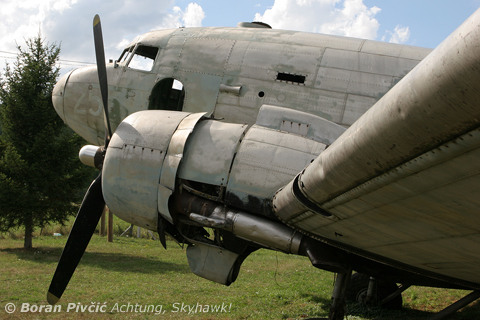


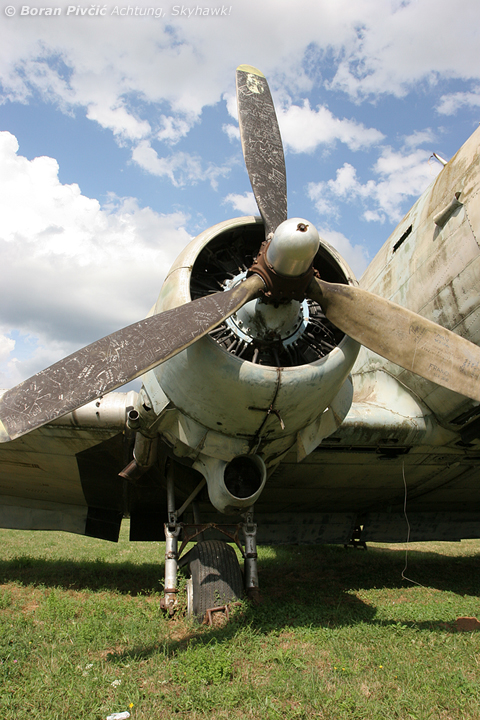

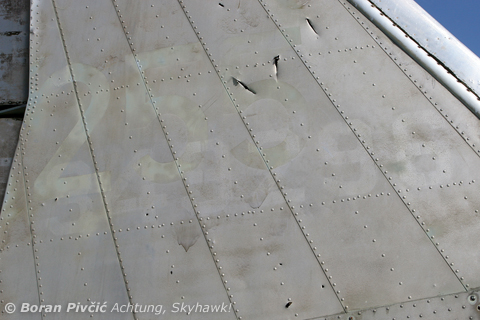
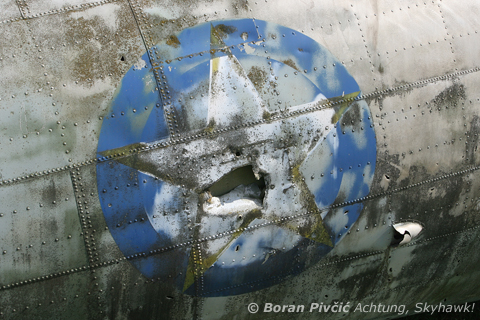


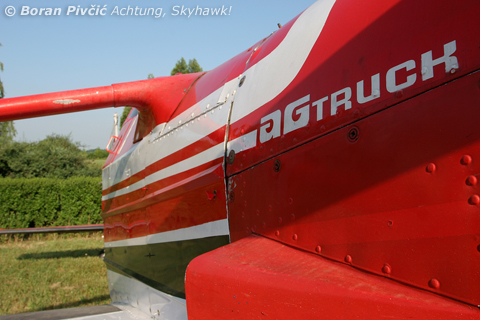

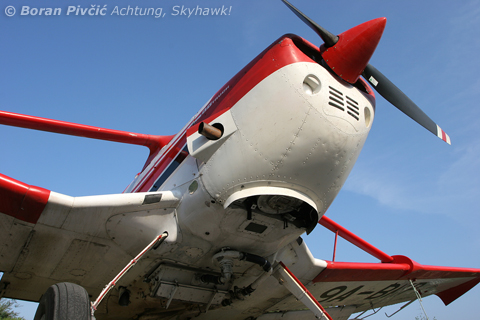


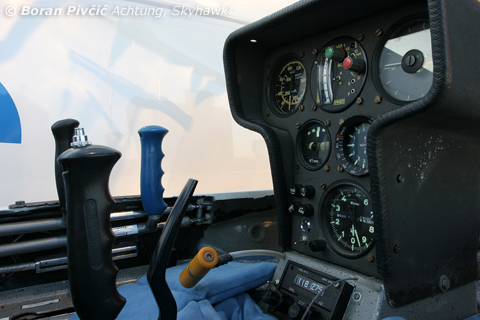


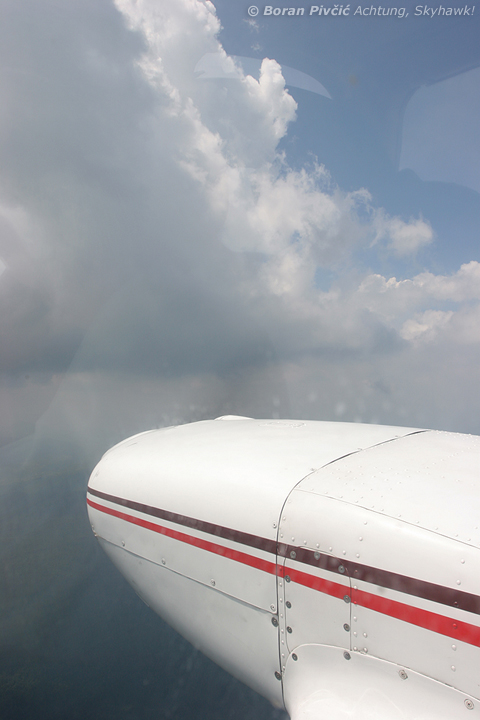

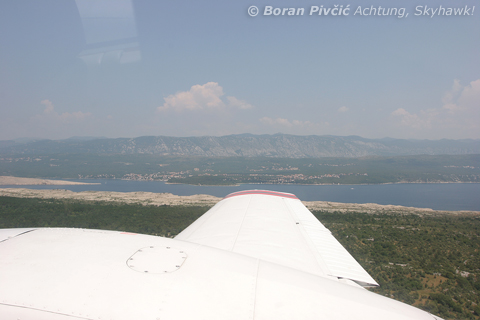
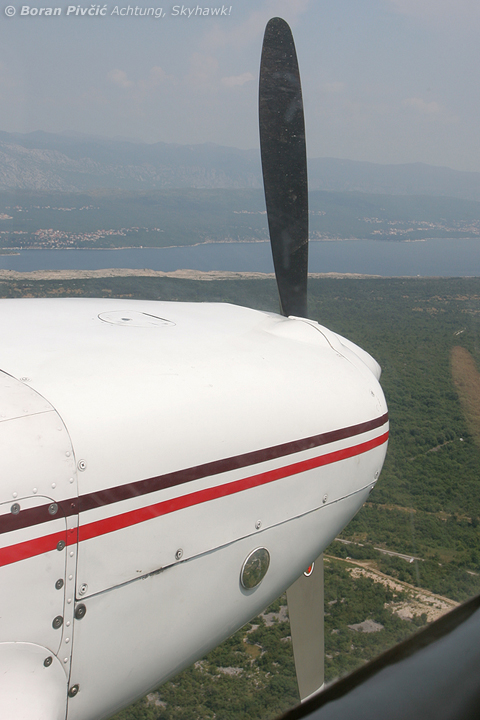

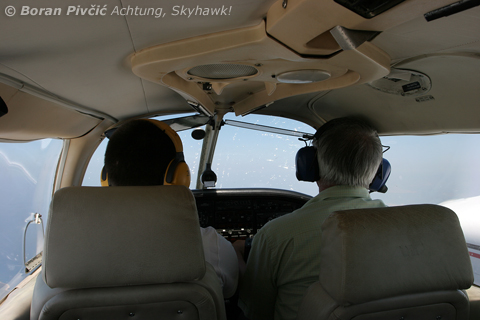
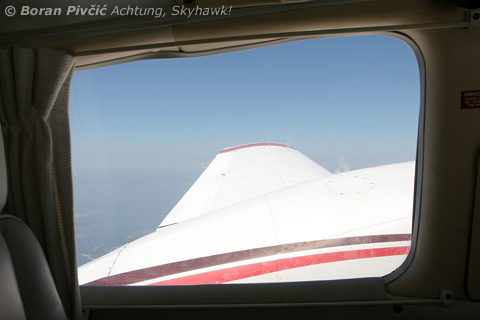
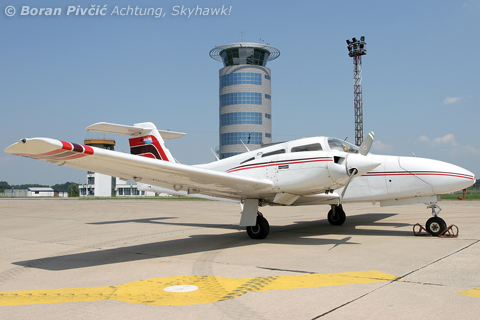
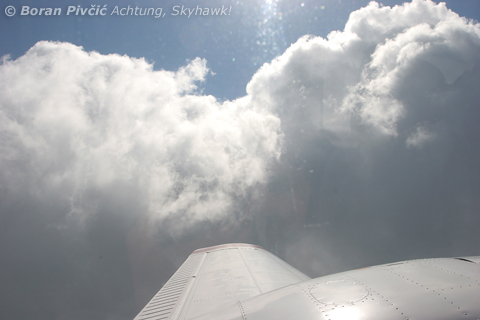

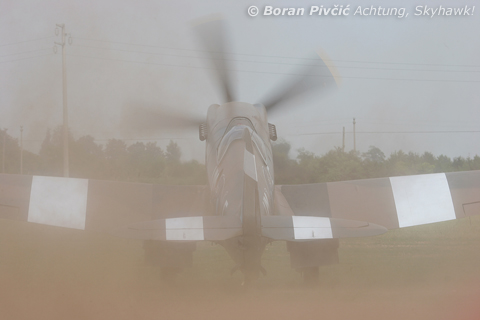


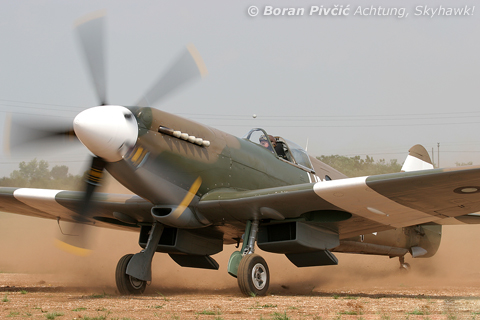


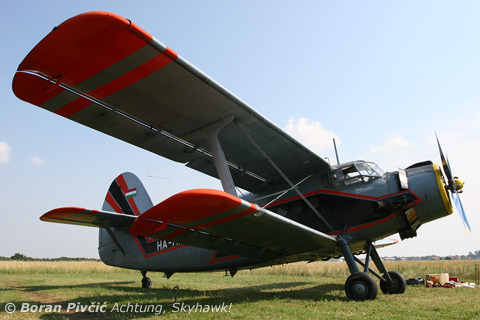


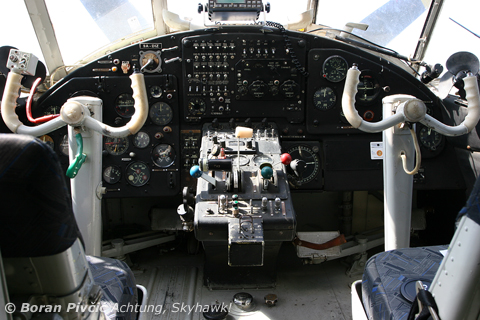


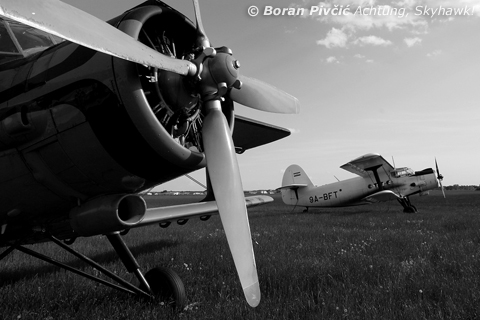

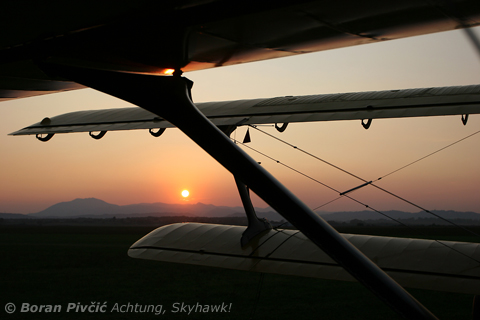

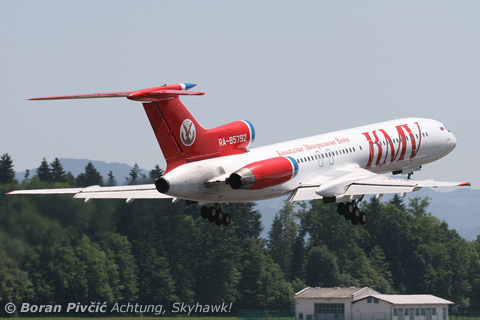
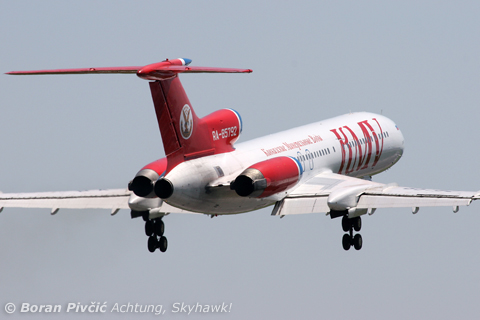
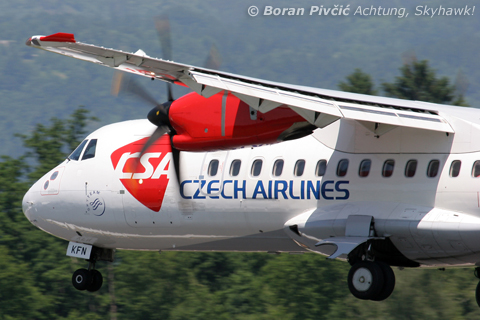
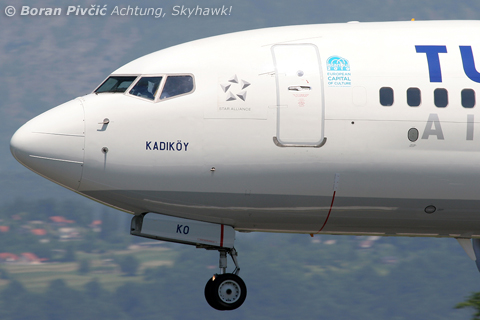


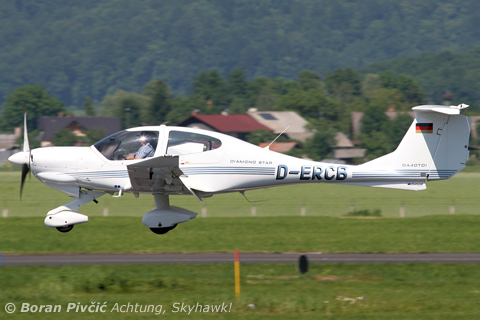

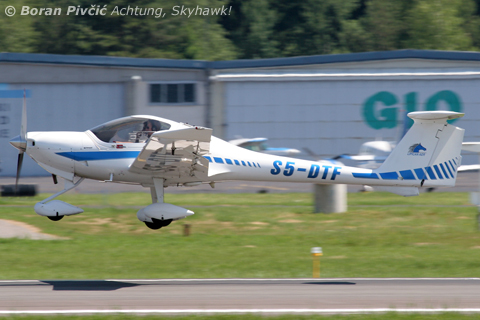

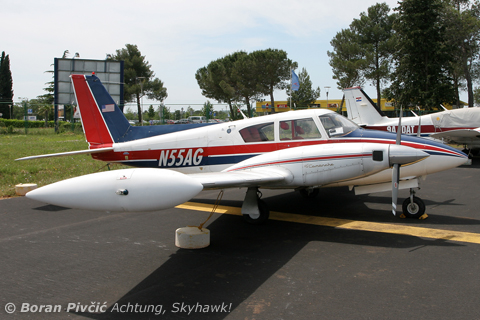

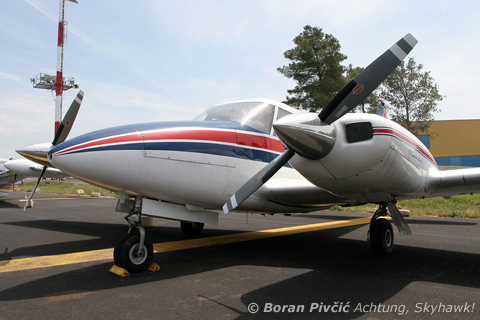
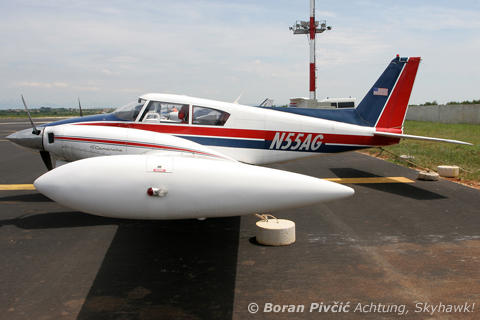

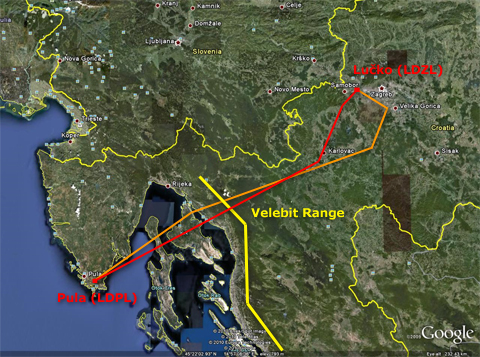
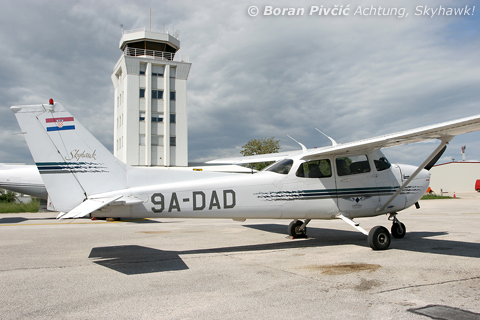


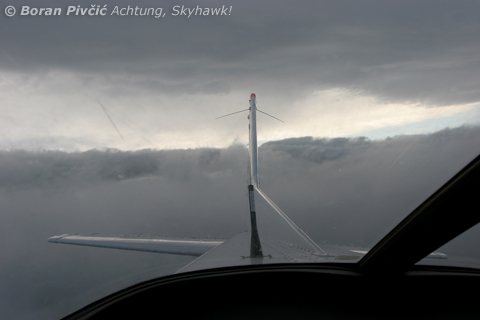

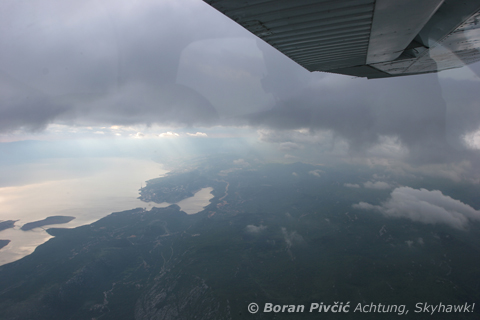
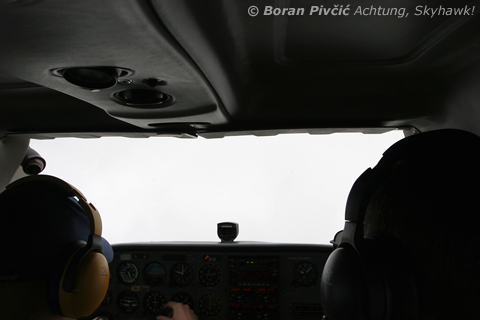
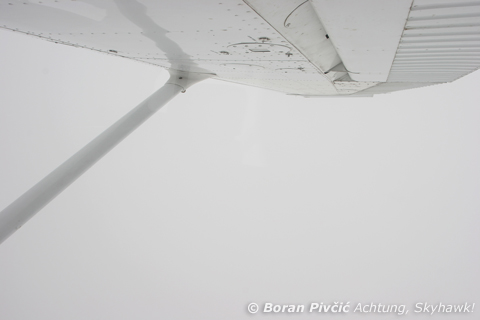


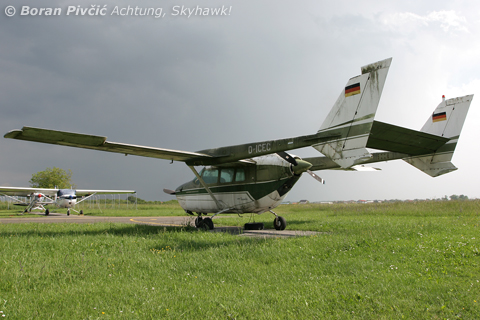
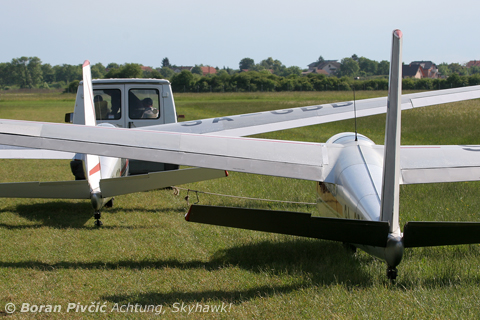
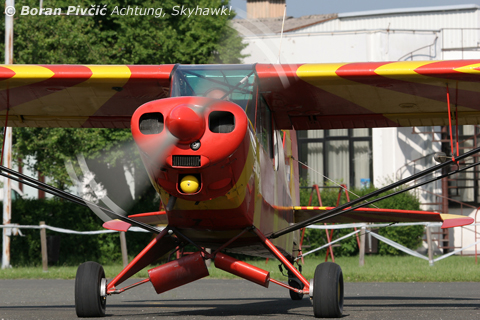
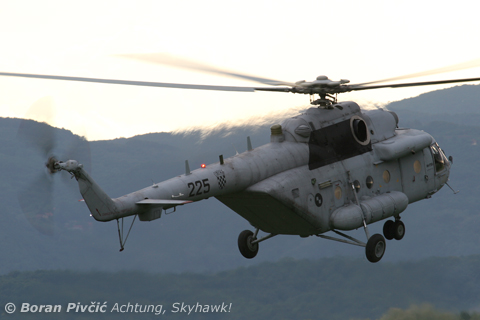
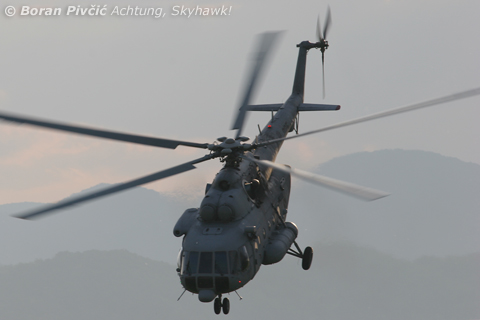
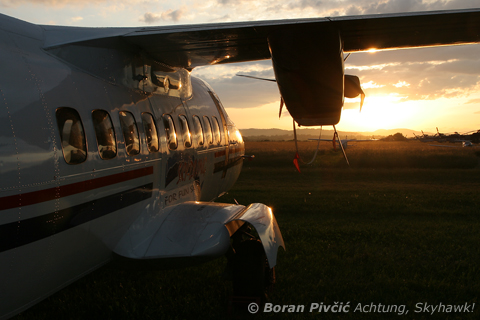

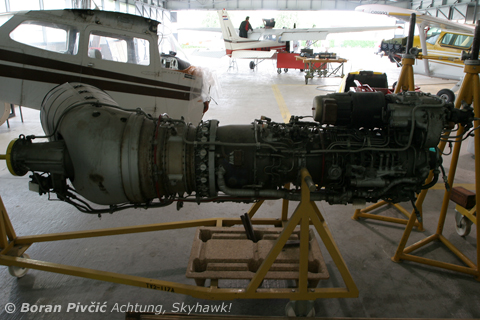
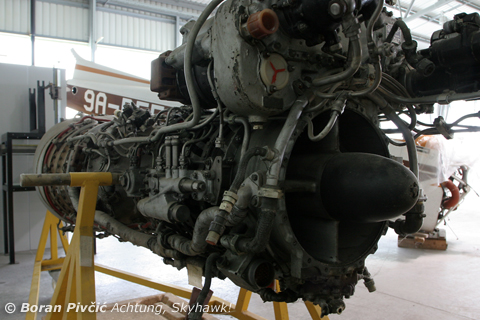
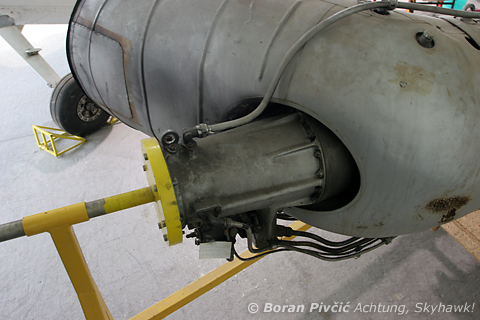
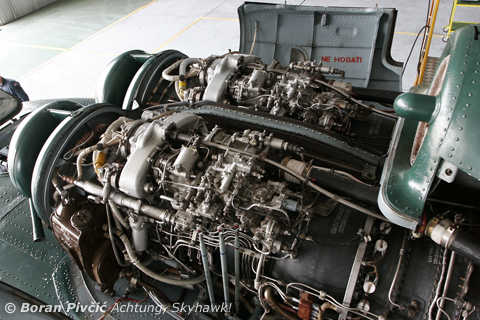
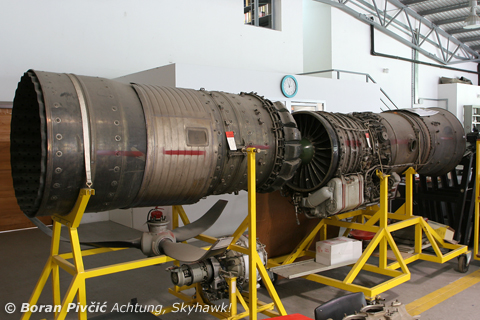
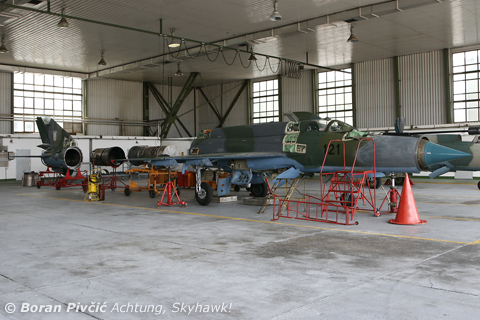
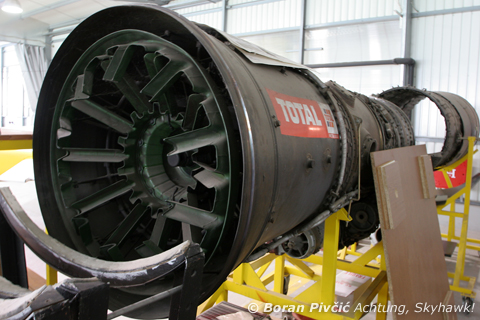

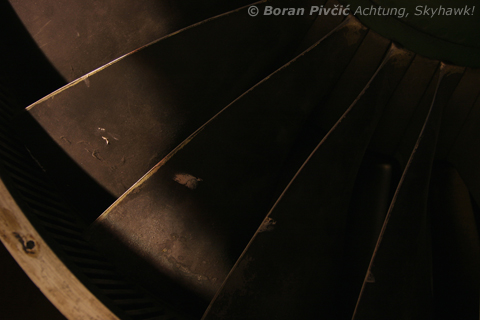

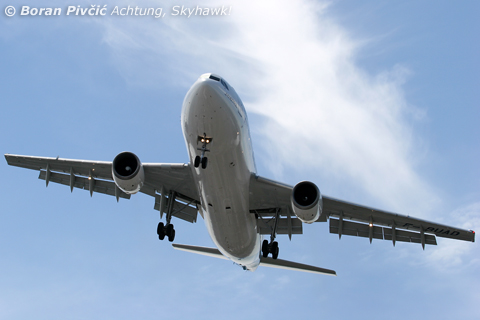


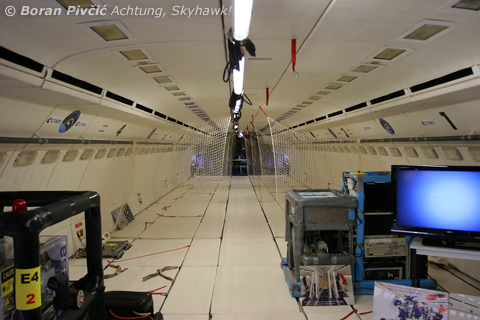


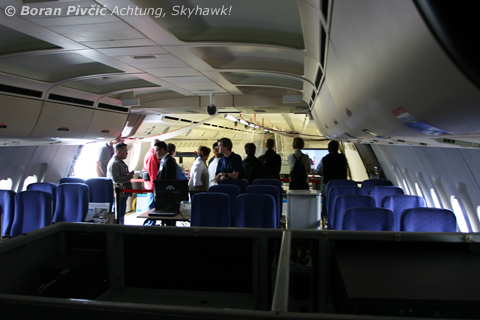


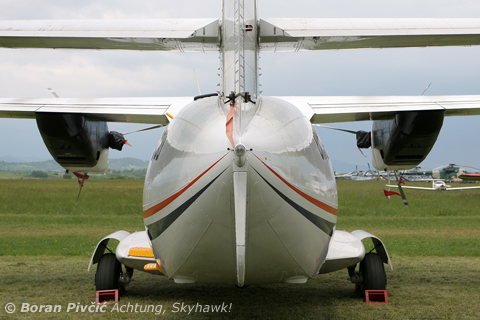


 Achtung, Skyhawk!