Having also posted photos of the Željava C-47 71212 on a local aviation forum, I was pleasantly surprised recently to find that some knowledgeable members had chimed in, keeping the discussion going with some very juicy details and stories of Dakotas in former Yugoslav service (both with the the YuAF and JAT, the state air carrier). Among these were the fates of three examples that had ended up with the South African Air Force – are still happily flying today in turboprop form! 🙂 So to update my small list – and with a lot of help from both the guys on the forum and the website they had directed me to – here goes:
1. 71237 / C-53D-DO / cn 11746:
A very interesting one this, apparently the only Skytrooper to have been operated by the YuAF. Essentially a stock C-47A fully adapted for paratroop drops, the Skytrooper was a common sight towards the end of the war, but few seem to have survived till today. Originally completed in 1943 as Hay Stack Annie – and taking part in the D-Day landings of 1944 – 71237 had served its first post-war decade in Scandinavia, where it flew for various small airlines before becoming part of the SAS fleet in 1949. Like all the three aircraft to be mentioned here, it was part of the batch bought from France in the 70s, serving with the French Air Force as 68819 from 1959 until it was transferred to the civil register as F-BRGI in November 1972. According to reports, it was sold to the YuAF “later that year”, operated now out of Zagreb (finally a local! 🙂 ). Just four years later, in 1979, it was back on the civil register as YU-ABW of the Obrazovni Centar Zračnog Saobraćaja (OCZS) training center, also based at Zagreb. Seeming to have bad luck with civil life, it was sold the same year to the Atlas Aircraft Corporation, becoming N8017Z – a “career path” also shared by the other two aircraft in this entry. Like them it would be returned to army life with the SAAF in 1981, where it became 6875. Today, it is a smart C-47TP, fittingly fitted with Pratt & Whitney PT6s 🙂 (of note, this is not the more common Basler BT-67 conversion, but a broadly similar South African modification – many thanks to Marko Beloglavec for the correction).
Could do with a bit of a wash - but no matter, it's still flying (I think)! (photo from: http://www.dc-3.co.za, a click will take you there 🙂 )
2. 71241 / C-47A-15DK / cn 12704:
71241, an “ordinary” C-47A this time,has had an even more interesting life. Manufactured in 1944, it was transferred to the Soviet Air Force the same year (an interesting fact, given the license-built Li-2 had entered service five years before), which had in turn passed it to the reborn Polish Air Force within several months. Following the end of the war, it had served with LOT Polish Airlines for 14 years, being sold to Finland as OY-AIC (a Nordic theme seems to be emerging here 🙂 ). Heading south, it had then flown with the French Air Force as 92857 – and on the civil register as F-BRGM – until sold to the YuAF in the later part of 1972. Like 71234, it was based at Zagreb and became YU-ABU of OCZS in 1979, while its subsequent “career path” had seen it registered as N8071X with Atlas Aircraft Corporation and 6887 with the SAAF, where it too received the C-47TP turboprop conversion in 1995.
Finally a confirmed B model! 😀 The only one of the three ultimately ending up on the civil register, 71254 had followed the usual USAF-French AF-YuAF path, flying as 348285 and F-BTDE while in France. A bit of a registration melee ensued, the aircraft first becoming 71254 (1972) and then YU-ABV (1979), N8071Y (1979), 6880 (1980), N330RD (2000), ZS-OJL (South African civil register), 9U-BHL (Burundi, raising a few eyebrows) and finally back to South Africa as ZS-OJM, where it remains to this day, flying for the Red Cross :).
Good to see the old workhorse, 65 years old, still going strong in tough conditions! Like the previous two, it was converted to a C-47TP turboprop in 1995 (photo from: http://www.dc-3.co.za)
4. The tally:
With the total now at eight aircraft – about a sixth of the number bought, if my calculations are correct – this is coming along pretty nicely :). So far we have:
71203
71212
71214
71237
71241
71248
71254
71255
Hopefully I’ll be able to dig out more info of my own soon, just as soon as I get my head out of my ATPL studies and realize that yes, there is a world with fresh air outside… 😀
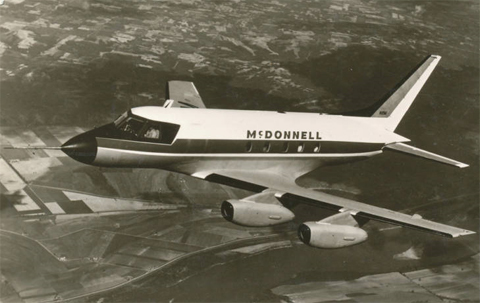
While the Lockheed JetStar may have been the only bizjet quad to see service, it certainly wasn’t the only such type built (thankfully for us aero-obscurists :D). At about the same time in the mid 50s, McDonnell – then still not associated with Douglas – started work on a design of their own, the little-known, but quite interesting (and in retrospect unjustly unlucky) Model 119.
What a handsome and striking thing! The one and only Model 119 back in happier days at the beginning of the program. If the JetStar was your own private VC-10, this is definitely your own private DC-8 🙂 (photo from: http://www.boeing.com/history)
1. A fish on dry land:
The genesis of the 119 – not “MD-119” as is sometimes thought – bears some striking parallels to that of the JetStar. Quite apart from the fact that both were aiming for the same USAF Utility Cargo Experimental (UCX) tender, the 119 was as much of a “shot out of the blue” for McDonnell as the JetStar was for Lockeed. An already-famed manufacturer of carrier-borne combat jets (and the occasional odd land-based fighter), McDonnell was as much of a first choice for the personnel transport UCX as the then all-civilian Lockheed had been for the fast-climbing P-38 Lighting interceptor. Yet the P-38 worked – in no small part due to Lockheed’s outside-the-box approach – so there was no reason or basis to discount the innovative McDonnell just yet…
Far from it in fact, for McDonnell’s pluckiness and appetite for unorthodox solutions had already put the company on the proverbial map. Though today much overshadowed by its merger with Douglas in 1967, McDonnell had notched up several achievements by the time of the 119, including:
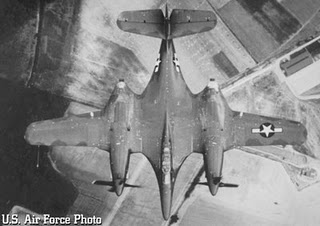
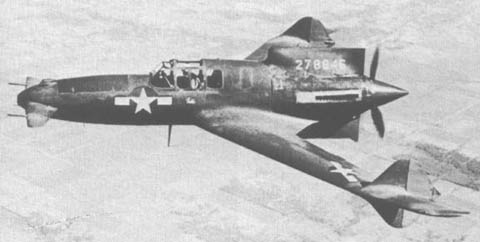
the XP-67 Bat (or Moonbat according to some sources), McDonnell’s first aircraft which was pretty much one of the few aircraft to actually live up to it’s name :). A very advanced twin-engine interceptor, the XP-67 had attempted to blend everything on the airframe into the wing, trying to create the most aerodynamically-perfect aircraft at the time…
Promising to be able to outrun anything in the skies, the XP-67 was - like the XP-55 Ascender mentioned in the Starship article - too an advanced a design for the technology available at the time...
the FH Phantom, the first American jet aircraft to land on a carrier, and – with Lockheed’s P-80, the only American jet to be developed to something near operational status before the end of WW2
the F2H Banshee, the follow-up to the Phantom and one of the key jet fighters of the Korean War (and arguably, alongside Grumman’s F9F Panther, the most important Navy jet)
and the F-101 Voodoo, after some teething troubles the USAF’s premier high-speed reconnaissance aircraft – and the proving point for the configuration and technologies used on one of the world’s most prolific and famous fighters to be, the F-4 Phantom II
Despite these not being quite the exact references needed for the UCX tender, McDonnell’s team – strengthened now by designers with transport aircraft experience – went ahead with the Model 119 design undaunted. Hey, if Lockheed could do it – whose entry wasn’t even designed outright for the role! – so could they…
2. Great minds think alike…
While McDonnell and Douglas hadn’t started cooperation before the merger talks of 1963, when the prototype 119 was rolled out in 1958 it had definitely warranted an “Any similarity to the DC-8 is purely accidental” sticker :). And while the 707 and DC-8 – flying in 1957 and mid-1958 respectively – were aesthetically pleasing designs, according to many the 119 took their layout to a new level…
Though some say it looks like a mini-707, to me the 119 looks more like a short-body DC-8, the -10 to -50 versions, with the wings, sleek and slim fuselage and pointy vertical stabilizer...
Indisputably fine aesthetics aside, the design was also quite intelligent and very well thought out (for its intended mission). The classic – and today unique – layout meant the engines could be easily accessed for repair and removal, while their separation into individual pods meant that a catastrophic failure of one engine wasn’t likely to affect the other, as would be the case on the JetStar. The pods and pylons themselves were strengthened to support the aircraft and protect the wing fuel tanks and fuselage from damage during a wheels-up landing; indeed, being considerably below the fuselage and right on the aircraft’s center of gravity meant they could act as pretty good skids in an emergency.
Operationally this yielded another advantage: with the engines below the wing and not out back, the cabin could be roomier; and not having a huge mass of exotic metals yanking the tail down all the time meant more flexibility with distributing the payload inside. This in turn meant that if you had wanted to equip yer 119 in a “cattle class” configuration, you could comfortably squeeze 26 people inside!
The low-slung engines meant that sucking in foreign objects - debris, dirt, ground crews 🙂 - was a very real possibility. To reduce this as much as possible, the engines were fitted with special square intakes that prevented the formation of vortices that could suck up objects from the runway (photo from: n303wr Flick gallery)
Being built with McDonnell’s customary sturdiness – brought to you by a manufacturer constantly watching their planes being crashed onto ships – the 119 was normally a tad heavier than the JetStar, tipping the scales at 20.5 tons at maximum takeoff weight versus the JetStar’s 19.4. To propel this not at all insignificant mass, the 119 was to be powered by the same Pratt & Whitney JT12 turbojets as the JetStar – but as these were unavailable for some reason, the decision was made to use the slightly less powerful Westinghouse J34s (quite an ironic choice, given the problems the company’s unreliable J40 afterburning turbojet was giving McDonnell’s F3H Demon carrier-based fighter).
Despite the somewhat lower power, the 119 had promised to be quite a performer, with a 45,000 ft ceiling, 840 km/h cruise speed and 3700 km range against a 70 knot headwind – an impressive set of numbers any way you put it. Thinking ahead as to how could this be improved with the new engine technologies then appearing on the horizon, the design team was also working in parallel on a trust reverse-equipped version, powered by General Electric CF700 turbofans, that would be able to operate in and out of 1,500 meter runways – a tremendous achievement for a rough-and-tough ’50s transporter that could now cruise at 900 km/h at the same time.
Back in the present, the sole Model 119 prototype – registered N119M – had made its maiden 49-minute flight on 11 February 1959. All that was left was to hand it over to the USAF and see what their test pilots would make of it… 🙂
3. Want a jet? Anyone?
With a design as good as this, the design team felt that they had produced an aircraft more than adequate for the role. Backed by enthusiastic comments from the air force test pilots that flew it, morale within McDonnell was high – right up until August 1959, when the UCX contract was suddenly awarded to Lockheed…
The blow, when it came, had put McDonnell in an unenviable position, with a one-of – and consequently quite expensive – blue-white albatross sitting on their hands. Rather than chop it up, and hoping to salvage the situation, McDonnell again offered the 119 to the USAF, this time rebranding it as a multipurpose high speed platform capable of filling the roles of a bombardier and navigation trainer, electronic countermeasures trainer, air communications service aircraft (a role eventually taken up by the military JetStar, the C-140A), interception radar trainer, flying electronics testbed, high-speed bulk cargo hauler, EMS aircraft… you name it and it was probably somewhere on the list :).
Imagine what impression this must have made taxiing around the airport... even today, this would turn a lot of heads 🙂
However, the answer was still a firm “no”, which again left McDonnell desperate for some way to sell the 119 and recover at least some of the funds invested in its development. Following the same path as Lockheed – which had from the start intended the JetStar to be of two worlds, serving as both a military transport and civil business jet – McDonnell quickly sought to market the 119 to civilian customers; in fact, low key negotiations with Pan Am for a 170 aircraft lease had already started even before the final UCX decision.
Given the rotten luck this aircraft has had with marketing so far, it almost wasn’t a surprise when the deal fell though… Despite 170 aircraft sounding like a lot – if you line them all up on the apron – it was nowhere near enough to cover all the costs the program would incur if it had started series production (the greatest being the production tooling) – and with no civil orders forthcoming to take up the rest, the negotiations were dropped as quietly as they had started.
4. When it rains, it pours:
To try and drum up some civil interest – the options list by now running dangerously short – it was decided to shift into high gear and turn fully to the world of business aviation, marketing the 119 as a high-end business jet to rival its eternal thorn in the eye, the JetStar. To this end, and at the suggestion of Jim McDonnell – Ol’ Man McD 🙂 – the 119 became the McDonnell 220 (still without the MD prefix), a designation commemorating the company’s entry into its second 20 years of existence. Re-registered as N4AZ, and repainted into a duller version of its original prototype colors (no dayglo orange anymore :(), the aircraft was then refitted with a custom deluxe 10-seat interior, including a galley and lavatory (still considered pretty posh amenities at the time).
But given that the God of Aviation – Murphy 😀 – has some bright moments every now and then, the 220 finally caught some tailwind when it became the first non-airline type to receive an FAA Class I provisional type certificate for air transport operations – in effect making this the first certified business jet :). A fact much used during 1963 by McDonnell salesmen, dispatched to the 750 (!) biggest corporations, agencies, airlines, leasing companies and businessmen in the world in an attempt to sell the “new” 220 by the hundreds. In the face of stiff competition though – the Rockwell Sabreliner and Dassault Falcon 20 having joined the fray in the mean time – their efforts didn’t gain much headway.
By the end of the year, McDonnell was back at square one and down to desperation with Plan Z – selling the actual prototype, the existing production tooling and design rights to the whole type, all for next to nothing.
Incredibly, there were no takers.
At that point, McDonnell gave up. Accepting that they were stuck with the 220 for good, the design team turned the aircraft into a company shuttle, to at least make some use of it. Its service was short-lived though, with the aircraft being retired in 1965 with just short of 230 hours on the clock…
5. Whoop, whoop! Pull up!
The “for good” in the end turned out to be just one year, for after being retired the aircraft was donated – DONATED – to the Flight Safety Foundation. This successful international non-profit organization had made a name for itself with its work on improving worldwide air safety, often going experimental to point out critical areas in need of improvement. One of their more famous experiments was running a specially-instrumented and remotely-piloted Douglas DC-7C into a hill to test the survivability of American aircraft. And that’s all fine and dandy, safety being important and all – but thankfully, common sense prevailed and the 220 was spared the same fate (which was already on the cards) :).
Instead, it was sold – for the first time! 😀 – to an aircraft retail company, which began its long physical and even longer legal odyssey around the US… the full story of which can be read on this very detailed and informative page: http://www.anav8r.com/page03.htm (too much to cram into this post 🙂 ).
Today, restored almost to airworthy condition, the 220 is parked at El Paso airport (ICAO: KELP) in Texas waiting out its fate. As of the end of 2009 it is up for sale for a bargain price of $800.000, which is – considering its rarity – not really all that much; less than half the price of a new Cessna Caravan or about the same as three moderately equipped Cessna 182s. So readers of Achtung, Skyhawk!, what are we all waiting for? 🙂
Looking well-kept and cared for... and with its restoration almost complete and engines remanufactured, we may yet see her flying! 🙂 (photo from: http://www.abpic.co.uk/photo/1169919/, taken by: Andrew Martin)
SPECIFICATIONS (some projected):
Takeoff weight: 20,560 kg Empty weight: 10,530 kg Wingspan: 17.55 m Length: 20.27 m Height: 7.21 m Wing area: 51.10 sq m Max. speed: 901 km/h / 487 kt Cruise speed: 837 km/h / 452 kt Ceiling: 13,685 m / 45,000 ft Range: 3,765 km / 2,032 NM
While not exactly a GA manufacturer – having produced only two designs fitting this category – Lockheed is nevertheless quite an interesting company to work with here, a company that’s had as many “hickups” as it had great aircraft. Never able to be classified into a single category, they’ve produced everything from ground breaking propliners like the Model 7 Vega, 8 Orion, 9 Sirius and the 10 Electra, to the incredible SR-71 Blackbird and the high-flying U-2 reconnaissance jets. And along the way, they’ve taken on the habit of proving one oft-neglected point: that you don’t have to have a legacy stretching back to the Wright Brothers to be able to produce something amazing…
Like with Burt Rutan at Scaled Composites, the driving force behind most of Lockheed’s designs from the 30s onward was a brilliant engineer, the famous Clarence “Kelly” Johnson. A man well versed in thinking outside the box, he was quick to adapt to any requirement put before him, a skill that earned him one of the most fascinating design lists in the history of aviation:
the model 10 Electra and 12 Electra Junior
the PV-1 Ventura light bomber based on the L-18 Lodestar transport (itself derived from the Electras) which was the mainstay of the UK’s maritime air defense at the beginning of WW2
the highly-innovative P-38 Lightning
the stunning Constellation airliner, one of the most graceful propliners to ever fly
the P-80 (later F-80) Shooting Star, America’s first combat-capable jet fighter, and it’s trainer version, the popular T-33
the pocket-rocket F-104 Starfighter
the still-speed-record-holding SR-71 Blackbird
the high-flying U-2
a plane that needs no introduction, the C-130 Hercules, still holding the record for the longest uninterrupted production run, coming up to 57 years!
the pioneering F-117 Nighthawk
and the now-mostly-forgotten L-1329 JetStar
1. Change of priorities ahead…
The first to get the ball rolling on Lockheed’s reputation was the P-38. Up until the late 30s, Lockheed had been mostly known for its civilian aircraft – or rather the records they set in the hands of pilots such as Amelia Earhart and Wiley Post. The closest they came to making a military aircraft was the Ventura, which was still a tried-and-tested civil design converted – in very little time – into a light bomber and coastal patrol aircraft. So when the USAAF in 1937 invited Lockheed to submit a proposal for a fast-climbing interceptor, many observers were not very optimistic – especially since the inexperienced company would be going up against companies such as Curtiss, Douglas and North American which had far more experience in the field.
However, that very inexperience is probably what gave Lockheed the edge. Unencumbured by the muscle-memory of years of building fighters, the team led by H.L. Hibbard – of which Johnson was a member – was able to take a more objective look at the requirement and think outside the box. The result left no one cold; the P-38 was a stunner any way you looked at it. Among all of its achievements, it was also the first US tricycle fighter, and the first US aircraft to down an enemy plane during WW2, a German Focke-Wulf FW.200 Condor patrolling off Iceland. Aggregated at the end of the war, it was one of the most successful – if not THE most successful – twin-engined fighter and became famous as the aircraft flown by Antoine de Saint-Exupery on his last flight off the coast of Sicily.
The most famous P-38 today, “Glacier Girl”. From every angle, everything on it screams Kelly Johnson
2. 4 engines 4 long haul?
Despite the fact that by war’s end the needs of the moment had turned Lockheed – like many other companies – into a purely military manufacturer (with even the nascent Constellation being hurriedly pressed into military service as the C-69), there were a number of farsighted people who were still keeping tabs on what was going on behind their backs in the civil world. And soon enough, when the post-war economy recovered in the mid 50s, Kelly Johnson’s team at the celebrated Skunk Works came to the conclusion that the time was right to try out their luck in the emerging business aviation segment.
Up until that time, the serious “transcontinental businessman” had very few suitable aircraft to choose from – indeed, most where whirling about in converted medium bombers such as the North American B-25 Mitchell or the Douglas A-26 Invaider (an even larger stuff like the Douglas B-23 Dragon), dirt cheap and dumped en masse onto the civil market after the hostilities had ended. The light tourer sector didn’t offer much hope either – even a high-end piston twin would be arduous on a flight across the US, with frequent fuel stops and all the associated hassle; not to mention lumbering down low in the worst of the weather.
No, what was needed was something new, something modern, something specifically tailored for the role. A fast, high-flying jet. Drawing on their extensive early experience with the P-80 – the Korean War having just finished – Johnson’s team decided on an aircraft that would become the template for the modern business jet: a twin-engined 10 seater turbojet with swept wings, christened the JetStar :).
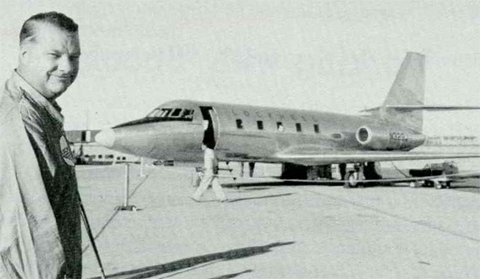
The man and the plane, the first JetStar prototype. In this configuration it would make its first flight on 4 September 1957.Though lacking the substantial stance of the production versions, the first prototype was certainly a looker when it first flew. From this angle it could be easily mistaken for a Dassault Falcon 20 (photo from: http://rbogash.com/jetstarhistory.html)
Powered by two British Bristol-Siddeley Orpheus turbojets, the JetStar was almost a revolution. The first pure bizjet, designed and built as such, it had represented a giant leap from the civilianized bombers that were plowing the medium flight levels at the time. With a swept-back wing (at 30 degrees), it had promised to be fast and it’s metallic, pointy appearance was just screaming “progress”.
The first prototype refitted with the optional slipper tanks which would become one of the JetStar’s defining features. In this form it was used by Johnson as his personal aircraft for some time (photo from: http://rbogash.com/jetstarhistory.html)The first (foreground) and second (background) JetStar prototypes in flight – flying all the Orpheus engines ever produced 🙂 (photo from: http://rbogash.com/jetstarhistory.html)
Inevitably though, there was a problem. To simplify production and keep costs down, Lockheed had tried negotiating with Bristol-Siddeley to license-produce the Orpheus in the US, much like Allison did with the Rolls-Royce Merlin during WW2. The negotiations had failed however, which left Lockheed with only two pairs of engines powering the two prototypes – the only four Oprheus engines ever made at that point – which wasn’t really enough to make progress. There was no engine yet available in the US with the Orpheus’ combination of size and power, so Johnson – in his typical display of lateral thinking – decided he’d simply have stick more engines on. How hard could it be? 😀
Apparently not very 🙂 – the second prototype soon flew again with four Pratt & Whitney JT12 turbojets, grouped in the back in a configuration that would be adopted – and made famous – by the much more well known Vickers VC.10 and Ilyushin Il-62 airliners five and six years later respectively.
While not technologically as advanced as the previously-featured Starship (in relative terms), the JetStar did take non-commercial aircraft to a whole new level. The design included backups of every major system analogous to those found on commercial airliners – a huge novelty in the simple and uncomplicated world of light aviation – while it’s cockpit was a meeting place for the most advanced navigation and instrumentation technologies available at the time, far, far removed from even the best tourers. Indeed, some reports indicate that it took six months to train pilots to think and act fast enough for the speedy and complex JetStar!
The JetStar did have one other claim to fame that made up for it’s relatively conventional design: it was the first, and so far only, four-engine bizjet to see production (but not the only one designed as such, with the abortive McDonnell 119/220 – to be featured here soon 🙂 – flying in prototype form only), and was for a long time the largest bizjet available on the market. Coupled with its hefty weight – 19.2 tons – and four thirsty engines, it naturally drank a lot of fuel, so the optional slipper tanks were quietly added as standard equipment. Despite the high consumption, it could do 4500 km in a stretch, which was nearly intercontinental range – quite a rarity among bizjets for some time to come.
As well as aiming for the business market, during the design phase Lockheed was also eying a potentially-lucrative USAF contract for a Utility Transport Category aircraft under the Utility Cargo Experimental (UCX) program. To this end they developed the C-140, generally similar to the basic civilian JetStar, which they pitched to the USAF as a multipurpose fast jet transport (probably with a “four engined safety for your bureaucrats” tag line). All was fine and well – right up until the contract was canceled due to budget cuts after just 16 examples were delivered…
A “Flight Check” C-140A – used for instrument calibration – easily distinguishable by its camouflage colors for operations in Vietnam (photo from: http://www.scottfieldairpark.org/c140.html)
Though few in numbers, the C-140’s Vietnam service record – including auxiliary communications roles back home – was further augmented by the VC-140B. Like all V-prefixed aircraft in the USAF, the VC-140B was a VVIP version, several times also acting as the famous “Air Force One” when transporting the President and his entourage on shorter distances.
One of the smallest Air Force Ones to have served with the USAF 🙂
However, while the C-140s were transporting the President, a civilian JetStar had the honor of transporting the King! 🙂 “Hound Dog II” was one of the two aircraft owned by Elvis Presley, along with his prized Convair CV-880 “Lisa Marie”. Bought for nearly $900.000 – at the time, quite a lot! – while waiting for the CV-880 to be delivered (which had in turn cost less), N777EP apparently didn’t have a long service life and is today beautifully preserved as part of an exhibit at Graceland (more photos here).
Yet, the JetStar’s range and hauling capacity came at a – for the then 70s – great price. The oil crisis meant that filling the thirsty jet up was becoming quite expensive, especially now that more modern twin- and tri-jets like the Canadair Challenger and Dassault Falcon 50 were only inches away from first flight. While some wealthier owners could live with this until the crisis had ended, the nail in the original JetStar’s coffin was – noise. Four small whining turbojets did little to make the JetStar a neighbour-friendly aircraft, so in the face of operational restrictions, a decision was made in the mid-70s to re-engine it with quieter and more economical turbofans.
The engine chosen was the then-new Garrett TFE731 introduced in 1972, which would go on to power a number of highly-successful business jets – including the Falcon 50, the nearest thing the JetStar had to an equal competitor at the time.
Unusually – what was usual about the JetStar anyway? – the first step was not to produce a “new and improved” version, but retrofit existing JetStars, which then became known as the 731 JetStar to differentiate them from the unmodified – and renamed – JetStar I aircraft.
The larger-diameter turbofans gave the 731 JetStar an even more imposing presence. The refit also included redesigned wing tanks which were moved down onto the wing’s lower surface (much like on the first prototypes), which returned a bit of purposefulness to an already imposing design (photo from: http://www.flug-revue.rotor.com/Frtypen/FRhist.htm)
As is to be expected, the new engines breathed new life into the design, giving significantly better performance (especially at lower altitudes) and maximum takeoff weight, greatly reduced noise – and of a less-irritating pitch as well – and increased range; with maximum payload (a full cabin) the 731 could do 4800 km in a stretch, while sacrificing some passengers for full fuel tanks, it would be touching 5200 km, a 15% increase over the old model. This translated into some interesting operational capabilities – even with a full cabin, the 731 could comfortably hop over the Pond between destinations such as Gander in Canada and Shannon in Ireland; and its four engines meant it could go there along shorter routes, not hugging Greenland and Iceland for fear of losing an engine (which could all in all – according to the Great Circle Mapper – save almost 1000 km!).
A very welcome upgrade for JetStar owners, the 731 mod was a great success and – the 731s being retrofits and not new-built aircraft – inevitably ended up being integrated into the production line, creating the brand-new JetStar II, of which only 40 were ever produced.
With a shape like this, it was very easy to dominate any ramp the JetStar II appeared at 🙂 (photo from: http://www.airportjournals.com)
5. Headin’ south over the border…
Despite the increased grunt that gave the JetStar II comparable performance to most modern business jets in its class, the end for this fascinating design was in sight even before the decade was out. In the end it wasn’t age that killed it, but to an extent, I’m inclined to believe Kelly Johnson’s, own outside-the-box methods. Conceived in the gas-guzzling late 50s, when jet engines were just getting into their stride, the JetStar was becoming rapidly outdated in the late 70s. Jet engine technology, already increasing by leaps and bounds, had started producing engines that had more output than the two TFE731s combined, burned less fuel and were easier to service, with longer service lives. In this environment, the JetStar’s four maintenance-intensive engines were starting to become over-redundant. The end didn’t take long to come and in 1979, after the 40 JetStar IIs were produced – for a grand total of 204 (206 according to some sources, probably including the two prototypes) – Lockheed pulled the plug on this design…
Thankfully though, like the Starship, the JetStar did not go out quietly. A number are still happily flying, with the majority operating in the Mecca of vintage bizjets – Mexico :). This country is fascinating as a whole, but when aviation is concerned, it is completely off the scale! A country where Sabreliners, 20 series Learjets, Starships, early Candair Challengers and Dassault Falcons are the order of the day is, you must admit, the perfect home for the JetStar… it could almost be lost in the variety :D. With the country’s relatively lax noise rules permitting more-or-less regular operations of turbojets, Mexico is home to all three variants of the JetStar, including:
JetStar I of the Mexico Government (classy!): photo 1 and photo 2 @ Airliners.net
731 JetStar in not the most flattering state (the only photo I could find) @ Airliners.net
The remainder – all JetStar IIs, Is being banned from many noise-sensitive airports – are mostly registered in the US, while there are also quite a few interesting ones out in the big wide world :)…
Despite the fact having slipped by me for 11 and half months now, 2009. is a very important year for Croatian aviation – not only is the Croatian Air Force 18 years old this month (does that mean that it’s aircraft can now fly alone? :D), but this year also marks almost 100 years of aviation in Croatia, all the way from its modest start in 1910. and the first airplane built by Slavoljub Penkala, a noted Croatian inventor of Polish-Dutch origin (and coincidentally also the inventor of the mechanical pencil and fountain pen). To commemorate both of these occasions, the Croatian Military Museum had decided to put together a large photo exhibition, displaying publicly for the first time almost all available Croatian military aviation photos, from the first biplanes to the latest jets. [brag] I myself was also honored by having one photo on display, a first for me and proof that hauling all my photo gear around airshows the past few years does indeed pay off! [/brag] 🙂
The exhibition, opened on 15 December, was naturally split into several periods, of which the Interwar period (1918. to 1941.) and WW2 caught my attention the most. Two of the largest and most impressive sections – with almost 150 photos in total – they represented a very colorful part of aviation in Croatia, showing the smorgasbord of aircraft of all shapes and sizes that had been operated by the Air Force of the Kingdom of Yugoslavia and its “successor” forces, the Facist Ustaška Eskadrila and the socialist Partisan Air Force (and its Allied supporter, the Royal Air Force’s Balkan Air Force).
Naturally, these periods being the highlight of Borongaj’s history, I immediately combed through the collection, searching for aircraft that had been out of that airfield. The end list – by no means complete, there were a lot of photos to go through! – is impressive and encompasses over a dozen types from all corners of Europe.
1. From Czech Mate to the French Connection:
Given the shifting political and economic situation between the two World Wars, these aircraft ended up coming from all over Europe, from the UK to former Czechoslovakia (interestingly, the only major country with a significant aeronautical industry missing is Poland – though the Royal Yugoslav Air Force and its successors did operate Polish designs from other bases). It should be noted also that these only represent a fraction of the types operated by the various air forces of Yugoslavia and that the whole list would be significantly longer…
AVIA FL.3 – a small Italian side-by-side two-seater. Used by the Ustaška Eskadrila primarily for pilot training (later in the war some were also based at Lučko I believe)
A restored FL.3 in what I believe to be very accurate colors of the Ustaška Eskadrila (source: Wikipedia, photo by Malcolm Clarke)
Avia BH.33E – a biplane fighter with – interestingly – a shorter span upper wing than the lower (usually it’s the other way around, in which case the aircraft is a “sesquiplane”). Produced in a different Avia, this one from former Czechoslovakia
Rare shot of a RYAF BH.33E somewhere in the wilds of former Yu (photo from: http://www.afwing.com)
Breguet 19 – a biplane (and a real sesquiplane this time) light bomber and reconnaissance aircraft produced by Breguet of France
A line up of RYAF biplanes. The nearest, coded 11, is a Brequet 19, while I think the third one out may be a Potez 25... (photo from: oaker.sweb.cz/Maketorama)
Dornier Do-17 (K and Z models) – the famous German high-speed light bomber from the early WW2 years
A Finnish Do-17Z, pretty much the same as flown by the Ustaška Eskadrila (photo from: Wikipedia)
Dornier Do-Y – a very, very rare three-engined bomber designed by Claude Dornier (his second) back in the 30s. Few in number, I’m not sure if they had survived till the war…
An unidentified Do-Y in flight, though the rudder colors do look incredibly like the ones used by the RYAF... (photo from: airwar.ru)
Fiat G-50bis – a late 30’s Italian monoplane fighter, operated by both the RYAF (which had bought them pre-war) and the Ustaška Eskadrila (which had also received some new examples). Reportedly, only one survives to this day, kept in the basement of the Aeronautical Museum at Belgrade Airport, Serbia
The distinctively humped G.50, a fuselage design common - and unique - to Italy during the 40s (photo from: Wikipedia)
Fieseler Fi-156C-1 Storch – the legendary German get-in-anywhere-anytime utility aircraft 🙂
The shape that had inspired dozens of subsequent STOL aircraft 🙂 (photo from: museum.af.mil)
Fiesler Fi-167A-0 – most probably the biggest oddity and rarity on this list, this carrier-borne torpedo bomber was transferred Croatia once it became apparent that Germany’s projected carrier, the Graf Zeppelin (for which the Fi-167 was designed) was going nowhere. Never seeing serial production, the models used by the Ustaška Eskadrila were all A-0 pre-production versions
A rare shot of a Fi-167 inflight. Some sources identify this as the fifth pre-production model, which means it could have ended up serving down here (photo from: Wikipedia)
Focke-Wulf FW.44B – a very well known German biplane training aircraft, much used before and during WW2. Unlike all other models which were powered by a Siemens radial, the B model unusually sported an Argus As 8 four-cyl inverted-V engine of 120 HP. Unfortunately, while the FW.44 as a type was quite common, the B models were rare, so pictures are hard to find…
Fokker F.IX (Avia F.39) – of similar class as the Do-Y, the Fokker F.IX started life in the 20s as a three-engined airliner. Though failing to gain a significant market as such, it did get some lease of life as a bomber, produced under license in Czechoslovakia as the Avia F.39. Like the Do-Y, they were operated by the RYAF and probably withdrawn from service before WW2
A F.39 in the colors of the Czechoslovak Air Force. Looks like a Ford Tri-motor this... (photo from: http://www.dutch-aviation.nl)
Hawker Fury Mk.IA and Mk.II – this very clean and fast British biplane fighter, a conceptual descendant of Hawker’s Hart bomber (an aircraft that in its day could outrun all existing fighters), was manufactured under license in Yugoslavia, hence it’s widespread use in the RYAF
A pre-war Yugoslav Fury Mk.I, showing off its very elegant lines for a biplane... elegant for any plane too... (photo from: http://www.aviation-history.com)
Hawker Hurricane Mk.I – does this even need an introduction or a photo? 🙂
Ikarus IK-2 – another rarity on the list is a home-grown monoplane fighter, the not-at-all bad looking IK-2. Resembling a number of Polish high-wing monoplane and parasol fighters, this 1934 aircraft was used by both the RYAF and the Ustaška Eskadrila, and though a good dogfighter, it was no match for modern Axis and Allied fighters and was retired in 1944.
Looking somewhat like a cross between a Fury, a Storch and a PZL P.11, the IK-2 was developed as measure to reduce the RYAF's reliance on foreign aircraft (photo from: Wikimedia)
Messerschmitt Bf.109G-6 – like the Hurricane, this one’s pretty straightforward 🙂
Potez 25‘Jupiter’ – though this one isn’t. Used among other thing to start the first mail service from Borongaj to Belgrade, this French biplane/sesquiplane fighter-bomber saw widespread use in various air forces, including those of the Soviet Union, USA and Poland. The ‘Jupiter’, Yugoslavia’s license-built version, was powered by the Gnome-Rhone 9ac Jupiter radial
A stock Potez 25 with what may be one of the Jupiters behind it. Though, given that the aircraft's engine mount could take a very wide variety of engines, who knows what they've mounted on the one in the photo... (photo from: http://www.e-pics.ethz.ch)
Rogožarski R-100 – another indigenous design, the R-100 was an intermediate trainer, the last step before the prospective student pilot was bolted into something armed and fast. Used initially by the RYAF, later in the war they were armed by the Ustaška Eskadrila with 80 and 100 kg bombs and used as ad-hoc divebombers
One thing springs to mind here (about the aircraft 😀 )... the prop pitch is enormous... (photo from: http://www.ww2aircraft.net)
SIM X – something unknown that has the same name as Microsoft’s Flight Sim X, significantly complicating my search effort 😀
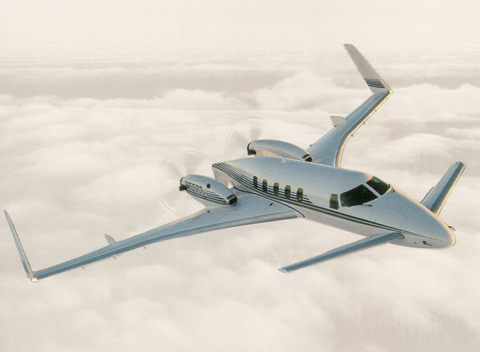
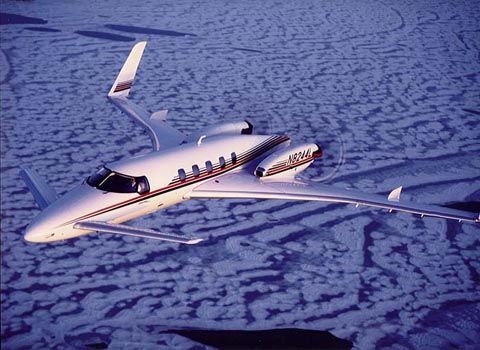
(with nothing still happening in the wonderful world of Croatian aviation, I thought I’d restart my Rare Aircraft series by profiling the incredible Starship… I’m a huge fan and it was only a matter of time before it made it here… :D)
Of all the big GA manufacturers, Beech can be classified – stereotyped if you will – the most easily, most often put into the blanket category of “the Rolls-Royce of the air”. And usually its aircraft fit the description perfectly: elegant, classy and timeless design, superior workmanship, comfort equal to none and not a hint of compromise at any level.
And sure enough, like the Rolls-Royce, when you peel away the glitter, you end up with a beautifully engineered aircraft, built to a specification and not a price. But – again like the Rolls-Royce – when you take a closer look you see the technology is rather commonplace, nothing fancy, nothing revolutionary… for the most part conservative, tried-and-tested technology wrapped into a high-performing – but on the face of it technologically rather dull – product. Bonanza, Baron, King Air, even my favorite twin, the Duke… all excellent aircraft, but none pushing any boundaries – or conventions.
However, every now and then each manufacturer suffers a hickup somewhere along the line, something to break the established pattern. Cessna had one in the form of the ground-breaking Citation bizjet in the 70s; Piper’s high-power pistons – the Cherokee 400 and Pressurized Navajo – raised more than one eyebrow when they were introduced ’round the same time. But Beech seemed pretty consistent and, apart from a foray into the low cost market, remained true to it’s name and brand. That is until they – in a fit of creativity – hired one of aviation’s greatest innovators: Burt Rutan.
Contracted to design a successor to the King Air 200, I like to think that the first thing he’d done was take all of the King Air’s plans and throw them into the shredder :). And then proceed to design something that broke all the rules of the biz-prop world (and a handful of others): the incredible, stunning and revolutionary Starship.
1. A rich man’s LongEZ:
Beginning life as the PD (Preliminary Design) 330 of the early ’80s, the Starship was intended to become the new cutting edge of the bizprop world, a space-age combination of advanced aerodynamics, radical materials and high-tech cockpit systems. This was a significant leap, for while there were a number of conceptually-similar aircraft flying at the time – including Rutan’s own VariEze and LongEZ piston singles – no one had attempted to design something similar on such a large scale.
Despite the world of difference between a homebuilt piston two-seater and a high-flying executive bizprop, the LongEZ seemed a good place to start looking for the basic aerodynamic solution. And while the Starship is not simply a scaled-up LongEZ, the latter’s proven performance – up to 170-180 knots out of just 100 HP – promised a lot for the new Starship.
The Starship's eventual similarity to the LongEZ was everything but unintentional (photo: author)Even the basic shape of the wing owes a lot to the experience gained building and flying the VariEze and LongEZ (photo: author)
However, translating that shape into the PD330 – a larger and far more complex aircraft – was still uncharted territory, so to have a stab at it and see what problems could/would be encountered, Burt Rutan’s Scaled Composites designed the proof-of-concept Model 115. Not a true prototype as such, the Model 115 was an 85% scale PD330 look-alike with a somewhat different fuselage design and materials, no pressurization and just the basic systems needed needed to get it into the air (an approach also used by SAAB when designing their revolutionary J-35 Draken double-delta interceptor back in the mid ’50s, using the Lilldraken, a 70% – I think – scale demonstrator, to test out the double-delta wing).
And it's a good job they built it - because the last time somebody had attempted to design something similar straight out of the box, it'd didn't go all that well: the Curtiss-Wright XP-55 Ascender from 1941. Sharing much of the configuration - but little of the technology - the XP-55 was inherently unstable and very difficult to fly
Unlike the Lilldraken which has survived to this day, the Model 115 was scrapped soon after its work was completed.
2. Back to the future:
Finally satisfied that the future Starship wouldn’t fall out of the sky, the design team set to work on PD330. Much of the design was done on an emerging, very powerful tool – CATIA. While commonplace today, this Computer Aided Design (CAD) program was developed by Dassault for use with later members of it’s Mirage interceptor family, and at the time presented a quantum leap in aircraft design and production.
Not that PD330 – soon to be renamed the Model 2000 Starship – was lagging much behind. By the time it first flew on February 15 1986, it was the hottest-looking thing in the sky… and suddenly yer King Air started to look just that much inadequate :D.
Imagine the impression this shape made back in 1986... and it still keeps turning heads 13 years later 🙂In my mind the Starship managed to pull off what only the Concorde before it did - get that perfect blend of form and function
But, true to Rutan’s form, the real treats lay below the skin – and on it for that matter :). Built entirely of graphite composites – carbon fiber in today’s speak – the Starship was the first civil production aircraft (as opposed to homebuilts) to have used composite materials to such an extent. Indeed, I think I’m right in saying that the Starship was the first composite aircraft to feature full pressurization, undoubtedly yielding a ton of information about carbon fiber under differential pressure in realistic, practical conditions.
An interesting design bit, inherited from the LongEZ, is the Starship’s virtual inability to stall. A well known phenomenon to EZ drivers, in any high Angle of Attack situation the canards – being aerodynamic surfaces in their own right – would stall well before the wing and drop the nose, keeping the aircraft in full control all the way till it returns to a normal AoA. Given that the Starship was Rutan’s child, I wouldn’t be half surprised to find out it could easily be maneuvered up to that attitude in the first place :).
Another benefit of its novel configuration was a smoother and quieter ride – at least on the inside :). Its pusher configuration meant that the spiraling propwash of the twin 1200 HP PT6 turboprops would at all times be clear of the wing – and any control surfaces it could buffet. However, while it also allowed the props to be deiced by engine exhaust, it too meant that they would be riding in the turbulent downwash from the wing, which gave the Starship the pusher prop’s characteristic, buzzing square-wave sound when heard from the outside. From the piloting point of view though, all the negative bits were offset by – for a twin – excellent engine-out characteristics. You may have noted from the photos above that the engines sit very closely together, with no fuselage in the way… in the case of an engine failure, the remaining one would not produce all that much yaw as in a conventional twin, yaw which could easily be counteracted by the relatively large surface areas of the twin rudders.
But for me one of the most interesting features of the Starship was its cockpit :). Back in the day when EFIS cockpits were getting into their stride in general aviation, Collins had gotten a bit carried away with their ProLine 4 AMS-850 suite – it featured no less than 16 CRT screens! I think a photo and a video will tell you far more than I could, but keep in mind this is the first certified glass cockpit system for general aviation use.
So many CRTs you could fry a chicken on a longer flight. The two screens with the keyboards are the FMS system, another first on light aircraft (photo from: http://www.bobscherer.com/Pages/Starship.htm)
3. Meanwhile, in the real world…
Sadly though, the Starship also shared one trait with all pioneering aircraft – it was too far ahead of its time. While everything it introduced we now take for granted – witness the successful Piaggio P-180 Avanti – back in the late ’80s that technology was pushing the envelope as far as practical use, and especially production, were concerned. In the end, the all-composite airframe was the Starship’s undoing…
The primary problem was, interestingly, weight, which had set into motion a cascade of issues that made the Starship a commercial failure. At 6758 kg, the production 2000A Starship 1 was 1125 kg heavier than originally planned. This hefty increase in weight – nearly 20%! – was due to frequent trips to the drawing board at the insistence of the FAA, the US Federal Aviation Administration. Being the first certified all-composite civil aircraft, the FAA was – understandably – not all that confident in the Starship’s structural integrity, repeatedly requesting the airframe be strengthened in order to receive certification. Beech had no choice but to comply, which set into motion the dreaded weight curve, with each structural modification requiring some sort of change somewhere else, adding weight and complexity. In the end, the result was predictable…
From a high-flying swan, the Starship had turned into somewhat of a goose. With all the added weight, performance figures inevitably went down, to the point where – at 295 knots in economical cruise – it could be outrun by the “lowly”, half as powerful Piper Cheyenne (though, in the Starship’s defense, the Cheyenne had nowhere near its FL410 ceiling). To add insult to performance injury, Starships were notoriously expensive to produce – despite the prototypes being built on production tooling to keep the costs down. Retailing at a minimum $3.9 million in 1989, the Starship had cost almost as much as the Cessna Citation V or Learjet 31, which were 89 and 124 knots faster respectively. The aforementioned Cheyenne had cost almost $1 million less…
The eventual fate of most pioneers... most of the Starships produced stored at Pinal Airpark
As a result, only 53 examples – including the three prototypes – were built before production ceased in 1995 due to a lack of buyer interest. Many were in fact not sold at all, but leased, hoping to try and raise their popularity and get back some of the $300 million invested in the aircraft’s development. However, inevitably, faced with the mounting costs of supporting a small and complex fleet, Raytheon – Beech’s parent company – decided in 2003 to pull the plug on one of the most innovative light aircraft in history, recalling all the leased aircraft for scrapping…
Because people who have the money to buy one of these tend to be a stubborn lot, there are still a few – five to be exact – Starships still flying today. All of them are privately owned, being the aircraft that Raytheon could not buy back – despite their continuing efforts to do so – and represent mostly the mid- and end-production machines of the ’90s:
NC-51, manufactured in 1994, currently flying as N514RS, and the greatest of the lot!
A Starship for a starship... can it get any more fitting? 🙂 Arguably one of the most famous Starships today, N514RS has the chase plane for a number of Scaled Composites aircraft (photo from: http://www.bobscherer.com)Which one looks more advanced? 🙂 (photo from: http://www.bobscherer.com)
By the looks of things – and by the passion their owners have for them – we may see Starships flying for some time to come :). So when you see Virgin Galactic proudly flying the SpaceShipTwo on the telly, look in the back… and you’ll see something far, far more charismatic… 🙂
NC-6 over San FranciscoJust another day at work for NC-51NC-29, the oldest Starship flying...
Some very helpful websites which were a great help in writing this:
www.bobscherer.com– a very informative website apparently maintained by NC-51’s pilot (and an excellent job sir!)
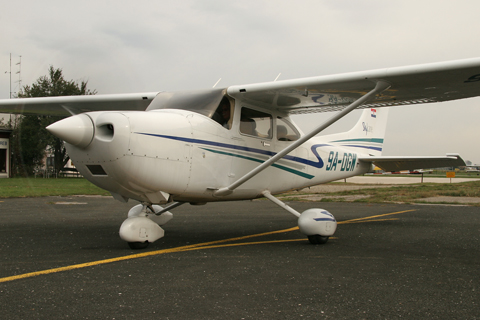
Just got back from the field with a few new bits of information about yesterday’s incident :). Apparently, DGW had landed a bit too long and couldn’t stop in time on the slippery grass. The pilot had managed to shut the engine down and switch off the magnetos before hitting the drainage canal, so the damage is said to be a lot less than previously though – just one bent prop blade. However, this will still necessitate an engine strip down and examination of the whole prop, so it’s not over yet… :). And that is as much as I have so far… stressing the “said” and “apparently”…
Just heard from Dean T. – and confirmed in the news – that 9A-DGW, our own Lučko C182T, was involved in a landing incident at the Zvekovac private airfield just outside Zagreb. Apparently, it had skidded off the slippery runway and ended up in a drainage canal that runs across the field. First reports indicate that the pilot is okay and without injuries, but that the material damage on the aircraft is substantial, at around €11.000, including a bent prop and knackered engine (pretty much what happened to 9A-BKS featured here recently).
Will post more updates as soon as I get some reliable information.
Seen a few months after it had joined the Croatian register. A 2001 normally-aspirated model, it was one of the best rentable aircraft at the field, operated by Air MGVFully equipped with everything you need, by far the best classic panel at the field 🙂
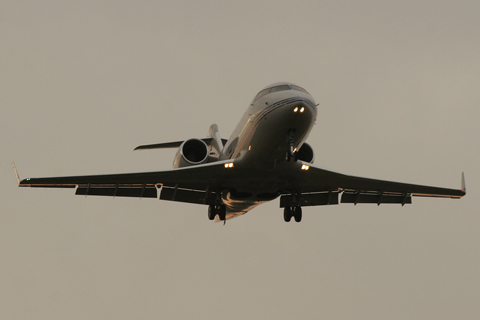
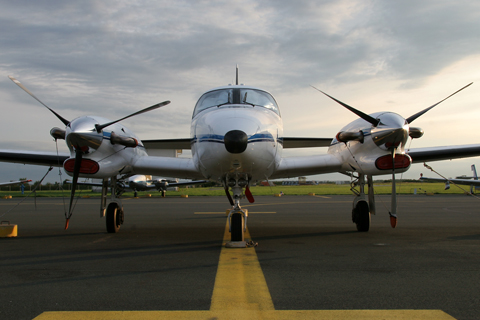
In another run through my database (lost count of them all 😀 ), I’ve seen I’ve got quite a few interesting shots from Pleso airport, our big bad international gateway (for our GA expectations anyway 🙂 ). Having often selflessly volunteered to fly there for fuel once our own station at Lučko closes for the day, I’ve had the chance to spend some quality time on the GA apron, snapping a few shots here and there while waiting for the bowser to trundle up. At other times I’ve taken my telephoto lens to the RWY 05 approach path, snapping a few landing photos before the police inevitably shoo me away :). So, while patiently waiting for something new, I’ve decided to compile a little collection of what can be seen operating in and out of our friendly little airport…
First up is 9A-CHC, a relative newbie to the Croatian register. A nowadays rather rare Cessna 501 Citation I/SP, it is operated by IVA-DOM Aviation, the country's first proper bizjet charter companyShot in some excellent light, 9A-CZG (formerly 9A-BZG) is a Piper PA-31T-500 Cheyenne I operated by Geo-Foto - a very well known local mapping company - in an aerial photography configurationSomewhat of a patriotic moment this as 9A-CRO, the presidential Canadair Challenger 604, glides in for landing on RWY 05My first Hawker 400! 🙂 CS-DMM, a 400XP, is operated by NetJets Europe out of PortugalAnother Cheyenne I, registered in Germany as D-IEMR, but operated privately in Croatia for a whileAnother new one for me here, what I believe is a Cessna 340, registered G-FEBE. Done quite a trip to get here...A prison view (almost! 🙂 ). Not a very good one at that, but my dad told me there was a Caravan at the airport - and I immediately rushed there to see it :D. Turns out it's the 1500th produced, N1276Y, here on an European tourAnd here's a very, very nice treat from Austria - a Piper PA-46-500TP Malibu Mirage (reg OE-KDM) on final for RWY 05The Swedes are bringing up the rear with an even rarer Citation than 9A-CHC, a non-single-pilot Citation 500 registered SE-DEGA view of the Pleso GA apron at night... and not even half full 🙂
As an afterthought, I’ve though I might add something a bit bigger as well :). Though most of the commercial traffic in and out of Pleso consists of boring Airbii, Boeings and Dash 8s, there are a few gems every now and then… big, smoky, Russian ones… 🙂
Lookie, twins! RA-76494 from Russia and UR-78786 from the Ukraine, both Ilyushin Il-76TDs, visiting Zagreb on a rare occasion. Shot with my old camera from the control tower 🙂One of the most graceful airliners ever built rocketing off RWY 23. Though still not all that uncommon, the Tupolev Tu-154 (M model here) is still a rare sight outside the former Eastern BlockNow this had really brightened that cold, windy March day - a very rare Ilyushin Il-86 charter on approach to RWY 05. The first true Soviet widebody, the Il-86 was produced in limited numbers, hampered all the way by a serious lack in power...



















 Achtung, Skyhawk!