All good (& nerdy) things happen in threes; that’s a fact. After my recently reinvigorated series on Croatia’s abandoned cropdustring airstrips had taken me to TWO newly reactivated runways in quick succession, I immediately thought to myself “well, this topic has peaked, no way something so cool will ever happen again”. But guess what: less than a month later, word reached me that yet another airfield had just been reopened, located barely 30 minutes away by Texan. No prizes for guessing what happened next!
So, you’re going along, minding your own business… driving down a country road you’ve gone down hundreds of times… expecting and suspecting nothing out of the ordinary… and then you round a corn field and see an airplane where no airplane has been seen for decades. 9A-UIX: confusing passing motorists since AUG 2025
Located just off the village of Nova Rača, the strip in question will probably be familiar to readers of the original article – if anything for being one of the most usable among the 12 I’d visited until then. A 595 x 10 m paved runway1 stretching in a 05-23 direction, it was built by PIK 5. Maj sometime in the early 70s (with 1973 being cited most often), and used primarily by An-2s and PZL Dromaders of PA Osijek (though Cessna 188s of PA Daruvar and Piper Pawnees of PA Zagreb made frequent appearances there as well). Following the violent dissolution of Yugoslavia in 1991, it would briefly serve as an actual “airbase”2, hosting militarized piston trainers and former PA cropdusters participating in the defense of the Bjelovar area (as one of the many improvisation efforts of the nascent, and woefully underequipped, Croatian Air Force).
The end of the Homeland War in 1995 would actually see a bit of life return to the airfield – albeit just as sporadic cropdusting and forestry operations that would go on few and far in between until 2008. After that, there would only be a one-of ultralight meet in MAY 2015, after which the runway would go completely dormant until 2025. Officially reopened on 08 SEP 2025 under the auspices of Aeroklub Nova Rača, there are no aircraft of any sort based there as of yet – so it became my privilege (and an honor) to do both the first official touch-and-go on 09 SEP… and then the first official full-stop landing on 17 SEP 🥳.
1 in the original article, I had listed the runway dimensions as 630 x 9 m; turns out, I was somewhat off the mark with that one. Despite having access to an unusual wealth of source material, detailed information about Nova Rača was curiously absent, forcing me to rely on measurement by Google Earth. The resulting error in length is primarily down to different references: whereas the official figure is just for the runway itself, my measurement had covered the entire paved surface end-to-end, including the 30 m apron. The error in width, however, is simply a consequence of trying to measure something super accurately on free-access satellite imagery
2 more precisely, the runway itself was used as a decoy; the airplanes (as well as command facilities and four 20 mm anti-aircraft guns) were actually located in a field about 300 m to the southeast, right on the edge of the forest visible in shadow in the photo above. Since surveillance radars of the Yugoslav Air Force could see aircraft taking off and landing somewhere near Nova Rača, the commanders of the Croatian defenses had hoped the opposing side would assume they were using the paved runway – and in case of an attack go straight for it, while avoiding the actual “base”. Indeed, exactly this had ended up happening on 03 JAN 1992, when a Yugoslav MiG-21 attacked the runway from an altitude of about 2,000-3,000 m, scoring only two ineffectual hits that did no damage to the pavement itself – apparently completely oblivious of the actual deployment on the forest’s edge
Despite some cracks along the edges (which increase in number towards the RWY 23 end), the state of the pavement is more than good – especially considering it’s 50 years old. Given that it was intended to support the 4.3 ton M-18 Dromader (which had the highest pavement loading in the entire PA fleet, even more so than the 5.5 ton An-2), the runway can easily handle any GA aircraft that could realistically use it in the future
The closeness of the road means that the displaced threshold (now in place of the old apron) is a must. Even so, on all of my approaches, I found myself coming in high and aiming for the second quarter of the runway to avoid startling the drivers below (the road is actually quite busy, despite what the photo would suggest!). While many of these strips were indeed built right next to roads for easier logistics (Korija and Čađavica too), their runways usually run parallel; Nova Rača and Čazma are the only examples that come to mind of a perpendicular arrangement
Unlike at Čađavica, there are no fixed close-in obstacles on either runway end, so you can come in and get out even in something with marginal performance (<cough> 60 HP Falke </cough>). However, like at Korija, thermal turbulence from the surrounding fields plays a large role… as does mechanical turbulence from the forest during any stronger southeasterly wind
An approach over trucks on one end, and over cornfields on the other… my kind of place!
It’s the classic story of the Phoenix: one ultralight burns down, and a new one soon rises from the financial ashes to take its place. Having lost their gorgeous TL Ultralight TL-232 Condor Plus D-MULL to a ground fire on 26 MAY 2025 (thankfully without any injuries), the three of my mates who had owned it all adopted a weapons-grade “shit happens” attitude, pooled their cash together once more, and set out to find a replacement – all within the span of just two months. If that’s not the proper GA attitude, I don’t know what is! 💪
Though another TL-232 was initially on the cards, in the event they went with a stunning B&F FK9 Mk. II TG called D-MRRP, which would become only the second of its type to ever be based in Croatia (the first one, OM-M483, actually being a temporary rental). As was the case with the old D-MULL, you could count on the fingers of one hand the number of days it took me to hop in and take it up for a spin…
Golden Hour with the boys… and airplanes
Funky
While it sounds tame compared to some of the other ones out there, the designation “FK9 Mk. II TG” actually contains quite a lot to unpack. The fun starts already with the 9 – for while it may be the design that had launched B&F as a company, the FK9 is actually the ninth aircraft penned by the company’s founder and chief designer, Otto Funk. Originally an engineering apprentice at the Heinkel works of Speyer, Germany (the place with the famous aeronautical museum), Mr. Funk had started designing gliders as a spare time passion project soon after joining the company in 1959. The first one out of the gate was the Greif 1a1, a striking all-metal V-tail single-seater that bore a strong resemblance to the contemporary Antonov A-15. Build using tools from Heinkel’s apprentice workshop, only one would ever be made (D-7142), despite its reportedly outstanding performance by the standards of the day. Its uniqueness would be further improved upon in 1960, when it would be rebuilt into the Greif 1b, now featuring a BMW 80262 turbojet engine in the lower fuselage for full self-launching and self-sustaining capability. You can probably see already where this article is going…
1 because it was built using Heinkel infrastructure, its formal name should actually be the Heinkel Greif Ia… though it would later be informally rechristened into the Funk FK1 Greif
2 a tiny 40 kg unit that could put out 450 N of thrust, this 1960 design was specifically intended to render winch launches and tow planes obsolete by allowing single-seat gliders to reach 7,000 ft in roughly 15 minutes, burning about 12-13 liters of Diesel in the process. Ironically for a “silent sport”, the 8026 spun at a very vocal 45,000 RPM, which was one of the reasons (cost being the primary one) why it failed to gain any traction.
Interestingly, the same setup was also used on the Hütter H30 TS, designed by the late, great Eugen Hänle. Whereas the Greif pioneered many metal construction techniques, the H30 would do the same for fiberglass; indeed, Mr. Hänle’s experience with crafting the design later helped him set up his own company, Glasflügel – whose H205 Club Libelle was the first glider (and first flying thing of any sort) that I have ever owned 🥰
Then in 1962 came the much improved, much more streamlined, and much much more elegant (albeit less turbojet-y) Greif II/FK2. Of this too only one example, D-7014, would be made; but unlike D-7142 (which was lost in an accident in AUG 1962), the II is still airworthy today, and regularly turns heads at any self-respecting vintage glider meet…
It took me awhile to realize that the Otto Funk who had designed the Greif II was the very same Otto Funk who had designed the FK9… well, better late than never! As was the case with the DV-22 Speed Katana featured in a previous post, I got to see the FK2 long before I could appreciate its provenance… though I did indeed appreciate its looks! Like the Greif I/FK1, D-7014 was also built at the Heinkel shop using Heinkel tools… so, if we were to nitpick, its proper name would have “Heinkel” at the front
1968 would see the appearance of the FK3, an 18 meter all-metal high-performance glider whose impact B&F themselves describe as “The high aspect ratio wings and the modern tapered fuselage were to leave their stamp on the design of modern gliders up to the very present”. That’s as maybe; what is more nerdilicious however is what happened in 1970 when Rhein-Flugzeugbau (RFB) turned the design into a motor glider by sticking a 40-ish HP engine3 driving an eight-blade ducted pusher fan mounted behind the cockpit. If that made you think Edgley Optica, you’d be on the right track; the Optica was indeed one of the designs that had learned valuable lessons from what would become known as the RFB Sirius I4. Another was RFB’s own Fantrainer, which took the concept into high-performance waters by scaling it up into a highly agile, 600+ HP5 advanced trainer for the military (a vid of which was kindly provided by spotting colleague Eddy Meštrović).
3 according to a number of sources, the Sirius I had been flown with a rather eclectic range of engines, starting out with a 48 HP Nelson H-63 two-stroke… then two Yamaha motorbike engines… and finally two 20 HP 163 cm3 Fichtel & Sachs KM48 Wankels. So that’s two-stroke flat four… four stroke inline two… and twin-rotor rotary… all rather understandable, given that the 70s were known for the widespread use of recreational drugs…
4 there was also the Sirius II, though it would be more commonly known as the Fanliner; think Fantrainer, but smaller, fixed gear, just 150 HP, and intended squarely for comfortable long-distance touring
5 the original Fantrainer 400 was powered by a 545 HP Allison 250-C20 turbine as seen in the Bell JetRanger helicopter; the subsequent Fantrainer 600 would switch to the improved C30, developing a juicier 650 HP
The real significance of the FK3 though was that it would become the first Funk design to enter any form of series production, with an 11-unit run undertaken by VFW-Fokker as the VFW-Fokker FK3. Don’t be fooled by the name change however; all of this was still happening at Speyer, VFW having absorbed Heinkel in 1965 before merging with Fokker in 1969.
Then there was the FK4 of 1970, another all-metal competition glider. The sole example made (D-KEUL) would this time be produced by the Academic Aviation Group of the University of Karlsruhe – mercifully shortened to just Akaflieg Karlsruhe6 – under the model name AK1. Its claim to fame was being the first high-performance glider to have a fully retractable powerplant, a 28 HP Hirth F10A1a two-stroke whirling a 1.3 m two-blade tractor prop that would fold backwards into the fuselage aft of the cockpit – a solution still used on virtually all modern self-sustaining gliders.
6 in 30s/40s/50s/60s/70s Germany, it was not unusual for these academic aviation groups to manufacture designs from up-and-coming engineers who had no production capabilities of their own. While many such machines had ended up being produced in small (or even token) batches only, some had actually managed to gain a proper foothold in this manner. Perhaps the best example is the Akaflieg MünchenMü-13, designed by “upstart” Egon Scheibe. Having been given a much-needed kick start, the Mü-13 would eventually evolve into the two-seat Bergfalke – which, when an engine was applied, would become the Motorfalke. Yes, the same one that would launch the SF-25Falke family, Europe’s most successful motor glider…
It took until the FK5 of 1979 for Mr. Funk to score his first real dud. Essentially an FK3 with the wings snipped down to 15 m (to make it fit into the more common and competitive 15 m Class), the prototype would reach 80% completion before being abandoned due to, and I quote, “company-specific reasons” at VFW-Fokker.
And then in 1985 came the FK6 – the first aircraft in this whole piece that actually has more than just a tangential connection to the FK9 💪. Its highlights include:
being Funk’s first proper ultralight (i.e. designed as such from the ground up, rather than being a conversion of a glider)
the first Funk design to use fiberglass instead of metal
and the design debut of Otto Funk’s son Peter, who would go on to have a significant part in the creation and evolution of the FK9
A single-seat parasol pusher somewhat reminiscent of the 1983 Aviasud Sirocco (albeit taildragging and with a fetching V-tail), the FK6 could boast very solid performance for its 30-50 HP, with a claimed cruise speed of as much as 120 km/h, and 750 km of range on just 25 liters of fuel. Despite reports of it being consistently superior to similar designs of the time (Sirocco included), the 6 was intended outright to be just an “attempt to build a lightweight construction using the newest technology“, so only three would ever be made:
D-MBBI, powered by a 31 HP Hirth F22 two-stroke
D-MTUD, sporting the common 50 HP Rotax 503 two-stroke
and D-MXOF, a dedicated glider tug with a 51 HP Rotax 462 (also two-stroke)
The design would also briefly reappear in 1994, when the Messerschmitt-Bölkow-Blohm (MBB) consortium developed it into the FK10, a slightly larger tandem two-seat model – though this would fail to gain any traction and remain as a one-of prototype (D-MTDD). And yes, you guessed it: MBB had taken over VFW-Fokker in 1981, so both the FK6 and FK10 were very much of Speyer origin!
Despite being just a testbed, the performance, reception and impact of the FK6 were encouraging enough for Funk Sr. to continue beavering away at the ultralight idea. Though the follow-on FK7 and FK8 would never leave the drawing board (and little to no information on them exists, save for being “FK6 derivations for amateur construction“), Peter Funk’s growing involvement would eventually bring this article back on track with the 1989 FK9… 🥳
On your Marks…
As it stood, the FK9 (then still without the Mk. I suffix) was an entirely conventional side-by-side tractor two-seater, similar in shape, size and layout to the contemporary Rans S-6 Coyote II. Offered only in tailwheel form, the majority would be powered by the Rotax 503, which made them good for 750 FPM in the climb and 135 km/h in the cruise at Maximum Take-Off Mass (MTOM). This compares favorably to another S-6 competitor from the time, the 1992 TL-132 Condor (the 232’s immediate predecessor), which could manage around 500 FPM and 130 km/h using the same engine – a difference that, while small, says a lot about 20+ years of experience in designing high-efficiency gliders, and a foreshadowing of what was to come with the later FK9 marks. More relevant to my Achtung, Skyhawk! sensibilities though was the existence of a handful of Mk. Is using alternate powerplants, either the run-of-the-mill 42 HP Rotax 447 two-stroke, or the very unusual 52 HP Wankel 814TG twin-rotor rotary – both another preview of the delightful nerdiness that awaits on the Mk. II 🥰.
However, while its Funk DNA did indeed give it an edge over its competitors, the FK9 was first and foremost a design intended outright for proper series production – which meant that, by necessity, it had to do away with some of the more avant-garde FK solutions for the sake of ease of manufacture. Whereas previous Funk designs were lovingly and painstakingly hand-crafted in apprentice workshops, the FK9 would have to be produced quickly and cheaply on a far larger scale by a conventional aircraft factory at Krosno, Poland, using whatever common (and/or easily obtainable) production tooling was at hand. Thus, Messrs Otto and Peter went down a more conventional route, employing:
a fuselage (designed by Peter) of steel tube at the front, and a mixture of steel and aluminium tubing from the cabin backwards, all wrapped in Ceconite fabric (except for the cowl, obviously)
and a wing (designed by Otto) built around aluminium spars and cabon-aluminium ribs also covered with Ceconite, with aluminium/Ceconite ailerons, flaps and elevators all mated to a control system taken from the stillborn FK8
Minus the prototype (D-MJKF, which the Funks had built in their own garage), 33 Mk. Is would be produced between 1992 and 1994, by which time the Krosno works would begin to prepare for the 1995 arrival of…
… the Mk. II
Essentially “just” an evolutionary development of the Mk. I, the Mk. II came about because the Funks wanted to make the design capable of accepting both a broader range of engines (as the 447 and Wankel options had already suggested) – and a broader range of power outputs. Changes to the structure were kept to the minimum necessary to accommodate a wider variety of engine mounts and associated stresses, and were actually fine-tuned “live” over the first 20 examples made. With anything between 45 and 80 HP now possible7, the Mk. II diverged into two regulatory versions, one with an MTOM of 400 kg, the other with 450, the applicability of which depended on the available power. The former limit applied if you went with our old friends the Rotax 462 or 503 and the 814TG… while the “full fat” 450 was available if you opted for the:
garden-variety 80 HP Rotax 912UL
its perennial competitor, the 82 HP Jabiru 2200
and the quite exotic Ecofly M160, essentially a Mercedes-Benz M160 0.6 liter turbocharged inline three out of the Smart ForTwo city car converted for aviation use. Depending on the version, the power output could be either 55 or 82 HP
Fascinated by this variety, I trawled a bit through the classifieds and various photo databases to try and see which of the above were actually used on real airplanes – as opposed to just offered on paper or submitted for the sake of legal documents. Unsurprisingly, the 912 took a clear lead, followed by the 503; the more powerful 582, interestingly, came in third, while bringing up the rear was the M160 – all but one in the more powerful M160/1 variant. No mention of the Jabiru, Wankel and 462.
7 despite the nominally low figure (with other aircraft of this class, such as the TL-232, regularly boasting 100 HP or more), the Mk. II’s glider heritage means that it makes excellent use of its power – so much so that the 912 model is even capable of being a rather capable tow plane. OK, heavy competition machines are beyond its capabilities… but stuff up to 580 kg MTOM is quite doable. Indeed, one flying club in Germany has successfully towed single-seaters such as the Schleicher Ka-6, Ka-8 and ASW19, the Grob G.102 Astir and the Neukom Elfe… and even some lighter twin-sticks, such as the very popular Schleicher ASK13 and the ubiquitous Let L-13 Blanik
The only other major difference was that the Mk. II was also offered with the option of a tricycle gear (w/ fully steerable nosewheel), aircraft so equipped receiving a TG suffix to their name. Indeed, the similarities between the two marks are such that I even found an instance of a Mk. I (D-MOKL) being converted into a Mk. II in 2006 by Otto Funk himself (and sporting a 55 HP M160 nicked from a later Mk. III; pure Achtung, Skyhawk! theater).
While it may lack the sweeping elegance of today’s Mk. VI, the Mk. II is not a bad looking machine – not by a long shot. Although the wing struts may appear to be inconveniently placed for entry into the cabin, getting in is surprisingly straightforward even for my (quite uncoordinated) 1.9 m: slide your backside into the seat from in front and simply pop your legs in… that’s it
Debuting already in 1997 on the coat tails of the Mk. II’s financial success, the Mk. III would realize the design’s “full Funk potential” by going nearly all composite (except the flight controls, which were still fabric covered). Other notable changes included redesigned vertical and horizontal stabilizers, as well as different control linkage for the ailerons and flaps (external links w/ internal mass balancing, the exact opposite of the Mk. II setup). Unlike the Mk. I and Mk. II, the performance and price differences between the II and III were such that both would actually be kept in side-by-side production for awhile due to customer demand. And on an entirely subjective note, the Mk. II’s cockpit feels narrower than the Mk.III’s… but also taller. Whereas in the latter I had to “keep a low profile” to avoid hitting my head against the upper crossbeams, in the former I could sit normally upright without issues – though, admittedly, this may simply be down to the design of the seats themselves and/or the thickness of their cushions
Return Of The Gästeflieger
As can be seen from the photos, D-MRRP itself is a pretty standard FK9 Mk. II TG, manufactured in 1995 with the serial 09 050. Up front there’s a normie 912UL driving an equally unremarkable (though very efficient) three-blade Woodcomp Propuls 174 ground-adjustable prop. Historically too nothing much stands out, save for a forced landing due to an engine failure in 2016, which resulted in the collapse of the nose gear and damage to the propeller, requiring their replacement.
Having relocated to its new home at Čakovec (LDVC) in mid AUG 2025, D-MRRP would immediately be put through its paces – not least of all by me, flying it in literal circles for minutes on end attempting to get a good cockpit shot… 😑
Fun is not a straight line… nor a particularly fast one, but I’m not complaining. One of the things that had immediately caught my eye was the airspeed indicator scale: goes all the way up to 180 km/h, but the yellow arc (above maneuvering speed/calm air only) starts at just a tad over 115. This, I suspect, may be due to the combination of a high lift wing and a lightweight main spar, making it rather easy to overstress with a full control deflection/any rapid increase in load at speeds higher than 120-ish km/h. Since it was a bumpy day with a lot of thermal turbulence – and I wasn’t really in a hurry to get anywhere – I decided to stick to conservative speeds and simply take in D-MRRP’s very elegant panel. A feature I particularly like is the tinted foil on the transparent roof panel, whose Visible Light Transmission (VLT) factor provided more than adequate ambient lighting (as seen here) without burning my scalp to a crisp
For us in-flight panel photography nerds, the FK9 has the same problem as virtually every other high-wing ultralight out there: you need to bank & bank some more to finally get the sun to illuminate the whole panel… however, the effort was worth it, particularly over water!
Though this may simply be down to my eye height (a consequence of being tall and insisting of squeezing myself into small airplanes), but I found the view out to be outstanding in nearly all directions, even in high angle-of-attack situations. More importantly, I could turn my head sideways without having to look at a door sill or the interior of the wing, which is definitely an A++ in my books! (and yes, I know the ball is not perfectly centered in any shot so far; the FK9 likes to wag its tail in turbulence and has a very touchy rudder – far more than any other UL I’ve flown – both of which took me a while to get used to)
A clean & tidy panel, with everything you really need; could stare at this for hours. There’s a Funke ATR833 com radio and a Trig TT21 Mode S transponder in there, with the rest of the electronics rounded out by a Kanardia Indu electromotor-driven altimeter and a TL Elektronic TL-8284 tachometer (though it is not used, and engine RPM is instead shown on the UL-MIP Flight Log). The one thing I really don’t care about is the Rotax throttle lever; you twist it left-right to fine-tune RPM – but for bigger and more rapid changes you have to press & hold the button on the top of the lever and then move it backwards & forwards. Trouble is, it moves in discrete steps (and holding the button for anything more than a few seconds is far from comfy), so ultra-fine power and rate control on landing is very difficult. As one of my colleagues would say, “an over-engineered solution to a problem that barely exists”
Another thing to get used to is the wheel brake lever, visible just in front of the left seat; it’s not the location that’s unusual so much as the fact that you have to push it forward to apply the brakes, a solution that I haven’t seen in any other ultralight so far (any brake lever is always pulled back). Some people also find the stick movements odd, since both are joined to a single shaft running through the tunnel between the seats – meaning they don’t pivot around a point in front of the seats, but rather to their side. To roll left you thus move the left stick left-down and the right stick left-up; while to roll right it’s right-up for the left and right-down for the right… i.e. the same sort of movement as a traditional yoke. With 25 years of experience on them, this movement felt perfectly natural for me… but I can imagine that glider and UL pilots, trained 99% of the time on conventional sticks, might find it disconcerting at first. Then there are the doors: you cannot fly with the doors open, but you can fly with them removed, in which case your max speed is limited to 100 km/h (to reduce twisting moments on the rear fuselage by the air rushing into the cabin, something that has cost many a skydive Cessna dearly!). Also note the choke lever on the left sidewall, which is essentially a gear shifter from a bicycle; sounds LOL, but actually makes a lot of sense, since its mechanism frees you from having to hold the choke lever continuously during start
Just flexing the glorious sunset a bit. Apart from its specific convex shape, a dead giveaway that you’re looking at an FK panel are the combined electrical/starting controls on the proprietary panel on the left. The main upshot is that you only need three switches to start the engine, all in line: Main Electrical ON, Ignition ON and Start PUSH (that’s if we ignore the boost pump switch on the right, and the electrical kill switch down by my left leg). On dual ignition engines (which all 912s are), the ignition switch turns on both circuits at the same time – but they can still be individually tested using the spring-loaded I-II switch (which kills the opposite side circuit when toggled)
Outside, the design is peppered with the sort of aerodynamic touches that leave little doubt its designers know their way around a glider. Some of the more conventional solutions include gap seals on the elevators, as well as ailerons that droop with flap extension (i.e. flaperons)… but there’s also more exotic stuff in there as well. For example, when fully retracted (at notch 0), the flaps are actually deflected upward by 10° (visible on the left flap), which significantly lowers the inner wing section’s angle-of-attack. This in turn means the speed of the airflow must increase in order for the wing to generate the necessary lift, allowing (and in fact “forcing”) the whole airplane to fly at higher speed in order to fly at all. Called negative flaps, this is a standard feature on high performance competition gliders – and one of the keys as to why this airplane does what it does on just 80 HP. The downside though is that the wing’s low speed performance tends to suffer, with a stall speed at notch 0 as high as 85 km/h – quite a high figure for a 450 kg aircraft with a large wing. Selecting the flaps to notch 1 gives a deflection of 0° and reduces the stall speed to 73 km/h… while dropping them down to the final notch (2) gives a 10° downward deflection and 68 km/h for the stall (just 20° of flap travel in total… absolutely shocking for a professional DeHavilland Canada/Bombardier driver!). Other noteworthy features visible here are the towing system mounting point below the tail (although the actual hook and release mechanisms are NOT fitted), and the single-point refueling port on top of the fuselage just above the second “R”, feeding two 20 liter tanks located just behind the seats
Both the Mk. I and II came fitted with a wing fold mechanism as standard. Disconnect the aileron and flap linkages, unplug the quick-release connector for the wingtip lights, remove a couple of safety pins – and then simply fold the wing back along the fuselage around a special joint on the rear spar. I’ve been told that an experienced operator could have the job done in as little as 10 minutes…
The centerpiece of the FK9’s performance is undoubtedly its airfoil, a modified Wortmann FX 62-K-153/20 designed for high-performance gliders – and already seen, used and proven on the FK3. Taking off with two of us on board and some 30 liters of fuel (thus maxing out the 450 kg MTOM), we saw an effortless 5 m/s | 1,000 FPM in the climb; during a go-around on a solo flight, I made the mistake of punching full power, with 6-7 m/s | 1,200-1,400 FPM registering on the vario, and acceleration so sudden and surprising I almost ended up with a flap overspeed; and in the cruise, when I found some smooth air and decided to try out 4,200 RPM (a low-to-mid range regime for the 912UL), 120-125 km/h were the figures I saw most often. This is particularly impressive given that I’d seen only marginally higher numbers on the TL-232 – which has 25% more power available – in roughly the same weather conditions, at roughly the same masses and with a very similar three-blade composite prop configured for climbing and hauling
I was quite smitten with the TL-232 when I first flew it… but I think the FK9 may have taken its crown; the airplane is an absolute riot (complicated throttle lever notwithstanding). Like D-MULL, D-MRRP will retain its German registration… and will eventually be refitted with the full glider tow setup
Speed is a tricky thing; not because it can kill you, but because it’ll complicate your life far more than it need be. Take my case for instance: for a bit of change, I recently swapped the 120 km/h SF-25 Falke motor glider for the 140 km/h Fly Synthesis Texan ultralight. Just 20 kph in it, that’s all; barely even noticeable on the sort of the distances common to continental Croatia… but I immediately started planning long(er) range flights like there was no tomorrow 🤨 (OK, much improved payload + better take off & climb performance + the ability to make a 180 turn in under 10 meters + more space inside had a lot to do with it as well… but mostly speeeeeeed).
Enticed by the prospect of finally visiting places that were beyond my physical (dis)comfort range on the Falke, it didn’t take long for my sights to land on two of Croatia’s 159 former cropdusting airfields that are still in use today: Korija near the town of Virovitica, and Čađavica near not-too-far-away Slatina (not the one in Romania). The problem, however, was that the Texan has a blue-tinted canopy and no convenient hatch to stick a camera out of (not to mention the wing is quite far forward, so the view down sucks), which meant Falke-style aerial reconnaissance was out of the picture (heh). Didn’t have my drone on me either, so a mix of ground shots and videos of the approach & landing was a self-selecting solution. Wasn’t expecting much in the way of quality as a consequence… but the end results actually came out quite solid – and, critically, good enough to use for another Cropdusting Airfields piece!
(spoiler alert: due to thermal turbulence on both flights, and the need to conserve fuel due to the Texan’s higher 100 HP burn, I ended up cruising at 125 km/h on average… so yeah, speeeeeeed)
Cropdusting strips are a vibe in themselves…
Korija (red) and Čađavica (green) with most of continental Croatia for scale. About 150-170 km in the realities of Croatian airspace from the Texan’s base at Mlinski kamen near Petrinja
Korija •RWY 01/19 • 600 x 20 m • very smooth & comfy
As it stands today, Korija sports a fairly unremarkable grass runway, whose only “claim to fame” is a noticeable 1% upslope in the RWY 01 direction. However, back in its heyday, it was essentially a 1200 x 150 m open field (whose outlines remain visible to this day), on which you could land wherever took your fancy.
Pocket history: served as a major base for cropdusting operations on behalf of PIK Virovitica (mostly with An-2s); opened sometime in the early 70s and operated until the run-up to the 1991 Homeland War; for many years afterward left mostly unattended (except for occasional mowing); and finally refreshed and reopened by the AK Virovitica flying club in the summer of 2024. It is currently registered as a “semi-private” runway (i.e. used solely by the club and aircraft based there, though PPR is possible), so it doesn’t have an ICAO Location Indicator… yet.
Is flat. Located at the heart of the region of Podravina – named after, and defined by, the river Drava – Korija is effectively the start point of the densest part of the whole PA cropdusting airstrip network. Of the 159 runways in total, 51 can be found in the 120 km between here and the confluence of the Drava and Danube (today’s border between Croatia and Serbia) – including also Čađavica, about 40 km E-SE of Korija as the crow flies
While the field itself doesn’t really have any vices (except for an abundance thermal turbulence, but it is hardly unique in that respect), if you wanted to be a good neighbor you’d definitely need to mind the village of Korija, located just 350 m off the RWY 19 end (and whose houses and church spire are faintly visible in the photo). Having shot a few touch and goes here as well, I certainly did put the Texan’s outstanding low speed maneuverability to good use on the upwind and crosswind legs!
On the other end, you have a fairly clear run, the first obstacles being the village of Golo Brdo and the foothills of the Bilogora mountain range some 1.3 km away. The only issue I can think of here are lorries on the dirt road running parallel with the runway, kicking up dust as they make their way to and from an under-construction express road about 800 meters out
Čađavica • RWY 02/20 • 470 x 15 m • half length OK, half length marginal
If, however, you found Korija too normal and conventional for your taste, don’t worry – I still got you covered 💪. On the face of it, Čađavica’s backstory pretty much mirrors that of Korija: built sometime in the late 70s… used by IPK Slatina and IPK Osijek (albeit primarily by PZL Dromaders)… abandoned in 1991… and left to rot for 30-odd years until the local government awarded an operator’s concession to a local father-son duo, who eventually brought it back to life in 2021. Same legal status, no ICAO Location Indicator.
What does stand out however – even by the standards of these strips – is its current configuration. Back in the olden PA days, Čađavica had a very comfy 620 x 15 m paved runway, with a large 150 x 25 m paved apron adjacent to the RWY 20 end; this would have been considered borderline luxurious at the time, and second only to Mirkovac near Osijek, whose 700 x 17 m runway with an apron at each end made it the queen of the network.
It’s 21st century incarnation though would see the runway shortened to 470 m – or the distance available from the RWY 02 threshold to the beginning of the apron. However, a pre-landing inspection pass also revealed that:
the first 200 m of RWY 02 were not in the best of shapes, with an uneven surface and lots of cracks – and while usable if need be, I personally wouldn’t venture there at speed without chunkier tires and a greater prop clearance than is available on the Texan
the final 200 m before the apron in the RWY 02 direction were surprisingly smooth, despite their visual appearance; pulled off a textbook greaser there
there’s a… hmm… “sub-optimal” earthen berm 20-ish m from the RWY 02 threshold; after climbing it on foot, I’d call it at about 5 m high… doesn’t sound like much, but clearing it on landing with a sufficient margin does mean that most of the threshold is unusable (even if it were in a good state to begin with)
Arriving with 02/20 hindsight. Even though the above realistically gave me “just” 300 m to play with, the combination of the Texan’s chunky low-speed wing, low mass, high flap and a helping headwind meant the landing was a complete non-issue; indeed, I actually had to ease off the brakes to avoid having to add power just to make the apron…
I’ve been at major GA airports with smaller aprons than this… at its peak, this would have easily been able to handle 5-6 An-2/M-18s and their attendant vehicles at the same time
View from the top… of the berm (which took a bit of work, given that it’s mostly fine earth). Don’t know why it’s here, but Google Earth historical imagery does not show it back in October 2024. Thankfully, the RWY 20 end is blissfully free of obstacles… and even Čađavica town is sufficiently far off (some 1.4 km) that you don’t have to worry about bothering the locals
And a bit of bonus content: one of only two CTSWs in Croatia, 9A-URV is actually a native of Čađavica… though obviously this was not taken there
After the meteorologically plainly useless spring of 2025 had gone, the arrival of more stable summer weather meant it was time once again to open up the map and see which airfield and which airplane I’d like to try out next 🤔. Having been on a bit of a Diamond roll lately (kick started by last year’s Alpine joyride in a Super Dimona), I decided I might as well focus on the ubiquitous DA-20 Katana, and try to get as many of its versions in as I could within a reasonable driving distance from home.
Naturally, this soon got me thinking about just HOW MANY of these versions there really are – which, in turn, sent me deep into my photo database to determine how many I’ve managed to snap over the years. Inevitably, this led me further on into my Croatian GA register, where I ended up counting seven that carry (or used to carry) the 9A prefix. Now, I’m no expert – but you have to admit that this sounds as gratuitous a reason to fire up Achtung, Skyhawk! as any…
Something’s wrong with the horizon… not the ADI, the real one
The Keyboard Is Mightier Than The Katana
But first, a bit of housekeeping. While most people use “DA-20” as a one-size-fits-all designation for the entire Katana family, the nerdy truth of the matter is that there’s quite a bit more to it than that. The story starts out in 1989 with the HK-36 Super Dimona touring motor glider (TMG), Diamond’s big rework of the earlier 1980 Hoffman H-36 Dimona. Available in many flavors – tailwheel/tricycle, 80-115 HP, naturally aspirated/turbocharged – the HK-36 had almost immediately become a runway success on the European market, with going on for 900 produced so far and at least one to be found in any Central European country.
Visual reference time: the original H-36(all of which were tailwheel, and most powered by the VW-derived 80 HP Limbach L2000)…
… vs the top-of-the-line HK-36TTC, 115 HP of turbocharged Rotax goodness
As was the case with another Austrian TMG manufacturer (HB Flugtechnik, but more on that in a later post!), this success had soon prompted Diamond to try and capitalize on its new market presence by turning the Super Dimona into a “conventional airplane” (i.e. something that would fit into the Single Engine Piston, or SEP, category). To this end, in 1991 the company would take a naturally aspirated 100 HP tricycle HK-36TC-100, snip its wings by five and a bit meters, add flaps to compensate for the loss of wing area… and call it a day. The resulting DV-20 Katana would even retain the motor glider’s wing joining system (which allowed for removal of the wings for storage or transport), as well as its notched elevator trim lever and characteristic panel with its raised radio cluster. Though the initial plan was to offer it with both the 80 HP Rotax 912A3 and the 100 HP Rotax 912S3 (both already seen on the HK-36), the A3 quickly dropped out of the picture, leaving the S3 as the only option.
HK-36 or DV-20? No way to tell really, same panel… (unless you look closely at the manifold pressure gauge and see the turbocharged 40 inch redline)
Unlike HB’s attempt though, the DV-20 worked; just as the Super Dimona had taken the market by storm a few years earlier, so did the Katana now. Indeed, already in 1993 – barely a year after series production had started at Wiener Neustadt in Austria – Diamond dropped a new version tailored specifically to the needs of the US market. Called the DA-20 Katana (or, more accurately, the DA-20A-1) – and intended from the outset to be produced at a new plant in London, Ontario – this model introduced a fair number of changes, including:
the 80 HP Rotax 912A3 as the only engine on offer (replaced from the 93rd airplane onward by the equally-powerful 912F3)
a simplified wing joint that was easier and cheaper to produce, but did not allow the wings to be removed so easily (fun fact, this made the center wing section under the seats significantly taller, which moved the seat base upwards… and in turn noticeably reduced headroom. Trust me, at my 1.91 m the difference is quite acute!)
a new, completely flat panel with a layout more similar to that of other US GA aircraft
an upgraded electrical system to cater for more avionics
an electrical elevator trim system with a rocker switch instead of the old mechanical setup
and a slightly different canopy with external handles (which, together with a different fuel tank cap, are the easiest ways to tell the DA and DV apart at a glance)
However, while Rotax engines are commonplace in North America today (thanks primarily to the ultralight and experimental boom of the 2010s), back in the mid 90s they were not really that big a thing, and support was not all that easy – nor cheap – to come by. To make the DA-20 even more US-friendly, in 1998 Diamond would swap out the 912 for the 125 HP Continental IO-240-B – whirling, for the first time on a Diamond, a fixed pitch prop – thus creating the DA-20C-1. Other changes included a larger fuel tank to cater for the thirstier engine (94 vs 79 liters), a higher Maximum Take Off Mass (800 vs 730 kg) – as well as a reduction in wing sweep by half a degree + relocation of the battery to behind the baggage compartment to compensate for the forward CG shift due to the IO-240’s higher mass. Originally called just the “Katana” and later “Katana Eclipse”, it would eventually diverge into three sub-models:
Eclipse: the full-fat touring machine, featuring two small side windows aft of the canopy for better visibility
Evolution: the bare-bones trainer, sans rear windows
Falcon: a military basic trainer with the primary and navigation instruments moved to the right seat, and a smaller fuel tank fitted to allow for increased payload (quite useful given the bulk of a even a basic flight suit)
So far, so straightforward… but no for long! 💪 Since the demand for the Katana kept growing – and Austrian production had wound down in 1996 after 160 DV-20s had been completed – many DA-20s had started making their way to Europe (including even a few C-1s). Their numbers had ended being so great in fact that they eventually pushed the DV-20 nameplate deep into obscurity – the reason, I suspect, subsequent Diamond designs all stuck with the DA prefix, despite being made at Wiener Neustadt. The A-1’s 20 HP deficit, however, was not to everybody’s liking (particularly in the hillier and/or hotter bits of the continent), leading Diamond to come up with the DA-20-100 Katana 100 package in 1998 – which was essentially just an overhauled A-1 factory refitted with the 912S3.
The fact that a convincing case for the DA-20-100 existed – and that DA-20A-1 production had ended in 1998 in favor of the C-1 – eventually convinced the company that there was still room in the market for the old Euro-spec DV-20. To address this niche, in 2006 Diamond would take the OG Katana, slap on Eclipse fuselage windows, stick in an Eclipse-inspired panel, and create what is often called the DV-20 NG (though formally it is still just the “DV-20”).
Croatia’s sole DV-20 NG zipping along back in 2012 when it was still brand new, its Eclipse fuselage windows showing proud…
Crisp, clean & classically correct. Note the “Dimona holdover” notched trim lever w/ fully mechanical linkage
More confusing though is the 2013 appearance of the DV-20E. Created at the behest of – and with input from – Austria’s Aviation Flight Center, it is touted a being a purpose-built VFR and IFR trainer, featuring the full Garmin G500 flight deck and the new fuel-injected (but still 100 HP) Rotax 912iS. Fine; however, a peek at its Type Certificate Data Sheet suggests that this may in fact be a US-spec Eclipse with Rotax power, featuring both the C-1’s 93 liter fuel tank and its 800 kg MTOM (neither of which are included on the DV-20 NG), plus a number of A-1/C-1 telltale physical features. To further give the impression that Diamond is out practicing its obfuscation techniques, this “AFC commissioned” configuration is offered to the average public as the DA-20i… so now we have an European designation being used for what looks like a US model, which is sold to one party under an Euro namplate, and to others under its US name… all while retaining European serial numbers 🤔.
And finally, for scheisse und giggles (as Jeremy Clarkson had put it), we also have to mention the DV-22 Speed Katana of 1996: the original DV-20 fitted with the turbocharged 115 HP Rotax 914F3 out of the HK-36TTC. However, unlike on the Super Dimona – where the extra grunt and altitude performance were used solely for hauling (gliders, not ass) – on the DV-22 the goal was explicitly overall touring performance. Yes, speed too (it says so in the name, with a 275 km/h cruise reported at 12,000 ft1), but also more fuel, payload and – critically – the ability to take them all even at higher temperatures and altitudes.
The latter was particularly important since the DV-22 boasted a 110 liter fuel capacity, now in the form of two 55 liter wing tanks instead of the standard single fuselage tank; indeed, one of the 22s is reported to have upped that to 129 liters for truly bladder-bursting endurance. The space freed by the deletion of the fuselage tank also made for a significantly larger baggage hold with a 30 kg capacity (10 up from the DV-20), and a practical fuselage cargo door for easy outside access. The MTOM too went up to 750 kg – which, while welcome, had managed to cover only 25 of those additional liters, and none of the extra baggage.
Even though overall performance was reported to be outstanding even in Mediterranean summer temperatures, the price increase (particularly on account of the engine) and inability to take a second person when full of fuel and baggage2 meant that the program would eventually go nowhere, and only two examples would ever be made – though both appear to still be flying as of July 2025…
1 this turn of speed however needs to come with a big *. The DV-22’s maximum design cruise speed (i.e. the beginning of the yellow arc on the Airspeed Indicator, which is a structural rather than performance limitation) is essentially the same as the DV-20’s: around 220 km/h. The Speed Katana had managed to achieve its cruise performance solely because the turbocharger allowed it to attain this maximum design cruise at significantly higher altitudes than the DV-20, where the difference between Indicated Air Speed and True Air Speed became significant. Using the rule-of-thumb of a 2% increase for every 1000 ft, a 220 km/h IAS at sea level neatly works out to a 275 km/h TAS at 12,000 ft…
2 with an empty mass of around 510 kg (no precise data is available since only two prototypes were ever made, and both were slightly different), a 750 kg MTOM leaves just 240 kg of load to play with. 110 liters of Mogas works out to around 85 kg; an average person, fully clothed with headphones, charts/tablet and such is probably around 90 kg; a full load of baggage is 30 kg. All this together works out to 215, leaving just 25 to spare
The second of the two – wearing the title “A Girl’s Best Friend” – roasting on the superheated turf of the now-defunct Unije Airfield (LDPN). The first and only time I’ve ever seen a Speed Katana in the flesh – and, sadly, at the time too ignorant of its provenance to fully appreciate it. If the model’s vivid paint is not enough of a clue, the two DV-22s can be easily recognized by their three bladed props, the only members of the Katana family to ever use them. Also note the cargo door above the wing trailing edge
In addition to all the tell-tale physical differences discussed above, a more subtle recognition feature of the various Katana models are the serial numbers themselves:
20.001 – 20.160: the original DV-20 series (1992-1996)
20.201 – 20.218: the DV-20 NG (2006-2013)
20.E001 and above: the DV-20E/DA-20i (2013-)
10.001-10.331: the original DA-20A-1 (1993-1998); the DA-20-100s, being a rework of existing A-1s, have no unique serials
C0001 and above: DA-20C-1 (1998-)
22.001 and 22.002: the sole DV-22s made (1996)
Swordfight
So, with the preliminaries now done, back to the main event! The (hi)story of the Katana in Croatian service can broadly be defined through two main factors: Yugoslavia and “business incompatibilities” – neither of which make for particularly light reading, and both of which continue to be a source of headache even now in 2025.
The first traces its roots back to the 60s, when Yugoslavia – fresh out of recovery from the chaos of WW2 – began looking to jump-start its light aviation sector. Even though the country had been designing and building its own airplanes ever since the 30s, the quality of the designs often left something to be desired, while production capacities were so constrained and the lines so outdated that a 100 airplane run could be considered a feat on par with the Ford Model T. The quickest fix was to buy in large numbers of proven Western designs; as well as solving the immediate problem and acting as a stop-gap until the local industry caught up, this sort of approach could also open the door to using Western tech in future airplanes (which did indeed happen), design collaboration with Western companies (that too) and even licensing deals (most notably for the Rolls-Royce Viper turbojet and Sud Gazelle helicopter). Bonus points were also awarded for fitting snugly into the (occasionally delicate) balancing act between East and West that was at the heart of non-aligned Yugoslavia’s foreign policy.
Reims Cessnas, Pipers, Bells… even Bellancas… poured in by the dozens. By the beginning of the 80s, every proverbial village in the country had a flying club with at least one Cessna 172 or Piper Warrior… some even with a Citabria, many more with glider-towing Super Cubs. “State organs” had gotten in on the action as well; the late 60s saw the formation of the first police air wings using Bell 47s (starting a Bell connection that continues to this day), while tending to Croatia’s huge crop fields involved Pawnees, Pawnee Braves and Cessna 188s in numbers to almost rival the country’s An-2 and PZL Dromader fleets. Post and newspapers were being flown nightly by Rockwell Commanders to all corners of the land, while domestic manufacturers were enthusiastically leafing thorough the FAA’s FAR 23 in preparation for designing the next generation of Yugoslav aircraft to full Western standards. It all looked and felt very promising.
By the late 70s though, things had started to go awry; OK, to be fair, “awry” may be too strong a word (since the country was flying, and flying a lot), but the long-term goal definitely became a victim of the short-term fix. The anticipated “take-off” of the local light aviation industry became just a hop down the runway, with the only worthwhile attempt – the Utva U-75 – topping out at just 138 examples made (and many of those were for military use). This was partly because the whole aeronautical industry had shifted toward designing and making proper military aircraft – such as the Soko G-2 Galeb trainer (which holds the Yugoslav Aviation Industry High Score at 239 made) and the Soko J-22 Orao ground attack aircraft (later to become the first Yugoslav design to exceed the speed of sound) – but mostly because the Cessnas and the Pipers and the Bellancas were simply doing too good a job. With such availability, support, quality and reliability (not to mention nearly unfettered access to the government’s purse for lifetime support), there was simply no incentive to go and burn massive resources in trying to make something better – especially if you had already burned yourself trying to do just that.
It was against this very background that the Katana (and many other modern designs) had to struggle once they finally arrived onto the Croatian scene following the end of the 90s independence war. The collapse of Yugoslavia in 1991 had seen many flying clubs and schools retain the aircraft they’d received in Yugoslav times – “generational hand-downs” that had in many cases been in their care ever since the 70s. For all intents and purposes completely free (i.e. paid for decades ago by a now-dead regime), and with their strengths and weaknesses known down to the last bolt, they were simply too good and convenient an option to warrant risking with, and actually paying for, “some Austrian plastic thing with a lawnmower engine”. Dad’s old Cessna 150 would do just fine… because it always had.
This time round though, things had started going awry for real. By the early 2000s, the economy was still in rough shape; the gov’t purse now had a thick lock on it; the airplanes themselves were not getting any younger; none of them had been upgraded since the 80s; fuel costs were inexorably on the rise… and then, two minutes to midnight, people suddenly started noticing that the plastic lawnmower was not that bad at all. Efficient, frugal, modern, comfortable… by that time proven as well… and the manufacturer as close as four hours away by car.
These very issues – plus the shift in perception – had been noticed by said manufacturer as well. Already in 2004, Diamond began actively trying to expand its presence in the country, first by registering a trio of demo aircraft on the Croatian register (DA-20A-1s 9A-DAI and 9A-DAK, and a Lyco-powered DA-40-180 9A-DAR) – and then even moving towards setting up composites manufacturing at Varaždin (LDVA) in the north of the country. Diamond events all over… Diamond participation in air shows… a Diamond flight school… even the fondly-remembered Diamond Cafe at Varaždin… all precursors to a long-term goal of setting up a full-scale full-aircraft manufacturing operation (with the likely endgame of transferring DV-20 NG production from Wiener Neustadt to focus on the DA-40 and 42). And in the midst of all of that, the other factor hit: “business incompatibilities”.
DAR and DAI under a depressing sky at the 2006 Croatian International Airshow Varaždin (and no, the photo is NOT monochrome!)
A veiled, vague and obviously diplomatic term, but it will have to do – since going in any deeper would involve bogging down in the happenings of 2000s Croatia, which is not really what Achtung, Skyhawk! is about. Suffice to say that Diamond and the local authorities couldn’t really see eye-to-eye on the manufacturing works; indeed, things reached a point in 2008 where Diamond felt the need to invite a bunch of us journalists to Wiener Neustadt to see “what Croatia was missing out on” – and for the then-head of the company, Christian Dries, to tell his side of the story directly on his home field.
A serious man talking about serious things… ooooh look, a prototype airplane! I may have physically been 23 at the time… but since this was my first proper factory tour, mentally I was closer to 13…
The exact reasons be what they may, their effect soon became obvious: in 2010, Diamond would pull out of Croatia completely, shelving any plans to set up shop here for the foreseeable future. With the possibility of elegantly supercharging Katana (and Star) sales throughout the region now gone, championing them as worthy replacements for Dad’s old C150 (and C172) effectively boiled down to just the initiative, needs and fiscal math of private owners and flight schools…
The Seven Samurai
To true avgeeks however, Diamond’s departure will quickly raise a different and altogether more important question: whatever happened to DAI and DAK? A line of inquiry I very much approve of, and can for once provide a meaningful answer to 🥰.
The older of the pair – and the oldest Katana to have ever served in Croatia – DAI was manufactured in 1995 with the serial 10.035. There aren’t many traces of its history before coming to Croatia in the summer of 2004, but it appears to have carried the reg C-FUJE at some time in the late 90s. It would serve as the company demonstrator and in the company’s flight school all the way until 12 SEP 2008, when it would suffer a power loss and go down in a cornfield near the town of Novi Marof; both of the crew would survive, albeit with significant injuries. The wreck, surprisingly intact given the terrain, would be shipped back to Wiener Neustadt, and later used as a training tool for advanced maintenance and repair courses.
“Fresh off the boat” from Austria – and very likely the only opportunity to see it “naked” in all-white. Already the following month, it would receive the classic “Diamond House Colors” blue stripes (photo by long-time spotting colleague Tomislav Muić over at Airliners.net)
Whereas DAI was from the front of the A-1 queue (the 35th off the line), DAK3 came all the way from the back. Manufactured in 1998 with the serial 10.323, it was one of the final A-1s made before the Ontario plant switched fully to the C-1 (10.331 would actually be the last one). Intended outright for delivery to Europe, it would initially be known as D-ETRY, before making its way to Diamond in Austria as OE-VPZ (an interesting reg given that the V stands for Versuchsflugzeug, or “development aircraft”, and is the default convention for prototypes and test machines).
Joining Diamond Aircraft Croatia soon after its formation – and engaged in the same sort of stuff as DAI – DAK would stay here all the way until Diamond closed up shop. However, instead of going back to Austria, it would be bought outright by one of the very locals who had learned to fly on it. The first (and nowadays only) privately-owned Katana in Croatia, in 2021 it would also become the first one I’d ever get the chance to fly, when a colleague from the Q400 (who had been an instructor on the DA-20) took me up for a very fun introductory flight…
3 the gap in regs, in case anyone’s wondering, is because 9A-DAJ was already taken by a 1972 Reims F150J based out of Grobnik (LDRG) (one of those old Yugoslav holdovers)
An 80 HP Katana vs 320 turbocharged Aussie horses… even with a former MiG-21 pilot at the controls, there’s simply no escape!
A classic Katana quarter-profile shot. This exact scheme was also worn by DAI after August 2004
One of the things the Katana does almost flawlessly – for a mass-produced tractor configuration aircraft – is the view forward. Coming off two decades of hard-to-see-out-of Cessna 150s and 172s, the Katana’s cockpit lines and the huge canopy were an absolute revelation (and don’t worry, I wasn’t landing and taking photos at the same time; PF was my colleague, who took the opportunity to give himself a right-seat refresher)
While Diamond itself may have left, the “Diamond Effect” had however remained. Four years of Diamond Aviation Training’s successful operation had shown the locals that there was another way – and that the Katana could indeed work as a C150 replacement if you used it properly. Yeah, sure, it was made out of a material that many oldtimers misunderstood and feared… yes, despite its near-constant expansion, Diamond was still a minuscule player compared to Cessna… and granted, the Katana’s 6000 hour check was nothing to sneeze at. But, at the other end of the scale, it flew beautifully; it was far more comfortable with two people on board; the extensive glazing made life in the congested airspace of a busy airfield so much easier; and it removed the manual mixture (which was never taught properly in local flight schools) and replaced it with something much more useful for an eventual move to a complex aircraft – the constant speed prop. Critically, unlike the Cessna 150 – or The Big Three’s other two-seat trainers, the Piper PA-38 Tomahawk and lookalike Beech 77 Skipper – the Katana was still very much in active production, and could be expected to remain so for at least a decade.
Then there was also the nitty-gritty business of hourly operational costs: for roughly the same payload and roughly the same straight-line speed (but better climb performance), the Katana drank half the fuel of the C150 – fuel which itself was (and remains) roughly half the price of Avgas. As in the US and Canada, by the 2010s the Rotax 912 had too ceased to be an exotic mystery and became commonplace – so even its maintenance would no longer be an organizational or financial hurdle. Simply put, if you were a pure training-only operator who could employ the airplane full-time (as opposed to a flying club with sporadic member use), and you could afford the Katana’s initial asking price, the see-saw of choice had suddenly become tilted very firmly AWAY from the trusty old C150.
This, in a nutshell, was the process that led to the appearance of Croatia’s third Katana, the previously mentioned 9A-DIG. Manufactured in 2011 with serial 20.207 (making it only the 7th NG made), it was bought new straight from the factory by the Croatian Aviation Training Center (HZNS) – and quickly put to use for initial flight training, helping to reduce the strain on the organization’s three-strong C172 fleet, and release them for more time-consuming IFR duties.
Revving up for a solo cross country flight. Another way to tell the DA and DV apart is the landing light; the DV has a single unit on the left side of the cowl, whereas the DA has twin landing/approach lights on the left wingtip. Funnily enough, the DV-20E/DA-20i also has the wingtip lights…
Other operators soon followed; what would later become the country’s second major training provider – Pan Aero – went the same route in APR 2013, albeit opting for three second-hand examples that would form the mainstay of its fleet. Alphabetically the first is 9A-PAA, a 1996 DA-20A-1 with serial 10.193; slightly more complicated life on this one, initially N693DA, then C-GFTO, then a hop across The Pond to become D-EULE, and then finally 9A-PAA…
DA and DV together. Back in 2013, issues with the usability of Lučko (LDZL) – the HZNS’ main base – often forced the entire fleet to disperse to Zagreb Intl (LDZA) and Varaždin. Since this also incurred a considerable loss of training time, delays in the schedule were compensated by renting in Pan Aero’s machines, hoping sheer numbers would have an effect before the winter weather set in…
No. 2 was, rather unsurprisingly, 9A-PAB, another 1996 DA-20A-1 with the serial 10.161. Having led an equally busy life – N851DF, C-GCVV and D-ETTC in succession – it would join the fleet already in AUG 2013.
It’s really hard to find an angle that doesn’t flatter the lines of the Katana…
PAB before PAB was even PAB. Snapped on 15 AUG 2013 literal minutes after its arrival at Zagreb on the last leg of its delivery flight. Ah, the luck of being in the right place at the right time… entirely by accident…
No. 3 though would arrive only a couple of years later in 2018, becoming 9A-PAE4 in the process. Also of 1996 vintage with serial 10.152 – thus making it the oldest Katana currently flying in the country – it too had several previous identities, including C-GKAH, G-BXHJ, F-GOCG and latterly SP-CAN.
4 the two letters skipped were being used by Pan Aero’s own Cirrus SR-20 (9A-PAC, later sold as G-FREY) and Beech 76 Duchess twin (9A-PAD, later sold to HZNS to replace its written-off Piper PA-44 Seminole)
Despite having been in the country for seven years at the time of writing – and our paths having crossed in the air more than once – I am ashamed to admit that I do not have a single photo of PAE… hence me borrowing one from another spotting colleague – Branko Češljaš – hosted on Jetphotos.com
And finally, the most characterful for last 🥳. For awhile the second (of two) privately-owned Katanas in Croatia, 9A-NIR does not appear to be much on the surface: a standard 1995 DA-20A-1 with serial 10.064, and a pedestrian blue stripe scheme that you could easily lose on a busy apron. Even its pre-Balkan life was relatively humdrum: N844DF until 1999, and then OE-AAA (cool reg btw) until MAY 2008.
Had it not been for the 9A-Nxx reg (there having been only one other aircraft in that range since the creation of the 9A prefix in 1992, the 1979 Reims F172M 9A-NOR), I would have likely walked right past it. OK, maybe not; with its crisp, shiny and freshly applied coat of paint, it did tend to catch the eye, particularly among all the usual weathered and tired Lučko residents…
At that time it would be sold on to Bosnia, where it would become T9-MIA (and then E7-MIA when the country switched prefixes in AUG 2008) of the little-known operator “Međugorje Airlines”. Based out of Mostar (LQMO) and taking its name from the eponymous town (in)famous for its apparitions of the Virgin Mary, this outfit was formed to take advantage of the tourist boom generated by constant pilgrimages – likely to the tune of taking people on panoramic flights over the major pilgrimage and apparition sites.
However, already by MAR 2009, E7-MIA would appear at Lučko for heavy maintenance – and then, through a chain of events that is not entirely clear (nor particularly transparent), end up staying here rotting away for the next four years…
First encounter in some truly terrible lighting conditions (made worse by my truly terrible camera work). The red spinner and partial stripes are remnants of the scheme it had worn as OE-AAA, the stripes having stretched back all the way till the rudder
M.I.A. … almost literally. Though it did appear looked after for quite awhile (at least with the minimum of effort), the fact of the matter was that it would take SEVEN years for it to finally move under its own power again…
In 2013, it would be de-registered from Bosnian books, bought by two local flight instructors – and then sent off to one of the very best mechanics in Croatia for a thorough overhaul (nuts and bolts upward). Emerging in 9A-NIR form in 2015, it was lauded as the best classic Katana in the country by all who flew it, with praise heaped on everything from the purring engine to the lack of play in the controls, the silky smoothness of the bearings, pulleys and cables – and even the bang-on rigging of the surfaces, controls and trim tabs (sadly, this was well before my time on the DA-20 😭).
Intended outright for long-term lease to flight schools, it would spend several years in the HZNS fleet, before eventually being made redundant once their operations had stabilized and student numbers dropped. With more work nowhere else to be found – Pan Aero being in the process of adding PAE, and no other professional training organizations existing elsewhere in Croatia – in 2018 the owners were forced to make the decision to sell. Thankfully, an airplane of this technical caliber had no trouble finding willing buyers, quickly becoming OM-KLA of Slovakia’s Seagle Air – where it is still happily (and very intensely!) flying as of JUL 2025…
Katanas in Croatia – summary:
9A-DAI • DA-20A-1 • 10.035 (1995) • crashed/returned to factory as wreck
9A-DAK • DA-20A-1 • 10.323 (1998) • operational
9A-DIG • DV-20 (NG) • 20.207 (2011) • operational
9A-NIR • DA-20A-1 • 10.064 (1995) • sold, became OM-KLA
9A-PAA • DA-20A-1 • 10.193 (1996) • operational
9A-PAB • DA-20A-1 • 10.161 (1996) • operational
9A-PAE • DA-20A-1 • 10.152 (1996) • operational
Other Diamonds in Croatia – historical summary:
9A-DAR: Diamond’s demo DA-40-180 • 40.258 (2003) • returned to Austria following Diamond’s withdrawal, later became D-EYZE with the European Flight Academy
9A-DME: the country’s sole Thielert-powered DA-40D • D4.218 (2006) • sold at some point, becoming S5-DOD
9A-ING: a private DA-40-180 • 40.245 (2002) • still flying in Croatia
9A-VIO: a brand new DA-40NG • 40.N652 (2024) • owned and flown by a Diamond distributor in Croatia
SE-MAD: a very busy DA-42 • 42.203 (2007) • privately owned and based at Varaždin despite the Swedish reg
It’s a story as old as time: boy wants to fly airplanes; boy gets PPL. Boy wants more power, more speed, more avionics, more range; boy gets airline job. Boy gets more than what he asked for; 5000+ hours later, boy grows wiser (crankier) and starts finding immense pleasure in flying the least amount of airplane bits necessary to actually be an airplane. Boy gets into TMGs. Boy drifts further into the extreme and gets into ultralights. Boy’s sailplane mates buy ultralight; boy remembers he has Achtung, Skyhawk!. And what follows is pretty obvious…
Through sheer long-term exposure to the “more fancy” bit of aviation, of late I have grown to greatly appreciate the elegant, unpretentious simplicity and undiluted “in yo face” flying experience that can be found on the other end of the spectrum. While I have not (yet?) gone down the route of the non-rigid wing, the world of the sub-100 HP single- and two-seaters has firmly ensnared me – as an emerging trend of topics on here may already suggest 🤔. Happily, this change of tune had coincided with an interesting uptick in the number of new motor gliders and ultralights in Croatia, with one seemingly joining some fleet somewhere every couple of months. There was the JUL 2024 arrival of a mint Scheibe SF-25C Falke 2000 (the last, great 1990 everything-fitted-as-standard Limbach model before the type’s switch to Rotax power)… then in DEC 2024 we got a crisp Fly Synthesis Texan on long-term load (only the second ever of its type in country, and the first on the 9A prefix)… and now in MAR 2025 a Fly Synthesis Storch prepping for its highly anticipated (by me) first flight after a major rebuild (and while the Storch may be a common animal here, this is the only “big wing” CL model for miles and miles around).
Lots to choose from then. But we start in OCT 2024 at Čakovec (LDVC) in the north of the country, with three sailplane/TMG drivers who took the plunge as well and brought over Croatia’s first ever TL-Ultralight TL-232 Condor Plus… 🥳
Introductory photo shoot on the ground? Nah, too boring…
TL; DR
But first, the Achtung, Skyhawk! obligatory backstory (it’s the law!). Unlike many of the aircraft featured here, the TL-232’s is pretty straightforward (😭), and starts with the original TL-132 Condor first flown in 1993. While TL-Ultralight is nowadays one of the Czech Republic’s most successful aircraft manufacturers – with hits such as the TL-96 Star, TL-2000 Sting and TL-3000 Sirius – and one of Europe’s pioneers in the mass production of modern, affordable composite airframes, back at the beginning of the 90s it was a struggling maker of ultralight trikes (such as the TL-22 Duo, designed in-house), trying to keep its head above the turbulence of the 1989 Velvet Revolution and the dissolution of Czechoslovakia in 1992.
The company’s roll-of-the-dice foray into the “mainstream ultralight market”, the 132 is an entirely conventional high-wing side-by-side two-seater that gives off a very “50s Piper, but more angular” vibe. Based on tried-and-tested can’t-mess-this-up steel tube/fabric cover construction, it was originally intended to run on two-stroke power in the form of the then-popular 53 HP Rotax 503. This was OK-ish given that its MTOM was limited to 450 kg | 990 lbs by ultralight class regulations, but performance was generally far from spectacular and bordering on the underwhelming. Hard numbers are difficult to nail down properly due to the myriad variations between individual airplanes, since the majority were supplied as kits to be built and modded by the owners themselves – but maximum speeds of 130 km/h |70 kts and climb rates of 2-2.5 m/s |400-500 fpm are reported as averages; not great, not terrible and hardly something to write home about.
Pretty soon, the more potent 64 HPRotax 582 became a popular drop-in substitute due to its identical dimensions and mounting points – while users wanting to move away from two-stroke engines in general would swap them out for either the 80 HP Rotax 912UL, or (for budget-conscious users) the automotive Subaru EA series with a conversion kit (most commonly the 78 HP EA81 made popular by the ACM Drahoš works of Tutnov in the Czech Republic). As before, the performance figures were all over the place, even for airplanes with the same nominal power output1; but in general achievable cruise speeds tended to jump to around 150 km/h |81 kts (right up against the maximum placarded structural speed) and rates of climb to as much as 5 m/s | 1,000 fpm for the “big engine” examples.
1 while this is true for ANY aircraft, using just the nominal power output for a performance comparison is a complete minefield in the world of non-certified aircraft. The reasons could fill an entire book, but the most pertinent is that what’s “written on the tin” is just the maximum power output, time-limited and used for take-off only – and not what the engine can give continuously. Engine A may churn out 80 HP for up to five minutes, but allow for only 70 in the climb and cruise… while Engine B may do “just” 78 HP for take-off, but output as much as 75 for hours on end. A 5 HP difference doesn’t sound like much, but on airplanes with an MTOM of less than half a ton, you’re going to notice them. Then there’s also the prop: two-blade, three-blade, wooden, composite, hand-made, CNC-machined, classic, modern, low pitch, high pitch… your performance mileage will definitely vary…
One of the cleanest Condors I’ve seen online, taken by Mr. Milan Cibulka over at JetPhotos. The key recognition feature versus the TL-232 is the “fullback” rear fuselage – which, from a distance, makes it hard to tell apart from the very similar Rans S-6 Coyote II. Indeed, with the latter having been introduced several years earlier in 1988, there are persistent rumors/accusations online that the 132 is either “modeled” or directly “based” on the S-62
The factory-spec Condor’s lack of oomph, and the rate (and creativity) at which users were swapping in a smorgasbord of more powerful engines, soon convinced TL to address the issue right at the source. Already in 1994, work started on the improved TL-232 Condor Plus (sometimes also labelled as the Condor+), which now came with the Rotax 582 or 912UL as standard (also the default offering on all of its competitors, including the S-6, Kitfox, Avid Flyer and so on). Other changes included:
a cut-down fully glazed “greenhouse” rear fuselage (with which the type is nowadays most closely associated)
a modified wing profile for reduced drag
and composite rear fuselage upper decking stretching from the “greenhouse” to the stabilizers
However, what effect these very simple tweaks had on sales is hard to judge with any measure of objectivity and empiricism. Actual production figures are nigh-on impossible to come by, with the only thing coming close being a quote on the manufacturer’s website claiming that the combined production of the Condor line “exceeded 300 units”… and elsewhere online that the 232’s production had lasted into the early 2000s. The best I can give you (and not for lack of research) is that today you’ll be hard-pressed to find an airworthy 132 outside of Czechia… while 232s abound by the dozens, particularly in Germany…
2 whether or not any of that’s actually true (or, more likely, to what extent) is up for debate; however, the precedent had already been set by TL with their first ultralight design, the TL-32 Typhoon of 1991. Despite the designation, this machine bore no relation to the Condors, and was, in fact, “heavily inspired by” the German Comco Ikarus C-22, first flown in 1987. Sharing the same layout, dimensions, masses, powerplant options and performance bracket – but with just enough different solutions for it to not be a 1:1 copy – the TL-23 would go on to sell in “over 200 units”, comparable even to the TL-232; but despite this, finding one in the wild today is nigh on impossible outside former Czechoslovakia, which is why I had to dip once again into the “online bin” to find a good photo…
… versus my mate’s slightly tired 1992 C-22B. While you can spot a number of differences even at a glance – rubber vs actual springs on the main gear, different elevator & rudder linkage, different nose and aft fairing profiles and so on – overall it’s tomato-tomato
Not to diss the TL-32 however, one can argue that its success led to, and was a direct catalyst for, the creation of the TL-132 and 232. Having logged time on both the C-22 and another one of its clones – the Italian Euro-Ala Jet Fox – I can confidently claim that these airplanes are a complete and utter riot… provided you’re a masochist and don’t intend on actually going anywhere. Their fun factor is truly off the scale – but, in their stock forms, creature comforts can be found in trace amounts only; practicality is straight out of a Wile E Coyote cartoon; and performance and endurance are LOL unless you have an 80 HP four stroke engine (which is definitely NOT the norm). With cruising speeds of around 100 km/h | 54 kts and up to 15 l/h | 4 GPH fuel flows on tanks rarely larger than 50 l | 13 USG, they’re the bee’s knees for local joyriding and having fun; but if your needs are more “conventional” (i.e. air work, training, cross country, towing), you needed to look elsewhere…
Precisely this appears to have been the motivation for “moving on” (as TL’s owner, Jiří Tlustý, stated on the manufacturer’s website) with the immeasurably more usable, user-friendly and capable Condor, which was able to be financed directly by sales of the Typhoon. If anything, in what would be a very pleasing bit of circularity, the in-turn success of the TL-132 and 232 (among others) might have been the trigger for Comco Ikarus to develop its own contender in 1996, the ultra-popular C-42 family (going on for 1,200+ sold now)…
One man’s trash…
Germany too was where the 232 that started this post came from, more precisely the aerodrome of Braunschweig (BWE/EDVE) in the federal state of Lower Saxony. Registered D-MULL (an interesting pun given that müll means “trash” in German 🤔) and only ever owned by one man (!), it was completed in 2001 with the serial 01C01 – which actually makes it both the first Condor kit to have been produced that year… and likely one of the last 232s ever made.
Everything you’d expect to find where you’d expect to find it; what some would call “classically correct”. Unlike the S-6 it was supposedly modeled on, the 232 was never offered with a tailwheel option; the likely reason is cost and simplicity, since taildragging and nosedragging Coyotes are quite different underneath (different structures with different load paths) and cannot be converted between the two configurations without some significant metalworking
Even though the 80 HP Rotax 912UL was intended to be the “flagship” engine at the time of the 232’s debut, like many late-production examples, D-MULL was fitted outright with the more meatier 100 HP Rotax 912S. Combined with a tailhook for towing gliders or banners (a Tost E85 unit in this particular case), this setup should more accurately be called the Power Condor – though I’ve never seen this designation used “in the wild”, and all of the type’s official documents still refer to it as a Condor Plus.
Not the best light (we were waiting for the morning fog to clear), but still useful enough to show off some of the airplane’s bits and bobs! Starting from the top, how to spot the 232’s composite deck: just look for the lines of rivets that fasten it to the underlying structure •• then there’s the distinctive ventral fin for the towing hook, an easy way to confirm the airplane is a 100 HP model; the hook release cable is internal, and runs alongside the rudder cables to a lever in the cockpit •• in another likely attempt to simplify production, the fuel tanks can be fitted to the wing roots only, with D-MULL sporting the standard 2x 27 liter | 7 USG fit; on the S-6 (and a number of other period Rans designs, such as the S-12 pusher) you could spec either a single fuselage tank behind the seats (usually 50 l | 13 USG), or twin 35 l | 9 USG tanks in the wings. If you were adventurous enough, you could fit all three for bladder-bursting endurance •• and always a problem area for high power ultralights, propeller ground clearance. While you could squeeze more efficiency out of the available power by using a two-blade prop (less blades means less disturbed air and less interference), the blade span that would be necessary would mean it would likely be digging a trench as it spun along; since that is not good at all, it necessitates a trade of efficiency for clearance by going to three (or even four) blades. An additional benefit of 3+ blade props is also a decrease in vibration and noise, since the prop is naturally more balanced, and the shorter blades mean that even at max RPM their tip speeds are still well below the transsonic region
Up front you have everything you’ll ever need for VFR duty: the UL “basic three”, supplemented by TL’s own multi-parameter engine instruments giving you engine RPM, oil pressure, oil temperature, coolant temperature and fuel flow (with a computed “fuel remaining” function that works by subtracting the flow meter output from the fuel on board you entered manually before flight; there is no actual fuel level sensing other than looking at the sight gauges on the tanks themselves). Rounding all that up is a Funke ATR833S 8.33 kHz com radio w/intercom, a Filser TRT800 Mode S transponder, and a Funkwerk TM250 traffic monitor that displays nearby airplanes with operating Mode A/C/S or FLARM systems. And, if you’re lazy like me, you can stick on a cellphone or tablet with a navigation app
The performance is much as you would expect given the low mass, high power, large wing w/ a thick low-speed profile, and a propeller set at fine pitch: it takes off and climbs like a stabbed rat (d’uh, glider tug). Admittedly, it was a winter’s day (although not a particularly cold one) when I first flew D-MULL, but with two of us on board and approximately 30 l | 8 USG of fuel – i.e. maxed out on payload and within an atom’s width of MTOM – we were in the air in no time (I’d estimate less than 100 m) and climbing with a consistent 5.5 m/s |1,100 fpm at maximum continuous power (which on the 912S works out to something like 95 HP). Even coming off 10 years on the brutally overpowered Q400, the way it went up was properly impressive – especially considering that fabric covers tend to flap in the airstream (no matter how taut), which naturally creates a fair bit of drag and disruption of airflow.
Going out solo later – just myself, my camera and 20 l | 5 USG of fuel – it stopped being an airplane and became a Looney Tunes cartoon. The performance was such a laugh that I eventually started taking off derated (this being one of the very few GA airplanes in which I was comfortable doing that), never going above 5000 RPM/75% power on the take-off run and still leaving the deck like I was being launched off an aircraft carrier. For a FSAG test (For Shits And Giggles), I decided to try a 95% power climb… and got to 8 m/s |1,600 fpm before I almost overshot up into controlled airspace.
In the cruise however, it suffers from exactly the same “problem” as every other aircraft of its type: it may have the power for speed, but not the aerodynamics (nor the structural strength). I say “problem” because the Condor was never designed to be a long-legged, continent-crushing touring machine that would zip along at 300+ km/h | 160+ knots and get to 10,000 ft without breaking sweat; it was designed to be an unpretentious, simple, cheap-to-buy and cheap-to-run all-rounder. It can handle hauling and climbing and speed in the same airframe – just none of them brilliantly, and that’s perfectly fine; hence why 64 do 80 HP was and remains perfectly sufficient for 90% of its uses. As an upshot, D-MULL’s green arc ends at just a tad over 140 km/h |75 kts – and because the flight was never about actually getting anywhere, we generally tootled around at no more than 115 km/h | 62 kts in level flight, soaking up the scenery…
Speeeeed! With my work having previously taken me to 660 km/h | 360 kts – and now 850 km/h | 450 kts – on a daily basis, it really is refreshing to be able to max out an airplane at what is essentially the Cessna 172’s best-rate-of-climb speed… and barely more than the national highway speed limit in Croatia
In what is a big “thumbs up” from me, the TL-232 lends itself particularly well to one of my favorite flying activities: river running. The extensive glazing provides quite a good view in all directions (though there are a few notable blind spots, at least with my height and its resulting sitting position)… but at the same time, you rarely end up being directly illuminated by the sun in any normal flight regime (which is quite nice in summer). Another (Condor) plus is that the airplane seems to be quite willing & responsive in all axes; this is not always the case with fabric-covered aircraft, which can have a slight delay in their reactions while the fabric itself responds to changes in air pressure during increases or decreases of lift
The interior is so airy and roomy in fact that, on a whim, I decided to do something I’ve ever only done twice in my life: take a selfie (using the towing mirror) 🤔 . Putting aside the fact that during my off days I look and dress like a bum, this shot does highlight one interesting thing: that even at 1.91 m | 6 ft 3″ and with headphones on, I have more than enough headroom in all directions… and coming from me (whose choice of ultralights is severely limited by this very metric), there is no greater compliment!
Back in its very own hangar at Čakovec having done its bit for the day. Parked in their trailers alongside are some the gliders it will soon be towing, including one of its owners’ Schleicher ASW-15 D-0633, another’s Schleicher Ka-8b D-8248… and what used to be my very own Glasflügel H-205 Club Libelle D-2447 (which I decided to sell since the airline job was not conductive to the time requirements of soaring). As the abundance of D- regs in this one comment may suggest, D-MULL will remain D-MULL despite its new place of residence
As always, a round of thanks are in order: Marin Lukas, Jan Gorski and Vladimir “Dado” Majder – D-MULL’s new owners – for going out of their way to accommodate me, and indulging me in my boyish enthusiasm and rampant Achtung, Skyhawk!-ness!
UPDATE: unfortunately, D-MULL would be written off on 26 MAY when it caught fire during ground operation, burning down to just the airframe tubing. Thankfully, the sole occupant had managed to get out uninjured
Ever since I’d gotten my motor glider endorsement back in 2021, I’ve been using the cheapness of the experience to go and explore all the out-of-the-way bits of Central Croatia I’d never have gone to otherwise. While there’s not really much to see here in the way of infrastructure – no majestic castles, no picturesque medieval towns, no sprawling cities, just a handful of abandoned airfields – the nature itself is often overwhelmingly pleasant, with gentle rolling hills, lush forests and meandering rivers complete with all sorts of interesting associated formations. As the 2020 lockdown had taught me the value of appreciating such marvels in full (since I couldn’t really go anywhere else), I continued to visit them all the way into 2025, more often than not at the controls of one of the several Scheibe SF-25 Falke (falcon) TMGs I normally fly.
Since I do 90% of my GA flying in “severe CAVOK” conditions (have enough of the nasty stuff at work) and always have my camera on me, I’ve inevitably ended up with a rather solid collection of aerial landscape photos, the majority of which were taken in the mellow colors of the afternoon golden hour. At one point I had mulled actually publishing this lot as a small e-book… but then in a happy brainwave remembered that I’ve had an outlet for these things since 2009, and that I might as well make use it for the first time in a year 😑. So, after a bit of 👍 and 👎 through the collection, I am pleased to present the (highly optimistic) Flight of the Falcon!
Forests, lakes, low & slow… this feature in a nutshell!
Croatia may already have a heart shaped island – the rather well-known Galešnjak – but there’s no reason for it not to have another one. Reeds, birds, driftwood and motor gliders on the fishponds of the Česma river
While nowadays we see the Sava river as a generally steady, unchanging and comforting presence, throughout history it has occasionally shown itself to have a mind of its own. Through heavy storms, frequent flooding from snowmelt in the Alps and porous land all round, it had shifted its course slightly on numerous occasions, leaving behind dozens of fascinating oxbow lakes – such as this one, just of the village of Tišina Erdedska
Another one – but this time inhabited. The picturesque village of Veleševec was once situated squarely on the main body of the Sava; however, in the 18th century a large storm and associated heavy flooding had, pretty much overnight, shifted the course of the river a couple of hundred meters (!) to the east. While the result is epic to behold from above, the mosquito situation down there must be… something else
While Croatia’s inland fishing industry may not have quite the same renown as its coastal counterpart, it nevertheless does exist – and in more than just token form. In addition to 3,500 km of rivers and god knows how many streams, there are numerous natural and artificial fisheries and fishponds scattered all over; indeed, between my base airfield of Zvekovac (LDZE) and the first-airfield-next-door Bjelovar (LDZJ), there are nearly 20 km of interconnected pools and lakes used for this purpose… which also happen to be one of my favorite spots to chill in the air. This shot perfectly illustrates why!
Traffic, traffic! The problem with flying along fishponds and lakes is that many birds tend to have the same idea… and while my Falcon is as predatory as the biological one, encountering a whole squadron at low level is a surefire way to ruin your day
Alone. While Zagreb’s other two medieval hill forts – Susedgrad in the southwest (known for its long and illustrious history) and Medvedgrad in the middle (one of the city’s main landmarks) – are famous in song and story, Zelingrad in the far northeast has been forgotten for so long that I’d bet 80% of the city’s inhabitants don’t even know it exists. Built in the 13th century in response to some Tatar invasion or the other, it would end up being passed like a hot potato from one noble family to the other for the next 300 years, before finally being abandoned and left to rot sometime in the early 1600s. Today just 40-ish minutes by car or bike from the city center – but back then a better part of the day by mule – and tucked away in a confined valley that’s not THAT easy to access even at the best of times, it would receive some TLC only in the 21st century, with basic conservation and archaeological efforts starting back in 2001…
While to Zagreb-folk like myself – who grew up in its shade – the Medvednica mountain has always been king of the hill (quite literally), barely an hour’s drive east is the equally beautiful Moslavačka gora range of high hills. While it does not share the same Protected Nature Park status as the former, epic nature abounds in equal measure, with an even greater number of medieval forts, even less spoiled forests…
… and a big-ass transmitter on its top. Given that every large hill has an antenna and every small one a church, navigating VFR around here is a doddle!
It’s not all “pretty autumn colors” though; here we have the same Česma fish ponds as before… but in their far less attractive “pea soup/nuclear waste” phase
And finally, a bit of a cheat on which to end this post… this is not, in fact, Croatia, but the Donačka gora range in neighboring Slovenia. Since it is literally two kilometers over the border, we can stuff it in here no problem – especially since the trees are the same, and this is a rare opportunity to look at them like this in level flight. Ah, the magic of being a motor glider gliding along without its motor and being able to do this legally for hours on end! #ridgeliftforthewin
A very Achtung, Skyhawk! PS: the Falkes used in the production of these photos include:
9A-DHD: a 1976 SF-25C with the 60 HP Limbach L1700
D-KDCK: a 1978 SF-25C with the 80 HP Sauer S2100
D-KIAH: a 1989 SF-25C 2000 (large cabin w/ tall canopy) with the 80 HP Limbach L2000
For what is (very nearly) the first anniversary of my article on Croatian cropdusting airstrips, I decided to do something rather special: actually sit down and write something for the first time in 11 and a half months 🤨. Self-critique aside however, I do honestly have something relevant to post. Following in the footsteps of my landing at Blagorodovac in the Falke, an opportunity came about in June 2023 to do the same at Čazma… and since the last time I had landed there was back in 2006 (when it was still more-or-less open), what sort of self-respecting nerd would I be if I passed that up?!
A UFO at a secluded airstrip: it’s a budget Area 51! (with suitable weather to boot)
While in essence a very similar affair to the Blagorodovac op, Čazma does however have a couple of peculiarities to keep in mind. Unlike the former:
it is not in use (unless tractors, lorries and teens looking for privacy count as traffic)
it is not maintained in any way, shape or form
and, most importantly, legally it is no longer an airfield, rather just a random strip of general-purpose tarmac owned by the municipal government
Thus, while securing permission to land at Blagorodovac took nothing more than a phone call to its owner, landing at Čazma would involve seeking an off-field landing permit from the Croatian Civil Aviation Authority. Thankfully, what was once quite an intellectually painful process has now become a more sensible bit of quick bureaucracy, which a colleague from work – who would also be supplying the airplane for the job1 – took care of post-haste.
1 since it had not featured at Achtung, Skyhawk! before, here’s the obligatory introduction: it’s a wonderful little FlySynthesis Storch HS 582 ultralight, manufactured in 1995 with the serial 190. The 582 refers to its Rotax 582 two-stroke engine developing 64 HP, while the HS (short for a very optimistic “High Speed”) indicates it sports a 1.45 m shorter wing than the normal CL model. Used mostly for training, 9A-UFO now sports a pretty chunky three-blade prop, which does limit its top speed to around 120-130 km/h… but on the other end of the spectrum gives a respectable 600-800 FPM rate of climb fully loaded
Enjoying the sunset after a particularly enjoyable riverine flight. Still sporting its old two-blade prop, there’s really a lot to love about it: the handling, the visibility, the metal-composite construction… the big Junkers flaperons… the manly man’s lever to actuate them…
Paperwork aside, the list of considerations for landing at Čazma was roughly similar to that for Blagorodovac:
performance? Yep, we had that; despite the 60-ish HP and the small wing, the figures said 200 m would be more than enough for both take-off and landing (even accounting for a healthy margin of error), leaving us with plenty of room to spare on Čazma’s 650 m runway
obstacles? Nothing close-in for RWY 19; for RWY 01 there’s a power line approx. 200 m from the threshold, but low enough that it doesn’t require any particular aerobatics to get over (it didn’t even with the much heavier and faster C172 back in 2006). Further out, fields as far as the eye can see for RWY 01; but for 19 there’s a hill 800 m past the runway end that would warrant some consideration in case of a go-around or take-off from that direction. The only thorn in the eye were disused power line poles running parallel to the runway with a 30 m offset (which tend to look much closer when you’re actually on approach!)
runway state? My colleague had already been there a few days earlier, plus I frequently visit by car and inspect it from the air on pretty much every flight with the Falke. A bit bumpy, but structurally intact along its full length and perfectly usable even by aircraft heavier than the 450 kg Storch
runway characteristics? Length, no problem as stated. Width? The Storch’s 1.65 m main gear span on Čazma’s 10 m wide runway is considerably more comfortable than the Falke’s 6.5 m outrigger span on Blagorodovac’s 8 meters! Slope? There’s a three meter elevation difference between the thresholds, which works out to a 0.3° upslope along RWY 19; noticeable, but nothing to write home about
All that was left then was the weather. As was the case with Blagorodovac, it had failed to cooperate fully: whereas I did the latter on the hottest day of 2022 (a sweltering 38° C and not a cloud nor shade in sight), The Čazma Run would be marked by thunderstorms in the distance and a mild, but constantly shifting frontal wind that made for quite a bit of turbulence.
Despite years of neglect, the runway markings are actually still faintly visible. The many cracks in the pavement notwithstanding, Čazma (along with Donja Rača) still ranks as the best-preserved of all the 35 remaining hard runways, and would need only moderate investment to become usable again
Though the wind direction was all over the place (occasional gusts from surrounding CBs didn’t help either), markers on the ground – smoke, dust, trees – suggested RWY 01 was the better bet, despite taking us over the aforementioned hill on approach. As before, the landing was preceded by a low pass, both for a final runway inspection and to let any vehicles/pedestrians/animals near the strip know that some airplaning was about to go down. Again as before, I had my action cam with me – but on the inbound flight it had suffered a circuit fart and did not record a single thing 😔. However, I had managed to mend it once on the ground, so to make up for that fail, I decided to shoot a touch-and-go on departure to (hopefully) show just how cool this hidden gem of an airfield really is 😊…
The vid’s sped up and sans audio, since it would otherwise be just eight solid minutes of two-stroke noise overwhelming the cam’s microphone
Anybody who has ever read anything on this website will know that I have quite a thing for rare, unusual and interesting general aviation aircraft; if anything, that’s kind of Achtung, Skyhawk!‘s whole deal 🤔 . And since I am also a lifelong “mediteranophile”, I have a particular soft spot for Italian, French and Spanish designs, mostly because their whole concept, style and technical solutions always seem to fly right into the face of the accepted Western norm.
So you can imagine that when offered the opportunity to fly an early, first-gen example of one of France’s best-selling piston singles, my interest was very much piqued. But when asked to also ferry it all the way from Spain to its new home in Croatia, my attention was definitely had! 😀
A little airplane’s big journey (yellows are Day 1; greens Day 2; blues Day 3)
Grandpa runs the marathon
But first, the customary Achtung, Skyhawk! preliminaries. The aircraft in question is a Morane-Saulnier MS.880B Rallye Club, manufactured in 1968 with the serial 1194 – which makes it part of one of the type’s earlier production batches, made just after the company morphed into the more well-known SOCATA in 1966 (though many documents would continue to use the original MS name for some time afterward). Unlike many of its kind, its life so far has been pretty hum-drum, having logged just under 5,800 hours with only four previous owners and two regs, the original OO-CLS and, from 2010 onwards, today’s D-EBKB. Really the only bit of excitement and genuine drama in its life was back in the early 80s, when it suffered a tail strike on landing that required the whole aft fuselage to be replaced.
Our mighty mouse being prepped for its final flight from its now former home. The previous owners had christened it “Virgen de Loreto”, Our Lady of Loreto, which I’m given to believe is the patron of aviation and air forces in Spanish-speaking countries. Given the ease with which we had made the entire flight, one could argue she was pulling double overtime!
In its original guise and with its original paint… and the old damaged fuselage in the back (photo from Airport Data)
Being a B model, it sports a 100 HP Continental O-200-A four-cylinder engine, the very same unit also found in the Cessna 150; combined with a Maximum Take-Off Mass (MTOM) of 770 kg | 1,700 lbs, on paper this gives it a very similar power-to-weight ratio and performance bracket to the 725 kg | 1,600 lbs late model 150. IRL however, the Rallye’s thicker wing profile and full-span slats do change the equation a bit, for while they make for measurably shorter take-off and landing runs, their extra drag means you do pay the price in the after take-off climb – particularly at the sort of high density altitudes common to continental Spain1. And while you can force the slats to close immediately after lift off in order to clean up the wing, to do so you have to accelerate to approximately 130 km/h | 70 kts (very near the 135 km/h| 73 kts best climb speed), which is not always possible without resorting to level flight, potentially throwing your obstacle clearance out of whack.
Haulage-wise, the standard fuel system (fitted to D-EBKB) is made up of two 52.5 liter |13.9 USG tanks, which give a total usable fuel of 94 l | 24.8 USG – though there is also an optional long range setup with two 92 l |24.3 USG tanks for a usable total of 170 | 44.9. With empty masses generally around the 500 kg |1,100 lbs mark, with full tanks the basic model has a respectable 190 kg |420 lbs left over for the payload, which today easily accommodates two modern adults with a bit of baggage2.
1 for the most part, the O-200 was considered perfectly adequate for the majority of operations, especially since it combined good fuel economy with reliability and ease of maintenance – all stuff that sounds perfect in marketing materials. However, to cater for the remaining minority that either required more poke or wanted an engine more suitable to their needs, Morane-Saulnier had also offered the:
MS.881, powered by the homegrown 105 HP Potez 4E engine (in variants 20, 20A and 20B)
MS.883, powered by the 115 HP Lycoming O-235-C2A
MS.884, powered by the 125 HP Franklin 4A.235.B3
MS.885 Super Rallye, using the 145 HPsix-cylinderContinental O-300 (versions A, B, C or D), as seen in the early Cessna 172
MS.886, with the 150 HP Lycoming O-320-E, and the
MS.887, with the 125 HP Lycoming O-235-F2A
Despite all this variety, most of these were produced in pretty much “token quantity”, with only the 883 and 885 managing to cross 50 examples (77 and 212 respectively if Wikipedia is to be believed)
2 being of 1960s design, the MS.880 was scaled to meet the sizes and masses of the people of the day – hence it being officially classified as a three-seater. And indeed, if you were a 70 kg male with a 60 kg wife and 30 kg kid, you could still take a full 30 kg of baggage, easily enough for a few days away. In 2022 though, the owner and myself – both on opposite sides of the 1.9 meter mark and pushing 90+ kg with our headsets, tablets, cellphones and cameras – were struggling to pack a change of clothes and clean underwear…
In light of these performance issues, we thought it best to attempt a bit of weight saving before departure. Up front thus went the heavy seat cushions, the carpet (which all on its own weighs some three kilos!) and the vacuum tube NAV/COM 2 radio…
… while out back, we ejected the rear seat upholstery in its entirety, the towbar, cargo net and all but the most essential equipment and tools (and a few quarts of oil). By the time we were finished, we had managed to throw out more than 20 kilos, a solid 4% of D-EBKB’s empty mass and equivalent to a full hour’s worth of fuel
The plane in Spain climbs poorly on the plain
Now time for the flight itself. As often happens whenever I start writing, my original idea of making just a simple “cheap & cheerful” photo story had quickly been thrown out in favor of a far more detailed work that would eventually take me three full days to write. Since this was the first time in my 20 full years of flying that I had done a ferry flight of this magnitude, I reasoned that a road map of my mental process during the planning stage might make for a much better read – especially since putting it down in writing would also provide me with a chance to sort out the experience and more thoroughly analyse both my initial preparation and my actual performance (and, of course, show off a couple of my best photos 😀 ).
So, to set the ball rolling, here’s a quick summary of the background to the whole operation. Back in early 2022, a friend from Lučko had told me that his son – a PPL(A) holder w/ helicopter experience – had bought an 880B as a personal time-building machine, and since he lacked the experience to fly it over himself, asked whether I would be willing to do the ferry with him. The aircraft was located at Cassarubios del Monte (LEMT) just to the southwest of Madrid, and would need to be flown to either its ultimate destination of Hvar (LDSH), or the intermediate stop at Lučko (LDZL) – all in all, a respectable great circle distance of 1,750 km |940 NM. The only “catch” was that we’d have to wait for April at the earliest for the paperwork to be completed and the airplane to undergo regular maintenance in preparation for the flight – which also gave me ample time to both request vacation time well in advance, and wait out the fickle spring weather, while still avoiding the hellish heat of full-on summer.
Having been given free reign to plan the whole thing as I saw fit, I set my airline OCD to 11 and then spent the better part of two weeks exploring various route options and fine tuning ideas until I was satisfied with the end result. While this may seem a bit over-the-top (especially since I was using flight planning software that did all the calculations for me), I was still wary of the fact that I had never done anything like this before – and that while I do have a ton of trans-European experience, the vast majority of it is in an airline environment, with five figure power outputs, comprehensive avionics, double & triple redundancy, another experienced crew member and Dispatch and Operations departments to call on. If anything, my airline experience had only served as a reminder of just how complicated planning could become (being on the receiving end of it), and just what can go wrong so easily and in such creative ways.
So, while pulling a few legs on a mobile app did indeed take just a couple of minutes, deciding where to pull them took up considerably more time. The legwork that I needed to do in choosing routes and airport stops was predicated by:
1. aircraft performance: as suggested previously with the 100 HP and thick wing, the 880B relies significantly on the curvature of the Earth to climb at higher altitudes and temperatures. So while the type’s “nearly STOL” credentials were not limiting in terms of runway length, they were a very real factor in clearing close-in obstacles and terrain, of which there are many along most of the Mediterranean coast. Compounding the problem was that with the two of us, our essential baggage and full (or nearly full) tanks, we’d be constantly operating at MTOM, further degrading our all-round performance and leaving us very little leeway. Thus, choosing airports for stopovers became first and foremost a question of being able to actually get in and out without undue sweating and swearing, and always being able to have Plans B through Z in case something goes to pot. For this reason, I focused exclusively on paved airstrips, where I could be reasonably sure that the surface held few surprises, and that we’d encounter less rolling resistance, fewer slopes and less chance of ending up stuck due to unfavorable weather
2. fuel and fuel consumption:the first stumbling block with this one was getting an accurate fuel burn figure; D-EBKB has no flowmeter, and I have had enough first-hand experience to take figures in the Pilot Operating Handbook with a grain of salt – especially given the airplane’s advanced age. The only thing I had to go on really was the previous owner, who from his own experience gave a figure of 26 l/block hour| 6.9 GPH at 2,500 RPM, giving around 140 km/h| 76 kts indicated in the cruise (which is a pretty high burn for that speed in O-200 terms). With 94 liters of usable fuel, he considered the realistic endurance to be around 3 hours 20 minutes, roughly on par with that of the Cessna 150.
However, while useful, these figures could also be a pretty sharp double-edged sword. The majority of D-EBKB’s previous flying had been done in highland Spain, which implies high density altitudes, prolonged climbing, and frequent operation at higher power settings – all of which have considerable influence on fuel burn and are not representative of all the conditions we’d be flying through on our way to Croatia. Then there’s also the previous owner’s flying style: how did he climb? how did he lean? how much weight did he carry? what altitudes did he cruise at? what were the average sector lengths? how would my own flying differ? and so on.
Unfortunately, since I had only partial answers to the above (there was a language barrier involved), I had to work with what was available – and then overlay that with a thick layer of additional protection. In combination with my desire to have a flexible and adaptable plan, the somewhat pessimistic fuel burn figure, and the small size of the Rallye’s tanks, this cushion had measurably reduced our possible flight times, adding yet more complexity to the planning. As on any of my own personal flights, my fuel plan was thus generally conservative, and on top of the required 45 minute reserve implied:
fuel to reach a realistically distant and realistically usable alternate that satisfied the same criteria as our destination (and not just the first sufficiently long stretch of runway that could take a Rallye)
contingency fuel equal to 15% of our trip fuel, as protection against higher-than-standard fuel burn, sub-optimal leaning, and my poor math & ham-fisted flying
and 20-30 minutes of additional fuel to cover issues like possible deviations off track, altitude changes (since we would mostly be sticking to 1,000 ft above ground), weather avoidance, stronger winds, and the possibility of holding at busier regional airports
What remained thus became the trip fuel. The upshot is that we ended up with possible flight times of up to 1 hour 40 minutes, which at 140 km/h make for approximately 250 km | 135 NM in one go. The issue here is that in parts of Spain (northeast) and Italy (northwest) there are not many airports within the distance that can readily fulfill our criteria, which naturally had a lot of bearing on both the choice of routes and the maximum flight time that we were willing to go to in order to avoid undue in-flight complications.
To illustrate just what sort of rabbit hole this can turn into, a fuel check and brief analysis after each flight revealed that our actual block consumption at said 2,500 RPM ranged from as much as 29 l/h| 7.7 GPH on the high plains down to as little as 21 l/h| 5.5 GPH along the coast, illustrating that a) a “one size fits all” figure is bound to be crap by default, and b) that with growing experience of the aircraft, careful leaning and as smooth a throttle operation as was possible in the conditions, we had managed to stretch our endurance by up to 30 minutes. Indeed, this better-than-planned fuel flow came in handy after we started encountering stronger headwinds over Italy, since we could now punch the RPM up to 2,650 and still meet our originally planned endurance figure despite a 31 l/h| 8.2 GPH fuel flow
3. aircraft handling: to expand on the previous paragraph, I also had to take into account my unfamiliarity with the Rallye (save for the couple of hours I’d logged on the bigger 150 HP MS.892 several years ago). Given the type’s pussycat behavior and the robustness and tolerances inherent to its design, this was not so much an issue of safety as it was of efficiency; any planning thus had to take into account that I’d need some time and at least a couple of legs before I even started hitting the performance figures in the POH, let alone getting the most out of the aircraft
4. weather: while the meteorological situation on a regional scale was important, so too were local conditions at and around our stopover airports, as well as at specific points en-route. For the first fifth of the trip, we’d be operating out of continental airports at 2,000+ ft above sea level, which – due to the absence of the sea’s stabilizing effect – experience considerable daily temperature variations. On the day before our departure, D-EBKB’s former home thus saw a temperature low of just 5° C at dawn… and a high of 35° C at 3 PM. This variation in density altitude and consequently aircraft performance would be keenly felt even with the 10,000 HP of the Q400, let alone the 100 of the Rallye. Thus, planning also hinged on using the morning chill as much as possible, and avoiding high terrain and obstacles during the high heat of noon (at least until we made it to the coast). Later on in the trip, the southern foothills of the Alps required their own approach – especially for their tendency to boil over with enthusiastic vertical cloud development – as did the fast-changing weather of the Genova Low. Finally, we’d have to cross the Velebit mountain range in Croatia, which has had a depressing number of aircraft carcasses litter its sides over the years – though here at least I could call on some of my own experiences of flying by over in aircraft with similar power-to-weight ratios
5. airport services: another issue that had to be balanced was the minimum level of airport service necessary, and avoiding complicated handling procedures common to larger airports (not to mention their traffic flows). While it may seem a stretch to claim that the Rallye needs some “minimum level of service”, being on a ferry flight and unfamiliar with most of the areas we’d be flying over, I had to take into account the possibility of change of plans due to weather, mechanical failures, in-flight re-planning, airspace closures and so on. So, the airports and airfields that I chose – destinations AND alternates – had to have:
a readily and commercially available supply of Avgas (since many smaller fields have fuel solely for their own purposes)
a flying club, airport operator or handling agent that could render logistical assistance
a maintenance shop with at least basic tools
acceptable accommodation nearby
and, for end-of-day legs, at least basic runway lighting
The availability of these services would have to be checked and confirmed by email and/or phone with each airport in turn, which alone had taken up almost two days. Further complicating things was that many regional airports in Spain and France (which are quite practical and very convenient) require prior permission or advance notice, which is doubly complicated when you aim to have a flexible plan that allows considerable space for improvisation should there be a delay or problem. The one thing at least that we didn’t have to worry about 95% of the time were customs and immigration, since all but the final leg were within the Schengen Area, and both of us have EU passports
6. rules, regs & local knowledge: passing as we were through unfamiliar territory, no detailed planning was practical until I had familiarized myself with the Aeronautical Information Publications (AIP) of Spain, France and Italy. While only a small fraction of that complicated mass of documents actually concerned us (general rules, VFR rules, VFR routes, airspace structure and such), they were still full of blind bends and loopholes that all had to be navigated in order to assure a stress-free trip.
Thankfully, I had much outside experience to call on here, starting with D-EBKB’s former owner (language barrier notwithstanding)… then Lukasz from Poland, who now actually lives in Spain, has had an 880B before and whose MS.892 I had flown and wrote about… and a friend from Lučko who flew his TB-20 and DA-42 pretty much all over Europe several times over. Such a huge mass of information was very welcome and gratefully received – but it still took some time to badger all of them with my stream of (occasionally stupid) questions and then process the results. Another good resource were various EU GA websites, as well as pilot reports within the flight planning app, which were often more revealing than all the docs in the AIP put together…
7. airspace configuration: another expansion of a previous point, and particularly applicable to southern France. Due to the large number of busy international airports and large military bases along the coast – Perpignan, Montpellier, Marseille, Nice, Cannes, Istres, Hyères – VFR transit routes over there are pretty restrictive both in lateral and vertical terms. To avoid causing a mess with commercial traffic on approach and departure, these routes limit light aircraft to between 500 and 1,000 ft above ground/water, which had to figure in available glide range and even the possibility of ditching and rescue
8. aircraft and system reliability: the big elephant in the room. “54 years old”, “first generation” and “trans-Mediterranean” may all sound full-on Achtung, Skyhawk! – but when you’re not typing that from a comfy chair and your ass is instead directly on the line, they take on a whole new kind of weight. Thankfully, much peace of mind was assured by the airplane’s excellent mechanical state (despite its tattered visual appearance), complete insight into its entire maintenance and damage history, a number of test flights prior to departure – and the new owner’s maintenance experience, which gave him a far more informed opinion than mine could ever hope to be. Props also go to him for indulging me in tearing apart the nose to check on the tautness of the throttle and mixture cables, something I’m quite touchy about given my past experiences on the 150…
In spite of these assurances, any planning had to take into account that the engine may go belly up at any moment – especially if it’s a bad one, as the patron saint of aviation, Murphy, is always teaching us. On overland flights, this included familiarizing myself with the terrain en-route (as much as I could online and without actually seeing it with my own eyes), and in flight keeping just a tiny bit closer to any formal airstrips where available – even if they’re intended for microlights only, since a short runway is better than no runway at all. Avoiding any extended overwater flight was as obvious as said water being wet (heh), even though it could not always be helped due to the aforementioned route restrictions. Lastly, the good thing is that both the O-200 and the original Rallye are so simple and robust that there’s really nothing on them delicate or fussy enough to break easily, which did go a long way to reducing stress levels in the cockpit.
The same approach also applied to the potential for on-board equipment failure, particularly the instruments and/or radios. To that end, we took along multiple mobile devices all fitted with the same flight planning software, as well as apps that use the unit’s GPS and internal gyros to simulate the Basic T should we lose any of the few primary instruments we had. Rounding all of them up was a powerful hand-held 8.33 MHz radio, as well as a set of torches, spare fuses and USB chargers to keep all of that tech fed
9. costs: ironically, a factor that made the whole operation into the non issue it turned out to be, and was a significant factor in my decision to take this flight on. As well as being given complete control over the flying side of the whole thing, I was also given pretty much a free hand financially, since the brief was “get yourselves home safely” and “price cutting doesn’t mean a damn thing if you’re dead”. However, while the financial considerations did thus drop to the bottom of the list of priorities, it would still be foolish and irresponsible of me to behave like a drunken millionaire, especially with current gas prices and inflation. Thus if I had a choice of two airports that offered the same level of handling and had the same (or very nearly the same) risks and benefits, I would tend to go for the cheaper option, particularly since I could usually arrange in advance to have available (and be charged for) only the services we actually needed. While this may sound highly specific, it was actually a common occurrence along the coast of France, with so many high quality GA airports on offer in a small area that you were spoiled for choice like a kid in a candy store…
ADDENDUM – 10. physiological factors: a frequently overlooked, but very pertinent, set of issues that should feature in any proper long-range planning – and which I had ironically overlooked (heh) when initially publishing this work. Yes, one of said issues was indeed coming to terms with the depressingly limited endurance of my bladder… but overall, they go so much further than that. Being a short-haul turboprop driver, I’ve had many an opportunity to experience first-hand just how much:
cockpit temperatures
vibration
noise
sitting position & seat quality
restricting elbow/leg/head room
unergonomic controls
exposure to sunlight
headphones + accessories
and the like have an influence on one’s performance during flight. The problem are not so much their individual or combined magnitudes – but the insidious effects of prolonged exposure to them that slowly, almost imperceptibly, erode your concentration, reaction time and judgement, while at the same time contributing to an increase in tiredness, irritability, forgetfulness, risk taking and the overall chances of royally screwing things up.
Like the Q400, the Rallye ticks pretty much all of the boxes mentioned. And while nearly 5,000 hours’ worth of exposure to them had definitely steeled me for the trip, these were still issues to be very wary of, and which had to factor prominently in both the maximum flight time and maximum number of legs we’d be willing to do each day (particularly since D-EBKB’s new owner had not gone through the same Regional Turboprop Meat Grinder, and would be expected to take the strain significantly worse than I). Since we were not pressed for time at any point during the trip, and had beautiful weather forecast for the entire week, I decided to adopt a similar approach to some airline scheduling departments, and start out strong and hard-hitting – but then progressively reduce the load and increase rest times as accumulated fatigue started to set in. As an upshot, Day 1 would thus see us do five legs for a total block time of seven hours – while Day 3 would whittle that down to just two legs and three block hours. Combined with an early arrival on Day 2 (6 PM) and late departure (11 AM), the latter had had significant beneficiary influence on our level of alertness and vigilance, especially important since we were a) due to cross the aforementioned Velebit mountain range on a windy day… and b) were within spitting distance of home and had to be on extra lookout for any “get-there-itis”
The Madrid-Zagreb Rallye
With the (not inconsiderable!) list of requirements finally reconciled, the end route ended up looking almost like a drunkard had planned it after a heavy binge session. The complete itinerary thus included:
DAY 1: Cassarubios del Monte (LEMT) •• Ocaña (LEOC) •• Requena (LERE) •• Reus (LERS) •• Girona - Costa Brava (LEGE) •• Béziers - Cap d'Agde (LFMU)

DAY 2: Béziers •• Le Castellet (LFMQ) •• Albenga - Riviera (LIMG) •• Cremona - Migliaro (LILR) •• Padova - Gino Allegri (LIPU)

DAY 3: Padova •• Portorož - Sečovlje (LJPZ) •• Lučko (LDZL)
And for how it actually turned out, here to tell the story are the best bits: the photos! 😀
Wind turbines, rolling hills and endless sun-burnt fields… the wonderful Spanish high plains in a nutshell. Their gentle nature, moderate elevations and ample space to land in case of engine trouble were the primary reasons for taking the longer southeastern route toward Valencia and then up the coast, rather than cutting directly northeast via Zaragoza and crossing Aragon’s Sistema Ibérico mountain chain
The “Looking Cool In Front Of Mountains” Starter Pack, first at Requena’s 2,340 ft and then Albenga’s 149 ft. While I do love both poses, they were actually borne out of necessity rather than aesthetics. D-EBKB has the type’s original (and temperamental) fuel system, in which both tanks are permanently interconnected; the fuel level between them thus takes some time to equalize, and if you fill both to full in quick succession on any form of sideways slope, fuel with soon start to vent through the underwing relief valves. So once refueling was done, we had to quickly reorient the airplane into a position where the wings could be as level as possible until the fuel settled – often with good visual results
High sun, scorched hills and a view full of navigation devices… perfectly sums up Day 1 in Spain! Though we were worried the exposure to direct sunlight through the transparent canopy would have a negative effect on the tablet (particularly in terms of heat), all devices remained cool and trouble-free throughout the trip, no doubt due to a helping breeze from the overhead ventilation grille
An off-beat airplane, a quirky panel, a calming sunset – and below us the beautiful Gulf of Lion (which we did not actually cross, but turned out to merely for the photo opportunity). The slats and this cockpit setup are probably my two favorite things about the early 880s; they just give them so much character and style. The visibility is epic… the whole cabin is airy and comfy… the instruments are a fascinating Anglo-French-US mix… the aux fuel pump switch and generator light look like Sean Connery’s Bond is about to pop up and use them… and most the levers have no sense whatsoever, since you push the throttle and mix to go – but pull the electrical master and cabin heat/vent knobs for them to do their thing
A suitcase in front of a personal airplane on a foggy dawn at a chic GA airport on the French Riviera… I feel like cut-price version of the Côte d’Azur jet set
Skirting the edge of the morning sea fog off the coast of Marseille. Like summer fog in Zagreb (and unlike the week-long blanket in winter), this one was extremely localized and cleared up within 30 minutes; indeed, visibility on the left was such that we almost saw Paris…
Being stuck at 500 ft all the way from Saint-Tropez to the Italian border meant we could at least enjoy the sights significantly closer up than usual… in this case the Cap du Dramont just off the picturesque town of Saint-Raphaël. Riviera cruising the proper way!
The Fueling Twin-Pak, Le Castellet at top & Cremona below. One of my more subtle planning failures was underestimating the time needed to refuel; no, not the actual process itself, but sorting out the bills afterwards. Same thing for landing fees; while not complicated in any way, it does take up more time than I’d expected, particularly since we were first-time visitors at all airfields en-route, and had to fill in extra paperwork as a result. Thus the 30 minutes that I’d planned for each stop at smaller airfields quickly turned into 45-60 (and more), except at Girona where we were all done in just 25…
Cruising by Venice Beach… no, not the one in LA, but the one near actual Venice. The abundance of sandy beaches – some miles long – that offered ample place to land in case of engine problems meant that following the coastline at the top of the Adriatic was a complete no-brainer, particularly since it added just 10 minutes to our flight time over a direct hop across the sea
Day 3 of 3, Leg 10 of 11, clear skies all the way, and familiar territory ahead… with as calming scenery as this, you can finally start to appreciate the magnitude of the whole trip, especially given our airplane’s sedate cruising pace and leisurely attitude to climbing
And finally (almost) home, parked at Lučko next to one of my daily drivers (sporting a brand new lick of paint now), just one minute after our planned arrival time. As mentioned previously, D-EBKB’s ultimate home will be Hvar Airfield on the island of the same name, but it will initially spend some time here at Lučko (where I had quite a bit of STOL fun with it in the meantime)
And finally, a little timelapse vid of one of the most scenic approaches of the trip (in pretty strong competition): the visual for RWY 09 at Albenga (sorry for the poor quality, the canopy is quite old + this was the only place I could put the camera without it rebooting due to vibration):
Totting up + lessons learned
So, when all was said and done, the end stats looked like this:
total block time: 17 hours 10 minutes
total time en-route: 75 hours 20 minutes| three calendar days
number of legs: 11
total distance covered: ~2,200 km | ~1,190 NM
average cruise ground speed: ~135 km/h |~73 kts
recorded ground speed extremes: 165 km/h |89 kts •• 75 km/h | 40 kts
elevation extremes: Ocaña(LEOC) 2,405 ft ••Portorož (LJPZ)7 ft
total fuel used: ~460 l |~122 USG (with RPM settings from 2,500 to 2,650 RPM)
However, much more important than any of these were the lessons I’d learned along the way. Since this was, as oft mentioned, the first time I’ve ever done a flight like this, it was inevitable that I’d make some missteps in the process, which – provided I lived to tell the tale – would allow me to both learn about myself and my (lack of) skills, as well as make for an interesting analysis of where I did good or bad.
The good is pretty obvious: we made it safely to where we needed to be. But, more than that, we had no significant operational issues along the way; we arrived at Lučko exactly to plan; we had no mechanical problems whatsoever (except a transponder that would overheat after six hours of operation); made no airspace infringements or AIP violations; and were more-or-less in our expected budget range. The entire trip was so smooth in fact that the biggest problems on our plate were cockpit temperatures, uncomfortable seats – and the nagging issue of our climb performance always fermenting somewhere in the subconscious. Indeed, we had commented more than once that we’d managed to cross half the Mediterranean with less fuss, delays and frustration than it sometimes takes to rent a Cessna 172 on a busy day and make a 30 minute panoramic flight (and that’s not an overstatement!).
Not only that, but the scale of what we’d done (in light of the performance limitations of the aircraft) has led to much professional maturing on my part, both by validation of the quality of my planning, and the realization of the amount of effort and foresight necessary to do it all by yourself… not to mention the sobering number of ways it could have all gone very wrong.
And now, for the more interesting part: the bad. While the amount of planning I’d invested was indeed the key to our carefree success, it would be foolish – and quite dangerous – to just pat myself on the back and leave it at that. As I mull over the whole thing a week later, I can identify several issues that would require more effort than I put into them, and that I’d definitely do differently if given the chance again:
trust your charts – but keep your options securely open: since even a cursory glance at the 880B’s performance tables had foretold the difficulties of operating at high masses and high temperatures, I took extra care to familiarize myself with both the terrain en-route, and around each stopover airport. Despite having studied numerous airport charts and satellite images, I was surprised more than once to realize just how… hmm… “colorful” the actual terrain really was, and just how misleading 2D (and even basic 3D) depictions could be. Area diagrams, VFR charts and Google Earth also did not accurately depict many obstacles further out along the departure path (such as trees, houses or power lines), which made for a few very lively take-offs up in the mountains, and considerable improvisation and re-planning right on the spot. So, while all of these tools are indispensable and definitely the basis of all planning, they are not the by-all-and-end-all – and should be looked at with a more critical eye and a full suite of backup plans and options
what goes up must come down: the vast open plains of Spain, clear skies and the rapid increase in temperature during the day are a sure guarantee of strong thermal activity, which can be a useful tool in aircraft with marginal performance; indeed, back in the times of skydive ops, it was not unusual to hitch a ride in them when climbing up to 10,000+ feet, since at those altitudes even a stripped out Cessna 182 could eek out just a paltry 200 feet per minute in the climb. However, since I was unfamiliar with the area’s thermal potential (and lacked the gliding experience to be able to judge it with what I would consider to be a sufficient level of precision), I decided to disregard them as an active factor and treat them as a hidden benefit. Unfortunately, despite some motorglider experience, I had failed to take into account that updrafts tend to be accompanied by downdrafts, which should then be classified as a “hidden danger”. This too made for some interesting initial climbing in Spain; and while I pretty quickly added their potential to the mix, it was still a fail on my part not to have considered them a problem right from the outset
optimistic ground stop planning: something I’d already touched upon in one of the photos above. While my plan included a lot of space for improvisation and soaking up delays, I was still working under the (misguided) assumption that ground handling would be a relatively smooth affair as it is in the airlines. And even though we had hit our 30 minute target a number of times, there were still several airports where we went significantly over the one hour mark. This was not so much of a problem on the scale of the entire ferry; rather, the issue was in reaching our overnight stop, where we had already booked parking space in advance to keep costs down. Case in point was the last leg of Day 1 (Girona-Béziers), where we made it in with just 15 minutes to spare on the ground service operator’s clock. And while all that would have happened had we scrubbed that leg and stayed the night in Girona was a hefty parking fee, more realistic planning could have avoided by a bigger margin a significant increase in costs without any compromise in safety or the overall timing of the flight
there’s no I in team: a point that particularly smarts given my airline background and its heavy emphasis on Crew Resource Management. The issue that bugs me here is not interpersonal or character-based; quite the opposite in fact, the trip was pretty much like a “boys’ night out”, but with airplanes. The problem lay in my own inconsistency and lack of delegation. When we started the trip, I insisted we do approach briefings, something ported over from the big cockpit and intended to keep both of us in the loop in a critical phase of flight. In this briefing, I would go over the most pertinent issues facing us at our destination – terrain, aircraft performance, runway characteristics, maneuvering areas, expected threats, … – with the purpose of giving the owner a clear idea of what my game plan was, getting his input, and helping him help me by assisting with traffic observation, frequency monitoring, navigation setup and so on. And that worked well… until we stopped doing them halfway into the trip. At first, the reason was simply us becoming more in sync as time went on, and starting to discuss such matters already en-route (albeit in a less structured manner); but later, it also became an issue of tiredness and a drop in novelty as we approached familiar territory (NE Italy, where I had flown a lot). The good thing at least is that the 880B’s asthmatic performance meant we never skipped a thorough performance and obstacle analysis before each flight, and were quite fastidious in agreeing to a suitable strategy for the after take-off climb. The other issue was the distribution of tasks between us. While I certainly did not do everything on my own like I’m a one-man-band – and the owner did sterling work on the ground, particularly handling and airport services – with hindsight I do note that I did do most of the in-flight stuff myself, despite having relied on the owner’s excellent ear for chatter on the radio. My core motivation at the time had been to both avoid breaking up my own single-engine mental flow as I grew more tired, and to avoid piling too much of a load on the owner, for whom this trip was a good deal more mentally exhausting than for me. However, I later realized this was counterproductive on a number of levels, since I had another person on board ready and willing to help (also point I went on about before we set off), and we were really never in the sort of conditions where his lack of flying experience would be a hindrance. If anything, a trip of this scale was pretty much a once-in-a-lifetime opportunity to gain experience you simply could not get in normal in-country flying, which would have been quite the useful educational tool had I used it properly
trusting mythology: this point has more to do with pre-departure aircraft familiarization than with actual planning, but is still a very important one to make. Having never flown an 880 before, I naturally did a few intro flights with the previous owner, who had had the aircraft for 10+ years, crossed a significant chunk of Western Europe with it, and was well versed in the particularities of operating both out of Cassarubios and Spain in general. And while his input after 35 years of flying was indeed very welcome and useful, I did feel that there were some elements of his handling of the 880 that fell into the category “do it like this, since we’ve always done it like that” – i.e. myths and half-truths passed down from generation to generation without analyzing in depth WHY it is done like that. Case in point were high weight take-offs from short runways, which flew into the face of many time-tested STOL practices – and were later, through experimentation on my part, proven to be at least partially false. My own fault here was taking the previous owner’s experience for granted – given he’s been flying for almost as long as I exist – without insisting I nevertheless try it my own way in controlled conditions and see if my ideas made more sense
Back to the world of grownups
And finally, a well-needed dose of realism and perspective. While everything said so far sounds fine and dandy - and the trip was indeed a "working adventure" that every pilot should try at least once - it turned out that way solely for one overarching reason: the financial and operational latitude that I had been given. Without a set price target (just a general expected bracket and no obligation to stick to it in the interests of safety), I could plan as conservatively as I felt necessary, and put professional best practices at the forefront.

Had I been on a low grade commercial contract like some professional ferry pilots are, things could have been far less rosy, and chances are that my operational freedom would have been severely restricted. In such a case, it would have been entirely possible that I'd be forced by circumstance into cutting corners and pushing beyond my comfort zone, which would have both made planning far more difficult - and made the whole ferry itself a good deal more stressful, with a bigger potential for making a right old mess of it
Sources:
EASA – MS.880 family Type Certificate Data Sheet (PDF)
Changelog:
1 JUN 2022: added “Physiological Factors” to planning stage
Even though light aircraft had remained faithful to Croatian airports all throughout the corona crisis – so there was always something to see wherever you went – the recent and quite sudden upsurge in tourist traffic had brought them back in numbers unseen even in record-setting 2019. From Pula (PUY/LDPL) at the top of the coast to Dubrovnik (DBV/LDDU) at its bottom, throughout July 2021 I was spoiled for choice on any GA apron, and more than once did not know where to actually start photographing (a #firstworldproblem if there ever was one). Homebuilts… turboprops… bizjets… touring… STOL… medevac… everywhere you went there was always something for any taste.
I, however, decided to indulge in a particular fascination with piston twins (a summer fling?), of which there were so many that I could easily devote an entire article to them – and, in fact, am doing right now. And while just a handful of them could be considered truly rare and interesting – even by Croatian standards – they should nevertheless make for a fun read for any GA nut!
An interesting airplane, a fine background and an electrically-assisted bike to get around the apron… the GA-loving Dash Driver’s summer vibe! And although it is not actually part of the this work (the covers ruin it for me), I can still tell you that this is a mint 1975 Partenavia P.68B Victor with the serial 00035, one of the many designs penned by brothers Luigi and Giovanni Pascale – the same duo that would later go on to found (and still run) the more famous Tecnam works
1. Piper PA-44-180 Seminole • F-GBPK
The first machine off the line may be the most common of the lot – but for reasons I can’t quite explain, I have a soft spot for Seminoles, particularly mint and sweet examples such as this one (though my colleagues were quick to point out that “sweet Seminole” is like saying “enjoyable tropical disease”).
Before taking selfies on the one on the left, you first need to leave a lot of sweat on the one on the right. While much maligned by students for its wheezy single-engine performance, lack of creature comforts and very many quirks, the Seminole is a real anvil of an airplane underneath, and can take so much abuse that a lesser aircraft would long before split in half. That said, having done my Multi Engine training on a nearly identical 1978 example, I was quite surprised at how potent the design becomes when fitted with a pair of turbos, with the 1982 Turbo Seminole I did my recurrents in feeling like a proper rally version!
Manufactured in 1979 under the serial 44-7994308, F-GBPK is seen here roasting at Split Airport (SPU/LDSP) after completing stage 2 of an epic trans-mediterranean journey that will see it cover everything from France to Croatia to Greece to Morocco to the Azores, before legging it back home across the entire width of the Iberian peninsula1. Having previously flown for the Aeralp flight school of Grenoble, F-GBPK sports a comprehensive avionics setup, including the Garmin G500 glass cockpit system, twin Garmin GNS430 moving-map GPS units, a King KRA10 radio altimeter, and a full suite of backup analogue IFR instruments – all of which makes for far more relaxing long-range flight!
1 as originally planned, the whole itinerary reads: Grenoble (LFLS) – Bologna (LIPE) – Split – Ioannina (LGIO) – Heraklion (LGIR) – Megara (LGMG) – Kefalonia (LGKF) – Valletta (LMML) – Pantelleria (LICG) – Palermo (LICJ) – Olbia (LIEO) – Menorca (LEMH) – Malaga (LESB) – Fes (GMFF) – Agadir (GMAD) – Lanzarote (GCRR) – Tenerife Nord (GCXO) – Madeira (LPMA) – Cascais (LPCS) – Biarritz (LFBZ) and then home. At the time of writing, the aircraft had reached Tenerife, roughly 3/5ths of the way in (with a tech stop on Corsica for some maintenance)
A simple, elegant and clean scheme that makes it look far younger and crisper than it actually is. An interesting detail are the three-bladed props (unusual on naturally aspirated Seminoles), which briefly gave rise to the hope that it could be another Turbo model…
2. Piper PA-34-200 Seneca • F-BTMH
No. 2 on the list is another “Frenchie Piper” – but this time one considerably rarer than the Seminole. Even before you look at its serial 34-7250135 – which denotes it as the 135th PA-34 made in 1972 – you’ll note the square windows, the square engine nacelles and the two-bladed props, and immediately recognize it as The Daddy: the first ever Seneca model to go into series production…
The fresh paint job may fool the eye initially… but the angular design quickly gives it away! Made a beeline for it immediately, despite much bizjet eye candy in the background…
As the only Seneca variant to be powered by naturally aspirated engines (Lycoming IO-360s with 200 HP apiece), and sporting a limited payload of just 1,356 lbs | 615 kg (of which 590 lbs | 260 kg is fuel with full tanks), this model was neither overly efficient nor a spirited performer, particularly when on the heavy side and at high ambient temperatures. Quickly surpassed by the more capable turbocharged Seneca II and then the 220 HP Seneca III, the original has nowadays found its niche in the world of flight training, where loads (usually just a student + instructor) are never such that its lack of performance becomes an issue… even on only one engine. Cheap to buy, often with comprehensive avionics setups and big & complex enough to give the student an idea of what it’s actually like to handle an airliner, they can be a realistic alternative to Seminoles and Beech Duchesses, with F-BTMH itself flying in that role with the Sky Explorer flight school of Aix-en-Provence.
To make it even better, it is also only the third of its type I’ve ever seen, alongside the even older YL-ATB and Croatia’s own 9A-LEM. Ironically, given my fascination with it, I now have more photos of the rarest Seneca mark than I do of the common-as-trees Seneca III or the still-in-production Seneca V!
Looking quite cool in the fading light at Dubrovnik. Other interesting bits about F-BTMH are the baggage door window (which became standard only on the Seneca III, but was offered as a retrofit on the original and Seneca II) – and the fact that it has carried its identity since new, not something you see often in GA!
3. Beech 58P Pressurized Baron • N333RF
Third plane’s the charm however – not only for being my first Pressurized Baron, but also for being the only pre-G58 model I’ve ever seen in the metal (Barons of any sort are a pretty rare sight over here in SE Europe)…
It may not be the prettiest twin out there… but that classic teardrop shape is hard to miss on any apron! Developed in 1969 out of the original (and quite pudgy) model 55, the 58 received a 10″ extension of the nose, larger cowls for its more powerful 285 HP IO-520 engines, and a slightly wider wheelbase – all of which contributed to its famous regal stance. Other mods include redesigned cabin windows, split cabin doors on the right side of the fuselage, and a cleaner, re-profiled and relocated panel
The most advanced evolution of Beech’s hard-to-kill twin, the 58P was part of a double act with the unpressurized 58TC, both of which were intended to bolster the type’s sales prospects in the face of new designs from Cessna and Piper. Conceived in early 1973, the 58P ended up being the “marketing department’s airplane”, since it was pushed into development over the objections of the company’s engineering circles, who felt that Beech already had a perfectly adequate high-performance pressurized six-seater – the stunning model 60 Duke. Whats more, at the time the Duke was still holding its own against the only realistic competitor in this segment – Cessna’s 421 Golden Eagle – so it was felt that a pressurized Baron would just undercut the Duke’s sales for no tangible gain. However, strongly positive feedback from sales personnel across the US eventually prevailed, and work soon started on turning the already capable 58 into a Mini Me Duke.
Flying for the first time on 16 August 1973 in the form of a development prototype, the new 58P – as certified in 1974 – was powered by twin Continental TSIO-540-L engines developing 310 HP, whose massive turbochargers could supply enough high pressure air to give a 25,000 ft ceiling, power the pneumatic de-ice boots on the wing and horizontal stabilizer AND pressurize the cabin to a maximum 3.7 psi cabin differential. At the type’s usual cruising altitude of 18,000 ft, the latter translated into a very comfortable 7,700 ft cabin altitude (round about what you get on most airliners) – or a tolerable 11,900 ft at the 25,000 ft ceiling.
At this maximum altitude, the 58P could do 213 kts | 394 km/h in high speed cruise, which doesn’t sound all that impressive compared to the 200 kts | 370 km/h of the stock 58 – and on the original 285 HP engines to boot, well before the 1984 upgrade to 300. However, the stock model achieved this at a pretty low 7,000 ft, well below many safe altitudes in the Western US and Alpine Europe. So, despite objectively being some 75-80% of the way to the bigger and more comfortable Duke, as it went on sale in 1976, the 58P sold 83 examples in the first year alone – not a big number on its own, but quite a success for that market segment.
Despite a number of changes under the skin, from the outside the 58P is, at a glance, almost indistinguishable from the regular model. The only major giveaways are the additional scoops and vents on the cowls – and a single cabin door on the left side, relocated there to avoid creating a structural weak spot and undue pressurization stress in tandem with the crew door
Meanwhile, as test flying and certification were being wrapped up, Beech executives realized that they could use the work done on the 58P to try and break into another niche: unpressurized twins, where Cessna’s 401/402/411 and the Piper Turbo Aztec had cornered the market. To this end, they created the 58TC, which was in essence a standard 58 fuselage and wings mated to the complete engine installation of the 58P, rather than being a 58P with the pressurization system removed (so it retained the right side cabin door). The only other major difference to the standard model were equipment levels; since the 58TC could fly far higher than the stock 58P, it was equipped as standard with the de-icing system, and sported more cabin amenities and an extended IFR cockpit setup. Long range fuel tanks were also a very common option, to cater for the TSIO-520’s higher thirst.
In 1979, both the P and TC received an engine upgrade, swapping the original L model engine for the more potent TSIO-520-WB, now developing 325 HP. The upgrade also saw the P’s maximum pressure differential increase to 3.9 psi, and the top speed to jump slightly up to 216 kts | 400 km/h.
Given the number of unpressurized turbocharged twin types still flying today – Senecas, Cessna T303s, Turbo Aztecs and the like – one would have expected that the 58TC would also be a sales success. Despite being considerably cheaper, less complicated to operate and easier to maintain than the P, the TC was a complete flop, with just 151 sold before production stopped in 1982. While it was easier to live with, it was still more expensive to buy and fuel than its rivals, and despite having roughly the same performance as the P, it did not provide the same level of passenger comfort. As a consequence, the P would outsell it nearly three-to-one, with 495 built by the time production ended in 1986 during the big GA slump.
N333RF itself is an early 1977 example sporting the serial TJ-92, which says it is the 92nd P-Baron made (prototypes included). A quick search online revealed that it had been put on sale in the States back in mid-2020, and the fact that it has found its way to Dubrovnik means it has likely found a new home somewhere in Europe…
It’s not just the shape… it’s also the correct “brown & browner” 70s paint scheme. Despite being an early model, N333RF has beenretrofitted with the WB engine by RAM Aircraft, and also sports the optional 196 USG | 742 l long range fuel tanks. Other stuff includes the Garmin GNS530 + 430 moving-map GPS units, the Avidyne Flight Max EX500 MFD, a Bendix King ART161A weather radar and a dated – but still perfectly adequate – Collins AP-107 autopilot
4. Cessna 414 RAM VI • N414SB
Compared to the 58P, the final aircraft for today was a far bigger sales success, with some 1,070 sold… but many people will still struggle trying to identify it. One of the many designs churned out by Cessna during its 60s and 70s market fight with Piper and Beech, the 414 is essentially a quick-and-cheap mishmash of parts from the earlier models 401 and 425, and was primarily intended to take over the Golden Eagle’s job of keeping the Beech Duke in check.
Despite its bright paint job, N414SB is the type of aircraft you could lose on any bigger apron. I myself had initially called it as a 401 or 402, until I had gotten close enough to read the tip tank…
Though it would eventually win and by quite a margin – outselling the Duke’s 596 by almost two-to-one – its lackluster looks and unglamorous origins had quickly made it fall behind the sofa of public consciousness. This, however, does not mean it was a bad aircraft; on the contrary, it would prove to be as tough, capable and long-lived as the 58P, and would in later years become a favorite for third-party upgrades.
N414SB itself – of 1970 vintage & serialled 414-0092 – thus sports the RAM Series VI mod, which sees the original Continental TSIO-520-J engines of 310 HP replaced by TSIO-520-NB units developing a more meaty 335 HP. Apart from a 10-15 knot bump in cruising speeds (depending on the regime), the upgrade also includes a 415 lbs | 188 kg increase in payload – and, despite the added mass, an increase in climb speeds from 1,580 to 1,900 FPM on both engines, and 240 to 310 on just the one.
The Series VI upgrade normally also includes new scimitar-type propellers – but the owner(s) of N414SB had decided to go one up and fit Hartzell’s odd-looking Q-Tip units. Occasionally mistaken for propstrike damage, the Q-Tip shape in essence behaves just like a winglet, increasing efficiency and thrust while reducing noise, vibration and fuel consumption. However – as is the case with Mazda and its pushing of the Wankel engine – the Q-Tip’s actual gains (particularly on a cost/benefit basis) are still fiercely debated online, with discussions on forums often growing quite heated and passionate…
With the financial situation at the airlines still worryingly precarious, I recently came to the conclusion that it’d do me good to become a bit more efficient with my GA flying (a #firstworldproblem right there). Since I usually spend my time in light aircraft joyriding around at low altitude with, at most, one other person on board, it dawned on me (belatedly!) that my usual Cessna 172 is quite a financial overkill – and that if the point is to just soak up the scenery and not actually go anywhere, I could do that for a lot less. Thus, I decided now’s a good time as any to kill two birds with one (cheap) stone, and do what I’d been wanting to do for ages: get a Touring Motor Glider (TMG) endorsement 🙂 .
Unsurprisingly, this had Achtung, Skyhawk! written all over it. And while I had initially planned to do another of my “amateur flight reports”, I soon hit upon a better idea. Since the approach to flying TMGs does differ somewhat from that of conventional aircraft, I decided to have a crack at an interesting mental exercise: try to anticipate what I’d struggle with during training – and then, having gone through the actual course, compare notes. Not only does jumping from the mighty Q400 into an aircraft that is it’s polar opposite promise to be quite an educational and humbling experience, it could also make for an interesting read – particularly on the peculiarities of the brain and the frequently amusing lack of love between the conscious and subconscious…
Another new cockpit for me – and again in windy and turbulent conditions. At least I’d finally managed to catch and ride my first ever thermal (until I unceremoniously fell out of it after just 500 feet)!
Tools of the trade
But, first things first: the airplane itself. The machine that has had to suffer my first attempts at “soaring with cheating” is a neat little Scheibe SF-25C Falke, registered 9A-DHD and based at Zvekovac Airfield (LDZE) to the east of Zagreb. Manufactured in 1976 with the serial 44148, it has lead a surprisingly straightforward life, having been initially known as D-KDEF and D-KLUG (likely temporary identities for delivery), before passing to the Austrian register as OE-9116 in 1977. Operated out of Scharnstein Airfield (LOLC) near Linz, it would be sold to Croatia in May 2018, to later become the founding aircraft of the SZK Dubrava flying club – and the eighth of its type to permanently reside in the country1.
Set and ready for me to take her up… the poor thing!
Future DHD in its original clothes, taken not long after delivery. The key differences (apart from the polish!) are dayglo markings and a dayglo rudder – as well as the installation of modern LED navigation/strobe lights on the wingtips
Like many other motor gliders, the Falke as a type comes with a choice of engines, with the C model’s Type Certificate Data Sheet listing no less than nine! Most of these are converted VW air-cooled four-pops from the 1.7 to 2.1 liter range (either by Limbach or Sauer), but there’s also the option of fitting the garden variety Rotax 912 – and even the turbocharged 914 of 115 HP (in which case the aircraft is sometimes known as the Rotax Falke). DHD itself sports the most basic fit, a 1.7 literLimbach SL 1700 EA2 unit developing 60 HP for takeoff and 53 HP continuously, spinning a fixed-pitch Hoffmann HO-11*-150-B-65-L2 propeller.
At 580 kg | 1,280 lbs all-up mass, in touring mode this powerplant is good for 120-150 km/h | 65-80 kts in the cruise – while as a glider, a glide ratio of approximately 1/21 can be expected at 70 km/h | 38 kts. The type’s manual states that the usual empty weight is around 375 kg | 827 lbs; DHD however tips the scales at 409 kg | 902 lbs, leaving 171 kg | 377 lbs for the payload and fuel. The latter usually comes in the form of a 44 liter | 11.6 USG tank mounted behind the cockpit; DHD however sports the optional 55 liter | 14.5 USG unit, which will take it… some distance, depending on your use of the throttle and how much of a glide can you get out of it. On the engine alone, the performance figures say you should get up to 750 km | 405 NM at the long-range cruise regime (2,500 RPM and 130 km/h | 70 kts), with the 9.5 l/h | 2.3 GPH fuel flow giving an endurance of 5 hours 45 minutes – though I know no owners who had taken them even remotely that far (delivery flights included).
Inside, it’s all pretty standard; everything’s how it should be and where it should be. Avionics-wise, there’s a brand new TQ KRT2 comm radio, a Garmin GPSmap 196 (an old but pretty reliable piece of kit), the proven Bendix-King KT76A transponder – and a very useful dual USB charging port. There’s also a Blue Mountain Avionics EADI upgrade in the works, both to reduce weight and – more importantly – increase reliability, given the rate at which mechanical instruments tend to fail on grass strips…
Other stuff? Well, the same manual notes that the engine can conceivably take it up to an absolute ceiling of 6,000 m | 19,700 ft, though the service ceiling – the level at which rate of climb drops to 300 FPM – is significantly lower at 4,000 m |13,100 ft… which begs the question of the length of time needed to climb all the way! Speed-wise, the C Falke is structurally limited to 190 km/h| 103 kts, though in level flight DHD’s SL 1700 will run out of ideas already by 175 km/h | 94 kts. However, the recommended limit in actual operations is 150 km/h | 81 kt, which corresponds to the Falke’s maneuvering speed – that is, the maximum speed at which a full and abrupt control deflection will not overstress the airframe (particularly important in thermals and mountain waves, where things are not always silky smooth).
1 of course, this being Achtung, Skyhawk!, we have to mention the rest, at least in passing. In addition to DHD, as of May 2021 there are six other SF-25Cs on the Croatian register (9A-DBV/DDB/DDT/DLK/DVB/GDK) – and one SF-25B (9A-DGZ) that had sadly been written off due to storm damage. There was also a rare and fully airworthy early model SF-25A Motorfalke (9A-DAG) from 1965 – but that one was sold on to Serbia back in April 2016
Folding wing – no wing – flappy wing – bunkered wing… it’s all here!
Describe your base airfield in one photo: a rare motor glider, a big bale of hay and a WW2 hangar made entirely out of asbestos… yep, that about covers it! Having arrived some months after this article had originally been published, 9A-JOJ marks the long overdue return of the Motorfalke to Croatia. For the time based right here at Lučko, it was known as D-KOKI in its previous life, and its serial 4553 suggests it too is a 1965 model like 9A-DAG (sn 4542)
2 as with many bits of an airplane that do not require sexy marketing names, the designations of both the engine and propeller represent pretty much their entire ID card. The engine is thus a Limbach unit (SL, now just L) of 1,700 cm3 (more precisely 1,680), with a single ignition system (E), and intended for use in a tractor configuration (A) with a fixed pitch propeller (2). The prop itself is a bit more complicated, being a Hoffmann unit with a Type 11 hub connection without any later modifications (*), made of hardwood, 150 cm in span with narrow blades (B) and designed as left turning (L); the 65 is a measure of the geometric shape of the blade and refers to the forward distance in centimetres the propeller would cover in one revolution – that is, its pitch – measured at some reference point along the blade (for this prop at 75% of the blade span)
Great expectations
So, that’s the machine taken care of – now time for the guy flying it. To explain why I think I may struggle a bit with the Falke, we first need to have a look at the scale of the challenge. On the face of it, short haul turboprop operations are often a curious mix of button pushing and stick & rudder flying, and tend to develop a very valuable (but also very specialized) set of skills – which is then hammered into the brain by sheer force of repetition. On one hand, you don’t really need to fly manually except for take-off and landing… but on the other, the latter requires some skill and finesse to get right, and it’s quite easy to make an uncomfortable mess of it if you’re not on the ball. Add to that the fact that four/five/six legs a day are the norm, and, like it or not, you have plenty of opportunity to get your handling & landing technique down pat. Indeed, I myself had already crossed the 2,000 mark just as Pilot Flying (i.e. in actual control of the aircraft, not counting another 1,500 as Pilot Monitoring), which is far in excess of anything I ever did in GA… and there on multiple types to boot. Since all of these landings were, by their very nature, highly structured and regulated, under their sheer numbers my perception and reactions have inevitably become biased towards the speed, power, inertia and control response of the Q400 – but experienced only in a very limited set of circumstances.
At the same time, after thousands of hours of looking at the same gauges and reaching for the same switches in the same positions, the brain inevitably develops a “blind map” of the cockpit, and begins working to a well-rehearsed procedural routine that relies extensively on muscle memory and requires very little conscious effort. In essence, if left unchecked, after awhile the basic business of pulling yokes, pushing levers, turning knobs and poking buttons becomes almost automatic, and starts to depend heavily on the familiarity of the surroundings and the lack of change in them.
Thus, when change does occur – as will happen in a new cockpit – there’s always bound to be some negative transfer, despite all conscious effort to prevent it. For while the brain is well aware that the surroundings have changed and that it needs to adapt accordingly, it will initially struggle to operate without all those blind maps it had previously taken for granted. To compensate for this lack of data, it will start filling in the gaps with an assortment of muscle memory, various preconceptions and all manner of past experiences – all stuff that rarely (if ever) works. The actual magnitude of this effect will vary from person to person; some will be alright almost immediately, while others may suffer for quite some time. In my experience, I’ve noticed that many of my “automated Q400 responses” tend to go away within a few minutes (after the brain builds up a first, crude mental image of the aircraft), and it seems that my dabbling in GA and frequent manual flying of the Q does help in shortening that period. However, whatever the duration and the manners of the new airplane, this is still the sort of thing that would be poor airmanship to ignore – no matter the thickness and contents of one’s logbook.
To apply this newfound “woke-ness” to my TMG training, I racked my head for stories told by experienced Falke drivers, my own observations from watching them fly and impressions from the 30 minutes I’d spent in control of one 15 years ago, and quickly came up with a list of things I feel I should keep an eye on:
overestimating the Falke’s mass and underestimating its control response
being too apprehensive about throwing it forcefully into a maneuver should the need arise
misjudging its drag and coming in too high and fast, without the benefit of big props, flaps and retractable landing gear to control deceleration and rate of descent
using the spoilers – not something I’ve had in this form on any airplane in the past – in a ham-fisted “Hulk smash” fashion
and getting caught out by the ground effect (low wing + large area) and a) floating for far too long, b) landing too hard for comfort, and/or c) moving the stick with a force and displacement appropriate to the Q and thus setting myself up for an unstable approach
The precedents for this caution and introspection are multiple. In my previous encounters with wholly new airplane types – the UTVA U-75, the SOCATA Rallye and latterly the Diamond Katana – I had noted an initial tendency to flare high and with a sudden movement of the controls, a well-rehearsed Q400 reflex that tackles its quirky combination of inertia, high approach speeds and low tailstrike pitch limits. Unsurprisingly, on light aircraft this usually results in a long float some way off the deck, followed by a firm and inelegant touchdown as the speed finally bleeds off – hardly the proper arrival into the type of soft and uneven strips that I normally operate out of. Given that the Falke is lighter, more agile and aerodynamically far more efficient than any of the above, it is reasonable to be on alert for more of the same – particularly given its eagerness in pitch3 and the fact that a far smaller change in Angle of Attack (AoA) is needed to produce the same results.
3 then there’s the control response with power off. With the engine running, the propwash provides additional airflow over the tail, increasing its effectiveness at all speeds. Remove the wash and that bonus is gone, resulting in a slight (and probably measurable) degradation in both stick feel and aircraft response
A similar point can also be made for use of the rudder. As on conventional gliders, the Falke’s long wings and large ailerons make for significant adverse yaw in the turns, which has to be countered by a lot of footwork – more so than on a “normal” touring aircraft. On the face of it, this should not be a problem, since I’m used to constantly keeping my tail in check; on the Q400, the P-factor of those huge props is such that you need to use rudder/rudder trim for any change in speed or power (down to as low as 3 knots or 2% torque), let alone in a turn. What does require awareness however is the magnitude of the input; the Q has notoriously heavy pedals and a very powerful rudder (part of which deflects up to 36°), and its application requires a firm, but still measured and comparatively short push action – which isn’t always compatible with the rudders and rudder pedals of light aircraft. This too was brought to my attention on the tail-happy Citabria, when the owner inquired as to why I was gingerly pussyfooting with the pedals, unaware that my muscle memory was trying not to yaw the airplane clean out of the sky and make an unholy mess back in the cabin.
Other predictions? Well, the Falke’s track record of docile handling and gentle behavior in the air suggests it has few (if any) naughty gremlins. That first 30 minute experience had hinted that it is very pleasant and relaxing to fly in many regimes (including the stall, which was a complete non-event), with the only oddity being a slow roll response due to the strong damping effect of its wing span. Another thing I imagine will feel weird at first is its low sink rate with power idle/off (me being used to getting 1/10 at best), which will initially make for an uncomfortably low traffic pattern and more than one overshoot in the descent. A further thing to keep in mind in glider mode are the temperature limits of the engine; with a minimum oil temperature of 50 °C required before you can fully open the taps, any extended soaring will have to factor in a potential warm-up period, and consequently an increase in the minimum altitude at which an air start is practical.
One of the “positive transfers” from the Q400 is a high degree of pitch awareness, making the lack of an artificial horizon a non-issue. Being long and low off the ground, the Q will scrape its tail on landing at as little as 6.5° in pitch; coupled with its approach attitude of around 2-3° (with Flaps 15) and a procedural pitch limit of 5°, you really don’t have much room to play with and cannot afford to yank the yoke around at will. What you can do is make one or two precise, well-timed rearward movements of the yoke at low height (usually 10-15 feet) to quickly increase the AoA and arrest your descent – and then gently reduce throttle so that the reduction in propwash over the wing settles you onto the ground (while slowly continuing to pull back on the yoke as needed). All of this promotes – and indeed requires – accurate pitch perception, something I expect (hope!) will serve me in good stead on the Falke
One other feature that had particularly piqued my interest is the landing gear. Though the outriggers mean there’s no chance of pulling a U-2 and tipping over onto one wing, the central main wheel nevertheless looks like it requires extra attention – since it, and not conventional main gear legs, is now the point around which the aircraft pivots during ground maneuvering (which contributes to its somewhat large 13 m turn radius). This I imagine requires a specific technique when operating out of rough or rutted strips, since countering the motion of the main wheel as it goes wherever the terrain wants it to go requires quick and energetic work with both the tail wheel steering and brake. This too is not particularly kosher on the Q400, since its large main wheel span (8.8 m), carbon brakes (which take their time to warm up and lock without regrets if you ride them too hard) and large nose wheel steering arc all require limited, well timed and patient inputs – just like the rudder. However, having put this thought to paper/screen, I then had a chat with a captain of mine who also has a TMG endorsement – and had, more so, done it on DHD itself. After I’d articulated my assumptions, he dispelled many of my ground maneuvering concerns – but did draw my attention to the need to actively keep the wings level during taxi, take-off and landing by using the ailerons, something that had not occurred to me at all in my initial analysis.
And last, but definitely not least, user-friendliness. Here I don’t anticipate any major issues; I know I fit… I’d used the metric system in the air before… and with my fair share of 60s Cessnas behind me, no panel setup – no matter how convoluted – is able to faze me anymore. The only thing that jumps out really are the spoiler levers: two big, handbrake-type affairs located on either side of the pilot seat. The catch is that they also operate the main wheel brake, which is activated by pulling the levers beyond the spoilers’ fully extended position; there are no pedal brakes, which is definitely something to keep in mind in the heat of the moment. However, given the Falke’s sedate touchdown speed – just 72 km/h| 39 kts – and its draggy, tailwheel-first touchdown attitude, there’s little conceivable reason for all-out braking on any GA runway in Croatia… particularly on the 630 m of it available at Zvekovac.
The levers do, however, raise an important question of ergonomics. Personal experience so far has shown that I appear to be ambidextrous as far as flying is concerned (and ONLY then!), and can operate the controls pretty much equally well with both hands. That said, being right handed, I prefer and feel physically more comfortable flying with my right hand, as I do at work (there’s muscle memory for you). When soaring with the engine off, this is a non issue: right hand on the stick and left hand on the spoiler handle, located almost exactly in the place I’d expect to find the up/down controls on the Q400 (the power levers). However, since DHD has only one central throttle lever, when flying under power, I’d have to switch hands and fly with my left (like on the C172), with the right reserved for the throttle, carb heat, the other spoiler handle and ignition/starter. Echoing the dilemma I’d faced on the U-75, the question now is whether to a) fly solely with the left in all regimes, b) switch between left and right as necessary or c) switch to the right only for extended periods of soaring. I guess trial & error will tell!
Off for another round of traffic circuits on a beautiful spring day… between myself and another student, it had logged 33 landings in just one afternoon; quite a busy bird!
Keeping the pointy end forward
So, how did it all work out in the real world? Unsurprisingly, I got some things right – but also missed the mark by quite a lot elsewhere. To make sense of the results, I felt it best to break the experience down into segments, roughly corresponding in theme (if not sequence) with the paragraphs above. Starting then from the top, we kick off with:
GROUND HANDLING
As foretold by my cap’n, this turned out to be quite easy, despite the bumpy runway at Zvekovac and a persistent (and annoying) crosswind. Quick footwork is definitely required, but the Falke’s response turned out to be very predictable, and I managed to get a hold of it already on my second time out. The aforementioned 13 meter turn radius does take a while to get used to, and on narrow runways one definitely needs to keep the outriggers in mind (located just outboard of the spoilers), lest he/she snag a runway marker or park them in a drainage canal. I was also surprised by how little braking was necessary, even during faster taxiing; with comparatively little mass, a low pressure main tire and some assistance of high grass, stopping was usually just a mater of closing the throttle and giving it a few seconds to run out of steam – meaning that I did not really miss classic foot brakes. Indeed, on my very first taxi, I felt distinctly unnerved by the mismatch between engine note (60 HP, so you have to rev it to get going) and the sedate pace of movement (rarely above 10 knots), half expecting it to suddenly accelerate and roar off like all hell broke loose (like the Q400 likes to do).
Another thing that had taken me by surprise was the poor ride comfort. The RWY 22 end at Zvekovac is a bit bumpier than the rest of the strip, and maneuvering there (particularly in a 180 degree turn to line up for take off) quickly showed the limits of the C model’s simple rubber shock absorber. On take off and landing, it was not so bad; but during taxi, when the full weight of the aircraft is on the wheel, it was quite uncomfortable and borderline physically tiring (mind you, I’ve been told this is Rolls-Royce smooth compared to the earlier B model, which had no shock absorber at all!). What’s worse, that this could be an issue had not even crossed my mind previously, being used to light aircraft that had been designed for rough(er) field operation right from the outset.
Adding to the workload was also the need to keep the wings level, as cap’n had also warned me. When rolling for take off or on landing, this wasn’t much of a job, since the ailerons become/remain effective at very low speeds, down to as little as 30 km/h | 16 kts. But, at taxi speeds – and particularly over the rougher bits of the runway – the Falke was quite eager to dip onto its outriggers, making for an even less comfortable ride. However, some experimentation with the opposite rudder – using inertia to tip the entire aircraft back into a wings level position – usually did the trick, though experience will undoubtedly reveal better ways to do this.
The major problem with this tipping tendency that I can see so far is that during touch and goes, the torque and gyroscopic effects of the rapid increase in propeller RPM will swing the nose significantly to the side, making it all but certain that you’ll end up on the outrigger. Its additional rolling drag – as well as becoming a pivot around which the aircraft can turn – could then swing the nose even further out and make for a lively departure. The key, it seems, is not to be aggressive with the power; I found that, even with a long landing, I had more than enough runway to slowly advance the throttle and get into the air with plenty of space to spare. This then allowed me to parry any swing more precisely and with less rudder deflection – though the downside is that the aircraft could become airborne before full throttle is reached (as had happened to me once after touching down with something like 60 km/h | 32 kts – and 70 km/h | 38 kts being at that point enough to get me airborne).
GENERAL HANDLING
On this front, I’m happy (?) to report that my assessment of both the Falke’s handling characteristics and my own response to them was pretty much on the ball! The old Q400 muscle memory had inevitably gotten the better of me in the beginning, and the first few circuits were as elegant as a brick falling down a flight of stairs (and I can’t even scapegoat the day’s thermal turbulence). Thankfully, progress improved dramatically after half a dozen landings, and by the end of the first session, I at least had general handling down pat. Things were, surprisingly, best in pitch; as noted previously, the Falke’s aerodynamic setup means that it is very willing to maneuver around its lateral axis, and that even a small change in pitch/AoA produces a significant change in lift. This I was prepared for; what did surprise me after the initial “shock” was how much its response reminded me to that of the Q400 (except in control feel, which is quite heavy on the airliner). Once I’d gotten used to the sight picture from the cockpit, I was outright shocked at how easy I could read what the nose was doing and how much input was needed to keep things in check. The only thing I really had to concentrate on was the need to correlate extension of the spoilers with a backwards pull on the stick; this took a bit of practice (since I had the impression that the spoilers had a pronounced non-linear effect), but by the sixth or seventh landing, I was pulling tailwheel-first greasers despite the turbulence.
Handling the spoilers had also solved another dilemma: which hand to fly with. As I’d been instructed during the course, for take-off and during normal engine operation, I should keep my left hand on the stick and the right on the throttle – and then, for soaring, approach and landing, switch to right on stick, left on spoiler lever. Though I myself had also considered the option of switching as needed, this particular method seemed flawed, since such a switch can lead to a momentary disruption of the flight path (something I’d experienced already on the U-75), particularly on final approach if you’re short and need to shuffle hands to add a bit of power. However, after the first few approaches, the rationale became clear: the spoilers are incredibly powerful, and you can come in close to the runway – keeping well within safe gliding range – and still make it just by modulating spoiler extension and leaving the throttle alone. To make it even better, the spoiler lever is spring-loaded to the retracted position (full forward), so operating it is simply down to varying hand back pressure; and with moderate and quite informative resistance in the handle, this means you can be incredibly precise in metering out drag.
All of this had three important effects: a) it alleviated my fears of coming in high, fast and without enough drag to slow down, b) it meant that floating would not be an issue and that I could flare late and low without worries, and c) the same time-honored method of controlling speed with the stick and rate of descent with power/drag works beautifully on the Q400 as well (especially since it has a big, four-meter air brake on each wing). Hence, I ended up on an aircraft whose pitch response and performance in the flare are reassuringly similar to that of my daily driver, with the flight path controls all in the same place and operated in exactly the same way – resulting in shocking ease and speed with which the Falke and I had managed to work together!4
4 this similarity/familiarity should not be overlooked. In my case, it enabled my muscle memory to work WITH the aircraft as opposed to AGAINST it. One student, who only ever flew Cessnas and Pipers beforehand (left hand for yoke/speed, right for throttle/vertical rate) ended up doing a nasty hard landing in a Falke when he pulled back on the spoiler lever instead of the stick, and dropped the airplane right onto the runway from an altitude of about 2-3 meters (this had occurred after a long circuit-bashing session, likely a reversion to “previous instincts”)
Could do with a mountain or two to spice up the view… but even so, it’s not a bad one!
However, if at this point I had any illusions about being one with the Falke, they were quickly dispelled by events in the other two axes. As expected, the long wing span makes it quite lazy in the roll; but just how lazy I discovered after entering my first thermal on the climb out, when the aircraft rolled violently to one side – and my full opposite aileron input had no effect for at least a second or two. Though this is perhaps an extreme example (open plains at 3 PM on a cloudless day make for pretty strong thermals), it is nevertheless a welcome one, since such behavior is uncommon on the types of airplanes I normally fly – which definitely warrants keeping it in mind!
But, what let the whole side down at first was my use of the rudder. Here, the Citabria Experience came back in full: countering the adverse yaw of both intended and unintended rolling required quick and occasionally significant inputs, something which my brain was reluctant to do (despite objective evidence that it should) for fear of over-yawing the airplane and sliding it about like something out of Fast & Furious. Compounding the problem was that in a steeper turn, the Falke, like all gliders, wants to continue banking in the same direction. The cause lies once again in its large wing span; in a tight enough turn, the outer wing moves significantly faster than the inner one, thus producing significantly more lift – so much so that it can overpower the glider’s natural rolling stability and effectively tip it over itself. This is easily sorted out with a bit of opposite aileron5 – but this again requires opposite rudder to cancel out the adverse yaw, which results in having to constantly jiggle the rudder from side to side (and even on occasion fly with crossed controls). All of this is perfectly doable – generations upon generations of glider drivers will attest to that – but for a high-performance airplane driver, all of this is subjectively new ground… despite logically being a clear as day.
A new yaw-related problem then appeared on landing – but this time had nothing to do with aerodynamics as such. While I’d quickly managed to nail down my vertical and horizontal profiles, for awhile I persisted in landing with a slight crab, something I was not really aware of until my instructor pointed it out. He said this was common for people transferring from touring airplanes, since the Falke’s smaller engine allows the cowling to taper off significantly in order to eek out a bit of extra streamlining. If you’re used to using a conventional “straight cowl” as one of your visual references on landing (as I am on the C172), you’ll subconsciously try to get the same sight picture on the Falke, and invariably land at an angle (which the grass runway at Zvekovac duly forgave, many thanks!). Rather embarrassingly, this is the same trap I fell into on the Diamond Katana not two months ago; and while in both cases my brain eventually got the message, it was definitely unpleasant to have to add rudder in the flare by conscious force and without a “visible” need to do so. The mind boggles!
5 as always, there’s a catch: if too slow and in too tight a turn, yanking the stick to the other side will cause more problems than it will solve. If conditions are right, the upgoing aileron on the inner wing will raise AoA sufficiently to stall the entire wingtip, converting the turn into a full blown spin
A cellphone shot (I know 😭 ), but I had to capture properly riding my first ever thermal!
SOARING
Being “just” flying without the engine, soaring as such does not present any new problems handling-wise (elegance, however, is another matter entirely!). Indeed, the only things that I had pegged in my analysis were the control response without propwash – and the need to warm the oil to 50°C or above before flooring it. The former turned out to be a non-issue; and while there was a slight drop in responsiveness in yaw and pitch, it was not nearly as significant as I thought it would be – and had I not been specifically looking for it, I might have chalked it up to the effects of thermals or turbulence. Additionally, the Falke’s solid glide performance meant that flying downwind just 600 ft above ground quickly became normal – an impression later reinforced by a simulated engine failure on upwind, during which I managed to make a 270° procedure turn to line up with the opposite RWY 04 and almost overshot the threshold with the spoilers extended (OK, I had 15 knots of tailwind to help, but still).
Unfortunately, the short time I’d spent so far on flying with the engine off – some 10 minutes – meant I could not get a meaningful impression of the latter; with 28°C on the ground and 25° in the pattern, the oil temp went from 92°C to around 75°C in that time, which doesn’t really tell me much. However, I did note that even in the heat, the oil does tend to cool quickly and warm slowly, so the real acid test will be prolonged soaring (later in the course) and/or lower temperatures (later in the year).
One thing that did particularly intrigue me was the whole process of shutting down the engine in flight. Procedurally, it’s a piece of cake: throttle gently to idle, leave it there for a spell so the engine temperatures and pressures stabilize – and then just flick the ignition switch to off. What I did not anticipate was the need to actively stop the propeller from windmilling, accomplished by raising the nose and letting the speed bleed off (and briefly punching the starter if the blades had stopped in a vertical position). The reason for this quickly became obvious, and with hindsight should have been obvious from the outset: like the Rotax line, converted VW units are shut down by cutting the ignition, and not by starving it of fuel as is the case with conventional Lycomings and Continentals. If the prop is allowed to windmill, it will not only create additional drag, but also suck fuel into the cylinders (since it is readily available); and if the cylinder walls and heads are sufficiently hot – which they will be after a prolonged low speed climb – the fuel will spontaneously ignite on contact and combust roughly in the same manner as if the engine was running, adding to the rotation of the prop. Normally this happens only once or twice after an in-flight shutdown (as had happened to me), since the cylinders tend to cool pretty quickly and it doesn’t take long to stop the prop; however, it is nevertheless a potent reminder to be very wary around a VW nose even if the airplane is shut down. Indeed, I’ve been told stories of hot Limbachs and Sauers coughing into life after nothing more than a quick yank of the prop…
Update 19 MAY 2021:
Having gotten a bit of additional soaring time in, I thought I’d report back with a couple of fresh observations; nothing “revolutionary”, but enough to add some extra substance to this section. As I’d noticed previously, the oil does tend to cool quite quickly even at moderate ambient temperatures. Upon reaching 3,000 ft with 17°Coutside, the oil was pegged at its usual “power on” 90°C; but after gliding down to 2,000 ft (some four minutes at an average 300 FPM), lighting the engine, climbing back to 3,000 and repeating the process, the oil was down to 60°C, by which time I decided to start the engine again and leave it running to keep it warm despite ample altitude left to go. Having then gently settled into a cruise at 1,500 ft with 20°Coutside, at 2,100 RPM it took a good 10 minutes for the oil to go past 70°C. It is worth noting that I had kept the cowl flaps open the entire time (on advice of my instructors, given the hot nature of training ops), and I’ve been told that for prolonged soaring closing them measurably reduces cooling rates for both the oil and cylinders…
The spinny thing isn’t spinning… but the pilot is not sweating. Having been preparing myself for days (especially through writing this piece), flying sans engine turned out to be anticlimactic and natural… a tribute to the confidence the Falke’s handling inspires!
USER FRIENDLIESS
Among the many things I did not expect while writing this piece was that this section would end up being the one with the most interesting revelations! The spoiler levers I had tagged as a potential issue turned out to be anything but; instead, what did require additional brainpower was something as basic as reading the Airspeed Indicator. No, not the fact that it’s metric – but that the Pitot tube that feeds it is mounted on the vertical stabilizer (as it is on a “purebred” glider) and thus sits square in the middle of all the propwash. Hence, it over-reads by default whenever the engine is running – and does so by a different amount depending on the throttle position. Thus, despite the Falke’s aerodynamic efficiency and pussycat stall behavior, I found myself adding slightly to my climb speed “for the wife and kids”, ending up at 110 km/h | 59 kts – well above the 85 km/h | 46 kts called for by the manuals and the 90-95 km/h | 49-52 kts briefed by the instructor due to the day’s thermal turbulence.
Then there was a Grade A rookie mistake, one I’m still trying to wrap my head around (when I manage to stop laughing at it): like many light aircraft, DHD has a friction control for the throttle lever, which was set quite high when I first sat inside. I though that a bit too much for my taste (mistake #1) and on subsequent circuits loosened it slightly. However, when I decided to see how far a thermal would take me – keeping the engine at idle since I was just 500 ft above ground at this point – I assumed (mistake #2) that the throttle would stay put, and thus failed to note the exact idle RPM (mistake #3). Having topped out and decided to head back down into the circuit, I was somewhat puzzled to find that I was struggling to descend at nearly 140 km/h | 76 kts and with the spoilers fully extended, barely making 3 m/s | 600 FPM. Normally, this speed with brakes out should be seen with at least 15° of nose down pitch, so my first thought was that I had hit another of the many thermals that had been lingering along the edge of the circuit. However, having covered some distance, my rate of descent actually started decreasing towards 2 m/s | 400 FPM, at which point I started to suspect something else was up. Belatedly, my ears then informed me that the engine note was far too loud for idle; and lo and behold, I noticed that the throttle lever had moved in slightly in all the commotion and increased RPM by 300 revs… quite a lot on the Falke, as I then discovered! Needless to say, I kept the friction pretty much all the way up from then on…
Another prediction that ended up being a bit off is “I know I fit”. While I most certainly do and can get comfortable even with my headphones on (more so than on the similarly tight Katana), problems began to arise when I needed to deflect the stick fully. To enable it to be moved to its extremes in such a small cockpit, the one on DHD is, by necessity, a bit short; and when you place your hand around it, taller people like me find that your legs get in the way left-right – and your “gentleman’s area” to the back. While I successfully managed to hit myself in all three on the first few flights, the frequency of… hmmm… “interfering with myself” soon began to decrease, though I’m still not entirely sure whether due to the reduced deflection of my control inputs (having began anticipating the aircraft better), subconsciously altering my sitting position to compensate, or a combination of both.
One other flight control to get used to is the elevator trim, a small lever located between the seats (and in roughly the same place I’d expect to find the electric trim switch on the Katana). On DHD it is a bit tightly set, which actually suits me just fine, since this too approximates the heavy controls of the Q400. What is an issue however is that to operate it in soaring flight or when at idle, I have to switch hands – again, not something I feel comfy doing at low altitude. However, the good thing is that the control forces are light whatever the trim setting, so you can easily “overpower” the trimmer and just keep additional forward or back pressure until you have time to adjust it.
And though it may not exactly fall under the category of “user friendliness”, all of the Falke’s controls have excellent feedback, so once you get a hang of the airplane, you can almost tell what each bolt is doing just by judging the feel in the pedals and stick. This makes it very relaxing and easy to fly in an old school manner – solely by visual reference to terrain – with just an occasional glance at the oil and cylinder temperature gauges. Indeed, the club is planning to stick on a yaw string, which will then make for a proper “soaring with cheating” experience – and hopefully another Achtung, Skyhawk! article!
Check, check and recheck. DHD getting ready to end the day with a bit of regular maintenance
In a return to form for a website I claimed would deal with “news from Croatian general aviation” – but which most of the time does nothing of the sort – my second piece for October 2020 could not be more on point: a photo session with the newest addition to the Croatian civil registry, Piper Seneca 9A-LEM. And while Senecas as such hardly qualify for the Endangered Airplane List, this particular example is a nowadays very rare first generation model – and only the second such example I’ve come across IRL. Now, if that wasn’t enough to reach for my car keys… 😀
It may not be the most exciting shape out there… but there are enough nerdy bits on it to keep me occupied for hours!
Swiss stability
Like with Soviet aircraft – whose designations and serial numbers amount to pretty much the airframe’s entire ID card – you can tell a lot about pre-80s Pipers just by making sense of all the gibberish on their data plates. 9A-LEM’s, for example, reads PA-34-200 with the serial 34–7350327, which translates to:
34 – the type designation for the Seneca family
73 – produced in 1973
50 – model code for the original Seneca series* (the Seneca II would be designated 70, while early Seneca IIIs – the last to use the system – were 33s)
327 – the 327th aircraft produced in 1973 (but not the 327th Seneca overall; with 360 produced in 1972, LEM would be no. 687, excluding the prototype)
The 200 suffix is a nugget as well, since it indicates that this model is powered by normally aspirated, fuel injected, four cylinder Lycoming L/IO-3601 engines producing 200 HP – making it the only Seneca mark not to use turbocharging. Its occasionally marginal performance at altitude (particularly in the climb) meant it would soon give way to the PA-34-200T Seneca II, powered by six cylinder Continental L/TSIO-360 engines developing the same 200 HP – but now equipped with turbochargers that could maintain that output all the way to 12,000 ft. Though this did wonders for overall performance, the subsequent PA-34-220T Seneca III would up the take off power to 220 HP in order to cope with the type’s constant mass increases (max continuous remained at 200), a solution that would also be re-used for the Seneca IV – before finally being upgraded to 220 HP both for take off an continuously on today’s Seneca V (achieved by fitting a different engine variant and improved turbocharger w/ intercooler).
* while it does appear in a number of sources on the Internet, the first Seneca series was never formally called the Seneca I; only the four later generations had a Roman numeral to their name
The first of the original Seneca’s several dead giveaways are the boxy engine nacelles – all lumps, bumps and intakes – and the 1.93 meter two-blade, constant speed, fully feathering prop. The type’s familiar three-blade unit of the same span would appear only in 1979 on the Seneca III – and even then initially as just an optional extra
For a light aircraft that’s pushing half a decade in service – and which you would expect has seen its fair share of commercial operators and flight schools – LEM had led an unusually quiet life, having only ever had two previous identities: N56394 for delivery, and HB-LEM from September 1973 to February 2020. Interestingly, its time in Switzerland – among some pretty high terrain – was spent accident-free and in the hands of just one private owner, having never seen a single student or contract pilot in the nearly 5,800 flight hours it had logged over there. In fact, the only blot on its record that I could find is an airprox incident in 2018 that ended without damage.
Proving that you can’t run away from school forever, this would change on 28 February when HB-LEM landed at Pisarovina-Bratina Airfield (LDZR), a private airstrip near Zagreb owned by local flight training provider Pan Avia. Through a combination of maintenance, paperwork and just plain old corona crisis, it would take nearly seven months for it to join the active fleet, by which time it would become known as 9A-LEM. Unsurprisingly, it will be used by future airliner drivers for their Multi Engine Piston (MEP) training, a task for which many operators said it was well suited, despite its asthmatic climb performance on one engine (somewhere around the 400 FPM mark in a typical training configuration, less – but only just – than the purpose-built PA-44 Seminole trainer).
American recycling
Having established that LEM’s history is squeaky clean and disappointingly straightforward, it’s time to get down to best part: the nerdy details! Even though the Seneca had looked thoroughly modern and quite cool when it went on sale in 1972 (particularly in comparison with Piper’s other twins, the 50s PA-23 Aztec and 60s PA-30/39 Twin Comanche), the truth of the matter is that it was still very much a “real Piper”: essentially designed on the back of common off-the-shelf components and structural bits & bobs of the company’s other aircraft. Indeed, the main parts donor – contributing the fuselage, wing, tail, interior and cockpit – was the six seat PA-32 Cherokee Six, traces of which would remain easily identifiable (as will become obvious later!) well until the early 80s Seneca III.
The first of the many telltale signs of the Seneca’s Cherokee Six DNA are the square windows, copied over bolt-for-bolt. With the coming of the Seneca II, they would receive rounded edges – and then be fully recontoured and resized on the Seneca IV (the III would introduce a third set in the cargo bay)
And while you’d be hard pressed to find a manufacturer that did not dip into its own parts bin for every new design, Piper is widely acknowledged for elevating this “Lego approach” to wholly new levels. By keeping things simple and not trying to reinvent the wheel – except in rare moments of madness such as the PA-31P Pressurized Navajo or the PA-35 Pocono regional airliner – they were able to produce good, reliable, middle-of-the-road aircraft quickly and on comparatively small budgets. Low development costs then translated into reasonable showroom prices, which were frequently worth the design’s long-term dynamic, economic and operational inefficiencies.
The Seneca had managed to pull this trick off as well, with the original series being such a hit that 933 would be sold before production shifted to the improved Seneca II in 1975. Piper’s continual pig-headed tinkering with the design and near-constant performance upgrades made the hard-to-kill twin relevant even into the 21st century, with Senecas still rolling off the production lines after nearly 5,050 have been built.
The doors (both in location and size) are another throwback to the Cherokee Six. Some authors even said that if you took the Seneca’s wings off, you pretty much wouldn’t be able to tell the two apart…
Piper archaeology
Having been based on the structure of a single-engine airplane – which was not originally envisaged or scaled to carry the extra mass of a second engine and the additional fuel to feed it – the first generation Seneca naturally had its fair share of limitations. Depending on the fit and equipment options selected, the empty weight for most examples hovered around the 1,200 kg | 2,650 lbs mark – noticeably more than the 820 kg | 1,810 lbs of the PA-32. With full fuel – 371 l | 98 USG(260 kg |590 lbs) across two wing tanks – you were left with only 355 kg | 760 lbs to play with before hitting the 1,815 kg | 4,000 lbs Maximum Take Off Mass (MTOM). Even considering that people in the 70s were, on the whole, slimmer than they are today, this made for a useful load of only four 75 kg | 165 lbs adult males with 5 kg | 11 lbs of baggage each.
If you wanted to max out the cabin and use all the six seats you paid for, you could be looking at barely 190 l | 50 USG worth of fuel. And while that would be classified as “a lot” on the Cherokee Six, the Seneca’s fuel consumption of 18 USG/h at 65% power meant it would suck its tanks dry in around two hours and 45 minutes. Knock 45 minutes off for Final Reserve Fuel, 30 minutes for a reasonable Alternate w/ a bit of holding, and 15 minutes for Contingency (to compensate for imprecise performance charts, calculation errors and weather avoidance), and you’d end up with an effective endurance of just one hour and 15 minutes – barely 370 km | 200 NM at the 295 km/h | 160 kts cruise speed you’d get at 9,000 ft. Throw in high temperatures, headwinds and “weekend fliers” who may not know all the tricks of economy flight – precise leaning, finding the best fuel/speed/wind ratio, least-fuel climb and descent profiles, etc – and that could very well drop below the 60 minutes mark.
This of course did not fly under Piper’s radar, and pretty soon it came up with an option to boost MTOM to 1,905 kg | 4,200 lbs. Essentially a “paper exercise” in stretching the rules while remaining firmly within them, this mod did not involve any structural changes to the aircraft – but merely the provision that this increase is possible as long as the aircraft’s Maximum Zero Fuel Mass (MZFM) does not exceed the original MTOM (1,815 kg | 4,000 lbs)**.
** in simple terms, the MZFM represents the maximum mass the aircraft may have with no fuel in its wing tanks (i.e. basic structure + payload + fuel in any other tanks other than wing). When loaded with fuel, wing tanks weigh the entire wing down and alleviate some of the upward bending moment caused by lift; and since lift counters mass, the heavier the aircraft, the more lift is needed and the larger the bending moment will be. If the moment is too large, it can cause significant structural damage to the wing – thus the mass of the airplane has to be limited so that in the case of fuel exhaustion, the moment would remain within safe limits. In an extreme example, this meant you could not load you Seneca with stuff up to a mass of 1,860 kg |4,100 lbs and then just add 45 kg |100 lbs worth of fuel – since if (or rather when) you ran out, the wings could buckle
In practice, this did go some way to addressing the type’s fuel issues, but there were a few traps along the way – chief among which was the Maximum Landing Mass (MLM). In the “six 75 kg male” scenario above, the mass of the loaded aircraft without fuel on board (Actual Zero Fuel Mass, AZFM) would be 1,680 kg | 3,700 lbs, which meant you could now conceivably take 225 kg | 485 lbs(320 l | 81 USG) of fuel, giving you a much more agreeable endurance of 4.5 hours. Factoring in the same Reserve, Alternate and Contingency Fuel, you got a solid three hours, or approx. 900 km |485 NM of range (to keep things simple, the math assumes the same cruise speed and fuel consumption as before, despite the higher weight).
The trick***, however, was that the MLM remained unchanged, and was equal to the MZFM and old MTOM. So on landing, the mass of the airplane, everything/body on board and the fuel remaining had to be 1,815 kg |4,000 lbs or less. So if you packed all six seats, fueled your bird to the brim and then flew for just one hour, you were going to be overweight on landing. The same issue also limited the load; if you planned everything right, you’d have landed at your destination with Reserve and Alternate fuel remaining – roughly 85 l |22 USG (60 kg |135 lbs) using the numbers above. With an empty weight of 1,200 kg, your load then could not exceed 555 kg |1,225 lbs – which is right on the limit for today’s average passenger weights (six 80 kg |175 lbs males with 10 kg | 22 lbs of baggage each).
*** another issue to be mindful of was a significant drop in performance at the new MTOM, particularly on one engine. The manuals show that the absolute single-engine ceiling went down from 6,600 to 5,000 ft – while the max sea level rate of climb on one engine dropped from a meager 230 FPM to just 190…
While this explanation is, admittedly, a bit long-winded and heavy on the numbers (being a byproduct of my own airline flight planning traumas), it does serve a couple of vital functions: one, LEM has the 4,200 option on it – and two, it goes to show just how “offbeat cool” and charmingly flawed the original Seneca really is. And more is to follow!
Since it was intended right from the outset to be a comfortable and serious touring aircraft with an eye on commercial ops, its systems, avionics and general equipment fit are considerably more extensive than on any previous Piper light twin. On the outside, the most notable is the optional de-icing system, available in several different configurations – but in the event taken up in full by the vast majority of aircraft, LEM included. Certified for flight into known icing conditions, it uses traditional pneumatic boots for the wing and tail surfaces (inflated by the same vacuum pump that drives the primary instruments, albeit a more powerful model to cope with the higher demand), while the props, fuel tank vents and windshield – where equipped – are heated electrically (in addition to the usual Pitot tube heat).
The limitations of electrical systems on light aircraft mean that “windshield heating” can be a bit misleading. While it is indeed physically possible to install full-pane heaters as seen on airliners, their current draw would simply be too much for the types of generators fitted to piston engines – especially in case of an engine failure at night and in icing conditions, when demand for electricity from the remaining unit is at its highest. To get around this issue, many twins and high performance singles use so-called “plate heaters” or “hot plates”, bolt-on heated glass frames whose size is small enough to avoid overtaxing the airplane’s electrical network – but still big enough to provide at least some form of forward visibility. Information on the net suggests this model has a 15 A current draw – for comparison some five amps less than the propeller heaters
Inside, the “front office” could be equipped with enough kit to rival some high-end twins, with a full IFR suite being standard – and buyers offered enough avionics options to fill several pages (quite literally). Since LEM was intended to operate in the occasionally complex weather conditions common to the Swiss Alps, it sports pretty much everything it was possible to fit, and had over the years been retouched with more modern avionics in place of the old 70s Kings, Narcos and Bendixes. The setup as of October 2020 includes:
Garmin GNS530 NAV1/COM1 w/ FLARM input from an external module
Bendix King KX 165 TSO NAV2/COM2
Bendix KN 62A TSO DME
Garmin GTX 330 transponder
S-Tec Fifty Five X two-axis autopilot w/ ST-645 remote announciator
S-Tec ST-360 altitude alerter
King KWX 50 TSO weather radar
King KRA 10 radio altimeter
and a PS Engineering PMA 6000M audio panel
The type’s “quirky coolness” continues on the inside as well with more bits of the Cherokee Six. A familiar sight to Warrior drivers, Piper’s traditional panel layout does have its drawbacks on the Seneca – clutter and a lack of space being the biggest ones. Despite that, it would be carried forward all the way to the Seneca III, at which point it would be made taller, more efficient and fully metal, allowing for a far more ergonomic layout. A neat detail is the hand pump next to the sill, which inflates the seal around the door in order to reduce wind noise and prevent entry of cold air in flight
The lack of space on the main panel is so acute that pretty much all electrical and light switches had to be relocated to a custom panel on the pilot’s left. In the Seneca III and above, these would be moved to where they (sort of) belong, on the main panel under the yoke and near the plot’s left knee; while far from ideal, this did free up some elbow room and reduced the likelihood of inadvertent switch activation (the narrower, tighter Seminole also sports a roughly similar panel)
Few things beat the night-time on the flight deck – no matter how small. This sight brings me back to my own MEP training on the Seminole and Turbo Seminole 10 years ago (which had a broadly similar panel, though with less stuff). Unfortunately, while setting up this shot – and doing it quickly as not to drain the battery – I apparently nudged the tripod to the side, so the photo is at a bit of a (frustrating) angle…
Back in the cabin, there are few surprises – the biggest being the seating arrangement, with two rows of two seats all facing forward. Yet another hand down from the Cherokee Six, it would be retained even on early examples of the Seneca II, at which time the familiar “club layout” – two rows facing each other – would be introduced as an optional extra (and finally made standard on the Seneca III).
Even on cursory inspection, it is obvious that LEM was very well cared for – and the simple, clean & classy cabin further proves it. The seats had been reupholstered in leather not too long ago and are quite comfortable despite being a bit on the small side. In the later club configuration, the rear row would be pushed slightly back into the cargo bay to give both sets of passengers usable legroom
One of the reasons late model Senecas were (and still are) popular with air taxi operators is that passengers did not have to climb up onto the wing to get in – unlike on the original. To get at the second row of seats with any dignity, you have to squeeze through the copilot’s door, past the front seat, and then plonk yourself down without hitting your head on the roof-mounted air gaspers. A detail that also catches the eye is the space between the second row seats; it was wide enough to actually allow installation of an optional “jump seat”, bringing the total capacity to seven (this would also be offered on Seneca IIs that did not have club seating; in the latter arrangement, this space would be occupied by a hollow armrest used for storing drinks and small items)
While the sitting position in the second row is OK as such – even for me at 1.9 m in the vertical – legroom can be an issue if the crew is taller and needs to move their seats further back
Given LEM’s overall state – nearly mint, with just a few flakes of (original) paint missing – I was not the least bit surprised to learn that its previous owner did quite a bit more over the years than just reupholster the seats. To get a bit more go out of its limited power, LEM sports several aftermarket aerodynamic tweaks, the most obvious being LoPresti Zip Tips. One of the many upgrades2 from the workshop of famed “speed merchant” Roy LoPresti, Zip Tips are carefully profiled wingtip extensions that alter the dynamics of wingtip vortices, rotating air currents that form when high pressure air below the wing tries to flow over its tip to the low pressure area above. Since the aircraft is continually moving forwards as this is happening, this swirling flow ends up being left behind the tip – in clear air – quickly developing into a full-blown vortex that slowly sinks and eventually dissipates when it uses its energy up (usually within a minute on Seneca-sized aircraft). As well as being the root cause of wake turbulence, these vortices also disturb the flow of air coming off the upper surface of the wing (the “downwash”), altering its direction so that the wing now operates at a lower Angle of Attack (AoA), reducing its lift. To compensate, the aircraft now has to either fly faster or at a higher pitch in order to maintain level flight, which increases both drag and fuel burn.
Based on the 1940s research by German aerodynamicist Sighard Hoerner (who did most of the legwork on the superlative Fi-156 Storch) and the 1920s ideas of aviation pioneer Ludwig Prandtl, Zip Tips work by extending the upper end of the wingtip beyond the actual end of the wing, forcing the vortex to form further out – and then use its kinetic energy and inertia to push it away from the tip so it remains clear of the downwash. Since Zip Tips are actually wingtip extensions, they also increase wing area slightly and up the aspect ratio (AR), the ratio between wing span and the chord that has a major influence on vortex strength (the higher the AR, the weaker the vortex). Another trick is relocating the navigation and strobe lights into a common cluster with the landing light; this reduces drag, further smooths the airflow around the tip, and makes the Hoerner Effect more effective – but at the price of reduced visibility of the lights. LoPresti don’t publicly say what the net results are – but I’ve read reports that people have been getting approximately 5 knots more in the cruise on the same power. Improvements in the rate of climb – particularly on one engine – remain a mystery; informed speculation suggests that up to 50 FPM would be a realistic figure. As fitted to LEM, the tips also include the Boom Beam, a High Intensity Discharge (HID) landing light that boasts a 20-fold increase in luminosity over factory lights, 20,000 lux vs 1,000
Other LoPresti mods fitted to LEM include:
Speed Seals – fair over the gap between the wing and flaps to prevent the high pressure air underneath the wing from escaping upwards, which gives 2 knots more in the cruise + a bit of extra maneuverability in the roll
gear fairings – improve the airflow around the main gear wheel well (which is not covered by the gear doors when the landing gear is retracted), reducing drag and noise and reportedly adding a further 3 knots
All in all, the LoPresti kit on LEM should be good for a solid 10 knots extra in the cruise at the same power setting – though the actual gains will depend on atmospheric conditions and flight regime, and may not be that impressive in the type of low-weight, low-altitude, low-speed situations that are typical of MEP training.
Money had been spent under the hood as well, with the engines sporting a full set of GAMInjectors, aftermarket fuel injectors developed by General Aviation Modifications that are built and calibrated to much much tighter tolerances than Lycoming’s own factory units – and provide a more uniform fuel/air mixture across all four cylinders, giving better power delivery and a quicker throttle response with reduced engine wear and lower fuel consumption.
The lopsided airplane. Surprise surprise, the wing is another Cherokee Six item, sporting the same planform, the same NACA 65-415 airfoil and the same 7° dihedral (the upward angle of the wing) – but now with two meters of span more, 12 vs 10. Unlike the Cherokee Six though, early Senecas were prone to Dutch Roll in turbulent conditions, an uncomfortable combination of rolling and yawing motion that did not always sit well with passengers. A byproduct of a design’s optimization for efficient cruising flight, the Dutch Roll occurs when the aircraft’s roll stability (along the longitudinal axis) is more powerful and acts more quickly than its directional stability (in yaw along the vertical axis, provided by the vertical stabilizer). When the aircraft is disturbed from straight & level flight, the coupling of these two stabilities sets the airplane up for an oscillating slipping motion that – left alone – can persist for quite some time. Dihedral wings increase roll stability and thus tend to exacerbate this effect – as do the Seneca’s draggy engine nacelles, increased wingspan and longer nose with a larger side area, all of which create additional & unhelpful yawing and rolling moments that combine together to cause problems the Cherokee Six did not have. This tendency would be corrected to a degree on the Seneca II with a modification of the rudder (in order to increase the vertical stabilizer’s responsiveness), which would eventually be offered as a retrofit for the originals as well
Intended to be user friendly even for less experience pilots, the first gen Seneca had interconnected ailerons and rudder (by means of light springs), so that when the control wheel was turned to initiate a roll, the rudder would automatically deflect to counter the adverse yaw (also useful with an engine out). However, this made the controls feel quite heavy, so the springs were removed on the Seneca II. As is common on most pre-80s Pipers, the flaps are actuated mechanically by a lever on the floor between the front seats, and can extend to 10°, 25° and 45° (electrical flaps would debut only in 1985 on the Seneca III, being a necessity since that version’s larger flaps required too much muscle power to actuate)
Third time’s the charm
Naturally, this being Achtung, Skyhawk!, it was only a matter of time before I’d try and fit LEM into some sort of wider historical context. As I was combing through its history while preparing this piece, I began to recall seeing mention of other early Senecas that had carried the 9A prefix. And sure enough, having checked my historic registry, I discovered that there were indeed two examples preceding LEM, both – sadly – well before I had my first camera:
9A-BIL | 1973 | s/n 34-7350314: just 12 airframes ahead of LEM, not much is nowadays known about BIL, except that it had previously been operated by Lošinjska plovidba out of Lošinj Airport (LSZ/LDLO). The only recent mention I have of it is from 2017 under the identity N351MC, when its registration was cancelled by the FAA (even though Flight Radar 24 showed this reg active in July 2020)
9A-BPW | 1972 | s/n 34-7250191: originally registered N4978T for delivery, BPW would spend the first 20 years of its life in Germany as D-GEAR, before being be delivered to the AK Zadar flying club of Zadar Airport (ZAD/LDZA) sometime in mid-1992; it would later pass to North Adria Aviation of Vrsar Airfield (LDPV) – and then join Airmed of Spain as EC-HCA, where it is still happily flying as of October 2020
Being lucky #3, LEM is poised to outlive them all, with tentative plans already being made for further avionics upgrades and a fresh new paint job. And all the students that have flown so far it have been reported to like it very much – so it may even get off easy in life… 😀 (speaking as a former MEP student!)
What photo shoot would be complete without having a bit of fun? It is also interesting how the shadows and contrast seem to make the Seneca look far meaner in the dark…
1 in common with many other Piper light twins, all Seneca models have counterrotating engines, where the left propeller spins in the normal clockwise direction (when viewed from the back) – but the right propeller spins counterclockwise (hence L for “left turning”). The idea behind this approach is to improve handling in an engine-out situation by removing what’s called the critical engine. In a nutshell, each propeller blade generates more lift going downwards than going up; hence, one part of the prop disc will always produce a higher lift than the other. In engines with the normal clockwise spin, the lift will thus be greatest on the right side of the disc.
On conventional twins – both engines spinning clockwise – this becomes an issue during an engine failure. Should one engine go belly-up, the other one has to keep the airplane in the air – and that means it has to run at maximum continuous power for the prop to produce the highest possible lift. In this situation, failure of the #2 engine is the “lesser evil”, since the right side of the #1 prop disc is fairly close to the fuselage/Center of Gravity (CG) – so the highest lift will be acting on a short arm and thus produce a comparatively small yawing moment. However, should the #1 engine fail, the right side of the #2 prop disc is considerably further out – so both the arm and the yawing moment will be correspondingly higher.
The only way to counter this moment in any of the above cases is with the rudder; but, since its effectiveness depends on speed, there is a point below which it will not be able to generate enough lift to oppose the yaw. This point is called the minimum control speed in the air (VMCA), and effectively represents the aircraft’s minimum permissible speed on one engine. Unsurprisingly, it is higher if the #1 fails since the yawing moment is higher – and is taken in practice as the value to be printed in manuals and indicated on instruments in order to avoid confusion in the heat of the moment (and provide an additional safety margin). For this reason, the #1 engine is called critical.
In a counterrotating setup however, the #2 engine rotates counterclockwise, so the part of the disc that produces the greatest lift is now inboard of the engine, next to the fuselage – and on an equal arm to that of engine #1. Now there is NO critical engine, since failure of either will result in a yawing moment of the same magnitude. Despite this – and for the reasons stated above – the Seneca POH will nevertheless reference VMCA to engine #1, a nice round 70 knots on the first gen models, a full 10 knots above the stalling speed. But, while handy, this solution is practical solely on light piston twins, since the #2 engine has to be built slightly differently (“ass forward”) to both spin in the opposite direction AND fit in a cowling of the same size – which is far from cheap even on the types of “little bangers” used on Seneca-sized aircraft.
2at this point, you may be wondering why it took a funny old man in a small factory to fix something Piper itself – with all its vast resources – failed to do. The answer, as ever, lies in cost/benefit analyses: in bygone times of cheap airplanes and even cheaper fuel, “small issues” such as wasteful wingtip vortices were not considered problematic enough at Seneca speeds and utilization rates to warrant fixing – especially since the fix itself was bound to increase cost, complexity and/or adversely affect payload (the latter always a premium on the early Seneca).
However, times, priorities and fuel prices do change, leading many third-party providers – LoPresti, Knots 4U, Laminar Flow Systems, etc – to tackle with problems like these on a wide variety of light aircraft, using materials and manufacturing techniques that simply did not exist (or were prohibitively expensive) when those aircraft were first designed. But, that’s not to say they are immune from the cost/benefit demon – far from it in fact. The Zip Tips for the 1st gen Seneca, for example, cost USD 4.000 without installation – which may not make much financial sense for an owner who doesn’t fly nearly enough to recoup the cost within a reasonable time frame, despite them offering a clear benefit in both fuel consumption and overall efficiency.
As ever, I’d like to extend my sincerest thanks to Mr. Domagoj Čingel – owner of Pan Avia (and, by extension, 9A-LEM) – as well as my Q400 colleague F/O Nikola Renčelj for his detailed knowledge of aerodynamics and help in making a coherent picture of all the mechanisms and gains of LEM’s LoPresti mods!
While going through my photo database in search of material for my previous Flying In The Time Of Corona photo file, I discovered that there’s plenty of stuff in there for a follow-up post as well – but this time focusing solely on foreign visitors to Croatia’s many coastal airports (+ Lučko of course). Like our own birds, these too could not be scared off that easily, arriving into the country in quantity and quality rarely seen even in years past. And since it would be rude of me to keep them all for myself, another summer time Photo File is obviously in order! (to build on the two bonus Cessna 172RGs already featured in their own post)
Before they can learn how to fly, young gliders must first learn how to taxi. To make that big step easier, their owners often fit them with training wheels and take them for short strolls around the apron. With time, they will progress to longer walks all the way to the runway – and eventually, when they feel more comfortable at the airport, they will finally be able to spread their wings and start flying all on their own…
A 210 on a hill… in the middle of an airport… next to a fire trainer… by a fuel farm… in the shade of an olive grove… well, that’s this week taken care of! What may eventually become the new static exhibit at Split Airport (SPU/LDSP), OK-TKN had arrived into town unexpectedly following an in-flight engine failure, and is now caught up in the financial and logistical nightmare of getting it going again…
Another skydive PC-6 – and another drive to see it right after the night shift. What makes this 2006 example a little bit more special is that it sports the 680 HP PT6A-34 engine instead of the stock 550 HP 27 series – and is seen carrying the type’s somewhat uncommon external fuel tanks. Carrying another 200 liters each, they give the PC-6 an impressive seven hour endurance – itself quite a neat trick on workdays when F-HBSF is used as an aerial imaging platform (for skydive ops they’re empty, but to simplify handling they’re usually left on the wing, since their performance penalty is quite small all things considered)
One of only 30 or so ever made (and the second one to end up in front of my camera), this beautiful Ruschmeyer R90 is one of those fantastic “what could have been” machines that make GA so special. Designed by Horst Ruschmeyer of Hannover in Germany, the R90 was an attempt to bring together all the cutting edge tech of the late 80s and combine it into a high-performance four-seat touring aircraft made squarely to European – rather than American – measure. Built entirely out of fiberglass (which was tested to destruction) and sporting a speedy laminar flow wing, it could touch 300 km/h in the cruise on just 230 HP – making it faster than pretty much every other aircraft of its power class. Its real party piece, however, was its noise signature: at full chat, it could do just 66 dB – roughly equivalent to the noise level of a typical office, and some 8 dB below the strictest level required by law. To do this, it was fitted with specially-designed exhaust stacks and a bespoke short-span four-blade composite prop – while the engine itself, a Lycoming IO-540, was actually derated down to 230 HP from its default 260 to cut down on all the yelling. Beautifully finished and with handling characteristics that were described as “a real treat”, the 230RG was supposed to launch an entire family of aircraft, including everything from a 190 HP fixed-gear “budget” model to a 470 HP Rolls-Royce 250 powered speed machine. Unfortunately, the design took until 1990 to sufficiently mature, by which time the market had slumped so hard that even Cessna had to throw in the towel. The results were depressingly predictable: after just five years of production and a single variant, the Ruschmeyer works filed for bankruptcy – and, despite attempts by other companies to revive the design, that was that for the sleek little R90…
So similar, yet so different: two “budget speedsters” that show just what can be done with some clever engineering and a bit of compromise. An aircraft that had set new standards for efficiency in its class, the Mooney M-20J (on top) was rebranded as the “201” when it became the first four-seat touring aircraft to reach 201 miles per hour (175 kts; 320 km/h) on just 200 HP. Though it had paid the price in payload and interior space – and required an extensive aerodynamic cleanup by the legendary Roy LoPresti – the J had set the stage for today’s M-20V, which needs only 280 HP and a turbocharger to cruise at 242 kts (450 km/h)… two thirds of the Q400’s maximum speed // But the more interesting machine is the Duruble RD.03 Edelweiss, an aircraft that needs only 180 HP and a fixed-pitch prop to do 147 kts (270 km/h) while sipping just 8.7 gallons an hour – roughly what a Cessna 172 would drink, using exactly the same engine and prop, to do 110 kts (204 km/h). What’s even more fascinating is that the RD.03 is actually a homebuilt, and was designed in the 70s by Roland Duruble, a marine engineer by trade. Other interesting bits include hydraulically operated landing gear and flaps, the latter extending automatically to the desired setting in response to airspeed – stuff unheard of even on turboprop twins. Another neat trick is that the horizontal stabilizer has a slight dihedral – it is mounted at an upward angle – so that it remains clear of the turbulence coming off the flaps (an effect that is quite pronounced on the Q400 at Flaps 35, and results in noticeable airframe vibration). This particular machine had been completed in 2003, and aside from the uprated 180 HP engine (the type standard is 160), it also sports a Lancair-style air intake that gives an additional performance and efficiency boost. In fact, the build is so sweet that it had featured in several GA magazines – often with the tagline “France’s homebuilt Mooney”
I may be small – but at least I’m weird. An aircraft whose elegance immediately belies its Italian origins, the Partenavia P.68 boasts quite an unusual cocktail of characteristics for a “serious six-seat touring aircraft”: a high cantilever wing, a pair of “small” IO-360 engines and – most interesting of all – fixed landing gear. But, while this may raise eyebrows, there’s quite a lot of method to its madness: from the outset, the P.68 was designed to be an efficient, affordable and user-friendly alternative to conventional twins of the 1970s, using sleek lines and clever aerodynamics to cruise at 300 km/h on just 2x 200 HP – and calculating that the drag penalty of the gear is a lesser evil than the weight, cost and complexity of retractable units (an approach later also taken by Cirrus). And it worked: in continuous production since 1971, more than 430 have been sold so far – including 20 of its glass-nosed patrol & observation models, the P.68 Observer & Observer 2 – making it one of Italy’s most successful GA designs. And if it reminds you somewhat of Tecnam’s new P.2012 Traveler, rest assured that the resemblance is NOT coincidental: the P.68 was in fact penned by the brothers Luigi and Giovanni Pascale, who would in 1986 go on to found the same “Costruzioni Aeronautiche Tecnam”…
Another speedy Italian Job – but with an unusual address (in Latvia no less). One of the many LSA designs to come out of Italy during the late 80s homebuilt boom, the Century 04 is a fixed-gear derivative of the earlier Century RG, featuring a 100 HP Rotax 912 w/ a constant speed prop – both of which are good for a solid 200 km/h in the cruise while sipping just 10-15 liters per hour. With space for a proper 2+2 config – but sporting only two seats to give more baggage space – YL-ARV will likely become a Lučko native soon…

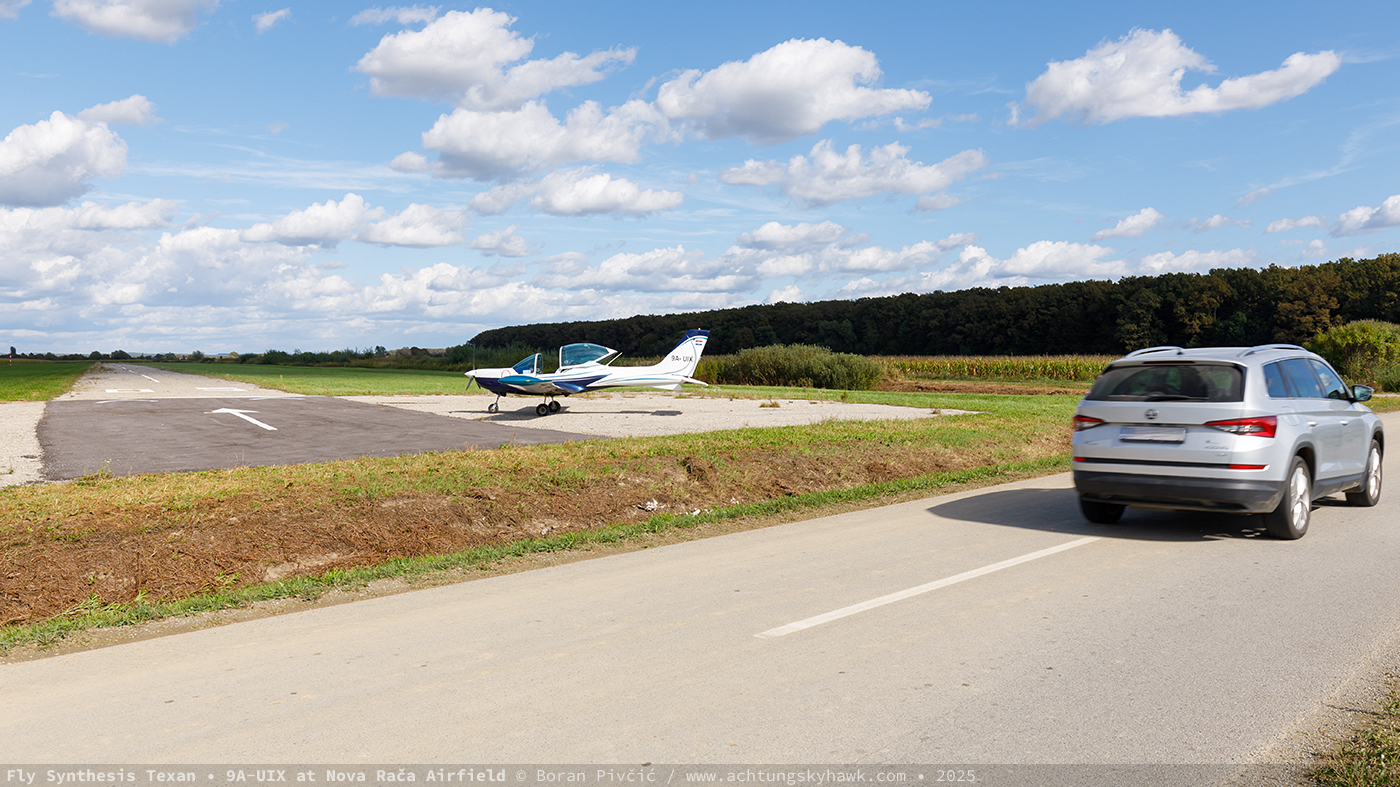


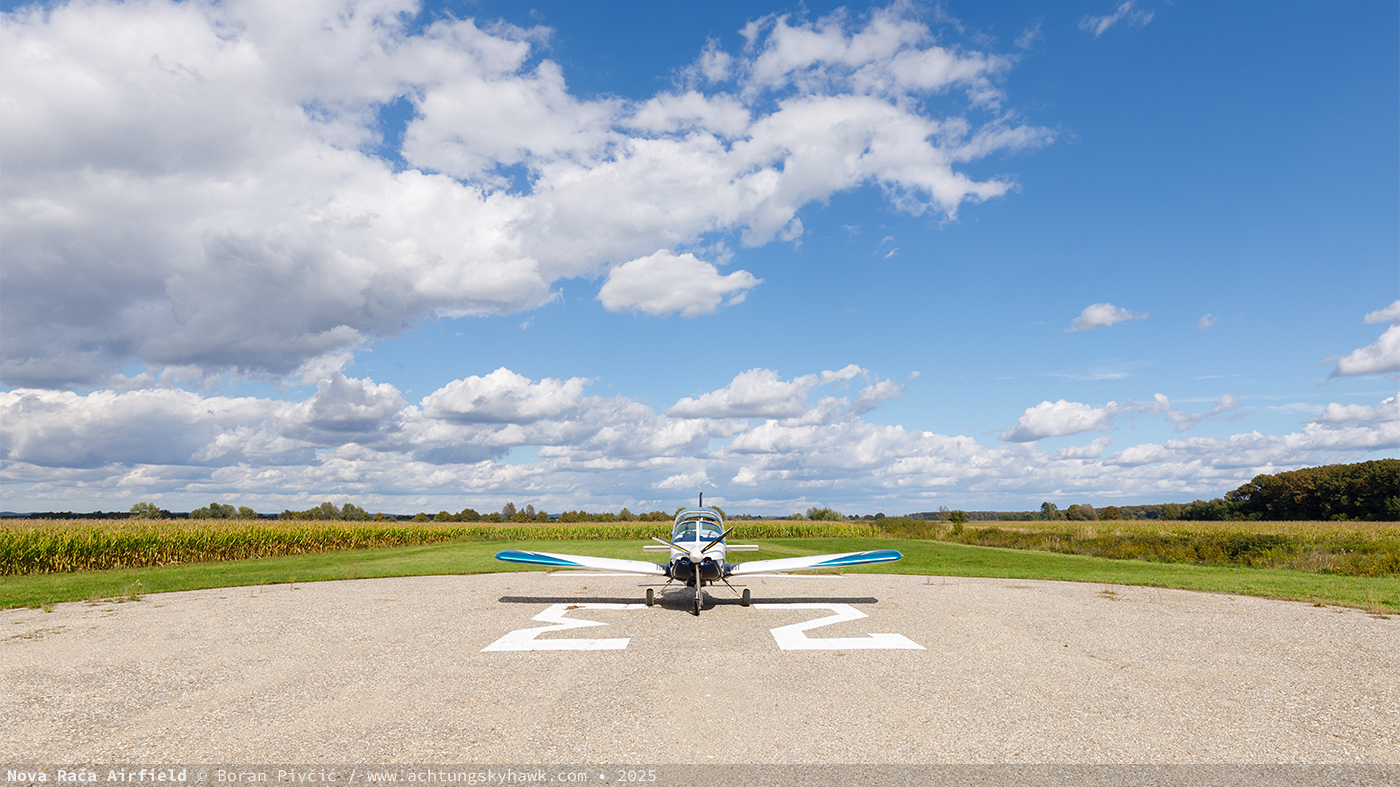
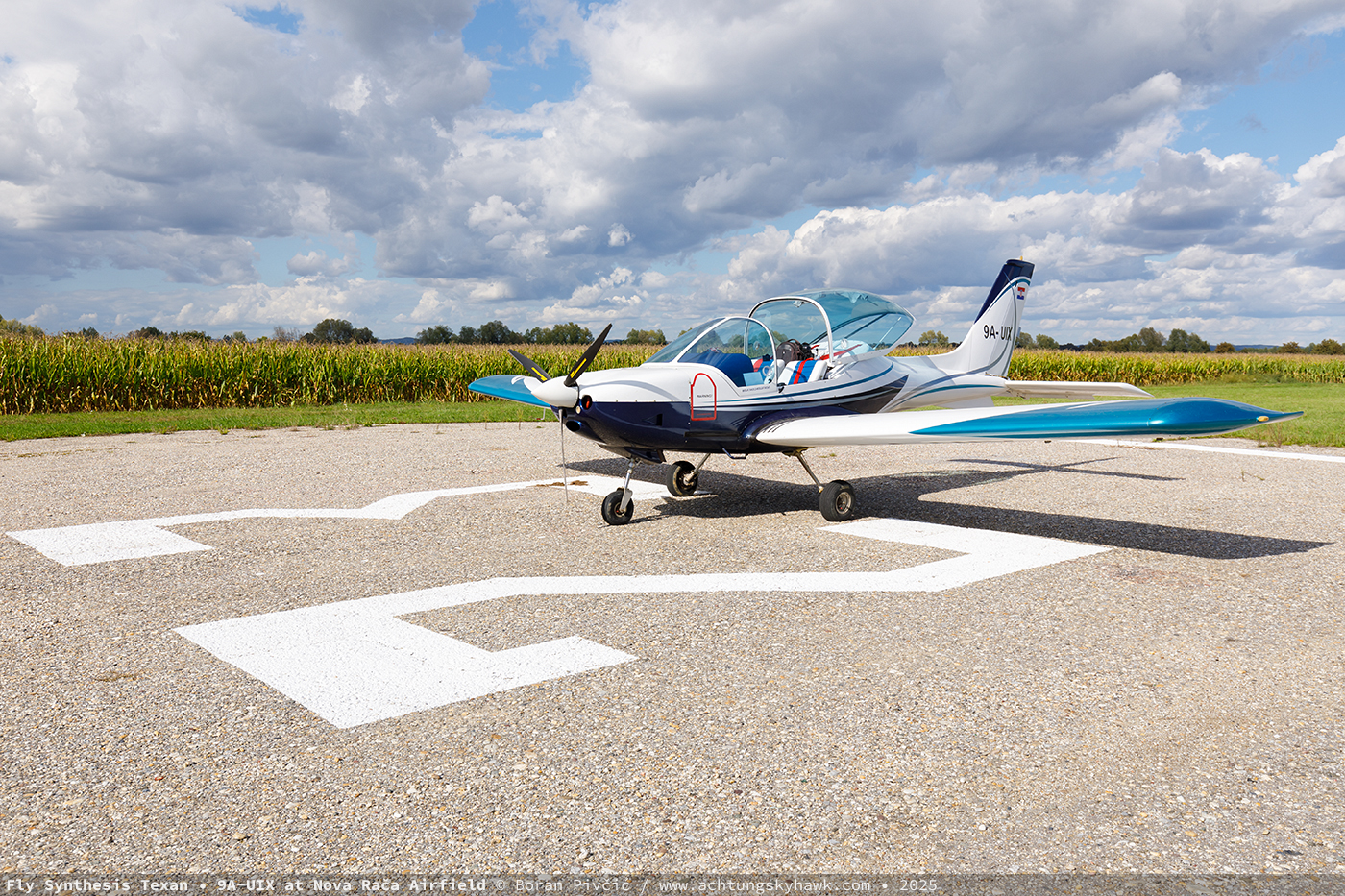


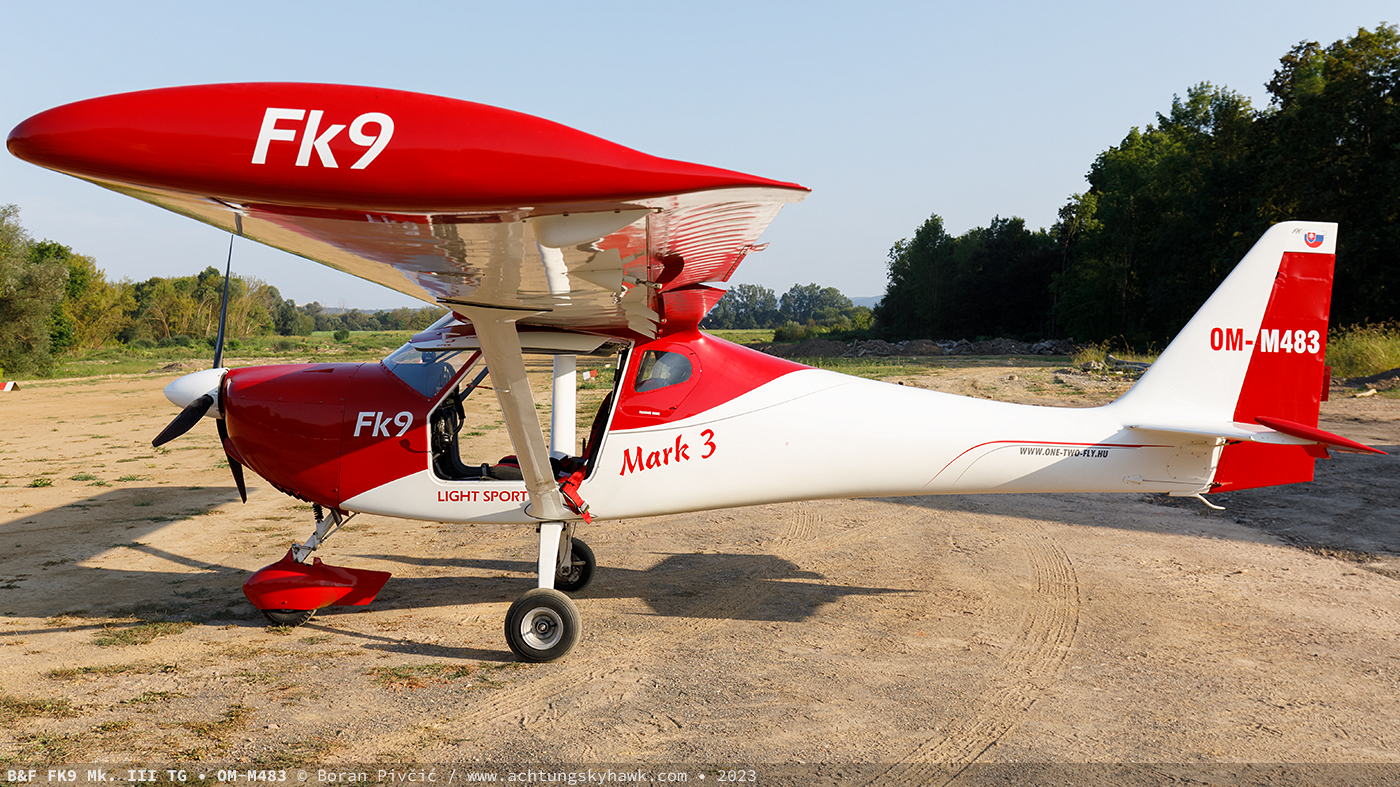
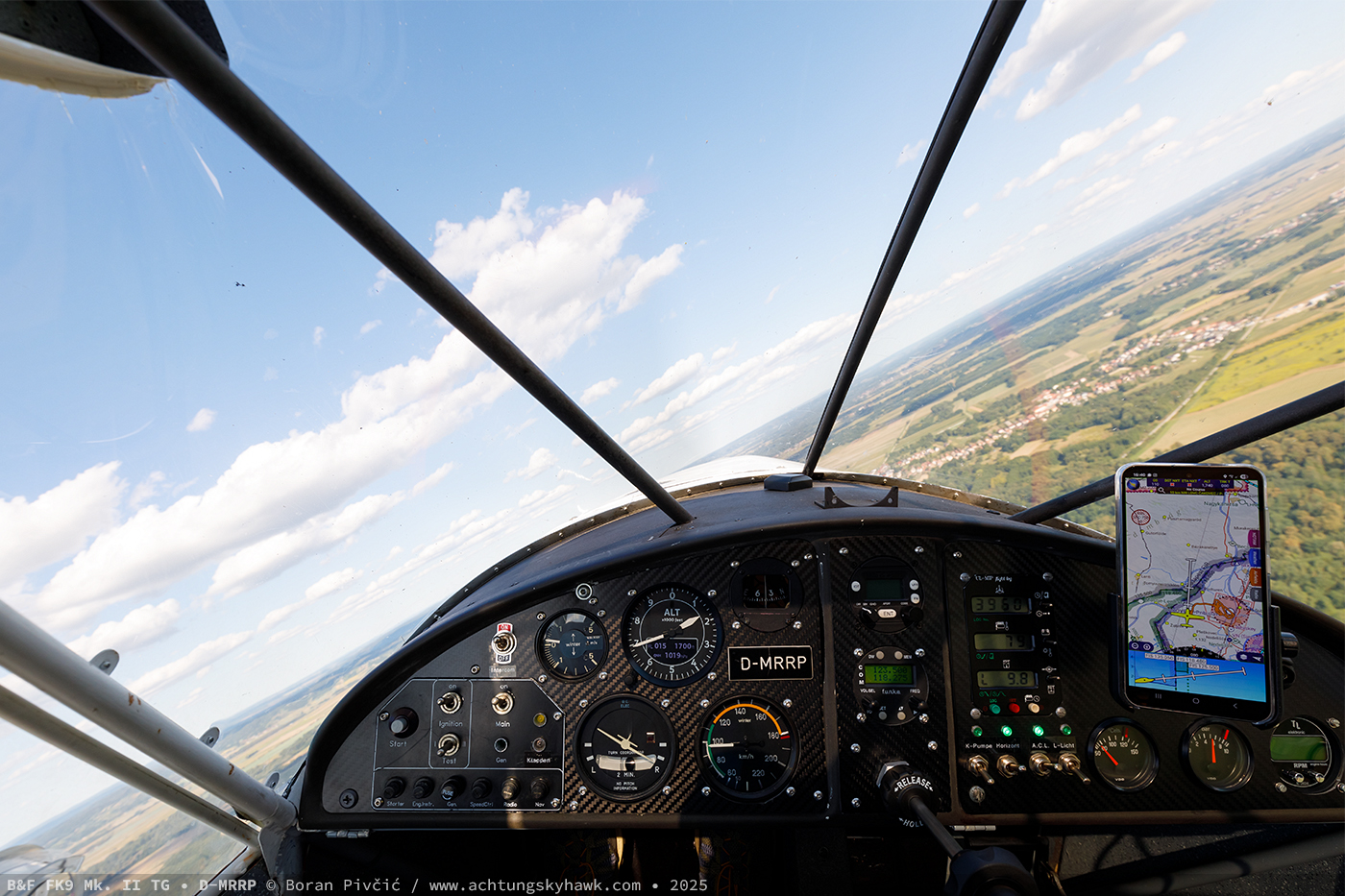


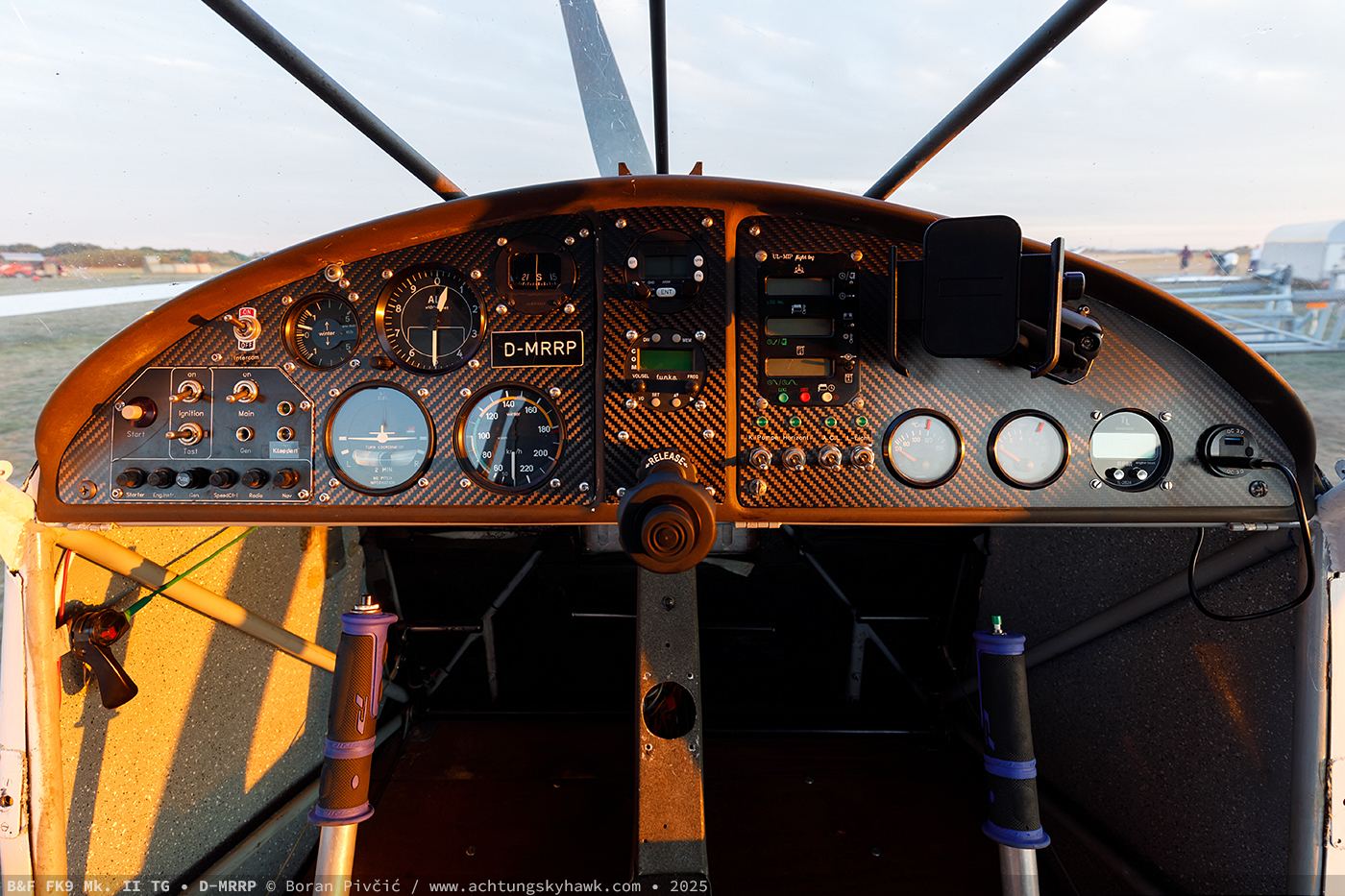

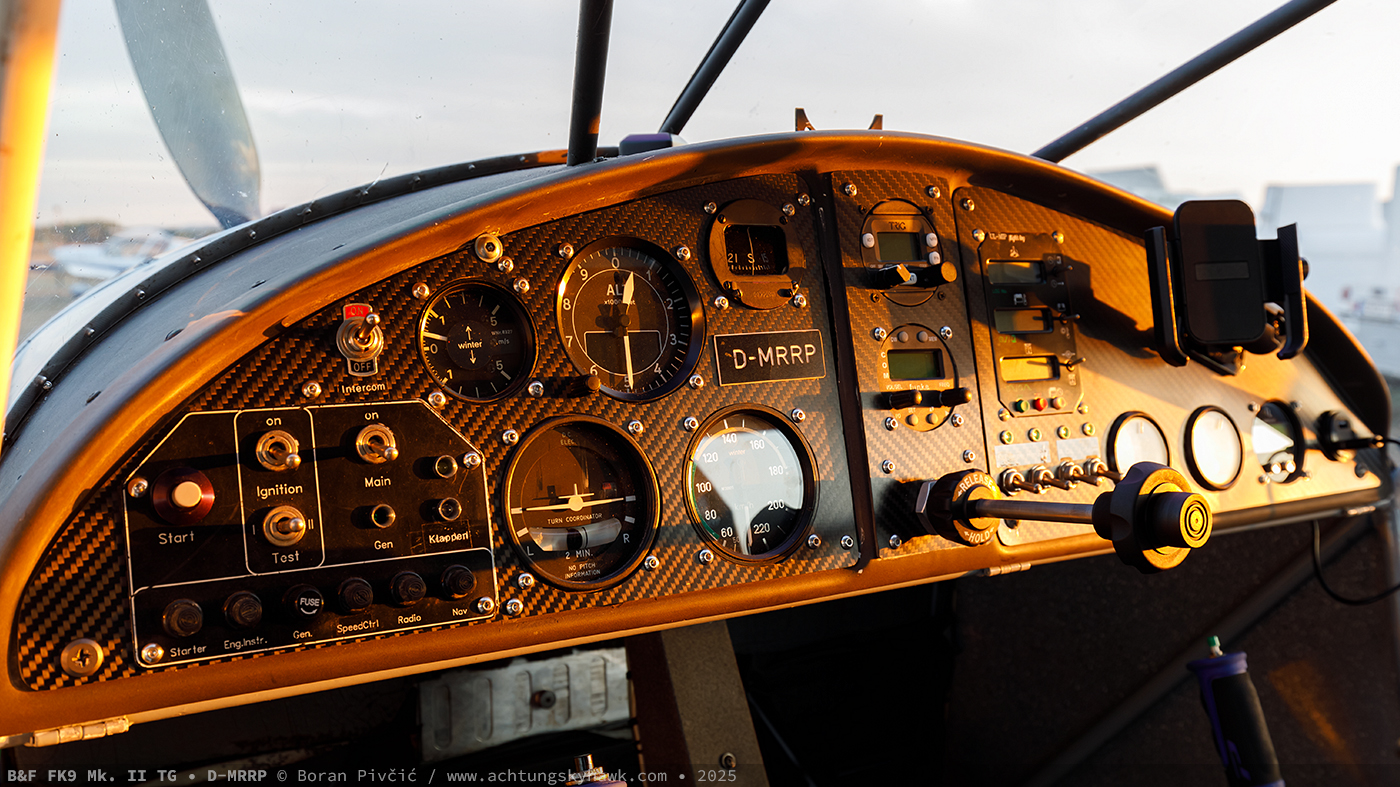

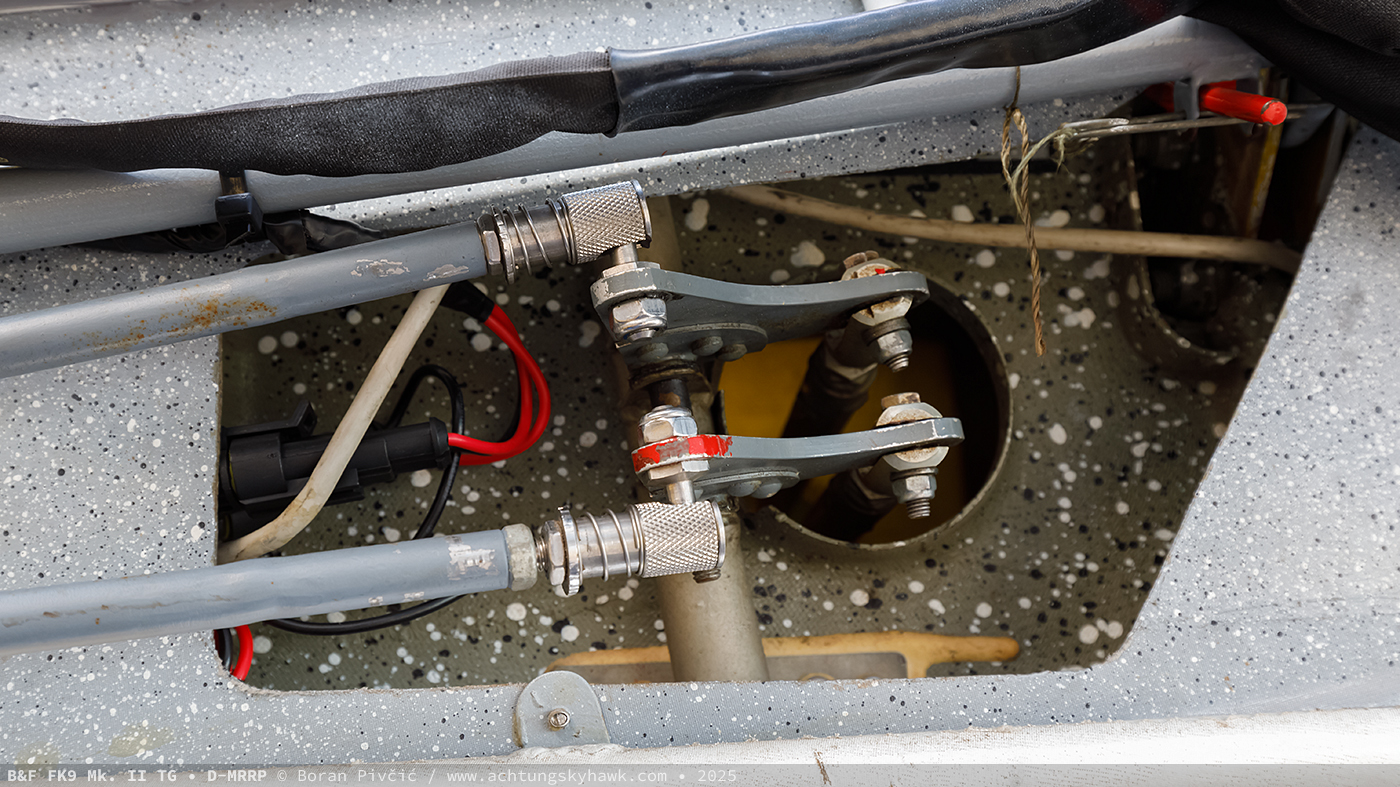


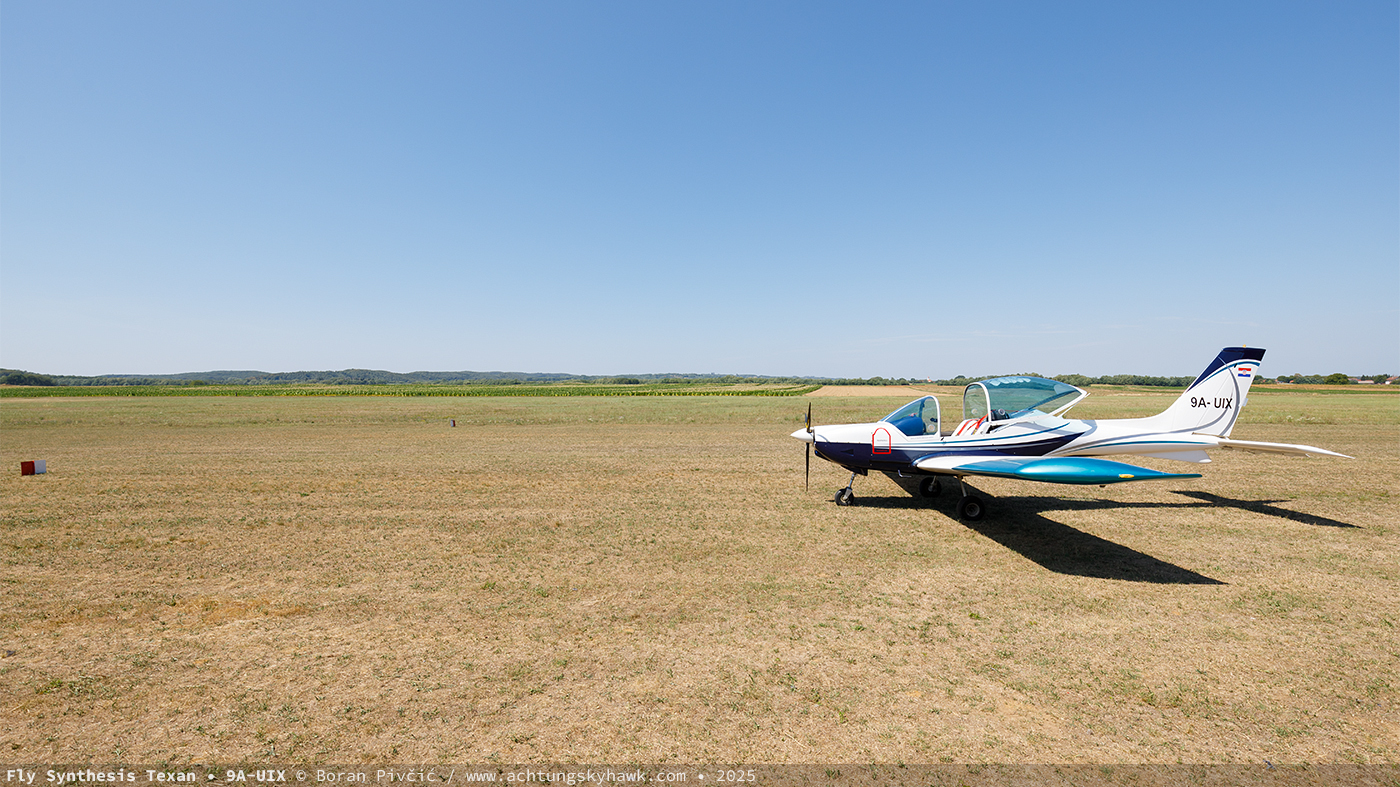


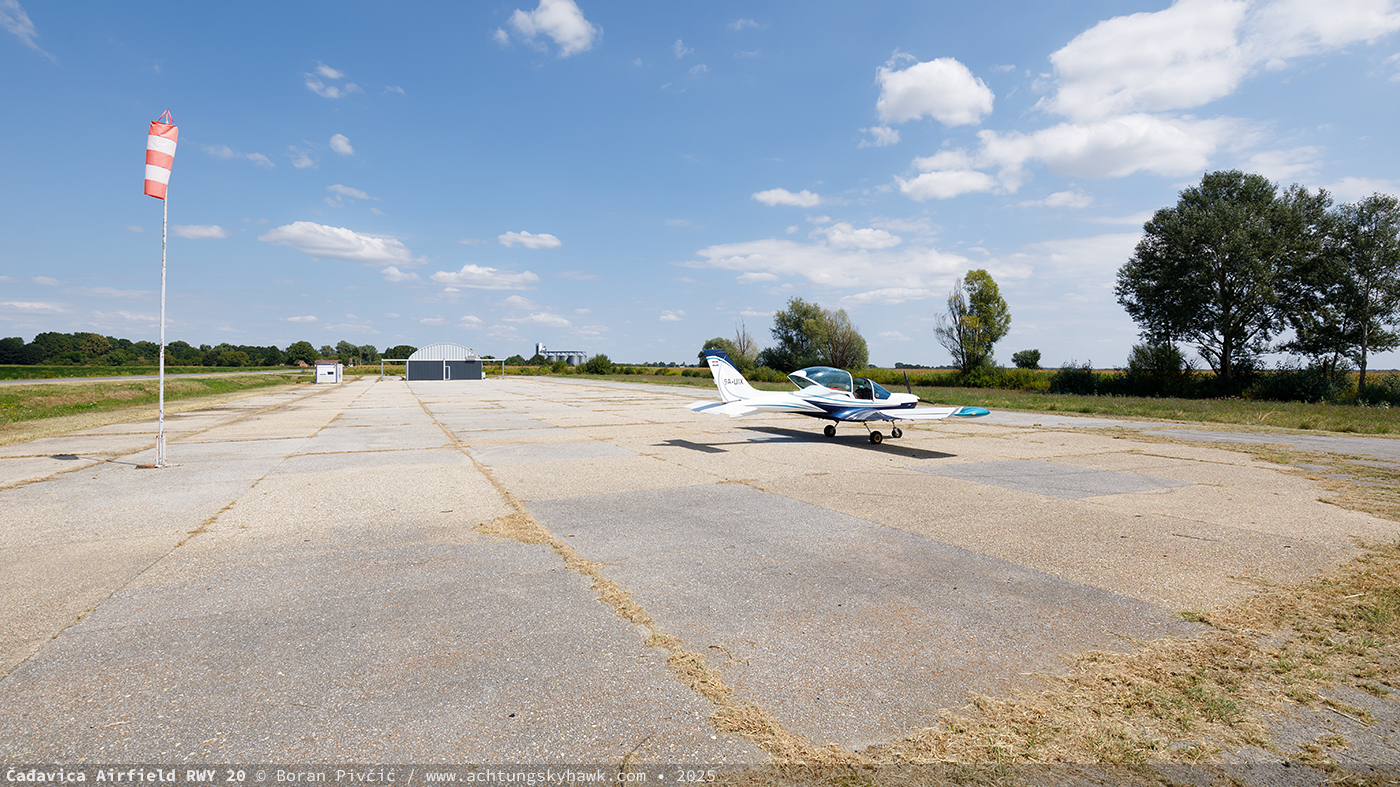

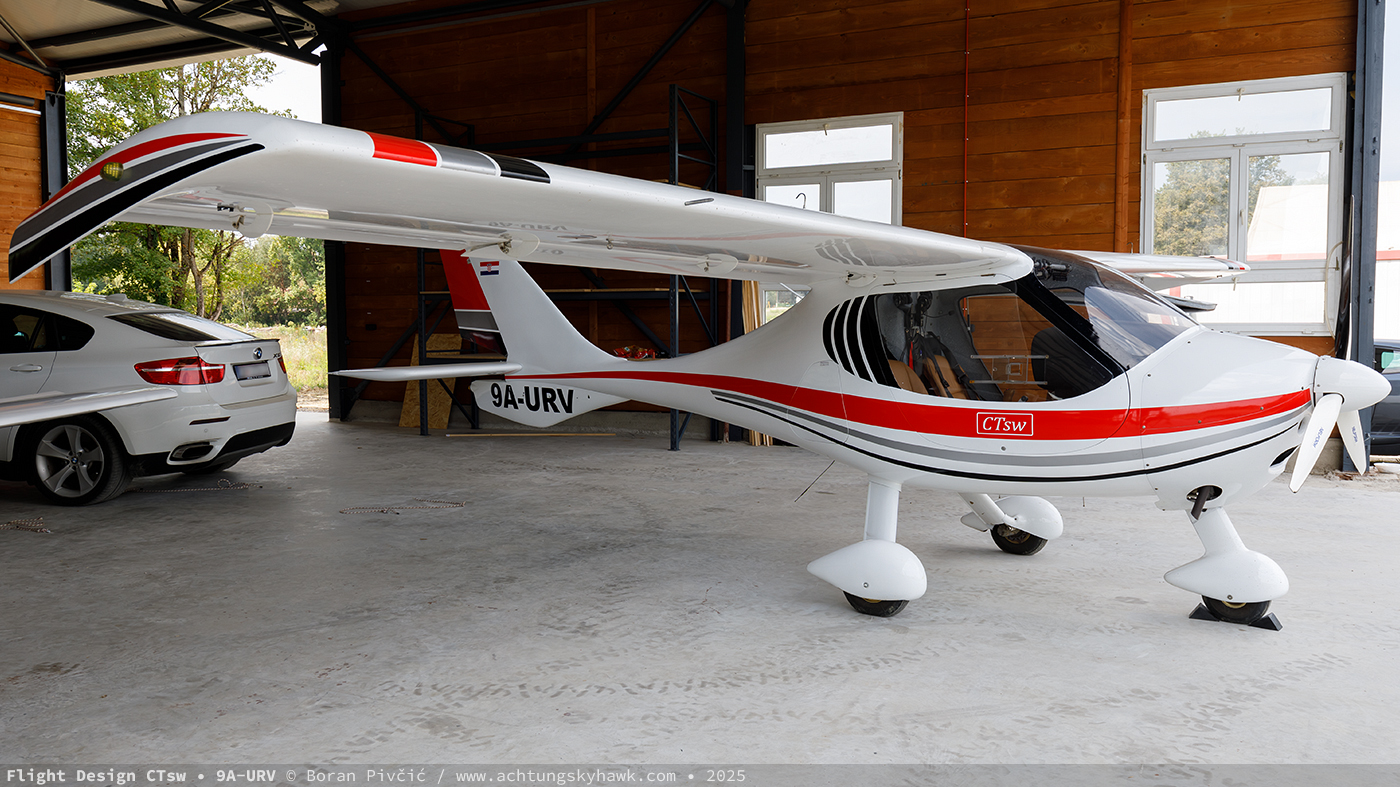

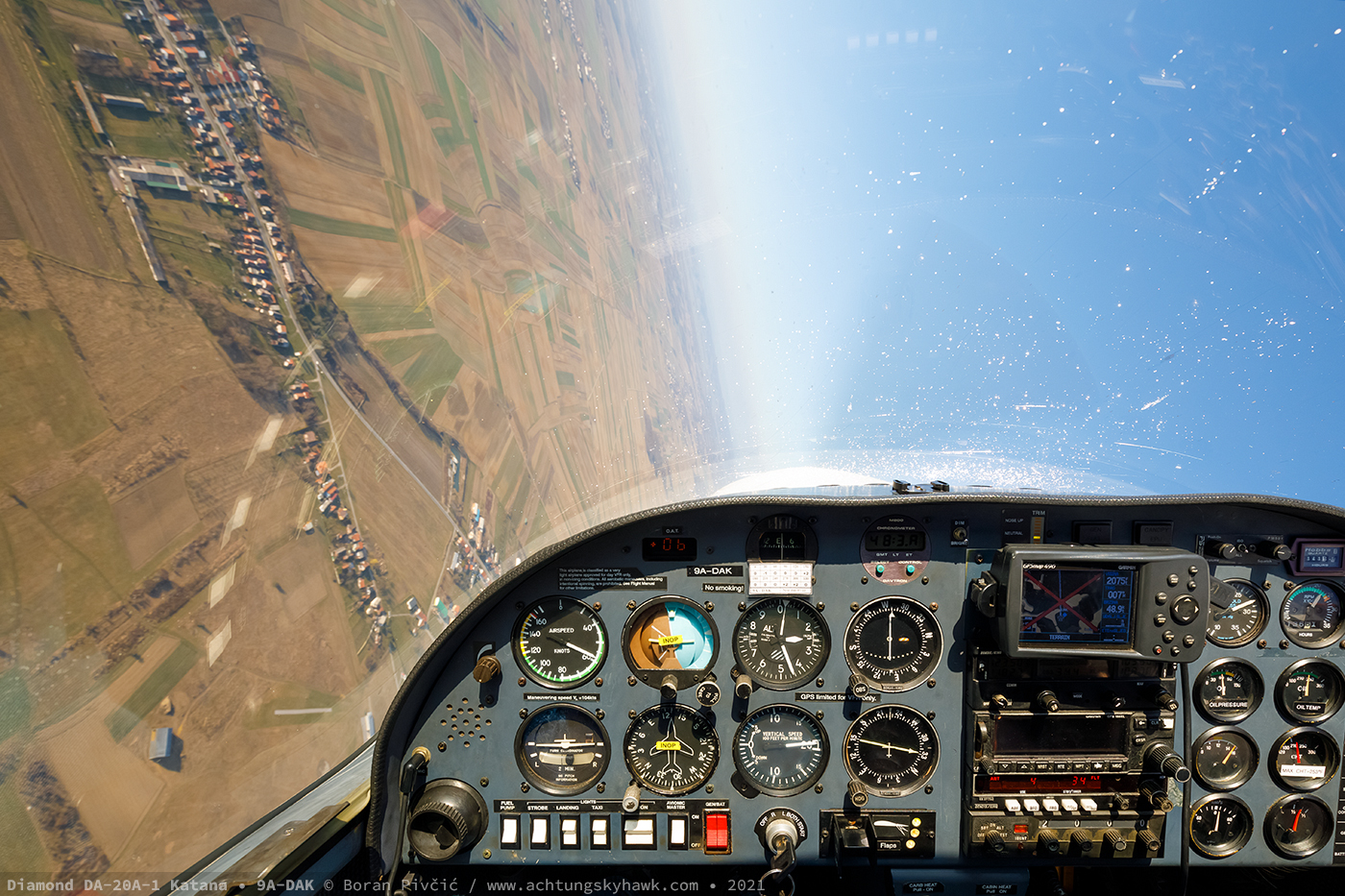

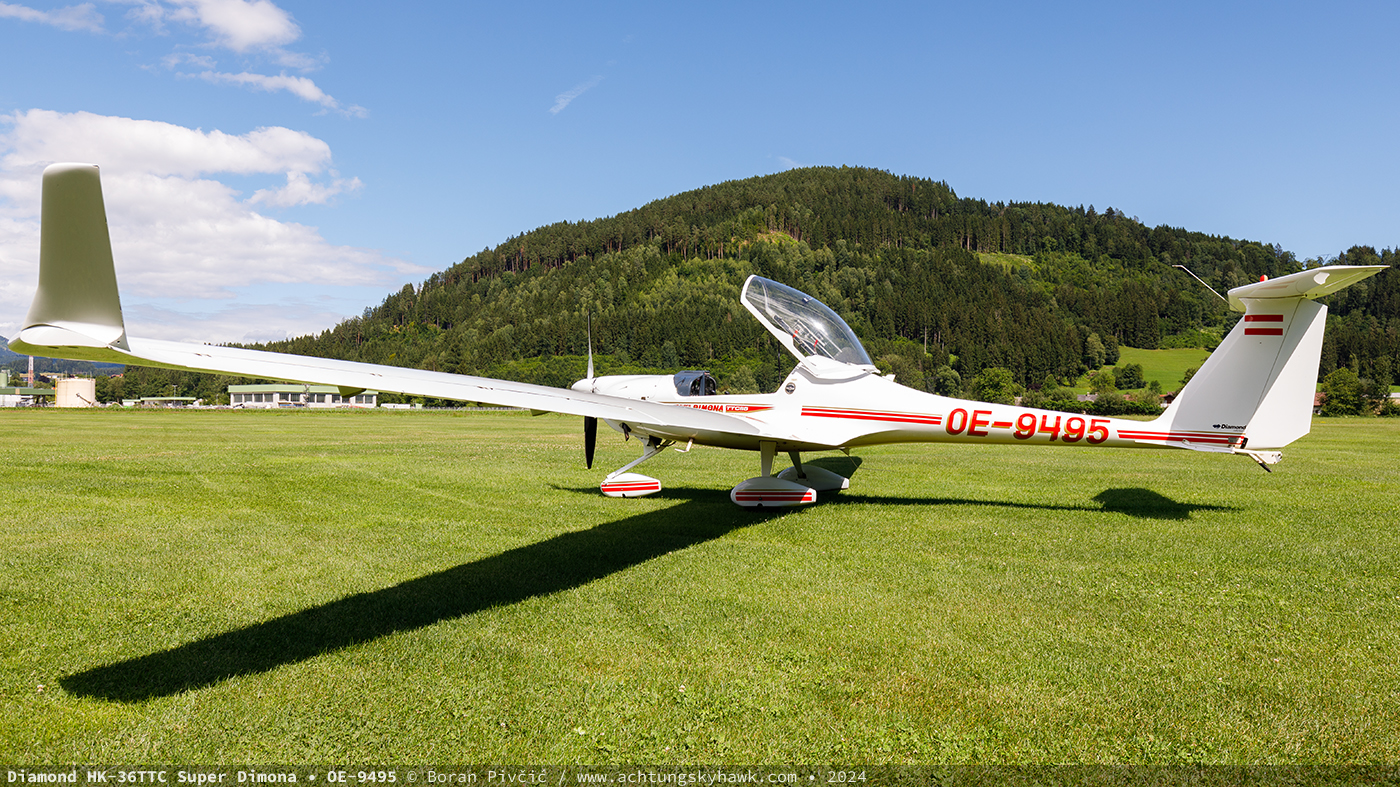

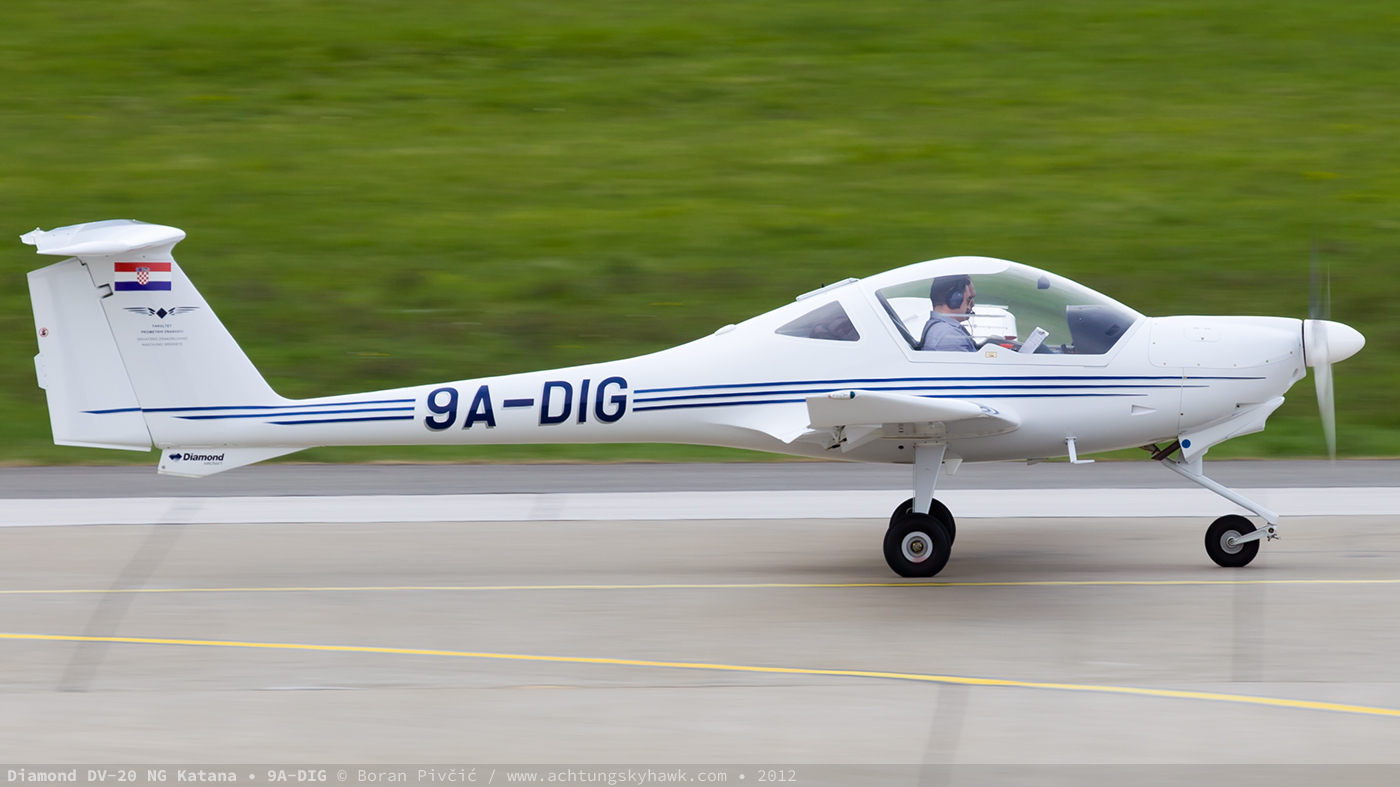


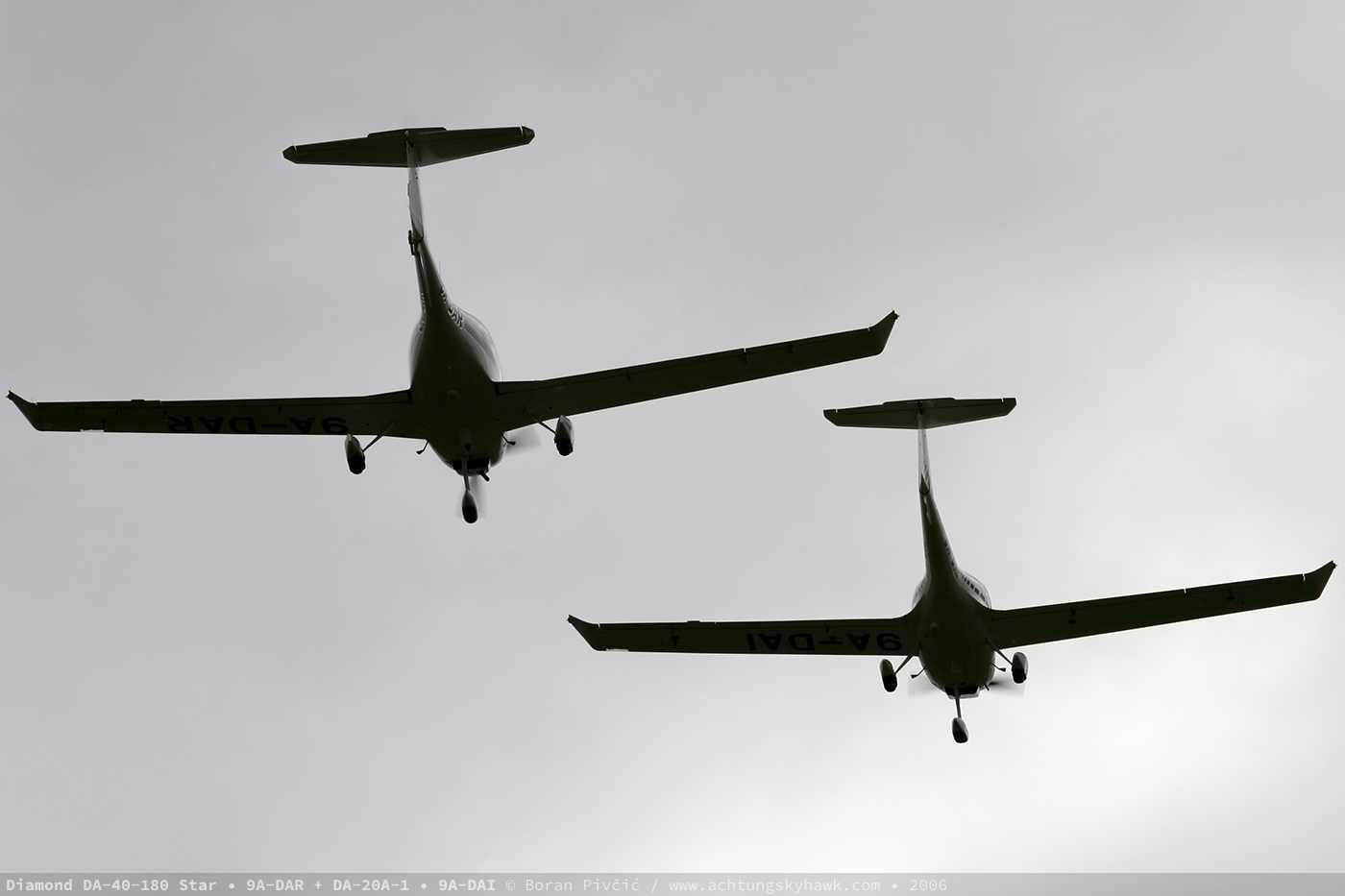


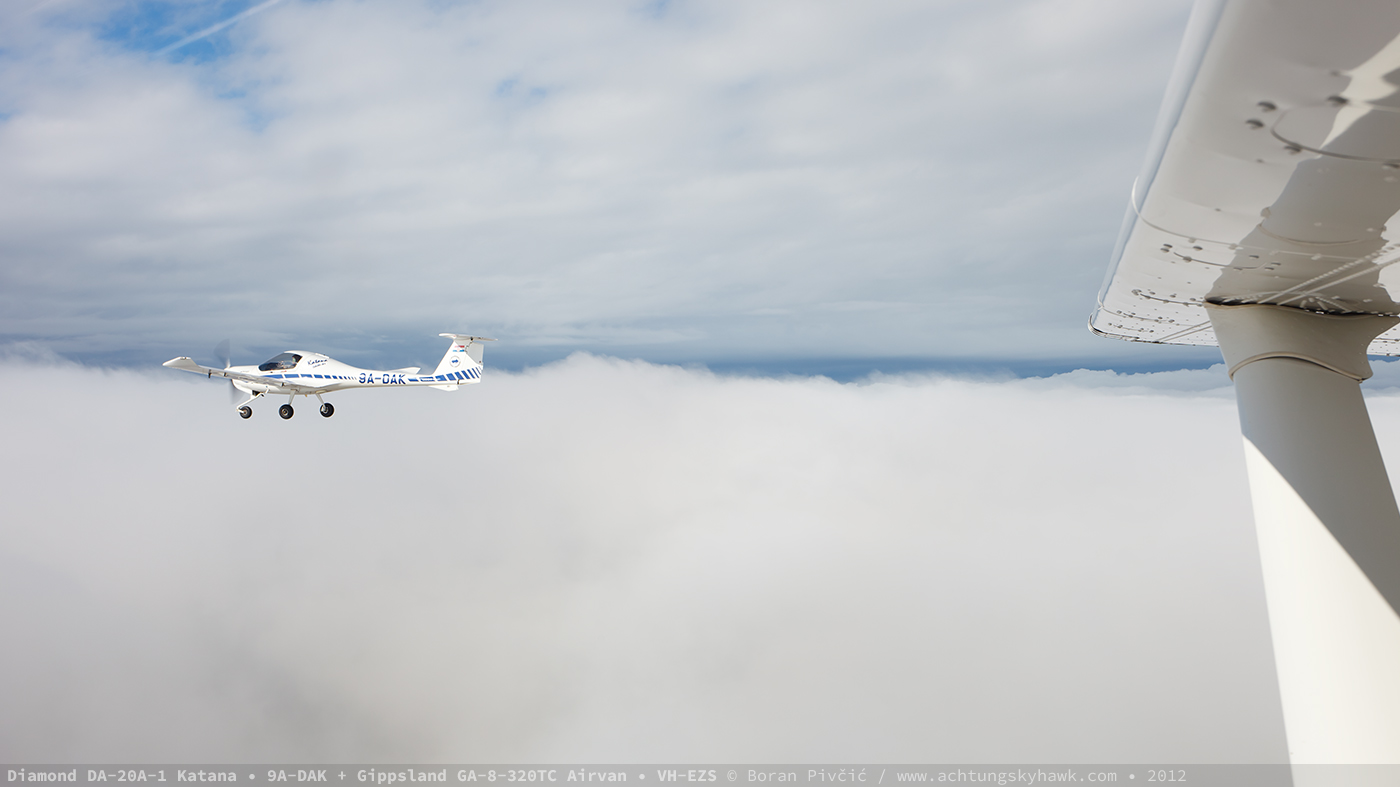


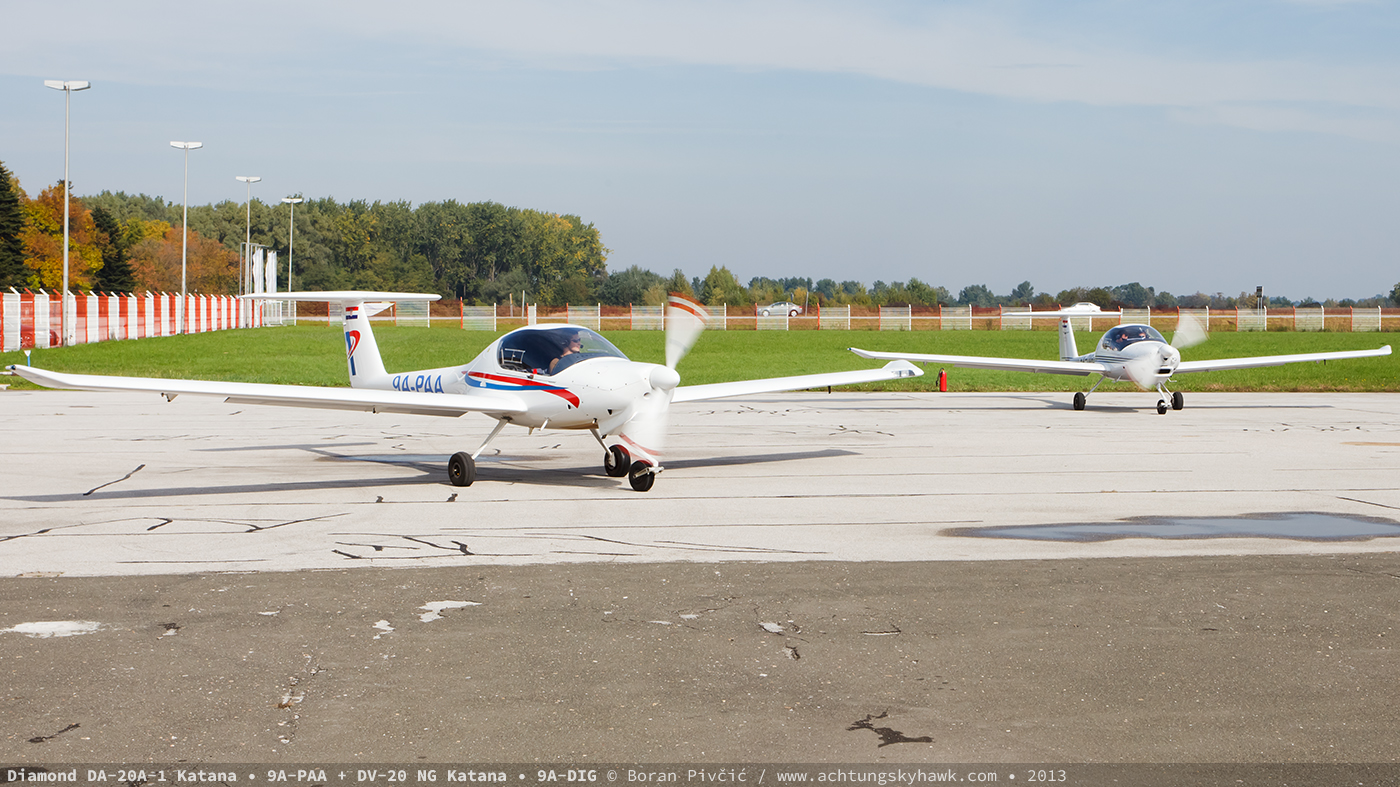
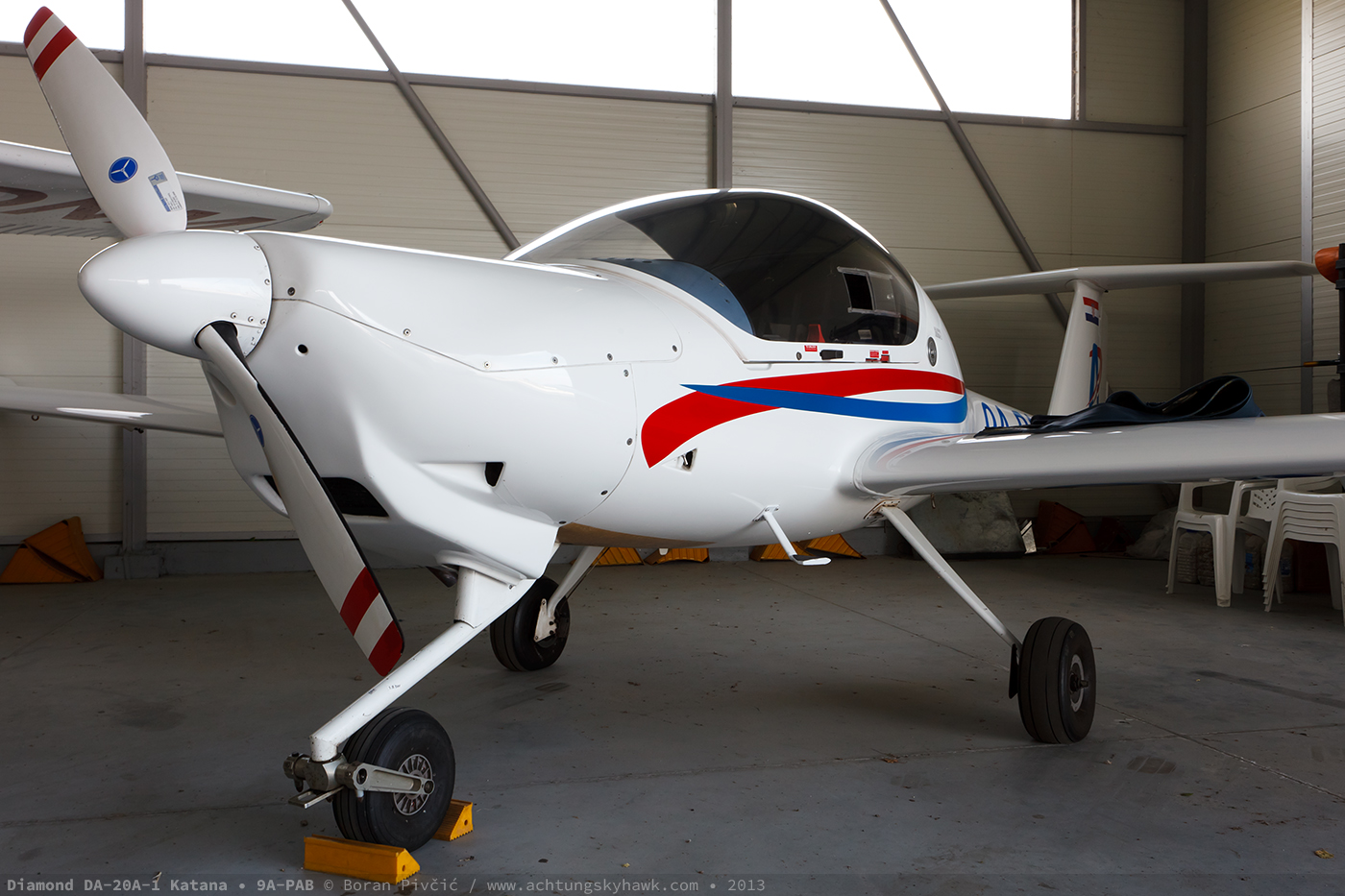


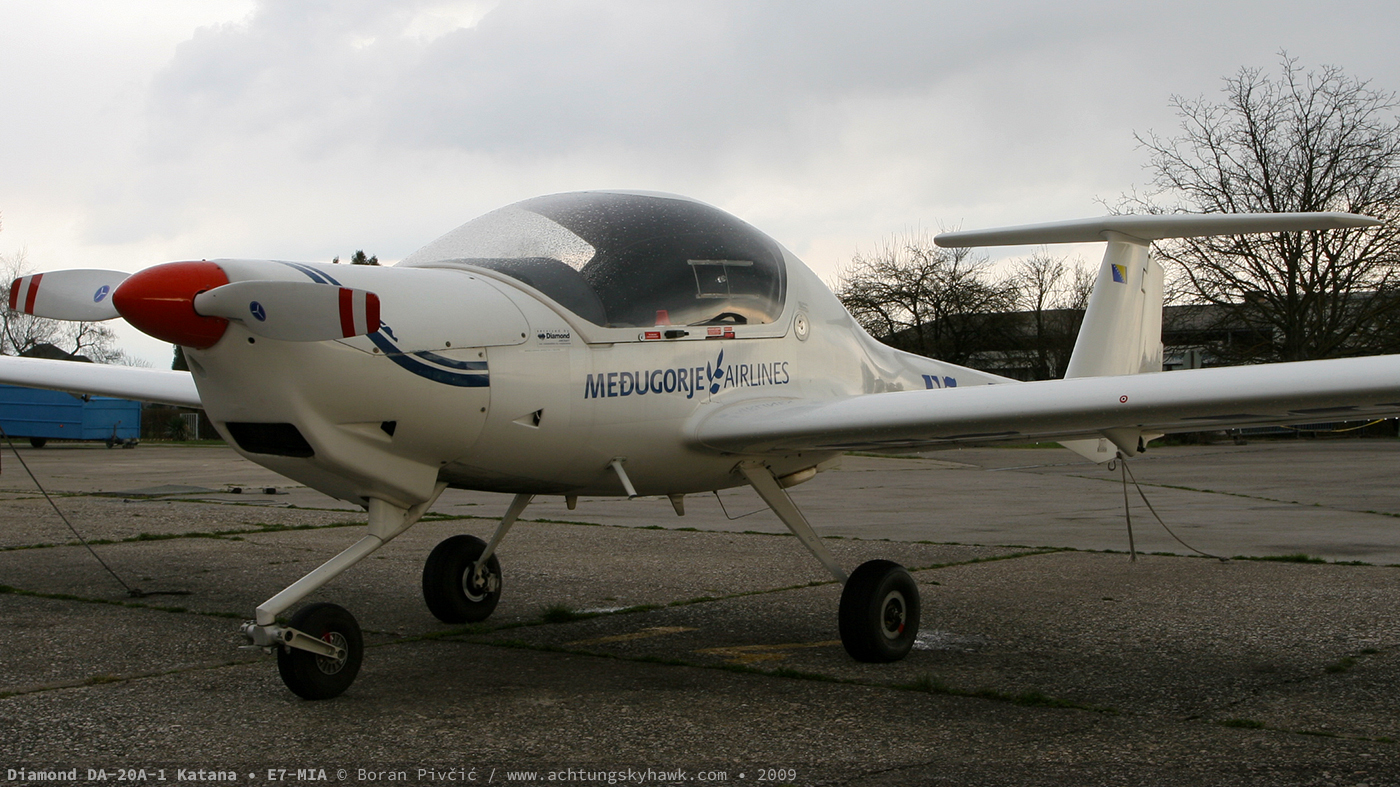
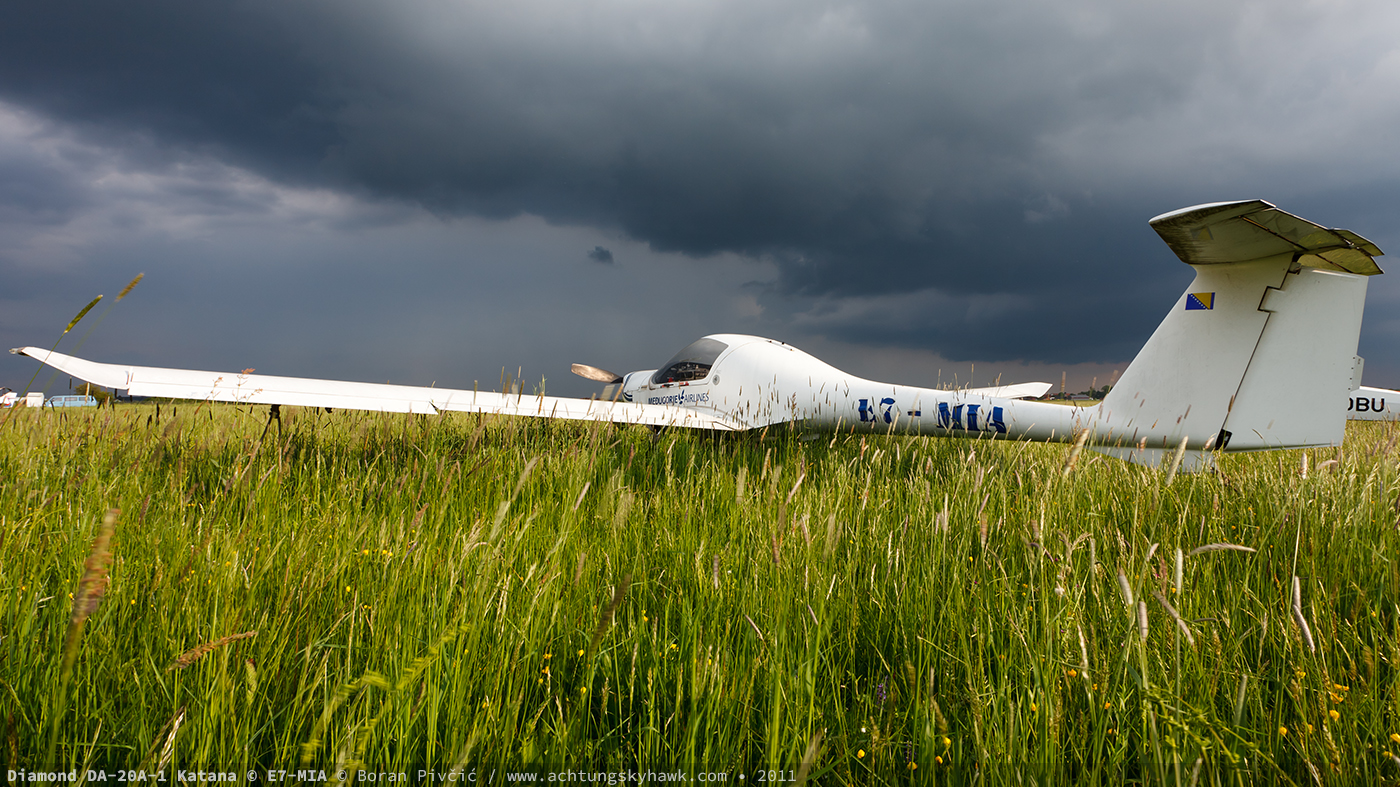
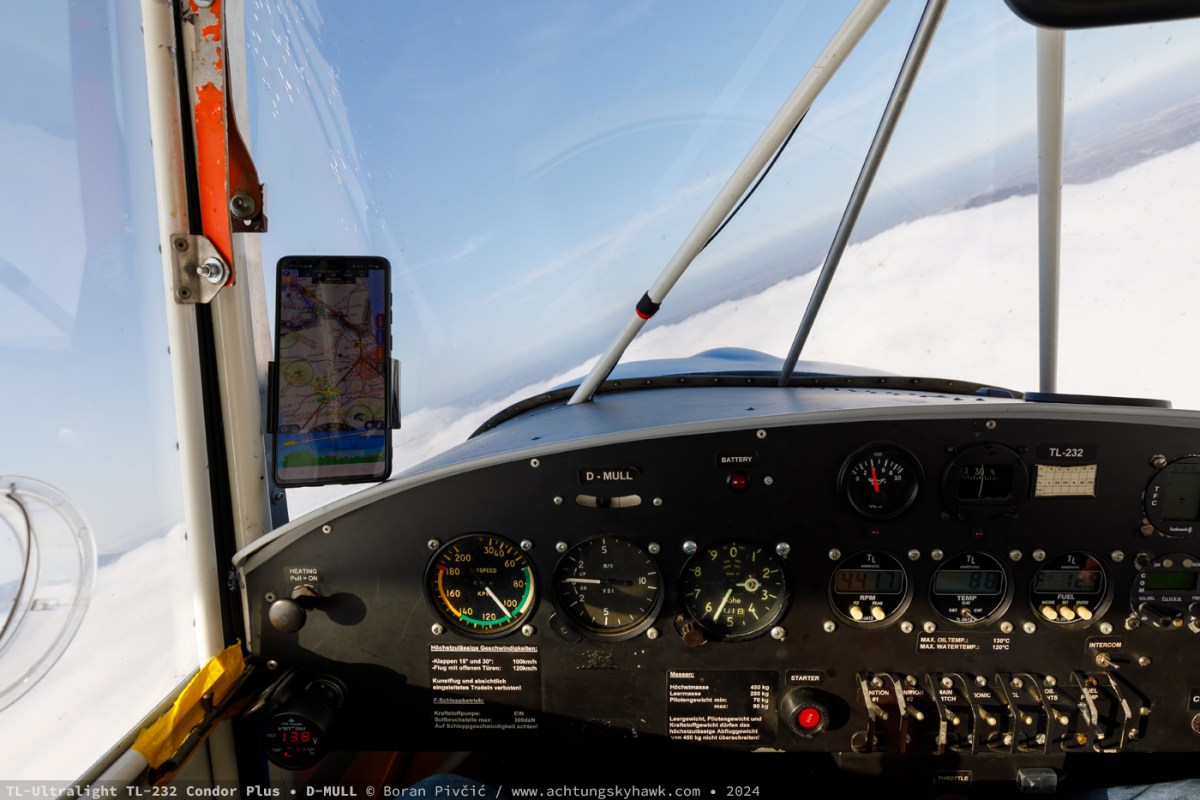
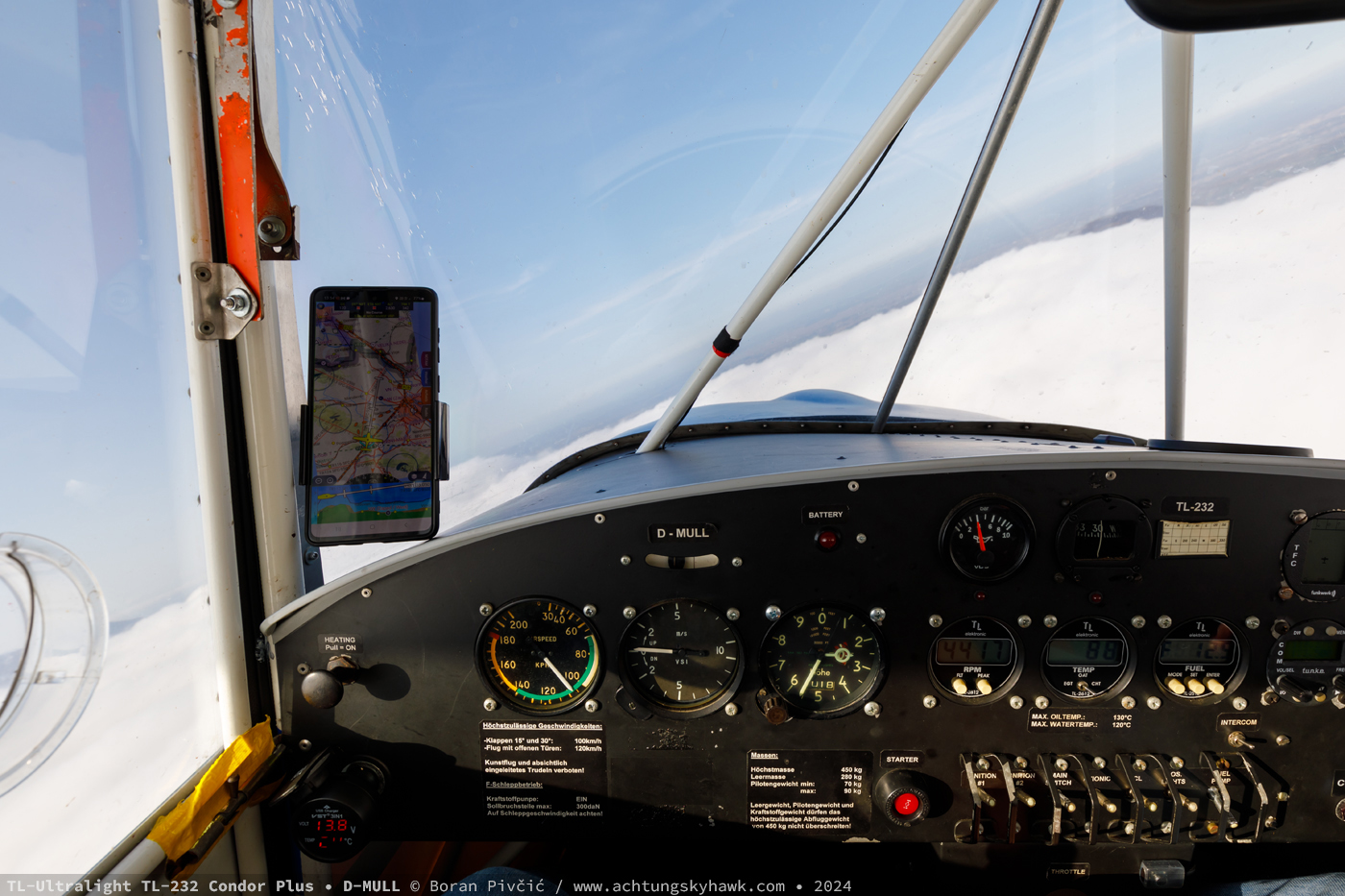


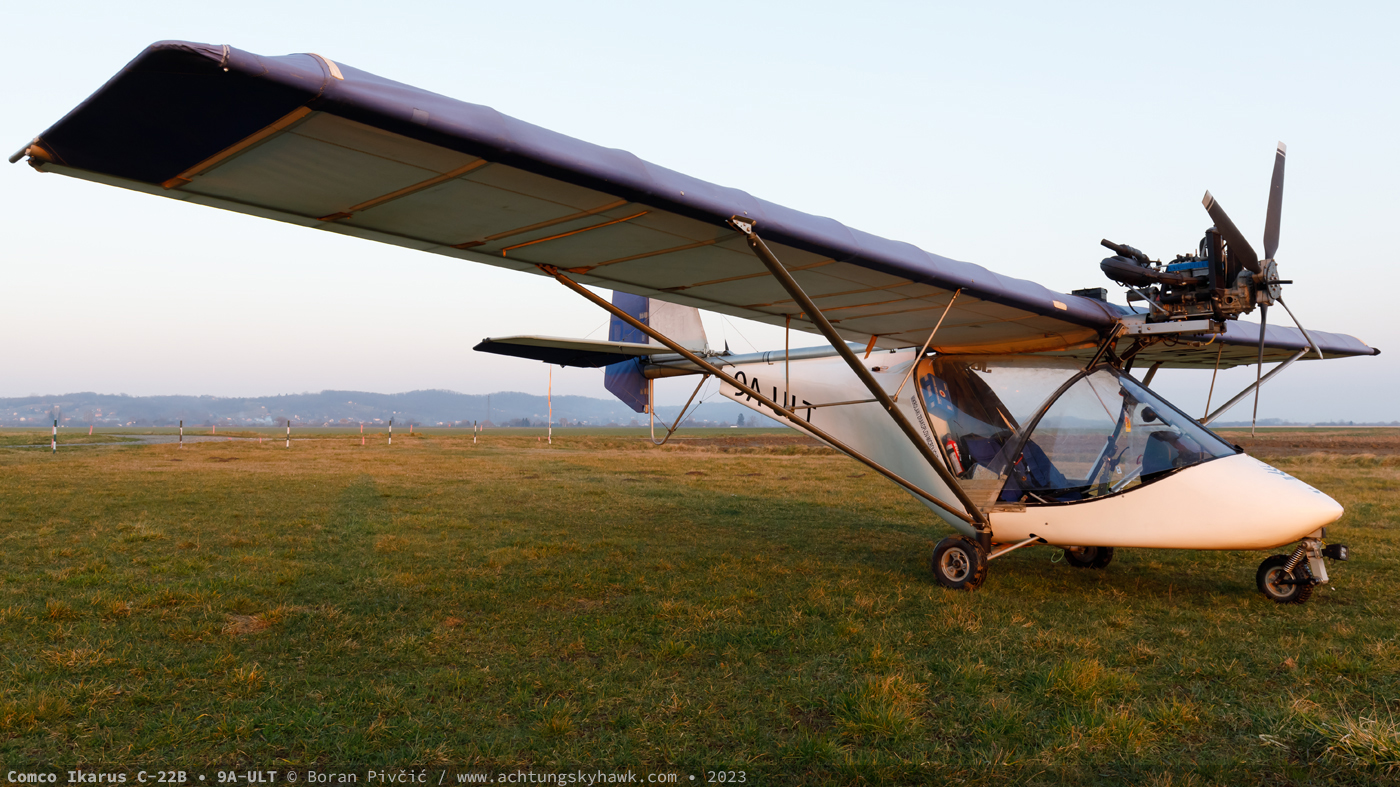


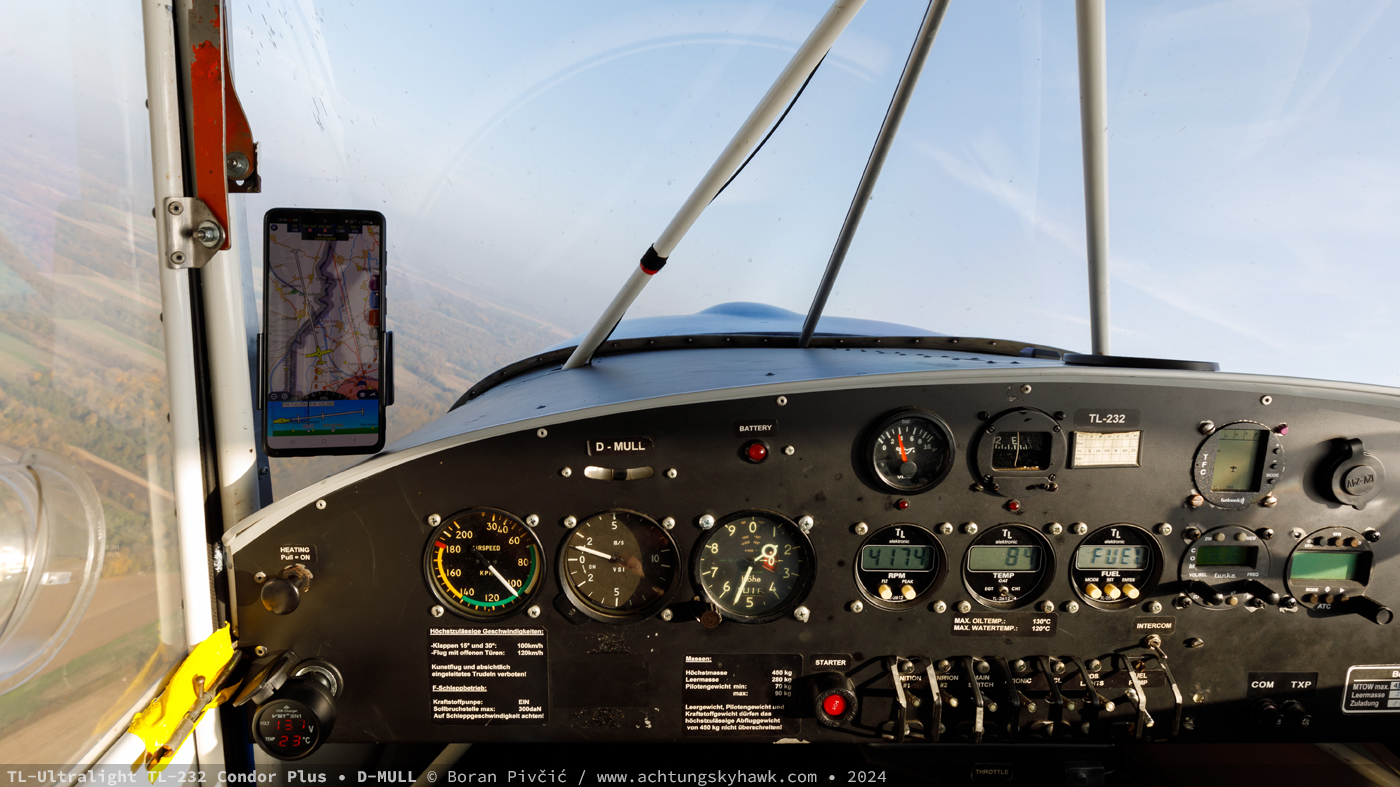

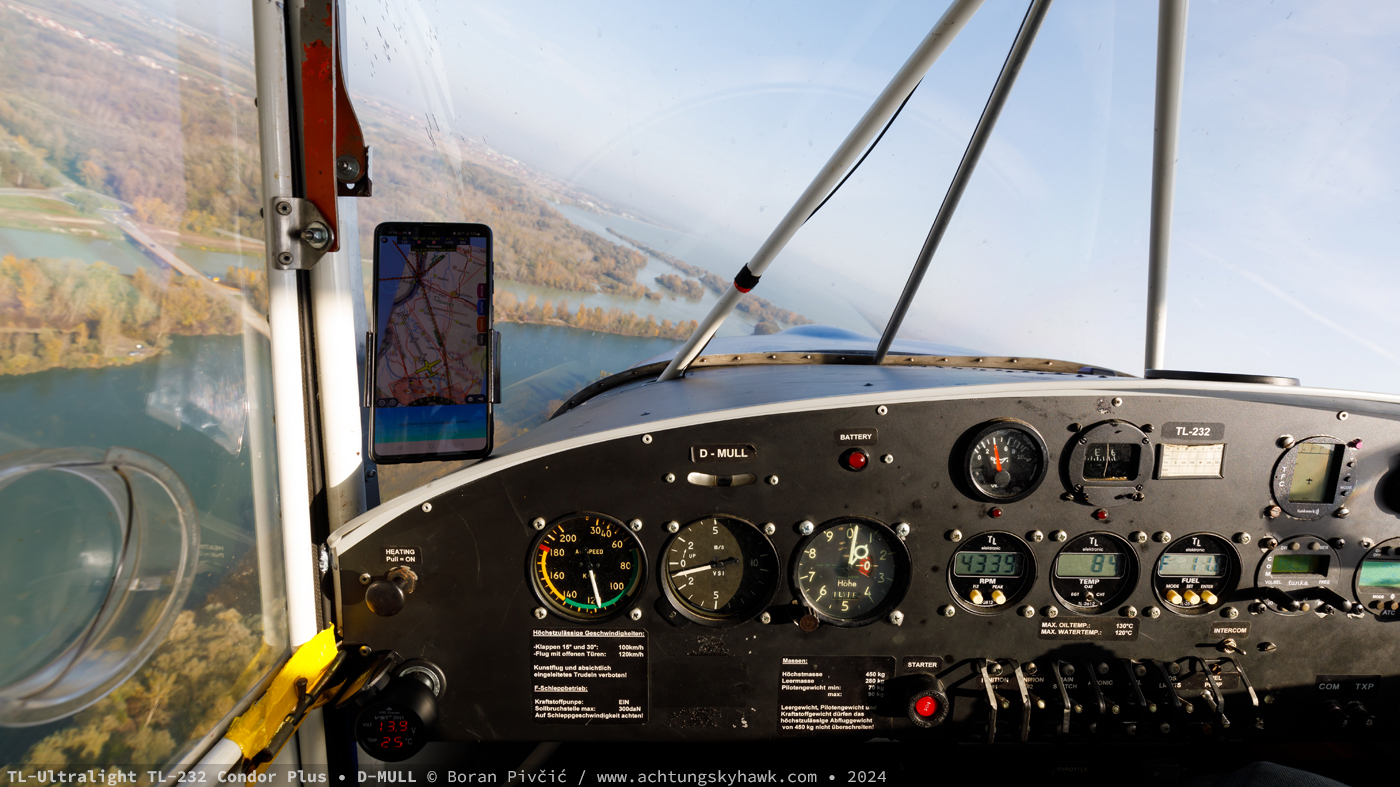
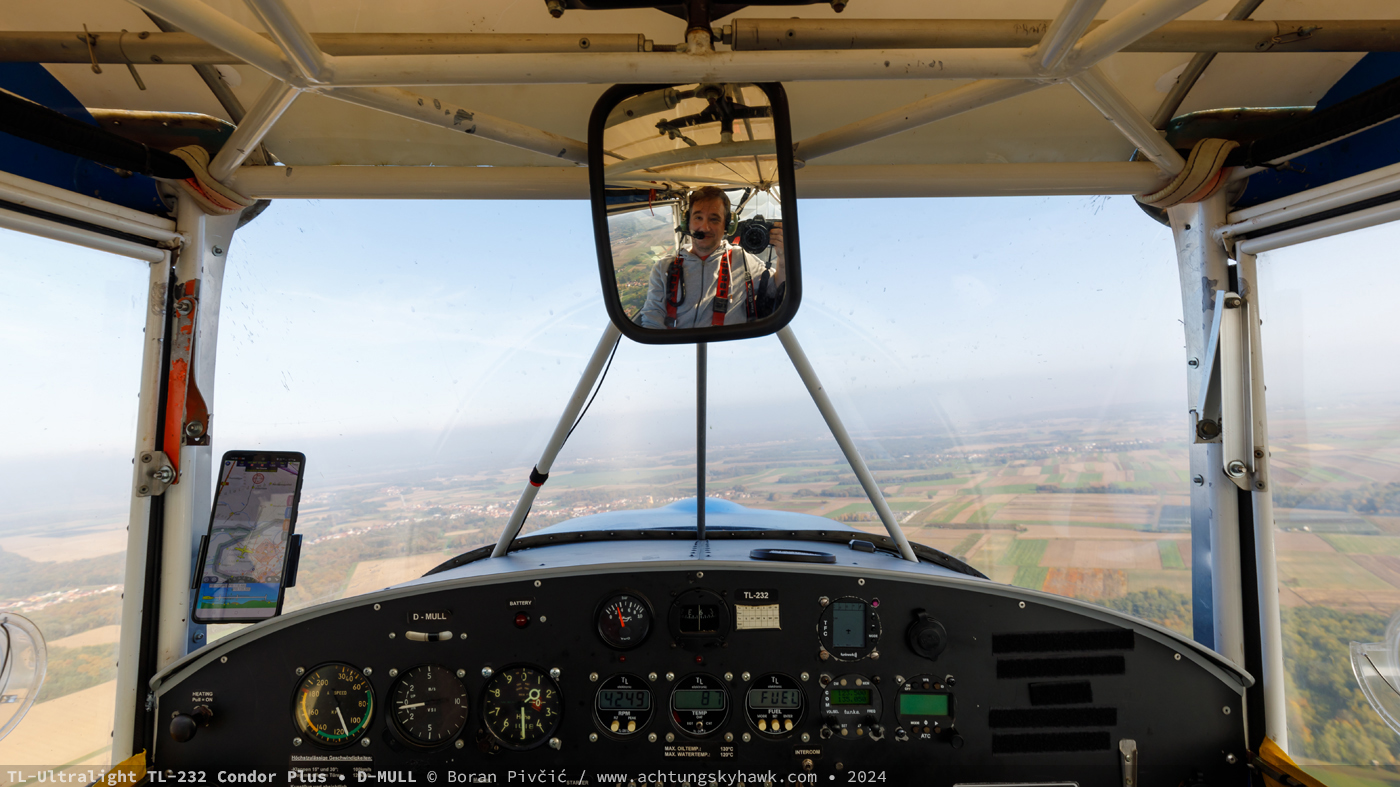
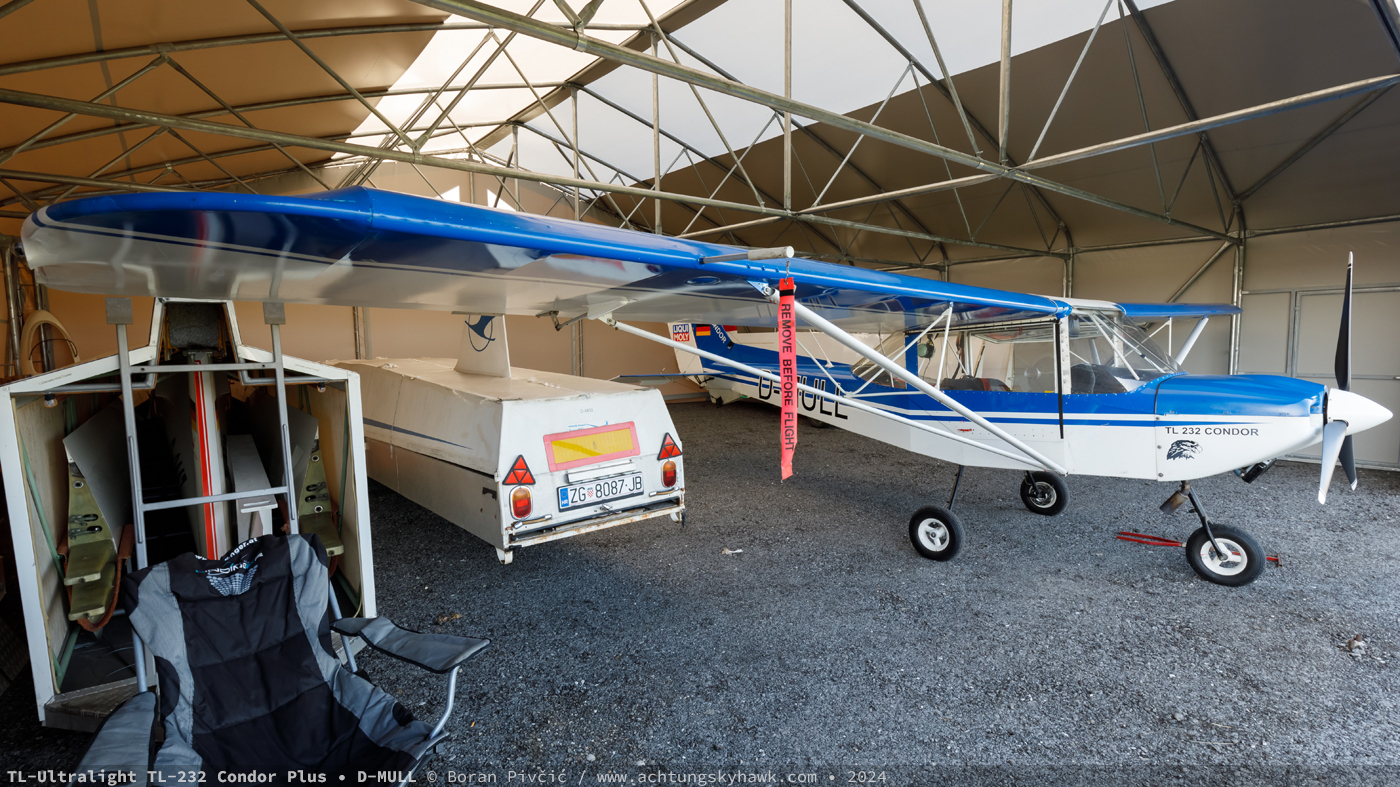




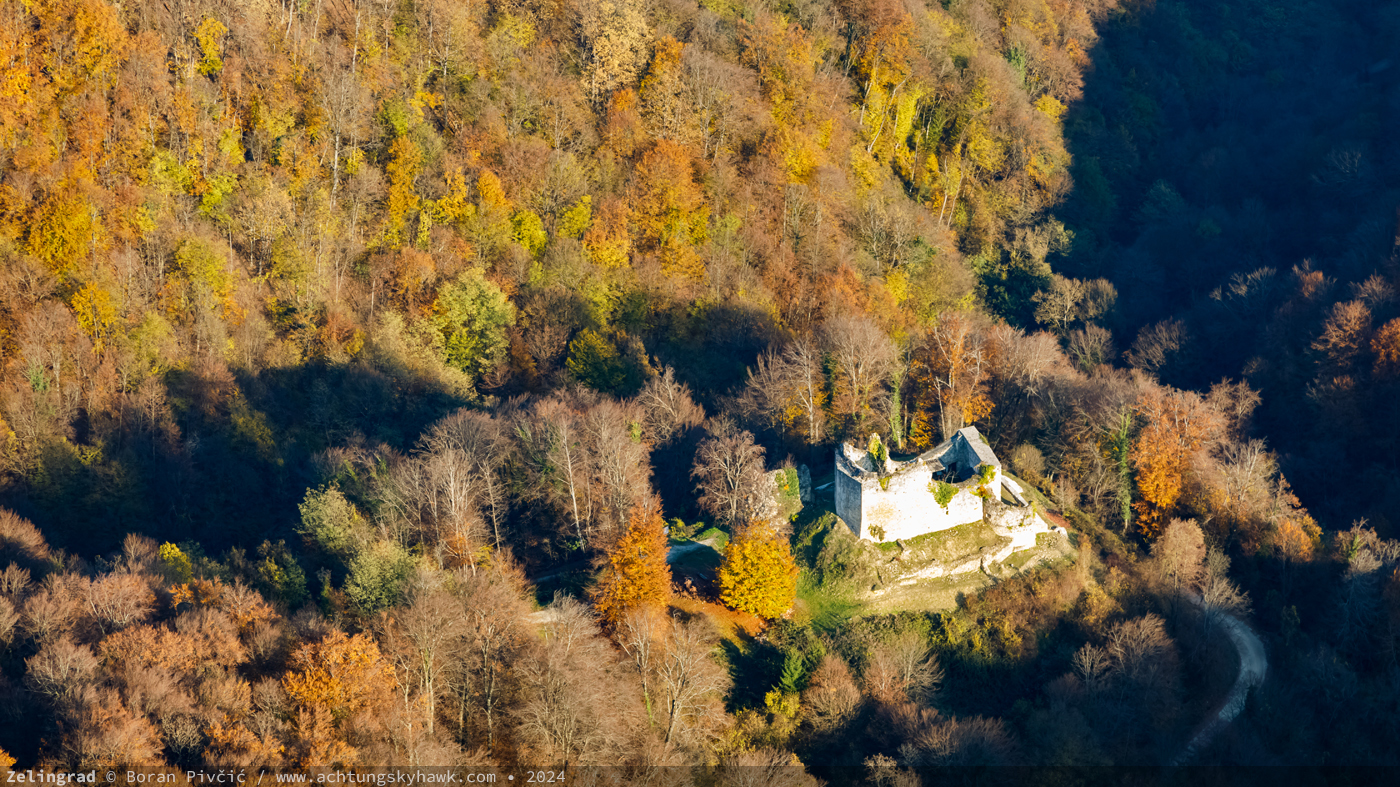


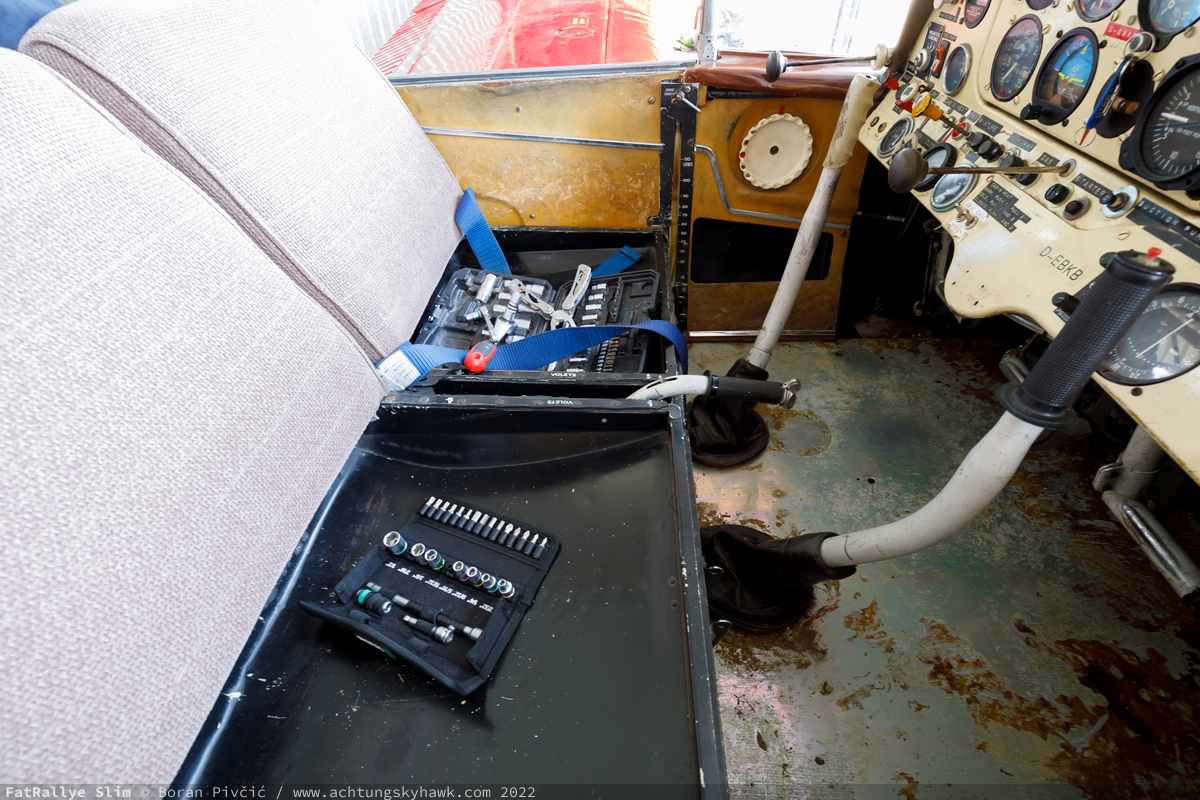
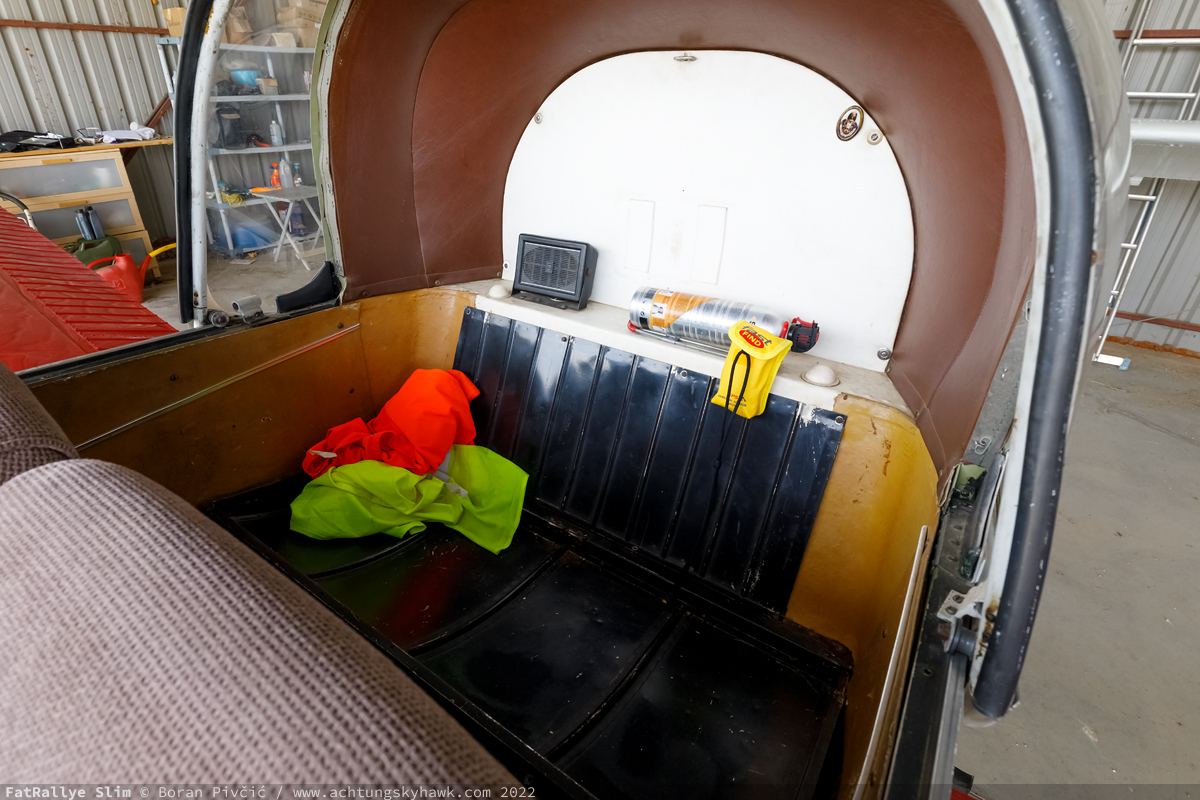
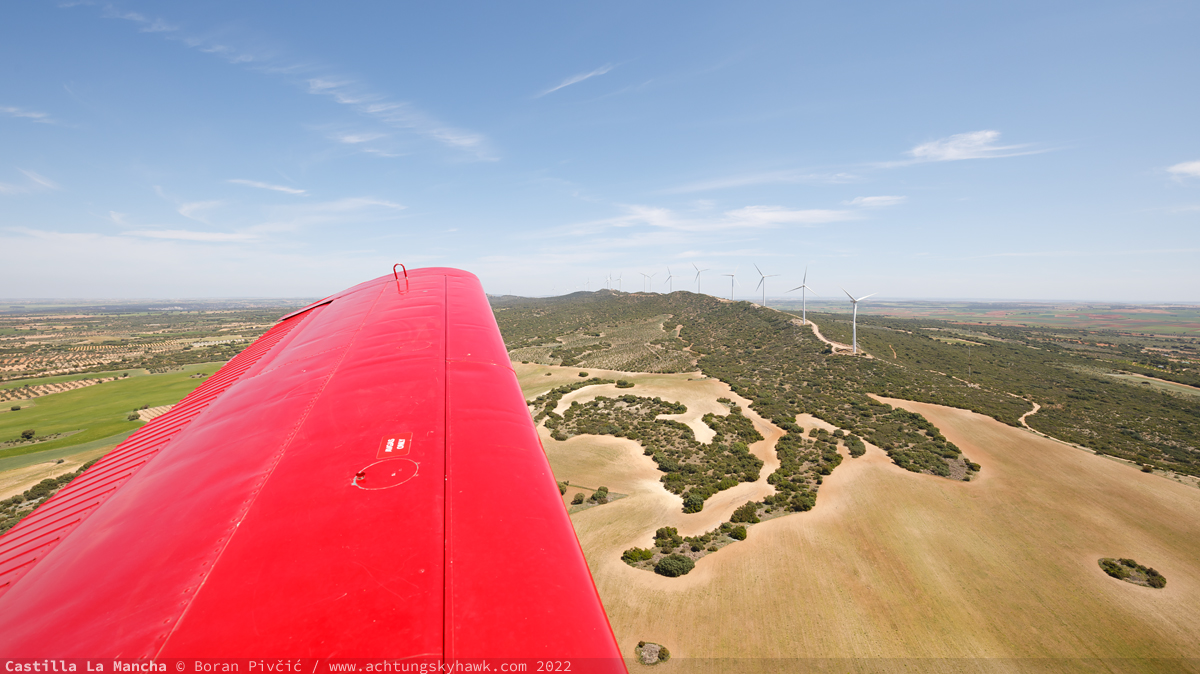
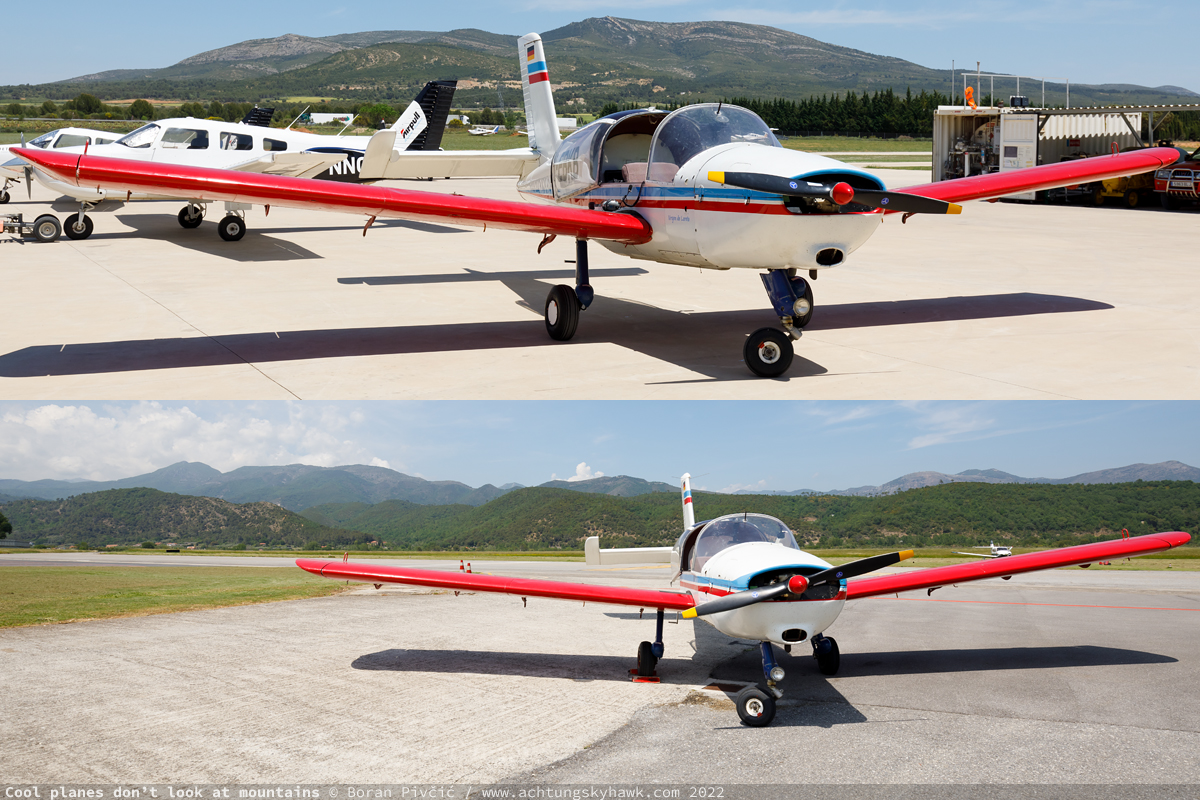
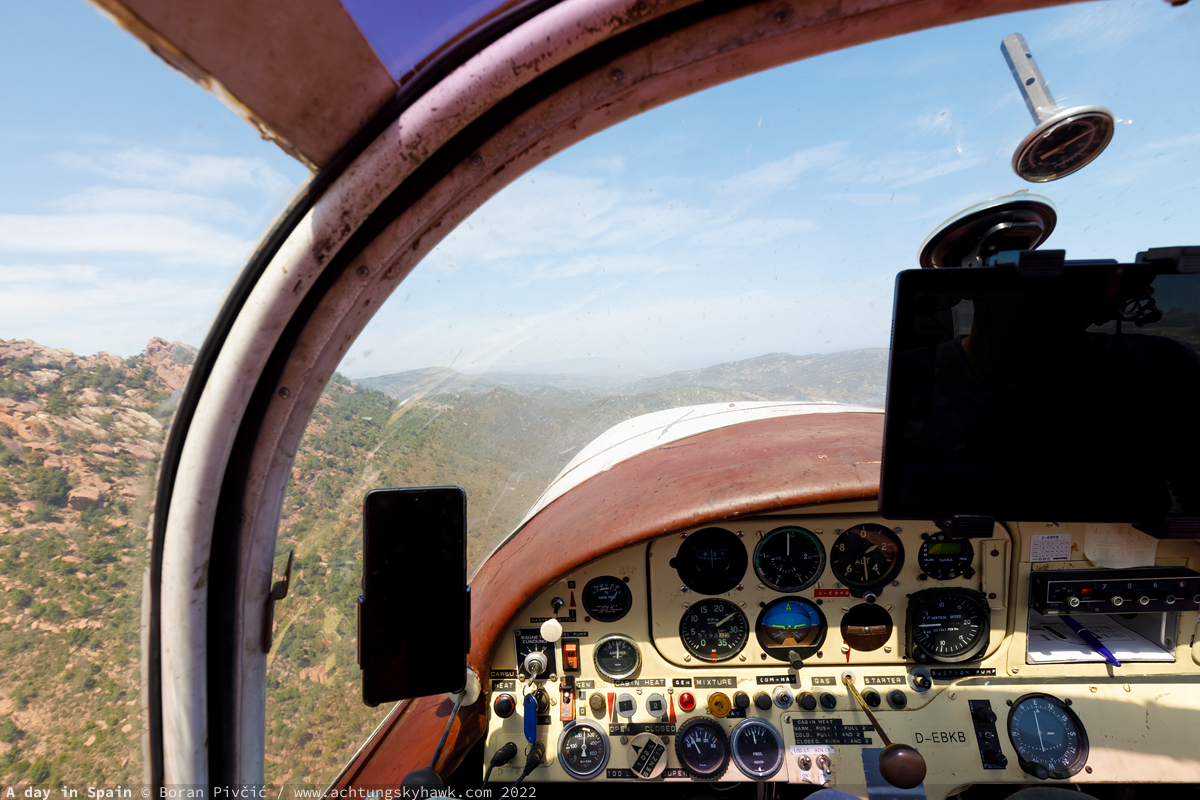
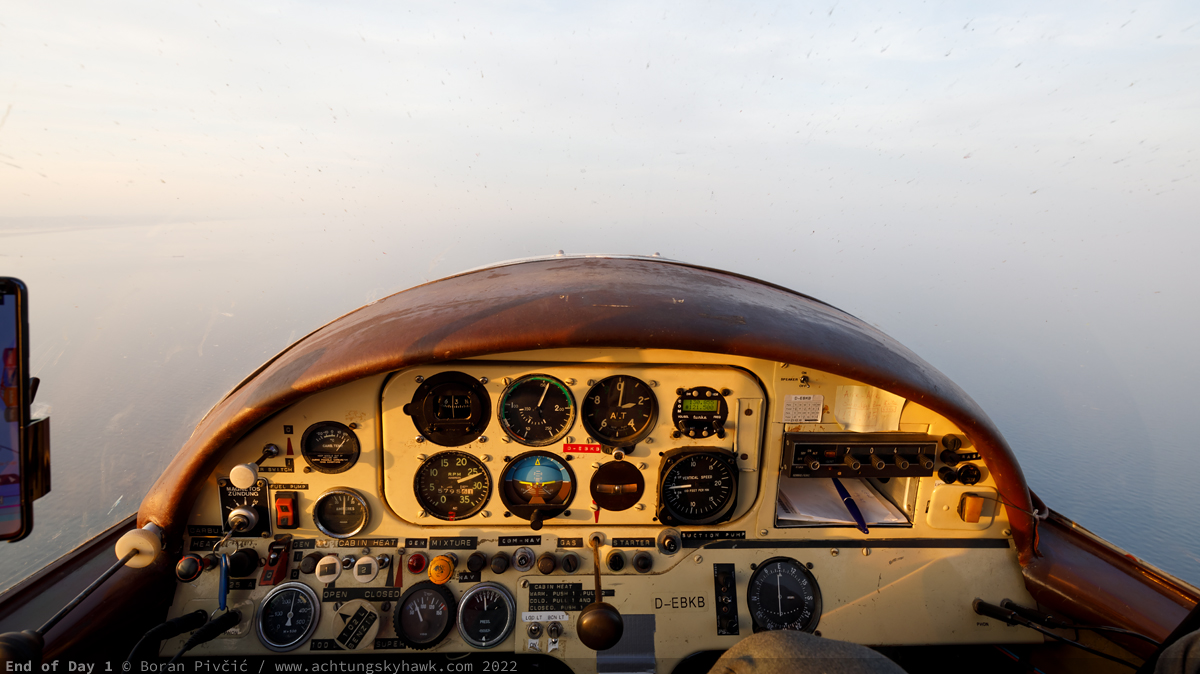
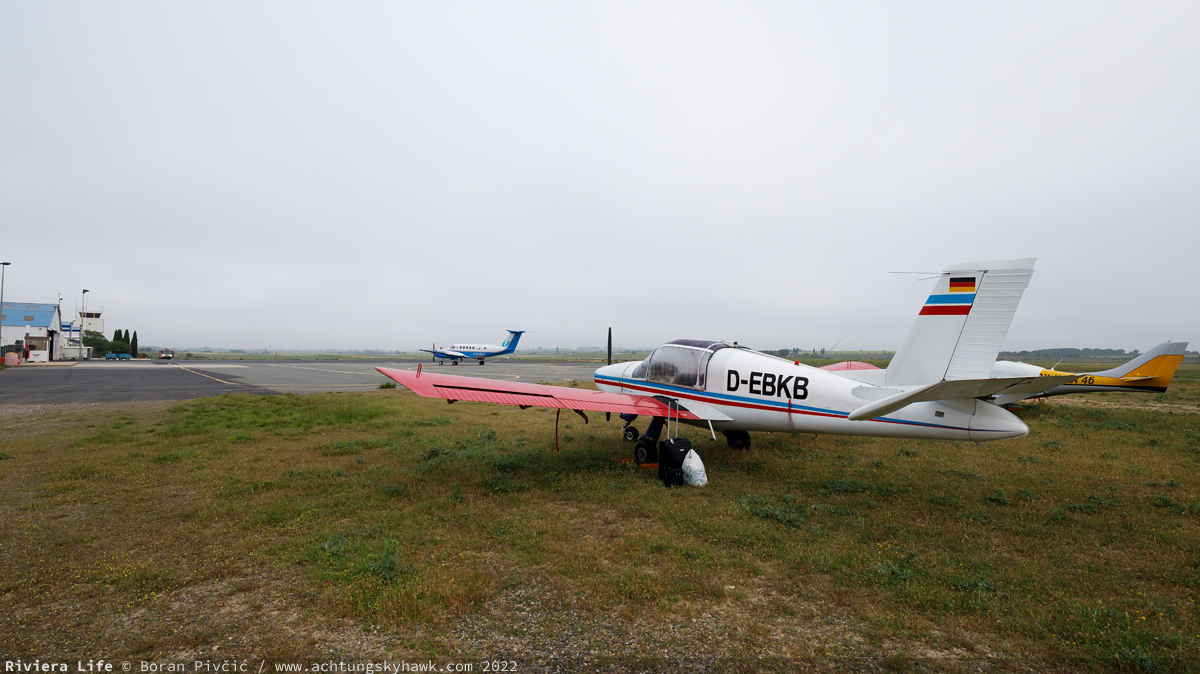
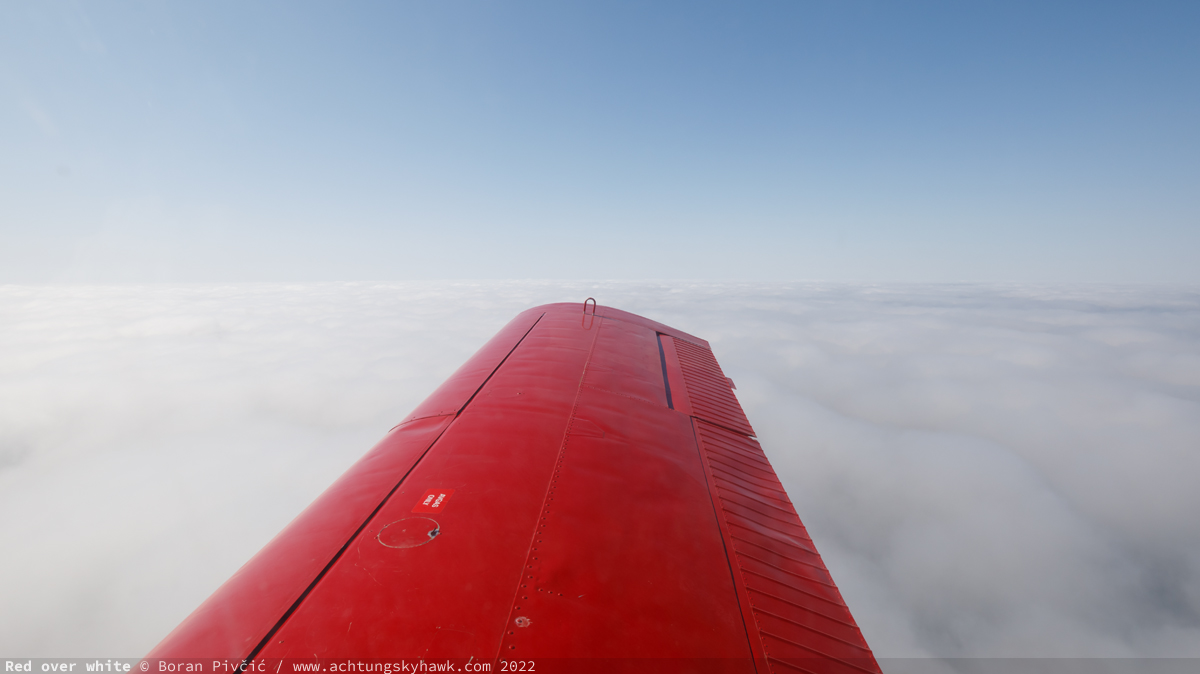
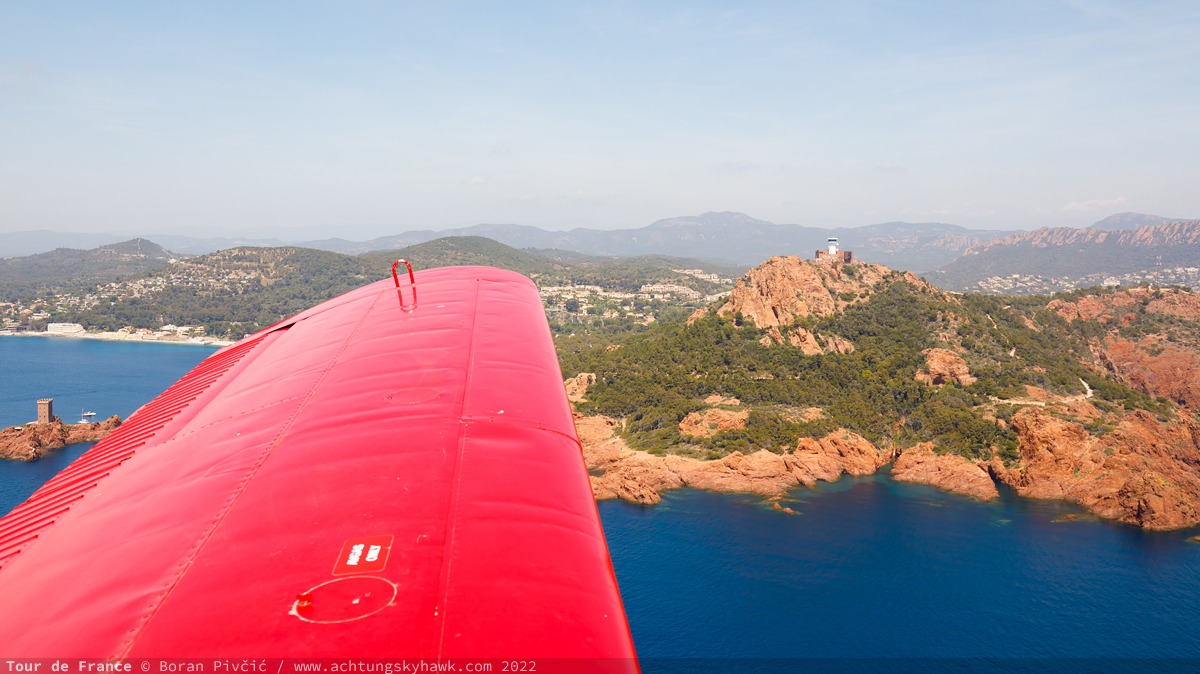
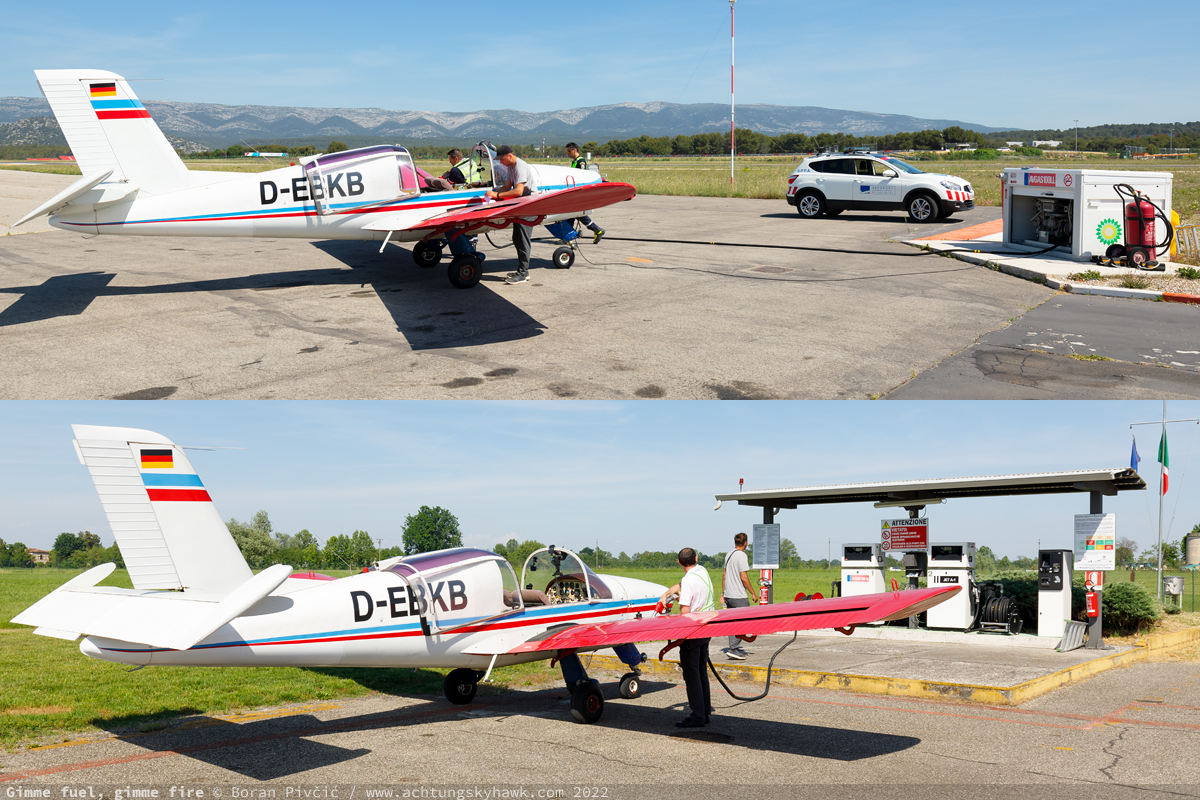
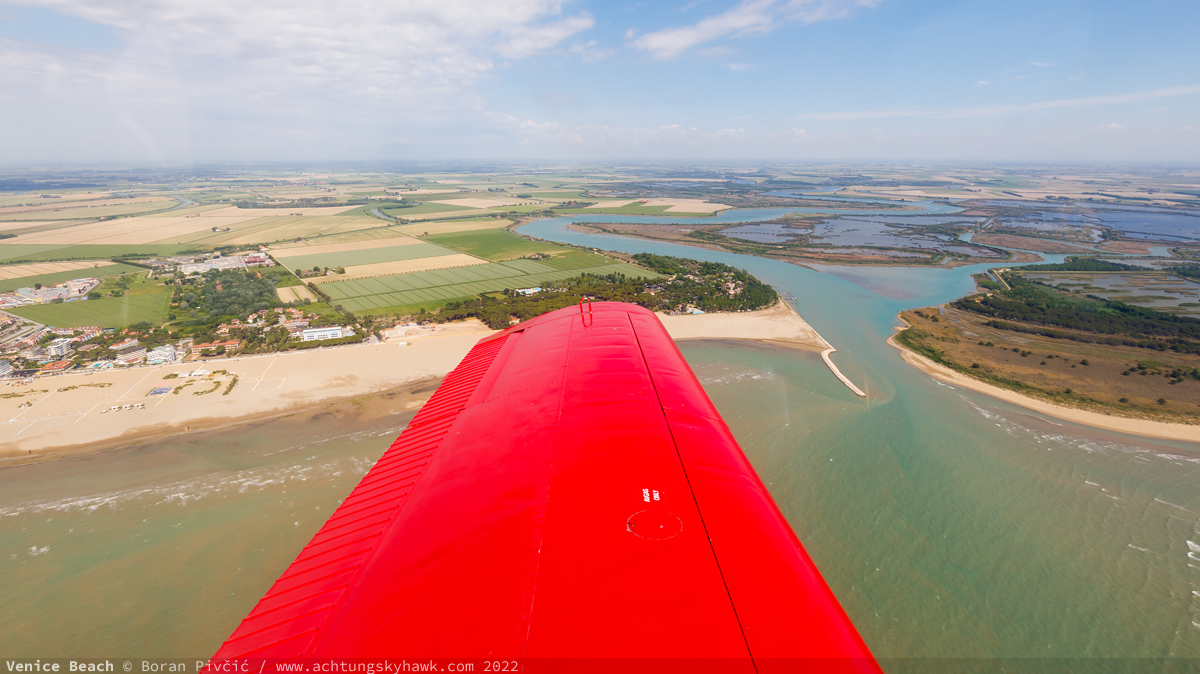
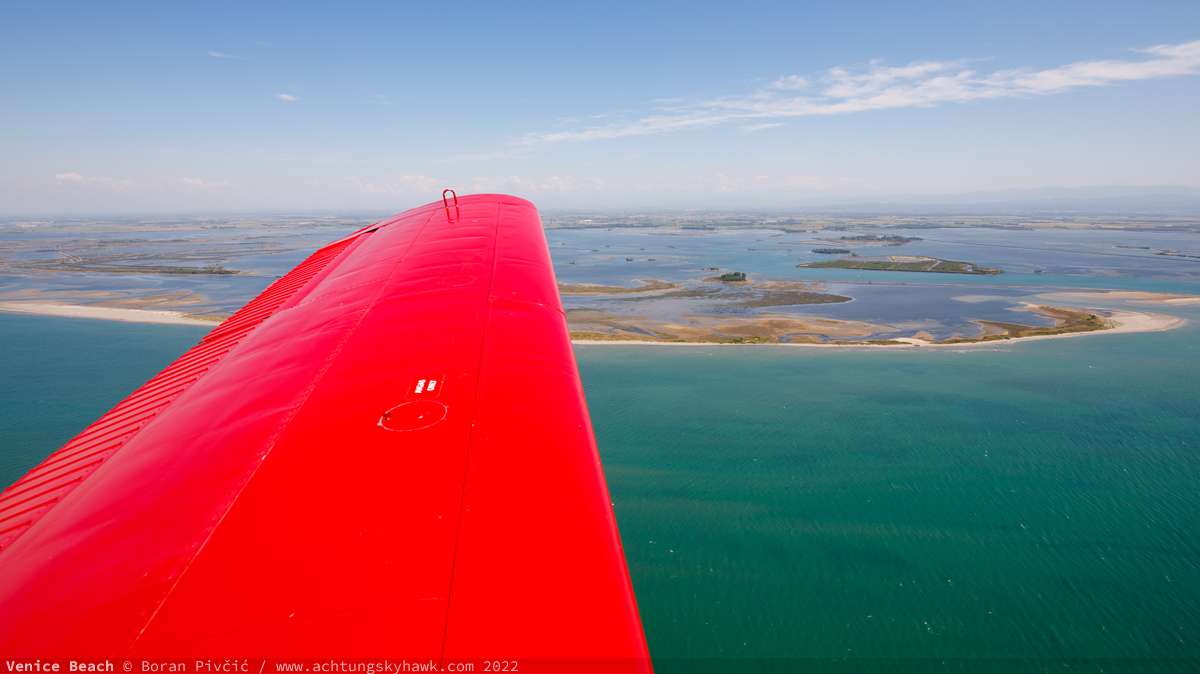
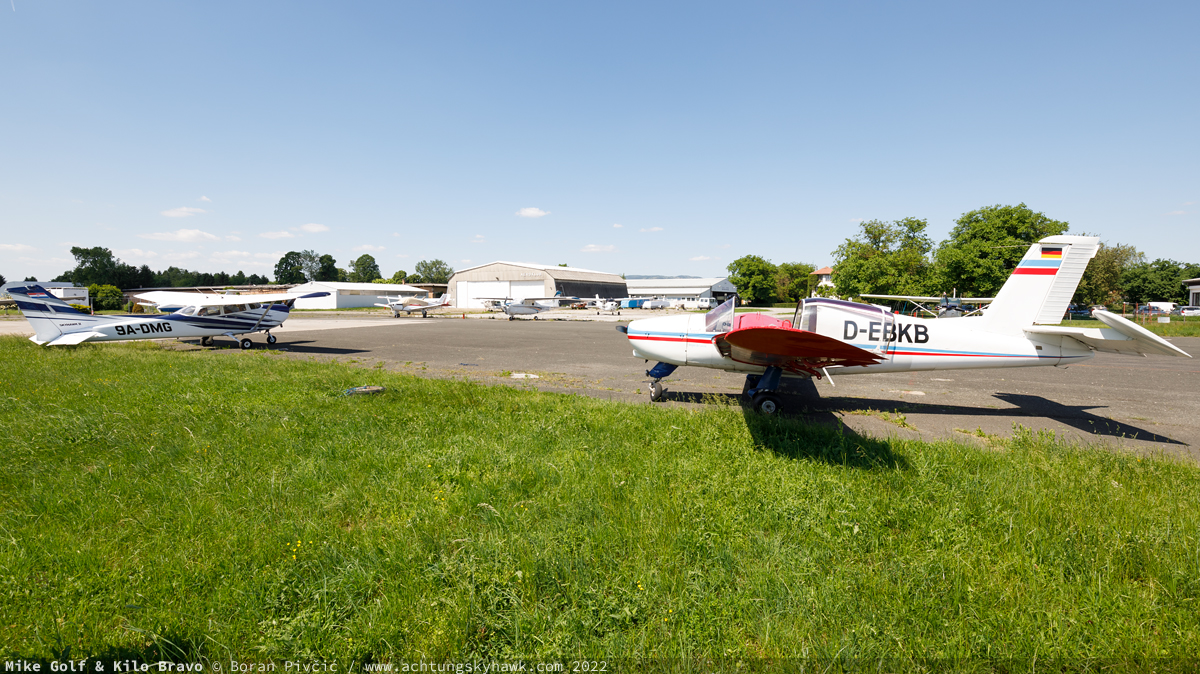


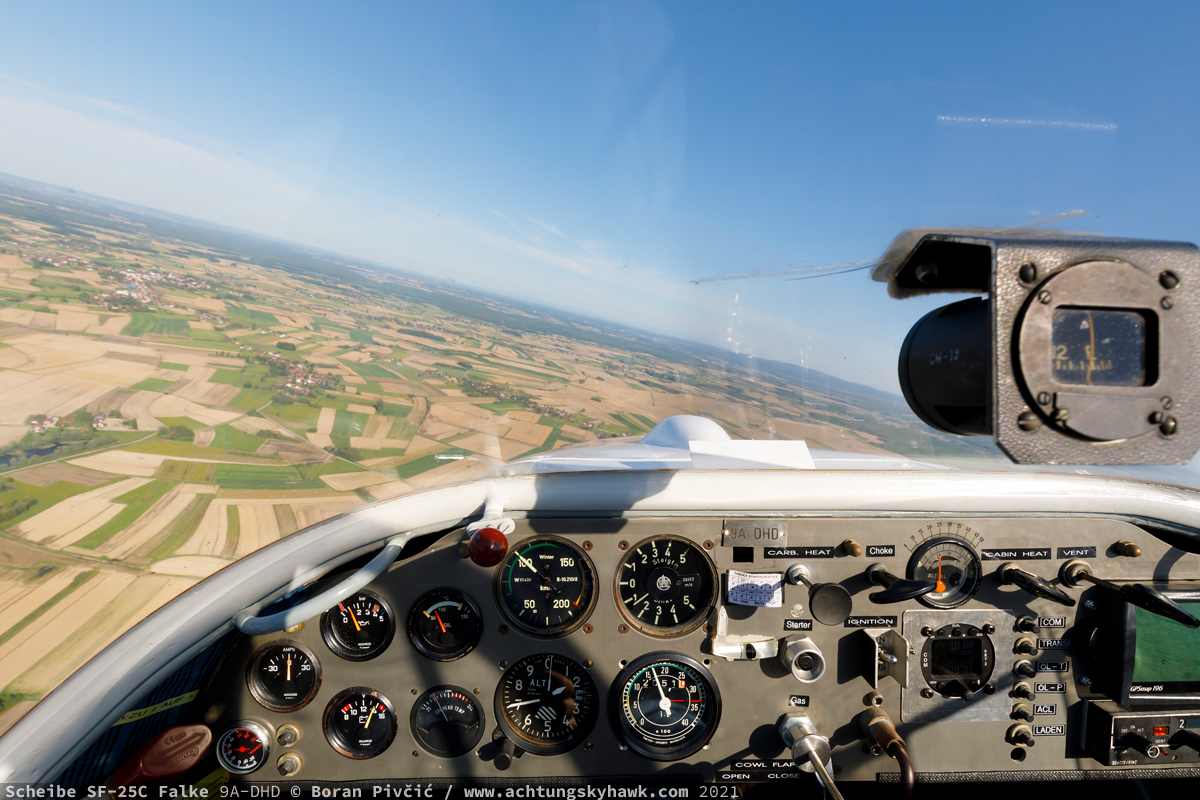


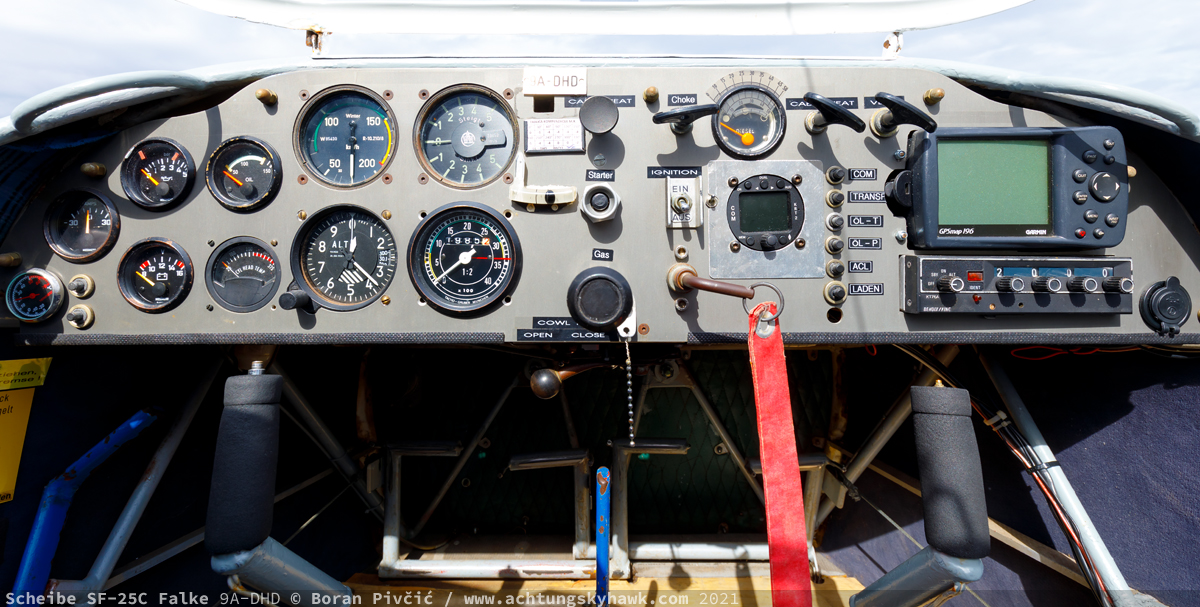
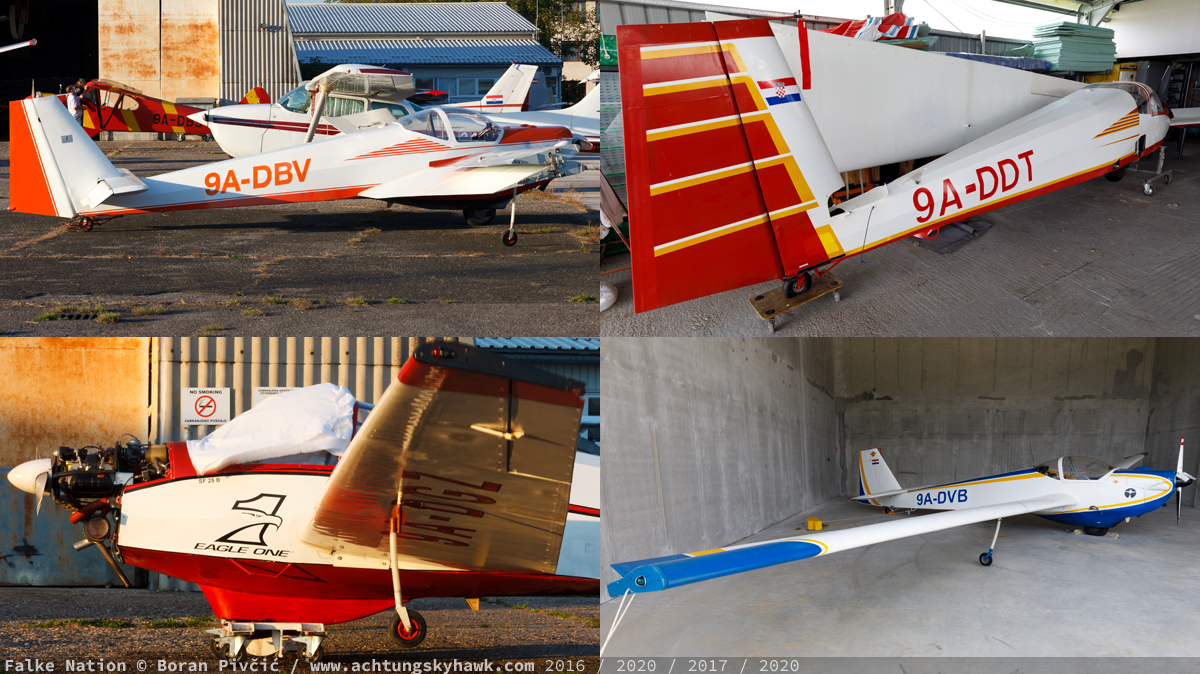
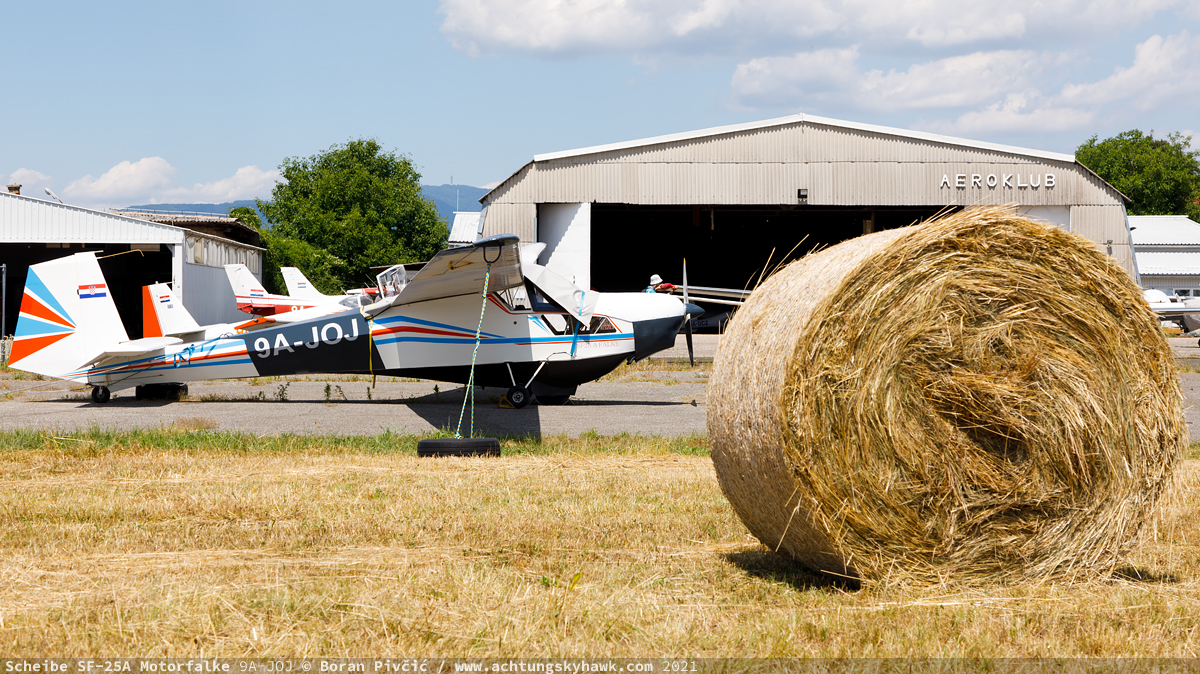


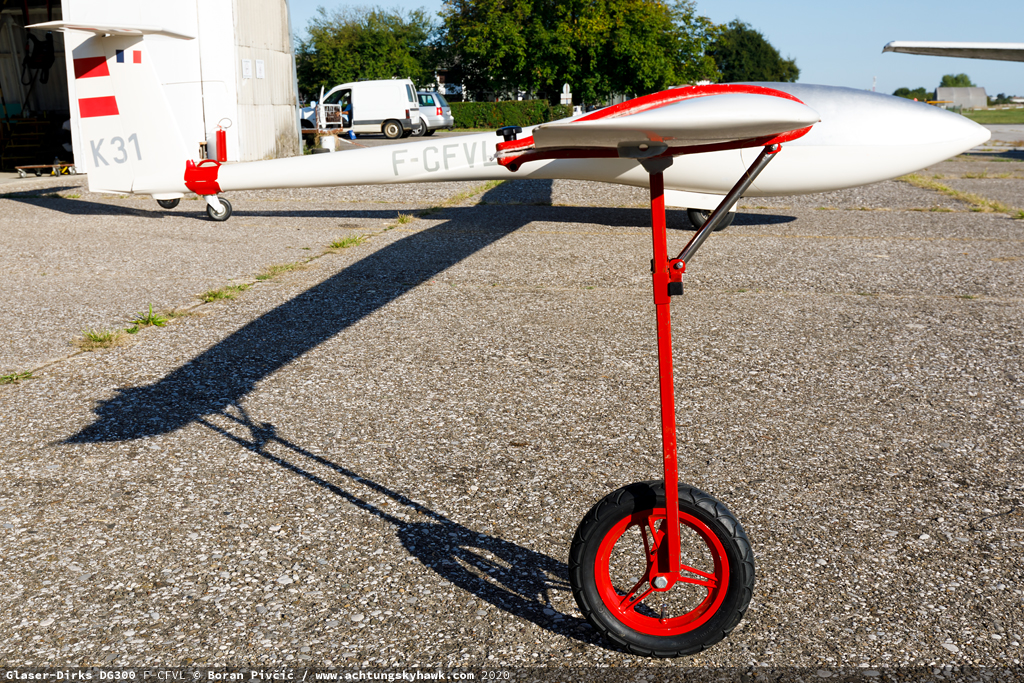

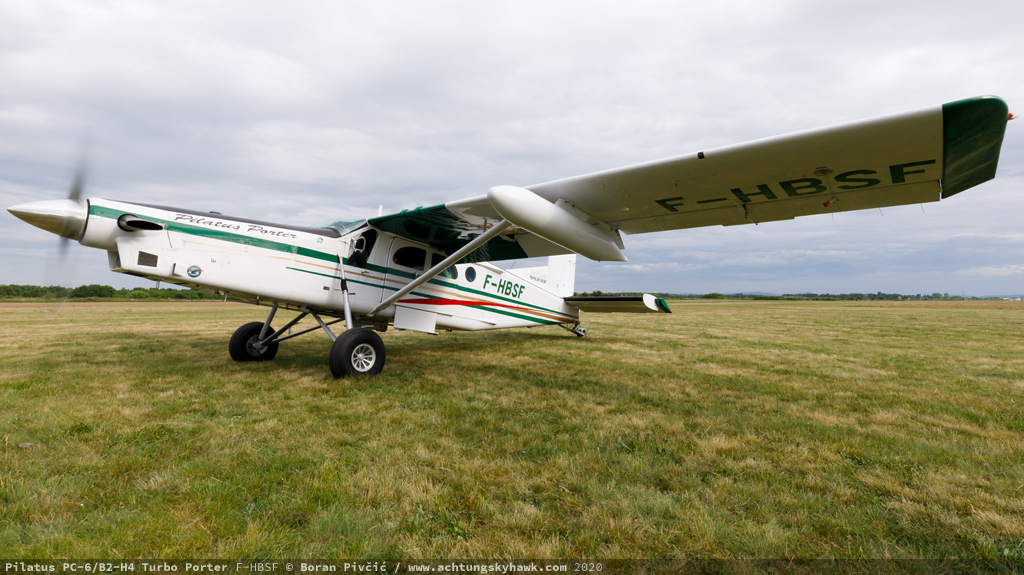
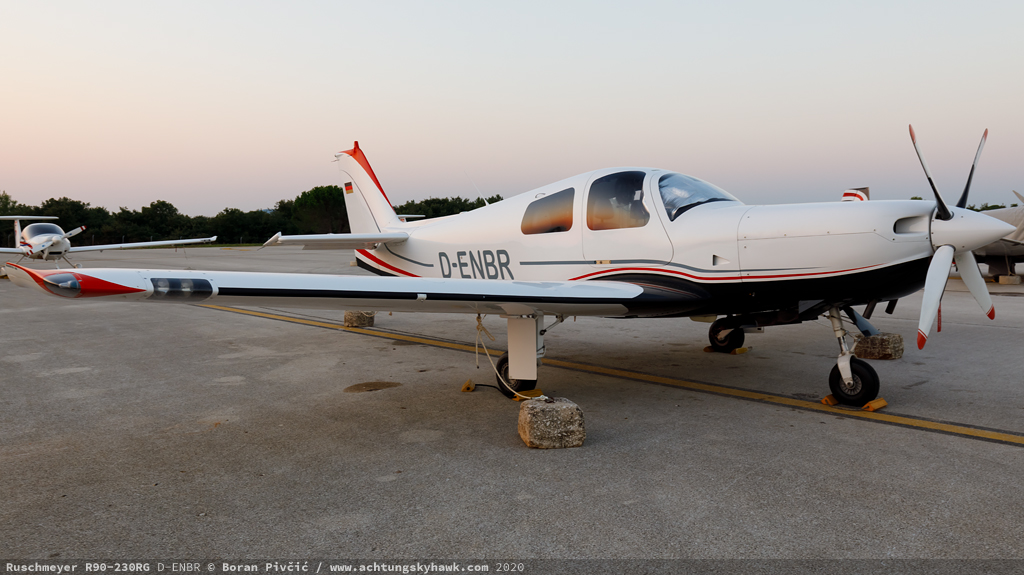


 Achtung, Skyhawk!