By me
Photos me too, unless otherwise stated
It’s a story as old as time: boy wants to fly airplanes; boy gets PPL. Boy wants more power, more speed, more avionics, more range; boy gets airline job. Boy gets more than what he asked for; 5000+ hours later, boy grows wiser (crankier) and starts finding immense pleasure in flying the least amount of airplane bits necessary to actually be an airplane. Boy gets into TMGs. Boy drifts further into the extreme and gets into ultralights. Boy’s sailplane mates buy ultralight; boy remembers he has Achtung, Skyhawk!. And what follows is pretty obvious…
Through sheer long-term exposure to the “more fancy” bit of aviation, of late I have grown to greatly appreciate the elegant, unpretentious simplicity and undiluted “in yo face” flying experience that can be found on the other end of the spectrum. While I have not (yet?) gone down the route of the non-rigid wing, the world of the sub-100 HP single- and two-seaters has firmly ensnared me – as an emerging trend of topics on here may already suggest 🤔. Happily, this change of tune had coincided with an interesting uptick in the number of new motor gliders and ultralights in Croatia, with one seemingly joining some fleet somewhere every couple of months. There was the JUL 2024 arrival of a mint Scheibe SF-25C Falke 2000 (the last, great 1990 everything-fitted-as-standard Limbach model before the type’s switch to Rotax power)… then in DEC 2024 we got a crisp Fly Synthesis Texan on long-term load (only the second ever of its type in country, and the first on the 9A prefix)… and now in MAR 2025 a Fly Synthesis Storch prepping for its highly anticipated (by me) first flight after a major rebuild (and while the Storch may be a common animal here, this is the only “big wing” CL model for miles and miles around).
Lots to choose from then. But we start in OCT 2024 at Čakovec (LDVC) in the north of the country, with three sailplane/TMG drivers who took the plunge as well and brought over Croatia’s first ever TL-Ultralight TL-232 Condor Plus… 🥳
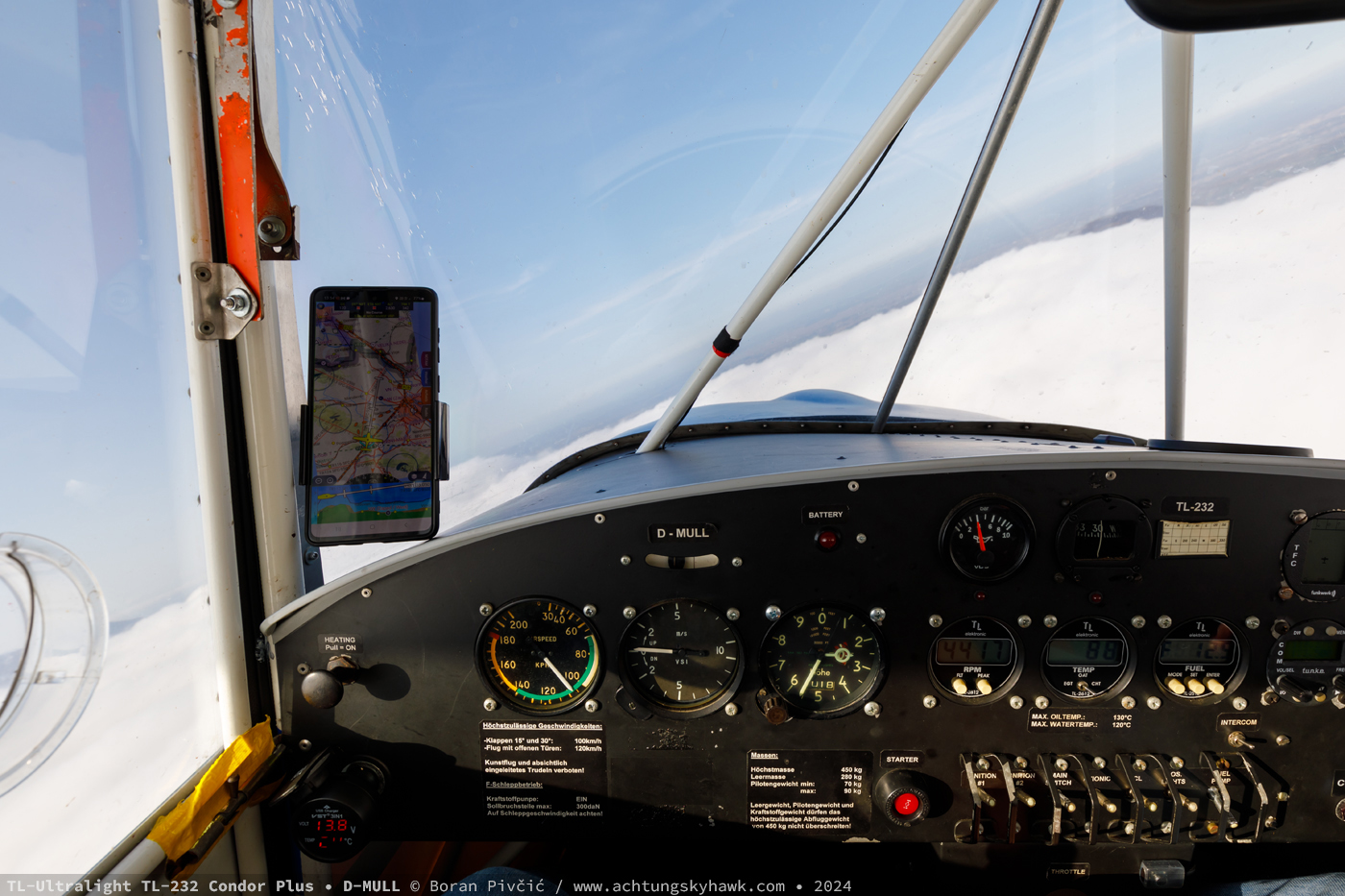
Introductory photo shoot on the ground? Nah, too boring…
TL; DR
But first, the Achtung, Skyhawk! obligatory backstory (it’s the law!). Unlike many of the aircraft featured here, the TL-232’s is pretty straightforward (😭), and starts with the original TL-132 Condor first flown in 1993. While TL-Ultralight is nowadays one of the Czech Republic’s most successful aircraft manufacturers – with hits such as the TL-96 Star, TL-2000 Sting and TL-3000 Sirius – and one of Europe’s pioneers in the mass production of modern, affordable composite airframes, back at the beginning of the 90s it was a struggling maker of ultralight trikes (such as the TL-22 Duo, designed in-house), trying to keep its head above the turbulence of the 1989 Velvet Revolution and the dissolution of Czechoslovakia in 1992.
The company’s roll-of-the-dice foray into the “mainstream ultralight market”, the 132 is an entirely conventional high-wing side-by-side two-seater that gives off a very “50s Piper, but more angular” vibe. Based on tried-and-tested can’t-mess-this-up steel tube/fabric cover construction, it was originally intended to run on two-stroke power in the form of the then-popular 53 HP Rotax 503. This was OK-ish given that its MTOM was limited to 450 kg | 990 lbs by ultralight class regulations, but performance was generally far from spectacular and bordering on the underwhelming. Hard numbers are difficult to nail down properly due to the myriad variations between individual airplanes, since the majority were supplied as kits to be built and modded by the owners themselves – but maximum speeds of 130 km/h | 70 kts and climb rates of 2-2.5 m/s | 400-500 fpm are reported as averages; not great, not terrible and hardly something to write home about.
Pretty soon, the more potent 64 HP Rotax 582 became a popular drop-in substitute due to its identical dimensions and mounting points – while users wanting to move away from two-stroke engines in general would swap them out for either the 80 HP Rotax 912UL, or (for budget-conscious users) the automotive Subaru EA series with a conversion kit (most commonly the 78 HP EA81 made popular by the ACM Drahoš works of Tutnov in the Czech Republic). As before, the performance figures were all over the place, even for airplanes with the same nominal power output1; but in general achievable cruise speeds tended to jump to around 150 km/h | 81 kts (right up against the maximum placarded structural speed) and rates of climb to as much as 5 m/s | 1,000 fpm for the “big engine” examples.
1 while this is true for ANY aircraft, using just the nominal power output for a performance comparison is a complete minefield in the world of non-certified aircraft. The reasons could fill an entire book, but the most pertinent is that what’s “written on the tin” is just the maximum power output, time-limited and used for take-off only – and not what the engine can give continuously. Engine A may churn out 80 HP for up to five minutes, but allow for only 70 in the climb and cruise… while Engine B may do “just” 78 HP for take-off, but output as much as 75 for hours on end. A 5 HP difference doesn’t sound like much, but on airplanes with an MTOM of less than half a ton, you’re going to notice them. Then there’s also the prop: two-blade, three-blade, wooden, composite, hand-made, CNC-machined, classic, modern, low pitch, high pitch… your performance mileage will definitely vary…

One of the cleanest Condors I’ve seen online, taken by Mr. Milan Cibulka over at JetPhotos. The key recognition feature versus the TL-232 is the “fullback” rear fuselage – which, from a distance, makes it hard to tell apart from the very similar Rans S-6 Coyote II. Indeed, with the latter having been introduced several years earlier in 1988, there are persistent rumors/accusations online that the 132 is either “modeled” or directly “based” on the S-62
The factory-spec Condor’s lack of oomph, and the rate (and creativity) at which users were swapping in a smorgasbord of more powerful engines, soon convinced TL to address the issue right at the source. Already in 1994, work started on the improved TL-232 Condor Plus (sometimes also labelled as the Condor+), which now came with the Rotax 582 or 912UL as standard (also the default offering on all of its competitors, including the S-6, Kitfox, Avid Flyer and so on). Other changes included:
- a cut-down fully glazed “greenhouse” rear fuselage (with which the type is nowadays most closely associated)
- a modified wing profile for reduced drag
- and composite rear fuselage upper decking stretching from the “greenhouse” to the stabilizers
However, what effect these very simple tweaks had on sales is hard to judge with any measure of objectivity and empiricism. Actual production figures are nigh-on impossible to come by, with the only thing coming close being a quote on the manufacturer’s website claiming that the combined production of the Condor line “exceeded 300 units”… and elsewhere online that the 232’s production had lasted into the early 2000s. The best I can give you (and not for lack of research) is that today you’ll be hard-pressed to find an airworthy 132 outside of Czechia… while 232s abound by the dozens, particularly in Germany…
2 whether or not any of that’s actually true (or, more likely, to what extent) is up for debate; however, the precedent had already been set by TL with their first ultralight design, the TL-32 Typhoon of 1991. Despite the designation, this machine bore no relation to the Condors, and was, in fact, “heavily inspired by” the German Comco Ikarus C-22, first flown in 1987. Sharing the same layout, dimensions, masses, powerplant options and performance bracket – but with just enough different solutions for it to not be a 1:1 copy – the TL-23 would go on to sell in “over 200 units”, comparable even to the TL-232; but despite this, finding one in the wild today is nigh on impossible outside former Czechoslovakia, which is why I had to dip once again into the “online bin” to find a good photo…

A mint TL-32 photographed by Mr. Antek Dec over at JetPhotos…
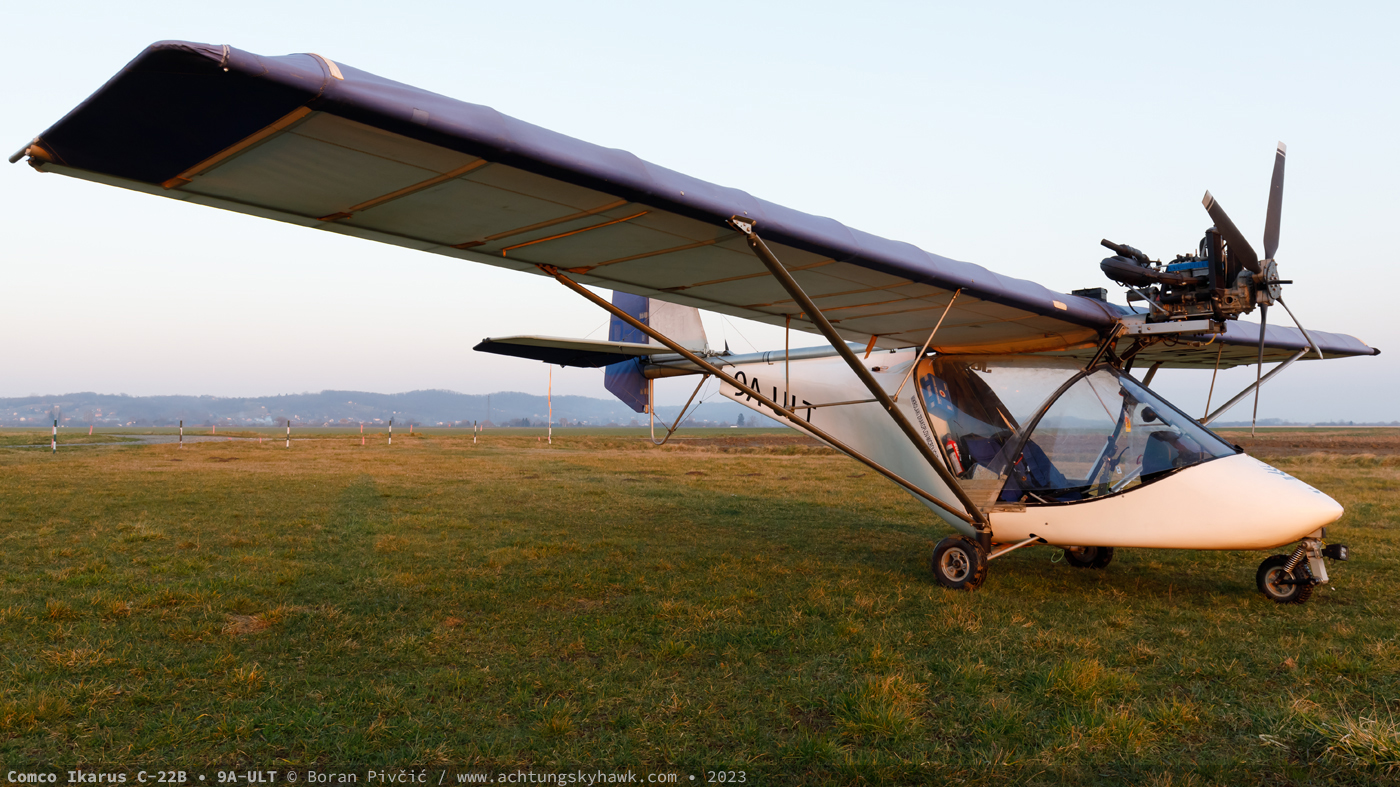
… versus my mate’s slightly tired 1992 C-22B. While you can spot a number of differences even at a glance – rubber vs actual springs on the main gear, different elevator & rudder linkage, different nose and aft fairing profiles and so on – overall it’s tomato-tomato
Not to diss the TL-32 however, one can argue that its success led to, and was a direct catalyst for, the creation of the TL-132 and 232. Having logged time on both the C-22 and another one of its clones – the Italian Euro-Ala Jet Fox – I can confidently claim that these airplanes are a complete and utter riot… provided you’re a masochist and don’t intend on actually going anywhere. Their fun factor is truly off the scale – but, in their stock forms, creature comforts can be found in trace amounts only; practicality is straight out of a Wile E Coyote cartoon; and performance and endurance are LOL unless you have an 80 HP four stroke engine (which is definitely NOT the norm). With cruising speeds of around 100 km/h | 54 kts and up to 15 l/h | 4 GPH fuel flows on tanks rarely larger than 50 l | 13 USG, they’re the bee’s knees for local joyriding and having fun; but if your needs are more “conventional” (i.e. air work, training, cross country, towing), you needed to look elsewhere…
Precisely this appears to have been the motivation for “moving on” (as TL’s owner, Jiří Tlustý, stated on the manufacturer’s website) with the immeasurably more usable, user-friendly and capable Condor, which was able to be financed directly by sales of the Typhoon. If anything, in what would be a very pleasing bit of circularity, the in-turn success of the TL-132 and 232 (among others) might have been the trigger for Comco Ikarus to develop its own contender in 1996, the ultra-popular C-42 family (going on for 1,200+ sold now)…
One man’s trash…
Germany too was where the 232 that started this post came from, more precisely the aerodrome of Braunschweig (BWE/EDVE) in the federal state of Lower Saxony. Registered D-MULL (an interesting pun given that müll means “trash” in German 🤔) and only ever owned by one man (!), it was completed in 2001 with the serial 01C01 – which actually makes it both the first Condor kit to have been produced that year… and likely one of the last 232s ever made.

Everything you’d expect to find where you’d expect to find it; what some would call “classically correct”. Unlike the S-6 it was supposedly modeled on, the 232 was never offered with a tailwheel option; the likely reason is cost and simplicity, since taildragging and nosedragging Coyotes are quite different underneath (different structures with different load paths) and cannot be converted between the two configurations without some significant metalworking
Even though the 80 HP Rotax 912UL was intended to be the “flagship” engine at the time of the 232’s debut, like many late-production examples, D-MULL was fitted outright with the more meatier 100 HP Rotax 912S. Combined with a tailhook for towing gliders or banners (a Tost E85 unit in this particular case), this setup should more accurately be called the Power Condor – though I’ve never seen this designation used “in the wild”, and all of the type’s official documents still refer to it as a Condor Plus.

Not the best light (we were waiting for the morning fog to clear), but still useful enough to show off some of the airplane’s bits and bobs! Starting from the top, how to spot the 232’s composite deck: just look for the lines of rivets that fasten it to the underlying structure •• then there’s the distinctive ventral fin for the towing hook, an easy way to confirm the airplane is a 100 HP model; the hook release cable is internal, and runs alongside the rudder cables to a lever in the cockpit •• in another likely attempt to simplify production, the fuel tanks can be fitted to the wing roots only, with D-MULL sporting the standard 2x 27 liter | 7 USG fit; on the S-6 (and a number of other period Rans designs, such as the S-12 pusher) you could spec either a single fuselage tank behind the seats (usually 50 l | 13 USG), or twin 35 l | 9 USG tanks in the wings. If you were adventurous enough, you could fit all three for bladder-bursting endurance •• and always a problem area for high power ultralights, propeller ground clearance. While you could squeeze more efficiency out of the available power by using a two-blade prop (less blades means less disturbed air and less interference), the blade span that would be necessary would mean it would likely be digging a trench as it spun along; since that is not good at all, it necessitates a trade of efficiency for clearance by going to three (or even four) blades. An additional benefit of 3+ blade props is also a decrease in vibration and noise, since the prop is naturally more balanced, and the shorter blades mean that even at max RPM their tip speeds are still well below the transsonic region
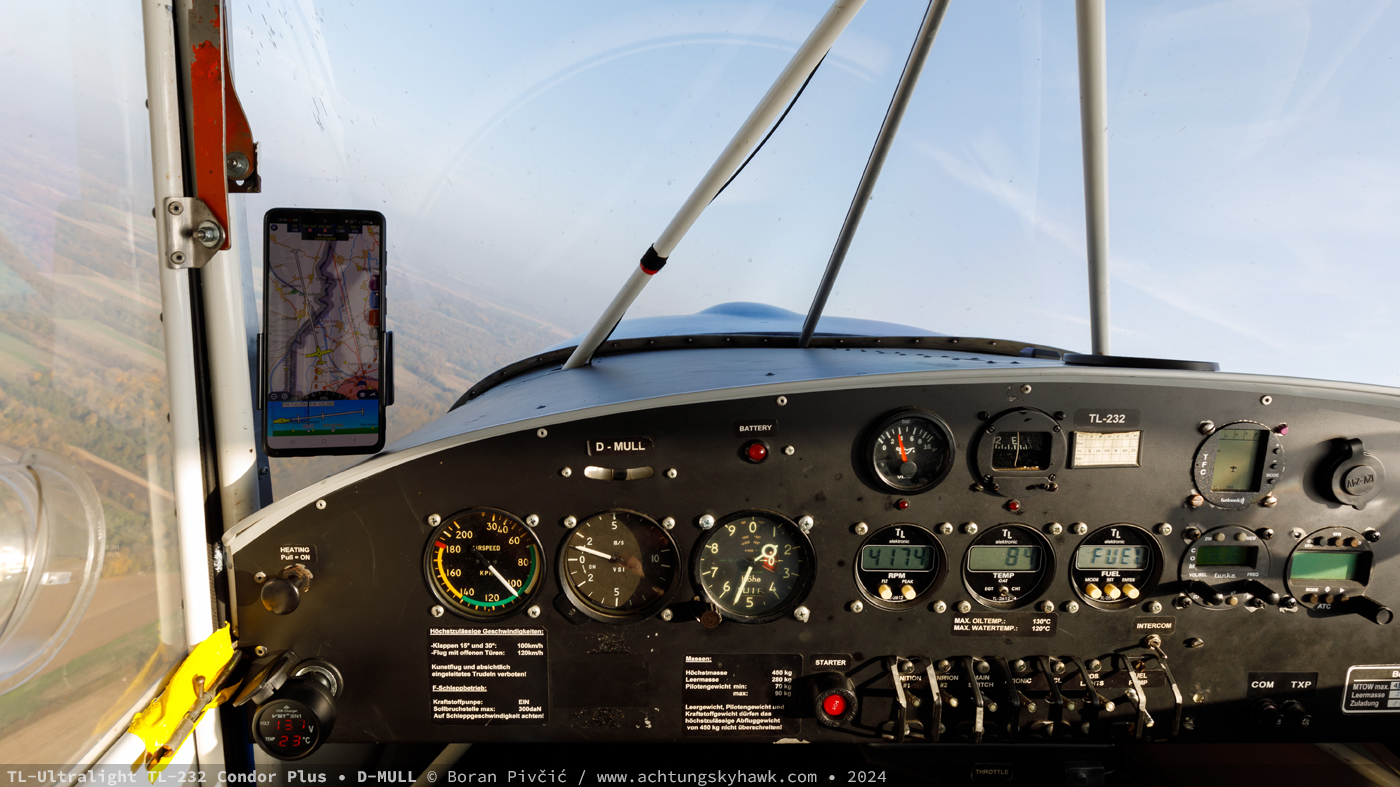
Up front you have everything you’ll ever need for VFR duty: the UL “basic three”, supplemented by TL’s own multi-parameter engine instruments giving you engine RPM, oil pressure, oil temperature, coolant temperature and fuel flow (with a computed “fuel remaining” function that works by subtracting the flow meter output from the fuel on board you entered manually before flight; there is no actual fuel level sensing other than looking at the sight gauges on the tanks themselves). Rounding all that up is a Funke ATR833S 8.33 kHz com radio w/intercom, a Filser TRT800 Mode S transponder, and a Funkwerk TM250 traffic monitor that displays nearby airplanes with operating Mode A/C/S or FLARM systems. And, if you’re lazy like me, you can stick on a cellphone or tablet with a navigation app
The performance is much as you would expect given the low mass, high power, large wing w/ a thick low-speed profile, and a propeller set at fine pitch: it takes off and climbs like a stabbed rat (d’uh, glider tug). Admittedly, it was a winter’s day (although not a particularly cold one) when I first flew D-MULL, but with two of us on board and approximately 30 l | 8 USG of fuel – i.e. maxed out on payload and within an atom’s width of MTOM – we were in the air in no time (I’d estimate less than 100 m) and climbing with a consistent 5.5 m/s | 1,100 fpm at maximum continuous power (which on the 912S works out to something like 95 HP). Even coming off 10 years on the brutally overpowered Q400, the way it went up was properly impressive – especially considering that fabric covers tend to flap in the airstream (no matter how taut), which naturally creates a fair bit of drag and disruption of airflow.
Going out solo later – just myself, my camera and 20 l | 5 USG of fuel – it stopped being an airplane and became a Looney Tunes cartoon. The performance was such a laugh that I eventually started taking off derated (this being one of the very few GA airplanes in which I was comfortable doing that), never going above 5000 RPM/75% power on the take-off run and still leaving the deck like I was being launched off an aircraft carrier. For a FSAG test (For Shits And Giggles), I decided to try a 95% power climb… and got to 8 m/s | 1,600 fpm before I almost overshot up into controlled airspace.
In the cruise however, it suffers from exactly the same “problem” as every other aircraft of its type: it may have the power for speed, but not the aerodynamics (nor the structural strength). I say “problem” because the Condor was never designed to be a long-legged, continent-crushing touring machine that would zip along at 300+ km/h | 160+ knots and get to 10,000 ft without breaking sweat; it was designed to be an unpretentious, simple, cheap-to-buy and cheap-to-run all-rounder. It can handle hauling and climbing and speed in the same airframe – just none of them brilliantly, and that’s perfectly fine; hence why 64 do 80 HP was and remains perfectly sufficient for 90% of its uses. As an upshot, D-MULL’s green arc ends at just a tad over 140 km/h | 75 kts – and because the flight was never about actually getting anywhere, we generally tootled around at no more than 115 km/h | 62 kts in level flight, soaking up the scenery…

Speeeeed! With my work having previously taken me to 660 km/h | 360 kts – and now 850 km/h | 450 kts – on a daily basis, it really is refreshing to be able to max out an airplane at what is essentially the Cessna 172’s best-rate-of-climb speed… and barely more than the national highway speed limit in Croatia
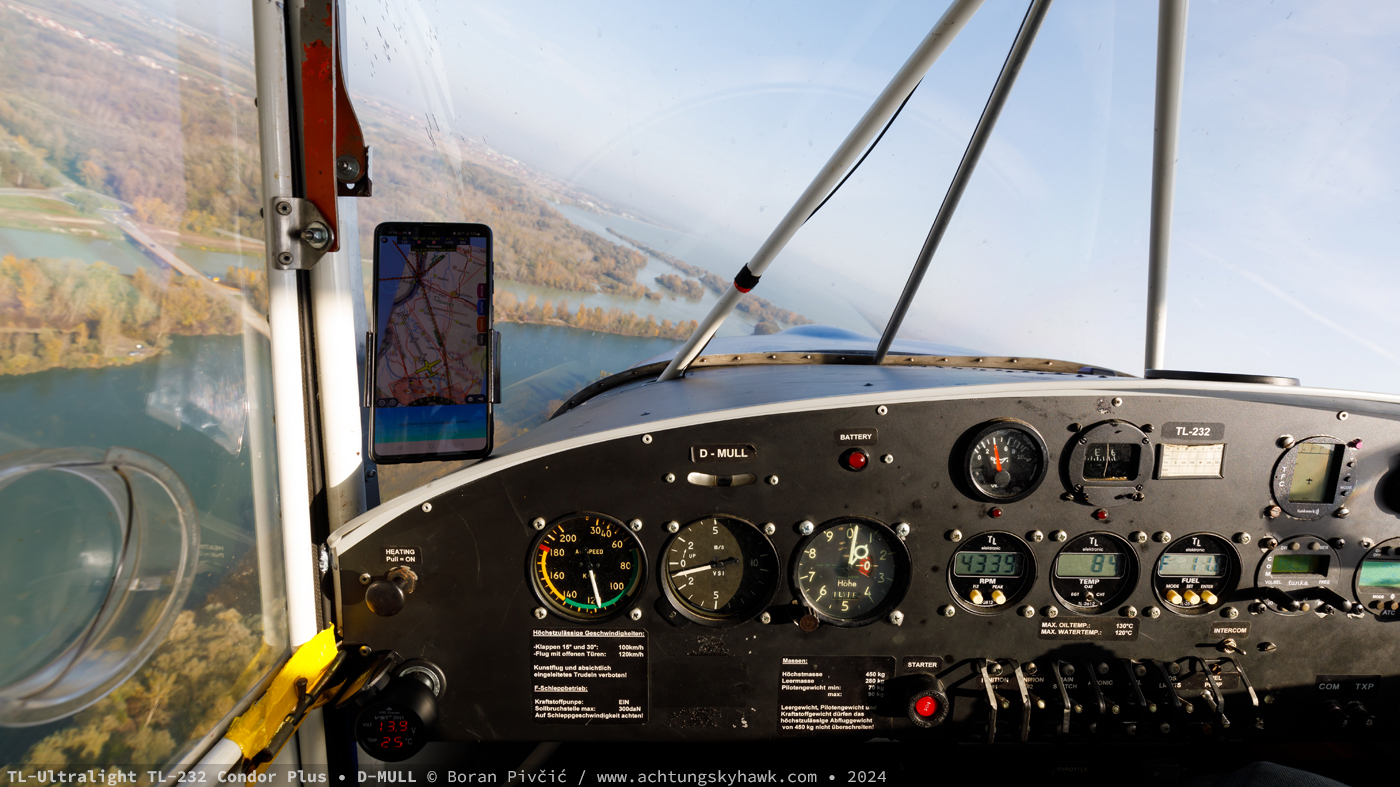
In what is a big “thumbs up” from me, the TL-232 lends itself particularly well to one of my favorite flying activities: river running. The extensive glazing provides quite a good view in all directions (though there are a few notable blind spots, at least with my height and its resulting sitting position)… but at the same time, you rarely end up being directly illuminated by the sun in any normal flight regime (which is quite nice in summer). Another (Condor) plus is that the airplane seems to be quite willing & responsive in all axes; this is not always the case with fabric-covered aircraft, which can have a slight delay in their reactions while the fabric itself responds to changes in air pressure during increases or decreases of lift
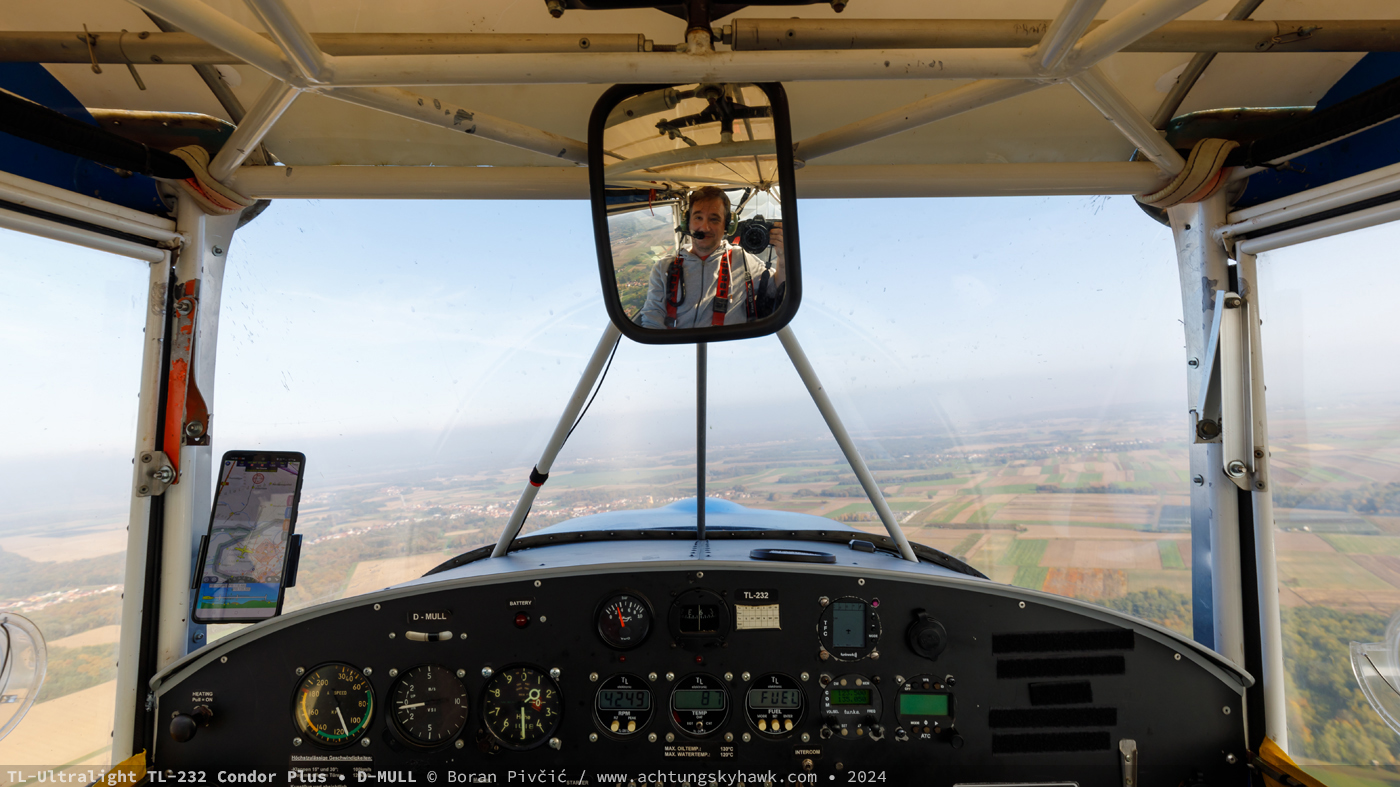
The interior is so airy and roomy in fact that, on a whim, I decided to do something I’ve ever only done twice in my life: take a selfie (using the towing mirror) 🤔 . Putting aside the fact that during my off days I look and dress like a bum, this shot does highlight one interesting thing: that even at 1.91 m | 6 ft 3″ and with headphones on, I have more than enough headroom in all directions… and coming from me (whose choice of ultralights is severely limited by this very metric), there is no greater compliment!
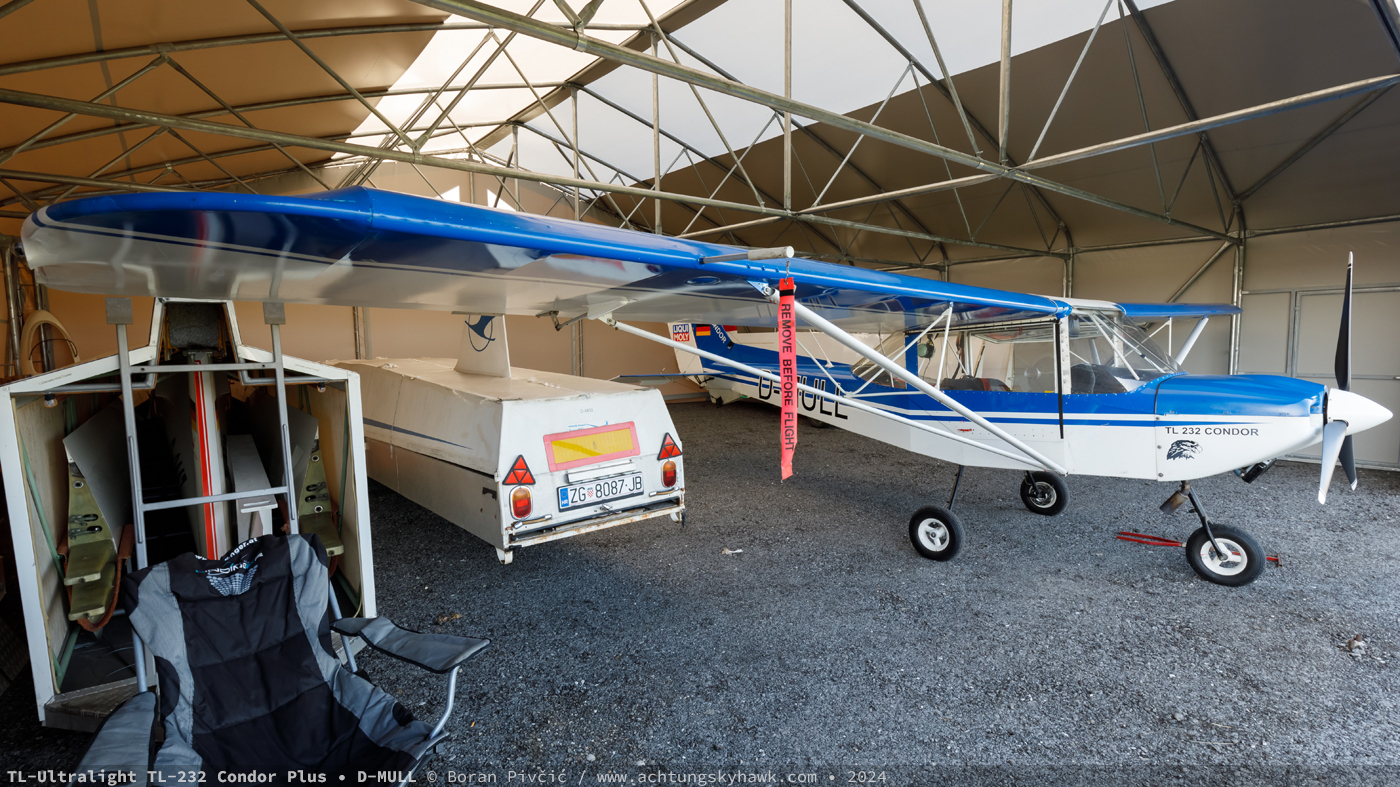
Back in its very own hangar at Čakovec having done its bit for the day. Parked in their trailers alongside are some the gliders it will soon be towing, including one of its owners’ Schleicher ASW-15 D-0633, another’s Schleicher Ka-8b D-8248… and what used to be my very own Glasflügel H-205 Club Libelle D-2447 (which I decided to sell since the airline job was not conductive to the time requirements of soaring). As the abundance of D- regs in this one comment may suggest, D-MULL will remain D-MULL despite its new place of residence
As always, a round of thanks are in order: Marin Lukas, Jan Gorski and Vladimir “Dado” Majder – D-MULL’s new owners – for going out of their way to accommodate me, and indulging me in my boyish enthusiasm and rampant Achtung, Skyhawk!-ness!
UPDATE: unfortunately, D-MULL would be written off on 26 MAY when it caught fire during ground operation, burning down to just the airframe tubing. Thankfully, the sole occupant had managed to get out uninjured
Sources:
- Avia-pro.net – TL-132 entry
- Key.aero – TL-Ultralight entry
- Migavia.com – TL-232 entry (sourced from Janes)
- TL-Ultralight.cz – company history


Condor is vaguely Maule looking, big tail. Or the Zenith 750 with the sloped up rear fuselage. And for sure vaguely RANSish. The visibility looks super with all that glazing, the main reason we fly.
In the US the ‘true ultralight’ plane, with no pilot’s license or any training required, that actually follows FAA Part 103 rules, are rarer than hen’s teeth. Because it’s so hard to build them safely and reliably at less than 254 lbs. A Rotax 503 is basically too heavy but builders use them anyhow figuring what the FAA doesn’t know won’t hurt them.
The 60mph mandated Part 103 top speed and 5 US gallon fuel restrictions make it less of a puddle jumper than a trickle jumper, but the most fun you can have with your clothes on. I’ve got a few training hours on the two-seat Quicksilvers ‘UL Trainers’ (used for joy rides too- ha, ha) and that will plaster bugs on your teeth. Landing is like a Stuka dive attack ending in an incredible flair and a rollout of 20 meters on dirt. Scary to a mostly Cessna 150 student.
The float equipped Quicksilver we landed on the Valley irrigation channels in a cloud of spray like a water park on a hot day. Finest kind of low and slow flying, goggles on the eyes and stick like an aluminum baseball bat in hand. No windshield. Three instruments in a pod overhead, you fly by pitch and power. Which is the righteous way to fly anyhow.
The Condor is a more capable all rounder fun plane with a larger range and in higher winds but no cross country plane either at 70 mph cruise. And with small fuel tanks. And lots of pilots in the rugged, mountainous, windy US West are put off by the thought of using a 2-stroke, as good and as developed as the Rotax 503 is.
We’re lucky here in the low rust west to still have a good choice of Light Sport (LSA) category aircraft from around 1946 to choose from for about $15k-35k USD. Low training hours are required and no medical exam- with some flight restrictions.
They seem pretty close to your European ultralight category. They are welded steel tube taildraggers such as the Piper J3 Cub (for the rich only), Taylorcraft, Aeronca Chief/Champ: and the aluminum monocoque Cessna 120/140, Luscome Silvaire, and the Ercoupe ‘safety plane’, the twin-tail nose-dragger lacking rudder pedals: and many more lesser knowns such as Commonwealth, Funk and Ranger.
They are also a joy to fly and quite capable of leisurely cross country flights, even in the mighty wide open spaces of the west, often with 25 US gallon tanks and 90-110 cruise speeds, and sometimes even cabin heat. Faster than a car and usually faster than the airlines or the laughable US train service. So they are closer to providing ‘the illusion of utility’ that General Aviation provides than the true Part 103 ULs.
The only truly legal US ultralight plane of note is Leonard Milholland’s Legal Eagle. It is a homebuilt using a welded steel tube frame, wood & fabric wing, and a bare, uncovered rear fuselage to make the weight limit. He cuts a VW bug engine in half to make about 30 dependable horses of 4-stroke power- sounds just like a Singer sewing machine.
The seat, said to be comfy, is a sling type he builds made of metal strips like a nylon beach chair. Again, to be able to legally fly without any license or training (if you are a fool), in any rural area, away from controlled airspace. Here’s a link to a Kitplanes article on the Legal Eagle. It is simple but not easy: https://www.kitplanes.com/legal-eagle-xl/
Thanks for the interesting post.
Ultralights even in the Condor’s class are quite capable cross-country; adjust the prop pitch for cruising efficiency and you can get 70 knots out of it easy… for barely a 2.5 USG/h fuel burn. That’s a five hour endurance; knock of 45 minutes for reserve, 45 for alternate + contingency, and that still leaves 3.5 hours… 250 miles in one hop, quite sufficient in Europe. If you want to go further and faster, there are entire classes and sub-classes of machines optimized for the task, all on the Rotax 912 family and burning mogas. Some get up to 150 knots out of 100-115 HP. EUR 50k will easily get you 90-100 knots and 5-7 hours of juice; an not on some 40’s brick, but a modern composite airframe with tons of gizmos and comfort, burning at most 3-3.5 GPH
What you say is all true. And I could buy a capable, fast, sexy, euro plane such as you mention in the US too. For $135,000 USD.
There are airplanes like that available in the US too, in the LSA category… such as the Rans line (even though that’s more STOL/hauling oriented, but it fits the market)
Yes, the RANS, Challenger, RV, Glassair etc types are all available and are fine, safe, fun fliers. But on Barnstormers.com they are usually priced higher than 1946 factory bricks that offer better specs, cross country performance, and FAA certified parts. And you don’t need to spend 10 years building it or trust that the original builders 1st attempt at learning welding was up to snuff. I’d tend to think about such things in turbulence in a homebuilt or kit plane.
My mates did several ultralights from the ground up (both kit and their own custom designs); all the way from the basic nuts and bolts up to the engine itself. The quality of the work, not to mention the solutions and components used, far outstrips anything ever churned out by any of The Big Three’s factories (and none of them took 10 years to build, the longest having been eight months). I have flown them a lot, and have no zero reservations about doing so again.
When you build for yourself, knowing your own safety is directly in your own hands, you tend to do a far far better job of it than a conglomerate looking at bottom lines and shareholder value (think Ford Pinto) #unpopularopinion
And that’s even before sticking a stick into the beehive of “certified components”… often outdated relics unchanged from the time they were designed that are relevant (and expensive) solely because they are mandated by an equally outdated piece of paper… whereas on an ultralight I can go for modern, high-quality non-certified stuff that’s much more efficient and safer – and pick and choose what to use to perfectly tailor the aircraft to my specific mission. The fuel system on a Rans S-12 we are currently working on is all high-grade, high-performance marine stuff; the engine fuel, oil and coolant pipes and hoses too are high-end automotive racing components of a standard far outstripping the original aviation specification… and so on. And all for a fraction of the price.
And the performance needn’t suffer… my mate’s Zenair CH-601 (which, in terms of components, had cost him about EUR 40.000) does 110 knots at 3.2 GPH with an eight hour endurance (close to 900 NM until dry). Tons of baggage space, almost IFR equipped, comfy even for me at 6 ft 3″…
Again, everything you say is absolutely true: magnetos are absurdly obsolete, engines designed in 1930 are antiquated, cabins were tiny in 1946 and at 6 foot 3 you are too tall for the Golden Age of flight flivvers.
Not to mention the need to use expensive avgas sans an STC: and the $18,000 cost to rebuild that obsolete Continental pancake engine when it finally wears out.
I suspect our disconnect comes from our differing situations, goals, and socioeconomic status. I lack the skills and the time at age 74, and the $40,000, to build a Zenith or other kitplane or homebuilt.
Or the trust needed to fly some random builder’s 1st try at airplane manufacturing, since I don’t have any Airframe & Powerplant good buddy trusted builders to buy from.
Whereas I can pick up off Barnstormers.com an old Airknocker, Super Chief, Champ or Ercoupe for $18,000 USD and go flying tomorrow.
Basically all I care about is the cost and the fun factor. Which for me is low and slow joyriding on good days. Which is most days here in California. Don’t care about speed, luxury, comfort, gauges, MFDs, IFR, utility, or getting some place in a big hurry. And the nice thought of flying it some day to Baja or Death Valley at 2,500 feet (750 meters). Thanks for responding, I look forward to your continuing adventures.
That’s the same reason why ultralights are so popular here, and why you have such a bewildering array of types and sizes and speeds and missions to choose from; from a low-and-slow joyriding all the way to proper long-range cruisers… and at prices considerably less than certified legacy aircraft fulfilling roughly the same criteria. This last bit is why the sector has exploded over the last 10 years (at least in continental Europe); everybody and their grandma are designing ULs now.
Don’t know how this works in the US (from a legal standpoint), but in Europe many ULs are either factory-built, or delivered as quick-build kits not requiring much sophisticated work. Indeed, there are also companies that (for a fee) build kits for you; the S-12 I had mentioned was originally built by such a company in Germany in the 90s and delivered to the previous owner as a ready-to-fly machine…