Photo Report – The Jet Set

By me
All photos me too, copyrighted

With “my” airplane now more-or-less permanently based at Zagreb’s Pleso Airport (LDZA), I’ve by necessity ended up spending as much time there as I did at Lučko back in its heyday. And while I’m not really a fan of the restricted (but understandably necessary) operating policy of larger airports, my relocation is not necessarily a bad thing… for despite the ton of paperwork, lots of security measures and more waiting for the big birds to clear, there’s a bewildering array of interesting aircraft to be seen, at times far eclipsing in size and scope anything possible at a small field 🙂 .

Even though Pleso itself is not a big facility by the standards of the world – most European countries would classify it as a regional airport – it does have a lot of things going for it that are conductive to aviation photography. The first (and foremost) is its status as the main gateway to the country’s capital, which by default implies bizjets and bizprops by the dozen. The other thing in its favor – though the airport management would struggle to agree with me on this 😀 – is its relatively low traffic volume, which lends itself to those aircraft that can’t be bothered to wait in queues or tend to take up too much time and space. Lastly, being the only port of entry in the area – as well as the largest airbase in Croatia – it tends to attract everything from ultralights to combat jets, so you’re never left wanting for something unusual 🙂 .

Since my last post on the topic, the tempo has picked up quite a bit – it being summer and all – so here’s what we’ve been graced with in the past few months… 🙂

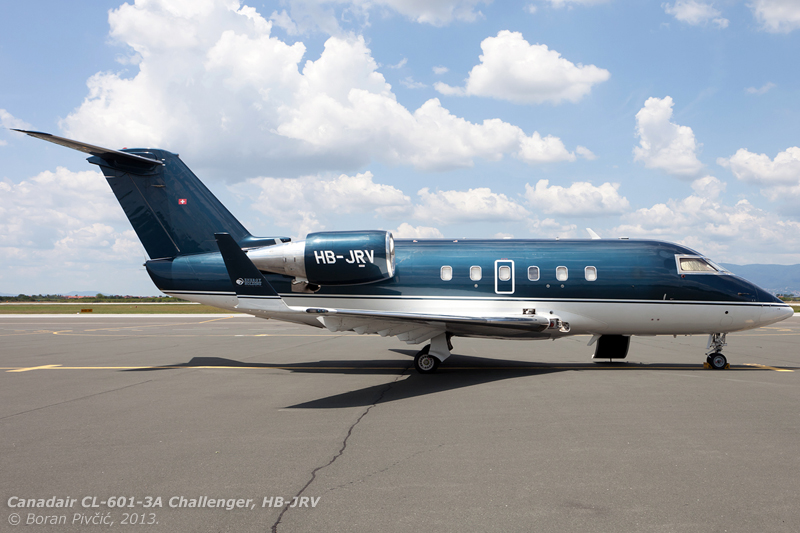
AS_LDZA2_HB-JRV
A beautiful classic Challenger snapped just a few minutes after landing. Today quite rare, the 601-3A represents the midpoint of the Challenger’s evolution and is considered to be the aircraft that had set the stage for today’s 604s and 605s. Compared to the original model 600, the 601 had introduced more powerful General Electric CF34 engines (replacing the old Lycoming ALF502), winglets, a higher MTOW – and, in the 3A version, an EFIS cockpit that taken the place of the old analogue avionics setup. The later 3R version would introduce larger fuel tanks, after which the design would evolve into the 604, sporting even more powerful engines, higher weights, yet more fuel and a full glass cockpit
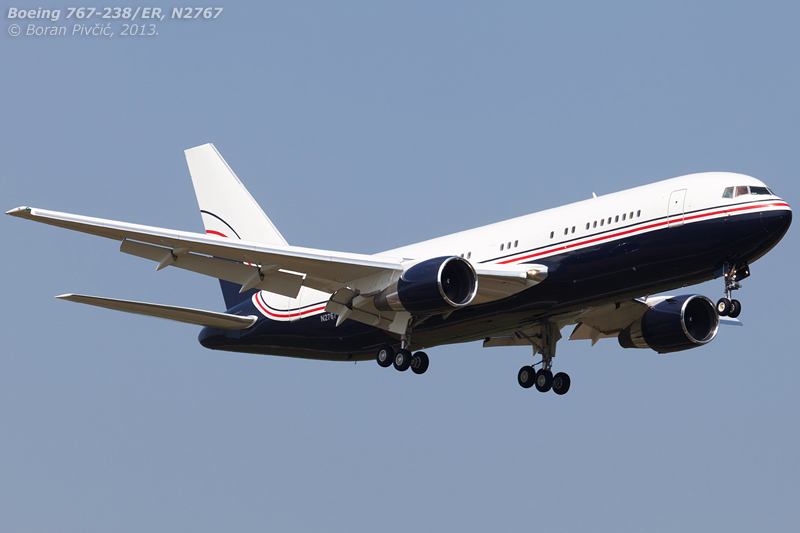
As clean and tidy as if it had just rolled off the production line - and not way back in 1987 - the Google jet is seen in the final moments of its approach to RWY 05. Even though it's very nice to see a private 767, the aircraft is a bit disappointing... considering its owner, I was expecting it to be pasted full of ads for cameras, safety jackets and spotter days
As clean and tidy as if it had just rolled off the production line – and not way back in 1987 – the Google Jet is seen in the final moments of its approach to RWY 05. Even though it’s very nice to see a private 767, the aircraft is a bit disappointing… considering its owner, I was expecting it to be pasted full of ads for cameras, safety jackets and spotter days!
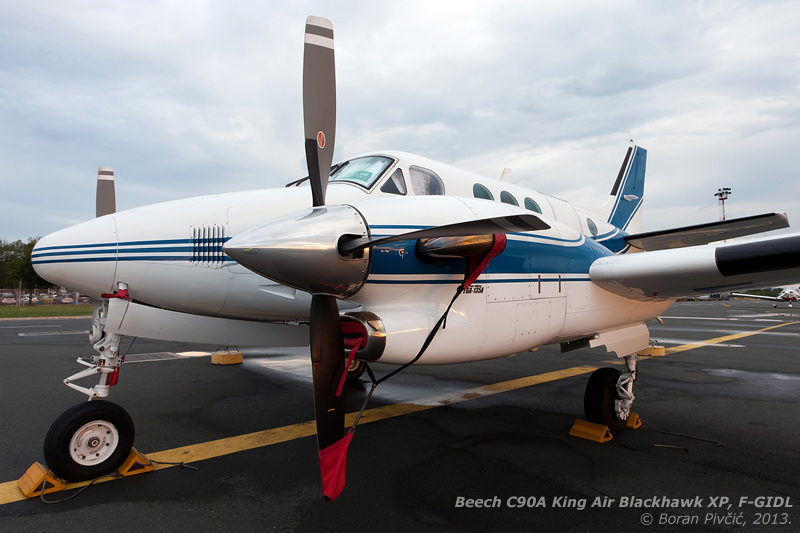
A machine that's as close as it can be to the ideal business turboprop . The only fully certified (and Beech-endorsed) King Air modification, the Blackhawk series conversion visually differ little from the standard models - but "under the hood", things are quite different. The top of the line choice for the model 90, the XP135A conversion includes the replacement of the standard 550 HP PT6A-21 engines with more modern 750 HP PT6A-135As. In addition to the drastically increased torque - which does wonders in the climb - the new engines predictably also increase cruise speed, boosting it from 403 to 503 km/h for the C90A .
A machine that’s as close as it can be to the ideal business turboprop! The only fully certified (and Beech-endorsed) King Air modification, the Blackhawk series of conversions visually differ little from the standard models – but under the hood things are quite different. The top of line option for the model 90, the XP135A conversion seen here entails the replacement of the standard 550 HP PT6A-21s with more modern 750 HP PT6A-135As. In addition to the drastically increased torque – which does wonders in the climb – the new engines predictably also increase cruise speeds, boosting them from 217 to almost 271 knots…
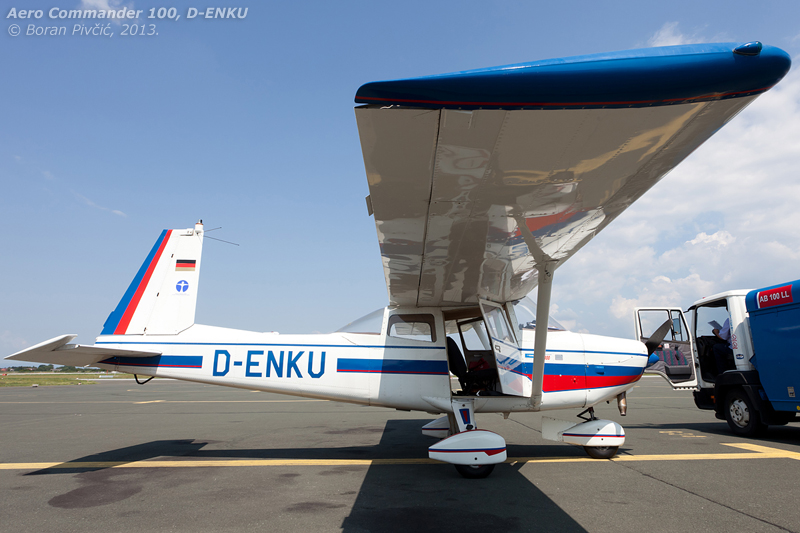
Even though jets and turboprops are de rigeur at Pleso, every once in awhile the airport gets a very interesting little piston.
Even though jets and turboprops are de rigeur at Pleso, every once in awhile the airport sees an interesting piston single like this one, usually on its way through immigration. One of the lesser-known members of the famous Aero Commander family, the 100 looks like the bastard child of a Mooney and Cessna 172 – and indeed was essentially designed to compete with the latter. Built in 1967 and powered by the same O-320 160 HP engine used on the Skyhawk, D-ENKU is one of the very few 100s still flying – and I believe one of only three or four in Europe…
g
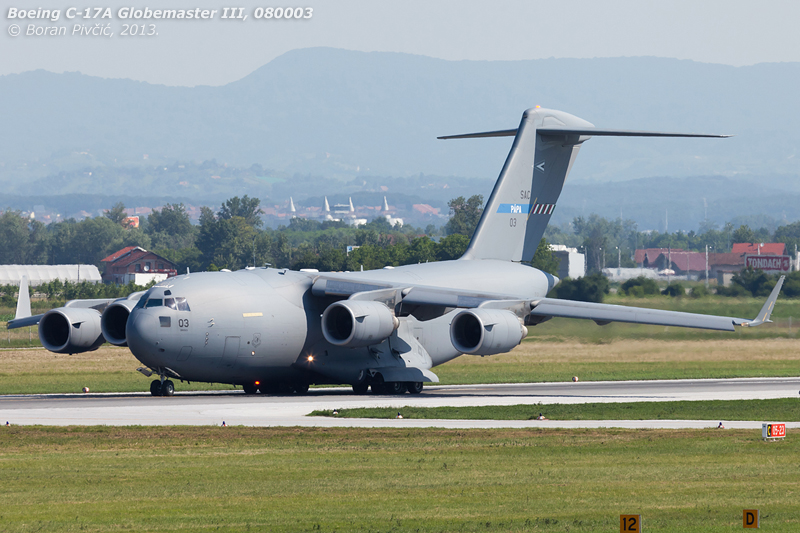
However, some of Pleso’s biggest attractions – which never fail to brighten the day – often come in military form. Quite rare by any local measure, “Bartok 25” is seen slowing down to vacate RWY 23 via taxiway C. Flying in from Papa Airbase in Hungary, 08003 is part of the three-strong NATO Strategic Airlift Capability (SAC) fleet, nominally based in Hungary and part of the Hungarian Air Force – but used on a wet lease basis by several countries in the region. A program started to allow small countries access to heavy lift capability without the need for buying their own aircraft, SAC has been quite a success, with even Croatia having its own yearly allotment of flying hours
A
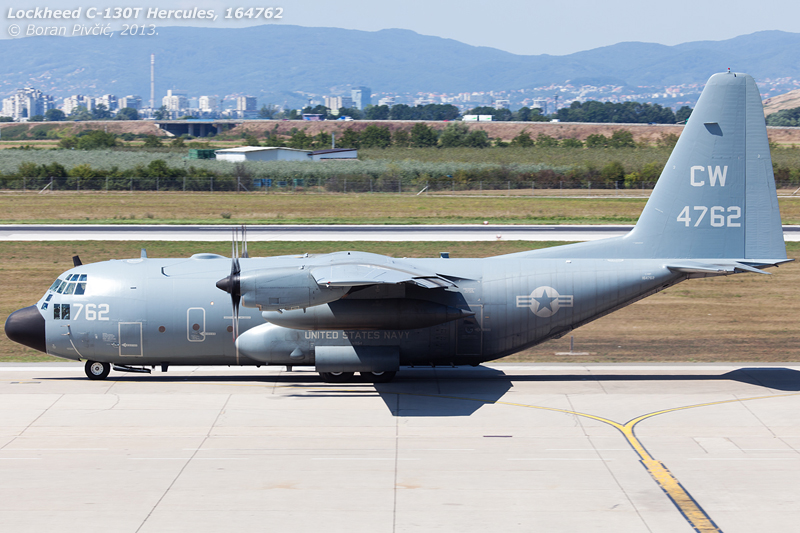
A perfect profile shot as “Convoy 6161” taxis out for departure down RWY 05. One of the many Herc versions to have visited Zagreb over the years – including the KC-130 tanker and MC-130 “spook” – the T model represents the US Navy’s primary logistics and support aircraft, and serves in this role alongside another veteran, the DC-9-based C-9B Skytrain II. Unlike most Hercs – which simply sweep through the airport on training missions – 164762 had arrived for a cargo pickup and spent almost two and a half hours roasting nicely on the superhated apron
g
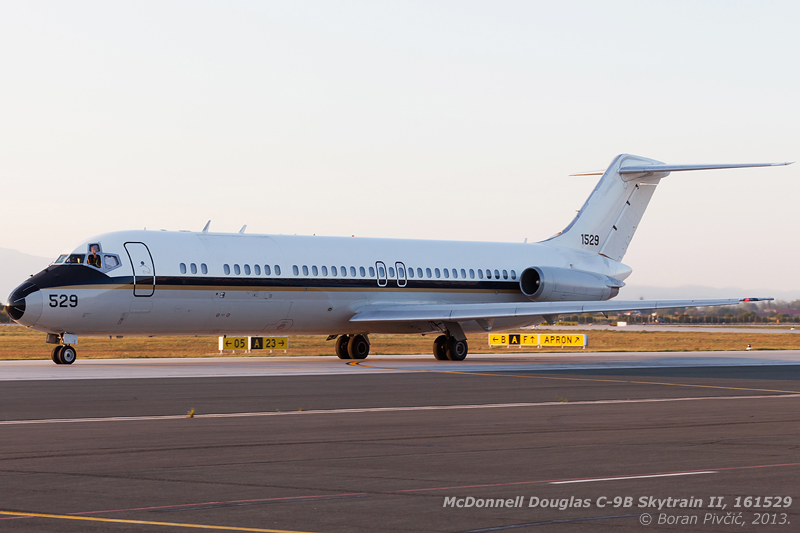
The wail of the classic Diesel 9 and a wave from the commander on a beautiful summer’s afternoon – what more could one ask for? Seeing as how I’d mentioned the C-9 in the previous photo, the US Navy had very kindly sent one example for our convenience, representing the second of the type I’ve seen in person. Using callsign “Convoy 6601”, 161529 is also seen taxiing towards RWY 05 – brought to you courtesy of my sprint across half the apron after landing and (badly) parking my Skyhawk!
U
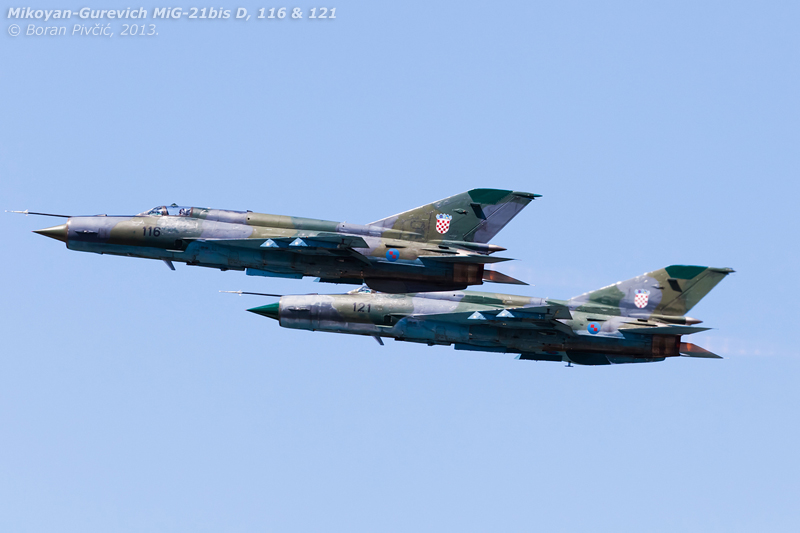
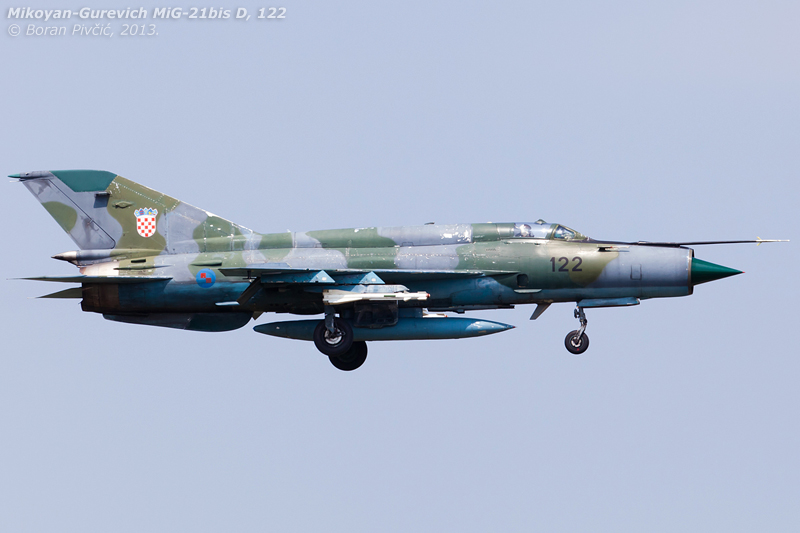
Up, up and away! Always the party piece, two of the Croatian Air Force’s few remaining MiG-21s are seen rocketing out of RWY 23 in an unusually tight formation. A good but nowadays outdated design, the MiG-21 has remained in front-line service with just three other European operators – Serbia (on a very limited basis), Romania and Bulgaria – making it quite an attraction and regularly drawing in dozens of foreign photographers
AS_LDZA2_122
More MiG action as “Knight 01” recovers home after a practice QRA (Quick Reaction Alert) scramble with sistership 116 “Knight 02”, trailing a mile or so behind. In full intercept config, both were armed with two AA-8 short-range heat seeking missiles, as well as the traditional centerline tank. Despite being almost 40 years old, CroAF MiGs still continue to ply the skies, and will soon undergo a life extension program that’ll keep them in front line service for up to 10 more years

Rare Aircraft – Mad Men: An Unusual Cessna 206

By me
All photos me too, copyrighted

As much as the art of marketing can be frustrating to those on the receiving end, its nuances, quirks – and not least of all its failures – rarely fail to add an interesting back story to the product it is trying to promote. Among the many fascinating examples out there is that of a Cessna 206 I’d come across at Vrsar Airfield (LDPV), an aircraft with a story so complicated it makes the whole airplane all that more interesting – though likely not in the manner that Cessna’s PR men had envisioned :D.

The aircraft in question is the fantastically rare P206B Super Skylane, one of the direct ancestors of today’s 206 Stationair family :). Though it has always been assumed that the Stationair had been created from scratch using a Cessna design template, the entire line actually has very muddled beginnings, marked with several configuration changes – and not just a few identity crises…

Its story thus begins not with a blank piece of paper, but the model 210 Centurion, Cessna’s posh high-performance tourer. First flown in 1957, the original 210 was quite unlike the luxury model that it is today, having started out in life as just a high-performance version of the model 182 Skylane. Based on the fuselage of the early 182 models, the 210 had included new tail surfaces and wings (strutted, its famous cantilever design still a decade away), a more powerful 260 HP engine – and, most importantly, retractable landing gear. Pretty hard to tell apart from a regular 182 at a distance, this first 210 would remain in production until 1960, when it would be replaced by the upgraded 210A, which featured a wider and longer fuselage with space for six instead of the 182’s four.

With this, 30 HP more and retractable gear, the 210’s performance and price lead over the 182 had soon grown too large for the liking of Cessna’s marketing division, so it was decided to slot in a simpler and cheaper model between the two. Avoiding much undue fiddling, Cessna’s engineers simply took the 210A, swapped its retractable gear for a fixed system, cut down the internal trim levels and equipment options and created the model 210-5, the first foundation for the model 206 :). This rework was so “cheap and cheerful” in fact that the aircraft retained the 210’s characteristic “chin” under the cowling, which would have housed the nose wheel when retracted…

However, with the model number still alluding to the expensive and exclusive Centurion, Cessna’s PR team had had another rethink, eventually renaming the new aircraft into the model 205. To dilute its “posh” heritage even further, this model would also become known as the Super Skylane, hopefully leading buyers to believe it was just a Skylane with two extra seats 🙂 (Cessna would pull the same trick off once more in the late 60s, marketing the 210 HP Reims Rocket, the 195 HP Hawk XP and the retractable Cutlass as 172s rather than the more expensive and troublesome 175 Skylark on which they were actually based). Nowadays a very rare bird – I myself know of only one example in the region – the 205 was produced for only two years, being dropped in 1964 in favor of the upgraded 206 :).

On the surface at least there seemed to be little in it between them. The same size and with the same passenger capacity, the 206 seemed to be more of the same from the marketing squad – but was in fact a clever re-think of the design, one that would have quite an impact on today’s 206 family. Under the skin, the most obvious change was an increase in power, up from the 260 HP of the 205’s Continental IO-470 to a juicier 285 HP of the 206’s larger and torque-ier IO-520. The other important detail was the diversification of the 206 line into several sub-versions, each with a different role. The most famous of these (and the only one to survive till today) was the U206 – U for “utility” – which would be the first model to feature the type’s distinctive split rear cargo doors, designed for ease of loading and unloading of cargo far, far in the backwoods :).

A version more pertinent to this article was the P206, with P standing not for “pressurized” but “passenger” (an eyebrow-raising moment this 😀 ). This version retained the door arrangement of the 210A, 210-5 and 205; namely, two large passenger doors on either side of the front cabin. The only Cessna model to ever use P for anything other than pressurized, the P206 was relatively short lived, produced only between 1965 and 1970 in a slew of versions (up to the P206E), including even a turbocharged model called the TP206 :). Like the 205, it had retained the Super Skylane moniker, in line with its sales image as a six-seat 182.

Still airworthy - and unusually clean - DER is the only first-gen 206 in Croatia and still leads an active life in passenger and occasional skydive ops.
Still airworthy – and unusually clean – DER is the only first-gen 206 in Croatia and still leads an active life in passenger and occasional skydive ops. Note also the 210’s “chin”, which would be retained for several more production years
being a 60s aircraft, the panel layout makes little sense to us used to the "basic six" arrangement, with instruments scattered at seemingly random locations. But, in a way this give it so much charm that I wouldn't have any reservations about taking this for a spin!
Being a 60s model, DER’s the panel layout makes little sense by today’s standards, with instruments scattered seemingly at random. But, in a way this gives it so much charm that I wouldn’t have any reservations about taking it for a spin! (also sorry for the glare outside, the sun was high and the interior quite dark)

These original “quirky” 206s would in the event remain in production until the early 70s, by which time the type – now renamed yet again into Stationair – would slowly start to transform into the aircraft we know today. After the U206D had introduced the 300 HP power rating – still used today – the U206F would finally smooth out the lower cowl, erasing the last obvious trace of the 210’s DNA. And the rest is history… 🙂 (unless they manage to re-brand that as well!)

(Aerial) Photo Report – Flight of the Phoenix

By me
All photos me too, copyrighted

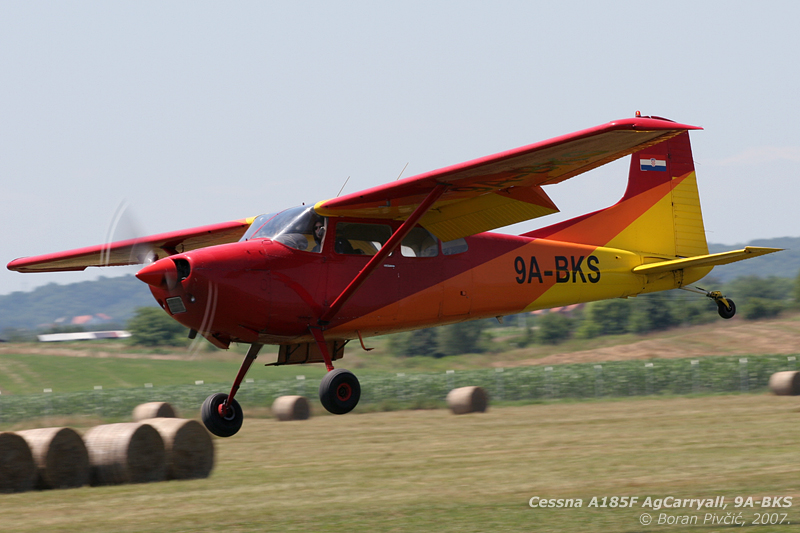
While it is somewhat less exciting than the movie of the same name (even though it involves a similar amount of mechanical ingenuity 😀 ), one event at Lučko back in May certainly gave rise to a bit of optimism, pride – and, not least of all, a fair bit of relief. The occasion in question was the return to flight of our much-loved Cessna A185F 9A-BKS, signalling its eagerly-awaited return to service after five long years on the ground. Covered in part by another post on here, BKS had suffered a prop strike back in 2008 which had seen it confined to the hangar until its prop and engine could be repaired – a process that, through various financial setbacks, took almost four and half years to complete…

Diving for the runway back in happier times
Diving for the runway after a skydive flight back in happier times

However, while the aircraft was airworthy and fully certified as June dawned, one important issue still remained before BKS could be given a clean bill of health and returned to active duty as a skydive platform – the engine break-in period. Like all new and overhauled engines, BKS’ IO-520 needed a 25 hour run-in period during which the piston rings would gradually wear themselves out and begin to lubricate the cylinders properly, boosting the engine’s efficiency and power and generally returning it to “its old self”. This however requires treating the engine with the utmost care, flying it gently and at relatively low power settings, all the while ensuring it is being properly cooled to compensate for the poor oil distribution – not all that easy to do if you’re flogging it at maximum continuous power for half an hour as you haul half a ton’s worth of skydivers to altitude at low speed :).

To avoid making a hash of it, AK Zagreb – the owners of the aircraft – had decided to send it out on a number of extended cross-country flights, which would also have the added benefit of providing long periods of steady cruising and allow the crew to check fuel flows, oil pressures and various temperatures against the operating manual :). Naturally enough, I’d quickly found my way onto several of these flights – and while I was relegated to being the ballast in the tail, I did at least have the time (and cabin space!) to enjoy the scenery outside…

A
A scene as if it came from the flight levels as we maneuver around some potentially hazardous weather on our way to the Adriatic coast. Moving slowly inland from Kvarner Bay, this storm front was making itself felt even at our 7,000 ft cruise altitude, with the air becoming ever rougher as we closed in
E
Eventually though, the front had forced us to descent to 3,000 ft and skim around its edge, swapping the soothing cloudscape with some fantastic mountains and shadows
W
With 300-ish horsepower up front, we managed to outrun the worst of the weather, skimming the edge of the system low among the peaks of the Velebit mountain range. Our 140 knots indicated – the end of the green arc despite flying on only 65% power – meant were were through in mere minutes
Enjoying the crisp and calm weather above Lošinj Island while looking back on the front that had caused us trouble . A beautiful study of convective clouds, the centerpiece of the scene is the impressive altocumulus castellanus, nicknamed the "turret cloud" due to its pronounced vertical development. Alongside another stunning altocumulus type - the altocumulus lenticularis - turret clouds are a sure indication of severe turbulence and icing, making them a handy aid in deciding when to take avoiding action.
Enjoying the crisp and calm weather above Lošinj Island as we look back on the front that had caused us so much trouble. A beautiful study of convective clouds, the centerpiece of the scene is the impressive altocumulus castellanus, nicknamed the “turret cloud” due to its pronounced vertical development. Alongside another stunning altocumulus type – the altocumulus lenticularis – turret clouds are a sure indication of severe turbulence and icing, making them a handy aid in deciding when to take avoiding action.
Enjoying the crisp and calm weather above Lošinj Island while looking back on the front that had caused us trouble . A beautiful study of convective clouds, the centerpiece of the scene is the impressive altocumulus castellanus, nicknamed the "turret cloud" due to its pronounced vertical development. Alongside another stunning altocumulus type - the altocumulus lenticularis - turret clouds are a sure indication of severe turbulence and icing, making them a handy aid in deciding when to take avoiding action.
Challenge accepted! Too good an opportunity to pass up, in a few moments we would be zooming between the peaks at something like 150 knots. How very nice of Mother Nature to place them right on our planned route!
An overflight of what my colleague flying had eloquently termed the "Krbavian Sea" . Neither a man-made nor permanent geographic feature, this temporary lake was created by the abundant rains that had hit the Krbavsko polje area over the past few weeks.
An overflight of what my colleague flying had eloquently termed the “Krbavian Sea”. Neither a man-made nor permanent geographic feature, this temporary lake was created by the abundant rains that had hit the Krbavsko polje (Krbava Field) area over the past few weeks. One of the country’s biggest mountain valleys, Krbavsko polje is also known for its excellent gliding weather, with most Croatian gliding records set not more than five miles to our right

Tech – A Flying Fashion Victim: The PC-6 Engine Saga

By me

In a dazzling display of consistency, my research for a magazine article about S5-CAM – the Pilatus PC-6 that had visited Lučko some months ago – took only moments to veer completely off track, invariably as soon as I began to delve deeper into the type’s rich history :). The culprit for my deviation was the fantastic database at www.pc-6.com, documenting in amazing detail the life and times of this amazing aircraft.

Such huge collection of sometimes obscure information was right up my runway, so with my initial research goal completely forgotten, I began to read through the type’s version list. Pretty soon I began to notice that the PC-6 had a tendency to change engines as often as I change clothes, prompting me to dig even deeper and attempt to make a list of all the powerplants (and their evolutions) that had ever been fitted to the Porter… 🙂

From A to D

While the PC-6 is today universally – and pretty much exclusively – associated with the venerable PT6A turboprop, the design actually had much more humble beginnings, starting out in life as “just another piston”. First flying back in 1959, the original PC-6 had been equipped with a Lycoming GSO-480 engine, whose six supercharged (S prefix) cylinders, linked to a reduction gearbox (G prefix), produced around 340 HP (the reason why this series is also known as the PC-6/340). Despite the comparatively low power – and the piston engine’s well known anemia at altitude – the Porter prototype had nevertheless managed to capture the period record for the highest (successful 🙂 ) landing, touching down at an impressive 18,856 feet somewhere in the Himalayas.

However, the GSO-480 was quite a complicated and temperamental thing to run and maintain, leading pretty soon to the development of a simpler model called the PC-6/275, powered by a normally aspirated – but still geared – 250 HP GO-480. But the loss of 90 HP – a whopping 26% – over the equally heavy standard model had meant the performance suffered dramatically, spurring the introduction of the follow-on PC-6/350, equipped with a fuel injected (I prefix) IGO-480 developing a much more reasonable 350 HP.

The apex of the piston PC-6 however did not come until 1970 – rather late by large piston standards – with the brutal PC-6/D, powered by the monstrous eight cylinder Lycoming TIO-720 producing a sizable 400 HP. One of the more ludicrous ideas to come out of the Lycoming works, the 11.8 liter TIO-720 was created by joining together two IO-360s and then – for that little extra something – screwing on a massive turbocharger (T prefix). Despite the power and potency of the engine – which had also been used to great effect on the Piper PA-24-400 Comanche and the PA-36-375 Pawnee Brave – it was very heavy and its rear cylinders were notoriously prone to overheating. The superiority of turboprops – which had been introduced to the PC-6 line nine years earlier – had slammed the final nail into the coffin of the D model, the program being quietly dropped after just one prototype had been completed.

The French Connection

This “first contact” with the turbine came in 1961 with the 523 HP Turbomeca Astazou IIE, creating the PC-6/A, the first of the Turbo Porters. A very light, compact and durable engine, the Astazou would go on to become one of the world’s great small turboprops – but would sadly have a short and largely unremarkable career on the PC-6. The only major revamp in the period was the one-of PC-6/Ax, powered by the new Astazou X which had – through the addition of another compressor stage – been boosted to 573 HP. This model was followed by the very similar PC-6/A1 and PC-6/A2, which had only differed in engine versions (Astazou XII and XIVE respectively) with no change in power. All in all, only 43 Astazou-powered examples were ever built, all of which were eventually re-engined with the PT6A – thus confining the A models to the pages of history…

What would eventually become the PC-6 we know today had started emerging in the mid-60s, when the Astazou of one example was swapped for a 550 HP PT6A-6A, creating the enduring legend – the PC-6/B. This first foray into PT6 World was however short lived, with only 12 examples produced before the introduction of the definitive early B model, the PC-6/B1-H2, sporting the PT6A-20 of equal power output, but higher torque.

Like fine wine (or cheese 😀 ), the PT6 PC-6 would then take some time to mature – 17 years in fact until the arrival of the penultimate Turbo Porter, the PC-6/B2-H2 of 1984. Representing 80% of the way to today’s standard, the B2-H2 was fitted with a 680 HP PT6A-27, flat rated down to the “original” 550 HP. While this may seem like a questionable move, it does have a raft of benefits for a “hauler” designed for operations at high weights and in all weather conditions. The first advantage is the engine’s larger core, which gives a measurable increase in torque throughout its operating range without a (significant) increase in fuel consumption. Additionally, running slower and cooler than it was designed for means engine wear is noticeably reduced, boosting overall reliability and noticeably prolonging the engine’s service life.

However, the biggest advantage is a stable power output regardless of outside air temperature. In a conventional non-flat-rated system, the maximum power the engine can produce with the throttle wide open – the so called thermodynamic power – varies greatly with air density, itself a function of air temperature. The higher the temp, the lower the density and vice-versa. When the density is low, the mass flow through the engine is reduced, the combustion efficiency is reduced and the engine’s thermal limits are more constricting – all of which results in a reduced power output. Conversely, when the density is high – such as on a cold day – the mass flow is high, combustion efficiency is high and the engine runs cooler, allowing more fuel to be injected and thus produce more power. The upshot is that an engine producing, say, 1000 HP in standard conditions (15 degrees Centigrade, used for all performance specs) may produce upward of 1100 HP at 0 Centigrade and as low as 900 HP at 30 Centigrade – which complicates performance calculations and adversely affects the aircraft’s overall performance. Obviously enough, the more critical condition is at lower densities – since very few pilots will object to having additional pep at takeoff :D.

Flat rating systems get around this issue (up to a point of course) specifically by limiting the engine’s maximum power so they always have a reserve to compensate for any drop in output due to reduced density. In the case of the PC-6, the capacity to produce that additional 130 HP is used to compensate for the reduced efficiency at higher temperatures, allowing the engine to produce its stated 550 HP regardless of outside conditions. Additionally, since the same principle applies to the reduction in density with altitude, flat-rated engines have a lower power decay while climbing, and can produce their stated power to a higher altitude, helping out greatly in hot-and-high operations.

Having finally sorted the engine out (after decades of trying 😀 ), Pilatus then turned to the other remaining propulsion item – the propeller – replacing the usual three-blade unit with a new four-blade model, creating today’s production standard PC-6/B2-H4.

However, while Pilatus themselves had stopped fiddling with the powerplant, the Porter’s users had other ideas and decided to carry on the tradition themselves. An immensely popular skydive platform, the PC-6 had at time been found wanting for power in the climb, leading to the logical idea of refitting it with a more powerful engine. This was eventually achieved in 2001, when an old B2-H2 was upgraded with the 750 HP PT6A-34 (flat rated to 620 HP), becoming the progenitor of a series of 30 such conversions (both H2s and H4s), all done under a new Supplementary Type Certificate.

The Alpine Yank

But the “fulfillment” of the PT6A installation is not the whole of the PC-6 engine saga – not by a long shot :). The success of the first turboprop models had created a lot of interest on the other side of the Atlantic, where operators were keen on a home-grown version using locally-available components. Not oblivious to the huge potential of the aircraft on the American – and especially SOUTH American – market, Pilatus quickly complied with demand, and in 1964 struck a deal with Fairchild-Hiller to produce the aircraft under license in the States. Initially, the aircraft rolling off the line were stock B models – but it took the locals only a year to come up with their own version, the PC-6/C, powered now by the 575 HP Garrett (AiResearch) TPE-331-25D.

Generally “confined” to the US market, the C models would eventually rise to worldwide fame, thanks most of all to the PC-6/C2, known in military service as the AU-23A Peacemaker. A type still happily flying with the Royal Thai Air Force, the AU-23A is/was powered by the 665 HP TPE-331-1-101F, and had flown into the spotlight during its exploits in the skies of Vietnam, Laos and Cambodia. Another C2 had also landed in the record books, having performed an amazing 424 take offs and landings in a single day, a feat achieved over 21 consecutive hours without breaks (except for oil and fuel top ups)…

Chronologically out of tune, the last of the C models was the the PC-6/C1 of 1969, powered by a 576 HP TPE-331-1-100. Apparently a TPE conversion intended for the European market, the C1 eventually ended up being just a one-of model, with the PC-6 already having a suitable engine in the form of the PT6A :).

Overview – piston:

  • PC-6 (PC-6/340) – Lycoming GSO-480-B1A6 (340 HP) (1959)
  • PC-6/275 – Lycoming GO-480-D1A (250 HP) (1960)
  • PC-6/350 – Lycoming IGO-480-A1A (350 HP) (1961)
  • PC-6/D – Lycoming TIO-720-C1A2 (400 HP) (1970)

Overview – turboprop:

  • PC-6/A – Turbomeca Astazou IIE (523 HP) (1961)
  • PC-6/Ax – Turbomeca Astazou X (573 HP) (1964)
  • PC-6/A1 – Turbomeca Astazou XII (573 HP) (1967)
  • PC-6/A2 – Turbomeca Astazou XIVE (573 HP) (1967)
  • PC-6/B – Pratt & Whitney Canada PT6A-6A (550 HP) (1964)
  • PC-6/B1-H2 – Pratt & Whitney Canada PT6A-20 (550 HP) (1967)
  • PC-6/B2-H2 – Pratt & Whitney Canada PT6A-27 (680 / 550 HP flat rated) (1984)
  • PC-6/B2-H4 – Pratt & Whitney Canada PT6A-27 (680 / 550 HP flat rated) (1996)
  • PC-6/B2 (mod) – Pratt & Whitney Canada PT6A-34 (750 / 620 HP flat rated) (2001)
  • PC-6/C – Garrett (AiResearch) TPE-331-25D (575 HP) (1965)
  • PC-6/C2 – Garrett (AiResearch) TPE-331-1-101F (665 HP) (1967)
  • PC-6/C1 – Garrett (AiResearch) TPE-331-1-100 (576 HP) (1969)

Sources:

Rare Aircraft – Mountains and Savannas

By me
Photos as credited

There is a well established procedure among aviation enthusiasts of visiting an airshow simply to see one or two interesting aircraft types. I myself am guilty of this as well, often going to regional shows (ones not far enough away to be expensive) just for the sake of enjoying the sight and sound of a handful of rarities :). While larger shows such as Air Power in Austria and Kecskemet in Hungary have a lot of interesting jets and piston props to offer, back in June I’d set my sights slightly lower and popped ’round to the small air meet at Zvekovac airfield (LDZE), just a 20 minute hop by Skyhawk from Zagreb.

While most of the aircraft in attendance were quite familiar to me – having flown on roughly a fourth of them 😀 – one visitor in particular had piqued my interest ever since I saw it on the guest list: the diminutive Fuji FA-200 Aero Subaru :).

H
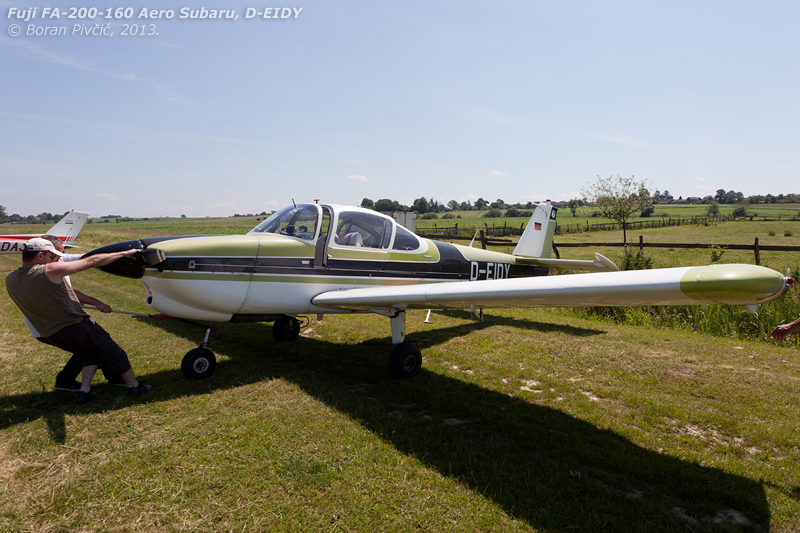
Heave! Backing the aircraft – registered D-EIDY – into its parking position required some manhandling by the crew, made all the more difficult by the pronounced slope… and the sizable ditch at the end

One of the very few light aircraft designed and produced by the Japanese aviation industry, the FA-200 is quite an odd machine, examples of which can in Europe be counted on the fingers of one hand. First conceived in the mid-60s – and reminiscent in concept to the Yakovlev Yak-18T – the Aero Subaru is a comfortable and spacious four-seat tourer – and at the same time an aerobatic-capable trainer. To add to this technically challenging mix, the design sports a 400 kg payload, on par even with some larger and more powerful tourers.

Relying more on aerodynamic efficiency than outright brute force, the design in its basic form – the FA-200-160 seen here – is powered by a 160 HP Lycoming O-320 driving a fixed pitch propeller, a setup nicked directly from the Piper Warrior (and/or Cessna Skyhawk). While this power is perfectly adequate for most needs, it did leave something to be desired in the aerobatic role, leading Fuji to introduce the more potent FA-200-180, powered by the 180 HP Lycoming IO-360 linked with a constant speed prop. Interestingly, the subsequent version – the FA-200-180AO – had kept the engine, but reverted once again to a fixed pitch prop, ostensibly to reduce costs and simplify maintenance.

g
Well cared for, D-EIDY spots a very clean and well equipped cockpit, including a Mode S transponder and a Garmin G3X multifunction unit. Note also the military trainer-style throttle lever, designed to fall more easily to hand and be more intuitive to use during maneuvers

In most other respects a solid design – done in the best tradition of Japanese heavy industry – the Aero Subaru had nevertheless failed to even dent the Big Three’s dominance in the GA market, ending its production run with just 275 examples built across all three versions. While on par in terms of quality with offerings from Beech, Cessna and Piper, the FA-200 lacked that “manufacturer’s prestige”, making it a risky choice from a company with little experience in general aviation and a virtually non-existent support network. However, despite these issues, several examples had made it out of Japan and are still happily flying all over the world 🙂 (with most of Europe’s examples concentrated in Hungary).

The same fate however had not befallen another interesting aircraft at the meet (which I’d stumbled upon quite by accident!): the ICP MXP-740 Savannah XL VG :). A name that will leave you short of breath during any attempt to pronounce it out loud, the MXP-740 is one of several spin-offs of the Zenair CH-701, an amazing STOL homebuilt ultralight whose takeoff and landing performance could have very well qualified it as a helicopter :D.

S
A bright & clean STOL aircraft with chunky tires and open doors, on a grass field in the middle of nowhere during a beautiful summer’s morning – a scene that simply begs you to go flying! Absolutely immaculate inside and out, 9A-DIS is one of the two or three best-built homebuilts in Croatia

While not a rare design in itself, the Savannah always warrants at least some attention – especially in this, the XL VG version on which the ICP people had really pushed the boat out :). The XL is pretty much self-explanatory; the VG however refers to vortex generators, small strips of metal on the upper wing surface specifically designed to disrupt the flow of air along the wing. Though this seems somewhat counterproductive, there is a finer underlying logic to it.

Vortex generators visible along the wing on another Savannah (photo from: rnzaf.proboards.com)

As with any fluid flowing along any surface, the airflow in the first inch or so above the wing forms what is known as the boundary layer, a thin area in which the flow speed drops due to air viscosity and surface friction. The behavior of the air in this layer is of great importance for the generation of lift, and is described using two terms: laminar flow and turbulent flow. As its name suggests, the laminar flow is smooth (and silky :D), flowing straight and true with no mixing or significant lateral speed or direction changes. This type of flow creates the least drag, which has made it a must for high performance aircraft – and especially gliders! – but requires a clean and smooth wing with no lumps or bumps :).

The turbulent flow on the other hand is as chaotic as it sounds, constantly being in a state of mix and suffering from continuous speed and direction changes – which, naturally, considerably increases drag. However, due to these characteristics, the turbulent flow sticks to the wing down more of its length, effectively increasing the wing area producing useful lift. This means that for the same wing area, the turbulent flow will create more lift than a laminar one; or, turning the premise around, the turbulent flow will create the same lift at a significantly lower speed. This is of course beneficial to STOL aircraft and trainers – and is one of the reasons why many light aircraft use dome instead of flush rivets on the wings and fuselage, which act as ready-made obstructions and prevent the formation of a laminar flow. However, they can only do so much, so on aircraft that really need proper low-speed handling, they are supplemented by “full blown” vortex generators :).

Vortex generators also enable the wing to reach higher Angles of Attack – which in turn means the aircraft can again maintain the required lift at a much lower speed (source: Aerospaceweb.org)

In concert with the thick low-speed wing, slotted flaps and slotted flaperons – ailerons that droop along with the flaps – these vortex generators give the Savannah a comically low stall speed of just 25 knots :). And with its MTOW of 560 kg pulled along by a 100 HP Rotax 912ULS engine, 9A-DIS can become airborne in just 35 meters (115 ft), with 50 meters (164 ft) needed to land and come to a halt.

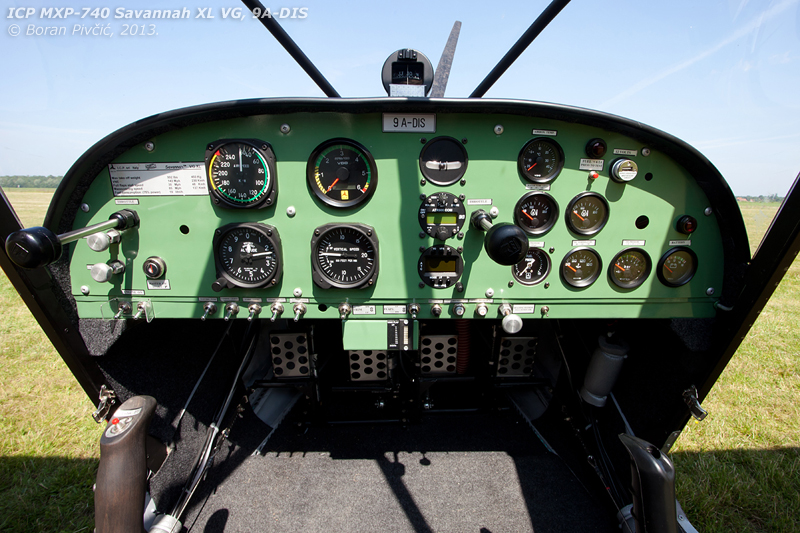
A nice
A nice and clean panel, with everything you really need in easy reach. The unusual green panel color is a throwback to the owner’s former workplace, the MiG-21 interceptor

Unfortunately, the aircraft was static only for the duration of the meet – being based at Zvekovac – but I’m told that it is definitely no hangar queen… 🙂