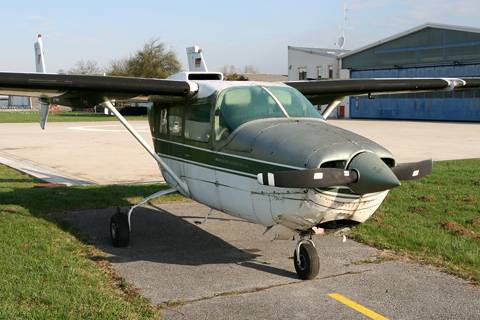
Usually hidden away behind the police helicopter hangar, our poor old Skymaster has over the years almost become part of the landscape. Relatively inconspicuous – an epithet not normally bestowed on one of Cessna’s oddest designs 😀 – it has pretty much become a fixture of the ECOS apron, taken for granted, as exciting as a tree (which it somewhat resembles in its green paint scheme). You get the impression that it’s as stable and permanent as the hangar it hides behind… right up until the moment it moves :).
Arriving at the field this morning for my simulator run, I threw a glance around the apron as I always do, checking to see what – if anything – was new. Expecting nothing really interesting – the field having opened only three days ago – I was taken off guard by a Skymaster parked out in the open, unobscured for the world to see, at the end of the ECOS apron. Briefly excited by the prospect of finally seeing a flying example, I soon spotted the familiar paint scheme… nevertheless, now that it was out in the open and away from its usual cluttered background, I thought I might as well get some photography done… 🙂
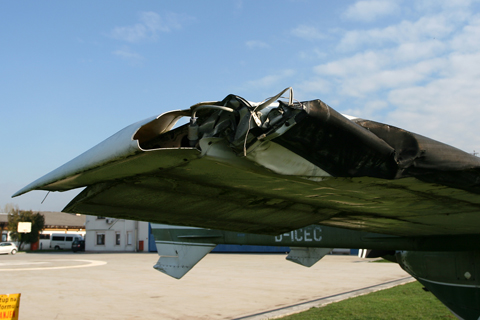
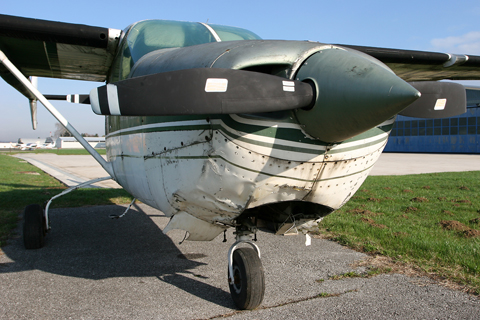
Not much of a sight, but nine years of standing around will do that. In its usual position blocking access to a new hangar being built on the ECOS apron, it had been temporarily moved here, for lack of a better solution. At least it got to stretch it legs a bit - and after nearly a decade finally have its tires pumped up 🙂An interesting machine from any angle :). A French-built Reims F337F Super Skymaster, serial F337-0027/01337, D-ICEC (previously registered F-WLIQ) had been bought about 9 years ago by a commercial pilot and flown over from Germany. However - as I've been told - the pilot flared too late and struck the ground with the nose and right wingtip, bending the front prop and seizing the engine, as well as damaging the nose gear. Rearing up into the vertical, the rear engine continued to operate and push the nose into the ground until it was presumably starved of fuel by gravity. There were no injuries, but the aircraft was towed to the ECOS apron, presumably pending investigation. For some reason, it had stayed there ever sinceThe damaged right wingtip. Toying with the idea of getting this thing flying again, a couple of us made a cursory visual "look-see" inspection and from the outside at least the spar - the most important element of the wing - seems to be in good order. However, any serious work would have to see a detailed ultrasound, magnetic or radiographic inspection to check for internal stressThe front cowl had suffered as well, with the nose gear doors having been instantly sheared off. Note also the bent prop, which is now - given its age - a total write-off not worthy of repairA slightly artsy B&W rear view. The normally aspirated Skymasters are powered by two 210 HP IO-360 engines usually driving two-blade constant speed props, set up to rotate in opposite directions to cancel out each other's adverse rotation effects. Because the rear prop rides in the turbulent airflow from the fuselage and central wing section, the Skymaster has a distinctive square-wave sound, in common with virtually all pusher props (inside it is less fun, because you now have two engines making noise in the cabin :)). D-ICEC's rear engine is - interestingly - relatively serviceable, as we had fired it up several times in the past, to keep it from seizingAnother artsy view of the left vertical stabilizer. Having a comparatively large stabilizer area as compared to most similarly sized aircraft, I'd wager a guess that the Skymaster was pretty stable around its vertical axisA previous photo of D-ICEC in its usual, less-that-flattering surroundings. The hangar that had caused its temporary relocation is seen here in its early stages of assembly. For those of you wondering, during retraction the main gears would fold down and then backwards - like on Cessna singles - and stow in wells just below the exhaust. On some models, the wells were exposed (again like on many Cessna singles), but on the F model for one they were covered by doors that would only open during gear retraction of extensionView in full, unfortunately blending in well with its surroundings...
As mentioned in the photo comments, a couple of us had thought of restoring it – but despite the fact that many of its common engine and system components can easily be found, being used on other Cessna designs, there really is no economic case for any form of serious restoration. The structural checks alone would cost a fortune – the entire airframe having absorbed the forces of the impact – plus you’d need to overhaul two engines, two props, the entire landing gear system, repair the wing damage, repaint it, rebuild the cockpit (this having been cannibalized for instruments) re-certify it and so on and so forth… it would be easier to just by a “new” one… 🙂
My preparation for the arrival of the “super depression” nicknamed Vatroslav – and its associated “heavy” snowstorm Andrea (abrasive sarcasm intended) – last Wednesday pretty much centered around throwing a shovel in the boot of my car and preparing my camera for the “horrors” of snowy weather. As I had to be at Lučko at 7 AM next morning – right after the heaviest snowfall was forecast – for my early-morning IFR simulator run, I though I might as well enjoy a spot of winter photography :).
Expecting Armageddon, Snow – the fifth rider of the Apocalypse – and a complete breakdown in law and order so vehemently prophesied in the media, I set off just before 6 AM. Normally the 11 km journey takes me about 15-20 minutes depending on the traffic – exactly the same time it took me that morning, when all possible communications outlets were blaring warnings about not leaving the house unless it is critically important. At the field I was greeted by not-even-remotely-catastrophic 20-30 centimeters of virgin snow, just perfect for some unusual photography! The only problem was, there was nothing really interesting to photograph and the dull, low overcast didn’t really help with the lighting situation…
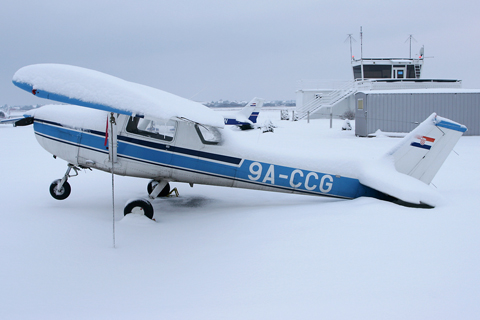
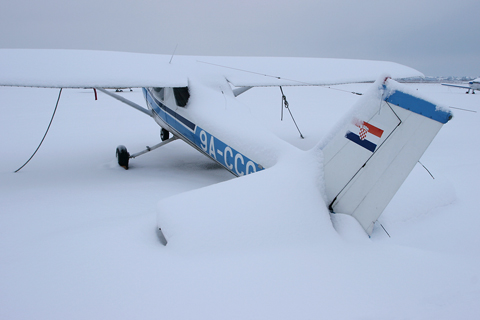
However, all was not lost, because then I just happened to notice that one of our planes was sitting in what could only be described as “unusual attitude” :D…
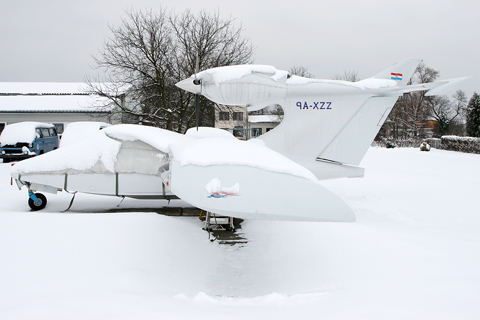
Oooops... after seeing similar photos of big airliners, seeing a small 150 in the same pose was more than a little humorous :). But with their proportionally long tails and light noses, 150s are sometimes prone to this. Even DMM at the other side of the field wasn't spared the same indignity...Thankfully for both 150s parked outside, the strong wind that had accompanied the storm had blown up a lot of snowdrifts, so when the tail did come down, its fall was cushioned, resulting in no material damage. Three hours later, both of them had been cleaned and right way up! 🙂An amphibian surrounded by water - but in the wrong state :). By the time the sim had finished, it was almost noon, so the lighting was much better - unfortunately, there still wasn't anything interesting to photograph...
Having become bored of my previous desktop wallpaper, I decided to rummage once more through my photo database in search of a suitable replacement. And being currently under the influence of pre- and post-WW2 aviation – as evidenced by my last two Rare Aircraft posts 😀 – I was looking for a technically imperfect, “realistic” photo of some aircraft of that era, which I would then artificially age in Photoshop and hopefully end up with something that could pass as “authentic”. Having drifted off course quite badly, I ended up with a Tu-154, but the process gave me a swell idea for a new post to break the monotony (and with it snowing like mad – again – the monotony was sure to continue)… 🙂
What I wanted to do was create something of a “historical East Block photo report”, using only my own photos and manipulating them to make more-or-less believable representations of photos that could have been taken in the periods concerned. Though I’ve sorted the images according to the aircraft type’s year of first flight (indicated in the parentheses), they actually represent the years when that type was at its heyday, that is, the years when it could be seen in greatest numbers. To this end, I stuck to images with neutral backgrounds and without anything modern in view, and “aged” them to reflect also on the various types of cameras that could have been used; so a photo taken in 1980 may be B&W, while a photo from the early 70s may be in faint colors…
The dead giveaways shattering the illusion are the modern registrations – as well as some obvious faults in my aging work – but for viewing pleasure, I think I’ve hit the mark quite nicely :).
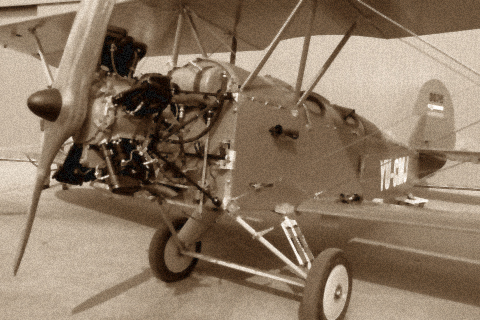
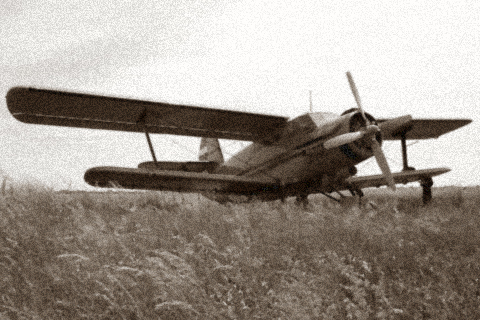
(FF: 1927) The oldest of the lot is the "USSR's Piper Cub", the legendary Polikarpov Po-2. Slow and noisy, this simple and docile biplane had trained generations of Soviet pilots and was - among other things - used with great success by even more famous 558th Night Bomber Regiment. Its all-female crews - nicknamed the "Night Witches" - flew night harassment missions against Axis forces on the Eastern Front, rising to become the most decorated air unit of the Soviet Air Force. The aircraft pictured here is just one of more than 40,000 produced, making it the second most produced airplane in the world, as well as the most produced biplane 🙂 (though not exactly East Block - having been designed in the 20s - the Po-2 was still in widespread use after WW2, so I grouped it with the others)(FF: 1939) Equally luminous is the very rare Lisunov Li-2. A Soviet license-built version of the C-47, the Li-2 was the backbone of a number of East Block airlines - Aeroflot, LOT (Poland), CSA (Czechoslovakia), Malev (Hungary), Tarom (Romania), ... - in the early years following WW2, before being replaced by the Ilyushin Il-12 and Il-14, the last of the Soviet piston airliners. This specific aircraft pictured, HA-LIX, is the only remaining airworthy Li-2(FF: 1947) Next in the lineup of the greats is the "Anushka", the indestructible Antonov An-2. The largest production single-engine biplane - and up till recently the aircraft with the longest uninterrupted production run, beaten now by the Lockheed C-130 - the An-2 has been employed in too many roles to count. Uneconomical, ungainly and slow, the An-2 has three times more charisma than weight 🙂
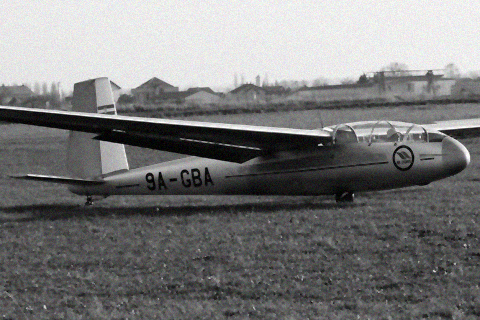
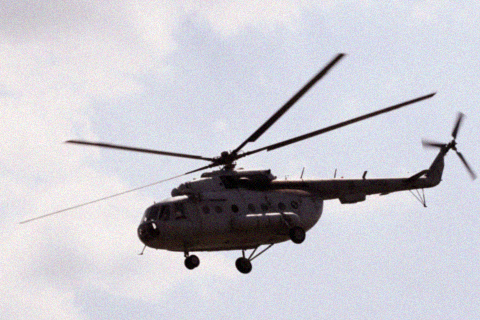
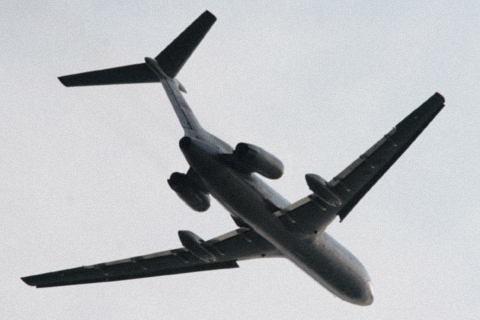
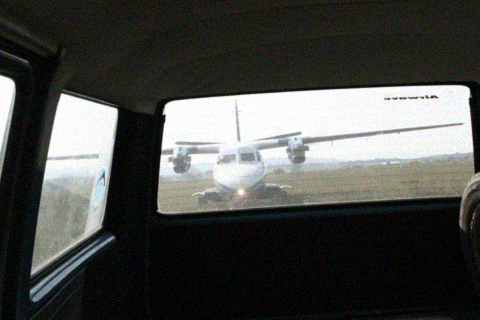
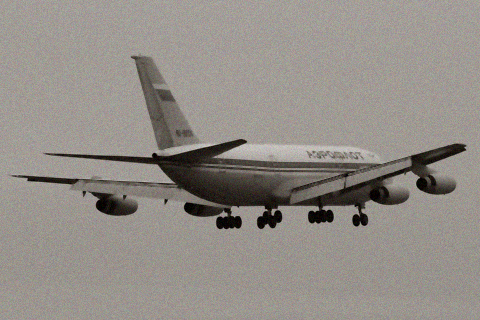
(FF: 1956) One of the most popular gliders ever built, the L-13 Blank was (and still is) a common sight across the lands of the former East Block. Embodying characteristics that make it a fantastic all-round glider, the L-13 has even been used in USAF service as the TG-10(FF: 1961) A true, undiluted workhorse, the Mil Mi-8 - produced in greater numbers than any other helicopter - can be seen in as many diverse roles as the venerable An-2. Though mostly famous for its military service, a number of Mi-8 versions were outright passenger transports, seating up to 32 in an airliner-style cabin. Some models - the "Salons" - have also been fitted with VIP interiors(FF: 1966) Representing Poland is the PZL-Bielsko SZD-30 Pirat. Cheap to produce on account of its wood and fabric construction - and weighing in at just 370 kg fully loaded - the Pirat was a popular and undemanding single-seat Club (later Standard) class glider for novice student pilots(FF: 1968) Roaring away from Zagreb on a wave of Soloviev noise, this beautiful Tu-154M is showing all the Airbii and Boeings how to make a stylish departure :). One of the most recognizable symbols of Soviet commercial aviation, the mighty - but thirsty - "Tushka" is slowly being phased out in favor of more modern, and more boring, Western equipment(FF: 1971) At home on backwood grass strips despite its size, the Let L-410 Turbolet is a worthy replacement for the An-2. Armed with commercial operations certification - something that has always eluded the Anuska - the Turbolet is still a popular 19-seat airliner in countries with under-developed aviation infrastructure(FF: 1971) Seeing double. With its menacing, angular and purposeful looks - not to mention the symphony of noise from the same Soloviev D-30s that power the Tu-154 - the Il-76 still manages to invoke the classic "Soviet Era feeling" wherever it goes. The epitome of the get-in-anywhere-anytime-carrying-anything transporter, the Il-76 is the DC-3 of jet transporters - it'll keep going long after you stop 🙂(FF: 1976) Still a common sight at airfields around the former Soviet Union, the fully-aerobatic Yak-52 represented the first major breakout of ex-Soviet GA outside of East Block. Today one of the most popular Yaks in the West (along with the Yak-18T), it is still produced by Aerostar in Romania and still used by several air forces as a primary trainer(FF: 1976) The "Russian Airbus" gliding noisily in on a dark, bitterly cold and windy day (much like home actually). The world's second quad widebody, the Il-86 is a fascinating aircraft, conceived as a true "flying bus for the Soviet people". This resulted in some unorthodox features, including its famous and unique baggage loading system - the passengers would climb into the hold, drop off their baggage and continue up into the cabin :). However - unusually for a Soviet aircraft - the Il-86 was abysmally underpowered, which had not helped its chances even on the state-sponsored USSR market. As a result, only 106 were made before it was superseded by the much more advanced Il-96(FF: 1993) In absence of a Sukhoi Su-26/29 - which in 1984 was one of the last all-new Soviet designs to fly before the breakup - I've decided to make do with the Interavia I-3 (designed by the same man who did the Sukhoi aerobatic series). A world-beater when it had first appeared on the international scene, the Su-26 had taken all of Sukhoi's combat aircraft experience and packed it into a fantastic little package that's been holding its own in Unlimited category aerobatics for more than 26 years now - despite all the new composite, computer designed kids on the block
When the Messerschmitt Bf.108 first appeared on the European general aviation scene in the mid-30s, it had created something of a “Porsche moment”: here was a small and light tourer, astoundingly fast yet relatively low powered, agile but quite docile, so left-field in design that it had shocked in the same measure it had fascinated. More than anything else, it had finally dispelled most of the skepticism and antagonism toward the low-wing monoplane configuration for light aircraft (at least in Germany), showing just what could be done with this novel idea once you’ve put your mind to it.
Pretty soon, this success had kicked off something of a “VW Beetle moment” :D. Seeing that the mentioned configuration does indeed work – and rather well at that – several manufacturers began seeing its potential to replace the lumbering open-cockpit biplanes then used for common day-to-day operations. What was needed here was a simple, cheap, robust and versatile no-frills machine that would efficiently go about its training and liaison duties, while still retaining that quantum leap in performance (and comfort!) over existing aircraft.
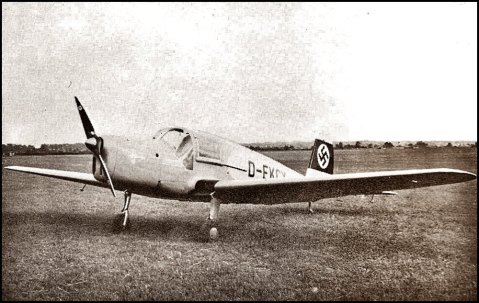
At the Arado works, the engineers, having too caught the bug, had rolled up their sleeves and set to work. The end result, intended like the Bf.108 to combine these new technologies into a single purpose-built design, was the diminutive, unimposing – and today unjustly forgotten – Ar 79…
A rare sight back then as it is today: two Ar 79s in formation shortly before the start of WW2 (photo from: http://www.eichhorn.ws)
1. Willy-nilly:
A very advanced design for its time – just a notch below the technical level of the production-standard Bf.108 – the Ar 79 was somewhat of a logical outcome for Arado. An innovative company that is today much overshadowed by the more famous names of 30s/40s German aviation, it had been around in one form or another since WW1, but rose to prominence as an independent manufacturer in 1924 when it was bought by a Fokker engineer, Mr. Heinrich Lübbe. While you’ll be hard pressed to find someone who’s heard of him, Mr. Lübbe has nevertheless left a lasting mark on military aviation as the inventor of the mechanical interrupter gear that had allowed machine guns to fire harmlessly through the propeller disc without clipping the blades. He had also left a significant mark on Yugoslav aviation, I was amazed to find out, when in the same 1924 he had opened an Arado subsidiary in Yugoslavia called – Ikarus! 😀
Under various design heads, including fellow Fokker veteran Walter Rethel – who would later go on to become the chief engineer on the Bf.109 – the young company had soon gained a solid reputation in Germany for its advanced, mostly metal light biplane fighters and trainers. Indeed, the company’s Ar 64 and Ar 68 were among the first combat aircraft produced in Germany after the Versailles Treaty was… ignored, and were the first front-line fighter aircraft to equip the new Luftwaffe. The majority of its pilots too were already familiar with Arado, having trained – in secrecy, under the guise of civilian aeroclubs – on the widespread civilian Ar 66 biplane trainer.
Despite these successes however, by the time the Luftwaffe was firmly on its feet Arado was already beginning to suffer from a slight case of “Messerschmittitis”. The animosity of several high-ranking German officials (most notably Erhard Milch) towards Willy Messerschmitt is well documented, having been a significant factor in undermining Bayerische Flugzeugwerke during the pre-war years, despite the demonstrated ingenuity – and outright superiority – of several Messerschmitt designs. Heinrich Lübbe’s refusal to join the Nazi Party had had a similar effect, though in the end far more reaching: with the Party’s patience finally running out in 1936, Lübbe was removed from his position and Arado promptly nationalized.
With the constraints of personal vendettas now removed through an unfortunate turn of events, Arado’s designs had finally received a fair fighting chance. This, and the accelerated production and development spurred by WW2, had seen the introduction into service of several notable Arado aircraft, including the Ar 96tandem two-seater (which would very soon become the standard Luftwaffe advanced trainer), the Ar 196 floatplane found virtually on every German ship, the innovative Ar 232 heavy transport, and finally the ground-breaking Ar 234 ‘Blitz’, the world’s first jet bomber. An unorthodox masterpiece of design, it’s legacy and impact are today pretty much the only things keeping the Arado name from sinking into total mainstream obscurity…
Called the ‘Tausendfussler’ – or ‘millipede’ – on account of its odd landing gear, the Ar 232 was in many ways a trendsetting design. What many call the first modern military transporter, it had introduced the easy-to-load square fuselage and rear loading ramp that are today de-rigeur on all serious military transports (photo from: http://www.world-war-2-planes.com)Like the Me-262, the Ar 234 – here in its B twin-engine version – heralded a revolution in aviation as a whole. Despite the fascinating design, it is ironically conventional compared to a number of jet projects Arado had been working on in 1945, including the six-jet E555-1 flying wing bomber and half a dozen single-engine jet fighters (photo from: 1000aircraftphotos.com)
The Arado company however had already been sunk long ago by the decision to nationalize, for with the collapse of German industry at the end of WW2, the company was shot down with it. While a vast majority of companies large and small were able to somehow stay afloat until the mass integration into huge consortiums in the 60s – Messerschmitt for example by producing sewing machines and the odd KE 175/200 bubble car – Arado was immediately declared bankrupt and written off once and for all…
2. A Diet 108:
Back in more successful pre-war times, the Ar 79 had – as mentioned – represented the company’s attempt to design a cheap & cheerful modern light aircraft that would lend itself well to common, non-utility tasks. Unusually, despite it being 1938, it was designed for the civil market only and very few were actually used in military roles – odd given the many aircraft of all types then being pressed into Luftwaffe service (more so when you consider that a majority of early German transports and bombers were designs that had started out as passenger aircraft for Lufthansa).
At a glance from a distance, the Ar 79 looked very much like a Bf.108 – and keeping in mind that there is only a number ways you can design a low-wing monoplane taildragger, we can’t hold that against it. Up close however, there were some notable differences, the biggest being the odd vertical stabilizer. Introduced on the Ar 68 in 1934, it would become the trademark of all subsequent Arado piston singles – however, I’ve not been able to find out exactly what advantages did the design give. But – using a bit of Eyeball Mk.I extrapolation – its near-vertical leading edge reminds me of the stabilizers on Mooneys, which are designed to give better control response in stall and near-stall situations. And given that most Arado singles were trainers likely to be spending quite some time there, it does sound plausible.
The Ar 79V2 (second prototype) showing off its unusual vertical stabilizer and diminutive size (photo from: 1000aircraftphotos.com)
Weighing in at just 760 kg MTOW – round about your average Cessna 150 – the Ar 79 did not really need much power, making do with a 105 HP Hirth HM 504A-2 inverted inline four cyl turning a two-blade fixed pitch prop – noticeably less exciting than the Bf.108’s inverted V8 :D. However, its clean lines and – unusually for such a small aircraft – retractable main gear meant it could squeeze a lot out of the power available, with a respectable cruise speed of 110 kn and a service ceiling of about 18,000 ft – all while burning just 10 l of avgas per 100 km. If we convert that to the more usual gallons per hour, we get a very low 5.2 (US) GPH at 110 kts…
So far, so Bf.108-ish. However, once you look below the skin – or at it for that matter – things start to go awry. Unlike the all-metal 108, the Ar 79 was a somewhat unusual mix of metal, wood and fabric, everything from the modern to the utterly conventional. Starting out back, the rear fuselage was an advanced magnesium alloy (!) (or “electron casting”) monocoque structure. In this type of construction, pioneered during the first decade of flight, the skin itself is the only load-bearing element – it is the only thing making up the structure, without any form of internal support. Contrary to what I had assumed, this had made the Ar 79’s rear end very light, much lighter than it would have been had more commonplace solutions been used. In addition, this type of construction had also paid off in simplicity and strength, with its oval shape spreading the load evenly around the fuselage and the (predominantly) one-piece structure removing the need for rivets, joints, welds or other such structural weak points (in later years, in an effort to reduce weight when applied to larger aircraft, this structure would evolve into what’s known as the semi-monocoque, which combines the load-bearing skin with an internal bracing frame, permitting the metal to be thinner and thus lighter, while still keeping many of the monocoque‘s qualities. In this form it has been used on airliners since the 50s, where it’s load bearing characteristics have been put to good use at battling the stress of pressurization 🙂 ).
EDIT: I would also like to extend my sincere thanks to Mr. Adolf Jaeger for correcting my erroneous assumption that this type of monocoque structure would be slightly heavier than conventional constructions.
Progressing forward however, things were starting to become more agricultural. The forward fuselage was a simple welded steel tube cage covered with fabric, while the wing – single spar, like the 108, but without slats and flaps – was a plywood affair again covered with fabric (and don’t laugh at the plywood! Just ask De Havilland and it’s Mosquito light bomber about what could be done with that fascinating material 🙂 ). The only other bit of metal up front was the cowling covering the engine…
Everything considered, one could deduce that the Ar 79 had quite an interesting weight distribution: almost evenly balanced fore and aft, something rare in most aircraft :). This would have located the center of gravity somewhat more aft than normally found on similar aircraft – not that far aft that it became tricky to fly, but enough to make it stable and maneuverable in equal measure. And being otherwise fully aerobatic – equipped with an aerobatic carburettor, permitting inverted flight – this would have made the Ar 79 quite agile :).
Pretty conventional today, but back in the late 30s this configuration was still a relative rarity on small non-combat aircraft (photo from: alasvirtuales.blogspot.com)
3. Fuel for thought:
While from today’s perspective the performance specs may seem a bit average – they’re hardly better than those of the Cessna 152 Aerobat (apart from the acro carburettor and retractable gear) – in its time the Ar 79 was quite a good performer and, like the Bf.108, was used on its fair share of record-breaking flights. The more “usual” ones were the 1000 and 2000 km solo class speeds records of 229.04 km/h (123.67 kn) and 227.028 km/h (122.58 kn) respectively, both set in 1938. While all very good for a light 105 HP aircraft, they were not nearly in the same league as what was done between 29 and 31 December of the same year…
It had always been said that the true test of an aircraft was a long distance record flight. The Arado team had apparently taken this a bit close to heart, for when they rolled the above pictured D-EHCR back into the hangar, they decided they could just up its fuel capacity a bit… now, I couldn’t find the exact capacity of the standard tanks, but with a range of 553 NM at 110 kn and 5.2 GPH, it works out to 26 gallons, or 99 liters. This was felt to be somewhat inadequate, so what the engineers did was bolt a jettisonable 106 liter fuel tank under the fuselage and screw in a whopping 520 liter tank behind the cabin. In total, this gave 725 liters (!) to burn, which – at avgas’ standard specific gravity of 0.7 kg/l – weighed in at 508 kg and was 48 kg more than the empty weight of the plane :D.
This was deemed enough to give good record-breaking range and was put to good use between 29 and 31 December when a two man crew flew non-stop from Benghazi in Libya to Gaya in India – a distance of 6,303 km (3403 NM)! At an average cruise speed of 160 km/h (86 kn) that would have taken a tad more than 39 hours, quite a feat for an understated two-seat trainer groaning under its own weight in fuel 🙂 (though this fuel to weight ratio would certainly not be unique; the Rutan Voyager, which flew non-stop around the world in 1984 without refuelling, could carry more than 3 times its weight in avgas!).
4. From here to… obscurity?
Apart from its record-breaking flights – flown mostly by the second prototype, which crashed in India about two months into 1939 – the Ar 79’s regular service life was quite uneventful. It’s versions were even scantier than those of the Bf.108, with only the Ar 79B, Ar 79D and Ar79E seeing the light of day – and these differed only in minor equipment changes. Some sources do state that the production models were fitted with Hirth HM 500A1 engines, rated at the same 105 HP, and that the 504 was used on the prototypes only.
But, despite its flying qualities and proven performance over longer distances, in the end the Ar 79 was not really a sales success (though WW2 had much to do with it, the civilian general aviation sector virtually disappearing overnight): not counting the two prototypes, only 48 production models were built when production ceased after just three years, in 1941.
Interestingly though, the basic design was still considered advanced in the 50s, and in East Germany plans were made in 1952 to return the aircraft into production in an all-metal form; however, the 17 July 1953 uprising had put an end to that for good. West Germany too had similar ideas, when in 1957 the Ar 79 was used as the basis for the all-metal Blume Bl 500, designed and built the man behind the original Ar 79, Walter Blume :). It’s high price of DEM 63,000 however meant the entire project never made it beyond the two prototypes…
It’s Ar 79 heritage evident, the Bl 500 was conceived as a stretched, tricycle gear four-seater, powered by a 150 HP Lycoming O-320 engine. Modified and improved to achieve German certification, the prototype became the Bl 502, pictured here, while the generally similar Bl 503 – sporting a more powerful Lycoming O-360 – was the only other aircraft built. With the economy still recovering from WW2, these expensive aircraft were not greeted with open arms… (photo from: http://www.pprune.org)
Today, only one Ar 79 is known to have survived – thanks once more to the sterling efforts of Lufthansa’s historic flight, the Deutsche Lufthansa Berlin Stiftung. D-EMVT – an Ar 79B-1 and the next-to-last Ar 79 built – was meticulously restored in 1996 and kept in flying condition up till 2001, when it was put up as a permanent exhibit in the Deutsches Technikmuseum in Berlin, where it now hangs out for most of its days :).
Looking beautiful during an engine run up (note also the modern propeller). The 47th Ar 79 off the production line, D-EMVT – previously also known as D-ECUV – was one of the busiest of its type, including serving as the personal aircraft of the French High Commissioner to the Saarland province in 1945 (which was in the French occupation zone) (photo from: http://www.dlbs.de)
Given that the Internet is not awash with precise specifications of obscure planes, I naturally had some issues in determining which sets of performance numbers to believe. In the end, I opted for the most reliable source – Lufthansa 🙂 – which gave the specs on the most widespread Ar 79, the B model:
Engine: Hirth HM 500A-1, 105 HP
Stall speed: 78 km/h (42 kn)
Cruise speed: 205 km/h (111 kn)
Maximum speed: 230 km/h (124 kn)
Range: 1024 km (553 NM)
Ceiling: 4,500 m (14,760 ft)**
Length: 7.6 m
Height: 2.1 m
Wingspan: 10 m
Wing area: 14 m²
Empty weight: 526 kg (1,160 lbs)*
Max. take-off weight: 850 kg (1.874 lbs)*
* Note: the biggest disparity in performance numbers I’ve found is in the weights. Most sources dealing with the B model put them at 526/850 kg, while two sources – which mostly covered the prototypes – put them at 460/760 kg. I haven’t found these numbers anywhere else, but it is entirely possible that the prototypes – given their record-breaking nature – were lightened by removal of equipment that was standard on the production versions.
** Similarly, the same two sources put the ceiling at 5,500 m (18,000 ft) as opposed to the B model’s 4,500 m (but this could be due to the engine, even though a 3000 ft increase is nothing to sneeze at)
With the weather having been steadily uncooperative these past few months – going from snow to dull, oppressive overcast and back – the arrival of sunny and clear skies, a light, refreshing wind and springtime temperatures was greeted with enthusiasm among those of us aching to go flying. Wasting little time – believing that, if Mr. Murphy was consistent, it wouldn’t last – a friend and I made arrangements with our instructor to kick the flying year off with a Night VFR refresher flight :).
Not being sure what are the regulations in other countries, I’d better explain – in Croatia, Night VFR is treated as an additional qualification to the standard Day VFR and can be done by anyone holding a stock PPL license. What it amounts to is 5-6 hours dual command time with an instructor, finished off with (usually) five solo circuits. The exact curriculum varies from instructor/FTO to instructor/FTO, but we, for example, had:
standard, fast and ILS approaches
standard and full flap landings at different runway lighting levels
standard rate and 60 degree turns
slow flight
cross-country route using radio navigation
In theory, this then allows you to fly both within the aerodrome control zone and cross-country along designated VFR routes. In practice, we rarely leave the control zone: Croatia is a rather hilly country – with significant mountainous areas – and with few large cities (which at night all look the same), so the prospect of going long distance in a single engine airplane is not really that appealing… should the engine decide to quit, you are faced with complete darkness, few lit roads, few larger cities and even fewer airports where to make your emergency landing – and that’s bound to end in tears. So we leave the night bit to the twins (which then again fly IFR…), sticking to the vicinity of the airport and the occasional panoramic flight above Zagreb. You may ask what’s the point then; the Night VFR qualification is also a requirement for the Instrument Rating, something most of us are aiming for, so while we’re here we might just get that off the list :).
Having last flown at night at the beginning of last year, we decided a few days ago to get our hand back in and finally give our planes a little shakedown…
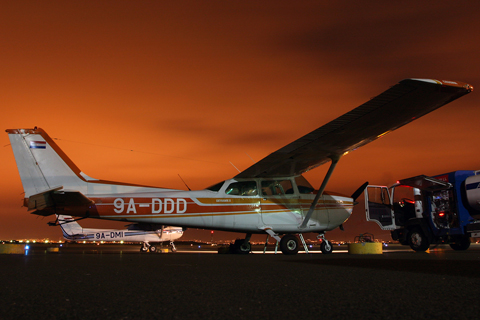
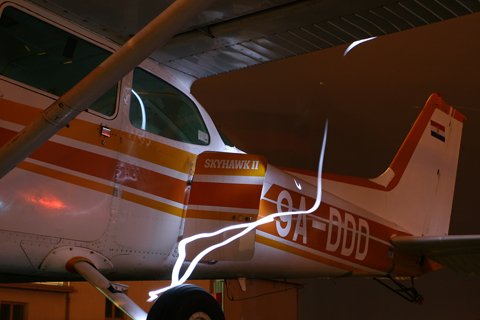
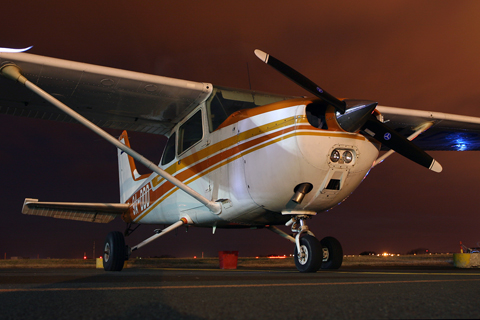
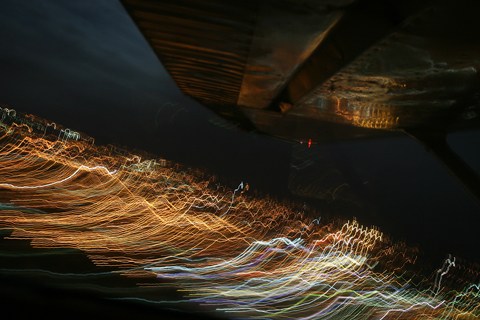
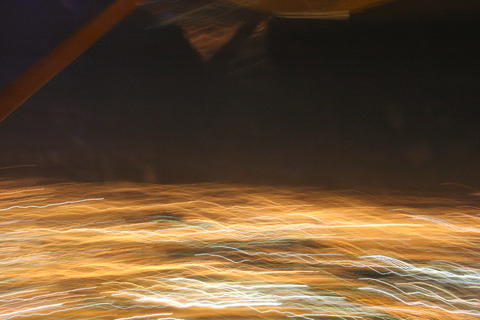
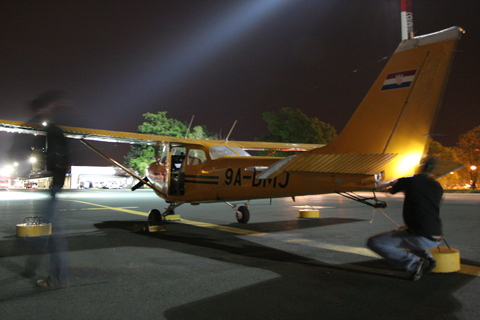
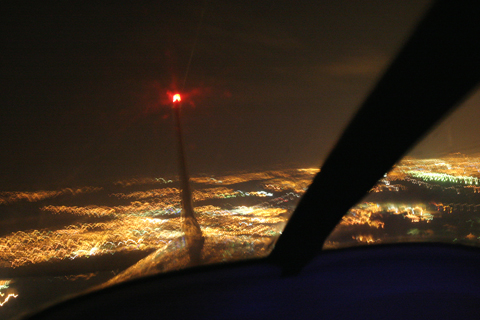
Fill 'er up! Brimming the tanks for our two-hour session - just to be on the safe side - with me flying first and my friend second. The lights of the Zagreb skyline decided to pitch in and provide us with some mood lighting 🙂Thunder and lighting! 😀 (actually my friend doing the preflight with a torch in a 30 second exposure)Ready and willing! (to throw some confusion into the stream of Croatia Airlines rush hour departures 😀 )A (relatively) steep climbout from RWY 23, shot with an 8 second exposure. The weather was brilliant, CAVOK with just a hint of mid-level clouds and some moonlight to help us alongWho says training is dull? 😀 To have us recalibrate our sense of height in the dark, our instructor had us fly a series of successive low passes from the traffic circuit, with the target of a steady 2 meters (6 ft) above the runway right down the centerline lights. I've managed to hit 3 meters and 125 knots, while my friend did 1.5 meters or thereabouts at 100 knots 🙂Something a bit more dated, back from when we started our night training in 2008. To get acquainted with the new perspective in the dark, we had to fly all the normal flight school turns on instruments only, using various points of Zagreb - seen here blurred beyond recognition - as referencePrepping DMJ for another two hour sortie. While a bit more complicated than DDD, we preferred DMJ because of its ample power and a big chunky engine pulling the center of gravity forward (very comforting when flying in slow flight near MTOW)Climbing out to the south-east for some zone work. Sadly, our session would soon be cut short when the alternator packed up... of all times, during the night. And the engine had just been overhauled a few weeks ago...














 Achtung, Skyhawk!