
By me
Photos as credited
After the meteorologically plainly useless spring of 2025 had gone, the arrival of more stable summer weather meant it was time once again to open up the map and see which airfield and which airplane I’d like to try out next 🤔. Having been on a bit of a Diamond roll lately (kick started by last year’s Alpine joyride in a Super Dimona), I decided I might as well focus on the ubiquitous DA-20 Katana, and try to get as many of its versions in as I could within a reasonable driving distance from home.
Naturally, this soon got me thinking about just HOW MANY of these versions there really are – which, in turn, sent me deep into my photo database to determine how many I’ve managed to snap over the years. Inevitably, this led me further on into my Croatian GA register, where I ended up counting seven that carry (or used to carry) the 9A prefix. Now, I’m no expert – but you have to admit that this sounds as gratuitous a reason to fire up Achtung, Skyhawk! as any…
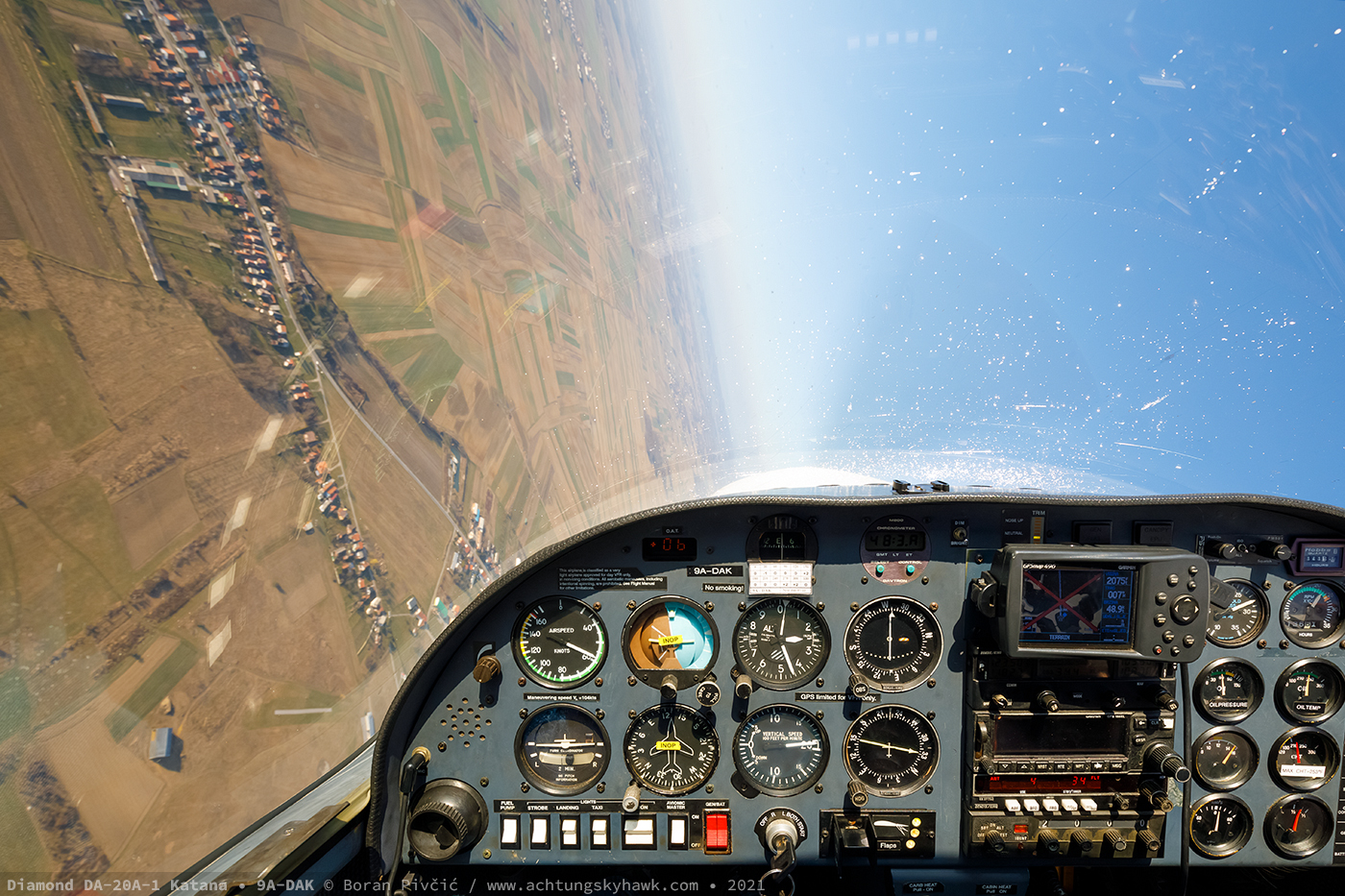
Something’s wrong with the horizon… not the ADI, the real one
The Keyboard Is Mightier Than The Katana
But first, a bit of housekeeping. While most people use “DA-20” as a one-size-fits-all designation for the entire Katana family, the nerdy truth of the matter is that there’s quite a bit more to it than that. The story starts out in 1989 with the HK-36 Super Dimona touring motor glider (TMG), Diamond’s big rework of the earlier 1980 Hoffman H-36 Dimona. Available in many flavors – tailwheel/tricycle, 80-115 HP, naturally aspirated/turbocharged – the HK-36 had almost immediately become a runway success on the European market, with going on for 900 produced so far and at least one to be found in any Central European country.

Visual reference time: the original H-36 (all of which were tailwheel, and most powered by the VW-derived 80 HP Limbach L2000)…
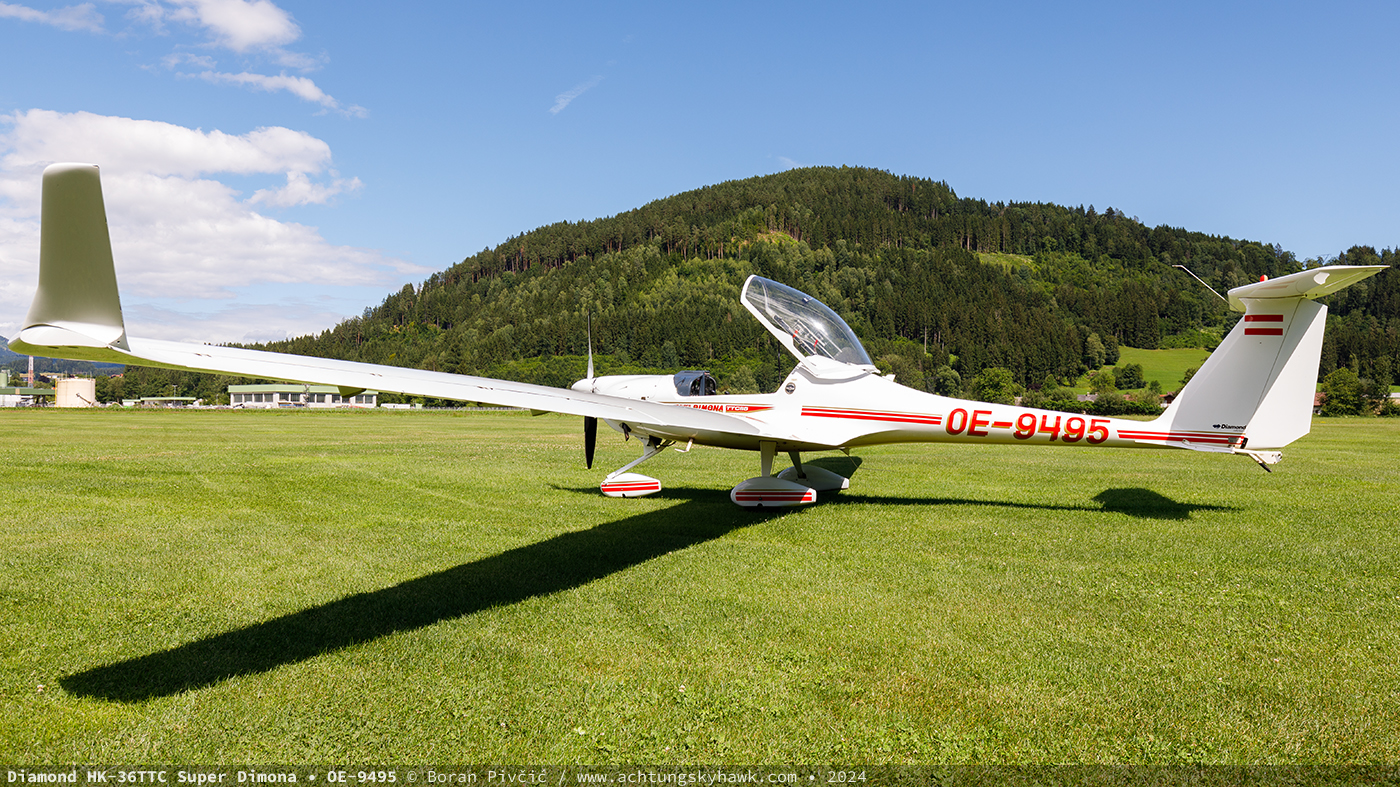
… vs the top-of-the-line HK-36TTC, 115 HP of turbocharged Rotax goodness
As was the case with another Austrian TMG manufacturer (HB Flugtechnik, but more on that in a later post!), this success had soon prompted Diamond to try and capitalize on its new market presence by turning the Super Dimona into a “conventional airplane” (i.e. something that would fit into the Single Engine Piston, or SEP, category). To this end, in 1991 the company would take a naturally aspirated 100 HP tricycle HK-36TC-100, snip its wings by five and a bit meters, add flaps to compensate for the loss of wing area… and call it a day. The resulting DV-20 Katana would even retain the motor glider’s wing joining system (which allowed for removal of the wings for storage or transport), as well as its notched elevator trim lever and characteristic panel with its raised radio cluster. Though the initial plan was to offer it with both the 80 HP Rotax 912A3 and the 100 HP Rotax 912S3 (both already seen on the HK-36), the A3 quickly dropped out of the picture, leaving the S3 as the only option.

HK-36 or DV-20? No way to tell really, same panel… (unless you look closely at the manifold pressure gauge and see the turbocharged 40 inch redline)
Unlike HB’s attempt though, the DV-20 worked; just as the Super Dimona had taken the market by storm a few years earlier, so did the Katana now. Indeed, already in 1993 – barely a year after series production had started at Wiener Neustadt in Austria – Diamond dropped a new version tailored specifically to the needs of the US market. Called the DA-20 Katana (or, more accurately, the DA-20A-1) – and intended from the outset to be produced at a new plant in London, Ontario – this model introduced a fair number of changes, including:
- the 80 HP Rotax 912A3 as the only engine on offer (replaced from the 93rd airplane onward by the equally-powerful 912F3)
- a simplified wing joint that was easier and cheaper to produce, but did not allow the wings to be removed so easily (fun fact, this made the center wing section under the seats significantly taller, which moved the seat base upwards… and in turn noticeably reduced headroom. Trust me, at my 1.91 m the difference is quite acute!)
- a new, completely flat panel with a layout more similar to that of other US GA aircraft
- an upgraded electrical system to cater for more avionics
- an electrical elevator trim system with a rocker switch instead of the old mechanical setup
- and a slightly different canopy with external handles (which, together with a different fuel tank cap, are the easiest ways to tell the DA and DV apart at a glance)
However, while Rotax engines are commonplace in North America today (thanks primarily to the ultralight and experimental boom of the 2010s), back in the mid 90s they were not really that big a thing, and support was not all that easy – nor cheap – to come by. To make the DA-20 even more US-friendly, in 1998 Diamond would swap out the 912 for the 125 HP Continental IO-240-B – whirling, for the first time on a Diamond, a fixed pitch prop – thus creating the DA-20C-1. Other changes included a larger fuel tank to cater for the thirstier engine (94 vs 79 liters), a higher Maximum Take Off Mass (800 vs 730 kg) – as well as a reduction in wing sweep by half a degree + relocation of the battery to behind the baggage compartment to compensate for the forward CG shift due to the IO-240’s higher mass. Originally called just the “Katana” and later “Katana Eclipse”, it would eventually diverge into three sub-models:
- Eclipse: the full-fat touring machine, featuring two small side windows aft of the canopy for better visibility
- Evolution: the bare-bones trainer, sans rear windows
- Falcon: a military basic trainer with the primary and navigation instruments moved to the right seat, and a smaller fuel tank fitted to allow for increased payload (quite useful given the bulk of a even a basic flight suit)
So far, so straightforward… but no for long! 💪 Since the demand for the Katana kept growing – and Austrian production had wound down in 1996 after 160 DV-20s had been completed – many DA-20s had started making their way to Europe (including even a few C-1s). Their numbers had ended being so great in fact that they eventually pushed the DV-20 nameplate deep into obscurity – the reason, I suspect, subsequent Diamond designs all stuck with the DA prefix, despite being made at Wiener Neustadt. The A-1’s 20 HP deficit, however, was not to everybody’s liking (particularly in the hillier and/or hotter bits of the continent), leading Diamond to come up with the DA-20-100 Katana 100 package in 1998 – which was essentially just an overhauled A-1 factory refitted with the 912S3.
The fact that a convincing case for the DA-20-100 existed – and that DA-20A-1 production had ended in 1998 in favor of the C-1 – eventually convinced the company that there was still room in the market for the old Euro-spec DV-20. To address this niche, in 2006 Diamond would take the OG Katana, slap on Eclipse fuselage windows, stick in an Eclipse-inspired panel, and create what is often called the DV-20 NG (though formally it is still just the “DV-20”).
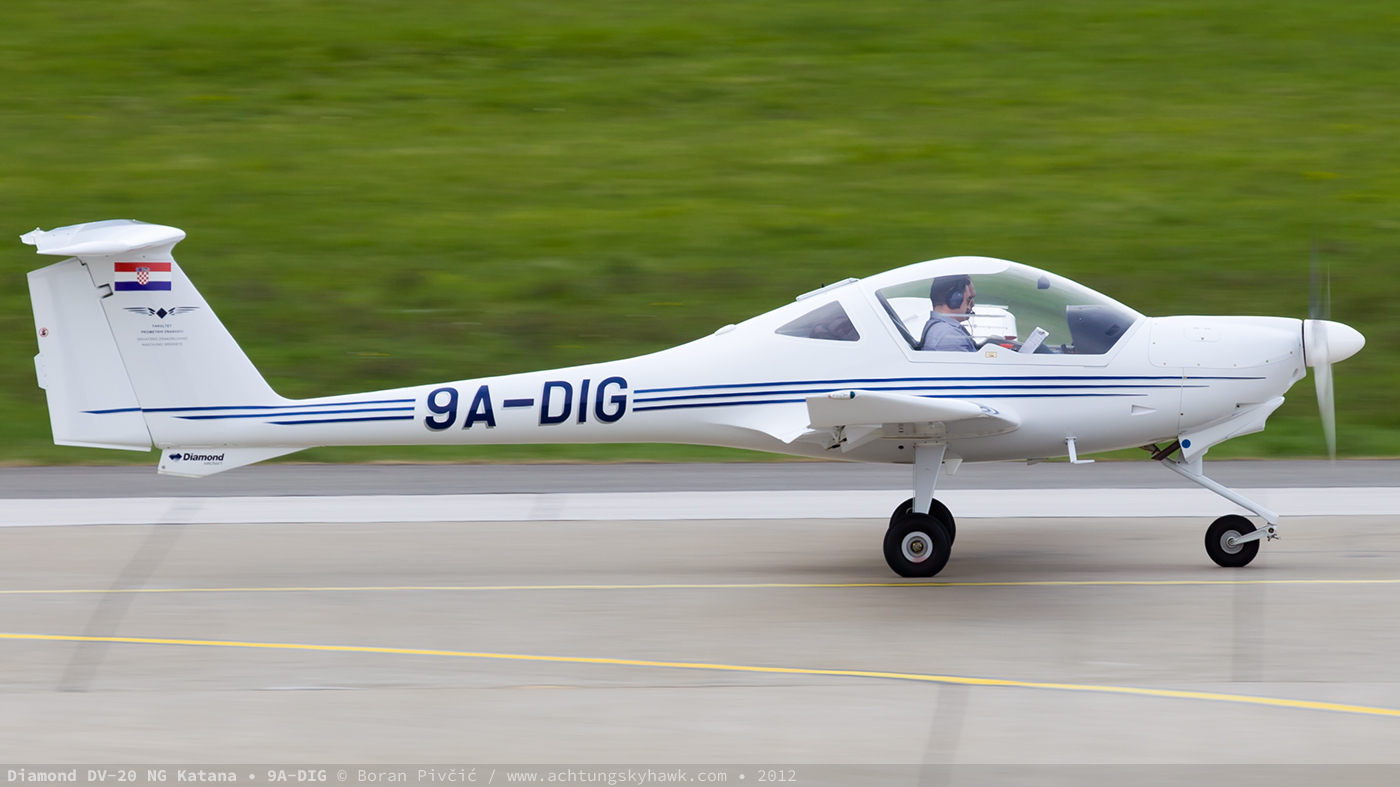
Croatia’s sole DV-20 NG zipping along back in 2012 when it was still brand new, its Eclipse fuselage windows showing proud…

Crisp, clean & classically correct. Note the “Dimona holdover” notched trim lever w/ fully mechanical linkage
More confusing though is the 2013 appearance of the DV-20E. Created at the behest of – and with input from – Austria’s Aviation Flight Center, it is touted a being a purpose-built VFR and IFR trainer, featuring the full Garmin G500 flight deck and the new fuel-injected (but still 100 HP) Rotax 912iS. Fine; however, a peek at its Type Certificate Data Sheet suggests that this may in fact be a US-spec Eclipse with Rotax power, featuring both the C-1’s 93 liter fuel tank and its 800 kg MTOM (neither of which are included on the DV-20 NG), plus a number of A-1/C-1 telltale physical features. To further give the impression that Diamond is out practicing its obfuscation techniques, this “AFC commissioned” configuration is offered to the average public as the DA-20i… so now we have an European designation being used for what looks like a US model, which is sold to one party under an Euro namplate, and to others under its US name… all while retaining European serial numbers 🤔.
And finally, for scheisse und giggles (as Jeremy Clarkson had put it), we also have to mention the DV-22 Speed Katana of 1996: the original DV-20 fitted with the turbocharged 115 HP Rotax 914F3 out of the HK-36TTC. However, unlike on the Super Dimona – where the extra grunt and altitude performance were used solely for hauling (gliders, not ass) – on the DV-22 the goal was explicitly overall touring performance. Yes, speed too (it says so in the name, with a 275 km/h cruise reported at 12,000 ft1), but also more fuel, payload and – critically – the ability to take them all even at higher temperatures and altitudes.
The latter was particularly important since the DV-22 boasted a 110 liter fuel capacity, now in the form of two 55 liter wing tanks instead of the standard single fuselage tank; indeed, one of the 22s is reported to have upped that to 129 liters for truly bladder-bursting endurance. The space freed by the deletion of the fuselage tank also made for a significantly larger baggage hold with a 30 kg capacity (10 up from the DV-20), and a practical fuselage cargo door for easy outside access. The MTOM too went up to 750 kg – which, while welcome, had managed to cover only 25 of those additional liters, and none of the extra baggage.
Even though overall performance was reported to be outstanding even in Mediterranean summer temperatures, the price increase (particularly on account of the engine) and inability to take a second person when full of fuel and baggage2 meant that the program would eventually go nowhere, and only two examples would ever be made – though both appear to still be flying as of July 2025…
1 this turn of speed however needs to come with a big *. The DV-22’s maximum design cruise speed (i.e. the beginning of the yellow arc on the Airspeed Indicator, which is a structural rather than performance limitation) is essentially the same as the DV-20’s: around 220 km/h. The Speed Katana had managed to achieve its cruise performance solely because the turbocharger allowed it to attain this maximum design cruise at significantly higher altitudes than the DV-20, where the difference between Indicated Air Speed and True Air Speed became significant. Using the rule-of-thumb of a 2% increase for every 1000 ft, a 220 km/h IAS at sea level neatly works out to a 275 km/h TAS at 12,000 ft…
2 with an empty mass of around 510 kg (no precise data is available since only two prototypes were ever made, and both were slightly different), a 750 kg MTOM leaves just 240 kg of load to play with. 110 liters of Mogas works out to around 85 kg; an average person, fully clothed with headphones, charts/tablet and such is probably around 90 kg; a full load of baggage is 30 kg. All this together works out to 215, leaving just 25 to spare

The second of the two – wearing the title “A Girl’s Best Friend” – roasting on the superheated turf of the now-defunct Unije Airfield (LDPN). The first and only time I’ve ever seen a Speed Katana in the flesh – and, sadly, at the time too ignorant of its provenance to fully appreciate it. If the model’s vivid paint is not enough of a clue, the two DV-22s can be easily recognized by their three bladed props, the only members of the Katana family to ever use them. Also note the cargo door above the wing trailing edge
In addition to all the tell-tale physical differences discussed above, a more subtle recognition feature of the various Katana models are the serial numbers themselves:
- 20.001 – 20.160: the original DV-20 series (1992-1996)
- 20.201 – 20.218: the DV-20 NG (2006-2013)
- 20.E001 and above: the DV-20E/DA-20i (2013-)
- 10.001-10.331: the original DA-20A-1 (1993-1998); the DA-20-100s, being a rework of existing A-1s, have no unique serials
- C0001 and above: DA-20C-1 (1998-)
- 22.001 and 22.002: the sole DV-22s made (1996)
Swordfight
So, with the preliminaries now done, back to the main event! The (hi)story of the Katana in Croatian service can broadly be defined through two main factors: Yugoslavia and “business incompatibilities” – neither of which make for particularly light reading, and both of which continue to be a source of headache even now in 2025.
The first traces its roots back to the 60s, when Yugoslavia – fresh out of recovery from the chaos of WW2 – began looking to jump-start its light aviation sector. Even though the country had been designing and building its own airplanes ever since the 30s, the quality of the designs often left something to be desired, while production capacities were so constrained and the lines so outdated that a 100 airplane run could be considered a feat on par with the Ford Model T. The quickest fix was to buy in large numbers of proven Western designs; as well as solving the immediate problem and acting as a stop-gap until the local industry caught up, this sort of approach could also open the door to using Western tech in future airplanes (which did indeed happen), design collaboration with Western companies (that too) and even licensing deals (most notably for the Rolls-Royce Viper turbojet and Sud Gazelle helicopter). Bonus points were also awarded for fitting snugly into the (occasionally delicate) balancing act between East and West that was at the heart of non-aligned Yugoslavia’s foreign policy.
Reims Cessnas, Pipers, Bells… even Bellancas… poured in by the dozens. By the beginning of the 80s, every proverbial village in the country had a flying club with at least one Cessna 172 or Piper Warrior… some even with a Citabria, many more with glider-towing Super Cubs. “State organs” had gotten in on the action as well; the late 60s saw the formation of the first police air wings using Bell 47s (starting a Bell connection that continues to this day), while tending to Croatia’s huge crop fields involved Pawnees, Pawnee Braves and Cessna 188s in numbers to almost rival the country’s An-2 and PZL Dromader fleets. Post and newspapers were being flown nightly by Rockwell Commanders to all corners of the land, while domestic manufacturers were enthusiastically leafing thorough the FAA’s FAR 23 in preparation for designing the next generation of Yugoslav aircraft to full Western standards. It all looked and felt very promising.
By the late 70s though, things had started to go awry; OK, to be fair, “awry” may be too strong a word (since the country was flying, and flying a lot), but the long-term goal definitely became a victim of the short-term fix. The anticipated “take-off” of the local light aviation industry became just a hop down the runway, with the only worthwhile attempt – the Utva U-75 – topping out at just 138 examples made (and many of those were for military use). This was partly because the whole aeronautical industry had shifted toward designing and making proper military aircraft – such as the Soko G-2 Galeb trainer (which holds the Yugoslav Aviation Industry High Score at 239 made) and the Soko J-22 Orao ground attack aircraft (later to become the first Yugoslav design to exceed the speed of sound) – but mostly because the Cessnas and the Pipers and the Bellancas were simply doing too good a job. With such availability, support, quality and reliability (not to mention nearly unfettered access to the government’s purse for lifetime support), there was simply no incentive to go and burn massive resources in trying to make something better – especially if you had already burned yourself trying to do just that.
It was against this very background that the Katana (and many other modern designs) had to struggle once they finally arrived onto the Croatian scene following the end of the 90s independence war. The collapse of Yugoslavia in 1991 had seen many flying clubs and schools retain the aircraft they’d received in Yugoslav times – “generational hand-downs” that had in many cases been in their care ever since the 70s. For all intents and purposes completely free (i.e. paid for decades ago by a now-dead regime), and with their strengths and weaknesses known down to the last bolt, they were simply too good and convenient an option to warrant risking with, and actually paying for, “some Austrian plastic thing with a lawnmower engine”. Dad’s old Cessna 150 would do just fine… because it always had.
This time round though, things had started going awry for real. By the early 2000s, the economy was still in rough shape; the gov’t purse now had a thick lock on it; the airplanes themselves were not getting any younger; none of them had been upgraded since the 80s; fuel costs were inexorably on the rise… and then, two minutes to midnight, people suddenly started noticing that the plastic lawnmower was not that bad at all. Efficient, frugal, modern, comfortable… by that time proven as well… and the manufacturer as close as four hours away by car.
These very issues – plus the shift in perception – had been noticed by said manufacturer as well. Already in 2004, Diamond began actively trying to expand its presence in the country, first by registering a trio of demo aircraft on the Croatian register (DA-20A-1s 9A-DAI and 9A-DAK, and a Lyco-powered DA-40-180 9A-DAR) – and then even moving towards setting up composites manufacturing at Varaždin (LDVA) in the north of the country. Diamond events all over… Diamond participation in air shows… a Diamond flight school… even the fondly-remembered Diamond Cafe at Varaždin… all precursors to a long-term goal of setting up a full-scale full-aircraft manufacturing operation (with the likely endgame of transferring DV-20 NG production from Wiener Neustadt to focus on the DA-40 and 42). And in the midst of all of that, the other factor hit: “business incompatibilities”.
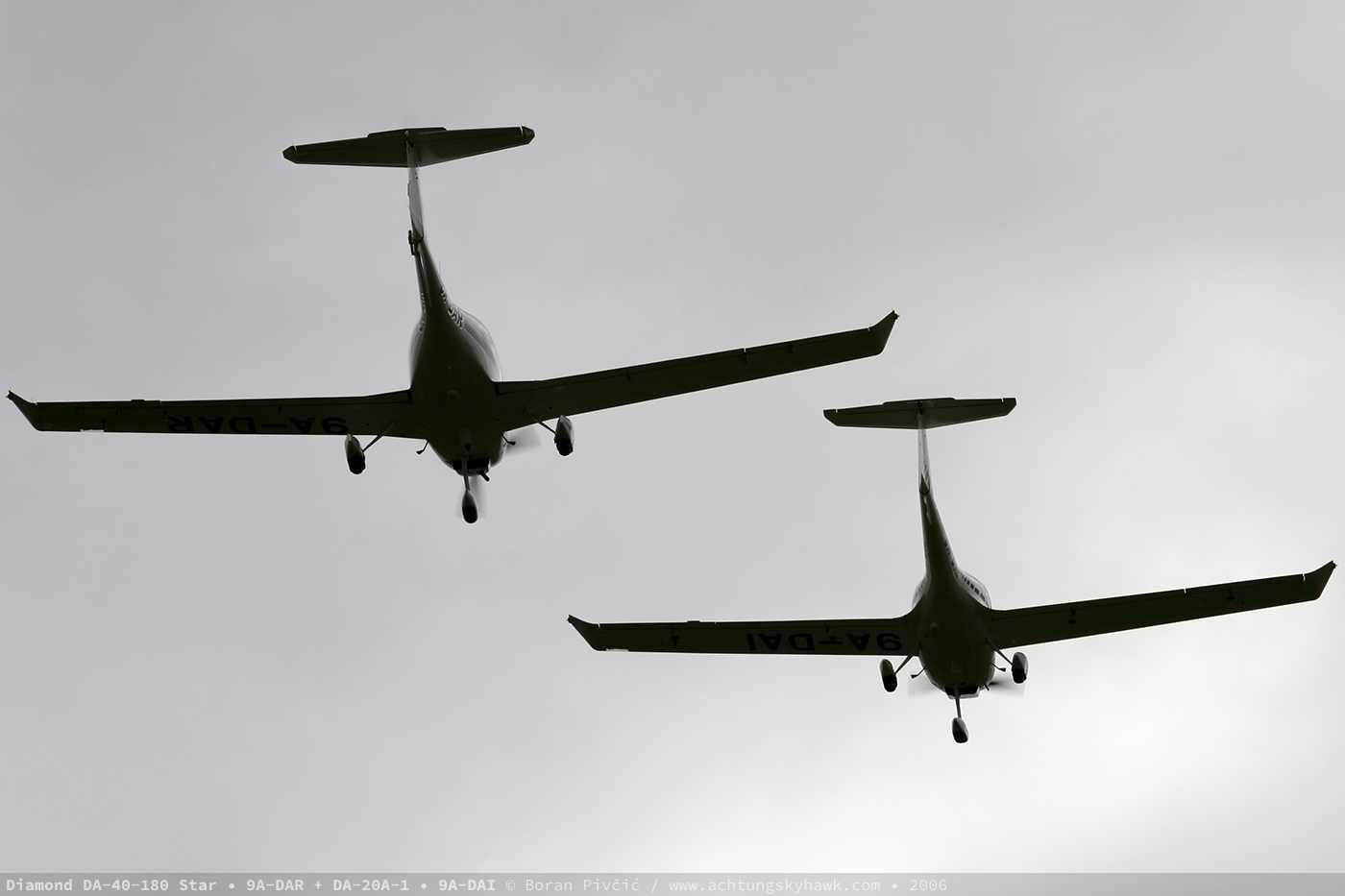
DAR and DAI under a depressing sky at the 2006 Croatian International Airshow Varaždin (and no, the photo is NOT monochrome!)
A veiled, vague and obviously diplomatic term, but it will have to do – since going in any deeper would involve bogging down in the happenings of 2000s Croatia, which is not really what Achtung, Skyhawk! is about. Suffice to say that Diamond and the local authorities couldn’t really see eye-to-eye on the manufacturing works; indeed, things reached a point in 2008 where Diamond felt the need to invite a bunch of us journalists to Wiener Neustadt to see “what Croatia was missing out on” – and for the then-head of the company, Christian Dries, to tell his side of the story directly on his home field.

A serious man talking about serious things… ooooh look, a prototype airplane! I may have physically been 23 at the time… but since this was my first proper factory tour, mentally I was closer to 13…
The exact reasons be what they may, their effect soon became obvious: in 2010, Diamond would pull out of Croatia completely, shelving any plans to set up shop here for the foreseeable future. With the possibility of elegantly supercharging Katana (and Star) sales throughout the region now gone, championing them as worthy replacements for Dad’s old C150 (and C172) effectively boiled down to just the initiative, needs and fiscal math of private owners and flight schools…
The Seven Samurai
To true avgeeks however, Diamond’s departure will quickly raise a different and altogether more important question: whatever happened to DAI and DAK? A line of inquiry I very much approve of, and can for once provide a meaningful answer to 🥰.
The older of the pair – and the oldest Katana to have ever served in Croatia – DAI was manufactured in 1995 with the serial 10.035. There aren’t many traces of its history before coming to Croatia in the summer of 2004, but it appears to have carried the reg C-FUJE at some time in the late 90s. It would serve as the company demonstrator and in the company’s flight school all the way until 12 SEP 2008, when it would suffer a power loss and go down in a cornfield near the town of Novi Marof; both of the crew would survive, albeit with significant injuries. The wreck, surprisingly intact given the terrain, would be shipped back to Wiener Neustadt, and later used as a training tool for advanced maintenance and repair courses.

“Fresh off the boat” from Austria – and very likely the only opportunity to see it “naked” in all-white. Already the following month, it would receive the classic “Diamond House Colors” blue stripes (photo by long-time spotting colleague Tomislav Muić over at Airliners.net)
Whereas DAI was from the front of the A-1 queue (the 35th off the line), DAK3 came all the way from the back. Manufactured in 1998 with the serial 10.323, it was one of the final A-1s made before the Ontario plant switched fully to the C-1 (10.331 would actually be the last one). Intended outright for delivery to Europe, it would initially be known as D-ETRY, before making its way to Diamond in Austria as OE-VPZ (an interesting reg given that the V stands for Versuchsflugzeug, or “development aircraft”, and is the default convention for prototypes and test machines).
Joining Diamond Aircraft Croatia soon after its formation – and engaged in the same sort of stuff as DAI – DAK would stay here all the way until Diamond closed up shop. However, instead of going back to Austria, it would be bought outright by one of the very locals who had learned to fly on it. The first (and nowadays only) privately-owned Katana in Croatia, in 2021 it would also become the first one I’d ever get the chance to fly, when a colleague from the Q400 (who had been an instructor on the DA-20) took me up for a very fun introductory flight…
3 the gap in regs, in case anyone’s wondering, is because 9A-DAJ was already taken by a 1972 Reims F150J based out of Grobnik (LDRG) (one of those old Yugoslav holdovers)
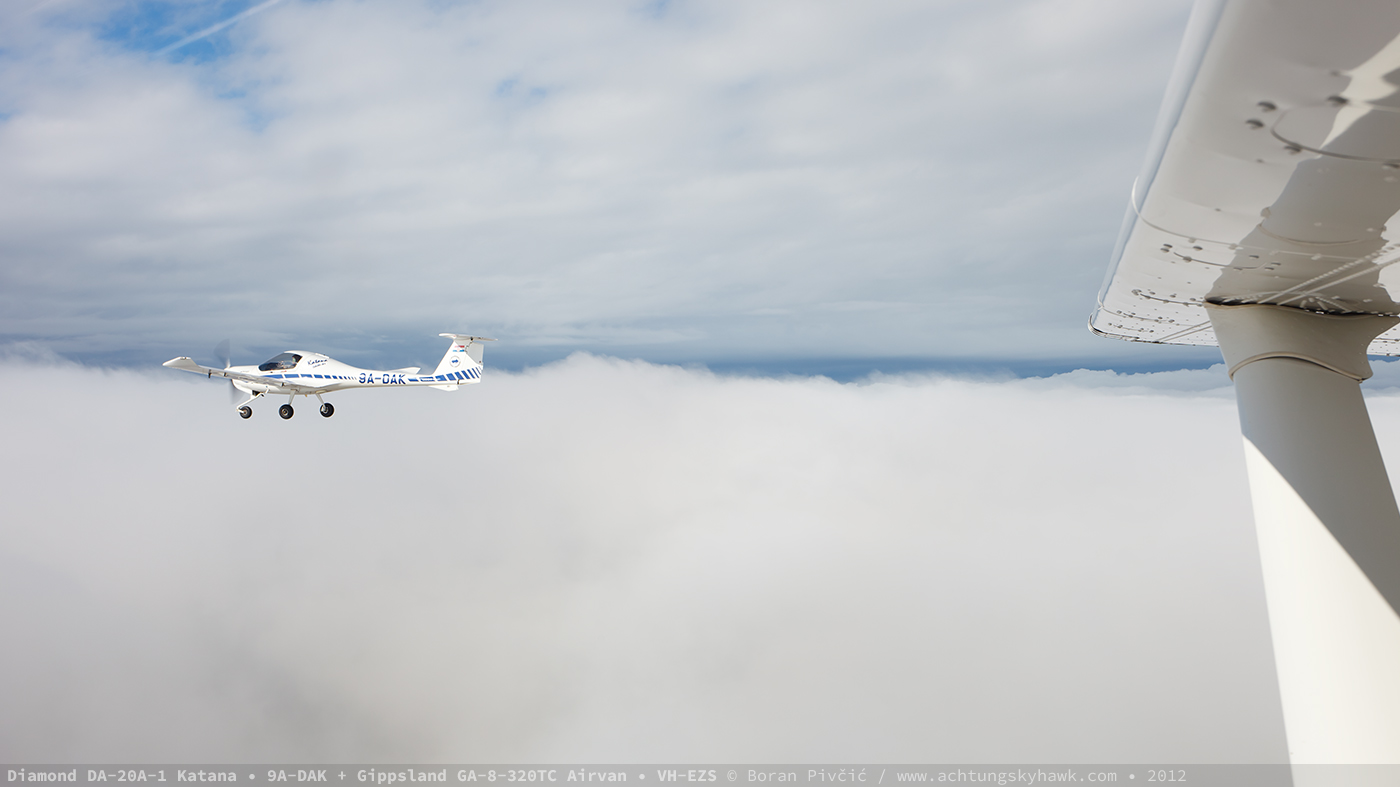
An 80 HP Katana vs 320 turbocharged Aussie horses… even with a former MiG-21 pilot at the controls, there’s simply no escape!

A classic Katana quarter-profile shot. This exact scheme was also worn by DAI after August 2004

One of the things the Katana does almost flawlessly – for a mass-produced tractor configuration aircraft – is the view forward. Coming off two decades of hard-to-see-out-of Cessna 150s and 172s, the Katana’s cockpit lines and the huge canopy were an absolute revelation (and don’t worry, I wasn’t landing and taking photos at the same time; PF was my colleague, who took the opportunity to give himself a right-seat refresher)
While Diamond itself may have left, the “Diamond Effect” had however remained. Four years of Diamond Aviation Training’s successful operation had shown the locals that there was another way – and that the Katana could indeed work as a C150 replacement if you used it properly. Yeah, sure, it was made out of a material that many oldtimers misunderstood and feared… yes, despite its near-constant expansion, Diamond was still a minuscule player compared to Cessna… and granted, the Katana’s 6000 hour check was nothing to sneeze at. But, at the other end of the scale, it flew beautifully; it was far more comfortable with two people on board; the extensive glazing made life in the congested airspace of a busy airfield so much easier; and it removed the manual mixture (which was never taught properly in local flight schools) and replaced it with something much more useful for an eventual move to a complex aircraft – the constant speed prop. Critically, unlike the Cessna 150 – or The Big Three’s other two-seat trainers, the Piper PA-38 Tomahawk and lookalike Beech 77 Skipper – the Katana was still very much in active production, and could be expected to remain so for at least a decade.
Then there was also the nitty-gritty business of hourly operational costs: for roughly the same payload and roughly the same straight-line speed (but better climb performance), the Katana drank half the fuel of the C150 – fuel which itself was (and remains) roughly half the price of Avgas. As in the US and Canada, by the 2010s the Rotax 912 had too ceased to be an exotic mystery and became commonplace – so even its maintenance would no longer be an organizational or financial hurdle. Simply put, if you were a pure training-only operator who could employ the airplane full-time (as opposed to a flying club with sporadic member use), and you could afford the Katana’s initial asking price, the see-saw of choice had suddenly become tilted very firmly AWAY from the trusty old C150.
This, in a nutshell, was the process that led to the appearance of Croatia’s third Katana, the previously mentioned 9A-DIG. Manufactured in 2011 with serial 20.207 (making it only the 7th NG made), it was bought new straight from the factory by the Croatian Aviation Training Center (HZNS) – and quickly put to use for initial flight training, helping to reduce the strain on the organization’s three-strong C172 fleet, and release them for more time-consuming IFR duties.

Revving up for a solo cross country flight. Another way to tell the DA and DV apart is the landing light; the DV has a single unit on the left side of the cowl, whereas the DA has twin landing/approach lights on the left wingtip. Funnily enough, the DV-20E/DA-20i also has the wingtip lights…
Other operators soon followed; what would later become the country’s second major training provider – Pan Aero – went the same route in APR 2013, albeit opting for three second-hand examples that would form the mainstay of its fleet. Alphabetically the first is 9A-PAA, a 1996 DA-20A-1 with serial 10.193; slightly more complicated life on this one, initially N693DA, then C-GFTO, then a hop across The Pond to become D-EULE, and then finally 9A-PAA…
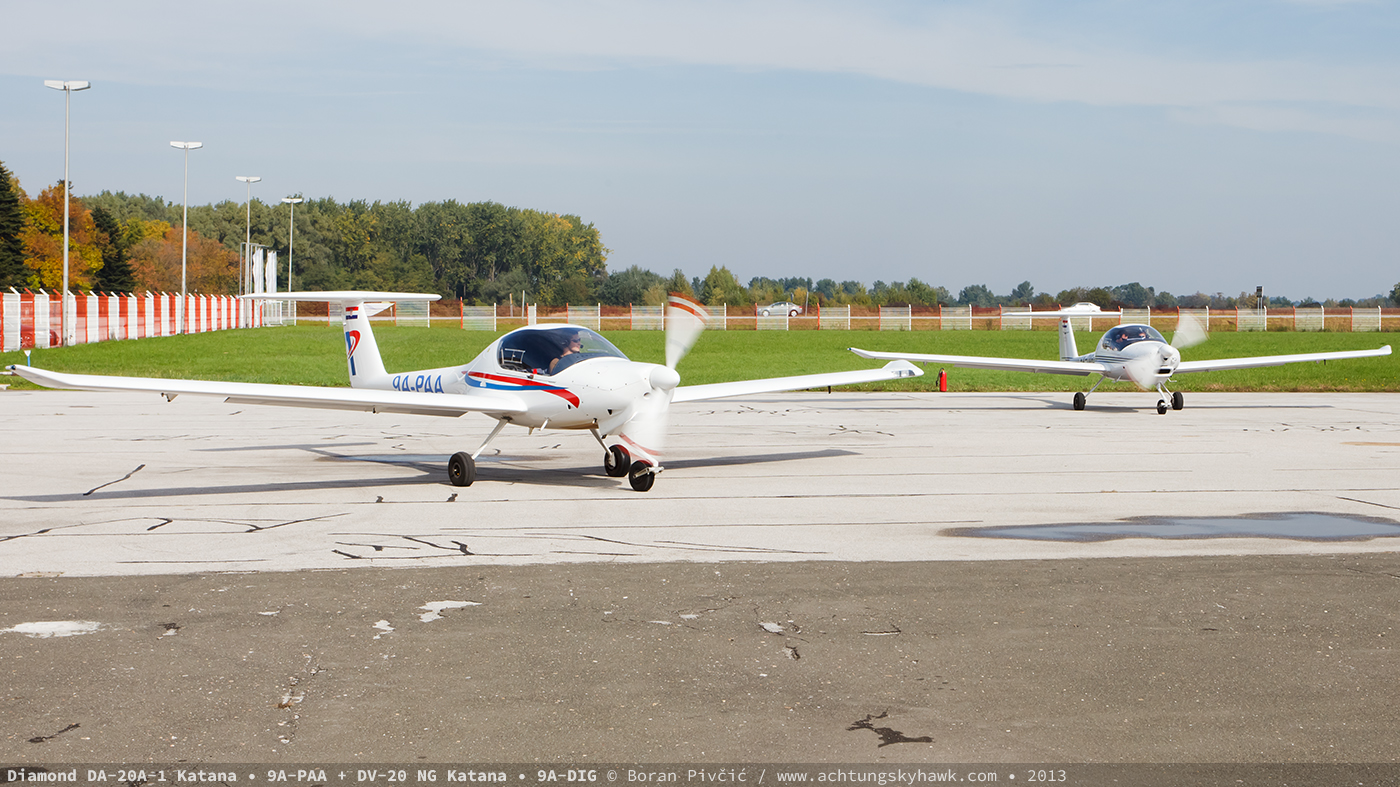
DA and DV together. Back in 2013, issues with the usability of Lučko (LDZL) – the HZNS’ main base – often forced the entire fleet to disperse to Zagreb Intl (LDZA) and Varaždin. Since this also incurred a considerable loss of training time, delays in the schedule were compensated by renting in Pan Aero’s machines, hoping sheer numbers would have an effect before the winter weather set in…
No. 2 was, rather unsurprisingly, 9A-PAB, another 1996 DA-20A-1 with the serial 10.161. Having led an equally busy life – N851DF, C-GCVV and D-ETTC in succession – it would join the fleet already in AUG 2013.
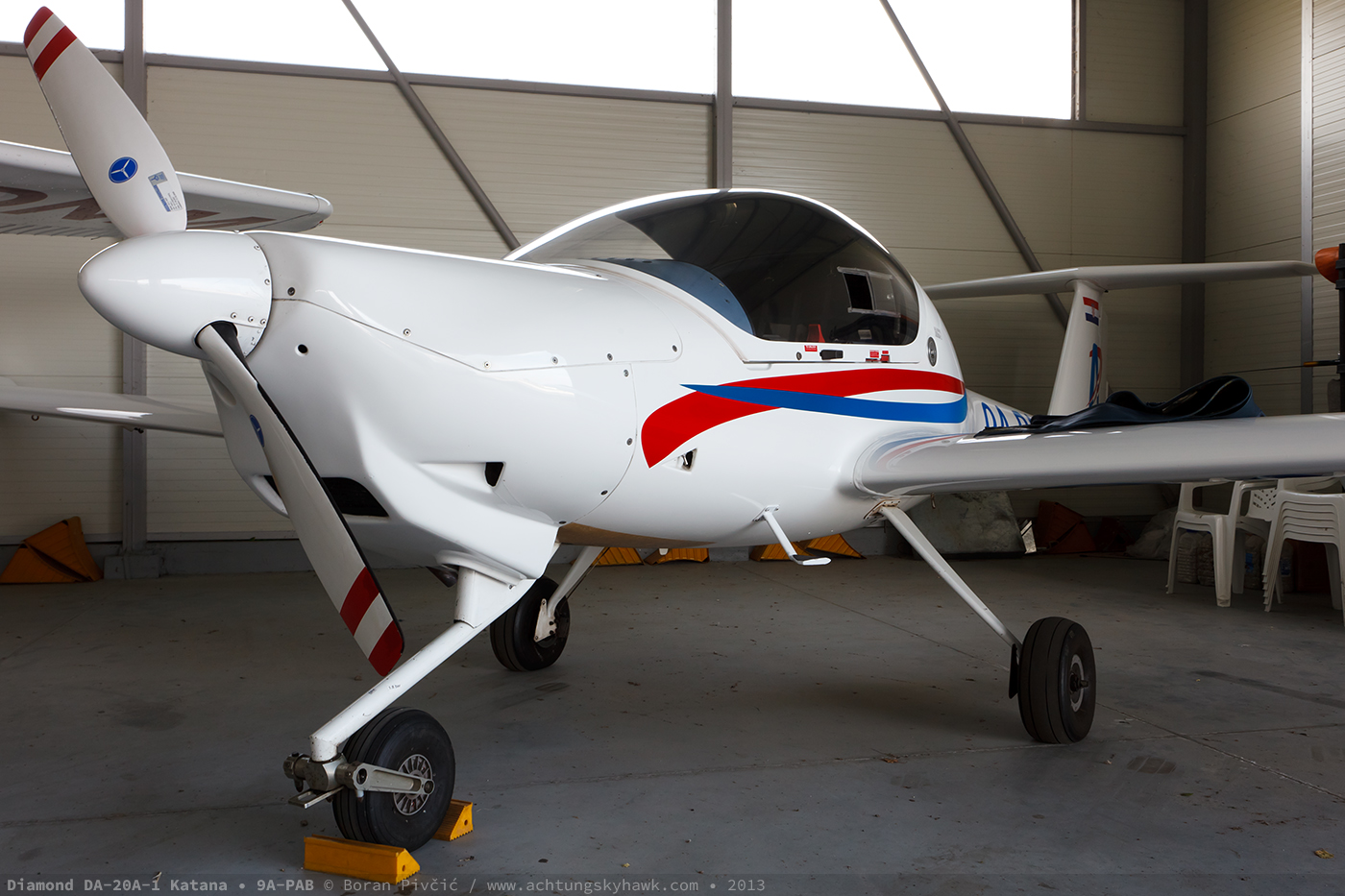
It’s really hard to find an angle that doesn’t flatter the lines of the Katana…

PAB before PAB was even PAB. Snapped on 15 AUG 2013 literal minutes after its arrival at Zagreb on the last leg of its delivery flight. Ah, the luck of being in the right place at the right time… entirely by accident…
No. 3 though would arrive only a couple of years later in 2018, becoming 9A-PAE4 in the process. Also of 1996 vintage with serial 10.152 – thus making it the oldest Katana currently flying in the country – it too had several previous identities, including C-GKAH, G-BXHJ, F-GOCG and latterly SP-CAN.
4 the two letters skipped were being used by Pan Aero’s own Cirrus SR-20 (9A-PAC, later sold as G-FREY) and Beech 76 Duchess twin (9A-PAD, later sold to HZNS to replace its written-off Piper PA-44 Seminole)

Despite having been in the country for seven years at the time of writing – and our paths having crossed in the air more than once – I am ashamed to admit that I do not have a single photo of PAE… hence me borrowing one from another spotting colleague – Branko Češljaš – hosted on Jetphotos.com
And finally, the most characterful for last 🥳. For awhile the second (of two) privately-owned Katanas in Croatia, 9A-NIR does not appear to be much on the surface: a standard 1995 DA-20A-1 with serial 10.064, and a pedestrian blue stripe scheme that you could easily lose on a busy apron. Even its pre-Balkan life was relatively humdrum: N844DF until 1999, and then OE-AAA (cool reg btw) until MAY 2008.

Had it not been for the 9A-Nxx reg (there having been only one other aircraft in that range since the creation of the 9A prefix in 1992, the 1979 Reims F172M 9A-NOR), I would have likely walked right past it. OK, maybe not; with its crisp, shiny and freshly applied coat of paint, it did tend to catch the eye, particularly among all the usual weathered and tired Lučko residents…
At that time it would be sold on to Bosnia, where it would become T9-MIA (and then E7-MIA when the country switched prefixes in AUG 2008) of the little-known operator “Međugorje Airlines”. Based out of Mostar (LQMO) and taking its name from the eponymous town (in)famous for its apparitions of the Virgin Mary, this outfit was formed to take advantage of the tourist boom generated by constant pilgrimages – likely to the tune of taking people on panoramic flights over the major pilgrimage and apparition sites.
However, already by MAR 2009, E7-MIA would appear at Lučko for heavy maintenance – and then, through a chain of events that is not entirely clear (nor particularly transparent), end up staying here rotting away for the next four years…
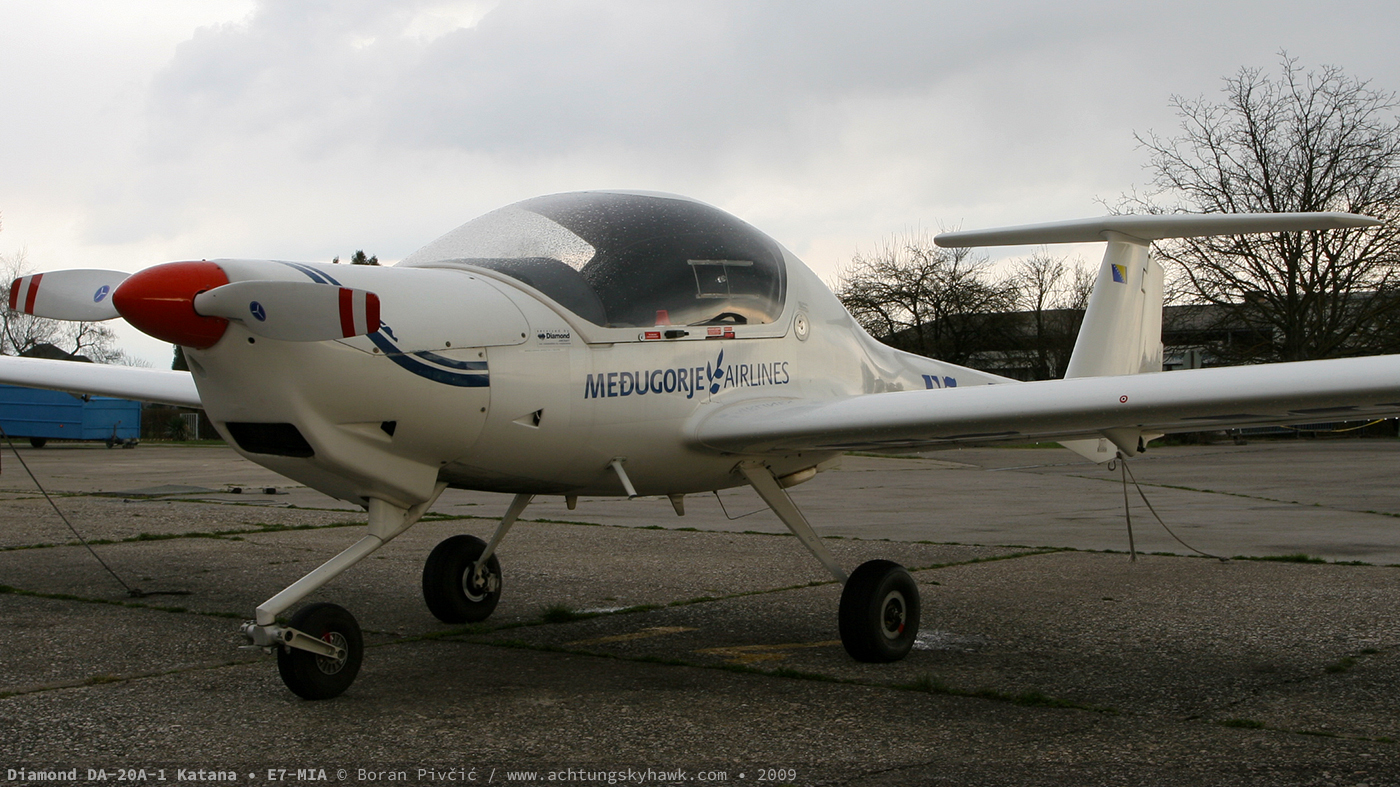
First encounter in some truly terrible lighting conditions (made worse by my truly terrible camera work). The red spinner and partial stripes are remnants of the scheme it had worn as OE-AAA, the stripes having stretched back all the way till the rudder
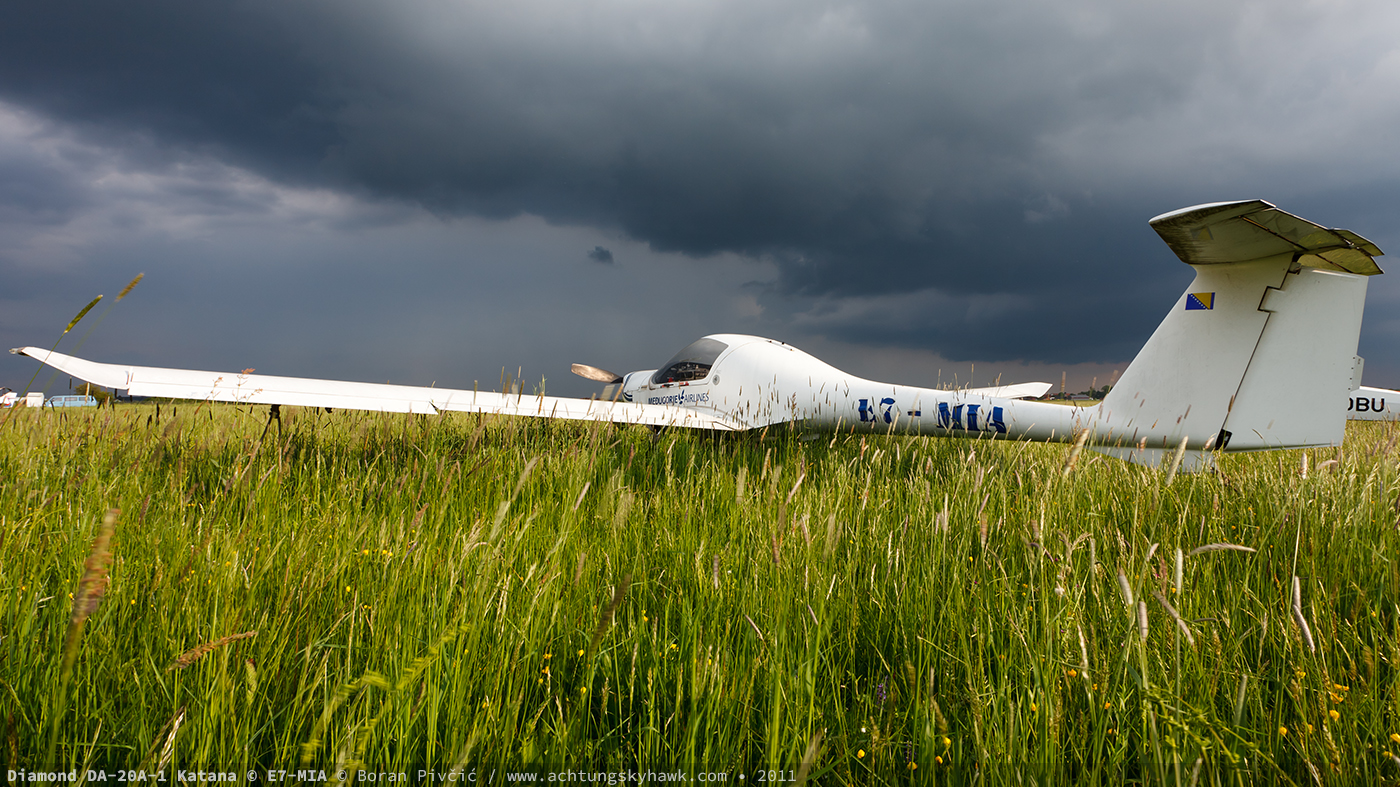
M.I.A. … almost literally. Though it did appear looked after for quite awhile (at least with the minimum of effort), the fact of the matter was that it would take SEVEN years for it to finally move under its own power again…
In 2013, it would be de-registered from Bosnian books, bought by two local flight instructors – and then sent off to one of the very best mechanics in Croatia for a thorough overhaul (nuts and bolts upward). Emerging in 9A-NIR form in 2015, it was lauded as the best classic Katana in the country by all who flew it, with praise heaped on everything from the purring engine to the lack of play in the controls, the silky smoothness of the bearings, pulleys and cables – and even the bang-on rigging of the surfaces, controls and trim tabs (sadly, this was well before my time on the DA-20 😭).
Intended outright for long-term lease to flight schools, it would spend several years in the HZNS fleet, before eventually being made redundant once their operations had stabilized and student numbers dropped. With more work nowhere else to be found – Pan Aero being in the process of adding PAE, and no other professional training organizations existing elsewhere in Croatia – in 2018 the owners were forced to make the decision to sell. Thankfully, an airplane of this technical caliber had no trouble finding willing buyers, quickly becoming OM-KLA of Slovakia’s Seagle Air – where it is still happily (and very intensely!) flying as of JUL 2025…
Katanas in Croatia – summary:
- 9A-DAI • DA-20A-1 • 10.035 (1995) • crashed/returned to factory as wreck
- 9A-DAK • DA-20A-1 • 10.323 (1998) • operational
- 9A-DIG • DV-20 (NG) • 20.207 (2011) • operational
- 9A-NIR • DA-20A-1 • 10.064 (1995) • sold, became OM-KLA
- 9A-PAA • DA-20A-1 • 10.193 (1996) • operational
- 9A-PAB • DA-20A-1 • 10.161 (1996) • operational
- 9A-PAE • DA-20A-1 • 10.152 (1996) • operational
Other Diamonds in Croatia – historical summary:
- 9A-DAR: Diamond’s demo DA-40-180 • 40.258 (2003) • returned to Austria following Diamond’s withdrawal, later became D-EYZE with the European Flight Academy
- 9A-DME: the country’s sole Thielert-powered DA-40D • D4.218 (2006) • sold at some point, becoming S5-DOD
- 9A-ING: a private DA-40-180 • 40.245 (2002) • still flying in Croatia
- 9A-VIO: a brand new DA-40NG • 40.N652 (2024) • owned and flown by a Diamond distributor in Croatia
- SE-MAD: a very busy DA-42 • 42.203 (2007) • privately owned and based at Varaždin despite the Swedish reg
Sources:
- Aviation Flight Center – DV-20 page
- Diamond – Katana product page
- EASA – DV-20/DV-20E TCDS (PDF)
- Katanaflyer – production lists and variants
- WildbergAIR – Austrian GA register
- and the aforementioned colleague from the Q400 (and now the CSeries), who had instructed on 71% (five out of seven) of the total Croatian fleet




 Achtung, Skyhawk!