Speed is a tricky thing; not because it can kill you, but because it’ll complicate your life far more than it need be. Take my case for instance: for a bit of change, I recently swapped the 120 km/h SF-25 Falke motor glider for the 140 km/h Fly Synthesis Texan ultralight. Just 20 kph in it, that’s all; barely even noticeable on the sort of the distances common to continental Croatia… but I immediately started planning long(er) range flights like there was no tomorrow 🤨 (OK, much improved payload + better take off & climb performance + the ability to make a 180 turn in under 10 meters + more space inside had a lot to do with it as well… but mostly speeeeeeed).
Enticed by the prospect of finally visiting places that were beyond my physical (dis)comfort range on the Falke, it didn’t take long for my sights to land on two of Croatia’s 159 former cropdusting airfields that are still in use today: Korija near the town of Virovitica, and Čađavica near not-too-far-away Slatina (not the one in Romania). The problem, however, was that the Texan has a blue-tinted canopy and no convenient hatch to stick a camera out of (not to mention the wing is quite far forward, so the view down sucks), which meant Falke-style aerial reconnaissance was out of the picture (heh). Didn’t have my drone on me either, so a mix of ground shots and videos of the approach & landing was a self-selecting solution. Wasn’t expecting much in the way of quality as a consequence… but the end results actually came out quite solid – and, critically, good enough to use for another Cropdusting Airfields piece!
(spoiler alert: due to thermal turbulence on both flights, and the need to conserve fuel due to the Texan’s higher 100 HP burn, I ended up cruising at 125 km/h on average… so yeah, speeeeeeed)
Cropdusting strips are a vibe in themselves…
Korija (red) and Čađavica (green) with most of continental Croatia for scale. About 150-170 km in the realities of Croatian airspace from the Texan’s base at Mlinski kamen near Petrinja
Korija •RWY 01/19 • 600 x 20 m • very smooth & comfy
As it stands today, Korija sports a fairly unremarkable grass runway, whose only “claim to fame” is a noticeable 1% upslope in the RWY 01 direction. However, back in its heyday, it was essentially a 1200 x 150 m open field (whose outlines remain visible to this day), on which you could land wherever took your fancy.
Pocket history: served as a major base for cropdusting operations on behalf of PIK Virovitica (mostly with An-2s); opened sometime in the early 70s and operated until the run-up to the 1991 Homeland War; for many years afterward left mostly unattended (except for occasional mowing); and finally refreshed and reopened by the AK Virovitica flying club in the summer of 2024. It is currently registered as a “semi-private” runway (i.e. used solely by the club and aircraft based there, though PPR is possible), so it doesn’t have an ICAO Location Indicator… yet.
Is flat. Located at the heart of the region of Podravina – named after, and defined by, the river Drava – Korija is effectively the start point of the densest part of the whole PA cropdusting airstrip network. Of the 159 runways in total, 51 can be found in the 120 km between here and the confluence of the Drava and Danube (today’s border between Croatia and Serbia) – including also Čađavica, about 40 km E-SE of Korija as the crow flies
While the field itself doesn’t really have any vices (except for an abundance thermal turbulence, but it is hardly unique in that respect), if you wanted to be a good neighbor you’d definitely need to mind the village of Korija, located just 350 m off the RWY 19 end (and whose houses and church spire are faintly visible in the photo). Having shot a few touch and goes here as well, I certainly did put the Texan’s outstanding low speed maneuverability to good use on the upwind and crosswind legs!
On the other end, you have a fairly clear run, the first obstacles being the village of Golo Brdo and the foothills of the Bilogora mountain range some 1.3 km away. The only issue I can think of here are lorries on the dirt road running parallel with the runway, kicking up dust as they make their way to and from an under-construction express road about 800 meters out
Čađavica • RWY 02/20 • 470 x 15 m • half length OK, half length marginal
If, however, you found Korija too normal and conventional for your taste, don’t worry – I still got you covered 💪. On the face of it, Čađavica’s backstory pretty much mirrors that of Korija: built sometime in the late 70s… used by IPK Slatina and IPK Osijek (albeit primarily by PZL Dromaders)… abandoned in 1991… and left to rot for 30-odd years until the local government awarded an operator’s concession to a local father-son duo, who eventually brought it back to life in 2021. Same legal status, no ICAO Location Indicator.
What does stand out however – even by the standards of these strips – is its current configuration. Back in the olden PA days, Čađavica had a very comfy 620 x 15 m paved runway, with a large 150 x 25 m paved apron adjacent to the RWY 20 end; this would have been considered borderline luxurious at the time, and second only to Mirkovac near Osijek, whose 700 x 17 m runway with an apron at each end made it the queen of the network.
It’s 21st century incarnation though would see the runway shortened to 470 m – or the distance available from the RWY 02 threshold to the beginning of the apron. However, a pre-landing inspection pass also revealed that:
the first 200 m of RWY 02 were not in the best of shapes, with an uneven surface and lots of cracks – and while usable if need be, I personally wouldn’t venture there at speed without chunkier tires and a greater prop clearance than is available on the Texan
the final 200 m before the apron in the RWY 02 direction were surprisingly smooth, despite their visual appearance; pulled off a textbook greaser there
there’s a… hmm… “sub-optimal” earthen berm 20-ish m from the RWY 02 threshold; after climbing it on foot, I’d call it at about 5 m high… doesn’t sound like much, but clearing it on landing with a sufficient margin does mean that most of the threshold is unusable (even if it were in a good state to begin with)
Arriving with 02/20 hindsight. Even though the above realistically gave me “just” 300 m to play with, the combination of the Texan’s chunky low-speed wing, low mass, high flap and a helping headwind meant the landing was a complete non-issue; indeed, I actually had to ease off the brakes to avoid having to add power just to make the apron…
I’ve been at major GA airports with smaller aprons than this… at its peak, this would have easily been able to handle 5-6 An-2/M-18s and their attendant vehicles at the same time
View from the top… of the berm (which took a bit of work, given that it’s mostly fine earth). Don’t know why it’s here, but Google Earth historical imagery does not show it back in October 2024. Thankfully, the RWY 20 end is blissfully free of obstacles… and even Čađavica town is sufficiently far off (some 1.4 km) that you don’t have to worry about bothering the locals
And a bit of bonus content: one of only two CTSWs in Croatia, 9A-URV is actually a native of Čađavica… though obviously this was not taken there
If you’ve ever wanted to send the ex-Yugoslav aviation scene into a fit of fond nostalgia and blind rage at the same time, there was only one aircraft you’d need to mention: the Utva U-75. Behind its facade as a rather conventional two-seat basic trainer, it had over the years evolved into one of the most polarizing aircraft ever made by Yugoslavia’s aviation industry, a rough but capable diamond to some – and a vile deathtrap to others. While the truth is inevitably somewhere in the middle (and requires quite a bit of historical context to place), the fact remains that even today the type is very firmly ingrained in the local aviation psyche.
This, in turn, meant that it was only a matter of time before it would start appearing in force here at Achtung, Skyhawk!. Indeed, back in 2017 there was a big piece on the sole surviving four-seat U-75A, followed up a year later by an attempt at making a sensible (!) pilot report for my first ever flight on one. And while their mention here is a shameless plug (💪), they are nevertheless worth a read on their own merits… if anything for providing at least some of the aforementioned context, and helping to illustrate just what the U-75 was supposed to be and why it ultimately succeeded/failed at that.
All of this is also relevant for what is to come now. What had originally started out as just a simple photo showcase of the U-75s I’ve flown so far had, shockingly, gone completely off the rails within minutes. I’d needed only a few catchy captions to go along with the photos… but ended up going ona number of lengthy tangents, each delving deeper and deeper into the juicy, nerdy details of the U-75’s design and operation. Thus, having even a bit of the type’s backstory at hand will make it much easier for this whole (rambling but hopefully interesting) text to fall neatly into place…
A manly man’s stick with a guarded weapon release switch, and a 70s green ergonomic mess of a panel… who could honestly say no?
The origins of this thing go back to the summer of 2022, when – in an entirely unscripted series of events – I had managed to log time on three different U-75s in three different countries all in the space of just three months’ time. What had set the ball rolling was an innocent decision in June to add another new reg and another new airfield to my logbook. While browsing through available fields within reasonable reach by car, I stumbled upon Prijedor (LQPD) just over the border in Bosnia, whose Facebook page had prominently featured its U-75 E7-PDC in all its galleries. Tick. Having posted photos of that flight on my Instagram account, I was then contacted by an instructor from Maribor (LJMB) in Slovenia, and invited to have one last go on their S5-DCI before it used up its remaining service life and ended its flying career. Tick again. And, having done all of that, I thought “sod it”, and on an impromptu vacation to North Macedonia in September decided to go for a Triple Tick and try out Z3-DCF out of Štip (sans ICAO code), by far the best of the few remaining U-75s in the country. Naturally, my camera had made all three trips as well, making for some entirely predictable results…
On a serious note: the story of every aircraft featured here touches upon, in one way or another, the Yugoslav independence wars of the early 90s; it’s simply the nature of the beast (much to my regret, having lived through those times). Since this site is, and has only ever been, about nerdy airplane stuff – and the 90s are anything but that – you’ll have to forgive me for occasionally skimping on the details… as well as being vague at times, since records from the period are not always easy to find (be it from not being kept at all, honestly lost, dishonestly destroyed, or simply unavailable for any of a myriad reasons)
The Mule: E7-PDC
Kicking off both the photos and the tangents is the youngest U-75 I have on file, manufactured in 1985 under the military ID 532381. Nowadays operated by AK Prijedor (AK = aeroklub, flying club), PDC is your typical small-town jack-of-all-trades, used for everything from basic flying instruction to precision flying competition to glider towing – all of which also makes it one of the busiest and hardest-working 75s on the Balkans today.
Since legacy Yugoslav aircraft tend to be “generational hand-downs” – frequently serving out their entire lives with the same club, or changing hands once or twice at most – PDC, like many 75s, has a disappointingly straightforward history. Initially flying with AK Paraćin of (the Federal Republic of) Serbia as YU-DJS, it would be transferred to Prijedor in JUN 1988, becoming YU-DLY in the process. One of the few 75s that do not appear to have gone into temporary military service during the collapse of Yugoslavia, it would remain on the Serbian register all the way into 2003, when it would become T9-PDC… and then finally E7-PDC when Bosnia swapped out its registration prefix in AUG 2007.
The twins. While the most complicated part of the entire airplane – the powerplant – may be as generic as it gets (a 180 HP Lycoming IO-360 whirling a two-blade Hartzell HC-series constant speed prop), the rest of the airplane is pretty much bespoke. This inevitably became an issue once the spares pool had started to dry out – and was further exacerbated by the type’s withdrawal from the Serbian Air Force in 2016-2017, ending any meaningful official support. Remaining operators are increasingly left with few choices but to cannibalize non-flying examples, a fate that likely awaits E7-PDB as well…
Despite its seemingly compact appearance (accentuated by the short 9.73 m wingspan), the U-75 is a proper chonk of an airplane – which becomes particularly obvious when parked next to something else. The wing root alone is approx. 80 cm off the deck, while the wingtip itself has a very generous 1.1 m ground clearance – both far in excess of many other low-wing two-seaters (E7-PDH would, sadly, be lost with both on board barely six months after this was taken)
As iconic a cockpit view as there can be on the Balkans! True to its role as an everyday workhorse, E7-PDC has a few add-ons not normally found in other U-75s: a Garmin Aera 500 GPS unit, an ICOM IC-A210E com radio, and a Trig TT31 Mode S transponder (the King KR 85 ADF doesn’t count; that was part of the factory standard fit). Other new bits include more modern seats with modern harnesses, and outside there’s a full suite of LED navigation and strobe lights
In addition to the panel layout, another thing to get used to inside are the very lines of the cockpit itself. The heavy frame and low door sills mean that looking forward initially feels like you’re peering out of a post box, while glancing over the sides you’d think you’re in an observation airplane. However, once you get a bit more comfortable with it all, it doesn’t feel even remotely as unnatural as it looks; the short downward sloping nose – plus the extensive glazing and generally airy feel to the cabin – mean that visibility is actually borderline excellent in all direction except backwards
1 among the many specifics of Yugoslavia’s aviation industry was the often confusing interplay of civilian and military interests in the design and manufacture of light aircraft. A perfect example, the U-75 itself was conceived to cater for the needs of both the civilian Vazduhoplovni savez Jugoslavije (VSJ, Aviation Federation of Yugoslavia) and the Yugoslav Air Force (Ratno vazduhoplovstvo, RV). It included very nearly equal amounts of input from both of them – a tow hook for the VSJ, underwing hardpoints for the RV for example – and both were intended to split the bill of its development. However, due to the military’s higher position in the state apparatus (not to mention having eventually ended up covering most of the expenses), all of the aircraft would actually be owned by the RV, with an agreed-upon number made available to the VSJ through a lease agreement. The VSJ would, in turn, distribute these aircraft to flying clubs across the land according to its own internal schedule. This meant that in peacetime, the RV could recall aircraft from civilian service to cover its own operational needs (such as replacement of losses) – and in wartime press them into use as nuisance raiders armed with two of either 120 kg dumb bombs, 12-round 57 mm rocket packs, twin-tube 128 mm rocket launchers, or 7.62 mm machine gun pods.
As an upshot of this “ownership structure”, all of the U-75s used by the VSJ would also carry the RV’s standardized five-digit ID (evidencijski broj, record number) alongside their normal civilian registrations. Here, the first two digits would denote the aircraft type, and the last three a particular aircraft’s position in the production sequence (with the 0xx block reserved for prototypes and pre-production examples, and 101 onward for series machines). With the U-75 having been assigned the type code 53 – and the two production batches being 53101-53124 and 53151-53261 – PDC’s ID of 53238, for example, works out to being the 111th production-standard 75 made. These IDs were sufficiently big a thing in fact that they became the stand-in for serial numbers when identifying individual airframes – so much so that many forgot the aircraft even HAD factory/line numbers to begin with.
To complicate matters even further, the RV also used custom type designations for many aircraft in its service, usually a combination of the aircraft’s role and its two-digit type code. The U-75 so became the V-53 (višenamjenski, multipurpose), though this tended to be rarely used outside of official documents and manuals; thus, U-75 YU-DJS of “the civilians” and V-53 53238 of the military would actually be the very same airplane.
But wait, there’s more! “According to its own internal schedule” is just an abridged, diplomatic way of saying the bureaucracy didn’t end there – not even remotely. Subordinate to the VSJ proper were the aviation federations of the individual Yugoslav republics and autonomous regions – much of the same really, but with a more tactical, hands-on approach. In the case of the U-75, the VSJ, as the “head office”, would split the 86 aircraft it had received (later upped to 114) into lots deemed sufficient for the needs of each republic/region – and then sit back and let the individual federations do the heavy lifting of allocating them to individual clubs. I mention this because anybody not from around here trying to make sense of the whole arrangement will inevitably run into a myriad of acronyms for the various organizations involved – VS, ZS, ZLOS, … – all of which may seem different and confusing… but all essentially denoting the very same thing. The main culprit here is linguistics – and to avoid setting off a firestorm, suffice to say that there were two dominant languages in use back then: Serbo-Croatian (Yugoslavia’s lingua franca) and Slovenian. You can probably see where this is going:
VS: vazduhoplovni savez … “aviation federation” in Serbo-
ZS: zrakoplovni savez … “aviation federation” in -Croatian
ZLOS: zveza letalskih organizacija Slovenije … “the union of aviation organizations of Slovenia”, a long-winded way of saying “aviation federation” in Slovenian
The warbird: S5-DCI
The next one, by contrast, is NOT your everyday hauler; indeed, it is (or rather was) possibly as close as you could get to an operational, original military-spec 75 anywhere in the lands of former Yugoslavia. Manufactured in 1980 as 53171, it would be allocated to AK Maribor right from the beginning, initially under the reg YU-DGF. Come the collapse of Yugoslavia in 1991, it and other Slovenian U-75s would be pressed into service with the 15. brigada vojaškega letalstva (15th Military Aviation Brigade) of the newly-formed Slovenian Air Force. Now known as SL-DCI, it would eventually become the S5-DCI we know today when Slovenia was allocated its permanent registration prefix2 in 1992.
Used solely for training duties during this time3, all of the impressed U-75s would be withdrawn from service in 1994 and replaced by the Zlin Z-242L. The surviving machines (some having been lost to accidents) would eventually be released for use by their original flying clubs, though they would nevertheless remain under military ownership for the next two decades4. And while all of them would lead busy civilian lives throughout the rest of the 90s, age and spares and maintenance costs would eventually whittle the fleet down until only DCI remained, operated by AK Maribor’s successor, Letalski center Maribor (LCM).
Initially earning its keep as a glider tug (and occasional competitor in the odd precision landing championship), by the mid 2010s it would increasingly take on the role of the “treasured family oldtimer”, flown pretty much solely for the experience and its historical significance. By mid 2022 however, the Utva Curse would catch up with it as well, with an upcoming engine overhaul – made doubly more expensive by post-lockdown inflation – being simply too expensive to be justifiable, particularly given the financial commitment required by LCM’s large “daily driver” fleet. With just 45 hours left to run by the time I arrived (again), DCI was flown to exhaustion over the summer, and finally ended its career in autumn with some 4,620 hours on the clock…
The last place you could see 1991-1994 Slovenian Air Force colors out in the wild. Serving out its third consecutive year in the hangar at the time of writing, there is a possibility (albeit not a definite one) that DCI might eventually join the ever-growing collection of airplanes at the fantastic Park vojaške zgodovine (Park of Military History)… note also the prominent fairing under the wing just outboard of the main gear; this covers up the fuel level sensor and fuel tank drain port – and NOT the pylon attachments as some seem to claim (these were located further out roughly half way towards the wingtip)
Hopping around tight grass strips on the edges of forests, a green panel inside and beautiful green landscapes outside… happy place, happy place!
A cockpit study… in banging my head against the overhead frame while trying to find a good angle. Unlike PDC, DCI’s interior is entirely stock, the only additions being the King KT76A transponder and Trig TY96 com radio
It’s hard to appreciate just how thicc the U-75 really is until you stand behind it. The vertical stabilizer tops out at approx. 3.2 m, while the trailing edge of the horizontal is at something like 1.7. Note also the tow hook under the tail, a VSJ requirement as stated previously
2 since they actually represent a national radio communication identity rather than just plain nationality, registration prefixes are regulated by an industry-spanning multinational body called the International Telecommunications Union (ITU). Since the ITU is a big thing with its own processes, meetings, committees and all the accompanying inertia, it takes awhile to get anything major done – particularly creating and allocating an entirely new prefix. To expedite abandonment of the now no-no YU-, both Slovenia and Croatia adopted temporary non-kosher prefixes of their own choosing that would be considered “legal tender” until the ITU decided on a permanent solution. Slovenia thus went with SL-, while Croatia opted for RC- (Republic of Croatia). By the mid-to-late 1992, all the required processes were complete, allowing for today’s S5- and 9A- to come into use…
And if anybody’s wondering what was wrong with SL- and RC-: as far as I can work out (and I reserve the right to be wrong), SL- had previously been used between 1947 and 1959 for the Saar Protectorate – a bit of Germany that France likes to occupy after every world war – and likely the ITU didn’t want to reuse it so soon. To dial up the irony in this to 11, Somaliland – an unrecognized breakaway territory of Somalia – is nowadays using the same SL- prefix for itself (apparently illegally), and on U-75s of unknown origin to boot! On the other hand, R + the earlier letters appear to be reserved by Russia for future expansion of its registry (such as the RF- regs used by its military hardware), while HR- (from Croatia’s native name, Hrvatska) was already taken up by Honduras
3 upon their formation, both the Slovenian and Croatian air forces existed pretty much in name only. With no proper combat aircraft and few left to capture (most RV units having been withdrawn to bases in Serbia and Bosnia on the eve of war), both forces had to take whatever they could get their hands on – hence the impressment of civilian aircraft from flying clubs. By virtue of its distance from the actual shooting, the Slovenian Air Force could afford to use its U-75s in the training role only; in Croatia however, the reality of BEING the front line meant that the Utvas actually had to go to war as designed – for the first and only time – hastily armed with Yugoslav M79 and M80 shoulder-launched anti-tank systems strapped to the wings in lieu of proper air-dropped munitions.
While this was (and remains) a masterclass in ad-hoc field improvisation and lateral thinking, the fact that it was organized so quickly and successfully owes something – ironically – to a Yugoslav “institution” called TO. Short for teritorijalna odbrana (Serbian) / teritorijalna obrana (Slovenian and Croatian) – meaning simply “territorial defense” – these were archetypal socialist paramilitary defense organizations, in essence irregular units that could be quickly raised from the civilian population in time of war. With their “biggest selling point” being the speed and geographical extent in which they could be activated, their primary goal was to harass and slow down the enemy using unconventional tactics, giving the regular army time to fully mobilize. A key component of this approach was using off-the-shelf “whatever is at hand” equipment, which also included civilian light aircraft. While even Western types were included in the scheme (Yugoslavia having had sizable Cessna and Piper fleets since the 60s), the most common actor in later years was the U-75 itself, since it was literally designed with this in mind. Using aircraft leased from flying clubs (albeit without pylons fitted), the TOs would run a number of exercises through the 70s and 80s, which went a long way to smoothing out kinks in the concept and providing experience to both air and ground crews. Indeed, the TO program as a whole would be wound down at the end of the 80s for fear that it would provide a nucleus for the formation of proper armies and air forces in any breakaway republics… which, in fact, was exactly what had ended up happening in Slovenia and Croatia
4 in this system, the clubs themselves would pretty much be responsible only for the airplane’s day-to-day operational costs and regular maintenance, while the military would do all major servicing and overhauls of its own accord (and out of its own pocket); more than anything else, this helps to explain why the U-75 held on in Slovenia for so long. However, in the early 2020s, the whole fleet would be placed under the jurisdiction of the civilian Letalska zveza Slovenije (LZS, Aeronautical Association of Slovenia), which would in turn transfer full ownership of individual airplanes to the clubs themselves. Included in this deal was a caveat that the airplanes could not be sold onward, which meant that they were now stuck where they were and completely at the mercy of their clubs’ finances. And while for 99% of the 75s this made little difference (having already been grounded and condemned to “hangar arrest” for years), for DCI it spelled a very resounding “game over”…
The joyrider: Z3-DCF
We had the mule… then the warbird… and now finally, here’s the mule-bird 🤔. Today used for a curious mix of frequent glider towing and even more frequent joyriding, Z3-DCF is one of those stereotypical Balkan aircraft that have been with the same operator and flying from the same airfield their entire lives – albeit with one notable break. 1981 and 53183 being the important bits, it was delivered new to AK Štip as YU-DGX, and would remain with the club all the way until 1993, when it would be pressed into military service5. Becoming Z3-DGX the same year, it would eventually take on its current identity in JUN 1994, when all remaining Macedonian U-75s appear to have been standardized into the Z3-DC* registration block. Finally, it would make its way back to AK Štip in 1996 when the Macedonian Air Force, like its Slovenian counterpart, started the switch to the Zlin Z-242L6.
Push, push, push, I can see the prop! Being a touch under 700 kg empty, pushing the U-75 up any form of slope is a guaranteed workout – especially on a soft surface (and don’t worry, as the youngest present, I did jump in and throw in my lot immediately after this was taken)
Maro says the walkaround is complete, no findings. If you can’t trust the airfield cat, who CAN you trust?!
Stick, rudder, throttle… and outside the sun-kissed slopes of Mt. Plačkovica. Had worse days out to be honest!
I may be biased – having grown up around hills, forests and rivers – but the views out here are a sight for sore eyes! Another sight that fails to escape notice is the 75’s small(ish) wing, which does make for quite a good view down. Despite its lack of span however, the wing area is still significant at 14.63 m2; at the type’s usual7960 kg Maximum Take Off Mass (MTOM), the resulting wing loading is just 65.3 kg/m2, not that much more than the 64.4 of the average 80s Skyhawk
5 while all the countries that broke away from Yugoslavia outright had sizable fleets of U-75s on the eve of independence (Macedonia 10, Slovenia 15 and Croatia 14), it is the Macedonian fleet in particular that warrants another tangent. By virtue of the country’s peaceful and orderly departure, with none of the fireworks seen up north, its 75s were neither sent to the front, nor pushed to destruction through intensive training and liaison operations; indeed, it took two years from the country’s SEP 1991 independence for them to even be drafted. What’s more, faced with the same lack of spares and support as everybody else, it appears that only two machines would actually be impressed and used: DCF and 53167 YU-DFZ/Z3-DFZ (later renamed Z3-DCE).
Being out of harm’s way also meant that quite a significant number of them had survived to fly another day. Of the 10 in country at the time of independence, eight were operational, and six would eventually live to see the Z3- prefix be introduced. According to available info, three remain flying today, DCE, DCF and 53118 YU-DFB/Z3-DCC/Z3-DAN. While this may not sound like something to write home about, the total sum of operational examples in Slovenia and Croatia is currently… zero
6 try to spot a pattern:
Slovenia declares independence… impresses U-75s from flying clubs… replaces them with Zlin Z-242Ls
Croatia declares independence… impresses U-75s from flying clubs… replaces them with Zlin Z-242Ls
Macedonia declares independence… impresses U-75s from flying clubs… replaces them with Zlin Z-242Ls
Either the Zlin really is that good… or we Balkan people are an unimaginative lot 🤔. Joking aside, there are some notable differences though: while Slovenia and Macedonia had ditched their fleets already in the mid-90s, Croatia held on to them until all the way until 2007. Croatia too would be the only one to NOT return the aircraft to their original owners – bar for one, mentioned later
7 I say “usual” because the U-75 actually had two MTOMs – the applicability of which depended, quite literally, on how many times you wanted to use the airplane afterwards. In the “training configuration” (used by the military in peacetime and by civilian operators all the time), the MTOM was capped at the aforementioned 960 kg, which was sufficient for two RV-standard crew and full tanks (2x 75 l). Critically, this was also identical to the Maximum Landing Mass (MLM), keeping things nice and simple, and assuring that the aircraft would (barring “unforeseen circumstances”) survive intact to its expiration date.
In the “combat configuration” however, the MTOM went up to 1,200 kg, which now allowed for two RV-standard crew, full tanks – and, critically, the maximum permissible war load of two 120 kg bombs (960 + 240). Since the aircraft’s role as nuisance raider meant that its expected lifetime in an actual shooting scenario was rather low, the additional stresses imposed on the structure while maneuvering at such masses were not considered limiting – especially since the aircraft would in all probability be lost well before it began to suffer from the strain.
The 1,200 kg limit would have also been pertinent for a proposed “ferry configuration”, in which the aircraft would be fitted with 2x100 l external tanks, one on each wing hardpoint. With a resulting 350 l of usable fuel, this setup was projected to give a range of almost 2,000 km – but in reality, the aircraft had never been flown even close to that during flight testing, and the whole idea would eventually go nowhere
BONUS: The Silent Ones
With the “three” now accounted for, it’s time to turn our attention to the “a bit” part. This “organized Utva hunting” being a relatively recent development (2017-2018, and then 2022 onward), it took me until typing this whole thing up to realize that I’ve been stumbling upon various U-75s since 2010, usually by accident and without prior knowledge of their existence. Having written off those encounters as a “one of” each time – “like that’s ever gonna happen again” – collating all of those photos into a single gallery had never really occurred to me… until I spotted E7-PDB in one of the shots above and went “hmm”. So, since it is the main culprit for this piece twice as long as it needs to be, we’ll start from there…
A gem straight out of the gate: ID 53182, making it Z3-DCF’s immediate older brother. Initially called YU-DGV, it was operated by AK Prijedor since Day 1; however, in the early 90s it would be impressed into the Bosnian Serb army and given the ID 51104 (it is unclear why the Bosnian Serb military used the Yugoslav type designation for the Cessna 185-lookalike Utva U-66). Following the end of the war, it would eventually become T9-PDB and then E7-PDB. Withdrawn from use sometime in the late 2000s, its future is unclear… though it would surprise no one if it became a parts donor to keep PDC running
E7-PDA, kept company by U-66V E7-PDI/51138 and shot across the dorsal fin of U-66 E7-PDJ/51143… what in another time could have been an Utva promo shot has, sadly, become just another reminder of the demise of the region’s aviation sector as a whole. Manufactured in 1983 with the serial 53219, its history mirrors that of PDB: from being YU-DIZ with AK Prijedor, through 51105 in the military, to T9-PDA & E7-PDA…
’tis but a scratch! Born in 1981 with the serial 53187, this sad mess was initially known as YU-DHB, first of AK Banja Luka, and then later AK Bihać. One of the few machines to end up in the hands of the newly-established Bosnian Army, it would become known for its 15 JUN 1992 dash from Cazin to Zagreb (100 knots, at night, through unfriendly skies), intended to open up an air bridge between the Bihać area and the Croatian capital. Having stayed at Zagreb (a return flight at that moment likely being deemed too risky), it would be used to train the upcoming generation of Bosnian military pilots, gaining a camo paint scheme and the reg T9-CLM sometime in 1993. It has been reported by some sources that it had actually made a few runs back to Bihać once the military situation had stabilized; be that as it may, the end of hostilities in 1995 would find it back at Zagreb undergoing heavy maintenance. Through a chain of events that’s not entirely clear, it would end up staying here forever, being slowly stripped of parts to keep the Croatian Air Force’s own fleet flying…
Forming with T9-CLM the second of two “sequential ID” pairs in my collection, 53188 was delivered new to AK Celje as YU-DHC, and would stay with them all the way until its impressment in 1991. Its history immediately after joining the military has some gaps to it, and I could not confirm whether it had ever carried the temporary SL- prefix; what I can confirm is that it became S5-DCJ while there, before rejoining its old alma mater after the introduction of the Zlins. It would serve there primarily as a glider tug, before being replaced by more manageable Western types – including Piper Pawnee HA-TNC, previously a Lučko native called 9A-BLF… and before that YU-BLF, one of a number of PA-25s operated by Privredna avijacija Zagreb
Caught between a trike and a hard place, the 1979 vintage 53122 is the second oldest U-75 I have on file. Originally known as YU-DKT, it would be allocated to AK Novo Mesto, based at the Slovenian airfield of the same name (nowadays LJNM) – ironically today home to world’s sole remaining four-seat U-75A. As was the case with DCJ, I could find no definitive proof that it had carried the SL- prefix in military service, only that it would return to civilian life under the reg S5-DCD. At some unknown point in time (but apparently quite a while ago), it would be withdrawn from use and chucked in the back of the hangar at nearby Metlika Airfield
The first U-75 I have on digital… but not the first one I’ve ever photographed, the honor going to DCI on film in 2002. 53233 from 1983, new to AK Murska Sobota as YU-DJH, all the 1991-1994 stuff as before, renamed into S5-DCN. Don’t really know what had happened to it since, saw it last in 2010 when it was still airworthy…
What could easily pass as an 80s flight line is, in fact, just part of the decommissioned U-75 fleet of the Croatian Air Force (10 strong at its peak). Leading the pack is 009 (1981 • 53177 • YU-DGH of AK Split > 001 of the CroAF (not to be confused with the later 001 of the CroAF) > 9A-DCH of the CroAF > 009 (despite still carrying the civilian reg) … then there’s 002 (1980 • 53169 • YU-DGB of AK Rijeka > 169 of the CroAF > 9A-DGB of the CroAF > 002) … further on, we have 010 (1981 • 53191 • YU-DHF of AK Slavonski Brod > 9A-DHF of the CroAF > 010) … and finally 011 (1983 • 53215 • YU-DJD of AK Vrsar > 9A-DJD of the CroAF > 011)
Crap photo, but featuring by far the oldest U-75 I have: 004. Just the seventh ever made (being 53107 of 1979), it would be operated by AK Osijek as YU-DED, before becoming 9A-DED of the Croatian Air Force and assuming its current military identity in 1995. Behind it is 003, 53179 from 1981, originally YU-DGS of AK Kila Like, then briefly 179 of the Croatian Air Force – and then 9A-DGS and finally 003 (UPDATE: as on June 2025, 003 is in the process of being returned to AK Otočac, the successor of AK Krila Like; it is unknown at this time whether it will be just a static example, or will it be returned to airworthy state)
The One That Made It Home – sort of. 53206 of 1982 and initially YU-DIH of AK Čakovec, wartime would find it without a temporary military ID8, and apparently without an RC- reg as well (despite having been QUITE active back then); it would appear in the registers only slightly later as 9A-DIH, before taking up its definitive Croatian Air Force ID, 008. The only U-75 to have been returned to its original owners following the type’s withdrawal from service, it would briefly become know as 9A-DIR (according to some sources), before finally reverting to its new-old identity. Seen here in 2016 during the final stages of a wheels-up restoration, it was supposed to become the first civilian-owned U-75 to fly in Croatia since 1991; unfortunately, a series of events (including the death of the mechanic doing all the work) meant that the project stalled at some 95% complete – and apart from a fast taxi down the runway, it had never actually made it out of the hangar. A couple of years later though, it would be sold to the Delić family of Medulin (LDPM) – well known locally for undertaking such restoration work on a regular basis, and whose members had been very active on the U-75 scene in Yugoslav times – with plans to finally finish it and get it back into the air after nearly 20 years9…
8 because the U-75s had joined the fight during the utter chaos of the first days of the war, it is of no surprise that their new Croatian identities had ended up being all over the shop. Most of the units operating light aircraft had sprung up essentially where and when they could, formed almost entirely through self-initiative and without much in the way of standardization from a central military authority. Thus, each unit had adopted a different way of identifying its aircraft, including:
the last three letters of their original Yugoslav registration, with the YU- completely or partially removed or covered (e.g. DED, U-DHF and -DIH)
the last three digits of their original Yugoslav military ID (such as 169 for YU-DGB, 179 for YU-DGS and 227 for YU-DJL/53227)
and the sequence of joining the unit (001 for YU-DGH or 002 for YU-DLD/53239 for example)
Once the “early days” had passed and the Air Force had managed to bring everything together under one roof, the U-75s would begin to receive civilian registrations – in essence just their old Yugoslav regs, but with RC- and later 9A- prefixes. The reasons for this are not entirely clear, but it has been suggested that this was a means to pass them off as non-military aircraft, thus bypassing the arms embargo imposed on the whole of former Yugoslavia, and allowing for the import of Western-made spare parts (particularly engines and propellers). Only around the end of the war in 1995 would the markings finally be put right with the standardized system used by the air force at large, the U-75s (as the OG air units) being allocated the 0xx block.
Mind you, things were not that straightforward even after the latter was adopted; 9A-DGH (which was 001 in its original unit) would now become 009, whereas 001 would go to a U-75 captured in 1995 during Operation Storm (ex. 53255, a military original with no prior civilian usage or reg)
9 something similar is afoot in Slovenia as well, with AK Slovenske Konjice well on its way to bringing its own 75 back into service. Reported to be as much as 90% done and just waiting on its engine, the aircraft in question is a 1983‘s 53216; interestingly, this is not a Slovenian native, having originally been operated by AK Kumanovo of Macedonia as YU-DJE. Heavily damaged in 1993 during a period of upheaval among the country’s Albanian population, it would be shipped off to Serbia for a complete rebuild in 2001 – and then sold on to AK Slovenske Konjice the same year to become S5-DPM. Having (again) not flown for some years, it is now back in the hands of the people who had rebuilt it the first time round, with a projected (third?) first flight due sometime in the summer of 2025… so watch this space!
BONUS DISCUSSION/RANT: as you have probably noticed (and lost time getting to grips with), the most complex thing about the U-75 is actually the system that created it. With military IDs, civilian regs, aviation federations, four-seat models and so on, it’s very easy to lose track of the basics, and build up an incorrect picture of stuff like the type’s production run, prototypes, versions and other nerdy bits (myself having been guilty of that numerous times). “If 53261 was the last of the production batch, why did I find mention of 53262 and 53265 on the internet?” “If there were only two prototypes, why do some sources also list 53003 and 53004?” and so on. Well, to set the record straight – and not through me being smart, but by asking people from the Utva works itself – here’s a very quick & dirty recap of what was actually going on…
All told, there were 138 U-75s produced, prototypes and production examples included. The first bit of myth-busting concerns the former; and since there’s no one-liner to describe them, we have to make do with a list:
53001: the first prototype (sometimes labeled as V53001)
53002: the second prototype
53003: the first pre-production aircraft – and the first to start the confusion rolling. Representing what the production-standard U-75 would eventually look like and intended to iron out the final bugs, it got caught up in one of the RV’s many whims, specifically a decree that all the aircraft made should be classified EITHER as prototypes or production machines. Since it was, after all, the template for actual production, the Utva works simply rolled with it, and 53003 became 53101, the first of the series examples (incidentally, despite them being called just “U-75” in everyday usage, their proper name is actually U-75A-21)
53004: the second pre-production example. Caught up in the same issue as 53003, it would go down a different route, being converted into the first incarnation of the four-seat U-75, called the U-78. Seeing as this was a major “prototype-ish” mod, it had managed to retain this ID until being lost in a crash in 1981
Production examples, as mentioned, came in two batches, 53101+53102 till 53124 and 53151 till 53261; the reason for the gap in IDs has never been conclusively established (since the airplanes were produced pretty much in one go), but it is believed to be another one of the RV’s idiosyncrasies. The outlier here is 53262, the final all-new U-75 ever made. The only machine not intended for the RV/VSJ (hence it mostly being excluded and consequently forgotten from production lists), it was destined for Jordan (to become JY-AKI), but was damaged in a test flight in 1986, and ended up being used as a spares donor for the existing RV fleet.
And finally, two examples that tend to cause way more confusion than actual impact – primarily because they carry bespoke follow-on IDs but are actually based on existing airframes:
53263: originally registered YU-XAC (and later YU-BRJ), this was the second incarnation of the U-75 four-seater. Properly called the U-75A-41 (or simply just the U-75A), this was a less extensive rework than the U-78, and was actually made from the surviving bits of 53004, combined with new-built parts and spares; so despite having an entirely new ID number, it was physically (well mostly) an existing example
53265: registered YU-XAF, this was a single-seat crop dusting model called the U-75A-11 (or U-75AG to common folk), and was similarly made out of the shell of 53185 following an accident… again, new number, (mostly) existing airframe
53264 (before anyone asks) did not exists; stories say it was supposed to be a twin-engine model… but that may as well be apocryphal, since there is no existing paper trail to ever mention it. Similarly, the aforementioned Somaliland examples – as well as Sudan’s SAFAT 03, 6-12 re-badged U-75s claimed to have been designed and built in-country – are in actuality all standard VSJ U-75s, though their actual IDs are pretty much impossible to ascertain.
So, the final tally is as follows:
2x prototypes
1x U-78 (later to be rebuilt into 53263)
135x production examples (including 53003/53101, 53185/53265 and 53262)
Summary of aircraft featured (state as of MAR 2025):
53107 •• 1979 • 004 • non operational
53122 •• 1979 • S5-DCD • non operational
53169 •• 1980 • 002 • non operational
53171 •• 1980 • S5-DCI • non operational
53177 •• 1981 • 009 • non operational
53179 •• 1981 • 003 • non operational
53182 •• 1981 • Z3-DCF • operational
53183 •• 1981 • E7-PDB • non operational
53187 •• 1981 • T9-CLM • non operational
53188 •• 1981 • S5-DCJ • non operational
53191 •• 1981 • 010 • non operational
53206 •• 1982 • 9A-DIH • in rebuild
53215 •• 1983 • 011 • non operational
53219 •• 1983 • E7-PDA • non operational
53223 •• 1983 • S5-DCN • non operational
53238 •• 1985 • E7-PDC • operational
Sources:
Istorija vazduhoplovstva Pančeva: Utva 75 (printed book by Dragan Kolundžić & Dragoslav Dimić)
Utva 75 – album VSJ (printed book by Dragan Kolundžić)
Utva: fabrika aviona 1937-2022 (printed book by Dragan Kolundžić)
Ever since the early days of Achtung, Skyhawk!, I’ve always been on the lookout for rare, interesting and historically significant aircraft puttering around the region – you know, the sort of machines that had it all really: rarity, backstory and a rich history to boot. As the winter’s soaked runways, persistent fog and oppressive low cloud finally gave way to dry grass, pleasant temperatures and clear sunny skies, I decided I might as well go one up this time and actually – fly one 🙂 .
Having spent my formative flying years listening to “oldtimers” and their stories of adventure on the many aircraft types indigenous to former Yugoslavia, the choice made itself really, especially since many of them are nowadays well up on the endangered list. The simplest solution was thus to go for the most modern and popular one, which eventually led me to Slovenia’s Maribor Airport (MBX/LJMB) and its resident UTVA U-75 two-seat trainer.
Responding to S5-DCI and owned by the Letalski center Maribor (LCM) flying club, this particular aircraft is itself already good for a classic AS review – but, being one of only a dozen or so still airworthy, I decided to bin tradition and focus this time on what this interesting machine is actually like to fly. So, instead of digging deep into its history (s/n 53171, mfd. 1980, ex. YU-DGF of AK Maribor, then SL-DCI and S5-DCI of the Slovenian Air Force until 2010, then to LCM 😀 ), I though I could put together a short flight report and attempt to describe what the U-75 feels like in its element…
The shape that launched a thousand student traumas… while it certainly won’t be winning any beauty contests, the U-75’s stocky build and generous size nevertheless make it stand out among its peers!
Author’s note: given that I have no experience flight testing aircraft (nor do I have the required skills or qualifications), this work is not a proper professional review – but rather the personal experience of a long-time light aircraft pilot and lifelong GA fan. As such, my observations will definitely not be something they will print in textbooks – but given the rarity of the U-75, they should nevertheless be an interesting read for the enthusiast!
Part 1: the basics
Even though the U-75 had already featured here in depth as part of a review of the type’s sole surviving four-seat example, for the sake of clarity and ease of reading I though it best to nevertheless run quickly through some of its more pertinent characteristics. Flying for the first time in 1976, the U-75 is a simple and robust all-metal semi aerobatic two seat trainer, designed to be suitable for everything from basic flying instruction (civilian and military) to initial aerobatics and even air-to-ground gunnery. Despite its not inconsiderable bulk, the U-75 weighs only 685 kg empty and 1,200 kg at maximum take-off (though it is usually flown at its maximum landing weight of 960 kg), which makes its 180 HP Lycoming IO-360 and its associated two-blade constant speed prop good for about 115 kts in the cruise. More importantly, its +5.5/-3 G stress limits with one person on board (and +4.4/-2.2 with two) give it a wide berth during maneuvers, while the tall wide-track landing gear, long-travel shock absorbers and large low pressure tires make (student) landings a doddle even on rough and unprepared strips.
With 138 examples made in total between 1978 and 1985, the U-75 would go on to become former Yugoslavia’s second most produced indigenous design – right behind the G-2 jet trainer – and was throughout the 80s and 90s used by civilian clubs and air forces across the land (in the latter often known as the V-53). And while it is today viewed with fond nostalgia, its life in service was much tarnished by a popular reputation for violent spinning (sometimes fatally), which bred considerable distrust in the design. In fact, the problems stemmed from the rearward position of its center-of-gravity, which made it a peppy and nimble performer – but at the expense of reduced longitudinal stability1. When pushed hard and then poked with a stick, it would indeed want to spin and keep on spinning; but when flown in moderation and per SOP, it had shown itself to be pretty docile in all flight regimes, a fact attested to by numerous operators who went aerobatic on a regular basis and without incident.
1 in simple terms, the two extremes of aircraft behavior are stability and maneuverability. An aircraft that is stable is not maneuverable; likewise, an aircraft that is maneuverable is not stable. Given that this principle acts along all axes of the airplane separately, nailing down the exact amount of each is an art. In prototype form, the U-75 was found to be too stable longitudinally, which reduced its maneuverability in pitch and made it less suitable for the training role. The root cause was determined to be a CG position that was too far forward; to solve the problem, the heavy battery – originally fitted behind the cockpit – was relocated to the tail cone. This shifted the CG backwards sufficiently to solve the problem, but at the same time made the U-75 “nervous” in pitch when it reached its limits. In a hurried or badly executed maneuver, it was not hard to stall and send the aircraft over one wing, initiating a spin that – if not countered immediately – just kept getting worse. Approved procedures therefore called for entry into a spin at a minimum of 5,000 ft AGL, and recovery to be initiated after just one turn; done properly, flight tests showed an 850 ft altitude loss could be expected. Done lower, slower and sloppier, you can well imagine the results
Aside from its significance to the locals, the U-75 is then a classic ab-initio trainer, the sort of aircraft produced by aeronautical establishments all around the world. This itself invites a comparison to some of its peers, such as the Slingsby T.67 Firefly, Scottish Aviation Bulldog, the PAC CT-4 or the SAAB S.91 Safir; however, what I am actually going to do is compare it to the restrained and very unmilitary Cessna 172. The reasoning behind this approach is simple: many GA flyers have at one point or another flown a Skyhawk, with most (myself included) having logged treble figures in at least one of its variants. Despite their different roles, the two aircraft are alike in a number of respects, which makes establishing a baseline for the U-75’s comparison all the easier. And anyway, there’s no point in drawing parallels with an equivalent aircraft if there’s nobody reading (or writing) who flew them, is there? 🙂
Part 2: getting in
But, first things first. Entry into the cockpit is pretty straightforward and is standard stuff for low-wing aircraft: hand in recessed handle, foot on step and up onto the wing from behind. However, since the U-75 was designed from the outset to operate out of unprepared strips, the wing root is a good 80 cm above the ground, so the whole maneuver requires a bit of gymnastics – though not much more than trying not to trip over the 172’s main gear leg.
Once on top, the two-part sideways hinged canopy (jettisonable in flight) opens upwards, and is then fixed in place by a manually folding arm tucked to the inside of the canopy frame. This setup is not really ideal for tall people (like me), since it is quite easy to bang one’s head against the canopy while maneuvering to enter the seat. Thankfully, the frame is pretty large overall so – heads notwithstanding – getting in and out is not difficult or haphazard by any measure.
Thankfully for its crews, the U-75’s exterior size is matched by its interior, with more space on offer than in Cessna’s premium piston singles, let alone the Skyhawk. The elbow room for either seat is impressive, and even larger pilots would still have plenty of space to work without body contact. Note the chunky seat belts and the canvas cover behind the seats that doubles as a parcel tray
While it is immediately obvious that all structural components and cockpit controls are built to last – everything feels decidedly more robust and durable than on the 172 – the overriding impression is of rudimentary finishing work, with rough and unprotected edges in abundance all over the cockpit. Admittedly, given the U-75’s military nature, comparing these and other creature comforts with those of the Skyhawk is apples to oranges – but despite the lack of padding and soundproofing and any form of interior trim at all, the cockpit is physically very comfortable and quite airy. Headroom however is slightly less generous than on the 172 (even when you lower the seat fully), and anybody over 1.8 m and wearing a headset will fill slightly hemmed in from above – though it is still manageable and not much of an inconvenience on shorter flights (under two hours).
While there are no basic Ts and sixes here, the U-75’s cockpit is in some respects pretty well though out, with a couple of good ergonomic touches. One in particular is the central pedestal, which contains pretty much all system controls, including the throttle (yellow lever), propeller control (blue lever), mixture control (plunger), alternate air source (red-topped plunger), demist controls on the side, parking brake (orange switch) and, out of shot, the fuel selector (which, like on the 172, has a very welcome BOTH setting). One particular level that is missing – and would have been fitted in the hole below the alternate air – is the underwing stores emergency release handle. Like many trainers, the U-75 also includes another set of throttle and prop controls on the left of the pilot’s seat. Absent from the shot is the flap level, a large Piper-like affair between the seats; its settings are simple, UP, notch 1 (take-off and landing) and notch 2 (landing only). For my taste, the sticks are of perfect height – not to low, not to high – and though they’re designed to accept either hand, they fall slightly more easily into the right. The only really annoying feature is that on both throttle quadrants the prop control is on the left and the throttle on the right; whereas the manifold pressure gauge (controlled by the throttle) in on the left and the RPM gauge is on the right. As is the norm for all Yugoslav designs, the flight instruments are all metric, while the engine instruments – usually cherry-picked from various Western designs – are mostly imperial.
Once seated, both the sitting position and the view ahead are pretty good, though the frame of the canopy initially gave me the impression of peering through a postbox; once on the move though, I quickly got used to it. The rudder pedals can be adjusted fore and aft, but this is generally avoided since the mechanism is known to stick. The brakes themselves are actuated by separate toe-operated paddles inboard of the pedals – a solution similar to that used on the Super Cub, where they’re heel-operated. With larger shoes (or military boots) on larger feet, this does not seem to be a particularly used-friendly solution, and it took me some fumbling and toe jabbing before I’d gotten used to it. The rudder pedal edges are also contoured to accept the outline of a thick boot – a feature not really compatible with the sneakers I was wearing that day.
Helping matters however is that the brakes are quite powerful, so even a slight jab at them (regardless of its elegance) produces some results. Then there’s also the fully steerable nose wheel, which makes ground maneuvering pretty painless – indeed, I’d managed to get the hang of it after just a few dozen yards. In fact, on steering alone (without differential braking), the turn radius is just 7 meters – noticeably less than the 8.3 the Skyhawk can achieve using BOTH steering and brakes at the same time. The shock absorbers and tires make the ride quite smooth even over rough terrain, but at the same time do not let the aircraft roll to much in the turns if you keep the speed moderate (though the aircraft’s low CG position has a lot to do with this).
Part 3: airborne
System-wise, all pre-departure checks are no more complicated than on the 172, and follow pretty much the same pattern. Having been designed from the outset to meet the FAA’s FAR Part 23 criteria, the U-75 holds no surprises, and there’s none of the “Eastern Bloc system exotica” that its looks and origin would lead one to believe. With the engine being essentially the same as on today’s Cessna 172S (albeit with a constant speed prop), the run-up is also straightforward and over in a jiffy.
As I was briefed by the instructor occupying the right seat, the standard flap setting for departure from both paved and soft fields is notch 1, which gives 20° of flap. The aircraft manual quotes a 225 meter max performance run on grass and with zero wind; however, we had the advantage of concrete and a quartering eight knot wind, so despite the 880 ft field elevation and 25° Centigrade outside, we opted for a more leisurely departure. Adding power, there’s a very noticeable swing to the left – far more pronounced than on the Skyhawk – which can be neutralized only with a large amount of right foot. What’s more, significant pressure on the pedal is constantly needed at high power, and with no rudder trim available, this tends to become wearisome after awhile (though I suspect the rigging of the tab of the vertical stabilizer was to blame for this). Being both lighter and more powerful than the 172, the acceleration was noticeably better, and with slight backward pressure on the stick we were already airborne at 110 km/h (59 kts), having used up around 300 meters of runway.
Passing 50 ft, LCM club procedures call for acceleration to the U-75’s best climb speed (Vy) of 130 km/h (70 kts), retracting the flaps at 300 ft AGL and then setting maximum cruise power, an easily remembered 25″ MP and 2,500 RPM (equivalent to roughly 80% power). In this regime, the rate of climb with full fuel and two of us on board varied between 4 and 5 m/s (800-1,000 fpm), but the day’s thermal turbulence made getting a constant figure impossible.
Once in the cruise – in our case at 3,000 ft towards one of Maribor’s training areas – the power came back to the 65% setting of 22.5″ and 2,350 RPM, which gave a solid 160 km/h (86 kts) indicated and 169 km/h (91 kts) true. While this is not particularly impressive for the available power, the thick wing profile and large landing gear do create a quite lot of drag; increasing the power by two inches MP gave around 170 km/h (92 kts) indicated, but since we were in no hurry, I soon throttled back to best cruise and set about seeing what’s what.
Given my previously noted lack of flight test qualifications, I decided to try and get an impression of the U-75 by flying a program based on the average PPL skill test (bits of which I dimly remember from ages past 😀 ). This I thought would give me the best impression possible in the allotted time frame (one hour 30 minutes), since I would get to see both how it behaves in regimes I’m familiar with from the 172 – as well as how a student might experience it during basic training. To this end, my “program” consisted of:
standard, 60° and 90° banked turns + snap roll
slow flight
stalling, both power on and power off
sideslip descent + gliding
flaps notch 1 and notch 2 approaches w/ crosswind
and route flying and navigation
Sadly, the pattern at Maribor was quite crowded that day, so there was no opportunity to perform a simulated engine-out approach without inconveniencing half the sky. To compensate, the ambidextrous nature of the U-75’s flight controls had allowed me to fly most of my program with each hand in turn and judge the ease and practicality of both. In the end – though I favor using my right hand as I do at work – flying with the left is often far simpler, since all relevant controls – flaps, lights, radio – are on the right side, allowing me to push and pull everything without having to constantly switch hands.
To cut to the chase without going through each maneuver separately, the handling came as quite a positive surprise – especially after everything I’ve heard said about it. The numbers themselves offer some clue to the above, as the U-75’s 65.3 kg/m² wing loading – only slightly up from the 172’s 64.4 kg/m² – promised similarly forgiving all-round behavior, while its 9.73 m wingspan – noticeably shorter than the Skyhawk’s 10.97 – bode well for rolling rates and a general willingness to maneuver.
Immediately after leaving straight & level fight, I found the stick to be very precise and informative, its travel pleasingly light in both axes – enough to get a good feel for the aircraft, but not twitchy enough to become tiring. Interestingly, the stick moves noticeably lighter in roll than in pitch, a setup exactly opposite to that of a glider. Thanks to the type’s large ailerons and powerful elevator (both blessed with considerable travel), the feel was matched by the aircraft’s physical response, with rolling and pitching done quickly and eagerly – but without the aggression of a thoroughbred aerobatic machine. Unsurprisingly, rates across all three axes were significantly higher than on the Skyhawk.
This harmony between stick and machine meant that I could achieve a remarkable degree of precision in most maneuvers already on the first time out, and all without any unnecessary flailing at the controls. Following my observations on take-off and in the climb, I was also quite surprised how little rudder was needed in turns – and that even left-hand maneuvers occasionally needed a poke of right rudder (though I again suspect tab rigging to be the cause). An additional characteristic that caught my eye/hand was that even in high bank turns, comparatively little backpressure was needed on the stick – and when I did find myself losing altitude, little additional force was necessary to return everything back to textbook state. As the numbers in the previous paragraph suggested, the U-75 was indeed very willing to sustain most maneuvers without much fuss and manhandling from my side, which immediately inspired a dose of confidence in its handling as a whole.
But what impressed me most of all was its stall response. Given the legends, tales and accident reports relating to U-75s going vertically, I was ever so slightly apprehensive about this part – not due to fears of ending up in a spin2, but a perception that an aircraft with such a reputation will likely not be well behaved once the going gets tough. I am pleased to say that I was quite off the mark, for the U-75 had exhibited flight simulator-like behavior, even with power on: just a very slight shudder and forward tug on the stick saying that it would like its nose to point down if I don’t mind. Honestly, it made the 172 look dramatic! Another thing of note is that despite the day’s turbulent thermal weather, it resisted wiggling its wings near the stall – and as soon as it even slightly went to the side, quick pedal action would sort everything out in an instant.
2 although owners who had spun the U-75 say it is not as big a deal as folklore suggests (again, if done properly), I had shied away from attempting one, due to both my lack of experience on the type – and the fact that S5-DCI itself was barred from spinning by LCM club rules
Some mention should also be made of the engine. Despite its nominal take-off rating of 180 HP, throughout the program we kept it at its 25″/2,500 RPM maximum cruise setting, which – according to the manuals – left us 150 HP to play with. Despite the abuse and the 20 °C at altitude, the engine oil temperature remained hovering around 95 °C (right in the middle of its 80-110 °C normal operating range), while the designated cylinder registered around 190 °C (deep enough for comfort within its 80-220 °C green arc) – which says a lot about the airflow through the engine compartment. Helping matters were the U-75’s distinctive cowl flaps, located on top of the cowl just ahead of the windshield, which lead to the odd situation of the front cylinders running hotter than the rear pair. Another thing of note is that despite its semi-aerobatic credentials, the U-75 sports the standard version of the IO-360, which is not equipped with fuel and oil systems for inverted flight (these would have been identified by the additional prefix AE).
Criticisms? Well, the only major thorn in my eye at this time was the trim wheel, which was far too coarse and lacking in feel; it resisted operation too much and even a slight turn resulted in an out-of-proportion change in stick force. However, as with the rudder, this may very well have been down to the rigging of this specific aircraft.
With the program completed, we settled back into the cruise, where the plan was for me to do some navigation of the greater Maribor area and see how the U-75 behaves en-route. In a number of critical areas, it didn’t fare all that well: its military genes mean that comfort was never allowed to compromise the training experience, the result of which is a cockpit with no soundproofing at all (as noted previously). The upshot is that ambient noise is off the scale, and even with headphones on it all becomes pretty annoying pretty quickly (especially since S5-DCI has no squelch control, which leaves the headphone mikes free to pick up the drone and amplify it back to you). The position and height of the stick also mean that you have very little space in your lap – so with a kneeboard on and the right seat occupied, you’re going to struggle to read an unfolded map, despite the nominally generous size of the cockpit.
However, as uncomfortable as it may be, the U-75 nevertheless does have something going for it as a navigation platform. In common with most other low-wing aircraft, the view outside is excellent, and the relatively small span of the wing means you can often have a good look down. Once trimmed (after much frustration), it will fly hands off for a surprising amount of time – without rudder input even – though having someone in the right seat to balance things out certainly helps. More importantly, the extensive glazing means you can easily keep tabs on surrounding traffic, and it never took us long to spot neighboring aircraft without having to bank or pitch or stand on our heads. So while the average GA tourer is in a completely different league in terms of comfort – so much so you’d be excused for sending hate mail to the UTVA works following a long cross-country – the U-75 is nevertheless a practical and safe platform for finding your way around.
In that other important route performance metric – fuel – the U-75 is pretty much on par with the 172, with our 65% power setting (mixture full rich) registering 30 liters/hour (7.5 GPH) on the flow meter. With the manufacturer’s 15% reserve fuel policy giving us 128 liters (34 USG) usable out of the 150 liters (40 USG) carried in total, this works out to an endurance of around 4.5 hours. At the same altitude, power/mix setting and ambient conditions, the POH for a late 70s 172N puts out a fuel flow of 25 liters/hour (6.7 GPH) which, with 136 liters (36 USG) available before hitting the 45 minute reserve, gives an endurance of 5.3 hours. However, I normally fly a 1979 Skyhawk with a very accurate digital flow meter, and the real-world figures in nearly identical conditions are all in the lower 7s, which gives an actual endurance of between 4.75 and 5 hours.
A charismatic 70s Yugoslav trainer, more noise than is believable, a green ergonomic mess of a panel and a guns/rockets/bombs toggle switch on the stick – fine ingredients for a fulfilling afternoon! Despite the large canopy frame, the view out is excellent in all directions (even back), though on clear days the sun coming in through the top of the canopy does lead to sauna-like conditions.
Part 4: stopping being airborne
With both zone and en-route work completed, I opted for a handful of touch-and-goes, to see how the U-75 manages that most difficult of maneuvers – landing. On the first three approaches, I went with a flaps notch 1 configuration – and quickly discovered that the little Utva could out-accelerate a brick going down. All that drag means that its glide is quite steep, with the manual quoting a L/D ratio (flaps up) of just 1/6.72 at 150 km/h, 1/7.1 at the 140 km/h (76 kts) recommended engine-out speed, and just 1/8.42 at its 116 km/h (63 kts) best glide – a condition where even the unaerodynamic 172 manages 1/9.2. In our case, these figures were decidedly lower, partly due to my ham-fisted flying – but mostly due to keeping our speed high to avoid disrupting the traffic flow and potentially shock cooling the engine. The ideal speed was therefore pegged at the same 130 km/h as in the climb, which gave more than adequate circuit performance while still keeping us below the maximum flap extension speed of 140 km/h.
Flying, both on and off work, a high-wing aircraft blessed with ample wingtip clearance, I was naturally apprehensive about touching down wing low in the day’s 6 knot crosswind. While this is just a light breeze everywhere else, the U-75 is deemed to be particularly sensitive to it, and is in fact limited to a 90° crosswind component of just 8 knots – HALF of the 15 knots limiting the Skyhawk. To avoid making a complete mess of it so early on, I elected instead for a jet-style crabbed approach with an appropriate bootfull just before the wheels hit the ground. The type’s powerful rudder made this a non-issue, though with experience I’m sure a proper sideslip approach could be flown easily and without danger to both the airplane and ego (especially since the 6° dihedral places the wingtip approximately 1.1 meters above the ground).
Glossing over my first landing – an inglorious thump from too high a flare – I’d soon gotten my hand in and discovered that the U-75 is quite easy to land softly, mostly due to the very tolerant trailing link main gear. As can be expected, the cushioning of the low wing and a more pronounced ground effect mean you can float a long way if you’re not careful, but it doesn’t take too long to get used to it. Indeed, pilots who flew the U-75 in precision landing competitions told me that it is far easier to place on a specific spot than the 172, and it was always the preferred mount with many podium finishes. Interestingly, despite the high degree of flap, the touchdown attitude is noticeably nose up, far more than on the Skyhawk; however, the slope of the nose does not impair forward visibility at any point. The touchdown speed in our case was around 100 km/h (54 kts), though this can be brought down a bit if a greaser is not your intention.
To step up the fun – and illustrate just how draggy the U-75 can be – for the next approach I was instructed to come in high, fast and close, rolling onto the runway heading just 1,200 meters away at 1,100 ft above ground, doing 150 km/h (81 kts). To reach the threshold, I’d have to fly a virtual glide slope of 16° – 10 more than the steepest ILS recognized by law. Pulling the throttle back to idle, setting the prop full fine and dropping flaps fully to notch 2 (30°), I found myself in a visually disconcerting steep descent at 110 km/h (59 kts) and slowing – eventually even having to add power just to make it to the runway. The maximum rate of descent I remember seeing was on the order of 8 m/s (1,500 fpm) with no forward acceleration.
As an encore, I had planned for the final landing to be a “minimum stopping distance” affair – but the traffic crowding in behind us and the necessity of taxiing a full kilometer to our turn off point meant I had to scrub the idea and get my behind off the runway ASAP. But, since I’m already throwing numbers around, the manual suggests a landing distance over a 50 ft obstacle of around 450 meters, with the run itself just 240 meters.
Post script / conclusion time
While the comparatively short time aloft (and my aforementioned lack of test pilot credentials) prevent me from making any worthwhile objective conclusion, from a purely subjective standpoint I was nevertheless pretty smitten with the U-75 – perhaps most of all because it was nothing like popular lore said it would be. While a pure aerobatic aircraft might have been more exciting (at least during maneuvering), the Utva is definitely not boring or dull; indeed, on fun factor alone it might even top the Super Cub and Citabria (both of which I’d had the privilege to fly). While it is not perfect – and living with its faults day to day would likely start to wear quite thin very soon – its charisma, origins and historical relevance had definitely been worth the trip!3 Simply put, to actually go somewhere, I’d undoubtedly choose the better equipped, more comfortable and far quieter Skyhawk; but to have a bit of good old fashion stick-and-rudder fun without much fuss and effort, it would definitely be U-75 all the way 🙂 .
3 despite their widespread use across the width and breadth of ex-Yugoslavia, airworthy examples are nowadays increasingly difficult to find, with – by my count – less than 10 still operational and in civilian hands. Their somewhat expensive maintenance, pretty specific role and an increasing lack of spares make them a financial handful for smaller flying clubs, while their specific character is unlikely to tempt the wallets of many private pilots and owners. Despite this, the few examples that are flying will likely continue to do so for some time to come, with one – 9A-DIH at Čakovec Airfield (LDVC) in Croatia – soon set to return to flight after nearly a decade on the ground!
DCI back in the hangar, dwarfing pretty much everything in there…
While there has always been an abundance of easily-accessible abandoned and disused aircraft to be found in Croatia, one place in particular has always been the local holy grail of “wreck photography” – the Zrakoplovno-tehnički centar (ZTC, Aeronautical-Technical Center) maintenance facility in the town of Velika Gorica, just a few kilometers south of Zagreb. Formerly a military depot with a long and illustrious history, it is now home to what remains of the Croatian Air Force’s earliest machinery, littered chocked full of rusting, disintegrating hulls that had in the war-torn early 90s formed the backbone of the country’s first aerial capabilities.
Even though each and every aircraft there has an interesting and often gripping story, the one I was always most interested in was 9A-ISC, a Dornier Do-28D Skyservant sitting alone and unloved at the edge of the apron. Unfortunately, the facility’s current status in the military hierarchy had always made “unannounced” photography perilous and complicated, making getting up close and personal an impossible task.
Thankfully, as part of the military’s ever-increasing drive for good PR, the ZTC had been selected as the prime venue for Air VG, Velika Gorica’s first aviation theme day scheduled to be held on 13 May 2017 – thus allowing for ample opportunity to sneak a (legal) peek at what’s really hiding behind that fence. However, since I had already reserved that date for snooping around hangars at small airfields in neighboring Bosnia, I’d decided to call on the help of Mr. Josip Miljenko Džoja, a fellow aviation photographer (Flickr gallery here) and keen Croatian military aviation buff who was sure attend no matter what 🙂 . Under our arrangement, he would be tasked with piecing together ISC’s life story and providing both current and past photo material – while I would weave everything together and add the inevitable nerdy bits about the Do-28 design 😀 . Despite not being able to peek inside and make a proper Achtung, Skyhawk! photo report, we both felt that an aircraft of its rarity needed its tale told however possible, so we pooled all of our resources together and got to work…
Despite not being easy on the eye, the Do-28 was – in all versions – a supremely capable aircraft. A direct development of West Germany’s first post-WW2 design – the six-seat Do-27 – the original A and B model 28s were simply straight twin-engine conversions that retained a majority of the 27’s parts. The significantly larger D model – able to accommodate 13 passengers and now named Skyservant – was however a much more thorough redesign that sacrificed almost all of its commonality with the 27 for increased cabin space and hauling capability. Despite this, it still boasted the impressive STOL performance and handling that had made the original 28 such a hit (photo copyright: Josip Miljenko Džoja)
Diaspora-28
But first, a bit of trivia! Like the majority of surviving Do-28s, ISC is a Do-28D-2* model, at 172 examples produced the most common of all the Skyservants. Developed in 1972 specifically to the requirements of the German army following its experiences with the earlier D-1 (the default production model that had introduced a 50 cm wingspan increase and higher take-off mass over the basic D), the D-2 had included:
a reworked internal layout to give an additional 15 cm of usable cabin length
a further 200 kg increase in maximum take-off mass
a higher fuel capacity adding nearly 700 km to the range
redesigned flaps and ailerons for better low speed handling
removal of the D-1’s wing fences
fixed leading edge slots along the outer sections of the wing to improve STOL performance
and fuselage mounting points for sensors such as mapping cameras and side-scanning radar (as well as equipment for oil spill monitoring on aircraft operated by the German Navy under the designation Do-28D-2/OC).
* in 1980, the Do-28D-2 designation would be dropped in favor of Do-128-2.
ISC itself would turn out to be an early production model, completed in February 1974 with the serial number 4178. Soon after delivery on the 13th of the same month, it would be allocated to the German Air Force’s Government Flight – the easily pronounceable Flugbereitschaft desBundesministerium der Verteidigung, or FlgBMVg – based at Köln/Bonn Airport (EDDK), where it would receive the code 59+03.
According to the information available, its service life with the FlgBMVg would be fairly uneventful – mostly hauling officials in a semi-VIP passenger interior – right up until early September 1992 when it would be parked at Leipheim Airbase (EDSD) near Ulm as part of the type’s general withdrawal from service.
At this point however, its story starts to become interesting. At some time in 1993, the aircraft had been bought by the Croatian Government – at the time fighting in the first of the 90s Yugoslav Wars – reportedly through intermediaries in the (sizable) Croatian diaspora in Germany. Apparently serviced and made airworthy again in the mean time, it would eventually make its way to Finow Airbase (EDAV) in the former GDR – from where it would be flown to Split Airport (LDSP) in Croatia on the night of 11-12 March 1994. Interestingly, the flight would be made under the reg 9A-NDH, a fictitious identity that had never appeared on the Croatian register before or since. The choice would prove controversial later, since in its most commonly-used form NDH stands for Neovisna država Hrvatska (Independent State of Croatia), a Nazi puppet state that had existed in the western Balkans between 1941 and 1945.
Upon arrival at Split on the morning of 12 March, the reg had immediately been changed into the no less ominous – and equally fictitious – 9A-ISC, under which it would continue to fly until its ultimate withdrawal from use**. Its life in wartime service with the Samostalni zrakoplovni vod (Independent Aviation Corps) of the Air Force’s 4th Brigade is still clouded in confusion and a fair bit of secrecy – and knowing full well the complicated political and military situation that had existed in Croatia in the early 90s, both Josip and myself had quickly decided against digging into the matter any further 🙂 .
** this reg would be formally used for the first time only in 2013 – and on a restored Polikarpov Po-2. Of interest, even though it had always had a dedicated military registry, the Air Force kept some of its transport and utility aircraft – including the Do-28 – on the 9A civil register until the early 2000s, when all active machines were allocated bespoke military codes.
Following the end of hostilities in 1995, ISC would continue to serve in the Croatian Air Force in various (but only occasional) transport roles until a throttle cable failure and burnt cylinder valves on one engine – coupled with a lack of spares and expensive upkeep – grounded it for good in 1999 with around 4300 hours on the clock. As was the case with virtually all aircraft acquired and used during the early stages of the war, ISC was relegated to the corrosion corner at ZTC (then still a fully-military facility known as the Zrakoplovno-tehnički zavod “Zmaj” – the Aeronautical-Technical Institute “Dragon”), where it has remained ever since…***
*** another interesting tidbit was that the MoD had actually been offered the opportunity to restore the aircraft to airworthy state by a private contractor – and even convert it to turboprop power along the way. The engine proposed for the job was the Czech-built Walter M601 – most commonly seen on the Let L-410 Turbolet – which would have resulted in something similar to the factory-standard, PT6A-110-powered Do-28D-6 / Do-128-6 of 1978. However, the MoD had never taken up this offer.
By far the type’s most distinctive feature is the location of the twin 380 HP six-cylinder geared and fuel injected Lycoming IGSO-540-A1E engines. Since the original Do-28 was produced on a tight budget, this solution was likely chosen to avoid an expensive redesign and strengthening of the wing required for high-mounted engines – while at the same time still providing adequate propeller ground clearance for operation on rough strips (photo copyright: Josip Miljenko Džoja)
In common with many similar aircraft acquired in a similar manner during the war, ISC had been hastily prepared and renamed, likely with whatever paint and/or stencils were available. More than 15 years of constant exposure to the elements have taken its toll, with its previous identity slowly coming to the surface… (photo copyright: Josip Miljenko Džoja)
It’s overblown, dirty, and not even from the same aircraft – but since there are so few detail shots of the Do-28 cockpit, I had to improvise. Like in many comparable aircraft of the period, the Skyservant’s cockpit is a mass of dials, buttons and levers; however, the layout is quite intuitive and everything is within easy reach from both sides of the cockpit. And despite the tailwheel layout, visibility over the nose is excellent – though the view out the side is understandably quite poor (photo copyright: Boran Pivčić)
And finally, the only interior shot of ISC we could lay our hands on. The main differences are a different radio fit, more modern IFR instrumentation (two Course Deviation Indicators (CDI) for the pilot, and an Automatic Direction Finder (ADF) for the copilot) – and a simple weather radar (photo copyright: author, name withheld on request)
While the very mention of its name often invokes fond nostalgia and strong apprehension in equal measure, there’s no denying that the pudgy little UTVA 75 remains one of the most famous, significant – and perhaps maligned – aircraft ever produced by the Yugoslav aviation industry. One of a number of piston props conceived, designed and built solely in-country, it had left a lasting mark on the local aeronautical landscape, having over the years seen off generation after generation of young pilots, service in a bewildering number of roles in every nook and cranny of the land – and the occasional appearance in the odd accident column…
But for all its past ubiquity, the type has become somewhat of a rare sight today, with most of the airworthy civilian examples nowadays confined to flying clubs in Serbia, Bosnia and Herzegovina and Macedonia. Outside military dumps, finding one elsewhere requires a bit of luck – so much so that even the locals (many of which had flown them extensively in the 80s and 90s) raise an eyebrow when one happens to rumble by.
So imagine my surprise when – having so far only five examples under my camera’s belt – I became aware of a beautifully curious four-seat example parked just 70 km away at Novo Mesto Airfield (LJNM) in southeastern Slovenia. Having only seen such a “quad” in one 80s photo, I was through the roof even before I found out it was the only such example in existence – a fact that (as if any further persuasion was necessary!) had seen me grab my car keys and set off across the border to see what’s what… 🙂
It may be fully white and featureless – making it particularly unsuitable for photography in direct sunlight – but being the only survivor of its kind had meant that I just had to have a crack at it whatever the conditions…
Wings of the nation
But, before we cover this prime example of Achtung, Skyhawk! material, a bit of history to introduce this compact little type to readers who may have never seen one in the metal 🙂 . Flying for the first time on 19 May 1976, the UTVA 75 – known under the factory designation U-75 – was designed to be a simple, straightforward basic trainer1 that could be efficiently used both in civilian and military roles. Even though the Yugoslav aviation industry had always put much stock in this segment, its offering of such aircraft was next to abysmal at the time, with the late 40s Ikarus Aero 2 and mid-50s Aero 3 being the only machines widely available for the role. Despite having given wings to post-WW2 Yugoslavia, they were both very much outdated designs, sporting wood & fabric structures, tandem cockpits, narrow-track tailwheel landing gear, basic instrument fits – and flight characteristics that often did not inspire much confidence in the student.
1 interestingly, the project had originally envisaged a whole family of aircraft stemming from one basic design, including a four-cylinder two-seat utility machine dubbed the M-10, and – most interesting for us 🙂 – a six-cylinder touring four-seater called the M-11. Eventually though, financial difficulties (which had also seen the temporary inclusion of Polish aircraft manufacturers in the design between 1973 and 1975) had left the M-10 as the sole survivor, paving the way for its development into the U-75
Designed around more modern principles, the U-75 had a lot going for it in the trainer role: it was robust, simple, easy to maintain and had just enough power to pull a few basic aerobatic maneuvers – but not enough to allow the student to correct every mistake with liberal application of the throttle. Additionally, it had a side-by-side seat configuration, a large instrument panel suitable for more advanced avionics (including blind-flying gear) – and, most importantly, was built entirely of metal (prolonging its service life in the aerobatic role) and used a wide-track tricycle gear with low pressure tires that made it safe and relaxing to operate even on poor airstrips. Other features had included a tailhook for towing gliders or banners, while the military could be content with a removable pylon under each wing, which could accommodate jettisonable fuel tanks, cargo drop containers (carrying 100 kg (220 lbs) each), light bombs of 50 kg (110 lbs) – and even unguided 12-tube 57 mm rocket packs and twin 7.62 mm machine gun pods.
One of the Croatian AF’s post-1991 examples (now decommissioned) doing what it was designed for during low-level training near Zadar (LDZD). Of interest, the fleet would in the mid 1990s be repainted into a mint CroAF scheme and be transferred to a bespoke military register (photo from: www.aeroflight.co.uk).
Designed from Day 1 to meet the requirements of the FAA’s FAR Part 23 regulations concerning UTILITY category aircraft, the U-75 can also boast a +6/-3 load limit – and was found in actual operations to be rather crash-worthy, since its wing and wing box were strengthened to cope with the rigors of “external cargo” 🙂 . Despite hailing from “the East”, under the hood the U-75 sports quite a bit of Western hardware, including a four-cylinder, fuel-injected 180 HP Lycoming IO-360-B1F whirling a Hartzell HC-C2YK-1 BF/F 7666A two-blade constant speed propeller.
With a MTOM of 960 kg, this package is responsible for a maximum level-flight speed of 215 km/h (116 kts), a maximum ceiling of 4,000 m (13,100 ft) and – combined with a wing profile suitable for low speed maneuvering – take-off and landing runs of only 125 m (410 ft) and 100 m (328 ft) respectively. The efficiency of the constant speed prop also means that the U-75 can be relatively frugal in a stable cruise, registering a range of 800 km (432 NM) on 150 liters (40 USG) of internal fuel. When fitted with two 100 liter (26 USG) drop tanks however, the U-75 was supposed to be able to reach an impressive 2,000 km (1,080 NM) – though this was a theoretical calculation only, since the aircraft had never been test flown to this extreme (the tanks themselves were never used in actual training operations).
Equipment-wise, the standard 75 was provided with the usual VFR instrument setup, including everything from the Basic 6 with the addition of an ADF receiver (all of which were powered from a simple and unremarkable 14 V electrical system). The armed versions used by the Air Force would also be provided with a simple optical aiming sight on the left side, while all models could be additionally equipped for night VFR operations. Interestingly, the instruments used were an unusual East-West mix, with the artificial horizon, turn and bank indicator, ADF, manifold pressure/fuel flow gauge and the tachometer all sourced from the US, with the rest of the instrumentation either indigenous or acquired from other European states that had used the metric system.
In service, the U-75 was always much blighted by a popular reputation for violent spinning (sometimes fatally), which bred some distrust in the design. However, while it could indeed be thrown into a serious spin if the pilot was determined enough, most of the type’s spinning accidents were due to it being flown contrary to manufacturer recommendation. Even before it had entered series production in 1978, official flight tests had concluded that the U-75 had no abnormal tendencies to spin if flown by the book – a fact also testified to by numerous operators who had never had any such problems, despite regularly putting their machines through various aerobatic and near-aerobatic routines2.
2 one of the main causes of the 75’s willingness to spin if pushed was the location of the (rather heavy) battery. Initially, it was to be located immediately behind the cabin; however, it was calculated that this would shift the CG too far forward, making the aircraft too stable and docile for its intended training role. To combat this issue, the battery was relocated to the extreme of the aircraft – the tail cone – thus moving the CG backwards and making the aircraft less stable and more maneuverable (but still well within accepted limits).
Interestingly, the U-75’s public perception parallels another love-hate civil aircraft, the sporty Mitsubishi MU-2 twin turboprop. From a purely statistical viewpoint one of the unsafest designs around, the MU-2 had gained its unenviable reputation mostly due its users’ inexperience with turboprop hot ships, coupled with poor and insufficient training (especially in the US). Once these issues are surmounted, owners swear on them to no end, with numerous examples having clocked up accident-free flight time that runs well beyond 15,000 hours
By the time production had ended in 1985, the U-75 had become one of the most produced indigenous Yugoslav designs, with 138 examples made (including the prototypes) – though not coming close to the country’s other notable aviation product, the Soko G-2 Galeb jet trainer, of which 248 were made 🙂 . Being a wee little piston prop had also meant that the U-75 was very usable outside military and training circles, with a good number eventually making it into various civilian flying clubs and to various private owners following Yugoslavia’s collapse. Despite 20 years of attrition still a common sight in Serbia, Bosnia, Macedonia and (very occasionally) Slovenia, the type is – as noted previously – sadly absent from Croatian skies, with the only examples operated after 1991 having flown with the Croatian Air Force. Used initially for limited combat operations during the war, the type would continue to soldier on in the basic training role until 2007, when it was withdrawn and replaced by the Zlin Z-242L…
The only CroAF U-75 to return to civilian life, 9A-DIH – formerly known as 008 – is unfortunately not airworthy… though major steps are being taken in that direction.
2+2=78
The story of the four-seat U-75 would, however, begin not long after the first of the standard machines had started rolling off the production line. For all the variety produced by the Yugoslav aviation industry, no manufacturer of the time had a modern touring machine on offer, with most of their light aircraft output catering to utility and training needs – leaving various imported Cessnas and Pipers to fill the gap. Having been the newest indigenous design available when the industry had finally turned more of its attention to this segment – not to mention its connection to the stillborn M-11 – the U-75 had seemed to be a good place to start, its basic design offering a low-risk opportunity to quickly (and cheaply) produce a suitable aircraft for the role. From the very outset, the design goal had been to create something of a home-grown PA-28 that could be used both for personal flying and IFR training – as well as potentially exported abroad3.
3 even though the international public’s unfavorable perception of Yugoslavia’s engineering capability (in part well earned) might have put off people from buying its hardware, several of its aircraft were in fact highly regarded in Western aeronautical circles. Most notably, in a USAF fly-off competition in the 80s, the Soko G-4 Super Galeb jet trainer was judged superior in a number of respects to the visually similar BAe Hawk – however, the implications of a major Western power buying military hardware from a Socialist state (never mind its alliance) had sealed the aircraft’s international sales prospects well before it had even been flown
However, since the whole project had had “cheap and cheerful” as its premise, the changes necessary to turn the standard 75 into a four-seater had to be kept minimal (in part to also reduce disruption on the production line). To this end, the design team had taken the second pre-production two-seater (53004/YU-DRJ) and reconfigured its capacious cargo bay to give a bit more room, slotted in two additional seats – and then fitted a longer, extensively-glazed two-piece canopy to make entry into the back easier.
… and then, post modification. Pretty much the only dead giveaway at a glance is the new canopy (equipped with shades) (author: unknown, photo kindly provided by Mr. Dragan Kolundžić).
Dubbed the U-78, the new aircraft had in other respects remained identical to the stock 754 (retaining even the towing hook under the tail). Even though it had also retained the original’s spartan mil-spec cockpit, production models were envisaged to sport a comprehensive IFR suite, sourced in full from Bendix-King and including the:
KI 525A HSI (slaved to a remote gyrocompass and with full ILS capability) + ADI
KI 229 RMI
KNS 81 RNAV system (a fascinating piece of kit used for early area navigation, covered in more detail here)
KN 62A DME
KT 79 transponder
and the system’s associated navigation and communication radios
4 there were indications in some sources that flush-headed rivets were used in lieu of the dome rivets of the standard model; available photo evidence however shows dome rivets on the fuselage, though it is not possible to discern their type on the wing. Informed opinion from a UTVA engineer is that it is highly unlikely (on a cost/benefit basis alone) that flush rivets were used anywhere on the aircraft
However, back in the actual world, many of the finer details of both the design and DRJ’s service life remain a mystery; according to people in the know, the production documentation for the U-78 had always been scant at best, and what little was widely known was further lost during Yugoslavia’s violent dissolution in the early 90s. Furthermore, the aircraft had never been formally tested by the Vazduhoplovni opitni centar, or VOC – the state flight test center which was required to sign off each indigenous design – so no accurate or official performance numbers exists. Pretty much not even the people who had worked on the basic U-75 at the time have a complete and definitive picture of its capabilities…
What is known for certain is that DRJ – as the U-78 – had flown for the first time on 23 March 1979. Following standard factory testing, it would be transferred to the VOC at Batajnica Airbase (LYBT) just outside Belgrade, where it would continue to fly informally until 14 August 1981, when it had suffered an unspecified accident and was written off.
The loss of the only prototype – and the continued desire to press ahead with the project – had meant that the UTVA works would eventually need to produce a replacement. Interestingly, this would occur only in 1986, a year after production of the standard 75 had come to an end. This had meant that the new aircraft would not be manufactured outright in the classical sense, but rather assembled from the ground up using replacement parts (manufactured in advance to support the fleet in the future) and DRJ’s vertical stabilizer (which had survived the accident). Given serial 53263 – denoting it as the first of the post-production modifications – this new aircraft would officially be designated the U-75A-41 (though always shortened to just U-75A), and would initially carry the reg YU-XAC. Despite the different name though, XAC would not differ from DRJ (apart from dome rivets definitely being used throughout 🙂 ).
Flying for the first time on 14 May 1986, XAC would also initially pass to the VOC – again informally – before ending up with UTVA’s own flying club (AK UTVA Pančevo) as YU-BRJ. Sadly though, it would be completely destroyed on 24 March 1999 when the factory and its facilities were severely damaged in a NATO air strike.
I’m leaving on a container ship…
Even though XAC would – as proof of the design – go on to fly for a good number of years, forewarning of Yugoslavia’s 1991 implosion had quickly dashed many hopes of continuing development beyond the prototype stage. However, just before the country’s whole aviation industry would grind to a halt, the UTVA works had managed to cobble together one final aircraft, the lucky No. 3 that would lure me to Slovenia 🙂 .
Like XAC, this new machine could only come about in an unusual manner. Despite not having produced any new aircraft since 1985, the factory was still busy repairing, overhauling and scrapping in-service 75s – activities that would continue right up until the start of hostilities. At one point in the very late 80s, the company had come into possession of YU-DJO – a stock 75 manufactured in 1983 with the serial 53230 – which had been written off following an accident. Seeing their last chance at keeping at least something of the four-seater dream alive, the factory had decided to take what remained of the aircraft and rebuild it into an XAC-like model using any available spares and parts of other demobbed 75s.
What happens next, however, requires a short digression. The consensus among online sources and forums dedicated to Yugoslav aviation is that the aircraft had never actually been completed prior to the war, and that only an empty shell had been produced. Much doubt is also cast on the extent to which it would have conformed to the U-78/75A standard, especially since it was a rebuild of an existing 75 (using its basic fuselage), rather than a bespoke four-seat model.
These sources also state that the aircraft had remained at the factory until 2003, when it was sold – along with a regular 75 – to a buyer in the US. However, the buyer was said to have been unable to register the four-seater due to issues with its paperwork, with specific reasons given including missing/discarded documents, the aircraft being a composite of several different serial numbers and “unassigned parts” – as well as available documentation pertaining only to the bits belonging to DJO. Having thus sat around for a while, it was said to have returned to Serbia in 2008, to be restored, re-certified and sold on to a buyer in Slovenia shortly afterwards.
But, having had the great opportunity to personally interview the buyer in question, the story I was made aware of was quite different. It transpires that the aircraft had actually been fully completed and outfitted by spring of 1991 – and that its paperwork was, in fact, clean and in good order. Possibly intended for export right from the outset5, the machine would soon be dismantled, crated up and – in the company of the aforementioned two-seater – shipped by sea to Mr. John Wallace of Oshkosh, Wisconsin, who had recently become the official distributor for UTVA aircraft in the US.
5 whether this export was just a fluke or planned from day one is not known with certainty. Given the ad-hoc nature of the build – with Yugoslavia already disintegrating – the project documentation was not diligently kept, so even UTVA employees are in the dark on this issue
53230 nearing completion in early 1991, with a stock two-seater visible behind (author: unknown, photo kindly provided by Mr. Dragan Kolundžić).
Two of Yugoslavia’s best-known people movers, the U-75 (aptly in its four-seat guise) and the Zastava 101 family sedan (author: unknown, photo kindly provided by Mr. Dragan Kolundžić).
Interestingly, Mr. Wallace had specifically requested both versions of the aircraft, since he was interested in marketing both its military and civilian potential (that is, having a single design fulfill the training, light attack and touring roles). However, to be able to actively offer them on the market, Mr. Wallace had first needed to make some changes to comply with FAA regulations, most notably swapping the existing Yugoslav instruments and avionics for a US-spec cockpit suite sporting imperial measurements (in another point of contention, there is some doubt that US instruments had already been fitted in Yugoslavia – though this is believed to be incorrect).
But, by the time the changes had been made and the aircraft were ready for re-assembly, open hostilities in now ex-Yugoslavia had already started, leading to the introduction of a wide-ranging UN embargo against all of its former states. For Mr. Wallace this had meant that he could no longer import any new aircraft from Serbia, making both of his current examples – worthless.
Faced now with a whole new set of financial problems, he had immediately decided to sell the engines of both aircraft in order to try and recoup at least some of the funds invested in setting up the dealership and shipping the machines across the Pond. This had made the already unwanted machines even more useless, with both examples eventually consigned to languish around in Mr. Wallace’s garage, still packed up in their original shipping crates. Having absolutely no use for two engine-less jigsaw puzzles whose market value had been steadily decreasing, he had in 2007 decided to put the aircraft up for sale, going so far as listing them on – eBay 🙂 .
As it is often stated online, “if it looks stupid and it works, it’s not stupid” – which fully applied here, since the aircraft were quickly spotted on that very site by Mr. Leon Pogelšek of Ljubljana, Slovenia. Having recently completed his PPL, he had expressed a desire for his first aircraft to be indigenous, with the four-seater seeming like the perfect ticket for the job. However, since both aircraft were being sold as a single item, there was no other option but to buy the lot and possibly use the two-seater for spares.
With the sale finalized, the aircraft – complete with all papers and US instruments, as provided by Mr. Wallace – were once again loaded up into a container and shipped to Slovenia’s main port in the city of Koper. However, once they had arrived, they would immediately be launched into a world of legal issues, which even today – nine years on – conspire to keep the four-seater grounded. Despite the U-75 having been as common as trees in ex-Yugoslavia, no certified mechanics or service centers had remained in Slovenia by 2007, making the aircraft impossible to assemble and fly within the country’s existing regulatory framework (being a one-of uncertified example didn’t help the four-seater either).
Pretty soon though, a workable solution was found, whereby the assembly and overhaul of the quad would be contracted out to a company based at Lisičji jarak Airfield (LYBJ) in Serbia – and headed by a former UTVA executive and engineer – with the two-seater used as payment for the work done (being a low-timer with prime potential for resale)6.
6 unfortunately, the identity of this aircraft is virtually impossible to determine today, since its documentation had been handed over during overhaul. However, it is known that it was one of reportedly six examples sent to Sudan around 2008/2009, where they had resurfaced under the designation SAFAT 03. Interestingly, that designation had initially been used for an upgraded, Sudan-built version of the U-75, which had failed to gain any meaningful orders and progress beyond the prototype stage…
In the event however, the work would drag on for four years – having even been handed over to a third party at one point – during which only the wings would be attached and a new engine and propeller from another U-75 fitted (both of which with only eight hours on the clock). Dissatisfied with the pace of the work so far, Mr. Pogelšek would in early 2013 ship the aircraft over to an official UTVA service center in Sremska Mitrovica – a road trip of 80 km that had, once again, seen the aircraft disassembled into its original state.
Here, the aircraft would be fully completed, outfitted with the type’s original instrumentation and test flown, making it finally suitable for delivery and operation. Wary of the legal requirements that had prevented it from being assembled in Slovenia, Mr. Pogelšek had originally wanted to register it in Serbia – but was informed by the Slovenian CAA that it was also possible to have it on the Slovenian register. Being a unique, uncertified example, it was initially allocated to the country’s experimental register, becoming S5-MZT the same year (M – experimental/homebuilt). However, it was soon decided that – given its commonality to the stock U-75 – the aircraft could even be added to the standard register (prefixed with D like in all former Yugoslav states), becoming S5-DZT in the process. Under this registration, it would be flown to Slovenia sometime in June 2013 (the exact date eluding Mr. Pogelšek’s recollection), making this the longest time it had been airborne in its entire life – for a grand total of just 7 hours and 13 minutes accumulated by the airframe.
The future is now
Unfortunately, soon after its arrival at Novo Mesto, the Slovenian CAA had withdrawn its approval for registration, effectively grounding the aircraft then and there (the exact reasons for this change of heart appear to fall into a domain I wish to steer clear of 🙂 ). Given that the issue was still not resolved at the time of writing, the aircraft had remained immobile for the next three years, though Mr. Pogelšek has made overtones to eventually register it in Hungary and potentially return it to airworthy state. Being employed in the art world, Mr. Podelšek plans on eventually turning the aircraft into a “mobile canvas” (more precisely, an “aero art” flying installation), and repainting it with stylized images of themes from Yugoslavia’s industry – thus paying homage to both the cultural and technical aspects for former Yugoslavia.
In the mean time, it remains the perfect “poster aircraft” for Achtung, Skyhawk! – and provides an almost unparalleled glimpse into a bit of left-field aeronautical thinking that I hope my readers will enjoy! 🙂
Something’s rotten in the Kingdom of Denmark… and the UTVA factory at Pančevo. A decidedly odd sight for the locals… four people in an UTVA 75…
Unlike similar aircraft, the 75A sports two individual seats in place of a one-piece bench. But, while this may sound like a nice touch, the space and structural constraints in the cabin mean that none of the four seats can recline even one inch.
DZT’s only external difference from both the U-78 and XAC is the shape of the canopy, which has a slanted as opposed to a straight rear edge. The reasons for this change are unknown; however, it is possible that this was a concession to ease of production, since this shape avoided the need to modify the fuselage and rear cabin frame (interestingly, straight-edge version had afforded less visibility to the rear passengers).
Having descended from what was primarily a military trainer, the A is naturally quite airy and full of light, with good view afforded in pretty much every direction except below and aft.
The same logic applies to the cockpit as well, which means that the pilot is spoiled for choice in terms of throttle and prop controls, with one set (the yellow level) on the left sidewall, and one in the traditional place in the throttle quadrant. Combined with an ambidexterous stick, this means the aircraft can be easily flown with both left and right hands, appealing to civilian and military pilots alike. However, like DRJ and XAC, DZT and had retained the basic setup of the standard trainer.
While the instrument panel itself is pretty conventional – reminiscent in layout to a 60s Cessna – the UTVA-75’s traditionally quirky central pedestal gives the cockpit an unusual feel. From top to bottom, the quadrant features the prop control (blue lever) and throttle (leverless… lever), with dual heating/ventilation on each side of the engine controls; the mixture is the first blue-red plunger below the throttle, with the brake block and elevator trimmer below (whose indicator – barely visible – is horizontal as opposed to vertical). To the right is the parking brake plunger and the injector air intake lever, which is a fancy name for an alternate air source. Finally, the small metal lever at the bottom of the pedestal is the fuel selector.
Always a relevant test of any light aircraft: how will I – with my 1.91 m / 6ft 3in frame – fit inside! Sadly though, the crossbeam near my knees (another remnant of an aircraft always designed to have two seats) makes sitting in the back somewhat uncomfortable. Likewise, the rear fuselage being relatively low, closing the canopy and sitting upright was a challenge…
Customarily, I would once again like to extend my sincerest thanks for their time and assistance to:
Mr. Leon Pogelšek, the current owner of S5-DZT
Messrs Matej Jevšček and Štefan Može of AK Novo Mesto
Mr. Mario Hrelja, who was one of the people responsible for DZT’s thorough refit
and Mr. Dragan Kolundžić, engineer at UTVA and author of several publications on its aircraft, without whose patience and education on the U-75 this article would not have been nearly as informative!
Sources:
Istorija vazduhoplovstva Pančeva: UTVA 75 (The History of Aviation in Pančevo: UTVA 75) by Dragoslav Dimić & Dragan Kolundžić
It’s a pretty sure bet that all of us had, at one point or another, casually ignored an aircraft sitting right under our noses… you know, the sort of machine that may as well be rare and interesting – but one we’re so accustomed to seeing that it pretty much becomes part of the landscape. While the small size of Croatia’s aviation sector doesn’t provide much “opportunity” for the above, there nevertheless still are a couple of aircraft lying around that have become – for lack of a better word – invisible.
As it often so happens, I had chanced upon such a machine purely by accident, running into it while browsing through historic photos taken at Zagreb Airport (ZAG/LDZA). While the gallery in question had much eye candy with which to distract the viewer – Convairs, Caravelles, early MiG-21s and so on – hiding in the corner was a lonely little Let L-200 Morava, unceremoniously preserved at the far end of the airport. While I had seen it numerous times before in my adult life – not to mention having played on it as a kid in the late 80s 😀 – I had completely pushed it out of my mind, always looking further and further out for fresh material.
Caught on a suitably dark and gloomy December day, being kept company by UTVA-66H 52105. Other aircraft that had previously been displayed alongside were Agusta-Bell AB.47J YU-HAG and Lockheed T-33B Shooting Star 10250 (the latter nowadays displayed at Čazma Airfield (LDZC))
Having always had a thing for Czech light aircraft – especially “visually curious” types such as the L-40 Meta Sokol and the L-200 – I decided it was high time to have a look into this example, and see if it maybe has a story worthy of Achtung, Skyhawk!. Though its lack of identification markings had raised some doubts online about its true identity, I once again had the great fortune of being able to call upon the men and women who had worked on it in the past, allowing me yet another fascinating glimpse into the country’s aviation heritage…
Pan-Slavic
While there is nothing on the outside to suggest it being anything other than a stock L-200, this machine does indeed have a bit of color in its history. Even though the Morava had had a short production run of just eight years, considerable interest in the design had still existed when Czechoslovak manufacture came to an end in 1964. One of the parties keen to continue building them was Yugoslavia, which had soon managed to secure rights for license manufacture, handing over the baton for the same to the LIBIS works of Ljubljana, Slovenia. Short for Letalski institut Branko Ivanus Slovenija (the Branko Ivanus Aviation Institute of Slovenia), this small factory had previously been responsible for a few notable GA designs, including the KB-6 Matajur two-seat trainer, KB-11 Branko four-seat tourer, and Libis 17 and 18 training gliders – all of which were produced in relatively small numbers, preciously few of which survive today.
The plan for the Morava, however, had called for just simple, small-scale assembly of aircraft from “knock-down kits” provided by Let (there is no indication that “proper” production was considered, though this cannot be ruled out). To this end, LIBIS was in 1964 supplied with a total of 14 kits, which, when completed, would produce aircraft known as the L-200 Libis. Named so purely for marketing purposes, these aircraft would be identical to the standard L-200D, which itself was an evolution of the early L-200A in response to Aeroflot requirements*.
* Aeroflot would, in the event, go on to operate the majority of the 360 Moravas produced, using them both in training and air taxi roles. To make the basic design suitable for this sort of work (as well as the conditions it was expected to operate in), Aeroflot had requested the addition of:
an engine-driven hydraulic pump for the landing gear, fitted to the No. 1 engine (replacing the A model’s manual hand pump)
dust filters on the engine intakes
a winterization kit to prevent engine over-cooling in low temperatures
a radio compass to aid in long-range navigation
and – most important of all – an increase in propeller ground clearance to prevent damage on rough strips. This was achieved by substituting the A’s two-blade 1.9 meter V410T/V410AT constant-speed propellers with three-blade 1.75 meter V506 units – making this the primary way to visually differentiate the two models (the original idea had actually been to move the whole engine nacelles higher up – but this would have drastically reduced visibility from the cockpit, so the idea was quickly dropped). A notable curiosity here were the propellers’ pitch control mechanisms: while the V506 had sported a “traditional” hydraulic actuator using engine oil, the old V410 was based on an electrical system, with propeller speed commanded by pushbuttons rather than the familiar blue levers
Of interest (since we’re already digressing 😀 ), two other versions had been considered while the Morava was still in series production. The first, dubbed the L-200B, would have been an evolutionary development of the A, while the L-200C was intended to be certified to UK airworthiness standards and sold as an export model. Both of these though had gone down to the tubes due to the sheer commitment required by Aeroflot and the model D.
In the event however, only five kits would be completed – with out example having been the first :). Rolled out in mid-1964, it would carry two distinct serials, Let’s own (and rarely used) 17-14-13, and LIBIS’ internal 300-20 (changed to 301-01 in September). Its first port of call following completion would be Pan Adria – a small Zagreb-based passenger and light freight airline – where it would become YU-BBE on 10 August.
A very rare pre-1991 shot of BBE in its original state. The photo source (Wikimedia) states this was taken during the aircraft’s formal handover to Pan Adria.
Joined soon by three other LIBIS machines (BBF, BBG & BBH), it would initially be used for just the odd crew training flight, most of which were flown at night. However, the little fleet would quickly be put to use on nightly newspaper and airmail services as part of the carrier’s newly instituted Noćni avionski poštanski saobraćaj (Night-time Aircraft Postal Service, NAPS) program. Ran in cooperation with the Jugoslovenska pošta, telefon i telegraf (Yugoslav Post, Telephone and Telegraph, JPTT), this service would be the first mail-only aerial operation Yugoslavia since WW 2, and had served – among others – Belgrade (BEG/LYBE), Split (SPU/then LYSP) and Dubrovnik (DBV/then LYDU) direct from Zagreb (then LYZA).
The program’s increasing success, however, had soon meant that the Morava was becoming too small and too slow to cope with demand. Piggybacking on one of Yugoslavia’s first mass acquisitions of light aircraft from the West, Pan Adria had in early 1968 ditched the L-200 in favor of the much more suitable Aero Commander 500, a type that would go on to serve in this role right up until the carrier’s dissolution in 1977**.
** interestingly, an identical service would be started in early 1991 by another local operator – Zagreb Airlines (Zagal) – using a fleet of Cessna 310s and 402s. In concert with the carrier’s freight feeder work for DHL and UPS, this operation would provide the essential foundations for the formation of Croatia Airlines later the same year.
Having now been left without a job, the little fleet (sans BBH, lost in Macedonia in June 1966) would on 15 March pass into the hands of the Aeroklub Zagreb flying club, which had at the time been dabbling with the idea of starting an in-house air taxi service. However, despite the bulk of the club – which had always been one of Croatia’s most eminent aviation institutions – standing behind this venture, the L-200 had proved to be simply too thirsty and maintenance-intensive to make the proposal work, resulting in the operation’s continual uphill battle to break even.
Coming to terms with its predicament, AK Zagreb had decided to finally part with the type sometime in 1973. BBF would quickly find a new home in Slovenia, while BBE and BBG would end up in the court of the newly-formed Obrazovni centar zračnog saobraćaja (Air Traffic Education Center, OCZS) based at Zagreb, later to become one of Yugoslavia’s most respected aeronautical organizations. Having had the finances, equipment and know-how to efficiently operate an aircraft of the L-200’s caliber, OCZS had naturally wanted to put these machines to some use, allocating them to its in-house flight school, the Viša zrakoplova škola (Aviation Polytechnic, VZŠ).
No spares to spare
However, right at the very outset, the school ran into a few problems. BBG was reportedly in such a poor state that it was immediately consigned to the scrap heap, while BBE needed a thorough work-over before it could be used in regular service. But, even when this was completed, issues remained; though they still had some time left on the clock, BBE’s engines were very near the ends of their 800-hour service lives. Given that parts and replacement engines were becoming increasingly hard (and expensive) to come by – and the school could do without the bother – it was decided to fly the aircraft as sparingly as possible in order to conserve it for when it would really be needed.
To this end, BBE was earmarked solely for the final stages of Commercial Pilot License instrument training – and would even then be flown only by the school’s first two generations of students. From 1975 onward, it would operate just the occasional staff transport flight, logging only a couple of hours per year in the process. To maintain it in a working condition during this extended downtime, it would be fired up and ran two to three times a month; but even this would cease in early 1980, when the engines finally ticked over to 800 and the aircraft lost its Certificate of Airworthiness once and for all – having flown just 50-ish hours in VZŠ service…
Despite it now being ripe for the chopping block, the school nevertheless did not want the aircraft to go to waste (especially given all the effort so far invested in it). Following its removal from the register on 28 May, BBE would be towed from the apron to the school’s courtyard, where it would be set up as a gate guard and teaching aid.
But, to properly explain what (little) happens next, I though it best to first mention some of the inner peculiarities of the OCZS. Even though the VZŠ was always the most famous thing about it, the OCZS had also ran another institution called Srednja zrakoplovna škola (Aviation High School, SZŠ). While the VZŠ was a higher learning organization that dealt almost exclusively with flight training, the SZŠ – opened in 1976 – was tasked with teaching various aeronautical topics at a high school level. In 1981 though, the OCZS as such would cease to exist, with both VZŠ and SZŠ becoming “standalone” partner institutions sharing the same building***.
*** to further complicate matters, the VZŠ had the habit of occasionally changing its name, but without any alteration to the underlying “mechanics”. This is most evident in official documents, which state that on 1 April 1977, BBE was transferred to the “Centar za odgoj i usmjereno obrazovanje kadrova u zračnom prometu”, or The Center for Education and Specialist Training of Air Traffic Cadre – a seemingly significant change, but in reality it was business as usual. To make the whole issue all the more ironic, the school would revert to its original name within a couple of years.
Having always been attached to the VZŠ, BBE would remain on its books all the way into late 1989, when the school was disbanded in the political turmoil that had preceded the violent collapse of Yugoslavia two years later…
YU-BBE pictured in a sad state in 1995. In common with a lot of preserved aircraft, the YU prefix and all Yugoslav markings had been removed following Croatia’s 1991 independence (photo from Erwin Alexander’s Flickr profile)
Despite the circumstances of VZŠ’s demise, the SZŠ – lacking high-value assets such as aircraft – had managed to remain below the radar throughout the ordeal, coming out of the late 80s relatively unscathed. Designated the nominal successor to VZŠ’s files and infrastructure, the school – nowadays named Zrakoplovna tehnička škola Rudolfa Perešina (The Rudolf Perešin Aviation Technical School, ZTS) – had also become the new owner of BBE, which would continue to serve in its role as a teaching aid all the way into the present.
Paper trails
While I strove throughout to dig up as much info on BBE as I could, many of the finer details (and dates) of its service between 1970 and 1980 are, sadly, lost to history – despite the very best intentions and efforts of the people who had helped me with my research. Virtually all of the aircraft’s known documentation has been confirmed as lost, some during the school’s organizational changes and collapse in the late 80s – but most through a simple lack of interest in BBE over the intervening 20 years.
Critically, even Serbia’s Directorate for civil aviation (the successor to Yugoslavia’s aircraft registry) lacks a clear picture of BBE’s movements in the mid 70s – so much so that even the exact year of its transfer to the OCZS is not known with certainty. Queries in the ZTS library and among current school staff had also failed to produce usable results – while the extensive, but ill-kept and disorganized AK Zagreb archive makes locating the right files harder than finding a needle in a haystack.
The only thing that had remained available to me were the memories and recollections of the men and women who had worked on or with the aircraft in the past – most of which were incorporated into the final article. Whether this story will get any “official closure” in the future remains to be seen…
Having led the hard life of an engineering trainer, YU-BBE is unsurprisingly in quite a shoddy state, despite its 1997 repaint. While its major structural components are still accounted for, the interior has been completely stripped to the bone, with the only thing remaining being the throttle quadrant…
Not an aircraft one is likely to lose in a crowd! Interestingly, even though the D model’s propellers were intended to give a bit of extra ground clearance when operating from unprepared strips, the space between the tips and the ground is not all that great. Note also the underfuselage supports; despite its hydraulics still indicated as being pressurized, BBE nevertheless needs some help standing up…
A peek at the right-hand side M 337Š – which looks to be pretty complete. Apart from its “inverted six” layout (producing 210 HP), this engine is also notable for its supercharger, which could be “plugged in” via a lever in the cockpit to give some extra oomph (a feature seen on several other Avia engines). Interestingly, the design itself is based on the four-cylinder M 332, which is in turn an upgraded Walter Minor – a unit designed way back in the late 20s.
As always, I would like to extend my sincere thanks to the people who devoted their time to answer my multitude of questions, including:
Capt. (retired) Antun Gabela, former VZŠ flight instructor and professor
Mr. Srđan Kisin, former BBE tech
Ms. Tihana Strmo, ZTS’ head librarian
and of course my father, who had been a dispatcher during Pan Adria’s final days, and mother, who had worked at VZŠ throughout the 80s!
Sources:
Zrakoplovna tehnička škola Rudolfa Perešina (ZTS) library
Civil Aviation Directorate of Serbia (DGCA) aircraft register
Air Britain Yugoslav Civil Register (printed edition)
As I had already noted in a previous post, the world of social media – while often tenuous – can on occasion also be a fantastic (and nearly inexhaustible) source of inspiration and information on pretty much any topic conceivable. Having already been responsible for two of my historic articles to date, Facebook (for one) must take the plaudits for #3 as well, having led me (by a roundabout way) to probably one of the most interesting aeronautical projects in the region 🙂 .
While browsing a local aviation group one day, I chanced to stumble upon an unusual photo of a partially-disassembled North American F-86 Sabre wearing the tell-tale colors of the Yugoslav Air Force. Instantly intrigued, I’d started digging a bit deeper, eventually discovering that it is actually an in-progress restoration job going on next door in neighboring Slovenia. Naturally enough, it did not take me long to find and bother the people responsible, eventually managing to set my sights/viewfinder) for the towns of Kranj and Pivka in the hilly west of the country…
Boran in Wonderland
While it cannot match the scale (nor financial backing) of similar endeavors further out west, this project is nevertheless a sight for sore eyes, and represents one of the most detailed aviation preservation works undertaken since the fall of Yugoslavia. Headed in the hands-on department by Mr. Alojz Potočnik, the Sabre’s restoration is actually part of a much larger museum drive jointly led by several notable Slovene institutions, including:
the Pivka Park of Military History (Park vojaške zgodovine Pivka), which has been given long-term use of the aircraft and will display it in its own collection
the Slovenian Army Military Museum (Vojaški muzej Slovenske vojske), which is formally the owner of the aircraft and whose custodian – Mr. Matjaž Ravbar – is responsible for the historical and technical accuracy of the restoration
the Slovenian Army (Slovenska vojska), which has provided some of the workforce for the restoration work
and the Pivka Municipality, which has – in this instance – fronted part of the restoration costs, with the rest having been made up from various EU funds
Though the Sabre was the one item that had initially caught my eye, the project also includes the preservation and display of several other aircraft that had previously flown with the Yugoslav Air Force – or had played their part in the defense of Slovenia during Yugoslavia’s violent dissolution in 1991. Numbering at four machines so far – two already displayed and two (the Sabre included) still in the works – this project is well on its way to becoming one of the highest-quality aeronautical collections in the region, and is already beginning to draw in an ever increasing number of visitors – some even from well outside the former borders of Yugoslavia. One of these, however, had decided to askew the normal tour program, electing instead to start straight at the source: the workshop of Mr. Potočnik 😀 .
The place where a number of the Park’s non-winged exhibits also came from, it was on this day home to two aircraft which, on the face of it, should not really rate all that high on the rarity list: the West’s most produced jet fighter – the Sabre – and the world’s most produced fighter, the MiG-21 🙂 . Standing at 9,680 and 10,645 examples produced respectively (excluding Chinese-built versions for the latter), both are still present in significant numbers on the airshow circuit, with the -21 still clinging on in front-line service even with several forces in the European Union*.
* Bulgaria, Croatia and Romania to name them. While the type is also in use in Serbia, it has been relegated to secondary roles and exists today in small numbers only.
However, the actual machines present here were of a different class altogether, representing first the exceedingly rare IF-86D – a Yugoslav home-brewed reconnaissance version of the “big Sabre” – and then the MiG-21F-13, the type’s first ever operational variant. In various stages of restoration (with the MiG significantly closer to completion), they had both promised to provide fantastic insight into the restoration process – as well as allow me to sneak a peek at some of their inner workings… 🙂
1. North American IF-86D-41-NA Sabre, 14325
Even though it shares the name, designation and general stature of one of the West’s most prominent fighters, the first machine to be featured here is actually somewhat of a black sheep within the extended Sabre family tree. Longer, wider, heavier and faster than all of the originals, the D model – often called the Sabre Dog – is in reality a separate type altogether, owing only its basic configuration (and various other bits of DNA) to the stock F-86…
Even without most of its extremities, the Sabre Dog is still a sizable piece of machinery. While it may look compact (like the original Sabre), it actually stands 12 meters from nose to tail – more than the wingspan of the Cessna 172.
Originally intended to be called the F-95, the D model can trace its roots back to the end of the 40s and attempts to turn the day-only Sabre into an advanced, all-weather fighter that could cope with the masses of Soviet bombers anticipated to eventually head for US borders. Faced with the need to carry both advanced weaponry and a bulky early-gen radar – AND then get both up to intercept altitude in a reasonable period of time – the new aircraft had immediately warranted a significantly more powerful engine, as well as a modified fuselage to accommodate the lot. Dispensing with the 23 kN General Electric J47-GE-13 of the later A models, the D would solve the first problem by being fitted with a reheated version of the same engine – the 33 kN J47-GE-17, later replaced by the 34 kN -33 – whose long reheat system and exhaust pipe had necessitated a one-meter fuselage stretch.
Its intended task as a bomber hunter had also brought about a rethink of its armament solutions. Rather than rely on old-fashioned guns – which were considered to be ineffective against dense, clumped masses of heavy aircraft – the Sabre Dog was to be armed with 24 70-mm “Mighty Mouse” Folding Fin Aerial Rockets (FFARs), housed in an unique retractable tray located on the underside of the fuselage. Wide by necessity – in order to accommodate the largest number of rockets possible without being too tall – the tray too had come to define some of the dimensions of the fuselage, being responsible for a small (but nevertheless noticeable) increase in the D model’s girth 🙂 .
In order to be able to find the bombers it would fire its mice at, the Sabre Dog was also fitted with an AN/APG-36 search radar, housed in a distinctive radome on the upper lip of the intake. With an effective range of some 55 km (30 NM), the radar was slaved to an (at the time) advanced fire-control system, allowing the aircraft to zoom in behind an enemy formation, discharge its rockets in a pattern calculated to inflict the maximum amount of damage – and then zoom out while still remaining (more or less) outside the presumed range of the formation’s defensive guns.
But, while all of this may sound solid in theory, in practice the aircraft had suffered from a number of serious shortcomings – all of which were a consequence of its transformation into something the original Sabre was never designed to be. The Mighty Mouse system, for example, was shown during tests to be inaccurate and ineffective; the aircraft’s sheer bulk had required a high landing speed and, by association, a long runway; the J47’s add-on reheat system was prone to malfunction – and the aircraft was generally too complex to handle by the average single pilot. All of this had, in fact, earned it the unflattering nickname Sabre Dog – alluding more to it being an under-performing “dog” than a separate model of the F-86 🙂 .
Nevertheless, between 1957 and 1961, the F-86D would be one of the mainstays of the US’ aerial defenses, until being supplanted and eventually replaced both by new aircraft types and upgraded versions of itself (most notably the much-improved F-86L). Its withdrawal from service had immediately led to a strong export drive, intended partly to recuperate as many of the funds invested into its acquisition as possible – but mostly to help shore up Europe’s WW2-battered defenses against the threat of the USSR**.
** following the formation of NATO as a functioning force, the US had instantly sought to strengthen the edges of Western Europe – and create a protective buffer for itself along the way – should the Union’s sabre rattling suddenly become less benign. Still not having caught their industrial breath following the ravages of WW2, countries such as Italy and West Germany were thought to be particularly vulnerable, leading to the decision to sell them – often for next to nothing – both surplus hardware from the war, and newer metal that could achieve a measure of parity with whatever the USSR could throw at them. Known as the Mutual Defense Assistance Program – MDAP – this project would eventually be responsible for most of the US machinery operated by West European forces throughout the 60s and early 70s.
Even though it was somewhat on the wrong side of world politics, one of the type’s customers was also Yugoslavia, at the time looking to modernize its leftover WW2 fighter and ground attack forces (then made up of an eclectic mix of local, US, British, German, Italian and Russian machinery). Even though the 1961 sale of 130 examples (comprising 36, 41, 45 and 50 series jets) to a communist country had caused a bit of an uproar at home, the US government was nevertheless quite forthcoming, especially since Yugoslavia had already operated the Lockheed T-33, Republic F-84 and Canadair-built “straight” Sabres – all important bits in trying to lure the country (which has always been non-aligned) to its side of the Iron Curtain.
While all of these jets would go on to lead variously interesting lives – some having already been earmarked for cannibalization on arrival – the ones of special interest to us were the 32 examples intended for conversion into home-grown photo reconnaissance platforms 🙂 . Done by the Jastreb (goshawk) works of Zemun, Serbia, this modification had quickly become known as the IF-86D (I – izviđač, scout), and had entailed the replacement of the Mighty Mouse system and its launch tray with a custom fit of three Kodak K-24 downward-facing cameras***, as well as the addition of underwing mounting points for target illuminating flash bombs. Apart from this, the jets would remain the same in all other aspects in order to keep maintenance costs down to a minimum.
*** interestingly, the Sabre Dogs would not be the only machines to receive this treatment. Another notable type to be modified so was the TV-2/T-33B, designated the ITV-2 and IT-33
However, how and where 14325 fits among them is still subject to some confusion, since the machine’s true identity and lineage have not yet been conclusively established. Upon their arrival into the YuAF inventory, all 130 jets had been allocated codes in the 14001 to 14130 range; however, one modified into the IF-86 standard, the 32 jets selected were re-coded as 14301 through 14332. While the serials for all 130 are available through public channels, they are referenced only to the original codes, and are not correlated with the IF “re-branding” – making even the Park and Museum unaware of 14325’s full and complete history. The level of uncertainty is such that in some channels the aircraft was rumored to actually be 14307 – though this had been disproved by the Museum.
Whatever its case, a helpful fact is that all of the recce Sabres had stuck together their entire lives, flying first with the 184th Reconnaissance Aviation Regiment from 1963, and then with the 352nd Reconnaissance Aviation Squadron when the former disbanded in February 1966 – both of which had been based at my home airport, Zagreb (ZAG/LDZA) 🙂 . Interestingly, the IF would have relatively short service lives, having been withdrawn from use already in 1967, formally struck of the active inventory list in 1968 – and then replaced by MiG-21Rs when the squadron moved to Željava Airbase on the border of Bosnia and Croatia****. As was the case with other types being pulled completely from service, several IF-86s had soon ended up as gate-guards across former Yugoslavia, with 14325 being posted at Ljubljana’s Brnik Airport (LJU/LJLJ). Interestingly, once displayed, it would be given the code 14146, a fictitious out-of-sequence identity never used in actual service.
**** an interesting side-story is that the squadron, its aircraft and new base would later go on to play an important part in modern Croatian history. On 25 October 1991, (then) captain 1st class Rudolf Perešin would fly the squadron’s MiG-21R 26112 to Klagenfurt, Austria during a reconnaissance sweep of Slovenia, becoming the first Croatian pilot to defect from the YuAF during the 90s civil war.
It would then stay at Brnik for the better part of 40 years, being forced to endure the fate of nearly all non-museum aircraft in the region – a slow death by atmospheric wear and sheer neglect. By the time it had been taken under Mr. Potočnik’s wing in 2014, 14325 had suffered extensive corrosion to parts of its structure, a tear in the lower aft fuselage – and the attentions of local scavengers and scrap-metal dealers. Thankfully though, all of the damage was deemed repairable (albeit with a lot of work!), making the aircraft an ideal candidate for restoration and display at the Park…
Even though they were dissimilar in a number of respects, the biggest differences between the normal and Dog Sabres were up at the front. Far more complicated than its gunsight & guns-only little brother, the F-86D had in reality needed a second crew member to operate efficiently; however, the Sabre’s front fuselage was ill-fitting for the addition of another seat, forcing North American to equip the Dog with some of the first computer systems ever fitted to a combat aircraft in order to keep it functioning as a single-man machine…
A close-up of the custom camera fit. An American modification of the 1920s British F24 device, the K-24s were also used on the IT-33, and had likely been obtained cheap during one of the West’s post-war “junk sales”.
Perhaps the most surprising detail on the F-86D is the sheer size of its engine. Complete from the tip of the intake centerbody to the exit of the tailpipe, the J47-GE-17B stands at 1.8 tons in mass – quite an increase from the original 1.5 ton J47-GE-13 of the regular Sabre.
2. Aero S-106, 22542
The second aircraft present in the shop though was perhaps even the more attractive one – if anything for the visceral appeal of the MiG-21 shape to a person used to seeing it his entire life 🙂 . Looking like it had just rolled off the production line, its sleek curves accentuated by the bare-metal finish, 22542 will eventually become one of only two F-13s displayed in the lands of former Yugoslavia – and one of the preciously few first-gen models of any sort to be found in this part of Europe…
Quite an evocative sight even without its wings! While keeping track of all the myriad MiG-21 versions can be a daunting task, the elegant F-13 can easily be recognized by its smaller intake and intake centerbody (lacking the radar of the later models), the smaller dorsal hump (which would on subsequent models be enlarged to include additional avionics and fuel), the forward-hinged one-piece canopy – and the Pitot-static tube located under the intake (not fitted here).
However, while it may look, smell and feel like a genuine YuAF example, 22542 is in reality a former Czechoslovak machine – which actually makes it an S-106, a MiG-21F-13 produced under license by the Aero Vodochody works near Prague (makers of the superb L-39 Albatros trainer) 🙂 . Having never had anything to do with Yugoslavia throughout its service life, now-22542 was manufactured in 1965 with the serial 560313, becoming 0313 when delivered to the Czechoslovak AF on 6 December of the same year.
Destined to spend its entire flying career on training duties, 0313 was first allocated to the Air Force Training Center at Přerov Airbase (PRV/LKPO), from which it would be transferred to the 1st Training Regiment (based at the same base) upon the latter’s formation in September 1973. Second in longevity only to Albania’s Chengdu-manufactured F-7s, 0313 and its squadron mates would eventually go on to become some of the oldest F-13s still flying in Europe, with 0313 itself struck off the military registry only on 19 June 1990 – and with just shy of 1,393 hours on the clock. Shortly afterwards – on 17 July to be precise – it would be transferred to the military aviation museum at Prague’s Kbely Airport (LKKB), where it would remain until acquired by the Military Museum in 2011 and picked up by Mr. Potočnik in 2014.
While the original intent had always been to restore an authentic Yugoslav machine, the inability to acquire one had forced the restoration team to think laterally and look elsewhere for a replacement. However, while they now had an aircraft to paint, its lack of a “Yugoslav pedigree” had meant that giving it an actual YuAF code would have been stretching history and accuracy to their limits – leading to the decision to simply give it a fictitious identity.
The task of choosing this new ID was – interestingly – pretty straightforward. Known in service as the L-12 (L – lovac, hunter), the YuAF had operated a total of 41 F-13s, all delivered between 1962 and 1966 – and designated 22501 through 22541. Slotting itself nicely into the sequence without causing too much historical disruption, the new addition was simply christened 22542 🙂 . Near completion at the time of writing, the aircraft will soon join the Park’s collection, and be displayed alongside the Sabre and two other machines in a new, purpose-built museum hall.
Very near its final form, outstanding items on 22542 include fitting the wings (which are already refurbished), slotting in its original engine and completing the restoration of the cockpit.
However, a close-up view maybe best illustrates the level of effort and attention to detail invested in the work: all of the ground crew instruction labels from nose to tail (and there are a lot of them!) have been reproduced in both the correct font and terminology… some rough parts still remain, but I’ve been told they’d be smoothed out before the aircraft goes on display.
Not the best of shots, but gripping a ladder with one hand and the camera with the other doesn’t leave you much in the way of options! One of the major sections still needing work, the cockpit will eventually be completed to in-service YuAF specs. But even as it is, it’s in quite a good nick given the difficulties of obtaining proper equipment for early generation models…
Looking remarkably like someone had sunk a MiG-25 into the ground, 22542’s wings wait to be mated to the airframe. Fully completed, they only lack their weapons pylons (one per wing), which are stored in a nearby garage.
A Walk in The Park
But, to fully appreciate just where these two restorations are going – and how much effort will yet be put into their work – one also needs to see and admire some of the “finished products” :). As mentioned in the opening entry, two completed machines – restored during an earlier phase and financed by the Army – are already displayed at the Pivka, and kept under the watchful eye of the Park’s expert associate, Mr. Boštjan Kurent. Continually maintained and meticulously cared for, both aircraft go quite some distance beyond normal museum specs and retain pretty much all of their operational fittings – including the engines and complete cockpit setups…
3. Republic F-84G-31-RE Thunderjet, 10642
The first of the pair to be featured, 10642’s story in many respects closely parallels that of the IF-86. However, while it too was produced in significant numbers – with 7,254 examples completed – the Thunderjet is nevertheless a much rarer sight today, with virtually all of the few surviving examples confined to a couple of (distant) museums in the West. Even more astounding is the realization that of the 231 (!) F-84s delivered to the YuAF, only 10642 and 10525 (of the Aeronautical Museum in Belgrade) still stand as display-grade examples, with most of the rest having either been sold or scrapped ages ago…
An odd-looking thing from any angle, the F-84 was once the spearhead of the Yugoslav Air Force’s modernization drive, and could be found at pretty much every significant airbase. Quite an irony then that existing examples have been whittled down to just 1% of the original fleet…
Looking quite fresh for its age (which says a lot about the quality of the restoration work!), 10642 had rolled off the production line in 1953 as part of the type’s third production series. Sporting the factory serial 3050-1829B and provisional USAF identity of 52-2910, it would be delivered the same year to the Italian Air Force, becoming MM52-2910 of the 5 Aerobrigata.
Following the end of Italian F-84 operations in May 1957, 10642 would be transferred to the Yugoslav Air Force as part of the continuation of MDAP, where it would take up its current identity as part of either the 82nd or 172nd Aviation Regiment of the 21st Division (the details are a bit hazy) based at Zemunik Airbase (ZAD/LDZD) on the Adriatic coast. Like virtually all newly-acquired aircraft at the time, 10642 would for awhile sport the original colors of its previous operator – bare metal in the case of the Italian AF – before being repainted into YuAF’s standard camouflage pattern some years down the line (as more funds became available).
At some point during its lifetime, 10642 would be transferred to the 82nd Air Brigade stationed at Cerklje ob Krki Airbase, Slovenia (LJCE), where it would continue to serve until its retirement in 1971. As was the standard modus operandi at the time, a couple of the type were picked up and placed as gate-guards at various locations of note, with 10642 having been allocated to Brnik alongside Sabre 14325 – gaining, like the latter, a non-existing identity (10914) in the process. Here it would remain unkempt for the next thirty or so years, before finally being rescued by Mr. Potočnik and the Museum in 2008.
Having been exposed to the elements – including high winds and snows – for more than three decades, the aircraft was, unsurprisingly, in a pretty poor state, requiring an extensive ground-up restoration that would continue well into 2013. Emerging from it looking like it had just rolled off the production line, 10642 was then placed in the open in the Park – from where it will move to the aforementioned permanent indoor location in September of 2015.
As was the case with the -21, 10642’s restoration had gone far beyond just making the aircraft look presentable. Accurate down to the millimeter, the refreshed scheme even includes all of the ground crew handling instructions – what I was told was one of the hardest part to get bang-on right.
4. Soko HO-42 Gazelle, TO-001
Conversely, the last machine on the list doesn’t really have much in the way of rarity on its side; however, what it lacks in that department it certainly makes up for in historical significance 🙂 . The Park’s only rotary-winged exhibit, TO-001 is often hailed as one of the most important aircraft in newer Slovene history – and is still ranked as one of Mr. Potočnik’s (and his team’s) best restorations…
The instantly recognizable shape of the Gazelle sticks out with ease even in a room full of armored vehicles! An intriguing exhibit, this part of the Park is devoted to the beginnings of the Slovenian military in 1991, and illustrates well the unavoidable mismatch in ground and air equipment that had been the case in Croatia as well…
Locally still considered to be one of the very few aircraft of any sort to fully live up to its name, the superlative Gazelle has always had a special connection to Yugoslavia, having been the mainstay of its light helicopter forces ever since its introduction into the YuAF in 1973. Still flying on the front lines in Serbia and Bosnia and Herzegovina today, the SA-341 is pretty much part of the aeronautical landscape, a reputation no doubt due to both its stellar flight performance – and its long-lasting license production***** by the Soko works in Mostar, Bosnia.
***** of interest, during the 70s and early 80s, Yugoslavia had gone on a number of mass hopping sprees all throughout the West, purchasing significant batches of everything from the Cessna 150, via the Bell 212, to the HS.125 bizjet. Numbering well into the treble digits of machines, the intent of these acquisitions was to prop up the country’s aviation sector by equipping flying clubs, schools, government agencies, larger companies – and even police air units – with modern, capable Western hardware.
Interestingly, all throughout the deal, the country’s purchasing committees had always shown a clear preference for aircraft designed in the US, but if at all possible manufactured somewhere in Europe – or even at home, if the production capabilities so allowed. Thus most of the smaller Cessnas bought were actually Reims machines – and most Bell helicopters were in fact Agustas (the only exceptions were aircraft not produced anywhere but in the States). Eventually, the only type to be built whole in Yugoslavia was the Gazelle (starting in 1978 from knock-down kits) – though license manufacture of various components (such as the Bristol-Siddeley/Rolls-Royce Viper turbojet) had been relatively widespread.
To differentiate them from original French-built examples (only 21 of which had ever been delivered to Yugoslavia), Mostar-produced examples came in a variety of designations******, including:
HO-42: a basic version equivalent to the military-export SA-341H (HO – helikopter opšti, general-purpose helicopter)
HI-41 Hera: a reconnaissance and artillery-fire correction model based on the HO-42 and equipped with the Hera gyro-stabilized laser range-finding system (HI – helikopter izviđački, scout helicopter)
HS-42: a MEDEVAC version based on the HO-42 (HS – helikopter sanitetski, sanitary helicopter)
NH-42M GAMA: an armed SA-341 sporting the 9M14M Malyutka wire-guided anti-tank missile and the Strela-2M air-to-air missile (NH – naoružani helikopter, armed helicopter; GAMA – GAzela MAljutka)
HO-45: another basic version, but based on the more powerful SA-342L
NH-45M GAMA: the same as the NH-42M, but based on the HO-45
****** another interesting tidbit is that the Yugoslav military designation system had often contained numerical references to WW2. The 41 in HI-41 thus refers to the start of the war in Yugoslavia (initiated by the Axis invasion on 6 April), while the 42 in HO-42 refers to the year Partisan forced had first really made themselves felt in their fight against the German Army. And the 45 is rather obvious 😀 .
One of 157 examples made in total, TO-001 can trace its roots back to the second production batch of HO-42s, leaving the factory floor in 1979 with the serial 028 and YuAF code 12660. There follows a two-year gap in activity that I could not account for, but in 1981 it would be allocated to the 894th Helicopter Squadron for Reconnaissance and Signals based at Brnik. Its subsequent history would be relatively uneventful (apart from a minor landing incident in 1984) all the way until 25 June 1991, when all helicopters based at Ljubljana were transferred to the Šentvid Barracks north of town – just days before one of the opening shots of the 90s war, the 28 June aerial attack on Brnik.
Two days later on 27 June – the day Slovenia had declared its independence from Yugoslavia – the unit was deployed east to monitor the Slovenian-Croatian border, with 12660 additionally tasked with airlifting an injured soldier to hospital in the town of Maribor, located in the north-eastern corner of the country. The next day – 28 June – when piloted by captain 1st class Jože Kalan and aviation technician sergeant-major 1st class Bogo Šuštar, 12660 had defected to the Slovenian Territorial Defense forces, flying west out of Maribor at high speed along the Slovenian-Austrian border, and onwards to the Golte forest where it landed at a winter sports facility and surrendered.
Having subsequently been moved several times to confuse enemy intelligence – even hiding on farms on occasion – the helicopter would, in the event, play no further part in the war. Nevertheless, it would soon be rechristened TO-001 (TO – teritorijalna obrana, territorial defense) and named Velenje, a homage to the Slovene town of the same name whose TO ground units were tasked with its protection while on the run. In 1992 though, it would be transferred to the civil register as SL-HAA (SL being Slovenia’s first post-independence prefix, before being allocated the current S5) and repainted into an aquamarine scheme reminiscent of 70s Bell JetRanger factory colors. It would then continue to fly with the 15th Brigade of the nascent Slovenian Air Force, serving mostly in various training and light transport roles.
All of this would come to an end however on 21 June 1994, when (now) S5-HAA had suffered a landing accident at Kočevski rog in the south-east of the country. Deemed to be beyond economical repair (as the only one of its type in-country), it was instead restored to display status and in 1996 installed as a gate guard in front of the 15th Brigade’s HQ at Brnik. But, like Thunderjet 10642 and Sabre 14325, it had suffered greatly from its exposure to the weather (even though it was outside for a “mere” decade only), leading to a drive to restore and preserve it once again as an important part of the country’s recent history.
Taking place from August 2008 to its unveiling at Pivka on 27June 2012, the restoration effort is still hailed as one of the biggest aeronautical history projects in Slovene history, and had involved a sizable team of 26 people – including numerous active military personnel and the crew that had flown it over on 28 June 1991 🙂 . As is the case with the Thunderjet, the work had gone far beyond the usual museum standards, going on to include the entire cockpit, all ancillary equipment – and the complete Astazou IIIA engine…
Attention to Detail 101. In order for the scheme to be as historically accurate as possible, during restoration TO-001 was first painted in its 12660 guise – and then its markings were covered up and superficially repainted in nearly exactly the same manner as in 1991…
I would also like to extend my sincerest thanks to: Messrs Potočnik and Kurent for their time, friendliness and forthcoming assistance; Mr. Svetozar Jokanović of the “YU vazuhoplovna istorija” group for information about the YuAF recce Sabres and their service lives; and Mr. Tomaž Perme for information on the project’s organization and various corrections of the machines’ individual histories!
When I had published my first derelict MD-80 story back in February of 2014 – featuring Maribor-based MD-82 S5-ACC – I had pretty much believed that to be that as far as this whole topic was concerned. And while there were several other abandoned Mad Dogs scattered throughout the region (two of which were in Croatia), all of them were pretty much inaccessible, shoved away into some remote corner of a commercial aerodrome and left to the elements. Sometimes of uncertain legal status and often with a fair bit of notoriety to their names, I had half expected them to either be broken up and scrapped – or disintegrate on their own – before I ever got the chance to snap them up close…
As it happens, I was somewhat wrong on that account, since one machine did indeed survive to be used again – sort of 🙂 . The aircraft in question is universally known to the locals as 9A-CBG, and had once flown with one of Croatia’s first post-independence private carriers, Air Adriatic (once also the parent of S5-ACC, known then as 9A-CBD). Unlike the latter though, CBG had changed considerably over the years, transforming from a sad, rotting hulk – and into a smoky, and quite interesting, firefighting trainer 🙂 .
No guts, no glory… and no engines, wings or interior either! Still wearing its given name from the days of Air Adriatic, CBG is nowadays named for irony!
Fire in the hole… hold!
Unlike most members of the MD-80 family, CBG had led a positively dull life, only ever flying with two operators – quite the anomaly in the Mad Dog world 😀 . Wearing the serial 49430 and line number 1334, CBG would first take to the skies on 11 November 1985, sporting an unknown (but likely subsequently reused) test registration. Interestingly, it would be more than a year before it appears in any online fleet list, joining the ranks of Italy’s flag carrier Alitalia in the very last days of December 1986. Taking on the identity of I-DAVI, it would remain in Italian service for nearly 20 years*, before finally being transferred (via leasing provider Azzure Holdings Ltd) to a rapidly expanding Air Adriatic in January 2005 🙂 .
* I-DAVI would not be the only Alitalia example to head east. The Air Adriatic fleet had also included ex I-DAVH (9A-CBF, 49221/1330) and I-DAVG (9A-CBH, 49220/1319).
Like its sister ships, CBG (now named “No guts, no glory”) would be put to use in the carrier’s various charter operations, where it would remain until September 2005. It would then return briefly to Italy, having been wet-leased to operator MyAir (along with the aforementioned 9A-CBD/S5-ACC) until November of the same year.
However, the difficult operating economics – among other unfavorable realities – of airline flying in Croatia at the time head meant that pretty soon the carrier had found itself in an increasingly unenviable financial position. With its back being pressed ever more firmly against the wall, Air Adriatic had started shedding its (by now) eight-strong MD-82/83 fleet already in late 2005, entering 2006 with just five machines on its record. The company’s downward spiral had continued all throughout the year, until – with just three MDs to its name – it had lost its Air Operator Certificate (AOC) in March of 2007…
The final nail in the carrier’s coffin, the revocation of its AOC had firmly grounded the remaining jets where they stood. In the case of CBG, this was Rijeka Airport (RJK/LDRI), a small regional gateway located on the island of Krk and serving the coastal town of Rijeka – once home to Air Adriatic’s HQ. Unfortunately though, even though it was stuck on the company’s doorstep, there would be no reprieve for CBG, since the company’s financial collapse – and its subsequent inability to honor lease and operating payments – had meant that the aircraft would certainly end up embroiled in long and complicated legal proceedings. And so it came to be: caught in no man’s land, CBG would be left to rot and disintegrate in the corner of the apron…
Though it had not had the good fortune of its former sister ship CBD/S5-ACC, CBF would nevertheless eventually manage to find a new meaning in life :). Scrapped in November 2012 according to some sources, the aircraft was actually modified into an unusual low-budget firefighting trainer for the Rijeka Airport firefighting brigade. Now called the Dim-12 (“Smoke-12”), CBD’s conversion had primarily entailed a drastic shortening of the fuselage, a clean strip of all interior fittings – and its mounting on a trolley so it can be towed to whichever part of the airport it is needed at. Thankfully for me, at the time of my visit to the airport it was not engulfed in smoke, allowing me and my camera a closer inspection… 🙂
Gives a whole new meaning to the term “short-body DC-9”! Constrained by the lack of apron space at Rijeka, CBG has been shortened to almost comic proportions by the removal of the entire fuselage section from the 1L passenger door to aft of the wing joint. However, the cut was done with forethought, since in this form the Dim-12 includes access both through a normal passenger door, the aft airstairs and the right-hand side baggage hold door – allowing firefighters to train for quite a number of contingencies.
A peek inside. Cleaned out to the bone, the interior only contains those elements which require firefighting practice. Being a cheap-and-cheerful job, the Dim-12’s smoke system consists of portable smoke generators, requiring minimal conversion of the airframe.
A closer (though sadly backlit) view of the joint between the aft fuselage and nose section. The oval area at the bottom would on normal MDs be covered by the aft wing mount fairing.
I would also like to extend my sincere thanks to both the Rijeka Airport ground team and firefighting service for the opportunity to snoop around!
Even though the world of modern social media may leave a lot to be desired, it nevertheless does occasionally have its bright and interesting moments :). While the definition of the latter could produce enough material for a whole book (not to mention the odd philosophical brawl), for me they mostly concern the occasional serious aeronautical discussions, all of which rarely fail to intrigue even the most basic aviation enthusiast. Having brought together in one place everyone from aspiring young aviators to experienced airline captains, these threads are always a gold mine of fantastic information and material – and had even served as an inspiration for my most detailed article to date, the extensive review of Croatia Airlines’ light aircraft, published a month or so ago 🙂 .
Rather unsurprisingly given the results, it would only be a matter of time before some new post or photo on Facebook would pique my interest once again. In the event, I did not have to wait long; already at the beginning of March, a member had put up a series of fantastic (and fantastically rare) photos taken from the Zagreb Airport (LDZA/ZAG) tower back in the 80s, covering everything from JAT’s DC-10s to the odd PanAm 737-200. Naturally enough, I was through the roof, and had immediately started digging through my own aviation collection for any other interesting bits from the period. However, having been born only in 1985, I could not produce any of my own material – so I had instead decided to dig up my dad’s old Jeppesen manuals, dust-covered reminders of his days as a dispatcher with Pan Adria in the early 80s 🙂 .
With five full binders now at my disposal – covering most of Europe, North Africa and the western edges of the USSR – I was at a quandary of where to begin… the East German corridors towards Berlin, Munich’s old Riem Airport, Athens’ half-buried Hellenikon, or the 80s versions of Schipol, Heathrow and Charles de Gaulle… however, in the end I’d decided to stick close to home and take a 30 year trip back in time to the second airport I call home… 🙂
Chronologically out of order, the most interesting chart of them all is the Airport Chart, showing what ZAG had looked like at the end of 1982. While at first glance it doesn’t appear to have changed much in the intervening 33 years, there are a few notable differences: there’s no GA apron (which would be added in the early 2000s as an extension of the main apron to the south), the parking positions for large aircraft are at the apron’s southern end (nowadays they’re at the northern, which had also been widened to be flush with the remainder) and the main parallel taxiway is designated M (changed to F sometime in the 90s).
A glimpse into times where reliable area navigation was still years in the future and waypoints were few and far in between, the STAR Chart makes for fascinating viewing. Far, far more complex in modern times (featuring several times as many arrival routes), the chart also shows another anachronism: the KOS NDB in the lower right corner, dismantled and shut down at the beginning of the 90s during the civil war.
The first of the SID charts illustrates a fascinating mix of old fashion NDB navigation and “newfangled” waypoints. VALLU (in the top procedure) still exists, while PAPA (in the lower procedure) would later become MACEL. The latter was actually located a few miles inside Slovenia (even though it was a border point), which would in the early 2000s lead to its replacement by point PODET located right on the border.
Another departure (and another chart that is far more cluttered in 2015). Among the many other notable differences, the point INNA from the upper procedure no longer exists, while the locator PI from the lower procedure is now a “full-blown” NDB called PIS and operating on 424 kHz.
The waypoints of the third SID page are, however, mostly correct today: KOPRY and NASSY are still used, with only BEREK having been withdrawn.
The final SID page is pretty much completely invalidated today due to the aforementioned removal of KOS NDB. As a consequence, airways B9 and UB9 (on the rightmost departure track) have been abolished, with their replacements – L187 and UL187 – using a nearby point called TEBLI.
The approaches themselves had, however, undergone the most change. What was just a “lowly” CAT I ILS in 1982 is nowadays a CAT IIIb system with DME (installed in the early 2000s), operating on the same frequency but with a final approach course of 044 degrees to cater for 33 years of magnetic variation change. With the aforementioned exception of PI, all of the radionav frequencies had stayed the same – though we’d recently gained another DME (LUK, 109.85), collocated with the outer marker. The communications frequencies have undergone a change as well, with Approach now using 120.700 as the primary and 118.500 as backup.
On the opposite approach, things have stayed more or less the same, with the major exception being an ILS frequency change to 109.10 (plus the final approach course change due to magnetic variation).
The ninth and final chart in the set (quite a bit less than the modern 15!). Even though PI has been upgraded, the locator approach still exists – with two having also been added for the RWY 23 end.
As could have been rightfully expected, 2013’s three-day visit of the An-225 to Zagreb had caused a stir of proportions unseen on the normally quiet and slow Croatian aviation scene. Spotters, photographers and enthusiasts from all over the country had flocked to town in their hundreds, while even the mainstream media – normally unimpressed by anything aviation – sat up and took notice, covering the entire visit with front-page news. Sensing a PR opportunity that it simply could not afford to miss, Zagreb Airport’s operating authority had gotten into the act as well, organizing a number of extended bus tours around the aircraft – and giving other visitors a virtual carte blanche to observe proceedings from the safe side of the airport fence. Inevitably, such freedom of movement had meant that enthusiasts with big cameras could roam the landside from end to end, snapping away at several normally inaccessible parts of the airport and the aircraft parked, stored and/or preserved there (though their relevance was, understandably, completely lost in the glory of the world’s biggest aircraft).
After the hubbub had died down a week or so later – once everybody had emptied their memory cards 😀 – photos of these other machines had slowly started surfacing on various social networks. Among them was a fine shot of a preserved Cessna 310R, painted in an early scheme used by national carrier Croatia Airlines and put up for display in front of the company’s (secluded) maintenance hangar. While some were already aware of its existence, for many it was nothing short of a revelation, with several even going on to question the authenticity of the paint job 🙂 . Pretty soon an interesting discussion had begun to unfold in the comments section, a discussion that would eventually reveal some fascinating – and hitherto little known – details of its time flying commercial services during Croatia Airlines’ formative years.
The little bird that had started all the trouble. The last and the best of all the 310s, the R model is nowadays somewhat of a rare sight, despite 1,332 examples having been produced.
Rather unsurprisingly, this had immediately set off a chain reaction here at Achtung, Skyhawk!, starting first of all with attempts to dig up as much history on the airframe as I could. My search was further spurred by the knowledge (previously… misplaced) that the company had actually started out in life with a handful of various Cessna piston twins, aircraft that had long been sold and nowadays completely forgotten by the general public. After a bit more digging – which had included extensive conversation with current and former Croatia Airlines staff – I was amazed to discover that the company had actually operated seven light aircraft, including even a lone Cessna Citation II. With this knowledge at my disposal, you can pretty much guess what happens next… 😀
I’m leaving on a jet plane
However, before we do get to the inevitable, I though it best to first run quickly through the company’s potted history. The country’s flag carrier ever since independence, Croatia Airlines – known to all by its ICAO code, CTN – can trace its roots back to 7 August 1989 and the formation of Zagreb Airlines (Zagal), a small cargo outfit created around a single Cessna 402. Flying feeder and nightly postal services on behalf of companies such as DHL and UPS, Zagal would in early 1990 undergo a program of rapid (and ambitious) expansion that would quickly see its fleet swell to include more than a dozen piston twins and singles – and even the odd business jet and turboprop.
This very ambition would soon extend to the creation of proper regional passenger services – using proper passenger aircraft – that would initially be known under the provisional name CROATIAirlines (at the time often stylized as CROATIAirlines). Re-branded into the now-familiar Croatia Airlines on 23 July 1990, this new unit would in May 1991 lease-in two McDonnell Douglas MD-82s (YU-ANC & YU-ANO) from Slovenia’s Adria Airways, kicking off operations with scheduled flights between Zagreb (LYZA at the time) and Split (LYSP). Further services would soon be established outwards to Europe, most of which would link Croatia with various cites in West Germany – and which would eventually account for the majority of the company’s traffic. In parallel, Zagal itself – having provided the necessary operational and regulatory foundations for the new airline – would be fully integrated into CTN by November, with its fleet (minus most of the piston singles) continuing to serve for awhile in its original roles.
YU-ANO basking in the sun at Split after its inaugural flight from Zagreb – the first ever scheduled passenger flight flown by Croatia Airlines.
However, as with everything else in those days, the violent dissolution of Yugoslavia in mid-1991 and the subsequent start of a four-year civil war would throw a huge spanner straight into CTN’s works. Following the Yugoslav Air Force’s 28 June attack on Ljubljana Airport (LYLJ) in Slovenia – one of the responses to Slovenia and Croatia’s simultaneous declarations of independence three days earlier – the two MDs would be immediately recalled back home, leaving Croatia Airlines with no machines with which to ply its trade. Things were equally bad for the lighties, whose duties had seen them scattered across the width and breadth of both countries. To protect them against anticipated hostile action, during September and November they were hurriedly (and occasionally in the face of small arms fire) ferried to safe ports in Austria, where they would stay until the following year.
To address the thorny issue of being an airline with no airliners to its name, CTN had in late 1991 and early 1992 made overtones with several manufacturers and various European airlines for the purchase of some of their used hardware. While a slew of types had been considered, the carrier’s new fleet would take on a pretty conventional look for the time, eventually coming to include:
five Boeing 737-230/ADVs (9A-CTA through CTE1), acquired from Lufthansa and delivered starting April 1992
two “quick change” ATR-42-300QCs (9A-CTS & CTT), fitted with around 400 kg worth of floor reinforcements to enable conversion to an all-cargo configuration, sourced new direct from ATR and delivered on 4 and 25 June 1993 respectively
and a lone ATR-42-320 (9A-CTU), sourced also from ATR, delivered on 31 May 1995
1 an interesting oddity that can still be found in period photos, three of the 737s (CTA, CTB & CTC) – as well as all of the lighties – had between April and July 1992 carried an unusual RC registration prefix. Decided and allocated by the International Telecommunications Union (ITU), these prefixes are used for all radio communications – not just aeronautical – so changing them naturally involves a fair bit of bureaucracy. However, with Yugoslavia now well and truly gone, there was no legal basis for using the old YU prefix anymore – while Croatia’s very recent recognition by the international community (9 January) implied a noticeable while while the ITU convened and decided what to do. To get around this issue, it was suggested from within CTN – and temporarily accepted in the corridors of power – that RC (Republic of Croatia) could be used until a permanent solution was found. The latter would take the form of the current 9A, not a bad choice overall considering that R prefixes are generally used by Russia, CR was allocated to Portugal’s overseas provinces – and HR (“Hrvatska”, the country’s local name) was already taken up by Honduras.
While they were a bit “old hat” even by the standards of the 90s, the noisy and infinitely charismatic 737s had nevertheless done sterling work throughout the war years and can – in retrospect – be credited for putting Croatia Airlines onto the proverbial map. However, while they were easy and cheap to buy, the certainly were not cheap to run. By the end of the decade, the post-war economic situation in Croatia was still wobbly at best, while the very visible scars of war were not really doing the country’s traditional economic staple – tourism – any favors. In this business climate, having a fleet of aging airliners that drank fuel like a burning oil refinery made increasingly little economic sense, prompting CTN to head out shopping once more.
A similar turn of events – albeit with a very different outcome – had also taken place among the lighties several years earlier. While all of them did have their uses and were not just standing idly around collecting dust, they nevertheless were considered to be an operational and financial burden – one that CTN, now preoccupied with airliners and scheduled operations, had soon decided it could do without. In trying to find a solution to this problem, suggestions were floated in 1993 and 1994 of separating the remaining bits of Zagal back into a standalone company similar in purpose to its 1989 original. However, this plan would have required CTN to part with a noticeable amount of manpower, a resource that a fledging airline trying to operate in the middle of a war could not really spare. Thus it was soon decided to sell off all but one of the remaining aircraft – the Cessna 310R mentioned in the opening entry – and eventually altogether close that chapter of the company’s history…
At this point, the 737s still had half a decade left to run – but the writing on the wall would become all the clearer on 29 May 1997, when CTN took delivery of its first truly modern airliner, the Airbus A320-211 🙂 . Registered 9A-CTF – and from then on affectionately known as “Tango Fox” – this 1992 machine was not actually bought outright, but rather taken under long-term dry lease, an arrangement under which it would operate for the next 16 years. But, having done its bit in paving the way for the type’s smooth introduction into service, CTF would – sadly – enter the history books once again as the first CTN aircraft to meet its maker, having been sentenced to death by scrapping after it ran out of service life in December 2013…
Always a sad sight: Tango Fox being slowly dismembered at Bergen op Zoom in the Netherlands in February 2014… (photo from: Dubrovački dnevnik)
While its demise did cause some tears to be shed on the local aviation scene, CTF was nevertheless still just the tip of an Airbus iceberg. Quickly gaining momentum, this iceberg would eventually come to include:
four A319-112s (CTG, delivered 21 January 1998 | CTH, delivered 4 June 1998 | CTI, delivered 15 June 1999 | CTL, delivered 23 June 2000)
and two A320-214s (CTJ & CTK), delivered 17 June 1999 and 9 June 2000 respectively
all of which were acquired mint-fresh straight from the Hamburg (A319) and Toulouse (A320) shop floors2.
2 however, even though the fleet would eventually grow to become ten strong – including four A319s, three A320s and three ATR-42s – the company would occasionally also lease-in additional machines to cater for seasonal traffic peaks. The first instance had involved BAe-146-200 G-FLTA, leased from British operator Flightline between April and June 2000; this would be followed by G-OZRH – also of Flightline – between April 2002 and September 2003; and finally, BAe-146-300 G-BPNT, which had taken over for G-OZRH during October of the same year. The choice of type would not be restricted to the Jumbolino however; the company would also take in Lufthansa’s own A319-114 D-AILH between April 2004 and 2005. A notable exception to this dynamic would become A320-211 9A-CTM, taken up in April 2005 after D-AILH’s departure and retained all the way till March 2010.
The second of the three Jumbolinos to serve with CTN. Like G-FLTA, G-OZRH would wear the company’s full livery for the duration of its employment (with only G-BPNT flying all-white due to the shortness of its lease)
As the first of these deliveries were taking place, the Boeings were already preparing to bid farewell to Croatia. With five Airbuses fully operational as mid-1999 dawned, all five of the 737s would depart the fleet in rapid succession between August and October, eventually making their way – some via roundabout routes – to operators in South Africa. As of December 2014, none are listed as being in flying condition anymore, with three permanently stored in SA, one stored (likely) in Pakistan, and one – ex. CTC – scrapped following its engine detaching at take-off from Cape Town in November 2007.
A similar fate – but (at first) without all the storage, scrapping and engines falling off – would eventually await the three ATRs as well, all of which would be gradually phased out between November 2007 and October 2008. Taking their place would be the larger and significantly faster Bombardier DHC-8-402 Dash 8 Q400, six of which (“classics” CQA through CQD, and Next Gens CQE and CQF) would join the fleet between May 2008 and April 2010. Like the Airbuses, these too would be new-build machines sourced direct from the factory – but would all be dry-leased for the long run (like CTF) rather than bought outright.
Like many early-gen ATR-42s, the Croatia Airlines Trio would eventually find new jobs in South America, criss-crossing Guatemalan and Honduran skies under the auspices of regional carrier Aviateca. In what is a delightful bit of irony, CTU would go on to fly under the flag on Honduras as HR-AUX, thus becoming the only (formerly) Croatian aircraft to wear the once-coveted HR registration prefix 😀 . CTU and sister ship CTT – now TG-TRG of Guatemala – would also come a full circle in 2015, returning back home to Zagreb for heavy maintenance. Unfortunately, various legal and economic issues within Aviateca had meant that they ended up standing here permanently, slowly deteriorating in the corner of the Croatia Airlines maintenance apron…
Relics of the past: Zagreb’s first control tower (long abandoned), Pan Adria’s mail-carrying Commander (mentioned later in the post) and CTU (sans a fair number of parts) – with CTT hiding away out of shot. The only 42 to escape the “737 curse” is CTS, now flying in Bangladesh as S2-AHI with Hello Airlines.
Dial C For Cessna
Interesting stories such as these though are not exclusive to just the airliner fleet – far from it in fact. Having operated at a time of great political and economic turmoil, the exploits and histories of the titular little birds often make for captivating reading, and more often than not provide unusual and unique insight into the early days of both Zagal and Croatia Airlines. Having served – in their own way – as stepping stones towards CTN as it is today, they have nowadays been mostly forgotten even by many ardent aviation enthusiasts, making it high time for their stories to be heard once again.
As had been noted in the opening entry, Croatia Airlines had operated seven light aircraft; however, that is there for brevity’s sake only, since the actual fleet composition since the creation of Zagal had varied all over the place, with each aircraft involved having a story that is impossible to untangle from that of the rest of the fleet. Therefore, to maintain clarity and coherence, I’ve decided to primarily focus on the said seven – but would, through the prism of their stories, also attempt to shed some light on the lives and times of the rest.
What follows then is as detailed an account of the fleet’s development as I could make it while relying solely on trustworthy sources. Given the troubled and politically-charged times in which both companies were created, it is a given that some information has been lost or corrupted, with scant records, missing details and the occasional withholding of information being just some of the issues I’ve ran into during research. Weaving this story together had thus required taking bits from multiple sources and stitching them together to form a continuous whole – a process that inherently carries the risk of omitting a detail or two. However, with the generous assistance of many of the people who were there – not to mention CTN itself – I’ve managed to put together what I believe to be an accurate, objective and aircraft-centered chronicle of the little fleet, which I hope will make for an interesting and stimulating read. So, without further ado, let me present the seven little aircraft that went on to make a big company… 🙂
Cessna 310R II, 9A-DFO:
Even though Zagal would come into being only in mid-1989, its genesis – and that of its fleet – can actually be traced back to 1987 and two (at the time unremarkable) Cessna 310R IIs registered YU-DFN and YU-DFO. Both manufactured not too far apart in 1978 and 1979 – sporting the serials 310R-1349 and 310R-1537 respectively – they would begin their service lives as N4018C and N5296C, temporary identities provided until their sale to an end customer. That customer would in the event become Yugoslavia, which had in the 70s and early 80s gone on a number of mass light aircraft acquisitions all throughout the West. Intended to support the country’s vibrant and rapidly-expanding aviation sector, these shopping sprees had involved the purchase of quantities of everything from the Cessna 150 to the Bell 212, the lot of which would subsequently be distributed to various state-owned flight schools, flying clubs, major companies – and even police air wings.
Our two C310s though would in 1980 be allocated to the Zagreb-based Obrazovni centar zračnog saobraćaja (Air Traffic Education Center, OCZS), from where they would in 1981 pass on to its successor, the Viša zrakoplovna škola (VZŠ) flight school – at the time one of Yugoslavia’s most famous and respected aviation institutions. Even though their primary role there had always been initial multi-engine training, from the mid-80s both would also be employed for various commercial operations under the auspices of the school, starting initially with on-demand passenger charters throughout the region (one of which would take DFO all the way to Alexandria, Egypt).
In June 1987, their operational portfolio would be further expanded with the addition of freight feeder and nightly airmail services, flown initially on behalf of DHL on the Zagreb – Vienna (VIE/LOWW) route. In January 1988, this service would be amended to also include an outbound-only stop at Graz (GRZ/LOWG), which would be discontinued in early 1989 for reasons I’ve not been able to determine (the whole run would eventually be cancelled a few months later). A further service would also be established to Budapest (BUD/LHBP), Hungary in December 1988, which would later go on to become the longest-running route of them all (having been operated right up until late 1991).
Unsurprisingly, the commitment needed by these contracts – coupled with existing training requirements – had put a ton of pressure onto both C310s, leading to the temporary addition of a rented Cessna 402C Businessliner (YU-BNF) in August 1988. With capacities now significantly increased, UPS would join the fray as well, establishing routes to Linz (LNZ/LOWL) and Belgrade (BEG/LYBE) in September 1989 – and, once DHL had vacated it, Vienna.
However, even before the implosion of Yugoslavia had begun, the whole operation had started encountering some turbulent air. Following VZŠ’s disbandment in late 1989, its entire fleet (at the time consisting of the two C310s, a lone Piper Cheyenne and 14 piston singles) would pass on to its major shareholder, Zagreb Airport. Included in this package were also the school’s cargo contracts, which the airport authority – seeing as they were running smoothly and in no need of further input – had decided to continue operating on its own. As before, DFN and DFO would bear all of the load – but could now, free of training requirements, be utilized to the full without interruptions in service. This arrangement would continue until December 1989, when Zagal would take up those flights on a permanent basis3.
3 at this point though, the fleet’s history becomes a bit confusing even to the attentive reader – so for clarity’s sake, I thought it best to first untangle that yarn before continuing on 🙂 . As mentioned, YU-BNF had joined the VZŠ fleet as a temporary measure only. Following the school’s closure, it would go back to its original owner, from where it would go on to play a pivotal role in the formation of Zagal (but more on that later).
In the mean time, Zagreb Airport would become one of Zagal’s founding members, eventually handing over control of the entire ex-VZŠ fleet to the new company. Formally, this transfer would occur only at the beginning of June 1990 (seven months after Zagal had started operations); however, it is unclear from the information I have whether the aircraft had been used “informally” prior to this date. Of the 17 aircraft inherited, the C310s would initially continue to fly alongside BNF in much the same manner as before, while the piston singles would be briefly used for training and then (bar two) sold on. This had only left the aforementioned Cheyenne – a PA-31T-500 registered YU-BKT – which had also presented the biggest problems of the lot. Manufactured in 1977 with the serial 31T-7720042 and temporary reg N82148, it too was one of the veterans of the 70s and 80s acquisitions, and was originally used by both OCZS and VZŠ to prepare students for the rigors of airline flying. However, it had spent the last four years sitting idle and unkempt in the corner of the apron due to the prohibitive costs of keeping it flying amid frequent mechanical issues. By the time it had ended up in Zagal’s court, it was in a pretty bad shape, requiring significant investment before it could fly again. While this option was considered, the major problem stalling it was one of practicality – due to its pressurized hull, the Cheyenne had ended up with only one service door, located at the rear of the fuselage. Once loaded up with cargo, the exit would be blocked, leaving the pilots with no means to vacate the aircraft (which would be an issue even during normal ops, let alone emergencies). Faced thus with both financial and operational hurdles to its use, Zagal had soon decided to part with BKT, selling it in late 1990 to Turkish operator Mono Air. Its service life there remains a mystery though; however, at some point it was returned to airworthy state and sold in June 1991 to French operator Pan Europeenne Air Service as F-GJPE. According to all available data as of 2026, it was scrapped some time ago, having last flown with operator Air Mont Blanc under the same reg.
A far more gloomy fate though would soon await DFN. While it did initially continue to fly with DFO and BNF as mentioned, in mid-March 1991 (on the 15th according to some sources) it would suffer a nose gear collapse at Ljubljana, following which it would be shipped back home to Zagreb and sold on to a private customer. Unfortunately, from this point on it would never fly again, spending the entire war (and many more years besides) rotting away at a remote location near one of Zagreb’s military hangars. It would finally be parted out and disposed of at some undetermined time in the mid-2000s…
DFO in its original Zagal guise. Of note is the Zagal logo, whose colors bear a lot of similarity to the proposed CROATIAirlines titles created at about the same time.
However, the demise of Yugoslavia and the subsequent start of hostilities would, as expected, bring all of the company’s commercial operations to an abrupt halt. UPS would be the first to cancel in July 1991 (citing increased risk to aircraft, crews and cargo), while DHL would follow suit at the end of August. Very soon though, this already elevated risk would increase tenfold, forcing the twin-engine fleet – by now five strong – to flee to the safety of the nearest neutral aerodrome. Located at the time in Zagreb, DFO would – in the company of two C402s – be flown first to Maribor (MBX/LYMB), Slovenia on 14 September, from where it would be ferried further north to Graz on 11 November (before this, however, it would get a quick taste of the war, flying into a blacked-out Zadar (ZAD/LYZD) during combat action in order to help the company’s unserviceable Citation to get out before any harm came to it).
Even though it was now in exile, DFO would not remain idle however, having occasionally been used for various state flights on behalf of the Croatian government, as well as the odd training session intended to keep the crews in shape. It was also at Graz that it would undergo the first of its identity changes, becoming RC-DFO when the temporary Croatian registration prefix went into effect at the beginning of April 1992.
The early months of the year would also see the situation in Northern Croatia improve somewhat, allowing the company to consider bringing the fleet back home to Zagreb (even though the war was still in motion elsewhere in the country). It was on the second return flight that DFO would be thrust into the spotlight, ending up playing what is definitely the most unusual role of its entire career. The fastest of the piston twins, it was tasked on 3 April with, simply, being the first aircraft of the day to fly from Graz to Zagreb. What would in any other situation have been an entirely forgettable 40 minutes was quite a different proposition at the time, since DFO’s main purpose was to see whether its flight would provoke a response from the Yugoslav Air Force (its nearest airbase being only 100 km / 55 NM away from Zagreb – a blink of an eye for the MiG-21). Even though the precedent – a successful, trouble-free landing – had already been set by BNF a few days earlier, DFO’s flight had the additional task of testing the air for the imminent arrival of CTN’s first own airliner, the 737 🙂 . Having landed without incident, DFO would then be followed by BNF (which had ferried crews to Graz earlier in the day) – and finally 737-200 RC-CTA…
However, this very event would also signal the beginning of the end of the little twin fleet. With the DHL and UPS contracts in shambles – and CTN pushing all-out towards the resumption of passenger operations – DFO would be left standing on the sidelines, eventually falling back to its original training duties and on-demand passenger and cargo charters. As these were always in short supply, the aircraft – known as 9A-DFO from August, even though the 9A prefix was introduced a month earlier – would occasionally complement the C402s on scheduled passenger services to Pula (PUY/LDPL), as well as the Split (SPU/LDSP) & Dubrovnik (DBV/LDDU) mail and newspaper run. From time to time, it would also find itself operating in support of the rest of the fleet, ferrying spares and mechanics where needed (mostly to under-equipped airports in the surroundings).
Most of these – minus the mail & newspaper services – would continue all the way until late 1998, when DFO would be withdrawn from service for good, following the development of complications (a financial nature) during a major landing gear inspection. Having managed to outlive the rest of the little fleet – and by a wide margin at that – it would end up being the only one not sold on, instead ending up parked at a remote corner of the apron (likely right next to DFN). Thankfully though, it would be spared the latter’s fate, having eventually been restored, repainted and set up as a gate guard on the grounds of the company’s maintenance base…
The only monument to the company’s early days, DFO was put up as a display piece sometime in 2008 or 2009. Unfortunately for visitors, it is located inside the maintenance base’s sterile area, where access and photography are subject to company (and security) permission.
Cessna 402C Businessliner, 9A-BNF:
Having been intertwined with the two C310s ever since the start of commercial operations at VZŠ, BNF would go on to lead an equally interesting life, part of which would (as noted) include playing a critical role in the formation of Zagal – one it had, however, been given not because of its qualities as an airplane, but simply because it was the only one available at the time. Its full story though would begin back in 1981, when it had rolled off the production line as a posh VIP-configured model with the serial 402C-0516. Originally allocated the provisional sales registration N68801, it too would eventually be picked up by Yugoslavia, where it would become YU-BNF with well-known Croatian construction company Montmontaža. Intended to be used for both corporate flights within the country and various sales and procurement trips abroad, BNF had never actually found much use there, leading to the decision to rent it out to VZŠ in exchange for the school taking up its complete maintenance work. Stripped of its frills, it would soon be converted into a dedicated cargo version and sent off to haul freight, even though it would retain a basic capability for carrying passengers – albeit without much of the luxuries and amenities of its original form.
One of the very few shots of BNF in its original guise. In the background is Hawker-Siddeley HS.125 YU-BME, which would also play a part in CTN’s story.
As mid-1989 came about – and VZŠ had all but finished slipping off the radar – Montmontaža would become one of the founders of Zagal, doing its bit to set the company rolling by contributing BNF as its very first aircraft. However, its return to commercial service was frustrated by a number of issues with Yugoslavia’s aviation administration, which had delayed the issuance of Zagal’s Air Operator Certificate (AOC) until the very end of November.
BNF in its Zagal freighter guise, parked near the old LDZA tower (nowadays part of Croatia Airlines’ maintenance base).
Once all of the papers were in order, the company was able to take over the feeder work from Zagreb Airport, a move that would go into effect already on 1 December. At the time, the route map had included four runs in total – Budapest for DHL, and Linz, Vienna and Belgrade for UPS – and would soon be expanded with the addition of a short hop to Ljubljana (LJU/LYLJ), also on behalf of UPS. All of these flights would be shared between BNF, DFN and DFO (with BNF generally taking Vienna and the C310s the rest, as dictated by required capacities on each route) until the fleet was bolstered by the arrival of two more C402s in November 1990 and June 1991 respectively.
The same November of 1990 would also see an expansion in DHL operations, starting with the introduction of the Zagreb – Ljubljana – Vienna run and the expansion of the Budapest route to also include a stop in Slovenia’s capital. Interestingly, there were a number of other services considered at around this time, including:
Zagreb – Thessaloniki (SKG/LGTS) – Athens (ATH/LGAT; the old Hellenikon airport),
Zagreb – Cologne/Bonn (CGN/EDDK),
Zagreb – Zadar – Split – Zagreb,
Zagreb – Osijek (OSI/LYOS) and
Zagreb – Ljubljana – Portorož (POW/LYPZ) – Zagreb
all of which would have been operated for UPS… and none of which would ever leave the drawing board.
In addition to the feeder contracts, the company – by now known as Croatia Airlines – had in early 1991 also instated a new airmail service based on an old postal system called NAPS (noćni avionski poštanski saobraćaj, Nightly Aircraft Postal Service in Serbian), ran by local carrier Pan Adria back in the 70s and 80s. Under the terms of this service, the company would fly mail and daily newspapers from Zagreb to Split and then onwards to Dubrovnik in the early hours of the morning, a task normally allocated to the higher-capacity C402s – but, as noted earlier, also occasionally ran by DFO (DFN having already been sold by this point).
Undergoing maintenance at the company’s service center and now wearing its final Croatian paint scheme. Note also the additional Croatian flag forward of the main door – a sign of things to come.
This very service would also cause BNF to briefly become caught up in the war, having been on the ground at Dubrovnik when the airport was closed by Yugoslav police units on 31 July. After a 22-day stay, BNF would finally manage to make it out of town on 21 August, flying a daring night-time escape straight through the heart of Serbia4. However, while Zagreb was its intended destination, it would be forced to divert to Budapest halfway through due to intensifying combat operations in and above Eastern Croatia. Following a two-day stay there, it would then head direct for Graz, where it would be joined by the rest of the fleet about two months later.
4 interestingly, the commander of that flight had told me he believes the plan worked primarily due to CTN’s remaining affiliation with DHL – or rather, the opposing side’s fear of making any threatening moves against an unarmed civil aircraft declared (with a flight plan no less!) to be flying on behalf of a US company (even though there was no actual cargo aboard). The fear of the same scenario – and the political and economic backlash that would follow in its wake – would also extend to DHL, with this flight having in fact been the trigger for the cancellation of its contract less than a week later.
As was the case with DFO, the C402s would not spend their time in Austria standing idly around, with all three having been used for various government purposes (including running several cargo flights to Bern (BRN/LSMB) in Switzerland). The fleet would occasionally also undertake some charter work, most notably ferrying members of the Mladost water polo team to various matches across Middle Europe.
As April 1992 dawned, BNF would become known as RC-BNF, the registration under which it would – for reasons undetermined – make its way back to Zagreb at the very beginning of the month, becoming the first CTN machine to successfully return home. As mentioned previously, it would then be used to ferry crews to Graz on the morning of 3 April, following which it would once again make the trip to Zagreb, being the second aircraft to test the would-be intentions of the Yugoslav Air Force prior to the arrival of the company’s first 737.
Once back home for good, it would end up facing pretty much the same problems as faced by DFO. With all of the prewar contracts nullified, the three C402s would end up being employed on scheduled passenger services to Pula (starting in May 1992) and on the old mail & newspaper runs to Split and Dubrovnik (once they’d been restarted in June). Essentially providing one of the very few reliable links to both cities, these flights would be mostly flown with the lights off and in radio silence, with the works turned on only in the final moments of approach to avoid attracting the attention of hostile forces located near both airports. However, since all of these flights were not enough to cover the fleet’s expenses, all three machines would also be employed on occasional medical flights and the few odd charters that could be scraped up in the middle of a war. It was also at this time that BNF would take on the new official Croatian registration prefix, becoming 9A-BNF in August.
Revving up at Zagreb in full commercial paint for what appears to be an engine test. By this time, CTN had introduced its new logo, combining a stylized representation of a wing with the Croatian “chessboard” coat of arms. Along with the blue bellies – representing the Adriatic Sea – introduced on the 737, this would quickly become the company’s most recognizable design feature.
Unfortunately, even this was not enough to keep the fleet afloat, forcing CTN – now with five 737s and three ATRs on its plate – to pull the plug on the entire operation in late 1994. However, having only been 13 years old at this point and with comparatively little time on the clock (despite most of it not being gentle), BNF was an attractive item on the used marked, being quickly picked up by US aviation broker Satellite Aero in December of the same year.
Re-registered N401SA for this purpose, it would be sold on to Canada in April 1996, becoming C-GOGP of the Ontario Provincial Government. Flying various law enforcement duties as part of the province’s Solicitor General’s office, it would in 1999 make its final operator change, passing on to charter outfit Lockhart Air Services (also of Ontario). However, its current status is up for debate, with some sources stating it is still active – while others that it had been withdrawn from use in 2012 and struck off the register…
Taking on fuel at Zagreb for its last ever flight from Croatian soil. With its new identity simply taped on, BNF would receive a new lick of paint (and a new interior) once safely across the Atlantic.
Cessna 402C Businessliner, 9A-BPV:
Since the simultaneous operation of five (soon to become seven) feeder routes with just three aircraft could very well end in tears, in November 1990 it was decided that another machine should be acquired as soon as possible. In order to keep maintenance and crewing costs down (as well as not delay entry into service), the only realistic option was to go with another C402 – one of which, registered F-GFZZ, was soon offered for sale in northwestern France.
Being inspected by a CTN delegation at Avranches Airfield on 14 November. Keeping out of sight in the background is one of the company’s 310s (unknown which, but likely YU-DFO), still wearing its old Zagal livery.
Operated and originally bought new by French charter company Valair, F-GFZZ was also a 1981 machine, carrying the serial 402C-0447. Following its successful acquisition and delivery to Zagreb, it would quickly be rechristened into YU-BPV, with its career path from then on pretty much mimicking that of BNF. Like the latter, it too would be forced into exile in 1991, having been one of the machines flown from Zagreb to Maribor on 14 September, and then further on to neutral Graz on 11 November.
In full Croatia Airlines colors, likely snapped just days or weeks before the start of hostilities…
Having stayed there with the rest of the fleet until April 1992, it too would quickly go through several changes of identity, becoming first RC-BPV the same month and then 9A-BPV in August. Again like the other C402s, it would spend the next two years flying passenger, mail and charter flights until being put up for sale in late 1994.
The moment of transformation from YU to 9A… interestingly, as far as I’ve been able to find out, even though the RC prefix was used in radio communications, it was never actually displayed on the aircraft (bar the 737s)
As with BNF, it would then be acquired by a US aviation broker – Capital Business Jets – in December, becoming N401SX in the process. Already in July of next year, it would find work with Primac Courier, a small cargo unit not unlike Zagal operating out of Ontario, Canada (where it would retain the US reg). A stint with Twin Cities Air Service – a small passenger charter operating throughout the northeastern US – would follow in December 2000, before it would pass on to famous C402 operator Cape Air in July 2013. Having joined the company’s world-renowned scheduled commuter services up and down the Eastern Seaboard, it would still be happily flying passengers in front-(air)line service at the time of writing.
Cessna 402C Businessliner, 9A-BPX:
The third and final C402 would join the fleet some seven months after BPV – and in pretty much the same general fashion. However, while the latter’s introduction was motivated by the requirements of the DHL and UPS contracts, the addition of this new aircraft was driven primarily by the needs of the NAPS-lookalike mail/newspaper service. As was the case with BPV, the choice of aircraft type was restricted to the C402 to keep costs and complexity down, factors especially relevant now that war was looming on the horizon. This time though, a suitable candidate was found all the way on the other side of The Pond in the form of N85PB, at the time (April 1991) owned by the Maine Aviation Corporation. Sporting the serial 402C-0606 and manufactured in 1981 like the other two, this aircraft had previously served only with Provincetown-Boston Airlines, a small (but long-lived) commuter airline that had in 1988 become one of the key components of today’s Continental Express.
However, by the time the aircraft was paid for and ready for delivery as YU-BPX (late June), the situation in Croatia had deteriorated noticeably, with hostile action already underway. Due to the closure of Zagreb Airport, the aircraft’s final destination was changed to Vienna just before its departure from the States, from where it would be flown to Austria in one go, with just the occasional technical stop for fuel and rest. It would not stay there for long though, since the CTN delegation sent to meet it had managed to persuade the captain to continue on to Zagreb at night, flying into the blacked-out airport in full radio silence and with all the lights off…
The escalation of war would, however, soon force it back to the safety of Austria, departing Zagreb with DFO and BPV on 14 September. Once at Graz, it would share in the government duties of the rest of the fleet, also being one of the aircraft involved in the aforementioned charter flights on behalf of the Mladost water polo team (in fact, the only photo of it I could find – hosted at Airliners.net – shows it at Prague (PRG/LKPR) in January 1992 during one such flight). Like the rest of the little fleet, it would then carry the familiar succession of identities, becoming first RC-BPX and then 9A-BPX. Following CTN’s return to Croatia in April, it would once again go on to participate in the commercial operations of the C402 fleet, until it too was listed in the classifieds in late 1994.
Sharing much of its subsequent life path with BPV, it would also be bought by Central Business Jets in December, becoming N402SX. In October 1995, the two machines would briefly part ways, with BPX being passed onto BNF’s original customer, Satellite Aero. They would come together once again a year later, when BPX was bought by Twin Cities Air Services, before also being passed on to Cape Air in July 2013 (where it would become N256CA in May of 2014).
Cessna 550 Citation II, 9A-BPU:
The penultimate entry on this list, CTN’s lone bizjet may not have been as influential or memorable as the rest of the fleet – but it nevertheless is by far the most intriguing. Like that of Zagal, its story would begin with a completely different actor from an earlier time, a beautiful Hawker-Siddeley HS.125-600B registered YU-BME. Manufactured in 1974 under the serial 256048, this machine was another veteran of Yugoslavia’s aeronautical shopping trips – but was one of the few aircraft not to have been acquired brand new. First serving as HB-VDS with Vaduz, Lichtenstein-based Fayair, in 1979 it would return back home to the UK as G-BHIE of Dismore Business Aircraft, before finally making it to Yugoslavia in April 1980. Becoming BME, it would then end up with INA Industrija nafte (Croatia’s only oil company), where it was intended to be used much in the same way as Montmontaža’s own BNF. However, like the latter, its utilization in this role was quite low, allowing it to be passed on to Zagal in early 1990 once INA became one of the company’s participating members.
Waiting for its next flight on the Zagal apron, while one of JAT’s DC-10s rolls down RWY 23.
But, while having such a jet in the fleet could be seen as quite a boon, BME’s potential use in service did present a number of operational and financial difficulties. On the one hand, in those early days Zagal was still first and foremost a cargo airline – and even though VIP charters were considered at the time, nothing would come out of it in the short term. This had meant that the aircraft would have to be reconfigured for the cargo role to be truly useful, a mission for which it wasn’t particularly suitable (being high off the ground and lacking a proper cargo door). On the other hand, the financial issues were mostly tempered by the two fuel-to-noise converters on the jet’s backside. Being a direct descendant of the original 60s Series 1 HS.125, BME was powered by a pair of Rolls-Royce Viper turbojets (the 601-22 model to be precise), the same powerplant used on many indigenous Yugoslav military designs. While it was a tough, sturdy and reliable no-nonsense engine, it was quite loud and had a tendency to drink like there’s no tomorrow. Coupled with the 125’s size and bulk – 11,300 kg / 24,900 lbs at MTOW – they made the aircraft extremely expensive to operate in the climate of the time, making it even more unsuitable for the freighter role.
However, the advantages of jet power were nevertheless very obvious, especially since UPS was willing to offer the company the chance to run a lucrative service straight to its main European distribution center at Brussels (BRU/EBBR) – a straight-line hop of 1,030 km / 557 NM that would be quite a daunting task (not to mention a huge wastage of time) on a C402. Since there was no easy or economic way to reconcile this requirement with what was available in the fleet, it was decided to trade BME in for a smaller and more fuel-efficient aircraft, which could also be modified outright for the transport of light cargo.
A suitable candidate for this role was found already in October 1990 in the form of Citation II5N220LA. Manufactured in 1980 under the serial 550-0128, this machine had up until this point served with a number of operators across the States, starting out as N536M of the Marathon Oil Company. Leaving its fleet in 1985, it would then go on to fly with operator Aircraft Trading Center, “trading up” to Larizza Industries in 1987 (where it would become N220LA a year later). Retaining the same reg, it would pass on to operator LA Air in September 1989, before finally ending up with O’Gara Aviation Company of Atlanta in June 1990.
5 interestingly, despite having (so far) been flown solely as a standard multi-crew model, N220LA had always had all the fittings necessary to operate as a single-pilot 551 Citation II/SP. The reason for this is not entirely clear, but I’m given to understand that the special crew certification requirements and associated airplane paperwork – plus restrictions on the type of operations that could be conducted – had made single-pilot ops too impractical and expensive for many small operators of the time.
Given that funds for an outright buy of this machine were in short supply at Zagal (now already in the process of becoming Croatia Airlines), O’Gara had eventually settled on a straight trade, swapping N220LA for BME. Despite its unsuitability for Zagal’s needs, BME still had a lot of life left in it at this point, remaining with O’Gara for the next two years as N6567G. A short stint with Ganntt Aviation would follow in July of 1992, before it would make its way back to European lands as TC-COS of Turkey’s Uray Technik. There it would stay until 2001, when it would hop to the States once more, becoming N852GA of General Aviation Services. Here it would be converted to the HS.125-600A standard in November 2002, before being sold to the Rivers Corporation in March 2003. Its final operator change would come in December of 2005, when it would pass into possession of Arnoni Aviation, a move that would eventually seal its fate. Stripped of useful parts in September 2009, it would be struck off the FAA registry in August of 2013, with its carcass interred to this day at the scrapyard of the famous Embry-Riddle Aeronautical University in Phoenix, Arizona (still carrying some of the Croatian-language placards from its Yugoslav service days)…
Out with the old, in with the new-ish… a CTN inspection delegation posing with N220LA shortly before its acquisition.
N220LA, however, would still spend some time on US shores before making its way to Croatia. As mentioned, the original premise for is acquisition was the ability to haul cargo at speed and over moderate distances; as CTN was beginning to take shape though, this would be expanded to include the retention of its passenger-carrying capability for use when needed (primarily in the VIP role as desired by Zagal on its formation). To satisfy both needs, the aircraft was dispatched into the workshop immediately after sale to be modified into an unusual “quick change” model, in which the interior could be swapped between the passenger and cargo configurations with a minimum of fuss and in very little time (some sources also hint that this mod had allowed the aircraft to be operated in a “combi” configuration, that is part passenger, part freight all at once).
An example of the all-cargo configuration originally intended to be fitted to N220LA.
Once this was complete, the aircraft would make the jump across the Atlantic, becoming YU-BPU upon its arrival into the fleet in December. Interestingly, this would also make it the first ever aircraft registered to CTN, with the rest of the lighties still nominally operated by Zagal (even though the two companies were all but merged at this point). In the few short months remaining until the start of hostilities, it would be employed on a few VIP passenger flights, with the Brussels idea having gone down the drain for reasons I’ve not been able to ascertain with certainty.
All three types in the fleet posing at some unspecified time either in late 1990 or early 1991. This is also the only shot I could find which includes both YU-DFN and DFO – though I can’t really tell which is which.
One of the most telling photos of Croatian aviation of the period: BPU proudly posing at Zagreb in a dual Croatian/Yugoslav identity, with CTN’s two leased MD-82s (YU-ANC & ANO) and a JAT 737-300 (reg unknown) waiting for passengers in the background…
The start of the shooting in mid-1991 would, however, quickly see BPU thrust into a vital logistical role, having been the only large(r) aircraft capable of operating into the surrounded and besieged city of Zadar (its small size, high maneuverability and impressive rate of climb providing the most protection against hostile anti-aircraft gunfire from batteries located around the city). But, the dangers of these operations – plus the increasing threat of aerial interception – would soon grow to become too great, forcing BPU to withdraw first to Ljubljana on 12 September and then to Graz the next day.
Like the piston twins, it would be kept busy with various state flights while there, often complementing the Croatian government’s own jet, Rockwell NA-265-70 Sabreliner 75 YU-BLY. Interestingly, when renamed into RC-BPU in April 1992, it would become the first ever aircraft to wear the RC prefix, thus also becoming the first aircraft formally registered in independent Croatia 🙂 . However, it would not hold on to this title for a second time when it became 9A-BPU in August.
Having returned back home with the rest of the fleet in mid-1992, BPU would change roles once again, taking to flying the Zagreb – Pula route alongside the piston twins, as well as the newly (re)established Zagreb – Split passenger run. However, as was the case with the C402s, all of these commercial duties did not translate into any sort of sustainable profit, with the jet racking up loss after loss. By early 1993, it was decided that there was no more hope for its case, leaving the company with no other option but to somehow unload it off its hands6.
6 before its departure from the fleet, BPU would also play a minor film role in the 1993 action move Detonator (known sometimes as Death Train), serving as the aircraft of the main protagonist under the guise of “N-BPU”. A very brief glimpse of it can seen in the first few seconds of this YouTube clip.
But, in what is a pleasing bit of circularity, BPU would not actually be sold outright, but rather traded in, providing part of the down payment for the company’s first ATR-42, 9A-CTS 🙂 . Having left the fleet in exactly the same manner as its precesessor YU-BME, BPU would in April pass to Air Group Finance – the leasing company financing CTS – where it would become F-WLEF. By November, it would find a new home in Dublin as EI-CIR (apparently still owned by AGF), from where it would be sent to the USA in March of 1994 for a thorough overhaul (becoming N60AR for its duration). The work would also entail the “legal activation” of its single-pilot capability, the consequence of which was a type and serial number change to 551 Citation II/SP and 551-0174 respectively. As such, it was returned to the Irish register under its previous identity in April of the same year, going on to fly with local operator Fast Air. In October 2010, it would be sold to operator Brisson 3 of France, becoming F-GJOB… after which its trail goes cold, save for a single appearace at Beziers Airport (BZR/LFMU) in 2020…
Lone propellers & war stories
And finally, all that remains are the little piston singles. The most numerous class of aircraft to be featured here (12 confirmed examples so far), they would also prove to be the most difficult and elusive to track down, creating more questions than answers all throughout my research. Pretty much temporary features wherever they appeared, they were likely considered to be a nuisance rather than a tool, having been completely unfit for the types of operations that had mattered most at both Zagal and CTN. The upsets of war and Croatia Airlines’ struggle for survival had pushed them still further out onto the sidelines – so far in fact that very few of the crews I’d talked to could even vaguely remember them.
This turn of events had eventually led me to dispatch inquiries to the Croatian CAA, Serbia’s Directorate for Civil Aviation (the legal heir of Yugoslavia’s aircraft registry) and Zagreb Airport – all of which would require diving deep into old paper records buried in various archives. Since this process would naturally take a long time (especially considering the disorder of the period) and this article has already been two months in the making, I’ve decided to skip the little singles this time around and leave them for a future follow-up story 🙂 .
This move also leaves the door open to another interesting opportunity. Conceived purely as an objective chronicle of both companies’ light machinery, this article actually tells only half the fleet’s story. Having operated in interesting times and under the constant threat of hostile action, all of the little aircraft – as well as their pilots – naturally have some unusual stories to tell, a number of which had already been hinted at over the course of this article. Since it is already very nearly as long as my diploma thesis, I though it best to also leave those stories for the same follow-up, where they can be properly and richly told as they deserve… 🙂
Twin & jet timelines and current status
Reg
Type
Entered CTN service
Left CTN service
Status (JAN 2026)
YU-BKT
PA-31T-500
JUN 1990
late 1991
F-GJPE • scrapped
YU-BME
HS.125-600B
mid 1990
NOV 1990
N852GA • stored
YU-BNF
C402C
AUG 1989
DEC 1994
C-GOGP • stored
YU-BPU
C550
DEC 1990
APR 1993
F-GJOB • unknown
YU-BPV
C402C
NOV 1990
DEC 1994
N401SX • operational
YU-BPX
C402C
JUN 1991
DEC 1994
N256CA • operational
YU-DFN
C310R II
JUN 1990
MAR 1991
YU-DFN • scrapped
YU-DFO
C310R II
JUN 1990
late 1998
9A-DFO • preserved
Acknowledgments
I would also like to extend my utmost and sincere thanks for their time and patience to:
Mr. Roman Gebauer, former Technical Director at Zagal and Senior Vice President of Maintance and Engineering at Croatia Airlines
Cpts. (retired) Antun Gabela, Slobodan Pukanić, Miroslav Meco & Borislav Radić, former Zagal and Croatia Airlines flightcrew
Cpt. Darko Klarić, former Zagal flightcrew
Ms. AnamarijaJurinjak, Head of the Promotions Department at Croatia Airlines
Mr. Davor Janušić, Croatia Airlines Spokeperson
Mr. Davor Bujan, Head of Engineering and Technical Support at Croatia Airlines
Ms. Tea Galić, Head of the Aviation Legislation and International Affairs department of the Croatian CAA
Change log
27 April 2016 – updated information on YU/RC/9A-BPU
12 October 2017 – updated info about ATR-42-300QCs
3 December 2017 – updated current state of ATR-42s; updated Q400 info; fixed typos
15 September 2021 – reformatted for the new site look; corrected 9A-CTU sub version
19 January 2026 – updated aircraft histories and changed minor errors for 9A-BPU
Sources
Mr. Gebauer’s photo collection & unpublished Zagal history booklet
Croatia Airlines’ PR department and various PR material
While I’ve frequently dabbled with Yugoslav Air Force Dakotas on this site – the hunt for which had led me across multiple countries and left me with a sizable stack of fuel bills 😀 – I’ve never really delved deeper into the lives of their civilian counterparts, flying passengers and mail for the national airline JAT (Jugoslovenski aerotransport, Yugoslav Air Transport). Birds of a feather, the Daks of both services had seen their fair share of action during the later stages of WW2 – some even having participated in the Normandy landings and operations at Arnhem – and were later given the task of restarting and re-energizing Yugoslavia’s war-torn logistic and passenger air services.
One of the very few color shots of the typical late-service JAT Dak (their paint schemes had constantly varied throughout their lifetimes). In use all the way up to the late 70s – well into the jet age – these machines were all WW2 veterans, some having even been passed down from the YuAF once the latter were done with them (photo from: http://www.dc3history.org)
But while the YuAF fleet had an auspicious debut here on Achtung, Skyhawk!, the introduction of the “Dakotaliners” starts, sadly, on a far more sombre note. Today completely forgotten and long buried by the sands of time (not to mention the period’s restricted freedom of the press), this opening story concerns Dak YU-ABC and its last ever flight into out very own Lučko airfield…
Its full name reading out as C-47A-25-DK, ABC had started out in life as 42-93352 of the USAAF, initially ordered in the 1942 fiscal year, but delivered – due to the immense backlog of orders – only in 1944, wearing the serial 13254. The finer details of its operational history are quite sketchy even on normally fastidious C-47 tribute sites, but it is known it had spent the entire war serving with the 3rd Combat Cargo Group initially stationed in India. A rag-tag formation cobbled together in a hurry during the spring of 1944, this unit was part of the so-called “Bond Project” (also known as “Project 90752”), and was intended to supply and relieve the British garrison in the mountain town of Imphal, at the time besieged by superior Japanese forces. Under this project, semi-trained and untested crews would be sent straight into the fray, where it was hoped they’d be brought up to standard as they went along by a cadre of experienced professional officers. Following their tour, the crews – now working together as tight teams – would be given additional advanced training and sent off into the more demanding and rigorous European hotspots.
Assigned to the unit’s 11th Combat Cargo Squadron, 42-93352 was commanded by (then) 2nd LT Duane B. Crites – who would later go on to fly F-86 Sabres, F-102 Delta Daggers and F-106 Delta Darts – and had quickly added its bit to the mass haulage of food, fuel and ammunition into Imphal. Abandoning the original plan of rotating the unit back to the States, the 3rd CCG would continue to operate in theater once the town had been secured, going so far as to even adding flights across the infamous “Hump” to its repertoire 🙂 . Following a spirited Allied advance near war’s end, the unit would eventually relocate into Burma in June 1945, becoming the 513th Troop Carrier Group along the way. However, 42-93352’s history beyond this point is unknown as far as the Internet is concerned; but, given that the unit was disbanded in April 1946 – and the JAT Dakota fleet formed in early 1947 – it is safe to say that it was part of the first batch of Daks acquired by Yugoslavia in the immediate aftermath of the war 🙂 .
A rare in-theater shot of 2nd LT Duane Crites (far right) kindly provided by his son, John. The magnitude of the task thrust upon aircrews in Burma – and especially those of the Bond Project – can best be illustrated by the final report issued by (then) Brigadier General William H. Tunner, commanding airlift operations in the theater: 509 aircraft lost, 1314 crew and passengers killed, 81 aircraft unaccounted for with 345 on board MIA, over a total of 1.5 million hours flown…
A line of CCG Dakotas wait for their next mission at Myitkyina in Burma as an unidentified P-47 beings its takeoff roll. Even though they did not have the supercharger upgrade of the C-47B – intended outright for operations at high altitude – the A models had nevertheless acquitted themselves well, operating successfully in the often dangerous and treacherous conditions predominant in the foothills of the Himalayas (photo from: http://www.cbi-history.com)
Having eventually been re-fitted with a passenger interior – and re-christened YU-ABC – the aircraft was quickly pressed into passenger service, flying scheduled flights across the width and breadth of former Yugoslavia. It would continue to do so until 21 September 1950, when it was lost with all passengers and most of its crew in one of Zagreb’s worst ever aviation incidents…
Despite the fact that it remains one of only two fatal, large-scale airline disasters to occur in the Zagreb area since the war, this event is – as near as makes no difference – completely forgotten today, limited only to the odd footnote in the occasional list of Yugoslav passenger aircraft (indeed, I myself had found out about it completely by accident while reading up on an unrelated topic). With searches on the net unexpectedly drawing mostly blanks, I’d decided to dig into the city archives and attempt to shed some light on the matter. Unfortunately though, the only thing I did manage to find were two short articles in the daily newspaper, which – while containing valuable information – were essentially just brief snippets. More interestingly, the results of the official inquiry – results stating a definite cause – were published already on 23 September, which strongly suggests that the whole issue was quickly swept under the carpet and that no in-depth report was ever made publicly available. A follow-on article from a few days later praising JAT and the development of the nation’s air transport system further cements the impression that the findings – which had surely been made in great detail – were kept classified and hidden from view since day one. Somewhat unsurprisingly, books on Yugoslav aviation incidents were similarly vague – while even correspondence with the Archives of the Republic of Serbia, Archives of SFR Yugoslavia, Air Serbia (the legal successor to JAT), Belgrade’s Aviation Museum and the Serbian Civil Aviation Directorate had failed to yield much in the way of usable results…
Nevertheless, after collating together all the information available from reliable sources, a clearer picture of ABC’s last flight began to emerge. On that fateful day, the aircraft was operating a scheduled flight from Belgrade, Serbia (LYBE) to Pula, Croatia (LYPL) with a stopover at Lučko (LYZL and at the time still the city’s primary passenger airport). The flight was operated by a crew of four, including:
captain Borivoje Marković (a former military pilot)
co-pilot Stevan Tot
flight mechanic Milorad Jovanović
radio operator Nikola Jovanović (no confirmed family link to the flight mechanic)
The loads for the flight were light – just seven passengers – including:
Bedžih Srega
Borivoj Stanić
Sava Ribić
Svetozar Ljubenović
Raka Ruben
Đuro Matijević
and Pavle Mihajlović
Approaching Zagreb on a westerly heading on the leg from Belgrade, ABC had either “descended into fog” (according to the initial article) or was “caught in a sudden change of weather” (as per the 23 September report)*. In the process, it had apparently deviated from its course, bypassed Lučko by several kilometers and impacted into the slope of the Medvednica mountain some 200 meters/656 ft below its 1,035 meter/3,395 ft peak of Sljeme**.
* knowing Zagreb’s often unusual autumn weather, both situations are possible – though the former scenario appears more likely. While late September is generally known for its unstable and fast-changing conditions, it is also frequently marked by thick and long-lasting morning and evening fog. Given the length of the entire Belgrade-Pula route – 570 km/307 NM one way as the crow flies, or about 2 hours 30 minutes at Dakota speeds – it is possible that the flight had arrived overhead Zagreb during the late morning or early noon, which would have left it plenty of time to load at Lučko, fly to Pula and then return the same way – with the same stop-over – before dark. This would have meant that it might have arrived well before the morning fog had time to fully clear. An additional factor is Zagreb’s extensive underground water table, which often causes unusual fog formation; one end of town can thus enjoy clear skies and excellent weather, while the other – not 10 km/5 NM away – can be mired in deep fog, with visibilities down in the double digits of meters.
** this would have given it a height above the city’s mean ground level of around 680 meters, or about 2,200 ft – above the usual fog depth. However, assuming that the crew did not spot the mountain at the last moment and pull up in an attempt to clear it, this opens the door to a third possibility – that they’d descended not into fog, but a low stratus layer formed with the fog lifts. These are usually between 500 and 1,000 ft deep and can sit for days at anything between 1,000 and 2,500 ft above ground.
A topographical representation of the distance between Lučko and YU-ABC’s impact site. This assumes that the aircraft had impacted on the south-eastern face of the mountain; it is possible – but highly unlikely – that it had actually hit on the opposite side, though this would have involved a lengthy detour around the town that would have added at least 15 minutes to the length of its flight and given very little operational benefit.
A 3D perspective from the approximate altitude of impact (800 m/2,600 ft above sea level). This view more-or-less also coincides with the likely direction of ABC’s approach to the city.
Of the 11 people on board, the only survivor was the radio operator Nikola Jovanović – 23 at the time – who’d suffered non life-threatening injuries. Indeed, in what is the only silver lining of the incident, he would remain with JAT after his recovery and eventually return to flying status, serving on the Ilyushin Il-14, Convair CV-440, Caravelle – and finally as the Flight Engineer on the Boeing 707 🙂 . Interestingly, he would be involved in another accident on 13 August 1972, when his 707-321 (YU-AGA) overran the runway at JFK during an aborted take-off*.
* on the take-off run, the copilot’s side window had opened with a loud bang, prompting the captain – who had assumed it could be an on-board bomb – to perform a rejected take-off even though the aircraft had passed V1 (decision speed) three seconds earlier. In the following overrun, the aircraft had struck a blast fence, with the left wing and engines #1 and #2 suffering damage by fire. Thankfully there were no fatalities among the 175 passengers and 11 crew, with only 15 light injuries reported during evacuation. The accident was also put down to an undetermined fault in the anti-skid system, which had disabled two of the 707’s eight wheel brakes, rendering it unable to stop in time. The aircraft was later repaired and returned to service 🙂 .
YU-AGA in its original guise in 1971, without the engine hush kits that would be fitted after its accident (photo from: Flickr, user Mike Didsbury)
Unfortunately, it is unlikely that more detailed information about YU-ABC might appear any time soon. As I’ve been told openly in more than one archive, many such documents from the period were either not diligently kept, were instantly classified – or outright lost and destroyed during the chaos of Yugoslavia’s dissolution in the early 90s (indeed, neither the Civil Aviation Directorate nor its accident investigation unit had anything on file about the incident). Lacking the high profile and international reach of the region’s other major air incident – the mid-air collision above ZAG VOR at Vrbovec in 1976 – means that digging up any subsequent report on ABC’s last flight could very well make “looking for a needle in a haystack” seem like child’s play…
I would also like to extend my sincere thanks to Mr. John Crites, son of the late Duane Crites, for information regarding his father’s service record!
While I have stated on more than one occasion that I’m not much of an airliner person, I’m nevertheless always on the lookout for rare and interesting examples of the breed – especially if they have a fair bit of history (and the odd plot twist) behind them 🙂 . Unfortunately though, the region’s traditionally fickle airline fortunes mean that “rare and interesting” is often synonymous with “abandoned and failed”, with a number of local airports home to disused aircraft in various states of (dis)repair that had been left behind when their parent companies went under. The very nature of these airlines – small, private start-ups fighting uphill for their place under the sun – had meant that these machines would inevitably be cheap members of the MD-80 family, with three such frames located within a 200 km radius from Zagreb.
One of these (and by far the best preserved) is the titular MD-82, nowadays displayed at Maribor Airport (LJMB) and briefly featured in one of my previous posts – where I’d pledged to give it a proper “work over” at some later date 🙂 . So, for another of my periodic returns to the world of commercial aviation, I’ve decided to make good on that pledge and – catching a break in our depressing winter weather – drove up there to see what’s what…
Just standing there, quiet and engineless, ACC was instant, “Grade A” Achtung, Skyhawk! material…
Mad Dog One
Following the universal path of the MD-80, ACC had led quite a varied and geographically diverse life, latterly changing operators more often than most people do socks 😀 . Sporting the serial 48095 and line number 1055, its story begins with first flight on 20 January 1982, soon after which – 23 April to be precise – it would join the fleet of Pacific Southwest Airlines (PSA) as N940PS. Interestingly – though I’ve been told this was not unusual among early Mad Dogs – N940PS had actually started out in life as an MD-81, to be reworked into its current MD-82 standard sometimes in the mid 80s. While both versions are visually identical inside and out, the 82 is fitted with more powerful Pratt & Whitney JT8D-217A engines – which produce 89 kN of thrust, versus the 82 kN of the -209 series fitted to the 81 – allowing for greatly improved performance in hot and high* conditions. The extra grunt had also led to a Maximum Take Off Mass (MTOM) increase of around three tons, even though fuel, passenger and cargo capacities had remained the same.
* a term that has pretty much entered everyday aviation conversation, “hot and high” refers to a specific set of atmospheric conditions created by a combination of high temperature and altitude. As the air warms up, its density begins to decrease, leading (among other things) to a reduction in engine efficiency and power. The same effect also occurs as altitude increases and is essentially one of the major factors that define an aircraft’s performance ceiling. Individually, either of these effects can be handled and overcome without undue problems by the majority of “regular” aircraft; however, when they combine, their total impact can be such that operations are only possible at very low weights – weights that imply a small payload and questionable operating economics. To overcome these conditions (found in many lucrative coastal areas around the world), several aircraft have been designed with higher than usual power-to-weight ratios and aerodynamics tailored to get as much out of thin air as possible. By far the most famous of these is the superlative 757, which, on a cold day at low altitude, can leave any other airliner for dead in the take off and climb 🙂 .
N940PS itself would continue to fly with PSA all the way into the beginning of April 1988, when the company merged with rival USAir (precursor to today’s US Airways). Retained in the new combined fleet, the aircraft would become N815US on 9 April, and would continue to serve staunchly until it left the fleet for good on 27 February 1997.
From there on end though, things start to get interesting 😀 . As far as the Internet is concerned, the aircraft had disappeared off the face of the planet for several years – in all probability spending some time in a desert somewhere – until it resurfaced back again in May 2003 as 9A-CBD 🙂 . Operated by Air Adriatic – one of the very few private airlines to have ever been formed in Croatia – it would fly various charter flights across the Balkans and Europe until August 2005, when it was wet-leased to Italian operator MyAir (keeping its Croatian registration as per the usual leasing rules). Sadly though, the realities of airline operations in Croatia – not to mention the complexities of their operating economics – had quickly caught up with Air Adriatic, which began shedding its eight-strong MD-82/83 fleet already by 2006 (the airline would eventually go under just a year later). Among the first to go, CBD was quickly acquired by Albanian low cost start-up Belle Air (which had commenced operations in 2005), where it became ZA-ARB on 1 February 2006.
But, even though the carrier was financially far sounder than Air Adriatic – and would, in fact, continue to operate for a further seven years before closing its doors in November 2013 – ARB still hadn’t experienced much in the way of smooth sailing. Having done its bit in giving Belle Air the initial kick it needed to get going, it would be pulled from the fleet just two years later, making way for the far more economical – and comfortable – A320.
Migrating back north once again, in early 2008 the jet would take on its current identity, serving now with Aurora Airlines, a Slovenian start-up operating out of Maribor 🙂 . Having spent much of the first half of the year on crew training duties, ACC would enter the commercial arena in September, flying on behalf of Air Kosova, a plane-less airline formed in the wake of Kosovo’s 17 February independence. Re-based at Priština Airport (BKPS) for this purpose, it would be used to connect Kosovo with several larger German cities, a traditionally sound choice given their wide variety of connection – as well as the presence of significant expat populations, in common with virtually every other Balkan nation.
However, given the new country’s economic climate and the population’s near-complete lack of purchasing power – Kosovo always having been one of the poorest regions of the Western Balkans – it was only a matter of time before Air Kosova too went under. And so it had happened near the end of the year, when the whole operation disappeared off the radar as quickly as it had appeared…
What was – with 20/20 hindsight – the final nail in ACC’s coffin, this development had left Aurora without any form of stable, sustainable work. Several charter contracts came and went – the last of which was for Hajj flights into Mecca – but pretty soon Aurora began to feel the same strain felt by Air Adriatic several years back; operating a cheap-to-buy but nowhere near cheap-to-run type on a shoestring budget, the company was pretty soon forced back against the wall. With bankruptcy staring it into the eyes, the company had no choice but to sell off its infrastructure while it could still be salvaged. Its second Mad Dog – MD-83 S5-ACE – was eventually sold, but ACC found no new home to go to. And so, on 14 January 2009, it had rolled up to a remote part of the Maribor apron and shut down its engines for good*…
* interestingly, this last flight – repositioning without passengers – was flown by two of my future CPL flight instructors, who’d once told me that despite its age and colorful working history, ACC was one of the finer Mad Dogs they’d flown…
A Trip to the Other Side
With those very engines now removed and sold, ACC was pretty much left to the elements. However, standing there for the better part of the year, it had caught the attention of the management of Letalski center Maribor (Maribor Flight Center), located on the opposite side of the runway. Deciding that it was not likely to go anywhere ever again – and that it could make for a nice addition to the center’s grounds – LCM had made a bid for the aircraft, eventually buying it outright in 2010 🙂 .
In what is perhaps the best tribute to both ACC, Aurora – and the MD-80 family as a whole – upon taking possession LCM had not gone down the path of turning the jet into a kitsch fairground attraction. Instead, they’d simply trucked it over to their side of the airport and preserved it (as much as possible) in its original shape and form 🙂 . Still in remarkably good nick, the aircraft is today open to visits by various school groups and enthusiasts – one of which had rocked up on 14 February with a huge camera and a mean-looking tripod… 😀
“Quiet” and “MD-80” – not words one is accustomed to seeing in the same sentence! The only Mad Dog hush kit fully approved by Pratt & Whitney, the Quiet Eagle mod includes an exhaust mixer, engine core sound insulation and a specially designed propelling nozzle and front fan case. Together, these elements quieten the MD-80 down to so-called “Stage 4 levels”, allowing it to fly into virtually all of Europe’s noise-restricted airports.
The party piece of the DC-9/MD-80 design, the rear air stairs were designed as a cheap and simple way of speeding up boarding without having to rely on your destination’s (sometimes questionable) ground equipment. However, after two well known incidents in the 70s – one on the DC-9 and one on the 727 – where hijackers parachuted out through this door, it was disabled and locked on most in-service machines (interestingly, the world-renowned Perris Valley Skydive center used to fly a short-body DC-9-21 on parachute flights). A good thing too, since my ears still have childhood traumas from the wail of the APU – located next to the right nacelle – while boarding JAT’s DC-9s in the late 80s… note also the protective tail skid just below the door, preventing tail scrapes on rotation.
Lightened by the absence of fuel – and never having to take the stresses of landing again – ACC is standing only on the number of legs it really needs (the two main wheels are actually stored nearby in LCM’s maintenance hangar).
A rare opportunity to steal a peak at the MD’s main wheel assembly. Even though it is not the most impressive unit around – not by a long shot – one cannot but be amazed by the size and robustness of all its components. A design built to true Douglas measure!
Like the rear door, the front is well equipped for operations from spartan airports (a trait shared with – among others – the 737). Of interest is also the jet’s name; while I have not been able to ascertain what exactly does “Juliett Papa” refer to, I have a sneaking suspicion it has something to do with JP, the IATA airline code for Slovenia’s national carrier Adria Airways (from which I believe a number of Aurora crew had transferred).
Probably one of the most famous offices in the history of aviation… simple and straightforward, the Diesel-9 and Mad Dog cockpits have weened generations and generations of airline pilots, and are as instantly recognizable as the jet itself. Interestingly, ACC’s cockpit is preserved in near-perfect condition, with only two altimeters and warning panels missing. Note also the unusual cockpit color, replacing the type’s traditional aquamarine.
Pure magic! While its essence is the same as that of the DC-9, the MD-80 cockpit is nevertheless significantly more advanced, mostly through the addition of more sophisticated avionics and systems. Compared with the average DC-9, the MD-80 includes an additional Inertial Navigation System (INS), a new digital autopilot panel and new digital radios, improved warning panels and digital fuel readouts. The later Mad Dogs – the 87 and 88 – had gone even further, ditching analogue engine gauges completely in favor of a 737-300/400 setup, and substituting the primary flight instruments with a basic EFIS system also used on said aircraft.
Like the cockpit, the rest of the interior has been preserved “as is” – even down to the food trolleys. The only things that are missing as far as I could see were various items of emergency equipment, which have either been sold (some being quite valuable) or removed for safety’s sake (such as crash axes). A walk down the cabin had also revealed that the passenger emergency oxygen system has been removed, another sensible safety precaution (since the MD-80’s “chemical candles” – which generate oxygen through a high-energy chemical reaction – are not the safest things to have lying around on an inert aircraft).
A shape that will likely never be forgotten. While there are far better and more sophisticated designs around, the whole DC-9 family has that special character and soul that is nigh on impossible to find today. Standing here, one cannot but feel respect and admiration for it – a true, unpretentious workhorse that has held its own for half a century now, standing shoulder-to-shoulder even with designs once set to replace it…
I would also like to extend my sincere thanks to Mr. Danilo Kovač of Letalski center Maribor for his time – as well as for opening ACC for me and sharing interesting snippets from its recent history!


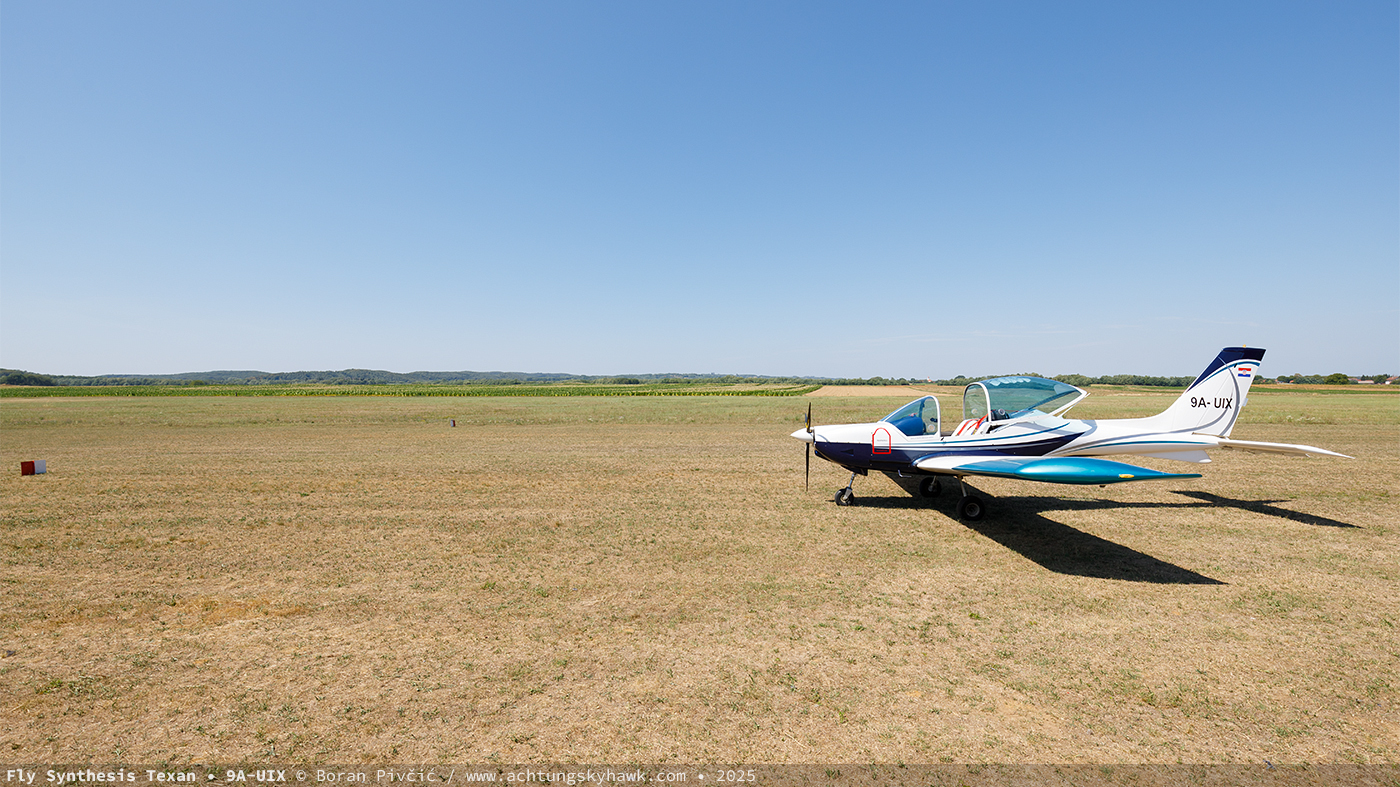


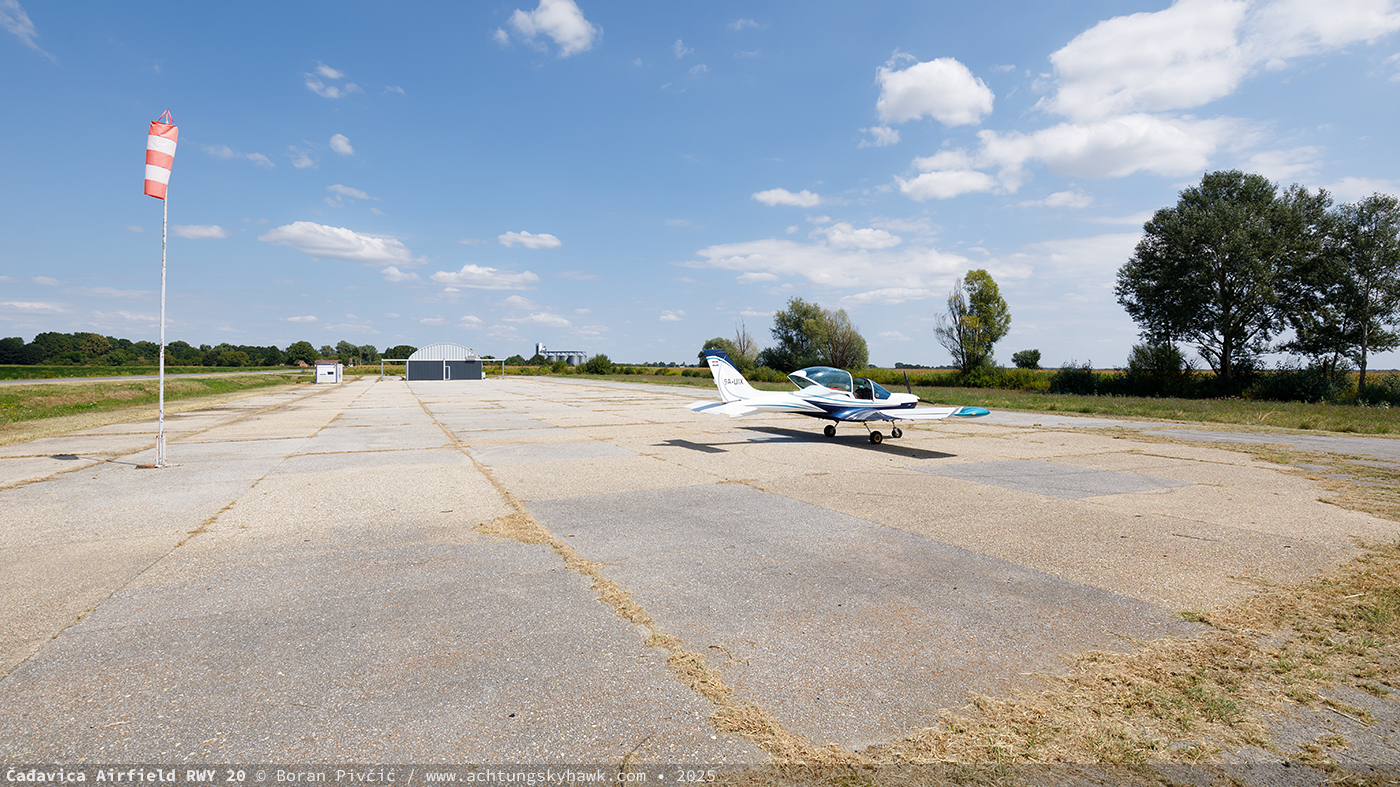

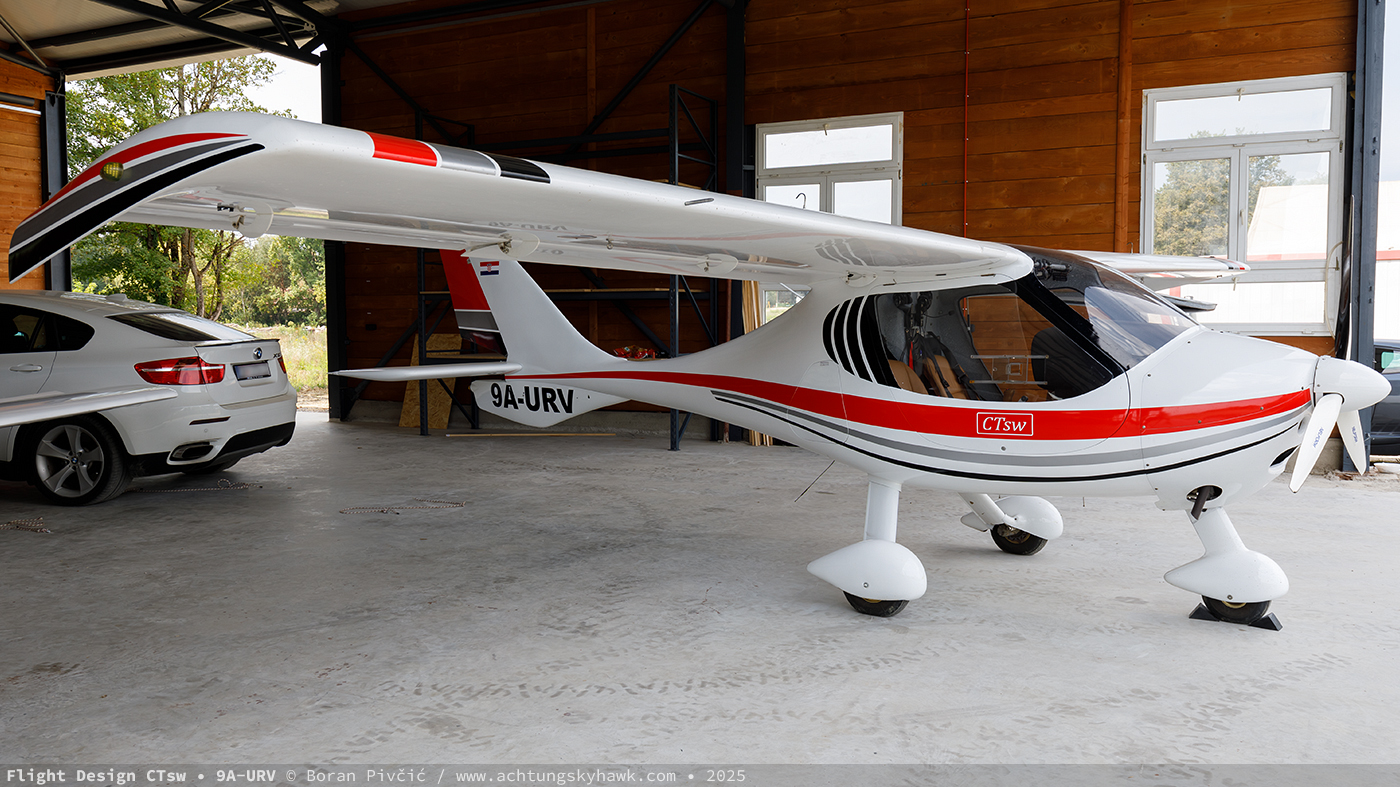


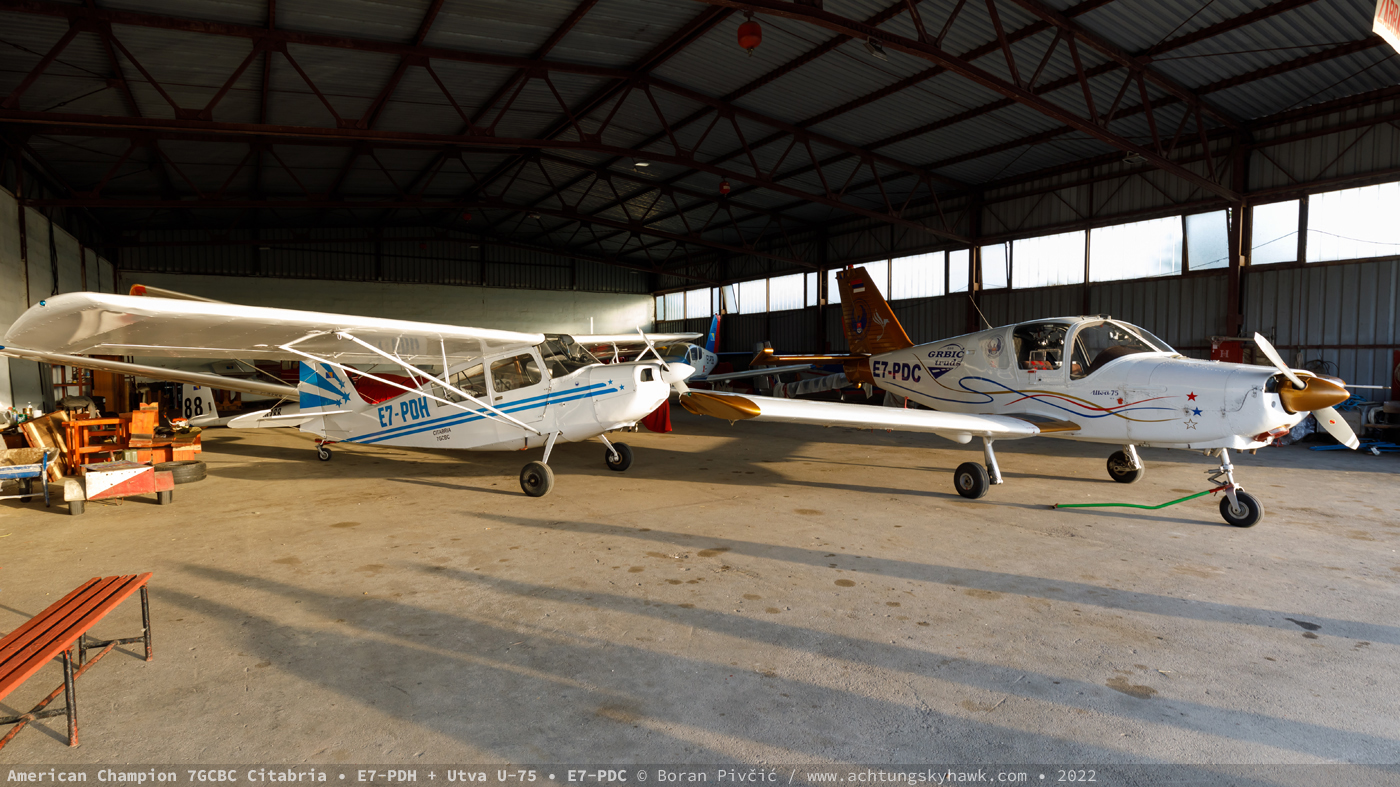
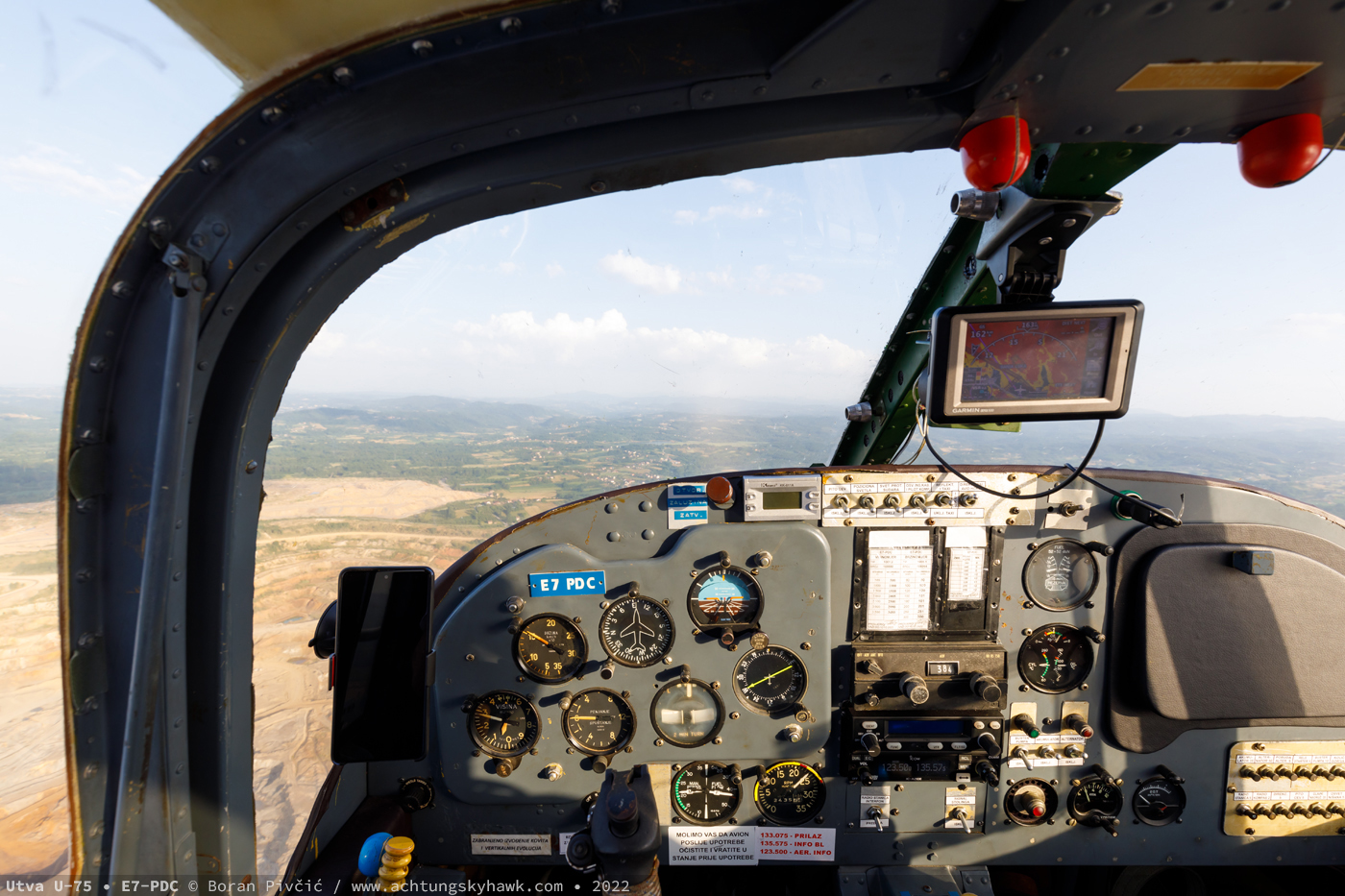


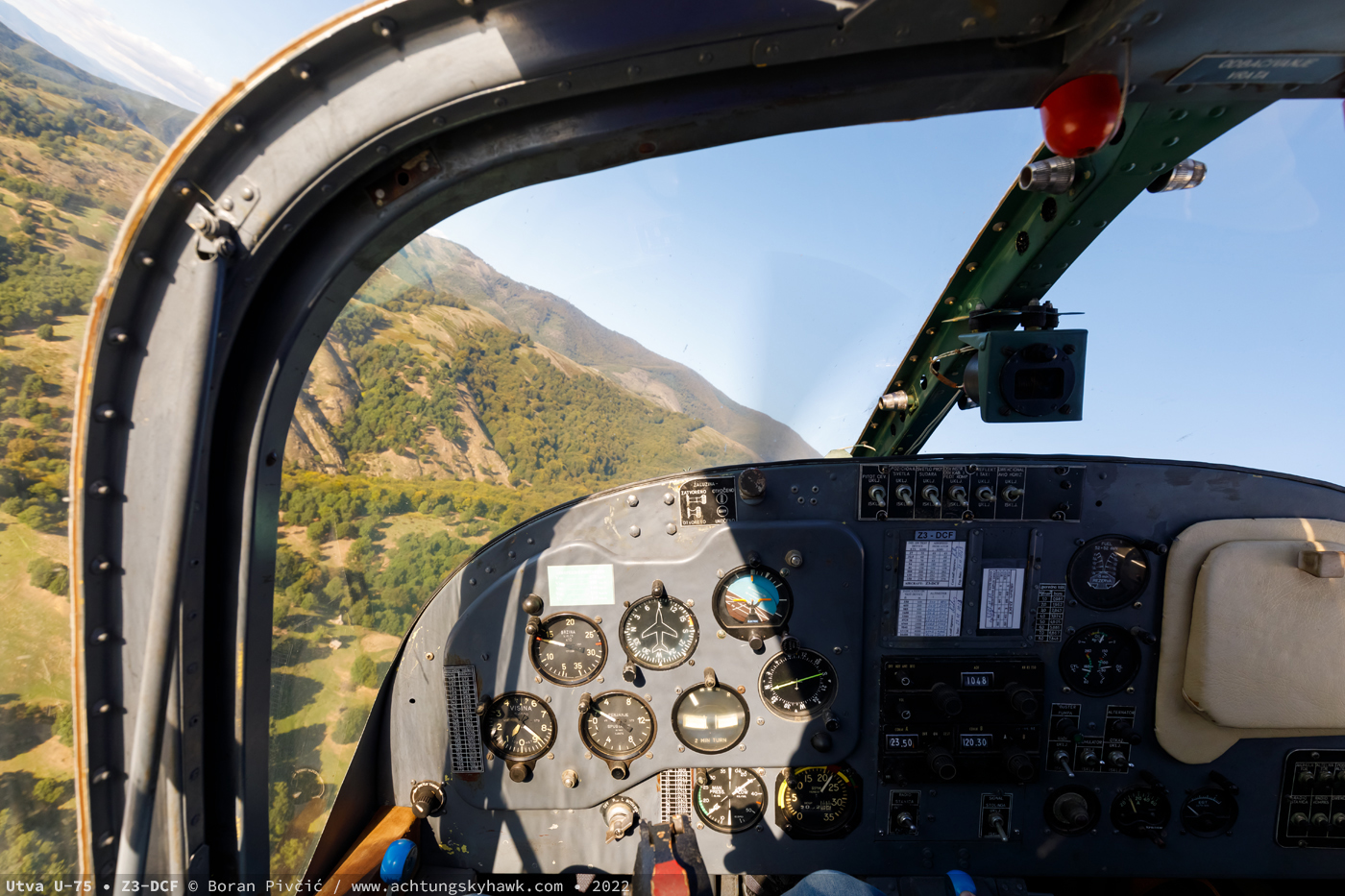


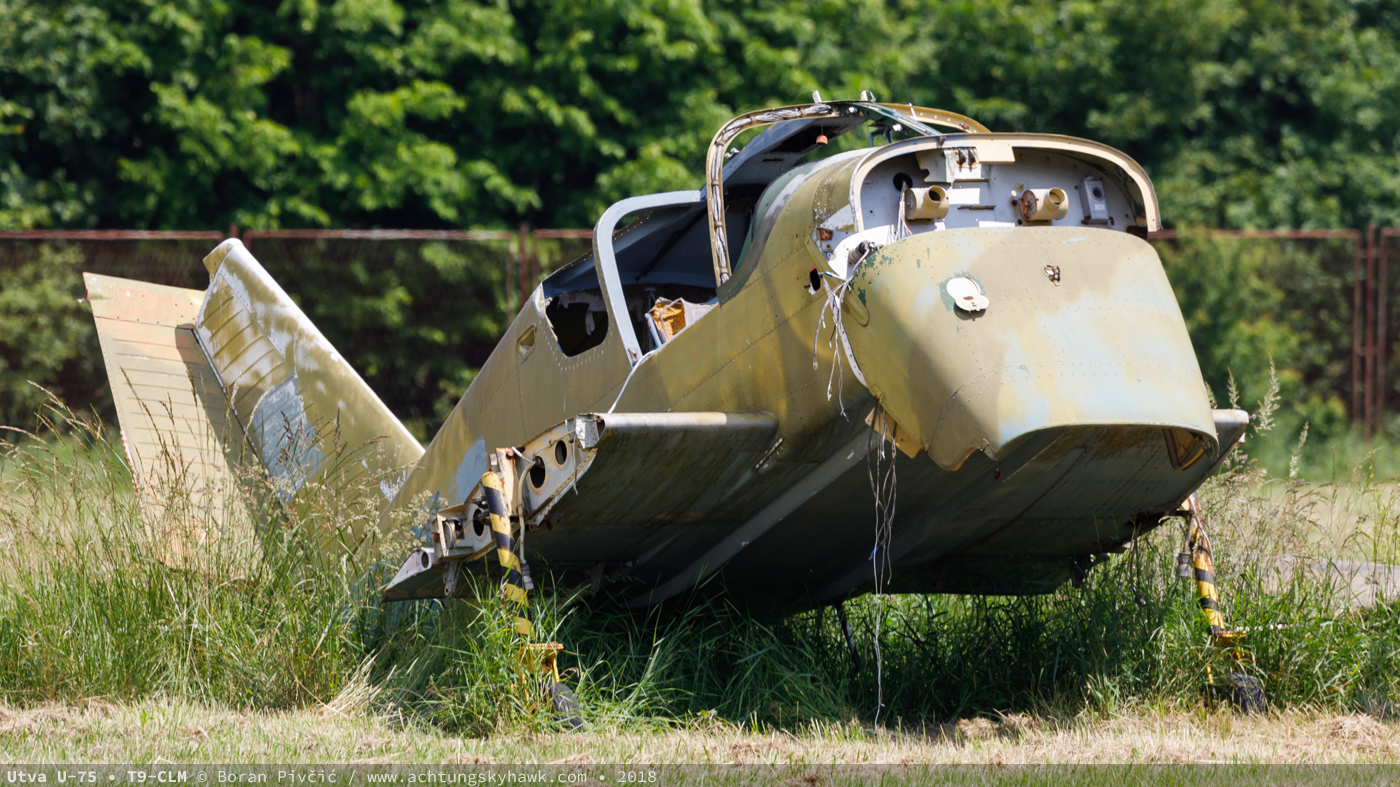
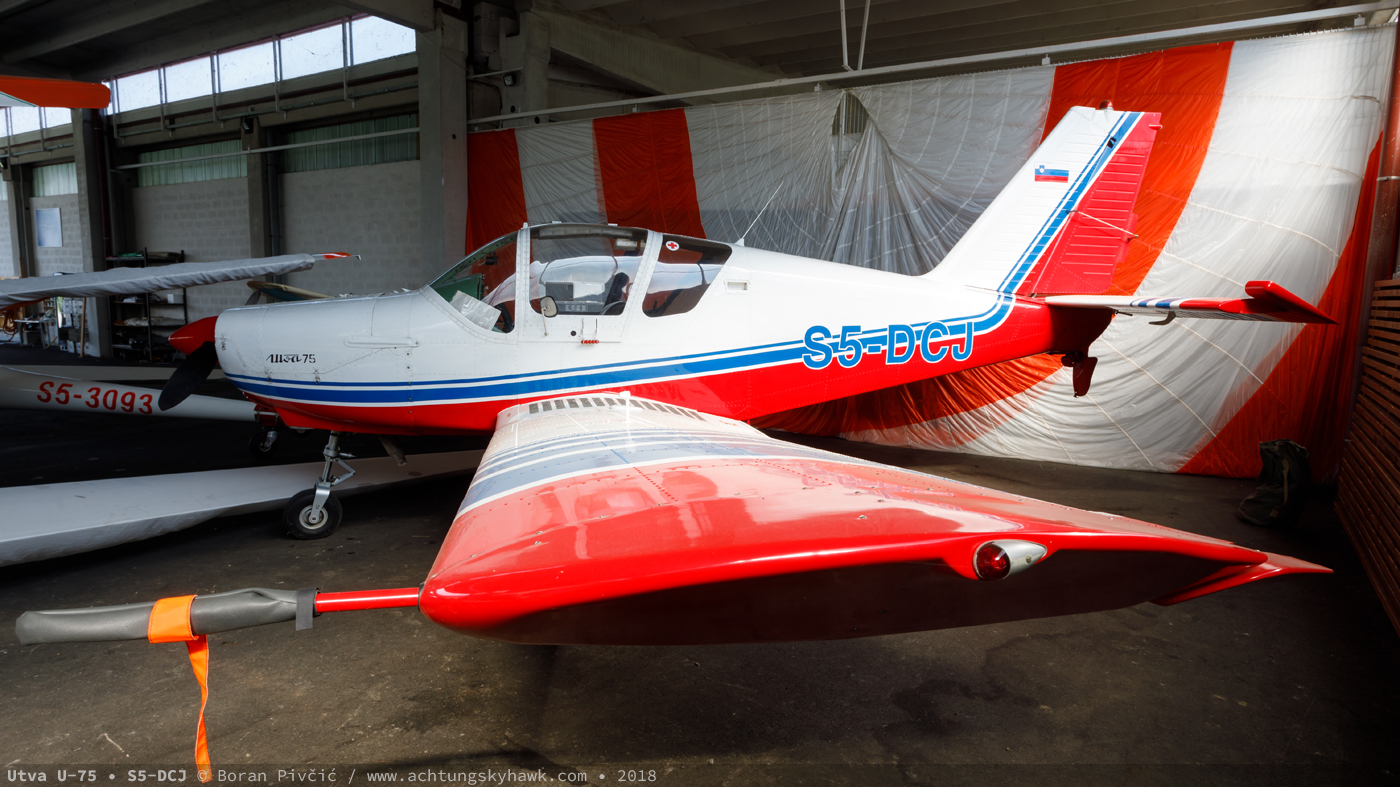


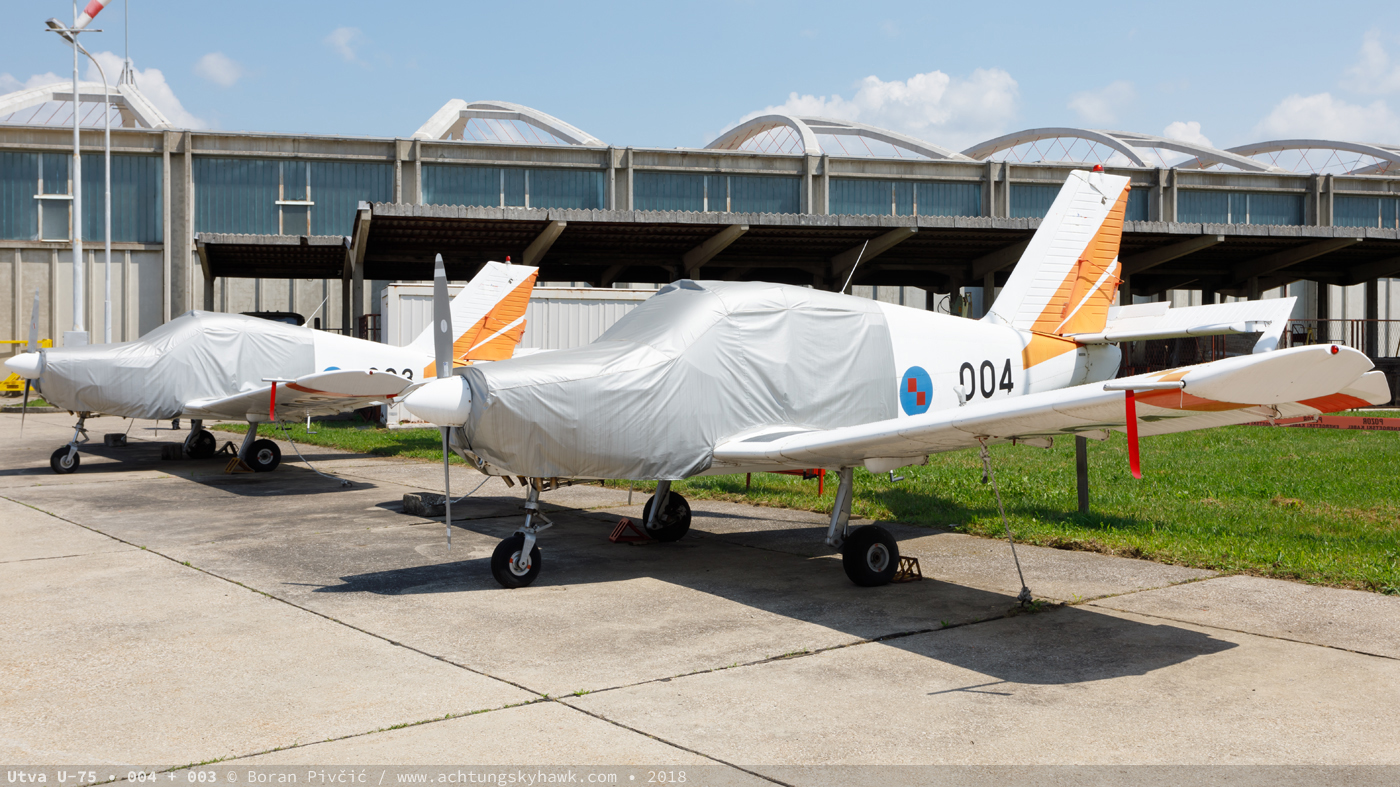


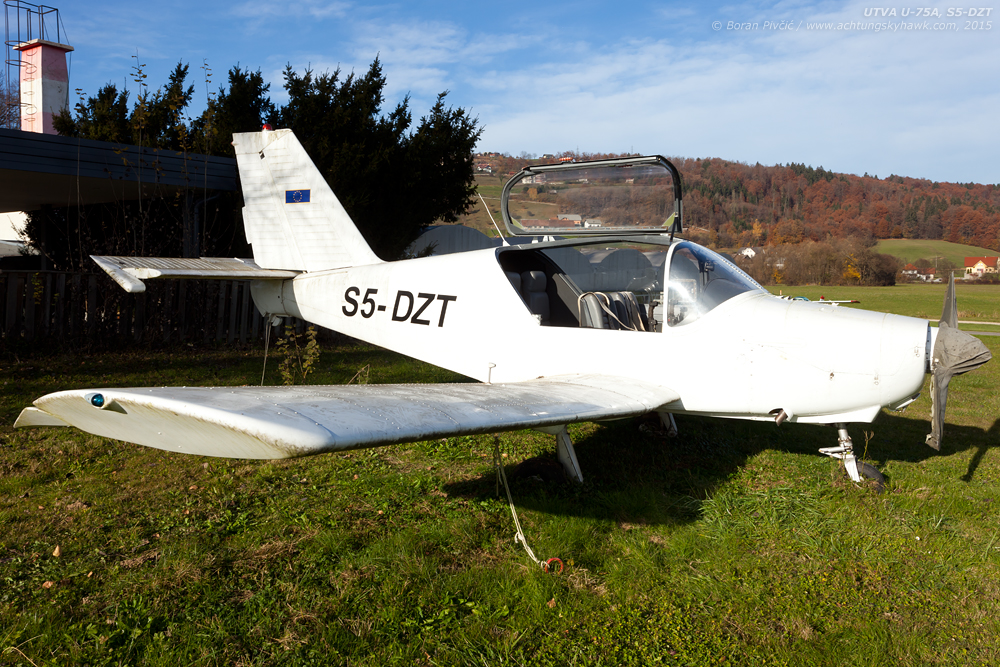


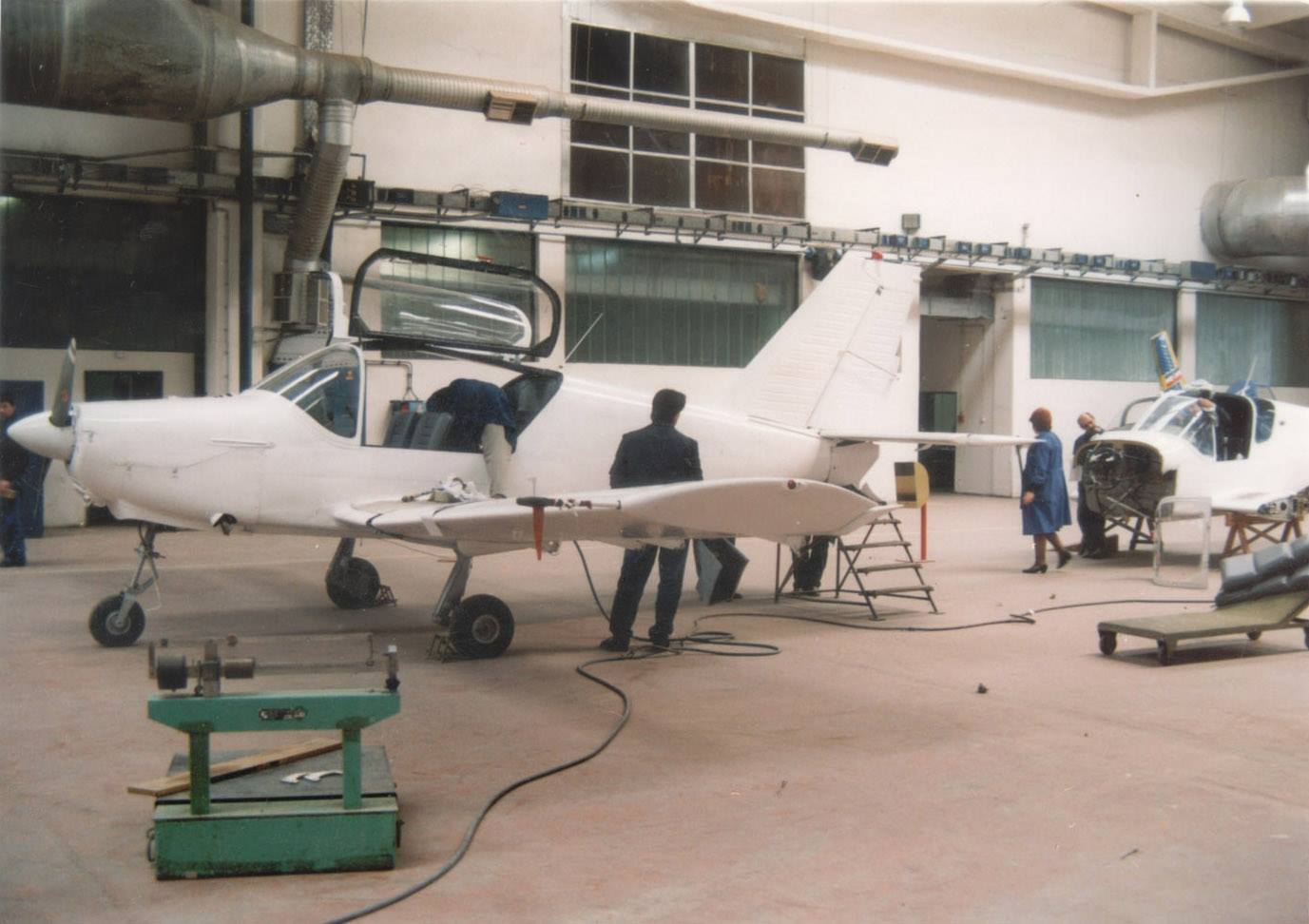
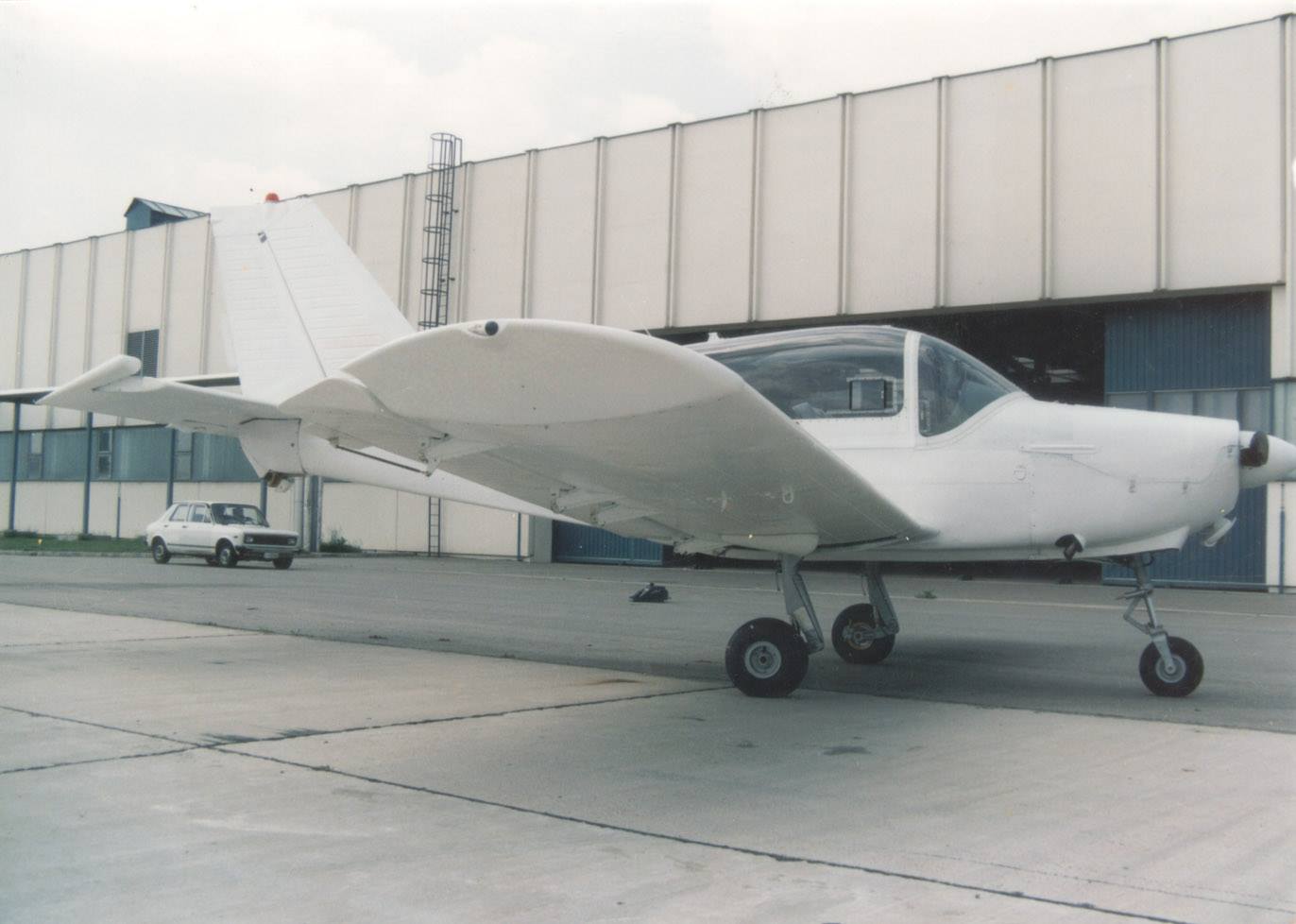

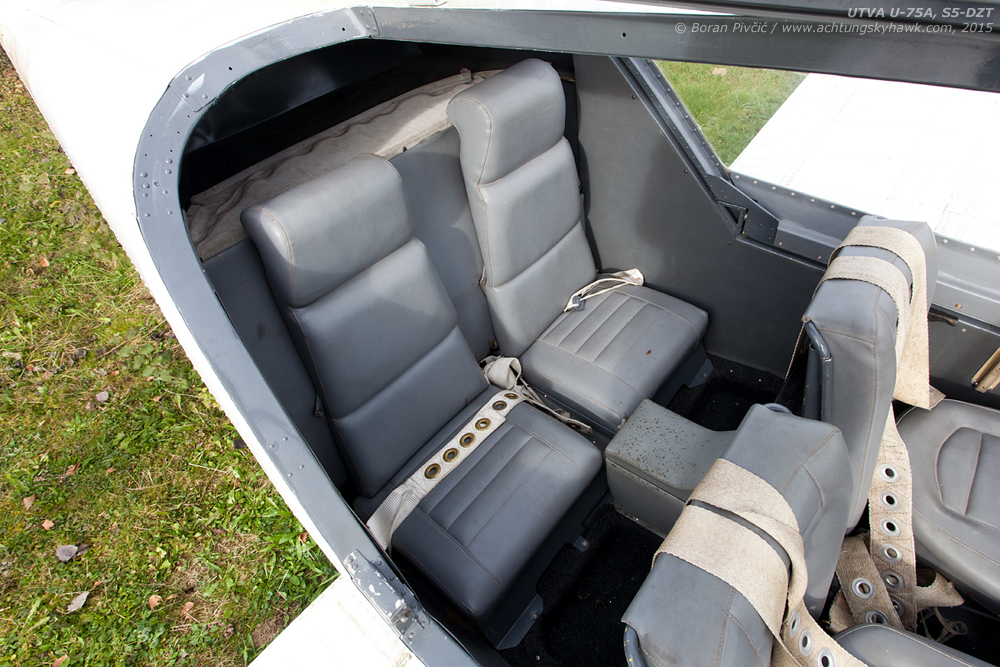


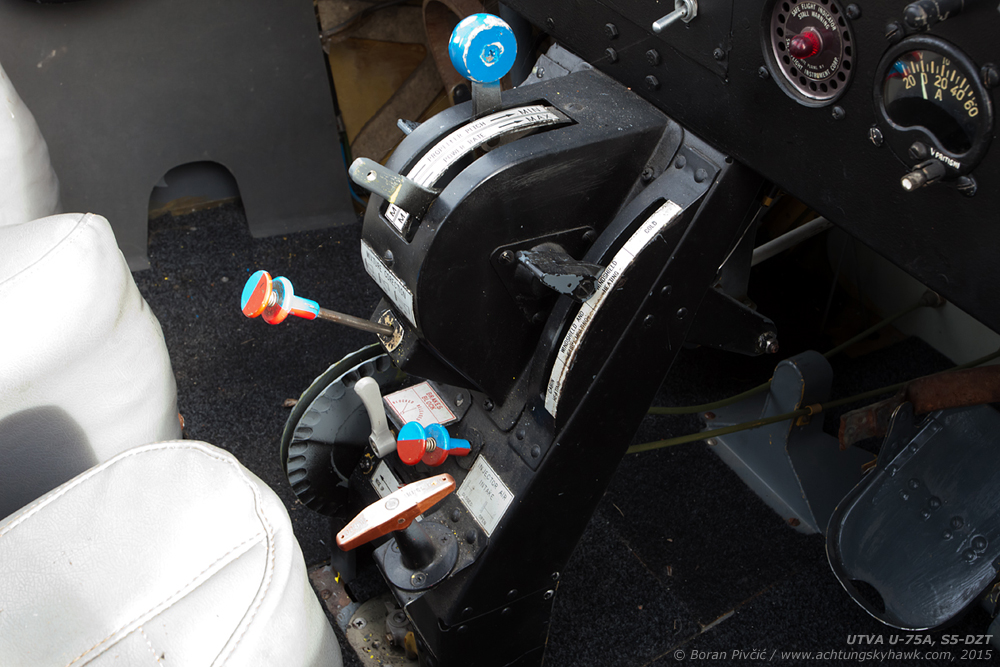

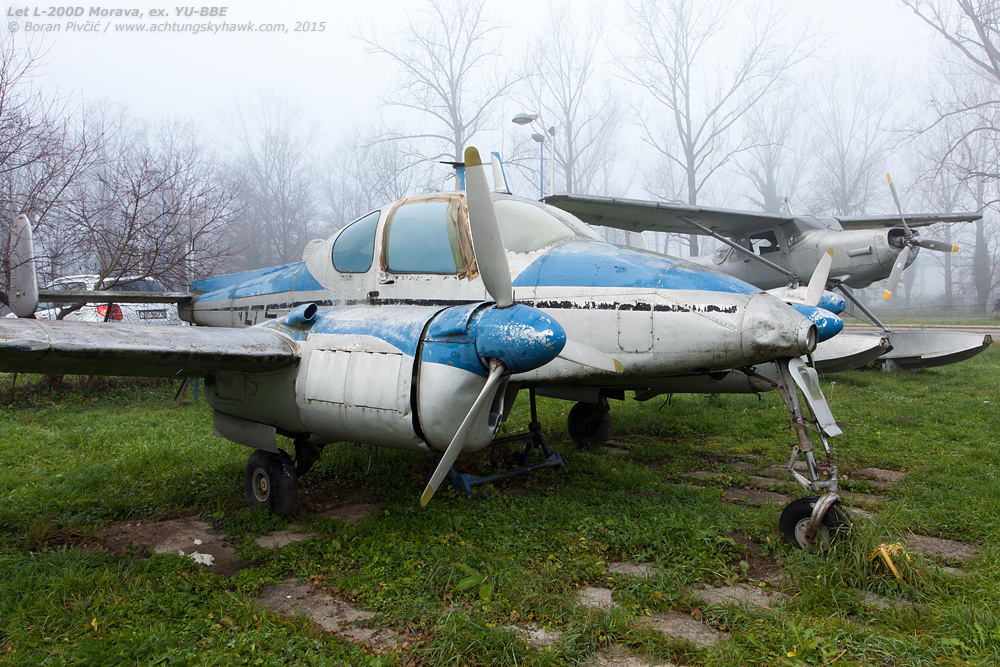
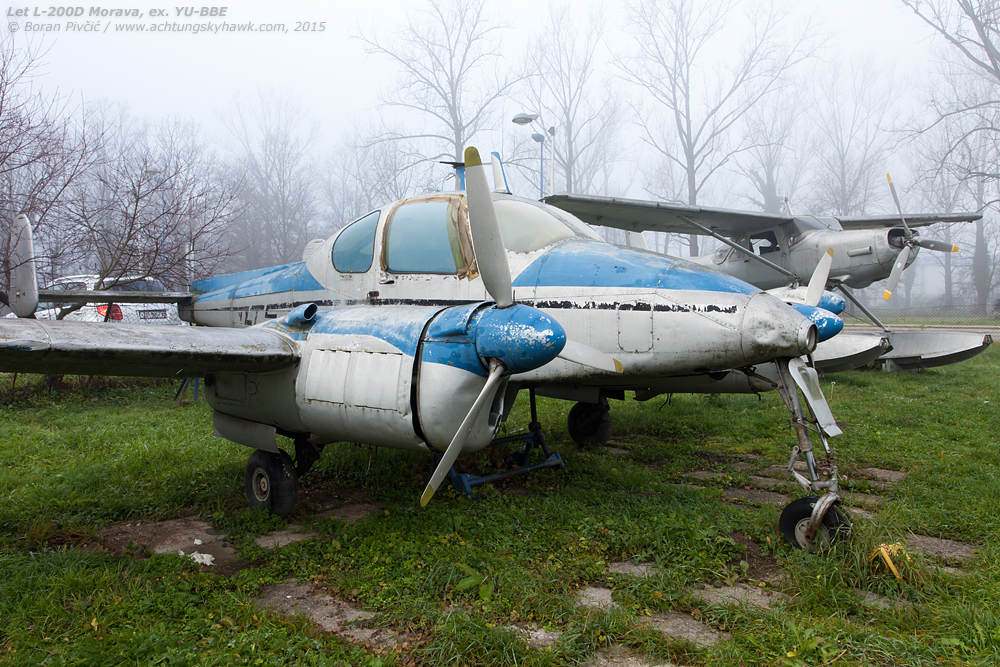




















 Achtung, Skyhawk!