Photo Report/Rare Aircraft – “Schastlivogo puti!”: Two Il-96s at Salzburg

By me
All photos me too, copyrighted

Despite having stated on numerous occasions that I’m not much of an airliner person, every once in awhile I like to give the “guilty pleasure” of airliner photography another shot, especially if expecting to see something rare, interesting and exciting – or Russian, which essentially boils down to the same thing :D. So, feeling a bit photography deprived, on January 9th I decided to join my spotting colleagues on a short trip to Salzburg Airport (ICAO: LOWS) in Austria – an airport locally famous for its abundant Russian and CIS ski charters – and try to kill two birds with one stone… 🙂

However, while the words “Russian and CIS ski charters” tend to conjure up images of noisy, smoky and flaky Soviet-era jets, the actual traffic picture in Europe (or more precisely, the EU) is quite different. While the mentioned aircraft are still happily flying and making economic sense for their operators outside the European mainland – with cheap maintenance and (in most cases) readily available crews, spare parts and service networks offsetting their higher fuel consumption – the EU’s stringent noise and pollution requirements have banned many of them from operating in European skies. And while many CIS airlines are not losing any sleep over this – flying mostly in the lands of the former USSR – charter airlines that tend to operate a significant amount of flights into the EU have had to adapt and switch over to more modern equipment. Thus in the end these “Russian and CIS ski charters” have actually turned into an almost endless stream of A319/320/321s and 737s in virtually every imaginable variant – all fine and quiet, but hardly that exciting :).

And yet, “modern equipment” does not necessarily equate to “Western equipment”, so there still were a couple of gems to be found in the now bleak timetable – two of which were the very interesting, and very rare, Ilyushin Il-96-300 :).

Designed in the late ’80s, the Il-96 was conceived as a somewhat shorter, but thoroughly modernized, development of the earlier Il-86, the USSR’s first – and only the world’s second – widebody quad jet. Despite being a quantum leap in many respects over contemporary Soviet passenger aircraft, the Il-86 had still suffered from the same problems that had ailed the rest of the USSR’s aviation industry: a comparative lack of system automation, and inefficient engines. While the former was eventually rectified to an extent – with the Il-86’s original four-man crew eventually reduced to three – the latter issue proved to be much more troublesome. Even at the best of times, the four Kuznetsov NK-86 low-bypass turbofans had to labor hard at high throttle settings to move the rather heavy aircraft, while their low mass flow (as compared to modern high-bypass turbofans) did very little for fuel consumption and overall efficiency – not to mention noise levels. So when all was said and done, the large, imposing Il-86 had boiled down to just a thirsty, underpowered (but nevertheless reliable) medium-range airliner of limited usefulness outside the USSR.

While - with 106 airframes produced - it cannot be said that the Il-86 was a total failure, its outdated engines had certainly played a large part in this limited production run. Often referred to as a "bypass turbojet" rather than turbofan, the NK-86 was based closely on the earlier NK-8, an engine well-known for its distinctive - and fantastic 😀 - high-pitched while at idle. Powering too early versions of the Il-62 and Tu-154 - as well as, in modified form, the Tu-144 supersonic transport - the NK-8 was quite an innovative engine back when it was designed in 1961; but, despite its reputation for reliability, by the Il-86's time it was essentially an uncompetitive relic

1. Born on the 9th of December:*

Yet for all its faults, it was clear that the basic design still had some potential in it, and that what was really needed was to bring it up to date with an infusion of modern technology :). So in an attempt to cure the Il-86’s ills, in the mid-80s the Ilyushin design team took its basic shell, shortened it a bit, and then set about looking for the most advanced stuff they could screw into it…

The resulting Il-96-300 – first flying on 28 September 1988 – was as much of a leap in its own right as the old Il-86 had been back in the 70s, featuring technologies previously unseen in Soviet passenger aircraft; including a full triplex fly-by-wire control system, more efficient supercritical wings with composite flaps and winglets, and an all-new six-screen glass cockpit conforming fully to ICAO navigation and ATS requirements. But more importantly, the new aircraft had dispensed with “traditional” low bypass engines and gone with the far more modern, quiet and economical Aviadvigatel PS-90A high-bypass turbofan then just entering service.

And sure enough, all of this had immediately opened a lot of doors for the new aircraft: a maximum range of 12,000 km (6,500 NM) with some payload restrictions meant you could comfortably reach the edges of your route map – indeed, this was 2,000 km (900 NM) better than the USSR’s long-range champion, the Il-62M – while the quiet, Stage III-compliant PS-90 engines meant you could operate unhampered from noise-restricted major airports. Once there, the ILS CAT IIIa-certified avionics allowed you to land in virtually any weather, while the new FBW system assured you a safe and comfortable ride along the way :).

However, while the above should have been the making of a classic success story – at least where the USSR’s dominant airline, Aeroflot, was concerned – the Il-96 had nevertheless ran up against few issues that would ultimately turn it into a bigger commercial failure than the aircraft it was developed from. One of the lesser ones was the very glass cockpit that was (seen as) such a step forward from the Il-86: despite its six-screen, full-color splendor, the Il-96 flightdeck still retained a Flight Engineer, in charge of the aircraft’s numerous subsystems. While this may not seem like a show-stopping issue, it did underline a weakness of the Soviet-designed digital avionics – the still-present lack of automation and aircraft system integration. The system did a good job of presenting flight, navigation and some system data, and as such went a long way to improving safety; but that being the sum total of its functions – and lacking aircraft-wide “reach” and control ability – it was operationally and financially little better than a set of TV screens with some interesting features :). This was all the more evident when compared to Western attempts at “digitalization”, all of which had managed to turn three-man steam-gauge cockpits into simpler and cheaper to operate two-man EFIS units within the same aircraft type (as well as Airbus with the A300, McDonnell Douglas had managed to pull off the same trick with the little-known “MD-10”, standard DC-10Fs equipped with a glass cockpit and operated for a time by FedEx pending the arrival of the full-blown MD-11F. The parallel is even more striking when you consider that the upgraded Il-96-400 – sporting a more modern glass cockpit suite – is a two-man machine!).

While it may be lacking compared to similar Western solutions, the cockpit is also symptomatic of another – and diametrically opposed – “issue” that had a hand in the Il-96’s abysmal production run. This one could best be illustrated by comparing the Il-96 with your “everyday” Soviet airliner of the late 80s and early 90s, say a Tupolev Tu-154B. On one hand you have an aging 60s design with a three-man crew, analogue cockpit, and proverbially as much automation as a doorknob. Seemingly built from forged steel – and repairable by a hammer (and sickle :D) – it was designed with toughness rather than economy in mind, reflected too by the simple and reliable, but not even remotely economical, 60s engines out back. Noise and pollution probably didn’t even figure in the design stage. Then on the other end you have a refined modern design with digital avionics, upgraded systems and a wing designed for cruising efficiency rather than sheer survivability, built too using modern state-of-the-art materials. Underwing, you have a new generation of quiet, fuel-efficient, FADEC-controlled engines with little commonality to the engines used by a majority of the Union’s jets. For any (ex-)Soviet airline of the day, undertaking this seismic shift would have incurred a radical reorganization of maintenance, training, fleet management and so on. Spare parts – new and still expensive – would have to be distributed among maintenance bases and destinations, while whole airports may have to be upgraded to properly handle the new aircraft. Flight, cabin and ground crews would have to get to grips with the new aircraft and its systems – and this would take a lot of time… and even more money.

Why the above was an issue in the first place – given that the introduction of modern types into CIS airlines is commonplace today – leads to the Il-96’s biggest problem: the fact that it was born in the worst possible time… leading to and during the breakup of the USSR. Just a short year after the prototype’s first flight, the Eastern Block – and with it the USSR – would begin to rapidly crumble, taking most of the Union’s aerospace financing down with it. Quickly becoming just a shadow of its former self, Aeroflot – now split into almost 300 (!) regional companies and without the vast resources of the Union to call upon – found itself in no position to go on a shopping spree. Likewise, the hundreds of airlines it created – limited to a great extent by the still unstable economies of their respective countries – were in an even worse position, quickly falling back onto cheap, plentiful and proven Tu-154s, Il-62s and even the odd turboprop Il-18. So the modern and capable – but quite expensive – Il-96 had at a stroke become redundant…

* for those not aware of the significance of this date, 9 December 1991 was the day the USSR was officially dissolved

2. Cliffhanger:

This situation was short-lived however; by the end of 1992, things had started moving in a slight upward trajectory again, and the slowly recovering economy had allowed Aeroflot to finally introduce the type into regular service – if anything to cover the increasingly pressing need for a modern, competitive aircraft. But even this was beset by problems: while the economy was indeed recovering, it was doing so at a snail’s pace, and was unable to support anything more than an occasional trickle of new-build Il-96s. Indeed, by the turn of the century, only 12 production-standard -300 series aircraft were made, with an all time high of just three aircraft per year (in 1994) – and no aircraft at all between 1995 and 1997.

The seemingly final nail in the Il-96’s coffin, as far as commercial success was concerned, came ironically from the very economy that had started its low-key production in the first place, helping to save it from the garbage heap. By the time the financial situation in Russia (and the CIS) had picked up sufficiently to allow for a meaningful fleet renewal program – around the year 2000 – the market was now open to some serious competition from the West; the Il-96-300, still burdened by all of its issues, was now up against the technological and industrial might of both Airbus and Boeing. And despite being up to 30% cheaper than equivalent aircraft from the Big Two – and being home-grown – the outcome was rather predictable: faced with the technological superiority and operating economics of the 777, the Il-96-300 was once again made redundant.

And yet, despite knocking on the scrapman’s door for the second time running, the Il-96-300 had nevertheless managed to cling on – but just barely :). A new lease of life came in 2006 with an order for three aircraft from Cuba’s national airline Cubana – though, to be honest, this had less to do with the Il-96’s qualities as a machine than the fact that it was the only new long-haul aircraft available that could dodge the long-standing US embargo. A further infusion of orders came from Russia’s “secondary flag carrier”, Roosiya, which had ordered four aircraft in 2007 – an order still keeping the production line open (which says much about the rate of production).

Knowing full well – even before it came face-to-face with the 777 – that a lethargic production run like this could very well be the Il-96’s future, the engineers at Ilyushin had decided in the mid-90s to “pull an Il-96 on the Il-96” and put it on a crash course of serious modifications like they did with the old Il-86 :). To this end, they stretched the fuselage back to ’round about that of the Il-86 and – in what was one of the precedents of Russian-US cooperation at the time – went overseas to ask for tools to mend the aircraft’s other ills :). These eventually took the form of a highly advanced Western glass cockpit system – which had dispensed with the Flight Engineer once and for all – and Pratt & Whitney PW2337 turbofans to replace the still not-as-efficient PS-90As and give the aircraft a shot on the international market. Designated the Il-96M – for modifikovany, or modified, a common designation on Soviet/Russian/CIS aircraft – the aircraft had stood quite a good chance at being a viable local alternative to Western designs… right up until the still fluctuating economy in Russia caused American investors – who’d be financing the avionics and engines – to pull out of the program. So on all fronts, it was “Economy: 3, Il-96: 0.5”.

3. Fortune 400:

At this point, the Il-96 started making a name for itself not for its somewhat troubled, yet essentially solid design, but for its sheer refusal to give up and die :). Having seen what the Il-96M – and its projected cargo variant, the Il-96T – could have been, the Ilyushin team dreamed up the Il-96-400, and its cargo version, the Il-96-400T. In essence, this was an Il-96M fuselage that reverted back to the PS-90 engines (now in their A1 variant), but had included a far more modern and capable Russian glass cockpit that, like the one on the Il-96M, didn’t require a Flight Engineer.

First flying in cargo form in 1997, the -400 had at first seemed like another lame duck: indeed, only one -400T was completed in the 20th century, while the passenger version had failed to drum up any concrete interest whatsoever. But the design persevered – one really has to admire Ilyushin’s dogged persistence with this one 😀 – and in 2007 had finally caught some wind in its sails: six examples were ordered by cargo operator Polyot, with four still waiting for completion (according to the latest data)…

In the end, given what the whole Ilyushin team had been through with the Il-96, it makes for some sad reading that the total tally for the all marks stands at just 27 examples, including the three prototypes and test aircraft that were broken up following the end of the official acceptance tests. Of the production models, only 17 – 14 -300s and three -400Ts – are known to be flying, which makes catching one a tricky game of chance…

4. Skiing (charter) competition:

Back in Salzburg, we counted ourselves very lucky that we’d managed to catch two – and in a single day at that 😀 (that’s essentially 12% of the entire flying fleet). The aircraft in question were RA-96007 (mfd. 1992) and sister-ship RA-96008 (mfd. 1993), both stock Il-96-300s operated by Aeroflot as ski charters from Moscow’s Sheremetyevo airport. Of interest here is the unique registration system adopted for low-production aircraft in Russia/CIS: the first two digits represent the type, and the remaining three the aircraft’s place on the production line (note, this does not equate directly to the serial number; RA-96007 for example is the 7th Il-96 ever produced, but its serial of 74393201004 denotes it as the 4th production example. There can also be some major discrepancies: the Il-86 featured in the previous photo is registered RA-86124 – but there were only 106 produced, including three prototypes. The aircraft is actually the 92nd production example, and the 95th Il-86 produced).

So, having arrived in the wee hours of the morning – intent on getting some night photography in while we’re there – we quickly set to work… 🙂

There's no better way to start the day than with some Russian heavy metal :D. The first Il-96 of the day is seen here cooling down after its 5 AM arrival, ready to depart back to Moscow within the hour. Another interesting item is the aircraft's name, printed in Cyrillic underneath the cockpit. According to Aeroflot tradition, each aircraft is named after a famous Soviet/Russian person, with "professions" being assigned by aircraft type. Il-96s are named after pilots, with RA-96008 carrying the name of test pilot Yakov Moiseyev 🙂
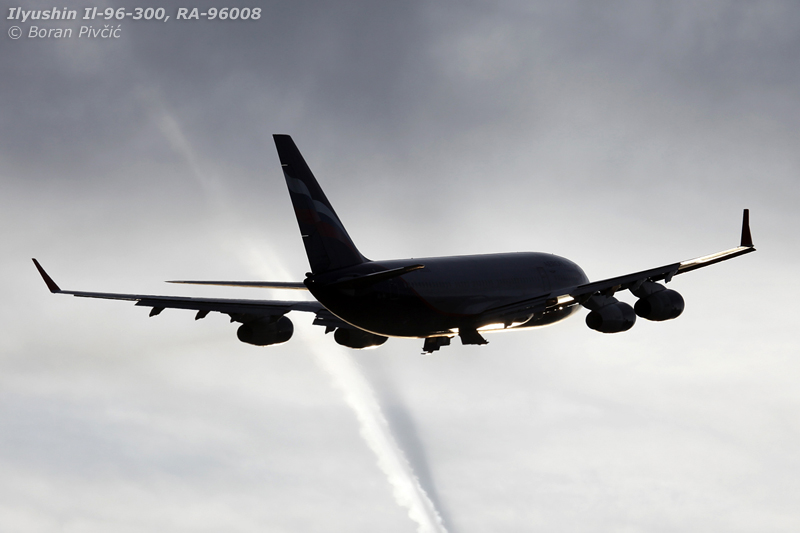
Cleaning her up after a spirited departure from RWY 16, with another high flyer providing a suitable background. "Schastlivago puti" - or have a nice trip - to them all!

I don't know why, but "I'm a little teapot, short and stout" always pops into my mind when I see the Il-96 :D. Noticeably shorter than the Il-86, the Il-96 is quite handsome in a brutish sort of way. In keeping with the naming tradition explained above, RA-96007 is named after Alexey Mayorov, personal pilot of both Brezhnev and Gorbachov
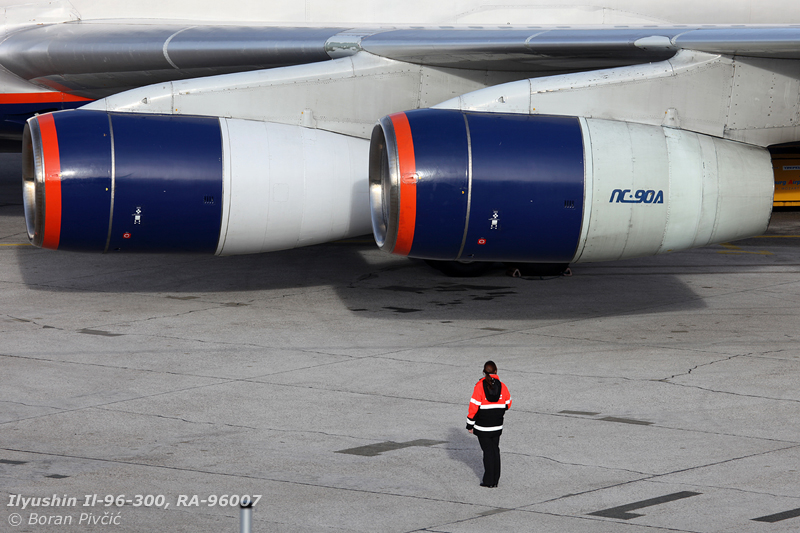
(Wo)man vs machine :). A ramp agent looks on at the port side PS-90As as the passengers begin to disembark. Apart from being one of the few "Eastern" engines to measure up to their Western counterparts, the PS-90 is also the first high bypass engine produced by the former Soviet engine industry
Another nose view. With its chunky, solid appearance - and painted in Aeroflot's fantastic color scheme - the Il-96 is hard to miss on any ramp :). It's a quiet thing too - not something you'd normally expect from something with an RA reg 😀

Photo Report – A Visit To The Neighbors: Spotting at Ljubljana, Slovenia

By me
All photos me too, copyrighted

Though I’m not really in the “business” of photographing airliners – at least not those that are common and plain enough – a few days ago I had happily accepted an invitation from two of my spotting colleagues to visit Brnik airport (LJLJ) in neighboring Slovenia for some international spotting :). And while the traffic picture at Slovenia’s main airport, serving the capital Ljubljana, isn’t in essence all that different from that of Zagreb – an endless stream of CRJs punctuated by some GA and an odd Airbus – the airport’s crisp, clear and unpolluted highland air, stunning mountain backdrops and very accessible spotting positions (not to mention very friendly local spotters) were ideal conditions for some photographic practice and experimentation :). Plus, given that the subjects at an international airport tend to move quite a lot faster than the GA lighties I usually photograph, it was all good panning and tracking practice :D. In the event, we even managed to nail two quite rare birds along the way…

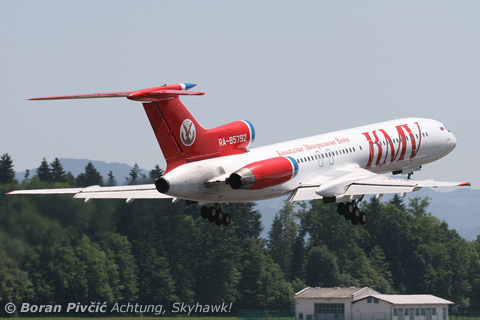
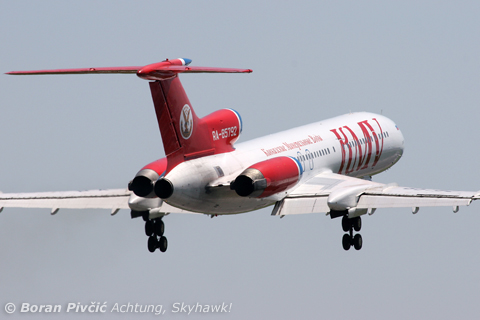
A beautiful - and freshly repainted! - KMV Tu-154M just starting its gear retraction sequence after a noisy RWY 13 departure, bound for Moscow. Ever since Aeroflot pulled the 154 from commercial service, they've become an increasingly rare sight, European spotters now having to make do with occasional charters such as this one...
Climbing out with the 154's typical shallow profile, intended to quickly accelerate the aircraft to its 550 km/h (296 kt) optimal climb speed. Little known outside the lands of the former USSR, KMV actually stands for "Kavkazskie Mineralnye Vody" - or "Caucasian Mineral Waters". The name makes more sense when you know that the airline is based in the Russian town of Mineralnye Vody, located on the Caucaus, in an area known for its abundant mineral springs 🙂

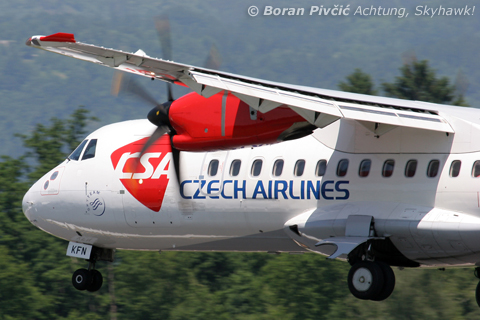
"What's In A Name" continues with this somewhat less exciting Czech ATR-42-500 flying in from Prague. Nowadays never expanded, "CSA" actually stands for "Československé Státní Aerolinie", or "Czechoslovak State Airlines", formed in 1923 in then-Czechoslovakia as one of the world's oldest airlines. By the time Czechoslovakia dissolved in the early 90s, the CSA brand (and especially the acronym) had become well known and established, prompting the company's new owner - the government of the Czech Republic - to keep it, thus forming "CSA Czech Airlines"
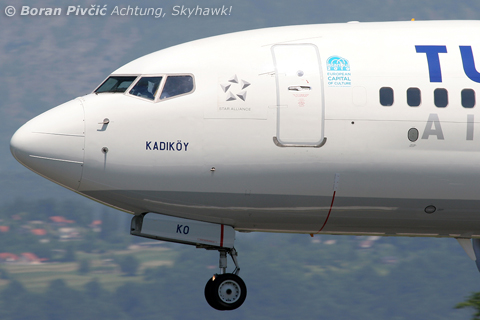
This shot made my day - and was worth the searing heat and scalding sun of a summer noon spent standing outside :D. Intense concentration in the cockpit of "Kadiköy", a Turkish Airlines Boeing 737-752, as it crosses the numbers on RWY 31 for a smooth and gentle landing
Sparkling white - maybe it's a vampire aircraft? (bad pop culture joke) - and clean, even an A319 can be made interesting given the right conditions :). Lining up on RWY 31, this example is operated by Slovenian national carrier Adria Airways, another company with a long history stretching back to 1961...
One more Embraer for me :). Contrasting brilliantly with the dark woods - further enhanced by the crisp mountain air - this ERJ-145 is operated on behalf of Air France by a small French company called Regional Airlines, and with its sister ships can often be seen at Zagreb airport as well...
Type-wise a common enough CRJ-200, VT-SAS was nevertheless the most interesting visitor of the day, hailing all the way from - India! 😀 Operated by JetLite, an Indian domestic carrier, SAS had flown in from Budapest on unknown business, though speculation includes servicing or a C check by Adria Airways' maintenance department... also, the white sphere behind the aircraft is the airport's Doppler weather radar 🙂
I'd say that "Boka" could do with a wash... named after Boka Kotorska, a bay on the Adriatic Sea shared by Montengero and Croatia, this Montenegro Airlines Fokker 100 from Podgorica was one of the last interesting arrivals of the day. Formerly sharing the YU registration prefix with Serbia (back when the two countries were part of the "Serbia and Montenegro" union), Montenegrin aircraft have been allocated their unique identifier - 4O - joining the alphabet soup of other ex-Yugoslav country prefixes (9A, S5, E7, Z3, ...)
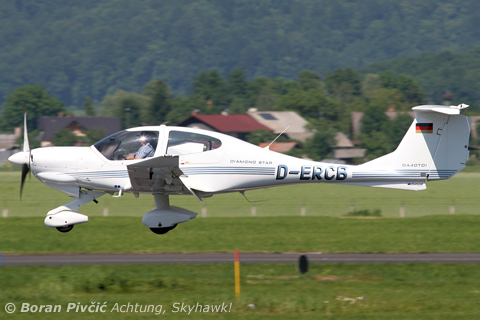
Yay, lighties! 😀 An almost perfect profile view of a Jet-A powered Diamond Star as it aims for the touchdown markings on RWY 31
A welcome break from the steady string of CRJs arriving during the early afternoon rush hour. Rising sharply upwards less than a dozen kilometers away, the Kamnik mountains - the foothills of the Julian Alps - provide an excellent backdrop, especially during the winter
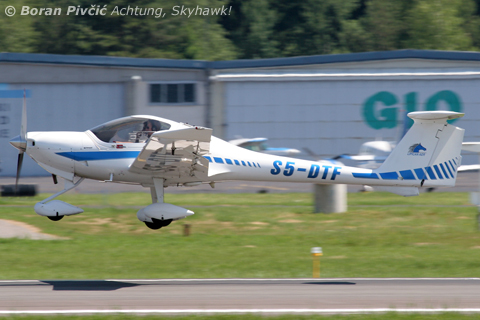
And finally, a small twist on the ubiquitous Diamond Katana. Unlike most Katanas flown in Europe, S5-DTF is a C1 model, powered by a 125 HP Teledyne Continental IO-240 engine spinning a two-blade fixed-pitch prop instead of the standard Rotax. The first C1 I've seen, they seem to be widespread in the USA...

Photo Report 2 – Some More Uneventful Spotting At Pleso

By me
All photos me too, copyrighted

Deciding to forsake the wonderful world of aircraft instrumentation for some sun, fresh air and photography, I thought I’d kill two birds with one stone by giving spotting at Pleso another shot, after the previous week’s somewhat disappointing results. Now that the sterling work of my colleagues at the Croatian Aviation Forum was beginning to pay dividends in spotter-security relationships, a friend from the said Forum and I made arrangements to camp out unstressed under the RWY 05 approach path and see if something unusual – something not on the timetables – might show up. A recent visit by an Omani C-130 Hercules tanker – and a Qatari A340 and Jordanian A310 before it – kept our spirits up, so we set out to see whether our luck was to be match as our optimism… 😀

Whopee, a Dash... (irony + sarcasm) 😀 Part of a steady stream of Dash 8s and A320s, Croatia Airlines' newest Dash 8 - the aforementioned 9A-CQF - might have gone unnoticed had I not checked the reg after taking the shot. Its unusual "Croatia 7F" callsign could indicate that this was either a training or shakedown flight (normally, callsigns are the same as the flight number, which is made up of three digits if the flight is scheduled, or four if it's a charter - which is standard practice at carriers around the world. However, to avoid confusion between similar callsigns, or denote special flights, these can be modified into various alphanumeric forms)
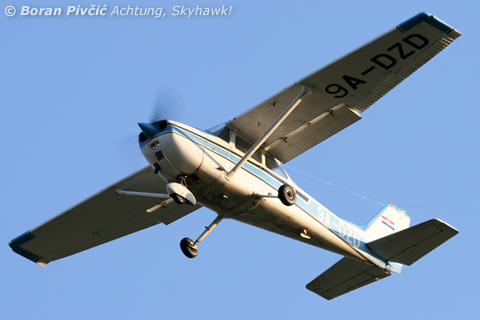
Our own Lučko resident, 9A-DZD was one of the just three GA movements in the three hours we were there
Somebody wash me! Looking a bit worn out, the Faculty of Transport Sciences Seminole trainer was out bashing the circuit for an hour or so. If all goes well, that should be me up there in a couple of months 🙂
An unidentified Croatia Airlines Dash 8 (could be 9A-CQC) just crossing the middle marker, while high above an Emirates 777 zips to the Middle East. As is always the case, the upper flight levels are more interesting than the Zagreb approach, with heavies of all sorts a regular occurence (on some days you can see an Emirates A380 followed a bit later by two company 777s in trail 🙂 )
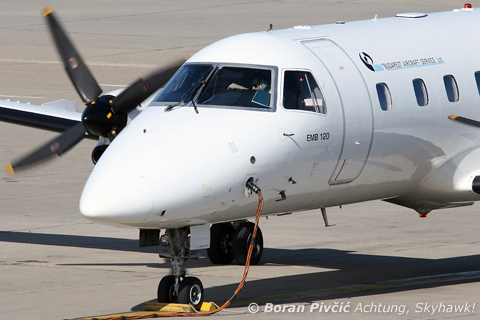
The only genuinely interesting movement of the day - and that says much about our expectations 😀 - was another very handsome Budapest Aircraft Service EMB-120 Brasilia on the daily flight from Budapest. A very rare - and very welcome - aircraft in this part of Europe... (and Europe in general)
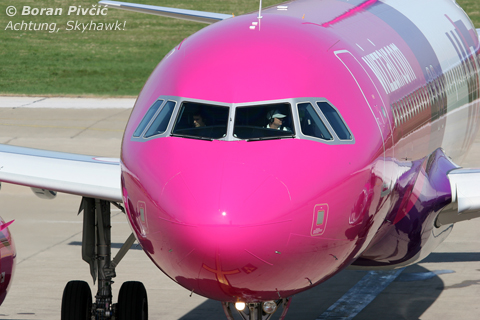
A splash of colour on approach. Anybody see a pattern with my previous post? Dash 8, EMB-120, Wizz A320... 🙂
Finally got N50DD in flight! 😀 The country's only Cessna P210N Centurion (and one of only three Centurions of any mark), N50DD is - despite the reg - permanently based at either Pleso or Lučko, depending on the weather. This is the first time in quite awhile that I've seen it in flight. Not the characteristic Cessna piston single rearward-retracting main gear and the strutless wing (in the Cessna singles lineup seen only on the 177 and 210)
And finally an increasingly rare Fokker 70, operated by Austrian Airlines. Note the type's powerful clamshell airbrakes, first seen on the Fokker F-28 Fellowship from which the 70 was developed. These, coupled with very powerful wheel brakes and thrust reversers, mean the 70 (and the bigger 100) can stop in ridiculously short distances for an airliner - another throwback to the F-28's incredible STOL performance. This same airbrake concept would find its way onto the Avro/BAe 146 regional quad 20 years later

Photo Report – Some Uneventful Spotting At Pleso

By me
All photos me too, copyrighted

By a stroke of good luck – and through the perseverance of my spotting colleagues – our little spotting group had managed to break into the mainstream media today :). Nothing really unusual out in the civilized world, but getting a four-minute time slot – on national television no less – for a “marginal” hobby can be considered quite an achievement here. Consequently, we were to gather at Pleso airport with all our gear and be filmed enthusiastically taking photos from the airport’s normally closed observation deck, opened just this once especially for us… 🙂
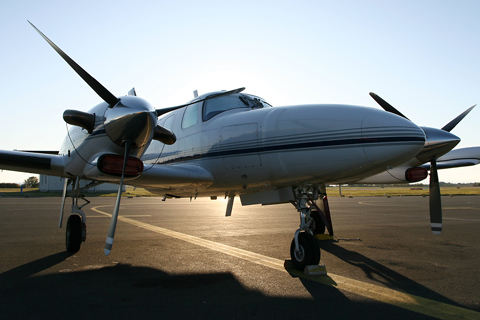
Now, normally I don’t photograph “standard” airliners, being a staunch member of the “when you’ve seen one A320, you’ve seen them all” school, but given that this was for the benefit of the group, I decided to try and make the best of it. Pleso does occasionally get a few gems (KC-10s, the odd CC-150 Polaris, Il-76s and the like), so hoped that something obscure might be in town today too…

But soon we ran into a problem – being a slow morning on Easter weekend, there wasn’t really much to photograph full stop, with a whopping six airliners and two movements in the hour we were there. Nevertheless, with the press eager to get it over with, we set to work :).

First on the list is this brand new Croatia Airlines Dash 8 Q400 :). Registered 9A-CQF, this is the company's sixth Dash and had - according to photo evidence - arrived just one or two days ago along with sister ship 9A-CQE :). Continuing with the tradition of naming turboprops after the county's regions, QF in named "Primorje" for the northern coastal bit of Croatia
Making up for the lack of traffic, I at least got to see my first ever Embraer Brasilia :). Operated by Budapest Aircraft Service - BASE - on behalf of Hungary's national carrier Malev, HA-FAL is seen firing up the No.2 engine for its short hop to Budapest
What a crowd :). Both of the morning's movements captured in one shot - and both registered in Hungary. HA-LWB is seen taxiing out for a RWY 23 departure to... somewhere
Having only to maintain runway heading pretty much all the way to Budapest - and with a light 3-knot south-western tailwind - HA-FAL decided on a RWY 05 departure. With the airport terminal positioned right by the RWY 05 threshold, this suited us well 🙂
If I were in a bit of a mood right now, I'd take a stab at the Airliners.net forums and raise a fuss about "how is the captain flying with a baseball cap?! That's unprofessional!" 😀
HA-LWB's No.2 IAE V2500 spooling up for departure. Too bad I didn't lower the shutter speed a bit further...
Outright the most interesting aircraft that morning was this Egyptian-registered A300B4 freighter. Looking cool and clean, this is the old 200 series (specifically a 203(F) ), still sporting a flight engineer and fully analogue cockpit - an increasingly rare bird in the skies of Europe. Another interesting aircraft is to the left, Farnair's freighter ATR-72 🙂

Photo Report – Big(ger) GA Birds at Pleso (LDZA)

By me
All photos me too, copyrighted

In another run through my database (lost count of them all 😀 ), I’ve seen I’ve got quite a few interesting shots from Pleso airport, our big bad international gateway (for our GA expectations anyway 🙂 ). Having often selflessly volunteered to fly there for fuel once our own station at Lučko closes for the day, I’ve had the chance to spend some quality time on the GA apron, snapping a few shots here and there while waiting for the bowser to trundle up. At other times I’ve taken my telephoto lens to the RWY 05 approach path, snapping a few landing photos before the police inevitably shoo me away :). So, while patiently waiting for something new, I’ve decided to compile a little collection of what can be seen operating in and out of our friendly little airport…

First up is 9A-CHC, a relative newbie to the Croatian register. A nowadays rather rare Cessna 501 Citation I/SP, it is operated by IVA-DOM Aviation, the country's first proper bizjet charter company
Shot in some excellent light, 9A-CZG (formerly 9A-BZG) is a Piper PA-31T-500 Cheyenne I operated by Geo-Foto - a very well known local mapping company - in an aerial photography configuration
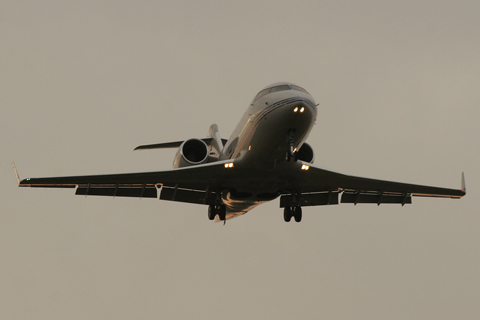
Somewhat of a patriotic moment this as 9A-CRO, the presidential Canadair Challenger 604, glides in for landing on RWY 05
My first Hawker 400! 🙂 CS-DMM, a 400XP, is operated by NetJets Europe out of Portugal
Another Cheyenne I, registered in Germany as D-IEMR, but operated privately in Croatia for a while
Another new one for me here, what I believe is a Cessna 340, registered G-FEBE. Done quite a trip to get here...
A prison view (almost! 🙂 ). Not a very good one at that, but my dad told me there was a Caravan at the airport - and I immediately rushed there to see it :D. Turns out it's the 1500th produced, N1276Y, here on an European tour
And here's a very, very nice treat from Austria - a Piper PA-46-500TP Malibu Mirage (reg OE-KDM) on final for RWY 05
The Swedes are bringing up the rear with an even rarer Citation than 9A-CHC, a non-single-pilot Citation 500 registered SE-DEG
A view of the Pleso GA apron at night... and not even half full 🙂

As an afterthought, I’ve though I might add something a bit bigger as well :). Though most of the commercial traffic in and out of Pleso consists of boring Airbii, Boeings and Dash 8s, there are a few gems every now and then… big, smoky, Russian ones… 🙂

Lookie, twins! RA-76494 from Russia and UR-78786 from the Ukraine, both Ilyushin Il-76TDs, visiting Zagreb on a rare occasion. Shot with my old camera from the control tower 🙂
One of the most graceful airliners ever built rocketing off RWY 23. Though still not all that uncommon, the Tupolev Tu-154 (M model here) is still a rare sight outside the former Eastern Block
Now this had really brightened that cold, windy March day - a very rare Ilyushin Il-86 charter on approach to RWY 05. The first true Soviet widebody, the Il-86 was produced in limited numbers, hampered all the way by a serious lack in power...

Photo Report – Flying on Croatia Airlines’ new Dash 8 Q400

By Boran Pivčić
All photos author

Okay, another departure from the GA norm, but I couldn’t resist but post this here :). In a twist of good aviation fortune, my direct flight from Paris to Zagreb on Croatia Airlines (after the Paris Air Show) had been canceled and I was re-booked on Paris-Split-Zagreb, changing aircraft at Split. What at first was mild annoyance turned into excitement when I opened the flight schedule Croatia Airlines had sent me – 1. it would be my first ever flight connection, and 2. I’d finally get my chance to fly aboard one of the company’s new Bombardier Dash 8 Q400s :).

Normally, still under photographic impressions from Paris, I was determined to make the best of it and already planned all the cabin shots I would upload to Airliners.net (good motivation 🙂 ). However, despite a friend of mine from Lučko being the F/O on this flight, I did not want to ask for cockpit access on such a short 30 minute flight – knowing full well from my own (limited) piloting and air traffic control experience that on this sector I’d just be in the way in the tight cockpit of the Dash 8.

Just to mention, the Q400 is the newest type in Croatia Airlines’ fleet, having replaced our aging ATR-42-300s. Four aircraft have been ordered with three delivered at the time of writing, making the Q400 the first new non-European type to be operated by the company (CA – or rather CTN per IATA – also operates a mix of A319s and A320, with Boeing 737-200Advs and leased BAe 146s having been operated in the past).

Anyways, after a two hour delay at Split – a slight birdstrike on the aircraft’s previous leg from Vienna necessitating some mx – I was aboard my first ever Dash 8 (flight OU6657) and ready for the off :).

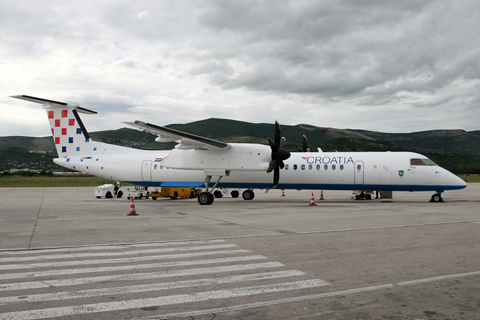
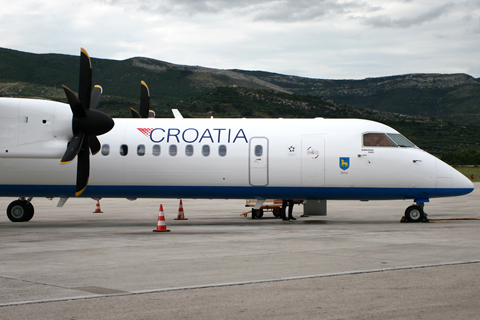
Here she is on the tarmac at Split (who'd have thought that after yawning at two A380 as Paris I'd be exicted by a lowly Dash 8 :) ). That damned overcast that that had stretched across much of Europe didn't spare the coast either
Here she is on the tarmac at Split (who'd have thought that after yawning at two A380 as Paris I'd be exicted by a lowly Dash 8 🙂 ). That damned overcast that had stretched across much of Europe at the end of June didn't spare the coast either
Christened "Istra" after the Istrian peninsula (and an ATR-42 of the same name), 9A-CQC was at the this time the newest Q400 in the inventory (the previous two being 9A-CQA and -CQB)
Christened "Istra" after the Istrian peninsula (and an ATR-42 of the same name), 9A-CQC was at this time the newest Q400 in the inventory (the previous two being 9A-CQA and -CQB)
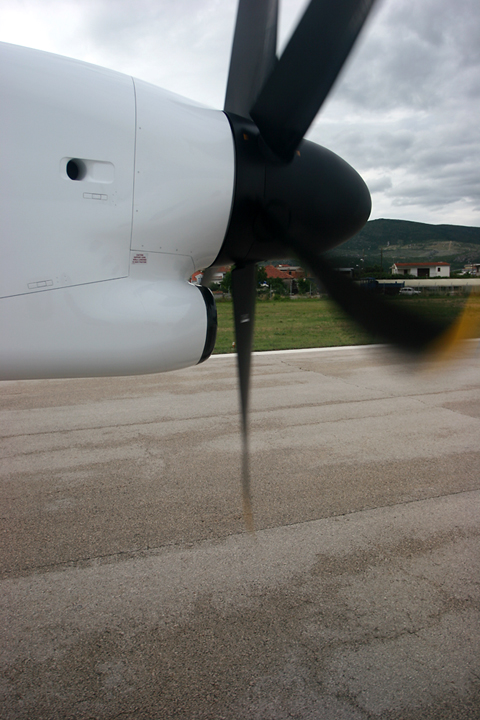
Spooling up the 5,070 HP Pratt & Whitney Canada PW150A on takeoff down Split's RWY 05
The city itself visible from a right turn. Due to the surrounding terrain, the Standard Instrument Departure for RWY 05 requires a 270 degree right turn if heading north (where we were going)
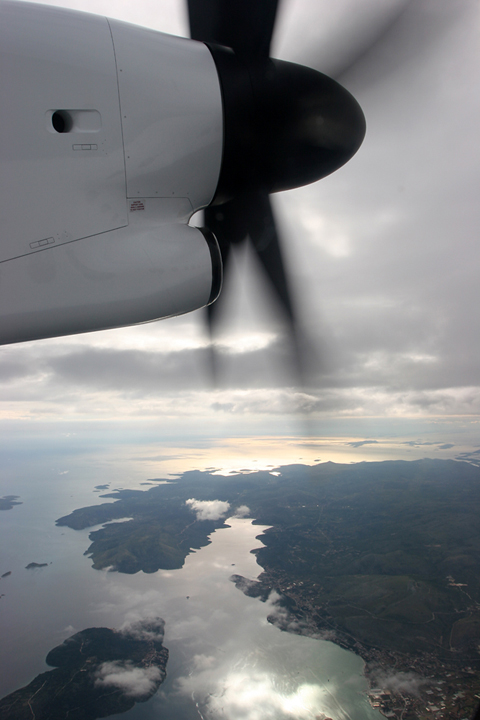
The Trogir area south of Split as we rocket to our 23,000 ft cruise altitude
Back with my head in the clouds :)
Back with my head in the clouds 🙂
Breaking through the deck into clear skies above is always a magic feeling :)
Breaking through the deck into clear skies above is always a magic feeling 🙂
Still climbing, I decided to take the opportunity to first snap the view from 19A. A very nice ambient - while it's still clean :)
Still climbing, I decided to take the opportunity to snap the view from seat 9A. A very nice ambient - while it's still clean...
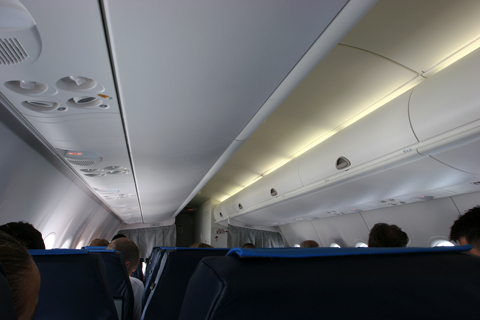
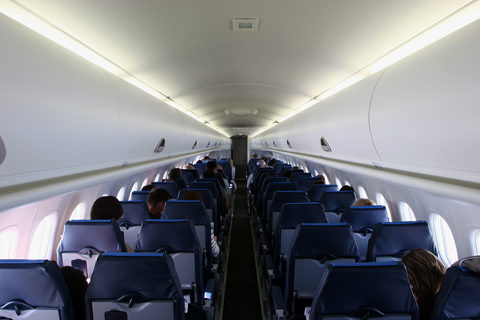
An ant's view (if the were allowed to travel :) ) of the front cabin
An ant's view (if they were allowed to travel 🙂 ) of the front cabin
Blasting along at 650 km/h, you don't get many chances to photograph the cabin between takeoff, drinks service and landing
Blasting along at 650 km/h, you don't get many opportunities to photograph the cabin between takeoff, drinks service and landing
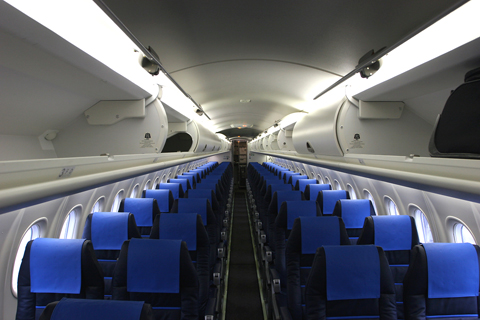
Many thanks to the cabin crew for allowing me a final snap of the cabin once all those walking distractions have left!