It is perhaps a sign of the state of general aviation on the Balkans that the arrival of a single Cessna Caravan can stir up so much interest that even people from neighboring countries head over to see it. While a perfectly common “garden variety” airplane everywhere else, the 208 is still a pretty exotic beast in these parts, with myself having come across only four examples in the 16 years I’ve spent hanging around light aircraft. Therefore I could be excused for packing up my photo gear and driving 120 km one way to Šentvid Airfield in Slovenia in order to catch it 😀 .
The machine in my sights, however, had a bit more going for it than just being a big Cessna with a turbine. On the one hand, it is a comparatively rare short-body Caravan I – and on the other it sports the impressive Blackhawk XP42 engine conversion that is not that common even in the more affluent bits of Europe. So as it spent its three days there hauling skydivers to altitude, I could take my sweet time and get to know it Achtung, Skyhawk! style 🙂 .
A handful of horses in the back – and 850 charging straight at me. Looking imposing in the soft afternoon light, D-FOXY returns from yet another series of skydive runs. Manufactured in 1999 with the serial 208-00303, Foxy spent its early years in the US, flying as a seaplane under the name N984J. In 2006 it would move to Italy as I-SEAA, before heading north into Germany in 2013, where it would eventually lose its floats, get buff and become a no-nonsense jump platform
Blackhawk Up
Though much can be said about the qualities and exploits of the rugged Caravan, what interested me most in this case was in fact Foxy’s nose job. One of the many products to come out of the Blackhawk Engineering works – the people who put third-party turboprop upgrades on the map – the XP42 mod involves replacing the 208’s standard engine (in this instance a “small series” 675 HP PT6A-114A*) with a much more potent “medium series” 850 HP PT6A-42A. In addition to the improved power, the 42’s larger core also noticeably adds to the torque, with take-off figures now up from 2,535 to 3,045 Nm. To soak all this up, the original three-blade 2.69 m McCauley prop gives way to a variety of four- and five-blade aluminum and composite units, with Foxy in particular sporting a conventional 2.54 m Hartzell for a bit of extra ground clearance.
* up until serial number 208-00276, most short-body Caravans were powered by the 600 HP PT6A-114 unit. From aircraft 277 onward, they switched to the same 114A as used by the bigger Grand Caravan. Also of note is PW&C’s engine class system: “small series” engines develop between 500 and 900 HP, “medium series” cover the 850-1,050 range – while “large series” go from 750 all the way to 1,900.
But, the XP42 upgrade is as much about added grunt as it is about the nature of its delivery. Unlike a simple engine swap, this conversion is what’s called a “firewall forward solution”, which includes – where necessary – extensive modification to the engine compartment itself in order to get the most out of the new powerplant. Since the majority of XP42s will be used for rough-and-tough hauling in arduous conditions, the folks at Blackhawk had gone to some length to make the upgrade more than just a course of steroids. To this end, the most obvious alteration is to the cowl, now widened at the front to accommodate a 40% larger oil cooler in order to keep things in the green even during operations in hot-and-high conditions or repeated back-to-back flight cycles. The new twin exhaust stacks (a consequence of the 42’s slightly different architecture) can be profiled to either eek more thrust out of the exhaust gasses (5 knots worth in fact) – or increase mass flow at the expense of cruising efficiency to lower turbine temperatures during the type of prolonged high-power climb common to skydive ops.
For comparison, a stock Caravan I, here in its military U-27 guise. Note the single large exhaust duct and narrow cowl
Other stuff? Well, the engine is now mounted at four points instead of three, there’s an improved air intake system with a modified inertial separator to further reduce the likelihood of foreign object ingestion at rough strips, the battery is now a Li-ion affair instead of lead/acid to save roughly 13 kg in weight – and there’s an optional 325 A starter generator instead of the stock 200 A unit to reduce wear and tear on the engine by shortening spool up and light up times. The package is also rounded up by custom Hawkeye engine gauges, generally similar to the Caravan’s originals – but now with an additional digital readout for most parameters.
Dear passengers, your flight is now ready for boarding. Though all of you will leave half way, we would like to thank you for flying with us! Though the prop is now noticeably shorter in span, it still spins at very similar speeds as the original, meaning the XP42 is still a pretty quiet machine, even at full chat
A peek under Foxy’s skirt. Though the 42A sports a larger core than the 114A, it is only 27 kg heavier dry, 190 vs 163 kg. Interestingly, it is also 34,7 cm longer than the 114A (1.68 vs 1.34 m) – but at the same time 13.2 cm narrower, sporting a 46.4 cm diameter vs the “smaller engine’s” 59.6. Also note the fuel/oil heat exchanger at the extreme right, which helps cool the oil by transferring some of its heat to the fuel on its way to the combustion chamber
And the conversion’s other party piece, the new oil cooler. A pretty good illustration why the XP42’s nose now looks like it had been rammed into a wall!
In addition to Blackhawk’s efforts to keep oil temperatures manageable even during repeated short cycles (as well as the day’s very agreeable 17 degrees Centigrade on the ground), Foxy came equipped with a custom cooling adapter, essentially three fans running off a 12 volt external battery that circulate air through the oil cooler to prevent the formation of local hot spots when the engine is not operating
With a load of between 10 and 15 skydivers every 15-20 minutes, Foxy’s modification sure had their work cut out for them (even more so since start-ups are more critical to turbine engine wear than running hours)!
What a truly wonderful way of spending an afternoon: sitting on the ground behind a revving 850 HP short-body Caravan to the background of rolling hills and lush forest…
As always, I would like to thank the very friendly staff at Šentvid Airfield – as well as Foxy’s pilot for allowing me to snoop around the aircraft inside & out!
While the summer season of 2018 was not really my most productive one (and is far below the bar set by 2017, which gave us classics such as this and this and particularly this), it nevertheless was not a total bust photography-wise. While I’m still smarting from having missed a couple of proper Achtung, Skyhawk! classics by mere minutes (including a Dash 7), I’ve still managed to hoard enough quality material for one jolly Photo File, to at least keep the ball rolling until something else comes up… 🙂
Silver Eagle is silvery! Easily the most popular aftermarket conversion for any Cessna piston single, the Silver Eagle mod entails a major rework of the classic 210 powerplant, substituting its original 310 HP Continental TSIO-520 six cylinder boxer for a 450 HP Allison/Rolls-Royce 250-B17 turboprop – the same type of engine fitted to the most popular helicopter in the West, Bell’s JetRanger. While just the power increase sounds worth the trouble (and cost), the conversion’s real party piece is the engine’s high mass flow, a trait inherent to all turboprop engines. The classic P210 had made its name for its 23,000 ft ceiling, full cabin pressurization and a pneumatic de-ice system for the wing and tail surfaces – all services that require a tremendous amount of compressed air. To cater for all of them, the turbocharger had to massive, which increased weight, maintenance complexity – and occasionally made the engine tricky to operate (especially with regards to shock cooling). Since half of a turboprop is essentially just a large compressor, it handles so much air that it can keep everything sufficiently supplied while still providing a care-free high performance experience – and all for a 158 kg wright reduction (the 250 tips the scales at 96 kg dry vs. the 254 of the TSIO). N700RS also features a frequent optional extra, a weather radar housed in a streamlined dome below the right wing.
Just when I thought it would be G400/G500/G600s or nothing for me here in Europe, into the mix comes this immaculate classic G-III. While you do have to stare at it for awhile to recognize it as an older model, its dead giveaway are the engines, old Rolls-Royce Spey units that are sufficiently loud to warrant the addition of “hush kits” – aftermarket (but certified) silencers that improve mixing between the exhaust gasses and ambient air and reduce the shearing forces between than that are the main “source” of jet engine noise.
Another meeting with the very colorful LY-DSK, which I already had the chance to snap – and elaborate on! – in a previous post. Thankfully, Split Airport (SPU/LDSP) had recently decided to park most of its surplus aircraft steps right on the edge of the GA apron, affording plenty of opportunity to go elevated!
Got contrast? The only proper way to end a working day – with a beautiful GA classic! One of the last mass-produced touring types developed by Italy’s traditional large manufacturers, the original S.205 was conceived in the mid 60s along similar lines as the contemporary Piper PA-28: a simple but versatile aircraft that could be developed into a diverse product family with comparatively little effort. To this end, the basic four-seat fixed-gear S.205F was quickly followed by the retractable S.205R and the more powerful five-seat S.208 – with the top of the range dominated by the planned six-seat S.206 and the S.210 twin. Unfortunately, despite the type’s undoubted qualities and robust build, it would nevertheless never fulfill its potential, SIAI-Marchetti having always lacked the production capacity, support and market reach of its Big Three rivals across the Pond…
The primary towplane of the Celje Flying Club intimidating ants as it awaits the start of the afternoon soaring session at Slovenia’s Celje Airfield (LJCL). An aircraft with a history dating all the way back to 70s Yugoslavia, TNC had during the early 2000s been a resident of my base airfield of Lučko (LDZL), where it had intrigued me – a green student pilot – with its unwieldy and lumpy looks. Despite not being easy on the eye, the Pawnee had far outlived its original role of cropduster, becoming the staple of glider clubs all over the world.
“Molki” throwing out the anchor as it decelerates after a training flight round the Celje Airfield (LJCL) circuit. Developed in the late 80s based on operational experience from the original L-13 Blanik, the L-23 came equipped with a completely new swept T-tail, a slightly larger cabin with new high-vis canopy (one piece on later models, such as this one) – and a revised wing that did away with the 13’s large flaps. Though it had bettered its dad in almost all respects, the Super Blanik would nevertheless fail to replicate its market success, with only limited numbers having been sold in Europe. Interestingly, the type had made somewhat of a name for itself overseas, with 12 examples used by the US Civil Air Patrol as trainers under the designation TG-10B Merlin.
Mirror mirror on the apron, which Learjet should I escape on? The 55 Longhorn you say? No problem! The first of the so-called “large cabin” Learjets, the model 55 was intended to be the starting point for a whole series of “premium” models (such as the shortened 54 and lengthened 56), but a tough market and lots of competition in the early 80s meant that the 55/55A/55B and 55C was as far as it ever made it. Even though the family would later serve as the basis for the very successful 60 series, the 55 was nevertheless a total sales flop, with just 147 having been sold during an eight year production run. Of particular interest is its Longhorn nickname – after a breed of Texas bull – which actually has a long association with the LJ line. The first model to carry it was the mid 70s 28, which had swapped the original 23’s characteristic tip tanks for a pair of imposing, NASA-designed winglets – becoming the first production bizjet to be so equipped. As they became a standard feature on all future Learjets, the Longhorn name was left to slowly fade, eventually dying out with the 55…
For most, a bunch of useless old relics… for Learjet fans, pure pornography! Winglets vs tip tanks as the very attractive fleet of Munich (MUC/EDDM)-based Jet Executive catches some rays on a beautiful summer afternoon. A round of beer for the folks responsible for keeping these machines in the air!
No horizons in the future for Future Horizon as it continues to deteriorate for another year in a remote corner of Dubrovnik Airport (DBV/LDDU). Not a stranger to my camera, DGS was the odd man out in the fleet of MD-80s operated by Air Adriatic, one of Croatia’s first post-independence private airlines (though it was actually owned by a local investment company). Formed in 2001 and well known locally for giving its aircraft names that bordered on the cheesy, Air Adriatic would eventually fold in 2007 when its finances were exhausted, leaving the fleet stranded at various airports in the Balkans. While some of its MDs did survive in some form or another (as fire trainers of museum exhibits), DSG today remains pretty much the last visible example of the carrier’s existence…
I go and visit Lučko for the first time in a month and straight out of the gate have this to see: 280 HP, 350 km/h, 20,000 ft – and a bucketload of charisma characteristic of all Mooney designs. Ever since the original single-seat M18 Mite, all of the company’s aircraft could boast impressive speeds for their power, outstanding performance and flight characteristics all round – and dragging tails with “flipped” vertical stabilizers (which Al Mooney claimed improved yaw control in a stall). Even though it had been under Chinese ownership for some time now, today’s Mooney remains true to its origins, with the top-of-the-line Acclaim Type S pushing a jaw-dropping 470 km/h with a turbocharged version of the Ovation’s engine… (and for those interested, the small mosquito at the top of the screen is actually Mi-8MTV-1 “215” of the Croatian Air Force)
EDIT: and a bit of video as well… when you need a break from boring a hole in the sky, you can rent a Skyhawk and go get in the way at a neighboring airbase. The guy up in the tower must have died laughing: PC-9s regularly fly high speed breaks down the runway, occasionally even F-16s “request permission for flyby”… and into the mix comes me with a 40 year old 172 doing a blistering 125 knots…
I’ve always said that only good things can happen when you use your off time from flying airplanes to – photograph airplanes. For me, this was very much the case recently when my itchy photo finger led me into neighboring Hungary in search of interesting indigenous and Eastern Block flying machinery. And while almost every airfield there is a gold mine in one way or another, my travels that day had taken me straight to Budaörs Airfield (LHBS) just outside Budapest, a well-known GA center in its own right – but doubly more interesting as the home of the Goldtimer Foundation. An eclectic group of enthusiast dedicated to preserving the country’s rich aviation heritage, it is most famous for its flagship, the world’s sole airworthy Lisunov Li-2 – a Soviet license built version of the early C-47 that had needed so many alternations (1400+ by some counts) to survive life in the Union that it pretty much became a standalone type.
But while the Big Li has always been the foundation’s party piece, the rest of its six-strong fleet also boasts much to write home about – in particular my target for the day, the home-grown (and extremely rare) Rubik R-18c Kánya STOL utility aircraft… 🙂
While it may lack the pedigree and heritage of similar designs East or West, the R-18 nevertheless ticks many Achtung, Skyhawk! boxes right from the start – not least of all for its interesting origins. Designed in 1944, the R-18 was penned by Ernő Rubik (father of the same Ernő Rubik who would much later design the eponymous cube) and was intended to fill the niche for a cheap-and-cheerful STOL utility aircraft that could also double as an effective glider tug. Despite nowadays being known solely due to Junior’s successes, Rubik Senior was at the time already a prolific aircraft designer*, and was thus intimately familiar with the challenges of producing a rugged and dependable working aircraft on a tight budget. Though the R-18 was never a direct copy (being much smaller for starters), to make it work Rubik had from the outset used the superlative Fieseler Fi-156 Storch as inspiration, adopting its solutions such as large fixed slots along the wing leading edge, wide-span drooping ailerons, a mixed wood/metal construction to save on strategic materials – and a tall landing gear that could both cope with the realities of rough field operations and provide sufficient drag to allow for steep approaches. Unlike its idol however, the R-18 would not have folding wings, a powerful engine with a constant speed propeller, provisions for light armament or quite the same insane level of STOL performance – all compromises made to simplify design and construction and keep production costs manageable.
* what’s more, Rubik Sr. would continue at it even after the war, turning his attention now to gliders (on which he had actually made his name before the war). The most successful of these new designs was the R-26 Góbé of 1961, a simple all-metal two-seater with a moderate 14 meter wingspan. Though production had ended in the late 60s after 115 examples were made, the design would come back to favor again in the late 80s, when a modernized version – the R-26SU Góbé 82 – was put into production by a Hungarian automobile plant. Despite this unorthodox return and the availability of the Let L-13 Blanik, a further 78 examples would be completed and sold, a large proportion of which continue to happily fly to this day.
In spite of its down-to-earth design goals, the R-18 – now named Kánya (“kite”, a species of hawk) – would not see the light of day until the end of the war. The German occupation in May of 1944 and the arrival of the Red Army in September had had a catastrophic effect on the country’s aviation industry, which made producing even such a simple and basic no-frills aircraft a very tall order indeed. In the event, the first Kánya – the R-18a, carrying the serial E-524** and military ID 1-002 – would be completed only in 1948, flying for the first time on 18 May 1949.
** like many Hungarian light aircraft, the R-18 family was produced by the state-owned Sportáru Termelő Nemzeti Vállalatnál aircraft factory at Esztergom (now LHEM) in northern Hungary. This was reflected in their serials: E-524 may sound exotic, but it simply meant 1-002 was the 524th aircraft produced at Esztergom so far.
The very first R-18, showing the original cabin shape and doors (photo from: www.avia-info.hu)
In its original guise, the R-18a was a pretty clean three-seater (two in the front, one in the back), powered by a Czechoslovak Walter Major 4-I engine which developed a modest 130 HP from four inline cylinders, and spun an unremarkable two-blade fixed pitch propeller. Interestingly, Rubik had envisioned the Kánya to be powered by a British-made inline engine (such as the 135-150 HP Blackburn Cirrus Major), but the post-war political situation in Hungary had quickly sent that idea down the tubes.
Originally pitched to the reformed Hungarian Air Force, 1-002 would quickly be made redundant by large numbers of readily available aircraft coming from the USSR (most notably the Polikarpov Po-2), which left Rubik with only one option – to go civilian. To this end, 1-002 would be transferred to the civil register, becoming HA-RUA the same year. Unfortunately, not long afterwards it would be involved in the type’s very first accident, when it stalled at low altitude and sideslipped into the ground during a glider tow demonstration. Even though the damage was repairable, the aircraft was not rebuilt and was instead re-purposed as a training aid for apprentice mechanics.
Based on experiences from military test flights and civilian trials, Rubik then developed the slightly improved R-18b, whose primary claim to fame was a redesigned fuselage around the rear seat, allowing the second passenger a bit more breathing room. As was the case with the A, only one B model would be made, wearing the serial E-552 and registered HA-RUB. Like its predecessor, it would meet its end during a glider tow exercise on 25 September 1954, ending up severely damaged in a corn field after running out of fuel.
Mostly identical to the A model from the outside, the B could only be recognized by slightly different contours of the fuselage just aft of the wing (photo from: Airwar.ru)
Having been convinced all along that there was more to come out of the basic design, at the very beginning of the 50s Rubik began work on a more extensive update, which would debut in 1952 as the R-18c. Compared to the B model, the C – in the form of the “prototype” HA-RUC (s/n E-761) – packed a more powerful six cylinder Walter Minor 6-III developing 160 HP, as well as a cut down and extensively glazed rear fuselage. The new powerplant was initially delivered with a two-blade Avia V410 variable pitch metal propeller – but unspecified problems with its reliability had quickly seen the switch back to a classic fixed pitch wooden unit manufactured right at Esztergom. Having caught some flak due to comfort issues with the A and B models’ rear seat, Rubik would soon dump it completely and replace it with a 120 l fuel tank to augment the two standard 60 l tanks located in each wing root.
In this tweaked form – which one source calls R-18c/1 – the C would become the first, and last, R-18 to enter any form of series production, with just six further examples completed between 1952 and 1953 (registered HA-RUD through HA-RUI). The reasons for such a short production run vary from one source to the other; but staff at Budaörs had told me that the R-18 was simply a casualty of Eastern Block politics of the time, which prioritized the import of aircraft from large factories abroad over small-scale indigenous production. Thus, like the original A model, the Kánya as a whole was simply swept away by a tidal wave of Polikarpovs, Yakovlevs and Zlins rolling in in their hundreds.
Visually the most curious of the lot, the C model can be identified by the long nose, large cowl flaps on the right side (not visible here) and the cut-down rear fuselage. Other changes included larger doors, which significantly improved the view downwards (photo from: airwar.ru)
To add insult to injury, the Minor engines would prove to be quite problematic and failure prone in Hungarian service, leading to a disproportionate number of incidents and write-offs; indeed, some sources claim that by 1966 – when the type was withdrawn from service – only two aircraft had remained intact. This rate of attrition had between 1955 and 1958 prompted a fleet-wide re-engine program, in which the Minor was thrown out in favor of the Shvetsov M-11 five cylinder radial used on the Po-2 (and manufactured by WSK-Kalisz in Poland), developing either 125 HP in the D model – or a more substantial 160 HP in the FR variant. Unlike the home-grown props used with the Minor, both M-11 variants would be bundled with the “factory default” WD-450, also made by WSK.
Interestingly, there was only one other structural mod attempted – and that was fitting skis to HA-RUE (s/n E-763). The aircraft was subsequently based at Budaörs, but I had been unable to find any photos of it in this configuration.
Kite flying
One of the two lucky ones to survive into their old age, the foundation’s example goes by the name HA-RUF, and was the first Kánya to be produced in 1953 (wearing the serial E-778). A standard R-18c (or R-18c/1 according to some), it sports the more powerful M-11FR engine, and had flown for the first time (again) on 1 October 2012, following an on-off restoration that took more than 20 years. Painted in accurate period colors that really make it stand out on the apron, it would immediately after enter the Goldtimer fleet, where it would happily open its doors to wandering aircraft geeks… 😀
While it is far from flattering, a head on view of the R-18 best shows its “Inspired by Storch” design. As well as providing adequate shock absorption, the tall main gear also ensures ample propeller ground clearance. However, the entire gear system is at the same time one of the Kánya’s biggest weak spots: fractures of the main gear attachment points have been reported throughout its service life – and the freely castoring tailwheel, coupled with the soft suspension, means that ending up in a nasty ground loop doesn’t require much effort
Though it lacks the visceral appeal of a big radial, the M-11 is nevertheless a perfectly charming little package in its own right. The exposed valve rods, a tendency to spit oil out of the exhaust, inevitable misfires on idle and that famous “sewing machine” sound all make for a delightful experience
A notable leitmotif of the R-18 is simplicity – and the use of whatever components the production team could get their hands on. The oil and rear fuel tank fillers (left and right respectively) have, for example, been salvaged from wartime German aircraft and take some getting used to – particularly for those of us brought up on the “plug & play” systems used on Cessnas and Pipers. Of further interest, the nose and cabin are the only bits of the Kánya that are made of metal; the rear fuselage, tail and wings are all wood (+ a bit of fabric)
In common with many aircraft from the Soviet sphere of influence, the R-18 uses pneumatics, rather than hydraulics, in its braking system. The upsides are a low total system weight and carefree operation in cold weather – but at the cost of very coarse metering and the need to isolate the air tank from the installation when the aircraft is at rest to prevent leaks. On the R-18, the valve for the tank is located on the floor in front of the seats – a pretty convenient solution compared to some others I’ve seen
As on any self-respecting utility aircraft, the visibility out of the cockpit is excellent in pretty much every direction, and there’s extensive glazing everywhere but on the floor. Apart from the sheer amount of air and light, I was most fascinated by the clean panel layout, which is ergonomic far beyond its 40s origins. Inevitably (and thankfully) there still are a couple of oddities: the comm radio is BELOW the pilots seat (barely visible here), the flap position indicator is above the pilot’s head – and the fuel level indicators for both wing tanks are combined into a single tube-style gauge above the passenger door. Another curiosity are the instruments, a charming mix of German, Soviet and Hungarian gauges and switches
Despite the Kánya’s high stance, visibility over the nose is excellent, which allows for easy operation on the ground (steering by differential braking notwithstanding). An interesting detail is the vertical rod nearest the door: this is actually part of the flight control linkage and actuates the ailerons. Unlike most modern light aircraft, the R-18 uses pushrods for all flight controls, which – while adding weight – give it a very quick, precise and predictable feel. The flaps too are mechanical and are operated by a Piper-like handle between the seats
An unusual view backwards showing just how much the C model’s cut down fuselage helps with visibility. Naturally, with all this glazing the cockpit can get pretty hot on sunny days, even with the roof-mounted sliding curtain drawn all the way. An interesting peculiarity here are the yellow tubes, which actually form part of the C’s fuel system. Unlike on the A and B, fuel from the wing tanks drains first into the fuselage tank, from where it is then drawn into the engine
The proper way to spend a vacation: buckled up in a German WW2 harness, pulled along by a Russian sewing machine, valves tapping away in front of your eyes and a windscreen full of oil drops from the exhaust…
The world’s sole airworthy R-18 to the background of the world’s sole airworthy Li-2… I kind of like it here I must admit!
And finally, a bit of video… a poor attempt I admit, but I’m not one with moving pictures and the air that day was a bit turbulent. But you can still hear the Singer in the nose doing its thing – and that’s worth a thousand pro videos! 😀
Customarily, I would like to thank everyone at the Goldtimer Foundation for a beautiful flight, especially my pilot, Mr. Gabor Szakacs!
Appendix – R-18 production list:
Reg
Variant
S/N
Mfd.
Notes
HA-RUA
R-18a
E-524
1948
• crashed 1949 (location unknown)
HA-RUB
R-18b
E-552
1949
• crashed 1954 near Székesfehérvár
HA-RUC
R-18c
E-761
1952
• crashed 1962 near Gödöllő
HA-RUD
R-18c/1
E-762
1952
• crashed 1956 near Szentes
HA-RUE
R-18c/1
E-763
1952
• fitted with skis; wfu 1966 and scrapped
HA-RUF
R-18c/1
E-778
1953
• wfu 1966; made airworthy in 2012
HA-RUG
R-18c/1
E-779
1953
• wfu 1966; in a museum until 2016
HA-RUH
R-18c/1
E-810
1953
• crashed 1957 near Kaposvár
HA-RUI
R-18c/1
E-811
1953
• wfu 1966 and scrapped
* HA-RUG was the sole surviving Minor-engined example; was displayed in a museum in Budapest until 2016, can’t find trace of it afterwards
Ever since the early days of Achtung, Skyhawk!, I’ve always been on the lookout for rare, interesting and historically significant aircraft puttering around the region – you know, the sort of machines that had it all really: rarity, backstory and a rich history to boot. As the winter’s soaked runways, persistent fog and oppressive low cloud finally gave way to dry grass, pleasant temperatures and clear sunny skies, I decided I might as well go one up this time and actually – fly one 🙂 .
Having spent my formative flying years listening to “oldtimers” and their stories of adventure on the many aircraft types indigenous to former Yugoslavia, the choice made itself really, especially since many of them are nowadays well up on the endangered list. The simplest solution was thus to go for the most modern and popular one, which eventually led me to Slovenia’s Maribor Airport (MBX/LJMB) and its resident UTVA U-75 two-seat trainer.
Responding to S5-DCI and owned by the Letalski center Maribor (LCM) flying club, this particular aircraft is itself already good for a classic AS review – but, being one of only a dozen or so still airworthy, I decided to bin tradition and focus this time on what this interesting machine is actually like to fly. So, instead of digging deep into its history (s/n 53171, mfd. 1980, ex. YU-DGF of AK Maribor, then SL-DCI and S5-DCI of the Slovenian Air Force until 2010, then to LCM 😀 ), I though I could put together a short flight report and attempt to describe what the U-75 feels like in its element…
The shape that launched a thousand student traumas… while it certainly won’t be winning any beauty contests, the U-75’s stocky build and generous size nevertheless make it stand out among its peers!
Author’s note: given that I have no experience flight testing aircraft (nor do I have the required skills or qualifications), this work is not a proper professional review – but rather the personal experience of a long-time light aircraft pilot and lifelong GA fan. As such, my observations will definitely not be something they will print in textbooks – but given the rarity of the U-75, they should nevertheless be an interesting read for the enthusiast!
Part 1: the basics
Even though the U-75 had already featured here in depth as part of a review of the type’s sole surviving four-seat example, for the sake of clarity and ease of reading I though it best to nevertheless run quickly through some of its more pertinent characteristics. Flying for the first time in 1976, the U-75 is a simple and robust all-metal semi aerobatic two seat trainer, designed to be suitable for everything from basic flying instruction (civilian and military) to initial aerobatics and even air-to-ground gunnery. Despite its not inconsiderable bulk, the U-75 weighs only 685 kg empty and 1,200 kg at maximum take-off (though it is usually flown at its maximum landing weight of 960 kg), which makes its 180 HP Lycoming IO-360 and its associated two-blade constant speed prop good for about 115 kts in the cruise. More importantly, its +5.5/-3 G stress limits with one person on board (and +4.4/-2.2 with two) give it a wide berth during maneuvers, while the tall wide-track landing gear, long-travel shock absorbers and large low pressure tires make (student) landings a doddle even on rough and unprepared strips.
With 138 examples made in total between 1978 and 1985, the U-75 would go on to become former Yugoslavia’s second most produced indigenous design – right behind the G-2 jet trainer – and was throughout the 80s and 90s used by civilian clubs and air forces across the land (in the latter often known as the V-53). And while it is today viewed with fond nostalgia, its life in service was much tarnished by a popular reputation for violent spinning (sometimes fatally), which bred considerable distrust in the design. In fact, the problems stemmed from the rearward position of its center-of-gravity, which made it a peppy and nimble performer – but at the expense of reduced longitudinal stability1. When pushed hard and then poked with a stick, it would indeed want to spin and keep on spinning; but when flown in moderation and per SOP, it had shown itself to be pretty docile in all flight regimes, a fact attested to by numerous operators who went aerobatic on a regular basis and without incident.
1 in simple terms, the two extremes of aircraft behavior are stability and maneuverability. An aircraft that is stable is not maneuverable; likewise, an aircraft that is maneuverable is not stable. Given that this principle acts along all axes of the airplane separately, nailing down the exact amount of each is an art. In prototype form, the U-75 was found to be too stable longitudinally, which reduced its maneuverability in pitch and made it less suitable for the training role. The root cause was determined to be a CG position that was too far forward; to solve the problem, the heavy battery – originally fitted behind the cockpit – was relocated to the tail cone. This shifted the CG backwards sufficiently to solve the problem, but at the same time made the U-75 “nervous” in pitch when it reached its limits. In a hurried or badly executed maneuver, it was not hard to stall and send the aircraft over one wing, initiating a spin that – if not countered immediately – just kept getting worse. Approved procedures therefore called for entry into a spin at a minimum of 5,000 ft AGL, and recovery to be initiated after just one turn; done properly, flight tests showed an 850 ft altitude loss could be expected. Done lower, slower and sloppier, you can well imagine the results
Aside from its significance to the locals, the U-75 is then a classic ab-initio trainer, the sort of aircraft produced by aeronautical establishments all around the world. This itself invites a comparison to some of its peers, such as the Slingsby T.67 Firefly, Scottish Aviation Bulldog, the PAC CT-4 or the SAAB S.91 Safir; however, what I am actually going to do is compare it to the restrained and very unmilitary Cessna 172. The reasoning behind this approach is simple: many GA flyers have at one point or another flown a Skyhawk, with most (myself included) having logged treble figures in at least one of its variants. Despite their different roles, the two aircraft are alike in a number of respects, which makes establishing a baseline for the U-75’s comparison all the easier. And anyway, there’s no point in drawing parallels with an equivalent aircraft if there’s nobody reading (or writing) who flew them, is there? 🙂
Part 2: getting in
But, first things first. Entry into the cockpit is pretty straightforward and is standard stuff for low-wing aircraft: hand in recessed handle, foot on step and up onto the wing from behind. However, since the U-75 was designed from the outset to operate out of unprepared strips, the wing root is a good 80 cm above the ground, so the whole maneuver requires a bit of gymnastics – though not much more than trying not to trip over the 172’s main gear leg.
Once on top, the two-part sideways hinged canopy (jettisonable in flight) opens upwards, and is then fixed in place by a manually folding arm tucked to the inside of the canopy frame. This setup is not really ideal for tall people (like me), since it is quite easy to bang one’s head against the canopy while maneuvering to enter the seat. Thankfully, the frame is pretty large overall so – heads notwithstanding – getting in and out is not difficult or haphazard by any measure.
Thankfully for its crews, the U-75’s exterior size is matched by its interior, with more space on offer than in Cessna’s premium piston singles, let alone the Skyhawk. The elbow room for either seat is impressive, and even larger pilots would still have plenty of space to work without body contact. Note the chunky seat belts and the canvas cover behind the seats that doubles as a parcel tray
While it is immediately obvious that all structural components and cockpit controls are built to last – everything feels decidedly more robust and durable than on the 172 – the overriding impression is of rudimentary finishing work, with rough and unprotected edges in abundance all over the cockpit. Admittedly, given the U-75’s military nature, comparing these and other creature comforts with those of the Skyhawk is apples to oranges – but despite the lack of padding and soundproofing and any form of interior trim at all, the cockpit is physically very comfortable and quite airy. Headroom however is slightly less generous than on the 172 (even when you lower the seat fully), and anybody over 1.8 m and wearing a headset will fill slightly hemmed in from above – though it is still manageable and not much of an inconvenience on shorter flights (under two hours).
While there are no basic Ts and sixes here, the U-75’s cockpit is in some respects pretty well though out, with a couple of good ergonomic touches. One in particular is the central pedestal, which contains pretty much all system controls, including the throttle (yellow lever), propeller control (blue lever), mixture control (plunger), alternate air source (red-topped plunger), demist controls on the side, parking brake (orange switch) and, out of shot, the fuel selector (which, like on the 172, has a very welcome BOTH setting). One particular level that is missing – and would have been fitted in the hole below the alternate air – is the underwing stores emergency release handle. Like many trainers, the U-75 also includes another set of throttle and prop controls on the left of the pilot’s seat. Absent from the shot is the flap level, a large Piper-like affair between the seats; its settings are simple, UP, notch 1 (take-off and landing) and notch 2 (landing only). For my taste, the sticks are of perfect height – not to low, not to high – and though they’re designed to accept either hand, they fall slightly more easily into the right. The only really annoying feature is that on both throttle quadrants the prop control is on the left and the throttle on the right; whereas the manifold pressure gauge (controlled by the throttle) in on the left and the RPM gauge is on the right. As is the norm for all Yugoslav designs, the flight instruments are all metric, while the engine instruments – usually cherry-picked from various Western designs – are mostly imperial.
Once seated, both the sitting position and the view ahead are pretty good, though the frame of the canopy initially gave me the impression of peering through a postbox; once on the move though, I quickly got used to it. The rudder pedals can be adjusted fore and aft, but this is generally avoided since the mechanism is known to stick. The brakes themselves are actuated by separate toe-operated paddles inboard of the pedals – a solution similar to that used on the Super Cub, where they’re heel-operated. With larger shoes (or military boots) on larger feet, this does not seem to be a particularly used-friendly solution, and it took me some fumbling and toe jabbing before I’d gotten used to it. The rudder pedal edges are also contoured to accept the outline of a thick boot – a feature not really compatible with the sneakers I was wearing that day.
Helping matters however is that the brakes are quite powerful, so even a slight jab at them (regardless of its elegance) produces some results. Then there’s also the fully steerable nose wheel, which makes ground maneuvering pretty painless – indeed, I’d managed to get the hang of it after just a few dozen yards. In fact, on steering alone (without differential braking), the turn radius is just 7 meters – noticeably less than the 8.3 the Skyhawk can achieve using BOTH steering and brakes at the same time. The shock absorbers and tires make the ride quite smooth even over rough terrain, but at the same time do not let the aircraft roll to much in the turns if you keep the speed moderate (though the aircraft’s low CG position has a lot to do with this).
Part 3: airborne
System-wise, all pre-departure checks are no more complicated than on the 172, and follow pretty much the same pattern. Having been designed from the outset to meet the FAA’s FAR Part 23 criteria, the U-75 holds no surprises, and there’s none of the “Eastern Bloc system exotica” that its looks and origin would lead one to believe. With the engine being essentially the same as on today’s Cessna 172S (albeit with a constant speed prop), the run-up is also straightforward and over in a jiffy.
As I was briefed by the instructor occupying the right seat, the standard flap setting for departure from both paved and soft fields is notch 1, which gives 20° of flap. The aircraft manual quotes a 225 meter max performance run on grass and with zero wind; however, we had the advantage of concrete and a quartering eight knot wind, so despite the 880 ft field elevation and 25° Centigrade outside, we opted for a more leisurely departure. Adding power, there’s a very noticeable swing to the left – far more pronounced than on the Skyhawk – which can be neutralized only with a large amount of right foot. What’s more, significant pressure on the pedal is constantly needed at high power, and with no rudder trim available, this tends to become wearisome after awhile (though I suspect the rigging of the tab of the vertical stabilizer was to blame for this). Being both lighter and more powerful than the 172, the acceleration was noticeably better, and with slight backward pressure on the stick we were already airborne at 110 km/h (59 kts), having used up around 300 meters of runway.
Passing 50 ft, LCM club procedures call for acceleration to the U-75’s best climb speed (Vy) of 130 km/h (70 kts), retracting the flaps at 300 ft AGL and then setting maximum cruise power, an easily remembered 25″ MP and 2,500 RPM (equivalent to roughly 80% power). In this regime, the rate of climb with full fuel and two of us on board varied between 4 and 5 m/s (800-1,000 fpm), but the day’s thermal turbulence made getting a constant figure impossible.
Once in the cruise – in our case at 3,000 ft towards one of Maribor’s training areas – the power came back to the 65% setting of 22.5″ and 2,350 RPM, which gave a solid 160 km/h (86 kts) indicated and 169 km/h (91 kts) true. While this is not particularly impressive for the available power, the thick wing profile and large landing gear do create a quite lot of drag; increasing the power by two inches MP gave around 170 km/h (92 kts) indicated, but since we were in no hurry, I soon throttled back to best cruise and set about seeing what’s what.
Given my previously noted lack of flight test qualifications, I decided to try and get an impression of the U-75 by flying a program based on the average PPL skill test (bits of which I dimly remember from ages past 😀 ). This I thought would give me the best impression possible in the allotted time frame (one hour 30 minutes), since I would get to see both how it behaves in regimes I’m familiar with from the 172 – as well as how a student might experience it during basic training. To this end, my “program” consisted of:
standard, 60° and 90° banked turns + snap roll
slow flight
stalling, both power on and power off
sideslip descent + gliding
flaps notch 1 and notch 2 approaches w/ crosswind
and route flying and navigation
Sadly, the pattern at Maribor was quite crowded that day, so there was no opportunity to perform a simulated engine-out approach without inconveniencing half the sky. To compensate, the ambidextrous nature of the U-75’s flight controls had allowed me to fly most of my program with each hand in turn and judge the ease and practicality of both. In the end – though I favor using my right hand as I do at work – flying with the left is often far simpler, since all relevant controls – flaps, lights, radio – are on the right side, allowing me to push and pull everything without having to constantly switch hands.
To cut to the chase without going through each maneuver separately, the handling came as quite a positive surprise – especially after everything I’ve heard said about it. The numbers themselves offer some clue to the above, as the U-75’s 65.3 kg/m² wing loading – only slightly up from the 172’s 64.4 kg/m² – promised similarly forgiving all-round behavior, while its 9.73 m wingspan – noticeably shorter than the Skyhawk’s 10.97 – bode well for rolling rates and a general willingness to maneuver.
Immediately after leaving straight & level fight, I found the stick to be very precise and informative, its travel pleasingly light in both axes – enough to get a good feel for the aircraft, but not twitchy enough to become tiring. Interestingly, the stick moves noticeably lighter in roll than in pitch, a setup exactly opposite to that of a glider. Thanks to the type’s large ailerons and powerful elevator (both blessed with considerable travel), the feel was matched by the aircraft’s physical response, with rolling and pitching done quickly and eagerly – but without the aggression of a thoroughbred aerobatic machine. Unsurprisingly, rates across all three axes were significantly higher than on the Skyhawk.
This harmony between stick and machine meant that I could achieve a remarkable degree of precision in most maneuvers already on the first time out, and all without any unnecessary flailing at the controls. Following my observations on take-off and in the climb, I was also quite surprised how little rudder was needed in turns – and that even left-hand maneuvers occasionally needed a poke of right rudder (though I again suspect tab rigging to be the cause). An additional characteristic that caught my eye/hand was that even in high bank turns, comparatively little backpressure was needed on the stick – and when I did find myself losing altitude, little additional force was necessary to return everything back to textbook state. As the numbers in the previous paragraph suggested, the U-75 was indeed very willing to sustain most maneuvers without much fuss and manhandling from my side, which immediately inspired a dose of confidence in its handling as a whole.
But what impressed me most of all was its stall response. Given the legends, tales and accident reports relating to U-75s going vertically, I was ever so slightly apprehensive about this part – not due to fears of ending up in a spin2, but a perception that an aircraft with such a reputation will likely not be well behaved once the going gets tough. I am pleased to say that I was quite off the mark, for the U-75 had exhibited flight simulator-like behavior, even with power on: just a very slight shudder and forward tug on the stick saying that it would like its nose to point down if I don’t mind. Honestly, it made the 172 look dramatic! Another thing of note is that despite the day’s turbulent thermal weather, it resisted wiggling its wings near the stall – and as soon as it even slightly went to the side, quick pedal action would sort everything out in an instant.
2 although owners who had spun the U-75 say it is not as big a deal as folklore suggests (again, if done properly), I had shied away from attempting one, due to both my lack of experience on the type – and the fact that S5-DCI itself was barred from spinning by LCM club rules
Some mention should also be made of the engine. Despite its nominal take-off rating of 180 HP, throughout the program we kept it at its 25″/2,500 RPM maximum cruise setting, which – according to the manuals – left us 150 HP to play with. Despite the abuse and the 20 °C at altitude, the engine oil temperature remained hovering around 95 °C (right in the middle of its 80-110 °C normal operating range), while the designated cylinder registered around 190 °C (deep enough for comfort within its 80-220 °C green arc) – which says a lot about the airflow through the engine compartment. Helping matters were the U-75’s distinctive cowl flaps, located on top of the cowl just ahead of the windshield, which lead to the odd situation of the front cylinders running hotter than the rear pair. Another thing of note is that despite its semi-aerobatic credentials, the U-75 sports the standard version of the IO-360, which is not equipped with fuel and oil systems for inverted flight (these would have been identified by the additional prefix AE).
Criticisms? Well, the only major thorn in my eye at this time was the trim wheel, which was far too coarse and lacking in feel; it resisted operation too much and even a slight turn resulted in an out-of-proportion change in stick force. However, as with the rudder, this may very well have been down to the rigging of this specific aircraft.
With the program completed, we settled back into the cruise, where the plan was for me to do some navigation of the greater Maribor area and see how the U-75 behaves en-route. In a number of critical areas, it didn’t fare all that well: its military genes mean that comfort was never allowed to compromise the training experience, the result of which is a cockpit with no soundproofing at all (as noted previously). The upshot is that ambient noise is off the scale, and even with headphones on it all becomes pretty annoying pretty quickly (especially since S5-DCI has no squelch control, which leaves the headphone mikes free to pick up the drone and amplify it back to you). The position and height of the stick also mean that you have very little space in your lap – so with a kneeboard on and the right seat occupied, you’re going to struggle to read an unfolded map, despite the nominally generous size of the cockpit.
However, as uncomfortable as it may be, the U-75 nevertheless does have something going for it as a navigation platform. In common with most other low-wing aircraft, the view outside is excellent, and the relatively small span of the wing means you can often have a good look down. Once trimmed (after much frustration), it will fly hands off for a surprising amount of time – without rudder input even – though having someone in the right seat to balance things out certainly helps. More importantly, the extensive glazing means you can easily keep tabs on surrounding traffic, and it never took us long to spot neighboring aircraft without having to bank or pitch or stand on our heads. So while the average GA tourer is in a completely different league in terms of comfort – so much so you’d be excused for sending hate mail to the UTVA works following a long cross-country – the U-75 is nevertheless a practical and safe platform for finding your way around.
In that other important route performance metric – fuel – the U-75 is pretty much on par with the 172, with our 65% power setting (mixture full rich) registering 30 liters/hour (7.5 GPH) on the flow meter. With the manufacturer’s 15% reserve fuel policy giving us 128 liters (34 USG) usable out of the 150 liters (40 USG) carried in total, this works out to an endurance of around 4.5 hours. At the same altitude, power/mix setting and ambient conditions, the POH for a late 70s 172N puts out a fuel flow of 25 liters/hour (6.7 GPH) which, with 136 liters (36 USG) available before hitting the 45 minute reserve, gives an endurance of 5.3 hours. However, I normally fly a 1979 Skyhawk with a very accurate digital flow meter, and the real-world figures in nearly identical conditions are all in the lower 7s, which gives an actual endurance of between 4.75 and 5 hours.
A charismatic 70s Yugoslav trainer, more noise than is believable, a green ergonomic mess of a panel and a guns/rockets/bombs toggle switch on the stick – fine ingredients for a fulfilling afternoon! Despite the large canopy frame, the view out is excellent in all directions (even back), though on clear days the sun coming in through the top of the canopy does lead to sauna-like conditions.
Part 4: stopping being airborne
With both zone and en-route work completed, I opted for a handful of touch-and-goes, to see how the U-75 manages that most difficult of maneuvers – landing. On the first three approaches, I went with a flaps notch 1 configuration – and quickly discovered that the little Utva could out-accelerate a brick going down. All that drag means that its glide is quite steep, with the manual quoting a L/D ratio (flaps up) of just 1/6.72 at 150 km/h, 1/7.1 at the 140 km/h (76 kts) recommended engine-out speed, and just 1/8.42 at its 116 km/h (63 kts) best glide – a condition where even the unaerodynamic 172 manages 1/9.2. In our case, these figures were decidedly lower, partly due to my ham-fisted flying – but mostly due to keeping our speed high to avoid disrupting the traffic flow and potentially shock cooling the engine. The ideal speed was therefore pegged at the same 130 km/h as in the climb, which gave more than adequate circuit performance while still keeping us below the maximum flap extension speed of 140 km/h.
Flying, both on and off work, a high-wing aircraft blessed with ample wingtip clearance, I was naturally apprehensive about touching down wing low in the day’s 6 knot crosswind. While this is just a light breeze everywhere else, the U-75 is deemed to be particularly sensitive to it, and is in fact limited to a 90° crosswind component of just 8 knots – HALF of the 15 knots limiting the Skyhawk. To avoid making a complete mess of it so early on, I elected instead for a jet-style crabbed approach with an appropriate bootfull just before the wheels hit the ground. The type’s powerful rudder made this a non-issue, though with experience I’m sure a proper sideslip approach could be flown easily and without danger to both the airplane and ego (especially since the 6° dihedral places the wingtip approximately 1.1 meters above the ground).
Glossing over my first landing – an inglorious thump from too high a flare – I’d soon gotten my hand in and discovered that the U-75 is quite easy to land softly, mostly due to the very tolerant trailing link main gear. As can be expected, the cushioning of the low wing and a more pronounced ground effect mean you can float a long way if you’re not careful, but it doesn’t take too long to get used to it. Indeed, pilots who flew the U-75 in precision landing competitions told me that it is far easier to place on a specific spot than the 172, and it was always the preferred mount with many podium finishes. Interestingly, despite the high degree of flap, the touchdown attitude is noticeably nose up, far more than on the Skyhawk; however, the slope of the nose does not impair forward visibility at any point. The touchdown speed in our case was around 100 km/h (54 kts), though this can be brought down a bit if a greaser is not your intention.
To step up the fun – and illustrate just how draggy the U-75 can be – for the next approach I was instructed to come in high, fast and close, rolling onto the runway heading just 1,200 meters away at 1,100 ft above ground, doing 150 km/h (81 kts). To reach the threshold, I’d have to fly a virtual glide slope of 16° – 10 more than the steepest ILS recognized by law. Pulling the throttle back to idle, setting the prop full fine and dropping flaps fully to notch 2 (30°), I found myself in a visually disconcerting steep descent at 110 km/h (59 kts) and slowing – eventually even having to add power just to make it to the runway. The maximum rate of descent I remember seeing was on the order of 8 m/s (1,500 fpm) with no forward acceleration.
As an encore, I had planned for the final landing to be a “minimum stopping distance” affair – but the traffic crowding in behind us and the necessity of taxiing a full kilometer to our turn off point meant I had to scrub the idea and get my behind off the runway ASAP. But, since I’m already throwing numbers around, the manual suggests a landing distance over a 50 ft obstacle of around 450 meters, with the run itself just 240 meters.
Post script / conclusion time
While the comparatively short time aloft (and my aforementioned lack of test pilot credentials) prevent me from making any worthwhile objective conclusion, from a purely subjective standpoint I was nevertheless pretty smitten with the U-75 – perhaps most of all because it was nothing like popular lore said it would be. While a pure aerobatic aircraft might have been more exciting (at least during maneuvering), the Utva is definitely not boring or dull; indeed, on fun factor alone it might even top the Super Cub and Citabria (both of which I’d had the privilege to fly). While it is not perfect – and living with its faults day to day would likely start to wear quite thin very soon – its charisma, origins and historical relevance had definitely been worth the trip!3 Simply put, to actually go somewhere, I’d undoubtedly choose the better equipped, more comfortable and far quieter Skyhawk; but to have a bit of good old fashion stick-and-rudder fun without much fuss and effort, it would definitely be U-75 all the way 🙂 .
3 despite their widespread use across the width and breadth of ex-Yugoslavia, airworthy examples are nowadays increasingly difficult to find, with – by my count – less than 10 still operational and in civilian hands. Their somewhat expensive maintenance, pretty specific role and an increasing lack of spares make them a financial handful for smaller flying clubs, while their specific character is unlikely to tempt the wallets of many private pilots and owners. Despite this, the few examples that are flying will likely continue to do so for some time to come, with one – 9A-DIH at Čakovec Airfield (LDVC) in Croatia – soon set to return to flight after nearly a decade on the ground!
DCI back in the hangar, dwarfing pretty much everything in there…
It seems to be a rule of nature that every former Yugoslav airbase still in use today has a few hidden gems with which to tempt the photo finger – even among the locals who were used to seeing them on a regular basis. Croatia’s Zagreb (ZAG/LDZA) has its large MiG-21/Mi-24 graveyard; Serbia’s Batajnica (LYBT) has a bewildering mix of Soviet and indigenous combat and transport machinery that cannot be seen anywhere else in the world; while Macedonia’s Skopje (SKP/LWSK) can boast what are likely Europe’s last non-preserved Su-25s – and very definitely its only Israeli-modified Mi-24s. And Bosnia’s Sarajevo? Well, that has a Rajlovac Helicopter Base and one of the rarest series-produced helicopters on the planet – Mil’s diminutive Mi-34.
While at first glance it looks just as “60s Soviet” as nearly everything else in its family tree, the 34 is nevertheless a pretty special little whirlybird – not just for being the last all-new helicopter type launched in the USSR, but also for being Mil’s final clean sheet design until the Mi-38 of the early 2000s. All of this had naturally ticked the lot of my Achtung, Skyhawk! boxes, so I recently decided to give the Bosnian MoD a ring and see if I could pop down to the country’s capital and tour one of Russia’s more charismatic (and least lucky) rotary designs… 🙂
It’s not the most beautiful whirlybird out there, nor is it the most representative… but its rarity was well worth the five hour drive here!
My first Gazelle
As the early 80s dawned, the helicopter industry of the USSR was slowly – but surely – beginning to feel the adverse effects of the Soviet leadership’s single-minded preoccupation with heavy machinery. With 20/20 hindsight, it is not really hard to see why: the exploits of the Mi-24 during the First Afghan War had clearly shown the value of the helicopter gunship, while the stalwart Mi-8 was proving – day in, day out – its ability to reach even the more distant backwoods of the Union. Then there were the impressive Mi-6 and Mi-10 for when you needed to move stuff, and Kamov’s ungainly – but supremely capable – Ka-25 and 27 families to keep the fleets safe from Yankee subs. Everywhere you looked, there was a shiny and mighty medium/heavy helicopter doing its bit to keep the system going and its citizens safe & (somewhat) content.
At the same time, the people who would go on to fly these things were being trained on archaic machinery such as the 50s Mi-1, which – while solid and dependable – were relics of the early days of Soviet helicopter design, and could in no way prepare pilots for the rigors of operating out on the front lines. As was also the case in the fixed-wing sector, learning to fly a helicopter in those days was essentially like stepping out of a Mach 0.1 Po-2 biplane and straight into a Mach 2.0 MiG-21 – with depressingly predictable results.
Having realized at two minutes to midnight that this problem needed to be addressed ASAP, the powers that be eventually ordered Mil to get itself into gear and start developing an all-new multipurpose light helicopter that could be used equally well for training, competition, transport and liaison – as well as potentially exported internationally even outside the traditional Soviet customer base. The definition of this new machine was also influenced by the successes of the Aerospatiale Gazelle and MBB Bo.105, since one of the key requirements was a proper, no-nonsense aerobatic capability – and not just a willingness to be thrown about inherent to most other training helicopters. At the same time, it also had to have a benign and forgiving nature, informative and precise controls – and flight characteristics that would enable students to get the most out of the experience without scaring them half to death.
But, while the Mil works certainly did have the expertise and industrial capability to pull this off and pull it off cleanly, by the point they’d finally gotten round to it, time was no longer on their side. By the mid 80s – when detailed design got under way – the signs of the USSR’s impending collapse were becoming more and more apparent, and the financing pipelines from Moscow more and more constricted. Faced with a tightening purse, the government’s own procrastination and the Soviet aerospace sector’s general R&D inertia, Mil had suddenly found itself under mounting pressure to do the new helicopter as cheaply and cheerfully as possible while still satisfying what is even today a demanding set of specs – and then getting the thing into the air with a minimum of fuss.
The resulting machine – christened the Mi-34 by its makers and Hermit by NATO’s Air Standardization Coordinating Committee – ended up being a pretty conventional affair, from some angles hard to tell apart from the similarly sized MD500. Flying for the first time on 17 November 1986, the Mi-34 would be presented to the world just seven months later at the 1987 Paris Air Show – a rush that says a lot about Mil’s burning desire to grab export orders and bring in fresh cash to finance further development and production. This need was so pressing in fact that Mil would in 1988 actually send one of the two prototypes to the States in the hope of drumming up some interest there – right in Bell’s own back yard and even before the Cold War had fully thawed out. Indeed, some sources report that Mil officials had been hoping for a 1,000 unit production run to start already in 1990 – a number equal to roughly 60% of all Gazelle production and ambitious even by the standards of Western manufacturers. Unsurprisingly given the situation it was born into, the Mi-34 would eventually enter production three years late in 1993, with a “token run” that would peter out at just 2.2% of its initial target…
One turning, zero burning
As it stood at the dawn of the 90s, the basic four-seat Mi-34 did however have some things going for it. Despite being Mil’s smallest helicopter design since the Mi-1, the 34 did manage to punch some way above its weight, sporting an advanced glass-fiber-reinforced rotor system dominated by a very capable four-blade semi-articulated main rotor (actuated mechanically, without powered boost). This setup had allowed for outstanding agility with maneuvers such as loops and rolls, flight at +3/-0.5 G (impressive figures for a helicopter), a yaw rate of 120º per second (head-turning even today), as well as the ability to reach 140 km/h flying backwards – all of which were firsts for any helicopter ever made in the USSR. Aside from its outright dynamic capabilities, the 34 was still a proper Mil – so it was as tough as nails – and its projected price was low enough to offset (at least for a while) most of its aerodynamic or mechanical inefficiencies, as well as its rather crude finish and lack of refinement inside.
Though it looks like the result of a three-way between a Gazelle, MD-500 and JetRanger, the Mi-34 does have a certain (if brutish) elegance. Though the rear cabin doors seem small, the interior is pretty spacious – though it does suffer from a lack of glazing compared to most Western helicopters.
Though it doesn’t look quite right, the absence of blades at least shows well the construction details of the -34’s main rotor head. While not the most sophisticated or efficient rotor system around, the semi-articulated setup (also used on the Gazelle) combines low weight, simplicity of production and easy maintenance with light, crisp and fast control feel and response – exactly what you need when you don’t plan on doing much flying in a straight line.
The MD500-style rear end is pretty conventional as well, with the transmission for the tail rotor running atop the tail boom and enclosed within a protective fairing – a pretty common solution on most helicopters (interestingly, on the R-44 – the most similar machine out there – the transmission is fully enclosed in the boom itself). A detail that can hardly escape the eye is the prong sticking out of the fin, which actually houses the rear navigation light.
But, while all of the bits on the outside were where you’d expect to find them, under the skin things were a bit less straightforward. Alongside its antiquated avionics setup – the eternal Achilles’ heel of all Soviet designs – the 34 was immediately let down by the only engine it had readily available, the 330 HP Vedeneyev (VMP) M14V-12V nine cylinder radial. While a superlative powerplant known in song and story for its bulletproof reliability, the M141 was nevertheless a heavier, thirstier, more maintenance-intensive and far less efficient solution than even the flat six of the 34’s closest rival – the 1991 Robinson R-44 – let alone the mighty turbines of the Gazelle, Bo.105 and JetRanger (which, admittedly, cost up to for times as much as an entire Mi-34: USD 2 mil for the JetRanger’s Allison 250 vs 500,000 – in today’s money – for a complete Hermit). Coupled with a 600 hour Time Between Overhauls (TBO) that fell woefully short of the 1,500-2,000 hour figures seen westwards, these issues seemed set to limit the Mi-34 appeal long before it even flew.
1 while very much a 1950s product – an old school, supercharged, carburetted, 10 liter mass of Russian metal – the M14 did have some plus points however… but only in a specific corner of the Mi-34’s envelope. Its lack of refinement and cruising efficiency was more than made up for by its capabilities during aerobatics, delivering high torque, world-renowned durability when being pushed hard, and a lightning-fast throttle response that no turbine before or since could match. Critically, its shape allowed it to be mounted upright in the fuselage, which in turn made it possible to set it right onto the 34’s CG sweet spot. This in particular did wonders for maneuverability, since it all but eliminated the adverse moments experienced when the engine has to be mounted away from the center of lift – as well as reduced stress on the airframe during high G flight by minimizing the engine’s moment arm
The most distinctive visual feature of the Mi-34, the engine cowl gives hint at the type of engine hiding behind it. While placing such a large and heavy mass immediately behind the rear seats did wonders for the Hermit’s dynamic behavior, it had made life on board pretty grim, with reports of high noise and vibration levels that were on par with early generation helicopters.
A peek under the hood nicely shows the unusual positioning of the engine – sideways and at a slight angle, which must not have been very popular with maintenance staff. Apart from reducing unwanted moments to a minimum, this approach also allowed for better cooling of the engine – especially during aerobatics and hover – by exposing its entire frontal area to the sideways flow of air through the cowl. This was further assisted by a large cooling fan, one of whose blades can be seen between the oil cooler and No. 2 magneto (the two right-most silver cylinders).
The engineers at Mil were, naturally, well aware of this straight from the outset, so even before test flying of the prototypes had ended in the late 80s they began looking into other – if less easily obtainable – engine options. Their first choice (and the most cost-effective from a design standpoint) was the Lycoming TIO-540-J six cylinder boxer unit, whose turbocharger and fuel injection were good for 360 HP at takeoff. Dubbed the Mi-34L, this model would have brought the Hermit more on par with the later R-44 – but was, sadly, torpedoed before getting off the drawing board by the dissolution of the USSR. And while import of these engines would have been possible even then, the increased costs for the end user – as well as the lack of support infrastructure within the (ex) Union – represented a pretty strong set of nails in the L’s coffin.
Meanwhile, the loss of the first prototype during a test flight on 27 February 1989 – attributed to deficiencies in its rotor system – had forced Mil into a quick-and-dirty redesign, the result of which was the Mi-34S, the type’s first production-standard model. As well as the necessary improvements to the main rotor, the S would also receive a redesigned (and more extensively glazed) nose, as well as avionics and equipment upgrades that made it possible to certify it to Russia’s new AP-27 standard in May 1995. Broadly similar to the FAA’s FAR-27 governing Normal Category Rotorcraft, a fully satisfied AP-27 had soon opened the legal doors to further international certification, worldwide export and widespread commercial use – the stuff of dreams for Mil’s by-then-exasperated sales team.
Back on the engine front, it would take the company’s next attempt – made in 1993 – to show just how desperate the engineering team was to replace (or at least supplement) the big M14. Called the Mi-34VAZ (or Mi-234 in some sources), this model was to be powered by twin rotary/WankelVAZ-430 engines running on standard automotive gasoline and developing 230 HP each along the way. A modification of the VAZ-4132 unit used in police versions of the Lada Riva and Samara, the 430s gave a significant payload (and noticeable performance) boost – but their low TBO, expensive maintenance and prodigious fuel and oil consumption quickly turned the -34VAZ into just another paper helicopter. A noteworthy tweak intended for this variant was also an all-new carbon fiber rotor head, which would have improved on the (already improved) fully composite setup of the standard S – but there are, however, no indications whether it was ever carried forward onto any future versions.
Their third crack at it – the more down-to-earth Mi-34A – would be made just two years later in 1995, and had, at the time, promised to finally unleash the full potential of the design by switching to turbine power. However, since there were no indigenous engines of sufficiently low a power and small enough a size available, the A would be based on the same 450 HP Allison 250-C20R as the JetRanger III, fed now from an enlarged 340 liter fuel tank (up from the standard 176) necessary to cater for the turbine’s higher thirst. Sporting an upmarket interior now aimed more at Russia’s growing upper class than traditional flight schools, the A would never make it beyond the mock-up stage, having ended up as another casualty of Russia’s very fragile post-Union financials (not to mention the increasing influx of more user-friendly helicopters from the West).
Interestingly, a second turbine attempt would be made more than a decade later in 2008 with the Mi-34S2 Sapsan (later marketed as the Mi-34AS), powered by the 515 HP Turbomeca Arrius 2F2 used on Europe’s best-selling EC-135 and A.109 families – as well as Russia’s own Ka-226T (in the form of the Arrius 2G1). Unlike the old Mi-34A, the S2 had come into being during a much milder economic climate, so it had even made it to the flying prototype stage before nosediving into the dirt. While it had shown a lot of promise as a cheap high-performance utility machine (with 56% more power – and shedloads more torque – than the basic S), the Sapsan would be shot down by none other than Mil’s parent company Russian Helicopters, which had in the early 2010s partnered with AgustaWestland for work on a brand new – and much improved – design of the two-ton class.
2 some sources state that Mil had also planned to offer the S2/AS with the option of the Ukrainian Ivchenko-Progress AI-450 unit developing 465 HP – a move that would have likely made the Mi-34 hugely appealing on the (very large) CIS market. However, recent… “political developments” down there mean that this idea is very firmly in toilet for the foreseeable future.
Of further interest, the AI-450 was developed during the mid 90s (’94 onward to be exact) to power the original Ka-226 – and was in fact the first small, relatively modern gas turbine designed in the former USSR. The only other “baby turboprop” fielded anywhere in the Eastern Bloc was Czechoslovakia’s Walter M601 of the mid 70s – which was never considered for the Mi-34, since even its lowest 710 HP output far exceeded all of the Hermit’s needs
With the turbine 34 now down for the count, the only way to salvage the time and effort invested was to keep beavering away at the piston model. Mil’s first (stillborn) attempt at it was the Mi-34SM, a simple upgrade of the basic S that would have seen its M14V-12V replaced by the 380 HP M14V-26V, fitted now with fuel and oil systems for inverted flight and boasting a TBO increase to nearly 2,500 hours. The rising popularity of the R-44 in Russia – and the SM’s predicted inferiority in many respects – had however soon forced Mil to shelve this idea and concentrate instead on the much-improved Mi-34S1, powered by the far more potent 365 HP VMP M9FV3. The new powerplant also came packaged with a redesigned main rotor and an all-new gearbox, both of which had proved to be recurring problem areas on the standard S (despite their 1989 post-crash rework).
The S1 would also become the first Mi-34 to feature hydraulically operated flight controls (with the actuating systems supplied by Goodrich of the USA), since the non-boosted controls of the classic S had shown themselves to be pretty tiring during prolonged aerobatics or long-range flight. The list of new features would also include a revised internal structure to prolong service life, and would be topped off by an avionics upgrade that had even included some digital avionics – though it is not clear from available sources whether the setup would be indigenous or sourced from the West.
3 the first significant update of the M14 since its introduction, the M9F was designed by the Voronezh Mechanical Plant (VMP) – the people who actually built the M14 – and was intended to power the stillborn Su-49 primary trainer. A development of the standard Su-29, the 49 would have used hydraulics for actuating the landing gear rather than the traditional Soviet pneumatic setup, the result of which was the addition of a hydraulic pump to the back of the engine case. Other smaller upgrades had included a redesigned supercharger for a bit of extra power, three powerful magnetos for better ignition – and in fixed-wing uses (such as on the very few “M3” Su-26s actually made) new propeller mounts to accommodate German-made MTV-3 and -9 units instead of the standard V-530 shipped with the M14. Interestingly, the Su-49 had stipulated a power requirement of around 450 HP, which was to be achieved by switching to fuel injection, creating the M9FS. However, no Russian-made fuel injection system had been available at the time, forcing the idea to be scrapped – since the 49’s primary customer, the Russian Air Force, wanted to keep things in-country as much as possible.
Of further interest, the V suffix appended to both the M14 and M9 is short for “vertolet” – or helicopter in Russian – and indicates models adapted to rotary use in which there is no gearbox integral to the engine (as on the fixed-wing versions), but where power is sent to the main rotor gearbox directly using a transmission system
Flying for the first time in prototype form on 4 August 2011, the Mi-34S1 had quickly shown the potential of being a reasonable R-44 alternative within Russia – but, sadly, still fell far short of being its rival everywhere else. The performance figures had once again highlighted the deficiencies of the radial engine, for despite commanding 120 HP more than the R-44 (365 vs 245 at maximum take-off power), the Mi-34 could cruise only 12 km/h faster (220 vs 202) and fly only a tiny bit higher (14,700 ft vs 14,000). At the same time, it was significantly fatter than the Raven (1,150 kg empty vs 683), carried 33% less payload (330 kg vs 450), hovered outside the ground effect at under half the altitude (3,500 ft vs 7,500) – and could fly 100 km less (450 km vs 550) despite being able to carry 60% more fuel (176 l vs 111). The fuel flow figures too were not that great, with figures of 18-19 GPH being reported in the cruise – noticeably higher than the 15-16 of the R-44.
And then there was its family curse. Right at about that time, the Russian Air Force had decided to pass up the Su-49 in favor of the less complicated Yak-152, which would have retained the traditional M14 and pneumatic installation of its predecessor, the Yak-52. This had, at a stroke, made the M9F redundant, leading VMP to rehash its production plans and abandon the design in favor of further tweaking the M14. The Mi-34 had thus, once again, been left up the creek and without an engine.
As the Mil works scrambled once more towards the West in search of a replacement engine, the 34’s fortunes continued to turn for the worse, since its continual delays, the inability to enter any form of meaningful series production and a lack of international certification (despite the promise of the AP-27) began to wear quite thin with potential customers – both civilian and military. Though UTAir (one of Russia’s largest helicopter operators) and Omsk Aviation Training (one of its bigger helicopter schools) placed orders for 10 each in the early 2010s, the decisive blow would once again come from the Russian AF, which had – having grown tired with waiting for the “domestic solution” to be ready – awarded its highly coveted 100-strong training helicopter contract to Eurocopter and its turbine AS.350 single and AS.355 twin.
The results were inevitable: by 2012, the development of the S1 – and with it practically the whole Mi-34 line – would be suspended indefinitely after just two flying prototypes had been completed. The total tally for the entire Hermit family would thus come to a stop at just 25 – the three original prototypes and 22 production examples…
The Mils Down in Africa
The 34’s constant engine woes and resulting failure to break into the marketplace had inevitably forced Mil to keep tinkering with the design (whatever its powerplant) in the hope of one day finally striking some gold. To this end, a number of specialist versions had been pitched from Day 14, the only one to enter service being the Mi-34P of 1994. A dedicated aerial surveillance and monitoring variant for the Moscow Police (reportedly only two or three of which were made), the P was developed from the original Mi-34, and was fitted with dual controls, spotlight, IR camera and a riot-control speaker system mounted under the rear fuselage; interestingly, some sources report that the latter was actually of little use, since the roar of the M14 tended to drown out most of what was being said…
Another version that had almost made it big was the Mi-34UT, a different, S-based dual control variant pitched to the Russian AF for its first 100-strong training helicopter tender in 2001. Like the unnamed S1-based model that had sealed the Hermit’s fate, the UT would also come up short compared to the competition – in this instance Kazan Helicopter’s Ansat turbine single, designed by the very factory that produced most of Mil’s transport helicopters.
4 some sources indicate that there may have been other versions under consideration, such as the Mi-44, powered by the OMKB TV-O-100 turboshaft originally developed for the first Ka-226 – and the Mi-34M, a twin-engine six-seat development similar to the AS.355. However, both of these are mentioned only in two places and nowhere else – so given the absence of concrete evidence of their existence, I have excluded them from further consideration
To add insult to injury, the government’s cold shoulder (twice over) would turn out to be just the tip of an iceberg. Despite its undoubted qualities (especially in the aerobatic role), the 34 would in service suffer from chronic “sovietness”, with a low service life, questionable dispatch reliability and appalling after-sales support that quickly undid any good impressions it made. The largest single operator of the type – the Nigerian Air Force – would be left with a particularly sour taste in its mouth, with all of its nine S models (all delivered from Mil stocks in 2002) suffering rotor gearbox failures soon after passing the 300 hour mark – despite the manufacturer’s claimed 1,500 hour TBO. Being uneconomical to run – let alone repair – the fleet would be permanently grounded and stored after just a few years, their only movement being the 2013 sale of six examples to a private buyer from New Zealand (where five have been reported cannibalized in an attempt to return No. 6 to airworthy state).
From that point on, the bad luck just kept on piling. The aforementioned “lifeline” orders from UTAir and Omsk came to naught due to the downturn of the whole program, while the few other operators who flew them – mostly governmental – began retiring their small fleets soon after due to difficulties in obtaining spares and support. While various production lists are either incomplete or give inconsistent information about the 34’s current and past operators, all point to the fact that Mil’s long-hoped-for sales break westwards ran out of steam already on the Balkans, with three examples sold to Romania and one (featured here) to Bosnia – a total of just four machines shifted in non-Soviet Europe.
All of this had made for a pretty depressing production run: disregarding the three prototypes, just four examples would be completed in 1993, followed by none in 1994, one in 1995, two in 1996, seven in 1997, five in 1998, again none in 1999 and 2000, one in 2001 – and a final two in 2002 when all new production ground to a halt (though some sources state that five more examples were in various stages of assembly, but ultimately never completed). Unfortunately, despite their low numbers, the paucity of records means that it is nigh on impossible to ascertain their current states and how many examples are actually still airworthy…
The Balkan connection
Despite its dismal failure to break into the international market (even within the Soviet sphere of influence), the Mi-34 is actually not really a stranger to the Balkans. Its first contact with the region would come in 1996, when Mil pitched it to the Croatian Air Force – a long-time Mi-8 and 24 user through its origins in the Yugoslav Air Force – which was at the time looking for a training machine with which to equip its newly formed helicopter training squadron. To that end, one Mi-34S was actually sent to the ZTZ maintenance facility adjacent to Zagreb Airport to fly demo flights for the military; but, despite having left a solid impression, the type would stumble here as well, losing out to the more-well-rounded (and better supported) JetRanger III.
It was in neighboring Bosnia that the Hermit scored its first – albeit negligible – local success. The sole example that had entered (very limited) service in the training role is, however, mired in some confusion and much mystery – and since I’ve been told that its history is a bit colorful (and not in a good, Achtung, Skyhawk! way), I will leave it be and concentrate instead on its objective nerdy bits 🙂 . Its full serial drags out to 97830001501004, a typical Soviet sausage that – when read properly – say all you need to know about that particular airframe. While there still are some uncertainties in its interpretation, the most plausible version reads as follows:
978: the code for the Progress factory in the city of Arseneyev where all Mi-34s were built
300: Mil’s internal product code for the Hermit
01: produced in the first quarter of the year
5: the year being 1995
01: part of the first tranche (though it doesn’t elaborate on the scope of the tranche)
004: fourth example of the tranche
If correct, this would make it an original (pre-S) model – and only the fifth 34 ever produced (not counting the prototypes). This interpretation appears to be backed up by info I’d received at Rajlovac, stating that this machine is part of the type’s “null series” – in local parlance the name of any post-prototype, pre-series production batch.
What is known for certain is that it had arrived to Bosnia in 1998, becoming VF-3601 soon after. Its history before and during that time remains unknown; indeed, the only Achtung, Skyhawk!-y info that’s fit to be printed is that it was retired with just around 100 hours on the clock – and that it’s M14 is retrofitted with magnetos from the newer M9F, indicating some work had been done on it prior to sale…
A small, but significant clue that -3601’s history is not really straightforward… chocked full of stuff (most of it its own), the whole helicopter has been officially sealed until its status in the military can be clarified…
Part of this status is reflected even in its military code, with VF standing for “Vojska Federacije” – or the Army of the Federation of Bosnia and Herzegovina, one of several military entities operating in the country following the 90s civil war. All of these entities would merge together in the early 2000s, leading to some… complicated and legally unusual situations, such as this one.
Bonus:having posted photos of VF-3601 in several places online, it did not take long for viewers from the region to start sending their materials… such as this video taken at Ćoralići Airfield near the Bosnian town of Cazin:
As always I would like to extend my very sincere thanks to the PR department of the Bosnian Ministry of Defense for its assistance in organizing this visit – and especially all the staff at Rajlovac Helicopter Base in Sarajevo for their hospitality!
Author’s note: the information presented above is the result of my own research into multiple sources (listed below), each of which had presented only part of the Mi-34 story – with possible inaccuracies and urban myths as a result. I have tried, to the best of my abilities, to filter and stitch them into a meaningful and representative whole – but given the type’s small production run and lack of much concrete info from primary sources (such as Mil themselves, who I had contacted without reply), I cannot vouch that this work is the whole truth and nothing but the truth… so if any of my readers have more info – or spot an error – I would be more than happy to hear from them!
Having noticed recently that my last post here was dated August 2017 (!) – and that my backlog of topics stalled for lack of information has been growing steadily larger – I decided it would be high time for me to dig through my collection of fresh photos and finally get a move on with my posting. Unfortunately though, not much had actually happened since August 2017, meaning that my GA inbox was pretty much empty. However, having spent quite a bit of time in the air lately, I did realize that I have a bunch of interesting aerial shots available – which could be turned into a perfect (and visually pleasant) distraction until something in my post queue actually started moving forward… 🙂
Those wonderful autumnal pleasures: a light aircraft, a deep anticyclone, an open window – and a full spectrum of colors outside. Enjoying the calming and serene view as we hop between the peaks of southern Slovenia’s Kočevje Hills – in years past, interestingly, a strongly-enforced no-fly zone due to the proximity of a major Yugoslav People’s Army military installation.
Yet more aerial splendor as we follow the western face of the Kočevska Mala Gora hill line. What better way to relax after a busy working week than hop into the skies in a light aircraft with the sole purpose of enjoying the low & slow view…
Winter is definitely not coming (despite it being December) as our little red Citabria zips past two of Pula, Croatia’s most notable landmarks: the Kaštel medieval Venetian fortress – and the Arena, one of the best-preserved amphitheaters in this part of Europe (even today the country’s most popular concert venue).
The moment you realize that no, you cannot keep up with the sun in a turboprop, and that it’d be best to just return back to course. Another deep anticyclone, a quick vector by ATC to clear us of traffic nearby – and just a tiny bit of luck and timing is all you need to make a sunset aloft all the better!
A transit of southern Germany under unbelievably clear skies – or a cheap knock-off of the Universal Pictures opening animation? You decide!
Real planets have curves – which are obvious even at turboprop altitudes. A soothing and humbling view of the Tyrrhenian Sea, with the distant horizon broken only by the sharp mountains of southern Corsica…
Bonus content: even though the GA season has (so far) been a complete and total bust – not an interesting lighty to be seen in six months – there nevertheless still are a few silver linings to this dark cloud. Having been all over the place during the winter, I had found myself with plenty of opportunity to snap some large turbine machinery, among which were several fine examples for my “boy did you take a wrong turn somewhere” file… 😀
Despite having given us such classics as regulation governing the size and shape of cabbage heads, the spiritual capital of the EU – Brussels (BRU/EBBR) – still does have some good use… for where in Europe could one so easily stumble upon a VIP Mad Dog from – of all places – Chad? At one time operated by Austrian Airlines as OE-LMO, TT-ABC is one of several jet aircraft owned by the Chad Gov’t, and is – sadly – rarely to be seen outside the Francophone world.
It’s not often that the same Il-62 appears twice in front of your camera at the same airport – especially if it is one of only two airworthy freighter conversions in existence. Parked at Zagreb (ZAG/LDZA) for three days now, EW-450TR of Belarus had naturally been an instant hit with the locals – so much so that we could reconstruct it from photos alone! Interestingly, it’s fast becoming a common sight in Europe, despite being as clean as a Victorian coal mine and as quiet as an 80s The Who concert…
And talking about taking wrong turns: an Mi-8 from Southeast Asia on the Adriatic Coast. Flying from Laos to Croatia – 8,500 km as the crow flies – in a 20+ year old Mi-8 at speeds barely above 100 knots, the crew surely must have some fascinating stories to tell! Interestingly, 34245 had flown into Zadar (ZAD/LDZD) direct from Brest in Belarus (BQT/UMBB), some 1,100 km away – a hop made possible thanks to long-range tanks mounted on top of the fuselage. Indeed, Zadar would turn out to be just a technical stop to top up with fuel and get some shuteye; 34245 would be seen departing for Palermo (PMO/LIPJ) already by noon the same day. Note also the absence of the Mi-8’s characteristic dust filters on the engine intakes, usually characteristic of early civilian members of the Hip family.
While it is a bit of a stretch to put the word “rare” next to “King Air” – the most ubiquitous light turboprop twin out there – there nevertheless is one member of the genus that first this description rather well: the nowadays mostly forgotten B100. One the one hand, it’s a 100 model (not one of the more common series to begin with!), and on the other the only King Air variant of any sort NOT to use PT6A engines by default… all credentials that make it a fine subject for a short Achtung, Skyhawk! historical review (not to mention me having snapped two examples in the space of just four months 😀 ).
Fortune favors the brave – or at least those willing to stand out in the wind and rain for a photo! The first B100 to ever cross my path, N3536 is seen waiting out a dreary night on one of Munich Airport’s (MUC/EDDM) northern GA aprons. Manufactured in 1978 with the serial BE-72, this machine has a life story worthy of an MD-80, starting out in life as N2830B, then becoming XA-OCI of Mexico, followed by YV-321CP of Venezuela, before eventually making it back to the States as N2425J and N20FL. Soon though it would head over for a spell to hot South Africa as ZS-MZS, followed by a stint in cold Canada as C-FAFE – and then finally back home for the second time as N3536. Well traveled it definitely is!
Queen of the Skies
In essence simply an evolutionary development of the original short-body model 90 (or more precisely the B90 variant), the 100 series came about in 1969, just five years after the type as a whole first went on sale. Its biggest selling point for the average Joe was a 1.27 meter fuselage stretch, allowing the new airplane to now accommodate up to seven passengers in addition to two crew, plus one more on a seat belt equipped toilet in the aft fuselage (sounds like a riot, but is actually a common solution on smaller executive aircraft even to this day 🙂 ). Outside marketing brochures however, the 100 had a lot more going for it than just extra space, including the wings, entire tail section and 680 HP PT6A-27 engines lifted off the B version of the model 99 commuter airliner – itself also a derivative of the same piston powered 65 Queen Air that had been the basis for the original King Air 90*.
* interestingly, the Queen Air had seemed to be a particularly suitable platform for the development of turboprop twins; not only did it give birth to the King Air and 99, but had also served as the jumping-off point for the Swearingen Merlin bizprop, later to be developed into the Metroliner family of commuter aircraft
It would be these very bits that would give rise to some of the 100’s more interesting traits. Despite being a 15 seat airliner larger than any King Air before or since, the model 99 had had quite a small wing, just 14 meters in span and 25 meters squared in area. When fitted to the basic 100 and its 4,810 kg of Maximum Take-Off Mass (MTOM), this resulted in a wing loading of 192 kg/m2, significantly higher than the 167 kg/m2 seen with the 27 m2 wing of the 4,550 kg B90. Indeed, by the time the 5,350 kg B100 had been introduced, this had swelled to 214 kg/m2, in excess of any King Air aside from the current heavyweight 350ER and its 260 kg/m2.
The upshot is that this makes the aircraft quite nimble and very efficient at high speed – but at the expense of pleasant low-speed handling, ceiling and climb performance¹. Bear in mind however that the difference between these figures is not so high as to make the 100 feel like a completely different aircraft; it just “likes to be flown” in a slightly different manner and gives its best when the crew plays to its specific strengths and bears in mind its specific weaknesses 🙂 .
Another interesting feature that had made it over from the 99 are the rear flight control surfaces, particularly the type’s powerful wide-span tailplane. The model 90 used (and still uses in fact) a fairly conventional setup consisting of a fixed horizontal stabilizer and a separate elevator attached to its trailing edge. The 99 however went for an all-moving tailplane, in which the entire surface acts as the elevator, and there is no separate section solely for pitch control. While this does add complexity and a fair bit of weight, this system provides for significantly more powerful and efficient pitch control, increasing maneuverability – and, critically for any King Air, broadening the aircraft’s range of safe CG positions (which are dependent on elevator authority). This particular feature had made the 100 an outstanding utility hauler, since it was highly tolerant of cargo distribution, easy to balance and with plenty of control left over for getting out of tight spots – a foreshadow of things to come with the improved model 200 🙂 .
Northern fights
But, despite having set the tough, no-nonsense-working-machine tone followed by all future King Air models, the 100 was never really a hit on the marketplace: only 89 would be made before production switched to the improved A100 in 1972. Easily distinguished by its four-bladed props and an extra cabin window on each side, the A100 differed underneath mostly by an increased MTOM of 5,215 kg and 360 liters of additional fuel capacity. Somewhat more successful than the base 100, the A100 would remain in production until 1979, with a total of 157 examples produced (making it the most… hmm… “common” of all the 100s).
That may have been that as far as the 100 series was concerned had Beechcraft’s hand not been forced into action by events further up north in Canada. In January 1974, workers at Montreal’s United Aircraft Works – the place that bolts PT6As together – went on a 20 month long strike, during which all deliveries of new engines to Beech were suspended. Compounding a growing apprehension of relying on a single engine provider (as they still do now…), this event forced Beech execs to look elsewhere for a replacement and attempt to salvage as many sales of its flagship product as they could. With few options available as it were, in 1975 the company turned to the only other large American engine maker – Garrett – sticking its flat-rated** 715 HP TPE331-6 into the A100 to create the B100.
** intended to assure the engine delivers the same take-off power output regardless of air density, flat rating involves electronically limiting the engine to a lower HP than it can actually produce by design. On a “non flat” engine, the stated power is available at full throttle only in International Standard Atmosphere Sea Level conditions (ISA SL) – or, in plain English, at 0 ft altitude and a temperature of 15° Centigrade. Up the temperature or increase the altitude and the power output will decrease due to a drop in air density. To put it in numbers, an engine that produces 100 HP in ISA SL conditions may only produce 75 HP at 30° C or at 3,000 ft. This, of course, is far from ideal and tends to complicate flight planing and performance calculation.
Flat rating gets around this issue (up to a point naturally) by using the excess thermodynamic capability of the engine to keep providing its rated power even in hot & high conditions. In the above analogy, the same engine would now be limited electronically to 75 HP even in ISA conditions… so when it gets hot and/or high, you still have its innate capacity to produce more power to meet that target. An additional benefit – especially on turboprops – is added torque, since the core of the engine is effectively “oversized” for the rated power it develops.
Despite not having the 200’s majestic T-tail, the 100 is still a presence on the apron. This particular machine – D-IDPL, manufactured in 1977 under the serial BE-29 – had had a simpler (albeit more German) life than N3536, having so far only flown as D-IZAC, D-IERI and N7729B.
While this was a successfully expeditious fix, it did not come without its problems. Despite its strengths – higher sea-level power and instant availability for installation – the reliability of the 331 had left something to be desired, falling short of what customers were used to getting from the PT6A by a noticeable margin. Additionally, its thermodynamic limit was only 840 HP, leaving just 125 HP to compensate for any drops in density. Indeed, flight testing had revealed that its could maintained its rated power only until about 6,000 ft (adding to existing climb performance issues of its short-span wing), while the ceiling on one engine was a low 11,000 ft. The maximum certified ceiling was still pegged at 31,000 ft like on the A100 – but the combination of aforementioned climb performance issues and cabin pressurization limits meant most spent their time in the lower 20,000 ft.
There were some good news though; the B100 was 15 knots faster than the A100 at 10,000 ft (265 vs 250 knots at maximum cruise) – and up to 27 at 20,000 ft (262 vs 235) – and was known to be less of a drinker than the PT6A in all flight regimes.
Still, despite these issues, the B100 would remain in production until 1983, by which time 137 would be produced – making it the second most common variant, even if it was the most “flawed” of the lot. Indeed, the B100 would actually survive the end of the strike at UAW mostly unscathed, and would continue to be made alongside the A100 for almost three years (until the latter’s end of production in 1979). Its demise would only come through the 1982 introduction of the “ultimate King Air” – the superlative B version of the already superlative 200 – which had made continued production of a slightly smaller, slightly less versatile non-PWC model commercially untenable…
Thus, despite having come about as a stop-gap variant of what could almost be considered to be a stop-gap model – being a bridge between the highly successful 90 and 200 series – the B100 would enjoy a surprisingly long and productive life, with approximately 106 still being listed as still active in 2017. This longevity was partly down to Garrett and its successor companies (Allied Signal and Honeywell) who had kept beavering away at the engine and improving its reliability – and partly down to the spirit of fiddling and inspired improvisation that’s always been characteristic of American GA. Seeing that all what the B100 needed was a bit more poke and a touch of aerodynamic refinement, US after-market specialists wasted little time in offering various performance improvement packs for the aircraft, the most comprehensive of which involves the installation of TPE331-10 series engines, flat rated to the same 715 HP – but with a thermodynamic capacity of 1,000 HP. Combined with modern McCauley Blackmac five-blade propellers and drag-reducing winglets, this upgrade raises the B100’s single engine ceiling up to 15,000 ft, and allows it to easily pop into the mid-20s for cruise without taking an eternity to get there – all of which still makes it a worthy (and cheap!) alternative to the more expensive early and mid-production 200s 🙂 .
Hiding in plain sight: B100 recognition
The 100 family can easily be picked out in the crowd by virtue of its 200 series size and general 90 series tail configuration – while its large horizontal stabilizer will be an instant giveaway of the 99’s heritage. Recognition features of the B100 itself are chunky side-mounted exhausts (due to the straight flow nature of the TPE331²), as well as propellers that are not feathered on shut down. A detail that will escape the eye are slightly raised engine nacelles, a necessity to cancel out various aerodynamic moments caused by the extra power and different airflow patterns of the TPE331.
However, despite the example set by my luck, finding one in Europe is a bit of an undertaking, with most surviving examples residing across the Pond in the US and Canada. Their final tally stands at just 388 produced, including the five A100-based U-21F transport models based completed for the US Air Force in 1971 (all grouped under the U-21 Ute designation applied to the 90 and 100 series).
Appendix:
¹ an additional long-winded explanation at no extra cost: wing loading is a measure of the amount of lift a meter square (or foot square) of the wing has to generate in order to support the airplane’s mass. The amount of lift that the wing CAN generate is operationally dependent on only one parameter: speed (and the use of high lift devices such as flaps and slats – but since these cannot be used in all regimes of flight, we can discount them for the purpose of this discussion). On a wing with a high loading, each unit of its area has to support more mass, thus it has to produce more lift – and the only way it can do that is to travel faster. This means that the aircraft’s minimum flight speeds will be higher, which is of particular importance during take-off, landing and low-speed maneuvering. Another side effect is reduced climb performance: since optimal climb speeds are also higher, more engine power has to be expended to maintain them, leaving less available to counteract the effects of gravity. This directly also limits the ceiling, since the drop in air density and consequent loss of power in the climb mean the aircraft will now run out of excess “puff” at a lower altitude.
Something similar also happens at the other end of the altitude band: down low. The higher minimum speeds also mean that any maneuvers require more energy and more engine power, especially at high bank angles where the short span wing has to work extra hard (i.e. fly extra quickly) to generate enough lift to keep the aircraft in the air. Stalling speeds are also higher, while the small span – and the consequent lack of large area to generate lift – mean that the stalling angle of attack will be lower.
However, the reduced span – which causes this whole loading issue in the first place – does have its advantages. Being short, the wing will produce less dampening when the aircraft is disturbed in the roll, since the restoring moment any rolling movement generates at the wing tip – the force that wants to return the aircraft to its previous stable state – is acting on a short moment arm and will have less effect overall. This in turn makes the aircraft more maneuverable, since a lower force is needed to overcome the aircraft’s natural stability (though this also makes it tiresome to control in turbulence). Another plus point is reduced total drag at high speeds, allowing greater velocities to be reached for the same power – or the same velocity for lower power and a lower fuel consumption.
² the root cause of all of the B100’s visual specifics is the internal layout of the TPE331, which – unlike the PT6A – is straight flow. In this setup, the air for combustion is inducted at the front of the nacelle, compressed in the “normal direction” and shot mostly in a straight line rearward into the combustion chamber. Once done in there, it passes across the turbines and is exhausted out the back like on your run-of-the-mill jet engine.
The PT6A however employs what’s called a reverse flow layout, in which the engine is essentially mounted back-to-front in the nacelle. Here the air is first ducted underneath the engine core and then reversed into the compressor (which is located at the rear), delivered to the combustion chamber in the direction of airplane travel, passed over the turbines at the front of the nacelle – and then ejected out through ducts located just aft of the propeller.
Which configuration (and engine) is better is pretty much the PC v Mac, Android vs iOS equivalent of the GA world, an endless see-saw battle of efficiency statistics, maintenance costs and power/fuel consumption curves… the resolution of which is far, far beyond the scope of this piece 🙂 .
While I often rant here about Croatia’s summer weather – an eclectic mix of searing heat and violent thunderstorms – these past few months have seen thermometers run off their scales, with several airports reporting temperatures in excess of 40 degrees Centigrade… no small feat, since readings are taken two meters above grass and in shade. Out on the tarmac, 55+ was nothing out of the ordinary, making life out in the open particularly unpleasant.
Thankfully though, the heat and humidity had not deterred the brave men and women of general aviation from their passion, with the region’s airports chocked full of everything from cheap-and-cheerful ultralights to high-flying, million+ Euro turbine singles. So having already come to terms that my summer would consist of flying from one oven to another, I’d decided to make the best of it and see what’s on offer on the country’s GA aprons… 🙂
Whenever I’m in a rut for not having snapped a light aircraft in awhile, I can always count on Dubrovnik Airport (DBV/LDDU) to come to the rescue! Even though both GA aprons had on this day been overflowing with various private and business aircraft, G-UAVA was the one that had instantly caught my eye – if anything for being one of the very few Twin Comanches still flying in Europe. Born in the early 60s, the PA-30 was an extensive twin-engine conversion of the earlier PA-24 Comanche, a “heavy cruiser” that had been the top of Piper’s single-engine offering all the way until the late 70s and the appearance of the PA-46 Malibu. Even though it is far from the most elegant twin out there, the Twin Comanche nevertheless has several aces up its sleeve – the biggest of which is a design penned by the legendary Ed Swearingen, a freelance engineer known for his passionate love of speed and low fuel consumption. Most famous as the father of the Merlin bizprop and Metro feederliner, Swearingen had used all of his talent in designing the PA-30, creating a 300 km/h aircraft powered by engines of only 160 HP that together drank just 17 USG per hour. While they do not sound like something to write home about, these numbers are identical to what the SINGLE engine Cessna 210N could manage on its 310 HP – and all the more amazing given the extra drag and weight penalties of the second engine. G-UAVA itself had been manufactured in 1967, and can additionally boast so called “turbonormalized” engines, a special variant of the classic turbocharged setup running at lower manifold pressures and cylinder temperatures – thus increasing engine life and durability with very little loss in performance. Another interesting detail is the slope of the apron and runway; my camera’s internal balance had said that this shot is perfectly level! Built on an undulating plain that is the only suitable piece of flat land for dozens of miles around, the airport is well known for its “uneven nature”, which can cause problems if you’re not prepared for it.
After Dubrovnik had served up its best offer, Split (SPU/LDSP) had also decided to deliver! Cessna’s first post-war twin, the 310 had remained in continuous production for 26 years, and spawned such a number of versions that they ate up half the alphabet. The Q model pictured here was the type’s last snub-nosed variant, with the subsequent 310R – the last series to go into production – receiving an elongated and aesthetically far more pleasing job that had included a lot of additional storage capacity. A fine example of a classic 70s Cessna paint scheme – proudly advertising the fact that the engines sport a fuel injection system and not the common man’s carburetor – D-IBMM had been manufactured in 1973, and can still be seen happily flying all over middle and southeastern Europe.
A cute little canary coming in to make an already fun day of flying and photography at Split Airport (SPU/LDSP) all the better. A pretty rare bird, the Do-328JET is – as it says on the tin – a turbofan variant of the 33-seat Do-328 turboprop, a sleek and sexy design that can still today be seen flying with smaller regional operators in and around the Alps. Even though it had always been a well designed, robust and quality product, the Do-328JET had one fatal flaw: it was the brainchild of two small companies (Fairchild and Dornier) that went head-to-head with the likes of the much more established ERJ-135 and CRJ-100/200 in a market that does not easily forgive design missteps. Dornier’s wobbly financials had further deepened the hole being dug under the design, the result of which are only 83 examples of the type ever made. Today however, it is enjoying a small Renaissance as a business jet – as well as a speedy and capable utility aircraft for both civilian (such as ADAC) and military operators (including the USAF).
The second oldest airworthy Skyhawk in Croatia – manufactured in 1966 – observing proceedings at Split (SPU/LDSP) from its elevated position halfway up the airport’s famous hill. Located just a 100 or so meters from RWY 23, the hill tops out at just 10 meters above the airport elevation, and in addition to a GA hangar and fuel farm features an olive garden – as well as a small church that predates the airport by a couple hundred years… not a bad feature to have INSIDE the airport fence! BDM itself is similarly native, having flown in country ever since the early 70s and the first of the Yugoslav government’s aeronautical shopping sprees (intended to equip flying clubs and schools with modern Western machinery). As an H model – Reims-built no less – it still sports the Skyhawk’s original six-cylinder O-300 engine developing 145 HP, quite a more charismatic (if inefficient) package than the modern fuel-injected four-pop IO-360.
Enjoying a bit of sun and fresh sea air on Croatia’s highest – and most challenging – airport. Perched on a high plateau surrounded by hills near the top of the eponymous island, Brač Airport (BWK/LDSB) sports a cocktail of characteristics that requires you to be very much awake on landing, including a 1750 ft elevation, a 1.4% runway gradient (1.7% in places even), notorious rotors and turbulence on all approaches, summer temperatures well above 30 degrees Centigrade – and a tight 1600 by 30 meter runway that often gives bother to business turboprops and jets, let alone the occasional airliner. On this day however, the stars of the show were the lighties, here a typical “summer holiday mix” of aircraft from Hungary, Romania, Germany and Slovenia. Type-wise, there was a lot to choose from as well, with just this lineup boasting one of the more powerful Morane variants, the Mudry CAP-232 aerobatic single-seater… as well as six-cylinder Mooney and a mint Skyhawk that – despite being 35 years old – looks like it had just rolled of the production line.
Taking a quick stroll through Varaždin’s (LDVA) small corrosion corner. Already disused and mostly abandoned prior to having been flipped over in a storm in 2012, CDZ is one of Croatia’s oldest Skyhawks, manufactured way back in 1967. Unfortunately, despite quite a bit of history in its logbooks, this is as far as it will ever get, since repairing it would actually cost more than buying an airworthy late 70s/early 80s example. Indeed, the extensive buckling down the tail (evident on both sides) is a telltale sign of major structural failure in the underlying load-bearing frame, requiring the whole back end of the airplane to be replaced at the very least. Though it had, damage-wise, fared much better, the country’s sole PA-28-235 hiding in the background – and registered, rather ominously, 9A-DIE – is pretty much in the same boat. Completed in 1965, it too had not seen much air these past few years, and looks to be another candidate for a “Coke bottle conversion”…
Just when I thought I’d used up all of my luck for finding rare piston singles, I stumble upon this magnificent Sierra at little old Lučko. Fairly atypical by the standards of the company, the Sport/Musketeer/Sierra family was Beech’s attempt at replicating the success of Piper’s legendary PA-28 Cherokee series. Standing at the top of the lineup, the 24 Sierra was essentially a 200 HP Musketeer with retractable gear that had hoped to take on the extremely popular PA-28R Arrow. Sadly though, none of these models had managed to make a significant impact on the market, partly because they were made to Beech standards – and therefore more expensive – and partly because this segment of the market had never really been the company’s forte. But more on the 24 in a separate post!
Though we had already met before several years ago, it is nevertheless always nice to see this old trooper once again. One of the very few early 206s still flying in Europe, HA-CPA celebrates its 50th birthday this year, a fact that had not – in true utility Cessna tradition – prevented it from working hard well into old age. Many moons ago actually a resident of Croatia, CPA had on this day popped into Lučko for a state skydive championship, for which it was the sole official dropship. An interesting detail is the pronounced chin under the nose, a leftover from the early Cessna 210 on which the 206 is based that had housed the 210’s nose wheel when retracted (a bit more info available here).
In common with many Cessna models of the 60s, CPA’s flight deck is, by modern standards, a jumbled mess – but it nevertheless does have a certain odd charm. Interesting details are the flap position indicator (partially obscured by the right yoke) with color-coded fields representing maximum flap extension speed – and a Soviet EGT gauge below the CDI, apparently salvaged and reused from a light transport twin (possibly even the An-14).
Taking a short breather on Croatia’s sole truly private airstrip. Nestled in rolling terrain 20-odd kilometers south of Zagreb, Pisarovina Airfield counts among the more scenic places to land at in the area, ringed by dense woodland and the Vukomerić Hills to the north, vast arable fields and fisheries to the south – and airliners on approach to Zagreb Airport (ZAG/LDZA) above. Indeed, the airfield is within spitting distance from both ZAG’s control zone and the Pisarovina NDB – the focal point for all approaches to RWY 05 – making getting in and out quite a fun and refreshing experience. Though several aircraft – and even a flight school – are based here, on this day we were the only plane in town, which made us feel a bit… conspicuous…
A short & sweet additional feature to accompany the photo above: a “dash cam” video of the approach to and landing on Pisarovina’s RWY 04… a fair bit of thermal turbulence that day, but what can you do (also, the camera shake on landing is exaggerated – the runway is relatively smooth, but the camera was mounted on a suction mount on the windscreen, which is flexible and tends to wobble about with every bump).
When aviation people mention Paris and its bi-annual air show, the first things that come to mind are often striking Boeings and fancy Airbuses, huge orders and major exclusives, big names and game-changing events. For the show’s 2017 iteration however, the Paris that had grabbed my attention the most was a bit more… utilitarian, with a wish list dominated by freighters, regional jets, light aircraft (duh) – and the Western premiere of the An-132D, Antonov’s freshly reborn An-32 tactical transporter 🙂 .
Though I had been most fortunate to see and hear the Croatian Air Force’s twin An-32Bs on a regular basis (even in retirement the only ones of their type in Europe outside the CIS), I was nevertheless through the roof to finally be able to view this long-awaited update up close. So, braving the week’s scorching heat wave, I decided to employ the little conversational Russian I know and head over to the Antonov stand to see what’s what…
A profile only Mama Antonov could love. Even though it was always a supremely capable aircraft, the original 32 was never really a looker. With its mismatched Ukrainian airframe, Chinese-style nose and Commonwealth powerplant, the 132 continues the trend in style!
Top of the world, ma!
A tough, no-nonsense airlifter of the old school, the original An-32 was developed in the mid-70s from the much more common An-26, and intended primarily for operation in hot-and-high environments – particularly Himalayan India, at whose behest it was created in the first place. Whereas the regular cold-and-low An-26 did just fine with its twin 2,820 HP Ivčenko AI-24VT engines, the greatly reduced air density at altitude (and the consequent loss of power) had necessitated a bit of a rethink, resulting in the decision to use the older – but significantly more powerful – AI-20M unit out of the An-12, developing a juicy 4,250 HP at sea level*.
* even though it would end up doing just that, the idea behind this power increase was not to make the 32 outperform the 26 in normal operation – but to make it perform within reasonable expectations out of airfields at elevations as high as 15,000 ft. At these sorts of altitudes, the air density would drop to such levels that the AI-20 would only be able to generate the same sort of power as the AI-24 did at lower levels – making the 32, in theory, behave somewhat like an overloaded 26 would at its optimal altitude. Even more demanding was the Indian request that the aircraft be able to maintain 20,000 ft on one engine fully loaded – a requirement that no aircraft of that type had until then been able to achieve.
Since propeller/engine combinations are not really open to (too much) experimentation, the selection of the AI-20M had automatically included its AV-62I propeller, at 4.5 meters in span noticeably bigger than the 3.9 meter AV-72T bundled with the AI-24. Apart from the obvious problem of reduced propeller ground clearance when operating “off road”, the size of the 62 had also dangerously reduced the gap between the prop tips and the fuselage, leading to the expeditious solution of simply relocating the engines to the upper surface of the wing – thus giving the 32 its distinctive (and somewhat unwieldy) look.
The (now demobbed) fleet of the Croatian AF rolling in after a formation flight. As can be seen, the primary goal of moving the engines higher up was to create extra space for the props due to the curve of the upper fuselage, thus avoiding the structural and aerodynamic headaches of having to move the engines further out – as well as efficiency shortfalls should propeller span be significantly reduced.
However, while all of this looked peachy on paper – and flew nicely in the Ukrainian lowlands – up in the mountains serious problems had quickly started to emerge. Even though the AI-20M represented a 51% increase in sea-level power for a comparatively small increase in weight, early test runs in the Himalayas had shown it to be woefully inadequate, with the prototype almost coming to harm during a high-weight, high-altitude take off in windy conditions. To keep the Indian Government – the 32’s only customer – on side, Antonov had decided to up the power after just a few flights, opting for the 5,180 HP** AI-20DM and 5.1 meter AV-68DM prop used on the An-8. The latter had created yet more bother for the engineering team, since the additional span had once again reduced fuselage clearance to uncomfortable numbers, requiring the propeller to be trimmed by 40 cm down to a span of 4.7 m.
** it is important to note that the 32’s oft-quoted 5,180 HP was available only as emergency power – and not used in daily driving. In fact, for most of its early life the AI-20DM was in reality a ∼ 4,500 HP engine, a restriction imposed to extend, as much as possible, its incredibly limited 1,000 hour Time Between Overhauls (TBO) – and a pitiful total service life of just 2,000 hours. But, as Ivčenko engineers beavered away at the design, its longevity began to increase dramatically, allowing that extra power to be occasionally used even in normal operation. Indeed, by the early 2000s, the AI-20D Series 5M used by the improved An-32B-100 could develop 4,750 HP for a TBO of 4,000 hours – and a total service life of a respectable 20,000 hours.
The first turboprop to come out of the Ivčenko works, the AI-20 was first run in the mid 1950s – and can likely trace its roots back to German jet engine research in the closing days of WW2. As such, it has always been a powerful – but very crude – unit, well known for its tendency to smoke like mad at higher throttle settings. Honestly, I don’t understand why the Croatian AF had even bothered painting them in low-visibility grey… you could spot them miles out without trying.
Apart from the added grunt (twice over), production standard machines would eventually feature a host of other changes to make them wear their new performance better, including:
an increased fuel capacity from 6,800 to 7,100 liters to cater for the AI-20’s higher thirst
larger wheels and brakes, a 33% increase in brake pressure, and a strengthened wing to cope with a three ton higher Maximum Take Off Weight (MTOW) and a 1.5 ton higher maximum payload
automatic slats along the leading edge of the wing, as well as triple-slotted flaps outboard and twin-slotted inboard of the engine nacelles to reduce its minimum landing speed
a revised horizontal stabilizer with a pronounced dihedral to keep it clear of the engine exhaust, as well as a largervertical stabilizer to compensate for the increased yawing moment in an engine failure situation (with up to 5,180 HP instead of 2,820 now pushing hard on one side)
a slightly taller cabin, achieved by relocating the An-26’s top-mounted air conditioning systems to the side of the fuselage
a redesigned ceiling above the rear ramp to provide an easier way out for cargo and paratroopers
rollers on the floor for easier loading and unloading of palletised cargo
a smaller – but more powerful – APU slash starter to enable static engine start at elevations of up to 15,000 ft
and revised electrical installations and systems to cope with the increased propeller vibration***
*** soon after the 32 entered service, it was discovered that the vibrations could be so strong they tended to loosen bolts and cause cracking in fuselage frames in the area of the propellers. The problem was so acute that, from the 32nd example onward, the affected sections had to be specially strengthened right on the production line.
Going south
Having finally reached its ultimate form by the early 80s, the An-32 would soon begin to encounter a world of unexpected issues. As the first Soviet aircraft designed for export right from the outset, it was in Antonov’s best interest to pitch it to as many foreign customers as it could, especially since the USSR – despite having bankrolled its development – expressed no intention of actually buying them.
However, having been tailored to meet the needs of only one customer – India – had meant that the 32 entered into a market fight it was in no way equipped to win. For despite having done everything Antonov had claimed it would do (so much so that it remained the only classic An to stay in production into the 2010s), it was simply too much aircraft – and too specialized – for the vast majority of the world’s operators. Stacked against it were also its tendency to drink like burning oil refinery, while the AI-20 / AV-68 combo was overly loud even by Soviet standards. Then there was the general lack of sophistication in the nose, with the factory-delivered cockpit virtually unchanged from the An-26 – and all of this at a time when glass cockpits in the West were already making their way into light aircraft. And finally, there was the stigma of its origin – and the feeling of dread whenever somebody uttered the words “Soviet after-sales support”. As a consequence, only around 360 would be completed by 2017 – significantly less than the 1,400 An-26s that were on file when its production ended in 1986, despite Antonov’s aggressive marketing both before and after the collapse of the Union.
That the inefficient engines and museum-grade equipment were some of the type’s main stumbling blocks had not gone over the heads of the engineers at Antonov, who had – following the end of the USSR – soon began looking into ways of refreshing the 32. Being strapped for cash though – the funding pipelines from Moscow having long gone – had meant that they could only address some of the aircraft’s cheaper issues, starting first of all with the flight deck. Their first crack at it had produced the An-32B-110, equipped with a more modern, two-man cockpit of CIS manufacture – while the follow-on An-32B-120 and An-32B-200 were more of the same, but with a number of Western avionics systems and an integrated electronic communication network to link (most of) them into a unified whole. While this was a very welcome development, the rest of the aircraft was still stuck back in the 70s, which – combined with the Ukraine’s wobbly economic and political situation – meant that there were still no foreign takers to be found.
With the need to replace the AI-20s becoming ever more pressing, Antonov had in the mid-2000s decided to go for broke, revealing plans for what had promised to be solution to all of the 32’s ills – the An-32B-300. What would in the event remain very much just a paper airplane, the 300 had envisioned mating a 200 series fuselage and systems with tried-and-tested 4,600 HP Allison AE2100D engines and Dowty R391 propellers – the same powerplant solution used on the C-27J Spartan and C-130J Hercules (whose earlier versions were, in a twist of irony, the performance benchmarks for the An-32). As before though, a chronic lack of funding to pull this mod off and certify it to Western standards had immediately hammered all the nails necessary into the project’s coffin…
Unable thus to go at it alone, Antonov had eventually started looking for an external partner that could reliably finance a future upgrade project. Even this was fraught with difficulty, partly due to the country’s instability, partly due to the company’s outdated Soviet system of design, manufacture and support – but mostly because the market was already dominated by competing aircraft such as the C-295 and C-27J, nearly as capable up high, but far easier to live with on a day-to-day basis.
In the end, it would take several years for an investor to be found – and it would turn out to be one few observers were expecting. Keen to boost its own fledging aeronautical industry, Saudi Arabia had emerged as the willing party, agreeing to provide Antonov with a healthy flow of cash in exchange for participation in the design work and priority on the delivery of the finished machines. Starting in early 2016 and composed of Antonov, the King Abdulaziz City of Science and Technology (KACST) and Taqnia Aronautics, this partnership would produce its first results already on 31 March 2017 when UR-EXK – the first An-132 prototype – took to the skies on its maiden flight… 🙂
Antonov, eh
Shown to the West for the first time right at Paris, UR-EXK – wearing serial 001 and still the only one of its type in existence – had attracted quite a bit of attention, despite the presence of much eye candy all around. A new-build airframe (as opposed to a conversion of an existing An-32), UR-EXK is scheduled to be used solely for certification purposes – which naturally means that it is not 100% representative inside or out of the aircraft people will actually be able to buy.
As it stands now, the 132 is a fascinating smorgasbord of influences from both sides of the former Iron Curtain, making it really hard for the eye to focus on any one thing. For those of us used to the characteristic shape of the legacy An-32, perhaps the biggest “offenders” are the engines, twin Pratt & Whitney Canada PW150A**** units out of the Dash 8 Q400, firing 5,071 HP for take-off – and up to 6,200 HP on firewall power – at their six-blade, 4.1 meter Dowty R408 propellers.
**** another nerdy tidbit is that the mighty PW150A is actually a close relation of the tried-and-tested PW100 family out of the ATR and early Dash 8. Originally called the PT7A, the three-spool PW100 uses two centrifugal compressors mounted in series, that on the most common 120 series are good for approximately 2,500 HP. Given that the Q400’s design cruising speeds required quite a bit more poke, P&WC simply took the 120, swapped the front (low pressure) compressor for a more powerful axial model, beefed up the internal structure where needed – and voila, the 5,000+ HP PW150 was born.
Apart from now providing a true “everyday” 5,000 HP capability, the new powerplant had also solved one of the 32’s bigger user-friendliness issues, noise and vibration. Like on the Q400, the props now spin at speeds of an idling piston engine, with 1,020 RPM used for take off, 900 for the climb – and just 850 in cruise. Being fully composite (glass fiber reinforced plastic + carbon on the outside, lightweight foam on the inside) each R408 weighs just 252 kg with all the works – while the PW150 itself tips the scales at just 720 kg dry… a significant 360 kg saving per engine over the 1,080 kg of the modern day AI-20K (for comparison, 360 kg in fuel is what each PW150 burns in 40 minutes at Q400 speeds!). The powerplant package is further rounded up by the UTC Aerospace (formerly Hamilton Sundstrand) APS 1000 APU – at 135 kg also significantly lighter than the 180 kg TG-16 starter used on the old 32.
However, while the reduction in noise and taming of the 32’s Jet A alcoholism are all very welcome news, the PW150 installation does have one notable drawback – like on the Q400, the maximum allowable altitude for take-off and landing is reduced to 10,000 ft, 5,000 short of what the AI-20s could manage.
With a roughly 50 cm shorter span than the AV-68 (and only 20 cm longer than the AV-72 of the An-26), the R408 had allowed the engine to be moved back down below the leading edge of the wing for improved aerodynamics. The exhaust is now vented to the side and downward, eliminating the interference with the horizontal stabilizer that had briefly plagued the 32.
Another detail that fails to escape notice is the new “platypus” nose, a design not unlike that of the company’s An-72/74… and more than one Chinese transport come to think of it. While it is hardly flattering to the robust and purposeful lines of the An-32, it is there to accommodate the 132’s brand new weather radar and avionics setup, the latter in the form of a custom-tailored version of Honeywell’s Primus Epic suite – the same system used on the Dassault Falcon 7X, all top-of-the-line Gulfstreams, as well as Embraer’s E2 series of regional jets.
Not a bad look I must say! Noticeably less cluttered than the original setup, the Primus Epic installation contains everything you need to fly in modern, congested airspace – and in sophistication and capability rivals pretty much anything found in a modern airliner. Interesting details are the two trackball controllers on either side of the throttle quadrant – used to control most of the system’s function via an on-screen cursor – and the presence of a long-range HF radio as standard, an indication that the 132 is still meant to be flown “off the beaten path”.
… all of which compares favorably – from an operational perspective at least – to the original three-man setup. One of the key issues of the 32’s flight deck was its closed architecture, making it costly and complicated to integrate many non-Soviet systems (especially on smaller, cost-sensitive aircraft such as this). For operators outside the Eastern Bloc, changes to the cockpit were thus limited only to the absolute necessities needed to operate in Western airspace, such as a modern Mode C/S transponder, TCAS system and the occasional basic GPS unit (like here).
The new setup also includes digital representations of just about any system installed on board; the only analogue indicators on the main panel were an old style AOA indicator and G meter, installed mainly for flight test purposes. The MFDs can also display interactive airport maps, further simplifying operations on complicated and busy airports – thus allowing the 132 easier access to places few 32s could visit on a regular basis.
An overhead panel that was once hard to imagine in a Soviet aircraft. Like all modern layouts, this one also follows the so-called “dark cockpit” concept, in which normal system operation is indicated by the ABSENCE of any switchlight illumination. While this makes the cockpit duller from a photographer’s perspective, it reaps huge benefits in actual operations, since the crew can now quickly scan the panel for any issues without having to verify the status of each group of switches – if nothing is illuminated, you’re good to go!
As well as making life in the pointy end far easier, the new avionics setup also has a couple of additional beneficial side effects by way of removing the navigator and his/her bulky work station. The lesser of these is the new entry door on the left side (w/ proper integrated stairs); but the more useful one is a bit more space in the hold, which now measures 13.45 m from the front bulkhead to the cargo door and equates to a floor surface of 32.3 m2– up from the 32’s 12.48 m and 30 m2 respectively. While this increase doesn’t sound like something to write home about, when operating with critical cargo and/or in critical conditions, it can make all the difference in the world!
Unlike the 32 – which in Soviet times was always sold pretty much solely in a single multi-purpose configuration – the 132 offers several interior and equipment options for specific missions. These range from common bulk transport + paratroop and medical layouts to the more exotic maritime patrol, surveillance, jamming and even firefighting and gunship***** configurations.
***** while using the An-132 as a firefighting aircraft may sound outlandish, the precedent had already been set by the An-32P Firekiller, the only variant of the original 32 to remain in production into the 21st century (as mentioned previously). First flown in 1995, the P carries up to eight tons of fire retardant in two conformal tanks on either side of the fuselage, the same setup as employed on firefighting versions of the British Aerospace 146 – as well as the Q400 firebomber used by the French Sécurité Civile.
Turning a medium transport into a low-cost gun platform is also not a novel idea. Forgetting for a moment the very first proper transport gunship – the Vietnam-era AC-47 Spooky – this concept had already been revived several years ago by the MC-27J, a standard C-27J modified with a modular cargo loading system that can accept a remotely operated GAU-23 Bushmaster II 30 mm cannon firing through the left rear door.
Of course, all of the above would be quite moot if the 132 did not also come with a brand new set of performance figures. As displayed at Paris, UR-EXK is actually a D model (dalniy, long range) that boasts a 3,600 km range with a six ton payload – a lot up from Grandpa 32’s 1,600 km with a five ton load (though most of this difference is down to a drop in fuel consumption rather than a large increase in fuel capacity). This newly found carrying capability is also reflected in absolute numbers, with Antonov quoting 9.2 tons for maximum payload – a 37% increase over the 32’s 6.7 tons. The extra power and efficiency of the PW150 / R408 combo is evident elsewhere as well, for despite being 4.5 tons “fatter” than the 32 – 31.5 vs 27 tons at MTOW – the 132 has pretty much the same ceiling, 27,000 ft against the original’s 26,500.
But perhaps the most important step up is in the way the 132 is built and maintained. Like many Soviet aircraft and systems of the period (cough… AI-20DM… cough), the 32’s service life was… unimpressive at best, standing at just 16,000 flight hours and 8,000 landings – the very reason why many, including those of the Croatian Air Force, had been nowadays withdrawn from service. Antonov had clearly taken note of this issue, since the 132 is now cleared for a respectable 50,000 flight hours and 30,000 landings – or 50 calendar years, whichever comes first. Maintenance schedules are now also much closer to the sort of numbers seen in the West, with the so-called “C check” – one below a complete disassembly of the aircraft – scheduled every 6,000 flight hours, compared to 8,000 for the equivalently sized Q400. More frequent checks – such as the “A check” – are still not that great, with 400 flight hours quoted versus the Q400’s 800.
Brand new day
At the end of the day however, it still remains to be seen whether all of the above will be enough for non-CIS customers to finally turn to Antonov as a viable manufacturer. As of July 2017, the aircraft had still not nabbed any orders from outside the Ukraine and Saudi Arabia, though things may change once EASA certification – the key to the European market – is in the bag. Until then though, the stress is still very much at 11 in downtown Kiev…
Will this be the 132’s only mode of locomotion? Time will tell…
Well, not really Africa geographically – but that was my first association when I stumbled upon a Diamond DA-62 and CERVA CE.43 Guépard (cheetah) on the Dubrovnik Airport (DBV/LDDU) GA apron 😀 (it may be corny, but it works for me!). After a photographic dry spell, this unlikely pair has been a godsend for me – and since both types have a bit of a (hi)story behind them, they were the perfect match for a quick & dirty Acthtung, Skyhawk! feature… 🙂
The past and future of light aircraft design in Europe… but even though the DA-62 is a vastly superior machine on all levels, one cannot but be drawn to the charisma of the lumpen – but incredibly rare – Guépard…
Diamond DA-62, ES-KEN
Guaranteed to catch more than one eye at any airport, the regal DA-62 is Diamond’s current flagship propeller product, a seven-seat grand tourer clothed fully in carbon fiber and pulled along by twin 180 HP Austro Engines AE330* four-cylinder Diesels. While the overall power available sounds underwhelming given the speedy look of the 62, the engines deliver quite a bit more than the raw numbers suggest, with a 190 knot high speed cruise doable on just 17 USG of Jet A per hour combined – a figure more common to a single engine of a similarly sized classic twin 🙂 .
While at first glance it seems to be just a stretch of the ubiquitous DA-42 Twin Star, Diamond’s construction technique – basing each type around a custom carbon fiber shell instead of a traditional frame used on metal aircraft – means that the 62 is a whole different animal under the skin.
This turn of performance – and the depth of engineering hiding under the carbon – means that the polished Diamond is perfectly capable of standing with the best of the classic luxury piston twins, including even the default standard, the Beech 58 Baron. Compared to the current production-standard G58**, the DA-62 carries the same load (710 vs 705 kg) and cruises all out just a teeny bit slower (191 vs 202 knots) – but does so with 240 HP less and at roughly HALF the fuel flow (19 vs ~ 33 USG/hour). Not a bad showing from a small company operating out of an equally small town in Austria!
ES-KEN itself – the 43rd DA-62 made – had on this day stopped for rest at Dubrovnik (DBV/LDDU), before continuing south to its new home at Tivat (TIV/LYTV) in neighboring Montenegro 🙂 .
* of interest, the AE300 series represents Diamond’s own modification of the 2.0 liter turbocharged Diesel out of the Mercedes A and B Class compact cars – the same engine that was the basis of the now-defunct Thielert Centurion 2.0 (the earlier Centurion 1.7 was based on the smaller, 1.7 liter version of the same unit).
** of course, this brief comparison does not take into account operational factors not related to outright flight performance, such as price, maintenance requirements and availability, fuel costs – and specific aircraft ability, such as the Baron’s ability to operate from rough strips thanks to its robust, Bonanza-derived landing gear.
CERVA CE.43 Guépard, F-BXCO
There are two types of airborne visitors to the Croatian coast – those who fly cattle class, and those who go classic piston single class. Another of those beautiful gems that make aviation photography so rewarding, F-BXCO had instantly caught my eye even tucked in among the high-speed carbon fiber pornography lining the GA apron.
At one time called “France’s Bonanza killer”, the somewhat ungainly Guépard can trace its roots back to the nowadays-forgotten WA.4, a late 60s four-seat steel-fabric-and-plywood training and touring aircraft designed by Wassmer, the country’s most famous glider manufacturer. One of the first French light aircraft designed around the more marketable usability and practicality principles used in the US, the WA.4 had benefited greatly from Wassmer’s glider experience, with pleasant, predictable handling and very good all-round performance provided by its 250 HP Lycoming IO-540 engine. Spurred by the type’s success on the French market, the Wassmer works had soon decided that an all-metal version could be an even better sell, teaming up with engineering company Siren SA to make this idea come true. Since French manufacturers have always had a thing for mergers and complicated names, the first thing to come out of this partnership was the CERVA joing venture, short for Consortium Europeén de Réalisation et de Ventes d’Avions – or the European Consortium for the Development and Sale of Aircraft.
Essentially just slapping a fully-metal skin onto the WA.4, the new consortium had quickly created the WA.43 – soon to be renamed CE.43 – France’s first proper, modern and “international-standard” touring machine. But while it looked, sounded and flew like an American aircraft – not to mention boasting a bum-numbing 7 hour endurance – it would nevertheless always be the product of a small company in rural France, a fact that had immediately put it at a market disadvantage compared to equivalent aircraft from the much more industrious Big Three (Beech, Cessna and Piper). This disproportionate footing – which had already killed a number of European designs – would be fatal for the Guépard as well, with only 44 manufactured between the type’s introduction in 1971 and Wassmer’s bankruptcy in 1977… and most of these on request of the French Air Force. In a last ditch attempt to save the ship from sinking, CERVA would in 1976 attempt to market two higher performance versions, the CE.44 Couguar with the 285 HP Continental Tiara 6*** engine – and the CE.45 Léopard with a turbocharged Lycoming TIO-540. However, only a handful of each version were built before the type as a whole ceased production...
F-BXCO itself was manufactured in 1975 as the 30th Guépard off the line – and, according to available info, had always flown in civilian hands.
*** one of the very few US post-war piston engines to actually have a “proper name”, the Tiara was Continental’s 1970s shot at making a next generation powerplant that would appeal to manufacturers (and owners) of the type of high-performance piston singles that were becoming rapidly popular at the time. While it still retained the traditional boxer layout and most of its mechanical workings (including bog-standard fuel injection and optional turbocharging), the Tiara was from the outset conceived with a small cubic capacity (405 cu in for the six-cylinder version used on the Guépard) and high rotation speed (up to 4500 RPM) in order to get the maximum power and efficiency out of the least amount of engine. The central element to making this work was a special reduction gearbox called “Hydra-Torque”, which both lowered propeller RPM to half the engine RPM (0.5:1 reduction ratio) and dampened the various vibrations and stresses commonly experienced on traditional geared engines (more detailed info available here). This – as well as tweaks to the engine’s various components and accessories – made the Tiara quite a bit lighter and smoother than a comparable engine, traits that Continental had hoped would appeal well to buyers wanting a quiet, comfortable and dignified Mercedes of the skies.
However, while this was all fine and dandy in theory, the engine did have a number of noticeable drawbacks. In some airplane installations it was quite loud – and in ALL installations it tended to drink like its much bigger siblings. Coupled with different (and more expensive) maintenance requirements on account of the Hydra-Torque system, this made the Tiara scarcely worth the bother over a traditional large engine – and is viewed in some quarters as an unnecessary attempt to “reinvent the wheel”. Despite this, it did manage to find its way into a number of aircraft types – and would, interestingly, achieve some popularity in France, having also been installed into the Robin HR.100 (creating the 285 HP HR.100-285 and 320 HP HR.100-320).
Bonus content – Mr. Mooney & Mr. Scheibe
Since I’ve been going on a lot about rare aircraft in general of late, I thought I might as well continue the trend here and slot in two more oldies I’d come across over the course of this month. Not really on the same level as the CE.43 in terms of outright rarity – few machines are – they’re nevertheless a sight for sore eyes, and well within Achtung, Skyhawk! tolerances! 😀
And the classics just keep on piling up! Having already snapped a brand new DA-62 – and the incredibly rare CE.43 – the day before, I was smitten to find a mint Mooney M-20F at a rainy Split (SPU/LDSP). The last of the type’s snub-nosed models, the F was the final development of the original M-20A before the design was cleaned up by famed aerodynamics specialist Roy LoPresti in the mid-70s, resulting in the highly-successful M-20J. Even though it’s not as rare as its looks suggest, finding one is definitely a treat – especially since D-EJHE is celebrating its 50th birthday later this year!
Some people love oldtimers of the road… while others love oldtimers of the air. Manufactured way back in 1958, this very rare Bergfalke – “mountain falcon” in German – perfectly encapsulates just why I love tooling through hangars at small local airfields. A thoroughly upgraded version of the mid-30s Akaflieg Mü13 glider, the Bergfalke had upon its introduction in 1951 quickly laid the foundations for what would become Schiebe Flugzeugbau – and served as the basis for the company’s most popular aircraft, the SF-25 Falke Touring Motor Glider (TMG). Another interesting factoid is that the type had been manufactured mostly at Riem, the main international airport for Munich until the opening of the current MUC on 17 May 1992… E7-1112 itself (latterly known as D-8241) is nowadays on service with the AK Livno flying club at Livno Airfield (LQLV), where it had arrived just recently as a – donation. Despite its advanced age, it is still a frequent flyer, and – according to the club – can hold its own even against more modern metal gliders.
While there has always been an abundance of easily-accessible abandoned and disused aircraft to be found in Croatia, one place in particular has always been the local holy grail of “wreck photography” – the Zrakoplovno-tehnički centar (ZTC, Aeronautical-Technical Center) maintenance facility in the town of Velika Gorica, just a few kilometers south of Zagreb. Formerly a military depot with a long and illustrious history, it is now home to what remains of the Croatian Air Force’s earliest machinery, littered chocked full of rusting, disintegrating hulls that had in the war-torn early 90s formed the backbone of the country’s first aerial capabilities.
Even though each and every aircraft there has an interesting and often gripping story, the one I was always most interested in was 9A-ISC, a Dornier Do-28D Skyservant sitting alone and unloved at the edge of the apron. Unfortunately, the facility’s current status in the military hierarchy had always made “unannounced” photography perilous and complicated, making getting up close and personal an impossible task.
Thankfully, as part of the military’s ever-increasing drive for good PR, the ZTC had been selected as the prime venue for Air VG, Velika Gorica’s first aviation theme day scheduled to be held on 13 May 2017 – thus allowing for ample opportunity to sneak a (legal) peek at what’s really hiding behind that fence. However, since I had already reserved that date for snooping around hangars at small airfields in neighboring Bosnia, I’d decided to call on the help of Mr. Josip Miljenko Džoja, a fellow aviation photographer (Flickr gallery here) and keen Croatian military aviation buff who was sure attend no matter what 🙂 . Under our arrangement, he would be tasked with piecing together ISC’s life story and providing both current and past photo material – while I would weave everything together and add the inevitable nerdy bits about the Do-28 design 😀 . Despite not being able to peek inside and make a proper Achtung, Skyhawk! photo report, we both felt that an aircraft of its rarity needed its tale told however possible, so we pooled all of our resources together and got to work…
Despite not being easy on the eye, the Do-28 was – in all versions – a supremely capable aircraft. A direct development of West Germany’s first post-WW2 design – the six-seat Do-27 – the original A and B model 28s were simply straight twin-engine conversions that retained a majority of the 27’s parts. The significantly larger D model – able to accommodate 13 passengers and now named Skyservant – was however a much more thorough redesign that sacrificed almost all of its commonality with the 27 for increased cabin space and hauling capability. Despite this, it still boasted the impressive STOL performance and handling that had made the original 28 such a hit (photo copyright: Josip Miljenko Džoja)
Diaspora-28
But first, a bit of trivia! Like the majority of surviving Do-28s, ISC is a Do-28D-2* model, at 172 examples produced the most common of all the Skyservants. Developed in 1972 specifically to the requirements of the German army following its experiences with the earlier D-1 (the default production model that had introduced a 50 cm wingspan increase and higher take-off mass over the basic D), the D-2 had included:
a reworked internal layout to give an additional 15 cm of usable cabin length
a further 200 kg increase in maximum take-off mass
a higher fuel capacity adding nearly 700 km to the range
redesigned flaps and ailerons for better low speed handling
removal of the D-1’s wing fences
fixed leading edge slots along the outer sections of the wing to improve STOL performance
and fuselage mounting points for sensors such as mapping cameras and side-scanning radar (as well as equipment for oil spill monitoring on aircraft operated by the German Navy under the designation Do-28D-2/OC).
* in 1980, the Do-28D-2 designation would be dropped in favor of Do-128-2.
ISC itself would turn out to be an early production model, completed in February 1974 with the serial number 4178. Soon after delivery on the 13th of the same month, it would be allocated to the German Air Force’s Government Flight – the easily pronounceable Flugbereitschaft desBundesministerium der Verteidigung, or FlgBMVg – based at Köln/Bonn Airport (EDDK), where it would receive the code 59+03.
According to the information available, its service life with the FlgBMVg would be fairly uneventful – mostly hauling officials in a semi-VIP passenger interior – right up until early September 1992 when it would be parked at Leipheim Airbase (EDSD) near Ulm as part of the type’s general withdrawal from service.
At this point however, its story starts to become interesting. At some time in 1993, the aircraft had been bought by the Croatian Government – at the time fighting in the first of the 90s Yugoslav Wars – reportedly through intermediaries in the (sizable) Croatian diaspora in Germany. Apparently serviced and made airworthy again in the mean time, it would eventually make its way to Finow Airbase (EDAV) in the former GDR – from where it would be flown to Split Airport (LDSP) in Croatia on the night of 11-12 March 1994. Interestingly, the flight would be made under the reg 9A-NDH, a fictitious identity that had never appeared on the Croatian register before or since. The choice would prove controversial later, since in its most commonly-used form NDH stands for Neovisna država Hrvatska (Independent State of Croatia), a Nazi puppet state that had existed in the western Balkans between 1941 and 1945.
Upon arrival at Split on the morning of 12 March, the reg had immediately been changed into the no less ominous – and equally fictitious – 9A-ISC, under which it would continue to fly until its ultimate withdrawal from use**. Its life in wartime service with the Samostalni zrakoplovni vod (Independent Aviation Corps) of the Air Force’s 4th Brigade is still clouded in confusion and a fair bit of secrecy – and knowing full well the complicated political and military situation that had existed in Croatia in the early 90s, both Josip and myself had quickly decided against digging into the matter any further 🙂 .
** this reg would be formally used for the first time only in 2013 – and on a restored Polikarpov Po-2. Of interest, even though it had always had a dedicated military registry, the Air Force kept some of its transport and utility aircraft – including the Do-28 – on the 9A civil register until the early 2000s, when all active machines were allocated bespoke military codes.
Following the end of hostilities in 1995, ISC would continue to serve in the Croatian Air Force in various (but only occasional) transport roles until a throttle cable failure and burnt cylinder valves on one engine – coupled with a lack of spares and expensive upkeep – grounded it for good in 1999 with around 4300 hours on the clock. As was the case with virtually all aircraft acquired and used during the early stages of the war, ISC was relegated to the corrosion corner at ZTC (then still a fully-military facility known as the Zrakoplovno-tehnički zavod “Zmaj” – the Aeronautical-Technical Institute “Dragon”), where it has remained ever since…***
*** another interesting tidbit was that the MoD had actually been offered the opportunity to restore the aircraft to airworthy state by a private contractor – and even convert it to turboprop power along the way. The engine proposed for the job was the Czech-built Walter M601 – most commonly seen on the Let L-410 Turbolet – which would have resulted in something similar to the factory-standard, PT6A-110-powered Do-28D-6 / Do-128-6 of 1978. However, the MoD had never taken up this offer.
By far the type’s most distinctive feature is the location of the twin 380 HP six-cylinder geared and fuel injected Lycoming IGSO-540-A1E engines. Since the original Do-28 was produced on a tight budget, this solution was likely chosen to avoid an expensive redesign and strengthening of the wing required for high-mounted engines – while at the same time still providing adequate propeller ground clearance for operation on rough strips (photo copyright: Josip Miljenko Džoja)
In common with many similar aircraft acquired in a similar manner during the war, ISC had been hastily prepared and renamed, likely with whatever paint and/or stencils were available. More than 15 years of constant exposure to the elements have taken its toll, with its previous identity slowly coming to the surface… (photo copyright: Josip Miljenko Džoja)
It’s overblown, dirty, and not even from the same aircraft – but since there are so few detail shots of the Do-28 cockpit, I had to improvise. Like in many comparable aircraft of the period, the Skyservant’s cockpit is a mass of dials, buttons and levers; however, the layout is quite intuitive and everything is within easy reach from both sides of the cockpit. And despite the tailwheel layout, visibility over the nose is excellent – though the view out the side is understandably quite poor (photo copyright: Boran Pivčić)
And finally, the only interior shot of ISC we could lay our hands on. The main differences are a different radio fit, more modern IFR instrumentation (two Course Deviation Indicators (CDI) for the pilot, and an Automatic Direction Finder (ADF) for the copilot) – and a simple weather radar (photo copyright: author, name withheld on request)
Having set the ball for long-winded photo commentaries rolling with my previous photo file, I am delighted to be able to continue the trend with what has proven to be an equally fruitful follow-on. True to my hopes and expectations for this year’s summer season, the material for Part 2 had flooded in rather quickly, thanks most of all to triple sightings of some pretty rare twins all in the space of two weeks.
So, while the owners of Porsche-powered Mooneys and skydive Caravans prepare for their vacation flights to Croatia’s coastal airports (where I’ll be waiting 😀 ), here’s a bit more of what’s been going on further inland…
The emperor’s new clothes… first look at a new & improved 9A-DMG following an extensive interior and avionics refit – the latter of which lags little in sophistication behind today’s class cockpit 172SP (and quite a few bigger and more expensive machines as well). From left to right there’s the Aspen Avionics Evolution 1000 PFD (w/ Synthetic Vision System (SVS)), the JPI EDM 900 Engine Data Monitor (a fantastic piece of kit), Garmin GTN 750 touchscreen NAV 1/COM 1/GPS + Garmin GNC 255 NAV 2/COM 2… and bringing up the right the Garmin GTX 345 Mode S transponder. Not a bad look for an 1979-vintage “old man”!
A bit of twin-engine action as this German canary navigates Lučko’s uneven apron on its way toward RWY 28. Even though the Seneca is one of history’s most popular piston twins, this early version – introduced in 1974 – is nowadays nevertheless a bit of a rarity. Created in response to the numerous criticisms levied at the original Seneca I – which was, with its normally-aspirated 200 HP engines, considered severely “asthmatic” – the Seneca II was fitted with turbochargers that, despite not adding to the power, had immediately and dramatically improved performance (especially in an engine-out scenario at altitude). However, despite this, the type’s ultimate lack of power had remained a thorn in users’ eyes, leading Piper to add 20 HP per engine and new three-bladed props in 1981, creating the most popular PA-34 of them all, the Seneca III. D-GLOC itself had been manufactured in 1978, and had received its eye-catching paint scheme from its previous owner, Italian watchmaker Locman (which also explains the reg). On this day, it had popped into town to pick up a passenger bound for Split (LDSP).
Speak of the devil – the original Seneca I! As noted previously, unlike the most popular models – the III and V – Number One had left quite a sour taste in the mouths of many owners, primarily due to its lack of power and marginal performance at altitude and with an engine out provided by its normally-aspirated 200 HP Lycoming IO-360s. This deficit was such that in some quarters the Seneca is still labelled as “the best single engine airplane in the world”, despite the vastly improved performance (and potential) of the turbocharged 220 HP III, IV and V. While the fuselage and wing are visually mostly identical across all five Seneca marks, the One can be picked out in a crowd by its boxy, square nacelles (replaced by more streamlined units on the Seneca II) and air intake on the side of the cowl. This particular example – snapped at Lesce-Bled Airfield (LJBL) in the northwestern corner of Slovenia – was manufactured in 1974, the One’s final production year…
As soon as it got a bit of wind in its wings, the Falke had started flapping trying to get airborne… and why wouldn’t it: pleasant temperatures, a light wind perfect for soaring, and not a cloud in the sky! While far from the best design around, the type’s durability, simplicity and good all-round performance have consistently made it one of Europe’s most popular Touring Motor Gliders (TMGs) – a fact also helped by its capacity to accept almost any light engine available, from the two-cylinder two-stroke 26 HP Hirth F10A of the original SF-25A, to the turbocharged 115 HP Rotax 914F of the late-model SF-25C.
… and a dog to pack all of Lučko’s active gliders into its compact WW2-era hangar. A scene well known to many pilots as instructors and students clean up at the end of a busy flying day.
Young Eagle and Flying Teddy Bear await their turn to be tucked into the hangar after another full day of soaring and towing. Though still far from Lučko’s “golden years” of the early 2000s, this weekend saw five gliders pretty much constantly in the air – a very welcome slight after the airfield’s nearly decade-long financial crisis-induced slump in operations.
Only the second 340 I’ve ever seen in the metal, D-INGI easily dominates the room during a spot of maintenance. One of Cessna’s “more serious” piston twins, the 340 boasts a pressurized cabin, pneumatic de-icing system and a 30,000 ft ceiling – all of which (especially when used together) require a significant supply of compressed air. To cater for these services, each of the type’s Continental TSIO-520s sports a whopping large turbocharger – seen just aft of the engine block – whose output is used to feed the engine itself, provide a 10,000 ft cabin altitude at the type’s typical 20,000 ft cruise, and inflate the wing and tail boots enough to break off any reasonable amount of ice. Like the similarly-equipped Beech 60 Duke and Piper PA-31P Pressurized Navajo, all of this however makes the 340 somewhat expensive to operate, making it slowly lose favor to the far simpler modern single-engine turboprop. Another interesting detail are the vortex generators, located just aft of the wing boots; most often seen on utility and short-field aircraft, their function is simply to create a swirling, turbulent layer of air along the upper surface of the wing. While this sounds counter-intuitive at first (and indeed does create a fair bit of additional drag), a high-energy turbulent boundary layer sticks to the wing for more of its width, increasing the lift generated at any one speed. This is most useful for operations at higher angles of attack (such as during approach and landing), since it both lowers the aircraft’s minimum speeds – and increases the effectiveness of the flaps and ailerons, providing for better control at low speed and more benign behavior in and near the stall.
Fortune favors the brave – or at least those willing to stand out in the wind and rain for a photo! And a nice subject to do so for it is – likely the rarest of all the King Airs, the elusive B100. One the one hand, it’s a 100 series, a nowadays uncommon stretch of the base 90 – and on the other it’s the B model, the only series-production King Air not to use Pratt & Whitney Canada PT6A-series engines, but the rival 715 HP AI Research/Garrett TPE331-6. The latter engine’s “straight flow” layout – in which the exhaust ducts are the the back of the engine – is pretty much the only visual clue that sets it apart from the PT6A versions, whose “reverse flow” setup means the exhausts are located up at the front. Unfortunately, due to the now-reduced commonality with the rest of the family (and a general lack of demand for a TPE-powered version), only 137 B100s would be made, with the 1979 vintage N3536 – snapped here at Munich Airport (MUC/EDDM) – being a crisp mid-production example.


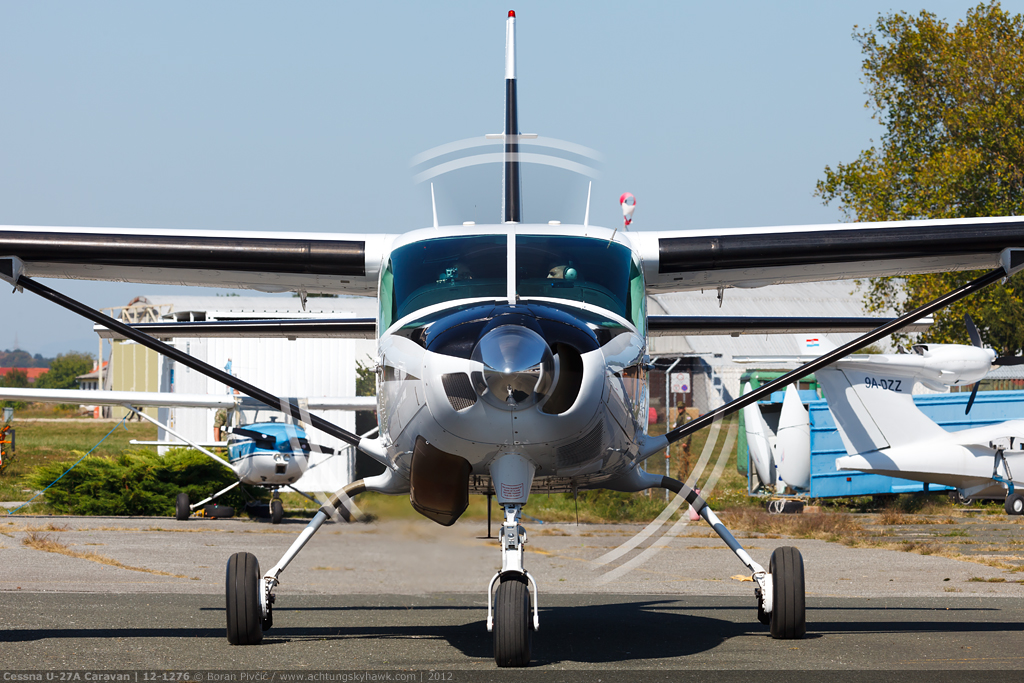


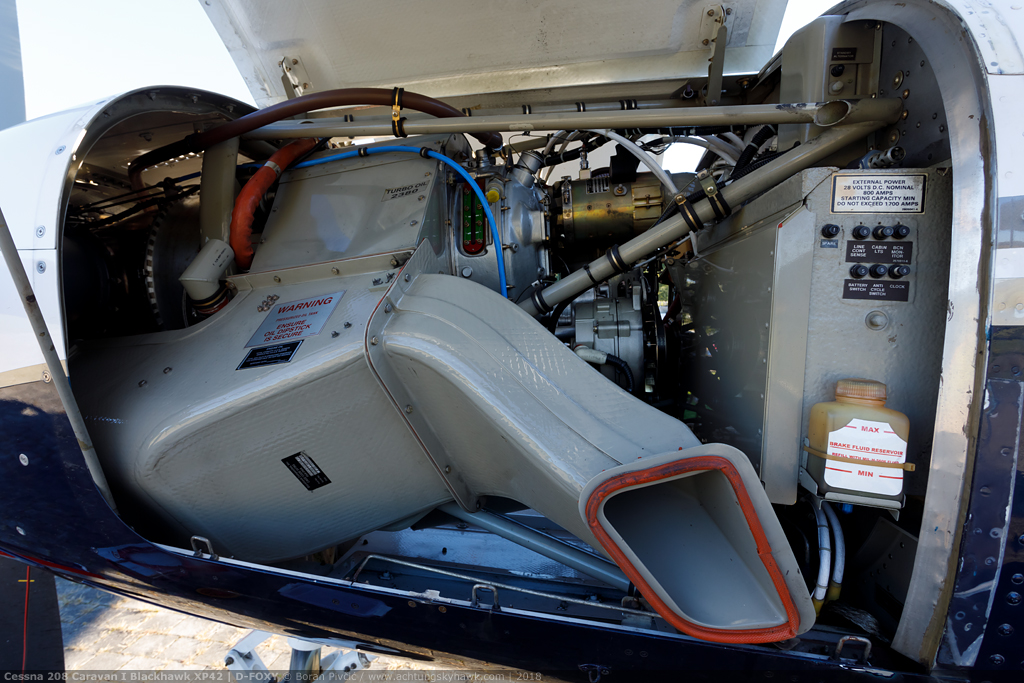


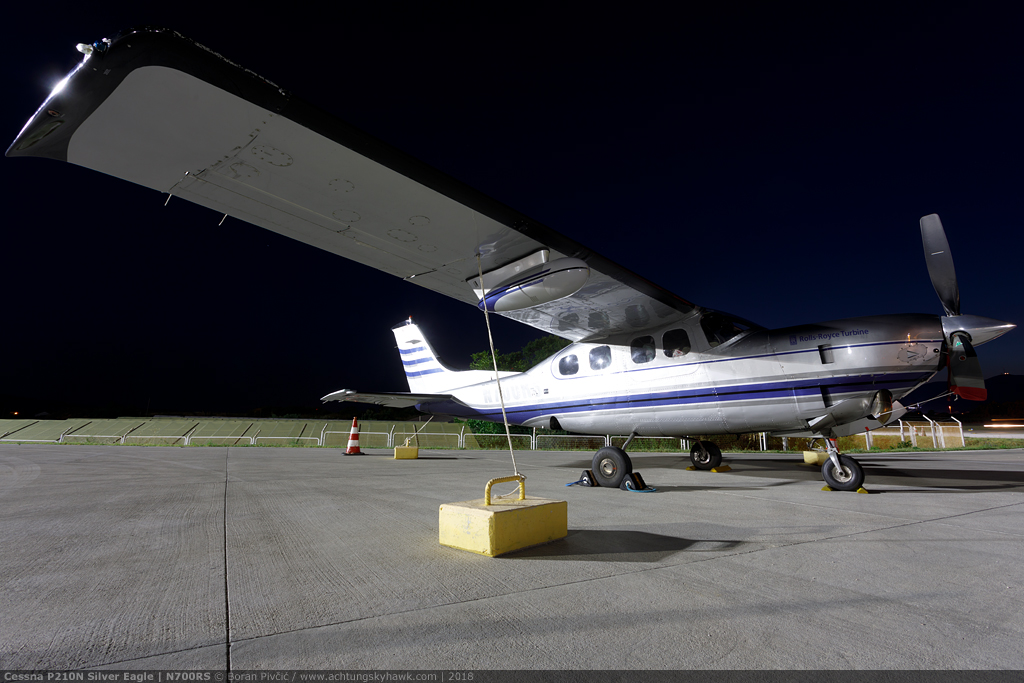


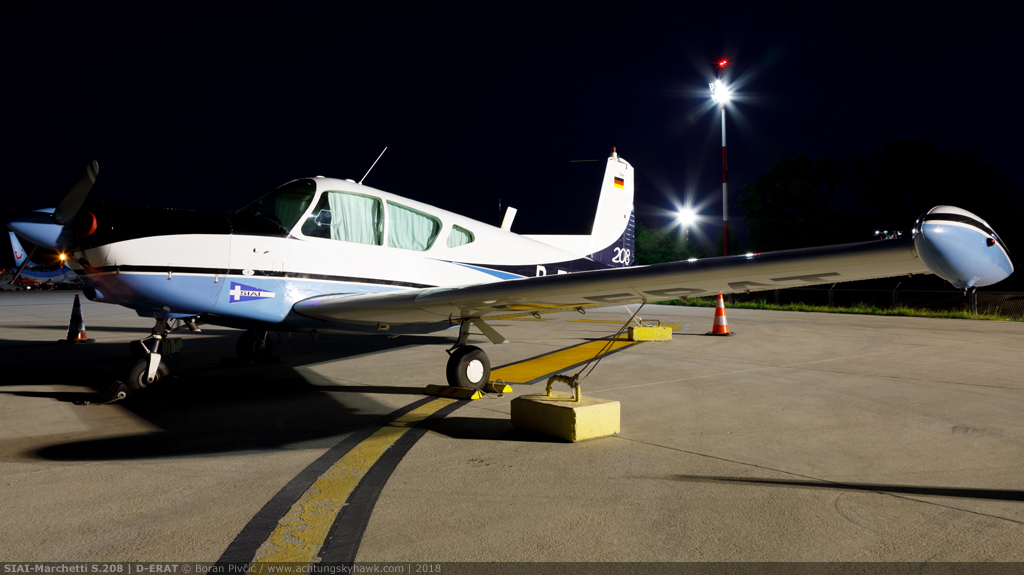
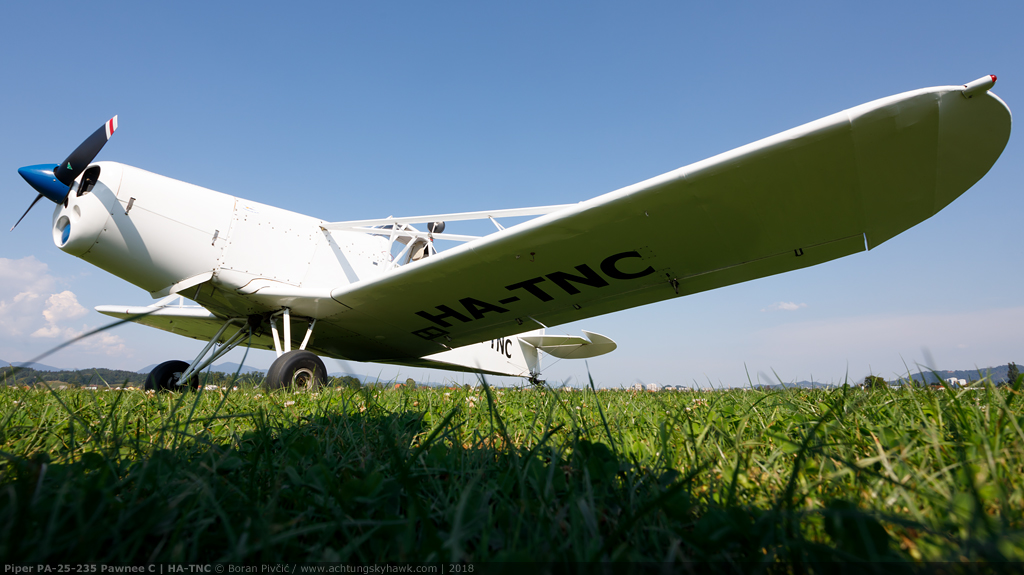
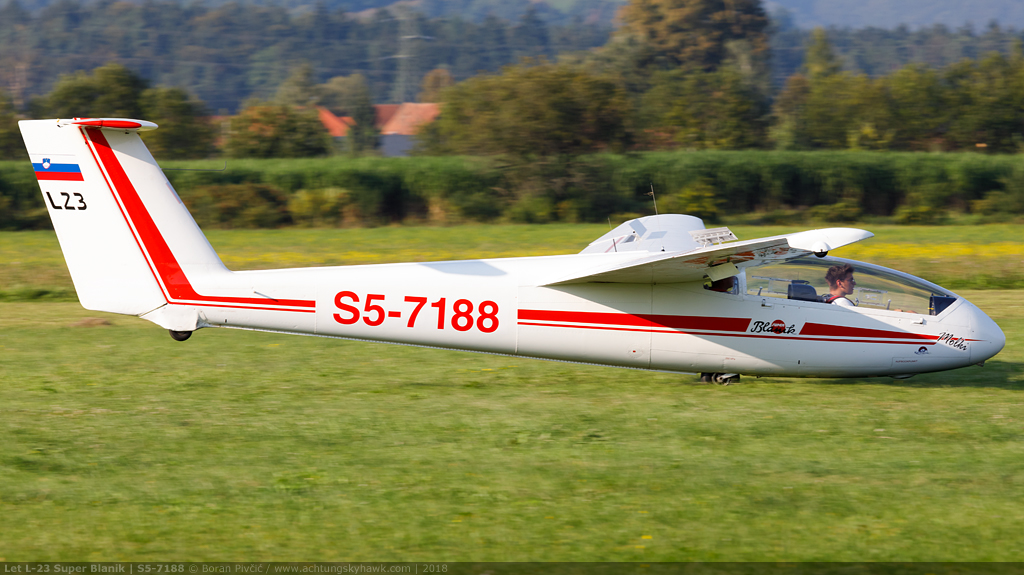
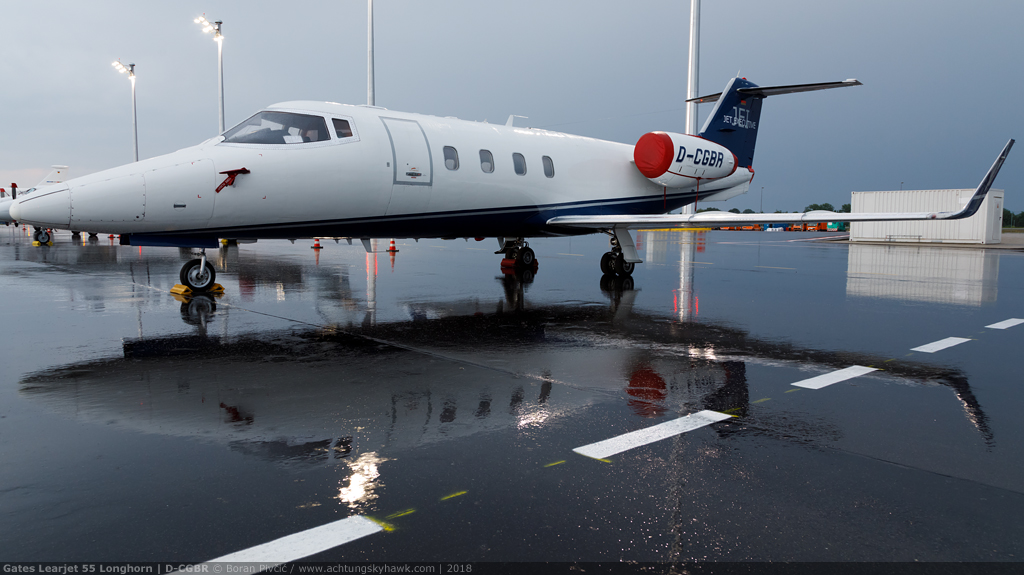
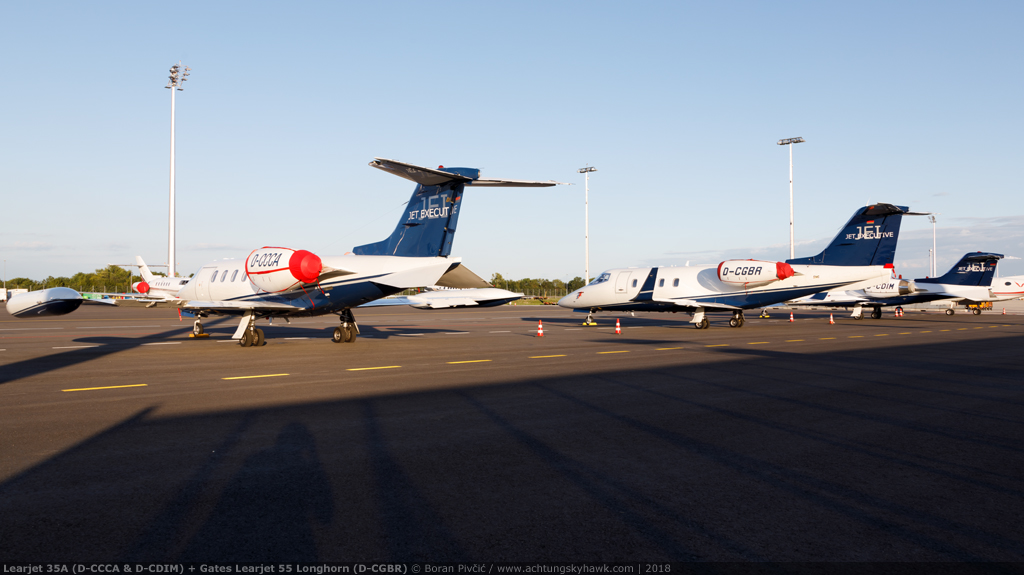


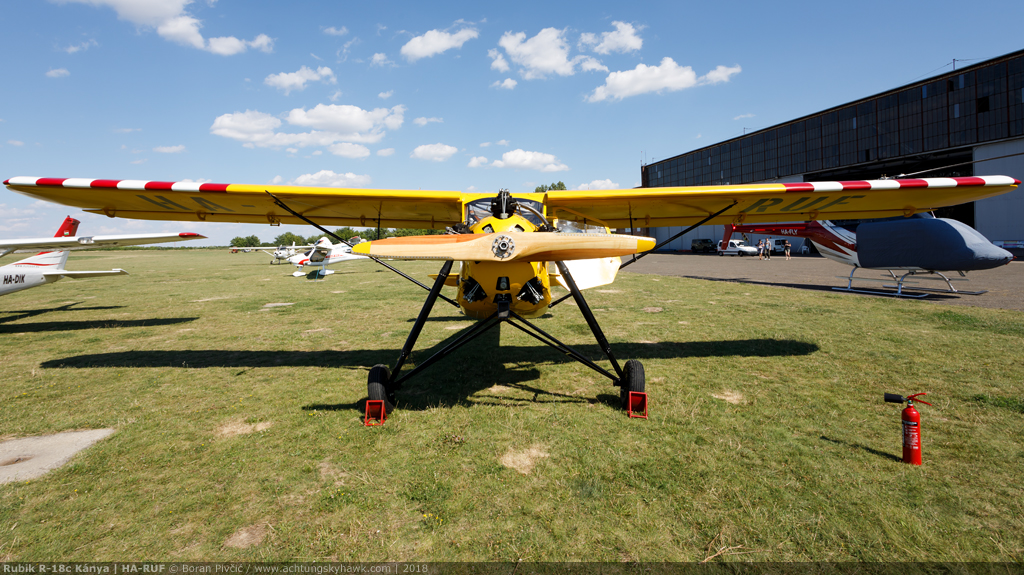


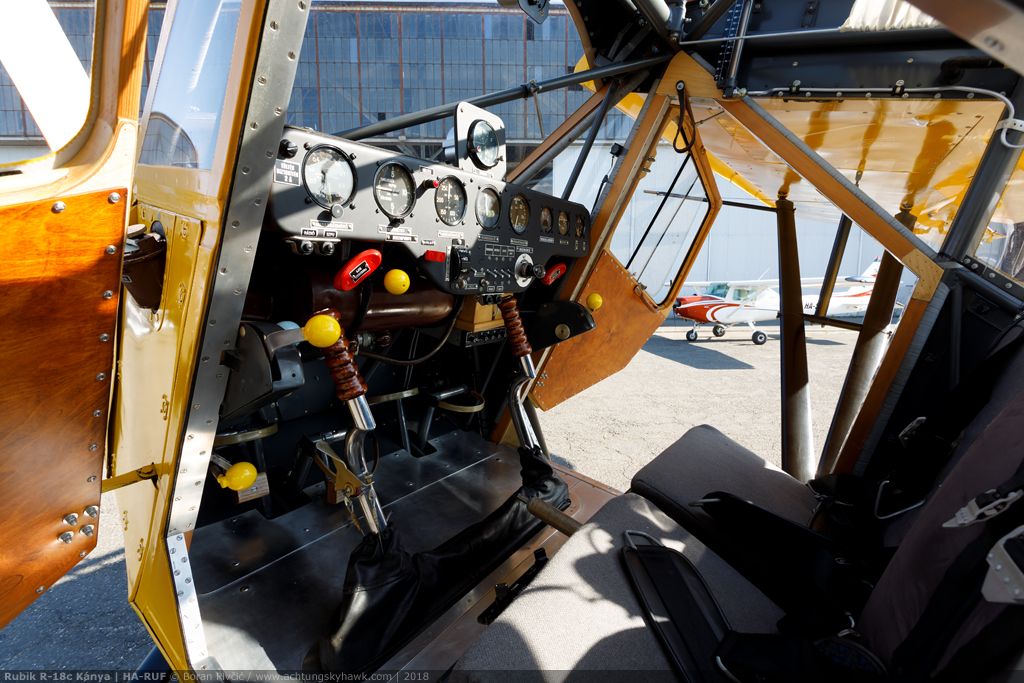

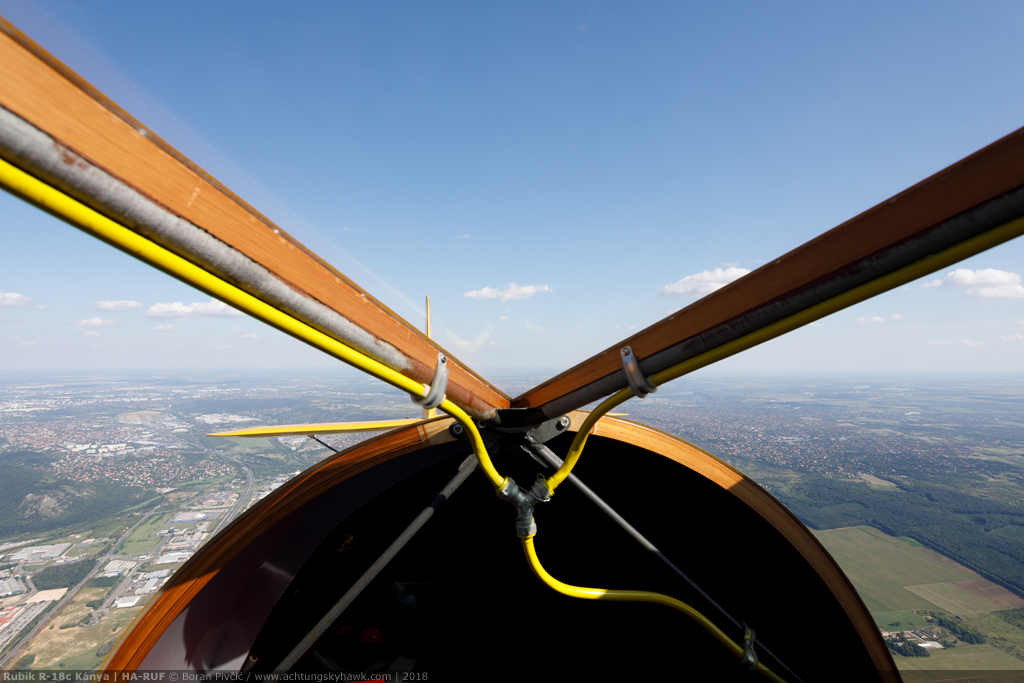

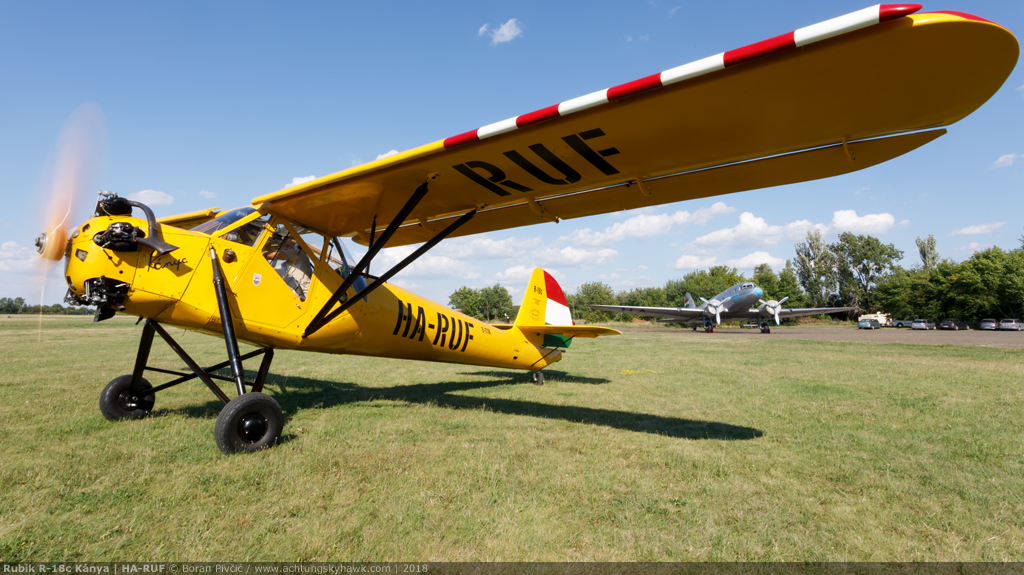


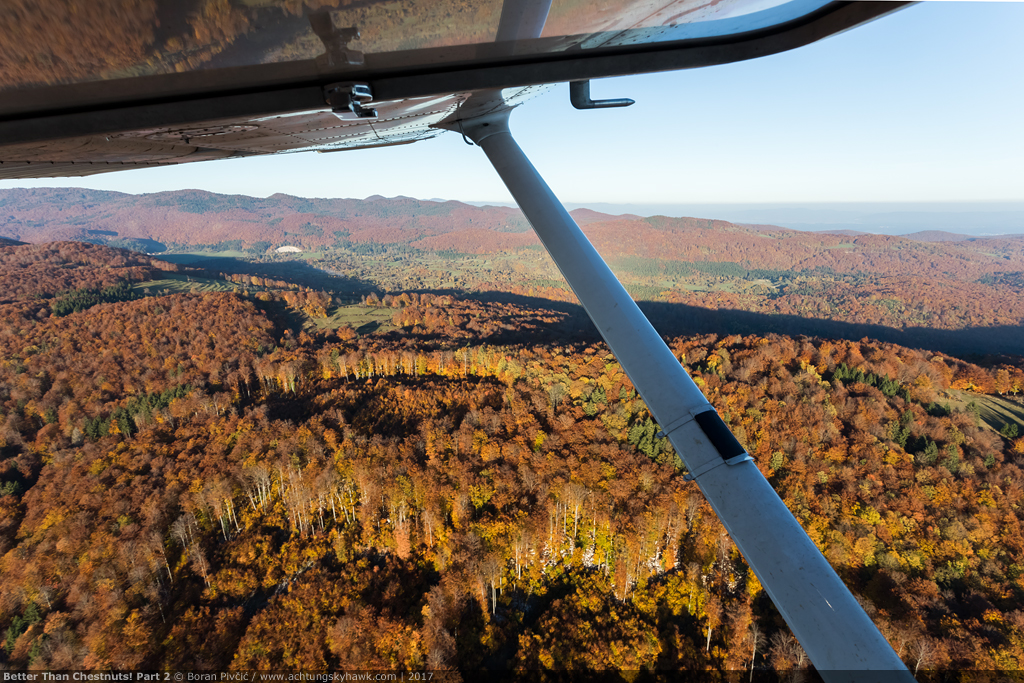
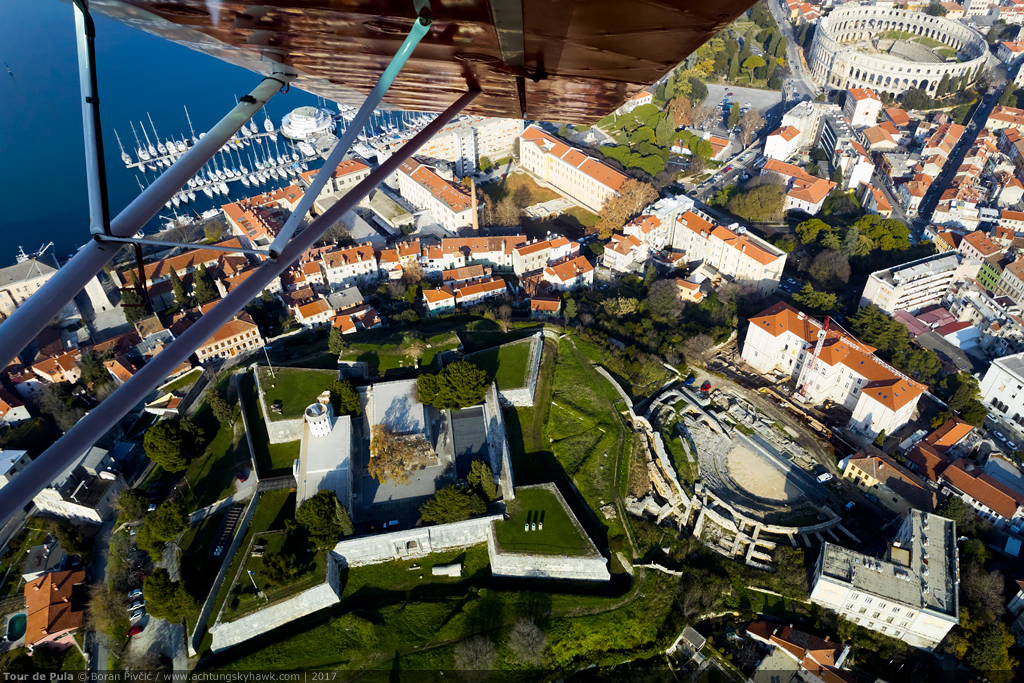





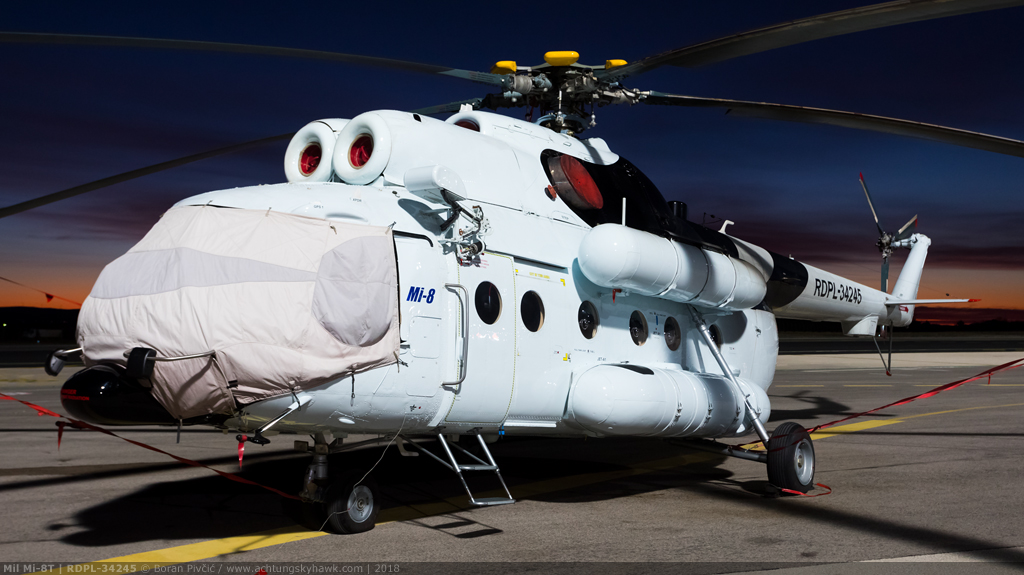


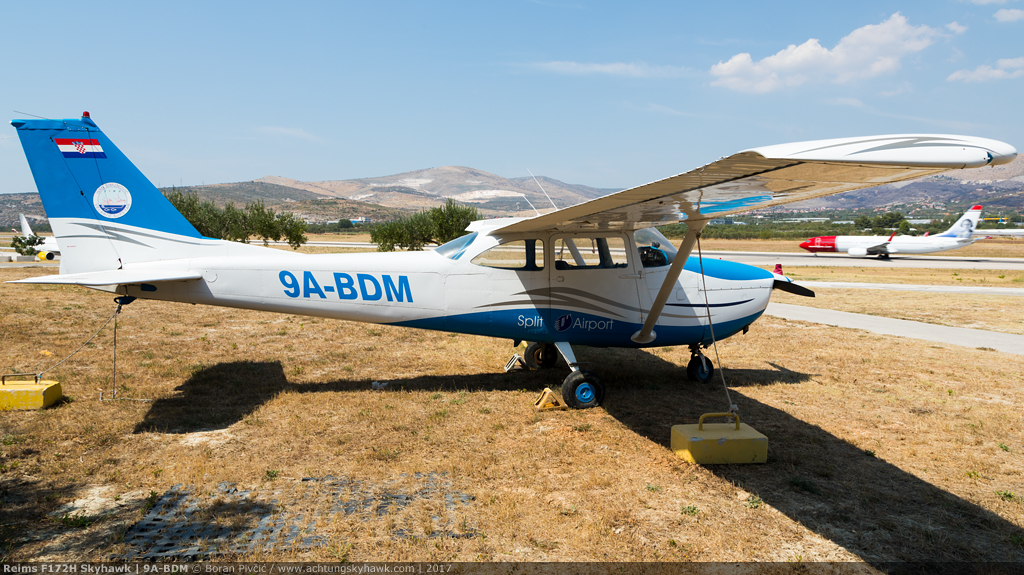


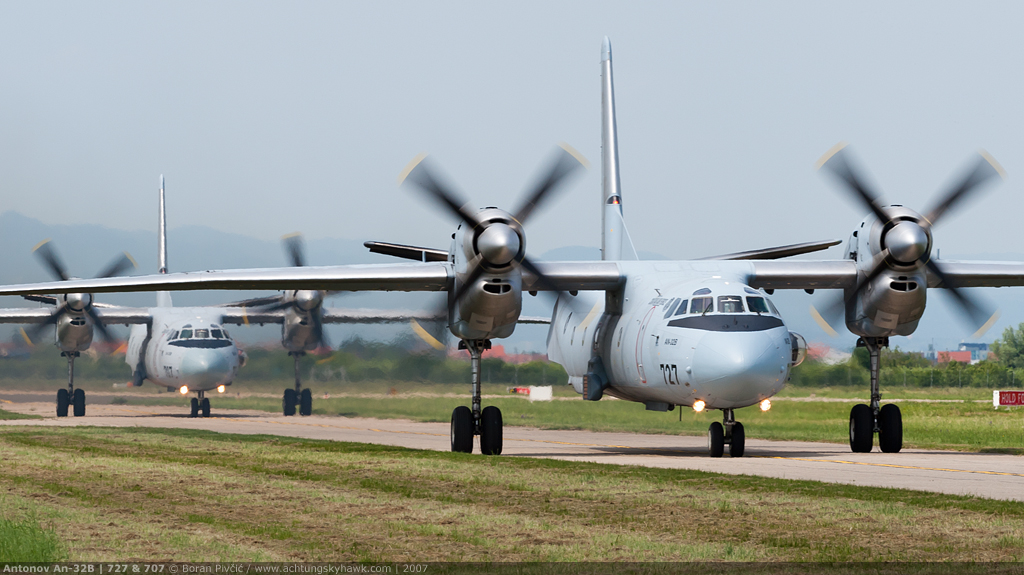

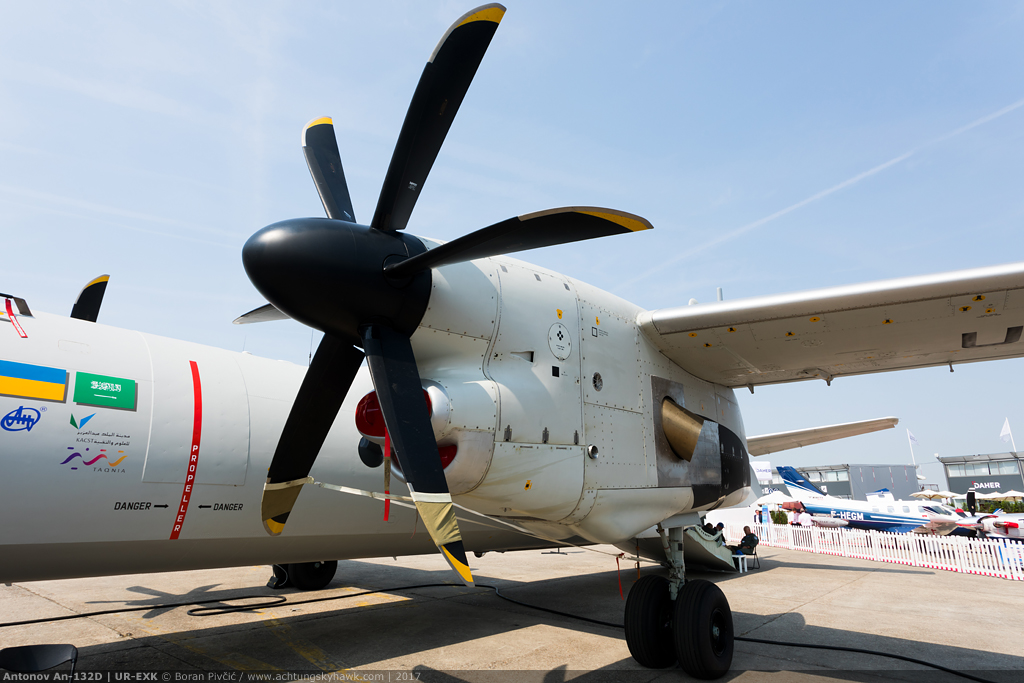


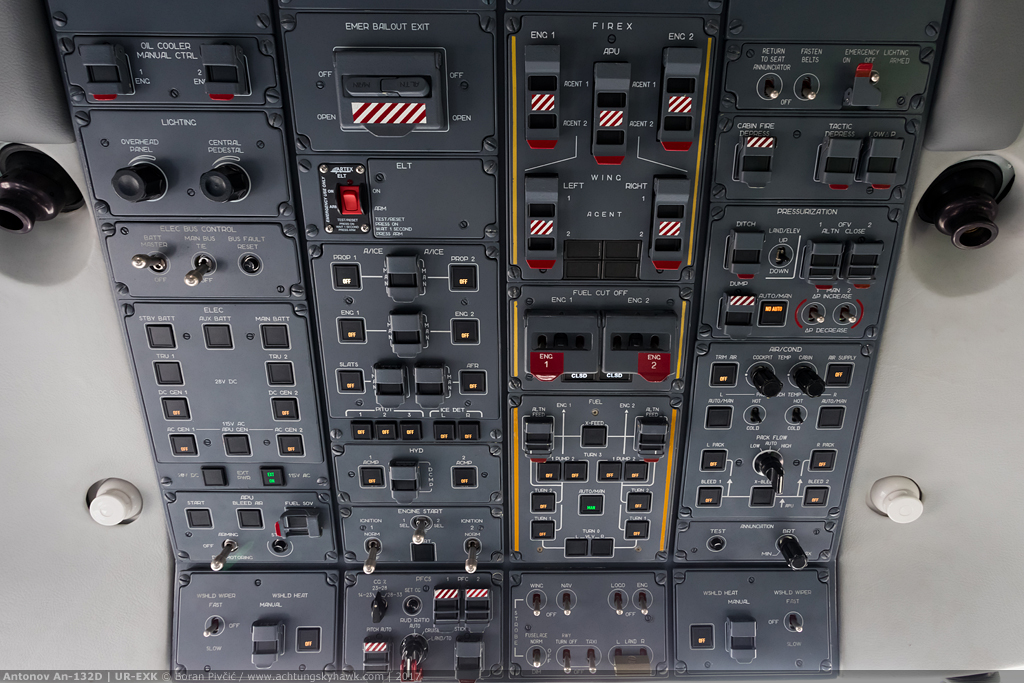
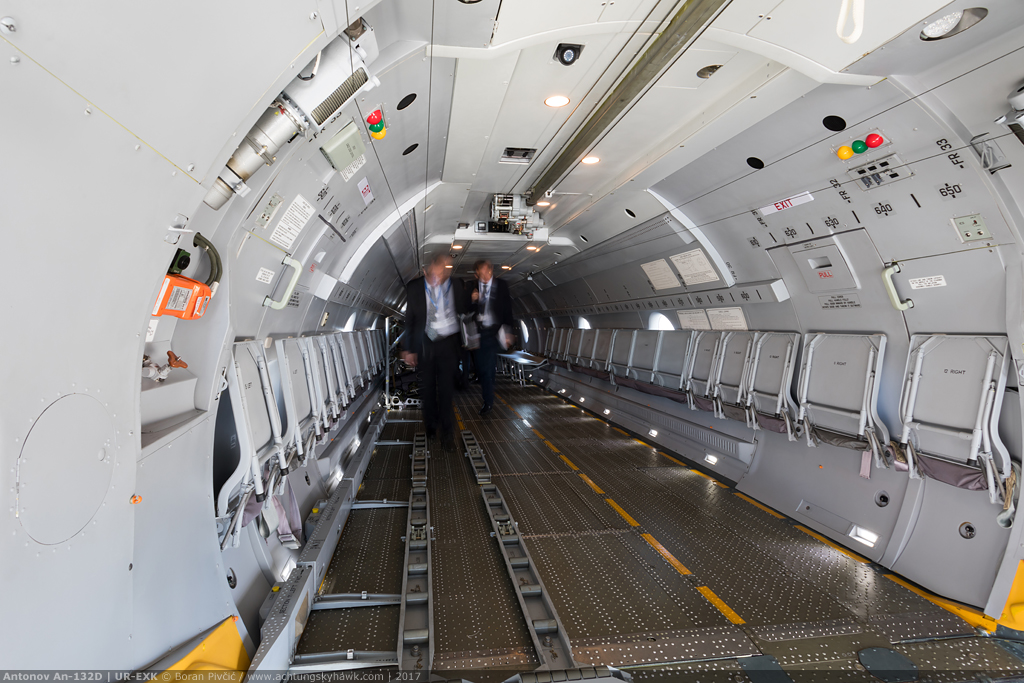




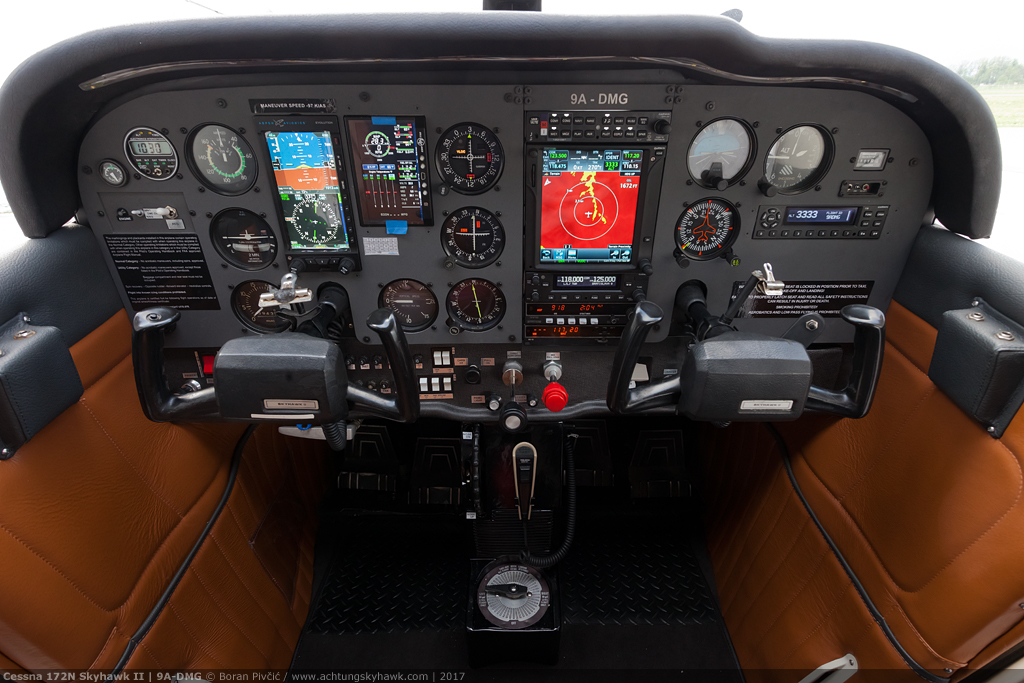
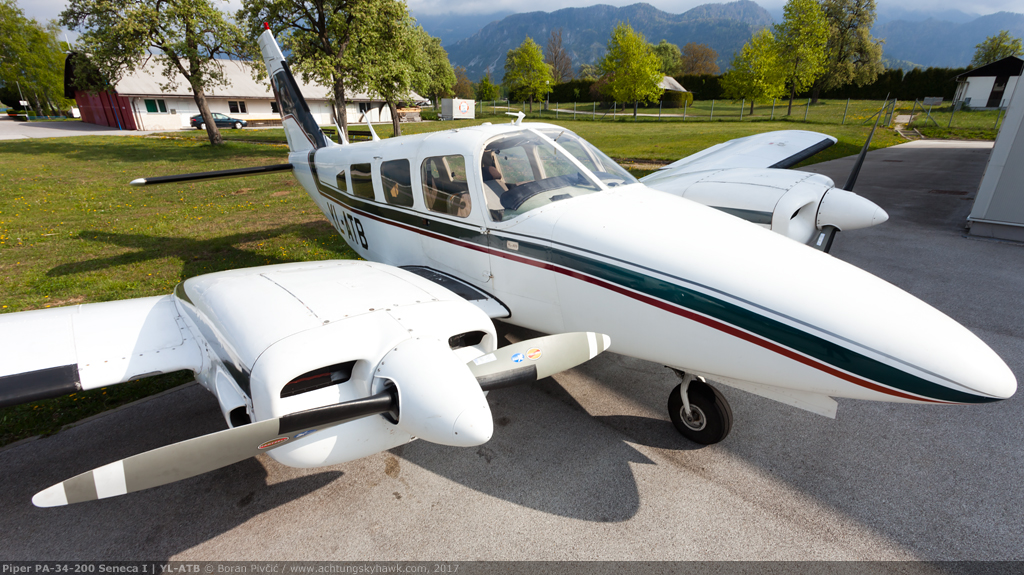
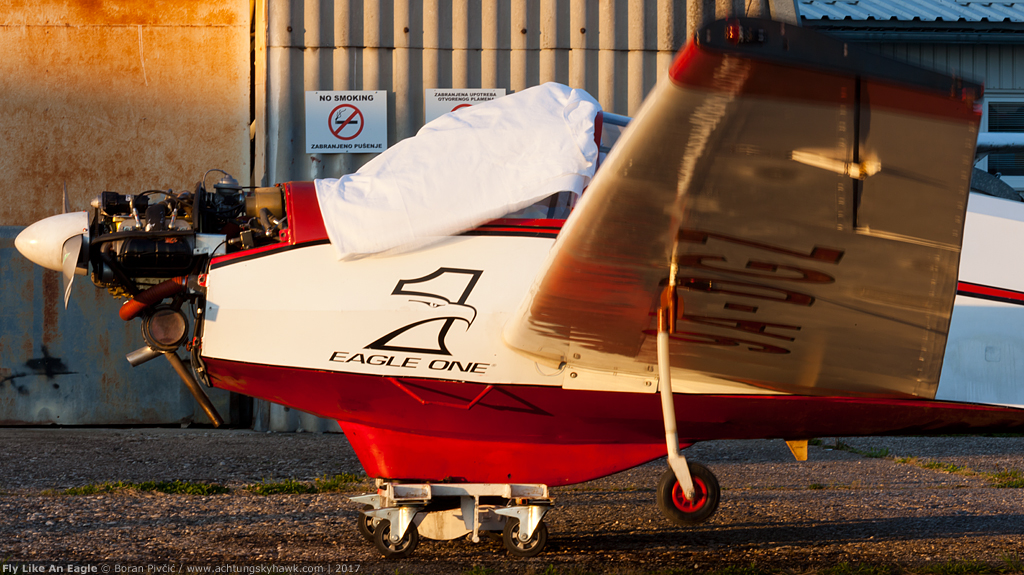
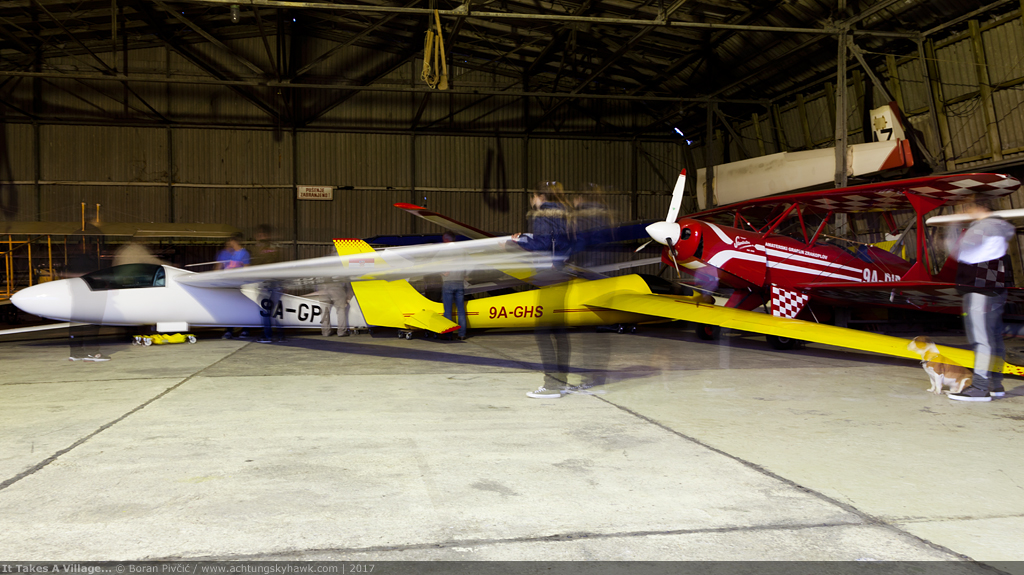
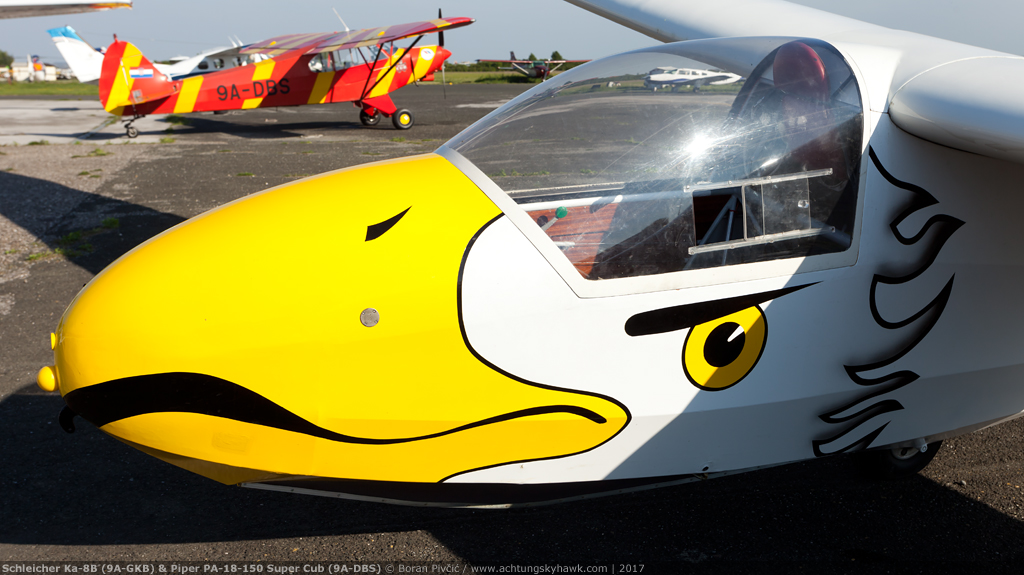
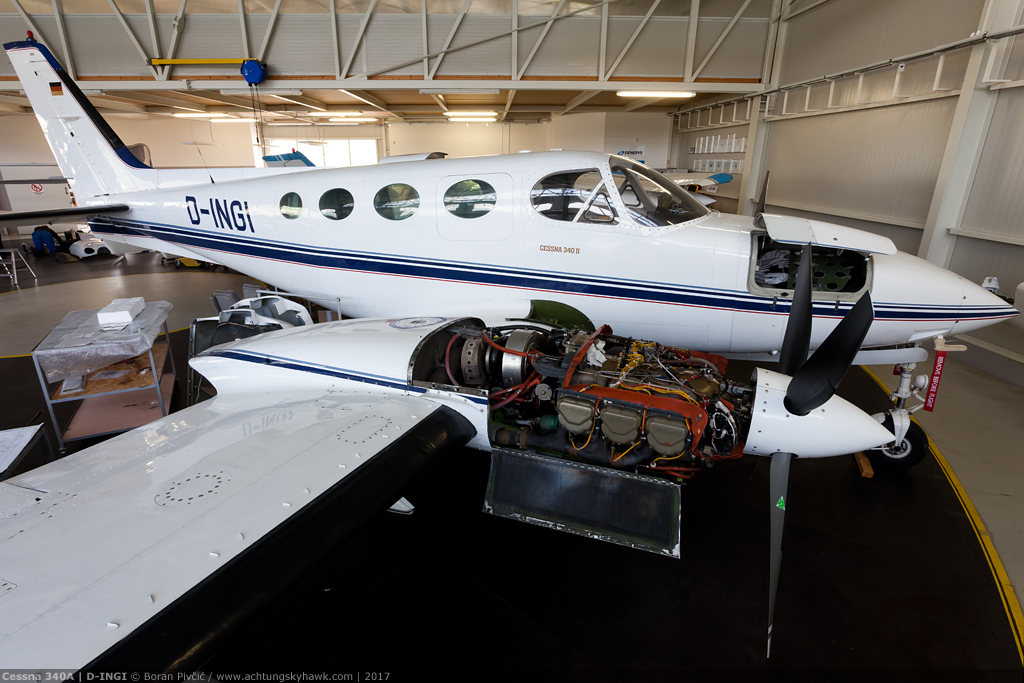
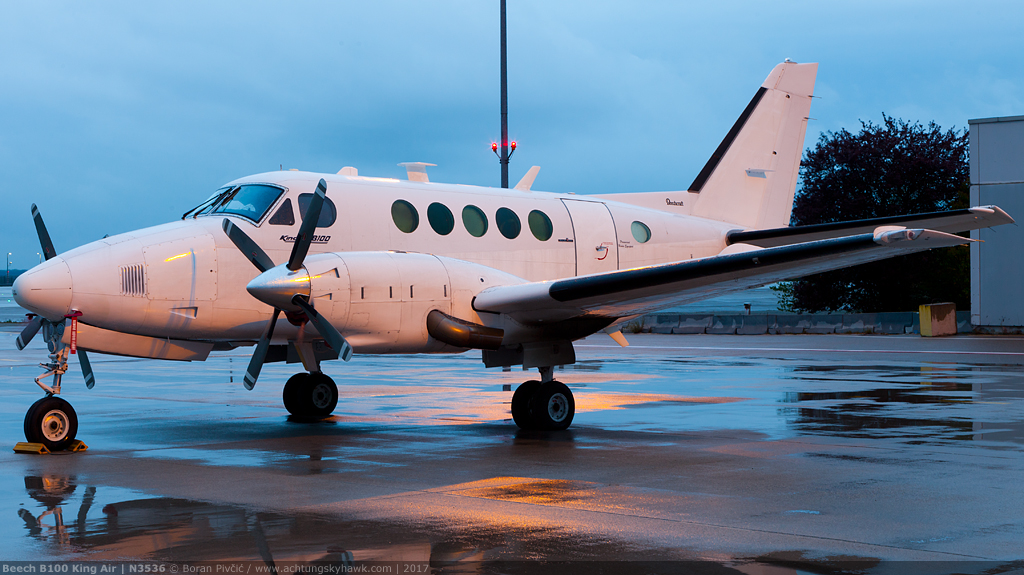
 Achtung, Skyhawk!