By me
All photos me too, copyrighted
It’s the classic story of the Phoenix: one ultralight burns down, and a new one soon rises from the financial ashes to take its place. Having lost their gorgeous TL Ultralight TL-232 Condor Plus D-MULL to a ground fire on 26 MAY 2025 (thankfully without any injuries), the three of my mates who had owned it all adopted a weapons-grade “shit happens” attitude, pooled their cash together once more, and set out to find a replacement – all within the span of just two months. If that’s not the proper GA attitude, I don’t know what is! 💪
Though another TL-232 was initially on the cards, in the event they went with a stunning B&F FK9 Mk. II TG called D-MRRP, which would become only the second of its type to ever be based in Croatia (the first one, OM-M483, actually being a temporary rental). As was the case with the old D-MULL, you could count on the fingers of one hand the number of days it took me to hop in and take it up for a spin…

Golden Hour with the boys… and airplanes
Funky
While it sounds tame compared to some of the other ones out there, the designation “FK9 Mk. II TG” actually contains quite a lot to unpack. The fun starts already with the 9 – for while it may be the design that had launched B&F as a company, the FK9 is actually the ninth aircraft penned by the company’s founder and chief designer, Otto Funk. Originally an engineering apprentice at the Heinkel works of Speyer, Germany (the place with the famous aeronautical museum), Mr. Funk had started designing gliders as a spare time passion project soon after joining the company in 1959. The first one out of the gate was the Greif 1a1, a striking all-metal V-tail single-seater that bore a strong resemblance to the contemporary Antonov A-15. Build using tools from Heinkel’s apprentice workshop, only one would ever be made (D-7142), despite its reportedly outstanding performance by the standards of the day. Its uniqueness would be further improved upon in 1960, when it would be rebuilt into the Greif 1b, now featuring a BMW 80262 turbojet engine in the lower fuselage for full self-launching and self-sustaining capability. You can probably see already where this article is going…
1 because it was built using Heinkel infrastructure, its formal name should actually be the Heinkel Greif Ia… though it would later be informally rechristened into the Funk FK1 Greif
2 a tiny 40 kg unit that could put out 450 N of thrust, this 1960 design was specifically intended to render winch launches and tow planes obsolete by allowing single-seat gliders to reach 7,000 ft in roughly 15 minutes, burning about 12-13 liters of Diesel in the process. Ironically for a “silent sport”, the 8026 spun at a very vocal 45,000 RPM, which was one of the reasons (cost being the primary one) why it failed to gain any traction.
Interestingly, the same setup was also used on the Hütter H30 TS, designed by the late, great Eugen Hänle. Whereas the Greif pioneered many metal construction techniques, the H30 would do the same for fiberglass; indeed, Mr. Hänle’s experience with crafting the design later helped him set up his own company, Glasflügel – whose H205 Club Libelle was the first glider (and first flying thing of any sort) that I have ever owned 🥰
Then in 1962 came the much improved, much more streamlined, and much much more elegant (albeit less turbojet-y) Greif II/FK2. Of this too only one example, D-7014, would be made; but unlike D-7142 (which was lost in an accident in AUG 1962), the II is still airworthy today, and regularly turns heads at any self-respecting vintage glider meet…

It took me awhile to realize that the Otto Funk who had designed the Greif II was the very same Otto Funk who had designed the FK9… well, better late than never! As was the case with the DV-22 Speed Katana featured in a previous post, I got to see the FK2 long before I could appreciate its provenance… though I did indeed appreciate its looks! Like the Greif I/FK1, D-7014 was also built at the Heinkel shop using Heinkel tools… so, if we were to nitpick, its proper name would have “Heinkel” at the front
1968 would see the appearance of the FK3, an 18 meter all-metal high-performance glider whose impact B&F themselves describe as “The high aspect ratio wings and the modern tapered fuselage were to leave their stamp on the design of modern gliders up to the very present”. That’s as maybe; what is more nerdilicious however is what happened in 1970 when Rhein-Flugzeugbau (RFB) turned the design into a motor glider by sticking a 40-ish HP engine3 driving an eight-blade ducted pusher fan mounted behind the cockpit. If that made you think Edgley Optica, you’d be on the right track; the Optica was indeed one of the designs that had learned valuable lessons from what would become known as the RFB Sirius I4. Another was RFB’s own Fantrainer, which took the concept into high-performance waters by scaling it up into a highly agile, 600+ HP5 advanced trainer for the military (a vid of which was kindly provided by spotting colleague Eddy Meštrović).
3 according to a number of sources, the Sirius I had been flown with a rather eclectic range of engines, starting out with a 48 HP Nelson H-63 two-stroke… then two Yamaha motorbike engines… and finally two 20 HP 163 cm3 Fichtel & Sachs KM48 Wankels. So that’s two-stroke flat four… four stroke inline two… and twin-rotor rotary… all rather understandable, given that the 70s were known for the widespread use of recreational drugs…
4 there was also the Sirius II, though it would be more commonly known as the Fanliner; think Fantrainer, but smaller, fixed gear, just 150 HP, and intended squarely for comfortable long-distance touring
5 the original Fantrainer 400 was powered by a 545 HP Allison 250-C20 turbine as seen in the Bell JetRanger helicopter; the subsequent Fantrainer 600 would switch to the improved C30, developing a juicier 650 HP
The real significance of the FK3 though was that it would become the first Funk design to enter any form of series production, with an 11-unit run undertaken by VFW-Fokker as the VFW-Fokker FK3. Don’t be fooled by the name change however; all of this was still happening at Speyer, VFW having absorbed Heinkel in 1965 before merging with Fokker in 1969.
Then there was the FK4 of 1970, another all-metal competition glider. The sole example made (D-KEUL) would this time be produced by the Academic Aviation Group of the University of Karlsruhe – mercifully shortened to just Akaflieg Karlsruhe6 – under the model name AK1. Its claim to fame was being the first high-performance glider to have a fully retractable powerplant, a 28 HP Hirth F10A1a two-stroke whirling a 1.3 m two-blade tractor prop that would fold backwards into the fuselage aft of the cockpit – a solution still used on virtually all modern self-sustaining gliders.
6 in 30s/40s/50s/60s/70s Germany, it was not unusual for these academic aviation groups to manufacture designs from up-and-coming engineers who had no production capabilities of their own. While many such machines had ended up being produced in small (or even token) batches only, some had actually managed to gain a proper foothold in this manner. Perhaps the best example is the Akaflieg München Mü-13, designed by “upstart” Egon Scheibe. Having been given a much-needed kick start, the Mü-13 would eventually evolve into the two-seat Bergfalke – which, when an engine was applied, would become the Motorfalke. Yes, the same one that would launch the SF-25 Falke family, Europe’s most successful motor glider…
It took until the FK5 of 1979 for Mr. Funk to score his first real dud. Essentially an FK3 with the wings snipped down to 15 m (to make it fit into the more common and competitive 15 m Class), the prototype would reach 80% completion before being abandoned due to, and I quote, “company-specific reasons” at VFW-Fokker.
And then in 1985 came the FK6 – the first aircraft in this whole piece that actually has more than just a tangential connection to the FK9 💪. Its highlights include:
- being Funk’s first proper ultralight (i.e. designed as such from the ground up, rather than being a conversion of a glider)
- the first Funk design to use fiberglass instead of metal
- and the design debut of Otto Funk’s son Peter, who would go on to have a significant part in the creation and evolution of the FK9
A single-seat parasol pusher somewhat reminiscent of the 1983 Aviasud Sirocco (albeit taildragging and with a fetching V-tail), the FK6 could boast very solid performance for its 30-50 HP, with a claimed cruise speed of as much as 120 km/h, and 750 km of range on just 25 liters of fuel. Despite reports of it being consistently superior to similar designs of the time (Sirocco included), the 6 was intended outright to be just an “attempt to build a lightweight construction using the newest technology“, so only three would ever be made:
- D-MBBI, powered by a 31 HP Hirth F22 two-stroke
- D-MTUD, sporting the common 50 HP Rotax 503 two-stroke
- and D-MXOF, a dedicated glider tug with a 51 HP Rotax 462 (also two-stroke)
The design would also briefly reappear in 1994, when the Messerschmitt-Bölkow-Blohm (MBB) consortium developed it into the FK10, a slightly larger tandem two-seat model – though this would fail to gain any traction and remain as a one-of prototype (D-MTDD). And yes, you guessed it: MBB had taken over VFW-Fokker in 1981, so both the FK6 and FK10 were very much of Speyer origin!
Despite being just a testbed, the performance, reception and impact of the FK6 were encouraging enough for Funk Sr. to continue beavering away at the ultralight idea. Though the follow-on FK7 and FK8 would never leave the drawing board (and little to no information on them exists, save for being “FK6 derivations for amateur construction“), Peter Funk’s growing involvement would eventually bring this article back on track with the 1989 FK9… 🥳
On your Marks…
As it stood, the FK9 (then still without the Mk. I suffix) was an entirely conventional side-by-side tractor two-seater, similar in shape, size and layout to the contemporary Rans S-6 Coyote II. Offered only in tailwheel form, the majority would be powered by the Rotax 503, which made them good for 750 FPM in the climb and 135 km/h in the cruise at Maximum Take-Off Mass (MTOM). This compares favorably to another S-6 competitor from the time, the 1992 TL-132 Condor (the 232’s immediate predecessor), which could manage around 500 FPM and 130 km/h using the same engine – a difference that, while small, says a lot about 20+ years of experience in designing high-efficiency gliders, and a foreshadowing of what was to come with the later FK9 marks. More relevant to my Achtung, Skyhawk! sensibilities though was the existence of a handful of Mk. Is using alternate powerplants, either the run-of-the-mill 42 HP Rotax 447 two-stroke, or the very unusual 52 HP Wankel 814TG twin-rotor rotary – both another preview of the delightful nerdiness that awaits on the Mk. II 🥰.
However, while its Funk DNA did indeed give it an edge over its competitors, the FK9 was first and foremost a design intended outright for proper series production – which meant that, by necessity, it had to do away with some of the more avant-garde FK solutions for the sake of ease of manufacture. Whereas previous Funk designs were lovingly and painstakingly hand-crafted in apprentice workshops, the FK9 would have to be produced quickly and cheaply on a far larger scale by a conventional aircraft factory at Krosno, Poland, using whatever common (and/or easily obtainable) production tooling was at hand. Thus, Messrs Otto and Peter went down a more conventional route, employing:
- a fuselage (designed by Peter) of steel tube at the front, and a mixture of steel and aluminium tubing from the cabin backwards, all wrapped in Ceconite fabric (except for the cowl, obviously)
- and a wing (designed by Otto) built around aluminium spars and cabon-aluminium ribs also covered with Ceconite, with aluminium/Ceconite ailerons, flaps and elevators all mated to a control system taken from the stillborn FK8
Minus the prototype (D-MJKF, which the Funks had built in their own garage), 33 Mk. Is would be produced between 1992 and 1994, by which time the Krosno works would begin to prepare for the 1995 arrival of…
… the Mk. II
Essentially “just” an evolutionary development of the Mk. I, the Mk. II came about because the Funks wanted to make the design capable of accepting both a broader range of engines (as the 447 and Wankel options had already suggested) – and a broader range of power outputs. Changes to the structure were kept to the minimum necessary to accommodate a wider variety of engine mounts and associated stresses, and were actually fine-tuned “live” over the first 20 examples made. With anything between 45 and 80 HP now possible7, the Mk. II diverged into two regulatory versions, one with an MTOM of 400 kg, the other with 450, the applicability of which depended on the available power. The former limit applied if you went with our old friends the Rotax 462 or 503 and the 814TG… while the “full fat” 450 was available if you opted for the:
- garden-variety 80 HP Rotax 912UL
- its perennial competitor, the 82 HP Jabiru 2200
- and the quite exotic Ecofly M160, essentially a Mercedes-Benz M160 0.6 liter turbocharged inline three out of the Smart ForTwo city car converted for aviation use. Depending on the version, the power output could be either 55 or 82 HP
Fascinated by this variety, I trawled a bit through the classifieds and various photo databases to try and see which of the above were actually used on real airplanes – as opposed to just offered on paper or submitted for the sake of legal documents. Unsurprisingly, the 912 took a clear lead, followed by the 503; the more powerful 582, interestingly, came in third, while bringing up the rear was the M160 – all but one in the more powerful M160/1 variant. No mention of the Jabiru, Wankel and 462.
7 despite the nominally low figure (with other aircraft of this class, such as the TL-232, regularly boasting 100 HP or more), the Mk. II’s glider heritage means that it makes excellent use of its power – so much so that the 912 model is even capable of being a rather capable tow plane. OK, heavy competition machines are beyond its capabilities… but stuff up to 580 kg MTOM is quite doable. Indeed, one flying club in Germany has successfully towed single-seaters such as the Schleicher Ka-6, Ka-8 and ASW19, the Grob G.102 Astir and the Neukom Elfe… and even some lighter twin-sticks, such as the very popular Schleicher ASK13 and the ubiquitous Let L-13 Blanik
The only other major difference was that the Mk. II was also offered with the option of a tricycle gear (w/ fully steerable nosewheel), aircraft so equipped receiving a TG suffix to their name. Indeed, the similarities between the two marks are such that I even found an instance of a Mk. I (D-MOKL) being converted into a Mk. II in 2006 by Otto Funk himself (and sporting a 55 HP M160 nicked from a later Mk. III; pure Achtung, Skyhawk! theater).

While it may lack the sweeping elegance of today’s Mk. VI, the Mk. II is not a bad looking machine – not by a long shot. Although the wing struts may appear to be inconveniently placed for entry into the cabin, getting in is surprisingly straightforward even for my (quite uncoordinated) 1.9 m: slide your backside into the seat from in front and simply pop your legs in… that’s it
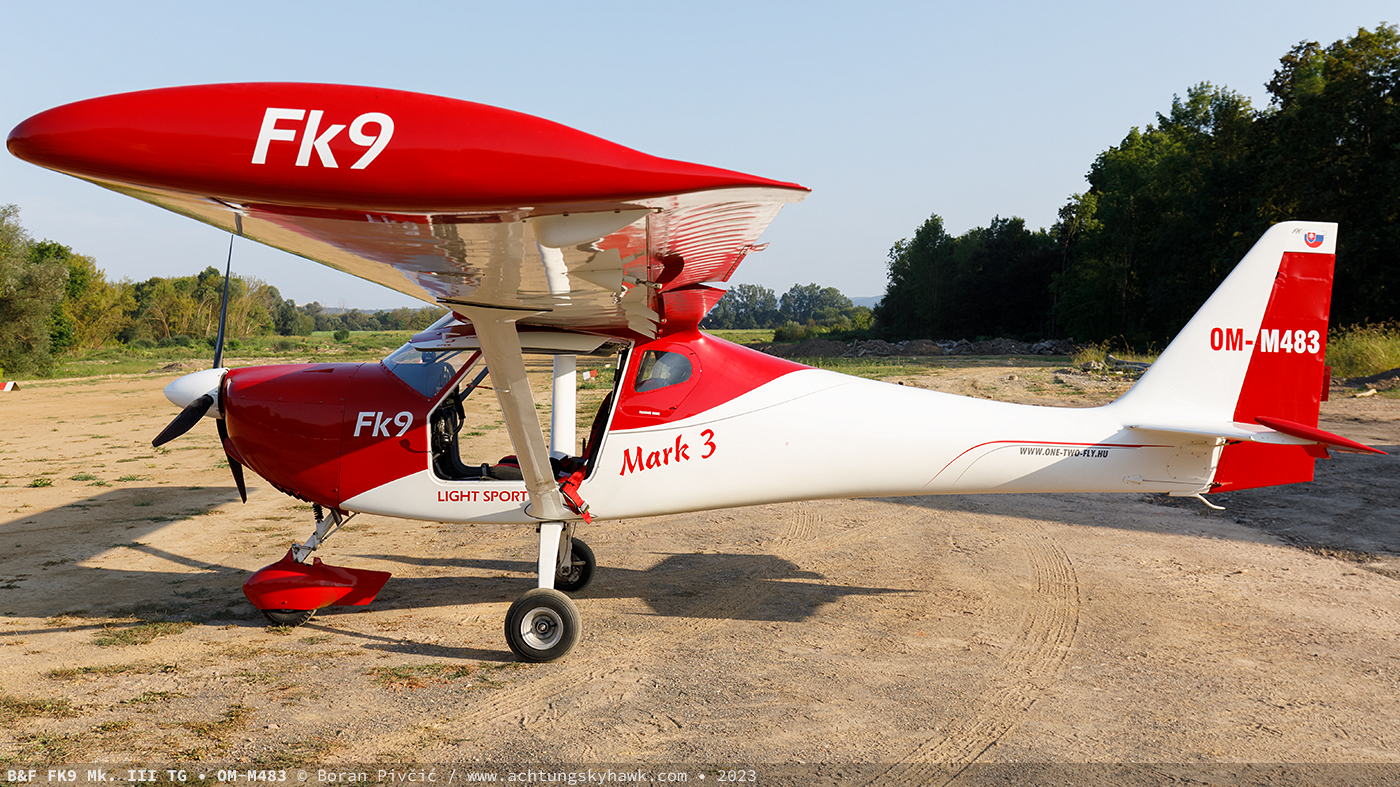
Debuting already in 1997 on the coat tails of the Mk. II’s financial success, the Mk. III would realize the design’s “full Funk potential” by going nearly all composite (except the flight controls, which were still fabric covered). Other notable changes included redesigned vertical and horizontal stabilizers, as well as different control linkage for the ailerons and flaps (external links w/ internal mass balancing, the exact opposite of the Mk. II setup). Unlike the Mk. I and Mk. II, the performance and price differences between the II and III were such that both would actually be kept in side-by-side production for awhile due to customer demand. And on an entirely subjective note, the Mk. II’s cockpit feels narrower than the Mk.III’s… but also taller. Whereas in the latter I had to “keep a low profile” to avoid hitting my head against the upper crossbeams, in the former I could sit normally upright without issues – though, admittedly, this may simply be down to the design of the seats themselves and/or the thickness of their cushions
Return Of The Gästeflieger
As can be seen from the photos, D-MRRP itself is a pretty standard FK9 Mk. II TG, manufactured in 1995 with the serial 09 050. Up front there’s a normie 912UL driving an equally unremarkable (though very efficient) three-blade Woodcomp Propuls 174 ground-adjustable prop. Historically too nothing much stands out, save for a forced landing due to an engine failure in 2016, which resulted in the collapse of the nose gear and damage to the propeller, requiring their replacement.
Having relocated to its new home at Čakovec (LDVC) in mid AUG 2025, D-MRRP would immediately be put through its paces – not least of all by me, flying it in literal circles for minutes on end attempting to get a good cockpit shot… 😑
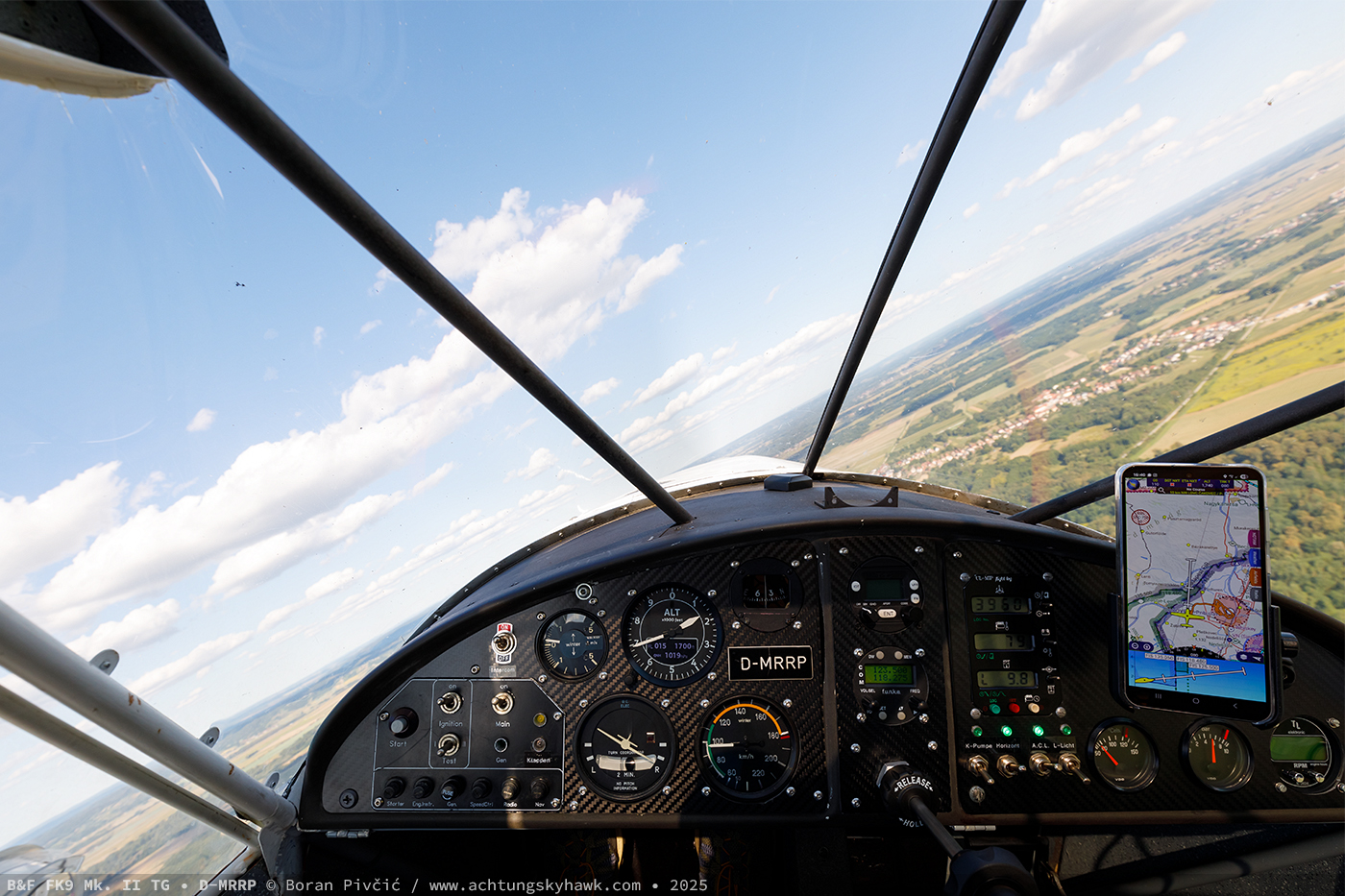
Fun is not a straight line… nor a particularly fast one, but I’m not complaining. One of the things that had immediately caught my eye was the airspeed indicator scale: goes all the way up to 180 km/h, but the yellow arc (above maneuvering speed/calm air only) starts at just a tad over 115. This, I suspect, may be due to the combination of a high lift wing and a lightweight main spar, making it rather easy to overstress with a full control deflection/any rapid increase in load at speeds higher than 120-ish km/h. Since it was a bumpy day with a lot of thermal turbulence – and I wasn’t really in a hurry to get anywhere – I decided to stick to conservative speeds and simply take in D-MRRP’s very elegant panel. A feature I particularly like is the tinted foil on the transparent roof panel, whose Visible Light Transmission (VLT) factor provided more than adequate ambient lighting (as seen here) without burning my scalp to a crisp

For us in-flight panel photography nerds, the FK9 has the same problem as virtually every other high-wing ultralight out there: you need to bank & bank some more to finally get the sun to illuminate the whole panel… however, the effort was worth it, particularly over water!

Though this may simply be down to my eye height (a consequence of being tall and insisting of squeezing myself into small airplanes), but I found the view out to be outstanding in nearly all directions, even in high angle-of-attack situations. More importantly, I could turn my head sideways without having to look at a door sill or the interior of the wing, which is definitely an A++ in my books! (and yes, I know the ball is not perfectly centered in any shot so far; the FK9 likes to wag its tail in turbulence and has a very touchy rudder – far more than any other UL I’ve flown – both of which took me a while to get used to)
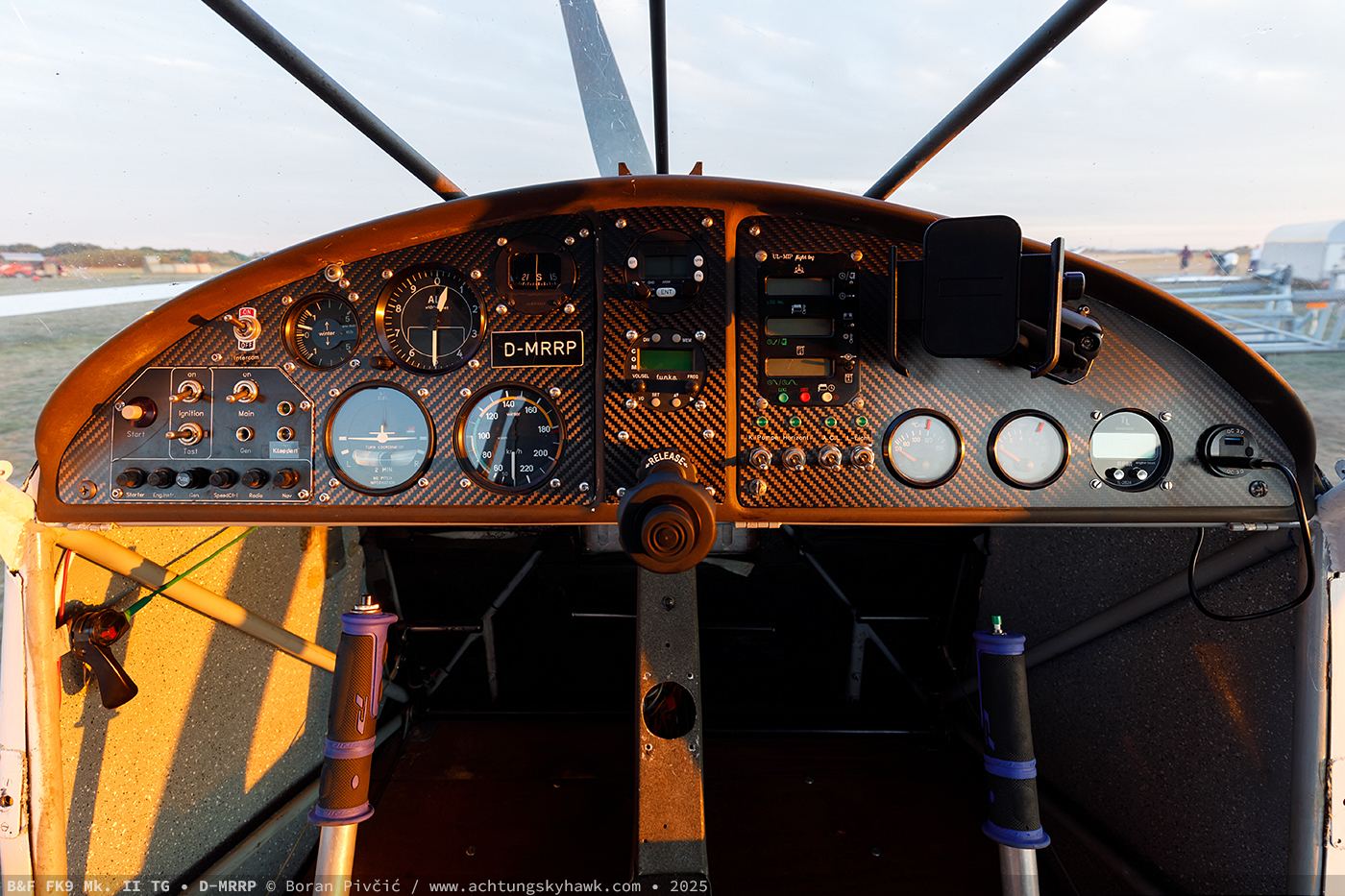
A clean & tidy panel, with everything you really need; could stare at this for hours. There’s a Funke ATR833 com radio and a Trig TT21 Mode S transponder in there, with the rest of the electronics rounded out by a Kanardia Indu electromotor-driven altimeter and a TL Elektronic TL-8284 tachometer (though it is not used, and engine RPM is instead shown on the UL-MIP Flight Log). The one thing I really don’t care about is the Rotax throttle lever; you twist it left-right to fine-tune RPM – but for bigger and more rapid changes you have to press & hold the button on the top of the lever and then move it backwards & forwards. Trouble is, it moves in discrete steps (and holding the button for anything more than a few seconds is far from comfy), so ultra-fine power and rate control on landing is very difficult. As one of my colleagues would say, “an over-engineered solution to a problem that barely exists”

Another thing to get used to is the wheel brake lever, visible just in front of the left seat; it’s not the location that’s unusual so much as the fact that you have to push it forward to apply the brakes, a solution that I haven’t seen in any other ultralight so far (any brake lever is always pulled back). Some people also find the stick movements odd, since both are joined to a single shaft running through the tunnel between the seats – meaning they don’t pivot around a point in front of the seats, but rather to their side. To roll left you thus move the left stick left-down and the right stick left-up; while to roll right it’s right-up for the left and right-down for the right… i.e. the same sort of movement as a traditional yoke. With 25 years of experience on them, this movement felt perfectly natural for me… but I can imagine that glider and UL pilots, trained 99% of the time on conventional sticks, might find it disconcerting at first. Then there are the doors: you cannot fly with the doors open, but you can fly with them removed, in which case your max speed is limited to 100 km/h (to reduce twisting moments on the rear fuselage by the air rushing into the cabin, something that has cost many a skydive Cessna dearly!). Also note the choke lever on the left sidewall, which is essentially a gear shifter from a bicycle; sounds LOL, but actually makes a lot of sense, since its mechanism frees you from having to hold the choke lever continuously during start
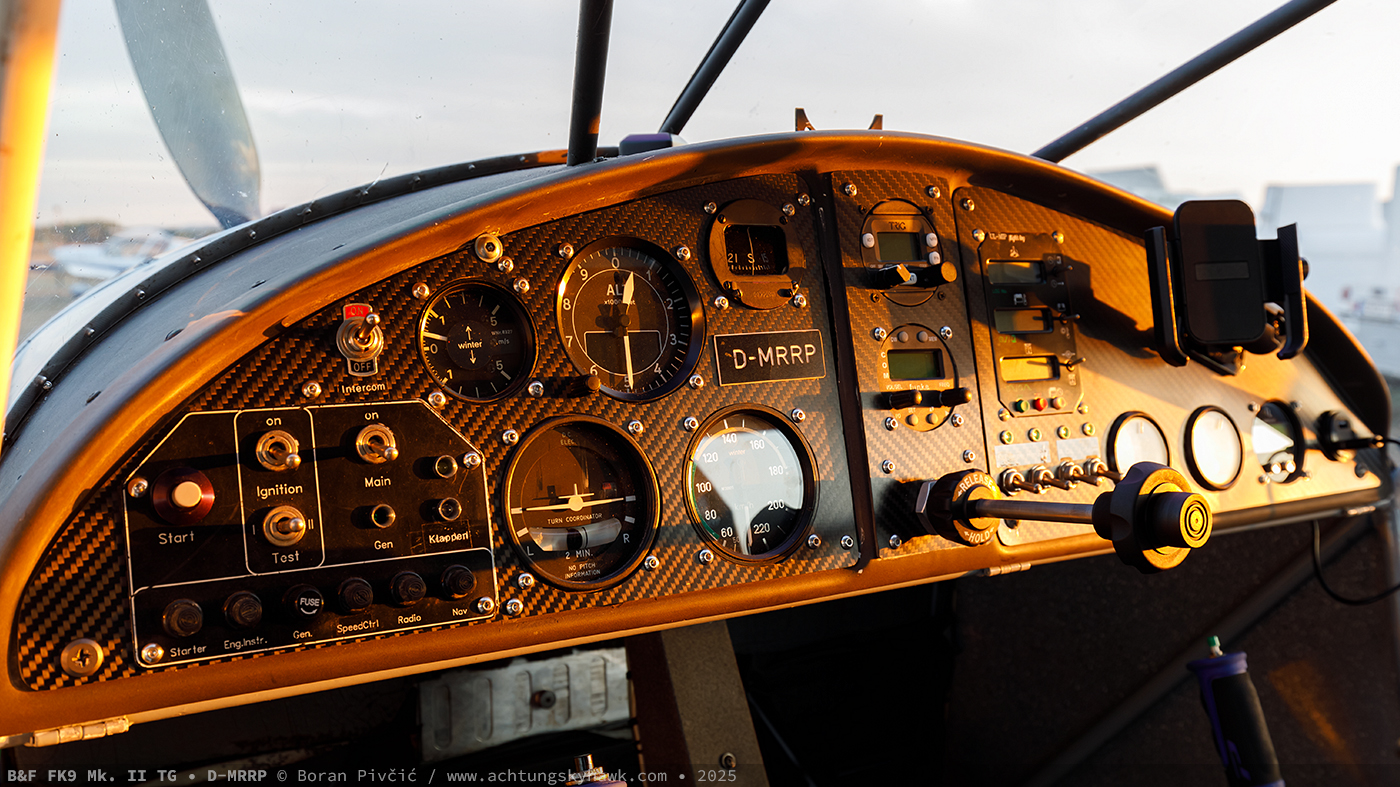
Just flexing the glorious sunset a bit. Apart from its specific convex shape, a dead giveaway that you’re looking at an FK panel are the combined electrical/starting controls on the proprietary panel on the left. The main upshot is that you only need three switches to start the engine, all in line: Main Electrical ON, Ignition ON and Start PUSH (that’s if we ignore the boost pump switch on the right, and the electrical kill switch down by my left leg). On dual ignition engines (which all 912s are), the ignition switch turns on both circuits at the same time – but they can still be individually tested using the spring-loaded I-II switch (which kills the opposite side circuit when toggled)

Outside, the design is peppered with the sort of aerodynamic touches that leave little doubt its designers know their way around a glider. Some of the more conventional solutions include gap seals on the elevators, as well as ailerons that droop with flap extension (i.e. flaperons)… but there’s also more exotic stuff in there as well. For example, when fully retracted (at notch 0), the flaps are actually deflected upward by 10° (visible on the left flap), which significantly lowers the inner wing section’s angle-of-attack. This in turn means the speed of the airflow must increase in order for the wing to generate the necessary lift, allowing (and in fact “forcing”) the whole airplane to fly at higher speed in order to fly at all. Called negative flaps, this is a standard feature on high performance competition gliders – and one of the keys as to why this airplane does what it does on just 80 HP. The downside though is that the wing’s low speed performance tends to suffer, with a stall speed at notch 0 as high as 85 km/h – quite a high figure for a 450 kg aircraft with a large wing. Selecting the flaps to notch 1 gives a deflection of 0° and reduces the stall speed to 73 km/h… while dropping them down to the final notch (2) gives a 10° downward deflection and 68 km/h for the stall (just 20° of flap travel in total… absolutely shocking for a professional DeHavilland Canada/Bombardier driver!). Other noteworthy features visible here are the towing system mounting point below the tail (although the actual hook and release mechanisms are NOT fitted), and the single-point refueling port on top of the fuselage just above the second “R”, feeding two 20 liter tanks located just behind the seats
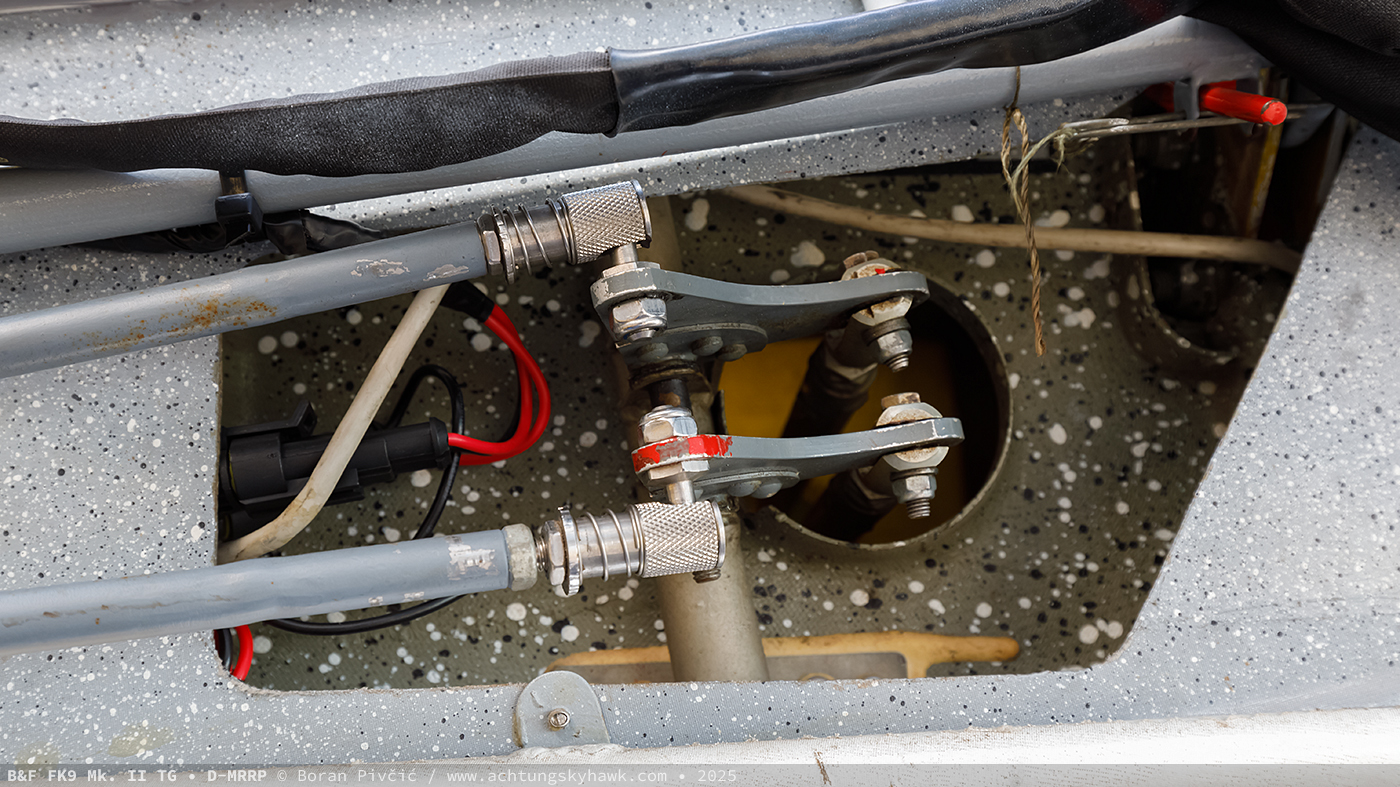
Both the Mk. I and II came fitted with a wing fold mechanism as standard. Disconnect the aileron and flap linkages, unplug the quick-release connector for the wingtip lights, remove a couple of safety pins – and then simply fold the wing back along the fuselage around a special joint on the rear spar. I’ve been told that an experienced operator could have the job done in as little as 10 minutes…

The centerpiece of the FK9’s performance is undoubtedly its airfoil, a modified Wortmann FX 62-K-153/20 designed for high-performance gliders – and already seen, used and proven on the FK3. Taking off with two of us on board and some 30 liters of fuel (thus maxing out the 450 kg MTOM), we saw an effortless 5 m/s | 1,000 FPM in the climb; during a go-around on a solo flight, I made the mistake of punching full power, with 6-7 m/s | 1,200-1,400 FPM registering on the vario, and acceleration so sudden and surprising I almost ended up with a flap overspeed; and in the cruise, when I found some smooth air and decided to try out 4,200 RPM (a low-to-mid range regime for the 912UL), 120-125 km/h were the figures I saw most often. This is particularly impressive given that I’d seen only marginally higher numbers on the TL-232 – which has 25% more power available – in roughly the same weather conditions, at roughly the same masses and with a very similar three-blade composite prop configured for climbing and hauling

I was quite smitten with the TL-232 when I first flew it… but I think the FK9 may have taken its crown; the airplane is an absolute riot (complicated throttle lever notwithstanding). Like D-MULL, D-MRRP will retain its German registration… and will eventually be refitted with the full glider tow setup
Sources:
- Akaflieg Karlsruhe – AK1 entry
- Deutsche Aero Club – FK9 Mk. II information sheet (PDF)
- Deutsches Museum – AK1 entry
- FK Aircraft – company history (old site, since removed, as well as the new one)
- Minijets – Greif Ib and BMW 8026 entries
- Museo Motori – KM48 entry
- Secret Projects – B&F designations discussion
- the FK9 Mk.I/II Flight Manual
- and Mr. Peter Funk himself, to who I’m very thankful for taking the time and answering a ton of my nerdy questions WHILE ON HOLIDAY
 Achtung, Skyhawk!