Photo File – Gulfs Galore: G-III N32MJ + G-II-B N4NR @ LDZA

By me
All photos me too, copyrighted

Having always been on Team Gulfstream when it came to range-topping business jets – and living in a touristy country where the rich and famous (used to) come to let off some steam – I naturally had plenty of opportunity to enjoy the many fine forms of the Big Gulf. Down at the coast the G-IV, G-V and latterly the mighty G650 were as common as trees, and there was virtually no seaside airport without at least half a dozen of them at any one time.

However, the “older gentlemen” of the family – the original G-II and G-III – had continually eluded me, and several years came by and went until I finally managed to snap one. Making the same mistake as before, I kept thinking “well, that’s it, I’ve seen one now and never again”… right up until they started appearing in measurable numbers all over the place, including – very conveniently – at my base airport, Zagreb Intl (ZAG/LDZA)…

Gulfstream Aerospace G-1159A Gulfstream III • N32MJ

The first one off the bat is a mint 1982 G-III with the serial 460, owned by the basketball world’s own Magic Johnson. Since I do not watch sports, I cannot comment on Mr. Johnson’s professional career; but he is very obviously a man of culture, since – despite everything – he chooses to own an “oldtimer” that’s so loud it has to be silenced by law!

It may be plain while and surrounded by newer, fancier & flashier birds – but N32MJ nevertheless manages to dominate the GA apron with ease!

While these large cabin jets tend to lead comparatively simple and quiet lives, N32MJ has a history that can rival any MD-80: by my count, it had carried 10 separate registrations and passed through the hands of 12 different owners! (the full list can be found at Plane Logger) What is interesting for us here and now is that in 2005 it would pass from jet legend Clay Lacy to court legend Magic Johnson, with the intervening 15 years representing by far its longest stint with a single operator…

So, while this particular airplane probably has quite a few stories to tell, the G-III as a whole has a good one too. While it sometimes takes a keen eye to tell it apart from other members of its extended family, the III is probably the definitive landmark Gulfstream, since it was the one to set the stage – in terms of performance, comfort and style – for all the models that came subsequently. To make it even better, its glorious shape – delicate, elegant, powerful and brutish all at once – actually has its roots in a – turboprop 😀 .

And while the very mention of the P Word may raise a few eyebrows, the machine in question is probably one of the most beautiful t-props of them all: the dashing and elegant G-159 Gulfstream. Grumman’s attempt to offer the business market something better than a converted WW2 light/medium bomber, the G-159 was on its debut in 1958 one of the world’s first purpose-built large executive aircraft, sporting a comfortable and pressurized cabin for 8-24 passengers* (w/ the type’s famous oval windows), an advanced flight deck, transcontinental range and a pair of very loud – but also very tough and reliable – Rolls-Royce Darts rated at 2,190 HP each.

* according to many of the sources I found, the voluminous cabin allowed for numerous configurations with large differences in total capacity. The most luxurious setup seated only eight; the Sardine Can Special could squeeze 24; while the most common variant had space for 10-12. There was even a version called the G-159C (five of which were built), aimed at the regional airline market; a 3.25 meter fuselage stretch brought the total capacity to 37, roughly equal to the much later DHC-8-100

By the mid 60s though, the rise of the business jet could not be ignored anymore; names such as Lockheed JetStar, Rockwell Sabreliner, Dassault Falcon and Hawker-Siddeley HS.125 had grown into a credible threat, which meant that the G-159 could not hope to compete for much longer solely on its superior capacity, fuel economy and airfield performance. To stay in the game, Grumman decided to build on the 159’s success and turn it once more into the ultimate business transport. To that end, in 1966 they took its entire cabin and forward section (including the nose gear), stuck on a bespoke swept wing w/ increased fuel capacity, a rakish T-tail, and a pair of howling Rolls-Royce Spey low-bypass turbofans in the back (still a quieter fit than the Darts!), thus creating the daddy: the G-1159 Gulfstream II**, the first jet Gulf.

** on its introduction, the G-159 – which would remain in production for two more years – would be renamed into Gulfstream I

While a quantum leap in performance over the G-I – being the first bizjet to cross the Atlantic non-stop – by the mid 70s the G-II was itself becoming a bit dated, and would soon start to face some worrying competition from (among others) the upstart Canadair Challenger – the first modern large cabin jet designed from the ground up for the business role. In reply, Grumman would in 1979 take the G-II and:

  • stretch the fuselage by 0.6 meters
  • re-contour the entire radome and windscreen
  • redesign the wing to incorporate 1.8 meters more span and a more efficient leading edge
  • add striking 1.5 meter winglets (inspired by those on the Learjet 28 Longhorn, the first bizjet to carry them)
  • up the luxury to 11
  • revamp the cockpit to include more glass and automation

and christen the result the G-1159A Gulfstream III. Despite having sold only a modest 202 examples, the G-III was such a conceptual hit that it immediately set the standards for what a proper Gulfstream should be (despite its inefficient and gas-guzzling engines).

Indeed, the hugely successful 1985 G-IV – more than 900 sold over multiple versions – is actually a lengthened G-III with a tweaked wing, a full glass cockpit and power provided by modern Rolls-Royce Tay high-bypass turbofans. Even the G-V of 1995 shares the same DNA, being a longer, fully re-winged G-IV powered the brand new Rolls-Royce/BMW BR710. Only with the coming of the clean sheet G650 did the old G-II/III finally decide to lay down and die…

Despite the “Eurowhite” paint job (which is actually new), N32MJ does carry a few tokens of Mr. Johnson’s sporting life: his old basketball team on one side…

… and the baseball team he owns on the other
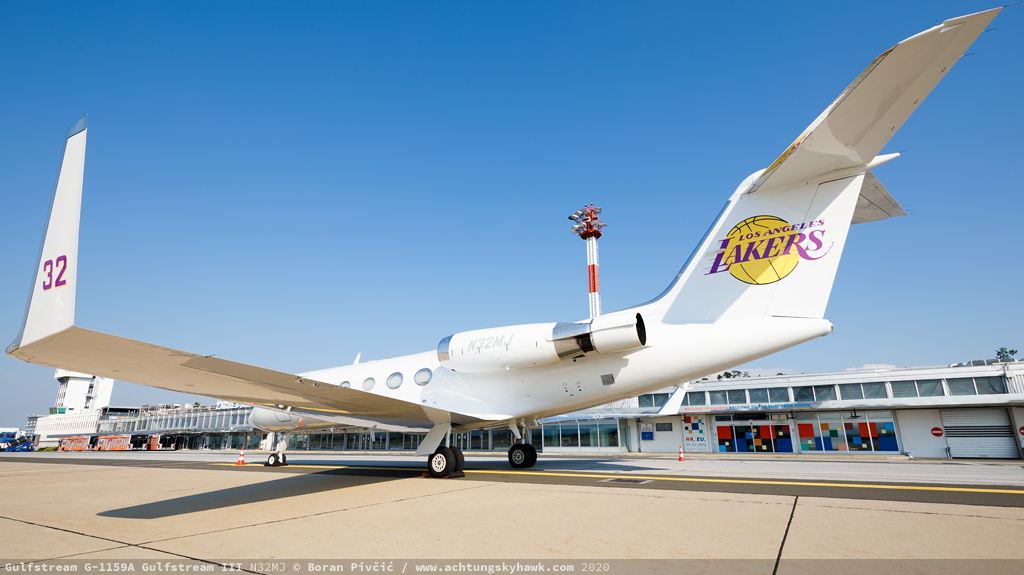
There’s just something about a quarter side view of a classic Gulf… interestingly, N32MJ was parked at Zagreb immobile for approximately two weeks while Mr. Johnson was down on the Adriatic coast, despite an abundance of airports that could (and had the space) to accommodate a G-III…

You know your airplane is good when it needs a muzzle. For those unfamiliar with them, “hush kits” – seen here at the back of the engine – are aftermarket air mixers fitted to older generation low-bypass turbofans to reduce their noise signature. They work by providing additional mixing of outside air and exhaust gases, which reduces the shearing forces between them that are the main cause of “jet engine noise”. In many Western countries, they are nowadays an essential piece of kit to even get in. The units fitted to N32MJ are QTA Stage 3 models, by far the most popular choice for Spey-powered Gulfs (of note, the gap between the engine and mixer accommodates the reverser buckets when open)

Rarely are there aircraft whose looks combine characteristics that are so different: elegant, but brutish… delicate, but powerful… discreet, but imposing…

Gulfstream Aerospace G-1159B Gulfstream II-B • N4NR

Just as the G-III’s advancement carried forward onto the G-IV, they also filtered backwards onto the old G-II. In 1981 – a year after its production ended – Gulfstream offered the G-1159B Gulfstream II-B upgrade, which would see the III’s wing and cockpit setup mated to existing G-IIs (the only other factory variant of the II was the G-II-TT, fitted with tip tanks; only 18 are known to have been so equipped). Offered until 1987, 44 machines had been converted to this standard – including our example, the non-hush-kitted N4NR.

Lost in the mist and overcast. To see a G-II in the 21st century is something… to see one WITHOUT hush kits is a different matter entirely!

Completed in 1978 under the serial 255, this odd bird had started out in life as N442A of the Aramco Steel Corporation. In 1984, it would pass into the hands of Rockwell International, where it would soon become N4NR – and, presumably, be converted to the II-B standard. It would stay with Rockwell’s various incarnations all the way until 2001, after which it would pass through the hands of several venture capital corporations (list also at Plane Logger), finally ending up with the somewhat cryptic Global Mission LLC in 2008.

That all was not going well in its world became obvious in November 2018, when its first (and last) arrival into Zagreb was met with a pre-planned sting operation ran by the Croatian Police, acting on information provided by the US Drug Enforcement Agency (DEA). Though some of the details are still not entirely clear, official press releases stated that the crew of two were flying in from Mali with a kilo of very pure cocaine, a sample of the payment to local arms dealers for a shipment of Soviet-era man-portable anti-aircraft systems, assault rifles, ammunition and other military gear – all stuff that was scheduled to be passed onto a Malian Islamist terror group.

Immediately impounded as evidence, it sat sealed for a few years in the corner of the GA apron, awaiting the end of the investigation and some future auction where it would be sold off to whoever cares. Informed opinion at the time (eventually to be proved pretty accurate) suggested that it would never fly again, since it is in pretty poor condition*** – and the costs of returning it to airworthy state and bringing it up to code are not encouraging…

*** indeed, it has been mentioned informally that is had started out for Zagreb three previous times before returning back to Mali with technical issues

While you’d be hard pressed to tell it apart from the G-III from most angles, the dead giveaway is the old G-I-style nose. While it is very cool in its own right, it almost looks like the G-IIIs rural cousin…
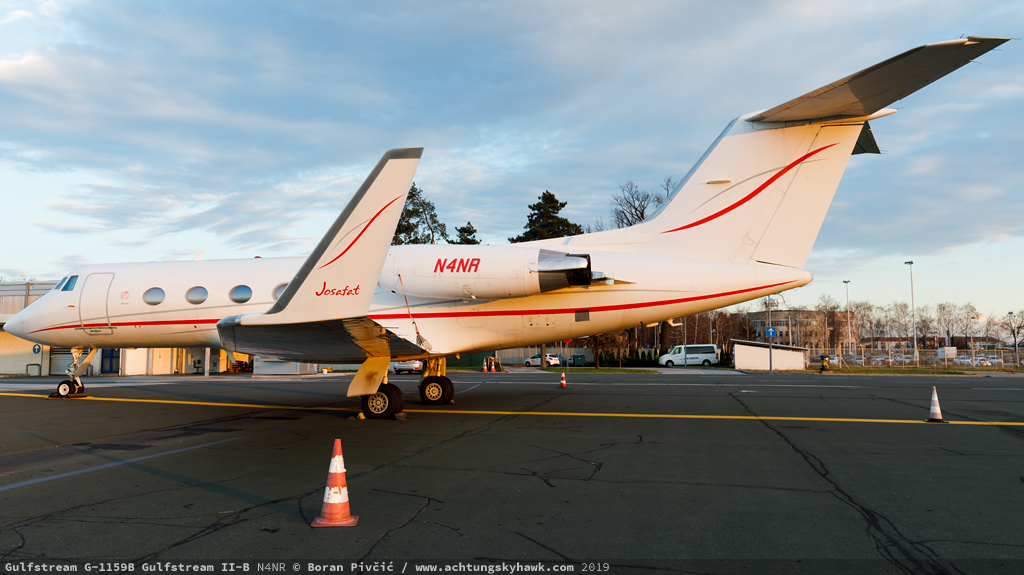
Jumpin’ Jehoshaphat? More like Forgotten Jehoshaphat! In 2020, N4NR would be moved to the far end of the apron (to a spot just under its horizontal stabilizer) and left to the elements…

Sources:

Photo File – The Swing-Leg Skyhawk: Cessna 172RG Cutlass RG

By me
All photos me too, copyrighted

To properly kick off my return here after an unintentional pause of nine months (!), I’ve decided to revisit an aircraft type I had mentioned in passing some time ago – seeing that, by a stroke of sheer dumb luck, I managed to snap TWO in the space of just one week (which is twice as many as I’d managed over the past 18 years). The machine in question – as the post title infers – is the Retractable Gear (RG) version of the common Cessna 172, an aircraft whose rarity and cool factor is matched only by its apparent uselessness and absurdity…

A mint 172RG, in a modern paint scheme, under clear skies on a beautiful summer morning… I could do worse for a pre-dawn spotting session I must admit!

Swinging 80s

To immediately get an idea of why the 172RG stands out like a sore thumb within the traditionally conservative Skyhawk family, it seems best to start off with its main party pieces, as compared to the stock 172P of the same period (1980):

  • fully retractable gear
  • a longer snout to house the nose gear when retracted
  • cowl flaps
  • 180 HP Lycoming O-360-F1A6 w/ constant speed prop (vs the standard 160 HP O-320 and fixed pitch unit)
  • 66 USG fuel capacity (up from the standard 42)
  • and a 1,202 kg MTOM (vs the 1,088 of the P)

Performance-wise, the extra grunt (particularly the increased efficiency of the constant speed prop) and cleaner lines meant the RG could pull up to a 20 knot lead over the stock P, with High Speed Cruise pegged at 140 knots. The new prop also made for slightly better after take-off climb performance (800 fpm vs 700), while the increased fuel tankage gave a pretty chunky range boost, from 440 up to as much as 770 NM.

Cutlass #2 undergoing a wheels-up restoration after a (heh) wheels-up landing in Germany. You can definitely tell it apart in a normal Skyhawk crowd!

However, the ~80 kg added by the gear retraction mechanism also upped the empty weight, now standing at 740 kg vs the P’s 660. Normally, this was not much of a payload issue if you took on only your required fuel – but if you went all out and brimmed the tanks, you’d be left with barely 260 kg of headroom… roughly two 2020 adult males, some luggage and all the stuff normally carried around when away from home (additional oil, tow bar, cockpit/wing covers, emergency equipment, survival kits, …).

The higher MTOM also made for longer take-off and landing runs, both up by roughly 70 meters even on concrete; and while some owners have been known to fly them out of rough fields (and even back country strips), it generally goes without saying that the new legs did not take too kindly to prolonged use on the types of runways normal 172s take for granted.

While the main gear legs are no thinner than those on the standard 172 (where they’re set inside streamlined fairings), Cessna’s electro-hydraulic RG systems are quite complicated things and can go bananas even when mollycoddled. As on the 177RG, 182RG and 210, the main legs of first swing downwards and the fold back into recesses in the fuselage (barely visible here). Early 210s – which were the first to use the system – also had main wheel well doors, but they proved problematic and were deleted well before the 172RG appeared

The Cessna Retractable Dance. Go to 0:30 for retraction and 1:30 for extension. You’ll note that the pilot leaves the gear down for quite some time after take-off; the standard wisdom on RG Cessnas is to leave it hanging until clearing obstacles, since the retraction sequence causes so much drag it can noticeably impair climb performance at a critical stage (this is also SOP on airliners during windshear escape maneuvers). Indeed, the main legs drop by a whopping 60 centimetres during retraction!

Maintenance-wise, private owners, commercial operators and various incident reports all tend to agree that the upsides of its commonality with the stock 172 are frequently balanced out by the many gremlins of the RG system – though user experiences vary considerably, particularly when comparing leisure and training ops.

Persistent weak spots and items that require frequent inspection are the main electric-driven hydraulic pump, down-stop pads that (if damaged) may prevent the main gear legs from locking down, and the main gear pivots that are worn out by the legs’ aerobatics during retraction and extension. There’s also the need to periodically cycle the gear on the ground during checks – which requires jacks and additional man-hours – as well as the costs of servicing the propeller governor (though that’s a pretty standard job).

And while none of these are deal-breakers in themselves – the 182RG and 210 say Hiii! – the cost-benefit math of doing all that on a lowly 172 did not make the RG everyone’s cup of tea…

Mission-ready

So, when all was said and done, the 172RG was a cheap & simple aircraft made expensive & complicated for just a few marginal gains – so much that even the fixed gear 210 HP Reims FR172 Rocket could keep up with it in a pinch (and for noticeably less money). What’s more, if you really wanted the “Full RG Experience”, five numbers up was the (slightly) more powerful, (much) more efficient, (oodles) more comfortable and (far) more elegant 177RG Cardinal – an aircraft conceived outright for the touring role, offering 182 series frills without many of its financial chills.

The 172RG thus appears to be – in technical terms – a complete crock. However, outright performance and mass market appeal are not what this airplane is about; its forte was to corner a very specific niche of the training market by offering a suitable and affordable “quick fix” for a problem few manufacturers seemed interested in tackling.

The niche in question was for what’s termed a complex aircraft, a surprising demanding specification that calls for a simple, easy-to-fly, robust and cost-effective airplane that can also boast toys such as flaps, retractable gear and constant speed props – all the complicated and fiddly stuff that future airline drivers are supposed to deal with (did mine on an old, student-weary PA-44, so the full set of traumas is there!)*.

And with the Skyhawk’s 25 years of active service to its name, the type’s well-known middle-of-the-road handling, off-the-shelf components (even the landing gear, nicked off the Cardinal), a reliable and frugal powerplant and a developed global support network, the 172RG had hit all the nails it needed to hit. Even though it would be born on the eve of Cessna’s decade-long single engine production pause, 1,191 would be made between 1980 and 1984… not bad for a niche design!**

* the original specification for complex aircraft had not set a specific minimum power limit; in 1997 however, the FAA set the bar at 200 HP, thus disqualifying the 172RG. However, the type still remains in widespread use as an introductory platform for more complex touring machinery – as well as a charismatic “left field” personal airplane

** though there are frequent parallels with the Beech 24 Sierra and the Piper Arrow, the 172RG is actually not a direct competitor to either. Both designs boast thirstier 200 HP fuel-injected engines (the Arrow with the option of turbocharging), better performance, more amenities – and are generally set up more for the posh end of the touring market; their closest Cessna analogue would be the aforementioned 177 Cardinal. The only aircraft on equal footing with the 172RG was the very first version of the Arrow – the 180 HP PA-28R-180 – which debuted in 1967 and remained in production for only a couple of years before being superseded by the first of the 200 HP models

What’s in a name?

While all of the above ticks quite a few Achtung, Skyhawk! boxes, one more thing remains that is very worthy of mention: it’s name.

While it does say “Cessna 172” on the tin, the 172RG is techno-legally not a purebred Skyhawk – but rather an offshoot of the nearly forgotten 175 Skylark. Billed as the next step towards the larger 182 (a role that would later be filled by the 177), the 175 was in essence an up-market high-trim version of the 1956 172A, fitted with a geared 175 HP Continental GO-300 instead of the standard direct-drive 145 HP O-300. Unfortunately, reduction gearboxes were at the time an unheard of feature on such a small civilian engine, meaning that very few pilots had ever encountered one before. The specific way in which such an engine had to be handled – flown at around the 3000 RPM mark – was so alien and absurd to private pilots that many drove them at the more usual 2000-2200 RPM, leading to a ton of breakdowns, failures and bad PR. By 1962, things had gotten so bad that Cessna was forced to pull the plug on the entire design, and retire both the 175 designation and the Skylark name…

A stunning late model 1962 Skylark with the original GO-300. Note the hump on top of the cowling; the propeller axis had to be raised up in order to accommodate the reduction gearbox without relocating the engine mounts

To salvage at least some of the effort invested in the design, the company decided to keep the 175’s Type Certificate (and some mechanical bits) and use them as the legal basis for all future high-performance variants of the 172:

  • the 195 HP R172 Hawk XP
  • the 210 HP Reims FR172 Rocket
  • the military T-41 Mescalero
  • and the 172RG

Traces of the Skylark’s original DNA can still be seen in the R172, FR172 and T-41, since they all sport the tall narrow-track landing gear of the 172A, which would be replaced by the squatter wider-track variant we all know and love on the subsequent 172B.

However, this would not be the end of Cessna’s marketing shenanigans; in 1983, the company would launch the 172Q Cutlass (sans RG), an attempt to “schlepp” on the RG image by fitting the 172P with a 180 HP Lycoming O-360-A4N driving a fixed pitch prop. Quite a rare model today – which did not offer much meaningful superiority over the P – only a handful would ever be built before the Skyhawk family as a whole went into its prolonged 80s coma…

Fixer Upper

While at this point in any normal Achtung, Skyhawk! post I’d go off with a ton of (more or less) descriptive external photos, in this instance I decided to “stay inside”, since the opportunity to snoop around a full-blown rebuild (currently at ~60%) was an opportunity too good to miss! The photos are not my best work – it’s hard to maneuver my 1.91 m frame w/ camera and tripod inside a 172 – but hopefully they’ll be interesting enough for the common avgeek!

I don’t know… it feels something is missing… free from all its kit, the Skyhawk panel looks far more commodious than it actually is! Note the (now very visible) sections for the flight and navigation instruments and the radio stack. Before its wheels-up landing and rebuild, D-EGGF also sported an autopilot (fitted above the glove compartment), and will – when completed – also carry a full set of digital engine instruments. Note also the rudder trim wheel next to the elevator trim; a very useful convenience/borderline necessity with a constant speed prop

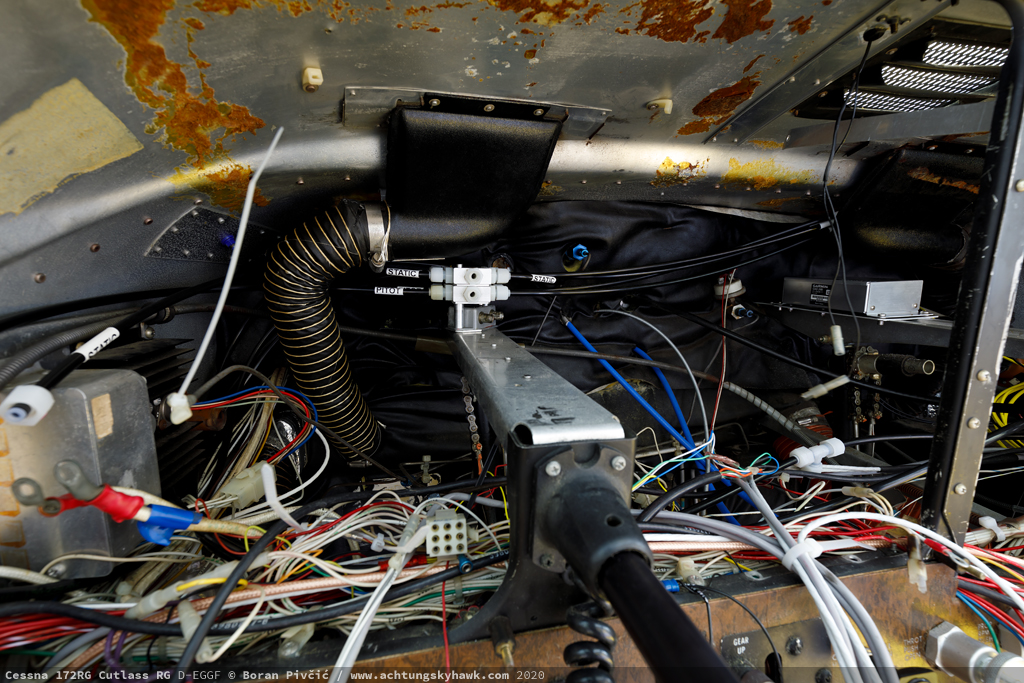
A peek “behind the scenes” shows just how many wires, cables, ducts – and even chain drives – there are in a light aircraft. The complexity, weight and maintenance headaches of the average analogue panel have been one of the key drivers behind modern glass cockpit systems built around digital buses and remote sensing systems

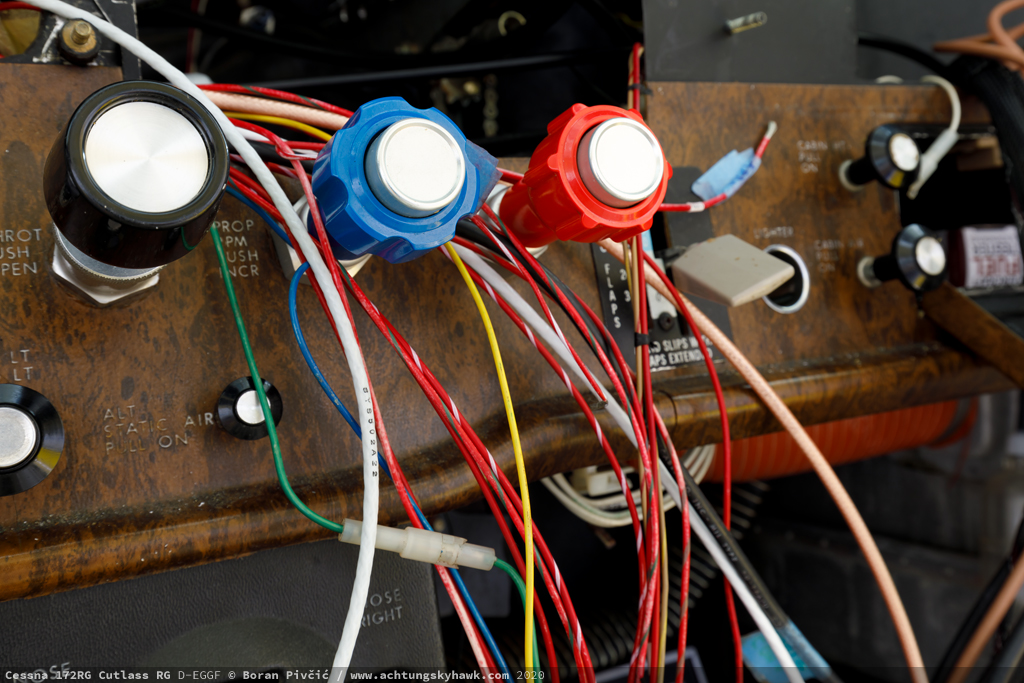
Lots of wires… and lots of levers too. With carburetor heat, throttle, prop, mixture and cowl flaps controls, the 172RG could be handful for inexperienced pilots used to the trouble-free operation of the classic Skyhawk (but ideal for the well-meaning masochism of flight training!). Indeed, this was Cessna’s most complicated throttle quadrant short of the 182 (even the 177RG had one level less, being fuel injected)

The most out-of-place level in a Skyhawk: the landing gear handle. One of the more unconventional operational features of Cessna’s RG system is that the “gear up and locked” lamp is – red… which on everything up to and including airliners means either “NOT locked” or “in transit”. Somewhat annoyingly, the light remains continually illuminated as long as the gear is retracted… which is mildly disconcerting from a Q400 driver’s perspective!

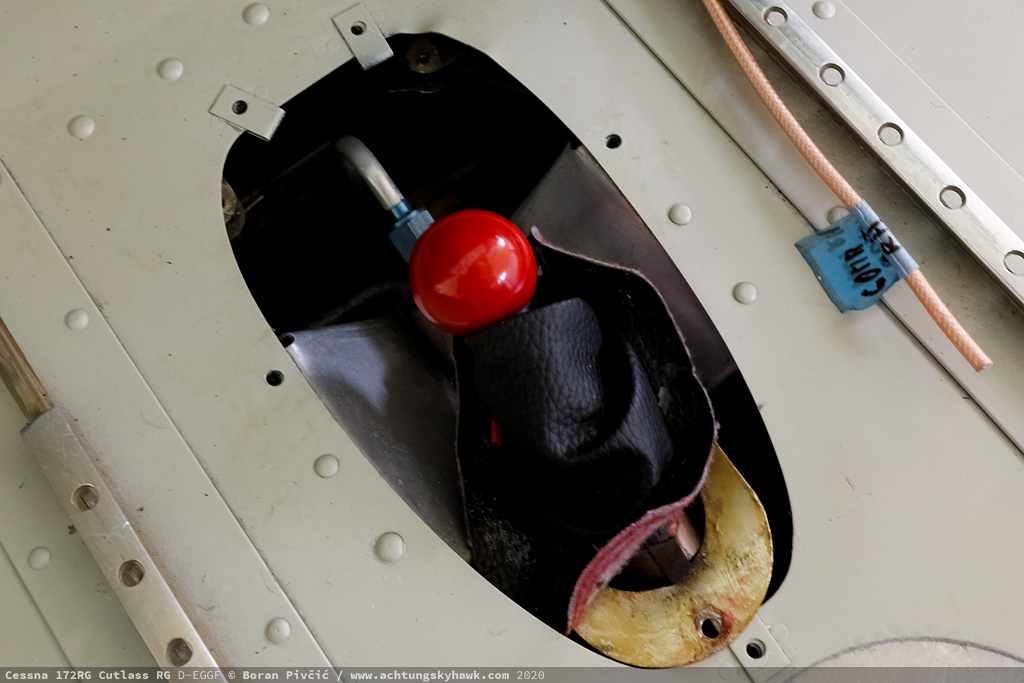
Like all RG airplanes, the 172 has a backup gear extension system, whose lever is located under a cover between the front seats. The trick here is that it is just a hand pump, to be used in case the electric one fails (~35 strokes are necessary, according to the POH); it still requires the hydraulic system to be fully operational, and there is no gravity drop or a standalone reserve hydro system. This “unusual feature” is the 172RG’s main Achilles’ heel: the gear is actually held up by hydraulic pressure, and to keep it from dropping, the hydraulic pump occasionally operates in flight to keep the pressure within limits (between 1000 and 1500 PSI). However, if there’s a leak in the system – which seems to happen with some frequency – the pump’s operation will simply dump the hydraulic fluid overboard, eventually emptying the entire system and rendering the gear completely inoperable

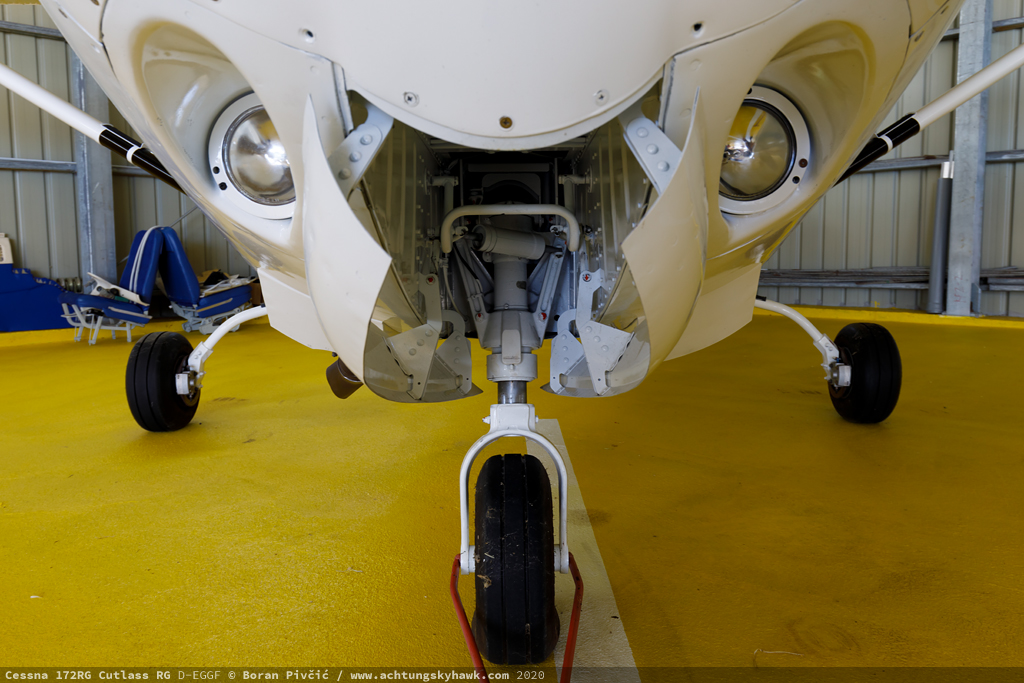
The more normal end of the Cessna RG system. The nose wheel doors are mechanically connected to the nose leg so they open and close with gear motion; their biggest operational problem is that they’re quite large and hang low, so it’s easy to damage them if you’re a bit too enthusiastic with the tow bar

Who would have thought that all of this cabling lies hidden behind the teeny panel of the Skyhawk? Another detail unique to the 172RG is the raised floor (best visible below the CDI), necessary to accommodate the main gear legs when retracted. The main wheels however stow behind the normal luggage compartment, so the loss of space there is minimal

Boxes boxes everywhere, not a place to sit… thankfully, the lack of space for maneuvering about with a tripod is taken up by some pretty cool kit: Garmin G5 x2, GMA350, GNC225… should be quite a looker when finished, very much looking forward to trying it out!

As ever, I would like to extend my sincere thanks to Dorian Delić of Medulin Airfield (LDPM) in Istria, for allowing me to snoop through his family’s hangar and drool a bit over D-EGGF!

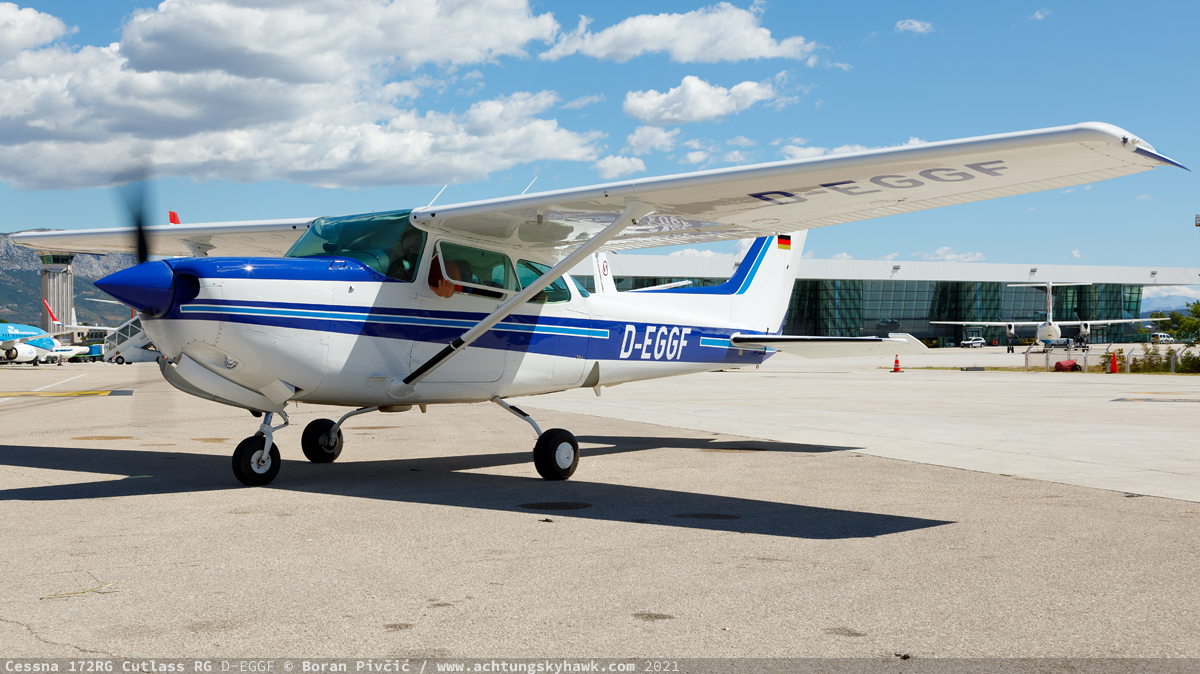
POST UPDATE – 8 SEP 2021: it may have taken awhile, but I’m happy to report that D-EGGF has been cheerfully flying for awhile now, shuttling around the northern bits of the Adriatic all summer long. To make it even better, I’d managed to catch it recently at Split, making for a proper photo update!

Waiting for its turn to taxi out for the hour-long hop back home to Medulin

Aircraft pictured:

  • D-EGGF: c/n 172RG-0301 • mfd 1980 • ex. N107JB
  • D-EPAW: c/n 172RG-0757 • mfd 1980 • ex. N6532V, I-ALEU

Sources:

Changelog:

  • 08 SEP 2021: added photo update