Short Photo File – Out of Africa

By me
All photos me too, copyrighted

Well, not really Africa geographically – but that was my first association when I stumbled upon a Diamond DA-62 and CERVA CE.43 Guépard (cheetah) on the Dubrovnik Airport (DBV/LDDU) GA apron 😀 (it may be corny, but it works for me!). After a photographic dry spell, this unlikely pair has been a godsend for me – and since both types have a bit of a (hi)story behind them, they were the perfect match for a quick & dirty Acthtung, Skyhawk! feature… 🙂
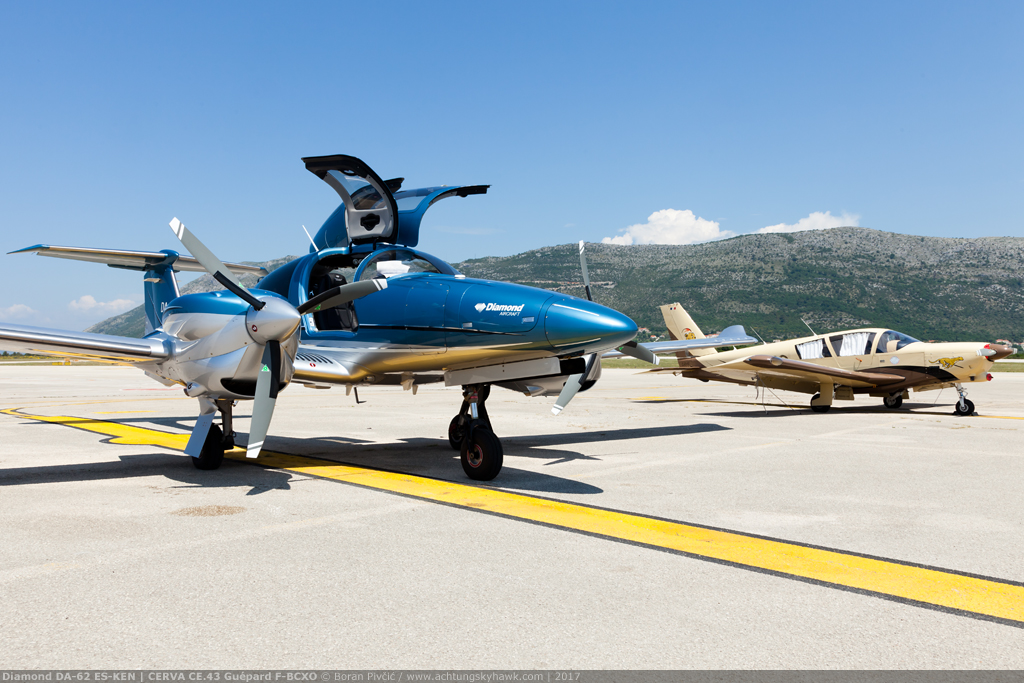
The past and future of light aircraft design in Europe… but even though the DA-62 is a vastly superior machine on all levels, one cannot but be drawn to the charisma of the lumpen – but incredibly rare – Guépard…

Diamond DA-62, ES-KEN

Guaranteed to catch more than one eye at any airport, the regal DA-62 is Diamond’s current flagship propeller product, a seven-seat grand tourer clothed fully in carbon fiber and pulled along by twin 180 HP Austro Engines AE330* four-cylinder Diesels. While the overall power available sounds underwhelming given the speedy look of the 62, the engines deliver quite a bit more than the raw numbers suggest, with a 190 knot high speed cruise doable on just 17 USG of Jet A per hour combined – a figure more common to a single engine of a similarly sized classic twin 🙂 .
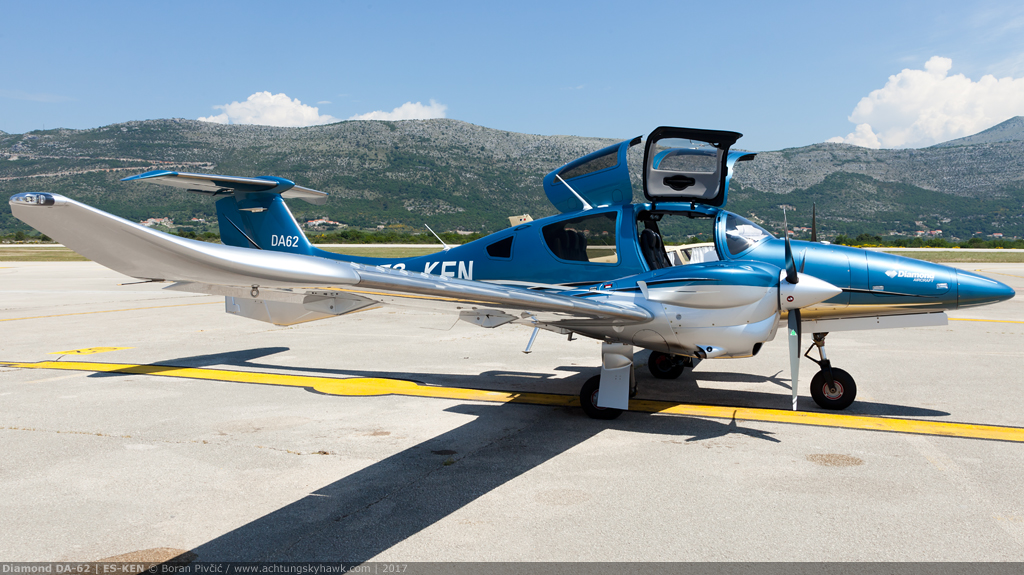
While at first glance it seems to be just a stretch of the ubiquitous DA-42 Twin Star, Diamond’s construction technique – basing each type around a custom carbon fiber shell instead of a traditional frame used on metal aircraft – means that the 62 is a whole different animal under the skin.

This turn of performance – and the depth of engineering hiding under the carbon – means that the polished Diamond is perfectly capable of standing with the best of the classic luxury piston twins, including even the default standard, the Beech 58 Baron. Compared to the current production-standard G58**, the DA-62 carries the same load (710 vs 705 kg) and cruises all out just a teeny bit slower (191 vs 202 knots) – but does so with 240 HP less and at roughly HALF the fuel flow (19 vs ~ 33 USG/hour). Not a bad showing from a small company operating out of an equally small town in Austria!

ES-KEN itself – the 43rd DA-62 made – had on this day stopped for rest at Dubrovnik (DBV/LDDU), before continuing south to its new home at Tivat (TIV/LYTV) in neighboring Montenegro 🙂 .

* of interest, the AE300 series represents Diamond’s own modification of the 2.0 liter turbocharged Diesel out of the Mercedes A and B Class compact cars – the same engine that was the basis of the now-defunct Thielert Centurion 2.0 (the earlier Centurion 1.7 was based on the smaller, 1.7 liter version of the same unit).

** of course, this brief comparison does not take into account operational factors not related to outright flight performance, such as price, maintenance requirements and availability, fuel costs – and specific aircraft ability, such as the Baron’s ability to operate from rough strips thanks to its robust, Bonanza-derived landing gear.

CERVA CE.43 Guépard, F-BXCO

There are two types of airborne visitors to the Croatian coast – those who fly cattle class, and those who go classic piston single class. Another of those beautiful gems that make aviation photography so rewarding, F-BXCO had instantly caught my eye even tucked in among the high-speed carbon fiber pornography lining the GA apron.

At one time called “France’s Bonanza killer”, the somewhat ungainly Guépard can trace its roots back to the nowadays-forgotten WA.4, a late 60s four-seat steel-fabric-and-plywood training and touring aircraft designed by Wassmer, the country’s most famous glider manufacturer. One of the first French light aircraft designed around the more marketable usability and practicality principles used in the US, the WA.4 had benefited greatly from Wassmer’s glider experience, with pleasant, predictable handling and very good all-round performance provided by its 250 HP Lycoming IO-540 engine. Spurred by the type’s success on the French market, the Wassmer works had soon decided that an all-metal version could be an even better sell, teaming up with engineering company Siren SA to make this idea come true. Since French manufacturers have always had a thing for mergers and complicated names, the first thing to come out of this partnership was the CERVA joing venture, short for Consortium Europeén de Réalisation et de Ventes d’Avions – or the European Consortium for the Development and Sale of Aircraft.

Essentially just slapping a fully-metal skin onto the WA.4, the new consortium had quickly created the WA.43 – soon to be renamed CE.43 – France’s first proper, modern and “international-standard” touring machine. But while it looked, sounded and flew like an American aircraft – not to mention boasting a bum-numbing 7 hour endurance – it would nevertheless always be the product of a small company in rural France, a fact that had immediately put it at a market disadvantage compared to equivalent aircraft from the much more industrious Big Three (Beech, Cessna and Piper). This disproportionate footing – which had already killed a number of European designs – would be fatal for the Guépard as well, with only 44 manufactured between the type’s introduction in 1971 and Wassmer’s bankruptcy in 1977… and most of these on request of the French Air Force. In a last ditch attempt to save the ship from sinking, CERVA would in 1976 attempt to market two higher performance versions, the CE.44 Couguar with the 285 HP Continental Tiara 6*** engine – and the CE.45 Léopard with a turbocharged Lycoming TIO-540. However, only a handful of each version were built before the type as a whole ceased production...

F-BXCO itself was manufactured in 1975 as the 30th Guépard off the line – and, according to available info, had always flown in civilian hands.

*** one of the very few US post-war piston engines to actually have a “proper name”, the Tiara was Continental’s 1970s shot at making a next generation powerplant that would appeal to manufacturers (and owners) of the type of high-performance piston singles that were becoming rapidly popular at the time. While it still retained the traditional boxer layout and most of its mechanical workings (including bog-standard fuel injection and optional turbocharging), the Tiara was from the outset conceived with a small cubic capacity (405 cu in for the six-cylinder version used on the Guépard) and high rotation speed (up to 4500 RPM) in order to get the maximum power and efficiency out of the least amount of engine. The central element to making this work was a special reduction gearbox called “Hydra-Torque”, which both lowered propeller RPM to half the engine RPM (0.5:1 reduction ratio) and dampened the various vibrations and stresses commonly experienced on traditional geared engines (more detailed info available here). This – as well as tweaks to the engine’s various components and accessories – made the Tiara quite a bit lighter and smoother than a comparable engine, traits that Continental had hoped would appeal well to buyers wanting a quiet, comfortable and dignified Mercedes of the skies.

However, while this was all fine and dandy in theory, the engine did have a number of noticeable drawbacks. In some airplane installations it was quite loud – and in ALL installations it tended to drink like its much bigger siblings. Coupled with different (and more expensive) maintenance requirements on account of the Hydra-Torque system, this made the Tiara scarcely worth the bother over a traditional large engine – and is viewed in some quarters as an unnecessary attempt to “reinvent the wheel”. Despite this, it did manage to find its way into a number of aircraft types – and would, interestingly, achieve some popularity in France, having also been installed into the Robin HR.100 (creating the 285 HP HR.100-285 and 320 HP HR.100-320).

Bonus content – Mr. Mooney & Mr. Scheibe

Since I’ve been going on a lot about rare aircraft in general of late, I thought I might as well continue the trend here and slot in two more oldies I’d come across over the course of this month. Not really on the same level as the CE.43 in terms of outright rarity – few machines are – they’re nevertheless a sight for sore eyes, and well within Achtung, Skyhawk! tolerances! 😀

And the classics just keep on piling up! Having already snapped a brand new DA-62 – and the incredibly rare CE.43 – the day before, I was smitten to find a mint Mooney M-20F at a rainy Split (SPU/LDSP). The last of the type’s snub-nosed models, the F was the final development of the original M-20A before the design was cleaned up by famed aerodynamics specialist Roy LoPresti in the mid-70s, resulting in the highly-successful M-20J. Even though it’s not as rare as its looks suggest, finding one is definitely a treat – especially since D-EJHE is celebrating its 50th birthday later this year!

Some people love oldtimers of the road… while others love oldtimers of the air. Manufactured way back in 1958, this very rare Bergfalke – “mountain falcon” in German – perfectly encapsulates just why I love tooling through hangars at small local airfields. A thoroughly upgraded version of the mid-30s Akaflieg Mü13 glider, the Bergfalke had upon its introduction in 1951 quickly laid the foundations for what would become Schiebe Flugzeugbau – and served as the basis for the company’s most popular aircraft, the SF-25 Falke Touring Motor Glider (TMG). Another interesting factoid is that the type had been manufactured mostly at Riem, the main international airport for Munich until the opening of the current MUC on 17 May 1992… E7-1112 itself (latterly known as D-8241) is nowadays on service with the AK Livno flying club at Livno Airfield (LQLV), where it had arrived just recently as a – donation. Despite its advanced age, it is still a frequent flyer, and – according to the club – can hold its own even against more modern metal gliders.

Photo File – Domesticated Dornier: The Croatian AF’s Do-28 9A-ISC

By Josip Miljenko Džoja and myself
Photos as credited, copyrighted

While there has always been an abundance of easily-accessible abandoned and disused aircraft to be found in Croatia, one place in particular has always been the local holy grail of “wreck photography” – the Zrakoplovno-tehnički centar (ZTC, Aeronautical-Technical Center) maintenance facility in the town of Velika Gorica, just a few kilometers south of Zagreb. Formerly a military depot with a long and illustrious history, it is now home to what remains of the Croatian Air Force’s earliest machinery, littered chocked full of rusting, disintegrating hulls that had in the war-torn early 90s formed the backbone of the country’s first aerial capabilities.

Even though each and every aircraft there has an interesting and often gripping story, the one I was always most interested in was 9A-ISC, a Dornier Do-28D Skyservant sitting alone and unloved at the edge of the apron. Unfortunately, the facility’s current status in the military hierarchy had always made “unannounced” photography perilous and complicated, making getting up close and personal an impossible task.

Thankfully, as part of the military’s ever-increasing drive for good PR, the ZTC had been selected as the prime venue for Air VG, Velika Gorica’s first aviation theme day scheduled to be held on 13 May 2017 – thus allowing for ample opportunity to sneak a (legal) peek at what’s really hiding behind that fence. However, since I had already reserved that date for snooping around hangars at small airfields in neighboring Bosnia, I’d decided to call on the help of Mr. Josip Miljenko Džoja, a fellow aviation photographer (Flickr gallery here) and keen Croatian military aviation buff who was sure attend no matter what 🙂 . Under our arrangement, he would be tasked with piecing together ISC’s life story and providing both current and past photo material – while I would weave everything together and add the inevitable nerdy bits about the Do-28 design 😀 . Despite not being able to peek inside and make a proper Achtung, Skyhawk! photo report, we both felt that an aircraft of its rarity needed its tale told however possible, so we pooled all of our resources together and got to work…

Despite not being easy on the eye, the Do-28 was – in all versions – a supremely capable aircraft. A direct development of West Germany’s first post-WW2 design – the six-seat Do-27 – the original A and B model 28s were simply straight twin-engine conversions that retained a majority of the 27’s parts. The significantly larger D model – able to accommodate 13 passengers and now named Skyservant – was however a much more thorough redesign that sacrificed almost all of its commonality with the 27 for increased cabin space and hauling capability. Despite this, it still boasted the impressive STOL performance and handling that had made the original 28 such a hit (photo copyright: Josip Miljenko Džoja)

Diaspora-28

But first, a bit of trivia! Like the majority of surviving Do-28s, ISC is a Do-28D-2* model, at 172 examples produced the most common of all the Skyservants. Developed in 1972 specifically to the requirements of the German army following its experiences with the earlier D-1 (the default production model that had introduced a 50 cm wingspan increase and higher take-off mass over the basic D), the D-2 had included:

  • a reworked internal layout to give an additional 15 cm of usable cabin length
  • a further 200 kg increase in maximum take-off mass
  • a higher fuel capacity adding nearly 700 km to the range
  • redesigned flaps and ailerons for better low speed handling
  • removal of the D-1’s wing fences
  • fixed leading edge slots along the outer sections of the wing to improve STOL performance

and fuselage mounting points for sensors such as mapping cameras and side-scanning radar (as well as equipment for oil spill monitoring on aircraft operated by the German Navy under the designation Do-28D-2/OC).

* in 1980, the Do-28D-2 designation would be dropped in favor of Do-128-2.

ISC itself would turn out to be an early production model, completed in February 1974 with the serial number 4178. Soon after delivery on the 13th of the same month, it would be allocated to the German Air Force’s Government Flight – the easily pronounceable Flugbereitschaft des Bundesministerium der Verteidigung, or FlgBMVg – based at Köln/Bonn Airport (EDDK), where it would receive the code 59+03.

ISC in its GAF guise at Airliners.net

According to the information available, its service life with the FlgBMVg would be fairly uneventful – mostly hauling officials in a semi-VIP passenger interior – right up until early September 1992 when it would be parked at Leipheim Airbase (EDSD) near Ulm as part of the type’s general withdrawal from service.

At this point however, its story starts to become interesting. At some time in 1993, the aircraft had been bought by the Croatian Government – at the time fighting in the first of the 90s Yugoslav Wars – reportedly through intermediaries in the (sizable) Croatian diaspora in Germany. Apparently serviced and made airworthy again in the mean time, it would eventually make its way to Finow Airbase (EDAV) in the former GDR – from where it would be flown to Split Airport (LDSP) in Croatia on the night of 11-12 March 1994. Interestingly, the flight would be made under the reg 9A-NDH, a fictitious identity that had never appeared on the Croatian register before or since. The choice would prove controversial later, since in its most commonly-used form NDH stands for Neovisna država Hrvatska (Independent State of Croatia), a Nazi puppet state that had existed in the western Balkans between 1941 and 1945.

Upon arrival at Split on the morning of 12 March, the reg had immediately been changed into the no less ominous – and equally fictitious – 9A-ISC, under which it would continue to fly until its ultimate withdrawal from use**. Its life in wartime service with the Samostalni zrakoplovni vod (Independent Aviation Corps) of the Air Force’s 4th Brigade is still clouded in confusion and a fair bit of secrecy – and knowing full well the complicated political and military situation that had existed in Croatia in the early 90s, both Josip and myself had quickly decided against digging into the matter any further 🙂 .

** this reg would be formally used for the first time only in 2013 – and on a restored Polikarpov Po-2. Of interest, even though it had always had a dedicated military registry, the Air Force kept some of its transport and utility aircraft – including the Do-28 – on the 9A civil register until the early 2000s, when all active machines were allocated bespoke military codes.

Following the end of hostilities in 1995, ISC would continue to serve in the Croatian Air Force in various (but only occasional) transport roles until a throttle cable failure and burnt cylinder valves on one engine – coupled with a lack of spares and expensive upkeep – grounded it for good in 1999 with around 4300 hours on the clock. As was the case with virtually all aircraft acquired and used during the early stages of the war, ISC was relegated to the corrosion corner at ZTC (then still a fully-military facility known as the Zrakoplovno-tehnički zavod “Zmaj” – the Aeronautical-Technical Institute “Dragon”), where it has remained ever since…***

*** another interesting tidbit was that the MoD had actually been offered the opportunity to restore the aircraft to airworthy state by a private contractor – and even convert it to turboprop power along the way. The engine proposed for the job was the Czech-built Walter M601 – most commonly seen on the Let L-410 Turbolet – which would have resulted in something similar to the factory-standard, PT6A-110-powered Do-28D-6 / Do-128-6 of 1978. However, the MoD had never taken up this offer.

By far the type’s most distinctive feature is the location of the twin 380 HP six-cylinder geared and fuel injected Lycoming IGSO-540-A1E engines. Since the original Do-28 was produced on a tight budget, this solution was likely chosen to avoid an expensive redesign and strengthening of the wing required for high-mounted engines – while at the same time still providing adequate propeller ground clearance for operation on rough strips (photo copyright: Josip Miljenko Džoja)

In common with many similar aircraft acquired in a similar manner during the war, ISC had been hastily prepared and renamed, likely with whatever paint and/or stencils were available. More than 15 years of constant exposure to the elements have taken its toll, with its previous identity slowly coming to the surface… (photo copyright: Josip Miljenko Džoja)

It’s overblown, dirty, and not even from the same aircraft – but since there are so few detail shots of the Do-28 cockpit, I had to improvise. Like in many comparable aircraft of the period, the Skyservant’s cockpit is a mass of dials, buttons and levers; however, the layout is quite intuitive and everything is within easy reach from both sides of the cockpit. And despite the tailwheel layout, visibility over the nose is excellent – though the view out the side is understandably quite poor (photo copyright: Boran Pivčić)

And finally, the only interior shot of ISC we could lay our hands on. The main differences are a different radio fit, more modern IFR instrumentation (two Course Deviation Indicators (CDI) for the pilot, and an Automatic Direction Finder (ADF) for the copilot) – and a simple weather radar (photo copyright: author, name withheld on request)

Sources:

Photo File – Story Time Part 2

By me
All photos me too, copyrighted

Having set the ball for long-winded photo commentaries rolling with my previous photo file, I am delighted to be able to continue the trend with what has proven to be an equally fruitful follow-on. True to my hopes and expectations for this year’s summer season, the material for Part 2 had flooded in rather quickly, thanks most of all to triple sightings of some pretty rare twins all in the space of two weeks.

So, while the owners of Porsche-powered Mooneys and skydive Caravans prepare for their vacation flights to Croatia’s coastal airports (where I’ll be waiting 😀 ), here’s a bit more of what’s been going on further inland…

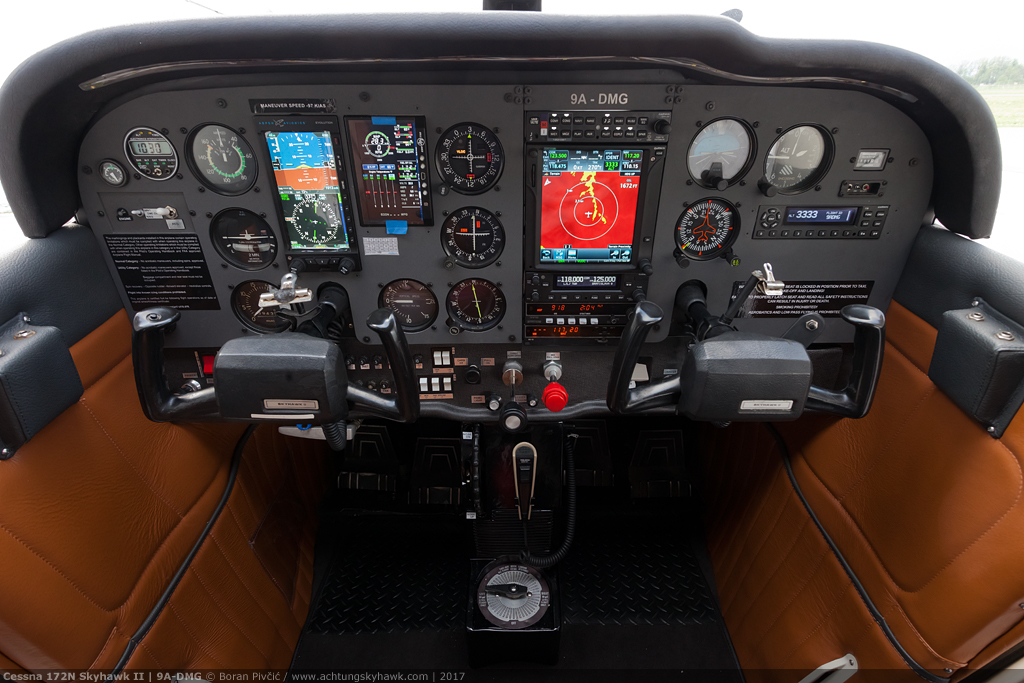
The emperor’s new clothes… first look at a new & improved 9A-DMG following an extensive interior and avionics refit – the latter of which lags little in sophistication behind today’s class cockpit 172SP (and quite a few bigger and more expensive machines as well). From left to right there’s the Aspen Avionics Evolution 1000 PFD (w/ Synthetic Vision System (SVS)), the JPI EDM 900 Engine Data Monitor (a fantastic piece of kit), Garmin GTN 750 touchscreen NAV 1/COM 1/GPS + Garmin GNC 255 NAV 2/COM 2… and bringing up the right the Garmin GTX 345 Mode S transponder. Not a bad look for an 1979-vintage “old man”!

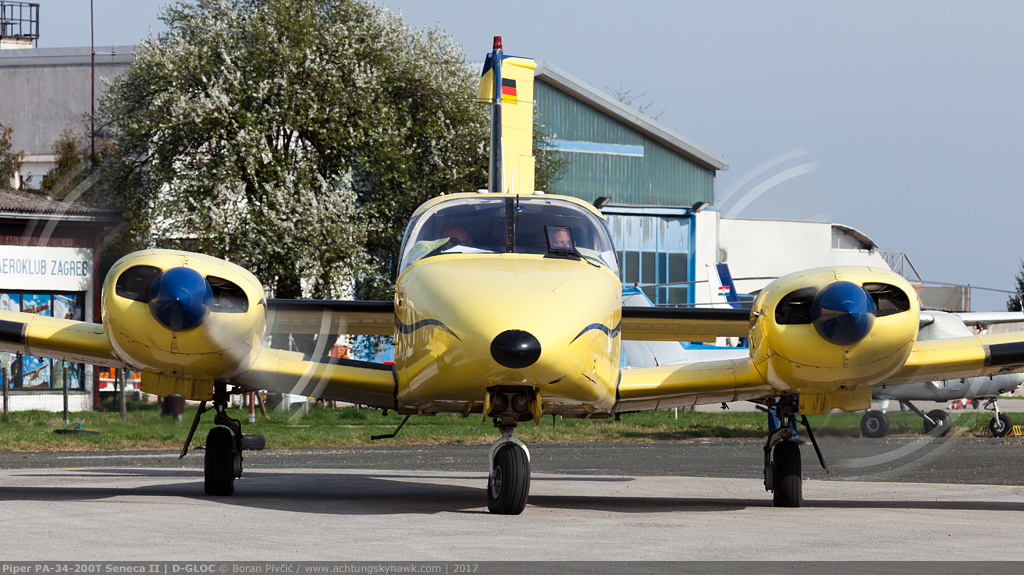
A bit of twin-engine action as this German canary navigates Lučko’s uneven apron on its way toward RWY 28. Even though the Seneca is one of history’s most popular piston twins, this early version – introduced in 1974 – is nowadays nevertheless a bit of a rarity. Created in response to the numerous criticisms levied at the original Seneca I – which was, with its normally-aspirated 200 HP engines, considered severely “asthmatic” – the Seneca II was fitted with turbochargers that, despite not adding to the power, had immediately and dramatically improved performance (especially in an engine-out scenario at altitude). However, despite this, the type’s ultimate lack of power had remained a thorn in users’ eyes, leading Piper to add 20 HP per engine and new three-bladed props in 1981, creating the most popular PA-34 of them all, the Seneca III. D-GLOC itself had been manufactured in 1978, and had received its eye-catching paint scheme from its previous owner, Italian watchmaker Locman (which also explains the reg). On this day, it had popped into town to pick up a passenger bound for Split (LDSP).

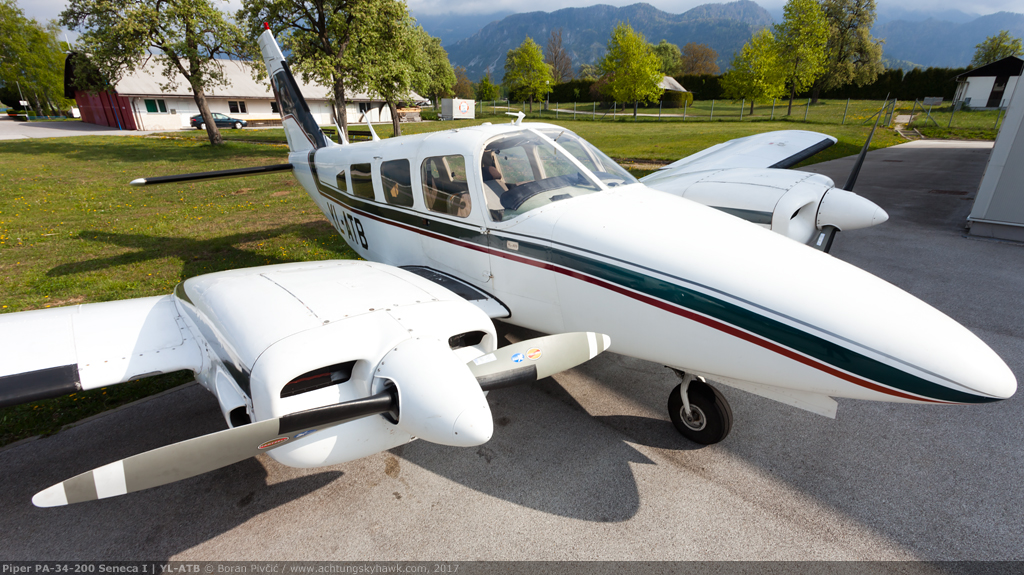
Speak of the devil – the original Seneca I! As noted previously, unlike the most popular models – the III and V – Number One had left quite a sour taste in the mouths of many owners, primarily due to its lack of power and marginal performance at altitude and with an engine out provided by its normally-aspirated 200 HP Lycoming IO-360s. This deficit was such that in some quarters the Seneca is still labelled as “the best single engine airplane in the world”, despite the vastly improved performance (and potential) of the turbocharged 220 HP III, IV and V. While the fuselage and wing are visually mostly identical across all five Seneca marks, the One can be picked out in a crowd by its boxy, square nacelles (replaced by more streamlined units on the Seneca II) and air intake on the side of the cowl. This particular example – snapped at Lesce-Bled Airfield (LJBL) in the northwestern corner of Slovenia – was manufactured in 1974, the One’s final production year…

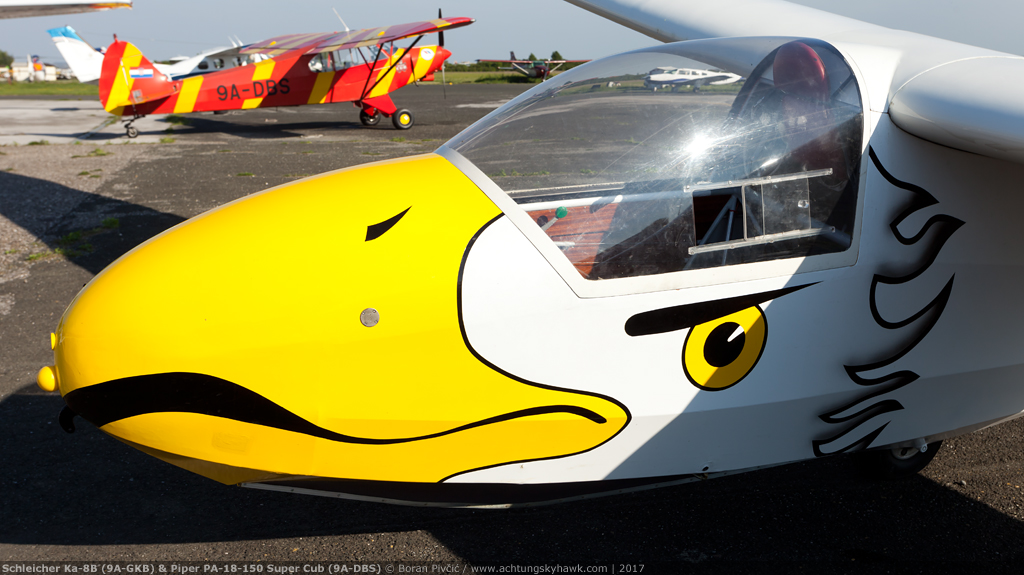
As soon as it got a bit of wind in its wings, the Falke had started flapping trying to get airborne… and why wouldn’t it: pleasant temperatures, a light wind perfect for soaring, and not a cloud in the sky! While far from the best design around, the type’s durability, simplicity and good all-round performance have consistently made it one of Europe’s most popular Touring Motor Gliders (TMGs) – a fact also helped by its capacity to accept almost any light engine available, from the two-cylinder two-stroke 26 HP Hirth F10A of the original SF-25A, to the turbocharged 115 HP Rotax 914F of the late-model SF-25C.

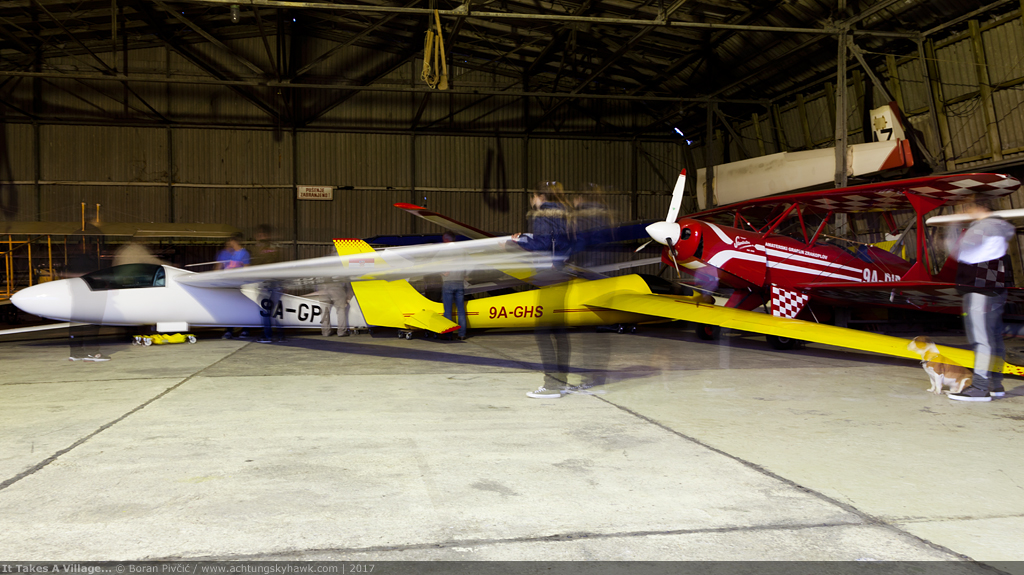
… and a dog to pack all of Lučko’s active gliders into its compact WW2-era hangar. A scene well known to many pilots as instructors and students clean up at the end of a busy flying day.

Young Eagle and Flying Teddy Bear await their turn to be tucked into the hangar after another full day of soaring and towing. Though still far from Lučko’s “golden years” of the early 2000s, this weekend saw five gliders pretty much constantly in the air – a very welcome slight after the airfield’s nearly decade-long financial crisis-induced slump in operations.

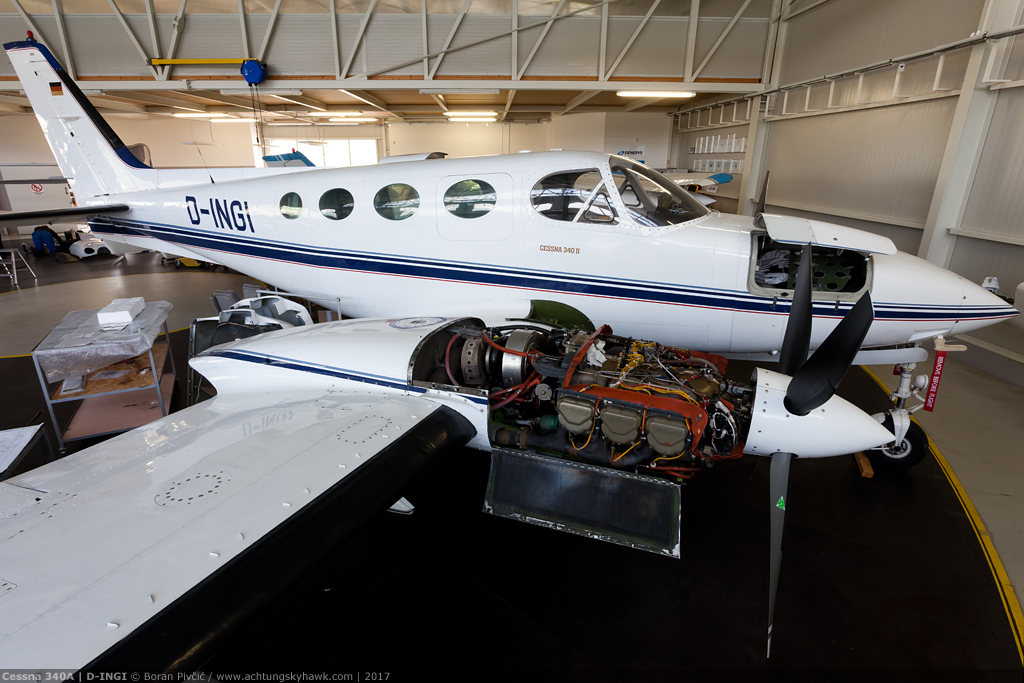
Only the second 340 I’ve ever seen in the metal, D-INGI easily dominates the room during a spot of maintenance. One of Cessna’s “more serious” piston twins, the 340 boasts a pressurized cabin, pneumatic de-icing system and a 30,000 ft ceiling – all of which (especially when used together) require a significant supply of compressed air. To cater for these services, each of the type’s Continental TSIO-520s sports a whopping large turbocharger – seen just aft of the engine block – whose output is used to feed the engine itself, provide a 10,000 ft cabin altitude at the type’s typical 20,000 ft cruise, and inflate the wing and tail boots enough to break off any reasonable amount of ice. Like the similarly-equipped Beech 60 Duke and Piper PA-31P Pressurized Navajo, all of this however makes the 340 somewhat expensive to operate, making it slowly lose favor to the far simpler modern single-engine turboprop. Another interesting detail are the vortex generators, located just aft of the wing boots; most often seen on utility and short-field aircraft, their function is simply to create a swirling, turbulent layer of air along the upper surface of the wing. While this sounds counter-intuitive at first (and indeed does create a fair bit of additional drag), a high-energy turbulent boundary layer sticks to the wing for more of its width, increasing the lift generated at any one speed. This is most useful for operations at higher angles of attack (such as during approach and landing), since it both lowers the aircraft’s minimum speeds – and increases the effectiveness of the flaps and ailerons, providing for better control at low speed and more benign behavior in and near the stall.

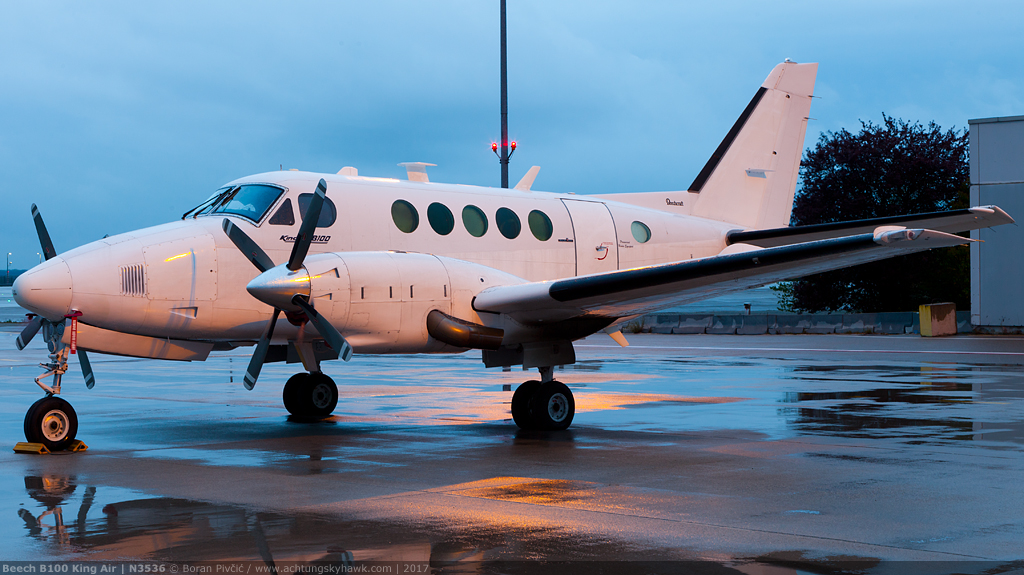
Fortune favors the brave – or at least those willing to stand out in the wind and rain for a photo! And a nice subject to do so for it is – likely the rarest of all the King Airs, the elusive B100. One the one hand, it’s a 100 series, a nowadays uncommon stretch of the base 90 – and on the other it’s the B model, the only series-production King Air not to use Pratt & Whitney Canada PT6A-series engines, but the rival 715 HP AI Research/Garrett TPE331-6. The latter engine’s “straight flow” layout – in which the exhaust ducts are the the back of the engine – is pretty much the only visual clue that sets it apart from the PT6A versions, whose “reverse flow” setup means the exhausts are located up at the front. Unfortunately, due to the now-reduced commonality with the rest of the family (and a general lack of demand for a TPE-powered version), only 137 B100s would be made, with the 1979 vintage N3536 – snapped here at Munich Airport (MUC/EDDM) – being a crisp mid-production example.