Possibly to compensate for its blatant refusal to play ball for most of the summer, the weather here in continental Croatia has been on its best behavior since my previous post, providing us (mostly) with the same clear blue skies, calm air and pleasant temperatures that we’d expected to see in months past :). Fearing that it may all go terribly wrong at any time and without much warning, out fleet at Lučko has been out and about from sunset to sunrise, getting in as much work as possible without bending any rules. Naturally, the same weather had lured me and my camera out as well, allowing me to present another snapshot of Life at Lučko… 🙂
Back home after an extended leave of absence due to a Cessna-mandated corrosion check, the legend of Lučko is back on the flying circuit. Parked – unusually – outside the hangar following its return from Varaždin (LDVA), BKS easily dominates the apron even in the dark…
Hands down one of the most interesting touring motor gliders (TMGs) in the region, the ungainly Vivat is actually based on the classic Let L-13 Blanik all-metal training glider, to which a 65 HP Walter Mikron III engine, side-by-side seating and a tougher, fully retractable landing gear have been added. Normally based at Sinj Airfield (LDSS) near Split, DSI had on this occasion popped into Lučko for some servicing, having suffered persistent issues with the engine starter.
A peek inside DSI’s clean and pleasant interior. Somewhat more complicated than a modern purpose-built TMG, the L-13SE contains almost as many controls as a standard light piston aircraft, including levers for the throttle, choke, elevator trim, airbrakes, wing flaps, cowl flaps and landing gear.
You could be forgiven for thinking that Lučko was having a helicopter theme day today! As well as HAT, HBA and HBB (the latter of which would later fly a short winch test), we’d soon be joined by Agusta-Bell AB.212 9A-HBM, which had – despite the day’s wind and in true Huey fashion – announced its arrival from miles away. Interestingly, the military side of the airfield was deserted for most of the afternoon, without a single Mi-8/171 to be seen (which in itself is quite unusual).
Definitely the most unusual new arrival into our little fleet, the Sova (“owl”) is an intriguing single-seat motor glider, designed and built by Mr. Marijan Ivanček. Among the many interesting details is the propeller – whirled by a two-stroke Rotax – that folds back under the action of a spring when the engine is not running, thus significantly reducing drag during soaring flight without the need to incur the weight penalty of a fully-retractable prop (of note, while the Sova is a glider with an engine, it does not fall into the same category as the Vivat from two photos above. Due to its ability to fly and operate like a “normal aircraft” during powered flight, the L-13SE is classified as a TOURING motor glider; the Sova however lacks that capability, and is thus labelled as an “engine-assisted glider”).
While for the most part the weather was just as fine as described in the introduction, several mornings – Sunday 19 October included – did let the side down. A common problem during autumn and winter (especially after prolonged rainy seasons such as this summer’s), Lučko, Pleso and indeed the whole of southern Zagreb can be blanketed by thick fog that can reduce visibility down to just 50 meters. While they tend to persist for days or even weeks during the winter, in October and early November they frequently disperse around noon, often leaving behind fantastic anticyclonic weather. On this occasion, a 125 meter visibility and 11 degrees Centigrade were replaced by clear blue skies, 23 Centigrade and just a hint of wind – all within one hour.
Once the fog did clear, flight ops had immediately picked up, including a few flights by the diminutive (and rarely seen) HMB – one of only two R-22s in Croatia and the only one still flying. The first series-produced design to come out of the pen of Frank Robinson – a world-renowned tail rotor expert – the R-22 had first flown way back in 1975 and has persisted in production to this day. HMB itself is an early Mariner version, equipped to carry inflatable floats on the skids for over-water operations and sporting an auxiliary 41 liter / 11 USG fuel tank located right behind the pilot. Interestingly, even though it is registered in Croatia and is operated by a Croatian company – Helimax – it is usually based at Ljubljana (LJLJ) in neighboring Slovenia.
Universally popular primarily due to their low acquisition costs and very agreeable operating economics, all R-22s are powered by variants of Lycoming’s O-320 four-pop – essentially the same engine fitted to the standard Cessna 172N. However, to prevent it from overloading the transmission system (and to assist with longevity), on the R-22 the engine has been de-rated from its nominal 160 HP to just 124. Another important modification – always the eyesore – is the forced cooling fan bolted to the rear of the engine, designed to blow cool, fresh air over the engine block and compensate for the lack of ram cooling in flight.
Looking back on it (even though it still has a month and a bit left to run), this year has, aviation-wise, been almost a complete joke. One of the rainiest years since record keeping began in Croatia some two centuries ago, it has produced no less than three major floods, interspersed with unusually frequent (and surprisingly violent) cyclones and depressions that had – in some cases – dumped a year’s worth of rain in just a few weeks. Scenes such as this and this had kept most of our grass airfields closed and flooded for days on end, trapping all of our money-making aircraft and rendering them unable to flee to the paved safety of the country’s major airports…
Likewise, man-made disasters had conspired against us as well, with the country’s long-standing economic crisis now running into its seventh consecutive year – with very little light only dimly visible at the end of the tunnel. Apart from a general reduction in life standard, spanners thrown into Croatia’s GA works include soaring fuel prices, increased maintenance costs – and, not least of all, stepped-up efforts by several operators of popular paved airports to collect increasingly exorbitant fees and charges in order to alleviate their own financial difficulties.
An yet, despite all of this, the local GA scene is operating like there’s no tomorrow (likely because if the weather continues like this, there probably won’t be 😀 ), with a new bizjet, new skydive Cessna, new glider and towplane all having arrived in country within the past few months. Flying clubs are on a roll as well, with mine already having beaten its previous flight time high, set – ironically – in 2013 :). Skydive flights, airshow performances, panoramic flights, private rentals… all seem to be coming back on track despite the worsening living standard (with only flight training letting the side down).
Much of the same could have also been seen during the 24th Zagreb Cup precision landing championship, held at Lučko Airfield (LDZL) on Saturday 11 October :). A yearly small-town event whose sole purpose is to have some good-natured fun (and enjoy a good BBQ afterwards 😀 ), the competition had this year attracted an all-time record in aircraft and competitors, numbering at four Cessna 150s, three Cessna 172s and 24 competing pilots respectively. While this doesn’t sound like much compared to some of the larger and more formal competitions held elsewhere in Europe, it is still of one of the main aviation (social) events of the season, and had this year easily topped the 2013 competition, where we had a showing of only five aircraft and just 18 pilots.
A handy visual guide to everything you need to know about the competition. Closest to me is the landing field used for the purpose, drawn up in lime powder on the right side of RWY 28L. 72 meters long in total, it is marked off in several 5 meter wide grids, plus a two meter wide “zero mark” that represents the ideal touchdown point. For 20 meters on either side, the grids are further split into one meter wide segments – as shown here – to aid the judges in determining the exact point of contact. Further back behind the field are three of the seven competition aircraft – parked on RWY 28R – with the competitors monitoring progress on the runway’s edge.
As nearly every year so far, the competition had been blessed with beautiful summer-like anticyclonic weather, sporting clear blue skies, temperatures of around 25 degrees Centigrade – and lighting conditions to die for. The only thing missing compared to last year was a stiff 15 knot crosswind, replaced this time by a light, variable and refreshing breeze – quite welcome when standing in the sun for several hours 😀 .
Even though this meant we’d miss out on the visually attractive landings of 2013, my shutter finger was not left to stand idly by, with my role as assistant judge allowing me the occasional opportunity to play around a bit… 🙂
The first group of competitors (minus C150 9A-DMI standing to my left) prepares for take-off down RWY 28L. Since they were departing individually, for reasons of safety the lead ship had to be the fastest of the group – C172 9A-DFH – with the three slower C150s at the back sequenced by their pilots’ precedence on the competition roster. Of note, since the competition field took up half the width of the runway, all competitors had to take off from an intermediate position – roughly 200 meters from the threshold – to avoid blowing the flags and lime away…
To avoid running over the above – and the occasional judge – on the way to the intermediate position, the competitors had to taxi past the field on the left side of the runway, which had conveniently brought them to within a few meters of my position – thus allowing me plenty of opportunity to play with various compositions as they rolled by. One of these had inadvertently ended up being a study of the minute differences and options available on the Cessna 150 during its production run…
One of life’s rare opportunities to stand in front of a (slowly) taxing aircraft on the primary runway of a (somewhat) busy airfield with a camera in one hand and a cool beverage in the other!
A crowd on final like we’re at a proper airport! Even though the competition specified a separation standard of one and a half minutes between successive aircraft – enough to have four machines evenly spaced around the circuit all at once – different piloting techniques and approaches had invariably eroded it from time to time…
“Caution wake turbulence”. They may not be fast jets and there’s no smooth tarmac under their tires, but it nevertheless makes one happy to see them! Interestingly, by the time CCG had turned onto the crosswind leg, the lead ship of the group – Cessna 172N 9A-DHL – was already turning final…
Even though it happens only rarely, it is not unseen for contestants to have occasional tailstrikes during these sorts of competitions. Thankfully, in this case the actual strike was very light and brief, with only the tail tie-down ring making contact with the ground. Had it not been there to kick up the grass, we likely would have never noticed…
Deja-vu from 2013… even though there was almost no wind for the entire duration of the competition, occasionally some of the contestant had made a hash of their final “no flaps, no power” approach, forcing them to stretch their glide as much as possible and plonk the aircraft down on its last few Newtons of lift. While this does look somewhat dramatic, the competition rules allow it up to a point, provided the wheel in the air is at a height less than its diameter and not for more than 5 meters horizontal distance.
It has always been a tradition at smaller airfields in the region – the kind where everybody knows everybody – to stick around after your daily flying is done and spend some time exchanging stories, banter and aviation gossip with whomever might be there. For many, this has always been the perfect time to sit back and enjoy the beauty of light aviation to the fullest, free from the nagging needs of planning, weather, paperwork, finance and other elements that sometimes conspire to take the joy out of flying…
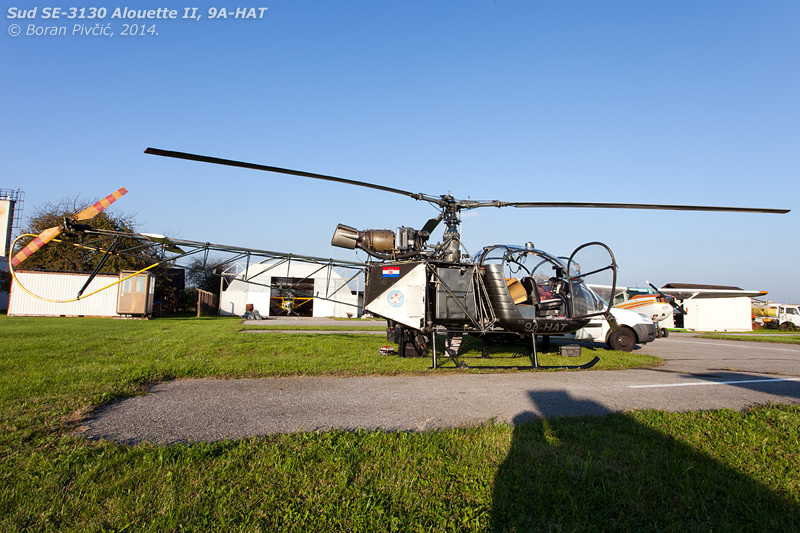
In my case though, this has always been the ideal opportunity to snoop around the airfield a bit, wander into hangars, peek into cockpits – and, naturally, attempt to snap an interesting photo or two 😀 . A method that had served me well in compiling most of the material previously featured here, it had come through once again on 30 September, providing an effective cure for my recent photographic dry spell – the beautiful Sud Alouette II 9A-HAT, nowadays the oldest helicopter in Croatia… 🙂
Approaching one of Lučko’s eastern aprons as Scheibe Falke 9A-DBV shoots some touch & goes in the back. I’d been chatting with a friend and enjoying the sunset when I heard an unfamiliar rotor/engine combination… a quick sprint with my camera across the field had revealed that an already fine flying day was about to get much better!
The cat in the HAT
One of the most groundbreaking designs to have been borne by the French helicopter industry – despite looking like it had been cobbled together in a shed – the SE-3130 Alouette II can trace its roots back to the early 50s and the lessons learned with the similarly named (but mechanically only distantly related) SNCASE* SE-3120 Alouette of 1951. An open framework two-seater powered by a homegrown 200 HP piston engine, the Alouette was in essence the first properly usable French helicopter, combining a light, but strong airframe, good performance – and, for the first time, less than harrowing handling characteristics 🙂 . However, while it did well up in the air (even capturing the closed-circuit distance record for helicopters at 1,250 km / 675 NM), it was a nightmare to maintain and service, resulting in a rather limited production run of just two prototypes…
* apart from its long history of innovation, the French aviation industry is also known for its rather complicated family trees. The original Alouette was, as noted, produced by SNCASE, short for “Société Nationale de Constructions Aéronautiques du Sud-Est”, or “The National Society for Aeronautical Constructions of the South-East (of France)”. Mercifully, by the time the Alouette II went into production, this was shortened to the much more agreeable Sud Aviation. However, during the massive industry consolidation of 1970, Sud became part of a new, powerful conglomerate called Aerospatiale, which would pretty much dominate the continent’s helicopter industry until its 1999 merger with German equivalent MBB to form Eurocopter. Having been under the auspices of Airbus since its early days, this famous name would in early 2014 also head for the history books, to be replaced by the slightly sterile and bland Airbus Helicopters.Thankfully though, the Alouette II itself was spared much rechristening, having only ever been known under two names, the SE-3130 prior to 1967, and SA-313B after.
But, the Alouette’s demonstrated strengths were enough for the bright men of (now) Sud to keep beavering away at the design in an attempt to make it more appealing to both civilian and military customers. Well aware that the complexity and weight of the piston engine – not to mention its associated clutch – was the source of most of their troubles, the program’s chief engineer, Charles Marchetti, had soon decided that the only way forward was to go with the newly available turboprop engine. Even though this was still 1954, the idea was not really new in itself; helicopter visionary Charles Kaman had already gone down this road back in 1951, equipping one of his K-225 intermeshing rotor machines with a Boeing 502-2 turboshaft engine** developing 175 HP, thus creating the world’s first proper¹ turbine-powered helicopter.
** Kaman, being the genius that he was, would three years later also create the world’s first twin-engine turbine helicopter, swapping the R-1340 nine-cylinder radial of the HTK-1 (later to become the HH-43 Huskie) for two of the same 502-2s…
However, while the modified K-225 did manage to fly successfully – achieving a dramatic performance increase despite a 45 HP deficit over its previous 220 HP O-435 piston engine – it was still a very far cry from even a remotely operational turbine helicopter. Reports indicated that the engine, when used in a helicopter installation, was quite prone to compressor surge and power loss, rendering the single-engine K-225 pretty much unusable for any real-world application. The root cause was, understandably, the “early days syndrome”, brought on by the technology’s lack of maturity and parallel use in a novel application. Since there really were no physical barriers to the idea working, getting an operational helicopter onto the shelves had quickly turned into a simple race at who’d iron out all the bugs first 🙂 .
HATs off!
As 1955 had dawned, Sud was edging ever so closer to claiming the trophy. Its partnership with another French institution – the engine maker Turbomeca – had produced quite the positive result, with one of the company’s Artouste II turboshafts already being mated to the new SE-3130 Alouette II. A clean sheet design only vaguely based on the configuration of the original Alouette, the II still fell some distance short of the model we know today, sporting a cabin for only two (the rest of the space being occupied by the fuel tank) and commanding a modest 450 thermodynamic HP, de-rated in normal operations to just 350.
Flying for the first time on 12 March the same year, the prototype would soon begin to evolve towards a definitive production standard, gaining an elongated cabin seating five, a larger fuel tank located directly below the engine for an improved center of gravity – and a more powerful Artouste IIc engine developing 530 HP on full beans and 460 de-rated. In this guise, it would enter production in April 1956 – nearly three years ahead of the runner-up, the Bell XH-40, which would enter service in 1959 as the legendary UH-1 – thus winning the title of the world’s first series-produced turbine helicopter 🙂 .
However, the Alouette II’s list of firsts did not end there. The lesser of the rest was the distinction of being the first helicopter type to carry munitions, specifically the Nord SS.11s wire-guided anti-tank missile; however, the big one was the lead role in the first recognized helicopter air rescue, when test pilots Jean Boulet and Henri Petit airlifted a heart attack victim from the Valliot refuge on the slopes of Mont Blanc on 3 July 1956, flying in at an altitude of 4,362 meters / 14,311 ft – just 448 m / 1,470 ft shy of the top of Europe. A similar feat was again repeated on 3 January 1957, when two Alouette IIs rescued the entire crew of a downed Sikorsky S-58 searching for young mountaineers Jean Vincendon and François Henry (who had sadly perished after 10 days on the snow).
The magic HAT
9A-HAT’s life on the other hand was decidedly less heroic, even though it did get the chance to see a fair bit of Europe! An original Alouette II of the same make and breed as the early production examples outlined above, HAT was completed in 1963 with the serial 1841/475C. Intended outright for military service, it had briefly carried the test reg F-WJDD (reused on several machines during acceptance test), before passing to the Heersflieger – German Army Aviation – as PO139. Throughout its service in Germany it appears to have changed several squadrons and identities, including PY211 and 7696. Following the type’s withdrawal from German service, it was sold on to Portugal, where it continued flying with the Guardia Nacional Republicana – the country’s gendarmerie – as 9208.
Leaving the military for good in 1993, it was then taken up by French operator Héli-Loc as F-GNEA, where it flew unspecified missions on behalf of the country’s electrical power and gas administration until its sale to operator Aéro 34 in 1997. The dawn of the 21st century would see it transferred to operator Avia-Flap in Italy under the reg I-DLSP, from where it would pass to its current home in 2002 🙂 . Flying since that time for operator Eudora Let (based in the popular coastal town of Vodice), HAT is listed on the company’s Air Operator Certificate (AOC) as being used for air work and utility duties – including aerial photography and cinematography, roles which had on 30 September brought it to Lučko… 🙂
Cooling slowly down as it prepares for an overnight stop following an extended mission across the north of Croatia. A beautiful example of simple and straightforward design, the Alouette II is essentially made up only of a rudimentary cabin, a large fuel tank, some girders for the tail – and a compact, but very loud, Artouste bolted to its back…
Equally as simple as the exterior, the interior of HAT contains everything you really need for classic “day VFR” operations. The panel itself is a mix of instruments with German, French and English labels, a reflection of the colorful life it had led prior to its arrival to Croatia…
Quite a compact little package, the Artouste (in its original “Artouste I” version) was originally designed to serve as an Auxiliary Power Unit (APU) on larger aircraft – a role it ended up fulfilling only on the Vickers VC10. Realizing the sales potential of a light, low-power turboprop to power the next generation of light aircraft, Turbomeca squeezed more power out of it, added more sophisticated controls and renamed it the Artouste II…
A rare archive shot from the days HAT had still sported its original red-black scheme. Quality’s not the best, but at this point my first DSLR was still a year or so in the future…
I would also like to extend my sincere thanks to the owner (Mr. Zoran Matić) for allowing me to snoop around for a good half hour!
A bonus story:
¹ in reality, the first application – of any sort – of a gas turbine engine to a helicopter predates the K-225 by a few months, tracing its roots to the workshops of Sud’s sister company SNCASO (“Société Nationale de Constructions Aéronautiques du Sud-Ouest”, “The National Society for Aeronautical Constructions of the South-West (of France)”). As early as 1946, the company’s engineers had been working on designs using so called “jet blades”, blades with outlets at their tips through which compressed air (provided by the engine) would be blown at high speed, creating a propelling reaction in the same way as a jet engine – and thus turning the entire rotor without the need for a heavy and complicated transmission system. The company’s first two models – the SO-1100 Ariel I and SO-1110 Ariel II – were powered by piston engines, a particularly unsuitable type of powerplant given the need to power a big, heavy compressor that is not native to the engine. When the Turbomeca Artouste I prototype appeared in 1951, the company quickly seized the opportunity and stuck it into the Ariel II, creating the SO-1120 Ariel III. But while the gas turbine’s large mass flow did wonders for performance, the whole setup was still far too thirsty and inefficient compared to a traditional configuration, leading SNCASO to pull the plug on the Ariel family and focus on turning the III into an autogyro, the SO-1310…




 Achtung, Skyhawk!