While I’d assumed we’d checked the German Bundespolizei off the list of potential future visitors after their last hop over, I was more than pleasantly surprised to the other day to stumble across another of their machines at the field – a hot find coming right on the heels of the US helicopter fleet that had stationed with us for a few days (welcome to Lučko International 😀 ). Sporting the service’s classy and elegant navy blue scheme, the machine in question is a nowadays rather rare EC-155B-1 medium-lift helicopter, a type completely alien to Croatia – and only the second one I’d ever seen in person…
With its elegant, flowing lines, the EC-155 definitely stands as one of the most handsome helicopters ever made, right alongside the stunning Agusta A.109. It’s lines here slightly spoiled by all its external gear – including TV and FLIR cameras, and winches – D-HLTL is mostly used for surveillance and patrol work
Seemingly a relatively new type at first glance – having been introduced in 1997 – the EC-155 had actually started out in life as the twin-engine Aérospatiale SA.365/AS.365 Dauphin 2* of 1975, itself evolved from the earlier (and stubbier) SA.360/AS.360 Dauphin* single-engine light utility model.
* like many French helicopter designs, both of these machines had gone through several designation changes throughout their lifetimes, a reflection on their constantly changing manufacturers. A holdover from the 60s, the SA prefix stands for the initials of Sud Aviation – the first large scale helicopter manufacturer in France – which had in 1970 merged with Nord Aviation (formerly SNCAN) to form what we know today as Aérospatiale. Taking its time, the new company had introduced the “proper” AS prefix only in 1990, just two years before the company would transform into Eurocopter. The new prefix had however survived the change, and would remain in use even today on older models that had remained in production
In essence occupying a niche below the heavier Puma transport, the EC-155 is not however a direct copy of the Dauphin, which is still in production as the Eurocopter AS.365N3+. Using (most of) the Dauphin as a base, the 155 had introduced a wider and more commodious fuselage, new digital avionics with many bells and whistles – and, most importantly, a completely new composite main rotor and more powerful engines for significantly improved performance in hot-and-high conditions (which also give a slight increase in maximum take off weight).
A design element that has however survived all designation and equipment changes is the type’s eye-catching Fenestron rotor, a trademark feature of many French light and medium helicopters. Literally translated as “small window”, this concept – pioneered by Sud Aviation – replaces the traditional tail rotor’s few large blades with up to 18 smaller ones, shrouded within the tail assembly itself. While this solution does add a fair bit of weight due to the structural reinforcements needed – and tends to shift the CG backwards, decreasing stability – it does allow the individual blades to be lighter and more durable, as well as be able to withstand significantly higher forces and stress. Among other benefits, this includes sharper, quicker and more controlled yawing, which adds quite a bit to the helicopter’s maneuverability.
On some machines – notably military Gazelles – made out of titanium, the Fenestron’s high mass flow can make for some impressive handling (as the Gazelle itself demonstrates). Being smaller, the blades are also noticeably quieter and produce less vibration – but, due to their higher drag, tend to require more power to run and sap more energy from the main rotor during an engine-out autorotation
A competent machine all-round, D-HLTL was in town on a demonstration visit, flying mostly at night to show off its advanced on-board imaging equipment :). Rumor on the apron is that the Croatian Police is likely to buy a few examples – supported by the EU and it accession funds – to supplement is aging (and comparatively under-equipped) Bell fleet… so we may yet see more of them quite soon :).
Author’s note: while not a new topic per se, the Bf.108 has turned out to be quite a popular item on this blog, with my previous post rising to an all time high viewcount. In view of that – and my “temporary”, two-year-old promise to finally sort out the post’s missing images – I’d decided I might refresh it, and post it in a format consistent with the new look of this site 🙂 .
When the first Bf.109s faced their German rivals in mock dogfights in the mid 30s, few observers – in any country – were left in doubt about the capability and raw potential of Messerschmitt’s first fighter design. International flying competitions during the run-up to WW 2 had only confirmed these impressions – but it would take the type’s impressive (though in later years somewhat diluted) wartime service record to finally remove all doubt. Lasting more than a decade in one form or another, the type’s all-up production run had encompassed more than 35,000 examples, spanning everything from the prewar lightweight Bf.109B Berthas to the post-war Merlin-engined Hispano Buchons.
A very advanced design by contemporary standards, the Bf.109 was not actually ground breaking per se; when all was said and done, it had not really introduced anything new or revolutionary into world of interwar fighter design. Rather, what it did – and did brilliantly – was to combine all the cutting edge technologies available at the time into a single aircraft: the monoplane configuration with its high wing loading; the powerful liquid-cooled V engine and its variable pitch prop; fully retractable hydraulically-actuated landing gear; the enclosed cockpit…
Other design features – which soon became the type’s hallmarks – had also included automatic leading edge slats and an innovative construction technique that had made the aircraft extremely light by the fighter standards of the day. The latter had also made the 109 simple and cheap to build, quick and easy to service – and especially tough, durable and reliable under actual combat conditions (though the rigors of the Soviet campaign would put its mettle fully to the test). And while the big engines and retractable landing gear and the monoplane configuration could easily be traced to some of the eminent fighter aircraft of the era, the above features were inherited from a decidedly more peaceful source – the lowly Bf.108 tourer 🙂 .
The aircraft that would eventually lend its technical solutions – not to mention most of its airframe – to the Bf.109 had started out in life as the four-seat* M.37 tourer prototype of 1934. Designed by the young Willy Messerschmitt, Bayerische Flugzeugwerke‘s chief designer, the M.37 was conceived primarily to compete in the 4th Challenge de Tourisme Internationale being held the same year. This interesting – and I’m sure sorely missed – general avation competition was intended to promote and spur the development of light touring aircraft, and had included such competition categories as “Short Takeoff”, “Short Landing”, “Fuel Consumption”, “Minimum Speed”, “Maximum Speed” and “Technical Trial”. Topped by an (at the time) grueling and arduous 9,500 km rally across the diverse spaces and climates of Europe and North Africa (stopping also in Zagreb 🙂 ), this competition was intended – much like the 24 Hours of Le Mans in the automotive world – to weed out inferior designs and encourage quality solutions for future touring aircraft.
* though designed as four-seaters, the M.37 and the early Bf.108 were actually flown as two-seaters, with the rear seats permanently removed to provide some storage space. With virtually all pre-series production versions having been used for competitions and proving flights, this gave impression that they were designed outright just for two…
Based in part on Messerschmitt’s previous M.29 tourer – designed in a similar manner for the 1933 competition, but never taking part due to a spate of crashes – and the M.35 aerobatic trainer prototype, the M.37 was a sleek and elegant all-metal, stressed-skin low-wing monoplane, sporting retractable main gear, an enclosed (and heated) cockpit, full-span flaps – with roll control provided by roll spoilers (in 1934!) – and a variable pitch prop… all of which had immediately made it stand out like a sore thumb in the wood & fabric biplane crowd of the time 🙂 . This brazen level of unorthodoxy had continued under the skin as well, with the wing being built around only one spar – a design that was made to work thanks primarily to Messerschmitt’s extensive glider building experience gained during the restrictions of the Versailles Treaty. The innovative mechanical leading edge slats could be extended manually to improve the airflow over the wing’s outer sections – which were likely to stall first – reducing the stall speed to just 61 km/h (33 knots). This in turn helped to significantly shorten the aircraft’s take off roll – not to STOL levels, but not far above either – and dramatically increased low-speed maneuverability, handling at high Angles of Attack, and behavior in, during and after a stall.
The leading edge slats on a production Bf.109. Interestingly enough, the slats were a British innovation, patented by Handley-Page several years prior their use on the M.37. To use them, Willy Messerschmitt had traded in his own patent, the single-spar wing (photo source: German Bundesarchiv via Wikimedia)
As with the wing, the whole design philosophy was to make the aircraft as simple as possible, using the fewest realistic number of parts needed to make a light and durable airframe. Pure functional minimalism. And it had worked, and worked well – compared to similar designs of later dates, the M.37 was indeed among the lightest and best performing. Official flight testing prior to the 4th CdTI was marked by the general enthusiasm of all pilots that had flown it, prompting the German Aviation Ministry – the Reichsluftfahrtministerium, or RLM – to give the aircraft a tentative green light as the Bf.108*.
* of note here is the oft-confused and misinterpreted designation. Popularized by the 109, the “Bf” prefix stood for the initials of “Bayerische Flugzeugwerke” (itself often shortened to BFW); however, when the company was renamed to “Messerschmitt Flugzeugwerke” in 1938, all subsequent designs were given the new “Me” prefix. The designs that had been produced before the name change had retained their original prefixes through the war – so there never was an “Me-108” as is claimed by some Internet sources.
However, despite the praise and the design’s undoubted qualities, one feature of the 108 had never really sat well with some of the test pilots: the roll spoilers. With the full length of the wing’s trailing edge taken up by the flaps – which increased the wing area by a significant 8% when fully extended – there was no space for traditional ailerons; roll control was instead provided by roll spoilers located on the wing upper surface, whose extension would create a difference in lift along the span of the wing. For example, if you had wanted to roll left, the spoilers on the left side would extend, dumping lift on that part of the wing. The wing’s ride side would now be producing more lift, which would roll the aircraft left around its center of gravity in the same manner as the ordinary aileron. This was fine in theory – and is today still used to provide additional roll control on a number of civil and military designs – but back in the 30s it was viewed with suspicion and more than its fair share of antagonism. This came to a head when test pilot von Dungern was killed while testing the spoilers, presumably somewhere near the edge of the envelope.
With the RLM’s well documented dislike of Willy Messerschmitt threatening to ground the Bf.108 – like it had the M.29 a year before – there was no other option but to revert to a conventional aileron arrangement. “Conventional” though should be taken with a grain of salt when Willy is concerned, because the resulting arrangement had still managed to raise an equal number of eyebrows… 🙂
You can see that Messerschmitt was adamant with his high lift devices: shortening the flaps a bit, he just managed to squeeze in two small 30 cm wide ailerons, lengthened to compensate for their lack of span. Note also the upper tailplane bracing that would be removed on production versions. The aircraft pictured here was one of four intended for the 4th CdTI – and one of three to actually compete – wearing its race number “11” (photo source: http://www.network54.com/forum)
In this form the aircraft became known as the Bf.108A, the designation under which it would be entered in the competition. Sadly, its beautiful handling and avantgarde features did not really help its case there, with the far lighter, nimbler and simpler wooden biplanes wiping the floor with it for most of the competition…
However, the 108 did eventually notch up several notable wins, all of which would eventually steer its development into the aircraft we know today. The top three aircraft in the “Fuel Consumption” category for example were all 108s – with the winner registering an impressive 10 kg (14 l) / 100 km. This figure – nowadays exceeded even by a basic SUV – was made even more impressive by the fact that the 108A was not powered by a small, frugal, fuel-sipping engine, but a 220 HP Hirth HM 8U inverted V8 (a proper GA engine 😀 ). Its power and torque had also helped in the “Maximum Speed” event, where the 108s again took the whole podium, with the slowest – at 283 km/h (153 knots) – being 30 km/h (16 knots) faster than the next contender. The trans-European rally was less of a success though, with the 108’s best result posted by Theo Osterkamp, who placed fifth. However, this poor showing was more due to the scoring system – and external influences such weather and poor navigation – than any faults with the aircraft themselves. Points were awarded based on total average speed, BOTH moving and stationary; this had meant that a fast aircraft grounded by weather for extended periods would score less points than a slow aircraft that had managed to evade the worst of it and continue flying. When everything fell in place though, the 108s had regularly posted the fastest average flying speeds – including on the legs to and from Zagreb 🙂 .
In the end, when the tally was done, the 108s had placed 5th, 6th and 10th out of a grand total of 19 contenders. But more importantly, their demonstrated low fuel consumption, high cruise speeds and beautiful handling – not to mention a leather upholstered and heated cockpit! – had immediately lent them well to cross-country touring. A clean, aerodynamic airframe, able to zip along on comparatively little power – sounds much like the Lancairs and Cirruses of today, doesn’t it? 🙂
Another quarter view of “11”. The early pre-production Bf.108As were the only models to sport the three-bladed VDM propeller (photo source: http://www.network54.com/forum)
This did not slip past the cash-strapped BFW, where Messerschmitt had decided to capitalize on the type’s competition success by adapting it for series production. To this end, a batch of pre-production Bf.108B-0 models was made (though they were still commonly known as the Bf.108A), with each successive aircraft representing a slight step toward a definitive production standard.
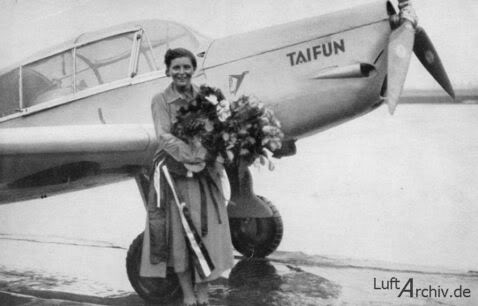
By 1935, these aircraft had already started making a name for themselves – some quite literally 🙂 . Well established as the fastest tourers in the sky, one example was chosen by famous German aviatrix Elly Beinhorn for her record breaking flight from Berlin to Constantinopole (now Istanbul, Turkey) and back. Her little Bf.108B-0 had more than lived up to its Taifun nickname when it took just 13 and a half hours to do the 3,470 km trip, flying along at an average ground speed of 257 km/h (139 knots) – a respectable result even by today’s standards.
Ms. Beinhorn and “Taifun” posing after their long flight. Easily seen here is the A/B-0 models’ bathtub cowling for the Hirth engine (photo source: http://www.luftarchiv.de)Like most 108s of the era, “Taifun” – the exact aircraft illustrated here – wore this simple gloss white paint scheme for its record flight (photo source: http://www.aviation-ancienne.fr)
This very convincing – and, at a time when the nation was hungry for records, very public – success had immediately opened the floodgates, and the 108’s already significant popularity skyrocketed overnight. As was the case with its showing at the 4th CdTI, this had not gone unnoticed at BFW, where Willy Messerschmitt increased efforts to finalize the Bf.108B-0 into a definite, production, high performance cross-country tourer. The end result was the Bf.108B-1, now adopting Taifun into its official name 🙂 .
Ms. Beinhorn posing in an early-production Bf.108B-1, sporting the type’s distincive logo (photo source: http://www.ctie.monash.edu.au)
While there was nothing really wrong with the original A series (and the early B-0s) performance-wise, they did have several features that were judged to be unfit for a production version. The whole idea behind the B-1 was to make the aircraft more production- and consumer-friendly, so the first item to go was the original’s powerplant. The expensive and hard-to-come-by VDM three-blade variable-pitch propeller was replaced by a simpler and cheaper two-blade fixed-pitch prop (although Messerschmitt’s own P7 variable-pitch unit was offered as an option), while the HM 8U engine was swapped for the more readily available Argus Ar 10C inverted V8, producing 240 HP. The wing was a bit dulled down as well by a reversion to a fully conventional aileron and flap arrangement – but had compensated for it by gaining a folding mechanism that allowed it to be tucked close to the fuselage for easier transport by road and rail.
Additional minor changes included the removal of the upper tailplane bracing mentioned previously, the replacement of the next-to-useless tailskid with a non-retractable, freely castoring tailwheel, and the shortening of the glazed canopy over the rear seats.
In this shape and form, the aircraft had continued to participate in international competitions, rallies and fairs (and, most notably, the 1936 Summer Olympics in Berlin) – but now under the increasingly ominous banner of Nazi propaganda. Indeed, soon after its initial competition successes, the fast-growing Luftwaffe had started eying the 108 as a liaison and communications aircraft to replace the obsolete, lumbering biplanes then being used.
A Bf.108B-1 in a prewar civil scheme, showing off some of the changes from the A model. Note the shallower, oval cowling, the modified canopy and the tall tailwheel (photo source: http://www.network54.com/forum)
However, the 108’s biggest contribution to the Wehrmarcht’s war effort was as the basis and jumping-off point for the impressive Bf.109 – a fact that in itself further underscores the essential quality of the Taifun’s design. In a fantastic display of lateral thinking, in 1934 Messerschmitt had simply taken the plans for the 108A and modified the design into a single-seater with a narrower fuselage, a big V12 up front – a “right way up” Rolls-Royce Kestrel on the first prototype (oh, the irony 😀 ) – and some firepower in the slightly modified wings (which too had reverted to a conventional aileron/flap arrangement). Apart from other smaller changes needed to fit all of this together, the rest of the new aircraft was a straight 108 🙂 .
Neatly showing off its 108 lineage is the third Bf.109 prototype – the Bf.109V3 – which had also served as the starting point for the B family (the type’s first production series). Apart from the complete tail unit, the 108’s DNA was also evident in the pilot position, which was exactly where the 108’s rear seats would be. Also not the cut-off spinner, a nearly design feature to facilitate the installation of the nose canon (photo source: www.network54.com/forum)A production-standard Bf.109B of the Legion Condor during the Spanish Civil War. The coolant and oil radiators on these early versions were mounted under the nose, giving this version a clearer 108 lineage (photo source: http://www.hrvatski-vojnik.hr)
While the wildly differing roles of these two aircraft may have raised some eyebrows – not to mention questions about Willy Messerschmitt’s command of his senses – the 108 was actually an amazingly suitable base for the 109. The Taifun’s advanced construction meant that the 109 could be light and maneuverable – as was demonstrated on more than one occasion over the next decade – and its relatively low part count meant it was simple to maintain and repair in the field with whatever facilities were on hand. Lacking complicated construction components also meant that it was very tolerant of combat damage, and the low number of critical design points made disabling it with a “lucky shot” quite the enterprise. At the same time, the clean airframe sliced through the air with relative ease, meaning the 109 could do with relatively little power and a smaller, more economical engine – quite a welcome feature given its notoriously short range and pitiful combat radius.
Achtung… Messerschmitt?
But an interesting and varied operational history was not just the prevue of the 109. Having had the (mis)fortune of being the most advanced light aircraft in the world during a period of significant – and often rapid – political changes, the Taifun had naturally accumulated its fair share of odd operators. Apart from the “usual” Axis users such as Bulgaria, Romania and Japan, there were also a few unexpected ones like China – and the Royal Yugoslav Air Force. The dozen or so B-1s acquired in 1939 were part of a larger batch of aircraft that had also included 60 Bf.109Es and quantities of spare parts – all paid for not with actual money, but in strategic materials such as iron, copper, aluminum and coal… materials abundant in the Kingdom of Yugoslavia, but scarce and badly needed for the military buildup in Germany.
And while the 108s would go on to lead rather uneventful lives in training and liaison roles, the 109s would pretty soon enter the history books 🙂 . The most potent fighter aircraft fielded by the Royal Yugoslav AF at the time of the German invasion in 1941, these machines would go down in history as the only 109s to ever face other 109s in outright combat, clashing violently during the spirited – but ultimately futile and short-lived – defense of Belgrade.
Š-08 (Š for “školski”, literally “training type”) at an airfield that could very well be Borongaj or Lučko (photo source: http://www.network54.com/forum)Yugoslav 108s were well known for their interesting paint schemes, with the above camouflage pattern being the most prevalent (photo source: http://www.network54.com/forum)
Next on the scale of the improbable was – the US military 🙂 . While it was quite common for the USAAF to fly and evaluate captured Axis aircraft, the single Bf.108B-1 it had operated had never even left Germany – and was actually peacefully bought, rather than forcefully captured. Designated the XC-44, this interesting aircraft had been based in Berlin and used as a high-speed staff transport by the US Military Air Attache up until 1941, when it was repossessed by the German government following the United States’ declaration of war against Germany and its allies.
Quite possible one of the rarest – and most ironic – paint job ever applied to an in-service Messerschmitt! (photo source: http://www.network54.com/forum)
Equally improbable – and, if anything, even more interesting – were the four Bf.108B-1s brought into the UK before the war. Bought on the “open market” just like the XC-44, but operated by civilian users, these examples were quickly impounded and pressed into RAF service at the start of hostilities, becoming the Messerschmitt Aldon. Used – like contemporary Luftwaffe examples – in the communications role, they were capable of comfortably outrunning every liaison type in the UK – though their shared family tree with the Bf.109 had often caused identification problems among defending fighters…*
* for those wondering how could the 108 be so easily mistaken for the obviously different 109: the first of the Griffon-engined Spitfires, the Mk XIIs, had been delivered with clipped wingtips intended to improve roll rates and increase maximum speeds at lower altitudes – a feature already well known at the time, and seen on virtually all Spitfires marks since the Mk V. On the ground, the Spit’s famous elliptical wing planfom was still very much obvious; up in the air however, things were somewhat different. On their first few sorties, only the mark’s new-found speed advantage had kept it safe from the attentions of patrolling Hawker Typhoons, which had mistaken their long noses and cut-off wings for those of attacking 109s…
A rare photo of one of the four Aldons – a shape that really is not difficult to confuse with that of the 109 in the heat of combat (photo source: Wikipedia)The 108 does ineed look striking in RAF camo colors! An interesting feature of this scheme is the bright yellow underside: even more so than from the sides or top, from the bottom the 108 can be virtually indistinguishable from the 109 when viewed from a distance. So to prevent the Aldons from being fired upon by nervous AA gunners – who may or may not have noticed the RAF roundels – it was considered prudent to make them as visible as possible from that angle… (photo source: http://www.network54.com/forum)Another catchy scheme – which again didn’t help much with identification (photo source: http://www.network54.com/forum)
The postwar period too saw its share of unusual operators, including Czechoslovakia (where the type was known as the K-70), Poland and even the Soviet Union, all of which had flown examples captured during the final days of the war. Another interesting operator – well known now for their very colorful 108s – was Spain, which had acquired several batches of the type during the Spanish Civil War and Franco’s subsequent ascension to power.
For the full photo history of the 108’s civil and military service around the world, you can visit the excellent pages below, a gold mine of fantastic information from which I’ve linked many of the photos above 🙂 .
Unlike its armed cousin though, the 108 did not go through new versions like pairs of socks. Apart from the B series, there was only one major production version, the D; equally, experimental and test versions were also few in number. However, what the latter lacked in quantity, they’d definitely made up in quality… 🙂
By far the most normal – and sensible – of these was the Bf.108C-1, an ungainly 1936 modification that had seen a B-1 airframe refitted with a Siemens Sh 14A-7 seven cylinder radial. Coupled with its increased frontal area and drag, the engine’s rather pitiful 160 HP – 80 HP, or 33%, less than the type’s standard Argus Ar 10 – made for some appalling performance, which saw the aircraft remain a one-of. However, while this version seems to be an unnecessary step backwards, there appears to have been some method in Messerschmitt’s madness after all. While there’s little concrete technical info available on the mark, the C-1 was most likely an insurance policy for the event that Ar 10 production became disrupted or sidetracked to other more important projects – a policy not unlike that later employed by Avro with the Bristol Hercules-engined Lancaster B II.
Used solely for promotional purposes during the 1936 Winter Olympics, the C-1 had managed to clock 21,600 km without incident, shuttling film roles of the games between Berlin and Stockholm. Abysmally underpowered, the aircraft was later re-engined back to the standard Ar 10 (photo source: http://www.network54.com/forum)
At the other end of the spectrum was a stillborn version that some sources also label as a C-1 – which, given the German aeronautical industry’s policy of reusing designations of failed models, was entirely possible. Diametrically opposed to the Siemens-engined version, this C-1 was to have been a high-speed model, fitted with a Hirth HM512 inverted V12 that would have developed an astounding 400 HP on takeoff! 🙂 Ground testing in 1938 though had quickly revealed that noticeable airframe vibration and buffeting was to be expected above 325 km/h, which would progressively become so severe that it could even tear the airframe apart. Given the scope of engineering changes that would be needed to make this version work – and the impending shift of the German military industry into high gear – meant the project was quietly dropped…
That the only way was up was quite literally demonstrated in 1939 by a specially-modified high-altitude Bf.108B-1 (lacking a special designation), built to capture the world altitude record for its class. Fitted with a supercharged Hirth HM508 inverted V8 producing 270 HP – and also providing air to pressurize the cabin – this aircraft had reached an impressive 9,125 m (29,930 ft) in the hands of Hirth’s managing director, Herman Illg.
Series production models were however less interesting – and had pretty soon started suffering from an acute case of Skyhawk-itis 😀 . If you took ten C172s of the same model and same production year and lined them all up, you’d be able to spot – with very little effort – at least one difference or unique feature on each aircraft… a different landing light here, a static port moved to there, a panel layout tweaked just so… and so on. As production ramped up, the Bf.108 became no different, with options and features freely flowing between versions. This had made sorting them by model a bit difficult and vague; however, after roving the Internet far and wide, I think I’d managed to hit the nail on the head in general terms:
B-1: the already-described base model
B-2: generally very similar, but with the wing fold system removed and the variable pitch P7 prop – offered as an option on the B-1 – fitted as standard. This version could easily be recognized by its thinner prop blades and slightly different propeller hub
D-1: debuting in 1941, this was the first model produced outright for military use, and had featured a modified vertical stabilizer, improved fuel feed system, more powerful electrics, a windscreen wiper and a new constant speed prop, being turned by an Ar 10R engine of the same power output as the C (of note here is that “variable pitch” and “constant speed” propellers are not the same thing. A constant speed propeller – standard today – automatically varies the pitch of its blades to maintain the same RPM regardless of throttle setting; the variable pitch prop however was fully manual, with the pitch having to be readjusted with every change of throttle or airspeed. The 108’s variable pitch prop was operated by a large circular handle in the middle of the panel – known among the type’s pilots as the “coffee grinder” – and had added quite a bit to the crew’s workload)
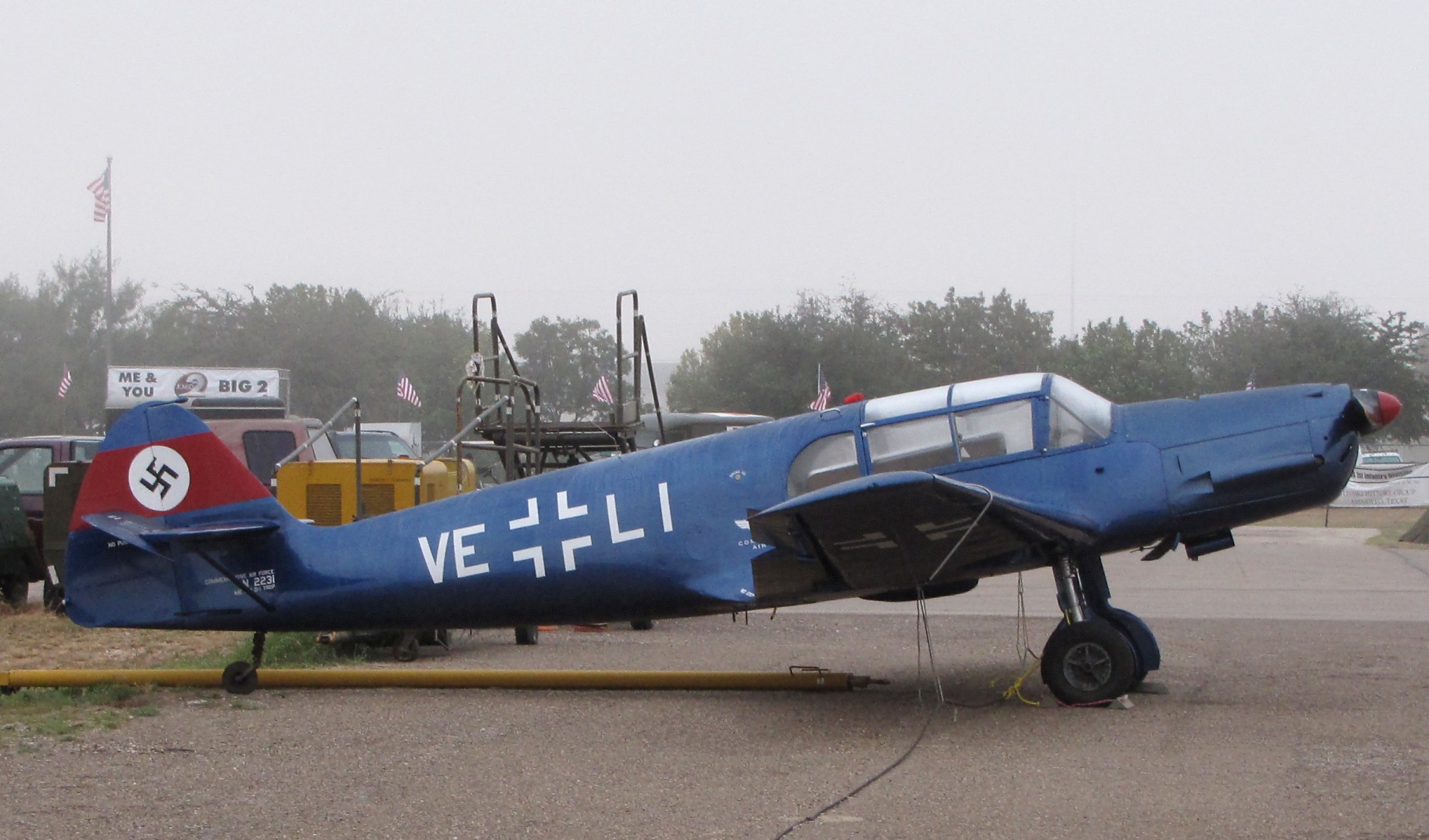
A fine photo of a B-1 fitted with its original fixed pitch prop. Somewhat rare even in the 40s, a majority of these versions were later refitted with the variable pitch P7 – though at least one surviving example, D-EBFW, had retained the original well into the 2000s (photo source: Flickr.com, user “kitchener.lord”)The more common P7 fitted to Messerschmitt Stiftung’s Bf.108B-1. In this guise, the B-1 was externally indistinguishable from the B-2 (photo source: Wilbergair.com)Photos of “proper” D-1s are nigh impossible to find, so I’ll just have to improvise a bit… the mark’s most distinctive feature was the “crowned” spinner for the new constant speed system, beautifully modeled here by a B-1. Like the P7, this unit was eventually retrofitted to some examples of the B-1 and B-2 (photo source: http://www.ampa.ch)Not much quality-wise, this was the best photo I could find that nicely shows the D-1’s other unique structural feature. Dispensing with the rudder horn balance seen on the B series, the D-1 used a slightly modified counterweight arrangement that was supposed to give slightly more rudder authority and better stability. Also note the B-1’s fixed pitch prop; whether this aircraft had actually been produced with it, or had the unit been fitted later, is unknown (photo source: Wikimedia)
The D-1 would also signal the last of German Bf.108 production before the whole works were transferred to France at the beginning of 1942. In a bid to free up domestic production capacity for badly needed Bf.109s, the B-2 and D-1 were allotted to the factory of the Société Nationale de Constructions Aéronautique duNord – SNCAN, or simply Nord – just outside Paris, where they would remain until the end of the war in France – with interesting consequences.
Following the country’s liberation in the summer of 1944, SNCAN – having produced just 170 aircraft out of the type’s total production run of about 880 – found itself with a significant number of uncompleted airframes and engines. Deciding it would be a waste to just throw them all away – and desperate to gain a foothold in the country’s recovering economy – the top brass elected to restart production of the 108 in the guise of the Nord Pingouin (what a demotion – from an impressive meteorological phenomenon to a cute polar animal 😀 ). The first model, the 1000 Pingouin, was virtually identical to the Bf.108B-2, save for the reintroduction of the B-1’s folding wings and the refitting of the D-1’s improved vertical stabilizer.
Apart from a French scheme, there was little to distinguish the early Pingouin from a regular Bf.108 – or rather from the smorgasbord of version features the late-war models had become (photo source: http://www.network54.com/forum)
Once these stocks had been exhausted, it was a relatively straightforward matter to re-manufacture the airframes from the original plans, the WW 2 production tooling having already been set up and waiting. However, the engines had proved to be a bigger challenge, having been produced in – and imported from – Germany during the war. The only way around this was to use a local engine of similar power; but the only unit available was the Renault 6Q family of six cylinder inverted inlines, a powerplant considerably longer than the compact Ar 10. But having no realistic alternative, SNCAN went ahead with the redesign, creating the long-nose 1001 Pingouin I. Powered by the 233 HP 6Q-11, this model was quickly followed by the 1002 Pingouin II, which upgraded to the slightly more powerful 240 HP 6Q-10 – and which would eventually become the most common of all the Pingouins.
These would eventually number at 286, bringing the 108’s overall total to a tad over 1,100 aircraft. However, I was unable to confirm with absolute certainty when French production had actually ceased – but given the type’s low rate of production, I’d guesstimate the aircraft had disappeared from the production lines during the early 50s.
One of the very few airworthy Pingouins still using the Renault engine, this handsome 1002 is seen sporting a prewar 108 paintscheme of the type worn during aviation competitions of the 30s. Note the extended nose for the long, but comparatively narrow, 6Q (photo source: http://www.airventure.de)
Note: some of the surviving aircraft have since been retrofitted with standard Lycoming and Continental engines, and have shorter, broader and more oval cowlings. For the sake of simplicity, I decided only to represent the original Renault-powered models here.
A (third) leg to stand on
However, the end of the Pingouin was not the end of France’s 108 connection 🙂 . Back in 1943, SNCAN – under prompting and guidance from Messerschmitt – had started working on an experimental tricycle version of the Bf.108B-2, which would have been known as the Me-208 (since this version was conceived after the creation of the Messerschmitt Flugzeugbau, it was allocated the Me prefix). Two prototypes were built during the last days of the occupation of France, but only one would actually survive to its end, later to become known as the Nord 1100 Noralpha. As in the case of the 108, SNCAN had decided to see the design though to the end – having already done 90% of the work – and market it under its own name. The result was the 6Q-10 engined 1101 Noralpha (known in French military service as the Nord Ramier, or “dove”), whose production ran to the 205 mark.
One of the surviving Noralphas in a tipsy landing. Though very similar to the intended Me-208, the design was already starting to significantly depart from the clean lines of the 108 (photo source: http://www.flugzeuginfo.net)
Much like the 108, the Noralpha did not see much in the way of different versions, but had compensated for it by a history of use as an engine testbed 🙂 . The first (rather conservative) iteration was the planned, but never built, 1102 Noralpha II, which would have been powered by the 6Q-11 seen on the Pingouin I. This version was followed by the slightly more successful 1104 – which had actually made it to the prototype stage, but no further – powered by a Spanish Potez 6Dba engine of the same configuration and power output as the 6Q-10.
However, the ultimate expression of power – and arguably of the entire 108 line – came in the form of two 1959 SFERMA-Nord 1110 Nord-Astazous. A project of the equally long-named Société Française d’Entretien et de Réparation de Matériel Aéronautique – SFERMA, a company formed in 1949 for the purpose of repairing and overhauling civil and military aircraft – the 1110s were conceived as testbeds for the in-development Turbomeca Astazou turboprop. The first example started out in life as the 150th 1101 Ramier produced, and was initially fitted with the 467 HP Astazou I. A bit later in the program, this aircraft – along with an additional 1101 – was re-equipped with the more powerful 550 HP Astazou II, as well as a host of other modifications including shorter span wings with cut off wingtips and vertical tail surfaces of increased size (to provide more stability at higher speeds).
Defined by the unconventional shape of the Astazou, the first 1110 was an even odder looking machine than the original 1101. However, with almost double the power of the piston models – and aerodynamic refinements that removed the high-speed effects first experienced by the second Bf.108C-1 – the 1110 easily took the title of the fastest Nord single prop in the sky (photo source: 1000aircraftphotos.com)
Like the Me-208 though, only one of these amazing aircraft would actually survive to fly another day once the Astazou test program came to an end. Owned and operated by the Association Antilope under the reg F-AZNR, the above pictured example is still airworthy and beautifully maintained, happily plying the airshow circuit in France on a regular basis 🙂 .
A beautiful atmospheric shot of F-AZNR by Mr. Eric Hannequin (photo source: Mr. Hannequin’s Flick gallery)
The wind that keeps on blowing
While the type’s prime – in any version – had passed a long time ago, its status as one of the preeminent touring aircraft of the 30s had naturally had an effect on its current status of a desirable WW 2-era warbird 🙂 . Most estimates suggest that somewhere between 25 and 30 Taifuns and Nords are still airworthy today – a number of which are, unsurprisingly, operated in Germany. Aside from Messerschmitt’s own historic flight – the previously mentioned MesserschmittStiftung, part of the EADS consortium – another famous 108 operator is Lufthansa’s vintage aircraft division, the Lufthansa Stiftung. Possibly the best known of all surviving 108s, the company’s silver B-1 – registered D-EBEI – also shows that there’s still some mischevous spirit left in one of the world’s most serious companies; for a Taifun named Elly Beinhorn was just too good an opportunity to pass up 😀 .
Looking resplendent in a period scheme. Like several surviving examples – some of which still tend to clock up decent flying time – D-EBEI was refitted with a modern propeller and constant speed unit, to avoid wearing out the nowadays hard-to-come-by Me P7 (photo source: D-OTTI gallery at arcor.de)
For photos of other flying – and museum – examples, some of which are too good to cram in here, you can visit these galleries at Airliners.net, which I’d sorted by type 🙂 :
A table view of the specs of the Bf.108B-1, B-2 and D-1 (Pingouin numbers were broadly similar). Click the image to go to the bigger version (source: http://www.network54.com/forum; or simply click on the Aeronet Aviacion Part 1 link)
Version overview
Since keeping track of all the 108 versions can be a handful – and was quite a frustration for me as I was writing (and rewriting) this 🙂 – I’ve decided it would be prudent to sum them all up in one place, along with a few of their distinguishing features:
M.37
the first prototypes, used for initial flight testing and equipped with roll spoilers
Bf.108
the designation adopted during acceptance tests, identical to the M.37
Bf.108A
1934 competition version, modified with short-span ailerons
Bf.108B-0
pre-production series, each aircraft incorporating slightly different features
Bf.108B-1
the first production version with folding wings, Argus Ar 10C engine and fixed-pitch prop (Me P7 variable-pitch as an option)
Bf.108B-2
B-1 with folding wings removed and the P7 fitted as standard
Bf.108C-1
initially a Siemens radial version; later reused on the proposed HM502 V12 high-speed model
Bf.108D-1
final German production version fitted with a constant-speed prop, Ar 10R engine, more powerful electrics, improved fuel system and a modified vertical stabilizer; produced mostly in France
Nord 1000 Pingouin
post-liberation Bf.108B-2s, incorporating the B-1’s folding wings and the D-1s vertical stabilizer
Nord 1001 Pingouin I
new-build 1000s fitted with the 233 HP Renault 6Q-11 engine
Nord 1002 Pingouin II
new-build 1000s fitted with the 240 HP Renault 6Q-10 engine
Me-208
two prototypes of the Bf.108B-2 modified with tricycle gear, designed in France
Nord 1100 Noralpha
the post-war designation of the only Me-208 prototype to survive the occupation of France
Nord 1101 Noralpha I / Nord Ramier
production-standard 1100s fitted with the 6Q-10 engine
Nord 1102 Noralpha II
proposed 6Q-11 model, never built
Nord 1104
1101 modified with the Potez 6Dba engine, one built
SFERMA-Nord 1110 Noralpha-Astazou
two 1101s modified as testbeds for the early Turbomeca Astazou tubroprop
While the annual Lučko Airshow, held over the weekend of 15 & 16 September, was just as lackluster as expected, it did have one bright spark which had immediately drawn me in :). Among the usual blend of Cessnas, Pipers and gliders – most of which are native to the field – we’d also been graced by a visit from the second turboprop of the month, a mint white Pilatus PC-6/B2-H4.
Registered S5-CMA and owned by the air service provider Aviofun of neighboring Slovenia, this fantastically charismatic aircraft had been tasked with almost round-the-clock skydive operations at the show, and had stayed on an additional day to do the same during the follow-on skydive competition. Unfortunately for it, Lučko is completely dry as far as Jet A is concerned, which had necessitated several trips to nearby Zagreb Intl. to refuel. Fortunately for me though, a couple of friends and I had managed to hitch a ride on one of these flights – with many thanks to the pilot! – giving me my first opportunity to enjoy the PC-6 in flight… 🙂
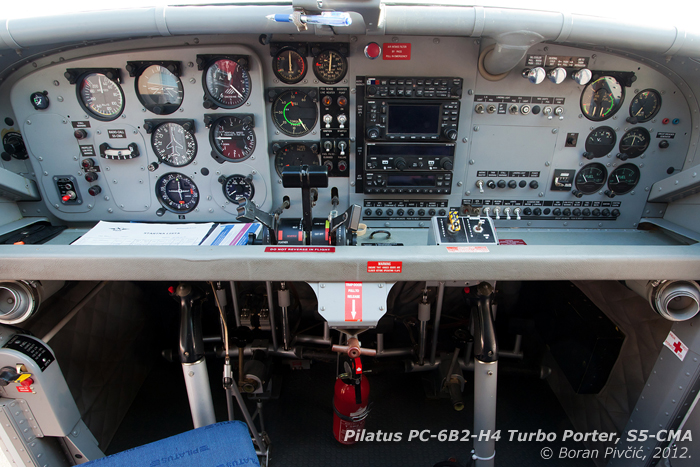
The most interesting – and hardworking – aircraft at the show taxiing out for another skydive flight. Like the Caravan that visited during the run-up to Jackal Stone 2012, the PC-6 is incredibly quiet compared to our piston-powered skydive aircraftA clean, simple and neat cockpit. Part of an earlier iteration of the Turbo Porter, CMA sports slightly different instrument types and cockpit layout than newer-build PC-6s – a layout, reminiscent of the versions used during the Vietnam era, that actually gives it even more characterDespite its age, the cockpit looks almost brand new, and is equipped with a few extras – such as a Mode S transponder and a Garmin GNS430 unit – to help it cope better in today’s crowded airspace. Decidedly a VFR aircraft, CMA’s only radionavigation aid is the single CDI, which came in the same package as the GNS unit“Where we’re going we don’t need runways!” Diving on the midpoint of Pleso’s RWY 23 for a cracking landing on the last quarter of the 3252 meter strip. With the GA apron located at the extreme end of the airport right by the RWY 05 threshold (obscured here by the windshield frame), light aircraft often practice “long landings” when RWY 23 is in use, touching down on the last third of the runway to save on taxiing times. I myself, when flying in with a Skyhawk, usually start the flare when passing taxiway C (the nearest taxiway in the photo), leaving me enough space to comfortably land and coast up to taxiway B (middle one), which leads almost directly to the GA apronEntering final for Lučko’s RWY 28L at 3,000 ft (as opposed to the usual 900), full flaps, 120 knots indicated and going down 5,000 ft per minute for a perfect landing right on the threshold… welcome to PC-6 World!
While our placid little airfield generally deserves the epithet of “the airfield at the edge of town” – despite what has been written here over the years 😀 – it does occasionally have its bright moments. Due to the relatively poor condition of its grass runway – among other issues – precluding the landing of any “serious” fixed wing aircraft, these tend to occur only when something rotary is in town, like the previously photographed US Navy Knighthawk or Bundespolizei Super Puma.
However, while these very welcome one-of visitors do make for a pleasant change of tempo – often becoming major attractions in their own right – they hadn’t really prepared us for the miniature assault fleet that had pitched up camp on the military apron between 8 and 12 September… 🙂
Jackal Stoned
In town to participate in the annual Jackal Stone multinational military exercise – this year starting on 13 September – this fleet had included no less than four transport helicopters (nothing to sneeze at when Lučko is concerned!), and even a supporting Cessna Caravan that had occasionally popped into the field on general transport business. And while their numbers alone were enough the cause widespread interest, their composition – once confirmed by a quick search on the Net – had elevated them to “must photograph at all costs” status :D.
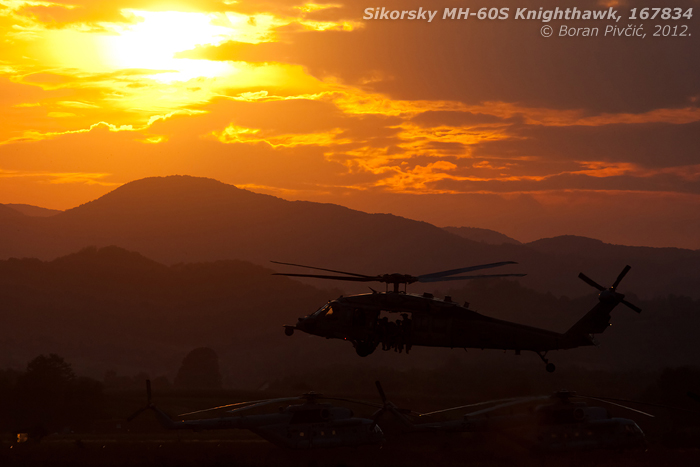
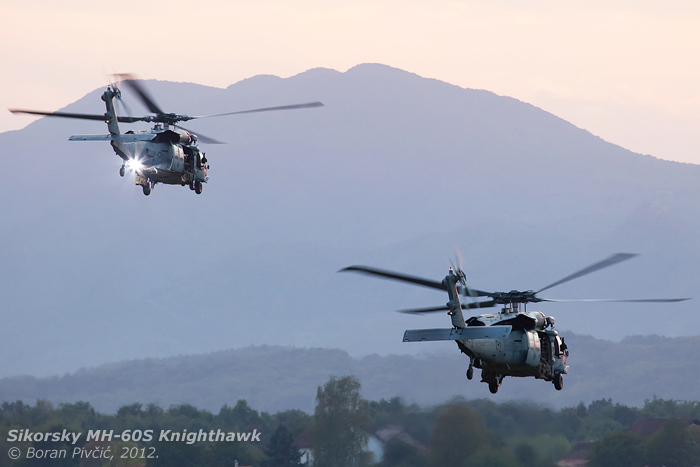
The “less interesting” pair – using the term lightly – were two already familiar US Navy Sikorsky MH-60S Knighthawks, pretty much identical to the example that had visited us a couple of months back, save for being equipped with turret IR cameras on their noses.
Laden with soldiers, “Jackhammer 81” is seen lifting off from the military apron for another afternoon mission. Operating mostly during sunset and at night, all four helicopters had spent their time here flying training missions and deployments in advance of the Jackal Stone 2012 exercise“Jackhammer 81” (left) and “Jackhammer 82” (code 166347) are seen blasting out of the field for an afternoon mission in the hilly Zagorje region north of Zagreb. Operating entirely over Northern Croatia, these flights had caused significant disruption to the normal flow of GA traffic, with exercises held in temporary prohibited zones established right on – or very near to – the most commonly flown cross-country routes
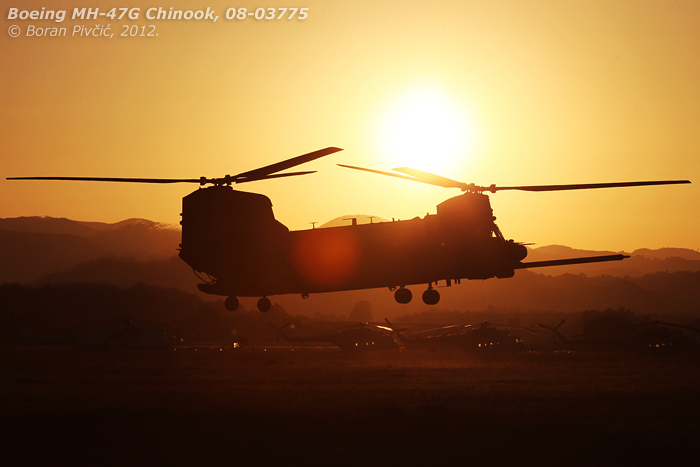
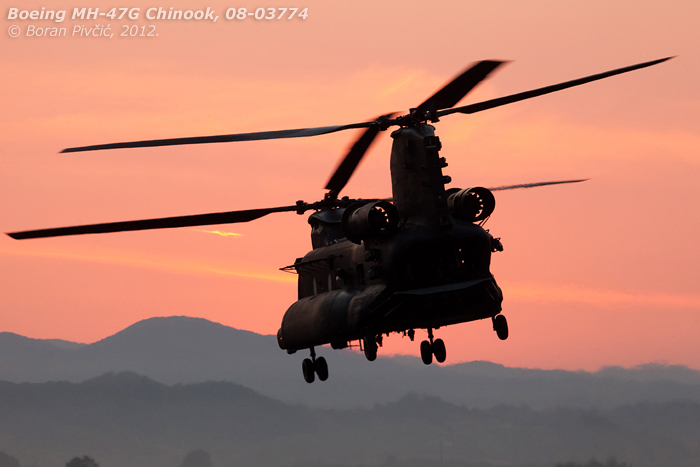
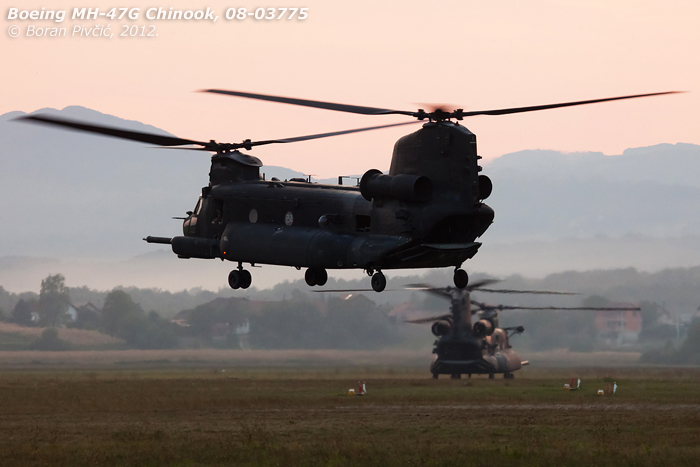
Far more interesting by any measure – objective or otherwise – were the “big guns”, two US Army Boeing MH-47G Chinooks. Significantly more potent than the stock transport CH-47s, the MH-47G is a dedicated special operations model, conceived and designed on the back of lessons learned during special forces deployments and insertions in Afghanistan and Iraq. The rarest – and among the newest – of all Chinooks, these models carry virtually no external markings (apart from faint titles and an incredibly-difficult-to-find serial) and sport a distinctive matte black finish that makes them impossible to photograph effectively in all but early morning light 🙂 (which had presented a slight problem for yours truly, since none of them had actually operated during the early morning).
A very famous silouette air taxiing back to the military apron after a special forces rappelling exercise. In addition to significantly improved avionics – including full night vision gear – the MH-47G also comes equipped with a slightly conspicuous refueling probe. Long by necessity – to prevent the front rotor from slicing through the refueling hose – the probe can most often be seen plugged into the KC-130 dedicated tanker, or on occasion even the MC-130 Combat Shadow, the Herc’s special operations support versionCaught in some fantastic light, “Crazy 21” is seen repositioning itself towards the helicopter start gates for a late afternoon mission with sister ship “Crazy 22”. Brutish looking machines, they’re amazingly quiet and (subjectively) make less of a racket than the CroAF’s own Mi-171sForming up at the start gates, “Crazy 21” and “Crazy 22” made for a sight that even my friends in the States wholeheartedly assure me is an incredibly rare sight – two special ops Chinooks at the same place and the same time, rearing to go
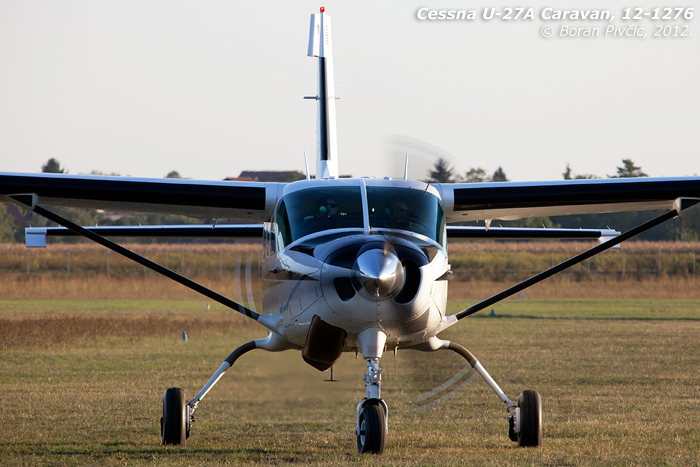
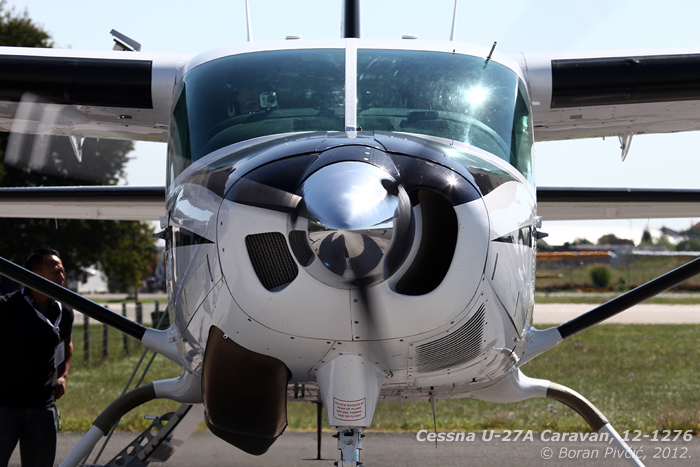
Of course, being the hopeless GA enthusiast that I am, both of these incredible – and incredibly rare – machines were overshadowed somewhat by a brief, five-minute visit of one of my favorite prop singles, the Cessna Caravan :D. The first one I’ve ever seen in person – which says much about the traffic at Lučko – this specific example belongs to the military U-27 family, operated in this instance by the US Army. Based on the stock 208B Grand Caravan, the U-27 differs mostly in its more spartan interior fittings – suited to its military transport role – and the absence of the imposing cargo pod seen on many civil versions…
What is probably the first Caravan to ever visit the field, “Army 1276” is seen rolling in along (the very uneven) taxiway A to pick up some foreign journalists covering the pre-exercise maneuvers. In a (fully justified) slap to Lučko’s infamously rough runway, even this off-road, rough-and-ready machine had exercised due care and caution during takeoff and landingFinally up close – and I must admit the 208 is quite a bit larger than I had imagined! Interestingly though, the aircraft is surprisingly quiet, no louder than a stock 172 or 182 (which had operated out of the field for the whole time). Of note here is the slightly offset propeller (and engine) axis, intended to partially compensate for the prop’s relatively high P factor
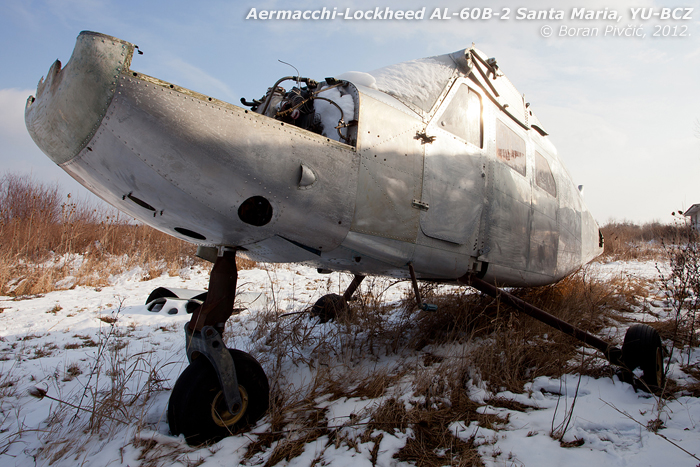
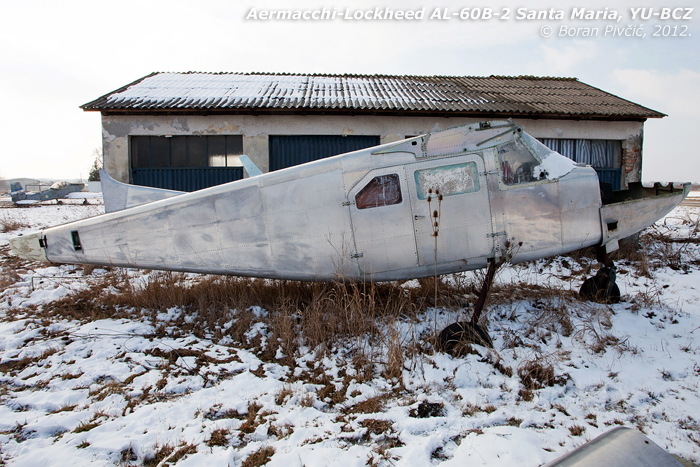
Even though sleepy rural airfields – the sort with just an odd Skyhawk or Super Cub about – do not really sound like exciting places to be (especially at -10 degrees Centigrade 😀 ), some careful exploration reveals that this is not always the case. Guided by this thought on one of my previous visits to Serbia, I’d decided to pop down to the Lisičji jarak (LYBJ) airfield just north of Belgrade and see if I could dig up something of interest. And sure enough, just 10 minutes into my self-guided tour, I turned a corner behind an isolated, out-of-the-way building and stumbled upon one of the rarest – and oddest – production piston singles built: the Aermacchi-Lockheed AL-60 :).
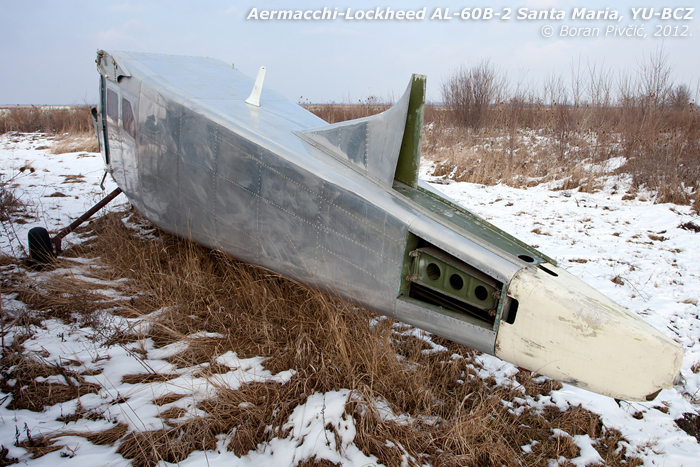
YU-BCZ was progressing significantly backwards since the last photo I saw of it on Airliners.net. Stripped of virtually all components that could be taken down, the aircraft is undergoing a slow – but thorough – process of repair and restoration
No country for new planes
Lockheed’s only foray into the light general aviation market, the AL-60 – originally known as the L-402 – was designed in the late 50s by the legendary Al Mooney, and intended to serve as a cheap and cheerful – but still tough and durable – backwater utility aircraft. Interestingly – and possibly uniquely at the time – it was fully tailored to the specifics and requirements of the growing South American market, and was never intended to be produced in the US (save for the prototype and eventual development aircraft).
Mass production was instead shifted south of the border (irony anyone? 🙂 ) to a brand new plant in San Luis Potosi, Mexico, operated by Lockheed’s subsidiary Lockheed-Azcarate SA, a company created specifically for the purpose. The move had also implied a change of name of the aircraft itself, which quickly became known as the LASA-60, derived from the initials of the subsidiary and the year in which the design was fully certified.
However, despite its robustness and quality of design, the aircraft had fared rather poorly when faced with designs from established GA manufacturers such as Cessna. Their proven 182 – and the incoming 185 and 206 – had all offered roughly similar performance, size and capability, but with a pedigree and support network that the one-of LASA-60 simply could not match. This disparity soon reached such proportions that after only a dozen or so examples built, Lockheed started looking for a way to offload the LASA-60 and salvage as much of the funds invested as possible.
In a fortunate turn of events – for both Lockheed and the design itself – Aermacchi of Italy was at that time looking around for a utility machine to add to its successful line of light tourers and trainers. Believing they’d found what they were looking for in the LASA-60, the company bought the type’s production license and tooling – which had churned out only 18 aircraft in total – and transferred them to Varese in Italy. Once set up there, the design became the AL-60 Santa Maria, named in honor of the town of Santa Maria in California that was home to Lockheed’s – and still is home to Lockheed Martin’s – headquarters :).
Never staying put for long, the design’s final – albeit only partial – move was to South Africa in 1974, by which time the production rights had probably covered more miles than the actual aircraft :D. Produced by Atlas – known for the Cheetah, a modification of the Dassault Mirage III, and the Impala, a license-built Aermacchi MB-326 – the aircraft became known as the C4M Kudu (named after a local antelope-like animal), and was the last version to roll of the assembly lines, Italian production having stopped in 1972.
Mooneying me
While this constant changing of hands would have implied the existence of a host of different versions – as each new owner adapted the design to his markets’ requirements – the AL-60 had in reality borne only three major series: the original LASA-60 and the AL-60B and C families, the latter of which also includes South Africa’s Kudus.
Structurally mostly identical across all versions – the major difference being the C series’ taildragger configuration – the AL-60 could provide seating for 4-6 passengers, an equal number of skydivers, or space enough for two stretchers in an ambulance configuration. A versatile, well-thought-out Mooney design, the aircraft’s simple interior and its regular rectangular shape allowed for numerous other variations – including an aerial photography setup – which could be switched at will with the minimum amount of effort and time.
Like any good bush plane, the AL-60 could also be equipped with skis or floats (but no amphibian versions were offered), though it is highly questionable whether any aircraft were actually delivered in these configurations – or otherwise retained them to this day.
All available evidence points to the wheeled versions (tricycle and tailwheel) as the only ones to have seen production. Another of Al Mooney’s touches – and one of the type’s distinctive features – the main gears of the tricycle models were designed so that the legs do not obstruct access to the cargo doors, while still providing a wide track and keeping the wheels sufficiently aft
What did vary significantly between versions were the engines. The original LASA-60s and the first of the Santa Marias – the four-strong AL-60B-1 series – were powered by the naturally aspirated Continental IO-470 flat six, developing 250 HP. While the same engine was also used to great effect on early versions of the Cessna 185, its power output on the AL-60 was described as inadequate by a number of pilots, who used to joke (and still do) that the only reason the AL-60 ever got airborne was due to the curvature of the Earth (latterly often applied to certain versions of the Airbus A340) :).
To try and address this issue, the first major production version, the AL-60B-2 – which ended up being the most common of all AL-60s, numbering 81 built – was refitted with a turbocharged version of the same engine, the TSIO-470, now developing 260 HP. While its performance at altitude – and especially during takeoff from low density hot-and-high conditions – improved significantly, the pitiful 10 HP of additional power still made little difference in normal, everyday operations.
A significant increase in power first came with the taildragging C series, originally designed to meet an Italian Army requirement for a liaison aircraft with transport capability (a requirement that eventually fell through). The resulting AL-60C-4 was whisked along by a Lycoming GSO-480 supercharged and geared (for that little extra something :D) flat six, developing a more potent 340 HP. Produced mostly by Piaggio, this version later matured into the AL-60C-4M – also known as the AL-60C-5 Conestoga, and, erroneously, the Trojan – which would in 1974 become South Africa’s C4M Kudu (hence the designation).
Apparently, in some quarters it was felt that even this was too little power, so the design was further developed into the “standalone” AL-60F-5 Trojan (the real one this time). Offered in both tricycle and tailwheel configurations, the Trojan was powered by the brutishly impressive Lycoming IO-720 flat eight, essentially two IO-360 stuck together at the drive shaft and producing a hefty 400 HP (this engine would later rise to fame as the powerplant of the Piper PA-24-400 Cherokee 400 four seat tourer and the PA-36 Pawnee Brave cropduster). And while it lacked charging, it’s raw power – and more importantly, torque – had made the Trojan an excellent climber and hauler, which had lent it to good use in the humid, hot-and-high environment of Central and Southern Africa.
Design freeze
Back in the dry, low-and-cold environment of Central Serbia however, YU-BCZ was doing less well. Completely devoid of any markings and data plaques, its identity was only confirmed after an Internet search, which had also revealed that it belongs to the original B-2 series – which would put its birthday sometimes in the mid 60s. Other information floating around also suggests that it was one of four registered in former Yugoslavia, and had – prior to the country’s dissolution – been based at Čepin Airfield (now LDOC) in Eastern Croatia :).
As noted previously – and evident in the photos – in the present the aircraft has been almost completely stripped of all external components, some of which were crammed into the cabin. Between them, glimpses of the panel had also indicated that it had been cleaned out, but otherwise seemed in good shape. Word on the apron is that the aircraft is being slowly restored to flying status by a team of experts after spending a lengthy 22 years on the ground – and the precision, thoroughness and purposefulness of its dismantling (as well as the carefully stripped paint) would certainly seem to confirm this.
With its status as one of the very few remaining examples in Europe – and likely the only Yugoslav survivor – we can only hope to see it back in the skies soon… 🙂
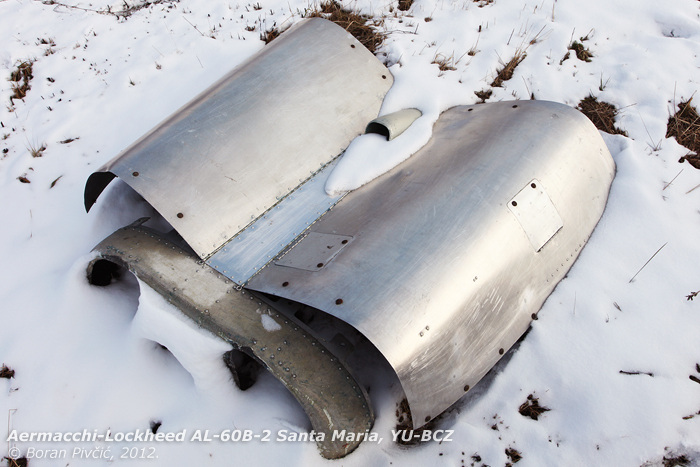
With most of its extremities gone, it had taken me a few seconds to recognize what this was – though the main gears were a dead giveaway. Of completely conventional all-metal construction, the AL-60 was a robust aircraft, on par with the analogous – but much more successful – Cessna 206Discarded by the side and half sank into snow, BCZ’s cowl makes for an oddly saddening sight. Of somewhat questionable aerodynamics – and with its eternal engine power woes (sporting 50 HP less than the similarly sized C206) – the original AL-60 was never a sales success, and had slipped into relative obscurity even while it was still being produced. Nevertheless, with a bit more power it had proven itself to be a solid aircraft – by which time the sales ship had passed – still serving in Kudu form with the South African AF
A couple of years ago when I first started this blog, I made mention of a skydive-configured Cessna 185 Carryall that had been involved in a landing accident awhile back, and had remained confined to the corner of the hangar ever since. The topic of one of my early Plane’s Anatomy posts, this specific, slightly understated ( 😀 ) aircraft had recently been thrust into the local spotlight again, this time when it finally coughed back to life after its long rest.
Overall not a particularly interesting or exciting aircraft by any objective measure – just a regular 185 – 9A-BKS is nevertheless one of the most endeared and endearing aircraft at Lučko; a charismatic fuel-to-noise converter that had at one point or the other served as a jump platform for virtually every skydiver in the area. Quite a loud aircraft, sporting a two-blade transsonic prop, BKS had cut a distinctive high pitched noise that could be heard all the way to the suburbs of Zagreb – some 10 km away – and pretty much represented the main symbol of the airfield.
The noise stopped however at the beginning of 2008, when BKS’ pilot braked a bit too hard on landing, sending the prop tips into the ground. While the aircraft itself had suffered no damage, the propeller was ruined and the engine overstressed by the sudden stop, both necessitating a thorough – and thoroughly expensive – overhaul. These costs, coupled with the operator’s poor financial state (which continues to this day) had dragged repairs through more than four years, until BKS finally fired up on 10 June this year 🙂 .
Naturally, I was ready to immortalize the event with my camera – even though it had meant a whole day of waiting at the airfield on an empty stomach 😀 – and even decided to shoot a spot of video to capture the moment.
But, “first start” was much overshadowed by the death of one of our most beloved skydivers, who tragically died on a jump at a county fair while we were preparing to light BKS. In view of that, both the following photo and video are dedicated to our dear Jasna 😦 .
Trying to avoid a “Carryall haircut” as I attempt to bring out the raw power and poise of the 185. Ran for the first time since overhaul, the engine had lost most of it characteristic deep roar, sounding for awhile like an 8.5 liter sewing machine. With just a few minutes of operation on the clock when this was taken, the engine still hadn’t fully drawn in oil and lubricated all of its parts – most notably the valves and valve seats – leaving it clanking like it’s falling apart
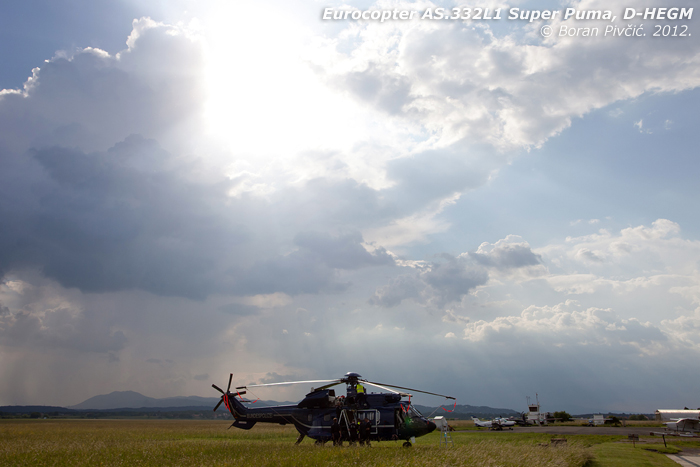
While foreign aircraft at my base airfield of Lučko are not really uncommon – and usually take the form of various skydive aircraft from neighboring countries – 2012 has seen something of a spike in the number of “higher ranking” and government rotary visitors :). Following closely on the heels of the US Navy MH-60 Knighthawk seen here earlier, a couple of months ago we’d been visited by a German Super Puma, in town for a week during an international rescue exercise.
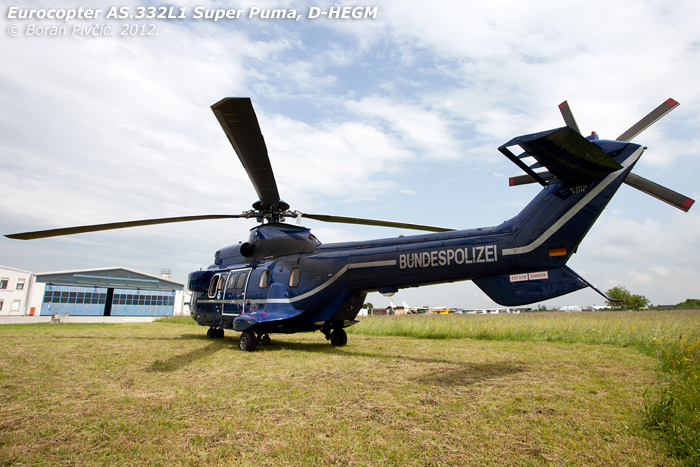
Quite an eye-catching and striking machine, parked – appropriately – in front of the Croatian Police hangar, home to its four strong Bell fleet
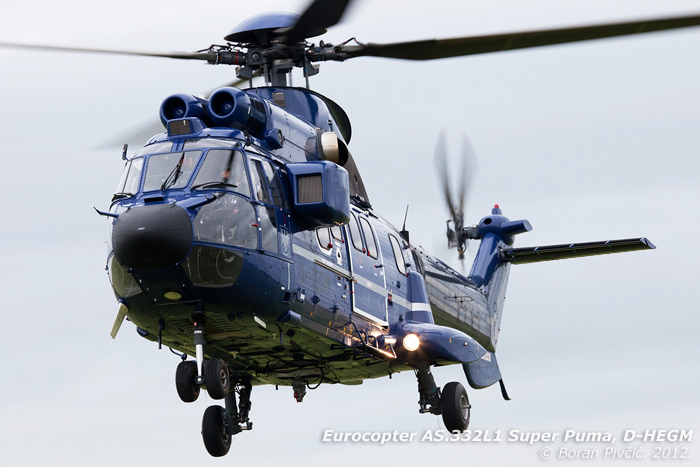
Operated by the Bundespolizei – Germany’s Federal Police – D-HEGM was tasked with providing aerial support during the IPA-CRO FLOODS 2012 international civil defense exercise, held in May on several artificial lakes close to the airfield. Interestingly, back in March 2011 – when it was just a year old – this helicopter had suffered a double engine flameout while transporting German chancellor Angela Merkel. The cause was determined to be intake icing, necessitating a – thankfully safe – forced landing :).
Quite a purposeful looking machine, the Puma is still one of Western Europe’s most popular helicopters – despite its 47 years of age. Like its Soviet counterpart, the legendary Mi-8, the Puma has outlived many of its intended replacements, and has over the years evolved into several versions, including the Cougar military transport and EC-725 Caracal gunship
Packing her up after the last flight of the day as ominous storm clouds roll in from the west. Cursed with unstable weather all week, the crew had had to curtail several flights when the winds and rain turned for the worst
Even though most large airshows on the European continent seem little affected by the world’s economic woes, out here on the periphery things are not going so well. Despite 2012 marking the centenary of aviation in many countries of the Balkans (as did the preceding 2011), celebrations are by economic necessity curtailed, unimpressive and in many cases held just for form’s sake. Case in point in Croatia is the yearly Lučko Airshow, which will – by most accounts – be degraded this year to a “rump airshow”, held simply to avoid breaking its continuity :D.
However, one event that has always seemed more resilient is the Batajnica Airshow, held at Batajnica Airbase (LYBT) just outside Belgrade, Serbia. Like Hungary’s own Kecskemet Airshow – held just a hundred or so kilometers north – Batajnica is primarily a military affair, though civilian aircraft do make up a sizable amount of the static display. Having been deprived of any serious airshow all year – the last one being MAKS in August 2011 – I was naturally quick to plan a trip east and see what has the Serbian AF managed to cook up for its de facto 100th birthday… 🙂
MiGs at 6 o’clock!
In common with many air forces on the Balkans, the chief attraction of the Serbian AF is the rarity of its aircraft, most of which are of Soviet and Yugoslav make. Alongside various transports such as the An-26 – which can still be occasionally seen on cargo runs across Europe – the SerbAF also operates a handful of much rarer MiG-21 and MiG-29 fighters, types which are nowadays generally endemic to the Balkans. To drive the point – and attraction – home, in Europe airworthy (more-or-less :D) MiG-21s can only be found in Croatia, Serbia, Romania and Bulgaria, while the potent MiG-29 only in Serbia, Bulgaria and Poland. Locally-produced types from the heyday of Yugoslav aviation are hardly less attractive and feature some of the world’s last airworthy Soko G-2 Galeb (seagull) and G-4 Super Galeb trainers, and the Jaguar-lookalike J-22 Orao (eagle) strike aircraft.
However, while the above list sounds juicy even to the locals, accustomed to seeing these aircraft on a frequent basis, there is a catch attached: like their counterparts in other air forces of the region, SerbAF combat aircraft are quite old and near the ends of their service lives (a mounting problem faced by the Croatian MiG-21 fleet as well). Consequently, their crews have neither the available flight hours nor the mechanical security to take the aircraft to their limits, resulting mostly in tame and lackluster displays (as was most evident during the MiG-29 interception demo).
Snap Inspection
But, flight routines aside, the show is still an excellent opportunity to simply enjoy the sight, sound – and smell 😀 – of some good ol’ proper aircraft :). And while there were some obstructions to quality photography even with generous access – lots of visitors swarming around static aircraft and horrid heat haze out on the runway – the following gallery I believe captures the essence of the show and its aircraft quite nicely…
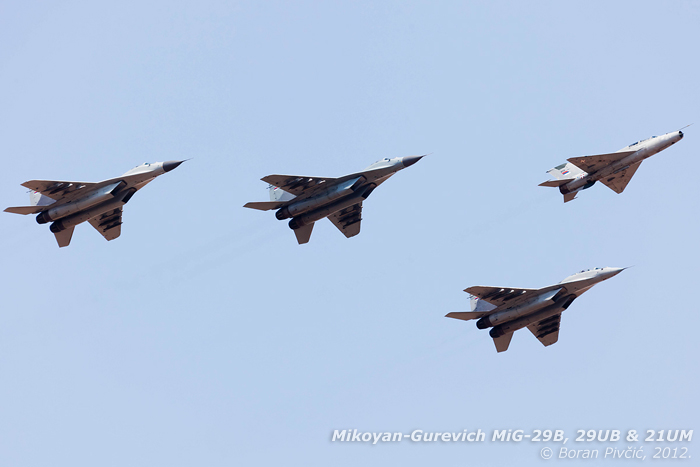
A formation that hasn’t been seen in European skies for a long time. A twin-stick MiG-21UM is seen leading an echelon formation including two single-seat MiG-29Bs and a two-seat MiG-29UB. The only remaining examples in Europe (and its proximity), B models are downgraded export versions, and feature a less powerful radar and simpler avionics
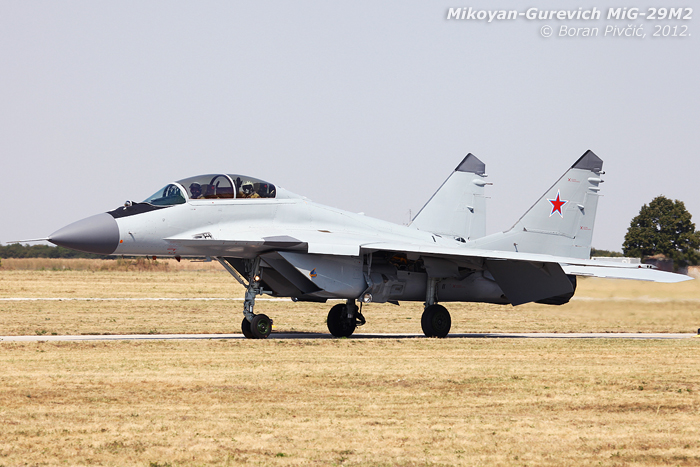
In contrast to the B model, this unmarked M2 – operated by the Russian AF – represents the opposite side of the MIG-29 spectrum. A comprehensive, new-built rework of the classic MiG-29, the M2 – sometimes known as the MiG-33 – includes fly-by-wire controls, improved aerodynamics, more powerful and (slightly) less smoky engines and vastly improved avionics that can carry a wider range of modern air-to-air and air-to-ground weapons. The M2 also addresses the Achilles’ heal of the original design, its woefully poor range, by introducing a larger fuel capacity
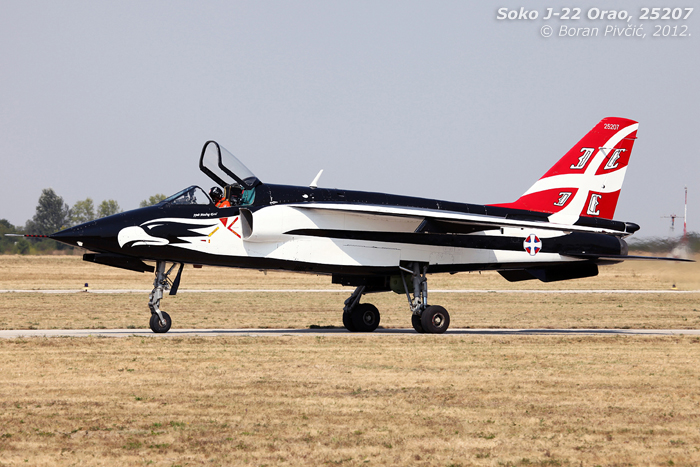
Looking resplendent in its special paint scheme, the SerbAF solo display J-22 Orao is seen taxiing past the press area on its way to the main apron. A design outwardly very similar to the Anglo-French SEPECAT Jaguar, the J-22 was designed as a lightweight, low-level strike aircraft that would use the maximum amount of “home-grown” technologies. Developed in cooperation with IAR of Romania – whose own version is called the IAR-93 Vultur – the Orao is powered by two Rolls-Royce Viper Mk.22 turbojet engines, produced locally under license and fitted with a locally-developed reheat system. Subsonic like the Jag, the Orao is in service only with the Serbian and Bosnian AF, and is one of the last dedicated ground attack aircraft serving anywhere in Europe
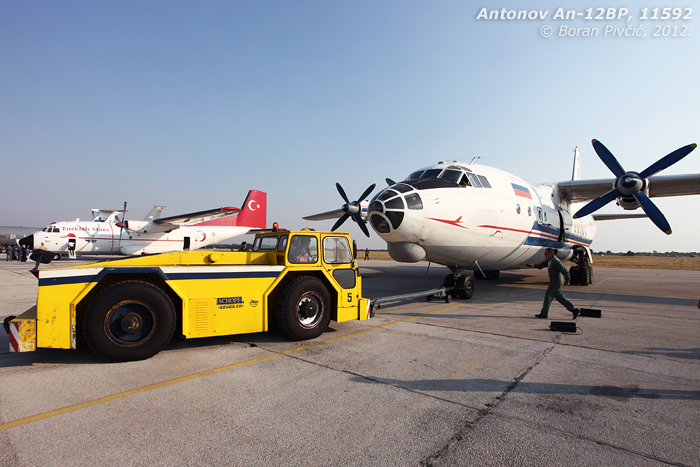
Following the MiG-29M2 wherever it goes is this shabby-looking An-12 transporter, operated by the MiG design bureau. One of the Soviet Union’s most successful turboprop workhorses, the An-12 can still be seen at Europe’s cargo hubs, flying freight charters to and from Africa and the CIS
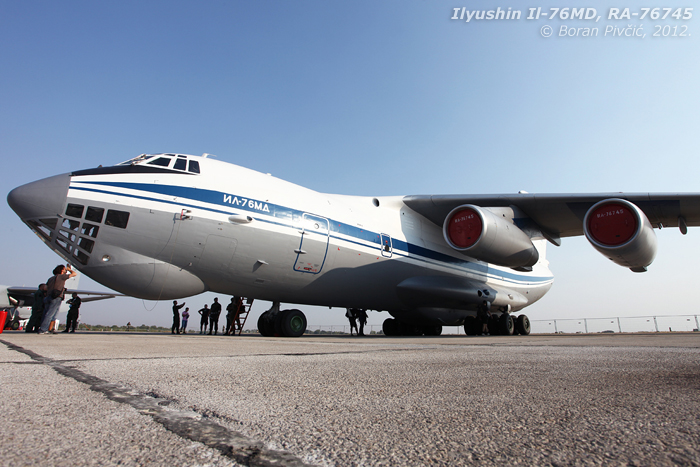
By contrast, this Il-76 support aircraft is immaculate, seeming like it had just rolled off the production line. The most successful Soviet transporter, the Il-76’s successes and exploits – as well as its durability and versatility – is on par to that of the C-130 Hercules
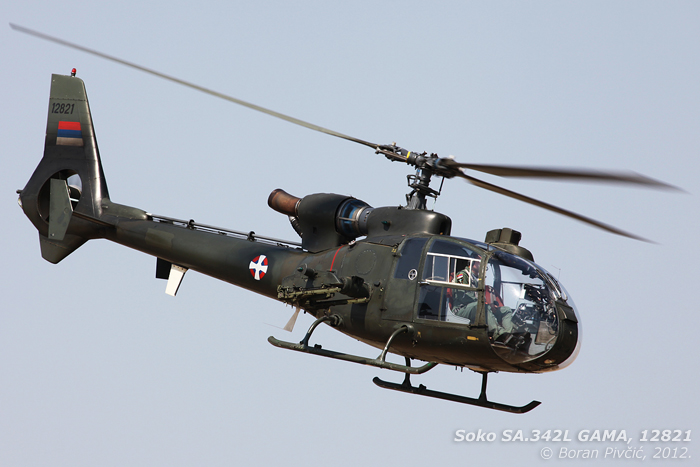
Fast, agile, tough and armed – quite a combination for a light combat helicopter. A license-built version of the venerable Aerospatiale Gazelle, the GAMA – a contraction of “GAzela MAljutka” – can be armed with four 9M14M Malyutka wire-guided anti tank missiles, known in the West as the AT-3 Sagger. Quite probably the Soviet Union’s most successful light anti-tank missile, the 9M14M has also been license produced in Serbia, making the GAMA almost a fully “self contained” product
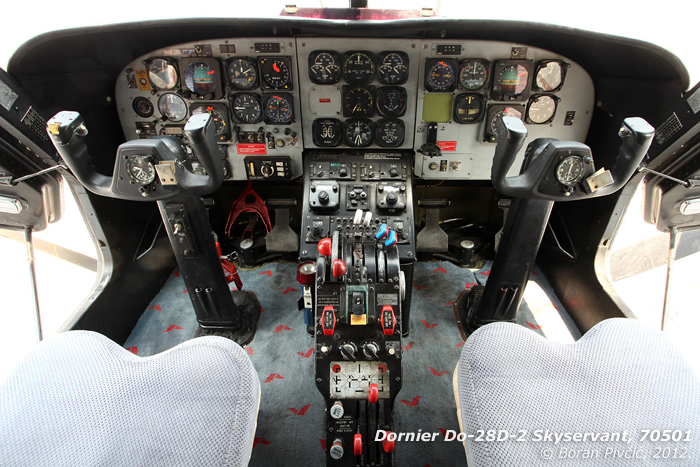
For a hopeless GA geek like me, a visit to this cockpit was more attractive than seeing a MiG-29. One of Germany’s first post-WW2 aircraft, the twin-engine Skyservant is an incredibly rare sight today. This example is still airworthy (just) and is normally used for surveillance and aerial mapping. Quite a clean shot otherwise, this photo was ruined unfortunately by dust on my UV filter (very dusty conditions), which I’d failed to notice until after taking the photo…












 Achtung, Skyhawk!