While the traditional Lučko Airshow had often enough ended up being little more than a “village airshow” – despite the good intentions of everyone involved – this year’s event, celebrating the centenary of aviation in Zagreb, was showing a lot more promise from the get-go :). The initial participant list alone was enough to get the blood flowing – and the photo finger itchy 😀 – with the likes of the DeHavilland DH.89 Dragon Rapide, and the extremely rare ex-Yu Ikarus Kurir, on the headlines; not to mention the first public flight of a lovingly built replica of the first aircraft designed in Croatia, way back in 1910 :).
Even though a few organizational issues, and the dreary and foul weather on 28 August (the original show day), had distilled that list somewhat – the Dragon Rapide and Kurir sadly dropping out – there still remained a number of very interesting aircraft to see and photograph :). So on 29 August, hoping for clear skies and good light – and with the assistance of Ms. Matea Makek, manning my old Canon 20D 🙂 – I set course for the field to see what’s what…
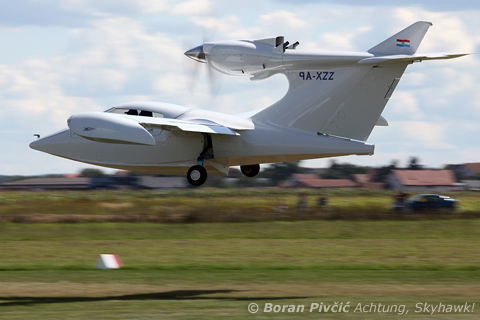
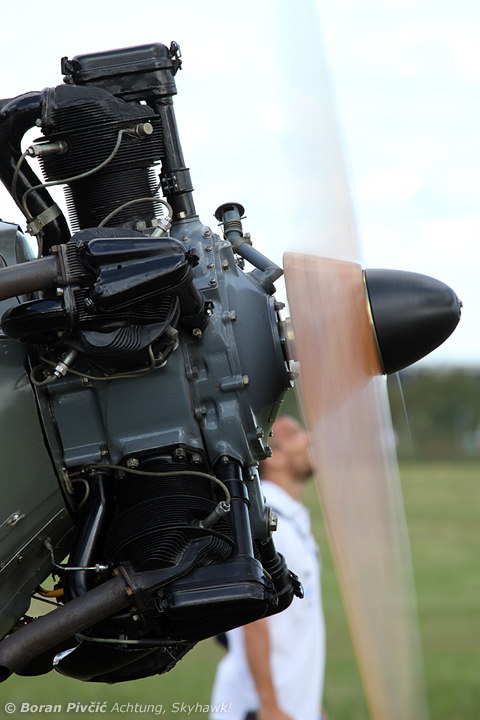
This after all being "Achtung, SKYHAWK!", I had to start off with... well some Skyhawks :D. Incidentally, these three N models and one R - representing my university's aviation department - are all the 172s I've flown so far, with 9A-DDD (in the bottom right corner) the aircraft on which I've logged the most hours 🙂 (normally owned by Ecos Pilot School - where I got my wings - but currently on loan to the university)The afternoon's building cumulus clouds had provided some outstanding backdrops...... which were at all odds with the morning's thick fog and single digit temperatures (in August!). All covered up about four hours before the start of the show, this Mil Mi-171Sh - coded 227 - was the only Air Force aircraft up for display, the rest of the fleet being parked at the far end of the apron (out of harm's way 😀 )At long last, finally photographed in the air! 🙂 Even though it had first flown about two weeks ago, this is the first time I've seen it in flight. Makes a pretty nice noise too...But by far the biggest attraction of the show was the CA-10 "Penkala", a modern replica of the Penkala P-3, the first Croatian aircraft :). Designed by famed inventor Slavoljub Penkala - the father of the fountain pen - the P-3 had attempted to take off in 1910, but never made it beyond a few hops due to some deficiencies in its design. Intending to set that right, the CA-10 was conceived as "modernized" P-3, upgraded using today's aerodynamic laws (and an 80 HP Rotax, with four times the power of the 24 HP engine that Penkala had used). Interestingly enough, the whole aircraft was built by hand using only archive photos because the original blueprints have long been lost. Unfortunately, due to its paperwork not being ready, it had not flown at the show, a huge source of disappointment for many...Another beautiful sight: the first jet aircraft to land at Lučko in more than 20 years! 🙂 Part of the Stars aerobatic team hailing from Serbia, this Soko G-2 Galeb - the most famous aircraft produced by the Yugoslav aviation industry - was one of the absolute attractions of the show. Mind you, it did have less than an elegant entrance - especially for a type designed to operate from unpaved strips - when it ran over a huge bump on the runway, ramming its nose wheel strut all the way to its stop. But some manpower later - a couple of us to lift the nose and allow the strut to extend back into normal position - and all was right again! 🙂A shot inspired in part by a popular F-104 Starfighter photo on Airliners.net... 🙂Taxiing out for its display, with its nose strut again at its stop. Despite the G-2's fantastic low-speed abilities, YU-YAK had used up virtually every meter of Lučko's 880 m (2890 ft) runway for the takeoff run. Powered by a Rolls-Royce Viper turbojet - a design from the late 50s - the G-2 needs some time and distance to accelerate when on the ground... Another gem at the show was this Polikarpov Po-2 from neighboring Slovenia. The second most produced aircraft in history, the Po-2 is often nicknamed "The Flying Sewing Machine" due to the specific sound of its 125 HP 5-cyl Shvetsov M-11 radial. I've always thought that to be an understatement - until I first heard it... :D.Operated in great numbers by virtually every air force in the Eastern Bloc, the Po-2 can - despite its age - be often seen on airshow circuits in Eastern and South-eastern Europe. This example, registered S5-MAY, was produced in 1937 and is still happily flying 73 years later :).Further up the performance range, international aerobatics champion Zoltan Veres (Hungary) was showing off just what the fantastic MX Industries MXS could do. Seen here in a knife-edge flyby, with his right wing just a foot - confirmed! - off the ground...Mr. Veres tearing through the skies in the most impressive and exciting display of the showThe only participant with a mostly vertical display, Mr. Veres had also flown the impressive "pierced heart" maneuver - not at all easy to do when you have only one aircraft and little time before the smoke blows away!Up close with N540XX, painted in the shades of the Hungarian flag. One of the first aerobatic aircraft built entirely of carbon fiber - without an underlying metal structure - the MXS weighs less than 600 kg, but can have up to 350 HP up front, making for utterly bewildering performance in the vertical plane. Its agility in the horizontal is hardly less impressive, with a demonstrated roll rate of 450 degrees per second 🙂Willing to participate every time, the Air Force "Krila Oluje" aerobatic team had put on another fine display. Four of the team's Pilatus PC-9Ms are seen here holding under increasingly impressive skies while the team's two solos (out of shot) position themselves for a low-level crossing passAlways the show-stopper, "Kockica" - or "little square", named for its "ILS shack" Croatian coat of arms paint scheme - thunders loudly away at full bore :). One of the three remaining MiG-21 operators in Europe - with Romania and Bulgaria - Croatia is fast becoming one of the last sanctuaries of this fantastically charismatic jets on the continent...An elevated overview of the field an hour before the start of the show, with two beautiful classics, an UTVA Aero 3 (left) and the Po-2 (right) facing off across the main taxiway (with the former to be covered in more detail in my next post 🙂 ). Complimenting them is An-2 9A-DIZ in the background, while in the distance the Medvednica mountain range - and a wall of puffy cumulus clouds forming atop it - complete the scene
While few could have guessed from the sporadic activities so far that 2010 marks the first century of aviation in Croatia, preparations for a series of events to commemorate this centeniarry were nevertheless well underway as the end of August approached. As well as the traditional Lučko Airshow – which would this time also feature a flying replica of the first Croatian aircraft 🙂 – these events had also included the so called “Millennial Photo”, part of a project of the same name undertaken by well-known local photographer Šime Strikoman. Celebrating 100 years of a notable local event by photographing 100 of something involved with that event before or since (brilliant explanation, I know :D), the photo would this time celebrate 100 years of local aviation by photographing 100 aircraft in a single shot :).
Despite only managing to drum up 77 aircraft in the end (by my count), the photo itself had nevertheless come out very, very nicely, and can be seen here. Yours truly is somewhere down there as well, by the red-tailed aircraft (Cessna 150, 9A-CCH) on the outside of the last zero to the right, waving to the camera helicopter :).
But apart from looking invisible, my contribution to this event had also included physical assistance in moving everything out of the hangar (and back), a task which had also given me ample opportunity to see a number of very interesting aircraft that are hidden away for most of the time. Unfortunately, since pushing and taxiing this lot around was a time consuming task – and I couldn’t really roam around at will, slacking off – I decided to give my new Canon 5D Mk.II camera a small shakedown by just photographing two very unique and rare gliders… 🙂
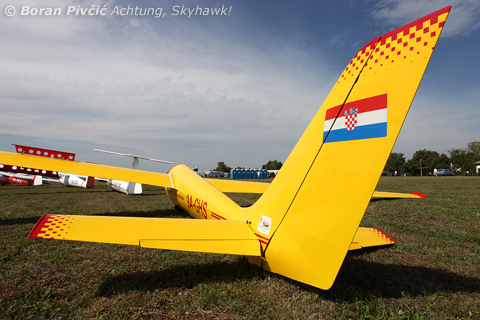
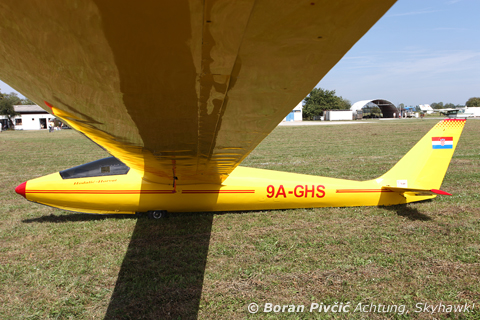
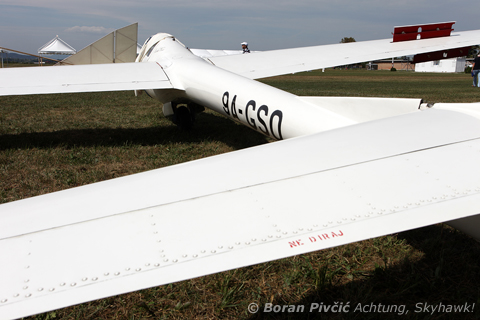
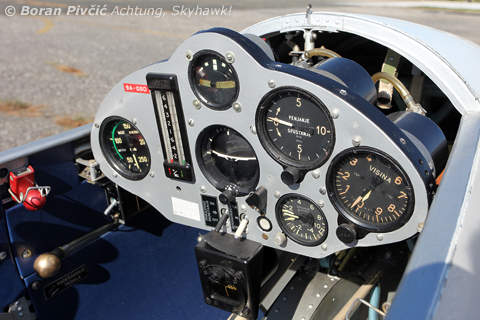
First up is this one-of-a-kind homebuilt glider, called “Delfin” and registered 9A-GHS. Though at first I’d thought it was a Polish SZD-24 Foka – surely one of the most beautiful gliders ever built – a closer inspection revealed that it was actually designed and built in Yugoslavia back in the early 60s 🙂A simple, but elegant design, the Delfin is a 15 meter Standard class glider, pretty much the same category as the Pilatus B4s and SZD-30 Pirats abundant at the field (from which it may draw some design cues)Yellow does indeed look good on gliders :). Easily one of the most catchy light aircraft that day!The second candidate is the ex-Yugoslav Ikarus Meteor 57, already featured in a number of previous posts. Designed in 1957 and intended to test construction solutions for jet trainers, the 20-meter all-metal Meteor was built so strongly that it effectively had no structurally-limited top speed (in the speed ranges it could achieve due to gravity and drag)… in one test flight, it had even managed to reach 500 km/h (270 knots/311 mph) in a steep dive!A look at the office, currently undergoing some work :). One of the most interesting bits here is the antique Cosim vertical variometer :D. Also, you’ll notice a Turn and Bank Indicator on top of the panel: in common with a number of Eastern European gliders, the Meteor dispensed with the yaw string on the canopy in favor of a more precise electrically-powered TBIBut by far the most interesting feature here is the apparently normal airspeed indicator. If you look closely, you will see that it has no red line (indicating the never exceeded speed)! 🙂 You can imagine what impact this aircraft made in the wood-and-fabric glider world of late 50s… it had also set a close-circuit average speed of 97 km/h (52.3 knots/60 mph) in 1958, an impressive performance for the time…
On somewhat of a discovery spree lately with my YuAF Dakotas – buoyed by finally having photographed 71203 and 71255 🙂 – I decided to carry on browsing the reaches of the Net and see what other interesting things I would inevitably stumble upon. I didn’t have to go far before I fell flat on my face, because within a minute or two of Googling I’d found an interesting list of the various C-47s and DC-3s operated by the YuAF at one time or another. Despite being rather vague with the airframe details – rarely listing anything more than their YuAF code and possible location – and out of date, it did bring my attention to two more easily traceable examples :)…
The Dakota Locator v1.1, now with 71253 on the scope 🙂
1. 71253 / C-47… / cn unknown:
Located just outside the small town of Otok near Metlika in south-eastern Slovenia (there’s an NDB there too), not much is known about this aircraft – and a cursory search revealed that the rest of the Net was not much wiser either. The only photo I managed to find (a Panoramio photo from Google Earth) showed it to be in an apparently good state, which makes it a prime target for my next photo mission :D. It’s not really that far away either…
2. 71288 / C-47A-20-DK / cn 12830:
A much more debatable example is 71288, now residing in the “Rahmi Koc Industry Museum” in Istanbul, Turkey (the latest on the long list of reasons to finally go there 😀 ). According to a number of online sources, it had started life as 42-92970 of the USAAF, before changing a raft of N-numbers in the years after WW2, to finally become TC-ALI in 1991. Interestingly, only two sources mention its YuAF service, so this should be treated with suspicion until verified :). Be that as it may, a photo on Airliners.net mentions that it had been converted to DC-3 standard at some point in its life, while another photo on JetPhotos.net shows that it definitely had a well-appointed cockpit for a Dak :D.
Up to 10 examples now, or about a third of the way there. To make navigation among the ever increasing number of posts a bit easier, I’ve linked each code to the post in which it is covered, but given that my posts tend to be a bit… long, you may have some scrolling to do :).
Having been in doubt about the history of 71255, in my previous post on the subject I’d stipulated that it had actually flown in French service before bought by the Yugoslav AF in the early or mid 70s. What gave me this hunch was a very faint code on the tail, almost barely visible through successive layers of paint: 349296. So, to try and clear this up and see what’s what, I ran this code through Google – and interestingly enough, got a match almost immediately :).
Sloppy paint jobs finally have an advantage!
It turns out that 71255 is actually a C-47B-15-DK, manufactured in 1943 under the serial 15112/26557. Its first service was with the RAF as a Dakota Mk.IV coded KK107 until 1947, when it was returned to the USAAF. Indeed sold to the French Air Force soon afterwards (I think maybe the same year), it then became 349296, also known by its radio callsign of F-RAVA. Flying in this guise for more than twenty years, it had been transferred to the Yugoslav AF in the early 70s as 71255, most probably operating out of our very own Zagreb airport :). The records are moot from that point on, and I haven’t (yet 😀 ) been able to determine when it was withdrawn from service…
Photos are even harder to find, but once again Airliners.net came to the rescue:
EDIT: with many thanks to Marko Beloglavec for the heads up, I’ve managed to confirm that 71255 had actually been produced on 8 November 1944, and not in 1943 as I had previously thought. A more detailed search under its temporary USAAF serial of 43-49296 – and with some very helpful input from Marko – revealed that the ’43’ in the serial is actually the fiscal year in which it was ordered; but given the huge backlog of orders, the aircraft had left the production line only at the end of 1944…
As it so often happens, the things that are closest to you in the end turn out to be the furthest ones away. You always think “naw, it’s close, I can visit any time” and you never do, as it inevitably slips your mind, shoved aside by the more exotic, distant places. Case in point is 71255, one of the ex-Yugoslav AF C-47s that I’ve wrote about in a number of previous posts (readable here). Located at Otočac airfield, it is pretty much a stone’s throw away from the country’s biggest north-south highway, a highway I go down at least 5-6 times a year. In a dazzling display of consistency, I’ve never ever stopped to photograph it, reckoning “it’s just an hour’s drive away, I can visit it anytime”…
Well, today I’ve finally decided to make good on that promise :D. Returning from an Open Day celebration at Zadar’s Zemunik airbase with a couple of friends, we unanimously decided that, while we’re there and having plenty of time to spare, we can just as well finally get it over with :). And this is what we’ve found…
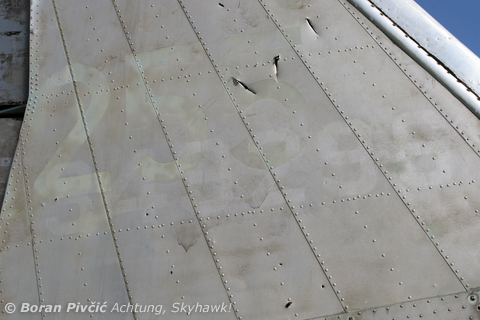
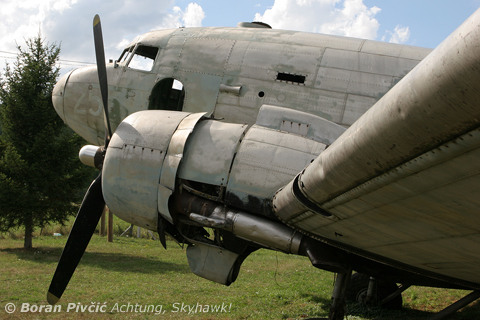
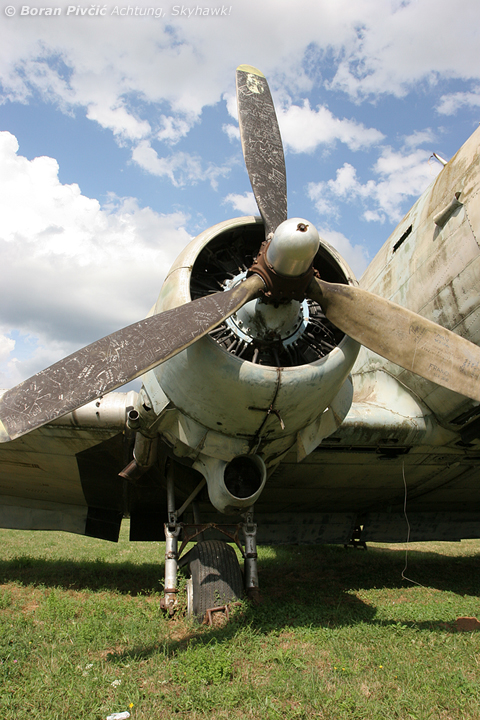
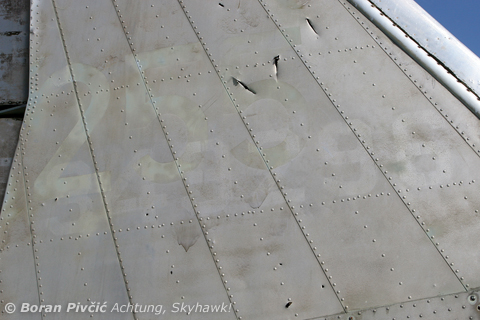
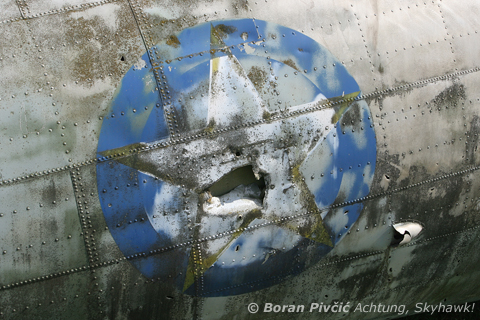
In a much better state than poor old bullet-riddled 71212 at Željava - but still a sad sight nevertheless...Mired deep into the ground from its long stay... also looks like the aircraft had some sort of muffler installation fitted, which could mean that it had remained in service for a comparatively long timeWeathered and beaten, 71255 retains pretty much only its basic parts. Everything of any use that could be taken away was hauled off, leaving the aircraft an empty shell (save for the engines, which seem to be in a better condition). Notice also the tear running down the fuselage...A classic DC-3 shot as seen on Airliners.net :). The clear air and an excellent cloud backdrop contributed to give this poor old bird a more lifelike appearance...Inside, the situation is even worse... up front, near the navigator's station, even the floorboards had been ripped out!A view outside from the first cabin window is hardly better... almost reminds of an engine fire...Looking back from the navigator's station... the only piece of usable "furniture" remaining was an old wooden desk that would not look out of place in a schoolroom... hardly a fitting piece of equipment for such a famous aircraftJust one of those shots where everything - the subject, the terrain, the sky, the light - line up perfectly! 🙂Years of neglect have - as usual - resulted in years of vandalism... quite a contrast between the precise, purposeful propeller serial numbers and the random, useless doodles that people have the need to leave behind...Traces of its former identities can still be seen faded-out on the vertical stabilizer. Given that many of the YuAF C-47s were bought from France - which had operated them after WW2 in both civil and military roles - it is possible that the fainter 349296 code may be a remnant of 71255's French AF serviceA touch of pure symbolism through and through - the roundel of the former YuAF shot and faded, a stirring representation of the violent breakup of former YugoslaviaA roundel in a much better shape underneath the starboard wing. Fifteen years after the end of the war, this is fast becoming a rare sight...Reaching for the skies, one last time...
EDIT: using the power of my 400 mm anti-aircraft Canon ( 😀 ), I’ve also managed to nail Zadar’s 71203 at extreme range while at the base during the Open Day. Distorted by heathaze, it isn’t up to my usual standard, but for now it’ll do :).
Close to 600 meters away, this was the best that I could do. But even despite the questionable photo quality, you can see that 71203 is in by far the worst shape of all the Daks I've seen. Looks like the left upper engine mount has cracked, with the engine sagging downward. For some reason, the aircraft has the "312" code painted on the tail, though this may also be part of its former identity...














 Achtung, Skyhawk!