
By me
All photos me too, copyrighted
As could have been expected by my regular readers, all that recent Police Eurocopter business had quickly sent me roving through my photo database in search of more (somewhat) related material to post 😀 . The train of thought that had derailed me this time was the sudden realization that 9A-HBB represents only the fifth Eurocopter ever to be registered in Croatia – quite the anomaly given the country’s proximity to the European heartlands and traditionally strong ties with one of Eurocopter’s biggest (and most forceful) players, Germany.
The primary reason for this discrepancy – a small, but nevertheless painful thorn in the side of the EU’s aviation industry – was the country’s long-standing “marriage” with Bell Helicopters, a relationship Croatia has entertained in one way or another ever since the earliest days of rotary aviation in Yugoslavia. While its strong socialist orientation would have immediately suggested that any flying machinery would, by default, be sourced from the Eastern Block, Yugoslavia’s geographic position – not to mention Tito’s near-violent split with Stalin and the subsequent drift into the non-aligned sphere – had made it a prime target for some economic wooing by the West 🙂 . Aviation was always pretty high on the bargaining list, which had translated into unprecedented liberty in buying Western hardware. The national airline JAT, for example, had throughout its lifetime operated an all-Western fleet (707, 727, 737, DC-9, DC-10, Caravelle, Convair 340/440, ATR-42/72), while the country’s flying clubs were awash with Cessnas bought in huge batches from the company’s dealership in Belgium (many of these are still flying today, with myself having logged time on at least half a dozen of them). The Yugoslav Air Force had too started out* with Spitfires, P-47s, Dakotas, T-33s, Sabres and Thunderjets, as well as a number of indigenous designs built using Western components produced locally under license (most notably the Armstrong Siddeley/Rolls-Royce Viper turbojet) 🙂 .
* while its beginnings were indeed rooted deep in Western hardware (with a few Eastern types inherited from the Partisans), the YuAF would eventually switch to mostly Soviet machinery when relations between the USSR and Yugoslavia thawed in the years following Stalin’s death. While the home-grown G-2 Galeb and G-4 Super Galeb (seagull), J-1 Jastreb (goshawk) and J-22 Orao (eagle) would continue to legally use the Viper engine and select Western components, the bulk of the Air Force would switch to types such as the MiG-21, MiG-29, An-26 and Mi-8.
Interestingly though, throughout all of this, Yugoslavia’s procurement delegations had always shown a clear preference for aircraft designed in the US but – if at all possible – actually produced somewhere in Europe. Consequently, Reims-built 150s, 172s and 182s had become de rigeur, with “original” Cessnas generally chosen only if the sought-after model (or its quantity) was not available in France 🙂 .
This trend was perhaps even more evident in the sizable police and military helicopter fleets. One of the types that will forever be associated with the latter (even though it’s an original European design) is the superlative Sud Gazelle, originally sourced direct from France, but later produced in large numbers at the Soko plant in Mostar, Bosnia and Herzegovina (where it became known as the Soko SA-341/342 Partizan) 🙂 . Soko production would eventually reach such heights that their Gazelles can still be found across the width and breadth of ex-Yugoslavia (and, interestingly, Hungary), with a few having even made it overseas into the UK! Similarly, the military had also briefly flown a handful of Sikorsky piston designs, procured – as expected – from Westland.
The civil government though had gone completely Italian-American, turning to Agusta and its license-built Bells (and whistles) for virtually all its rotary needs. Having been the world’s dominant helicopter maker at the time of Yugoslavia’s rotary expansion in the late 60s – back when Eurocopter’s parents hadn’t even met yet 😀 – Bell was the natural choice, and would continue to furnish the police force all the way into the late 80s. Throughout this period, it would shift a total of 64 helicopters this way – nothing to sneeze at in a country with a peak population of just 23 million! – including 32 JetRangers and a remaining mix of LongRangers, 47s, 212s, 412s and the odd 222. Spread across bases throughout the country, many of these machines would greet the dissolution of Yugoslavia on station, eventually becoming absorbed into the nascent police forces of whichever successor state they were in at the moment. In Croatia’s case, this fleet would include a lone 212 (9A-HBM) and four JetRangers (HBC, HBZ, HCG, HDM) – all of which are still happily flying today, save for HCG which was written off in an accident in the early 2000s.
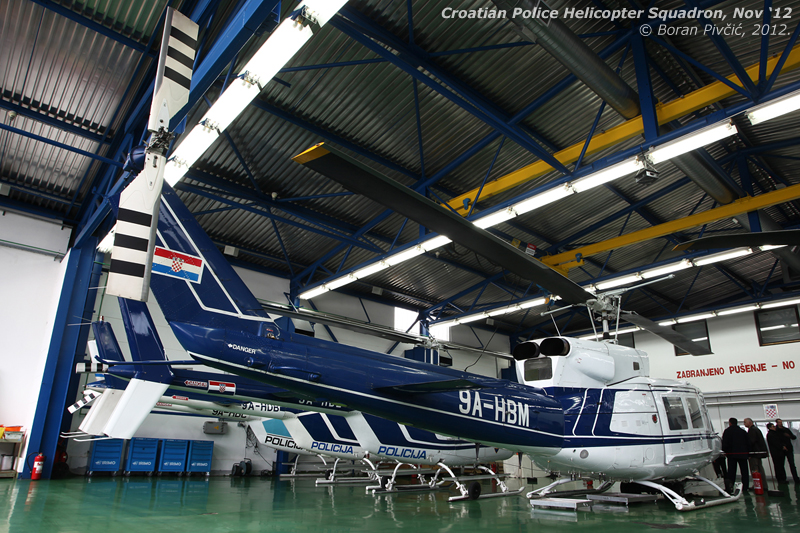
Having thus accumulated almost 20 years of operational experience with 206s and 212s as the late 90s dawned, Croatia was now well and truly deep in Bell territory – so when the Air Force expressed a desire for a light training helicopter, Bell already had its foot very firmly in the door 🙂 *.
* the military helicopter forces had however followed a different “career path” to that of the government fleet. At the time of Yugoslavia’s disintegration, the bulk of the YuAF was composed of the aforementioned Gazelles – filling the light attack and training roles – and heavier Mil Mi-8s performing the day-to-day haulage. With war imminent, the YuAF had withdrawn the lot of its assets back to Serbia, leaving what would become the Croatian AF without any machinery (save for an ex-Police Bell 47 that was plucked from Zagreb’s Technical Museum, restored and sent to the front on MEDEVAC and CASEVAC duties). However, while the helicopters themselves were gone, the people and experience had remained, so it was decided to acquire a fresh batch of Mi-8s, since they were cheap and could be pressed into service the quickest (the first example was, in fact, captured). With the haulers sorted – and the war over – the AF now needed a helicopter to mimic the Gazelle, a role that was eventually fulfilled by – surprise, surprise – a fleet of 10 JetRanger IIIs 🙂 (the CroAF had also operated a small fleet of Mi-24V gunships during the war, but these were retired in the early 2000s due to the prohibitive costs of maintaining them operational).
With the state’s needs and desires now finally sorted out, the newbie Eurocopter – first appearing as a functioning unit only a few years prior in 1992 – was left with no room in which to flex its new-found corporate muscle. Even though it commanded the impressive might of Aerospatiale (itself the successor of Sud) and Daimler-Benz Aerospace (which had absorbed Messerschmitt-Bölkow-Blohm – MBB for short – in 1989), the harsh reality of post-war economics had also denied it any hope of breaching the nascent civilian market, leaving it out in the cold for the remainder of the 20th century 🙂 .
Eurocopters to the rescue?
The brand’s first breakthrough into the Croatian market would come only in 2005 – and then just as a meager two-ship “assault” that faltered and failed barely four years in (though through no fault of Eurocopter itself). At the time, civilian HEMS duties were still being performed exclusively by the CroAF’s increasingly rickety Mi-8 fleet, a fleet composed primarily of machines that had seen their fair share of action during the war. After a few safety scares, it was decided in the corridors of power – with the helpful assistance of the JAA 😀 – that HEMS operations should in future be handed over to a dedicated (and private) civilian operator, flying proper, modern equipment intended outright for the job.
However, while this was all fine and well on paper, in the real world things were somewhat more complicated. While the government’s intention to the above was duly published through official channels – and consequently widely reported in the press – it had still remained just an intent and not a concrete call to action. That needed to take the form of a standard public tender, at which various private operators could submit their bids for the role and then proceed to beat each other senseless with various cost-benefit analyses 🙂 .
The catch, however, was that at the time there was only ONE private helicopter operator in the country, flying a lone 1963 Sud Alouette II (9A-HAT) on leisure and pleasure flights up and down the Adriatic coast – and rumored to not even be interested in the whole HEMS issue. Sensing a very lucrative niche just waiting to be fulfilled – a niche perilously open to well-heeled and established operators from beyond the border – a group of local businessmen soon founded the company Helikopterska kompanija in anticipation of the actual tender (a company that would quickly become known under the cute and easily-pronounced acronym HIKO – despite, or perhaps because of, “hik” being a Croatian onomatopoeic word for an alcohol-induced hiccup 😀 ).
To be able to actually perform the duties the tender was expected to require, the company had immediately acquired two helicopters, later to become famous in song and story as the first Eurocopters on the Croatian register 🙂 . Unsurprisingly, the company went for versions of the tried-and-tested BK-117/EC-145 – still Europe’s default standard in HEMS operations – including a stock EC-145 (registered 9A-HKA) and a BK-117C-1 (registered 9A-HKB)*.
* however, while it does say “Eurocopter” on the tin, the BK-117 is not the consortium’s original design. Tracing its roots back to the late 70s, the 117 had actually come about through cooperation between MBB and Kawasaki of Japan – a cooperation that predated the creation of Eurocopter by almost 15 years. A huge commercial success (especially in offshore and medical circles), the BK-117 was still rolling off the production lines when Eurocopter was born, eventually being absorbed into its product offering. Progressively updated, the design reached its apex with the C-1 version, which would soon – with a few technological, structural and visual tweaks – morph into the EC-145 🙂 (sometimes also dubbed BK-117C-2). So, even though its base design predates Eurocopter, HKB itself does not, warranting its inclusion into this list.
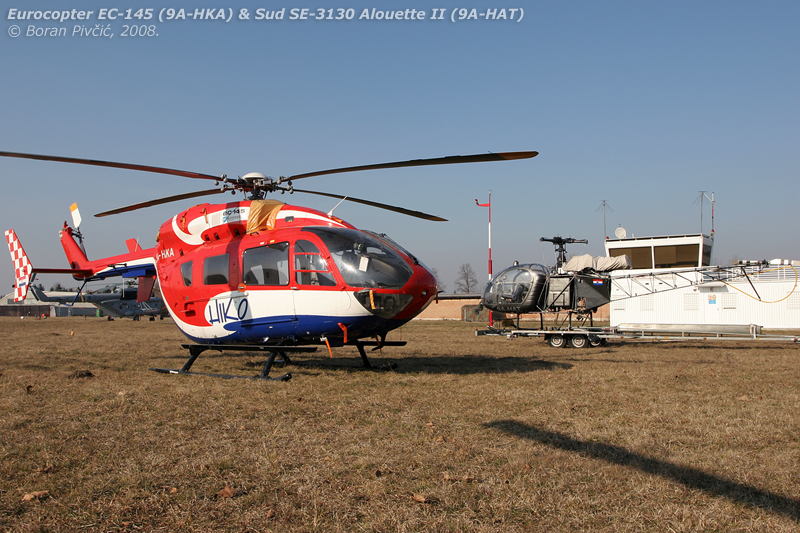
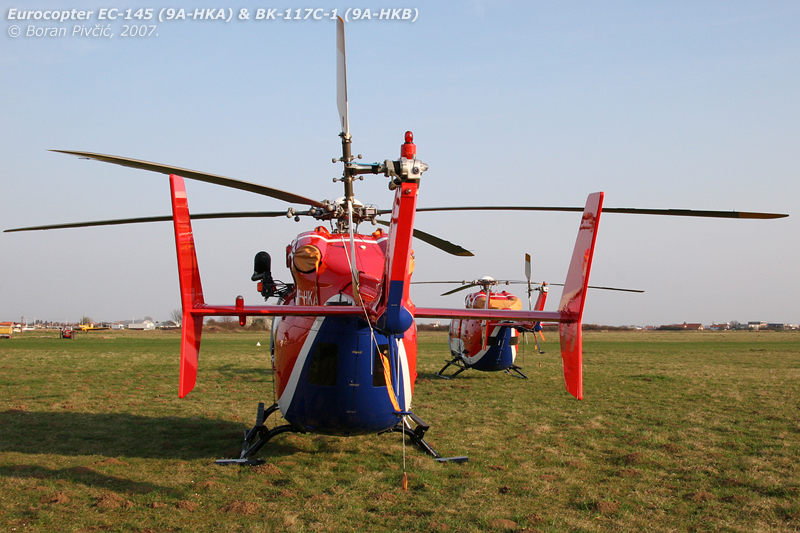
At this point through, the story turned overall Croatian 🙂 (for lack of a suitably descriptive word). Having never experienced smooth sailing in all their time here, both of these machines would spend the subsequent four years leaping from one scandal into another, starting with HIKO’s PR deception about their true ages and histories. Always billed to the public as a 2004 machine, HKB was eventually disclosed to be a 1999 model and – more worryingly – to have been involved in a flying accident in Italy in 2000 that had required it to be virtually rebuilt from the skids up. HKA was not spared either, for it was argued that it too was not the 2005 version it was posing to be, but an earlier 2004 model that had initially served as a FADEC testbed before reverting to the regular EC-145 standard (FADEC would eventually be implemented on the EC-145T-2). While the allegations against HKB would eventually prove to be correct, HKA’s past was never fully and conclusively resolved – especially since the state’s official register had it listed as manufactured in 2005 with no previous registrations to its name (unlike HKB).
The second kick into HIKO’s shin came all the way from Russia (and without any love whatsoever 🙂 ). Faced with the accelerating decay of its Mi-8 fleet – decay that had led directly to the HEMS tender – the Croatian AF had spent the better part of the mid 2000s looking (increasingly frantically) for a replacement type. However, while the intent was there, the funds were not, no matter how hard the government tried to scrape something together (likely much to Eurocopter’s continuing disappointment).
Salvation though was quickly at hand once Russia agreed (quite readily it must be said) to shift some brand new helicopters our way as repayment of its long-standing debt to Croatia. A concept that still tends to amuse the locals – a lion (admittedly with few teeth left) owing money to a mouse 😀 – this debt stems all the way to the heyday of commodity exchange between the USSR and Yugoslavia back in the 70s and 80s. Despite both countries having disappeared almost simultaneously in the early 90s, the debt had remained on the books, to be later passed onto Russia at one end and Yugoslavia’s successor states on the other.
Sixteen and a bit years later, the CroAF was gleefully rubbing its hands together as the first two of the ten brand new Mi-171s ordered touched down at Pleso Airbase… 🙂
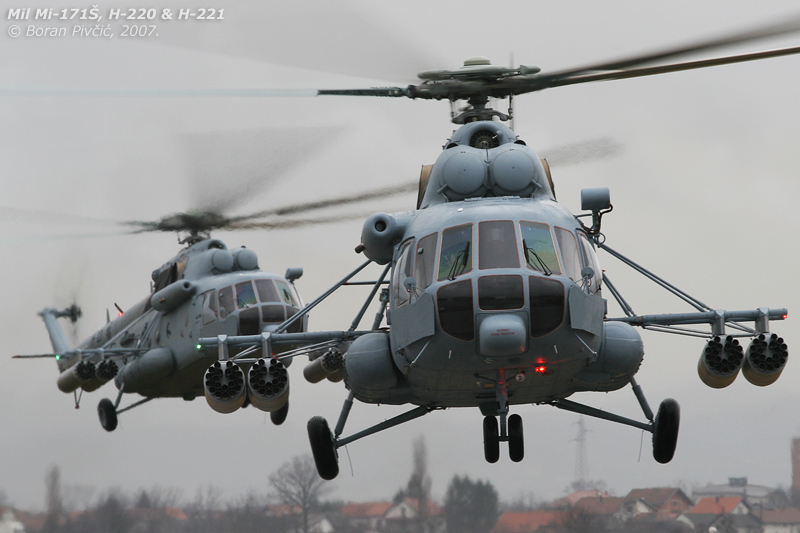
While this would have been quite the occasion under any other circumstances, this acquisition had there and then resolutely sounded the death knoll for HIKO’s HEMS ambitions. Reinvigorated and back on strength – sporting the newest aircraft in the country – the CroAF was now poised and set to resume its former place as the country’s default HEMS provider. Convinced by this show of force, its operating economics – and not least of all by the lack of bidders save for the lackluster HIKO – the government quickly cancelled and shelved the civilian HEMS contract, leaving HIKO up the paddle and without a creek.
With the final nail in the company’s coffin firmly in place, HKA and HKB would spend the next few years flying various odd jobs, struggling to survive until inevitability finally caught up with them. HKA was eventually struck off the register in 2009, becoming D-HDPP of the HSD Luftrettung, while HKB joined Flymed as D-HAOE in 2010…
The meat of the discussion
Even though HIKO’s demise would severely dent its already weak presence on the Croatian market, all was still not black for the Eurocopter brand as the end of the 2000s dawned 🙂 . With the economy beavering away better than ever, the country started to see a sharp increase in the ownership of private aircraft, spanning everything from the humble Skyhawk to the odd Citation. With plains to the east, mountains to the west, islands to the south – and airfields few and far in between wherever you look 🙂 – a significant proportion of these were always going to be light helicopters, a class particularly popular among the country’s few well-off agricultural industrialists, owning large swaths of farmland in often difficult to reach places.
Among them was also the heir of a locally-famous meat delicatessen empire – producing some of the country’s best-known salami and sausages – who in 2009 acquired a mint EC-130B-4 straight from the factory, later to become 9A-HEG. Representing only the second non-US turbine single in the country – 9A-HAT rears its rotorhead again 🙂 – HEG was a frequent visitor at various local air shows, on occasion always being piloted by a former Mi-8 commander who was never shy to put it through its paces.
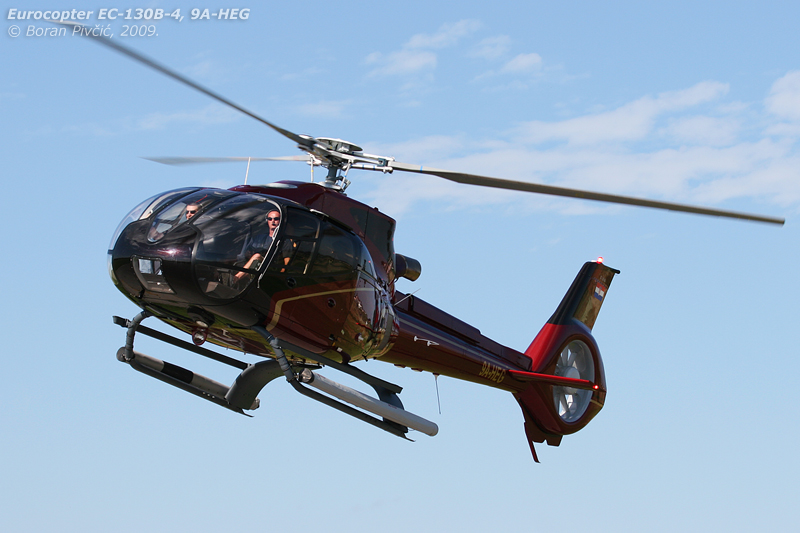
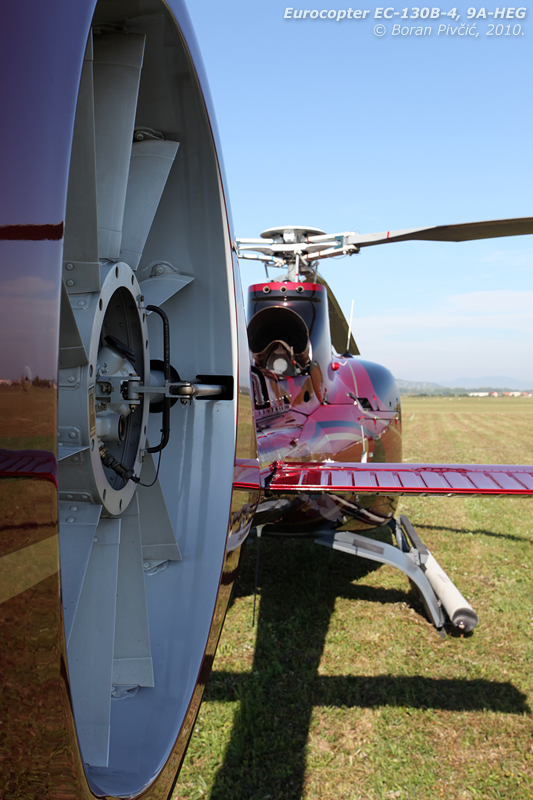
However, while they are operationally conductive to conditions in Croatia, privately-used helicopters almost invariably fail the acid, corrosive test of outright economic efficiency. While they do allow for unprecedented and easy access to the various out-of-the-way places scattered across the land (of which there are a lot!), their sheer thirst, high maintenance costs and legal hassles associated with off-field operations all conspire to turn financing them into an absolute nightmare. With one notable exception – another industrialist who has successfully been sustaining his own helicopter (initially a Bell 407, nowadays a 427) for years – almost all examples acquired solely for private use became notoriously short-lived. Such was the case with HEG as well, which in 2012 bade farewell to Croatia to become OO-EVL out of Belgium.
I, EU, he, she…
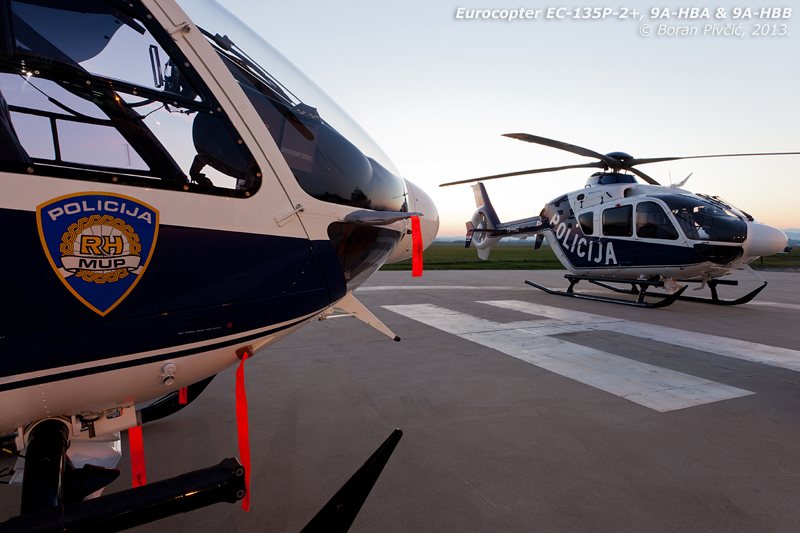
Somewhat unsurprisingly, Eurocopter’s fortunes began to pick up once again with Croatia’s ascension into the EU back in July 2013. Now the proud owners of the EU’s second-longest single border with non-EU lands – standing at 1198 km/745 miles, just 115 km/71 miles short of Finland’s border with Russia – Croatia has by default been given the task of reducing the porosity of this expanse as much as possible in preparation for the eventual implementation of the Schengen Agreement. While still operational and holding its own, the existing Bell fleet was – quite correctly – deemed unfit to cope with the task (through lack of numbers alone), leading to the EU-brokered acquisition of our famous pair of EC-135s 🙂 (but, as if to underscore Croatia’s long relationship with Bell one last time, the 429 GlobalRanger had also made it into the running). The only ones actually ordered at the time, these machines are said to be part of a batch of seven examples that will be progressively introduced into service by 2015 (the earliest date Croatia would be eligible for joining the Schengen Area).
Well, as an old Croatian saying goes, “he who is patient will be saved”… 😀

 Achtung, Skyhawk!