By me
All photos me too, copyrighted
All good (& nerdy) things happen in threes; that’s a fact. After my recently reinvigorated series on Croatia’s abandoned cropdustring airstrips had taken me to TWO newly reactivated runways in quick succession, I immediately thought to myself “well, this topic has peaked, no way something so cool will ever happen again”. But guess what: less than a month later, word reached me that yet another airfield had just been reopened, located barely 30 minutes away by Texan. No prizes for guessing what happened next!
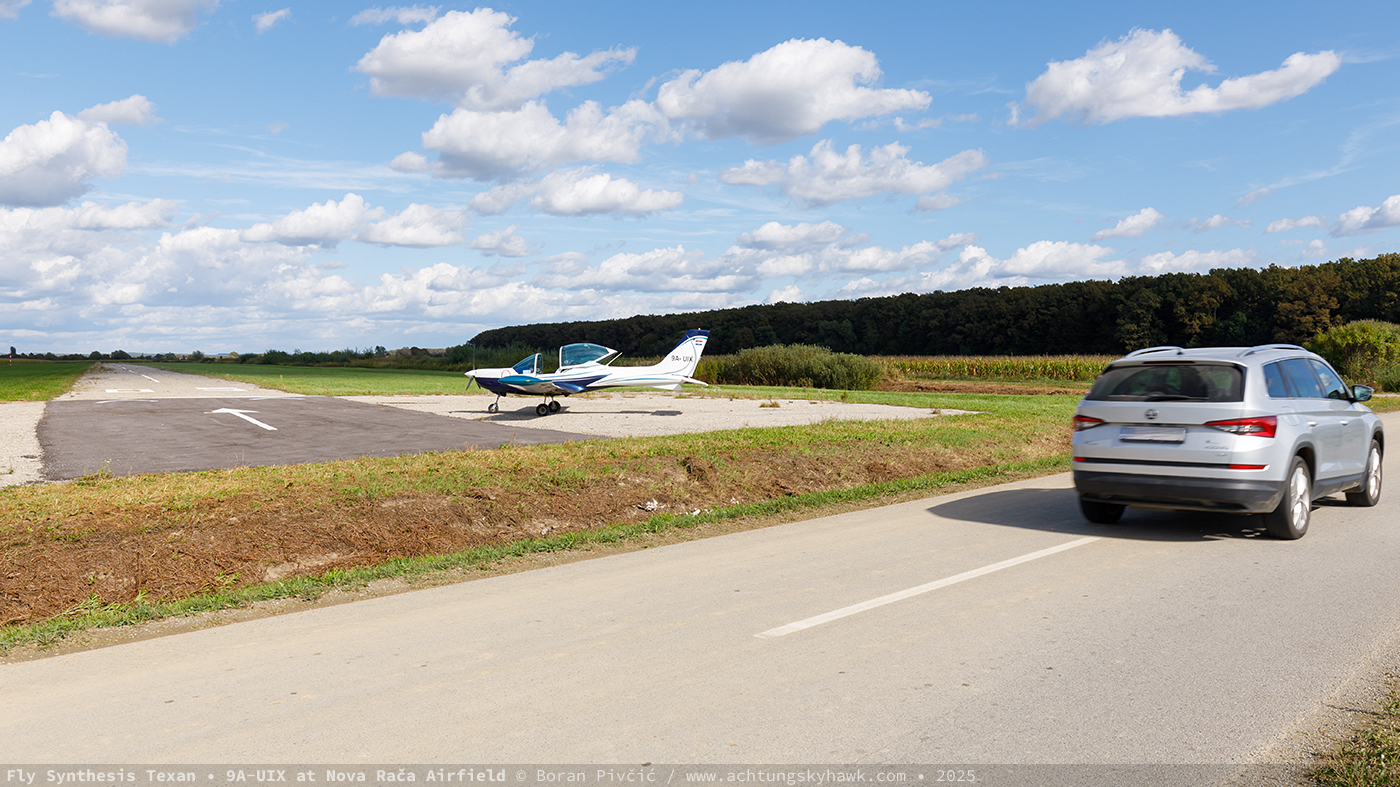
So, you’re going along, minding your own business… driving down a country road you’ve gone down hundreds of times… expecting and suspecting nothing out of the ordinary… and then you round a corn field and see an airplane where no airplane has been seen for decades. 9A-UIX: confusing passing motorists since AUG 2025
Located just off the village of Nova Rača, the strip in question will probably be familiar to readers of the original article – if anything for being one of the most usable among the 12 I’d visited until then. A 595 x 10 m paved runway1 stretching in a 05-23 direction, it was built by PIK 5. Maj sometime in the early 70s (with 1973 being cited most often), and used primarily by An-2s and PZL Dromaders of PA Osijek (though Cessna 188s of PA Daruvar and Piper Pawnees of PA Zagreb made frequent appearances there as well). Following the violent dissolution of Yugoslavia in 1991, it would briefly serve as an actual “airbase”2, hosting militarized piston trainers and former PA cropdusters participating in the defense of the Bjelovar area (as one of the many improvisation efforts of the nascent, and woefully underequipped, Croatian Air Force).
The end of the Homeland War in 1995 would actually see a bit of life return to the airfield – albeit just as sporadic cropdusting and forestry operations that would go on few and far in between until 2008. After that, there would only be a one-of ultralight meet in MAY 2015, after which the runway would go completely dormant until 2025. Officially reopened on 08 SEP 2025 under the auspices of Aeroklub Nova Rača, there are no aircraft of any sort based there as of yet – so it became my privilege (and an honor) to do both the first official touch-and-go on 09 SEP… and then the first official full-stop landing on 17 SEP 🥳.
1 in the original article, I had listed the runway dimensions as 630 x 9 m; turns out, I was somewhat off the mark with that one. Despite having access to an unusual wealth of source material, detailed information about Nova Rača was curiously absent, forcing me to rely on measurement by Google Earth. The resulting error in length is primarily down to different references: whereas the official figure is just for the runway itself, my measurement had covered the entire paved surface end-to-end, including the 30 m apron. The error in width, however, is simply a consequence of trying to measure something super accurately on free-access satellite imagery
2 more precisely, the runway itself was used as a decoy; the airplanes (as well as command facilities and four 20 mm anti-aircraft guns) were actually located in a field about 300 m to the southeast, right on the edge of the forest visible in shadow in the photo above. Since surveillance radars of the Yugoslav Air Force could see aircraft taking off and landing somewhere near Nova Rača, the commanders of the Croatian defenses had hoped the opposing side would assume they were using the paved runway – and in case of an attack go straight for it, while avoiding the actual “base”. Indeed, exactly this had ended up happening on 03 JAN 1992, when a Yugoslav MiG-21 attacked the runway from an altitude of about 2,000-3,000 m, scoring only two ineffectual hits that did no damage to the pavement itself – apparently completely oblivious of the actual deployment on the forest’s edge

Despite some cracks along the edges (which increase in number towards the RWY 23 end), the state of the pavement is more than good – especially considering it’s 50 years old. Given that it was intended to support the 4.3 ton M-18 Dromader (which had the highest pavement loading in the entire PA fleet, even more so than the 5.5 ton An-2), the runway can easily handle any GA aircraft that could realistically use it in the future

The closeness of the road means that the displaced threshold (now in place of the old apron) is a must. Even so, on all of my approaches, I found myself coming in high and aiming for the second quarter of the runway to avoid startling the drivers below (the road is actually quite busy, despite what the photo would suggest!). While many of these strips were indeed built right next to roads for easier logistics (Korija and Čađavica too), their runways usually run parallel; Nova Rača and Čazma are the only examples that come to mind of a perpendicular arrangement
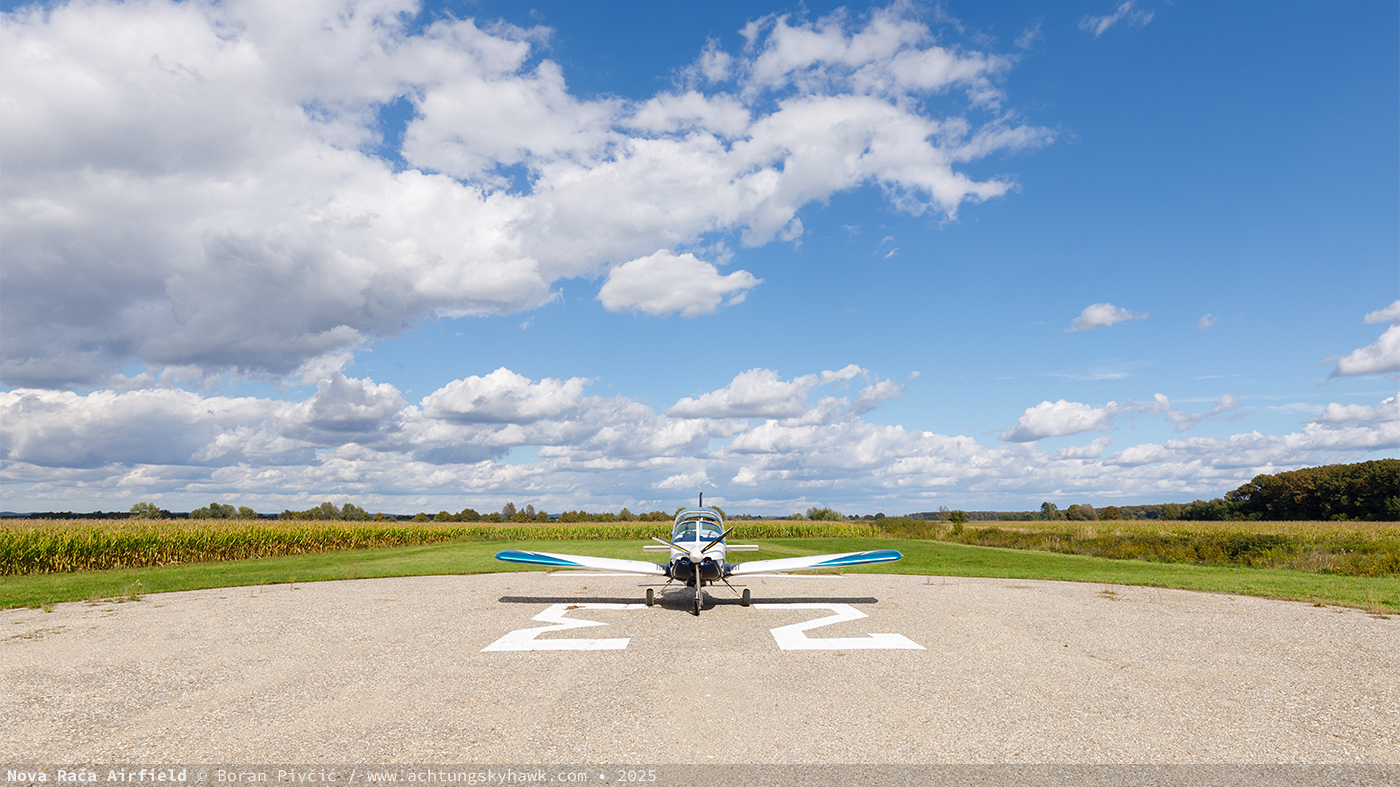
Unlike at Čađavica, there are no fixed close-in obstacles on either runway end, so you can come in and get out even in something with marginal performance (<cough> 60 HP Falke </cough>). However, like at Korija, thermal turbulence from the surrounding fields plays a large role… as does mechanical turbulence from the forest during any stronger southeasterly wind

An approach over trucks on one end, and over cornfields on the other… my kind of place!
 Achtung, Skyhawk!
One thought on “Croatia’s Abandoned Cropdusting Airstrips: Nova Rača”