History – The Yugoslav Czech: Let L-200 Morava at LDZA

By me
Photos as credited

It’s a pretty sure bet that all of us had, at one point or another, casually ignored an aircraft sitting right under our noses… you know, the sort of machine that may as well be rare and interesting – but one we’re so accustomed to seeing that it pretty much becomes part of the landscape. While the small size of Croatia’s aviation sector doesn’t provide much “opportunity” for the above, there nevertheless still are a couple of aircraft lying around that have become – for lack of a better word – invisible.

As it often so happens, I had chanced upon such a machine purely by accident, running into it while browsing through historic photos taken at Zagreb Airport (ZAG/LDZA). While the gallery in question had much eye candy with which to distract the viewer – Convairs, Caravelles, early MiG-21s and so on – hiding in the corner was a lonely little Let L-200 Morava, unceremoniously preserved at the far end of the airport. While I had seen it numerous times before in my adult life – not to mention having played on it as a kid in the late 80s 😀 – I had completely pushed it out of my mind, always looking further and further out for fresh material.
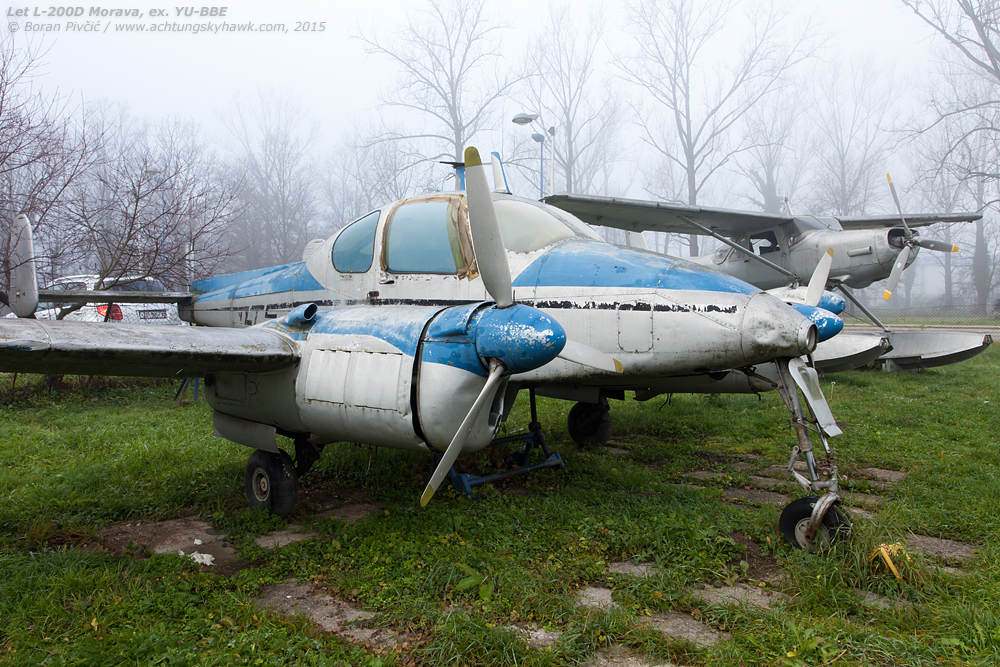
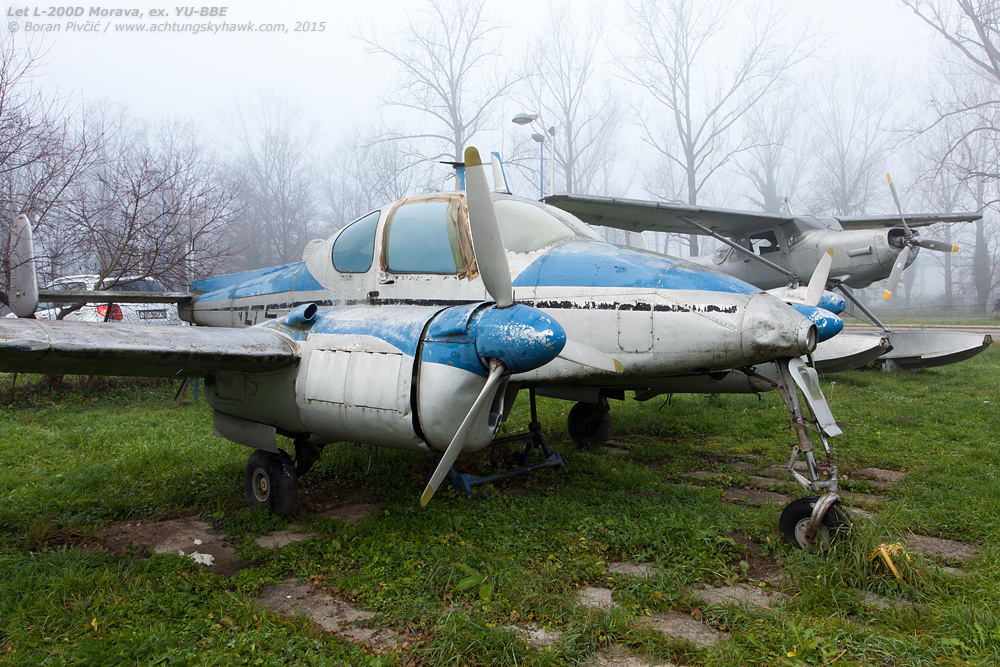
Caught on a suitably dark and gloomy December day, being kept company by UTVA-66H 52105. Other aircraft that had previously been displayed alongside were Agusta-Bell AB.47J YU-HAG and Lockheed T-33B Shooting Star 10250 (the latter nowadays displayed at Čazma Airfield (LDZC))

Having always had a thing for Czech light aircraft – especially “visually curious” types such as the L-40 Meta Sokol and the L-200 – I decided it was high time to have a look into this example, and see if it maybe has a story worthy of Achtung, Skyhawk!. Though its lack of identification markings had raised some doubts online about its true identity, I once again had the great fortune of being able to call upon the men and women who had worked on it in the past, allowing me yet another fascinating glimpse into the country’s aviation heritage…

Pan-Slavic

While there is nothing on the outside to suggest it being anything other than a stock L-200, this machine does indeed have a bit of color in its history. Even though the Morava had had a short production run of just eight years, considerable interest in the design had still existed when Czechoslovak manufacture came to an end in 1964. One of the parties keen to continue building them was Yugoslavia, which had soon managed to secure rights for license manufacture, handing over the baton for the same to the LIBIS works of Ljubljana, Slovenia. Short for Letalski institut Branko Ivanus Slovenija (the Branko Ivanus Aviation Institute of Slovenia), this small factory had previously been responsible for a few notable GA designs, including the KB-6 Matajur two-seat trainer, KB-11 Branko four-seat tourer, and Libis 17 and 18 training gliders – all of which were produced in relatively small numbers, preciously few of which survive today.

The plan for the Morava, however, had called for just simple, small-scale assembly of aircraft from “knock-down kits” provided by Let (there is no indication that “proper” production was considered, though this cannot be ruled out). To this end, LIBIS was in 1964 supplied with a total of 14 kits, which, when completed, would produce aircraft known as the L-200 Libis. Named so purely for marketing purposes, these aircraft would be identical to the standard L-200D, which itself was an evolution of the early L-200A in response to Aeroflot requirements*.

* Aeroflot would, in the event, go on to operate the majority of the 360 Moravas produced, using them both in training and air taxi roles. To make the basic design suitable for this sort of work (as well as the conditions it was expected to operate in), Aeroflot had requested the addition of:

  • an engine-driven hydraulic pump for the landing gear, fitted to the No. 1 engine (replacing the A model’s manual hand pump)
  • dust filters on the engine intakes
  • a winterization kit to prevent engine over-cooling in low temperatures
  • a radio compass to aid in long-range navigation
  • and – most important of all – an increase in propeller ground clearance to prevent damage on rough strips. This was achieved by substituting the A’s two-blade 1.9 meter V410T/V410AT constant-speed propellers with three-blade 1.75 meter V506 units – making this the primary way to visually differentiate the two models (the original idea had actually been to move the whole engine nacelles higher up – but this would have drastically reduced visibility from the cockpit, so the idea was quickly dropped). A notable curiosity here were the propellers’ pitch control mechanisms: while the V506 had sported a “traditional” hydraulic actuator using engine oil, the old V410 was based on an electrical system, with propeller speed commanded by pushbuttons rather than the familiar blue levers

Of interest (since we’re already digressing 😀 ), two other versions had been considered while the Morava was still in series production. The first, dubbed the L-200B, would have been an evolutionary development of the A, while the L-200C was intended to be certified to UK airworthiness standards and sold as an export model. Both of these though had gone down to the tubes due to the sheer commitment required by Aeroflot and the model D.

In the event however, only five kits would be completed – with out example having been the first :). Rolled out in mid-1964, it would carry two distinct serials, Let’s own (and rarely used) 17-14-13, and LIBIS’ internal 300-20 (changed to 301-01 in September). Its first port of call following completion would be Pan Adria – a small Zagreb-based passenger and light freight airline – where it would become YU-BBE on 10 August.

A very rare pre-1991 shot of BBE in its original state. The photo source (Wikimedia) states this was taken during the aircraft’s formal handover to Pan Adria.

Joined soon by three other LIBIS machines (BBF, BBG & BBH), it would initially be used for just the odd crew training flight, most of which were flown at night. However, the little fleet would quickly be put to use on nightly newspaper and airmail services as part of the carrier’s newly instituted Noćni avionski poštanski saobraćaj (Night-time Aircraft Postal Service, NAPS) program. Ran in cooperation with the Jugoslovenska pošta, telefon i telegraf (Yugoslav Post, Telephone and Telegraph, JPTT), this service would be the first mail-only aerial operation Yugoslavia since WW 2, and had served – among others – Belgrade (BEG/LYBE), Split (SPU/then LYSP) and Dubrovnik (DBV/then LYDU) direct from Zagreb (then LYZA).

The program’s increasing success, however, had soon meant that the Morava was becoming too small and too slow to cope with demand. Piggybacking on one of Yugoslavia’s first mass acquisitions of light aircraft from the West, Pan Adria had in early 1968 ditched the L-200 in favor of the much more suitable Aero Commander 500, a type that would go on to serve in this role right up until the carrier’s dissolution in 1977**.

** interestingly, an identical service would be started in early 1991 by another local operator – Zagreb Airlines (Zagal) – using a fleet of Cessna 310s and 402s. In concert with the carrier’s freight feeder work for DHL and UPS, this operation would provide the essential foundations for the formation of Croatia Airlines later the same year.

Having now been left without a job, the little fleet (sans BBH, lost in Macedonia in June 1966) would on 15 March pass into the hands of the Aeroklub Zagreb flying club, which had at the time been dabbling with the idea of starting an in-house air taxi service. However, despite the bulk of the club – which had always been one of Croatia’s most eminent aviation institutions – standing behind this venture, the L-200 had proved to be simply too thirsty and maintenance-intensive to make the proposal work, resulting in the operation’s continual uphill battle to break even.

Coming to terms with its predicament, AK Zagreb had decided to finally part with the type sometime in 1973. BBF would quickly find a new home in Slovenia, while BBE and BBG would end up in the court of the newly-formed Obrazovni centar zračnog saobraćaja (Air Traffic Education Center, OCZS) based at Zagreb, later to become one of Yugoslavia’s most respected aeronautical organizations. Having had the finances, equipment and know-how to efficiently operate an aircraft of the L-200’s caliber, OCZS had naturally wanted to put these machines to some use, allocating them to its in-house flight school, the Viša zrakoplova škola (Aviation Polytechnic, VZŠ).

No spares to spare

However, right at the very outset, the school ran into a few problems. BBG was reportedly in such a poor state that it was immediately consigned to the scrap heap, while BBE needed a thorough work-over before it could be used in regular service. But, even when this was completed, issues remained; though they still had some time left on the clock, BBE’s engines were very near the ends of their 800-hour service lives. Given that parts and replacement engines were becoming increasingly hard (and expensive) to come by – and the school could do without the bother – it was decided to fly the aircraft as sparingly as possible in order to conserve it for when it would really be needed.

To this end, BBE was earmarked solely for the final stages of Commercial Pilot License instrument training – and would even then be flown only by the school’s first two generations of students. From 1975 onward, it would operate just the occasional staff transport flight, logging only a couple of hours per year in the process. To maintain it in a working condition during this extended downtime, it would be fired up and ran two to three times a month; but even this would cease in early 1980, when the engines finally ticked over to 800 and the aircraft lost its Certificate of Airworthiness once and for all – having flown just 50-ish hours in VZŠ service…

Despite it now being ripe for the chopping block, the school nevertheless did not want the aircraft to go to waste (especially given all the effort so far invested in it). Following its removal from the register on 28 May, BBE would be towed from the apron to the school’s courtyard, where it would be set up as a gate guard and teaching aid.

But, to properly explain what (little) happens next, I though it best to first mention some of the inner peculiarities of the OCZS. Even though the VZŠ was always the most famous thing about it, the OCZS had also ran another institution called Srednja zrakoplovna škola (Aviation High School, SZŠ). While the VZŠ was a higher learning organization that dealt almost exclusively with flight training, the SZŠ – opened in 1976 – was tasked with teaching various aeronautical topics at a high school level. In 1981 though, the OCZS as such would cease to exist, with both VZŠ and SZŠ becoming “standalone” partner institutions sharing the same building***.

*** to further complicate matters, the VZŠ had the habit of occasionally changing its name, but without any alteration to the underlying “mechanics”. This is most evident in official documents, which state that on 1 April 1977, BBE was transferred to the “Centar za odgoj i usmjereno obrazovanje kadrova u zračnom prometu”, or The Center for Education and Specialist Training of Air Traffic Cadre – a seemingly significant change, but in reality it was business as usual. To make the whole issue all the more ironic, the school would revert to its original name within a couple of years.

Having always been attached to the VZŠ, BBE would remain on its books all the way into late 1989, when the school was disbanded in the political turmoil that had preceded the violent collapse of Yugoslavia two years later…

YU-BBE pictured in a sad state in 1995. In common with a lot of preserved aircraft, the YU prefix and all Yugoslav markings had been removed following Croatia’s 1991 independence (photo from Erwin Alexander’s Flickr profile)

Despite the circumstances of VZŠ’s demise, the SZŠ – lacking high-value assets such as aircraft – had managed to remain below the radar throughout the ordeal, coming out of the late 80s relatively unscathed. Designated the nominal successor to VZŠ’s files and infrastructure, the school – nowadays named Zrakoplovna tehnička škola Rudolfa Perešina (The Rudolf Perešin Aviation Technical School, ZTS) – had also become the new owner of BBE, which would continue to serve in its role as a teaching aid all the way into the present.

Paper trails

While I strove throughout to dig up as much info on BBE as I could, many of the finer details (and dates) of its service between 1970 and 1980 are, sadly, lost to history – despite the very best intentions and efforts of the people who had helped me with my research. Virtually all of the aircraft’s known documentation has been confirmed as lost, some during the school’s organizational changes and collapse in the late 80s – but most through a simple lack of interest in BBE over the intervening 20 years.

Critically, even Serbia’s Directorate for civil aviation (the successor to Yugoslavia’s aircraft registry) lacks a clear picture of BBE’s movements in the mid 70s – so much so that even the exact year of its transfer to the OCZS is not known with certainty. Queries in the ZTS library and among current school staff had also failed to produce usable results – while the extensive, but ill-kept and disorganized AK Zagreb archive makes locating the right files harder than finding a needle in a haystack.

The only thing that had remained available to me were the memories and recollections of the men and women who had worked on or with the aircraft in the past – most of which were incorporated into the final article. Whether this story will get any “official closure” in the future remains to be seen…

Having led the hard life of an engineering trainer, YU-BBE is unsurprisingly in quite a shoddy state, despite its 1997 repaint. While its major structural components are still accounted for, the interior has been completely stripped to the bone, with the only thing remaining being the throttle quadrant…
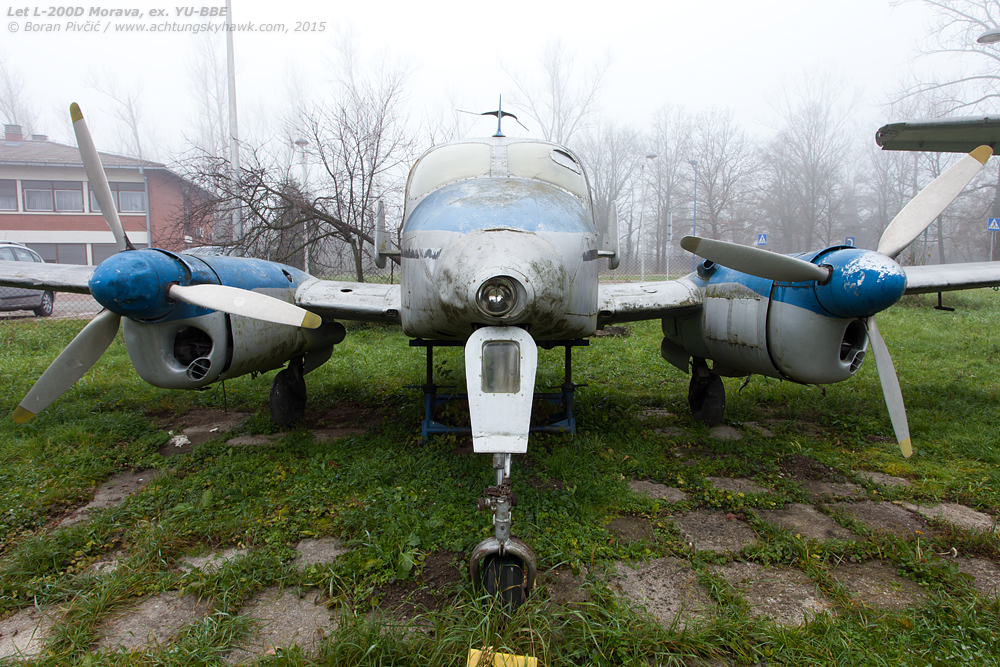
Not an aircraft one is likely to lose in a crowd! Interestingly, even though the D model’s propellers were intended to give a bit of extra ground clearance when operating from unprepared strips, the space between the tips and the ground is not all that great. Note also the underfuselage supports; despite its hydraulics still indicated as being pressurized, BBE nevertheless needs some help standing up…

A peek at the right-hand side M 337Š – which looks to be pretty complete. Apart from its “inverted six” layout (producing 210 HP), this engine is also notable for its supercharger, which could be “plugged in” via a lever in the cockpit to give some extra oomph (a feature seen on several other Avia engines). Interestingly, the design itself is based on the four-cylinder M 332, which is in turn an upgraded Walter Minor – a unit designed way back in the late 20s.

As always, I would like to extend my sincere thanks to the people who devoted their time to answer my multitude of questions, including:

  • Capt. (retired) Antun Gabela, former VZŠ flight instructor and professor
  • Mr. Srđan Kisin, former BBE tech
  • Ms. Tihana Strmo, ZTS’ head librarian
  • and of course my father, who had been a dispatcher during Pan Adria’s final days, and mother, who had worked at VZŠ throughout the 80s!

Sources:

History – Turbomess: The L-410 Turbolet Family Tree

By me
All photos me too, copyrighted

In one of those instances in life where innocent scrolling through aircraft photos leads to several hours’ worth of research, I am once again able to present one of my (unplanned 😀 ) historical works, borrowing now on a theme set by my previous PC-6 engine piece. The unsuspecting party this time is the pudgy Let L-410 Turbolet, one of the Czech Republic’s most notable and successful aircraft – and a machine that many in Eastern and Southeastern Europe associate with durability, practicality and robust versatility (alongside the An-2 naturally).

The train of thought that had derailed this time was the realization of the sheer number of L-410 variants out there – 39 by my count so far! – all identified by cryptic and complex shorthand such as “UVP”, “E-17”, “E-S”, “AB” and so on. Coming to terms that I’m (at best) a bit hazy on what they all actually mean, I’ve decided I might as well dig a little deeper and see if this mass of numbers and letters can be forced to make some sense… 🙂

All aboard! One of the several Turbolets to have visited Lučko over the years, OM-PGD is by far the rarest, being a member of the “early” L-410M family – nowadays quite an unusual sight.

Despite its apparent complexity though, the classic L-410 line can actually be split into only eight easily-manageable families. Given that various online sources give various specs and details for each generation, I’ve decided to go back to the absolute basics, and concentrate solely on the one definitive source – the Turbolet’s Type Certification Data Sheet (or TCDS), available both from the Czech Civil Aviation Authority and EASA.

But, since fiddling with the sort of detailed specs that can be found in such a document would defeat the purpose of a “clarification”, the aim of this article is simply to construct an overview of the general changes from family to family – and not a thorough analysis of all 39+ versions. To keep the comparison clean, tidy and understandable, only the bits that were changed between models are noted – with an exact side-by-side comparison of key performance specs and characteristics (also my own work) provided at the end.

So, starting from the top…

L-410 “originals” (6 aircraft): despite the Turbolet being most closely associated with the Walter M601 series engine, the type’s beginnings were actually tied to another turboprop great, the Pratt & Whitney Canada PT6A. While the L-410 had been designed from the outset with the M601 in mind, the engine was still not usable by the time the Turbolet was nearing the detail design stage in the mid-60s. In order not to hold up development, the Let works had soon decided to slot in a replacement engine, the PT6A-27, developing 680 SHP. Given that engine-propeller combinations are not really open to experimentation, the choice of a Western engine had necessitated the use of a Western propeller, in this case the Hamilton 23LF-343 three-blade unit with a 2.6 meter span.

Following flight and ground testing of the four XL-410 prototypes, the design was finally “frozen” at the beginning of the 70s, subsequently entering production in 1971 as the L-410. However, only six aircraft of this series were ever produced – with all having subsequently been converted to the L-410A standard.

An interesting detail – first seen on the final two prototypes – was the de-icing system, which had dispensed with standard pneumatic boots in favor of a TKS fluid system. Increasingly popular on today’s high-performance GA aircraft, this system works by bleeding a special glycol-based fluid through micro pores on the wing and tailplane leading edges, preventing the accumulation of ice. While the system is significantly more effective than classic boots, the protection provided is dependent on the quantity of fluid carried – a factor that had limited the aircraft’s exposure to icing conditions to only 40 minutes.

L-410A (25 aircraft): picking up where the original left off, the A model was introduced at the beginning of 1972, but had essentially differed only in the propeller fit – with the Hamiltons giving way to Hartzell HC-B3TN-3D units with the same three blades and 2.6 meter span. Interestingly, some sources state that this version had also introduced a Maximum Take Off Mass (MTOM) increase to 5,700 kg from the original’s 5,400 kg; however, the TCDS states that both the original and A models were certified for the higher mass.

Sub-versions include the L-410AB, L-410AF and L-410AS

L-410M (108 aircraft): by the mid-70s, the M601’s bugs had finally been ironed out, making it suitable for installation on the Turbolet. Debuting in 1975, the M would be fitted with the increased-diameter M601A unit, developing 740 SHP and whirling three-blade Avia V508 propellers with a 2.5 meter span. Despite the increased power, this new setup had actually had a slightly detrimental effect on performance, with cruise speed now reduced by 10 km/h / 5 kts to 350 km/h / 189 knots, and ceiling by 100 m / 300 ft to 6,000 m / 19,700 ft.

The switch to the M601 had also marked the end* of the TKS de-icing system and the return to standard pneumatic boots, resulting in the lifting of the 40 minute restriction for flight in icing conditions.

* however, I’ve been told that the TKS system was actually discontinued in 1974, so it may be possible that a handful of the final A models were also fitted with boots…

Sub-versions here include the L-410MA/MU (such as OM-PGD from the featured photo)

L-410UVP: as was the case with many Eastern European aircraft, the Turbolet’s main market was – by default – the USSR, especially in the hands of the state behemoth Aeroflot. Having originally instigated the development of the L-410 as a potential substitute for the vast fleets of An-2s still being used on commercial services, Aeroflot had naturally been interested in getting the most out of the design, having had some reservations about the M model’s ability to operate in the Soviet backwoods. Under the airline’s urging, Let had in 1979 introduced the improved UVP, whose primary claim to fame was full STOL performance (with UVP being short for ukorochennovo vzlyota i posadki, or “improved take-off and landing” in Russian).

While at a glance it looks just like its predecessors, this new model is in fact a somewhat larger machine, sporting a 0.8 meter fuselage stretch (for a total of 14.17 meters in length) – and, critically, a 2 meter increase in wingspan to 19.48 m. Fitted with a pair of ground spoilers to dump lift on landing, these changes were in theory all that was needed to achieve the required short-field performance.

However, all these mods had also resulted in a significant increase in empty weight, which – without an appropriate increase in MTOM – had led to a reduction in payload (despite the extra room on board). Further complicating matters was the revised powerplant, now taking the form of the 700 SHP M601B and its associated Avia V508B propeller – making for an 80 HP deficit at take-off. This problem would be mitigated somewhat in 1983 with the introduction of the 735 SHP M601D and Avia V508D – as well as Service Bulletins which, when implemented, allowed an MTOM increase from 5,500 to 5,800 kg for the M601B and 6,000 kg for the M601D.

Despite this, the added bulk (and re-certification to Soviet standards) had also resulted in a reduced ceiling of 4,250 m / 14,000 ft, and a reduction in passenger capacity from 19 to 15 (not even swapping the metal rudder for a fabric-covered one had helped bring the weight down).

The sub-versions of this family include the L-410FG and L-410T

L-410UVP-E: to cure the UVP’s ills, the Let works would in 1986 debut the further improved UVP-E (E for ekonomicheskiy, or “economic”), also known briefly under the tongue-twister L-410UVP-L-E. This would be fitted with the 760 SHP M601E or E-21 engine (the latter intended for hot-and-high conditions), spinning more substantial Avia V510 five-blade propellers with a 2.3 meter diameter and fully automatic autofeather system. Even though cruise speeds had remained the same as on the UVP, the new aircraft could boast significantly higher maximum weights, with an MTOM of 6,400 kg and a Maximum Landing Mass (MLM) of 6,200 kg.

Apart from regaining its 19 passenger capacity (in part due to the reconfiguration of the rear baggage compartment), this version had also introduced optional tip-tanks, which together added 315 kg of fuel to its basic 1,000 kg internal capacity. Other changes had also included a revised avionics setup, now fully compatible with both Western and Eastern ground navigation aids – as well as the reintroduction of limitations for icing conditions, with the E now restricted to low and moderate icing down to a minimum temperature of -20 degrees Centigrade. The reason for this turn of events is somewhat uncertain, but was suggested to be due to the design of the oil-to-fuel heat exchanged fitted to this model, which could lead to the overcooling of both the oil and fuel in extremely low temperatures.

Sub-versions were greater in number, including the L-410UVP-E1, E2, E3, E4, E6 and E8

L-410UVP-E9: a further update of the basic UVP-E, debuting in 1988. Generally identical, the E9 had only introduced MTOM and MLM increases to 6,600 and 6,400 kg respectively

Sub-versions include the L-410UVP-E9A, E9D, E13, E14, E15, E16, E17 and E19

L-410UVP-E20: what would eventually become the definitive classic Turbolet had appeared in 1990, sporting only a 40 cm fuselage shrink and a (once again) restored ability to continuously operate in icing conditions (likely due to the removal of the offending heat exchanger). While this had hardly set the world alight, the changes “on paper” were much more significant, with the E20 being the first of the family to be fully certified against both FAA FAR 23 and (today’s) EASA Part 23 regulations. Being “universally accepted” in the world had also meant that the E20 would remain in production until this day, with new builds still being delivered left and right at the time of writing.

Sub-versions include the L-410UVP-E20C, E20D, E20G and E27

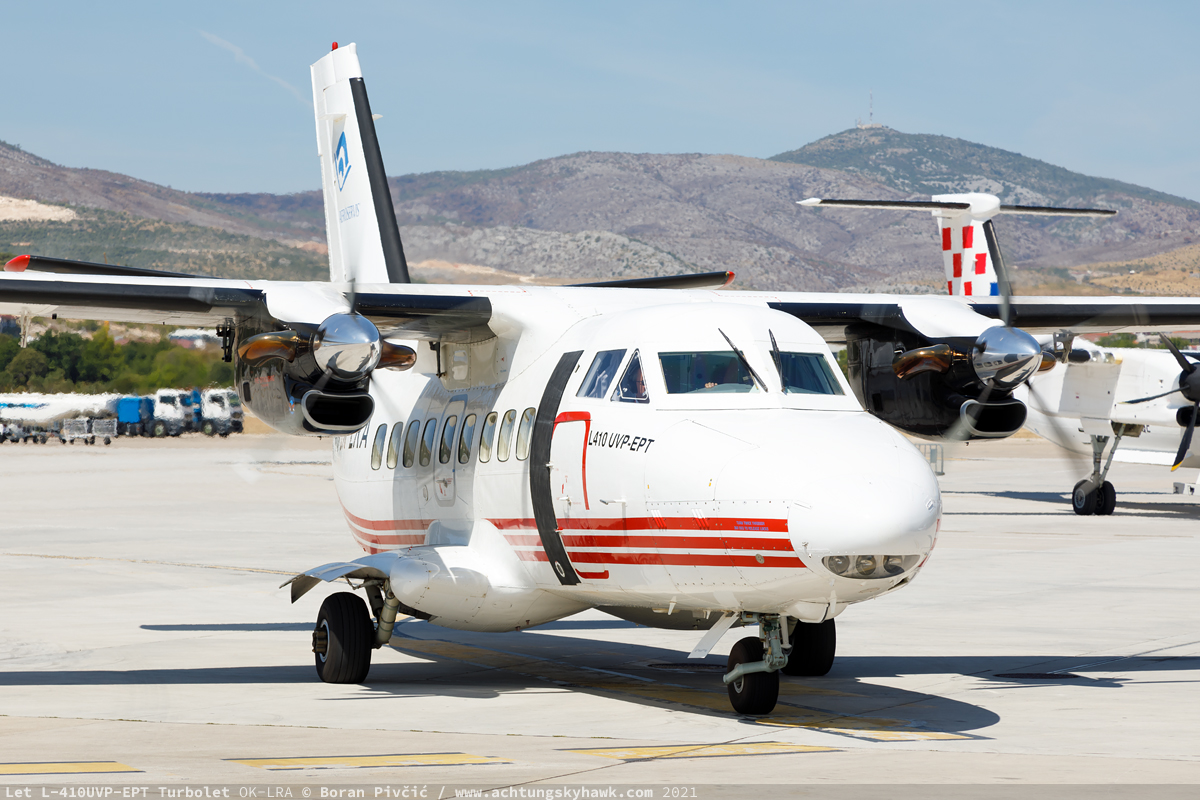
L-410UVP-EPT (one aircraft): in what would become an interesting piece of circularity, 2016 would see the Turbolet’s return to PT6 power with the EPT, a third-party conversion penned by Aero Servis of the Czech Republic. Having become dissatisfied with General Electric’s handling of the M601 program – citing rising costs and dropping support quality – the company decided to replace the Walter with the more potent PT6A-42, flat rated to 800 HP and spinning a modern Avia AV-725 five-blade aluminium propeller. Though Aero Servis does not cite any performance figures, they do say that the installation reduces fuel consumption and noise, while increasing both hot-and-high performance and the maximum cruise speed.

As of SEP 2021 when this chapter was added, only one aircraft has so far been converted.

The Lone Ranger. Currently the world’s sole EPT, OK-LRA had started out in life as a regular UVP-E9, manufactured in 1989 and sporting the serial 892216. It would be converted to Pratt Power in 2017, making its first flight on 1 September the same year. For the past 12 or so months, it had been operating domestic Croatian PSO flights on behalf of local carrier Trade Air, replacing the previous L-410 OK-LAZ

L-420 (one aircraft): the last of the Turbolet classics, the L-420 also had the dubious distinction of creating confusion far greater than its “production run”. Introduced in 1998, the 420 was often labelled as just a re-branded E20; however, in reality, the model was actually another refresh of the E line, intended for certification and export to the US market. Sporting 790 HP M601F engines driving the same V510s, the 410 could boast a top speed of 375 km/h / 202 knots and an “A level” ceiling of 6,100 m / 19,700 ft. Interestingly, the aforementioned FAR regulations had necessitated a number of unusual changes to the basic design, including the removal of the engines’ Integrated Electronic Limiter Unit (IELU) – which would reduce engine power in case any of its parameters were exceeded – the addition of a passenger door on the right side of the fuselage (identical to the one on the left) and reinforced flight control linkage.

Despite the increased performance and the additional changes, the design had not fared well against Western competition, with reportedly only one aircraft made – and a test conversion from a stock E20 at that (though it is now normally flying in commercial operations).

L-410NG – the new kid on the block: even though this one doesn’t count towards the classic family tree, I’d decided it would be unfair to skip over it – especially since it picks up the baton of the L-420. Having flown for the first time in 2015, the NG is essentially a thoroughly updated current-production E20, marketed (ironically) primarily to operators in the former USSR. The highlights of its transformation include a three-screen Garmin G3000 glass cockpit, composite materials in non-critical areas (such as doors), an elongated nose for increased baggage space – and a significant power boost in the form of the 850 SHP General Electric H85-200 unit and its associated five-blade Avia AV-725 prop. While the latter sounds like quite the change, the engine in question is actually a modernized M601, born during GE’s purchase of Walter.

The extra grunt naturally promises increased performance and capability, with an MTOM of 7,000 kg, MLM of 6,800 kg – and cruise speeds now in the 420 km/h / 227 knot range. Interestingly, the update also includes a significant boost in fuel capacity, with 2,340 kg now available with tip tanks, versus 1,315 for an equivalent E20.

Another visiting Turbolet – but this time a basic UVP that had mistakenly ended up on the military helipad and had to be pushed back… manually

The Devil Is In The Details

Given that the above pretty much covers 75% of the Turbolet’s family tree, I thought it a shame not to list – at least in passing – some of the aforementioned sub-versions. However, as they are not contained or listed in the TCDS, this review is based on various human and online sources and includes just a short snipped of what made the version special or different… 🙂

  • L-410AB: the L-410A fitted with Hartzell HC-B4TN-3 four-blade propellers
  • L-410AF: a one-of aerial photography and cartography version with a glazed nose and fixed nose wheel
  • L-410AS: ten examples built for the Soviet market, with upgraded navigation and communication equipment. Used to test the design’s suitability for use in the USSR
  • L-410MA: a standard L-410M refitted with the UVP’s M601B engine and V508B propeller
  • L-410MU: an alternate designation for the L-410MA
  • L-410FG: identical in function and configuration to the L-410AF, but based on the first UVP; seven produced. Interestingly, to enable the camera operator to reach his station in the nose, the copilots control column had to be removed; despite this, the aircraft had remained a two-pilot machine. It is unknown however (though likely) that the AF had also “suffered” from the same issue
  • L-410T: a standard UVP modified to be able to better handle freight, with a larger cargo door and cabin modifications to be able to accommodate pallets, stretchers and bulky cargo
  • L-410UVP-E1: two aircraft for Bulgaria, reportedly for a mixed photography/transport role
  • L-410UVP-E2: a modified version for the Polish Maritime Office
  • L-410UVP-E3: version optimized for skydive operations
  • L-410UVP-E6: navaid calibration version
  • L-410UVP-E-S: a “salon” VIP version with integrated steps and plush interior
  • L-410UVP-E4 & E8: exact details unknown
  • L-410UVP-E9A: a version for the Swedish marked fitted with Bendix/King avionics
  • L-410UVP-E9D: a sole example modified with a Bendix/King EFIS cockpit system
  • L-410UVP-E14: another model with Bendix/King avionics, intended for the transport of military dignitaries
  • L-410UVP-E17: a version for the Polish market
  • L-410UVP-E13, E15, E16 & E19: exact details unknown
  • L-410UVP-E20C: a version for South Africa
  • L-410UVP-E20D: VIP version for government use
  • L-410UVP-E20G: a version for the Tunisian Armed Forces
  • L-410UVP-E27: four machines for use in high-altitude conditions in India
  • L-410UVP-EPT: third-party PT6A-42 re-engine conversion

As always, I would like to extend my sincere thanks to former L-410 F/O Enes Handžar, who had shed a lot of light on the Turbolet’s history and quirks!

Additional files:

Sources:

Change log and revisions:

  • 08 SEP 2021: added the L-410UVP-EPT
  • 19 FEB 2016: added new details to the L-420; added additional notes to the L-410FG