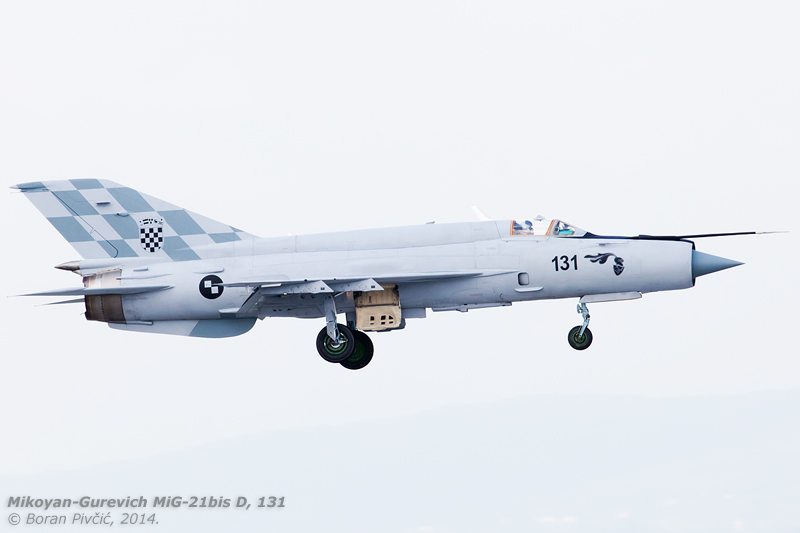
In a dazzling display of impeccable timing, my recent post about the Croatian Air Force’s few remaining MiG-21s had appeared here barely a week before the fleet was boosted by an eagerly-awaited new member :). The jet in question is MiG-21bis D 131, the first of five low-time examples bought from the Ukraine for the express purpose of keeping the fighter force operational until funds can be scraped together for a proper new machine :). Thoroughly overhauled in the port town of Odessa, these five would eventually be trucked piecemeal across Hungary to Zagreb, where they’ll be progressively tested out one by one and added to regular service (releasing hard-working 121 and 122 for servicing). The first of the lot to be completed, 131 was scrambled out today on its first ever flight from Croatian soil, an event eagerly anticipated by several men with very large cameras… 😀
Far from my best work, but an event that had to be captured at all costs – 131’s first ever take off from Croatian soil. Preceded by 121 and 122 in full QRA config, 131 would eventually stay aloft for 35 minutes, flexing its wings in the Lekenik Flight Test zone.Quite an unusual sight after two decades of colorful camo schemes as 131 returns back home to RWY 05. While fresh from the outside, the jets have had some work on the interior as well, the biggest of which was the addition of a Garmin GNS430 GPS and a Sandel SN3500 EHSI.
As many of my readers might have already deduced from posts past, when operating out of Zagreb Intl (LDZA), chances are you’ll pretty quickly stumble upon one of the Croatian Air Force’s charismatic fuel-to-noise converters :). The aircraft in question are – of course – the MiG-21s, 70s manned missiles that are holding on as one of the last of their type still in front line service in Europe. And while we may have grown to taking them for granted through sheer exposure, they nevertheless still have a special – and resolutely unshakable – status on the local aviation scene. As I’ve already noted in a previous post, despite all their drawbacks, they’re still the rock stars of the skies, and have garnered a cult following that extends even outside the immediate aviation community (quite the achievement in a normally disinterested Croatia) :).
So too feel increasing numbers of photographers and enthusiasts from other lands, with the remaining few operational jets achieving close to “tourist trap” status :D. Given that they’ve been thrust back into the spotlight of late – primarily due to delays to their refurbishment in the Ukraine – I thought I might further their promotion a bit by cobbling together a collection of recent and already-featured (but hopefully still interesting) shots of the fleet going about its business. With one notable exception, I’ve decided to completely shy away from photos taken at various events and open days, preferring to stick to snapping them in their “natural operational habitat”… 🙂
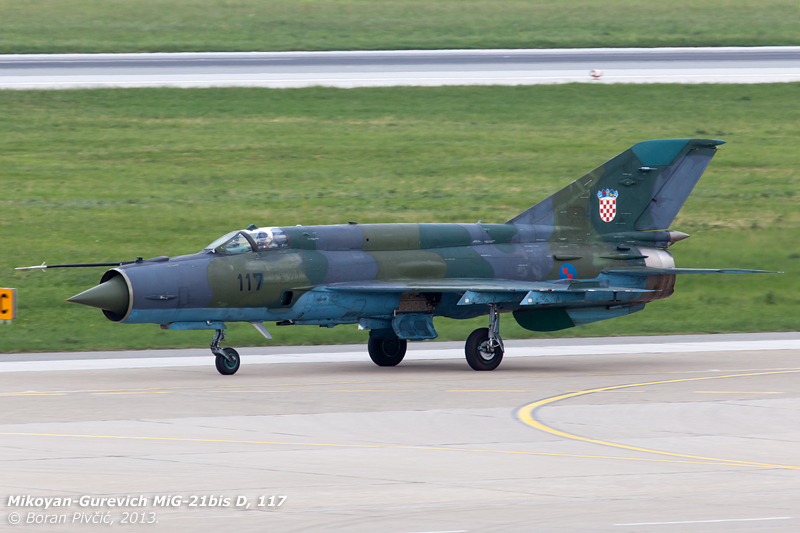
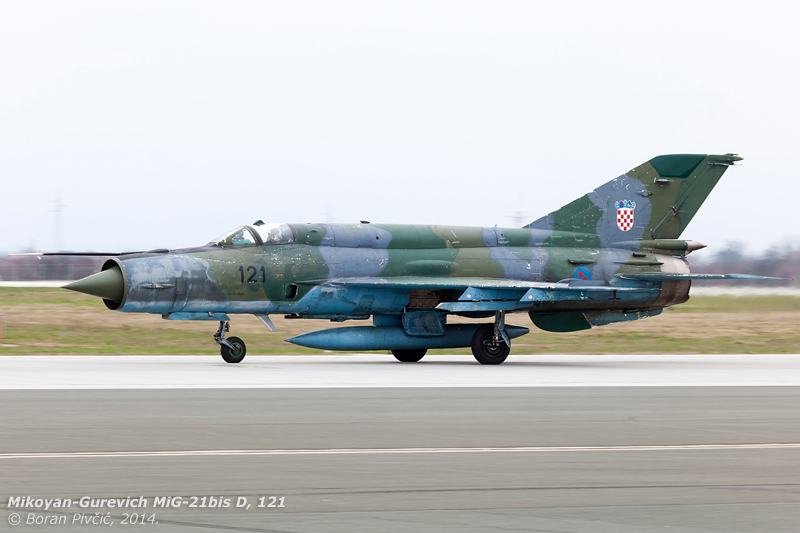
Up, up and away! Latterly the hardest working of all the jets in the fleet, 116 and 121 are seen rocketing out of RWY 23 in an unusually tight and attractive formation. Flying unarmed – and without the centerline fuel tank – would suggest they’re heading out on a simple training mission, rather than the more common Quick Reaction Alert (QRA) practice scramble.116 rocketing out on its own for another short training sortie. Essentially a piloted missile, the MiG-21 is (like the F-104 Starfighter) a pure-blooded interceptor, designed for acceleration, climb, and hit-and-run tactics in large numbers rather than the payload capability, versatility and persistence of an air superiority fighter like the Su-27 or F-15.A rarely seen member of the fleet, 117 taxis out towards RWY 05 for a test flight. Alongside Bulgarian and Romanian examples, CroAF machines are the last of the front-line MiG-21s flying in Europe – with the type also serving in limited secondary roles in Serbia. Interestingly, all of these operators fly slightly different versions of the jet, with Romania having its own MiG-21MF-based Lancers, Croatia it’s home-grown “bis D” upgrade – and Bulgaria sticking to the most capable examples of the stock bis family.121 performing a 200 knot wheelie as it returns back to base after a practice QRA scramble with sister ship 122. In the default CroAF intercept configuration, it is equipped with two R-60 (AA-8 Alphid) short-range heat-seeking missiles and the distinctive 800 liter / 211 USG BAK drop tank (giving it a usable endurance of slightly over an hour – which is not all that bad given the type’s notoriously short legs).Weathered and tired – but still infinitely charismatic – 121 is seen quietly sitting around in the background of the CroAF’s 22nd anniversary ceremony. Sadly, this is one of the last times we’ll be able to enjoy the distinctive camo scheme, with the fleet being progressively repainted into a customized NATO air superiority grey pattern… The workhorse of the fleet of late, 121 is seen rolling out for a one-ship practice scramble. Despite being part of the QRA pair, it is flying unarmed (but with the R-60 pylons still in place), retaining only the centerline fuel tank. The reasons for this are unclear, but likely have something to do with releasing the aircraft for a training mission with the minimum of fuss and operational complication.Seconds from touchdown on RWY 05 after another one-hour sortie. Buoyed by the recent arrival of the first of the “new” MiG-21s – five low-time examples bought from the Ukraine – the Air Force had started intensively flying armed pairs again, giving their pilots some much-needed air time – all while safe in the knowledge that they can use the jets’ little remaining lifetime to the fullest without fear of compromising the fleet’s operational availability.A rare venture outside by a twin-stick UMD (upgraded to the same local standard as the bis D). An endangered species, the UMDs had up until recently numbered just three operational examples, which were whittled down over the course of the summer to just 166. However, the remaining two currently being overhauled in the Ukraine, including 165, famous in song and story for its chessboard Croatian coat of arms paint scheme.
Anybody who has ever spent some time flying light aircraft – especially those part of smaller flying clubs – will no doubt have experienced what I’ve come to call the “cascading planning failure”. It’s the weekend, the weather is (nearly) perfect, the bird is operational and ready… and willing pilots can be found in their dozens. After several rounds of negotiation – and a hefty phone bill – you finally end up with a working plan, one that will both make everyone involved happy and keep the aircraft’s down time to a minimum. Excellent. All that remains now is one person to derail the entire works right at the outset… 😀
Such was the case on 13 April, when a planning meltdown kicked off my series of flights with an hour’s delay. What was a mild irritant at first had though quickly turned to excitement, proving conclusively (once again) that there really is a silver lining to every dark cloud! Rejoining the pattern at Zagreb Intl. – now well over two hours behind schedule – I happened to catch a transmission by an N-reg aircraft on approach, complete with a movie-set American accent. And while we do get quite a few N-numbers here in Croatia, most of them are aircraft actually based somewhere in Europe and operated by European companies and individuals – so catching an “authentic” US machine was immediate cause for excitement. Rolling lazily into the downwind leg, I scanned the skies for signs of the newcomer, expecting it to be a small business prop or the like… and then I saw it, dead abeam and 1000 ft lower – a pristine white Learjet gliding in towards the touchdown point.
Being a lifelong fan of the Learjet (thank you Microsoft Flight Simulator 98 😀 ), I was naturally through the roof, especially given my recent photographic dry spell. And while I couldn’t make out the exact model from the air, I’d assumed it was one of the established, “common” models like the 45 or 60. So you can imagine my surprise when, while holding on TWY B for the traffic to clear, a brand new Learjet 75 happened to roll by in front of my nose… 🙂
With their classic, speedy lines – hallmarks of the brand ever since the original model 23 of 1963 – Learjets definitely tend to stand out on the apron… even when sporting such a basic scheme as this!
Nip ‘n’ tuck
The newest operational member of the Learjet family (notwithstanding the recently problematic 85), the model 75 is not a new design per se, but rather a revamp and thorough upgrade of the best-selling model 45 (the aircraft included in the aforementioned Flight Simulator that had sparked my love affair with the brand 🙂 ). First flying in 1995, the 45 was conceived as the replacement for the superlative model 31 – for many the greatest of the classic Learjets – and had introduced a new, wider fuselage, reworked wing for higher cruise speeds and a new, state-of-the-art glass cockpit (the Honeywell Primus 1000 suite to be exact).
Despite being a clean sheet design, the 45 was nevertheless still a “proper Learjet” in every way – not the most commodious of aircraft, but one that could out-accelerate, out-climb and out-fly pretty much everything else in its category. And while its ceiling of 51,000 ft – known in the 60s and 70s as “Learjet country” – was neither that impressive nor unobtainable anymore, the way it got there had nevertheless still guaranteed it a healthy and loyal customer base.
However, by the early 2010s, the 45 was becoming increasingly hauled in by time, prompting Bombardier to put on its thinking cap and develop a modernized version. To that end, they took the basic 45 airframe and refitted it with new winglets (a design borrowed from the Global Express), more powerful Honeywell TFE731-40BR engines producing 17.1 kN of thrust each (versus the 15.57 of the 45’s TFE731-20s) and a completely redesigned cockpit featuring the newest in Garmin digital avionics. In this form, the new aircraft would become the model 75*, first flying in late 2012, with FAA certification following on in November 2013 🙂 .
* the same treatment would also be applied to the Learjet 40, the 45’s shorter brother. Fitted with the same suite of upgrades, it would become the model 70, with its certification still pending.
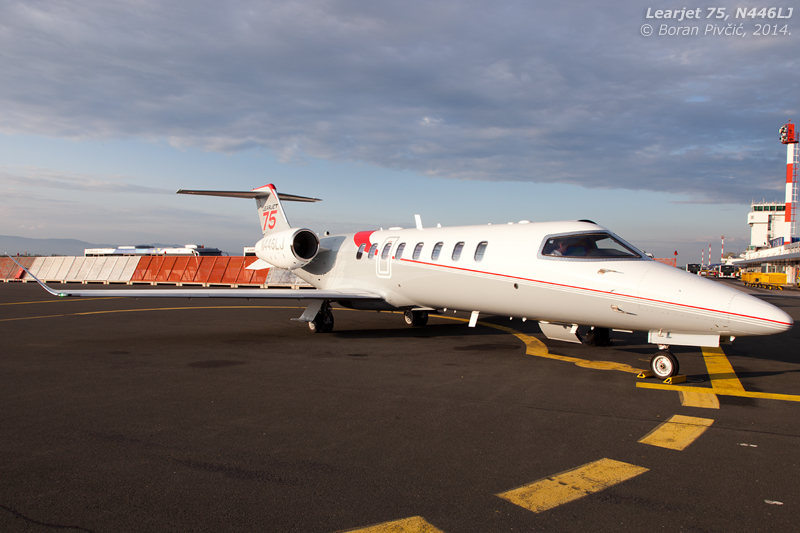
With the aircraft now ready for sale, all that was needed was to whip up a fully spec’d demonstrator and head out into the world. Such was the role of the titular aircraft, N446LJ, which had popped into Zagreb to take on fuel before continuing onwards to Denmark. Having rolled onto the GA apron just a few minutes later, I was at the plane in moments, camera naturally set and ready… 🙂
Looking stunning in the golden afternoon light. Even though it was in town for just half an hour on a “mere” technical stop, N446LJ’s visit was nevertheless quite the local exclusive, marking the type’s first ever appearance both in Croatia and South-Eastern Europe.
Many news here in the pointy end! Doing away with the Primus, the 75’s cockpit is based around the new Garmin G5000 suite which – in addition to all the usual features – also includes the Synthetic Vision System (SVS). Notably cleaner and less cluttered than those of previous Learjets, the 75’s flight deck actually feels more open and airy – despite the fact that it is of the same size as that on the 45 (also, sorry for the poor crop… the F/O was preparing the bird for its onward flight so I though it best to intrude as little as possible).
One of the reasons for the cockpit’s cleanliness lies in the relocation of the light switches to the overhead console – the first such panel ever fitted to a Learjet.
Like on all modern Learjets, the cabin of the 75 is comfortable – but not all that roomy. Updated along with the rest of the aircraft, it now features pop-up video monitors linked to touchscreen controllers installed at every seat, as well as several new trim options – the best of which is this pleasant and warm cream-wood combo.
A reverse view from the lavatory (which also doubles as the ninth passenger seat). At my 1.93 m / 6ft 3 in, navigating the cabin was a bit interesting – but not nearly as much trouble as I would have thought. Provided you’re not carrying a huge camera bag on your back, entry, seating and exiting is pretty straightforward, with very few objects you could snag with your limbs or clothes on the way.
While it is technologically far removed from the original 23 – and even the legendary 31 – the 75 still sports those evocative, exciting lines of the classic Learjet. With that narrow nose, short-span wing and short vertical stabilizer – plus a perfectly proportioned fuselage – it continues to dominate the business jet segment in sheer visual (and visceral) appeal. Also note the new winglets, installed at a significantly more obtuse angle than on the 45.
I would also like to extend my sincere thanks and appreciation to the crew of N446LJ for allowing me to snoop around and snap at will!
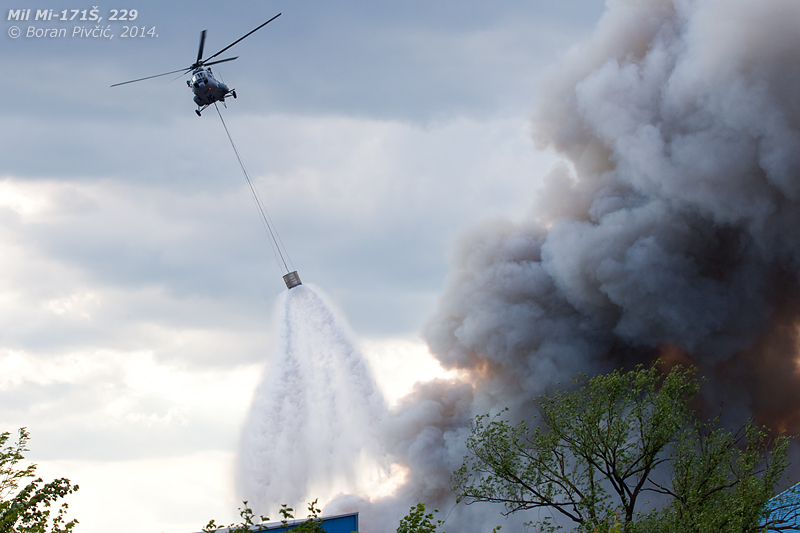
Once again I am interrupting my usual programing for a bit of breaking news… on 14 April at around 13:30 local, the CIOS recycling plant in Zagreb caught fire. Apparently the plant’s warehouse had gone up in flames, creating a smoke plume that has blanketed the entire town center and can seen for dozens of kilometers around. Given the magnitude of the blaze, the Croatian Air Force had been drafted in, sending a “bambi bucket” equipped Mi-171 to assist in operations…
229 attempting to control the blaze using a FLORY 2600 bambi bucket. Scooping up water in a nearby artificial lake, the crew were able to drop a load every few minutes – sadly without much effect.
On yet another run – one of a dozen I myself had witnessed, though the helicopter was at the scene for more than two hours. Thankfully, thunderstorms are inbound which should assist ground teams!
229 departing Lučko in a hurry before we knew what was going on. In the event, it was flying to the ZTC maintenance facility next to Zagreb Intl. to pick up the bambi bucket…















 Achtung, Skyhawk!